CUT AND RUN (Italy - 1985; US release 1986) Directed by Ruggero Deodato. Written by Cesare Frugoni and Dardano Sacchetti. Cast: Lisa Blount, Leonard Mann, Willie Aames, Richard Lynch, Richard Bright, Michael Berryman, Karen Black, John Steiner, Valentina Forte, Eriq La Salle, Gabriele Tinti, Barbara Magnolfi, Luca Barbareschi, Penny Brown, Carlos De Carvalho, Edward Farrelly, Ottaviano Dell'Acqua. (Unrated, 91 mins) Often erroneously lumped in with his controversial cannibal films, CUT AND RUN is a fairly straightforward and infrequently tacky '80s Italian jungle actioner from the infamous Ruggero Deodato. Unlike his JUNGLE HOLOCAUST (1977) and the legendary CANNIBAL HOLOCAUST (1980), CUT AND RUN has absolutely no cannibal gut-munching, so it's surprising that so many people consider it the final chapter of a non-existent Deodato "cannibal trilogy" or some such nonsense. Sure, it takes place in the Amazon and has some savage tribes who engage in shooting poisoned blowdarts, decapitations, and rape, but even it in its uncensored, hard-edged European form that features one poor bastard being split in half up the middle--softer kill scenes and alternate takes were used for the export version handled by New World, which hit US theaters in May 1986--there's nothing here that equals the disturbing savagery seen in any Italian cannibal outing. No flesh-eating. No on-camera animal deaths. It's not a cannibal movie. It's a distant cousin at best.
Deodato nevertheless finds other ways to be tactless, like using actual footage of Jonestown cult leader and Kool-Aid aficionado Jim Jones being interviewed by NBC reporter Don Harris, who would be one of the people ambushed and killed on a Guyana airstrip by Jones' "People's Temple" disciples when he and other members of Congressman Leo Ryan's entourage tried to help people escape from Jonestown in 1978. CUT AND RUN's chief villain is the fictional Col. Brian Horne (Richard Lynch), a disgraced and dishonorably discharged ex-Green Beret purported to be Jones' right-hand man and the mastermind behind the Jonestown massacre. Horne escaped from Jonestown and has secretly built a powerful drug operation in South America with a few Jonestown latecomers and some Amazon tribesmen he uses to eliminate the competition. He's more or less what might happen if APOCALYPSE NOW's Col. Kurtz ran a drug cartel. Horne has been believed dead, but when intrepid Cable Video News reporter Fran Hudson (Lisa Blount) and her cameraman Mark Ludman (Leonard Mann) beat the police to a bloody crime scene and find a recent picture of Horne with runaway Tommy Allo (Willie Aames), the son of their boss Bob (Richard Bright), they head down to the Amazon to find Tommy and get an exclusive interview with Horne. Obviously, mayhem and over-the-top violence ensue.
Shot in Florida and Venezuela, CUT AND RUN began life, oddly enough, as an unmade Wes Craven script titled MARIMBA. Written around 1980, MARIMBA got as far as pre-production when Craven made the acquaintance of Alessandro Fracassi, a wealthy Italian Formula One racing enthusiast looking to break into film production. Craven had scouted locations in South America and went so far as casting Dirk Benedict, Chris Mitchum, and Tim McIntire in starring roles before the project fell apart. Fracassi hung on to Craven's script and it was eventually completely reworked for Deodato by veteran Italian genre screenwriters Cesare Frugoni (MOUNTAIN OF THE CANNIBAL GOD, THE GREAT ALLIGATOR), frequent Lucio Fulci collaborator Dardano Sacchetti (CITY OF THE LIVING DEAD, THE NEW YORK RIPPER), and an uncredited Luciano Vincenzoni (THE GOOD, THE BAD AND THE UGLY). None of Craven's MARIMBA script was used, and he remains uncredited even in a courtesy "Story by" capacity on CUT AND RUN. The closest one gets to any sense of Craven's at-most peripheral involvement in what was eventually made is the presence of THE HILLS HAVE EYES' Michael Berryman as a machete-wielding madman working for Horne. He disembowels a few people and chops off a few heads, but other than that, his primary job is to be Michael Berryman.
1980 Variety ad announcing Wes Craven's never-made MARIMBA
Fracassi managed to corral an impressive cast for Deodato, certainly one with more recognizable names and faces than most junky Italian exploitation movies of the time. The appealing Blount was one of the few stars of AN OFFICER AND A GENTLEMAN who didn't get a career bump from it, possibly because her shallow, scheming Lynette was so unlikable, duping David Keith's Sid, faking a pregnancy, and ultimately driving him to suicide. On Anchor Bay's 2001 DVD release, Deodato praised Blount as "completely professional," but he got the sense that she "didn't really want to be there." The cast also included small roles for a shrieking Karen Black as a Cable Video News exec; John Steiner as a rival cartel boss and recipient of the truly disgusting "split up the middle" death, which was cut from the US release (he just gets put out of his misery by being shot instead); Gabriele Tinti as a drug-running pilot who gets a particularly gushing decapitation courtesy of Steve (David Warbeck lookalike Edward Farrelly), another Horne henchman; and future ER star Eriq La Salle, of all people, turns up as Vargas, a Huggy Bear-like Miami pimp and informant who keeps Fran in the loop about what's going on in the cartel. Of his stars, Deodato had the most trouble with two American actors. Bright (best known as Michael Corleone's chief enforcer Al Neri in the GODFATHER trilogy) was drinking heavily but, according to the director, got his act together after being kicked off the set for a day and set straight by an intervening Karen Black. EIGHT IS ENOUGH's Aames had just started both CHARLES IN CHARGE and a serious cocaine addiction around the time CUT AND RUN was made. By his own admission in his later memoir, Aames was on a massive coke binge during the entire shoot and, as required in such circumstances, destroyed a hotel room. He would eventually get clean and become a born-again Christian, producing and starring in the inspirational kids video series BIBLEMAN. Aames now works as a celebrity cruise director for Oceania Cruises, and other than a pair of EIGHT IS ENOUGH reunion movies in the late '80s, has acted very sparingly, most recently appearing in a couple of Hallmark Channel original movies.
Anchor Bay's uncut and uncensored DVD release was a welcome offering at the time, but it's in serious need of an upgrade. It's a composite assembling of the New World US cut (opening with the company's logo) with a few scattered scenes in Italian with English subtitles, usually whenever there's violent imagery exclusive to the European version. In the first issue of Video Watchdog, Stephen R. Bissette's article "Uncut and Run" details the differences between the European and American versions, with several scenes completely reshot for the softer US version or, in the case of Steiner's death scene, drastically edited to make it appear that he dies a different way (the same with Tinti's decapitation after getting shot with a poisoned dart; the US cut just shows him getting shot with the dart). The decline in quality of some of the footage is noticeable, with Steiner's big scene looking like a subpar bootleg.
There's enough of a minor cult following around CUT AND RUN and a major one around Deodato himself to warrant a Blu-ray upgrade to the acceptable but problematic 15-year-old DVD. CUT AND RUN suffers from some dumb plotting that relies too much on convenience and contrivance (no way the lady with the fake baby is making it through customs), but it's extremely fast-paced, loaded with action and splatter, has a killer score by Goblin's Claudio Simonetti, and has the kind of bizarre cast (Lisa Blount, Willie Aames, and Eriq La Salle in a Ruggero Deodato movie?) that makes it a must-see for followers of strange cinema. Deodato and Fracassi reteamed for the 1986 slasher BODY COUNT, which was never officially released in the US, and Fracassi continued to sporadically work in the Italian and Romanian film industry. Fracassi now makes his living in the financial industry, his last major credit being a co-producer of the 2006 Donald Sutherland-Sissy Spacek horror film AN AMERICAN HAUNTING.
CUT AND RUN and the Dario Argento-produced DEMONS
opening in Toledo, OH on May 30, 1986
Visual proof of a Ruggero Deodato movie opening
at three Toledo malls in the summer of 1986.
With their Roger Corman line and their endless parade of classic TV shows among other offerings, it's been a busy couple of years for Shout! Factory, who have quietly emerged as the top genre Blu-ray/DVD label for serious cult movie fans and only look to get bigger with their "Scream Factory" offshoot and an MGM licensing deal. Here's a look at several of their releases from the last couple of months.
CRIME STORY (Hong Kong - 1993)/ THE PROTECTOR (US/Hong Kong - 1985)
Two atypical Jackie Chan films are paired on a single disc, starting with 1993's CRIME STORY, which was released in a dubbed version in the US by Dimension Films in 1996 to capitalize Chan's RUMBLE IN THE BRONX breakthrough (this offers the English dub and the original Cantonese with English subtitles). It's a different kind of Chan film in that it's a dark and very violent kidnapping thriller that's completely lacking his usual comedic flair. In a role originally intended for Jet Li, Chan is Detective Eddie Chan, an honest cop trying to get to the bottom of the abduction of a millionaire construction magnate. CRIME STORY reveals early on that the culprit is actually Chan's partner Hung (Kent Cheng) and there's a nice pre-INFERNAL AFFAIRS vibe to their game of cat & mouse as Hung gets increasingly nervous about Chan's incessant digging. Chan found the film too dark and insisted, against the wishes of director Kirk Wong (who's interviewed on the Blu-ray) on dumping a subplot about Det. Chan's psychological issues and adding some typically acrobatic martial-arts action sequences. These scenes don't really gel with the gritty vibe Wong was going for, and because we know in the very beginning that Hung is responsible, there isn't a whole lot of suspense in the film. The spectacular action scenes then, are really the highpoints, so perhaps Chan was right to overrule Wong. CRIME STORY suffers from inconsistent pacing, Chan's need to present his character as selflessly heroic as possible (not one, but two scenes where he puts his job aside to rescue someone in distress--you're the hero, we get it) and a very intrusive score, but the memorable action scenes, including one incredible car chase, make it worthwhile. Wong came to Hollywood a few years later for the 1998 Mark Wahlberg actioner THE BIG HIT, but hasn't directed a film since 2000's THE DISCIPLES, which is credited to "Alan Smithee."
Coming a decade before Chan finally found success in the US with RUMBLE IN THE BRONX, 1985's much-maligned THE PROTECTOR was the second attempt by Golden Harvest to make Jackie Chan a star in the US. 1980's THE BIG BRAWL bombed and Chan's co-starring roles in both CANNONBALL RUN films did little to endear him to American fans. Chan was never happy with THE PROTECTOR and reportedly clashed with writer/director James Glickenhaus (THE EXTERMINATOR) throughout the shoot and eventually ended up preparing his own version of the film for the Asian market, adding fight scenes and reshooting others, dumping the nudity and the profanity to make it a more traditional Chan film. THE PROTECTOR tanked in the US, grossing less than $1 million, but time has been pretty kind to it. If one approaches it as a Glickenhaus film first and a Chan film second, they'll have a better time with it. The first 20 minutes contain some vintage Glickenhaus fused with Chan's incredible stuntwork. Chan is NYC cop Billy Wong, who's sent to Hong Kong with crass partner Garoni (Danny Aiello) to take down the crime lord who's kidnapped the daughter of a Manhattan business partner. THE PROTECTOR drags a bit in the middle, but Glickenhaus, one of the action genre's most underrated craftsman, is really at the top of his game here and the film is immensely enjoyable if you're into the whole trashy B-movie thing. It's nonstop F-bombs (even one from Chan!), gratuitous nudity, insane violence, Aiello dialing his Noo Yawk schtick to 11, and every cop movie cliche known to man. Shout's 1.85:1 Blu-ray features some nice extras, including an interview with a diplomatic Glickenhaus, who says the disagreements came after the film was finished and insists he and Chan were always amicable and professional, a great featurette showing the NYC locations then and now, and the 88-minute Chan-supervised Asian cut, dubbed in Cantonese with English subtitles. It follows the same basic plot structure, but adds a subplot with actress Sally Yeh and has enough major differences that it qualifies as a completely different film. (CRIME STORY: Unrated, 107 mins./THE PROTECTOR: R, 95 mins; THE PROTECTOR, Chan cut: Unrated, 88 mins)
DEADLY BLESSING (US - 1981)
Low-key Wes Craven horror film takes its time getting revved up, but offers a few decent scares and one memorable bathtub encounter with a snake that's endeared itself to devout followers of '80s horror cinema. After her husband dies mysteriously, pregnant Maren Jensen (the original BATTLESTAR GALACTICA) and her two visiting friends (GREASE's Susan Buckner and Sharon Stone in one of her earliest roles) are terrorized and persecuted by the husband's estranged family, a community of Hittites from which he was banished. Craven does some clever misdirection and we're of course led to believe that Jensen's irate father-in-law (Ernest Borgnine) is behind all the mayhem, but that's too easy and always be wary of prominently billed actors who don't appear to have much to do with the plot. DEADLY BLESSING almost feels like the kind of slow-burner that a lot of indie horror filmmakers are going for today (I'm surprised it hasn't been remade with some kind of Westboro Baptist Church-type extremist group in place of the Hittites), and it subverts expectations time and again. The plot twist in the finale is genuinely unexpected in the way it changes your views of the perceived crazies and who the real antagonists of the story were. An interesting and unusual film that's marred only by a last shot that feels like it doesn't belong, only in the sense that it takes a frightening premise essentially grounded in reality and turns it otherworldly and supernatural in a way that provides a cool shock to go out on, but also cheapens the film to some degree. Also with Lois Nettleton, Michael Berryman (as the Hittite village idiot...or is he?), Jeff East, and "introducing" Lisa Hartman, even though she'd been in several TV movies and starred in a TV series years before doing this film. Shout's 1.78:1 Blu-ray features a commentary with Craven and Horror's Hallowed Ground's Sean Clark (where Craven admits he hasn't seen the film in many years and is "foggy" on a lot of details but says he's always been "embarrassed" by the last shot), and interviews with Buckner and Berryman. (R, 102 mins)
DEATH VALLEY (US - 1982)
This desert-set thriller wasn't a success in theaters, coming along at the height of the slasher craze, but it's bit more restrained than most (there's some brief nudity and a couple of gory throat slicings) and feels a lot like a made-for-TV movie. Heavy cable rotation in the mid-1980s has earned it some sentimental affection and a devoted cult following. For the most part, it's sluggishly-paced and rather average, with an overbearing score by Dana Kaproff that really goes out of its way to mimic Bernard Herrmann at his stringiest, but it has its moments and Stephen McHattie is a memorably effective killer, pursuing young Peter Billingsley (a year before A CHRISTMAS STORY), who's vacationing in Arizona with his divorced mom (Catherine Hicks) and her new boyfriend (Paul Le Mat). Director Dick Richards and screenwriter Richard Rothstein give us a lot of repetitious character-building scenes of young Billingsley sullenly giving Le Mat the cold shoulder before forming a tentative bond, but things pick up considerably once Le Mat and Hicks go out to dinner, leaving Billingsley alone with one of horror cinema's most useless babysitters as McHattie shows up ready to kill. Shout's 1.78:1 Blu-ray transfer looks good and there's a commentary track with Richards, best known as the producer of 1982's TOOTSIE and as the guy who got into an on-set brawl with Burt Reynolds during the making of 1987's ill-fated HEAT. DEATH VALLEY isn't bad--it was nice to revisit it after 30 years but it's nothing special, and a good example of something whose status may be elevated somewhat because it was seen at such an impressionable age. (R, 88 mins)
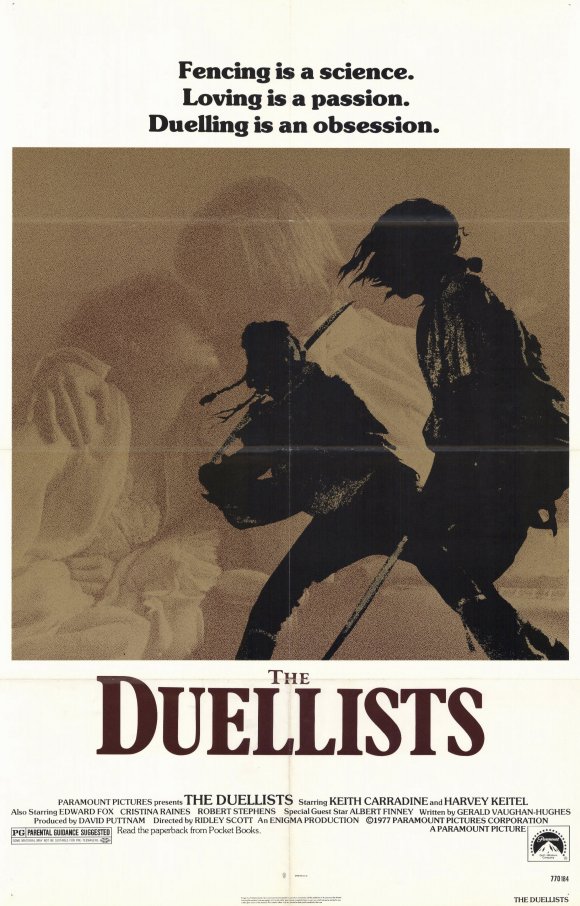
THE DUELLISTS (UK - 1977)
Ridley Scott's debut feature wasn't a big box office hit but it became a major cult film and established him as enough of a visual stylist that it led to his breakthrough blockbuster ALIEN two years later. Based on Joseph Conrad's short story "The Duel," THE DUELLISTS finds two French army officers in the Napoleonic era, D'Hubert (Keith Carradine) and Feraud (Harvey Keitel), engaged in a nearly 20-year battle over a perceived insult that neither of them even remember by the end of the film. In 1800, the easy-going D'Hubert was assigned to find hot-tempered, bullying Feraud and place him under house arrest at the base camp after the dueling-obsessed Feraud nearly killed the local mayor's son. An offended Feraud instead takes his frustrations out on D'Hubert and so begins a grudge match that consumes their lives over the next two decades. Their battle is a metaphor for the madness of war, a recurrent Conrad theme that was being explored at the same time by Francis Ford Coppola's APOCALYPSE NOW (1979), of course based on Conrad's novel Heart of Darkness. Working with fencing choreographer William Hobbs (whose expertise also helped make 1973's THE THREE MUSKETEERS, 1974's THE FOUR MUSKETEERS, and 1981's EXCALIBUR, among others, so memorable) and debuting cinematographer Frank Tidy (who never again shot a film this beautiful), Scott makes his mark with THE DUELLISTS, showcasing intense, brutal, bloody duels (how did this manage to get a PG rating?), and utilizing the natural lighting style that made Stanley Kubrick's BARRY LYNDON (1975) so visually stunning. Shout's Blu-ray looks very good, easily the best it's ever looked since it was in theaters, but shows some wear at times, and it's likely just inherent in the 1970s film stock. Some of the exterior shots (particularly in the closing scene) and ornate interiors are absolutely breathtaking. Carradine and Keitel do good work, despite both being miscast as officers in Napoleon's army. Scott gathered a fine supporting cast: Edward Fox, Robert Stephens, Cristina Raines, Tom Conti, Diana Quick, Alan Webb, Jenny Runacre, Alun Armstrong, Maurice Colbourne, W. Morgan Sheppard, a young Pete Postlethwaite, and Albert Finney. Narrated by Stacy Keach. Carradine and Keitel would reunite a decade later in Damiano Damiani's ancient Rome-set religious mystery THE INQUIRY (1986). (PG, 100 mins)
THE SEVEN-PER-CENT SOLUTION (US - 1976)
The 1970s saw numerous revisionist Sherlock Holmes films, such as Billy Wilder's THE PRIVATE LIFE OF SHERLOCK HOLMES (1970) and THEY MIGHT BE GIANTS (1971), with George C. Scott as a mental patient who thinks he's Holmes. THE SEVEN-PER-CENT SOLUTION, adapted by Nicholas Meyer (TIME AFTER TIME, STAR TREK II: THE WRATH OF KHAN) from his own novel, opens with the dark, rarely-depicted-on-screen drug-addicted side of Holmes, showing the great detective (Nicol Williamson) in the midst of a crazed cocaine binge as his brother Mycroft (Charles Gray) and Dr. Watson (Robert Duvall) conspire to trick him into going to Vienna to rehab with none other than the renowned Dr. Sigmund Freud (Alan Arkin). While in Vienna, a cleaned-up, clear-thinking Holmes finds himself with Watson and Freud in pursuit of one of Freud's kidnapped patients (Vanessa Redgrave). All of this leads to a thrilling train chase and Holmes and the villain squaring off for a swashbuckling showdown atop a speeding train. Meyer and director Herbert Ross find the perfect balance between drama, humor, and spectacular action throughout, and while such shifts in tone might have come off as jarringly uneven, they make it a very natural and organic progression. Williamson's Holmes ranks among the best, and while Duvall initially feels miscast as Watson, he eventually settles into the role and captures the spirit of Watson even if is his strange accent is a bit distracting. The film is mainly played straight, especially in the early going, but has a lot of humor, such as Holmes and Watson investigating a bordello where Holmes tries to shield the proper Watson's eyes from some of the more lascivious sights on display (it plays like a moment that Williamson might have ad-libbed). This was a big-budget release from Universal, and Meyer's script got an Oscar nomination, but these days, THE SEVEN-PER-CENT SOLUTION is generally well-regarded but remains little known outside of cult movie circles and hardcore Holmes enthusiasts, which is a shame. It's a rousing adventure, brilliantly acted, and prefigures Guy Ritchie's SHERLOCK HOLMES in a number of ways, and Robert Downey, Jr.'s portrayal of Holmes owes much to Williamson's often manic interpretation of the character. Also with Laurence Olivier as an innocent, falsely-accused Moriarty, Joel Grey, Samantha Eggar, and Jeremy Kemp, THE SEVEN-PER-CENT SOLUTION is a richly entertaining film that's aged beautifully. Shout's 1.85:1 transfer spotlights Ken Adam's stunning production design, and the Blu-ray/DVD combo set also offers an interview with Meyer. (PG, 114 mins)