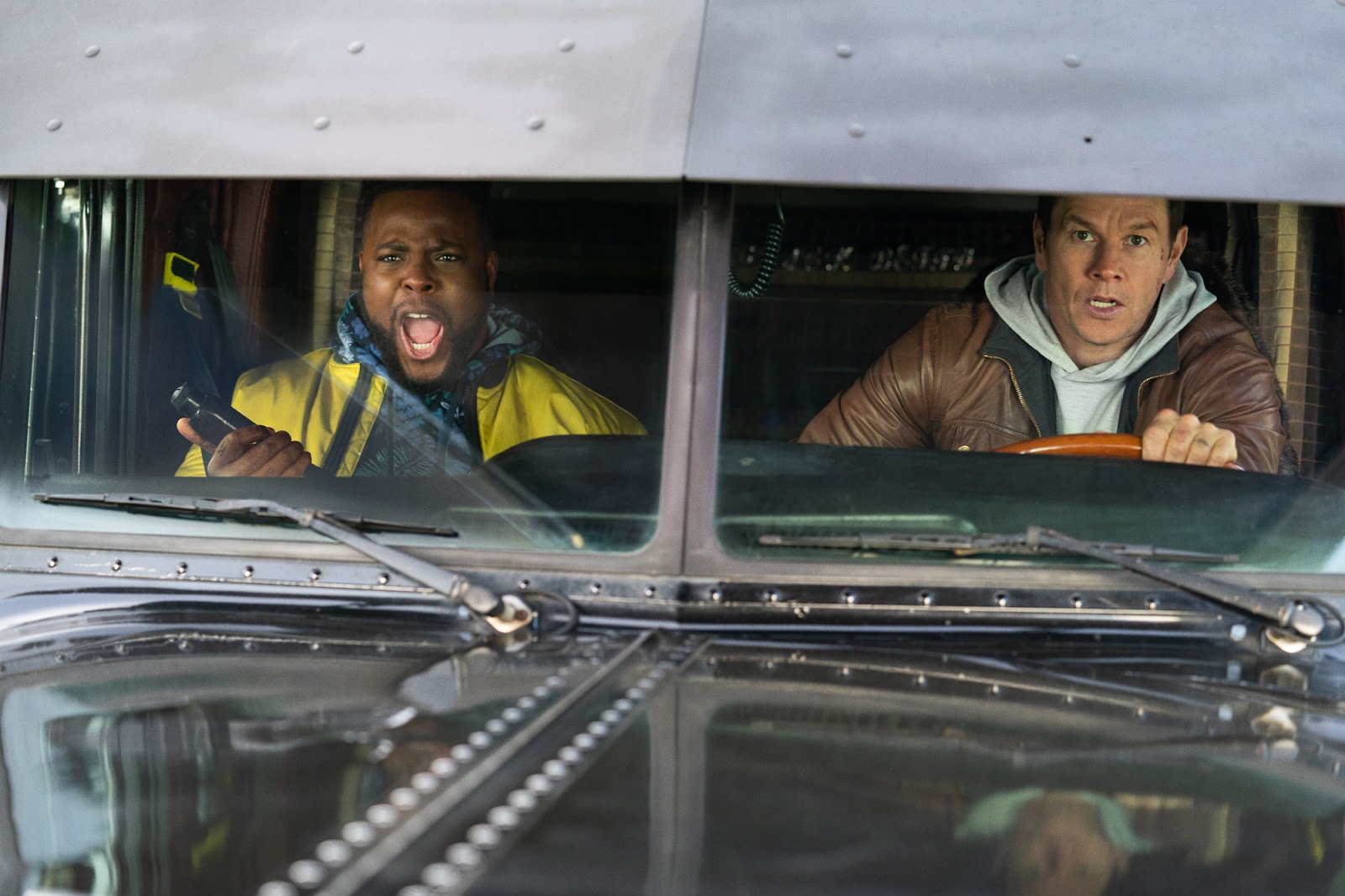
SPENSER CONFIDENTIAL (US - 2020) Directed by Peter Berg. Written by Sean O'Keefe and Brian Helgeland. Cast: Mark Wahlberg, Winston Duke, Alan Arkin, Iliza Shlesinger, Michael Gaston, Bokeem Woodbine, Marc Maron, James Dumont, Austin Post, Colleen Camp, Hope Olaide Wilson, Kip Weeks, Brandon Scales, Ayana Brown, Dustin Tucker, Rebecca Gibel, Alexandra Vino. (R, 110 mins) Mononymous Boston private eye Spenser was the subject of 40 novels by Robert B. Parker published from 1973 to 2011, as well as the inspiration for the 1985-1988 ABC series SPENSER FOR HIRE with Robert Urich in the title role and Avery Brooks as his buddy and partner Hawk, later followed by a trio of 1999-2001 A&E TV-movies with Joe Mantegna and Ernie Hudson. Following Parker's death in 2010, his estate commissioned mystery writer Ace Atkins to continue the Spenser series. Atkins has since written another eight Spenser novels, and it's his second, 2013's Wonderland, that's the basis of the Netflix Original film SPENSER CONFIDENTIAL, a very loose adaptation repurposed as an origin story, using little aside from the character names, incidental details, and the Boston setting, which is probably the biggest reason Mark Wahlberg and Peter Berg were attracted to the project. Yes, it's another chance for Wahlberg, in his fifth collaboration with Berg, to indulge in his feckin' "Say hi to your mother for me" act, along with obligatory shout-outs to Dunkin and classic rock bands Boston and Aerosmith.
As the film opens, disgraced Boston cop Spenser is about to be paroled after serving a five-year stretch for beating the shit out of his asshole captain Boylan (Michael Gaston), with whom he was already butting heads when he showed up at his house unannounced to discuss a case and walked in on him in an act of domestic violence against his wife. Ex-boxer Spenser shacks up in Southie with his cranky, fatherly former trainer Henry (Alan Arkin) and has to share a room with Henry's latest protege Hawk (Winston Duke of BLACK PANTHER and US). It's a temporary arrangement, as he just wants to leave Boston behind, get a license to drive a big rig, and move to Arizona with his beloved, elderly dog Pearl (who's giving him the cold shoulder and has bonded with Hawk during her human's five-year absence), but fate intervenes. The next morning, breaking news reports reveal that now-Chief of Police Boylan has been killed and in no time at all, Spenser's former partner Driscoll (Bokeem Woodbine) is knocking at the door, checking his alibi. Spenser is persona non grata with all of his one-time colleagues and the first obvious suspect, though Boylan's killer is quickly revealed to be Terence Graham (Brandon Scales), a boy scout of a cop who had drugs and money stashed away in his home and his found dead from a self-inflicted gunshot wound. Graham's widow (Hope Olaide Wilson) insists her late husband is being framed and that his suicide was staged, and Spenser isn't buying the official Boston P.D. story either. He's almost instantly nosing around in places he doesn't belong, with an intimidating Hawk as an initially reluctant but soon enthusiastic sidekick as they uncover a tangled web of corruption involving drug trafficking, a shady racetrack land deal, some Aryan Nations assholes in the joint (among them Austin Post, aka Post Malone, really stretching as a guy named "Squeeb"), machete-wielding enforcers, a money-laundering hit man known as Tracksuit Charlie (James Dumont), and a ring of dirty cops that might...wait for it...goall the way to the top.
Co-written by Oscar-winning L.A. CONFIDENTIAL screenwriter Brian Helgeland (his first gig since 2015's Krays biopic LEGEND), SPENSER CONFIDENTIAL doesn't have an original idea in its head, but it's enjoyable-enough formulaic entertainment most of the way, with Wahlberg much more likable here than in his last two Berg films, with the ludicrous, pandering bullshit of PATRIOTS DAY and the abysmal, career-worst MILE 22. He and Duke make a fun team that's eventually joined by his hot-headed, tough-as-nails ex Cissy (Iliza Shlesinger, seemingly patterning her performance on Heidi Gardner's recurring SNL character "Angel, Every Boxer's Girlfriend from Every Boxing Movie Ever"). SPENSER gets some points docked for not giving a national treasure like Arkin something substantive to do, and Berg indulges in way too many classic rock needle-drops: it opens and closes with Boston's "Foreplay/Long Time," Aerosmith's "Sweet Emotion" plays during some destructive truck crashes and a subsequent shootout (the big rig Spenser drives is called "Black Betty," and the only surprise is that they didn't license Ram Jam), Foreigner's "Feels Like the First Time" blares when Spenser and Cissy have wild sex in a restaurant restroom, and Neil Diamond's 'Sweet Caroline" accompanies a brawl in a cop bar where Spenser is no longer welcome. SPENSER is an OK time-killer that moves fast, is never dull, has a handful of funny lines, and gets dumber the longer it goes on. Spenser's only been away for five years but he has no idea how computers and the cloud work? And don't miss one really hackneyed exposition dump when Spenser uncovers a secret recording made by Graham during a private conversation with Boylan, where Graham engages in the most "I'm clearly wearing a wire" line of questioning you'll ever hear, or later, when the criminal mastermind behind it all Facetimes Spenser and actually says "Be there in one hour...and bring me my drug shipment!" Who talks like that? C'mon, Helgeland. You're smarter than that.
GOING IN STYLE (US - 2017) Directed by Zach Braff. Written by Theodore Melfi. Cast: Morgan Freeman, Michael Caine, Alan Arkin, Christopher Lloyd, Matt Dillon, Ann-Margret, John Ortiz, Peter Serafinowicz, Joey King, Kenan Thompson, Josh Pais, Maria Dizzia, Siobhan Fallon Hogan, Melanie Nichols-King, Ashley Aufderheide. (PG-13, 96 mins) 1979's GOING IN STYLE was sold as a wacky comedy about a trio of elderly retirees robbing a bank in Groucho Marx disguises. But the stick-up was only a small part of the story, which primarily focused on the three aging widowers (George Burns as Joe, Art Carney as Al, and Lee Strasberg as Willie) looking for something to alleviate the boredom, the loneliness, and the depression of getting old and spending their days sitting in the park feeding the pigeons. The breakthrough film for 28-year-old writer/director Martin Brest (who would go on to make BEVERLY HILLS COP, MIDNIGHT RUN, SCENT OF A WOMAN, and the career-ending GIGLI), GOING IN STYLE was a comedy but a dark and character-driven one, with poignant and heartfelt observations about growing old, living with regrets, and knowing you don't have a lot of time left. It wasn't a feel-good movie. Hell, Al and Willie both die, and Joe not only gets nabbed, but he's in prison at the end. Nearly 40 years later, GOING IN STYLE gets the remake treatment, appropriately cast with three living legends--Michael Caine as Joe, Alan Arkin as Al, and Morgan Freeman as Willie--but the results aren't the same. GOING IN STYLE '17 is perfectly acceptable in a dumb and unchallenging kind of way. It's less a story than it is a focus group-approved checklist of cliches, tropes, and contrivances. This new take is a GOING IN STYLE that's a mash-up of GRUMPY OLD MEN, THE BUCKET LIST, and HORRIBLE BOSSES. It's all about the bank robbery, now an intricately-planned heist with alibis, decoys, a getaway vehicle, and an ethnic accomplice in Jesus (John Ortiz), a Latino version of Jamie Foxx's Motherfucker Jones from HORRIBLE BOSSES, There's no depth to GOING IN STYLE '17. The humor is limited primarily to "It's funny because they're old!" jokes like a motorized scooter chase, Joe and Willie smoking weed and getting the munchies, and Al rediscovering the long-dormant sexual dynamo within after hooking up with still-foxy grocery clerk Annie (Ann-Margret).
Written by Theodore Melfi, whose script existed several years before he scored big by writing and directing HIDDEN FIGURES, and directed by, of all people, SCRUBS star, GARDEN STATE auteur, and emo cautionary tale Zach Braff, GOING IN STYLE '17 goes out of its way to give the trio substantial reasons to rob the bank. Retired from a Brooklyn steel mill that's about to screw over their workforce and move its operations to Vietnam, Joe, Al, and Willie find their pensions frozen with no money coming in. This causes Joe's house to go into foreclosure when his mortgage triples after being sold on a sketchy refinancing offer by the asshole loan manager (Josh Pais) at the bank. Joe is at the bank trying to deal with this issue when it's robbed by a trio of highly-coordinated gunmen. When Joe finds out the same bank that's foreclosing on him also holds the steel mill's liquidated pension accounts, the seed is planted. He convinces his best buddies to go along with him on a robbery by promising to only take the money they'd be getting in their pensions for the next seven or so years (estimating how long they'll likely be alive) and if any more is accrued, they'll give it to charity. After a test run of their crime skills fails miserably when they're busted shoplifting at the neighborhood market (this entire sequence is embarrassingly awful), they decide they need help from a pro, and end up meeting Jesus through Joe's weed-dealing ex-son-in-law Murphy (Peter Serafinowicz). Jesus helps them map out the heist, helps them set up alibis, and teaches them how to hotwire a car, at which the old guys are immediately experts. Sporting Frank Sinatra, Dean Martin, and Sammy Davis Jr. Rat Pack masks, they barely pull off the robbery--a bank employee hits the silent alarm, but according to the movie's own timeline, it takes roughly 30 minutes for the police to arrive--but are pursued by dogged FBI agent Hamer (Matt Dillon), who knows they're his guys but can't prove it.
GOING IN STYLE '17 is so concerned with making the audience love its altruistic, irascible old geezers that it constantly stacks the deck against them for maximum sympathy: Joe's house in foreclosure, his daughter (Maria Dizzia) and granddaughter (Joey King) live with him after they get away from loser Murphy, Willie's in late-stage renal failure and hasn't told anyone that he needs a kidney transplant ASAP or he'll die, and he desperately wants to be closer to his own daughter and granddaughter who live across the country. Al has no pressing issues other than his innate grouchiness, which is vintage late-career Arkin, but his work here is awfully similar to 2012's already-forgotten STAND-UP GUYS, where he, Al Pacino, and Christopher Walken played aging mobsters pulling off One Last Job. GOING IN STYLE '17 is beneath its stars, but Freeman, Caine, and Arkin are so good at doing whatever they do whenever they're onscreen in anything that there's some moderate level of enjoyment to be had, even if it's watching the three of them sitting around watching TV and arguing about who THE BACHELORETTE's choice should be. But the whole thing is too formulaic and too afraid to take chances, like embracing the inherent sense of melancholy that Burns, Carney, and Strasberg were allowed to do back in 1979.
Burns, Strasberg, and Carney in the original 1979 version.
GOING IN STYLE '17 doesn't want to address any of these serious concerns in an intelligent, mature, and dignified way. It lacks the courage to allow any of its heroes to die (is there any chance Willie doesn't find a donor?) and goes for easy laughs like an old woman screaming "Who the fuck took my scooter?" when Joe commandeers it fleeing the grocery store, because geriatrics dropping vulgarities is a can't-miss, as decreed in the Burgess Meredith Amendment of 1993. It wants to show Freeman and Caine stuffing ham and pork loins down their pants and then getting all hazy and glassy-eyed after blazing up with Jesus' weed, or Arkin and Ann-Margret panting in a post-coital sweat. It's mostly good-natured and not done in a mean-spirited or mocking way (though there's several laughs at the expense of a senile and perpetually befuddled lodge brother played by Christopher Lloyd in total Reverend Jim mode), but at the same time, these are cheap and lazy jokes that allow the film to coast on the charm and the accomplishments of its three Oscar-winning stars. They're fun to watch, but wouldn't you almost rather watch 96 minutes of Freeman, Caine, and Arkin just sitting around bullshitting and telling stories? GOING IN STYLE '79 was a modest hit at the box office but is still fondly remembered by those who saw it 38 years ago. Will anyone remember GOING IN STYLE '17 38 days from now?
Directed by Peter Segal. Written by Tim Kelleher and Rodney Rothman. Cast: Robert De Niro, Sylvester Stallone, Kevin Hart, Alan Arkin, Kim Basinger, Jon Bernthal, LL Cool J, Anthony Anderson, Paul Ben-Victor, Barry Primus, Camden Grey, Griff Furst, Jim Lampley, Michael Buffer. (PG-13, 114 mins)
GRUDGE MATCH caps off a busy 2013 for stars Robert De Niro and Sylvester Stallone, but it's too bad they couldn't have teamed up on a more inspired project. They worked together before, on 1997's underappreciated COP LAND, a film that's just gotten better over the years, but this finds them squarely in a safe, predictable, "geriatrics behaving badly" comedy that gets bogged down with forced, feel-good blandness and a plethora of jokes that fall flat due to lack of humor or just bad timing on the part of the actors. And, my God, the montages! "What Makes a Good Man" and "How You Like Me Now?" by The Heavy? Check. "Boom Boom" by Big Head Todd and the Monsters? Check. "Here I Come," by The Roots? Check. And sorry, but there's no excuse for a boxing movie with De Niro and Stallone to contain a montage set to Phillip Phillips' "Gone Gone Gone." None. Well, I guess it could be worse. They could've used "Home."
30 years ago, two rival light heavyweights, Billy "The Kid" McDonnen (De Niro) and Henry "Razor" Sharp (Stallone) were about to square off in their third fight when Razor abruptly backed out and disappeared from public view and The Kid retired from boxing to open a bar and car dealership. When an HBO documentary sparks renewed interest in their story, fast-talking promoter Dante Slate, Jr. (Kevin Hart), the son of the crooked manager who screwed the two fighters over back in the day, talks them into doing some motion capture work for a boxing video game. Still bitter enemies, the pair get into a brawl in the studio and the resulting footage goes viral. Before long, the long-postponed title fight--now called Grudgement Day--is back on as Razor recruits his old trainer Lightning (Alan Arkin) from the nursing home, and The Kid, after being turned down by his now-retired protégé (LL Cool J), teams up with B.J. (Jon Bernthal), the son he never knew, who's grown up to be a high-school football coach. The Kid fathered B.J. with Sally (Kim Basinger), who was Razor's girlfriend, but had a brief fling with the Kid while Razor was away training. That's the source of the animosity, and it's something Razor's never been able to put behind him.
Oh, but there's more drama: The Kid and B.J. finally get a chance to bond as father and son after 30 years (De Niro seems to be in physical pain uttering the line "I need you in my corner," and just as B.J.'s about to bail on him, the Kid pulls out a scrapbook filled with old photos of B.J.'s high school and college football days, showing that he's been with him all along!), and The Kid finds out he's got a grandson, Trey (Camden Gray). They've only now connected but the script by Tim Kelleher (FIRST KID) and Rodney Rothman (a former writer for THE LATE SHOW WITH DAVID LETTERMAN) is so lazy that there's one scene where B.J. makes an off-the-cuff remark about doing something "like you used to show me." Wait a minute...didn't they just meet for the first time? There are some genuinely funny bits in the early going, and some winking nods to the past that fans will find amusing (Stallone repeats the "drinking raw eggs" bit from ROCKY, but worries about the cholesterol), but then the laughs start to get cheap, repetitive, and too easy, like Arkin, cast radically against type as "Alan Arkin," talking about far-east hookers and ping-pong balls and telling Razor he should be "getting some snapper" and "doing the bone dance" with Sally, fulfilling the mandatory "old guy being pervy" requirement as set forth by the Burgess Meredith Amendment. Stallone, whose Razor is the perpetual underdog against the boorish Kid, gets a chance to do some serious acting and handles it nicely despite the hackneyed lines he's forced to read. He's trying his best, but the main problem is that he's played this part and a similar enough (on his end, at least) scenario before in 2006's surprisingly solid ROCKY BALBOA. He does the sad sack loner bit effectively, but does the script have to make him so befuddled and out of touch? There's a running gag about Lightning being angry that Razor doesn't have a TV, but for a guy who, sure, is a bit of a loner, but works in the everyday world and isn't a complete hermit, is there any reason other than a cheap laugh for how Razor possibly couldn't understand how caller ID works? How has he never heard of it before 2013? He understands video games and iPads, but caller ID is just way over his head?
There's also too much time spent on The Kid coming to the realization that he's been a total dick, which results in one of the most nonsensical sequences in any film this year. Wishing to bond with Trey (I know it's wrong to pick on child actors, but this kid is unbearable), he asks B.J. if he can take him out to dinner and a movie. Using a 12-pack of beer as a car seat, The Kid instead takes Trey to his bar, leaving him in the care of his bartender buddy Joey (Barry Primus) while he hooks up with a hot young fan. Later, a tired Trey finds the 12-pack in The Kid's office and takes it outside to sit in the driver's seat of his grandfather's SUV, where he finds the keys, starts the SUV, and shifts it into gear. Cue The Kid and the hottie popping up from the cargo space of the SUV as it rolls into the street and Trey can't reach the brake. OK, I have several questions about this comedic set piece: 1) where's the humor? 2) how did The Kid and the girl not hear him open the car door, plop the heavy 12-pack down, climb in, grab the jingling keys, put the keys in the ignition, start the SUV, and shift it into gear? 3) Why, before getting laid in the cargo space of the SUV, would The Kid feel the need to take the time to remove the 12-pack from the seat and walk it all the way into his office inside the bar when he would just need to bring it back out again to get Trey home? It's not like it was obstructing the path to the cargo space. None of this scene makes any sense at all, and it's all crammed into place to get Trey in the driver's seat of the vehicle. And the less said about the forced, labored, beat-to-death gag about B.J.'s initials, using the term "butterscotch jellybeans" as a euphemism for blowjobs, and The Kid advising his grandson that "not all girls like butterscotch jellybeans," the better.
Naturally, director Peter Segal (TOMMY BOY, 50 FIRST DATES) tries to turn it into a feel-good man-weepie by the end, but the emotion and the character arcs are so perfunctory that it doesn't feel earned. Pitting RAGING BULL against ROCKY could've been some late-career comedy gold for these two screen legends, but aside from some effort put forth by Stallone, who's written enough solid screenplays to know how shitty this one is, no one really cares. De Niro coasts by on the expected De Niro schtick and mannerisms, though on a couple of occasions, he tries so hard to sell a gag that it's actually uncomfortable to watch (there's one excruciating bit where he's emphatically and repeatedly listing three options in a different order and it lands with such a thud that I'm shocked it made the final cut). Arkin is a national treasure, but even his patented grouchy curmudgeon act is feeling pretty spent. He gets some laughs and his banter with Hart isn't bad, but you've seen it all before. GRUDGE MATCH is hardly the worst film for either of its iconic headliners (it's not even the worst De Niro film of 2013--that would be THE BIG WEDDING), and there's enough laughs that it's not a complete waste of time for completists, but it's among their most instantly forgettable, especially with the run Stallone's been on lately with the hugely entertaining EXPENDABLES franchise, BULLET TO THE HEAD, and ESCAPE PLAN.
With their Roger Corman line and their endless parade of classic TV shows among other offerings, it's been a busy couple of years for Shout! Factory, who have quietly emerged as the top genre Blu-ray/DVD label for serious cult movie fans and only look to get bigger with their "Scream Factory" offshoot and an MGM licensing deal. Here's a look at several of their releases from the last couple of months.
CRIME STORY (Hong Kong - 1993)/ THE PROTECTOR (US/Hong Kong - 1985)
Two atypical Jackie Chan films are paired on a single disc, starting with 1993's CRIME STORY, which was released in a dubbed version in the US by Dimension Films in 1996 to capitalize Chan's RUMBLE IN THE BRONX breakthrough (this offers the English dub and the original Cantonese with English subtitles). It's a different kind of Chan film in that it's a dark and very violent kidnapping thriller that's completely lacking his usual comedic flair. In a role originally intended for Jet Li, Chan is Detective Eddie Chan, an honest cop trying to get to the bottom of the abduction of a millionaire construction magnate. CRIME STORY reveals early on that the culprit is actually Chan's partner Hung (Kent Cheng) and there's a nice pre-INFERNAL AFFAIRS vibe to their game of cat & mouse as Hung gets increasingly nervous about Chan's incessant digging. Chan found the film too dark and insisted, against the wishes of director Kirk Wong (who's interviewed on the Blu-ray) on dumping a subplot about Det. Chan's psychological issues and adding some typically acrobatic martial-arts action sequences. These scenes don't really gel with the gritty vibe Wong was going for, and because we know in the very beginning that Hung is responsible, there isn't a whole lot of suspense in the film. The spectacular action scenes then, are really the highpoints, so perhaps Chan was right to overrule Wong. CRIME STORY suffers from inconsistent pacing, Chan's need to present his character as selflessly heroic as possible (not one, but two scenes where he puts his job aside to rescue someone in distress--you're the hero, we get it) and a very intrusive score, but the memorable action scenes, including one incredible car chase, make it worthwhile. Wong came to Hollywood a few years later for the 1998 Mark Wahlberg actioner THE BIG HIT, but hasn't directed a film since 2000's THE DISCIPLES, which is credited to "Alan Smithee."
Coming a decade before Chan finally found success in the US with RUMBLE IN THE BRONX, 1985's much-maligned THE PROTECTOR was the second attempt by Golden Harvest to make Jackie Chan a star in the US. 1980's THE BIG BRAWL bombed and Chan's co-starring roles in both CANNONBALL RUN films did little to endear him to American fans. Chan was never happy with THE PROTECTOR and reportedly clashed with writer/director James Glickenhaus (THE EXTERMINATOR) throughout the shoot and eventually ended up preparing his own version of the film for the Asian market, adding fight scenes and reshooting others, dumping the nudity and the profanity to make it a more traditional Chan film. THE PROTECTOR tanked in the US, grossing less than $1 million, but time has been pretty kind to it. If one approaches it as a Glickenhaus film first and a Chan film second, they'll have a better time with it. The first 20 minutes contain some vintage Glickenhaus fused with Chan's incredible stuntwork. Chan is NYC cop Billy Wong, who's sent to Hong Kong with crass partner Garoni (Danny Aiello) to take down the crime lord who's kidnapped the daughter of a Manhattan business partner. THE PROTECTOR drags a bit in the middle, but Glickenhaus, one of the action genre's most underrated craftsman, is really at the top of his game here and the film is immensely enjoyable if you're into the whole trashy B-movie thing. It's nonstop F-bombs (even one from Chan!), gratuitous nudity, insane violence, Aiello dialing his Noo Yawk schtick to 11, and every cop movie cliche known to man. Shout's 1.85:1 Blu-ray features some nice extras, including an interview with a diplomatic Glickenhaus, who says the disagreements came after the film was finished and insists he and Chan were always amicable and professional, a great featurette showing the NYC locations then and now, and the 88-minute Chan-supervised Asian cut, dubbed in Cantonese with English subtitles. It follows the same basic plot structure, but adds a subplot with actress Sally Yeh and has enough major differences that it qualifies as a completely different film. (CRIME STORY: Unrated, 107 mins./THE PROTECTOR: R, 95 mins; THE PROTECTOR, Chan cut: Unrated, 88 mins)
DEADLY BLESSING (US - 1981)
Low-key Wes Craven horror film takes its time getting revved up, but offers a few decent scares and one memorable bathtub encounter with a snake that's endeared itself to devout followers of '80s horror cinema. After her husband dies mysteriously, pregnant Maren Jensen (the original BATTLESTAR GALACTICA) and her two visiting friends (GREASE's Susan Buckner and Sharon Stone in one of her earliest roles) are terrorized and persecuted by the husband's estranged family, a community of Hittites from which he was banished. Craven does some clever misdirection and we're of course led to believe that Jensen's irate father-in-law (Ernest Borgnine) is behind all the mayhem, but that's too easy and always be wary of prominently billed actors who don't appear to have much to do with the plot. DEADLY BLESSING almost feels like the kind of slow-burner that a lot of indie horror filmmakers are going for today (I'm surprised it hasn't been remade with some kind of Westboro Baptist Church-type extremist group in place of the Hittites), and it subverts expectations time and again. The plot twist in the finale is genuinely unexpected in the way it changes your views of the perceived crazies and who the real antagonists of the story were. An interesting and unusual film that's marred only by a last shot that feels like it doesn't belong, only in the sense that it takes a frightening premise essentially grounded in reality and turns it otherworldly and supernatural in a way that provides a cool shock to go out on, but also cheapens the film to some degree. Also with Lois Nettleton, Michael Berryman (as the Hittite village idiot...or is he?), Jeff East, and "introducing" Lisa Hartman, even though she'd been in several TV movies and starred in a TV series years before doing this film. Shout's 1.78:1 Blu-ray features a commentary with Craven and Horror's Hallowed Ground's Sean Clark (where Craven admits he hasn't seen the film in many years and is "foggy" on a lot of details but says he's always been "embarrassed" by the last shot), and interviews with Buckner and Berryman. (R, 102 mins)
DEATH VALLEY (US - 1982)
This desert-set thriller wasn't a success in theaters, coming along at the height of the slasher craze, but it's bit more restrained than most (there's some brief nudity and a couple of gory throat slicings) and feels a lot like a made-for-TV movie. Heavy cable rotation in the mid-1980s has earned it some sentimental affection and a devoted cult following. For the most part, it's sluggishly-paced and rather average, with an overbearing score by Dana Kaproff that really goes out of its way to mimic Bernard Herrmann at his stringiest, but it has its moments and Stephen McHattie is a memorably effective killer, pursuing young Peter Billingsley (a year before A CHRISTMAS STORY), who's vacationing in Arizona with his divorced mom (Catherine Hicks) and her new boyfriend (Paul Le Mat). Director Dick Richards and screenwriter Richard Rothstein give us a lot of repetitious character-building scenes of young Billingsley sullenly giving Le Mat the cold shoulder before forming a tentative bond, but things pick up considerably once Le Mat and Hicks go out to dinner, leaving Billingsley alone with one of horror cinema's most useless babysitters as McHattie shows up ready to kill. Shout's 1.78:1 Blu-ray transfer looks good and there's a commentary track with Richards, best known as the producer of 1982's TOOTSIE and as the guy who got into an on-set brawl with Burt Reynolds during the making of 1987's ill-fated HEAT. DEATH VALLEY isn't bad--it was nice to revisit it after 30 years but it's nothing special, and a good example of something whose status may be elevated somewhat because it was seen at such an impressionable age. (R, 88 mins)
THE DUELLISTS (UK - 1977)
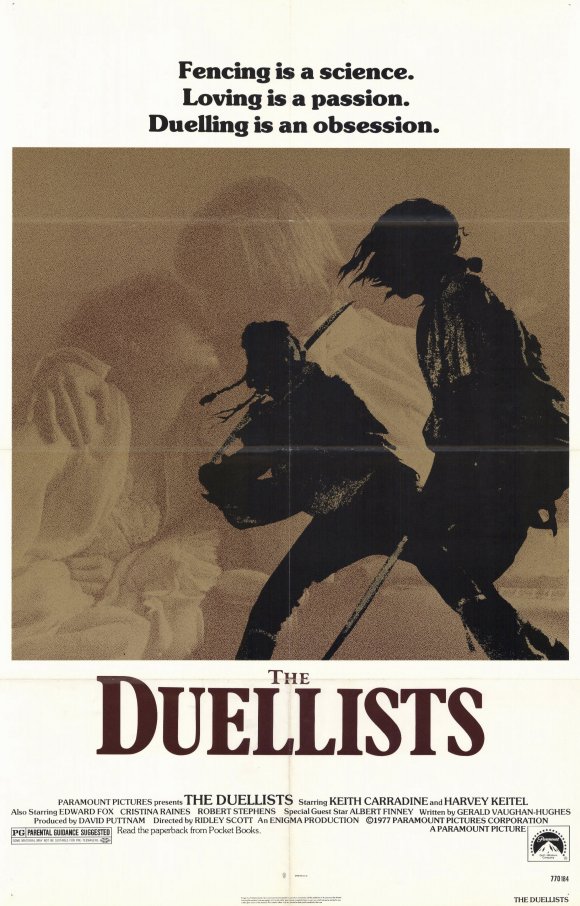
Ridley Scott's debut feature wasn't a big box office hit but it became a major cult film and established him as enough of a visual stylist that it led to his breakthrough blockbuster ALIEN two years later. Based on Joseph Conrad's short story "The Duel," THE DUELLISTS finds two French army officers in the Napoleonic era, D'Hubert (Keith Carradine) and Feraud (Harvey Keitel), engaged in a nearly 20-year battle over a perceived insult that neither of them even remember by the end of the film. In 1800, the easy-going D'Hubert was assigned to find hot-tempered, bullying Feraud and place him under house arrest at the base camp after the dueling-obsessed Feraud nearly killed the local mayor's son. An offended Feraud instead takes his frustrations out on D'Hubert and so begins a grudge match that consumes their lives over the next two decades. Their battle is a metaphor for the madness of war, a recurrent Conrad theme that was being explored at the same time by Francis Ford Coppola's APOCALYPSE NOW (1979), of course based on Conrad's novel Heart of Darkness. Working with fencing choreographer William Hobbs (whose expertise also helped make 1973's THE THREE MUSKETEERS, 1974's THE FOUR MUSKETEERS, and 1981's EXCALIBUR, among others, so memorable) and debuting cinematographer Frank Tidy (who never again shot a film this beautiful), Scott makes his mark with THE DUELLISTS, showcasing intense, brutal, bloody duels (how did this manage to get a PG rating?), and utilizing the natural lighting style that made Stanley Kubrick's BARRY LYNDON (1975) so visually stunning. Shout's Blu-ray looks very good, easily the best it's ever looked since it was in theaters, but shows some wear at times, and it's likely just inherent in the 1970s film stock. Some of the exterior shots (particularly in the closing scene) and ornate interiors are absolutely breathtaking. Carradine and Keitel do good work, despite both being miscast as officers in Napoleon's army. Scott gathered a fine supporting cast: Edward Fox, Robert Stephens, Cristina Raines, Tom Conti, Diana Quick, Alan Webb, Jenny Runacre, Alun Armstrong, Maurice Colbourne, W. Morgan Sheppard, a young Pete Postlethwaite, and Albert Finney. Narrated by Stacy Keach. Carradine and Keitel would reunite a decade later in Damiano Damiani's ancient Rome-set religious mystery THE INQUIRY (1986). (PG, 100 mins)
THE SEVEN-PER-CENT SOLUTION (US - 1976)
The 1970s saw numerous revisionist Sherlock Holmes films, such as Billy Wilder's THE PRIVATE LIFE OF SHERLOCK HOLMES (1970) and THEY MIGHT BE GIANTS (1971), with George C. Scott as a mental patient who thinks he's Holmes. THE SEVEN-PER-CENT SOLUTION, adapted by Nicholas Meyer (TIME AFTER TIME, STAR TREK II: THE WRATH OF KHAN) from his own novel, opens with the dark, rarely-depicted-on-screen drug-addicted side of Holmes, showing the great detective (Nicol Williamson) in the midst of a crazed cocaine binge as his brother Mycroft (Charles Gray) and Dr. Watson (Robert Duvall) conspire to trick him into going to Vienna to rehab with none other than the renowned Dr. Sigmund Freud (Alan Arkin). While in Vienna, a cleaned-up, clear-thinking Holmes finds himself with Watson and Freud in pursuit of one of Freud's kidnapped patients (Vanessa Redgrave). All of this leads to a thrilling train chase and Holmes and the villain squaring off for a swashbuckling showdown atop a speeding train. Meyer and director Herbert Ross find the perfect balance between drama, humor, and spectacular action throughout, and while such shifts in tone might have come off as jarringly uneven, they make it a very natural and organic progression. Williamson's Holmes ranks among the best, and while Duvall initially feels miscast as Watson, he eventually settles into the role and captures the spirit of Watson even if is his strange accent is a bit distracting. The film is mainly played straight, especially in the early going, but has a lot of humor, such as Holmes and Watson investigating a bordello where Holmes tries to shield the proper Watson's eyes from some of the more lascivious sights on display (it plays like a moment that Williamson might have ad-libbed). This was a big-budget release from Universal, and Meyer's script got an Oscar nomination, but these days, THE SEVEN-PER-CENT SOLUTION is generally well-regarded but remains little known outside of cult movie circles and hardcore Holmes enthusiasts, which is a shame. It's a rousing adventure, brilliantly acted, and prefigures Guy Ritchie's SHERLOCK HOLMES in a number of ways, and Robert Downey, Jr.'s portrayal of Holmes owes much to Williamson's often manic interpretation of the character. Also with Laurence Olivier as an innocent, falsely-accused Moriarty, Joel Grey, Samantha Eggar, and Jeremy Kemp, THE SEVEN-PER-CENT SOLUTION is a richly entertaining film that's aged beautifully. Shout's 1.85:1 transfer spotlights Ken Adam's stunning production design, and the Blu-ray/DVD combo set also offers an interview with Meyer. (PG, 114 mins)
Directed by Fisher Stevens. Written by Noah Haidle. Cast: Al Pacino, Christopher Walken, Alan Arkin, Julianna Margulies, Mark Margolis, Lucy Punch, Vanessa Ferlito, Addison Timlin, Craig Sheffer, Katheryn Winnick, Weronika Rosati. (R, 94 mins)
There's a famous Gene Siskel quote where the legendary film critic said that one of the criteria in his reviewing a movie was "Is this film more interesting than a documentary of the same actors having lunch?" That's not to say that STAND UP GUYS is a bad movie, because it's not. And in all fairness, most movies released these days aren't as interesting as the notion of sitting in on Al Pacino, Christopher Walken, and Alan Arkin kicking back and bullshitting over a meal together. While STAND UP GUYS offers some laughs and some drama and a chance to see three living legends doing what they do, the film seems fully cognizant of its ability to just coast through 90 minutes without really making much of an effort, because with 72-year-old Pacino, 69-year-old Walken, and 78-year-old Arkin onboard for approximately 140 combined years of movie experience, 90% of the work is pretty much done. Seeing these guys onscreen together is an absolute joy for any serious film fan. It's too bad they weren't given much to work with other than essentially being GRUMPY OLD GOODFELLAS and Pacino walking around with a giant hard-on after scarfing down a fistful of boner pills.
When mid-level mobster Val (Pacino) is released from prison, his best buddy Doc (Walken) is there to pick him up. Val served 28 years, taking the fall for a botched job that resulted in the death of the son of powerful and bizarrely-nicknamed mob boss Claphands (Mark Margolis). Claphands gives the long-retired Doc 24 hours to kill Val. Val knows it's coming and the conflicted Doc decides to take him out for one last party. The pair visit a brothel, break into a pharmacy to steal some Viagra, go back to the brothel, steal a car, bust their old emphysema-stricken wheelman Hirsch (Arkin) out of a nursing home, and take on the lowlifes who own the stolen car and gang-raped a young prostitute (Vanessa Ferlito). All the while, the clock's ticking and Doc, under increasing pressure from Claphands and his goons, has until 10:00 am to whack Val and can't bring himself to do it.
Pacino and Walken work so well together that they make it easy to overlook the deficiencies of Noah Haidle's script. Both do their distinct "Pacino" and "Walken" routines while admirably not overdoing it. Pacino avoids his "Hoo-aah!" histrionics and Walken is nicely subdued as the quiet Doc, who spends his days painting and watching "the cable TV" (which, like most things, is awesome when said by Christopher Walken), and visiting an all-night restaurant where he's befriended a sweet graveyard-shift server (Addison Timlin). Walken is given the film's most interesting character and underplays it quite well, looking appropriately weathered and worn-down after a long life nickel-and-diming it as a blue-collar working stiff gangster (these guys were probably friends of Eddie Coyle). STAND UP GUYS focuses primarily on the relationship between Val and Doc, and Arkin really gets shortchanged in what basically amounts to an extended cameo. His Hirsch doesn't even turn up until halfway through and even then, he doesn't really prominently figure in before a highly implausible departure that doesn't make a whole lot of sense (Julianna Margulies has a couple of scenes as Hirsch's daughter, and she's given even less to do).
STAND UP GUYS, which expanded this week after opening on one screen in New York and Los Angeles for a week in December 2012 to qualify for the Oscars (that was hardly a necessary maneuver, Lionsgate), has a lot of quiet and introspective moments that really work but just as many silly elements that don't, and as a result, it struggles to find a consistent tone. Arkin is a national treasure, but even he can't sell the idea of his character hooked to an oxygen tank gasping for breath in one scene, and leading the cops on a wild chase in the next before going to a brothel and fulfilling his lifelong dream of "two women at the same time." Old guys doing young guy things can be funny, like Kirk Douglas in a Red Hot Chili Peppers mosh pit in 1986's somewhat similar TOUGH GUYS, but STAND UP GUYS too often panders to the lowest common denominator by going for the cheap "geezers being vulgar" laughs, and a dazed Pacino pitching a tent in his pants is about on the level of Burgess Meredith talking about "taking the skin boat to Tuna Town!" in GRUMPY OLD MEN. But with these guys working together, Haidle and director Fisher Stevens clearly realize that most of their work is done for them. It's really hard to dislike the admittedly slight and forgettable STAND UP GUYS, but one still wishes it exerted itself just a little and gave these still-vital gentlemen something a little more substantive.
Directed by Ben Affleck. Written by Chris Terrio. Cast: Ben Affleck, Bryan Cranston, Alan Arkin, John Goodman, Victor Garber, Tate Donovan, Clea DuVall, Rory Cochrane, Scoot McNairy, Christopher Denham, Kerry Bishe, Kyle Chandler, Chris Messina, Bob Gunton, Philip Baker Hall, Titus Welliver, Zeljko Ivanek, Richard Kind, Michael Parks, Adrienne Barbeau, Richard Dillane, Keith Szarabajka, Jamie McShane. (R, 120 mins)
ARGO is a riveting, relentlessly-paced chronicle of the covert operation that rescued six Americans who escaped from the US Embassy in Iran as the 1979-81 hostage crisis unfolded. They spent nearly three months hiding in the home of Canadian ambassador to Iran Ken Taylor (Victor Garber) before CIA exfiltration expert Tony Mendez (Ben Affleck, who also directed) was able to put an extremely unlikely rescue plan in motion, or as Mendez's boss Jack O'Donnell (Bryan Cranston) puts it: "This is the best bad idea we've got."
Mendez is presented with a preliminary plan of getting the six Americans bicycles to ride 300 miles to the Turkish border ("You can send someone to follow them with an air pump," he says), but stumbles upon an idea while watching BATTLE FOR THE PLANET OF THE APES on TV: have the six Americans pose as a Canadian film crew scouting Iranian locations for a big-budget STAR WARS ripoff. Mendez consults Oscar-winning makeup designer John Chambers (John Goodman), who's "worked for us before," and brings in aging Hollywood producer (and fictional composite character) Lester Siegel (Alan Arkin), to help establish the backstory to make the plans for the film "real." They can't just say they're making a movie...it has to look like it's being made, which means a fake production company, ads in Variety, a table read, Chambers creating costumes and makeup effects, and Siegel doing some Hollywood wheeling and dealing. They choose a script called ARGO, a "piece of shit" that's in turnaround and likely has no chance of getting made. Mendez, posing as a Canadian movie producer and using the cover name "Kevin Harkins," arrives in Tehran on January 27, 1980 and meets with Taylor and the six Americans, assigns them their cover identities and preps them for an escape from the Tehran airport via a flight to Switzerland.
This whole incident was known for a long time as "The Canadian Caper," and for the safety of the 50 American hostages at the embassy (who were ultimately released on January 20, 1981), US involvement remained top secret until the whole "Argo" operation was declassified by President Clinton in 1997. Until then, it was a Canadian operation, which strained their relations with Iran and Taylor had to head home for his own safety. There was a 1981 Canadian TV movie entitled ESCAPE FROM IRAN, which dealt with the story strictly from the Canadian side with Taylor, and one flaw of ARGO is that it does seem to downplay Taylor's involvement and just how much he put himself and his wife at risk by giving sanctuary to the Americans. It doesn't take long for the Ayatollah's forces to figure out that six Americans are unaccounted for, and if they'd been caught, Taylor and his wife certainly would've been jailed or executed. ARGO is, of course, "based on a true story," so Affleck and screenwriter Chris Terrio do play a little fast and loose with some facts for the sake of dramatic and entertainment purposes. Apparently, the tension-filled trip through the Tehran airport wasn't nearly as tension-filled as the film suggests, and one of the six Americans, Robert Anders (played by Tate Donovan in a gray wig) is chosen to pose as ARGO's director because he's "the oldest of the group" at 54, when the real Anders was, in fact, just 34 at the time.
But ARGO is not a documentary, it's a thriller, and it's a damn fine one. After the excellent GONE BABY GONE (2007) and THE TOWN (2010), ARGO is Affleck's most accomplished work yet as a director, and one that makes a clear case that he's a serious filmmaker. This is an actor who's clearly spent a lot of time watching and learning from other directors over the course of his career. He does a terrific job of not just overseeing a 1980 look (from the hair, the wardrobe, and the ghastly eyeglass frames to the smoke-filled interiors) but a 1980 feel, even opening with that era's Warner Bros. logo. ARGO has the same sort of tense, nail-biting, nerve-wracking energy that guys like Sidney Lumet and Alan J. Pakula routinely brought to their films of the 1970s and early 1980s. Affleck also proves to be an actors' director, graciously giving all of his co-stars the best moments, particularly Goodman and Arkin, both of whom are just fantastic. Arkin, especially, is an absolute joy to watch as a seen-it-all dealmaker who's way past his prime but still knows how to get it done. One surprising element of ARGO, given its grim, serious nature, is how laugh-out-loud funny it sometimes is. Terrio's script has some great quotable dialogue, most of it coming from Arkin, Goodman, and Cranston. The supporting cast is packed with character actors young and old and Affleck gives them all an opportunity to shine. Affleck himself is good as Mendez, even if he isn't exactly a convincing Hispanic and looks nothing like the real guy. In the end, ARGO is a stomach-in-knots experience that honors some extraordinarily brave people and is one of the year's best films.
Tony Mendez meeting with President Jimmy Carter
in 1980 after completing the "Argo" rescue mission.