HOTEL COLONIAL (US/Italy - 1987) Directed by Cinzia Th. Torrini. Written by Enzo Monteleone, Cinzia Th. Torrini, Robert Katz and Ira R. Barmak. Cast: John Savage, Rachel Ward, Robert Duvall, Massimo Troisi, Anna Galiena, Claudio Baez, Zaide Silvia Gutierrez, Isela Diaz, Demian Bichir, Areceli Jurado, Daniel Santa Lucia. (R, 103 mins)
Dumped in one theater in both NYC and Los Angeles for a week by Orion in September 1987 before turning up at every video store in America, the obscure US/Italian co-production HOTEL COLONIAL wants to be a Graham Greene-style tale of a stranger in a strange land getting involved with all manner of mystery and intrigue, but it's little more than a sleepy John Savage travelogue. With THE DEER HUNTER, HAIR, and THE ONION FIELD in his rearview and Lucio Fulci's tedious swan song DOOR TO SILENCE on the horizon, Savage stars as Marco Venieri, an Italian-born New Yorker whose phone rings at 4:00 am informing him that his older brother and former Red Brigade terrorist Luca has committed suicide in Buenaventura, Colombia. Marco hasn't seen Luca in almost ten years, shortly before Luca was granted an early release after cooperating and ratting on other, more high-ranking Red Brigade figures and quickly high-tailing it to South America. At the request of Luca's ex-wife Francesca (Anna Galiena, who's only heard on the phone but remains fifth-billed, a good indication that her role was cut), Marco heads to Colombia to claim the body and bring it to Rome only to find that the body isn't Luca's. This sends him on a slow-moving goose chase from Colombia to Brazil and back again, not helped by Irene Costa (a terribly underutilized Rachel Ward), his contact at the Italian embassy in Colombia, who's prone to cryptic bullshit like "Whatever you're looking for, you won't find it here." If she means things action, suspense, or a point, she's right.
The trail to Luca eventually leads Marco to the titular hotel in Bogota, owned by gregarious cocaine trafficker Roberto Carrasco, played by a hilariously miscast Robert Duvall in possibly the most ridiculous role of his career. The Carrasco character is just one of many aspects of HOTEL COLONIAL that's handled in a botched fashion by director/co-writer Cinzia Th. Torrini, an Italian documentary filmmaker who found some acclaim for her 1982 narrative feature GIOCARE D'AZZARDO, which earned her a Best New Director nomination at the David di Donatello Awards, the Italian equivalent of the Oscars. Upon hearing of Luca's death, Marco recalls the last time he visited his brother in prison, and even though Torrini shoots this flashback in murky, grainy black & white, it's pretty clear that it's Robert Duvall speaking with a garbled Italian accent and hiding behind a black wig and thick beard in the least convincing disguise this side of "Richie" in COLOR OF NIGHT. This comes just a few minutes after the opening credits, which include "and Robert Duvall as Roberto Carrasco." As a result, when Duvall turns up again nearly an hour later as "Carrasco," it's not really a surprise when he's eventually revealed to be Luca, and the only mystery how long it'll take Savage's dim Marco to finally figure it out. We know Duvall is in the movie and we're almost immediately shown that he's Luca. There's no hook to the mystery and no reason to care. Imagine THE USUAL SUSPECTS showing the Keyser Soze police sketch coming out of the fax machine ten minutes into the movie after we just saw a credit reading "and Kevin Spacey as Verbal Kint."
After looking like a Next Big Thing at the end of the '70s, Savage peaked quickly. His career was already in decline by the time he got to HOTEL COLONIAL, even though he had a brief but memorable bit two years later as Clifton, the "I own this brownstone!" Celtics fan carelessly smudging Buggin' Out's brand new Jordans in DO THE RIGHT THING, and he had a small role as the priest son of the absent Duvall's late Tom Hagen in THE GODFATHER PART III. But it's hard knowing what drew Duvall to this film*. It's not exactly a case of an overqualified actor slumming in an '80s Italian exploitation outing, even though a couple familiar dubbing voices can be heard among the supporting cast (which features EL NORTE's Zaide Silvia Gutierrez in a thankless role as a cafe server as well as two future Oscar nominees with IL POSTINO's Massimo Troisi as an Italian-born Bogota charter boat captain improbably named "Werner," and A BETTER LIFE's Demian Bichir in younger days as a nervous Hotel Colonial desk clerk). No, Duvall was probably drawn to it because of Torrini's acclaim in Italy as well as some reputable behind-the-scenes personnel, including co-writer and past Liliana Cavani collaborator Robert Katz (THE SKIN); regular Fellini cinematographer Giuseppe Rotunno; frequent Sergio Leone editor Nino Baragli; production manager Alessandro Tasca, an Orson Welles associate on CHIMES AT MIDNIGHT and the unfinished DON QUIXOTE; and go-to Brian De Palma composer Pino Donaggio, whose work here is among his least essential, other than "Stranger," the Al Stewart-esque earworm of a closing credits song.
Duvall might've thought he was getting involved in some Italian prestige project with a couple of free vacations as a bonus (shooting was done in Mexico and Italy), but here he is, chewing the scenery with wild abandon just four years removed from his TENDER MERCIES Oscar, making you wish HOTEL COLONIAL was as entertaining a movie as the one Duvall seems to imagine he's in. Sporting a blond wig, an ascot, and usually seen smirking and strutting around in a sleeveless safari shirt, Duvall handles a gator, wrestles an anaconda, snorts blow, and regales Savage and the viewer with his best open-mic night Tony Montana impression, advising Marco "Jew want sumting? Jew take it! Jew don't aahnsore to no one!" It's hilarious even without taking into consideration that Marco somehow can't tell that Carrasco is his supposedly dead brother and it's supposed to be a surprise when he spills the beans ("You had plastic surgery!" Marco yells; nope, always looked like Robert Duvall). The kind of movie that has Carrasco conducting a drug exchange with a buyer in front of huge window during a dinner party just so Marco can stumble on it from a distance and watch the deal go down, HOTEL COLONIAL (just out on Blu-ray from Scorpion, because physical media is dead) doesn't even register a pulse until Duvall finally shows up, though even that's marred by the late introduction of a Carrasco pedophilia ring that generates more nausea than suspense. Duvall remains a national treasure, and this forgotten misfire is ultimately a very minor footnote to his career. He had the controversial COLORS in theaters the next year and the beloved LONESOME DOVE on TV the year after that, though if you're a Duvall completist, HOTEL COLONIAL might be worth checking out just for his over-the-top histrionics.
* update from my friend Bob Cashill: "I saw this on VHS and recalled zero about it until I read your review. Whenever an actor takes on a weird role I always look at the marital history; there’s often a divorce settlement and need of cash involved. And sure enough Duvall divorced in 1986, his second wife, who was...John Savage’s sister!"
WIDOWS (US/UK - 2018) Directed by Steve McQueen. Written by Gillian Flynn and Steve McQueen. Cast: Viola Davis, Michelle Rodriguez, Elizabeth Debicki, Cynthia Erivo, Liam Neeson, Robert Duvall, Colin Farrell, Brian Tyree Henry, Daniel Kaluuya, Jacki Weaver, Carrie Coon, Garret Dillahunt, Lukas Haas, Jon Bernthal, Kevin J. O'Connor, Manuel Garcia-Rulfo, Molly Kunz, Matt Walsh, Coburn Goss, Michael J. Harney, Adepero Oduye, James Vincent Meredith, Josiah Sheffie, Tonray Ho. (R, 129 mins) Following 2008's HUNGER, 2011's SHAME, and 2013's 12 YEARS A SLAVE, British filmmaker/video artist Steve McQueen's winning streak continues with the heist thriller WIDOWS. Though it's McQueen's most commercially accessible work yet, it's got more going on beneath the surface, mixing contemporary concerns into a story with a decidedly '70s aesthetic, one that manages to be a stylish, Michael Mann-inspired crime saga, an introspective, Robert Altman-esque character piece, as well as a chronicle of big-city political corruption that feels like vintage Sidney Lumet. Based on a British TV series created by Lydia LaPlante that ran in 1983 and 1985, WIDOWS has been both streamlined and expanded for its American incarnation by McQueen and co-writer Gillian Flynn, the latter quick to point out in interviews that the one whopper of a mid-film plot development is all LaPlante, despite it having Flynn's GONE GIRL style and execution written all over it.
McQueen opens WIDOWS with an initially jarring series of smash-cut snippets that quickly settle into a masterfully economic display of concise exposition. Chicago career criminal Harry Rawlings (Liam Neeson) lives a life of luxury in a penthouse apartment with his wife Veronica (Viola Davis), a former rep for the Chicago teacher's union. Veronica is as aware of Harry's "business" as she needs to be and seems to feign blissful ignorance while enjoying its many financial benefits. That comes to a screeching halt when Harry and his crew--Florek (Jon Bernthal), Carlos (Manuel Garcia-Rulfo), and Jimmy (Coburn Goss)--are killed in an explosive shootout with police following a high-speed chase after their latest score. Immediately following the funeral, Veronica is visited at home by Jamal Manning (Brian Tyree Henry), a well-known south-side crime kingpin who was robbed of $2 million by Harry's crew. That money burned up with Harry and the others and he gives Veronica a month to get it back, threatening to send his ruthless, attack-dog younger brother Jatemme (Daniel Kaluuya) after her if she fails to pay up.
It's a sign that Jamal isn't quite ready to let go of his past life, even as he's trying to go legit at the same time by running a high-profile campaign for alderman of the city's economically-depressed and predominantly African-American 18th Ward. It's a spot that's been held for three generations by the corrupt Mulligan political dynasty, currently being handed off by elderly and ailing Tom Mulligan (Robert Duvall) to his son Jack (Colin Farrell), the scion who's inheriting a storied legacy that he doesn't really want. With her back against the wall, Veronica reaches out to the widows of Harry's partners--Carlos' wife Linda (Michelle Rodriguez), violent meathead Florek's battered wife Alice (Elizabeth Debicki), and Harry's wife Amanda (Carrie Coon)--to carry out a haphazardly-sketched heist from a notebook of Harry's, one that will net them $5 million--$2 million to repay Jamal and $3 million to split among themselves. Amanda, preoccupied with a four-month-old infant, declines to take part, and when Jatemme kills Harry's loyal driver Bash (Garret Dillahunt) to send a message to Veronica that the clock is ticking, they need a driver. They find one in hairdresser Belle (Cynthia Erivo, so memorable in the recent BAD TIMES AT THE EL ROYALE), a casual acquaintance of Linda's who's been babysitting her kids while Linda meets with Veronica and Alice to plan the heist.
All of these characters cross paths in unexpected ways, and WIDOWS manages to pack quite a bit into its brisk and relentlessly-paced 129 minutes. There are times where it feels like things are too simplified or convenient, most notably when Alice's gold-digging mom (Jacki Weaver) convinces her to become a de facto escort for some easy money, and her first "date" is David (Lukas Haas), who happens to be a big-time architect who spots a blueprint of the heist target on her bedside table and instantly recognizes it as a panic room and eventually helps identify its location. There's also Alice pretending to be a Russian mail-order bride at a gun show and effortlessly convincing a red-state mom to buy her three Glocks. And of course, Veronica's dog, an adorable little Westie that accompanies her everywhere, seemingly holding on to it in desperation as the last connection to a family that's been taken from her (she and Harry had a teenage son, whose death ten years earlier will prove to have a profound effect on the events that transpire), but is really there as a plot device that's instrumental in setting up that mid-film twist.
From the standpoint of commercial, mainstream storytelling, McQueen's handling of these sorts of things could use a little more polish, but WIDOWS makes up for its occasional narrative clumsiness with a stacked ensemble of award-worthy performances, the standouts being the always-galvanizing Davis, a terrifying Kaluuya, who makes Jatemme one of 2018's great bad guys, and Debicki, whose character gets the most surprising arc, revealing her unexpected smarts and ambition as the one who most transcends her lot in life as an abused doormat for her asshole husband and narcissistic mother. The political gamesmanship between Farrell's Mulligan and Henry's Jamal almost has enough going on that it could warrant its own movie, but it serves its purpose as part of a greater mosaic that McQueen is constructing, both thematically and artistically. There are several arresting visual touches ranging from the use of reflections in windows and mirrors (the final scene in the coffee shop!) to one long, uninterrupted take involving the younger Mulligan's limo that's a total knockout telling you all you need to know about his character. In the end, despite some occasional hiccups that might seem smoother on repeat viewings, WIDOWS is a terrific and compelling piece of grown-up filmmaking--the kind that can credibly and successfully coexist in the multiplex and the art-house--the likes of which we don't see enough of these days.
WHAT WE DO IN THE SHADOWS (New Zealand - 2014; US release 2015)
FLIGHT OF THE CONCHORDS' Jemaine Clement and EAGLE VS. SHARK and THE INBETWEENERS director Taika Waititi wrote and directed this overrated but still affectionate and often quite amusing Christopher Guest-inspired vampire spoof, with a documentary crew following the nightly routine of four vampire flatmates prior to the annual Unholy Masquerade. Viago (Waititi) is the den mother of sorts, a worrisome bloodsucker who's always trying to manage the household and make sure the bills are paid and the chores are getting done. That's the kind of absurdist humor that's on display throughout the film, and while it has moments that are very funny, it's a thin premise for a feature-length film (it seems like it should be one of those filmed SNL pieces that they call back to three or four times over the course of a show), with a really draggy middle that makes it feel longer than 86 minutes. There's also the perverse and jaded 800-year-old Vladislav the Poker (Clement), the younger--at just 183 years of age--and irresponsible Deacon (Jonathan Brugh), who thinks it's "bullshit" that he has to do the dishes, and the ancient, Nosferatu-like Petyr (Ben Frasham), with a new flatmate brought in when Petyr bites Nick (Cori Gonzalez-Macuer). WHAT WE DO IN THE SHADOWS works best when it sardonically looks at the impracticalities of vampirism, like neat-freak Viago spreading newspaper over the floor around a female victim in preparation for any bleeding out that takes place (and a real mess ensues when he accidentally bites the main artery, sending gory arterial spray shooting everywhere and confessing "That didn't go as I expected"). Or, when a depressed Vladislav lets himself go and starts showing his true age and opting to stay in for the evening as Viago implores "You don't look that good, but if you eat someone on the way..." The vampires also have a hilarious, ballbusting back-and-forth with a pack of asshole werewolves, with a scene-stealing performance by Rhys Darby as their hectoring leader, who sounds like a scolding parent when he informs his fellow lycanthropes "It's transformation night! Where's your track suit pants! Your legs expand when you transform and you're gonna rip through those jeans completely!" There's a lot of clever, deadpan humor throughout the film, but it never really rises to the level of laugh-out-loud funny or to the point where it can carry an entire film. It's likable and if you're a horror fan, you'll enjoy it, but it's not the new SHAUN OF THE DEAD. It's more like the new TUCKER AND DALE VS. EVIL. (R, 86 mins)
WILD HORSES (US - 2015)
Stepping behind the camera for the first time since 2003's middling ASSASSINATION TANGO, the great Robert Duvall stumbles badly with the awful WILD HORSES, a rambling, self-indulgent home movie with two purposes: to allow Duvall to yet again play--wait for it--an irascible, ornery old coot and to give a leading role to his much younger wife Luciana, who has a total of three acting credits, two being in films directed by her husband. Duvall has helmed five films since 1977's little-seen, self-released rodeo documentary WE'RE NOT THE JET SET, and his directing efforts are small, often self-financed passion projects, with 1983's ANGELO MY LOVE scoring some significant critical acclaim and 1997's THE APOSTLE breaking through to the mainstream and netting Duvall a Best Actor Oscar nomination. With the barely-released WILD HORSES however, Duvall is all over the place as a writer and director, with a meandering story that goes nowhere and entirely too many scenes brought down by the atrocious non-acting of Luciana Duvall and a supporting cast of non-professionals from the Salt Lake City and Magna, UT area where the film was shot. Duvall's wife--truly one of the worst actresses you'll ever see--has a monotone delivery that makes her sound hypnotized and she repeatedly trips over her dialogue. Some of the local actors pause their readings like they momentarily forgot their line, find their bearings and keep going. Then there's the poor kid playing Duvall's grandson, obviously distracted by the crew and looking directly into the camera several times in one scene as a reassuring Josh Hartnett visibly tries to keep him focused. It actually looks like Hartnett and the child were still rehearsing the scene when Duvall decided it was good enough. Personal passion projects with a gritty, DIY feel are fine, but there's a big difference between "naturalistic acting" and "people who have no business being in front of a camera." The 84-year-old Duvall has been a working actor in film and television since 1960. He's a living legend, but with all due respect, that doesn't excuse his attempting to pass this amateur-night vanity project off as a real movie.
The film opens with crotchety, gun-toting, Bible-thumping Texas rancher Scott Briggs (Duvall) finding his youngest son Ben making out with his best friend Jimmy in the barn. 15 years later, Texas Ranger Samantha Payne (Mrs. Duvall) re-opens an investigation into the disappearance of Jimmy, who was never seen again after that night on the Briggs farm. Scott remains close to his two older sons, Johnny (Devon Abner) and KC (Hartnett), and extends an olive branch to the estranged, openly gay Ben (James Franco), who ran away to live with his mother (wives leaving them years earlier is a recurring motif for Duvall's grizzled old cowpokes) and hasn't seen his father since that fateful night. Scott wants his sons home so he can finalize his will and set things right, which also involves revealing that family friend Maria (Angie Cepeda, also in the recent Duvall-as-cantankerous-old-bastard dud A NIGHT IN OLD MEXICO), who's "like a sister" to the Briggs boys, actually is their sister, thanks to a years-ago fling. When he isn't mending fences with Ben, Scott, who obviously knows the truth behind Jimmy's disappearance, is pressuring the local law, who gave him a pass 15 years ago, into "encouraging" Payne to give up her investigation and leave him alone, and after multiple attempts on her life by goons in the employ of the corrupt deputy sheriff, she's not about to ease off on old Scott. WILD HORSES has the makings of an intriguing mix of family skeletons drama and revenge thriller, but Duvall can't be bothered to focus on either of those potentials. He's more interested in local color and capturing the chattering, non-professional actors being "real," which doesn't really translate to watchable cinema when they can't hold their own with experienced vets like himself, Franco, Hartnett, and BABEL Oscar-nominee Adriana Barraza as Jimmy's still-devastated mother. At times, it seems like WILD HORSES is trying to go for a THREE BURIALS OF MELQUIADES ESTRADA-type vibe, but Duvall's aimless script, lax direction, and unconditional love for his wife prevent it from accomplishing anything at all. (Unrated, 104 mins)
DER SAMURAI (Germany/UK - 2014; US release 2015)
This ultra low-budget, partially Indiegogo crowd-funded fusion of cult genres deserves some special mention for never self-consciously winking at the audience, like it's a prefab, self-aware cult movie. The film began as writer/director Till Kleinert's senior thesis for the German Film & Television Academy (though he already has one feature, 2009's THE LONGEST NIGHT, under his belt), and while its allegorical implications are perhaps a little too obvious, DER SAMURAI has enough wit, style, and spirit (cue the now-mandatory John Carpenter-style synth score!) to work quite well, and at just 80 minutes, it doesn't have chance to wear out its welcome. In a small German town near the Polish border, young police officer Jakob (Michel Diercks) lives with his grandmother (Ulrike Hanke-Haensch) and gets zero respect from his colleagues or the townies. He's mocked by his boss for hanging bags of meat in the woods to attract a wolf that's been terrorizing neighborhoods, and gets an oddly-sized package sent to the station addressed to "The Lonely Wolf." A strange phone call sends him to a seemingly abandoned hovel where he finds a nameless, transvestite squatter (Pit Bukowski) who says the package is for him. It's a samurai sword, and the squatter--Der Samurai--goes on a rampage of violence and destruction across the town with Jakob in pursuit. Der Samurai's constant chatter about how he and Jakob are one and the same and Jakob's constant failed attempts at displaying any sense of manhood or masculinity certainly make gay panic one very likely subtext. For a while, it seems as if Kleinert might even be going into Chuck Palahniuk territory with the way he seemingly goes out of his way to avoid having Jakob and Der Samurai in the shot together when other characters are involved. Der Samurai is Jakob's repressed homosexuality run rampant, trying to goad him into a killing spree to assert his hetero manliness. There's a lot of potential to be offensive here--some overseas poster art comes dangerously close to Uwe Boll territory, with the tag line "The deadliest thing from Germany since 1945," which erroneously sends the message that it's a shock value-type of film--but Kleinert directs with much self-confidence, never letting things get too jokey or over-the-top, and the performance by Bukowski in the title role--he looks like a deranged DNA experiment that fused Klaus Kinski, Jake Busey, and Carrot Top--should establish the character as a minor-league cult icon. (Unrated, 80 mins)
THE JUDGE (US - 2014) Directed by David Dobkin. Written by Nick Schenk and Bill Dubuque. Cast: Robert Downey Jr., Robert Duvall, Billy Bob Thornton, Vera Farmiga, Vincent D'Onofrio, Jeremy Strong, Dax Shepard, Leighton Meester, Ken Howard, Balthazar Getty, David Krumholtz, Emma Tremblay, Grace Zabriskie, Denis O'Hare, Sarah Lancaster. (R, 142 mins)
THE JUDGE is a film that tries to be too many things and succeeds about half of the time. On one hand, it perceptively deals with the idea of family, the ties that bind, the consequences of one's actions, and ultimately, the love that triumphs over the adversity of grudges that have lasted the better part of a lifetime. It's also the kind of glossy courtroom drama that used to be commonplace in the late '80s and into the '90s. Its tonal shifts are whiplash-inducing, including one jawdropper of a subplot that seems more fitting for the raunchy comedies that director David Dobkin has made in the past, like WEDDING CRASHERS (2005) and THE CHANGE-UP (2011). Working from a script by Nick Schenk (GRAN TORINO) and Bill Dubuque, Dobkin throws a little of everything into THE JUDGE, and while he gets outstanding and fully committed performances by his stars, the film too often compromises itself, sacrificing honesty and raw emotion for grandstanding, cliched speeches that ensure every cast member gets some time in the spotlight, THE JUDGE is the kind of film where it's not enough for things to reach the boiling point for an embittered father and son as they have a knock-down, drag-out screaming match during a family get-together--no, the family get-together has to be in the basement because there's a massive tornado blowing through town, and of course, the argument extends beyond the basement as they take it out into the yard while battling violent winds before heading back into the house again.
Hank Palmer (Robert Downey Jr), is a hot-shot, high-powered, big-money Chicago defense attorney who has no qualms about getting his guilty clients off ("Everyone wants Atticus Finch until there's a dead hooker in the hot tub," he explains). Devoted to his job and never around for his young daughter (Emma Tremblay), he's in the middle of a nasty divorce after his neglected wife takes up with an ex-boyfriend. All of that takes a backseat when he's summoned to his small Indiana hometown after his mother dies unexpectedly. Hank has never visited after leaving 25 years earlier and has had minimal contact with his older brother Glen (Vincent D'Onofrio), and younger, possibly autistic (it's never specified) brother Dale (Jeremy Strong), who carries a Super 8 camera around at all times, filming everything (Clumsy foreshadowing alert! Yes, Dale's extensive collection of film reels will hold an important piece of information!). There's no love lost between Hank and the Palmer patriarch, stern local judge Joseph (Robert Duvall), who curtly thanks his son for attending and promptly ignores him. Just as Hank is about to head back to Chicago, he's called off the plane by Glen: "The Judge," as everyone calls Joseph, has been hauled in by the cops for questioning after a dead body is found in a ditch and his damaged car has traces of the victim's blood and hair in the grille. Complicating matters is that the victim is an area shitbag who was recently paroled after serving a long sentence for killing a girl--which he did only after The Judge gave him a light, 30-day sentence for his earlier harassment of her in the first place. This scandal was the one smudge on The Judge's otherwise exemplary career, and there's overwhelming evidence that he ran down the parolee with the specific intent of killing him. The Judge hires wet-behind-the-ears townie lawyer C.P. Kennedy (Dax Shepard), who can't stop vomiting before court every morning, and when Kennedy proves too inexperienced to deal with special prosecutor Dwight Dickham (Billy Bob Thornton), sent in from Gary, and the kind of impeccably-dressed, merciless attack dog who brings his own expensive, Sharper Image-looking, gadgety metal water glass to court. The Judge reluctantly sets aside his differences with his middle son and accepts his legal services.
When THE JUDGE deals with old wounds reopened by Hank's return, it works very well. There's numerous moments of blunt realism in the way Dobkin and the screenwriters rely on family shorthand to convey things that only a family know but we can perceive. When Hank is greeted by Glen, there's an odd way they won't look at each other and you wonder why Glen half-heartedly uses his left hand for a handshake. That's followed by mention of Glen's once-promising baseball career being derailed by an accident, and though it remains unspoken for most of the film, it's clear that there's some involvement in this accident on Hank's part. Hank ran away and never looked back, and his high-school girlfriend Samantha (Vera Farmiga), who owns the diner she worked in as a teenager, won't let him forget it. Incidents are referenced and they don't need to be fully explained for the audience to grasp the significance they hold in the lives of these characters, and that's where THE JUDGE often excels.
Where it stumbles is when it devolves into various plot contrivances, medical crises, and hackneyed courtroom histrionics. Hank learns early on that The Judge is secretly getting chemo treatments for advanced colon cancer, and it's caused memory issues that come and go as the plot mandates. And after the ludicrous father-son argument in mid-tornado, they of course get a chance to hash out all of their issues on the witness stand, culminating in a guffaw-worthy shot of the trial judge (Ken Howard) starting to tear up. And there's that whopper of a subplot involving cute bartender Carla (Leighton Meester) that appears to be heading in one direction that the filmmakers don't have the balls to attempt in a major studio movie, and yet somehow, the way they explain themselves out of it manages to make it even more awkward given one character's non-reaction and the fact that the whole tasteless episode is played for laughs. On one hand, it's admirable what Dobkin tries to get away with before backtracking, but on the other, it's tacky and doesn't belong in this movie. At 142 minutes, THE JUDGE runs a good 30 minutes too long, and Meester's plot thread could've--and should've--been completely eliminated.
Aside from the writing in its more successful introspective and honest moments, it's Downey and Duvall who carry this through. Downey's persona works perfectly for an unscrupulous lawyer and Duvall, comfortably in his "crusty old coot" wheelhouse, at least has better material to work with than bombs like Thornton's unwatchable JAYNE MANSFIELD'S CAR and the terrible A NIGHT IN OLD MEXICO provided him. There's still an unfortunate desire by mainstream Hollywood to turn geriatric actors into dirty old men, as set forth by the Burgess Meredith Amendment. A feared, respected authoritarian taskmaster like The Judge doesn't seem the type to mockingly chide Hank because his wife "played Hide the Pickle with some other guy." Inconsistencies and assorted silliness aside, THE JUDGE is worth seeing for the performances of Downey and Duvall, but Dobkin has been given a strange amount of leeway in what made it to the final cut. This thing could've used another run through the editing room and quite a bit less overbaked courtroom melodrama. Or it could've settled on being a either a glossy, commercial courtroom thriller or a gritty, in-your-face look at frayed family dysfunction, because in committing fully to neither, it comes up harmlessly entertaining but curiously lacking.
A loose, stripped-down adaptation of Michel Faber's 2000 novel, UNDER THE SKIN spent nearly seven years in pre-production before director/co-writer Jonathan Glazer (SEXY BEAST, BIRTH) finally started shooting in 2011. On a very basic, narrative level, it's about an alien visitor (Scarlett Johansson) driving around Glasgow in a van, picking up men, seducing them, and draining their lifeforce. It sounds like the plot of cheesy B-movie, but UNDER THE SKIN is a hypnotic, abstract, and often surreal and experimental sci-fi art film that lulls you into a near trance with its visuals and Mica Levi's eerie, minimalist score. It owes a certain debt to Nicolas Roeg's THE MAN WHO FELL TO EARTH (1976) but bringing to mind a markedly less-abrasive stylistic take on Gaspar Noe's ENTER THE VOID (2011). Johanssen takes the men--played mostly by non-professional actors using improvised dialogue--to what looks like a typical Glasgow flat from the outside but the interior is an otherworldly realm with a black liquid floor into which they descend. As she collects more victims, she begins to experience emotional connection, especially with a painfully shy young man with a facial disfigurement (Adam Pearson, who suffers from neurofibromatosis), which marks the turning point in the story. She's also being pursued by a perpetually one-step-behind mystery cyclist (retired Grand Prix motorcycle racer Jeremy McWilliams) monitoring her activities. Dialogue is sparse throughout, and when it's used the Scottish accents of the non-actors are often so thick and garbled that the audience will feel--by design--as alienated as Johansson does. For the first hour, UNDER THE SKIN has an enigmatic, dream-like aura, complete with unnerving, droning music, soundscapes, and bizarre visuals as Glazer adamantly avoids clear-cut explanations. The latter part of the film finds Glazer taking things in a--relatively speaking--conventional direction as he begins telling something of an actual story.
UNDER THE SKIN is most effective when it's providing as few details as possible. If approached from a position of expecting a linear, cohesive story, the film is bound to disappoint, especially with its abrupt conclusion. Fortunately, the bulk of the film is not concerned with narrative issues as we see a disorienting Glasgow through Johansson's alien eyes, traveling through the streets and shopping malls, trying to comprehend the human existence. It doesn't make any philosophical or political points and it doesn't need to. It's Glazer using film as a visual and sound medium in a way that lives up to its title. A perfectly-cast Johansson is excellent, accomplishing very much by doing very little in a brilliantly nuanced and very subtle performance that should be studied side by side with David Bowie's in THE MAN WHO FELL TO EARTH. UNDER THE SKIN is a film that washes over you, casts a spell, seduces and haunts you, much like the victims of its protagonist. The midnight movie crowds of decades passed would've embraced the hell out of this. (R, 108 mins)
A NIGHT IN OLD MEXICO (Spain/US - 2014)
The great Robert Duvall is a national treasure showing no signs of slowing down, but A NIGHT IN OLD MEXICO, which could easily be titled NO COUNTRY FOR GRUMPY OLD MEN, again finds him in his now-standard "cantankerous old coot" mode. Duvall has nothing to prove to anyone at this point in his career, but he's played this role so many times that he can do it in his sleep. Perhaps that's why he opts to go through A NIGHT IN OLD MEXICO doing a feature-length impression of Uncle Pecos. We all love Duvall, but this film is just awful. Duvall co-produced it with his buddy Bill Wittliff, who also wrote the teleplay to LONESOME DOVE, one of the actor's most iconic works. Wittliff has also scripted films like THE BLACK STALLION (1979), BARBAROSA (1982), and LEGENDS OF THE FALL (1994), but OLD MEXICO won't go down as a career highlight. Duvall is Red Bovie, an irascible old Texas rancher being forced off his property to make room for a new housing community. Just as he's about to blow his brains out, he meets Gally (Jeremy Irvine), the grandson he never knew he had. Gally's father left home decades earlier, following the path forged by Red's wife, who got fed up with her husband's crotchety ways and split (this is a recurring motif with geriatric Duvall characters; see also JAYNE MANSFIELD'S CAR, or better yet, don't). Soon enough, Red and Gally are heading off in Red's classic Cadillac to "old Mexico" on a male-bonding road trip (thankfully we're spared a Tex-Mex cover of "Born to Be Wild") that gets a brief detour thanks to a pair of shitbag hitch-hikers who are carrying a bag of cash that belongs to Mexican drug cartel kingpin Panama (Luis Tosar). After getting a bad vibe, Red ditches the pair when they get out of the car to take a leak, and proceeds into Mexico unaware that a vast sum of cash in his car. Once in Mexico, Red stops at a whorehouse to get his "horn honked," and harangues Gally with taunts of "ol' Five-Finger Nelly" when he declines the old man's offer of a prostitute. Meanwhile, a very Anton Chigurh-like assassin named Cholo (Joaquin Cosio) relentlessly pursues Panama's cash as Red and Gally deal with long-dormant family issues.
Every development and character arc is either completely predictable or thoroughly unbelievable, starting with Red's unlikely romance with aspiring, several-decades-younger singer Patty Wafers (Angie Cepeda), which prompts an almost creepy competition between grandfather and grandson over who's going to sleep with her. Of course Red and Gally will butt heads, part ways, and of course big city tenderfoot Gally, with his red cowboy boots and ridiculous hat, will return to show his grandfather that he's a real man by facing down Panama. Wittliff and director Emilio Aragon can't decide if A NIGHT IN OLD MEXICO is a serious look at an aging hellraiser's last hurrah or a raunchy geezer comedy, or whether it's a leisurely, comfort-food road movie for Duvall's aging fans or a loud, bloody Sam Peckinpah shoot 'em up. There's a reason this only made it to a few theaters and VOD: too vulgar for elderly moviegoers, too dumb for the arthouse, and too boring for just about everyone else, it's a film with no target audience. It's an aimless, plodding mess that not even the presence of Duvall can salvage. At 83 years of age, it's nice to see that Duvall is still getting lead roles. It would be a lot nicer if they were in projects that were worthy of him. (Unrated, 104 mins)
Billy Bob Thornton hasn't had a lot of luck behind the camera after his 1996 breakthrough SLING BLADE. Harvey Weinstein sent DADDY AND THEM straight to cable in 2003 after five years on the shelf. In 2011, Thornton made THE KING OF LUCK, a documentary about Willie Nelson, and it's still waiting for distribution. The tactlessly-titled JAYNE MANSFIELD'S CAR is Thornton's first narrative directorial effort since Weinstein forced him to cut over an hour from 2000's ALL THE PRETTY HORSES. He needn't have bothered. Reuniting with his writing partner Tom Epperson, with whom he scripted 1992's ONE FALSE MOVE, 1996's DON'T LOOK BACK, and 2000's THE GIFT, Thornton hits bottom and drags a great cast down with him. This is a complete embarrassment for all involved. It's poorly-written, atrociously-acted, and hardly a scene goes by without some mind-boggling disaster. It's hard to tell what any of these people were thinking, but I hope they had a better time making it than anyone will have watching it. Released on just 11 screens after gathering dust for two years, JAYNE MANSFIELD'S CAR may not be the worst film of 2013, but it's likely the most wasteful of a quality ensemble of actors.
In small-town Georgia in 1969, cranky patriarch Jim Caldwell (Robert Duvall) gets word that his ex-wife has died. She left him and their four adult children 20 years earlier, married Brit Kingsley Bedford (John Hurt) and moved to England. Her dying wish was to be buried back home, so Bedford and his children--Philip (Ray Stevenson) and Camilla (Frances O'Connor) are on their way to Georgia. This doesn't sit well with Jim or his uptight eldest son Jimbo (Robert Patrick), though the other two sons, battle-scarred war vet Skip (Thornton) and aging hippie Carroll (Kevin Bacon) seem to welcome them. Jim has spent 20 years hating Kingsley, but the two bond over their love of the same woman (Tippi Hedren played this character, but Thornton ultimately granted the legendary Hitchcock muse the dignity of having her scenes cut) and talk of Jayne Mansfield's decapitated head when Jim takes Kingsley to an exhibit where the actress' alleged death car is on display. Meanwhile, Skip falls for Camilla, convincing her to strip naked and recite prose in her British accent while he masturbates, and the Caldwell boys' sister Donna (Katherine LaNasa) is drawn to Philip as she grows tired of her blowhard, ex-football pro husband Neal (Ron White). JAYNE MANSFIELD'S CAR tries to be a culture-clash character piece, Vietnam-era period drama, and raunchy comedy, botching all three and only succeeding in being one of the most appallingly ill-conceived pieces of cinema in recent memory. Character behavior makes no sense from scene to scene and Thornton seems to almost intentionally sabotage any momentum he gets going. Stevenson has a terrific scene where Philip defends himself against his father's drunken accusations of cowardice in battle, but then Thornton has Jimbo and his wife (Shawnee Smith) start making out on the couch for no reason while everyone watches. Skip walks into his dad's bedroom at one point with his war medals pinned to the dead skin on his burned and scarred chest, and all Jim can say is "Why don't you go get yourself some ice cream?" Who are these grotesque people? What planet do they live on? Duvall is a national treasure, but even his reliable "crusty old coot" act is played-out and tiresome here. It's the kind of film where, after seeing the Jayne Mansfield death car, old Kingsley gets philosophical and mutters "We all have a crash of some sort awaiting us." Indeed. That's some advice Thornton would've been wise to heed before he shit the bed with this unbearable misfire. (R, 122 mins)
BERBERIAN SOUND STUDIO (UK/Germany - 2012/2013 US release)
Not so much a straight-up homage to the Italian giallo as much as a mood piece inspired by the subgenre, BERBERIAN SOUND STUDIO is an impenetrable puzzle that fascinates and frustrates in equal measures. Writer/director Peter Strickland is clearly a fan who obviously did his homework in terms of period detail and the work that went into producing an Italian horror film in the 1970s, but it does have some tedious stretches. Gilderoy (Toby Jones), is a meek, introverted British sound mixer hired to supervise the dubbing and foley work for an Italian horror film titled THE EQUESTRIAN VORTEX. With his sound-mix work history primarily in nature documentaries, Gilderoy can't quite figure out why director Giancarlo Santini (Antonio Mancino) is so eager to hire him. Gilderoy doesn't mesh well with producer Francesco Corragio (Cosimo Fusco) or the rest of the Berberian Sound Studio staff and can't seem to stop unintentionally offending them, whether he's adjusting some equipment or getting the run-around on being reimbursed for his plane ticket. He can't even eat a grape without pissing someone off ("it's a custom to swallow the seeds here"). With the lecherous Santini distracted by young starlets and tensions mounting with the bottom-line-watching Corragio, the homesick Gilderoy finds comfort in letters from his mum and starts growing increasingly paranoid and seems to begin losing touch with reality.
While not a giallo, BERBERIAN SOUND STUDIO uses giallo tropes to ambiguously detail Gilderoy's slow descent into madness, eventually seeing himself in the film in events that just happened moments before, and already dubbed into Italian. Strickland does a masterful job at capturing the details of sound editing, particularly in the way the Italian film industry had to dub everything in the days of no direct sound on-set. We never actually see any footage from THE EQUESTRIAN VORTEX, a film ostensibly about the supernatural vengeance of a condemned witch (though Strickland does cleverly show its opening credits instead of BERBERIAN's opening credits; in retrospect, the first hint that fantasy and reality will fuse), but we see its profound effect on an increasingly disturbed Gilderoy as he hacks watermelons to get the right sound effect of a hatchet slicing through flesh, or recording the sound of sizzling grease to replicate the sound of a hot poker going into an accused witch's vagina. The horrors of THE EQUESTRIAN VORTEX are never shown, but heard with precision and clarity, and if nothing else, BERBERIAN SOUND STUDIO is a triumph of cinematic sound. Jones, Fusco, and Mancino are excellent, Strickland undoubtedly knows his giallo history, and the score by Broadcast is very effective, but the film's languid pacing and general obfuscation sometimes do it a disservice. Highly recommended for cult film enthusiasts and those interested in the more technical aspects of filmmaking and genre history, but those looking for a mainstream horror film might find it a bit of an endurance test. (Unrated, 92 mins, also streaming on Netflix)
MAN OF TAI CHI (US/Hong Kong/China - 2013)
A surprisingly straight-faced and credible directorial debut for Keanu Reeves, MAN OF TAI CHI is a martial-arts film that doesn't go the predictable route of snarky, reference-drenched, tongue-in-cheek homage but rather, plays it largely legit and serious throughout. He even went with Chinese and Hong Kong co-producers and a good chunk of the film is in Cantonese with English subtitles. Universal put up some of the $25 million budget, but perhaps following the tepid response to RZA's '70s kung-fu homage THE MAN WITH THE IRON FISTS, opted not to distribute the film in the US, where the Weinsteins' B-movie wing Radius-TWC acquired it and dumped it on 110 screens for a paltry $100,000 gross. Drawing from such influences as the "to the death" tournament video games and film genre and John Woo-inspired Hong Kong cop thrillers and fashioning it into a good vs. evil morality play, MAN OF TAI CHI has the titular student, Tiger Chen (Chen-Hu, who worked on the MATRIX stunt team), forgetting the peaceful Tai Chi ideals of his fatherly mentor (Yu Hai) as he's sucked into the underground fight club world overseen by the nefarious Donaka Mark (Reeves), an almost Satanic figure of such power that he can pause what's running on TV simply by pointing at it. Initially participating to get some quick cash so he can pay to restore his master's Ling Kong Tai Chi temple, which has been hit with code violations (!), Tiger gives into his violent impulses and becomes an increasingly vicious fighter in Donaka Mark's high-tech realm, where the fights are broadcast online to his obscenely wealthy clients. Will Tiger hit bottom and see that he's being led down the wrong path? Will he cleanse his soul and find redemption in a fight to the death with Donaka Mark? Have you ever seen a martial-arts flick before?
Working with legendary fight coordinator Yuen Wo-Ping, Reeves has put together an unexpectedly solid film, perhaps a bit overlong and draggy in spots, but the veteran actor must have been picking up tips from his directors all these years, because he makes MAN OF TAI CHI look like a film that cost much more than $25 million. Reeves probably could've trimmed 15 minutes from it and tightened it up a bit, and there's one laughable CGI car wreck, but he deserves some credit for being handed a large amount of money and not dicking off and turning it into an insufferable vanity project, opting instead to keep the focus on Tiger and only occasionally indulging himself with some overacting or an odd facial expression here and there. Also with Karen Mok as an obsessed Hong Kong cop trying to bust Donaka Mark, Simon Yam as the police superintendent, and THE RAID: REDEMPTION's Iko Uwais as one of Tiger's opponents, MAN OF TAI CHI is no classic, but it's better than anyone would've guessed upon hearing that Keanu Reeves was directing an Asian martial-arts epic. (R, 105 mins)
With their Roger Corman line and their endless parade of classic TV shows among other offerings, it's been a busy couple of years for Shout! Factory, who have quietly emerged as the top genre Blu-ray/DVD label for serious cult movie fans and only look to get bigger with their "Scream Factory" offshoot and an MGM licensing deal. Here's a look at several of their releases from the last couple of months.
CRIME STORY (Hong Kong - 1993)/ THE PROTECTOR (US/Hong Kong - 1985)
Two atypical Jackie Chan films are paired on a single disc, starting with 1993's CRIME STORY, which was released in a dubbed version in the US by Dimension Films in 1996 to capitalize Chan's RUMBLE IN THE BRONX breakthrough (this offers the English dub and the original Cantonese with English subtitles). It's a different kind of Chan film in that it's a dark and very violent kidnapping thriller that's completely lacking his usual comedic flair. In a role originally intended for Jet Li, Chan is Detective Eddie Chan, an honest cop trying to get to the bottom of the abduction of a millionaire construction magnate. CRIME STORY reveals early on that the culprit is actually Chan's partner Hung (Kent Cheng) and there's a nice pre-INFERNAL AFFAIRS vibe to their game of cat & mouse as Hung gets increasingly nervous about Chan's incessant digging. Chan found the film too dark and insisted, against the wishes of director Kirk Wong (who's interviewed on the Blu-ray) on dumping a subplot about Det. Chan's psychological issues and adding some typically acrobatic martial-arts action sequences. These scenes don't really gel with the gritty vibe Wong was going for, and because we know in the very beginning that Hung is responsible, there isn't a whole lot of suspense in the film. The spectacular action scenes then, are really the highpoints, so perhaps Chan was right to overrule Wong. CRIME STORY suffers from inconsistent pacing, Chan's need to present his character as selflessly heroic as possible (not one, but two scenes where he puts his job aside to rescue someone in distress--you're the hero, we get it) and a very intrusive score, but the memorable action scenes, including one incredible car chase, make it worthwhile. Wong came to Hollywood a few years later for the 1998 Mark Wahlberg actioner THE BIG HIT, but hasn't directed a film since 2000's THE DISCIPLES, which is credited to "Alan Smithee."
Coming a decade before Chan finally found success in the US with RUMBLE IN THE BRONX, 1985's much-maligned THE PROTECTOR was the second attempt by Golden Harvest to make Jackie Chan a star in the US. 1980's THE BIG BRAWL bombed and Chan's co-starring roles in both CANNONBALL RUN films did little to endear him to American fans. Chan was never happy with THE PROTECTOR and reportedly clashed with writer/director James Glickenhaus (THE EXTERMINATOR) throughout the shoot and eventually ended up preparing his own version of the film for the Asian market, adding fight scenes and reshooting others, dumping the nudity and the profanity to make it a more traditional Chan film. THE PROTECTOR tanked in the US, grossing less than $1 million, but time has been pretty kind to it. If one approaches it as a Glickenhaus film first and a Chan film second, they'll have a better time with it. The first 20 minutes contain some vintage Glickenhaus fused with Chan's incredible stuntwork. Chan is NYC cop Billy Wong, who's sent to Hong Kong with crass partner Garoni (Danny Aiello) to take down the crime lord who's kidnapped the daughter of a Manhattan business partner. THE PROTECTOR drags a bit in the middle, but Glickenhaus, one of the action genre's most underrated craftsman, is really at the top of his game here and the film is immensely enjoyable if you're into the whole trashy B-movie thing. It's nonstop F-bombs (even one from Chan!), gratuitous nudity, insane violence, Aiello dialing his Noo Yawk schtick to 11, and every cop movie cliche known to man. Shout's 1.85:1 Blu-ray features some nice extras, including an interview with a diplomatic Glickenhaus, who says the disagreements came after the film was finished and insists he and Chan were always amicable and professional, a great featurette showing the NYC locations then and now, and the 88-minute Chan-supervised Asian cut, dubbed in Cantonese with English subtitles. It follows the same basic plot structure, but adds a subplot with actress Sally Yeh and has enough major differences that it qualifies as a completely different film. (CRIME STORY: Unrated, 107 mins./THE PROTECTOR: R, 95 mins; THE PROTECTOR, Chan cut: Unrated, 88 mins)
DEADLY BLESSING (US - 1981)
Low-key Wes Craven horror film takes its time getting revved up, but offers a few decent scares and one memorable bathtub encounter with a snake that's endeared itself to devout followers of '80s horror cinema. After her husband dies mysteriously, pregnant Maren Jensen (the original BATTLESTAR GALACTICA) and her two visiting friends (GREASE's Susan Buckner and Sharon Stone in one of her earliest roles) are terrorized and persecuted by the husband's estranged family, a community of Hittites from which he was banished. Craven does some clever misdirection and we're of course led to believe that Jensen's irate father-in-law (Ernest Borgnine) is behind all the mayhem, but that's too easy and always be wary of prominently billed actors who don't appear to have much to do with the plot. DEADLY BLESSING almost feels like the kind of slow-burner that a lot of indie horror filmmakers are going for today (I'm surprised it hasn't been remade with some kind of Westboro Baptist Church-type extremist group in place of the Hittites), and it subverts expectations time and again. The plot twist in the finale is genuinely unexpected in the way it changes your views of the perceived crazies and who the real antagonists of the story were. An interesting and unusual film that's marred only by a last shot that feels like it doesn't belong, only in the sense that it takes a frightening premise essentially grounded in reality and turns it otherworldly and supernatural in a way that provides a cool shock to go out on, but also cheapens the film to some degree. Also with Lois Nettleton, Michael Berryman (as the Hittite village idiot...or is he?), Jeff East, and "introducing" Lisa Hartman, even though she'd been in several TV movies and starred in a TV series years before doing this film. Shout's 1.78:1 Blu-ray features a commentary with Craven and Horror's Hallowed Ground's Sean Clark (where Craven admits he hasn't seen the film in many years and is "foggy" on a lot of details but says he's always been "embarrassed" by the last shot), and interviews with Buckner and Berryman. (R, 102 mins)
DEATH VALLEY (US - 1982)
This desert-set thriller wasn't a success in theaters, coming along at the height of the slasher craze, but it's bit more restrained than most (there's some brief nudity and a couple of gory throat slicings) and feels a lot like a made-for-TV movie. Heavy cable rotation in the mid-1980s has earned it some sentimental affection and a devoted cult following. For the most part, it's sluggishly-paced and rather average, with an overbearing score by Dana Kaproff that really goes out of its way to mimic Bernard Herrmann at his stringiest, but it has its moments and Stephen McHattie is a memorably effective killer, pursuing young Peter Billingsley (a year before A CHRISTMAS STORY), who's vacationing in Arizona with his divorced mom (Catherine Hicks) and her new boyfriend (Paul Le Mat). Director Dick Richards and screenwriter Richard Rothstein give us a lot of repetitious character-building scenes of young Billingsley sullenly giving Le Mat the cold shoulder before forming a tentative bond, but things pick up considerably once Le Mat and Hicks go out to dinner, leaving Billingsley alone with one of horror cinema's most useless babysitters as McHattie shows up ready to kill. Shout's 1.78:1 Blu-ray transfer looks good and there's a commentary track with Richards, best known as the producer of 1982's TOOTSIE and as the guy who got into an on-set brawl with Burt Reynolds during the making of 1987's ill-fated HEAT. DEATH VALLEY isn't bad--it was nice to revisit it after 30 years but it's nothing special, and a good example of something whose status may be elevated somewhat because it was seen at such an impressionable age. (R, 88 mins)
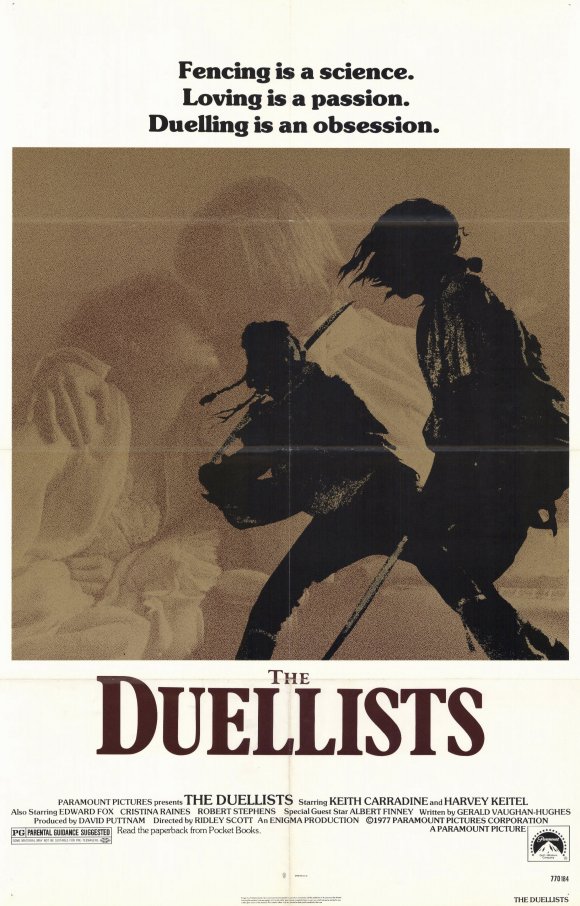
THE DUELLISTS (UK - 1977)
Ridley Scott's debut feature wasn't a big box office hit but it became a major cult film and established him as enough of a visual stylist that it led to his breakthrough blockbuster ALIEN two years later. Based on Joseph Conrad's short story "The Duel," THE DUELLISTS finds two French army officers in the Napoleonic era, D'Hubert (Keith Carradine) and Feraud (Harvey Keitel), engaged in a nearly 20-year battle over a perceived insult that neither of them even remember by the end of the film. In 1800, the easy-going D'Hubert was assigned to find hot-tempered, bullying Feraud and place him under house arrest at the base camp after the dueling-obsessed Feraud nearly killed the local mayor's son. An offended Feraud instead takes his frustrations out on D'Hubert and so begins a grudge match that consumes their lives over the next two decades. Their battle is a metaphor for the madness of war, a recurrent Conrad theme that was being explored at the same time by Francis Ford Coppola's APOCALYPSE NOW (1979), of course based on Conrad's novel Heart of Darkness. Working with fencing choreographer William Hobbs (whose expertise also helped make 1973's THE THREE MUSKETEERS, 1974's THE FOUR MUSKETEERS, and 1981's EXCALIBUR, among others, so memorable) and debuting cinematographer Frank Tidy (who never again shot a film this beautiful), Scott makes his mark with THE DUELLISTS, showcasing intense, brutal, bloody duels (how did this manage to get a PG rating?), and utilizing the natural lighting style that made Stanley Kubrick's BARRY LYNDON (1975) so visually stunning. Shout's Blu-ray looks very good, easily the best it's ever looked since it was in theaters, but shows some wear at times, and it's likely just inherent in the 1970s film stock. Some of the exterior shots (particularly in the closing scene) and ornate interiors are absolutely breathtaking. Carradine and Keitel do good work, despite both being miscast as officers in Napoleon's army. Scott gathered a fine supporting cast: Edward Fox, Robert Stephens, Cristina Raines, Tom Conti, Diana Quick, Alan Webb, Jenny Runacre, Alun Armstrong, Maurice Colbourne, W. Morgan Sheppard, a young Pete Postlethwaite, and Albert Finney. Narrated by Stacy Keach. Carradine and Keitel would reunite a decade later in Damiano Damiani's ancient Rome-set religious mystery THE INQUIRY (1986). (PG, 100 mins)
THE SEVEN-PER-CENT SOLUTION (US - 1976)
The 1970s saw numerous revisionist Sherlock Holmes films, such as Billy Wilder's THE PRIVATE LIFE OF SHERLOCK HOLMES (1970) and THEY MIGHT BE GIANTS (1971), with George C. Scott as a mental patient who thinks he's Holmes. THE SEVEN-PER-CENT SOLUTION, adapted by Nicholas Meyer (TIME AFTER TIME, STAR TREK II: THE WRATH OF KHAN) from his own novel, opens with the dark, rarely-depicted-on-screen drug-addicted side of Holmes, showing the great detective (Nicol Williamson) in the midst of a crazed cocaine binge as his brother Mycroft (Charles Gray) and Dr. Watson (Robert Duvall) conspire to trick him into going to Vienna to rehab with none other than the renowned Dr. Sigmund Freud (Alan Arkin). While in Vienna, a cleaned-up, clear-thinking Holmes finds himself with Watson and Freud in pursuit of one of Freud's kidnapped patients (Vanessa Redgrave). All of this leads to a thrilling train chase and Holmes and the villain squaring off for a swashbuckling showdown atop a speeding train. Meyer and director Herbert Ross find the perfect balance between drama, humor, and spectacular action throughout, and while such shifts in tone might have come off as jarringly uneven, they make it a very natural and organic progression. Williamson's Holmes ranks among the best, and while Duvall initially feels miscast as Watson, he eventually settles into the role and captures the spirit of Watson even if is his strange accent is a bit distracting. The film is mainly played straight, especially in the early going, but has a lot of humor, such as Holmes and Watson investigating a bordello where Holmes tries to shield the proper Watson's eyes from some of the more lascivious sights on display (it plays like a moment that Williamson might have ad-libbed). This was a big-budget release from Universal, and Meyer's script got an Oscar nomination, but these days, THE SEVEN-PER-CENT SOLUTION is generally well-regarded but remains little known outside of cult movie circles and hardcore Holmes enthusiasts, which is a shame. It's a rousing adventure, brilliantly acted, and prefigures Guy Ritchie's SHERLOCK HOLMES in a number of ways, and Robert Downey, Jr.'s portrayal of Holmes owes much to Williamson's often manic interpretation of the character. Also with Laurence Olivier as an innocent, falsely-accused Moriarty, Joel Grey, Samantha Eggar, and Jeremy Kemp, THE SEVEN-PER-CENT SOLUTION is a richly entertaining film that's aged beautifully. Shout's 1.85:1 transfer spotlights Ken Adam's stunning production design, and the Blu-ray/DVD combo set also offers an interview with Meyer. (PG, 114 mins)
Written and directed by Christopher McQuarrie. Cast: Tom Cruise, Rosamund Pike, Robert Duvall, Richard Jenkins, Werner Herzog, David Oyelowo, Jai Courtney, Joseph Sikora, Alexia Fast, Vladimir Sizov. (PG-13, 131 mins)
Since winning an Oscar for scripting 1995's THE USUAL SUSPECTS, Christopher McQuarrie has maintained a pretty low profile: he made his directing debut with 2000's THE WAY OF THE GUN, an underrated thriller best known for its hilariously profane opening sequence, and it was another eight years before he resurfaced to script VALKYRIE. He created the short-lived 2010 NBC series PERSONS UNKNOWN and scripted the awful THE TOURIST and starting with JACK REACHER, his first directing effort in 12 years, McQuarrie is either having a burst of inspiration or he's out of money: he wrote the upcoming JACK THE GIANT KILLER and this summer's X-MEN spinoff THE WOLVERINE, and is slated to write and direct MISSION: IMPOSSIBLE 5. JACK REACHER, an adaptation of One Shot, the ninth entry in Lee Child's popular series of Jack Reacher thrillers, is a refreshingly bullshit-free, crowd-pleasing popcorn action thriller configured as a perfect star vehicle for a seemingly miscast Tom Cruise, who's not quite the image of 6' 5" Reacher that Child's readers have gotten used to over the years. But, Cruise is Cruise, and when he's on his game, he can sell you on pretty much anything. There are times in JACK REACHER where it teeters on becoming a Cruise vanity project, but McQuarrie keeps it in check and the result is a fast-paced and very entertaining film.
Opening with a Pittsburgh sniper attack that's one of the most well-crafted set pieces of 2012, the film finds Iraq War vet and sharpshooter James Barr (Joseph Sikora) accused of killing five random people outside PNC Park from a parking garage across the river. He says nothing while interrogated by homicide detective Emerson (David Oyelowo) and the district attorney (Richard Jenkins), but writes "Get Jack Reacher" on a sheet of paper. Barr ends up in a coma after being beaten by other inmates during a prison transport, and all Emerson can conclude about Reacher is that he's a much-honored US Army vet, war hero and ex-military cop who disappeared and lives off the grid except for having his monthly pension wired to wherever he happens to be. As soon as Emerson says "You don't find Jack Reacher unless he wants to be found," in walks Reacher (Cruise). Reacher knows Barr from their combat days and knows what he's capable of, but something doesn't add up. Reacher ends up working as an investigator for Barr's attorney Helen Rodin (Rosamund Pike), who happens to be the district attorney's daughter ("Is that even legal?" Reacher asks), and in the course of his detective work, uncovers various clues and conspiracies that indicate that perhaps a complicated plot has been set in motion to frame Barr and make him a patsy.
The ultimate revelation (maybe the victims weren't random after all?) doesn't really hold up under much scrutiny, or the very least, it seems like entirely too much work for the true villains, though it does give us the inspired casting of legendary filmmaker Werner Herzog as a one-eyed, nearly-fingerless ex-Siberian gulag inmate known as "The Zec." JACK REACHER is a fun ride the entire way, with an intriguing mystery, lots of wiseass, crackling dialogue, and a very welcome respite from blurry, CGI-heavy shaky-cam action sequences and obvious, distracting greenscreen work. There's a long car chase midway through that's hardly the greatest ever filmed but manages to stick out from the pack simply for how old-school it is in its execution. Sure, there's minimal CGI in a few shots, but it's mostly the real deal with the actors in the cars, and what's immediately clear from watching it is how exceptional it seems because we so rarely see them done this way anymore. The JACK REACHER car chase is good but would've been pretty by-the-numbers in the days of, say, BULLITT (1968), THE FRENCH CONNECTION (1971), THE SEVEN-UPS (1973) or TO LIVE AND DIE IN L.A. (1985). The fact that it seems so great in 2012 is a pretty sad commentary on what passes for car chases most of the time. In fact, other than the cell phones and the Iraq War references, JACK REACHER could've almost been made 30 years ago with very similar results.
I haven't read any of Child's Reacher books, which is probably why I have no opinion of the miscasting of Cruise, but in the context of what's onscreen, he's fine. He's got a solid supporting cast around him, most notably Herzog, who has the kind of voice that you can just listen to regardless of the subject (even better when he's talking about chewing off his own fingers), and the always-awesome Robert Duvall in full-on "old coot" mode as a crusty ex-Marine who helps Reacher out in the final act. JACK REACHER isn't the kind of film that wins awards or gets the deluxe Criterion treatment down the road, but it never tries to present itself as anything more than what it is: fast, unpretentious and thoroughly enjoyable big-screen escapism.