There's some serious Terrence Malick/Robert Altman hero worship on the part of writer/director David Lowery with AIN'T THEM BODIES SAINTS, an artfully-shot but dreary and dull '70s-set mood piece. Young lovers Bob Muldoon (Casey Affleck) and Ruth Guthrie (Rooney Mara) are wrapping up a crime spree when they're cornered by police, an accomplice is killed, and Ruth fires a shot that injures young cop Patrick Wheeler (Ben Foster). Ruth is pregnant, and for the sake of her and their baby, Bob surrenders to the police, takes the blame for the shooting, and says he acted alone. Four years later, Ruth has stayed out of trouble and is a single mother looked after by Skerritt (Keith Carradine), the father of their dead friend and a dangerous man with criminal ties. Patrick and Ruth have a tentative friendship that's leaning towards a relationship when he gets word that Bob has busted out of the joint and with the authorities and three killers hired by Skerritt on his tail, is headed straight back to town to pick up Ruth and their daughter and live life on the lam.
On paper, AIN'T THEM BODIES SAINTS sounds like a solid drama. But Lowery is more interested in the aesthetic element, which would be fine if the film wasn't so dark and drably shot. Sure, there's some shots that have an almost still photo quality and Lowery's obviously a disciple of Malick's every stylistic move (I'm talking early, BADLANDS-era Malick when he still bothered with trivialities like narrative construction), but shouldn't there be more than that? Lowery also seems to paying special tribute to Altman's 1974 film THIEVES LIKE US, which had a similar "young couple on the run and she's pregnant" element and starred Carradine and featured Tom Skerritt in a supporting role, very likely the source of Carradine's character name. SAINTS boasts a strong and internalized performance by Foster and an excellent one by Carradine, in what's probably his best role in years and the film's most interesting character (Lowery even lets him sing the closing credits song and his voice hasn't lost a bit of that "I'm Easy" magic), but the film can't overcome its stale plot, sluggish pacing, and a pair of ineffectual performances by Affleck and Mara. Affleck's naturally mumbly delivery has worked in his favor before, particularly in his Oscar-nominated turn in 2007's THE ASSASSINATION OF JESSE JAMES BY THE COWARD ROBERT FORD and the recent OUT OF THE FURNACE, but here he underplays to the point of catatonia. He and Mara both sound like they might doze off in mid-sentence every time they open their mouth. By the time it's over, you may find that the film's high points are the performances of Foster and especially Carradine, who obviously has a huge fan in Lowery. Now that he's got a fake Malick film out of his system, maybe next time Lowery should write a script specifically tailored for Carradine. That sounds like a winner. (R, 96 mins)
THE HUNT (Denmark/Sweden/Belgium - 2012/2013 US release)
Ghost-produced by Lars von Trier, THE HUNT is one of the top feel-bad movies of the year. Directed and co-written by Thomas Vinterberg (THE CELEBRATION), the film stars Mads Mikkelsen as Lucas, a mild-mannered nice guy who's divorced and has a teenage son who's thinking about moving in with him permanently. A teacher by profession, Lucas was laid off after the school closed, but now he's helping out at a pre-school in the small town where he lives. He works, hangs out with his buddies, and leads a generally quiet life, and things are starting to progress romantically with co-worker Nadja (Alexandra Rapaport). All that goes to shit when he's accused of sexually abusing young Klara (a remarkable performance by Annika Wedderkopp in a very difficult role). Klara is the daughter of Lucas' best friend Theo (Thomas Bo Larsen) and trusted family friend Lucas frequently walks her to school. Klara develops a harmless crush on Lucas and in one of those awkward moments where kids imitate adults, kisses him on the lips when he's horsing around in the school playroom with some of the boys. Lucas handles the issue in a way that's sensitive to Klara, but she's embarrassed and makes up a story using verbiage she overheard her older brother and his friend using when they were looking at a porno mag. Lucas' boss Grethe (Susse Wold) handles the matter in the most overzealous manner possible, properly notifying the police but then immediately telling all the parents and even calling Lucas' ex-wife, who lives out of town with their son Marcus (Lasse Fogelstrom). The cops questioning little Klara practically put the words in her mouth and before he even realizes what's happening, Lucas is the town pariah, ostracized by everyone, banned from all business establishments, and Theo and his wife Agnes (Anne Louise Hassing) want nothing more to do with him, even after Klara confesses that nothing happened and she made it up. The damage is done and a mob mentality forms throughout the town, with more parents coming forward with allegations that Lucas molested their children as well.
THE HUNT mellows out as it goes along, but for a while, it's a harrowing experience. The tension mounts as Lucas grows increasingly panicked over the situation and can't get a straight answer out of anyone, and it's hard not getting angry at the "villages storming Castle Frankenstein" reaction of his friends and acquaintances as the situation quickly and plausibly spirals out of control. The resolution probably wouldn't work if this got an American remake, which seems likely. A mainstream take on this would've turned Lucas' plight into a STRAW DOGS-style siege situation leading to a vengeance saga. There is an element of that here, and in the fate of one individual, but Vinterberg doesn't proceed in that direction, instead going for that arthouse ambiguity in an ending that doesn't provide closure, which is probably the whole point. THE HUNT is a top-notch suspense drama with an outstanding performance by Mikkelsen, who took home the Best Actor prize at the 2012 Cannes Film Festival for his brilliant work here. (R, 116 mins)
With their Roger Corman line and their endless parade of classic TV shows among other offerings, it's been a busy couple of years for Shout! Factory, who have quietly emerged as the top genre Blu-ray/DVD label for serious cult movie fans and only look to get bigger with their "Scream Factory" offshoot and an MGM licensing deal. Here's a look at several of their releases from the last couple of months.
CRIME STORY (Hong Kong - 1993)/ THE PROTECTOR (US/Hong Kong - 1985)
Two atypical Jackie Chan films are paired on a single disc, starting with 1993's CRIME STORY, which was released in a dubbed version in the US by Dimension Films in 1996 to capitalize Chan's RUMBLE IN THE BRONX breakthrough (this offers the English dub and the original Cantonese with English subtitles). It's a different kind of Chan film in that it's a dark and very violent kidnapping thriller that's completely lacking his usual comedic flair. In a role originally intended for Jet Li, Chan is Detective Eddie Chan, an honest cop trying to get to the bottom of the abduction of a millionaire construction magnate. CRIME STORY reveals early on that the culprit is actually Chan's partner Hung (Kent Cheng) and there's a nice pre-INFERNAL AFFAIRS vibe to their game of cat & mouse as Hung gets increasingly nervous about Chan's incessant digging. Chan found the film too dark and insisted, against the wishes of director Kirk Wong (who's interviewed on the Blu-ray) on dumping a subplot about Det. Chan's psychological issues and adding some typically acrobatic martial-arts action sequences. These scenes don't really gel with the gritty vibe Wong was going for, and because we know in the very beginning that Hung is responsible, there isn't a whole lot of suspense in the film. The spectacular action scenes then, are really the highpoints, so perhaps Chan was right to overrule Wong. CRIME STORY suffers from inconsistent pacing, Chan's need to present his character as selflessly heroic as possible (not one, but two scenes where he puts his job aside to rescue someone in distress--you're the hero, we get it) and a very intrusive score, but the memorable action scenes, including one incredible car chase, make it worthwhile. Wong came to Hollywood a few years later for the 1998 Mark Wahlberg actioner THE BIG HIT, but hasn't directed a film since 2000's THE DISCIPLES, which is credited to "Alan Smithee."
Coming a decade before Chan finally found success in the US with RUMBLE IN THE BRONX, 1985's much-maligned THE PROTECTOR was the second attempt by Golden Harvest to make Jackie Chan a star in the US. 1980's THE BIG BRAWL bombed and Chan's co-starring roles in both CANNONBALL RUN films did little to endear him to American fans. Chan was never happy with THE PROTECTOR and reportedly clashed with writer/director James Glickenhaus (THE EXTERMINATOR) throughout the shoot and eventually ended up preparing his own version of the film for the Asian market, adding fight scenes and reshooting others, dumping the nudity and the profanity to make it a more traditional Chan film. THE PROTECTOR tanked in the US, grossing less than $1 million, but time has been pretty kind to it. If one approaches it as a Glickenhaus film first and a Chan film second, they'll have a better time with it. The first 20 minutes contain some vintage Glickenhaus fused with Chan's incredible stuntwork. Chan is NYC cop Billy Wong, who's sent to Hong Kong with crass partner Garoni (Danny Aiello) to take down the crime lord who's kidnapped the daughter of a Manhattan business partner. THE PROTECTOR drags a bit in the middle, but Glickenhaus, one of the action genre's most underrated craftsman, is really at the top of his game here and the film is immensely enjoyable if you're into the whole trashy B-movie thing. It's nonstop F-bombs (even one from Chan!), gratuitous nudity, insane violence, Aiello dialing his Noo Yawk schtick to 11, and every cop movie cliche known to man. Shout's 1.85:1 Blu-ray features some nice extras, including an interview with a diplomatic Glickenhaus, who says the disagreements came after the film was finished and insists he and Chan were always amicable and professional, a great featurette showing the NYC locations then and now, and the 88-minute Chan-supervised Asian cut, dubbed in Cantonese with English subtitles. It follows the same basic plot structure, but adds a subplot with actress Sally Yeh and has enough major differences that it qualifies as a completely different film. (CRIME STORY: Unrated, 107 mins./THE PROTECTOR: R, 95 mins; THE PROTECTOR, Chan cut: Unrated, 88 mins)
DEADLY BLESSING (US - 1981)
Low-key Wes Craven horror film takes its time getting revved up, but offers a few decent scares and one memorable bathtub encounter with a snake that's endeared itself to devout followers of '80s horror cinema. After her husband dies mysteriously, pregnant Maren Jensen (the original BATTLESTAR GALACTICA) and her two visiting friends (GREASE's Susan Buckner and Sharon Stone in one of her earliest roles) are terrorized and persecuted by the husband's estranged family, a community of Hittites from which he was banished. Craven does some clever misdirection and we're of course led to believe that Jensen's irate father-in-law (Ernest Borgnine) is behind all the mayhem, but that's too easy and always be wary of prominently billed actors who don't appear to have much to do with the plot. DEADLY BLESSING almost feels like the kind of slow-burner that a lot of indie horror filmmakers are going for today (I'm surprised it hasn't been remade with some kind of Westboro Baptist Church-type extremist group in place of the Hittites), and it subverts expectations time and again. The plot twist in the finale is genuinely unexpected in the way it changes your views of the perceived crazies and who the real antagonists of the story were. An interesting and unusual film that's marred only by a last shot that feels like it doesn't belong, only in the sense that it takes a frightening premise essentially grounded in reality and turns it otherworldly and supernatural in a way that provides a cool shock to go out on, but also cheapens the film to some degree. Also with Lois Nettleton, Michael Berryman (as the Hittite village idiot...or is he?), Jeff East, and "introducing" Lisa Hartman, even though she'd been in several TV movies and starred in a TV series years before doing this film. Shout's 1.78:1 Blu-ray features a commentary with Craven and Horror's Hallowed Ground's Sean Clark (where Craven admits he hasn't seen the film in many years and is "foggy" on a lot of details but says he's always been "embarrassed" by the last shot), and interviews with Buckner and Berryman. (R, 102 mins)
DEATH VALLEY (US - 1982)
This desert-set thriller wasn't a success in theaters, coming along at the height of the slasher craze, but it's bit more restrained than most (there's some brief nudity and a couple of gory throat slicings) and feels a lot like a made-for-TV movie. Heavy cable rotation in the mid-1980s has earned it some sentimental affection and a devoted cult following. For the most part, it's sluggishly-paced and rather average, with an overbearing score by Dana Kaproff that really goes out of its way to mimic Bernard Herrmann at his stringiest, but it has its moments and Stephen McHattie is a memorably effective killer, pursuing young Peter Billingsley (a year before A CHRISTMAS STORY), who's vacationing in Arizona with his divorced mom (Catherine Hicks) and her new boyfriend (Paul Le Mat). Director Dick Richards and screenwriter Richard Rothstein give us a lot of repetitious character-building scenes of young Billingsley sullenly giving Le Mat the cold shoulder before forming a tentative bond, but things pick up considerably once Le Mat and Hicks go out to dinner, leaving Billingsley alone with one of horror cinema's most useless babysitters as McHattie shows up ready to kill. Shout's 1.78:1 Blu-ray transfer looks good and there's a commentary track with Richards, best known as the producer of 1982's TOOTSIE and as the guy who got into an on-set brawl with Burt Reynolds during the making of 1987's ill-fated HEAT. DEATH VALLEY isn't bad--it was nice to revisit it after 30 years but it's nothing special, and a good example of something whose status may be elevated somewhat because it was seen at such an impressionable age. (R, 88 mins)
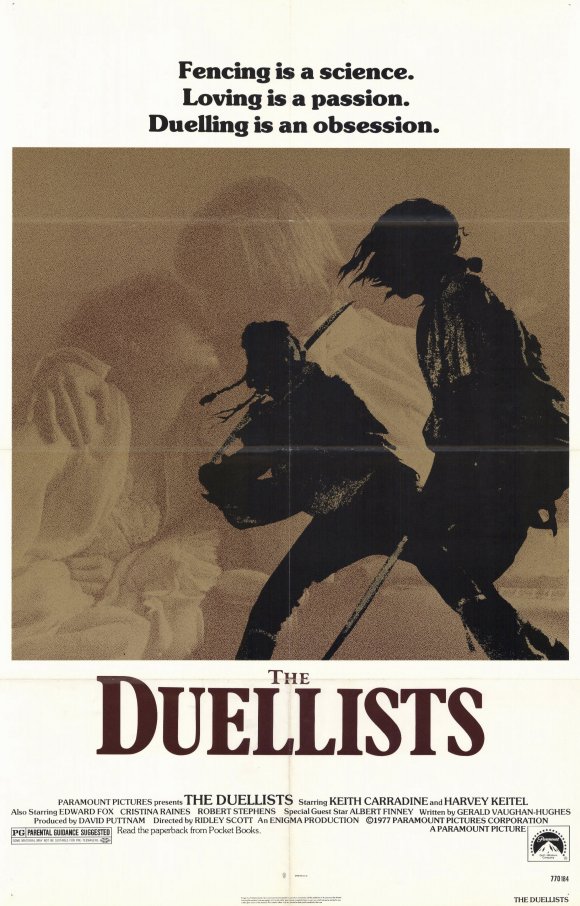
THE DUELLISTS (UK - 1977)
Ridley Scott's debut feature wasn't a big box office hit but it became a major cult film and established him as enough of a visual stylist that it led to his breakthrough blockbuster ALIEN two years later. Based on Joseph Conrad's short story "The Duel," THE DUELLISTS finds two French army officers in the Napoleonic era, D'Hubert (Keith Carradine) and Feraud (Harvey Keitel), engaged in a nearly 20-year battle over a perceived insult that neither of them even remember by the end of the film. In 1800, the easy-going D'Hubert was assigned to find hot-tempered, bullying Feraud and place him under house arrest at the base camp after the dueling-obsessed Feraud nearly killed the local mayor's son. An offended Feraud instead takes his frustrations out on D'Hubert and so begins a grudge match that consumes their lives over the next two decades. Their battle is a metaphor for the madness of war, a recurrent Conrad theme that was being explored at the same time by Francis Ford Coppola's APOCALYPSE NOW (1979), of course based on Conrad's novel Heart of Darkness. Working with fencing choreographer William Hobbs (whose expertise also helped make 1973's THE THREE MUSKETEERS, 1974's THE FOUR MUSKETEERS, and 1981's EXCALIBUR, among others, so memorable) and debuting cinematographer Frank Tidy (who never again shot a film this beautiful), Scott makes his mark with THE DUELLISTS, showcasing intense, brutal, bloody duels (how did this manage to get a PG rating?), and utilizing the natural lighting style that made Stanley Kubrick's BARRY LYNDON (1975) so visually stunning. Shout's Blu-ray looks very good, easily the best it's ever looked since it was in theaters, but shows some wear at times, and it's likely just inherent in the 1970s film stock. Some of the exterior shots (particularly in the closing scene) and ornate interiors are absolutely breathtaking. Carradine and Keitel do good work, despite both being miscast as officers in Napoleon's army. Scott gathered a fine supporting cast: Edward Fox, Robert Stephens, Cristina Raines, Tom Conti, Diana Quick, Alan Webb, Jenny Runacre, Alun Armstrong, Maurice Colbourne, W. Morgan Sheppard, a young Pete Postlethwaite, and Albert Finney. Narrated by Stacy Keach. Carradine and Keitel would reunite a decade later in Damiano Damiani's ancient Rome-set religious mystery THE INQUIRY (1986). (PG, 100 mins)
THE SEVEN-PER-CENT SOLUTION (US - 1976)
The 1970s saw numerous revisionist Sherlock Holmes films, such as Billy Wilder's THE PRIVATE LIFE OF SHERLOCK HOLMES (1970) and THEY MIGHT BE GIANTS (1971), with George C. Scott as a mental patient who thinks he's Holmes. THE SEVEN-PER-CENT SOLUTION, adapted by Nicholas Meyer (TIME AFTER TIME, STAR TREK II: THE WRATH OF KHAN) from his own novel, opens with the dark, rarely-depicted-on-screen drug-addicted side of Holmes, showing the great detective (Nicol Williamson) in the midst of a crazed cocaine binge as his brother Mycroft (Charles Gray) and Dr. Watson (Robert Duvall) conspire to trick him into going to Vienna to rehab with none other than the renowned Dr. Sigmund Freud (Alan Arkin). While in Vienna, a cleaned-up, clear-thinking Holmes finds himself with Watson and Freud in pursuit of one of Freud's kidnapped patients (Vanessa Redgrave). All of this leads to a thrilling train chase and Holmes and the villain squaring off for a swashbuckling showdown atop a speeding train. Meyer and director Herbert Ross find the perfect balance between drama, humor, and spectacular action throughout, and while such shifts in tone might have come off as jarringly uneven, they make it a very natural and organic progression. Williamson's Holmes ranks among the best, and while Duvall initially feels miscast as Watson, he eventually settles into the role and captures the spirit of Watson even if is his strange accent is a bit distracting. The film is mainly played straight, especially in the early going, but has a lot of humor, such as Holmes and Watson investigating a bordello where Holmes tries to shield the proper Watson's eyes from some of the more lascivious sights on display (it plays like a moment that Williamson might have ad-libbed). This was a big-budget release from Universal, and Meyer's script got an Oscar nomination, but these days, THE SEVEN-PER-CENT SOLUTION is generally well-regarded but remains little known outside of cult movie circles and hardcore Holmes enthusiasts, which is a shame. It's a rousing adventure, brilliantly acted, and prefigures Guy Ritchie's SHERLOCK HOLMES in a number of ways, and Robert Downey, Jr.'s portrayal of Holmes owes much to Williamson's often manic interpretation of the character. Also with Laurence Olivier as an innocent, falsely-accused Moriarty, Joel Grey, Samantha Eggar, and Jeremy Kemp, THE SEVEN-PER-CENT SOLUTION is a richly entertaining film that's aged beautifully. Shout's 1.85:1 transfer spotlights Ken Adam's stunning production design, and the Blu-ray/DVD combo set also offers an interview with Meyer. (PG, 114 mins)