THE EXORCIST III (US - 1990) Written and directed by William Peter Blatty. Cast: George C. Scott, Ed Flanders, Brad Dourif, Jason Miller, Scott Wilson, Nicol Williamson, George DiCenzo, Don Gordon, Lee Richardson, Grand L. Bush, Nancy Fish, Viveca Lindfors, Zohra Lampert, Barbara Baxley, Harry Carey Jr, Ken Lerner, Mary Jackson, Sherrie Wills, Tracy Thorne, Tyra Ferrell, Lois Foraker, Kevin Corrigan, Patrick Ewing, Samuel L. Jackson. (R, 110 mins)
LEGION (US - 1990/2016) Same credits minus Jason Miller and Nicol Williamson. (Unrated, 105 mins) Released in August of 1990 after a tumultuous production, THE EXORCIST III is tops among threequels that completely disregard the Part II's that preceded them, instead functioning as a direct sequel to the first film (see also HIGHLANDER: THE FINAL DIMENSION and the recent BLAIR WITCH, to name just two). William Peter Blatty, the author of The Exorcist who adapted his 1971 novel for William Friedkin's landmark 1973 classic, had nothing to do with John Boorman's insane box office bomb EXORCIST II: THE HERETIC (1977) and opted to write his own sequel, publishing the novel Legion in 1983. When it came time to make Legion into a film, Blatty adapted and directed it himself, but made the first of many compromises with Morgan Creek bosses James G. Robinson and Joe Roth when he agreed to include the word "Exorcist" in the title. Throughout production, no one could settle on a name: on-set footage of the clapboard shows it as EXORCIST 1990, and it was also called EXORCIST: LEGION and EXORCIST: 15 YEARS LATER at various points. Even before shooting wrapped, the signs of disconnect and a communication breakdown between Blatty and his backers were already glaringly apparent.
The focus here is on Lt. Bill Kinderman, the Georgetown detective who investigated the death of the movie director thrown out of possessed Regan MacNeil's bedroom window in the 1973 original. Kinderman had a much larger role in the novel but was mostly relegated to the sideline in Friedkin's film, where he's played by the great Lee J. Cobb. Cobb died in 1976, so Kinderman is played in THE EXORCIST III by George C. Scott, whose interpretation is much more sarcastic and blustery than Cobb's more soft-spoken and easygoing portrayal. The film also features the minor character of Father Dyer, played in Friedkin's film by church technical advisor Rev. William J. O'Malley, and here by Ed Flanders. The character of Father Damien Karras, the troubled priest who sacrifices himself by jumping out of Regan MacNeil's bedroom window and tumbling down the famous steps to his death, makes an improbable return in THE EXORCIST III. It was Blatty's initial wish to have his old friend Jason Miller, who received an Oscar nomination for his work in THE EXORCIST, reprise the role but for various reasons (more on that below), Miller was replaced by Brad Dourif. The plot has Kinderman investigating a string of brutal killings where the victims all have at least tenuous ties to the original exorcism of Linda Blair's Regan MacNeil. The methodology follows that of James Venamun, aka "The Gemini Killer," a Zodiac-like serial killer who was executed in the electric chair 15 years earlier, the same night of the MacNeil exorcism. Kinderman's investigation leads him to the locked-down psych ward of a local hospital, where he sees a patient who looks exactly like the long-dead Father Karras. The priest is possessed by the spirit of the Gemini Killer. Karras' soul was taken from his body at the moment of death by what Venamun describes as "The Master," who was angry about being exorcised from Regan MacNeil and decided to put the Gemini Killer's spirit into the body of Karras. After a decade and a half of rebuilding his strength inside Karras' body, the Gemini has been leaving Karras and possessing elderly folks in the dementia ward, who are then able to escape the hospital and continue his killing spree 15 years after his presumed death.
It's an admittedly hokey story that works because of the unique elements Blatty brings to the table. It plays like a supernatural police procedural, with plenty of Blatty's trademark eccentricity, dark humor, and verbose repartee, particularly in the spirited and sometimes oddball conversations ("The carp...") between Kinderman and Dyer (Cobb and Miller were able to bring a little of that to THE EXORCIST, but there's much more of it here) and the bizarre character quirks, like twitchy, chain-smoking Dr. Temple (Scott Wilson) having stacks of newspapers ("I like to read the science articles") and nudie mag pics plastered on his office wall. THE EXORCIST III is very dialogue-heavy and at times feels like more of a companion piece to Blatty's only other directing effort, the 1980 cult film THE NINTH CONFIGURATION, which also featured Miller, Flanders, Wilson, and George DiCenzo from this film. But when Blatty turned in his cut of LEGION (or whatever it was called at the time), the studio wasn't happy. Their biggest concern was that there was no exorcism, but they also didn't like the idea of Dourif in the role of Karras and insisted Miller be summoned to reshoot all scenes involving the character. That was Blatty's original intention, but as Dourif explains on Shout! Factory's new two-disc Blu-ray set, Miller was suffering from severe alcoholism at the time, with everyone agreeing that he wasn't up to the demands of the role. The idea of replacing Miller with Dourif wasn't too hard to fathom, especially since they already had Scott replacing Cobb and Flanders in place of O'Malley. Morgan Creek didn't budge. They wanted someone from the original EXORCIST, so Miller was brought in and Dourif was informed by Blatty that his entire performance was being scrapped. But, as Blatty feared, Miller started showing signs of not being up to the task, so a decision was made to reduce his workload by having Dourif return to essay the role of just the Gemini Killer, instead of both Karras and the Gemini-possessed Karras. So in what was ultimately released as THE EXORCIST III, when Kinderman sees Karras, the priest is played by Miller, but when Karras is overtaken by the talkative, ranting Gemini Killer, the audience sees Dourif, who returned to reshoot half of his scenes, meeting the demand of the producers that Miller play Father Karras and satisfying Blatty's wish that Dourif still be in the film. It's an initially jarring effect, but it works for the most part. Nicol Williamson was cast as Father Morning, a character exclusive to the reshoots, who arrives for a climactic exorcism that comes out of nowhere and looks like a hastily tacked-on afterthought even to those not in the know about the film's troubled production. For starters, Karras is suddenly possessed by the devil for the climax (the uncredited voice provided by Scott's two-time ex-wife Colleen Dewhurst), which is filled with loud, gory special effects (Morning's skin peeling off as he unsticks himself from the ceiling) that are completely at odds with the serious, understated tone of the first 95 minutes of the film.
THE EXORCIST III opened to middling reviews but its reputation has improved over time. It remains a flawed mess but has so many effective moments throughout that the good far outweighs the not-as-good. The long, static hallway shot of the nurses' station culminates in one of the greatest jump scares in horror movie history. The nature of the Gemini Killer's murders and Kinderman's investigation ("the victim had an ingot driven into each of his eyes, then the killer cut off his head and crucified him on a pair of rowing oars") are profoundly disturbing and get under your skin in ways that prefigure the likes of David Fincher's SE7EN and help make this film as terrifying as THE EXORCIST in its own way. It's worth noting that all of these creepy scenes and the incredible hallway jump scare were in the LEGION cut, which built up a mystique over the years, with rumors always swirling that Blatty wanted to assemble a director's cut. But extensive searches yielded little and the footage was never found, leaving LEGION a title regularly mentioned with other Holy Grails of lost films, like the never-to-be-assembled original cuts of Erich von Stroheim's GREED (1924) or Orson Welles' THE MAGNIFICENT AMBERSONS (1942). The original prints of LEGION have been lost to time for now, but we've got the next best thing on Shout!'s Blu-ray: in addition to the theatrical version, there's a composite assembling of Blatty's original vision using VHS dailies combined with footage from THE EXORCIST III that remained from the original cut of LEGION. Because they were part of the studio-mandated reshoots, neither Miller nor Williamson are in LEGION, so other than incidental bits (like shots of photographs) reinstated to indicate that Dourif was indeed playing Father Karras, most of the big differences start around 50 minutes in when Kinderman first visits Karras' cell and Karras is only being played by Dourif. The cell is different in LEGION, which was shot at the DEG Studios in Wilmington, NC, while the reshoots were done in Los Angeles on a different set, which necessitated Dourif filming his scenes a second time. It's easy to see why Robinson and Roth were unhappy with LEGION. As brilliant as it is at times, it's got one of the most abrupt and anti-climactic endings you'll ever see. Dourif's memorable performance is more hammy and his voice electronically altered a bit in THE EXORCIST III, but the actor prefers his slightly more restrained LEGION interpretation and remains dissatisfied with the released version.
As incongruous as the exorcism is in a film called THE EXORCIST III, it's the best of two imperfect ways to end the movie, and it's the only cut that includes Scott's incredible "I believe!" speech, which wasn't in LEGION. Even with Blatty's original version now newly-assembled for fans to finally see, it still doesn't explain the inconsistencies with the 1973 film. The biggest of these is Scott's Kinderman repeatedly referring to Karras as his "best friend," when, going by their relationship in the first film, they had one testy but generally good-natured conversation before Karras' death. When did they have a chance to pose for a happy photo on what looks like a fishing trip? Kinderman's friendship with Father Dyer makes sense, especially considering the reinstated ending on the 2000 "Version You've Never Seen," where Cobb's Kinderman and O'Malley's Dyer walk away from the MacNeil house with Kinderman quoting CASABLANCA's "beautiful friendship" line (faithful to Blatty's novel, but unnecessary in the film). And it's still hard to accept that a detective as observant as Kinderman, even in a state of concern over his friend Father Dyer being hospitalized, would fail to notice a headless statue right in front of him by the elevator. Also, in LEGION, Dourif's possessed Karras has an ability to mimic sounds, like roars and train whistles, a concept that was wisely dropped for THE EXORCIST III. Another key difference is that the closing scene of THE EXORCIST III--Kinderman and cop Atkins (Grand L. Bush) standing over the grave of Father Karras--actually comes much earlier in LEGION, when they're exhuming Karras and discover the remains of Brother Fain, an elderly Jesuit who vanished in 1975. In LEGION, the Gemini Killer reveals that Fain was tending to the burial of Karras when the possessed-by-the-Gemini Killer priest awoke and crawled out of his coffin, inducing a heart attack and scaring Fain to death. The explanation is also in THE EXORCIST III, but it makes little sense without Fain's backstory and the exhuming of Karras' remains.
While not adhering to the tone or style of Friedkin's 1973 classic, LEGION is a film that still gets under your skin, demonstrating some distinct similarities to MR. FROST, a little-seen and now-forgotten 1990 supernatural thriller that was also released not long after THE EXORCIST III, with Alan Bates as a cop dealing with chatty serial killer Jeff Goldblum, who claims to be Satan. EXORCIST sequels seem to be a doomed lot, as shown again 14 years later when Paul Schrader's EXORCIST prequel DOMINION was shelved entirely for EXORCIST: THE BEGINNING, a completely reshot version directed by Renny Harlin, with both starring Stellan Skarsgard as a young Father Merrin, Max von Sydow's character from the original. Similar to LEGION in that it was a thoughtful look at the nature of evil rather than a conventional, head-spinning and green-barfing possession movie, DOMINION eventually got a limited release before appearing on DVD. but was further evidence that no one was sure what they really wanted out of an EXORCIST movie. Still, even with its problems, THE EXORCIST III is easily the best of the bunch after Friedkin's original trailblazer. Shout!'s Blu-ray is packed with extensive vintage and new supplemental material, including an audio interview--played over the LEGION cut as a commentary track--with the now-88-year-old Blatty who, not surprisingly, hasn't directed a film since.
"Half the big-name cast appears to be drunk; the other half looks as though it wishes it were" - Leonard Maltin on VENOM.
One of the most stupidly entertaining guilty pleasure horror movies of the 1980s, VENOM finds a claustrophobic London hostage situation made worse when the party is crashed by the world's deadliest and most venomous snake. Philip (Lance Holcomb) is the animal-obsessed, dangerously asthmatic ten-year-old son of a wealthy American hotel CEO based in London. When Mom (Cornelia Sharpe, wife of the film's producer Martin Bregman, and the Lorraine Gary to his Sid Sheinberg) goes on a business trip with Dad, Philip is left in the care of his grizzled, retired safari guide grandfather (the always wonderful Sterling Hayden, in his last big-screen role) and maid Louise (Susan George). Unbeknownst to Philip and Grandpa, Louise and surly chauffeur Dave ("and Oliver Reed as Dave") are conspiring with Louise's beau, international terrorist Jacmel (Klaus Kinski, who turned down the role of Toht in RAIDERS OF THE LOST ARK because he felt the script was "moronically shitty" and VENOM paid more) to kidnap Philip and get a fat ransom from his dad. That plan goes south when Philip's package at the neighborhood pet store--a harmless African house snake--is mixed-up with an order for a black mamba placed by an area toxicology lab overseen by Dr. Stowe (Sarah Miles). The box containing the mamba is opened and it immediately bites and kills Louise, then proceeds to hide in the vents, occasionally slithering out to launch itself at someone or just play games by scaring the shit out of them. Meanwhile, irate hostage negotiator Bulloch (Nicol Williamson) tries to contain the escalating crisis from outside the house and meet Jacmel's demands. And, of course, Philip can't breathe.
Opening in theaters in January 1982, VENOM began production in the fall of 1980 with THE TEXAS CHAINSAW MASSACRE director Tobe Hooper at the helm, fresh off of his success with the 1979 CBS miniseries SALEM'S LOT and the 1981 hit THE FUNHOUSE. Shortly into filming, creative differences manifested, leading to Hooper either quitting or being dismissed, depending on who's telling the story. While Hooper went on to direct (or "direct") POLTERGEIST, his hastily-chosen VENOM replacement was found in journeyman Piers Haggard. A respected and consistently busy director for British television, Haggard occasionally dabbled in features like 1970's THE BLOOD ON SATAN'S CLAW and Peter Sellers' horrendous 1980 swan song THE FIENDISH PLOT OF DR. FU MANCHU, where he was fired by the star, who finished directing the film himself, though only Haggard--the third director cycled through the doomed project--remained the credited fall guy. Haggard arrived on VENOM with very little prep time and had to not only contend with an already troubled production falling behind schedule, but also with the numerous volatile personalities in his cast. The key focus of the damage control was on anger management poster boy Kinski, whose legendarily bad behavior and near-constant screaming fits prompted even the normally difficult Reed and Williamson to tone down their acts and just stay out of the path of Hurricane Klaus. Haggard contributed a very enjoyable commentary to Blue Underground's 2003 DVD release of VENOM (a Blu-ray upgrade is due out this summer) where he detailed all of the hassles and brouhahas that developed during the shoot (Haggard recounts Miles at one point telling Reed to just punch Kinski in the face to shut him up, to which the usually short-fused Reed quietly balked and said "I'm no fool").
As problematic as everything was, he seems like a good sport about it, and the film works in spite of its silliness. It's hard not to be entertained by Kinski's climactic spaz attack as he flails around wrapping a rubber snake around himself, Williamson's obviously grouchy disinterest in the whole endeavor, and a gun-shot Reed rendered immobile and forced to watch the mamba crawl up his pants leg and bite him on the dick. Also with brief appearances by Michael Gough as the London Zoo's leading snake expert, and John Forbes-Robertson--best known as Hammer's ineffective replacement Dracula when Christopher Lee refused to appear in 1974's horror/kung-fu hybrid THE LEGEND OF THE 7 GOLDEN VAMPIRES--as a doomed cop killed by an impulsive and panicked Dave. Reed apparently had such a great time doing a horror movie about a snake that he did another one a year later with 1983's Canadian-made SPASMS. (R, 92 mins)
With their Roger Corman line and their endless parade of classic TV shows among other offerings, it's been a busy couple of years for Shout! Factory, who have quietly emerged as the top genre Blu-ray/DVD label for serious cult movie fans and only look to get bigger with their "Scream Factory" offshoot and an MGM licensing deal. Here's a look at several of their releases from the last couple of months.
CRIME STORY (Hong Kong - 1993)/ THE PROTECTOR (US/Hong Kong - 1985)
Two atypical Jackie Chan films are paired on a single disc, starting with 1993's CRIME STORY, which was released in a dubbed version in the US by Dimension Films in 1996 to capitalize Chan's RUMBLE IN THE BRONX breakthrough (this offers the English dub and the original Cantonese with English subtitles). It's a different kind of Chan film in that it's a dark and very violent kidnapping thriller that's completely lacking his usual comedic flair. In a role originally intended for Jet Li, Chan is Detective Eddie Chan, an honest cop trying to get to the bottom of the abduction of a millionaire construction magnate. CRIME STORY reveals early on that the culprit is actually Chan's partner Hung (Kent Cheng) and there's a nice pre-INFERNAL AFFAIRS vibe to their game of cat & mouse as Hung gets increasingly nervous about Chan's incessant digging. Chan found the film too dark and insisted, against the wishes of director Kirk Wong (who's interviewed on the Blu-ray) on dumping a subplot about Det. Chan's psychological issues and adding some typically acrobatic martial-arts action sequences. These scenes don't really gel with the gritty vibe Wong was going for, and because we know in the very beginning that Hung is responsible, there isn't a whole lot of suspense in the film. The spectacular action scenes then, are really the highpoints, so perhaps Chan was right to overrule Wong. CRIME STORY suffers from inconsistent pacing, Chan's need to present his character as selflessly heroic as possible (not one, but two scenes where he puts his job aside to rescue someone in distress--you're the hero, we get it) and a very intrusive score, but the memorable action scenes, including one incredible car chase, make it worthwhile. Wong came to Hollywood a few years later for the 1998 Mark Wahlberg actioner THE BIG HIT, but hasn't directed a film since 2000's THE DISCIPLES, which is credited to "Alan Smithee."
Coming a decade before Chan finally found success in the US with RUMBLE IN THE BRONX, 1985's much-maligned THE PROTECTOR was the second attempt by Golden Harvest to make Jackie Chan a star in the US. 1980's THE BIG BRAWL bombed and Chan's co-starring roles in both CANNONBALL RUN films did little to endear him to American fans. Chan was never happy with THE PROTECTOR and reportedly clashed with writer/director James Glickenhaus (THE EXTERMINATOR) throughout the shoot and eventually ended up preparing his own version of the film for the Asian market, adding fight scenes and reshooting others, dumping the nudity and the profanity to make it a more traditional Chan film. THE PROTECTOR tanked in the US, grossing less than $1 million, but time has been pretty kind to it. If one approaches it as a Glickenhaus film first and a Chan film second, they'll have a better time with it. The first 20 minutes contain some vintage Glickenhaus fused with Chan's incredible stuntwork. Chan is NYC cop Billy Wong, who's sent to Hong Kong with crass partner Garoni (Danny Aiello) to take down the crime lord who's kidnapped the daughter of a Manhattan business partner. THE PROTECTOR drags a bit in the middle, but Glickenhaus, one of the action genre's most underrated craftsman, is really at the top of his game here and the film is immensely enjoyable if you're into the whole trashy B-movie thing. It's nonstop F-bombs (even one from Chan!), gratuitous nudity, insane violence, Aiello dialing his Noo Yawk schtick to 11, and every cop movie cliche known to man. Shout's 1.85:1 Blu-ray features some nice extras, including an interview with a diplomatic Glickenhaus, who says the disagreements came after the film was finished and insists he and Chan were always amicable and professional, a great featurette showing the NYC locations then and now, and the 88-minute Chan-supervised Asian cut, dubbed in Cantonese with English subtitles. It follows the same basic plot structure, but adds a subplot with actress Sally Yeh and has enough major differences that it qualifies as a completely different film. (CRIME STORY: Unrated, 107 mins./THE PROTECTOR: R, 95 mins; THE PROTECTOR, Chan cut: Unrated, 88 mins)
DEADLY BLESSING (US - 1981)
Low-key Wes Craven horror film takes its time getting revved up, but offers a few decent scares and one memorable bathtub encounter with a snake that's endeared itself to devout followers of '80s horror cinema. After her husband dies mysteriously, pregnant Maren Jensen (the original BATTLESTAR GALACTICA) and her two visiting friends (GREASE's Susan Buckner and Sharon Stone in one of her earliest roles) are terrorized and persecuted by the husband's estranged family, a community of Hittites from which he was banished. Craven does some clever misdirection and we're of course led to believe that Jensen's irate father-in-law (Ernest Borgnine) is behind all the mayhem, but that's too easy and always be wary of prominently billed actors who don't appear to have much to do with the plot. DEADLY BLESSING almost feels like the kind of slow-burner that a lot of indie horror filmmakers are going for today (I'm surprised it hasn't been remade with some kind of Westboro Baptist Church-type extremist group in place of the Hittites), and it subverts expectations time and again. The plot twist in the finale is genuinely unexpected in the way it changes your views of the perceived crazies and who the real antagonists of the story were. An interesting and unusual film that's marred only by a last shot that feels like it doesn't belong, only in the sense that it takes a frightening premise essentially grounded in reality and turns it otherworldly and supernatural in a way that provides a cool shock to go out on, but also cheapens the film to some degree. Also with Lois Nettleton, Michael Berryman (as the Hittite village idiot...or is he?), Jeff East, and "introducing" Lisa Hartman, even though she'd been in several TV movies and starred in a TV series years before doing this film. Shout's 1.78:1 Blu-ray features a commentary with Craven and Horror's Hallowed Ground's Sean Clark (where Craven admits he hasn't seen the film in many years and is "foggy" on a lot of details but says he's always been "embarrassed" by the last shot), and interviews with Buckner and Berryman. (R, 102 mins)
DEATH VALLEY (US - 1982)
This desert-set thriller wasn't a success in theaters, coming along at the height of the slasher craze, but it's bit more restrained than most (there's some brief nudity and a couple of gory throat slicings) and feels a lot like a made-for-TV movie. Heavy cable rotation in the mid-1980s has earned it some sentimental affection and a devoted cult following. For the most part, it's sluggishly-paced and rather average, with an overbearing score by Dana Kaproff that really goes out of its way to mimic Bernard Herrmann at his stringiest, but it has its moments and Stephen McHattie is a memorably effective killer, pursuing young Peter Billingsley (a year before A CHRISTMAS STORY), who's vacationing in Arizona with his divorced mom (Catherine Hicks) and her new boyfriend (Paul Le Mat). Director Dick Richards and screenwriter Richard Rothstein give us a lot of repetitious character-building scenes of young Billingsley sullenly giving Le Mat the cold shoulder before forming a tentative bond, but things pick up considerably once Le Mat and Hicks go out to dinner, leaving Billingsley alone with one of horror cinema's most useless babysitters as McHattie shows up ready to kill. Shout's 1.78:1 Blu-ray transfer looks good and there's a commentary track with Richards, best known as the producer of 1982's TOOTSIE and as the guy who got into an on-set brawl with Burt Reynolds during the making of 1987's ill-fated HEAT. DEATH VALLEY isn't bad--it was nice to revisit it after 30 years but it's nothing special, and a good example of something whose status may be elevated somewhat because it was seen at such an impressionable age. (R, 88 mins)
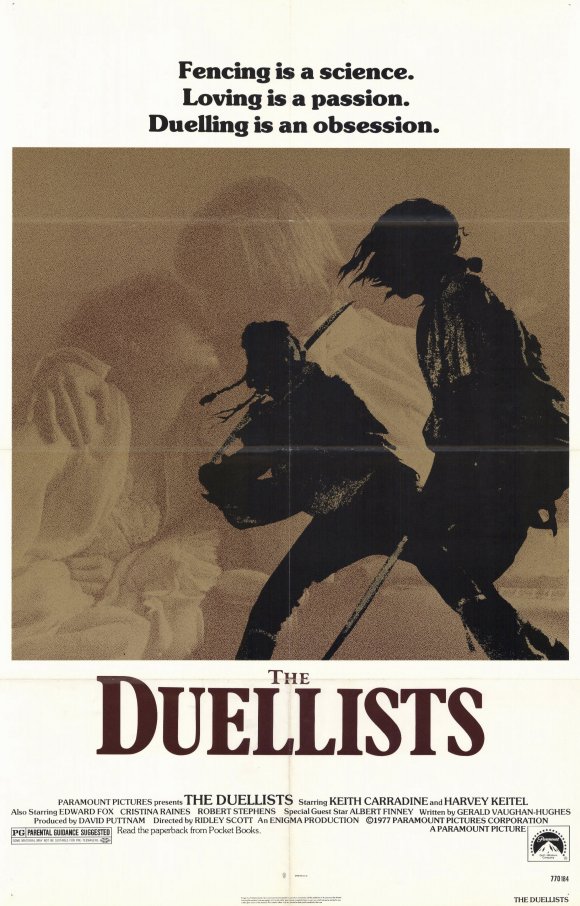
THE DUELLISTS (UK - 1977)
Ridley Scott's debut feature wasn't a big box office hit but it became a major cult film and established him as enough of a visual stylist that it led to his breakthrough blockbuster ALIEN two years later. Based on Joseph Conrad's short story "The Duel," THE DUELLISTS finds two French army officers in the Napoleonic era, D'Hubert (Keith Carradine) and Feraud (Harvey Keitel), engaged in a nearly 20-year battle over a perceived insult that neither of them even remember by the end of the film. In 1800, the easy-going D'Hubert was assigned to find hot-tempered, bullying Feraud and place him under house arrest at the base camp after the dueling-obsessed Feraud nearly killed the local mayor's son. An offended Feraud instead takes his frustrations out on D'Hubert and so begins a grudge match that consumes their lives over the next two decades. Their battle is a metaphor for the madness of war, a recurrent Conrad theme that was being explored at the same time by Francis Ford Coppola's APOCALYPSE NOW (1979), of course based on Conrad's novel Heart of Darkness. Working with fencing choreographer William Hobbs (whose expertise also helped make 1973's THE THREE MUSKETEERS, 1974's THE FOUR MUSKETEERS, and 1981's EXCALIBUR, among others, so memorable) and debuting cinematographer Frank Tidy (who never again shot a film this beautiful), Scott makes his mark with THE DUELLISTS, showcasing intense, brutal, bloody duels (how did this manage to get a PG rating?), and utilizing the natural lighting style that made Stanley Kubrick's BARRY LYNDON (1975) so visually stunning. Shout's Blu-ray looks very good, easily the best it's ever looked since it was in theaters, but shows some wear at times, and it's likely just inherent in the 1970s film stock. Some of the exterior shots (particularly in the closing scene) and ornate interiors are absolutely breathtaking. Carradine and Keitel do good work, despite both being miscast as officers in Napoleon's army. Scott gathered a fine supporting cast: Edward Fox, Robert Stephens, Cristina Raines, Tom Conti, Diana Quick, Alan Webb, Jenny Runacre, Alun Armstrong, Maurice Colbourne, W. Morgan Sheppard, a young Pete Postlethwaite, and Albert Finney. Narrated by Stacy Keach. Carradine and Keitel would reunite a decade later in Damiano Damiani's ancient Rome-set religious mystery THE INQUIRY (1986). (PG, 100 mins)
THE SEVEN-PER-CENT SOLUTION (US - 1976)
The 1970s saw numerous revisionist Sherlock Holmes films, such as Billy Wilder's THE PRIVATE LIFE OF SHERLOCK HOLMES (1970) and THEY MIGHT BE GIANTS (1971), with George C. Scott as a mental patient who thinks he's Holmes. THE SEVEN-PER-CENT SOLUTION, adapted by Nicholas Meyer (TIME AFTER TIME, STAR TREK II: THE WRATH OF KHAN) from his own novel, opens with the dark, rarely-depicted-on-screen drug-addicted side of Holmes, showing the great detective (Nicol Williamson) in the midst of a crazed cocaine binge as his brother Mycroft (Charles Gray) and Dr. Watson (Robert Duvall) conspire to trick him into going to Vienna to rehab with none other than the renowned Dr. Sigmund Freud (Alan Arkin). While in Vienna, a cleaned-up, clear-thinking Holmes finds himself with Watson and Freud in pursuit of one of Freud's kidnapped patients (Vanessa Redgrave). All of this leads to a thrilling train chase and Holmes and the villain squaring off for a swashbuckling showdown atop a speeding train. Meyer and director Herbert Ross find the perfect balance between drama, humor, and spectacular action throughout, and while such shifts in tone might have come off as jarringly uneven, they make it a very natural and organic progression. Williamson's Holmes ranks among the best, and while Duvall initially feels miscast as Watson, he eventually settles into the role and captures the spirit of Watson even if is his strange accent is a bit distracting. The film is mainly played straight, especially in the early going, but has a lot of humor, such as Holmes and Watson investigating a bordello where Holmes tries to shield the proper Watson's eyes from some of the more lascivious sights on display (it plays like a moment that Williamson might have ad-libbed). This was a big-budget release from Universal, and Meyer's script got an Oscar nomination, but these days, THE SEVEN-PER-CENT SOLUTION is generally well-regarded but remains little known outside of cult movie circles and hardcore Holmes enthusiasts, which is a shame. It's a rousing adventure, brilliantly acted, and prefigures Guy Ritchie's SHERLOCK HOLMES in a number of ways, and Robert Downey, Jr.'s portrayal of Holmes owes much to Williamson's often manic interpretation of the character. Also with Laurence Olivier as an innocent, falsely-accused Moriarty, Joel Grey, Samantha Eggar, and Jeremy Kemp, THE SEVEN-PER-CENT SOLUTION is a richly entertaining film that's aged beautifully. Shout's 1.85:1 transfer spotlights Ken Adam's stunning production design, and the Blu-ray/DVD combo set also offers an interview with Meyer. (PG, 114 mins)