HOSTILES (US - 2017) Written and directed by Scott Cooper. Cast: Christian Bale, Rosamund Pike, Wes Studi, Ben Foster, Jesse Plemons, Rory Cochrane, Adam Beach, Stephen Lang, Scott Wilson, Timothee Chalamet, Q'orianka Kilcher, Peter Mullan, Jonathan Majors, Bill Camp, Paul Anderson, Ryan Bingham, Tanaya Beatty, Xavier Horsechief, John Benjamin Hickey, David Midthunder, Robyn Malcolm, Boots Southerland, Scott Shepherd. (R, 135 mins) Based on an unpublished novel written by veteran screenwriter Donald E. Stewart (JACKSON COUNTY JAIL, MISSING, THE HUNT FOR RED OCTOBER) way back in the 1980s (Stewart died in 1999, but still gets an executive producer credit here), HOSTILES is a western that works despite being torn between revisionism and genre standards. Written and directed by Scott Cooper (CRAZY HEART), HOSTILES reunites the filmmaker with his OUT OF THE FURNACE star Christian Bale, and while it has moments that aspire to the likes of pre-self-parody Terrence Malick and something like Clint Eastwood's UNFORGIVEN (even stealing the "killed everything that's walked or crawled" line) or Andrew Dominik's THE ASSASSINATION OF JESSE JAMES BY THE COWARD ROBERT FORD, it ultimately leans more toward the OPEN RANGE and the remake of 3:10 TO YUMA side of things. And there's nothing wrong with that because those were fine westerns, and while the languid pacing likely won't bother fans of revisionist westerns, the more commercial, mainstream moviegoers may get a little fidgety. HOSTILES was acquired by Byron Allen's upstart Entertainment Studios, and after the surprise summer hit 47 METERS DOWN and last fall's social media bomb FRIEND REQUEST, Allen clearly intended HOSTILES to be his ticket to the Oscars. It was given a limited rollout at Christmas 2017 and finally expanded nationwide a month later, but it was all for naught. It's a very good movie, probably Cooper's most accomplished yet (and a nice rebound from the disappointing BLACK MASS, the Whitey Bulger biopic starring a pair of ice blue contact lenses resting on the corneas of Johnny Depp), but it obviously didn't connect with the Academy, netting a grand total of zero nominations.
A veteran of the 1890 massacre at Wounded Knee, about-to-retire US Army Capt. Joseph Blocker (Bale) is a respected leader with no love for Native Americans, viewing them as "savages" and "animals." He's assigned by his commander (Stephen Lang), under orders from President Benjamin Harrison, to lead a military escort for imprisoned tribal chief Yellow Hawk (Wes Studi) and his family from New Mexico back to his tribal land in Montana. Yellow Hawk has cancer and his days are numbered, and as a goodwill gesture, the President has granted the aging chief's final wish to die and be buried on his land. Having faced Yellow Hawk in battle and losing several men under his command to him, Blocker initially refuses the order until he's threatened with a court-martial and the loss of his pension. Blocker is accompanied by the most trusted soldiers under his command--Sgt. Metz (Rory Cochrane) and Major Woodson (Jonathan Majors)--along with West Point graduate Lt. Kidder (Jesse Plemons), and fresh-faced, French-born rookie Pvt. DeJardin (Timothee Chalamet). As soon as they're far enough from the base, bitter Blocker drops the niceties, grabs a pair of knives and challenges Yellow Hawk to a fight, only to be stoically rebuffed when the chief tells him he isn't afraid of death. Instead, Blocker orders Yellow Hawk and his family--son Black Hawk (Adam Beach), daughter-in-law Elk Woman (Q'orianka Kilcher), grandson Little Bear (Xavier Horsechief), and daughter Living Woman (Tanaya Beatty) to be chained for the duration of the trip. Shortly into the journey, they encounter shell-shocked widow Rosalie Quaid (Rosamund Pike), who just saw her husband scalped and three children murdered by Comanche warriors in an almost unbearably grim and brutal opening sequence. Rosalie joins them, and with those Comanches still in the vicinity, Blocker is ultimately forced to accept the help of sworn enemy Yellow Hawk, and that's before things get even more complicated when a stop at the next military outpost results in them adding three additional members to the party--two officers escorting Sgt. Wills (Ben Foster), a prisoner due for execution who, conveniently enough, used to be under Blocker's command.
There's no shortage of formulaic elements to HOSTILES, starting with the "one last job" motif as Blocker is set to retire once he's finished escorting Yellow Hawk to his tribal land. And, of course, they're determined to make it there if they don't kill each other first! But there's some interesting character development throughout, primarily with the arc of Bale's Blocker. It's obvious that he and Yellow Hawk will come around to reaching a mutual respect with the understanding that battle was battle, that was then and this is now. But the soldiers accompanying Blocker ultimately symbolize the stages of that arc, with DeJardin representing the youthful naivete of a young Blocker before experiencing the horrors of war; the ruthless, racist Wills serving as Blocker's dark side, reminding him of what a vicious killer of "redskins" he used to be; upstanding and loyal Woodson demonstrating his capacity for empathy; and Metz exemplifying the ability to change and recognize and correct the errors of the past. Metz starts out reminiscing about the good old days of scalping "savages" but he's the first to give a peace offering to Yellow Hawk on the journey and apologize for the things that happened to him and his people. Granted, Metz's abrupt come-to-Jesus moment is one of the film's missteps, handled in a clumsily heavy-handed and melodramatic way by Cooper. The fleshing out of Bale's character does come at the expense of Pike's, who's endured an inconceivable tragedy yet her stages of grief are given somewhat of a short shrift. Still, at the end of the day, these are minor quibbles for an overall excellent film that runs the gamut from some truly stomach-turning violence to powerful moments of genuine heartbreak and emotion. It's got a terrific cast of character actor ringers (Studi can play this kind of role in his sleep, but he does it better than anyone), beautiful imagery from cinematographer Masanobu Takayanagi (THE GREY), and some nicely complex characterizations that help elevate the film's more cookie-cutter elements into something a little more ambitious.
THE EXORCIST III (US - 1990) Written and directed by William Peter Blatty. Cast: George C. Scott, Ed Flanders, Brad Dourif, Jason Miller, Scott Wilson, Nicol Williamson, George DiCenzo, Don Gordon, Lee Richardson, Grand L. Bush, Nancy Fish, Viveca Lindfors, Zohra Lampert, Barbara Baxley, Harry Carey Jr, Ken Lerner, Mary Jackson, Sherrie Wills, Tracy Thorne, Tyra Ferrell, Lois Foraker, Kevin Corrigan, Patrick Ewing, Samuel L. Jackson. (R, 110 mins)
LEGION (US - 1990/2016) Same credits minus Jason Miller and Nicol Williamson. (Unrated, 105 mins) Released in August of 1990 after a tumultuous production, THE EXORCIST III is tops among threequels that completely disregard the Part II's that preceded them, instead functioning as a direct sequel to the first film (see also HIGHLANDER: THE FINAL DIMENSION and the recent BLAIR WITCH, to name just two). William Peter Blatty, the author of The Exorcist who adapted his 1971 novel for William Friedkin's landmark 1973 classic, had nothing to do with John Boorman's insane box office bomb EXORCIST II: THE HERETIC (1977) and opted to write his own sequel, publishing the novel Legion in 1983. When it came time to make Legion into a film, Blatty adapted and directed it himself, but made the first of many compromises with Morgan Creek bosses James G. Robinson and Joe Roth when he agreed to include the word "Exorcist" in the title. Throughout production, no one could settle on a name: on-set footage of the clapboard shows it as EXORCIST 1990, and it was also called EXORCIST: LEGION and EXORCIST: 15 YEARS LATER at various points. Even before shooting wrapped, the signs of disconnect and a communication breakdown between Blatty and his backers were already glaringly apparent.
The focus here is on Lt. Bill Kinderman, the Georgetown detective who investigated the death of the movie director thrown out of possessed Regan MacNeil's bedroom window in the 1973 original. Kinderman had a much larger role in the novel but was mostly relegated to the sideline in Friedkin's film, where he's played by the great Lee J. Cobb. Cobb died in 1976, so Kinderman is played in THE EXORCIST III by George C. Scott, whose interpretation is much more sarcastic and blustery than Cobb's more soft-spoken and easygoing portrayal. The film also features the minor character of Father Dyer, played in Friedkin's film by church technical advisor Rev. William J. O'Malley, and here by Ed Flanders. The character of Father Damien Karras, the troubled priest who sacrifices himself by jumping out of Regan MacNeil's bedroom window and tumbling down the famous steps to his death, makes an improbable return in THE EXORCIST III. It was Blatty's initial wish to have his old friend Jason Miller, who received an Oscar nomination for his work in THE EXORCIST, reprise the role but for various reasons (more on that below), Miller was replaced by Brad Dourif. The plot has Kinderman investigating a string of brutal killings where the victims all have at least tenuous ties to the original exorcism of Linda Blair's Regan MacNeil. The methodology follows that of James Venamun, aka "The Gemini Killer," a Zodiac-like serial killer who was executed in the electric chair 15 years earlier, the same night of the MacNeil exorcism. Kinderman's investigation leads him to the locked-down psych ward of a local hospital, where he sees a patient who looks exactly like the long-dead Father Karras. The priest is possessed by the spirit of the Gemini Killer. Karras' soul was taken from his body at the moment of death by what Venamun describes as "The Master," who was angry about being exorcised from Regan MacNeil and decided to put the Gemini Killer's spirit into the body of Karras. After a decade and a half of rebuilding his strength inside Karras' body, the Gemini has been leaving Karras and possessing elderly folks in the dementia ward, who are then able to escape the hospital and continue his killing spree 15 years after his presumed death.
It's an admittedly hokey story that works because of the unique elements Blatty brings to the table. It plays like a supernatural police procedural, with plenty of Blatty's trademark eccentricity, dark humor, and verbose repartee, particularly in the spirited and sometimes oddball conversations ("The carp...") between Kinderman and Dyer (Cobb and Miller were able to bring a little of that to THE EXORCIST, but there's much more of it here) and the bizarre character quirks, like twitchy, chain-smoking Dr. Temple (Scott Wilson) having stacks of newspapers ("I like to read the science articles") and nudie mag pics plastered on his office wall. THE EXORCIST III is very dialogue-heavy and at times feels like more of a companion piece to Blatty's only other directing effort, the 1980 cult film THE NINTH CONFIGURATION, which also featured Miller, Flanders, Wilson, and George DiCenzo from this film. But when Blatty turned in his cut of LEGION (or whatever it was called at the time), the studio wasn't happy. Their biggest concern was that there was no exorcism, but they also didn't like the idea of Dourif in the role of Karras and insisted Miller be summoned to reshoot all scenes involving the character. That was Blatty's original intention, but as Dourif explains on Shout! Factory's new two-disc Blu-ray set, Miller was suffering from severe alcoholism at the time, with everyone agreeing that he wasn't up to the demands of the role. The idea of replacing Miller with Dourif wasn't too hard to fathom, especially since they already had Scott replacing Cobb and Flanders in place of O'Malley. Morgan Creek didn't budge. They wanted someone from the original EXORCIST, so Miller was brought in and Dourif was informed by Blatty that his entire performance was being scrapped. But, as Blatty feared, Miller started showing signs of not being up to the task, so a decision was made to reduce his workload by having Dourif return to essay the role of just the Gemini Killer, instead of both Karras and the Gemini-possessed Karras. So in what was ultimately released as THE EXORCIST III, when Kinderman sees Karras, the priest is played by Miller, but when Karras is overtaken by the talkative, ranting Gemini Killer, the audience sees Dourif, who returned to reshoot half of his scenes, meeting the demand of the producers that Miller play Father Karras and satisfying Blatty's wish that Dourif still be in the film. It's an initially jarring effect, but it works for the most part. Nicol Williamson was cast as Father Morning, a character exclusive to the reshoots, who arrives for a climactic exorcism that comes out of nowhere and looks like a hastily tacked-on afterthought even to those not in the know about the film's troubled production. For starters, Karras is suddenly possessed by the devil for the climax (the uncredited voice provided by Scott's two-time ex-wife Colleen Dewhurst), which is filled with loud, gory special effects (Morning's skin peeling off as he unsticks himself from the ceiling) that are completely at odds with the serious, understated tone of the first 95 minutes of the film.
THE EXORCIST III opened to middling reviews but its reputation has improved over time. It remains a flawed mess but has so many effective moments throughout that the good far outweighs the not-as-good. The long, static hallway shot of the nurses' station culminates in one of the greatest jump scares in horror movie history. The nature of the Gemini Killer's murders and Kinderman's investigation ("the victim had an ingot driven into each of his eyes, then the killer cut off his head and crucified him on a pair of rowing oars") are profoundly disturbing and get under your skin in ways that prefigure the likes of David Fincher's SE7EN and help make this film as terrifying as THE EXORCIST in its own way. It's worth noting that all of these creepy scenes and the incredible hallway jump scare were in the LEGION cut, which built up a mystique over the years, with rumors always swirling that Blatty wanted to assemble a director's cut. But extensive searches yielded little and the footage was never found, leaving LEGION a title regularly mentioned with other Holy Grails of lost films, like the never-to-be-assembled original cuts of Erich von Stroheim's GREED (1924) or Orson Welles' THE MAGNIFICENT AMBERSONS (1942). The original prints of LEGION have been lost to time for now, but we've got the next best thing on Shout!'s Blu-ray: in addition to the theatrical version, there's a composite assembling of Blatty's original vision using VHS dailies combined with footage from THE EXORCIST III that remained from the original cut of LEGION. Because they were part of the studio-mandated reshoots, neither Miller nor Williamson are in LEGION, so other than incidental bits (like shots of photographs) reinstated to indicate that Dourif was indeed playing Father Karras, most of the big differences start around 50 minutes in when Kinderman first visits Karras' cell and Karras is only being played by Dourif. The cell is different in LEGION, which was shot at the DEG Studios in Wilmington, NC, while the reshoots were done in Los Angeles on a different set, which necessitated Dourif filming his scenes a second time. It's easy to see why Robinson and Roth were unhappy with LEGION. As brilliant as it is at times, it's got one of the most abrupt and anti-climactic endings you'll ever see. Dourif's memorable performance is more hammy and his voice electronically altered a bit in THE EXORCIST III, but the actor prefers his slightly more restrained LEGION interpretation and remains dissatisfied with the released version.
As incongruous as the exorcism is in a film called THE EXORCIST III, it's the best of two imperfect ways to end the movie, and it's the only cut that includes Scott's incredible "I believe!" speech, which wasn't in LEGION. Even with Blatty's original version now newly-assembled for fans to finally see, it still doesn't explain the inconsistencies with the 1973 film. The biggest of these is Scott's Kinderman repeatedly referring to Karras as his "best friend," when, going by their relationship in the first film, they had one testy but generally good-natured conversation before Karras' death. When did they have a chance to pose for a happy photo on what looks like a fishing trip? Kinderman's friendship with Father Dyer makes sense, especially considering the reinstated ending on the 2000 "Version You've Never Seen," where Cobb's Kinderman and O'Malley's Dyer walk away from the MacNeil house with Kinderman quoting CASABLANCA's "beautiful friendship" line (faithful to Blatty's novel, but unnecessary in the film). And it's still hard to accept that a detective as observant as Kinderman, even in a state of concern over his friend Father Dyer being hospitalized, would fail to notice a headless statue right in front of him by the elevator. Also, in LEGION, Dourif's possessed Karras has an ability to mimic sounds, like roars and train whistles, a concept that was wisely dropped for THE EXORCIST III. Another key difference is that the closing scene of THE EXORCIST III--Kinderman and cop Atkins (Grand L. Bush) standing over the grave of Father Karras--actually comes much earlier in LEGION, when they're exhuming Karras and discover the remains of Brother Fain, an elderly Jesuit who vanished in 1975. In LEGION, the Gemini Killer reveals that Fain was tending to the burial of Karras when the possessed-by-the-Gemini Killer priest awoke and crawled out of his coffin, inducing a heart attack and scaring Fain to death. The explanation is also in THE EXORCIST III, but it makes little sense without Fain's backstory and the exhuming of Karras' remains.
While not adhering to the tone or style of Friedkin's 1973 classic, LEGION is a film that still gets under your skin, demonstrating some distinct similarities to MR. FROST, a little-seen and now-forgotten 1990 supernatural thriller that was also released not long after THE EXORCIST III, with Alan Bates as a cop dealing with chatty serial killer Jeff Goldblum, who claims to be Satan. EXORCIST sequels seem to be a doomed lot, as shown again 14 years later when Paul Schrader's EXORCIST prequel DOMINION was shelved entirely for EXORCIST: THE BEGINNING, a completely reshot version directed by Renny Harlin, with both starring Stellan Skarsgard as a young Father Merrin, Max von Sydow's character from the original. Similar to LEGION in that it was a thoughtful look at the nature of evil rather than a conventional, head-spinning and green-barfing possession movie, DOMINION eventually got a limited release before appearing on DVD. but was further evidence that no one was sure what they really wanted out of an EXORCIST movie. Still, even with its problems, THE EXORCIST III is easily the best of the bunch after Friedkin's original trailblazer. Shout!'s Blu-ray is packed with extensive vintage and new supplemental material, including an audio interview--played over the LEGION cut as a commentary track--with the now-88-year-old Blatty who, not surprisingly, hasn't directed a film since.
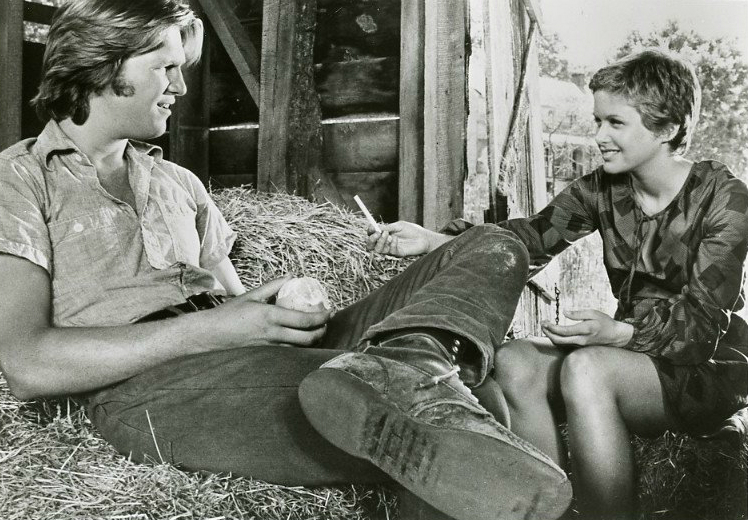
LOLLY-MADONNA XXX aka THE LOLLY-MADONNA WAR (US - 1973) Directed by Richard C. Sarafian. Written by Rodney Carr-Smith and Sue Grafton. Cast: Rod Steiger, Robert Ryan, Jeff Bridges, Scott Wilson, Season Hubley, Gary Busey, Joan Goodfellow, Tresa Hughes, Paul Koslo, Ed Lauter, Kiel Martin, Randy Quaid, Timothy Scott, Katherine Squire. (PG, 106 mins) In the years before her career took off in 1982 with A is for Alibi, the first of her ongoing "alphabet mysteries" (the 24th, titled simply X, was released last year), novelist Sue Grafton worked primarily in television, writing numerous made-for-TV movies in addition to being a creative force behind Michael Learned's post-WALTONS CBS series NURSE. She made the move to TV in an effort to polish her plotting and character-building skills after her first two books tanked. Her second novel, The Lolly-Madonna War, was published overseas in 1969 with little fanfare, not even attracting interest from a US publisher. British writer/producer Rodney Carr-Smith (BARTLEBY) bought the movie rights and brought it to MGM in an attempt to establish himself in America (still unpublished in the US, The Lolly-Madonna War remains Grafton's most obscure novel, and used mass market paperback import copies currently range from $423 to $880 on Amazon). Carr-Smith collaborated with Grafton on the screenplay adaptation and the film version was rechristened as the ill-advised LOLLY-MADONNA XXX, which didn't do it any favors as many confused moviegoers and theater owners may have understandably mistaken it for a porno. The title refers to a signature on a postcard, with the "xxx" being "kisses," but it proved problematic enough that MGM pulled the film and relaunched it under its original book title as the more straightforward THE LOLLY-MADONNA WAR (and judging from the trailer, it was also titled FIRE IN THE MEADOW at some point prior to its release), though the LOLLY-MADONNA XXX title is what it's most commonly known as today. Under either title, the movie bombed and Carr-Smith's adventures in Hollywood, as well as his career in cinema, came to an abrupt end.
A then-contemporary take on the feud between the Hatfields and the McCoys, updated to rural backwoods Tennessee, LOLLY-MADONNA XXX opens with young Roonie Gill (Season Hubley) switching buses in a podunk town on her way to Nashville and being mistaken for Lolly-Madonna, the supposed fiancee of Ludie Gutshall (Kiel Martin). Roonie is abducted from the bus stop by Thrush (Scott Wilson) and Hawk Feather (a never-better Ed Lauter), two sons of Laban Feather (Rod Steiger), who's in a property dispute with former best friend and rival moonshiner Pap Gutshall (Robert Ryan, in one of his last films; he died less than five months after it was released). Correctly assuming Feather's dumb sons would take the bait and head to the bus stop, Ludie put a forged postcard from a non-existent "Lolly-Madonna" in the Feather mailbox (right next to the Gutshalls on the roadside), asking to be picked up, giving Ludie and two other Gutshall sons, Zeb (Gary Busey) and Villum (Paul Koslo), time to run up to the Feather still and vandalize it. This is just one in a series of escalating back-and-forth pranks that the Feather and Gutshall sons have been playing for the last couple of years, as the bond between the families has deteriorated to the point where star-crossed lovers Skyler Feather (Timothy Scott) and Sister E. Gutshall (Joan Goodfellow) are forced to carry on their relationship in secret. Things headed south after Gutshall's other daughter married Zack Feather (Jeff Bridges) and was killed in a horse-riding accident that Laban blamed on black sheep Thrush. Following Gutshall's purchase of a disputed piece of land that went up for auction when Feather owed back taxes on it, tensions have done nothing but flare and it's only made worse by the presence of Roonie, who is held captive by the Feathers and can't convince Laban or any of his sons--even Zack, with whom she falls in love in what may be a case of Stockholm Syndrome--that she's not Lolly-Madonna and has no idea who the Gutshalls are.
LOLLY-MADONNA XXX is a strange and often twisted film that somehow got a PG rating in 1973 despite some grim and disturbing developments as things take a decidedly dark turn. Ludie confronts Thrush and cracks his skull open with a rock, requiring stitches. Heading to the hills for a clandestine dalliance with Skyler, Sister E. is spotted by Thrush and Hawk (the latter with his face smeared in Roonie's makeup and wearing her bra and granny panties), who attack her and take turns raping her. Pap demands justice for his daughter's rape and wants Thrush and Hawk whipped, which only enrages Laban as the violence and lunacy intensifies and the Feather patriarch sets the disputed piece of land ablaze while leading his clan in a sing-along of "For He's a Jolly Good Fellow." Eventually, Pap and his sons--with the exception of pacifist Zeb, who goes behind his father's back and attempts to broker a truce with an unconvinced Zack, pack an arsenal of weapons to launch an assault on the Feather homestead.
Directed by journeyman Richard C. Sarafian (VANISHING POINT), LOLLY-MADONNA XXX is surprisingly strong stuff that would probably get an R rating even today with the mostly-implied but still unsettling rape scene (it's actually more effective that Sarafian cuts away just as it's about to get really unpleasant), the bloody violence, and fleeting nudity by both Hubley and Goodfellow. Though it prefigured oncoming hillbilly-centered films like GATOR BAIT by a couple of years and the great SOUTHERN COMFORT by eight, it feels a lot like a big-studio version of a really grimy drive-in hicksploitation flick, almost like THE WALTONS-meets-DELIVERANCE, definitely revealing an unexpected side to Sue Grafton's writing if you're only familiar with her very mainstream mystery novels. The climax--a long, protracted, Sam Peckinpah-meets-Walter Hill-style shootout where all hell breaks loose while a catatonic and insane Laban can do nothing other than silently stew at the kitchen table and angrily make himself a mayonnaise-and-ketchup sandwich--is the kind of batshit craziness that did little to win LOLLY-MADONNA XXX any fans then but makes it a terrific and bizarre curio item today (one of Hollywood's great overactors, Steiger is one of the very few people who can overdo the act of pouring ketchup). It's hard to believe there was once a time when a character played by a young and still-serious Gary Busey (in just his fourth film) would function as the most stable and level-headed voice of reason in a movie (speaking of crazy, a young Randy Quaid is also on hand as a mentally-challenged Feather son). Despite its more exploitative elements, there's certainly an anti-war Vietnam era metaphor to LOLLY-MADONNA XXX in the way Laban and Pap express concern over what's going on but do absolutely nothing to stop it, instead being complicit in its escalation and content to let their sons do the fighting and the dying. Vietnam is also directly invoked by Pap Gutshall having lost a son in combat and Zack Feather being established as a draft dodger. Even by the standards of the more adventurous, chance-taking cinema of the post-EASY RIDER, pre-summer blockbuster 1970s, LOLLY-MADONNA XXX is one of the weirder movies to come from a major studio in that era and is worth seeing on that basis alone, and even more so when you look at that fascinating mix of old-school Hollywood and up-and-coming youngsters. Shortly after completing this film, Ryan and Bridges would work together again on John Frankenheimer's THE ICEMAN COMETH, released several months after Ryan's death from lung cancer.
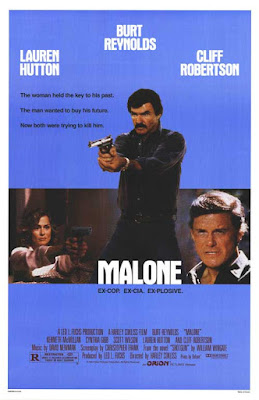
MALONE (US - 1987) Directed by Harley Cokliss. Written by Christopher Frank. Cast: Burt Reynolds, Cliff Robertson, Lauren Hutton, Kenneth McMillan, Cynthia Gibb, Scott Wilson, Philip Anglim, Tracey Walter, Dennis Burkley, Alex Diakun, Brooks Gardner, Mike Kirton, Blu Mankuma, Don Davis. (R, 92 mins) "Got a name?" "Malone." "Got a first name?" "Yeah."
From the late '70s and into the early '80s, Burt Reynolds was the top box-office draw in America. The busy actor appeared in two to three movies a year, and there was rarely a time when a Burt movie wasn't in theaters. But after a while, his base grew fatigued with increasingly lazy efforts like 1983's STROKER ACE and 1984's CANNONBALL RUN II. 1984's CITY HEAT, a much-anticipated teaming with Clint Eastwood, the other biggest movie star in America, proved to be a disappointment for both actors, but it would be far more devastating to Reynolds than your average box-office underperformer. While filming a fight scene, Reynolds was supposed to be hit across the face with a lightweight, breakaway prop chair. Somehow, the prop chair was replaced with a real one and Reynolds was hit in the face with it at full force. His jaw broke on impact, requiring extensive surgery that kept his mouth wired shut for months, forcing him on a liquid diet and later resulting in an addiction to painkillers. It took over two years for him to recover, during which time Hollywood and many of his friends abandoned him and tabloids had a field day with the rumors about his health and his weight loss. Reports stated that he was dying of either cancer or AIDS. Reynolds had his long-delayed Elmore Leonard adaptation STICK in theaters in 1985, but it was actually shot in late 1983, prior to CITY HEAT and the jaw incident. Other than a cameo in his buddy Mel Tillis' 1986 comedy UPHILL ALL THE WAY, Reynolds was offscreen until the release of HEAT in March 1987. Savaged by critics and ignored by audiences, HEAT was a troubled production that cycled through three directors--Robert Altman quit after one day, his replacement Dick Richards made most of the film before quitting after an on-set physical altercation with Reynolds, and then TV vet Jerry Jameson finished it; director credit went to "R.M. Richards"--and opened in 11th place. In three years, Reynolds went from box office king to Hollywood pariah. Burt was back and he was in good shape, healthy, and fully recovered, but HEAT's paltry gross left little doubt: nobody cared.
HEAT was the first of three comeback vehicles Reynolds had lined up for 1987. The second was MALONE, opening less than two months after HEAT. The results were almost identical: MALONE opened in 11th place and grossed $3 million before quickly disappearing from theaters. HEAT grossed just under $3 million but both were stunning freefalls from the blockbuster revenue generated by Reynolds films over the preceding decade or so (even CANNONBALL RUN II grossed $28 million in theaters and that was considered weak by Reynolds standards in 1984). HEAT and MALONE bombed so badly that the third Burt comeback movie, RENT-A-COP, which paired him with Liza Minnelli, saw its wide release nixed and was unceremoniously bumped to January 1988, grossing $300,000 on just 200 screens. The idea of a megastar like Reynolds being downgraded to a limited release was almost unheard-of in 1988, but the message came through loud and clear: moviegoers no longer gave a shit about Burt Reynolds.
Of course, Reynolds has proven himself to be nothing if not resilient. There was an undeniable "pile-on" mindset in the way critics approached Reynolds films during his 1987-and-onward return to the big screen, and these films during his darkest period (at least to that time) aren't nearly as bad as their reputations would suggest. HEAT has aged well as a character piece, and 1988's THE FRONT PAGE/HIS GIRL FRIDAY remake SWITCHING CHANNELS is a perfectly enjoyable screwball comedy that shows Burt in fine form engaging in witty, rapid-fire repartee with Kathleen Turner and Christopher Reeve. Even a dull misfire like 1989's PHYSICAL EVIDENCE has a decent Reynolds performance for completists. Reynolds got some of his best reviews in years in the low-key 1989 indie BREAKING IN, which led to the short-lived ABC series B.L. STRYKER before Reynolds' career saw a major resurgence in 1990 with the CBS sitcom EVENING SHADE, and this was all prior to his Oscar-nominated career-best performance in 1997's BOOGIE NIGHTS.
Just out on Blu-ray from Kino Lorber, MALONE opens with burned-out covert ops CIA agent Malone (Reynolds) unable to pull the trigger on his latest target. He informs his handler/lover Jamie (Lauren Hutton, Reynolds' GATOR co-star) that he's leaving the agency. "You know too much! You can't just walk away!" she implores. "Watch me," Malone glumly replies. Driving with no particular place to go, Malone finds himself stranded in a small town in rural Oregon when his car breaks down. Malone befriends Vietnam vet mechanic Paul (Scott Wilson) and his spunky late teens daughter Jo (Cynthia Gibb). Paul is one of the last remaining holdouts, refusing to sell his business and his property to Charles Delaney (Cliff Robertson), a paranoid, far-right zealot who's taking over the town and turning it into his base of operations for his plot to "take America back." Delaney has assembled a cabal of one-percenters with the intent of getting himself a Senate seat and bringing down the US government. As Paul, Jo, and Malone are repeatedly hassled by Delaney's goons, Malone finds himself in a classic SHANE situation, helping them protect their property (and trying hard to not succumb to Jo's obvious crush on him) while being the only one tough enough to stand up to Delaney--who keeps a tight leash on useless Sheriff Hawkins (Kenneth McMillan) and thinks Malone was sent there to kill him--and amassing a blood-splattered body count in the process. Malone's troubles don't end there: once news that Malone has surfaced reaches the CIA, the powers that be dispatch Jamie to eliminate him.
An on-set photo from MALONE posted on actress
Cynthia Gibb's web site. Gibb on Burt:
"He made me feel like an equal on set
when I was still such a novice."
MALONE adheres to the SHANE template pretty closely, with some additional FIRST BLOOD in the way that the asshole sheriff keeps trying to run Malone out of town. It's also interesting to note how, even in the context of the jingoistic, "Born in the U.S.A." Reagan era of 1987, Delaney is clearly presented as a psychotic, delusional, and dangerous madman, and an ideological relative of John P. Ryan's similarly politically insane villain in the 1986 Cannon classic AVENGING FORCE. Forget the Senate--today, Charles Delaney's beliefs and statements would likely catapult him straight to 2016 GOP Presidential front-runner. Based on the novel Shotgun by William Wingate, MALONE's credited screenwriter is Christopher Frank, a British novelist who spent most of his career working in French cinema (he wrote the post-BREATHLESS Valerie Kaprisky film L'ANNEE DES MEDUSES). Reynolds said in an interview around the time of MALONE's release that the project originated in Europe and was intended for Gerard Depardieu and then Christopher Lambert before it exchanged hands and ended up in Hollywood with him. Frank's script was reworked for Reynolds by an uncredited Rudy Wurlitzer, best known for writing Monte Hellman's TWO-LANE BLACKTOP (1971) and Sam Peckinpah's PAT GARRETT AND BILLY THE KID (1973). MALONE was directed by American journeyman Harley Cokliss, whose past credits included the post-nuke WARLORDS OF THE 21ST CENTURY (1982) and the John Carpenter-scripted BLACK MOON RISING (1986), in addition to serving as a second-unit director on THE EMPIRE STRIKES BACK (1980). Cokliss never really distinguished himself enough to rise above the level of C-lister, though his 1988 British horror film DREAM DEMON, which took several years to get a straight-to-video release in the US, was written by the venerable Christopher Wicking and was one of the more ambitious NIGHTMARE ON ELM STREET ripoffs. He's worked very sporadically in TV and mostly unseen movies from 2000 on, but in the early '90s, Cokliss pulled a "Fronk-en-steen" and started calling himself "Harley Cokeliss," presumably to ensure the correct pronunciation and to prevent people from snickering at "Cokliss."
Reynolds at the Philadelphia Comic Con in May 2015