tenebre

tenebre
Showing posts with label Jeff Bridges. Show all posts

Monday, October 15, 2018

In Theaters: BAD TIMES AT THE EL ROYALE (2018)


BAD TIMES AT THE EL ROYALE
(US - 2018)

Written and directed by Drew Goddard. Cast: Jeff Bridges, Cynthia Erivo, Chris Hemsworth, Dakota Johnson, Jon Hamm, Cailee Spaeny, Lewis Pullman, Nick Offerman, Xavier Dolan, Shea Whigham, Mark O'Brien, Jim O'Heir, Charles Halford, Manny Jacinto, Tally Rodin, William B. Davis, Katharine Isabelle. (R, 141 mins)

A cursory glance at the trailer for BAD TIMES AT THE EL ROYALE would suggest a throwback to the kinds of winking, referential neo-noirs that were commonplace in the post-Tarantino craze of two decades ago (THINGS TO DO IN DENVER WHEN YOU'RE DEAD, 2 DAYS IN THE VALLEY, etc). It's actually more in line with the later phase of Tarantino's career that gave us a motor-mouthed chamber piece like THE HATEFUL EIGHT, but even that isn't a completely accurate assessment since it's not nearly as self-indulgent. Written and directed by J.J. Abrams and Joss Whedon protege Drew Goddard (screenwriter of CLOVERFIELD and THE MARTIAN), EL ROYALE shares many themes and motifs as his previous directing effort, the meta genre deconstruction THE CABIN IN THE WOODS, so much so that as the story begins to play out and the sense of paranoia kicks in, you almost wouldn't be shocked to find Richard Jenkins and Bradley Whitford observing the goings-on from a secret installation at an undisclosed location and placing bets on who makes it to the end. Goddard also blatantly patterns the structure on vintage Tarantino by dividing the film into chapters and frequently going backwards in the narrative to fill in what was going in at the same time other events have happened, but for the most part, EL ROYALE manages to be its own unique work despite Tarantino's unavoidable influence. It's got a clever, twisty structure with a ton of genuine surprises, a dark sense of humor, shocking bursts of violence, and a game cast, but at nearly two and a half hours, it starts to run on fumes by the end, and the payoff ultimately isn't on the same level as the intricately constructed, densely-plotted build-up.


In a prologue, a man (Nick Offerman) rents a room, pries up the floorboards and stashes a bag full of money before being blown away by an unknown assailant. Cut ahead ten years and it's 1969, and a group of strangers arrive one by one at the El Royale, a dilapidated Lake Tahoe motor lodge that literally straddles the state line, its lobby split down the middle between California and Nevada. There's aspiring singer Darlene Sweet (Cynthia Erivo), who's on her way to Reno for a low-paying gig; aging priest Father Daniel Flynn (Jeff Bridges), who says he's visiting his brother in Oakland; obnoxious, good ol' boy vacuum cleaner salesman Laramie Seymour Sullivan (Jon Hamm); and Emily Summerspring (Dakota Johnson), a hippie with a bad attitude who signs the check-in registry with a "Fuck You." The El Royale has seen better days, having lost its gambling license a year earlier, and there only seems to be one employee running the place in frazzled desk clerk Miles Miller (Lewis Pullman), who frequently goes MIA and ignores the bell, leaving the guests to serve themselves coffee and drinks from the bar. Once in their rooms, it's clear that all of them have something to hide and aren't who they claim to be. Sullivan drops the overbaked Southern accent and makes a phone call before locating and dismantling dozens of bugging devices from everywhere in his room. He finds Miles passed out with a needle in his arm, and in a long, single-take sequence, ventures down a secret corridor behind the office, where he's able to see into each room through a one-way mirror. Darlene is singing, Father Flynn--clearly not a real priest--is tearing up the floorboards, and Emily is dragging a bound and gagged young woman (Cailee Spaeny) in from the trunk of her car. Sullivan goes to a nearby pay phone and calls the FBI. He mentions the apparent kidnapping and is told that "Mr. Hoover" wants him to disregard it, stick to his assignment, make sure no one leaves, and retrieve what he's there to find.


Shot on actual film and with a Michael Giacchino score that often sounds affectionately reminiscent of Bernard Herrmann, BAD TIMES AT THE EL ROYALE is often just as indebted to Hitchcock as it is Tarantino, particularly PSYCHO with its motel setting and the character getting the most screen time in the early going being unexpectedly killed off before the midway point. Others will find the secret corridor and see things they aren't supposed to see, which seems to be the entire purpose of the El Royale's continued existence, a place where bad things go down and equipment is in place to record it all. A classic MacGuffin comes into play in the form of a stag film shot from behind the one-way-mirror looking into one of the rooms, dating back several years and featuring someone both prominent and dead. BAD TIMES AT THE EL ROYALE keeps piling on the twists and turns and is an absolute blast until Goddard loses his way with the third-act, dark-and-stormy-night introduction of Billy Lee (Chris Hemsworth), a charismatic, Manson-like cult leader who arrives with murderous goons in tow to find one of his flock who got away from him and is keen to stick around once he sees there's a bag of loot and a potential blackmail reel involved. It's no fault of Hemsworth, who attacks the role with amused gusto, but Billy Lee is a two-dimensional villain with too little screen time to make an impact. So instead of creating a fully-developed character like the ones we've been able to get to know, Goddard lets Hemsworth ham it up and show off by smirking and strutting to Deep Purple's "Hush," while he holds everyone captive and plays roulette with their lives as the film turns into a rote, generic "terrorizing the hostages" scenario.


It's a shame Goddard couldn't figure out a way to give keep the same level of intensity and bring the story to a conclusion worthy of its set-up, but the first 2/3 of the film is so good that the less-inspired and comparatively weak final third can't help but end with a fizzled shrug. It isn't a complete deal-breaker and it's still recommended, but part of the problem is that there's simply no reason for this film to be as long as it is. But it's beautifully shot, has some wonderful production design, and the cast is terrific, particularly Erivo (a Tony-winner for 2015's Broadway musical version of THE COLOR PURPLE) and national treasure Bridges, who lends a convincing weariness to a bad guy who maybe has some redeeming qualities after all. In the end, BAD TIMES AT THE EL ROYALE averages out to a film that's quite good, but for an hour and a half, it flirts with being a great one.

Tuesday, August 30, 2016

In Theaters: HELL OR HIGH WATER (2016)


HELL OR HIGH WATER
(US - 2016)

Directed by David Mackenzie. Written by Taylor Sheridan. Cast: Jeff Bridges, Chris Pine, Ben Foster, Gil Birmingham, Marin Ireland, Katy Mixon, Dale Dickey, Kevin Rankin, John-Paul Howard, Margaret Bowman, Taylor Sheridan. (R, 102 mins)

A strong, character-driven thriller that emerged as a summer sleeper after being rolled out the old-fashioned way--limited release over a few weeks and expanding nationally with strong word-of-mouth--HELL OR HIGH WATER is a timely drama about family, duty, poverty, and getting revenge on the system. It does get a little ham-fisted on occasion, with characters required to give a florid speech every now and again as they look at a bank and vent their anger at everything it represents, but director David Mackenzie (YOUNG ADAM, MISTER FOE) and screenwriter Taylor Sheridan (SICARIO) excel at creating very real people that the audience comes to know thoroughly over the course of the film. Unemployed gas driller Toby Howard (Chris Pine) and his bank-robbing, ex-con older brother Tanner (Ben Foster) are hitting the small-town branches of the regional Texas Midlands Bank, usually before open as an employee arrives and never taking packs of money, only the loose bills in the tills. They get away, bury the car, and move on to the next town. Meanwhile, wily old Texas Ranger Marcus Hamilton (Jeff Bridges) is looking at forced retirement but wants to nail the robbers first ("I may have one hunt left in me"), following their criminal path with his Mexican/Native American partner Alberto Parker (Gil Birmingham). As they make their way across the state toward Oklahoma, the Howard brothers are almost undone by Tanner's impulsive behavior that includes a reckless, spur-of-the-moment robbery while Toby is picking up the check at a diner across the street. Hamilton is stymied in his pursuit by behind-the-times Texas Midlands, with two of the targeted branches not having an electronic surveillance system, instead relying on a VHS recorder that's not even working. The robberies are masterminded by Toby, with Tanner tagging along because he's experienced. Their mother recently passed away and Texas Midlands was threatening foreclosure even as she quickly withered away from terminal cancer. Toby's ultimate plan for the stolen cash is an inventive one, and he does it with the best intentions--to provide his two sons with his bitter ex-wife Debbie (Marin Ireland) the kind of life he and Tanner never had. He's breaking the law to break the cycle of poverty that, as is the case with so many others in these desolate nether regions of rural America, has been passed on from generation to generation.


HELL OR HIGH WATER recognizes the noble reasoning behind Toby's actions but never makes him or Tanner heroes, even though the locals questioned by Hamilton and Parker are all too happy to see Texas Midlands get screwed. The only clear villains of the piece are those in the financial sector, who are treated with scorn and condescension by everyone, even Hamilton, who arrives at one crime scene, sees a well-dressed manager and gruffly intones "Well, let's talk to this guy here, he looks like someone who can foreclose on a home." Pine and Foster are excellent as the sibling bank robbers, and even a trigger-happy loose cannon like Tanner is humanized to some degree and not played as a stock psycho by Foster.  But HELL OR HIGH WATER's biggest joys are provided by the national treasure that is Jeff Bridges. It's another Oscar-caliber performance, on the same level of burned-out melancholy as Tommy Lee Jones' Ed Tom Bell in NO COUNTRY FOR OLD MEN but given a more gregarious manner in his rapport with Parker. Indeed, the testy ballbusting between Hamilton and Parker is hands-down the bromance of the year, so much so that you could easily watch an entire movie of Bridges and Birmingham in character, just sitting around dogging on each other. Whether it's Parker getting on Hamilton about his age ("You gonna do somethin' or just relax and let Alzheimer's run its course?") or Hamilton's constant razzing about Parker's dual ethnicities ("I haven't even gotten to my Mexican insults yet. I'm still on the Indian ones."), these two have an unspoken respect and dedication to one another ("You're gonna miss me pickin' on you," Hamilton tells Parker), an ironclad bond that makes events that transpire utterly heartbreaking.


Like other recent indie films that have addressed foreclosure and those doomed to struggle in a vicious cycle of being screwed and marginalized by the system (SUNLIGHT JR and 99 HOMES come to mind), HELL OR HIGH WATER is filmed in areas that have been hit hard, augmented by a downbeat score courtesy of Nick Cave and Warren Ellis. Abandoned houses and boarded-up businesses line the streets. Old-timers are embittered, beaten-down, and done giving a shit (the "What don't ya want?" T-Bone waitress played by Margaret Bowman is a real crowd-pleaser) and young people just cruise around looking for fights (watch Toby handle the two meatheads blasting aggro-metal and waving a gun at Tanner at a gas station). Sheridan was best known as the ill-fated Deputy Hale on SONS OF ANARCHY before he switched careers to screenwriting with SICARIO. In between, he directed VILE, one of the worst horror films ever made, and one that was mentioned a lot on his Facebook page but mysteriously vanished from his IMDb profile and reappeared as the sole credit on another as soon as SICARIO started getting some positive buzz (c'mon, man--if James Cameron can own up to PIRANHA II: THE SPAWNING, you can admit to VILE). His hapless attempts at scrubbing his past aside, Sheridan has proven himself adept at creating believable, fully-rounded characters but it sometimes comes off as a little too scripted and "messagey." It's not enough to be a huge issue, but some more subtlety would've been a good thing in these fleeting moments. In the end, HELL OR HIGH WATER is one of 2016's best, a film that doesn't let anyone off the hook, one filled with nail-biting tension when it counts most and genuine, devastating emotion when you least expect it.

Wednesday, May 25, 2016

Retro Review: LOLLY-MADONNA XXX (1973)


LOLLY-MADONNA XXX
aka THE LOLLY-MADONNA WAR
(US - 1973)

Directed by Richard C. Sarafian. Written by Rodney Carr-Smith and Sue Grafton. Cast: Rod Steiger, Robert Ryan, Jeff Bridges, Scott Wilson, Season Hubley, Gary Busey, Joan Goodfellow, Tresa Hughes, Paul Koslo, Ed Lauter, Kiel Martin, Randy Quaid, Timothy Scott, Katherine Squire. (PG, 106 mins)

In the years before her career took off in 1982 with A is for Alibi, the first of her ongoing "alphabet mysteries" (the 24th, titled simply X, was released last year), novelist Sue Grafton worked primarily in television, writing numerous made-for-TV movies in addition to being a creative force behind Michael Learned's post-WALTONS CBS series NURSE. She made the move to TV in an effort to polish her plotting and character-building skills after her first two books tanked. Her second novel, The Lolly-Madonna War, was published overseas in 1969 with little fanfare, not even attracting interest from a US publisher. British writer/producer Rodney Carr-Smith (BARTLEBY) bought the movie rights and brought it to MGM in an attempt to establish himself in America (still unpublished in the US, The Lolly-Madonna War remains Grafton's most obscure novel, and used mass market paperback import copies currently range from $423 to $880 on Amazon). Carr-Smith collaborated with Grafton on the screenplay adaptation and the film version was rechristened as the ill-advised LOLLY-MADONNA XXX, which didn't do it any favors as many confused moviegoers and theater owners may have understandably mistaken it for a porno. The title refers to a signature on a postcard, with the "xxx" being "kisses," but it proved problematic enough that MGM pulled the film and relaunched it under its original book title as the more straightforward THE LOLLY-MADONNA WAR (and judging from the trailer, it was also titled FIRE IN THE MEADOW at some point prior to its release), though the LOLLY-MADONNA XXX title is what it's most commonly known as today. Under either title, the movie bombed and Carr-Smith's adventures in Hollywood, as well as his career in cinema, came to an abrupt end.


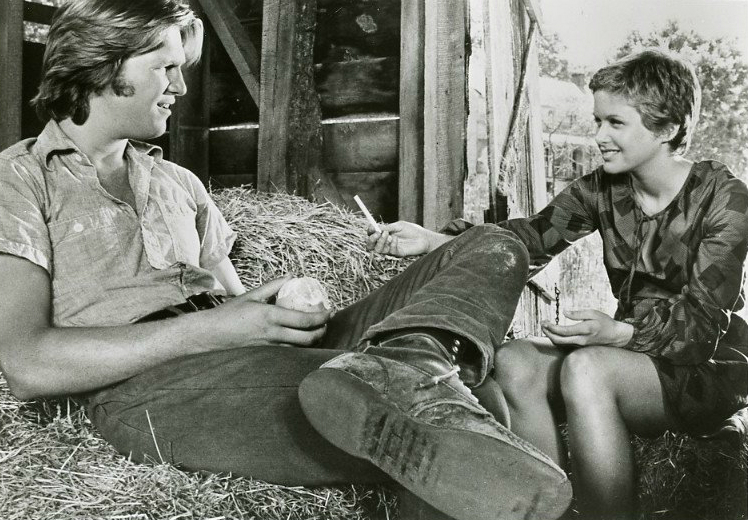
A then-contemporary take on the feud between the Hatfields and the McCoys, updated to rural backwoods Tennessee, LOLLY-MADONNA XXX opens with young Roonie Gill (Season Hubley) switching buses in a podunk town on her way to Nashville and being mistaken for Lolly-Madonna, the supposed fiancee of Ludie Gutshall (Kiel Martin). Roonie is abducted from the bus stop by Thrush (Scott Wilson) and Hawk Feather (a never-better Ed Lauter), two sons of Laban Feather (Rod Steiger), who's in a property dispute with former best friend and rival moonshiner Pap Gutshall (Robert Ryan, in one of his last films; he died less than five months after it was released). Correctly assuming Feather's dumb sons would take the bait and head to the bus stop, Ludie put a forged postcard from a non-existent "Lolly-Madonna" in the Feather mailbox (right next to the Gutshalls on the roadside), asking to be picked up, giving Ludie and two other Gutshall sons, Zeb (Gary Busey) and Villum (Paul Koslo), time to run up to the Feather still and vandalize it. This is just one in a series of escalating back-and-forth pranks that the Feather and Gutshall sons have been playing for the last couple of years, as the bond between the families has deteriorated to the point where star-crossed lovers Skyler Feather (Timothy Scott) and Sister E. Gutshall (Joan Goodfellow) are forced to carry on their relationship in secret. Things headed south after Gutshall's other daughter married Zack Feather (Jeff Bridges) and was killed in a horse-riding accident that Laban blamed on black sheep Thrush. Following Gutshall's purchase of a disputed piece of land that went up for auction when Feather owed back taxes on it, tensions have done nothing but flare and it's only made worse by the presence of Roonie, who is held captive by the Feathers and can't convince Laban or any of his sons--even Zack, with whom she falls in love in what may be a case of Stockholm Syndrome--that she's not Lolly-Madonna and has no idea who the Gutshalls are.


LOLLY-MADONNA XXX is a strange and often twisted film that somehow got a PG rating in 1973 despite some grim and disturbing developments as things take a decidedly dark turn. Ludie confronts Thrush and cracks his skull open with a rock, requiring stitches. Heading to the hills for a clandestine dalliance with Skyler, Sister E. is spotted by Thrush and Hawk (the latter with his face smeared in Roonie's makeup and wearing her bra and granny panties), who attack her and take turns raping her. Pap demands justice for his daughter's rape and wants Thrush and Hawk whipped, which only enrages Laban as the violence and lunacy intensifies and the Feather patriarch sets the disputed piece of land ablaze while leading his clan in a sing-along of "For He's a Jolly Good Fellow." Eventually, Pap and his sons--with the exception of pacifist Zeb, who goes behind his father's back and attempts to broker a truce with an unconvinced Zack, pack an arsenal of weapons to launch an assault on the Feather homestead.


Directed by journeyman Richard C. Sarafian (VANISHING POINT), LOLLY-MADONNA XXX is surprisingly strong stuff that would probably get an R rating even today with the mostly-implied but still unsettling rape scene (it's actually more effective that Sarafian cuts away just as it's about to get really unpleasant), the bloody violence, and fleeting nudity by both Hubley and Goodfellow. Though it prefigured oncoming hillbilly-centered films like GATOR BAIT by a couple of years and the great SOUTHERN COMFORT by eight, it feels a lot like a big-studio version of a really grimy drive-in hicksploitation flick, almost like THE WALTONS-meets-DELIVERANCE, definitely revealing an unexpected side to Sue Grafton's writing if you're only familiar with her very mainstream mystery novels. The climax--a long, protracted, Sam Peckinpah-meets-Walter Hill-style shootout where all hell breaks loose while a catatonic and insane Laban can do nothing other than silently stew at the kitchen table and angrily make himself a mayonnaise-and-ketchup sandwich--is the kind of batshit craziness that did little to win LOLLY-MADONNA XXX any fans then but makes it a terrific and bizarre curio item today (one of Hollywood's great overactors, Steiger is one of the very few people who can overdo the act of pouring ketchup). It's hard to believe there was once a time when a character played by a young and still-serious Gary Busey (in just his fourth film) would function as the most stable and level-headed voice of reason in a movie (speaking of crazy, a young Randy Quaid is also on hand as a mentally-challenged Feather son). Despite its more exploitative elements, there's certainly an anti-war Vietnam era metaphor to LOLLY-MADONNA XXX in the way Laban and Pap express concern over what's going on but do absolutely nothing to stop it, instead being complicit in its escalation and content to let their sons do the fighting and the dying. Vietnam is also directly invoked by Pap Gutshall having lost a son in combat and Zack Feather being established as a draft dodger. Even by the standards of the more adventurous, chance-taking cinema of the post-EASY RIDER, pre-summer blockbuster 1970s, LOLLY-MADONNA XXX is one of the weirder movies to come from a major studio in that era and is worth seeing on that basis alone, and even more so when you look at that fascinating mix of old-school Hollywood and up-and-coming youngsters. Shortly after completing this film, Ryan and Bridges would work together again on John Frankenheimer's THE ICEMAN COMETH, released several months after Ryan's death from lung cancer.


Sunday, February 8, 2015

In Theaters: SEVENTH SON (2015)


SEVENTH SON
(US/China - 2015)

Directed by Sergei Bodrov. Written by Charles Leavitt and Steven Knight. Cast: Jeff Bridges, Julianne Moore, Ben Barnes, Djimon Hounsou, Alicia Vikander, Kit Harington, Olivia Williams, Antje Traue, Jason Scott Lee, John DeSantis, Gerard Plunkett, Kandyce McClure, Luc Roderique, Zahf Paroo. (PG-13, 102 mins)

Filmed way back in 2012 and bounced around the schedule since its first announced release date of February 2013, the $100 million SEVENTH SON has finally arrived with some of the lowest expectations this side of 47 RONIN. The original release date was postponed after one of the film's primary companies in charge of the visual effects went bankrupt. After that was sorted out, the first official trailer appeared in theaters in July 2013, followed by numerous release date shuffles pushing the movie into 2014. Some time later, Legendary Pictures ended their partnership with distributor Warner Bros., setting up a new deal with Universal, who bumped SEVENTH SON to February 2015, likely to afford it a reasonable opportunity to distance itself from the 47 RONIN debacle of Christmas 2013. The train-wreck potential on this one is pretty high, but its primary offenses are shoddy visuals, sloppy writing, and a strict adherence to a stale formula. Despite the buckets of money thrown on the screen, SEVENTH SON doesn't look any better than one of Uwe Boll's straight-to-DVD IN THE NAME OF THE KING sequels, with some alarmingly unimpressive greenscreen backdrops and the daytime exteriors given the same kind of blurry, smeary soft focus that ABC News uses on Barbara Walters and Diane Sawyer.


Based on Joseph Delaney's 2004 novel The Spook's Apprentice (retitled The Last Apprentice: Revenge of the Witch in the US), the first part of the "Wardstone Chronicles" (UK)/"Last Apprentice" (US) medieval fantasy series (now up to 13 books, plus several spinoff novels), SEVENTH SON deals with Master Gregory (Jeff Bridges), a wise old warrior fighting the supernatural. Known as a "spook," he's the last of his kind, the sole survivor of a legion of warriors defeated by evil. Now a mercenary witch hunter, Gregory is called back into action when Mother Malkin (Julianne Moore), a nefarious spellcaster he imprisoned in a mountain dungeon decades earlier, escapes and kills his apprentice Bradley (Kit Harington). Mother Malkin, who frequently shapeshifts into a dragon, is set to reclaim her throne and unleash her evil over the world upon the rise of the Blood Moon, a once-per-century lunar event that happens to be a week away. Gregory needs a new apprentice, a seventh son of a seventh son, which leads him to earnest farm boy Tom Ward (Ben Barnes). Tom leaves his family to join Gregory in his quest, falling in love with Alice (Alicia Vikander), the half-witch niece of Mother Malkin. As Gregory trains Tom in the ways of being a spook--of course they initially butt heads but come to a mutual respect--they're joined by Gregory's faithful servant Tusk (John DeSantis) and prepare for battle against Mother Malkin, who's assembling her army of fellow shapeshifting witches and warlocks in order for evil to reign supreme at the coming of the Blood Moon.


No stranger to planned franchises that stall after one film, director Sergei Bodrov--well-respected in Russian and, since the 1991 dissolution of the Soviet Union, Kazakh cinema--is best known to arthouse audiences for his Genghis Khan epic MONGOL (2008), the first installment of an announced trilogy whose second chapter has yet to materialize. It's hard to say what drew the 64-year-old Bodrov to a mega-budget Hollywood blockbuster-type project 40 years into his filmmaking career (he also directed PRISONER OF THE MOUNTAINS, a 1996 Oscar-nominee for Best Foreign Language Film), but the look and feel of SEVENTH SON is purely that of a B-grade LORD OF THE RINGS knockoff, from the inevitable swooping, circular aerial shots of the heroes walking along hills and mountaintops to the sage old mentor instructing a naive, impulsive pupil. The bland Barnes, who's seen whatever momentum he had going from being THE CHRONICLES OF NARNIA's Prince Caspian derailed by films shelved for anywhere from two (THE BIG WEDDING) to three (this) to even five years (LOCKED IN), was 31 at the time of filming and looks a good decade too old for his role. Barnes, currently the British guy you go to after Andrew Garfield, Jim Sturgess, Aaron Taylor-Johnson, and Alex Pettyfer turn you down, is largely indistinguishable from his CGI surroundings, and in many scenes, he and the supporting cast appear to be looped in a way that's just ever-so-slightly off, giving a certain slapdash feel to the proceedings. It's especially noticeable with Swedish Vikander and German Antje Traue (as Mother Malkin's witch sister), who are clearly dubbed with different voices in some scenes, and speak with their own audible accents in others. This, along with some later scenes where Barnes' hairstyle and Bridges' hair color have changed, are obvious indicators of hasty reshoots.


Even Moore flubs it at times, using a comically regal tone most of the time and occasionally slipping into her normal way of speaking. She goes through rants and raves with a look on her face that indicates she's well aware of how dumb all of it sounds, but she trudges through like a pro, as does the great two-time Oscar nominee Djimon Hounsou, who deserves better than a stock henchman role as one of Mother Malkin's supernatural cohorts. It's hard telling what's up with Bridges, who really seems to have stopped trying after his CRAZY HEART Oscar. Bodrov obviously just let Bridges do whatever he wanted to do, which apparently involved playing Master Gregory as a some sort of bizarre mash-up between Gandalf and Karl Childers. Enunciating oddly through a jutted-out lower jaw, Bridges is mannered and hammy, much like he's been since his Oscar-nominated turn as Rooster Cogburn in TRUE GRIT. That was a fine and fun performance in 2010, but a coasting Bridges has just kept delivering it over and over again since. Jeff Bridges is one of the greats and while we all love The Dude, maybe it's time for him to start giving a shit again.


Earlier Warner poster art reflecting just
one of the film's many bumped release dates.
Bridges does get a couple of funny one-liners, but the script--credited to BLOOD DIAMOND screenwriter Charles Leavitt and LOCKE writer/director Steven Knight, who separately rewrote an earlier draft by Matt Greenberg (REIGN OF FIRE)--is all over the place, often feeling like we're watching the sequel to something that doesn't exist, arbitrarily pulling new rules and stipulations out of its ass when it gets backed into a corner, and not even following its own logic: why does Master Gregory even need an apprentice?  He has Tusk, a more than formidable sidekick. And the only time Tom comes to Gregory's rescue is after the pupil's stupidity causes the mentor to be captured in the first place. If Gregory has a week to stop Mother Malkin's Blood Moon-abetted reign of terror, he and Tusk seem more than up to the task--why take all the time to train Tom, who's obviously dead weight until the script needs him to be the hero? Ultimately, all of this "seventh son of a seventh son" malarkey does nothing other than make you wish Iron Maiden was handling the soundtrack duties. On the plus side, SEVENTH SON moves quickly, Bodrov deserves some credit for getting Jason Scott Lee (DRAGON: THE BRUCE LEE STORY) back on the big screen again even if it's a brief role as a warlock who shapeshifts into a giant bear, and I'm sure Bridges and Moore had a great time between takes reminiscing about THE BIG LEBOWSKI. It's just too bad that SEVENTH SON doesn't end NEWHART-style with The Dude waking up from a hazy dream and trying to explain it to an incredulous Maude Lebowski.


Sunday, July 8, 2012

Summer of 1982: TRON (July 9, 1982)


TRON, released by Disney on July 9, 1982, had been in various states of development by writer/director Steven Lisberger since 1976, when the animator was inspired by the game Pong to create a story that fused film and computer animation.  While CGI effects and visuals are commonplace today, the very idea was revolutionary in 1982 and no studio took Lisberger seriously until Disney decided to give him a shot.  Lisberger worked on other projects during that time period (TV shows, commercials, directing the 1980 animated film ANIMALYMPICS), but by 1982, the video game and arcade craze was in full swing, and it only seemed natural that a movie would syngergistically combine the two.  Many critics and prognosticators were wary of TRON, thinking it would change the way movies were made and that everything could just be computer-animated from that point on.  It didn't quite turn out that way, and while it grossed $33 million and made back its budget, it was far from a blockbuster and regarded more as a novelty than the wave of the future.  Critics praised the visuals but panned the storyline, but today, TRON is held in a generally positive light.  Everyone is quick to point out how 1982 it is (and there's songs by Journey!), and by today's standards, the effects in Lisberger's film are primitively retro but the imagination is there, regardless of how badly they've aged.


Jeff Bridges as Flynn


Bruce Boxleitner as Tron

David Warner as Sark


With all the hype about TRON's groundbreaking use of computer animation, that style was really only used for landscapes and vehicles for the scenes inside the mainframe where software designer Flynn (Jeff Bridges) finds himself teaming with Tron (Bruce Boxleitner) in battle against Sark (David Warner).  Most of the imagery involving the actors was achieved with a combination of backlit animation and depth cueing (shooting the actors in high-contrast black & white on a black set), with rotoscoping and other animation techniques to color the actors and fill in the backgrounds of the computer world.  According to Lisberger, this technique was more costly and time-consuming than it would've been to simply animate the whole film.  But for better or worse, TRON is an important film in the evolution of visual effects and CGI.  CGI has made obviously huge strides in the ensuing decades, but many--myself included--feel it isn't quite where it should be considering the extent to which filmmakers rely on it.  But at least with TRON, it was supposed to be in the context of a sci-fi/fantasy world and was justified in looking the way it did.  And it's hard to disregard a film whose look was designed in part by contributions from French comic book artist Moebius and BLADE RUNNER "visual futurist" Syd Mead.


TRON led to numerous product tie-ins, including video games and toys, and led to the belated 2010 sequel TRON: LEGACY, made at a time when CGI technology was finally capable of being used to the extent Lisberger intended in 1982.  Lisberger was only onboard as a producer for TRON: LEGACY (Joseph Kosinski directed it), and has only made two films since TRON:  the John Cusack romantic comedy/adventure HOT PURSUIT (1987), and SLIPSTREAM (1989), a big-budget British-made sci-fi epic with an interesting cast (Ben Kingsley, Mark Hamill, Bill Paxton, and F. Murray Abraham) that ended up bankrupting producer Gary Kurtz, a former Lucasfilm executive (hence the casting of Hamill) who went off on his own after a falling out with George Lucas during the making of THE EMPIRE STRIKES BACK.  Kurtz used his plentiful but apparently not limitless STAR WARS profits to finance SLIPSTREAM, but got divorced in the meantime and lost everything.  SLIPSTREAM ended up going straight to video in the US and has since fallen into the public domain and can be found on numerous $9.99 "50 Sci-Fi Hits!" collections that you find at Wal-Mart.  SLIPSTREAM is no classic, but it really does deserve a little more dignity than that. 


Lisberger hasn't directed a film since SLIPSTREAM, and other than a 2010 Comic Con appearance to promote TRON: LEGACY and doing Q&A's at occasional TRON screenings, he maintains a pretty low profile.  Still, even if he isn't a household name, Steven Lisberger is held in high regard by visual effects artists and technicians for his envelope-pushing work on TRON 30 years ago.  Even the Pixar folks have name-checked him as a major influence and gone on the record in saying that Pixar wouldn't be what it is had TRON not helped pave the way.


TRON director Steven Lisberger being interviewed by Walter Cronkite in 1982.


TOP 10 FILMS FOR THE WEEKEND OF JULY 9, 1982 (from www.boxofficemojo.com):

1.   E.T.: THE EXTRA-TERRESTRIAL
2.   TRON
3.   ROCKY III
4.   FIREFOX
5.   POLTERGEIST
6.   ANNIE
7.   STAR TREK II: THE WRATH OF KHAN
8.   BLADE RUNNER
9.   THE THING
10. THE SWORD AND THE SORCERER

Sunday, March 4, 2012

Cult Classics Revisited: THUNDERBOLT AND LIGHTFOOT (1974)

THUNDERBOLT AND LIGHTFOOT
(US - 1974)

Written and directed by Michael Cimino.  Cast: Clint Eastwood, Jeff Bridges, George Kennedy, Geoffrey Lewis, Catherine Bach, Bill McKinney, Gary Busey, Vic Tayback, Burton Gilliam, Dub Taylor, Gregory Walcott, Roy Jenson. (R, 115 mins)


Even before film critics and historians finally took him seriously after 1992's UNFORGIVEN, Clint Eastwood consistently took chances to show his versatility with offbeat departures and was always more than Dirty Harry and The Man with No Name.  Films like THE BEGUILED, PLAY MISTY FOR ME (both 1971), and BREEZY (1973), the latter directed by but not starring Eastwood, were atypical projects and the same can be said for 1974's character-driven road/buddy movie THUNDERBOLT AND LIGHTFOOT.  The film was a fairly big hit at the time (grossing $25 million, which is around $150 million in 2012 dollars), even though Eastwood reportedly wasn't happy with United Artists' handling of it, nor with the fact that co-star Jeff Bridges got all the attention as well as a Best Supporting Actor Oscar nomination (he lost to THE GODFATHER PART II's Robert De Niro).  This was probably one of the earliest instances that led to Eastwood's tendency to control and backseat-drive the films he wasn't actually credited with directing.  He fired Philip Kaufman a few days into shooting THE OUTLAW JOSEY WALES and took over directing it himself (leading to the DGA's "Eastwood Rule," which essentially forbids a producer, cast, or crew member of a movie from stepping in for a fired director), then notably clashed with mentor Don Siegel on 1979's ESCAPE FROM ALCATRAZ, and relieved director Richard Tuggle of his duties early into shooting 1984's TIGHTROPE, taking over directing but reportedly keeping Tuggle on the set in order to appease the DGA (and does anyone really believe Buddy Van Horn was calling the shots on any of those 1980s Eastwood movies he's credited with directing?).  Eastwood's director on THUNDERBOLT AND LIGHTFOOT was a debuting Michael Cimino, who co-wrote the 1973 DIRTY HARRY sequel MAGNUM FORCE.  Cimino went on to become the toast of Hollywood with 1978's THE DEER HUNTER before almost immediately morphing into an industry pariah with 1980's HEAVEN'S GATE.  Eastwood would get annoyed if Cimino wanted more than three takes, but he seemed to generally stay out of the first-time director's way.  With the exception of 1993's IN THE LINE OF FIRE, directed by Wolfgang Petersen and the only time in the last 40 years that Eastwood was just an actor-for-hire in a film he didn't produce, THUNDERBOLT AND LIGHTFOOT is likely one of the last times he extended that courtesy to someone directing him.

Eastwood is Thunderbolt, a career thief and fugitive who's found by some vengeful cohorts who think he made off with the loot of a previous heist, when in fact, the place where he stashed the money was demolished, and Thunderbolt was never able to recover the money. While fleeing, he's picked up by amiable drifter Lightfoot (Bridges), who's in a Trans-Am that he just stole from used-car dealership.  The two become fast friends, and when two of Thunderbolt's associates--hot-tempered Red Leary (George Kennedy) and dumb Eddie Goody (Geoffrey Lewis)--catch up with them, it's Lightfoot who hatches the plan that they all rob the same place again.

Eastwood and Bridges make a great team, and Cimino's script has a good amount of humor, especially when Kennedy and Lewis turn up later on.  It's not just Bridges who makes a huge impression--a low-key Eastwood manages to be upstaged by all three of his co-stars (Kennedy is hilarious when he tells an obnoxious brat "Look, kid...go fuck a duck").   The tone gets much more serious after the heist, leading to a downbeat, heartbreaking finale that would likely be changed if it were made today.  The film benefits from a lot of eccentric touches and recognizable character actors, like Bill McKinney as a crazy driver with a raccoon in the front seat and a trunk filled with rabbits, Dub Taylor as a cranky gas station attendant, and the sight of Kennedy and Lewis squeezed into a tiny ice cream truck.  I also like the way Thunderbolt and Lightfoot steal the car of a vacationing older couple and spend the rest of the film wearing the man's loud, garish old-guy shirts.


When THUNDERBOLT AND LIGHTFOOT was released, critics praised Cimino's work as a writer and director and Cimino has often said that he wouldn't have a career without Eastwood's help.  TV airings throughout the 1980s continued to find the film new fans, but it's rarely mentioned today with Eastwood's best work.  It's in semi-regular rotation on MGM HD, but it doesn't turn up as part of any Eastwood marathons on TCM or AMC.  It was issued on DVD years ago, but is now inexplicably out of print and going for exorbitant amounts online.  I'd love to see this given the deluxe Criterion treatment--it's certainly worthy, both as an essential classic of the 1970s and proof that even then, Eastwood was a better actor than dismissive critics of the 1970s were crediting him.  And there was no doubt that a young Jeff Bridges, who already had THE LAST PICTURE SHOW, BAD COMPANY, and THE ICEMAN COMETH under his belt, was going on to great things.  Cimino never really did recover from the HEAVEN'S GATE debacle, and was fired from both FOOTLOOSE and THE POPE OF GREENWICH VILLAGE before finally returning with 1985's flawed-but-intermittently-great YEAR OF THE DRAGON.  Cimino, now 73, hasn't directed a feature film since 1996's barely-released SUNCHASER.  THUNDERBOLT AND LIGHTFOOT and THE DEER HUNTER both stand as brilliant intros to a potentially great career derailed by hype, hubris, self-indulgence, and bad press, though HEAVEN'S GATE's reputation has somewhat improved in the ensuing 32 years since it bankrupted United Artists.  There's really not much point in defending 1987's dreadful THE SICILIAN or his absurd 1990 remake of the Bogart classic DESPERATE HOURS, and I haven't seen SUNCHASER.  Cimino's place in film history is cemented, but primarily for the wrong reasons.  His flops and fiascos may outnumber his successes, but it's hard to argue with successes like THUNDERBOLT AND LIGHTFOOT and THE DEER HUNTER.  Perhaps it's time to reconsider Michael Cimino. Or at least give him a shot at making another film.