He's 82 and shockingly frail, but living legend Burt Reynolds shows he's still got it in THE LAST MOVIE STAR, which is getting an unusual rollout from A24: it premiered on DirecTV a month ago and is being released on Blu-ray three days before its limited theatrical run. In his first significant big-screen role in at least a decade, Reynolds is aging movie legend Vic Edwards, but let there be no misunderstanding: he's playing Burt Reynolds. Edwards was the biggest movie star in the world for six straight years starting in the late '70s, but his fortunes have waned as time and age have shown no mercy. He's been divorced five times. He still lives in a nice L.A. mansion that looks like a Vic Edwards museum, but he hasn't acted in years, he walks hunched over with a cane, is in constant physical pain, and from the opening scene where he's at the vet's office and makes the difficult decision to put down Squanto, his terminally-ill, 15-year-old dog, it's clear that Vic Edwards is ready to say goodbye. He gets invited to the International Nashville Film Festival to accept a lifetime achievement award that he's been told has previously been bestowed upon the likes of Robert De Niro, Jack Nicholson, and Clint Eastwood, and though he's hesitant and thinks it's bullshit, he decides to attend after being prodded by his buddy Sonny (Chevy Chase). Vic arrives in Nashville (after his first class tickets turn out to be coach) only to find that he's been put up in a cheap motel, the festival--which he confused with the Nashville International Film Festival--is being held in the backroom of a bar by local movie nerds Doug (Clark Duke) and Shane (BOYHOOD's Ellar Coltrane), and his promised assistant is Doug's loud, obnoxious, can't even, #whatever sister Lil (MODERN FAMILY's Ariel Winter). She's an aspiring artist whose work veers toward the disturbingly dark (Clive Barker, of all people, provided Lil's artwork), has no idea who Vic is and is too preoccupied with her cheating, douchebag boyfriend Bjorn (Juston Street) to care. Feeling he's been conned, Vic spends the first night of the festival getting drunk and insulting the attendees in Shatner/"Get a Life!" fashion (calling them "losers watching movies in your basement"). When Lil picks him up at the motel the next morning, he makes her drive him three hours away to Knoxville so he can visit his childhood home and try to find closure and meaning to his life and reconnect with the person he was once upon a time as these two unlikely travelers form an unexpected friendship on their impromptu road trip.
Burt is the whole show here, and it's a shame writer/director Adam Rifkin (THE DARK BACKWARD, THE CHASE, DETROIT ROCK CITY), a Reynolds superfan who wrote this specifically for his hero, didn't give him something more consistently substantive. Burt is terrific when Rifkin keeps the focus on him and lets the camera just take in his aged, craggy, cosmetically altered face and the sadness in his eyes. Reynolds is a guy who's burned a lot of bridges in Hollywood over his career. Movies that meant something to him were dismissed by critics and he ultimately stopped caring. He's been smeared by tabloids over his marriage to Loni Anderson and his mismanaged finances and bankruptcies, and was the subject of nasty AIDS rumors in the '80s after shattering his jaw in an on-set accident making 1984's CITY HEAT. He was shunned by industry insiders he thought were his friends, and it all left him with a seething bitterness that's affected his life and career to this day. Sometimes he's been his own worst enemy and just can't help himself, as when Paul Thomas Anderson gave him arguably the best role of his career (leading to his only Oscar nomination) in BOOGIE NIGHTS and Reynolds responded by shit-talking the movie before it was even released. Reynolds has fucked up a lot and he knows it, and he channels that anger and regret into Vic Edwards. Why then, does Rifkin spend so much time on a going-nowhere subplot about Lil being pissed at Bjorn for cheating on her? This is Burt Reynolds baring his soul--no offense to Ariel Winter, but no one cares about Lil. And no one cares about Doug's hurt feelings or Shane's unrequited love for Lil and how she doesn't even know he exists.
When THE LAST MOVIE STAR is about Vic, it's very good, and Reynolds rises to the occasion. For fans who have followed him for several decades, it's difficult seeing the Bandit taking slow baby steps and grunting with nearly every physical action, watching him mourn the loss of his dog and going grocery shopping alone, buying prune juice and Hungry Man TV dinners. There's a devastating scene late in the film where Vic visits his long-estranged, pre-fame first wife Claudia (Kathleen Nolan), who's in a Knoxville nursing home in the late stages of Alzheimer's. THE LAST MOVIE STAR needs more of these moments, or at least visually clever ones like Vic disappearing into his memories as present-day Reynolds is CGI'd into scenes from his old movies and converses with the Bandit during a SMOKEY AND THE BANDIT car chase or lounges in a canoe marveling at himself from DELIVERANCE ("Damn, you're good lookin'!" Vic tells his much-younger self). Since Burt is basically playing Burt, maybe a better film could've been made by dropping the film festival angle altogether and doing more things like that, like putting Burt into scenes from his old movies and reminiscing about them or what was going on in his life at that point, like a sort-of visual journey through Burt Reynolds' memories, guided by the man himself. THE LAST MOVIE STAR is filled with touching, heartfelt moments, but in the narrative constructed by Rifkin, the story is predictable and the dialogue too often trite, as when Burt is forced to say "I look in the mirror now, and I have no idea who that person is staring back at me." THE LAST MOVIE STAR is a real mixed-bag: there's enough good stuff here that Burt fans need to see it, but they'll probably walk away from it wishing it was something else. (R, 103 mins)
I REMEMBER YOU (Iceland/Norway/Denmark - 2017)
There's some great chilly atmosphere in this very slow-burning Icelandic thriller based on a novel by Yrsa Sigurdardottir. The story, at least in director/co-writer Oskar Por Axelsson's adaptation, tries to juggle a few too many elements to reach a wholly satisfying conclusion, but the big twist is such that you'll be wanting to go back and take another look at seemingly minor details in the early scenes that end up having a major impact later on. Having said that, viewers well-versed in twisty mysteries and thrillers of this sort are almost certainly going to figure out one late-film reveal long before psychiatrist Freyr (Johannes Haukur Johannesson, best known to American audiences for his brief stint as Lem Lemoncloak on GAME OF THRONES) and his detective friend Dagny (Sara Dogg Asgeirdottir) overtly spell it out for them. Freyr is still grieving the loss of his son Benni, presumed dead after he went missing three years earlier, last seen in footage from a security camera outside a nearby gas station. Every lead and tip led to nothing and Benni's case has gone cold, with Freyr and his ex-wife Sara's (Elma Stefania Agustsdottir) marriage imploding in the traumatic aftermath. Dagny calls Freyr for a medical opinion on a suicide case where an elderly woman named Halla hanged herself in a room with crosses and the word "Ohreinn" ("filthy" in English) drawn on the walls, and crosses--both fresh and several years old--carved into her flesh. The crosses and the handwriting match the vandalizing of a church 60 years ago, where the child culprit--a persistently bullied boy named Bernodus--disappeared immediately after, never to be seen again. Why Dagny has called Freyr is that Halla is the seventh elderly person found dead in an inexplicable fashion, with a photo from 1956 showing that the seven were all classmates of Bernodus and all of their faces have been scratched out. One such classmate happens to be a schizophrenic and virtually catatonic patient of Freyr's who tells him, out of the blue, "Benni is at the bottom! Everything is green!"
Meanwhile, in a parallel storyline (yes, this is one of those where it's a waiting game to see how two completely unrelated plots converge), Gardar (Porvaldur David Kristjansson) and Katrin (Anna Gunndis Gudmundsdottir) are a married couple still picking up the pieces after their son was stillborn a year earlier. They and their third wheel friend Lif (Agusta Eva Erlendsdottir) have traveled to a seaside ghost town to renovate an abandoned house that's been empty for 60 years. It isn't long before a love triangle rears its ugly head, and erratic Katrin starts seeing spectral flashes of a little boy, followed by the discovery of a long-mummified corpse in the cellar, its fingers clutching an old black & white photograph. There's a lot of plot for I REMEMBER YOU to cover, and the clunky shift from procedural to the supernatural comes off as a little forced. Things head in a direction that's equal parts Shyamalan and THE ORPHANAGE and while it isn't an in-your-face, jump-scare chiller, its foreboding mood and relentlessly downbeat tone make it a flawed but generally effective mystery for fans of Scandinavian gloom. (Unrated, 105 mins)
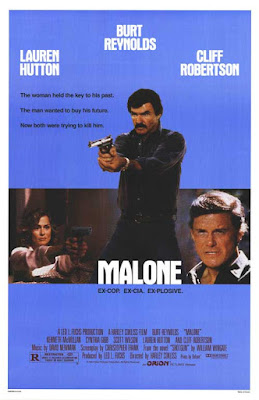
MALONE (US - 1987) Directed by Harley Cokliss. Written by Christopher Frank. Cast: Burt Reynolds, Cliff Robertson, Lauren Hutton, Kenneth McMillan, Cynthia Gibb, Scott Wilson, Philip Anglim, Tracey Walter, Dennis Burkley, Alex Diakun, Brooks Gardner, Mike Kirton, Blu Mankuma, Don Davis. (R, 92 mins) "Got a name?" "Malone." "Got a first name?" "Yeah."
From the late '70s and into the early '80s, Burt Reynolds was the top box-office draw in America. The busy actor appeared in two to three movies a year, and there was rarely a time when a Burt movie wasn't in theaters. But after a while, his base grew fatigued with increasingly lazy efforts like 1983's STROKER ACE and 1984's CANNONBALL RUN II. 1984's CITY HEAT, a much-anticipated teaming with Clint Eastwood, the other biggest movie star in America, proved to be a disappointment for both actors, but it would be far more devastating to Reynolds than your average box-office underperformer. While filming a fight scene, Reynolds was supposed to be hit across the face with a lightweight, breakaway prop chair. Somehow, the prop chair was replaced with a real one and Reynolds was hit in the face with it at full force. His jaw broke on impact, requiring extensive surgery that kept his mouth wired shut for months, forcing him on a liquid diet and later resulting in an addiction to painkillers. It took over two years for him to recover, during which time Hollywood and many of his friends abandoned him and tabloids had a field day with the rumors about his health and his weight loss. Reports stated that he was dying of either cancer or AIDS. Reynolds had his long-delayed Elmore Leonard adaptation STICK in theaters in 1985, but it was actually shot in late 1983, prior to CITY HEAT and the jaw incident. Other than a cameo in his buddy Mel Tillis' 1986 comedy UPHILL ALL THE WAY, Reynolds was offscreen until the release of HEAT in March 1987. Savaged by critics and ignored by audiences, HEAT was a troubled production that cycled through three directors--Robert Altman quit after one day, his replacement Dick Richards made most of the film before quitting after an on-set physical altercation with Reynolds, and then TV vet Jerry Jameson finished it; director credit went to "R.M. Richards"--and opened in 11th place. In three years, Reynolds went from box office king to Hollywood pariah. Burt was back and he was in good shape, healthy, and fully recovered, but HEAT's paltry gross left little doubt: nobody cared.
HEAT was the first of three comeback vehicles Reynolds had lined up for 1987. The second was MALONE, opening less than two months after HEAT. The results were almost identical: MALONE opened in 11th place and grossed $3 million before quickly disappearing from theaters. HEAT grossed just under $3 million but both were stunning freefalls from the blockbuster revenue generated by Reynolds films over the preceding decade or so (even CANNONBALL RUN II grossed $28 million in theaters and that was considered weak by Reynolds standards in 1984). HEAT and MALONE bombed so badly that the third Burt comeback movie, RENT-A-COP, which paired him with Liza Minnelli, saw its wide release nixed and was unceremoniously bumped to January 1988, grossing $300,000 on just 200 screens. The idea of a megastar like Reynolds being downgraded to a limited release was almost unheard-of in 1988, but the message came through loud and clear: moviegoers no longer gave a shit about Burt Reynolds.
Of course, Reynolds has proven himself to be nothing if not resilient. There was an undeniable "pile-on" mindset in the way critics approached Reynolds films during his 1987-and-onward return to the big screen, and these films during his darkest period (at least to that time) aren't nearly as bad as their reputations would suggest. HEAT has aged well as a character piece, and 1988's THE FRONT PAGE/HIS GIRL FRIDAY remake SWITCHING CHANNELS is a perfectly enjoyable screwball comedy that shows Burt in fine form engaging in witty, rapid-fire repartee with Kathleen Turner and Christopher Reeve. Even a dull misfire like 1989's PHYSICAL EVIDENCE has a decent Reynolds performance for completists. Reynolds got some of his best reviews in years in the low-key 1989 indie BREAKING IN, which led to the short-lived ABC series B.L. STRYKER before Reynolds' career saw a major resurgence in 1990 with the CBS sitcom EVENING SHADE, and this was all prior to his Oscar-nominated career-best performance in 1997's BOOGIE NIGHTS.
Just out on Blu-ray from Kino Lorber, MALONE opens with burned-out covert ops CIA agent Malone (Reynolds) unable to pull the trigger on his latest target. He informs his handler/lover Jamie (Lauren Hutton, Reynolds' GATOR co-star) that he's leaving the agency. "You know too much! You can't just walk away!" she implores. "Watch me," Malone glumly replies. Driving with no particular place to go, Malone finds himself stranded in a small town in rural Oregon when his car breaks down. Malone befriends Vietnam vet mechanic Paul (Scott Wilson) and his spunky late teens daughter Jo (Cynthia Gibb). Paul is one of the last remaining holdouts, refusing to sell his business and his property to Charles Delaney (Cliff Robertson), a paranoid, far-right zealot who's taking over the town and turning it into his base of operations for his plot to "take America back." Delaney has assembled a cabal of one-percenters with the intent of getting himself a Senate seat and bringing down the US government. As Paul, Jo, and Malone are repeatedly hassled by Delaney's goons, Malone finds himself in a classic SHANE situation, helping them protect their property (and trying hard to not succumb to Jo's obvious crush on him) while being the only one tough enough to stand up to Delaney--who keeps a tight leash on useless Sheriff Hawkins (Kenneth McMillan) and thinks Malone was sent there to kill him--and amassing a blood-splattered body count in the process. Malone's troubles don't end there: once news that Malone has surfaced reaches the CIA, the powers that be dispatch Jamie to eliminate him.
An on-set photo from MALONE posted on actress
Cynthia Gibb's web site. Gibb on Burt:
"He made me feel like an equal on set
when I was still such a novice."
MALONE adheres to the SHANE template pretty closely, with some additional FIRST BLOOD in the way that the asshole sheriff keeps trying to run Malone out of town. It's also interesting to note how, even in the context of the jingoistic, "Born in the U.S.A." Reagan era of 1987, Delaney is clearly presented as a psychotic, delusional, and dangerous madman, and an ideological relative of John P. Ryan's similarly politically insane villain in the 1986 Cannon classic AVENGING FORCE. Forget the Senate--today, Charles Delaney's beliefs and statements would likely catapult him straight to 2016 GOP Presidential front-runner. Based on the novel Shotgun by William Wingate, MALONE's credited screenwriter is Christopher Frank, a British novelist who spent most of his career working in French cinema (he wrote the post-BREATHLESS Valerie Kaprisky film L'ANNEE DES MEDUSES). Reynolds said in an interview around the time of MALONE's release that the project originated in Europe and was intended for Gerard Depardieu and then Christopher Lambert before it exchanged hands and ended up in Hollywood with him. Frank's script was reworked for Reynolds by an uncredited Rudy Wurlitzer, best known for writing Monte Hellman's TWO-LANE BLACKTOP (1971) and Sam Peckinpah's PAT GARRETT AND BILLY THE KID (1973). MALONE was directed by American journeyman Harley Cokliss, whose past credits included the post-nuke WARLORDS OF THE 21ST CENTURY (1982) and the John Carpenter-scripted BLACK MOON RISING (1986), in addition to serving as a second-unit director on THE EMPIRE STRIKES BACK (1980). Cokliss never really distinguished himself enough to rise above the level of C-lister, though his 1988 British horror film DREAM DEMON, which took several years to get a straight-to-video release in the US, was written by the venerable Christopher Wicking and was one of the more ambitious NIGHTMARE ON ELM STREET ripoffs. He's worked very sporadically in TV and mostly unseen movies from 2000 on, but in the early '90s, Cokliss pulled a "Fronk-en-steen" and started calling himself "Harley Cokeliss," presumably to ensure the correct pronunciation and to prevent people from snickering at "Cokliss."
Reynolds at the Philadelphia Comic Con in May 2015
It's easy to forget these days just how huge a star Burt Reynolds was in his prime, but perhaps the biggest testament to his popularity is that he's the one who finally, if only for a week, ended E.T.: THE EXTRA-TERRESTRIAL's reign at the top of the box office in the summer of 1982. And it wasn't just any Burt Reynolds movie. It wasn't a car chase comedy and it wasn't a cop thriller. It was a Burt Reynolds musical: the big-screen version of the Broadway smash THE BEST LITTLE WHOREHOUSE IN TEXAS.
Musicals weren't exactly a dominant genre in 1982 (and E.T. would reclaim the top spot a week later), and Reynolds even tried one once before--with disastrous results--in 1975's infamous bomb AT LONG LAST LOVE. But the raunchy Broadway production was so popular, and he had a more than capable co-star in Dolly Parton, that, along with ANNIE, it proved to be one of the few successful musicals of its era. And it was the last time for a long while that Reynolds tried something different. As far back as 1972's DELIVERANCE, Reynolds showed he had the chops to be a serious actor who was always working (starring in four major films in 1975 alone) and always willing to stretch. Even in misfires like 1975's HUSTLE, Reynolds rose above the material. But then he had his biggest hit yet with 1977's SMOKEY AND THE BANDIT, and he and director/buddy Hal Needham found a formula and they just stuck with it. For the next several years, Reynolds was the biggest movie star in the world, and one of the busiest, with SMOKEY and SEMI-TOUGH (both 1977), directing and starring in the dark suicide comedy THE END (1978), reuniting with Needham for HOOPER (1978), SMOKEY AND THE BANDIT II (1980), and THE CANNONBALL RUN (1981), plus the popular love story STARTING OVER (1979), the heist comedy ROUGH CUT (1980), PATERNITY (1981), and later in 1982, teaming up with Goldie Hawn in the romantic comedy BEST FRIENDS. Reynolds was averaging three movies a year for several years, and given the longer theatrical runs in those days, there was hardly a time when a Burt Reynolds release wasn't in theaters. The guy was everywhere. He was huge and everybody loved him. Burt Reynolds was the man.
But at some point, Reynolds' fans started to turn on him. The movies kept coming, but people stopped going. It's possible this turn can be traced back to 1981's SHARKY'S MACHINE, which he also directed. A dark, melancholy modern film noir about Atlanta vice cops taking down a drug kingpin and one (Reynolds) falling in love with a high-class hooker (Rachel Ward), SHARKY'S MACHINE is, in some ways, a more focused, fully-realized version of HUSTLE, but it was expertly directed (with a legendary Dar Robinson stunt fall in the climax) and featured Reynolds' best performance since DELIVERANCE. But critics weren't buying it and while it did OK in theaters, it wasn't the Burt that people wanted. By Christmas 1981, people wanted the funny Burt. They wanted car chases and wisecracks and the signature Burt laugh. Reynolds didn't laugh much in SHARKY'S MACHINE, and his fans didn't want to see him as a lonely, sad-sack cop pining for a prostitute who's under the thumb of a sleazy crime lord (Vittorio Gassman). Reynolds has only directed a handful of films, but as a filmmaker, SHARKY'S MACHINE is his masterpiece. It's a great film that's only gotten better with age and in a perfect world, it would've done for him what UNFORGIVEN did for Clint Eastwood and established him as a serious artist. By the time SHARKY'S MACHINE hit theaters, THE BEST LITTLE WHOREHOUSE IN TEXAS was already in the can, but after that, Reynolds just started coasting. He gave his fans what they wanted to the point where they didn't want it, or him, anymore. In retrospect, it almost seems like his heart was broken after the cold response SHARKY'S MACHINE got. Even its own studio seems to have forgotten about it: Warner released it in a now out-of-print, VHS quality fullscreen DVD in the early days of the format. There's been talk of a Warner Archive upgrade, but thus far, it hasn't happened. At 76, Reynolds is still with us and in good health. It's a mystery why there hasn't been a SHARKY'S MACHINE special edition with a Reynolds commentary. Maybe they're not interested. Maybe he doesn't want to talk about it.
Starting in 1983, Reynolds' credits just become ghastly: nobody went to see Blake Edwards' THE MAN WHO LOVED WOMEN. STROKER ACE (1983) and CANNONBALL RUN II (1984) are generally regarded as the two worst films from his heyday. His seemingly can't-miss pairing with Clint Eastwood on 1984's CITY HEAT was a major disappointment for both actors, and a nightmare for Reynolds after a stunt gone wrong (Reynolds was hit in the face with a real chair instead of a breakaway prop one) resulted in his jaw being shattered, and a liquid diet caused an alarming drop in weight, which then led to AIDS rumors in tabloids and throughout Hollywood. He directed and starred in 1985's box office dud STICK, which was shot before CITY HEAT, and as a result of his jaw injury and subsequent painkiller addiction, Reynolds was offscreen until 1987's troubled HEAT (which went through three directors, including one who got into an on-set altercation with Reynolds), but by then, his audience moved on. In four years, he went from the biggest movie star in the world to has-been punchline. HEAT bombed, as did MALONE later that year, and RENT-A-COP and SWITCHING CHANNELS (both 1988) and PHYSICAL EVIDENCE (1989). 1989's BREAKING IN was a low-budget indie that got Reynolds his best reviews in years, and he had a small-screen comeback with TV series like B.L. STRYKER and the popular EVENING SHADE. Bankruptcy and a highly-publicized divorce from Loni Anderson constantly kept him in the tabloids. Approaching 60, Reynolds slowly mounted a comeback as a character actor and got an Oscar nomination for his brilliant performance as porn filmmaker Jack Horner in 1997's BOOGIE NIGHTS. A few decent roles came after that, but it still didn't lead to the career rebirth one would expect, or that Reynolds was likely anticipating. Other than occasional TV guest spots on BURN NOTICE and ARCHER, he usually only appears in straight-to-DVD garbage, including an obligatory appearance in an Uwe Boll film.
But in his day, he was a movie star in the truest sense of the word, and THE BEST LITTLE WHOREHOUSE IN TEXAS finds him at a time when he was still bringing his A-game. Parton and director Colin Higgins were reuniting after their 1980 smash 9 TO 5, and longtime Reynolds pal Charles Durning got a Best Supporting Actor Oscar nomination for his role as the Governor. Reynolds' buddies Dom DeLuise and Jim Nabors also co-starred. THE BEST LITTLE WHOREHOUSE IN TEXAS grossed just under $70 million, making it the ninth highest-grossing film of 1982 and the most popular movie musical of the decade.
George Roy Hill's THE WORLD ACCORDING TO GARP, based on the 1978 John Irving novel, also opened this weekend. Irving's book was considered unfilmable by some, but Hill had shown an ability to meet that challenge before with his 1972 film version of Kurt Vonnegut's SLAUGHTERHOUSE FIVE. Hill had several classics to his name--1969's BUTCH CASSIDY AND THE SUNDANCE KID, 1973's Best Picture Oscar winner THE STING, and the 1977 hockey comedy SLAP SHOT--and was working from a script by Steve Tesich, who won a Best Screenplay Oscar for 1979's BREAKING AWAY. GARP was an important film for Robin Williams, in just his second starring film role after 1980's POPEYE and the TV series MORK & MINDY, which had wrapped up its fourth and final season earlier in the year. Williams had many serious moments in this comedy-drama, but critics and audiences didn't seem quite ready to consider him anything but the wacky comedian they saw on TV, and much of GARP's acclaim went to two of Williams' co-stars: John Lithgow as transsexual ex-football star Roberta Muldoon, and veteran stage actress Glenn Close, making her big-screen debut as Garp's mother. Both Lithgow and Close received Supporting Oscar nominations for their work in GARP. Close immediately proved to be the real deal, earning Oscar nominations for her first three films, and by 1989, she'd made eight films and received Oscar nominations for five of them.
Williams' gained his earliest notoriety when his Mork was a guest character on HAPPY DAYS, which led to the spinoff MORK & MINDY. Another HAPPY DAYS cast member had a film opening this weekend with Scott Baio starring in the comedy ZAPPED. Baio joined HAPPY DAYS in 1977 and had developed a following as Fonzie's cousin Chachi Arcola, introduced as a love interest for a maturing Joanie Cunningham (Erin Moran). Joanie and Chachi's romance gave ABC the idea to give Moran and Baio their own show with JOANIE LOVES CHACHI, which was yanked after one season and the two actors returned to HAPPY DAYS until the show ended in 1984. While Moran tried to get a big-screen career going with the Roger Corman-produced GALAXY OF TERROR (1981), ZAPPED teamed Baio with fellow ABC series stars Willie Aames (EIGHT IS ENOUGH) and Heather Thomas (THE FALL GUY). Baio plays a science nerd who acquires telekinetic powers, leading to much wackiness and topless young women, which made ZAPPED a video store and cable TV favorite for the rest of the decade. It also starred Felice Schachter (one of the original girls on the first season of THE FACTS OF LIFE), Merritt Butrick (STAR TREK II and soon to be on TV's SQUARE PEGS), cult-movie regular Irwin Keyes, veteran TV actress Sue Ann Langdon, all-purpose nerd Eddie Deezen, LaWanda "SANFORD & SON's Aunt Esther" Page, and the great Scatman Crothers. ZAPPED led to the 1990 sequel ZAPPED AGAIN, with only Langdon returning from the 1982 film. Baio and Aames would become friends and take their ZAPPED magic to the small-screen for the long-running CHARLES IN CHARGE.
Also in theaters was the great John Frankenheimer's action thriller THE CHALLENGE, which featured the badass teaming of Scott Glenn and Toshiro Mifune, paired up to take on a bunch of Japanese bad guys after a rare sword. Co-written by John Sayles, THE CHALLENGE bombed in theaters and was made at a time when Frankenheimer (THE MANCHURIAN CANDIDATE, THE TRAIN, SECONDS) was in a serious career slump and his battle with alcoholism took him to a personal low point. Frankenheimer went into rehab after finishing THE CHALLENGE and slowly began to rebuild his stellar career, which was back in solid standing when he died in 2002. THE CHALLENGE is hardly Frankenheimer's finest hour, but it's fast-moving and undeniably entertaining, and like ZAPPED, became a constant fixture on cable throughout the 1980s. Glenn and the incredible Mifune make a great team, as evidenced in this YouTube clip of all of their CHALLENGE kills.
Directed by R.M. Richards (Dick Richards, Jerry Jameson, Robert Altman). Written by William Goldman. Cast: Burt Reynolds, Karen Young, Peter MacNicol, Neill Barry, Howard Hesseman, Diana Scarwid. (R, 102 mins)
This review was originally published in a slightly different form on the Mobius Home Video Forum in April 2011
It was announced today that Brian De Palma was teaming up with star Jason Statham for a remake of this until-now forgotten Burt Reynolds vehicle that had a very troubled production, going through three directors, one of whom had an on-set altercation with the star. The film, scripted by Oscar winner William Goldman (BUTCH CASSIDY AND THE SUNDANCE KID, ALL THE PRESIDENT'S MEN) was started by Robert Altman, who left after a day of shooting. He was replaced by TOOTSIE producer Dick Richards, who helmed most of the film (and got his ass kicked by Burt), then veteran TV director Jerry Jameson was brought in to finish it. Richards gets sole credit, under the name "R.M. Richards." To date, he has not directed or produced another film.
HEAT isn't a very cohesive film and its behind-the-scenes issues are all too apparent. But it does have a good Burt Reynolds performance at its core, and, with the passing of a couple of decades, it seems to play a lot better now that one can view it without the baggage of the Reynolds expectations of that era. It's clearly not SHARKY'S MACHINE, but flaws and all, Burt was at least trying here, which is more than one can say for stuff like STROKER ACE and CANNONBALL RUN II. I think he went into this with the intention of it being a change-of-pace character-driven piece. Otherwise, why would a non-action guy like Altman be onboard to direct? Altman and Burt must've been on good terms by 1992, because Burt's cameo as himself in Altman's comeback film THE PLAYER made reference to HEAT's troubled shoot.
It's also worth noting that the 1.33:1 print streaming on Netflix is an alternate version that features a different outcome for one major character and an additional scene with an uncredited Mickey Knox as a doctor (and Reynolds looks completely different in this added scene; not just his hairpiece, but his moustache is also trimmed differently). It seems this alternate version was released on the budget-priced R1 DVD by Platinum Disc, and is not the version released in US theaters or on the Paramount VHS.