By now, it's pointless to find any rhyme or reason when it comes to Nicolas Cage's career choices. These days, his only A-list gigs come from voice work in animated films like SPIDER-MAN: INTO THE SPIDER-VERSE, and every once in a while, he'll luck into a FROZEN GROUND, JOE, THE TRUST, or MOM AND DAD among his plethora of VOD clunkers. But 2018 was the year of MANDY, Panos Cosmatos' gonzo mindfuck of a midnight movie that got a lot of festival buzz and was an instant, legit cult classic right out of the gate. It immediately became an essential entry in the Cage canon and got him the most acclaim and attention he'd received in years. But any hopes that MANDY would herald a Cageassaince are dashed with BETWEEN WORLDS, a moronic and amateurish supernatural thriller that hit VOD at the tail end of last year. With enough strange ideas and Cage once again cast as a blue collar loner who finds himself caught up in all sorts of inexplicable mayhem, BETWEEN WORLDS could almost pass itself off as a distant cousin to MANDY, but it's filmed in such a basic, rudimentary fashion so devoid of style and a sense of professionalism that it actually looks, at best, like a student film that accidentally got a distribution deal. It seems the only trick that co-producer/writer/director Maria Pulera has in her arsenal--aside from somehow cajoling the great Angelo Badalamenti into composing the main theme, which I guess is there to give the film a Dipshit David Lynch vibe--is the repetitious and pointlessly wanky reliance on low-angle close-ups of everything from a coffee carafe to a bottle of beer to the hairy ass crack of an overweight convenience store clerk. That, and the ability to get real and long-established actors like Cage and Franka Potente (RUN LOLA RUN, THE BOURNE IDENTITY) to embarrass themselves in a project that's far beneath them.
In an opening filled with one of the most laboriously clumsy exposition dumps I've ever seen, Alabama trucker Joe Majors (Cage, wearing what looks like the tattered remains of his CON AIR mullet), still grieving the loss of his wife and young daughter in a recent house fire, is using the men's room at a gas station when he walks in on a burly guy strangling a woman. The woman is Julie (Potente), and Joe thinks he saved her life, but it's something else entirely: since a near-drowning experience as a child, she's had the ability to cross "between worlds," with a psychic ability to rescue those near death. She uses it sparingly, but needs it now because her grown daughter Billie (Penelope Mitchell) is in a coma after a motorcycle accident that morning. In order to go between worlds, she has to be taken to the brink of death herself, with strangling being the most convenient way, and she paid the guy to choke her. Since he ruined the connection, Joe feels obligated to choke Julie himself in order for her to save a non-responsive Billie at the hospital, and it works. Before long, Joe and Julie are a thing but something isn't right with Billie. She's soon leering at Joe, tempting him in various states of undress when Julie isn't around, and giving him under-the-blanket handjobs on the couch while they watch TV and Julie's in the kitchen making dinner. Yep, you guessed it: when Julie went between worlds, Billie's soul was switched out with that of Joe's late wife, who's now inside Billie's body, ready for action, and not at all pleased that he's hooked up with Julie.
BETWEEN WORLDS doesn't even follow its own barely-there logic, and its primary justification is simply for Cage to channel his inner Talk Show Robin Williams, with Pulera apparently so grateful that he said yes that she does nothing to rein him in. In a performance that makes his work in the long-forgotten early '90s erotic potboiler ZANDALEE seem disciplined, Cage has several absurdly over-the-top sex scenes with both Potente and Mitchell, sometimes amusing himself while thrusting away by randomly quoting and pantomiming the crucifix masturbation scene in THE EXORCIST or reading aloud from a book of erotic poetry with a cover that reads "Memories by Nicolas Cage." He ad-libs endlessly (Potente: "Want a beer?" Cage: "Does the Tin Man have a sheet-metal cock?"), and totally loses it in the finale, which has him sobbing uncontrollably and cradling his dead daughter's Jack-in-the-Box while pouring gasoline on himself to the tune of The Shangri-Las' "Leader of the Pack." Mind you, as on-brand as this is for Nic Cage--who wouldn't wanna see the movie I just described?--none of it is ever as entertaining as it sounds. Similar to his disastrous performance in the unwatchable ARMY OF ONE, Cage's histrionics come off as exhausted and overly affected, because there's no movie here--it's just him goofing off for 90 minutes. Something more polished and professional might've made Cage's antics more palatable, but BETWEEN WORLDS is a film that displays all the production value of a high-end sex tape or hostage video, magnifying the fact that Cage has nothing to work with and really begging the question of what even attracted him and Potente to this thing in the first place. (R, 91 mins)
A PRIVATE WAR (US/UK/Germany - 2018)
One of the most overlooked films of the 2018 awards season, at least by the general moviegoing public, A PRIVATE WAR is a harrowing chronicle of Marie Colvin, an American expat and war correspondent who spent nearly 30 years covering the most dangerous areas of the world for the UK's Sunday Times. The film covers the post-9/11 era, where Colvin, portrayed here in a remarkable performance by Rosamund Pike, spent most of her time embedded in Iraq, Afghanistan, and Syria, venturing into places and situations that most journalists would consider too dangerous (when asked if she's afraid, she replies "You're never gonna get to where you're going if you acknowledge fear...fear comes later"). She lost the sight in her left eye after catching shrapnel in a bomb blast in Sri Lanka in 2001--with an eye-patch subsequently providing her signature look--and after two miscarriages, two failed marriages to journalist/novelist David Irens (Greg Wise), and now too old to have children, she threw herself into her work and grew even more ambitious and addicted to the danger. After befriending photographer Paul Conroy (Jamie Dornan) in Iraq, she convinces him to tag along with her and a translator, breaking the rules and moving ahead of US troops to corroborate rumors of a Saddam Hussein-ordered mass grave in Fallujah. Her actions both earn the respect and test the patience of everyone in her life, from Conley to her editor (Tom Hollander), her best friend (Nikki Amuka-Bird), and a sympathetic potential love interest (Stanley Tucci). Colvin extensively covered the Syrian civil war, and her life came to an end in the city of Homs, where she, Conroy, and journalist Remi Ochlik (Jeremie Laheurte) would be trapped in a building receiving heavy artillery fire trying to evacuate residents from the area. Only a seriously-injured Conroy survived, with Colvin and Ochlik succumbing to injuries sustained from a bomb blast. Only hours before her death, Colvin was interviewed by Anderson Cooper in prime time on CNN.
BEIRUT (US - 2018) Directed by Brad Anderson. Written by Tony Gilroy. Cast: Jon Hamm, Rosamund Pike, Dean Norris, Shea Whigham, Mark Pellegrino, Larry Pine, Jonny Coyne, Douglas Hodge, Alon Moni Aboutboul, Idir Chender, Kate Fleetwood, Leila Bekhti, Hicham Ouraqa, Ahmed Said Arie, Sonia Okacha, Mohammed Attougui. (R, 109 mins) At the risk of sounding wistful or cliched, BEIRUT is the kind of movie you don't see in theaters very often these days. It's a smartly-written, mid-budget political thriller whose target audience is middle-aged adults. It's a star vehicle for Jon Hamm, whose place in pop culture history is cemented thanks to MAD MEN but who hasn't really had a breakout leading role on the big screen, instead standing out in supporting roles in films like THE TOWN and BABY DRIVER. With Hamm's biggest success being on TV and SESSION 9 and THE MACHINIST director Brad Anderson settling comfortably into hired-gun TV journeyman mode in recent years (FRINGE, TREME, BOARDWALK EMPIRE), BEIRUT almost feels like the kind of period piece project that's designed more for a limited series on HBO, FX, or Netflix. On one hand, that's a depressing commentary on the changing landscape of mainstream moviegoing over the last couple of decades that a solid piece of suspenseful escapism like BEIRUT seems like a pleasant surprise. However, in the capable hands of veteran screenwriter Tony Gilroy (the BOURNE series, MICHAEL CLAYTON, and most recently, ROGUE ONE, for which he also handled the reshoots when director Gareth Edwards was relieved of his duties), BEIRUT, which does share a few core plot ideas with 2000's Gilroy-scripted PROOF OF LIFE, is a riveting thriller about the delicate nature of political gamesmanship and double-crossing diplomacy making an already volatile region even more dangerous and unpredictable.
Opening in 1972, Mason Skiles (Hamm) has a pretty cushy gig as a US diplomat based in Beirut. He's a smooth negotiator and spends most of his time schmoozing and entertaining visiting politicians and intellectuals. He and his wife Nadia (Leila Bakhti) are hosting a dinner party when his State Department buddy Cal Riley (Mark Pellegrino) shows up with CIA officials who want to haul in Karim, a 13-year-old Palestinian orphan the Skileses are currently sponsoring and hope to adopt, for questioning. Skiles was unaware that Karim had an older brother, Abu Rajal (Hicham Ouraqa), who is being hunted by Mossad agents for his role in the Munich massacre that killed eleven members of the Israeli Olympic team. Abu Rajal has been in contact with his little brother, and Cal has photographic evidence. As Skiles attempts to placate the agents with as little disruption to his party as possible, Abu Rajal and his men storm Skiles' house, whisk Karim away, with Nadia among those killed in the ensuing skirmish.
Cut to 1982, and widower Skiles is an alcoholic wreck, living in Boston and skating by as a mediator on various local union disputes as something to do during the day until he can get to the bar in the evening. He's summoned by the State Department and told he's needed in a civil war-torn Beirut. He's offered $6500 and a passport and is instructed to be on a flight in six hours. Once on the ground in Beirut, everyone--State Department guys Gary Ruzek (Shea Whigham) and Donald Gaines (Dean Norris), and glad-handing US politician Frank Shalen (Larry Pine)--hems and haws about why he's there and why he's been provided with CIA handler Sandy Crowder (Rosamund Pike) to babysit him. Skiles has been requested by name to lead the negotiation to release a kidnapped Cal, who's being held by a splinter group of the PLO. A meet is arranged and Skiles comes face to face with the group's leader, a now-grown Karim (Idir Chender), who's threatening to kill Cal if Israel doesn't turn over his brother in exchange for Cal, and he knows Skiles is the only negotiator sharp enough to get it done. Skiles meets with multiple Israeli officials who agree to look into Abu Rajal's whereabouts and all come back with the same story: "We don't have him." Things get even more complicated, forcing Skiles to go rogue when Ruzek and Gaines reveal their true motive: making sure Cal, who's been based in Beirut for 13 years and is a walking encyclopedia of classified intel, doesn't talk about the things he knows, both on and off the books.
Given Gilroy's expertise in screenwriting, the cynical BEIRUT does a good job of keeping the copious exposition of the various Middle East conflicts as concise and succinct as possible. It also gets some terrific location work from Tangier doubling as Beirut, with some chilling atmosphere throughout as we see the almost nonchalant, business-as-usual reaction of citizens when guns and bombs go off around them. Hamm displays enough gravitas to convey Skiles' cut-the-shit attitude once he figures out that Ruzek and Gaines consider Cal expendable, even if "Mason Skiles" is a name that could only exist in a Hollywood screenplay. Likewise, we of course get the obligatory scene where the drunkard hero finally his shit together and pours all of his booze down the drain while regarding his aging visage in the mirror and pondering What I've Become, but Gilroy and Anderson aren't making a documentary here. They do, however, incorporate actual events and historical elements into a fictional story that's tense, fast-paced, and well-acted by its cast. Pike, in her second terrorism thriller in the last month after the inexplicably dance-crazed 7 DAYS IN ENTEBBE, does what she can with an underwritten role (Sandy is dismissed by Gaines as a "skirt," but then Pike still isn't given that much to do other than yell at Skiles when he needs a kick in the ass), but Norris is perfectly cast as a duplicitous, untrustworthy dick with an Oscar-caliber rug, while Whigham is at his sneering best, barely tolerating Skiles' meddlesome involvement in the entire negotiation process. But BEIRUT is Jon Hamm's show from start to finish, and he proves himself a capable leading man who probably would've been better served by Hollywood movie studios if he was around in the '70s and '80s. He's displayed a gift for comedy and proven his versatility in supporting roles and ensemble feature films, and BEIRUT leaves no doubt that he can carry a movie but it's an anomaly in today's distribution model that declares everything a disappointment if it doesn't make $100 million out of the gate. BEIRUT is the kind of mid-range film that used to turn into a word-of-mouth sleeper hit in April or September and maybe make $25-$30 million and everyone would be happy. But those days are gone. It's not going to make a ton of money, but it'll enjoy a long life on streaming and cable, acquiring fans shocked that they'd never heard of it before.
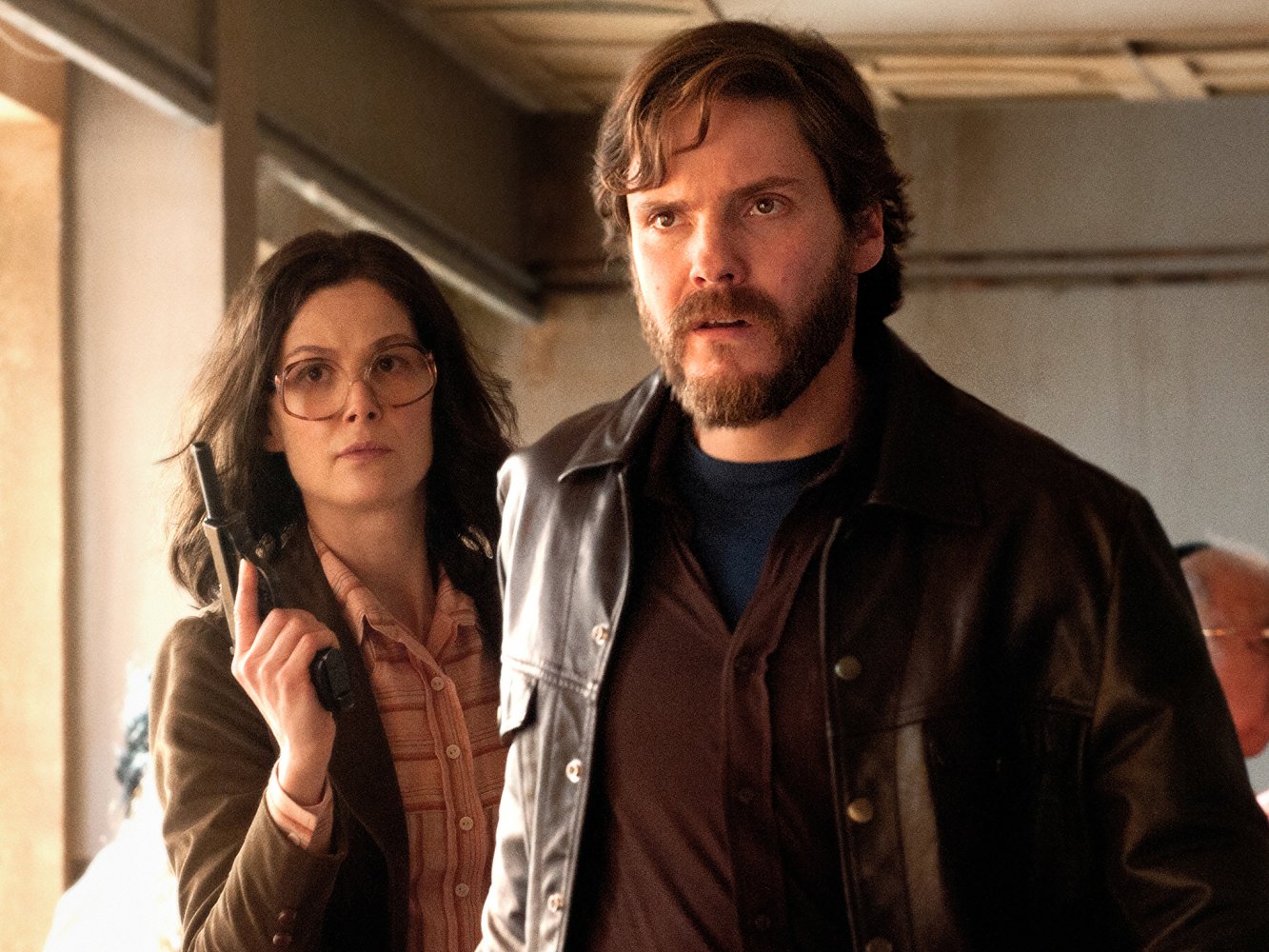
7 DAYS IN ENTEBBE (US/UK - 2018) Directed by Jose Padilha. Written by Gregory Burke. Cast: Daniel Bruhl, Rosamund Pike, Eddie Marsan, Denis Menochet, Lior Ashkenazi, Ben Schnetzer, Brontis Jodorowsky, Nonso Anozie, Mark Ivanir, Angel Bonnani, Peter Sullivan, Andrea Deck, Natalie Stone, Vincent Riotta, Trudy Weiss. (PG-13, 107 mins) Operation Thunderbolt, the Israel Defense Forces' successful July 4, 1976 raid of Entebbe Airport in Uganda to rescue hostages being held by the far left German Revolutionary Cells and the Popular Front for the Liberation of Palestine stands as one of the most daring military missions in history. It immediately spawned two competing, hastily-shot, all-star TV-movie "events" with ABC's VICTORY AT ENTEBBE (with Anthony Hopkins, Kirk Douglas, Burt Lancaster, Richard Dreyfuss, Helmut Berger, Linda Blair, and Elizabeth Taylor among others) airing just five months later in December, quickly followed by NBC's RAID ON ENTEBBE (headlined by Charles Bronson, Yaphet Kotto, Martin Balsam, Horst Bucholz, John Saxon, and Peter Finch in his last film) in early January 1977. Future Cannon heads Menaham Golan and Yoram Globus even got into the act, with the Golan-directed Israeli production OPERATION THUNDERBOLT (with Klaus Kinski and Sybil Danning as the hijackers) hitting theaters in January 1977. The Entebbe raid is also touched upon in other films, like THE LAST KING OF SCOTLAND and the epic CARLOS, and now, over 40 years later, 7 DAYS IN ENTEBBE is yet another take on the same subject.
On June 27, 1976, Germans Wilfried "Boni" Bose (Daniel Bruhl) and Brigitte Kuhlmann (Rosamund Pike), two members of Revolutionary Cells, board an Air France jet during a layover in Athens, en route from Tel Aviv to Paris. They and some accomplices commandeer the plane and force pilot Capt. Michel Bacos (Brontis Jodorowsky, best known as the little boy in his dad Alejandro's 1970 cult classic EL TOPO) and navigator Jacques Le Moine (Denis Menochet, looking like he's auditioning for THE NICK OFFERMAN STORY) to reroute to Benghazi, Libya to refuel en route to Entebbe, Uganda, where dictator Idi Amin (Nonso Anozie) has granted them an airstrip at Entebbe Airport. The pro-Palestine Bose and Kuhlmann are far-left ideologues, with Kuhlmann a protege of incarcerated and recently-deceased Red Army Faction leader Ulrike Meinhof, who was found hanged in her cell in what was deemed a suicide but many in German terrorist circles feel was a staged execution. Once the plane lands in Entebbe and Amin gives them passage, the days drag on and as the unstable Kuhlmann keeps popping amphetamines and Bose begins to resent that the Palestinian cohorts who were waiting for them at Entebbe--under the orders of PFLO leader Wadie Haddad--and begin to muscle the Germans aside and start separating the Israeli passengers, moving them to another room and threatening to begin killing them if Israeli Prime Minister Yitzhak Rabin (Lior Ashkenazi) doesn't release all of the Palestinian terrorists being held in Israeli prisons.
The most compelling parts of 7 DAYS IN ENTEBBE are the tense meetings with Rabin, the Israeli military, and testy Israeli Defense Minister Shimon Peres (a terrific performance by Eddie Marsan, sporting an amazing makeup job), and the debates over Israel's policy of never negotiating with terrorists (staunchly supported by Peres, who believes Rabin is deliberately stalling on a response in the hopes that he can just throw Peres under the bus). Less successful are the arcs of Bose and Kuhlmann. Pike can't do much with director Jose Padilha (ELITE SQUAD, NARCOS, and the ROBOCOP remake) and screenwriter Gregory Burke ('71) whittling her complex character--who blames herself for Meinhof's death--down to a stock "crazy bitch" act that culminates in a ridiculous scene where she calls her lover and pours her heart and her belief in the cause out to him in a long monologue on a pay phone that's not even functioning. The filmmakers don't give a pass to the Germans, but definitely want to engineer some sympathy for them as two idealistic young activists who get in way over their heads, though in one flashback scene, a Revolutionary Cells associate who's trying to talk them out of the hijacking does call Bose out as a bit of a poseur who likes to rant about oppression and the evils of capitalism while owning a small but financially successful publishing company ("You're not oppressed! You're a capitalist!" the guy yells). During the real seven days at Entebbe, Bose apparently did express some concern over the optics of being a German in a hostage situation where Israelis were being threatened with execution, but 7 DAYS IN ENTEBBE almost seems like it wants to absolve him of any wrongdoing. If Bose (and, to an extent Kuhlmann, who starts to realize they screwed up when she runs out of pills and is able to clear her head a little) really felt this way as the situation escalated way beyond the statement they wanted to make, it would hardly be the last time ideologically pure and stubbornly uncompromising far-left activists were duped into being the useful idiots that a powerful political organization requires to roll out a far more insidious plan.
For about 85 of its 107 minutes, 7 DAYS IN ENTEBBE is a generally involving hostage/political thriller despite some occasional tap-dancing around certain issues and the puzzling omission of key details, like the whole situation with elderly hostage Dora Bloch (briefly seen in a couple of scenes and played by Trudy Weiss), her disappearance during the ordeal and how her Amin-ordered execution is never even addressed. But in the home stretch, as the raid is underway (one of the commanders, and the only Israeli military officer killed during Operation Thunderbolt, was Yonatan Netanyahu--played here by Angel Bonnani--the older brother of current PM Benjamin Netanyahu), Padilha completely shits the bed by intercutting it with some footage of Israel's Batsheva Dance Company. One of the soldiers (Ben Schnetzer) is called to duty and will miss the opening night performance of his dancer girlfriend (Andrea Deck). We see the dance outfit practicing throughout and Operation Thunderbolt is intercut with their performance, with the girlfriend repeatedly falling flat on her face time and again. It's a mystery whether that's a metaphor for something happening with the raid or for Padilha himself, but it completely drains the suspense from what should be the key sequence in the film. Even the closing credits play over some dance routine with a male dancer contorting throughout the frame while a female dancer runs in place in the background. It's one of the all-time climactic derailments of what was an otherwise decent movie up to that point. Sure, it was sort-of an acceptably second-string MUNICH but Padilha's bizarre decision to turn it into what looks like snippets of a justifiably abandoned production of "Bob Fosse's ENTEBBE!" is thus far the head-scratcher of the year for 2018 moviegoing. Sure, the out-of-nowhere violent sex scene near the end of MUNICH was jarring, but it didn't instantly turn the film into a hot mess.
HOSTILES (US - 2017) Written and directed by Scott Cooper. Cast: Christian Bale, Rosamund Pike, Wes Studi, Ben Foster, Jesse Plemons, Rory Cochrane, Adam Beach, Stephen Lang, Scott Wilson, Timothee Chalamet, Q'orianka Kilcher, Peter Mullan, Jonathan Majors, Bill Camp, Paul Anderson, Ryan Bingham, Tanaya Beatty, Xavier Horsechief, John Benjamin Hickey, David Midthunder, Robyn Malcolm, Boots Southerland, Scott Shepherd. (R, 135 mins) Based on an unpublished novel written by veteran screenwriter Donald E. Stewart (JACKSON COUNTY JAIL, MISSING, THE HUNT FOR RED OCTOBER) way back in the 1980s (Stewart died in 1999, but still gets an executive producer credit here), HOSTILES is a western that works despite being torn between revisionism and genre standards. Written and directed by Scott Cooper (CRAZY HEART), HOSTILES reunites the filmmaker with his OUT OF THE FURNACE star Christian Bale, and while it has moments that aspire to the likes of pre-self-parody Terrence Malick and something like Clint Eastwood's UNFORGIVEN (even stealing the "killed everything that's walked or crawled" line) or Andrew Dominik's THE ASSASSINATION OF JESSE JAMES BY THE COWARD ROBERT FORD, it ultimately leans more toward the OPEN RANGE and the remake of 3:10 TO YUMA side of things. And there's nothing wrong with that because those were fine westerns, and while the languid pacing likely won't bother fans of revisionist westerns, the more commercial, mainstream moviegoers may get a little fidgety. HOSTILES was acquired by Byron Allen's upstart Entertainment Studios, and after the surprise summer hit 47 METERS DOWN and last fall's social media bomb FRIEND REQUEST, Allen clearly intended HOSTILES to be his ticket to the Oscars. It was given a limited rollout at Christmas 2017 and finally expanded nationwide a month later, but it was all for naught. It's a very good movie, probably Cooper's most accomplished yet (and a nice rebound from the disappointing BLACK MASS, the Whitey Bulger biopic starring a pair of ice blue contact lenses resting on the corneas of Johnny Depp), but it obviously didn't connect with the Academy, netting a grand total of zero nominations.
A veteran of the 1890 massacre at Wounded Knee, about-to-retire US Army Capt. Joseph Blocker (Bale) is a respected leader with no love for Native Americans, viewing them as "savages" and "animals." He's assigned by his commander (Stephen Lang), under orders from President Benjamin Harrison, to lead a military escort for imprisoned tribal chief Yellow Hawk (Wes Studi) and his family from New Mexico back to his tribal land in Montana. Yellow Hawk has cancer and his days are numbered, and as a goodwill gesture, the President has granted the aging chief's final wish to die and be buried on his land. Having faced Yellow Hawk in battle and losing several men under his command to him, Blocker initially refuses the order until he's threatened with a court-martial and the loss of his pension. Blocker is accompanied by the most trusted soldiers under his command--Sgt. Metz (Rory Cochrane) and Major Woodson (Jonathan Majors)--along with West Point graduate Lt. Kidder (Jesse Plemons), and fresh-faced, French-born rookie Pvt. DeJardin (Timothee Chalamet). As soon as they're far enough from the base, bitter Blocker drops the niceties, grabs a pair of knives and challenges Yellow Hawk to a fight, only to be stoically rebuffed when the chief tells him he isn't afraid of death. Instead, Blocker orders Yellow Hawk and his family--son Black Hawk (Adam Beach), daughter-in-law Elk Woman (Q'orianka Kilcher), grandson Little Bear (Xavier Horsechief), and daughter Living Woman (Tanaya Beatty) to be chained for the duration of the trip. Shortly into the journey, they encounter shell-shocked widow Rosalie Quaid (Rosamund Pike), who just saw her husband scalped and three children murdered by Comanche warriors in an almost unbearably grim and brutal opening sequence. Rosalie joins them, and with those Comanches still in the vicinity, Blocker is ultimately forced to accept the help of sworn enemy Yellow Hawk, and that's before things get even more complicated when a stop at the next military outpost results in them adding three additional members to the party--two officers escorting Sgt. Wills (Ben Foster), a prisoner due for execution who, conveniently enough, used to be under Blocker's command.
There's no shortage of formulaic elements to HOSTILES, starting with the "one last job" motif as Blocker is set to retire once he's finished escorting Yellow Hawk to his tribal land. And, of course, they're determined to make it there if they don't kill each other first! But there's some interesting character development throughout, primarily with the arc of Bale's Blocker. It's obvious that he and Yellow Hawk will come around to reaching a mutual respect with the understanding that battle was battle, that was then and this is now. But the soldiers accompanying Blocker ultimately symbolize the stages of that arc, with DeJardin representing the youthful naivete of a young Blocker before experiencing the horrors of war; the ruthless, racist Wills serving as Blocker's dark side, reminding him of what a vicious killer of "redskins" he used to be; upstanding and loyal Woodson demonstrating his capacity for empathy; and Metz exemplifying the ability to change and recognize and correct the errors of the past. Metz starts out reminiscing about the good old days of scalping "savages" but he's the first to give a peace offering to Yellow Hawk on the journey and apologize for the things that happened to him and his people. Granted, Metz's abrupt come-to-Jesus moment is one of the film's missteps, handled in a clumsily heavy-handed and melodramatic way by Cooper. The fleshing out of Bale's character does come at the expense of Pike's, who's endured an inconceivable tragedy yet her stages of grief are given somewhat of a short shrift. Still, at the end of the day, these are minor quibbles for an overall excellent film that runs the gamut from some truly stomach-turning violence to powerful moments of genuine heartbreak and emotion. It's got a terrific cast of character actor ringers (Studi can play this kind of role in his sleep, but he does it better than anyone), beautiful imagery from cinematographer Masanobu Takayanagi (THE GREY), and some nicely complex characterizations that help elevate the film's more cookie-cutter elements into something a little more ambitious.
GONE GIRL (US - 2014) Directed by David Fincher. Written by Gillian Flynn. Cast: Ben Affleck, Rosamund Pike, Neil Patrick Harris, Tyler Perry, Carrie Coon, Kim Dickens, Patrick Fugit, Scoot McNairy, David Clennon, Lisa Banes, Emily Ratajkowski, Boyd Holbrook, Lola Kirke, Casey Wilson, Sela A. Ward, Missi Pyle, Jamie McShane. (R, 149 mins)
"You only hurt the one you love" is a saying that's appropriate for David Fincher's version of Gillian Flynn's bestselling 2012 novel. Flynn scripted the adaptation herself, but the end result is very much in line with Fincher's cynical worldview. Over the last 20 years, Fincher has built a reputation as an auteur's auteur, and comparisons to cinema giants like Stanley Kubrick have been made for quite some time. There's no doubt that some of those comparisons are justified, especially in Fincher's mercurial nature and his methodical, meticulous, and sometimes fussy style. He's been known to do an exorbitant amount of takes like Kubrick did, and both display signature styles to ensure their films feel like no one else's. This has been especially the case with Fincher over the last few years, as GONE GIRL marks his third consecutive teaming with score composers Trent Reznor and Atticus Ross and cinematographer Jeff Cronenweth, and the fourth overall with Cronenweth, who also shot Fincher's FIGHT CLUB (1999). Over the course of THE SOCIAL NETWORK (2010), THE GIRL WITH THE DRAGON TATTOO (2011), and now GONE GIRL, Fincher and that team have forged a unique style in cold, clinical detachment, and perhaps that's where the Kubrick analogies really started to gain traction, though if any comparisons are to be made, he's more in line with the non-fantasy side of David Cronenberg.
While the mere mention of Fincher's name is enough to elevate expectations and get cineastes salivating, his pursuits are generally more commercial than either of those legendary filmmakers, and they exist in different eras that make comparisons a moot point: while Kubrick and Cronenberg also made film versions of wildly popular, bestselling novels (THE SHINING and THE DEAD ZONE, respectively), Kubrick never would've made a film about Facebook. And even as an auteur who's probably given more wiggle room than most of his contemporaries, Fincher still has people he reports to, and with today's "$50 million opening weekend or it's a flop" mindset, there's no way a major Hollywood studio would give Kubrick complete autonomy and a blank check to make whatever he wanted and then leave him unsupervised to take all the time he needed to do it. And Kubrick, while possessing a cynical outlook, pointed his finger mostly at established power structures (the military in PATHS OF GLORY and FULL METAL JACKET, the government in DR. STRANGELOVE, the aristocracy in BARRY LYNDON, the supernatural in THE SHINING, the perverse upper class in EYES WIDE SHUT) and their cruel and frequently dehumanizing nature. Kubrick wasn't quite the misanthrope that Fincher is. Fincher doesn't like people, he doesn't trust people, and in his world, they're largely inherently unhappy and looking for a way out, and no matter how successful they are and what they achieve, happiness is perpetually elusive. Matt Singer pointed in a pre-release Dissolve piece on GONE GIRL that it's the first Fincher film to put the impossibility of romantic relationships front and center. While GONE GIRL may form a loose stylistic trilogy with the two Fincher films that precede it, it's really not some thinkpiece-worthy truth bomb blowing the doors off the psychology of relationships, misogyny, feminism, and the state of marriage in America. Anyone who was a child of divorce, saw their parents have a huge argument, has gotten divorced or been around when married friends have a meltdown in a social setting or been in any kind of romantic relationship at all knows that marriage and relationships can be ugly. How many single people have had a married friend tell them "Don't ever get married"? There's certainly room for discussion over its conclusion and the decisions and compromises that certain characters make and the ways they manipulate those around them, but for the bulk of its sometimes bloated two and a half hours, GONE GIRL is a riveting, top-notch thriller by a director at the top of his game. Fincher isn't the second coming of Kubrick. He's a more stylized, high-end Alan J. Pakula or Sydney Pollack. And that's still pretty great.
Flynn's novel utilized dual unreliable narrators in Nick and Amy Dunne. Flynn keeps structure here but in ways that obviously need to be made cinematic, along with other incidental changes to suit the medium. On the day of their fifth wedding anniversary, Amy (Rosamund Pike) disappears and her husband Nick (Ben Affleck) comes home to find their house a shambles, with signs that a struggle ensued. Fincher repeatedly cuts between present, anchored by Affleck, and past, represented in flashbacks with narration by Pike from Amy's journal. She's the daughter of famous children's book authors (David Clennon, Lisa Banes) who based their beloved Amazing Amy character on Amy herself, with Amy constantly feeling like the let-down version of a fictional character who never disappointed her parents and got all the things Actual Amy wanted. In Nick, she finds the first person who understands and accepts her and doesn't want Amazing Amy. But domestic bliss slowly begins to unravel: Nick and Amy lose their jobs in the recession, Nick's mother is diagnosed with cancer and his father with Alzheimer's, the bills aren't getting paid, and Amy's parents get dropped by their publisher and need to use Amy's trust fund to get out of debt. Nick and Amy move from NYC to his childhood Missouri suburb where Amy feels adrift and left out when it comes to Nick and the bond he has with his twin sister Margo (Carrie Coon). Tensions escalate in Amy's journal, and in the present, evidence mounts that suggests Nick may have killed his wife. Nick isn't being upfront about numerous things with the cops or with Margo, and then Fincher pulls a daring bait-and-switch at just past the one-hour point that provokes a palpable buzz of energy among the audience and forces you to view everything you've just seen in a completely different fashion.
To say any more would involve divulging massive spoilers, but the performances of Affleck and especially Pike, a very difficult role, are outstanding. They get tremendous support from one of the year's best ensembles, particularly in the unlikely casting of Neil Patrick Harris as one of Amy's ex-boyfriends who's still hung up on her, and Tyler Perry as Nick's lawyer, a big-money celebrity attorney known for defending husbands accused of killing their wives. Coon is excellent, as is Kim Dickens as the increasingly incredulous detective investigating Amy's disappearance. Fincher and Flynn spend quite a bit of time examining the notion of media hype, deftly represented by a shrill, shrieking, over-the-top harpy of a cable news broadcaster (Missi Pyle), clearly based on the loathsome Nancy Grace. They also take aim at the culture of fleeting celebrity and the idea that everything is entertainment. Witness how Nick is accosted by a flirtatious woman who aggressively takes a selfie with him against his wishes, and of course the photo ends up on cable news as "proof" that he's a callous, remorseless wife killer. A bar--called The Bar--owned by Nick and Margo becomes a destination for gawking rubberneckers as Fincher pays subtle homage to Billy Wilder's bile-soaked ACE IN THE HOLE (1951). Like many filmmakers before him, Fincher has frequently cited Hitchcock as an influence, and that's on display here as Pike's Amy isn't too far removed from the blonde and "complicated" heroines played by Kim Novak in VERTIGO, Janet Leigh in PSYCHO, and Tippi Hedren in MARNIE (Margo: "Nick! Don't you know 'complicated' is code for 'bitch?'"). There's also one fleeting shot where a character hastily exits a room in a way that's identical to "Mother" leaving the motel room after the shower murder in PSYCHO.
Nothing is what it seems in GONE GIRL, and even if you've read the book (I haven't), it works as exemplary storytelling as Fincher punches the narrative forward in the same hypnotic, matter-of-fact fashion he did with his 2007 masterpiece ZODIAC, a damn-near-perfect thriller that opened to great acclaim at the time but for some inexplicable reason, seems to be a lesser-mentioned Fincher film that's fallen through the cracks in just a few short years. It's rare these days to see a provocative adult thriller that gets the audience talking and opens the floor for post-viewing debate. That doesn't necessarily warrant the "deeper meaning" thinkpieces of the sort that seem to permeate review sites and blogs every week (and really, if GONE GIRL hasn't opened this past weekend, we'd be getting similarly pretentious, diarrhetic essays on ANNABELLE), but perhaps the flood of such thinkpieces is actually a damning critique that too few intelligent films for grownups are getting any exposure in the current cinematic climate.