THE BALLAD OF BUSTER SCRUGGS (US - 2018) Written and directed by Joel Coen & Ethan Coen. Cast: Tyne Daly, James Franco, Brendan Gleeson, Bill Heck, Grainger Hines, Zoe Kazan, Harry Melling, Liam Neeson, Tim Blake Nelson, Jonjo O'Neill, Chelcie Ross, Saul Rubinek, Tom Waits, Clancy Brown, Jefferson Mays, Stephen Root, Willie Watson, David Krumholtz, Ralph Ineson, Jesse Luken, Sam Dillon. (R, 133 mins) There's a loose, shaggy dog vibe to THE BALLAD OF BUSTER SCRUGGS, a six-part western anthology from the Coen Bros. Erroneously reported to be a planned Netflix series retooled as a Netflix Original film, it still feels like a feature-length pilot for a potential series that could be hosted by Buster Scruggs, the protagonist of the first segment, "The Ballad of Buster Scruggs." Scruggs (Tim Blake Nelson) is a singing cowboy of the Roy Rogers/Gene Autry sort, but with a ruthless streak that's incongruous with his affable, folksy demeanor. He rides into the town of Frenchman's Gulch and crosses paths with the fearsome Çurly Joe (Clancy Brown), which starts the first in a series of showdowns. It's an amusing piece that's short enough to not overstay its welcome, and is a fine display of the kind of absurdist humor that defines the Coen Bros' funniest work. That same tone is apparent in "Near Algodones," with James Franco as an outlaw who messes with the wrong teller (Stephen Root) in a bank in the middle-of-nowhere desert town of Tucumcari, sending his day on a quick journey from bad to worse.
The Coens have been sitting on some of these ideas for years, and indeed, first two stories are briskly-paced and funny, almost like short sketch concepts that wouldn't have had a place in any of their other projects. BALLAD takes a much darker and almost macabre, SANTA SANGRE-like turn with "Meal Ticket," with Liam Neeson as a grubby, hard-drinking impresario traveling from town to town with Harrison (Harry Melling), an armless, legless "artist" who recites pieces of Biblical verses, poetry, and the Gettysburg Address into a sort of still-life performance art that plays to decreasing attendance as they venture to more distant areas until the impresario finds a new act and has to make a decision about what to do with his old one. "All Gold Canyon," based on a Jack London story, stars Tom Waits as a grizzled old prospector who finds a gold deposit (which he names "Mr. Pocket"). It's mostly a one-man show to a certain point, but while Waits is entertaining, this is probably the least interesting of the stories.
The fifth segment, "The Gal Who Got Rattled," based on a story by Stewart Edward White, is the longest and most substantive, with a devastating gut-punch of a wrap-up. On the arduous Oregon Trail, Alice (Zoe Kazan) is left to fend for herself when her older brother Gilbert (Jefferson Mays) dies unexpectedly. Trail boss Mr. Arthur (Grainger Hines) and his right-hand man Billy Knapp (Bill Heck) offer their condolences and bury Gilbert but they're a day away before Alice realizes their money was on his person and is now buried with him. Potential Indian attacks make it too dangerous to go back, but as they continue on the trail, a bond forms between Alice, who has no money and no one else in the world, and Billy, who wants to settle down with a family and not grow old and alone like Mr. Walker. "Gal" meanders and takes its time and doesn't seem to be headed anywhere in particular, but it sneaks up on you, and it gets a lot from a trio of outstanding performances by Kazan, Heck, and especially Hines, a guy who's been around in bit parts (he's credited as "Emergency Room Aid" in ROCKY II) and minor supporting roles for decades but has never before gotten a chance to shine like he does here.
The final segment, "The Mortal Remains," could almost pass for an old-west version of DR. TERROR'S HOUSE OF HORRORS, with five stagecoach passengers barely tolerating one another: Irishman Clarence (Brendan Gleeson), Englishman Thigpen (Jonjo O'Neill), Frenchman Rene (Saul Rubinek), society matron Mrs. Betjeman (Tyne Daly), and a scurvy, unkempt, and extremely talkative trapper (Chelcie Ross). Disagreements abound and barbs are traded, and Mrs. Betjeman is worked into a state of apoplexy, but as its pointed out, the driver never stops. Like "Gal," "The Mortal Remains" engages in some clever misdirection by seemingly going nowhere, especially in the hilariously rambling monologue delivered by the trapper, which gives veteran character actor Ross more dialogue than he's ever had in a movie. But then Clarence calms down Mrs. Betjeman by singing an Irish ballad and the story becomes something else entirely. Its final destination may not come as a surprise, especially once O'Neill starts acting like he's auditioning for a Vincent Price biopic, but in spite of that, it becomes oddly moving.
THE BALLAD OF BUSTER SCRUGGS feels too cobbled together and scattershot to be top-tier Coen Bros., and despite their claims that this was its intended format all along, it really does play like the two-hour premiere of a TV series. But even in a weaker segment like "All Gold Canyon," there's joys to be had. Shot digitally by Bruno Delbonnel, the film has some stunning shots of desert and canyon vistas along with some--perhaps intentionally--dubious CGI visuals. THE BALLAD OF BUSTER SCRUGGS has too many positives to say it's only for Coen completists, but when their bio is written, this will be one of the peculiar outliers in their filmography. It's by no means the place for newbies stumbling upon this on Netflix and impulsively deciding to begin their Coen studies, but having said that, it's a good sampler appetizer for their unique style and the themes that have run through their work over the last four decades.
FUTURE WORLD (US/Italy/France/UK - 2018) Directed by James Franco and Bruce Thierry Cheung. Written by Bruce Thierry Cheung, Jeremy Craig Cheung and Jay Davis. Cast: James Franco, Milla Jovovich, Lucy Liu, Suki Waterhouse, Jeffrey Wahlberg, Margareta Levieva, Snoop Dogg, George Lewis Jr, Cliff "Method Man" Smith, Carmen Argenziano, Scott Haze, Rumer Willis, Ben Youcef. (R, 88 mins) Last year, THE DISASTER ARTIST showed that director James Franco was maturing as a filmmaker and was ready to move toward the commercially viable and finally leave his self-indulgent, home-movie vanity projects behind.
FUTURE WORLD: "Hold my beer."
His entire career is shaping up to be one long display of bizarre performance art, but as a filmmaker, Franco has historically been a poster boy for misbegotten ambition. Prior to THE DISASTER ARTIST, his efforts behind the camera have been typified by a series of classic American literature adaptations--the works of William Faulkner (AS I LAY DYING and THE SOUND AND THE FURY), Cormac McCarthy (CHILD OF GOD) and John Steinbeck (IN DUBIOUS BATTLE)--projects whose primary reason for being seemed to be their utter unfilmability to the point of being unwatchable by design. Franco's directed over 20 feature films, and has another four set for release this year, including the long-shelved ZEROVILLE, completed in 2014 and co-starring Franco, Seth Rogen, Megan Fox, and Will Ferrell. Right after finishing THE DISASTER ARTIST, which sat around for about a year and half before it was released, Franco dove into FUTURE WORLD, apparently after finding a couple of hours to watch MAD MAX: FURY ROAD and rounding up some of his buddies to quickly shit out their own DIY version of it. Franco co-directs with his longtime cinematographer Bruce Thierry Cheung and called in some favors from some pals, including his frequent star Scott Haze, whose biggest contribution to the Franco legacy thus far is taking an on-camera shit and wiping his ass with a stick at the beginning of CHILD OF GOD. It should tell you everything you need to know about CHILD OF GOD that it was all downhill from there.
A throwback to the kind of post-nuke actioners that came out of Italy and the Philippines and flooded video stores and cable in the wake of THE ROAD WARRIOR back in the early-to-mid '80s is a fun idea, but where most of Franco's work as a filmmaker can be charitably described as self-indulgent home movies made for an audience of one, FUTURE WORLD doesn't even seem to interest its own director. Say what you will about his endurance test literary adaptations, but at least Franco committed to them (and to be fair, IN DUBIOUS BATTLE was a step up in many ways and, at the very least, looks and feels like a real movie). FUTURE WORLD opens in a post-apocalyptic America, after the world's been destroyed following an era of prosperous technological advancement of robotics and artificial intelligence that proved too lethal in the hands of stupid, greedy, self-serving, and self-destructive humanity. "Synthetic" sex android Ash (Suki Waterhouse) is found in an abandoned factory and revived by Warlord (Franco), the despotic leader of a marauding desert biker gang called The Raiders. He keeps her as a slave for sex and murder, and eventually they cross paths with Prince (Jeffrey Wahlberg, Mark and Donnie's nephew), a teenager from the isolated utopian community "The Oasis." Prince is journeying through the "Neon Forest" to reach "The Temple" at "Paradise Beach" or some such nonsense, in the hopes of finding a miracle cure for his deathly ill mother Queen (Lucy Liu, spending almost all of her limited screen time bedridden). At a desert titty bar called Love Town, overseen by wisecracking host Love Lord (Snoop Dogg), Warlord programs Ash to kill Prince, but she starts displaying traces of a conscience and independent thought, defying Warlord and going on the run with Prince. They eventually end up in Drug Town, ruled by the ruthless Drug Lord (Milla Jovovich), with Warlord and his goons in hot pursuit.
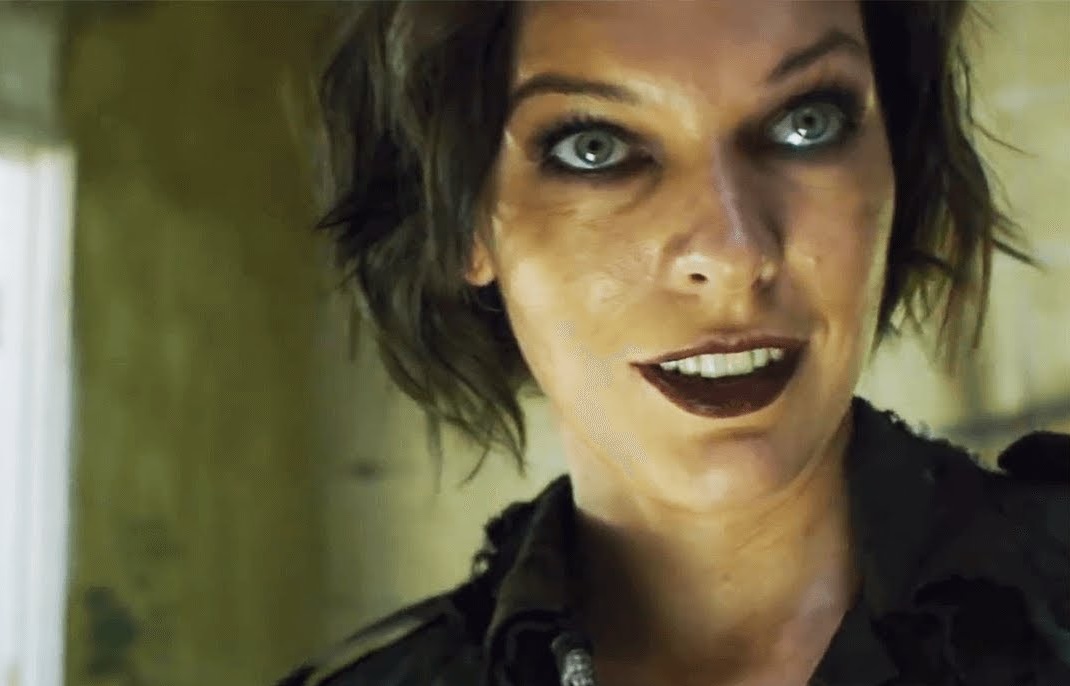
You know the writers really put in the time and effort with the script when you've got "Love Town" run by a guy named "Love Lord" and "Drug Town" ruled by someone named "Drug Lord." One could argue that it's a cynical, Terry Gilliam-esque dystopian commentary on people being defined by their work, but that's probably giving FUTURE WORLD a little too much credit. Jovovich doesn't turn up until the midway point, and she provides FUTURE WORLD's only spark of life with what seems to be a largely improvised performance. Her character is completely despicable--and gets naive, innocent Prince hooked on drugs--but while a little of her manic, bug-eyed overacting and general smartassery goes a long way, it shows Jovovich is at least trying to make something out of nothing. Waterhouse, who tread similar ground in last year's dismal-but-suddenly-looking-better-now THE BAD BATCH, doesn't have much to do other than look like she's Pearl Prophet in a 2018 riff on the old Van Damme sci-fi favorite CYBORG. Top-billed Franco is absent for long stretches--probably the case behind the camera as well--and can't help but come off as a poseur Toecutter and Immortan Joe, turning in the kind of performance that makes one wonder whether he was perhaps spending too much time with Tommy Wiseau while prepping THE DISASTER ARTIST (how is a walking freakshow like Wiseau not in this?) Wahlberg doesn't quite have the presence of his uncle Mark or even his uncle Donnie, and it's gotta be an ominous sign that his acting coach gets an onscreen credit. Like most of his "hanging out and dicking off with his buddies" auteur endeavors, Franco corralled a potentially interesting and eclectic cast--there's also Method Man, Rumer Willis, and veteran character actor Carmen Argenziano, who gets killed by Warlord after about ten seconds of screen time--but, as usual, he abandons them, this time in a dull post-nuke flick that's not even up to the level of late-career Cirio H. Santiago.
James Franco in one of Warlord's more pensive moments.
There's an attempt at an intriguing subplot involving Ash discovering her emotions and falling for Lei (Margarita Levieva), Drug Lord's techie mechanic, but it leads to nothing but a tame sex scene, as Franco can't even be bothered to make something like that look exciting. Other than Jovovich's inexplicably spirited and wildly gesticulating performance, the only other positive is Franco managing to secure the services of acclaimed cinematographer Peter Zeitlinger, who's been Werner Herzog's go-to D.P. for the last 25 or so years (including the great documentaries GRIZZLY MAN, ENCOUNTERS AT THE END OF THE WORLD, and CAVE OF FORGOTTEN DREAMS). He likely met Zeitlinger while starring in Herzog's globally-panned QUEEN OF THE DESERT, one of approximately 258 movies Franco's been in over the last five years. Zeitlinger does a nice job with some of the desert footage and some long Steadicam takes, but overall, the film has the same ugly, cheaply digital look you'll see in any random clunker on the straight-to-VOD scrap heap. Only Franco could follow the universally-acclaimed THE DISASTER ARTIST with a project that makes him look like he's chucking it all to become the next Albert Pyun.
THE DISASTER ARTIST (US - 2017) Directed by James Franco. Written by Scott Neustadter and Michael H. Weber. Cast: Dave Franco, James Franco, Seth Rogen, Ari Graynor, Alison Brie, Josh Hutcherson, Jacki Weaver, Zac Efron, Megan Mullally, Sharon Stone, Melanie Griffith, Paul Scheer, Jason Mantzoukas, Hannibal Buress, June Diane Raphael, Andrew Santino, Nathan Fielder, Charlyne Yi, Bob Odenkirk, Jerrod Carmichael, Zoey Deutch, Randall Park, Casey Wilson. (R, 104 mins) Since making his mark nearly 20 years ago on the ignored-and-now-iconic cult TV series FREAKS AND GEEKS, James Franco has had one of the strangest careers of any mainstream Hollywood actor. He's one of the industry's most tireless workaholics, with some extremely unpredictable choices that often border on some kind of obscure performance art. He appears in box-office blockbusters (Sam Raimi's SPIDER-MAN trilogy, RISE OF THE PLANET OF THE APES), hit comedies (PINEAPPLE EXPRESS, THIS IS THE END), played the bad guy in a Jason Statham movie (HOMEFRONT), stars in acclaimed indies (SPRING BREAKERS), barely-released European art films (Wim Wenders' EVERY THING WILL BE FINE, Werner Herzog's QUEEN OF THE DESERT), Lifetime movies (the remake of MOTHER, MAY I SLEEP WITH DANGER?), has an Oscar nomination for Best Actor (127 HOURS), did a three-year recurring stint on GENERAL HOSPITAL, frequently turns up in uncredited cameos (THE HOLIDAY, the remake of THE WICKER MAN, NIGHTS IN RODANTHE, THE GREEN HORNET, ALIEN: COVENANT), has published several collections of poetry and short stories, created a multimedia presentation based on the late '70s/early '80s sitcom THREE'S COMPANY, starred in the TV series 11.22.63 and THE DEUCE, earned a degree in Creative Writing in the mid '00s while maintaining his film and TV work schedule, and more recently, taught film courses at UCLA. For the last several years, he's been in an average of ten movies a year, and has somehow found the time to direct over 20 feature films, most getting very limited exposure and some still unreleased, ranging from the experimental CRUISING riff INTERIOR LEATHER BAR to biopics (he directed and starred as poet Hart Crane in THE BROKEN TOWER) to gothic horror (THE INSTITUTE), and most notably, an ongoing series of classic American literature adaptations (William Faulkner's THE SOUND AND THE FURY and AS I LAY DYING, Cormac McCarthy's CHILD OF GOD, and John Steinbeck's IN DUBIOUS BATTLE). Franco's oeuvre as a director has been commonly described as self-indulgent at best and unwatchable at worst, but he remains undeterred: he's got five directing efforts scheduled for release in 2018.
With that in mind, it's easy to see why Franco the filmmaker might feel some sense of kinship with Tommy Wiseau, the auteur behind 2003's THE ROOM, the midnight cult movie sensation that's become one of the most beloved bad movies of all time. Based on the 2013 memoir by ROOM co-star Greg Sestero, THE DISASTER ARTIST chronicles the friendship between Wiseau (Franco) and Sestero (James' younger brother Dave Franco) that began in a San Francisco acting class in 1998. 19-year-old Greg lives with his mom (Megan Mullally) and dreams of being an actor, but he's too shy and lacking in confidence in front of an audience. Enter Tommy, a long-haired, enigmatic mystery man of unknown origin and indeterminate age who gives the class an overwrought, climbing-the-walls, writhing-on-the-floor, pelvic-thrusting version of the "Stella!" bit from A STREETCAR NAMED DESIRE. Greg approaches Tommy about practicing some scenes together, and though he's a terrible actor, Tommy's fearlessness inspires Greg and almost immediately, the pair move to Los Angeles to pursue their acting dreams. They live in Tommy's L.A. apartment--a self-described "pied-a-terre" that he rarely uses. Tommy also drives a Mercedes and seems to be independently wealthy, but refuses to discuss his past, his money, or his age. Greg soon lands an agent and gets a few small gigs and a girlfriend (Alison Brie, Dave Franco's offscreen wife), while Tommy, with his strange appearance and even stranger accent, goes nowhere and grows increasingly jealous of Greg's relative "success." With both of their careers seemingly stalled before they even begin, Tommy considers giving up and going back to San Francisco but when Greg half-jokingly suggests they make their own movie, Tommy takes him seriously.
Tommy spends nearly three years writing THE ROOM, a drama with obviously semi-autobiographical plot elements, including a woman who broke his heart by cheating on him with his best friend. Tommy casts himself in the lead role of Johnny and Greg as his best friend Mark. Tommy also intends to direct the film, despite having no filmmaking experience. This is evident when he chooses to go the significantly more expensive route of buying the camera and sound equipment instead of renting, and when asked if he's shooting in 35mm or digital, he impulsively blurts out "both," which requires two different crews of technicians, but Tommy doesn't care because "I have a vision!" He pays to have sets constructed that look exactly like the real locations right outside the studio, which thoroughly baffles experienced script supervisor Sandy Schklair (Seth Rogen), who's worked on real movies and TV shows and immediately recognizes that Tommy has no idea what he's doing. But Tommy perseveres, making the film he wants to make while alienating a good chunk of the cast and crew, including Greg, with a turning point being his berating female lead Juliette Danielle (Ari Graynor) over a couple of small pimples on her chest that he insists will ruin their sex scene. By the time filming is finished--it's no surprise that Tommy goes over schedule--the budget balloons to $6 million and he doesn't even bat an eye at the cost.
What makes THE DISASTER ARTIST work as well as it does is the respectful approach James Franco takes--both as a director and an actor--to Wiseau. It would've been easy to make a snarky and mocking takedown, but Franco seems to genuinely admire the eccentric auteur. And he's perfect in the role, nailing his garbled, vaguely Eastern European accent (Wiseau repeatedly claims to be from New Orleans) and his mannerisms, right down to every facial expression. THE ROOM was a film whose early cult consisted of celebrities telling their friends about it--both James and Dave Franco, Rogen, and others like Kristen Bell (who acquired a print and would screen it for friends at her house), Paul Rudd, Patton Oswalt, Kevin Smith, Adam Scott, Danny McBride, David Cross, J.J. Abrams, and VERONICA MARS creator Rob Thomas, who began slipping ROOM references into episodes of the show. Like THE ROCKY HORROR PICTURE SHOW, THE ROOM took on a life of its own on the midnight movie circuit, with audiences throwing plastic spoons (a reference to a strange photo of a framed spoon in Johnny's house) and tossing footballs around, which characters in the film always seem to be doing. And there's so much quotable dialogue, from "Oh, hi Mark," to "You're tearing me apart, Lisa!"
Tommy Wiseau, James Franco, Greg Sestero, and Dave Franco
at an early 2017 screening of THE DISASTER ARTIST
Making his most accessible, commercial effort yet as a director (you really don't need to know THE ROOM to enjoy THE DISASTER ARTIST, but if you haven't seen it, you should), James Franco clearly adores Wiseau but isn't afraid to show his paranoid and often unlikable side, nor does he shy away from pointing out the genuinely inept elements of THE ROOM--like Wiseau's bizarre choice to have Johnny laugh at a story Mark tells about a friend being nearly beaten to death, or one character's announcement that she has breast cancer never leading anywhere or being referenced again ("It's a twist!" Franco-as-Tommy explains, obviously not knowing what a plot twist is), and James Franco matches Wiseau's utter lack of self-consciousness with the auteur's tendency to lay himself bare when a ranting Tommy demands his thrusting ass be the center of attention in a sex scene. There's a fair amount of dramatic license taken for sure, but THE DISASTER ARTIST is a funny, heartfelt, and sincere love letter not just to a movie that's brought joy to a lot of people (of course, Wiseau now insists much of the film was meant to be funny), but to all of the misguided souls whose dreams are too far beyond their capabilities--few soundtrack choices this year are more perfect than Faith No More's "Epic" playing as Tommy and Greg walk to the set in slo-mo on the first say of shooting ("You want it all but you can't have it!") . Be sure to stick around for the credits, where several ROOM scenes are played side-by-side with dead-on, perfectly-matched recreations by the in-character cast of THE DISASTER ARTIST. I wouldn't be surprised if Franco actually shot a scene-for-scene remake of THE ROOM with his cast to be included as an inevitable Blu-ray bonus feature.
ALIEN: COVENANT (US - 2017) Directed by Ridley Scott. Written by John Logan and Dante Harper. Cast: Michael Fassbender, Katherine Waterston, Billy Crudup, Danny McBride, Demian Bichir, Carmen Ejogo, Guy Pearce, James Franco, Jussie Smollett, Callie Hernandez, Amy Seimetz, Nathaniel Dean, Alexander England, Benjamin Rigby, Goran D. Kleut. (R, 120 mins) Despite the pre-release tap-dancing around the issue, it was obvious that 2012's PROMETHEUS was Ridley Scott's return to the universe he created with the 1979 classic ALIEN. After PROMETHEUS' ultimate reveal as a prequel, Scott has returned with no illusions about what's going on with ALIEN: COVENANT. Picking up ten years after the events of PROMETHEUS, COVENANT centers on a colonization mission on the space vessel Covenant, with a crew of 15 carrying 2000 colonists and 1000 embryos on a seven-year, hypersleep mission to an oxygenated planet known as Origae-6. They're under the watchful eye of "Mother," the ship's computer, as well as Walter (Michael Fassbender), a synthetic in charge of maintaining the ship. A "neutrino burst" causes significant damage to the ship, killing some sleeping colonists and forcing Walter to bring the crew out of stasis. Second-in-charge Oram (Billy Crudup) is forced to assume command when mission leader Branson (a barely-seen and uncredited James Franco) is killed in a freak explosion when his pod won't open. They're still seven years from Origae-6, and Branson's wife Daniels (Katherine Waterston, Sam's lookalike daughter), who's also on the crew, voices her objection when Oram decides to investigate a signal (someone singing John Denver's "Take Me Home, Country Roads," in a garbled audio transmission that's effectively creepy in an EVENT HORIZON way) from a previously unseen planet just a few weeks away that's showing even better habitability figures than their intended destination.
I guess Daniels is the only one who's ever seen an ALIEN movie or an ALIEN ripoff, since this is obviously a decision worthy of a Bad Idea Jeans commercial. While the Covenant and pilot Tennessee (Danny McBride) stay in orbit with two other crew members, a smaller vessel piloted by Tennessee's wife Faris (Amy Seimetz) takes Oram and the rest of the crew to the surface. They split up, with Oram's biologist wife Karine (Carmen Ejogo) collecting samples with soldier Ledward (Benjamin Rigby), who unknowingly stirs some alien spores that enter his ear and go undetected, taking root in his brain. Meanwhile, Oram and the others discover the wreckage of the spacecraft in which Dr. Elizabeth Shaw (Noomi Rapace) and synthetic David (also Fassbender) escaped at the end of PROMETHEUS. When a soldier in that group, Hallett (Nathaniel Dean), also gets infected by spores, they head back to the docked vessel where a creature has already burst out of Ledward's back and killed Karine, eventually leading to an explosion that kills Faris. A creature erupts out of Hallett's mouth and soon, others similar to the franchise's signature xenomorphs start attacking until the whole group is rescued by David (also Fassbender), who's been living alone in what appears to be the ruins of a Pompeii-like civilization. Dr. Shaw was killed in a crash landing ten years earlier, and when David isn't weeping at a shrine he's set up in her memory, he's been surviving on his own. He clearly has other intentions, as evidenced by his barely-contained enthusiasm upon being told that there's 2000 hibernating colonists and 1000 embryos aboard the still-orbiting Covenant.
ALIEN: COVENANT is consistently interesting, but it's still a hot mess. The biggest obstacle that it can't overcome--and it didn't seem apparent to me until I considered it and PROMETHEUS as a whole piece--is that knowing the backstory to the events of ALIEN and the whole Ripley (Sigourney Weaver) saga is completely unnecessary. When the actual H.R. Giger-designed xenomorphs finally appear in the last half hour or so, we see entirely too much of them, and in their sleek new CGI incarnation, pinballing all over the screen like sprinting zombies in 28 DAYS LATER, they lack the sense of tangible menace like the aliens in ALIEN and its equally great 1986 sequel ALIENS. This whole saga of PROMETHEUS and COVENANT ultimately feels like little more than ALIEN fan fiction that does nothing to enhance the movies we've been watching for going on 40 years now. Scott throws in enough bizarre and unexpected elements that COVENANT has always got your attention even when it's stumbling--the whole midsection of the film, showing David's routine around the ruins of the society he's adopted as his home, is another example of the director's occasionally insane side making its presence known. But in the end, it doesn't go far enough, like a lobotomized Ray Liotta eating his own sauteed brain in HANNIBAL or Cameron Diaz fucking a car in THE COUNSELOR. Before long, we once again start getting that PROMETHEUS feeling that Scott realizes he needs to appease the studio and abandons the project's unique ideas in favor of rushing through the last 30 or so minutes because he seems to suddenly remember he's making an ALIEN movie. In other words, almost right down to the minute, the same flaws in PROMETHEUS are repeated in COVENANT, with the added detriment of a laughably predictable twist ending and an attempt to turn David into a quipping, synthetic android Freddy Krueger.
Fassbender is fine in both roles, especially as David, with his gentlemanly sinister demeanor and erudite line delivery recalling Peter Cushing not just in his performance, but also in the echoes of Cushing's Nazi mad scientist living on a deserted island among his aquatic zombie creations in 1977's SHOCK WAVES (instead of CGI-ing Grand Moff Tarken in ROGUE ONE, they should've just hired Fassbender to do his Cushing impression). ALIEN: COVENANT feels like three movies in one, all of them tonally different (a late shower kill with gratuitous T&A as an apparently pervy xenomorph peeps in on a cavorting couple feels like it belongs in an '80s slasher movie or, at best, a Roger Corman ALIEN ripoff like GALAXY OF TERROR). Waterston makes a tough, gritty heroine, but elsewhere, there's too much distracting stunt casting, whether it's McBride coming off as "Kenny Powers in space" and not selling lines like "That's one hell of an ionosphere!" or Franco turning in his finest performance in years as a burnt corpse (Guy Pearce also appears as evil CEO Peter Weyland in a prologue). It's intriguing that the crew is almost entirely made up of married couples, with some sociopolitical commentary in Oram being established as conservative and bitching that his faith has held him back in his career, or that Hallett and badass security head Lope (Demian Bichir) are a gay couple, but it's never really explored other than as transparent thinkpiece-bait. Ridley Scott owes no explanations to anyone, and it's great that the 79-year-old legend is still full of piss and vinegar and able to work so much in his emeritus years, but like others in his age bracket such as Clint Eastwood and Woody Allen, his average of a new film every year or year-and-a-half is an indication that maybe a break and a recharging wouldn't be a bad thing. Scott is just spinning his wheels here, and so is the ALIEN franchise.
Philip Roth has been a lion of American literature since the 1950s, though that success hasn't always translated to the screen, with a common description of Roth's writing being "unfilmable." 1969's GOODBYE, COLUMBUS, adapted from Roth's 1959 National Book Award winner, was a critical and commercial hit that put Richard Benjamin and Ali MacGraw on the map. But when Benjamin was tapped to star in another Roth adaptation with 1972's PORTNOY'S COMPLAINT, lightning didn't strike twice and the results were so disastrous that it would be over 30 years before anyone attempted another big-screen take on Roth. Robert Benton's THE HUMAN STAIN opened to middling reviews in 2003, and Barry Levinson's THE HUMBLING (based on one of Roth's most critically panned works) only made it to a handful of theaters in 2015. Other than GOODBYE, COLUMBUS, the only Roth adaptations to receive any notable degree of acclaim were 2008's ELEGY, based on his 2001 novel The Dying Animal, and 2016's INDIGNATION. 2016 also saw the release of the long-planned AMERICAN PASTORAL, based on Roth's 1997 Pulitzer Prize winner about a well-to-do family falling into turmoil in the late 1960s. In various stages of development since 2003, filming actually began on a version in 2012 with Fisher Stevens at the helm and husband and wife Paul Bettany and Jennifer Connelly starring, but the project fell apart and was scrapped almost immediately. It got rolling again in 2015 with some help from Chinese co-producers TIK Films, with Connelly still attached and now heading the cast with Ewan McGregor in place of Bettany, but when director Philip Noyce quit during pre-production, McGregor himself stepped in to make his directorial debut. AMERICAN PASTORAL was touted as a major 2016 awards contender but that never panned out, as the initial reviews were so overwhelmingly negative that Lionsgate bailed on the film, pulling the plug on its nationwide rollout and stalling its release at just 70 screens for a gross of $550,000.
Considering its internationally revered source novel, AMERICAN PASTORAL the film is a complete disaster, the kind of transparently phony awards bait that wears its bloated sense of self-importance on its sleeve. You can actually see the film completely collapse around the 23-minute mark, when we get our first look at stuttering 16-year-old Merry Levov (Dakota Fanning) as she's cooking burgers in the kitchen. She's having a pleasant conversation with her father Seymour "Swede" Levov (McGregor) when the sight of LBJ on TV provokes a profane, hysterical meltdown. She excoriates Swede and her mother Dawn (Connelly) over their upper-middle class complacence, with Swede running his dad's (Peter Riegert in cartoonish Oy, vey! mode) Newark glove factory and Dawn having her own cow pasture on their expansive property in rural Old Rimrock. When Dawn tells Merry "You're not anti-war...you're anti-everything!," Merry concludes this bug-eyed, out-of-nowhere tirade by shouting "And you're pro-cow!," spitting her burger on the floor and storming out of the house, prompting Swede to go into her bedroom to find the walls plastered with anti-war, Weather Underground-like pamphlets and flyers calling for revolution as Buffalo Springfield's "For What It's Worth" cues up on the soundtrack, modern cinema's universal sign that the times they-are-a-changin' and it's...the Sixties, man! AMERICAN PASTORAL never recovers from this jaw-droppingly awful scene, as the Levovs' cushy existence is upended when Merry becomes a fugitive after blowing up the Old Rimrock post office and killing the local mailman. This leads to endless malaise and ennui in the lives of the Jewish Swede, a high-school football legend, and the Catholic Dawn, a shiksa who was Miss New Jersey in the 1947 Miss America pageant.
McGregor and journeyman screenwriter John Romano (who's had a long career in writing for TV on everything from HILL STREET BLUES to the recent HELL ON WHEELS) cut out huge chunks of Roth's novel willy-nilly to focus on how the general sense of the Sixties, man! takes its toll on the Levovs, though they do leave in a 2002-set framing device with recurring Roth character Nathan Zuckerman (David Strathairn) that really doesn't add anything to the story. AMERICAN PASTORAL relies on trite cliches and overwrought hysteria, with McGregor demonstrating no clue how to direct himself or his actors: Fanning's vein-popping overacting through clenched teech and flared nostrils is actually embarrassing to watch, especially since that palpable rage comes out of nowhere and wasn't present in the 12-year-old Merry we see played by a younger actress in earlier scenes. The first time we see Fanning, she's boiling with uncontrollable, shrieking fury and we don't know why. Even Connelly is terrible here, saddled with an unplayable character whose big scene has her showing up at Swede's factory, off her meds and babbling incoherently, dancing around totally nude except for her Miss New Jersey sash. At one point, a cop tells Swede "You've done everything wrong you possibly could've." I think that actor was breaking character and speaking directly to McGregor. AMERICAN PASTORAL is a botched misfire, but hey, congrats to PORTNOY'S COMPLAINT: you're no longer the worst big-screen Philip Roth adaptation. (R, 108 mins)
KING COBRA
(US - 2016)
Though it frequently succumbs to the cliches that come with almost any post-BOOGIE NIGHTS look at the seedy underbelly of the porn world, KING COBRA shifts gears into a grim and bleak thriller that benefits from the twists and turns of the real-life events on which it's based. Based on Andrew E. Stoner and Peter A. Conway's true crime chronicle Cobra Killer: Gay Porn Murder, the film follows wide-eyed innocent Sean Paul Lockhart (Garrett Clayton) as he arrives in the relatively non-descript northeastern Pennsylvania from San Diego, intent on becoming a star for Cobra Video, a web-based gay porn production company owned by Stephen (Christian Slater). Middle-aged Stephen (a character based on Cobra Video head Bryan Kocis) is drawn to young, late-teens "twinks," and he has a particular affinity for Sean, growing extremely jealous when he shows interest in other men. Stephen directs a series of videos with Sean starring under the name "Brent Corrigan," and after a falling out when Sean begins aggressively demanding more money and objecting to Stephen's controlling attitude, the pair part ways in an acrimonious split that jeopardizes both of their careers when Sean reveals he lied about his age and was only 17 when Stephen directed his first videos. Meanwhile, Joe Kerekes (James Franco, one of 29 credited producers) and Harlow Cuadra (Keegan Allen), a pair of sketchy escorts and amateur gay porn entrepreneurs running a low-rent company called Viper Boyz, are trying to break into the big time, living way beyond their means convincing themselves that they're on the level of Cobra Video. $500,000 in debt and increasingly desperate, the unstable and manipulative Joe reaches out to "Brent" to forge a business partnership based on the "Brent Corrigan" name, but Sean isn't legally allowed to use it since Stephen had the name copyrighted as a property of Cobra Video. While Sean tries to broker a peaceful agreement with Stephen, Joe and Harlow decide to deal with it in a manner that befits their thoughtless, volatile nature: they kill Stephen and set his house on fire in a half-assed attempt to cover it up.
All of this occurred from 2004 to 2007, and other than changing the name of Slater's character, it gets all the pertinent details down, albeit a bit glossed over and rushed considering the film only runs 90 minutes. It's a rare instance of a movie that could've been improved if it ran a little longer, with some more time allotted to explore the smaller details. Writer-director Justin Kelly keeps things moving briskly and copies from the best, with much of the film having that same tense vibe as the section of BOOGIE NIGHTS where everyone's hitting bottom (Dirk hustling, Rollergirl in the limo, etc). He gets mostly strong performances from his cast, with a really skeezy Franco doing his best to channel Willem Dafoe in AUTO-FOCUS mode but sometimes going overboard, and Clayton and Allen doing solid work as the naive and, in the case of Allen's Harlow, dumb young twinks being manipulated by the older men projecting their neuroses on to them. Molly Ringwald has a small role as Stephen's wholesome, oblivious sister and if you want to feel really old, Alicia Silverstone plays Sean's mom (yes, Alicia Silverstone is 40 now). But the real standout is Slater who, between Lars von Trier's NYMPHOMANIAC and his Golden Globe-winning work on the acclaimed TV series MR. ROBOT, has very quietly been taking his career seriously again in between his frequent gig as a guest co-host on LIVE WITH KELLY. Slater sells every facet of Stephen's mercurial personality. He puts up a front for his sister and his neighbors, pretending he makes a living as a photographer at kids' birthday parties, but when it comes to Cobra Video, he stops at nothing to get what he wants. He's soft-spoken and sensitive, insanely jealous, a creepy manipulator of barely-legal boys far away from their homes, and a ruthless businessman who never hesitates to remind Sean/"Brent" that he owns him. It's a complex and fearless performance by Slater, who manages to make you feel some degree of sympathy for Stephen--he fears growing old alone and Sean did lie about his age with a very well-crafted and believable fake ID. KING COBRA has to get to the circumstances surrounding Stephen's murder, but it loses something once Slater exits the movie with about 30 minutes to go. He's so good here that you almost wonder if a more interesting film could've been made by just focusing on his Bryan Kocis-inspired character. As it is, KING COBRA is a decent film, and one of the more relatively accessible James Franco indie productions of late (more than, say, INTERIOR. LEATHER BAR., for example), and the story is so intriguing that it may leave you wanting more substantive details into the world of Cobra Video. (Unrated, 92 mins, also streaming on Netflix)
THE CRASH
(US - 2017)
A financial thriller set in the near future that plays like the 1981 flop ROLLOVER if remade by the most annoying Ron Paul supporter in your Facebook newsfeed, THE CRASH is a lecture disguised as a movie. Written and directed by Aram Rappaport, last seen watering down 2013's SYRUP, a pointless adaptation of Max Barry's scathing 1999 novel satirizing corporate marketing and branding, THE CRASH renders itself dated immediately as it assumes Hillary Clinton won the 2016 election, with "Madame President" a fleetingly-seen character (played by Laurie Larson) late in the film. After cyber-terrorists hack the NYSE and threaten to bring down the global economy in 48 hours, Treasury Secretary Sarah Schwab (Mary McCormack) only sees one option: hiring master hacker and market manipulator Guy Clifton (Frank Grillo, also one of 29 credited producers) to thwart the attack. Clifton's currently facing SEC charges of hacking the Chicago Mercantile Exchange to benefit his own companies and previously hacked into the NYSE. He's somehow not in prison but he'll be granted immunity on the latest charges if he and his crack team of computer wizards and financial experts can stop the cyber attack and keep the economy stable. This mostly involves Clifton and his cohorts--sultry market analyst Amelia Rhondart (Dianna Agron), ALS-afflicted hacker George Diebold (John Leguizamo), and genius programmer Ben Collins (Ed Westwick)--spouting endless financial jargon while staring at monitors in the makeshift command center set up in Clifton's mansion. Clifton's got other things on his plate: his wife Shannon (Minnie Driver) isn't convinced this will keep him out of prison, and his 18-year-old daughter Creason (AnnaSophia Robb) is suffering from cancer and isn't responding to chemo. And she just got dumped by her secret boyfriend Ben.
THE CRASH runs just 84 minutes--and even then it's padded with super-slow-moving end credits kicking in around the 78-minute mark--yet it feels roughly three hours long. There's a way to make financial thrillers intriguing and suspenseful--BLACKHAT and the little-seen AUGUST come to mind--but Rappaport still feels the need throw in some disease-of-the-week TV-movie melodrama with Creason, and relies on too much in-your-face shaky cam, perhaps with the intention of making the viewer feel as backed-against-the-wall as Clifton, but it doesn't work. The more the film goes on, the more preachy and obvious it gets, especially with a corrupt, sneering Federal Reserve chairman named Richard Del Banco, who any seasoned moviegoer will correctly deduce is a scheming Dick from the Bank the moment they see he's being played by Christopher McDonald. By the end, with a mole inside Clifton's team planting a virus that creates a domino effect of collapsing world economies (of course, there's still time for Clifton and Ben to have a heart-to-heart and reach an understanding about dumping Creason) as "Madame President" stands around helplessly while her aides scramble and freak out, Clifton has a change of heart and just lets it fail, followed by an end crawl passive-aggressively advocating the abolishing of the Federal Reserve. Considering what I've seen of his work with SYRUP and now THE CRASH, I think the bigger priority is abolishing Aram Rappaport's DGA membership. (Unrated, 84 mins)
GOAT is a harrowing chronicle of fraternity hazing, based on the 2004 memoir by Brad Land. Director Andrew Neel (the LARP documentary DARKON) and co-writer David Gordon Green (PINEAPPLE EXPRESS) take some significant liberties with the book, playing a little fast and loose with the facts as to what happened to Land and what he did regarding the fraternity. Taken on its own terms, GOAT is frequently very powerful, with a pair of strong performances as its core by Ben Schnetzer (the acclaimed but short-lived series HAPPY TOWN) as Brad and Nick Jonas as his older brother Brett (though he looks younger, Schnetzer is actually two years older than Jonas). In the summer after graduating high school, Brad visits Brett at his Phi Sigma Mu frat house at Brookman University (the frat and Brookman are fictional; the actual university was Clemson) and is talked into giving a ride to two sketchy-looking townies who steal his car and nearly beat him to death. Still traumatized by the incident and unwilling to cooperate with police, Brad has all of his masculine insecurities brought to the forefront, questioning why he gave them a ride and why he never tried to fight back ("Am I a pussy?" he drunkenly wonders). Though Brett doesn't think it's the answer, Brad decides to pledge Phi Sigma Mu and is joined by his sensitive new roommate Fitch (Danny Flaherty), both freshmen needing to feel like they belong somewhere and needing to feel bolstered and reinforced by the power and prestige that comes with being in a popular frat ("I'm having sex for the first time in my life!" Fitch keeps saying). Neel doesn't shy away from the brutal hazing of Hell Week, an endless series of increasingly degrading and dehumanizing rituals that make it seem like a collegiate version of SALO could break out at any moment. The pledges are terrorized, forced to drink gallons of alcohol until they puke and black out, tied up and locked in animal cages, urinated on, threatened with forced bestiality with a goat if they don't finish a keg in a certain amount of time, and one comparatively harmless prank involves a blindfolded Brad believing he's being forced to eat a turd out of a toilet bowl, but it's only a banana. The hazing by frat leaders Chance (Gus Halper) and the sadistic Dixon (Jake Picking) goes over the line to the point where even Brett is growing disillusioned with the whole thing, asking Chance at one point "Is this getting a little weird this year?"
Weird eventually escalates to tragic, but all the while, Brad is willing to look the other way because the more he endures, the less of a "pussy" he feels. It's his way of getting back at the guys who assaulted him, even as he ignores calls from the cops to come in and ID two guys who match the description and have been picked up for another crime. The changes made by Green and Neel are strange--in the book, Brad put his foot down and quit the fraternity while Brett was presented as, for lack of a better term, an antagonist who resented his brother. In the film, Brad is so concerned with asserting his manhood that he refuses to give up on the frat even as Brett pleads with him to do so, and it's Brett who grows tired of Chance's and Dixon's antics. It's an odd decision that may create some dramatic tension between the brothers but sort of undermines Brad's role in what was supposed to be his own story and his own expose. The story works in the context of the film, but it's a bizarre artistic choice by the filmmakers, unless someone thought making Nick Jonas the hero might secure a better distribution deal. It hardly mattered--the Cincinnati-shot GOAT only played in a few theaters and on VOD, but it's a sleeper that's certain to find an audience on streaming services, as difficult as it is to endure at times. Schnetzer and Jonas are both excellent (Jonas is a real surprise here, though he might've fared even better as an actor if the filmmakers stuck to the book), but producer James Franco gives himself a cameo as an aging frat god from years earlier who still periodically stops by the house to chug some beers and reminisce with the younger guys about his glory days. Franco basically turns up for a few minutes to play a dudebro combination of "James Franco" and "Matthew McConaughey's Wooderson" for a few minutes, and it's distracting to say the least, but hey, he's the producer, so what are you gonna do? (R, 102 mins)
PET (US/Spain - 2016)
There's some intriguing ideas in this sort-of extreme horror variation on the John Fowles novel The Collector, famously made into a 1965 film with Terence Stamp and Samantha Eggar. What begins as a standard-issue psycho-stalker movie gets a major boost from a mid-film reveal that just ends up fizzling by the end, when screenwriter Jeremy Slater (a writer and producer on the Fox TV series THE EXORCIST) and director Carles Torrens (the found-footage possession movie APARTMENT 143) go for one too many twists and contrivances as things wrap up with a groan instead of a jolt. Seth (Dominic Monaghan, whose American accent needs some work) is a lonely and awkward man who works as an attendant at a Los Angeles animal shelter. On the bus ride home from work one evening, he spots Holly (Ksenia Solo), an aspiring writer and high school classmate who doesn't remember him. He makes bumbling small-talk and is oblivious to the fact that she's clearly not interested, but he stalks her on social media, shows up at the greasy spoon where she waits tables asks her to a Ben Folds show, and follows her to a bar where he's promptly beaten up by her ex-boyfriend Eric (Nathan Parsons). Repeatedly reprimanded at work for getting too attached to the animals and failing at any attempt at male bonding with imposing security guard Nate (Da'Vone McDonald), a desperate Seth finds a closed-off room in the shelter basement, complete with a large cage, which he deems the perfect place to keep Holly until she realizes how perfect they are for one another.
PET is pretty standard up to that point, but Slater and Torrens pull one of 2016's better bait-and-switches that up-ends both Seth's motive for doing what he does and the audience's perception of Holly. We're not talking a USUAL SUSPECTS-level game-changer here, but as far as twists go in 2016 movies, this one is pretty audacious. But the filmmakers stumble on the follow-through, with PET completely collapsing in the final act, trying to go for ambiguity as an excuse to cover up the trail of implausibilities that's left them completely backed into a corner. Seth's devotion and Holly's behavior ultimately make little logical sense, and PET turns into one of those movies where everyone from Seth's bosses to the cops are required to be incredibly careless and unbelievably stupid in order to keep the plot moving. Still, there's enough good intentions in the building blocks of PET's construction and in an outstanding performance by Solo that it's worth a look, even if it ultimately misses the mark and 40-year-old Monaghan looks entirely too old to have gone to high school with Solo. (R, 94 mins)
DAD'S ARMY (UK - 2016)
Running from 1968 to 1977, the BBC series DAD'S ARMY remains one of the most beloved sitcoms in the history of British television. Giving career roles to great British character actor ringers like Arthur Lowe and John Le Mesurier, DAD'S ARMY dealt with the wacky antics of a platoon of misfit Home Guard volunteers in a small English town in WWII. With its slapstick comedy and quotable catchphrases, it was so popular that it spawned a 1971 feature film spinoff in the middle of its run. Nostalgia would seem to be the only reason to produce a remake nearly 40 years after the show went off the air, and with absolutely no reason to exist, the 2016 version of DAD'S ARMY is painfully unfunny and would be completely unwatchable if not for a distinguished cast that's hopefully having a lot more fun than the audience. In 1944, in the days before D-Day, Walmington-at-Sea's Home Guard leader Capt. Mainwaring (Toby Jones in Lowe's role) and his right-hand Sgt. Wilson (Bill Nighy in Le Mesurier's role) are informed by their commander Theakes (Mark Gatiss) that they're to patrol an Allied base at Dover that's being targeted for invasion by high-ranking Nazi Admiral Canaris (Oliver Tobias), who's sent a spy to infiltrate the area. Meanwhile, sultry reporter Rose Winters (Catherine Zeta-Jones) arrives to do a story on the Home Guard, which results in Mainwaring and Wilson trying to one-up the other in their hapless attempts to woo her, which naturally infuriates their henpecking wives. Also among Mainwaring's Home Guard troops are doddering Jones (Tom Courtenay), senile Godfrey (Michael Gambon), crotchety Frazer (Bill Paterson), and youngsters like the womanizing Walker (Daniel Mays) and goofball Pike (Blake Harrison).
With that cast and a script by frequent Rowan Atkinson collaborator Hamish McColl (MR. BEAN'S HOLIDAY, JOHNNY ENGLISH REBORN) working under the direction of Oliver Parker (the 1995 OTHELLO with Laurence Fishburne, AN IDEAL HUSBAND), it's hard to believe DAD'S ARMY is as terrible as it is. Joke after joke lands with a thud, the pace is laborious, and the greenscreen work and CGI look unfinished. Who is the audience for this movie? Older people who fondly remember the TV show probably won't go for the more contemporary vulgar elements, whether it's a confused Godfrey relieving himself on what he thinks is a tree but is really Jones in disguise (I'm pretty sure that when Tom Courtenay received an Oscar nomination for Best Supporting Actor in DOCTOR ZHIVAGO 50 years ago, he never envisioned Michael Gambon pissing on him in their emeritus years), or Paterson's Frazer dropping trou and mooning a U-boat crew. The increased toilet humor seems to be there to draw a younger crowd who I'm certain has no interest in seeing an otherwise dated and creaky WWII comedy headlined by Bill Nighy, Toby Jones, and Tom Courtenay. DAD'S ARMY resurrects the catchphrases ("You stupid boy!") and gives cameos to the series' two surviving cast members (Ian Lavendar, the original Pike, appears as a general, and Frank Williams reprises his role as the town's vicar), but it was panned by British critics and flatly rejected by UK audiences, bombing when it was released there in early 2016. With the TV show known only by the most ardent Anglophile TV fans in the US, Universal had no viable strategy on how to sell this to American audiences, even with familiar faces like Nighy and Zeta-Jones, so they ended up releasing it straight-to-DVD/Blu-ray with no publicity at all. A rare movie that's made for absolutely no one and whose very existence is an inexplicable mystery, DAD'S ARMY's only point of interest is that it was produced by Alan Parker (MIDNIGHT EXPRESS, FAME, PINK FLOYD: THE WALL, MISSISSIPPI BURNING), who's been MIA since directing 2003's THE LIFE OF DAVID GALE. He's no relation to Oliver Parker, which would at least explain his involvement. Alan Parker disappears for 13 years and this is what inspired him to emerge from self-imposed exile? You know a comedy is bad when even the end credits blooper reel isn't funny. (Unrated, 100 mins)
EVERY THING WILL BE FINE (Germany/Canada/France/Sweden/Norway - 2015)
One of the major voices of the 1970s New German Cinema who reached his pinnacle in the next decade with the classics PARIS, TEXAS (1984) and WINGS OF DESIRE (1987), Wim Wenders has enjoyed his biggest success in the latter half of his career with documentaries like THE BUENA VISTA SOCIAL CLUB (1999), PINA (2011), and his contributions to the PBS series THE BLUES. His first narrative feature since 2008's surreal PALERMO SHOOTING (one of Dennis Hopper's last films, and still unreleased in the US), EVERY THING WILL BE FINE plays more like an homage to SWEET HEREAFTER-era Atom Egoyan, from the crux of its story being a tragedy uniting several people, to its cold, wintry Canadian setting. Judging from the end result, Wenders can't do vintage Egoyan any better than Egoyan can these days. Making superfluous use of 3-D, which is limited mostly to some falling snowflakes for the six people who managed to see this in a theater, EVERY THING WILL BE FINE offers the most somnambulant cast this side of Werner Herzog's HEART OF GLASS, headed by James Franco as Tomas Eldan, a struggling Quebecois novelist whose marriage to Sara (Rachel McAdams, with a distracting and stilted Swedish--I think--accent) is in a rough patch. It gets worse when Tomas is involved in a freak accident on a snowy rural road where he thinks he narrowly averted hitting a young boy in a sled but realizes too late that there were two boys on the sled and the other died, pinned under his SUV. This scene, where Tomas thinks he and the surviving kid had a close call but slowly realizes, when the boys' shell-shocked single mother Kate (Charlotte Gainsbourg) asks where the other boy is, that he's accidentally killed the unseen second child, is by far the best in the film and it's all downhill from there.
Of course, even though it was a tragic accident, Tomas is plagued by guilt and half-heartedly attempts suicide, demonstrated in a trite montage where Wenders shows him crashing in a cheap motel, empty booze and pill bottles and torn up papers strewn about the room. The film repeatedly jumps through a few years at a time. Tomas and Sara have split up and he feels compelled to help the devoutly-religious Kate in some way. She's forgiven him and doesn't blame him and though they seem drawn to one another through their mutual grieving, Wenders and screenwriter Bjorn Olaf Johannessen don't indulge anything further, since that would mean something happening. The film takes place over an 11-year period, and every time Wenders seems to be building to something, he calls a time-out and jumps ahead four years. It's especially frustrating in the last section, when Tomas gets a letter from troubled, 16-year-old Christopher (Robert Naylor), who was five when he survived the accident that killed his little brother. Tomas has become a bestselling author, channeling his pain into prose and becoming rich and famous, and while Christopher is a fan of his work, he feels his brother's death has somehow worked in Tomas' favor while his mother has never really recovered. While Tomas and his second wife Ann (Marie-Josee Croze) are away on a brief book tour, someone--obviously Christopher--breaks into their house and urinates all over their bed. Just as EVERY THING WILL BE FINE seems poised to turn into a thriller of some kind, the film abruptly ends in the most enraging way possible, with Franco--who's about as believable a Quebecois novelist named Tomas as you'd expect--turning to the camera and smiling. Did Wenders just feel "Hey, it's been a while, I should probably make a drama again"? There's some beautiful cinematography by the venerable Benoit Debie, but EVERY THING WILL BE FINE is a film that keeps stopping itself dead in its tracks. Scenes crescendo into nothing and collapse, actors appear and disappear (Peter Stomare has one scene as Tomas' publisher; frequent Wenders actor Patrick Bauchau plays Tomas' dementia-addled father). It seems to be actively avoiding being about anything. The actors seem to be partially sedated, even more so as the film goes on. When a remarried Sara has a chance meeting with Tomas at a Patrick Watson concert (yes, time-killing concert footage) and slaps him, it seems less out of anger than to simply revive Franco. A comatose Wenders misfire like 2001's THE MILLION DOLLAR HOTEL moved at the pace of plate tectonics but at least had an insane performance by a neck-braced Mel Gibson to occasionally liven things up--there's nothing of the sort in EVERY THING WILL BE FINE. Life is filled with disappointments, regrets, and unresolved issues--which can make for compelling cinema but not when it's done the way Wenders does it here. It seems like a sincere enough film, but what's the point? (Unrated, 119 mins)
THE CONFIRMATION (UK/US/Canada - 2016)
The kind of slight, low-key character piece that goes over like gangbusters at film festivals but plays to crickets and tumbleweed in general release, THE CONFIRMATION is the directing debut of Oscar-nominated NEBRASKA screenwriter Bob Nelson. As in that film, we have a story set in a blue collar town where most of the residents have seen better days. Anthony (MIDNIGHT SPECIAL's Jaeden Lieberher) has it pretty good other than his ambivalence about being prodded into confession and confirmation by his church-going mom Bonnie (Maria Bello) and stepdad Kyle (Matthew Modine). Bonnie and Kyle are going away to a church-sponsored couples retreat for the weekend, leaving Anthony in the care of his alcoholic, sporadically-employed carpenter dad Walt (Clive Owen). Slumped-shouldered Walt has been dealt some shitty hands and is beaten down by life, but he's trying to make things work. He's on his latest attempt to quit drinking and isn't sure what to do with Anthony over the weekend, but that soon becomes a moot point as the pair encounter one obstacle after another. Walt gets a lucrative job lined up for Monday morning, but his expensive and sentimental (they were his dad's) specialty tools get stolen from his truck, his truck breaks down, a trip to drop a huge jar of change into a Coinstar machine at the grocery store to get some quick cash is all for naught when Anthony accidentally hits the "Donate" button, and they get locked out of the house when Walt gets an eviction notice. Borrowing Bonnie's SUV--Anthony neglects to tell Walt the brakes need replaced--the pair spend the weekend tracking down Walt's tools BICYCLE THIEF-style, getting help from a variety of odd folks both helpful and dubious, ranging from Walt's fatherly friend Otto (Robert Forster), drunken gun nut Vaughn (Tim Blake Nelson), and eccentric drywaller Drake (Patton Oswalt) whose claim to have the inside info on Walt's tools is negated by the fact that everyone knows he's back on meth.
THE CONFIRMATION is basically a standard redemption saga, with Walt and Anthony bonding and everyone realizing Walt's not such a loser after all. Nelson gives the story time to breathe and find its way, even with the trite symbolism of carpenter Walt "building" a relationship with his son. Walt tries to keep his temper in check as the deck is constantly stacked against him and and does everything he can to not cave to temptation and disappoint his son (after a bad withdrawal episode the first night, the first thing out of Walt's mouth in the morning is "Are you OK? Did I hurt you?"). Though he's hardly a textbook role model, Walt tries to dispense life lessons to the boy, and of course, he learns just as much from the wise-beyond-his-years Anthony. There's some legitimate surprises in the development of some of the characters: Anthony forms a friendship with Vaughn's sensitive son Allen (Spencer Drever); when Walt finds out who stole his tools, he feels sympathy rather than anger; and after constantly hearing from Walt what a useless tool he is, we're surprised to find that Kyle is actually a genuinely nice and sincere guy once we meet him. There's no big scenes or huge plot reveals in THE CONFIRMATION. It's a quiet, working-class indie film where the actors probably wore there own clothes and packed their own lunches for Nelson's heartfelt labor of love. It's not much to get excited about, but Owen and Lieberher make a good team, and fans of the actors will definitely want to check it out. (PG-13, 101 mins)
The third of four films Robin Williams had in the can at the time of his death in August 2014 and the last to feature him onscreen (he voices a dog in Terry Jones' long-delayed sci-fi comedy ABSOLUTELY ANYTHING, tentatively due in the US in early 2016), BOULEVARD finds the actor on the controlled, dramatic side of things for one of the better projects from his mediocrity-plagued final couple of years. A character study of a lifetime of repression and walled-off emotions, BOULEVARD was directed by the wildly inconsistent Dito Montiel, who garnered some indie acclaim with 2006's A GUIDE TO RECOGNIZING YOUR SAINTS, but other than 2009's underrated FIGHTING, has fizzled in the years since. Montiel's specialty is shooting his films in the parts of NYC that still look like the NYC of the 1980s, but BOULEVARD finds him venturing outside his comfort zone. A low-budget indie shot in Nashville in the summer of 2013, the film didn't even secure a distributor until several months after Williams' death (Starz Media, who opened it on 11 screens in July 2015), which probably had to do with the subject matter as much as it's just a depressing downer without a lot of mass appeal. Williams stars as Nolan Mack, a milquetoast, 60-year-old loan officer who's worked at the same bank branch for 25 years. The comfort and familiarity of his job extends to his home life with wife Joy (Kathy Baker). While they enjoy one another's company, share an affinity for fine wine, the literary works of John Updike and Salman Rushdie, and movies like Godard's MASCULIN FEMININ, the childless couple are more like old friends than spouses. They sleep in separate rooms and there's no indication of any physical intimacy between them in quite some time. While returning from a visit to his father (Gary Gardner, who also died prior to the film's release) at a nursing home, Nolan impulsively detours through a sketchy part of town and picks up Leo (Roberto Aguire), a male prostitute who suggests they go to a motel. Asexual Nolan declines any offers of sex and just wants to talk or, at most, gently caress or hold Leo. Nolan becomes a sugar daddy of sorts, buying Leo a phone, clothes for a job interview, and giving him money. He grows possessive of Leo, who comes to like Nolan but is still drawn to the streets and hustling. Nolan's fixation on Leo becomes a major life distraction that eventually gets him a black eye after a physical altercation with Leo's pimp (Giles Matheny) that spills over into his workplace, and forces him to spin a web of lies that Joy constantly catches him in but says nothing.
It's always strange seeing an actor who's since passed on in a new project months or years after their death. Of course, the fact that Williams is no longer here and that his life ended the way it did casts a dark cloud over the already melancholy BOULEVARD. Nolan is a meek man who loves his wife, but whose life has passed him by and at 60, he's only now coming to terms with the fact that he's gay but too emotionally withdrawn to know how to act on it. After years (decades?) of a loving but platonic, convenient marriage, that part of Nolan has shut down but Leo stirs something inside of him and while he can't act on it in a sexual way, it's making him re-evaluate everything, much to the dismay of Joy, who loves her husband but knows their marriage is a security blanket of sorts. She even demonstrates just how well she knows her husband when he finally admits he's been lying and her first question is "What's his name?" Williams and Baker are very good here, and after some truly abysmal films in recent years (THE BIG WEDDING, THE ANGRIEST MAN IN BROOKLYN, A MERRY FRIGGIN' CHRISTMAS) and the failed TV series THE CRAZY ONES, it's nice to see one last excellent performance from him--he's always been at his best when a director can rein him in, and Montiel succeeds on that front, even as the story seems ready to clandestinely veer into ONE HOUR PHOTO territory at any moment. Williams also works well with Aguire and with Bob Odenkirk, as Nolan's best friend, a cynical English prof with a propensity for younger women. BOULEVARD manages to accomplish the rare feat of being a downbeat film that doesn't force its characters to wallow in misery, but at the same time, it offers no real surprises in its outcome and it's prone to clunky exposition drops. It's not a great film (unless you're grading on the Montiel curve), but it's an occasionally effective and heartfelt one, and fans of Williams and the always-excellent Baker (who gets a fine Beatrice Straight-from-NETWORK tirade near the end) will definitely want to seek it out. (R, 88 mins)
THE D TRAIN (US/UK - 2015)
IFC opened THE D TRAIN on over 1000 screens in the second week of the summer movie season and watched it promptly tank, landing in 19th place with $450,000 and plummeting an apocalyptic 97% in its second weekend. It's a mixed bag, but commercially speaking, it's the kind of offbeat project--think of Adam Sandler fans going to see PUNCH-DRUNK LOVE--that produces vitriolic reactions from an audience that's not getting the movie they thought they'd be getting. Of course, THE D TRAIN didn't really get much of a push in the first place, starting with a vague trailer that sort-of looked like a wacky reunion comedy but seemed a little off. IFC was probably betting on Black's presence alone netting them a commercial hit, while Black was probably thinking this would be another BERNIE to beef up his indie cred. Black is Dan Landsman, a nice-guy sad sack with a nice family--wife Stacey (Kathryn Hahn), teenage son Zach (Russell Posner), and an infant daughter--and a dull job at an outdated Pittsburgh consulting firm whose technophobe owner Bill (Jeffrey Tambor) doesn't buy into the idea the computers are essential. Dan also chairs his 20th high school reunion committee, even though the other volunteers don't like him and don't invite him out for drinks after their meetings (Dan sees their bar pics on Facebook the next day). After spotting their high school god Oliver Lawless (James Marsden) in a sunblock commercial on TV, Dan has a plan to make the reunion epic and make himself the hero in the process: get Lawless, a star athlete and all-around stud who went to L.A. after high school to become an actor, to commit to the reunion. Dan grows a soul patch and fakes a business trip to L.A. in order to meet up with Oliver, and after a drug and alcohol-fueled weekend where something quite unexpected happens, Oliver agrees to come to the reunion, which up-ends Dan's life in ways that soon spiral out of control.
Given that the sexually adventurous Oliver talks openly of no preference for women or men, just "whatever feels right," what happens in L.A. between him and Dan probably won't come as a surprise to anyone who's seen 2000's CHUCK & BUCK, the indie hit whose star/writer Mike White--looking alarmingly like the late, great Norman Fell as he gets older--has a supporting role and co-produces here. THE D TRAIN explores this plot turn with little concern for commercial viability, but the biggest issue is that Dan never seems like a real person. He's a man who desperately wants to rewrite his high school experience, even inventing ridiculous nicknames for himself (like "The D Man," "D-Fresh," and "D-Money") that everyone calls out as complete bullshit. At first, Dan seems sad and a little pathetic, not unlike Ricky Gervais' David Brent on THE OFFICE, but the more the film goes on, especially after the L.A. section, the more unsympathetic you'll feel to the point of possible repulsion. Cringe comedy has to be funny while making you uncomfortable, but Dan becomes such an unlikable asshole that the cringe factor never gets to take hold and you start feeling sorry for Oliver, who's the far more interesting character and didn't ask for any of this. Marsden is terrific as Oliver, who also has his own insecurities ("I peaked in the 11th grade," he says regarding his failed pursuit of Hollywood fame, and he also haplessly tries to impress Dan by pretending to know Dermot Mulroney when they spot him in a bar) and vulnerabilities that he tries to mask by doing things like dispensing sage advice to Zach about how to maneuver his way through a three-way. But Black's performance becomes so over-the-top and off-putting that you keep rooting for Dan's life to completely collapse, and I'm not sure that was the intent of the writing/directing team of Jarrad Paul and Andrew Mogel. As Dan grows increasingly desperate and more hostile, I kept thinking of the nuances that an actor like, say, the late Philip Seymour Hoffman could've brought to the character (he would've been perfect for this). Black isn't able--at least not in his performance here--to explore the dark places that THE D TRAIN wants to go, and the film never finds the right tone, trying to go in one direction but being pulled in another by Black doing his "Jack Black" thing. It also doesn't seem to make much sense that 45-year-old Black and and 41-year-old Marsden would be high school seniors in 1994. Why not make it a 25-year reunion? And maybe this is being pedantic, but why is Quarterflash's 1981 hit "Harden My Heart" being played at a Class of 1994 reunion? What 18-year-old in 1994 was listening to Quarterflash? And the morning after the reunion, Stacey tells Dan that he needs to take Zach to school. What class reunion takes place on a weeknight or a Sunday? (R, 101 mins) TRUE STORY (US - 2015)
There's a fascinating film to be made of the facts behind TRUE STORY, but the result here is a lifeless and formulaic psychological thriller-turned-forgettable courtroom drama. In 2002, New York Times journalist Michael Finkel was fired after fudging some facts and creating composite characters for an investigative piece. At the same time, American fugitive Christian Longo was in Mexico, evading murder charges for the deaths of his wife and three children. When Longo was apprehended, he had been using the name "Mike Finkel," and passing himself off as a reporter. Finkel and Longo had no connection and had never met, and when word got back to Finkel that someone on the FBI's Ten Most Wanted list was using his name as an alias, he reached out to a jailed Longo, who was in Oregon awaiting trial. So began a relationship that's somewhere between man-crush and co-dependency of sorts that carries on to this day (the film says the men still talk on the first Sunday of every month), one that saw Longo manipulating Finkel and the disgraced Finkel using the case to nab a book deal and revitalize his career. There's a lot of talk in the prison visitation scenes between Finkel (two-time Academy Award-nominee Jonah Hill) and Longo (Academy Award-nominee James Franco) but none of it really goes anywhere. Longo keeps insisting he's innocent, which secures Finkel's book deal, but then pleads guilty to two of the murders, and not guilty to the other two in what's perceived as a blatant attempt to confuse the jury and cause a mistrial. Longo has been diagnosed with a narcissistic personality disorder, but TRUE STORY doesn't really explore that. In fact, once director Rupert Goold keeps the focus on their one-on-one discussions, the film isn't really about much of anything. There's no suspense in the courtroom sequences, which are anchored by Franco giving a long and rambling Longo monologue, and Finkel comes off as too sloppy in his ambition and too gullible to be taken seriously. Because they have a nice natural rapport and have been friends for years, Hill and Franco--a dramatic pairing that, thanks to their extensive comedy history, still feels like stunt casting even though they have three (yes, three) Oscar nods between them (and a single wink from Franco as Longo smiles at Finkel after the verdict is read almost salvages things)--do good work with what they're given, but the Brad Pitt-produced TRUE STORY just never catches fire. (R, 99 mins)