Based on a 2017 novel by German author Daniel Kehlmann, YOU SHOULD HAVE LEFT reunites writer/director David Koepp with star Kevin Bacon, the pair having last collaborated on 1999's acclaimed supernatural thriller STIR OF ECHOES. Bacon once again plays a man tormented by strange, inexplicable occurrences, though instead of a blue collar everyman, he's now Theo Conroy, a wealthy former bank exec who's married to the much younger Susanna (Amanda Seyfried), with a six-year-old daughter named Ella (Avery Essex). Susanna is a moderately successful actress prepping for an eight-week movie shoot in London, so they decide to rent a spacious, modern home in a remote part of the Welsh countryside beforehand as a family getaway. But they have problems that were simmering at home that only proceed to reach a boil when they're stuck in the middle of nowhere. Theo has grown very insecure over their 30-year age difference, about which both Susanna and Ella regularly razz him ("Daddy, will you die before Mommy because you're so much older?"), and though she's only six, Ella is very perceptive and is aware that Theo had a wife before Susanna and that she died under mysterious circumstances that made him a tabloid target ("Why do people hate Daddy so much?" she asks). Theo is also annoyed by Susanna's constant text messages to and from a male colleague, as he's in constant fear that she'll leave him for a younger man. He's working through these jealousies and insecurities and writing in a journal, but the Welsh home only makes things worse. Theo begins to feel disoriented by various things that don't make sense: light switches don't work on the lights they should, doors mysteriously appear where there was once a wall, and a walk down a previously unseen hallway results in a four-hour loss of time. Sensing something is off in the layout, he measures the living room, and finds the interior is five feet longer than the exterior (Ella, holding the tape measure: "How can that be?"). He finds a Polaroid of himself standing in the hallway, a shot that seems to have been taken a minute earlier and left for him to discover. Both he and Susanna start having bad dreams, Ella sees strange shadows on her bedroom wall, and a couple of unfriendly locals seem skittish that they've rented what's known as "the Stetler house." And someone has scribbled "YOU SHOULD HAVE LEFT!" and "NOW IT'S TOO LATE!" in Theo's journal.
In and of themselves, those instances have some creepy and unsettling potential. There's definitely a sense of THE SHINING in this house, especially with its labyrinthine design, its spatial impossibilities (an idea that also prompted House of Leaves author Mark Z. Danielewski to make accusations of plagiarism), a ghostly woman in a bathtub, and the house's effect on the family staying there. But this Blumhouse production tries to meld their patented jump scares with the more cerebral dysfunctional family horrors of HEREDITARY and MIDSOMMAR mastermind Ari Aster, and its pieces never quite come together. It feels padded even at 90 minutes, like a TWILIGHT ZONE episode belaboring its point, with a muddled shrug of a reveal that you'll see coming long before Theo or Susanna do (Koepp makes a huge mistake by telegraphing it in an overtly obvious fashion in the opening scene). Bacon is the solid pro he's always been, and he has terrific father/daughter chemistry with young Essex (Seyfried, for reasons that can't be divulged without significant spoilers, is absent for a long stretch in the middle), but the payoff isn't worth the elaborate buildup. Koepp was one of the hottest screenwriters of the '90s and into the early '00s (APARTMENT ZERO, JURASSIC PARK, CARLITO'S WAY, THE PAPER, MISSION: IMPOSSIBLE, PANIC ROOM, SPIDER-MAN, and he created the acclaimed but little-watched TV series HACK), but to call his more recent work indicative of a slump would be an understatement: in the last few years, he's scripted the dismal likes of INFERNO and THE MUMMY and directed the unwatchable MORTDECAI. YOU SHOULD HAVE LEFT is a step up from those, but it's no STIR OF ECHOES, and Koepp still hasn't regained his mojo relative to his 1990s glory days. Perhaps Universal wasn't feeling it either: this was originally intended to be a summer theatrical release, but once the pandemic hit, YOU SHOULD HAVE LEFT wasn't given a new release date later in the year, nor was it bumped to 2021. Instead, it was among the first major-studio titles to get relegated to the premium VOD route. $2 at Redbox is one thing, but this is definitely not $20 PVOD material. (R, 93 mins)
LEGACY OF LIES (Ukraine/UK/US - 2020)
Scott Adkins, the hardest-working man in action movies, is back with LEGACY OF LIES, his second movie of 2020, with five more tentatively on the way before the end of the year. This mostly Ukrainian-financed espionage thriller gets too convoluted and sluggish for its own good, but it's anchored by a typically committed Adkins performance and some nicely-done fight scenes, with the star once again collaborating with busy stunt coordinator Tim Man (TRIPLE THREAT). Dutch writer/director Adrian Bol embraces the cliches without shame, with Adkins as Martin Baxter, a PTSD-stricken former MI-6 agent who walked away from the spy game after a botched mission in Kyiv 12 years earlier. Now a single dad to precocious, wise-beyond-her-years Lisa (Honor Kneafsey), Baxter works as a bouncer in a popular London club (cue a packed throng of decadent partiers and throbbing techno beats) and picks up some quick cash in (wait for it) underground MMA fights, but he's in such a slump on that end that Lisa secretly cashes in by betting against him. Baxter's past comes back to haunt him when Sacha (Yuliia Sobol), a crusading Ukrainian journalist and daughter of one of his late former colleagues, comes to him with a story about a dead MI-6 agent and a rat in the network, and something about exposing a Russian plot to develop a deadly nerve gas. He doesn't want anything to do with it, but is forced into action when ruthless Russian agent Tatyana (Anna Butkevich, waiting around for Luc Besson to call her to be the next Sasha Luss) kidnaps Lisa and gives Baxter 24 hours to find Sacha and some top-secret files she has in a safety deposit box in a Kyiv bank.
There's nothing particularly surprising or original here, and a string of false endings only serves to make the film feel like it's loitering for an extra 15 minutes when it could've been sufficiently wrapped up by the 90-minute mark. LEGACY OF LIES is far from essential Adkins, but he's got several not-bad throwdowns that make it required viewing for his fans. The film is torn between being a brutal action flick and a John Le Carre-style espionage downer, and it never quite finds a balance. There's also a backstory involving Baxter's late wife and Lisa discovering the truth behind her death that's never adequately dealt with by the script, and we really could've done without the scene where a depressed Baxter gets caught up in memories of his wife, sitting on the floor turning his bedside lamp on-and-off FATAL ATTRACTION-style. Oh, and at one point, Baxter is told "You just signed your own death warrant!" Yeah, it's that kind of movie. (R, 101 mins)
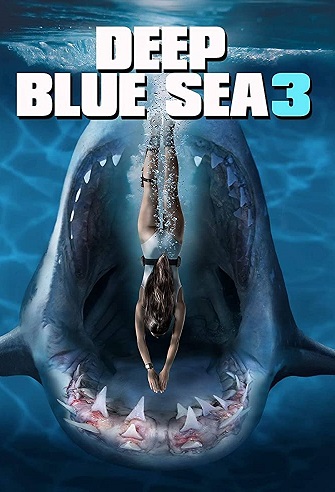
DEEP BLUE SEA 3 (US - 2020)
A quick glance at the title DEEP BLUE SEA 3 will probably cause most people to wonder "Wait, there was a DEEP BLUE SEA 2?" A DTV sequel coming nearly two decades after a 1999 original that gave us one of the all-time great surprise kills and one of the dumbest closing credits songs ever, DEEP BLUE SEA 2 did the bare minimum to get by, hindered by a low budget and some really shitty CGI, and its story of sharks turning into super-intelligent beings used as experimental subjects in a mad billionaire's Alzheimer's research was beyond absurd. Look no further than the instant classic moment when the bad guy announces his intention to destroy the sharks once he gets all the research info he needs, and he fails to notice an eavesdropping shark either listening or reading his lips. DEEP BLUE SEA 3, which tragically misses the opportunity to call itself D33P BLU3 S3A, sometimes hits those same heights of silliness, and it's a bit of an improvement over its predecessor. Filled with a cast of familiar second-tier TV faces, DEEP BLUE SEA 3 stars Tania Raymonde (of LOST and Lifetime's JODI ARIAS: DIRTY LITTLE SECRET) as shark expert Dr. Emma Collins, who's working with a small research team at Little Happy, a mostly abandoned fishing village on a man-made island in the Mozambique Channel (it was shot in nearby South Africa). Dr. Collins is also a great white whisperer of sorts, unafraid to get up close and personal with one longstanding resident of a great white breeding ground near Little Happy. The team--Collins, her late father's military buddy Shaw (Emerson Brooks of THE LAST SHIP), techie nerd Spin (Alex Bhat), and college intern Miya (Reina Aoi)--have their peaceful existence intruded upon by--conveniently enough--her ex Richard (Nathaniel Buzolic of THE VAMPIRE DIARIES and THE ORIGINALS) and a crew of mercenaries that includes loose cannon Lucas (Bren Foster, another LAST SHIP alum), who are on the hunt for three unusually aggressive bull sharks that killed some residents of a fishing village 100 miles away.
Those three bull sharks tie into DEEP BLUE SEA 2--they're more experimental subjects with human-level intelligence, even understanding Richard's warning of "Back the fuck off!" when one is captured and the other two start attacking the boat. DEEP BLUE SEA 3 is pretty by-the-numbers until it finally embraces its innate stupidity about an hour in, starting with a surprise kill that's actually just as great as the one in the first film (which was honestly one of the best crowd reaction moments I've ever experienced as a moviegoer). Then, it's all-out madness, highlighted by sharks circling a slowly sinking Little Happy as Shaw and Lucas have a spontaneous, full-on choreographed MMA throwdown (Lucas: "C'mon, old man!"); some groan-worthy zingers ("Sorry, chum!"); and an underwater Wilhelm Scream. Writer Dirk Blackman (OUTLANDER, UNDERWORLD: RISE OF THE LYCANS) and director John Pogue (writer of U.S. MARSHALS, THE SKULLS, and GHOST SHIP) understand that these things are basically slasher films with sharks, so they try to make every shark kill the equivalent of the Samuel L. Jackson moment from the original--it works the first time, but the one immediately after is really unnecessarily cruel--and after a draggy start, DEEP BLUE SEA 3 turns surprisingly entertaining, even with PS2-level CGI that seems intentionally cartoonish. Foster's Lucas is a cardboard psycho villain who endangers everyone's lives for no other reason than that's what the script needs him to do. But Raymonde commits herself to this like it's her ticket to the A-list as Collins and lone remaining Little Happy resident Nandi (Avumile Qongqo) eventually find themselves forced to deal with out-of-control, hyper-intelligent sharks and a lunatic Lucas. Not exactly good, but more guiltily enjoyable than it has any reason to be, you can do a lot worse than DEEP BLUE SEA 3 when it comes to cheap DTV shark movies. (R, 100 mins)
A passion project that Martin Scorsese's had in various stages of development since acquiring the rights to Shusako Endo's 1966 novel in the late '80s, SILENCE completes the legendary filmmaker's unofficial religious trilogy that began with 1988's THE LAST TEMPTATION OF CHRIST and 1997's KUNDUN. SILENCE was already made into a movie once with a 1971 Japanese adaptation, but SILENCE '16 again demonstrates Scorsese's recurring obsessions with faith and religion, themes that go back as far as his earliest films like 1968's WHO'S THAT KNOCKING AT MY DOOR? and 1973's MEAN STREETS. Make no mistake--SILENCE is a horse pill. It's slow-moving and sometimes punishingly long at 161 minutes, which almost seems by design to put you in the mindset of his central character. It's the kind of visually stunning epic that you rarely see any more, equal parts Werner Herzog, Terrence Malick, and Francis Ford Coppola, but filtered through the uniquely singular vision of arguably the greatest living American filmmaker. It's the reality of getting movies made today, but it's hard to believe that a director of Scorsese's reputation and stature has to get funding from a truckload of production companies (including the unlikely involvement of VOD and Redbox B-movie dealmakers Emmett/Furla Films, taking a break from being a half-assed Golan & Globus for a rare bid at respectability) from four countries with 40 (!) credited producers. C'mon, Hollywood studios. This is Martin Fucking Scorsese. If he comes to you with a project, give him the money. His films tend to stand the test of time, if that even matters anymore. Sure, they can't all be TAXI DRIVER, RAGING BULL, and GOODFELLAS, but can you name a terrible Martin Scorsese film?
In 17th century Macau, two Portuguese Jesuit missionaries, Father Sebastiao Rodrigues (Andrew Garfield, having a breakout 2016 and even better here than he was in his Oscar-nominated turn in HACKSAW RIDGE) and Father Francisco Garupe (Adam Driver) journey to Japan in search of their mentor Father Cristovao Ferreira (Liam Neeson). Ferreira's been missing for seven years, and a letter turns up in the hands of Bishop Valignano (Ciarin Hinds)--a letter the rogue Ferreira sent years earlier, indicating that he's apostasized, renouncing Christianity, leaving the priesthood and has no intention of returning from a missionary trip to Japan, where he's taken a wife and wishes to live a normal life. Instinctively concluding that this letter doesn't sound like the words of Ferreira, Rodrigues and Garupe insist on finding their teacher and embark on a trip that will draw obvious comparisons to Heart of Darkness and APOCALYPSE NOW, but also the grueling sort of quest that recalls Herzog's AGUIRRE: THE WRATH OF GOD and FITZCARRALDO, as well as Roland Joffe's THE MISSION. The missionaries will be double-crossed by guide Kichijiro (Yosuke Kubozoka), will eventually be separated, and the story will focus primarily on Rodrigues. Rodrigues clashes with Inquisitor Inoue (a scene-stealing Issey Ogata), a powerful official hellbent on stopping the spread of Christianity in Japan, and willing to torture, crucify, and kill to do so (one harrowing scene has converted Japanese Christians crucified at sea, drowned by the incoming tide, then having their bodies set ablaze so they can't be given a Christian burial). Rodrigues will eventually find Ferreira and he isn't quite the Col. Kurtz-like madman you might be expecting. SILENCE is a difficult and challenging film that has definite slow stretches but it rewards the patient viewer. The script by Scorsese and Jay Cocks unfolds like a richly-textured novel, taking its time to build and establish the characters and get you in their heads, which makes the complete experience all the more powerful. Pitched by distributor Paramount as a major awards-season contender, SILENCE played well in NYC and Los Angeles but bombed hard when it expanded into wide release, relegated to one 9:55 pm showing per day when it finally made it to my area. It was almost shut out of the Oscars, earning just one nomination for Rodrigo Prieto's cinematography. It's not the kind of film that will appeal to casual moviegoers or even to casual Scorsese fans (though it explores recurring themes in his work, its style is more Terrence Malick than Scorsese). It's an often profoundly moving film about deeply committed faith, one that's philosophical without being preachy, and if you've followed Scorsese through the years, you'll recognize his passion and his concerns, his voice coming through even though it's somewhat of a stylistic departure for him. (R, 161 mins)
PATRIOTS DAY (US/China - 2016)
You might think it takes a special breed of asshole to bag on a movie that honors the victims and heroes of the 2013 Boston Marathon bombing, but it takes a special breed of asshole to create a bullshit composite character and make almost the whole thing about him. Composite characters are dramatic necessities in narrative chronicles of true events but here, it's a clumsy distraction that's alternately insulting and unintentionally hilarious. The last and by far the least of director/co-writer Peter Berg's unofficial "Mark Wahlberg: American Hero" trilogy (after LONE SURVIVOR and the underrated DEEPWATER HORIZON), PATRIOTS DAY has Wahlberg playing Tommy Saunders, a composite character created specifically for the film. Tommy, or as he'll be known from here on, "Tawmy," is a plays-by-his-own-rules homicide sergeant who played by his own rules one too many times and got temporarily busted down to patrolman. But he's free and clear and out of the doghouse after one more day--you guessed it--Patriots Day. Tawmy's got a bum knee but puts on a brace, plays through the pain, and does his jawb, and he's right there when the bombs set by the Tsarnaev brothers--Tamerlan (Themo Melikidze) and Dzhokhar (Alex Wolff)--go off. He immediately calls for backup and oversees the triage unit, and when FBI Special Agent Rick DesLauriers (Kevin Bacon) and Gov. Deval Patrick (Michael Beach) show up at the scene, they know that the only person they need to consult is, of course, Tawmy.
Tawmy's right there at the center of the action at the command center, taking charge and making sure everyone's on the same page, and thank Gawd he's there to inform DesLauriers how investigations work, imploring "Hey! Listen! I was hawmicide! Witnesses! We should talk to witnesses! Maybe somebody saw somethin'!" as everyone within earshot nods in agreement. Yeah, because I'm sure veteran FBI Special Agent Rick DesLauriers who, according to his FBI bio, has been an agent since 1987, has no fucking idea how to do his job, so props to Tawmy for being there to show him how it's done. Police Commissioner Ed Davis (John Goodman) also holds back on making any decisions until he runs things by Tawmy, who's given a special role in the investigation when DesLauriers asks "Hey, you know this area pretty well, right?" because obviously there's no way any other cawp knows more about Boston than Tawmy Saunders, Super Cawp! Because Tawmy can't be there for every break in the investigation without turning the film into outright fiction, when an FBI agent spots a possible suspect in Dzhokhar in surveillance footage, the first person DesLauriers alerts to this discovery is Tawmy. Later on, Tawmy's also the cop who first spots Dzhokhar hiding in a boat in a Watertown resident's backyard, and that's not long after a shootout between Watertown cops and the Tsarnaev brothers where one Watertown cop opens fire, shouting "Welcome to Watertown, motherfucker!" It's telling that the two best sequences in the film--Chinese college student Dun Meng's (Jimmy O. Yang) carjacking by and subsequent escape from the Tsarnaevs, and Tamerlan's American wife (Melissa Benoist) being interrogated by a sinister black ops agent (Khandi Alexander, killing it in just a few minutes of screen time)--are nail-biting set pieces that don't involve Wahlberg, at least until the Zelig-like Tawmy is the one who responds to Dun's 911 call, because of course he does. Why not just make an Altman-esque ensemble piece showing how all of these people worked together in pursuit of the suspects? PATRIOTS DAY pays a lot of lip service to the notion of a community coming together but in execution, it's almost all about Tawmy. I get that Tawmy is a symbol of "Boston Strong," but it just gets silly. Why clumsily straddle the line between paying reverent tribute and making a formulaic Mark Wahlberg vehicle, especially when the usually reliable actor responds by turning in what might be his career-worst performance (Tawmy sobbing on his couch and yelling "We're gonna get these motherfuckers!" is embarrassing)? It's hard to take the film seriously when Tawmy seems to be the only cawp who knows what he's doing, and one with enough juice to get lippy and bark "Who the fuck are you?" to an FBI guy. The real question is "Who the fuck is Tawmy?" (R, 133 mins)
EVOLUTION (France/Spain/Belgium - 2016)
The first film in over a decade by acclaimed INNOCENCE director Lucile Hadzihalilovic (she's married to IRREVERSIBLE director Gaspar Noe, edited his 1998 film I STAND ALONE and co-wrote his 2009 film ENTER THE VOID) is an impenetrable arthouse sci-fi/horror mood piece that feels like an aquatic UNDER THE SKIN and can best be described as what might've transpired if David Cronenberg remade THE LITTLE MERMAID. There's some memorable visuals (this was shot on Lanzarote in the Canary Islands) and a pervasive sense of ominous dread throughout, but it all seems to be an aimless, meandering voyage that doesn't really have anything in mind other than low-key and extremely slow-burning squeamishness. In a remote seaside village that seems to be frozen in time, young Nicolas (Max Brebant) is swimming and sees the body of a drowned boy with a bright red starfish attached to his navel. He tells his mother (Julie-Marie Parmentier), who dives in the area where he was swimming and only finds the starfish. There are no adult males in the village, which is populated only by young boys and their mothers, all plain and unemotional, with white eyebrows and their hair pulled back in tight librarian buns. The boys are fed a gruel-ish concoction of goop and worms and given a strange medicine in between visits to a local "hospital" where they're kept for observation and given ultrasounds by the female doctors and nurses. Nicolas becomes convinced that the village mothers are up to something and spies on them as the writhe naked in star-shaped formations, covered in a slimy film along the shore in the dead of night. Convinced his "mother," who has six suction-cup-like growths on her back, is not his mother, Nicolas is given an extended stay at the hospital, where he befriends strange nurse Stella (Roxane Duran), who decides to show him who--or more accurately, what--he really is. It's a lugubriously slow buildup to very little, but there's some effectively unsettling imagery along the way, with a droning score that really contributes to the escalating sense of unease. But mood and style aren't enough to get the job done with EVOLUTION, which ends up being some kind of asexual nightmare with a predictably ambiguous, hackneyed ending suggesting these creatures are about to walk among us. Some interesting ideas here, but EVOLUTION never comes together. (Unrated, 82 mins, also streaming on Netflix)
The finale to Uwe Boll and Brendan Fletcher's RAMPAGE trilogy is the clumsiest and preachiest yet. On the positive side, Boll seems to be walking back his gushing admiration for Fletcher's insane lone-wolf domestic terrorist Bill Williamson. Where the first sequel RAMPAGE: CAPITAL PUNISHMENT felt like a love letter to mass shooters, PRESIDENT DOWN at least admits that words and actions have consequences and by the end, Bill is most certainly the villain with a lot of blood on his hands. But the road there is paved with some welcome bits of old-school Boll idiocy that's not helped by the director struggling with his lowest budget yet. His German tax shelter heyday of being able to afford the likes of Ben Kingsley, Jason Statham, and Burt Reynolds a fading memory, Boll can't even corral cheap labor on the level of past RAMPAGE co-stars like Matt Frewer or Lochlyn Munro. Boll unsuccessfully tried to crowdfund the film--originally titled RAMPAGE 3: NO MERCY--on Indiegogo and Kickstarter but failed to meet his goal, leading to an inevitable YouTube meltdown excoriating fans for giving their money to Hollywood studios while not helping out important artists like Dr. Uwe Boll. So with a lot less money at his disposal, Boll relies heavily on flashbacks and stock footage from the first two films, and mainly has Fletcher's Bill posting YouTube rants from his hiding place in the middle of nowhere, which may be the perfect metaphor for 2016 Uwe Boll.
Long thought dead after the events of the previous film, Bill emerges from hiding to assassinate the President, Vice President, and Secretary of Defense during a speech to Congress. Of course, how he manages to accomplish this is a mystery, since it happens offscreen. The FBI, vowing to get to the bottom of the assassinations, assigns two--yes, two--agents, Molokai (Steve Baran) and Jones (Ryan McDonnell) and a Bureau computer expert (Scott Patey) to run the investigation out of what looks like an underfunded police precinct. Bill manages to hack into their computer system with the help of a mole inside the FBI, and once Molokai and Jones (worst cop show title ever?) spot him on some surveillance footage outside the White House, he starts taunting them from his undisclosed location and threatening their families. Unfortunately, the agents are unable to convince their bosses that Bill is the culprit because a publicity-hogging ISIS claims responsibility for the assassinations, prompting the reactionary new Commander-in-Chief to round up all the Muslims and Syrian refugees in the US, close all the mosques, and nuke the Middle East "with the full support of Russia and China." The notion of an irrational, knee-jerk US President content with blowing up a good chunk of the world is an uncomfortably prescient notion that Boll completely sidesteps and never mentions again. There's no satire, no poking people with sticks--instead, the focus is on Molokai and Jones finding out where Bill is hiding and leading a raid where of course, Bill gets the edge on everyone, but Jones makes it easy by not even bothering to wear a bulletproof vest.
The message is muddled: Bill says he wants a world without violence in a film that opens with him shooting a random pedestrian in cold blood and concludes with him killing about a hundred FBI agents. Nothing here makes sense: why does Bill suddenly have a girlfriend (Crystal Lowe) and a kid? And how can he be presumed dead when he's actively posting videos to his YouTube channel to his legion of supporters? And when news of the assassinations of the President, VP, and Defense Secretary hits the wire, watch the only two news anchors seen in the film exclaim "Oh my God! The President is dead!" as the camera pans down to her reading the info off of a second page, as if that news a) would come over a teletype in 2016, and b) would be relegated to the second page. And are we to believe that the only two guys investigating the murder of the President, VP and Defense Secretary would exit a building and be confronted by one reporter? And it's one of the two news anchors we just saw? Boll ineptly inserts talking points about gun control and police brutality, but then he and Fletcher (they co-wrote the script together) go off on tangents about Hollywood's richest celebrities. There's jabs at Tom Cruise and Jennifer Aniston, and the murders of Taylor Swift, Rihanna, and Mark Zuckerberg among others are announced over the course of the film. These bits sound less like legitimate grievances about tabloid culture and more like a case of sour grapes from Boll and Fletcher because they aren't in the club. Canadian actor Fletcher's been around since the late '90s and was in hits like AIR BUD and FREDDY VS. JASON, and some Canadian arthouse films. He's also made eight movies with Uwe Boll. Dude, maybe that's why you're not in the club. You were in THE REVENANT (notice that Leonardo DiCaprio doesn't make Bill's Hollywood shit list). Maybe take a break from Uwe and start hanging out with Leo or Alejandro Inarritu a little more. You'll have time: Boll was so angry about the lack of fan support for the funding of RAMPAGE: PRESIDENT DOWN that he announced it would be his final film. Indeed, a post-credits stinger finds a pensive Boll tipping his hat to the camera and walking into the sunset. If that's the case, let me just say that for all your many, many faults, you were certainly never boring, Dr. Boll. Thanks for everything. I guess. (Unrated, 100 mins)
A BIGGER SPLASH (Italy/France - 2016)
The first English-language work by acclaimed Italian filmmaker Luca Guadagnino reunites the director with Tilda Swinton, the star of his 2009 art-house breakthough I AM LOVE. Where that film showcased the director's adoration of all things Stanley Kubrick and Alain Resnais before settling into a sort-of Luchino Visconti autopilot mode (faux-Visconti is something THE GREAT BEAUTY director Paolo Sorrentino does a lot better), A BIGGER SPLASH feels a lot like the 1990s Bernardo Bertolucci that made THE SHELTERING SKY and STEALING BEAUTY. A remake of Jacques Deray's 1969 film LA PISCINE (released in the US as THE SWIMMING POOL), A BIGGER SPLASH is essentially one of these European films where some wealthy bourgeois types get together and things escalate into a powderkeg of unresolved issues and psychosexual mind games. Aging glam rock legend Marianne Lane (Swinton) blows out her voice on tour and has to take a significant amount of time off to recover from vocal cord surgery. She can only speak at a whisper and is convalescing on Pantelleria, off the coast of Sicily with her younger lover, photographer/filmmaker Paul De Smedt (Matthias Schoenaerts). Their days are spent lounging naked by the pool, getting massages, reading, and having a lot of sex until they get an unannounced visit from Harry Hawkes (Ralph Fiennes), Marianne's producer and ex-boyfriend, who's brought along Penelope (Dakota Johnson), the 22-year-old daughter he only recently found out he had. The boisterous, gregarious Harry brings a manic and disruptive presence to their quiet, idyllic getaway, even inviting a couple of other people--Mireille (Aurore Clement) and Sylvie (Lila McMenamy)--along, and it's clear that there's a past between these people that's still gnawing at both Harry and Paul. There's also numerous instances of Harry acting in a not-fatherly way with Penelope, and an uncomfortably close rendition of "Unforgettable" between the two at a karaoke bar creeps out Marianne enough that she confronts him, leading to Harry shouting "I'm not fucking my daughter!" in front of a bunch of people in the street. As Harry keeps professing his love for Marianne, Paul and Penelope go off exploring on their own, and anyone who's ever seen a movie before can see that things aren't going to end well.
Despite the serious subject matter, A BIGGER SPLASH is fairly lighthearted a lot of the time, right down to its slapsticky title that seems more fitting for a romantic comedy. It certainly doesn't portend the shift the story takes in the last 35 or 40 minutes, when an unexpected event occurs that gets the local police involved. A lot of this is due to a rambunctious performance by Fiennes, whose Harry is really a grating, insufferable asshole but the actor finds ways to make you like him and even feel sorry for him. Whether he's yammering on about his sexual exploits (it's suggested that Mireille and Sylvie, who may be mother and daughter, are among his conquests), humble-bragging about his uncredited contributions to the Rolling Stones' 1994 album Voodoo Lounge, or busting out the moves like Jagger while blasting their 1980 hit "Emotional Rescue" (a scene that must be seen to believed), Fiennes is the unabashed show-stealer here and even dominates the film when he's not onscreen. Working with screenwriter David Kajganich (whose credits include, of all things, the underrated 2009 horror movie BLOOD CREEK), Guadagnino leaves enough ambiguity to keep an audience discussing the events after the film is over, and manages to keep things focused even with the many changes in tone and some showboating filmmaking techniques in the early going, things that are mainly used when Fiennes is onscreen to accentuate what a loud jackass Harry can be. Guadagnino, Kajganich, Swinton, and Johnson are tentatively reuniting for the latest announced incarnation of the perpetually in-development remake of Dario Argento's SUSPIRIA. (R, 125 mins)
THE DARKNESS
(US - 2016)
With 2005's WOLF CREEK, Australian filmmaker Greg McLean seemed to be a new voice in horror, but that voice has had nothing to say for several years running. His follow-up film, the outstanding killer crocodile flick ROGUE, was buried by the Weinsteins, and McLean has yet to bounce back, with another six years passing before he resurfaced with the belated and over-the-top WOLF CREEK 2. Working with horror factory Blumhouse, THE DARKNESS is McLean's first Hollywood production and it couldn't possibly be any more predictably generic and lazy. During a family trip to the Grand Canyon, autistic Mikey Taylor (David Mazouz) finds some rocks with strange symbols and takes them as souvenirs. It isn't long before paranormal activity manifests itself back home, with Mikey talking to an unseen entity called "Jenny," and sooty handprints turning up all over the house. Dad Peter (Kevin Bacon, visibly bored) and Mom Bronny (Radha Mitchell) are too preoccupied to notice the supernatural goings-on or that their angry older daughter Stephanie (Lucy Fry) is bulimic and saving containers of her purgings under her bed as a way of acting out her resentment toward Mikey. After more shenanigans, like a possessed Mikey starting a fire and trying to kill his grandmother's cat, and all manner of standard-issue Blumhouse jump scares, Bronny discovers that some Anasazi curse has latched itself to Mikey and starts to believe this is some kind of karmic retribution over her past alcoholism (she falls off the wagon) and Peter's past infidelity (and he's tempted again by young intern at work).
Taking a page from THE EXORCIST in the way the demon enters a world in disarray, making it easy to possess Regan, McLean and co-writers S.P. Krause and Shayne Armstrong (the latter two co-wrote the Australian "sharks-in-a-supermarket" opus BAIT) toy with the idea of the demonic invasion of the home being a response to the various unspoken dysfunctions in the family. But they don't really do anything with it and everything is resolved too easily to get to the rote horror histrionics. Keeping your vomit in bags and tupperware containers under your bed is pretty odd, but hey, one visit to a therapist and moody, abrasive Stephanie is healthy and chipper. Instead, the filmmakers follow a Blumhouse checklist right down to the last-15-minutes introduction of a pair of eccentric demonology experts who do a quick drive-by exposition drop before an impromptu exorcism of the house. The film's twists and turns come straight out of Plot Convenience Playhouse. Is Paul Reiser only in this for a few scenes as Peter's fist-bumping, asshole boss just because the boss has a wife (Ming-Na Wen) who happens to have recently started pursuing an interest in Hopi Indian mythology? Well, that immediately qualifies her as an expert to advise Bronny after she figures out they're being haunted by a pissed-off Anasazi spirit. What are the odds? It's that kind of movie. THE DARKNESS plays like a Blumhouse sampler platter with a dash of INSIDIOUS and a scoop of PARANORMAL ACTIVITY, but topped off with a generous sprinkling of some old-fashioned POLTERGEIST to make a total shit sandwich of a horror movie. It's a film that doesn't even try, and it's almost perversely impressive how it manages to go an entire 90 minutes without pursuing a single original idea. Where did THE DARKNESS go wrong? Who cares? Blumhouse and Greg McLean certainly don't. (PG-13, 92 mins)
ESCOBAR: PARADISE LOST (France/Spain/Belgium - 2014; US release 2015)
Giving audiences the rare opportunity to see Benicio Del Toro in a movie about drug trafficking, ESCOBAR: PARADISE LOST grants the Oscar-winning actor a role he was seemingly born to play: infamous Medellin Cartel kingpin Pablo Escobar (1949-1993). Unfortunately, ESCOBAR: PARADISE LOST is a tedious misfire hellbent on making Pablo Escobar a supporting character, and there are long stretches where Del Toro, who gained quite a bit of weight to play the cartel head in his indulgent years just before his 1991 incarceration, is offscreen. Rather, the focus is on Nick Brady (THE HUNGER GAMES' Josh Hutcherson), a Canadian who's somehow found his way into the Escobar inner circle on the eve of the boss turning himself over to Colombian authorities. Flashbacks show Nick was a surfer spending time doing Habitat for Humanity-type charity work in Colombia in the mid '80s with his older brother Dylan (Brady Corbet) and his wife Anne (Ana Girardot). Nick meets and quickly falls in love with nurse Maria (Claudia Traisac), who happens to be the beloved niece of her protective uncle (you guessed it) Pablo Escobar. Nick is welcomed into the family and affectionately dubbed "Nico," but tries to keep a distance from knowing too much about Uncle Pablo. Escobar is lauded as a benevolent hero by the people after his 80% stake in the world's cocaine traffic has made him a multi-billionaire with some interests in legitimate businesses, like opening a hospital for his nurse niece. But Escobar is a powerful and merciless boss who doesn't like loose ends, and he wants them all tied up before he goes to prison. Nick realizes far too late that he knows too much and the lives of everyone he loves are in danger and that Uncle Pablo intends to have him killed.
The directorial debut of Italian actor Andrea Di Stefano (Dario Argento's THE PHANTOM OF THE OPERA, and Hollywood fare like EAT PRAY LOVE and LIFE OF PI), ESCOBAR: PARADISE LOST is plodding and sluggishly-paced, perhaps because you aren't expecting a movie alleged to be about Pablo Escobar to instead focus on Peeta Mellark and his Colombian girlfriend. Del Toro pops in and out of the story with the majesty of a slovenly Don Vito Corleone, but the bulk of the film focuses on Nick, who's based on a person who was involved with Escobar's niece, but beyond that, his story as presented here is a work of fiction, which begs the question "Who cares?" Di Stefano has essentially dropped the character of Pablo Escobar into a Josh Hutcherson movie that could just as easily be titled THE MEDELLIN GAMES. Things pick up when Nick realizes he's a target and Escobar's men start pursuing him, but then the story just becomes an excuse for Hutcherson to play a suddenly gun-toting, blood-splattered badass blasting caps into some cartel flunkies. After a deadly dull opening hour and change, it at least belatedly comes alive when it turns into a conventional chase thriller, but it's too little, too late. There's one admittedly great scene that's very well-acted by Hutcherson, when he hears an inconceivably savage act on the other end of the line during a phone call, but almost everything else is ponderous, predictable, and boring. The Weinstein Company acquired this in early 2014 and sat on it for a year and a half before releasing it on just 105 screens in June of 2015. Its Blu-ray/DVD release has been expertly timed with the wide release of SICARIO, a far superior Del Toro drug trafficking saga. The actor makes a superb Escobar, but this isn't the Escobar movie he should've done. (R, 120 mins)
MANGLEHORN (US/UK - 2015)
The third chapter in Al Pacino's back-to-basics, character-driven trifecta of low-key indie films following THE HUMBLING and DANNY COLLINS, David Gordon Green's MANGLEHORN lets the Oscar-winning screen legend be eccentric without resorting to his familiar post-SCENT OF A WOMAN histrionics. Pacino is very good here, but the film is a mixed bag, with Green too often engaging in self-indulgent asides and distracting detours into quirkiness that serve no real purpose other than establishing film festival bona fides. Pacino is A.J. Manglehorn, a sad-eyed locksmith in a smallish Texas suburb. Manglehorn works and spends most of his days alone with his beloved cat Fanny and occasionally takes his adorable granddaughter Kylie (Skyler Gasper) to the park. Divorced and mostly estranged from his high-rolling investment broker son Jacob (Chris Messina), Manglehorn laments a life wasted, spent without his lost love Clara. The proverbial "one that got away," Manglehorn pours his heart out in letters relayed in voiceover and mailed to Clara daily, and every day, there's an envelope in his mailbox stamped "Return to Sender." At first coming across like a tragic and lonely old soul, Manglehorn is soon revealed to be abrasive and a bit of an asshole who seems to sabotage his interactions, whether it's an unpleasant lunch with Jacob, where he complains about the food and how he never loved Jacob's mother because she was a poor substitute for Clara, or running into sleazy tanning salon owner/part-time pimp Gary (SPRING BREAKERS director Harmony Korine, in a role that seems like it was intended for Green pal Danny McBride), a socially inept, no-filter type prone to using words like "retard" and "mulatto" in public, but who still idolizes Manglehorn, his childhood Little League coach. Manglehorn has a friendly flirtation with bank teller Dawn (Holly Hunter) that leads to a disastrous date that goes south as soon as Manglehorn does what he always does: surely as THE BIG LEBOWSKI's Walter Sobchak made everything about Vietnam, Manglehorn steers every conversation into another rambling tale-of-woe monologue about how he let Clara slip away.
At its core, MANGLEHORN is a tale of redemption for a bitter, angry man who has some good in him, especially when it comes to his devotion to his granddaughter and his willingness to drain a good chunk of his savings on an expensive surgery for an ill Fanny. But Manglehorn wants Clara and is content to make everyone within earshot as miserable as he is about not being with her. It gets repetitive after a while (though his date with Dawn is a small masterpiece for connoisseurs of cringe), and Green's idiosyncratic digressions--a guy breaking into song in the bank and a teller responding in kind; Manglehorn encountering a multi-car pileup involving a truck full of smashed watermelons that looks like a pointless homage to Jean-Luc Godard's WEEKEND; one scene where he shows off some De Palma-style trickery that comes off like directorial wankery--just get in the way. Green also does some obvious telegraphing with the way he deliberately keeps the viewer out of a locked room that Manglehorn enters daily and emerges in a rage--of course, it's the decades-long shrine for the unattainable Clara, every returned letter filed away, every rejected bouquet of flowers wilted and rotting, which makes him look less like an unfortunate man burdened with a lifetime of sorrow and regret and more like an obsessed loon who needs a restraining order. Pacino's skills help him play a largely unplayable character, and by the time it's over, it's little more than a quirky indie version of AS GOOD AS IT GETS. Even with its many ups and downs, MANGLEHORN is still required viewing for Pacino completists, but be warned going in that it includes a feel-good ending that directly involves a mime. (PG-13, 97 mins)
COP CAR (US - 2015)
Often coming off like a hastily-sketched idea that the Coen Bros. penciled into the margins of a script only to not include it, the acclaimed indie COP CAR has a solid premise that isn't quite enough to carry it to feature length. It gets a lot of mileage from a terrific, frantic performance by a Brimley-stached Kevin Bacon as Sheriff Mitch Kretzer, a suburban lawman whose day goes from bad to worse when his cruiser is stolen by a pair of grubby ten-year-old runaways who take it on a joyride. Travis (James Freedson-Jackson) and Harrison (Hays Wellford) are two of the dumbest, most obnoxious brats in cinema history, a pre-teen Beavis and Butt-Head who make one idiotic decision after another, usually involving playing with Kretzer's weapons they find in the backseat and staring down the barrel of the guns to figure out why they aren't firing. They also don't know there's a body in the trunk, the second of two that a coke-fueled, corrupt Kretzer was trying to bury in a field--he was off disposing of the first body when the idiot kids stumbled on the seemingly abandoned cop car. As the kids recklessly drive around the rural outskirts of town, plowing through fields and stopping to point automatic weapons at one another, Kretzer races around town, first on foot, then in a stolen car, then finally in his own pickup, to try and cover his tracks and locate the kids.
Directed and co-written by Jon Watts, who was rewarded (?) with the upcoming SPIDER-MAN reboot based on the festival buzz around COP CAR, the film mostly works as a thriller, but the implausibilities and the plot conveniences abound. It's never believable that Kretzer manages to misdirect all the other cops on the force and keeping them chasing their own tails all day, and it's tough to buy the way he goes about undetected all day long, even when he's pulled over by one of his own cops, calls in a fake emergency to the dispatcher on his cell phone, and manages to go unrecognized, with the now-distracted cop letting him off with the warning without really even taking a good look at him. Bacon is great as the wiry, frazzled, increasingly wigged-out Kretzer, and the child actors do a convincing job of playing--by design--a pair of stupid and truly appalling little shits, though Wellford's Harrison is slightly less loathsome than Freedson-Jackson's cocky, twerpy Travis. There's a couple of other characters--Camryn Manheim as a concerned citizen who spots the kids swerving in the cop car on a back road, and Shea Whigham ends up playing a prominent role, plus Bacon's wife Kyra Sedgwick provides the voice of the gullible dispatcher--but Bacon is the real show here. He's excellent, but the film seems ultimately too slight even for just under 90 minutes. (R, 88 mins)
BLACK MASS (US/UK - 2015) Directed by Scott Cooper. Written by Mark Mallouk and Jez Butterworth. Cast: Johnny Depp, Joel Edgerton, Benedict Cumberbatch, Kevin Bacon, Jesse Plemons, Peter Sarsgaard, Dakota Johnson, Corey Stoll, Rory Cochrane, David Harbour, Adam Scott, Julianne Nicholson, Juno Temple, W. Earl Brown, Bill Camp. (R, 122 mins)
If you listen closely in the theater, as the lights go down and BLACK MASS starts, you can almost hear CRAZY HEART and OUT OF THE FURNACE director Scott Cooper say "As far back as I can remember, I always wanted to make a Scorsese movie." So it is with the much-anticipated BLACK MASS, touted as a return to form following a surplus of whimsical dress-up and endless self-indulgent eccentricities from former actor Johnny Depp. Even the most devoted Depp apologists turned on him after the loathsome MORTDECAI and to that end, BLACK MASS does showcase Depp's best performance in years, even if it's by default. Though he's not as "Depp"-y, it's still more of the same to some extent: as infamous South Boston gangster James "Whitey" Bulger, he's again buried under a ton of caked-on makeup, a combination bald cap/receded hairline, and a pair of ice-blue contact lenses that look not unlike those used on Bill Bixby at the beginning of a Hulk-out into Lou Ferrigno on THE INCREDIBLE HULK. Taking place from 1975 to 1991, BLACK MASS covers a lot of ground with a lot of characters, but it has all the depth and insight of Bulger's Wikipedia page. There was probably a longer, more epic film here at some point--even shortly before the film's release, it was still being tweaked, with Sienna Miller's entire role as a Bulger girlfriend ending up on the cutting room floor due to what Cooper termed "narrative choices."
Though Depp is front and center as Bulger, it almost feels as though the film should be about FBI agent John Connolly, played here by Joel Edgerton (THE GIFT). A childhood friend of Bulger and his state senator brother Billy (Benedict Cumberbatch), Connolly approaches Bulger in 1975 with an offer to become an FBI informant in an effort not to take down Southie crime operations, but rather, the Irish mob's Mafia competition. As the years go on, Bulger's Winter Hill Gang empire grows as he gives nothing to Connolly, who becomes complicit in Bulger's crimes by alerting him to FBI operations and falsifying reports under the guise of Bulger cooperation. Bulger is the devil on Connolly's shoulder, but their relationship really isn't explored, nor is there much in the way of escalating tension as Connolly gets in way over his head in his labyrinthine machinations to steer the FBI away from Bulger. We see him and co-conspirator agent John Morris (David Harbour) getting into shouting matches with incredulous colleagues played by Kevin Bacon and Adam Scott in superfluous extended cameos, and we see Connolly's new-found flashy sartorial choices not going over well with his wife (Julianne Nicholson), but nothing really happens with him until a new special agent (Corey Stoll) takes charge and starts holding him accountable as he still struts around the bureau office with a "What? Me Worry?" demeanor.
Connolly is a man obliviously drowning in his immoral and unethical choices and his pure hubris, but Cooper and screenwriters Jez Butterworth (EDGE OF TOMORROW) and Mark Mallouk are much more interested in Depp's feature-length Whitey Bulger impression. Depp is fine in the role, but at the end of the day, it's still not very far removed from what he's been doing for the last several years. He's using an intimidating monotone voice but letting the hairline and the contact lenses do almost all of the heavy lifting, and there's numerous scenes--the "family recipe" bit with Harbour's Morris, in particular--where he's just riffing on Joe Pesci and the "Funny how?" scene from GOODFELLAS. Cooper wants the entire film to be a Scorsese love letter, whether it's to GOODFELLAS or THE DEPARTED with its Baahston accents and Bulger being the prime inspiration for Jack Nicholson's Frank Costello in the latter film. Cooper doesn't have the style or the sense of energy to pull off Scorsese beyond a basic homage, and as a result, his film often keeps you at a distance.
BLACK MASS is a pretty decent movie, but it's hard to shake the feeling that it could've been an exceptional one. There's a great cast and a fascinating story here and all we really get when it's over is a Whitey Bulger Greatest Hits package that gets into a comfortable and too-familiar groove and never tries to go further than scratching the surface. Everyone loves a good Scorsese-style crime saga, but why not just watch a real one instead of a pretend one? For all the presence Depp has as Bulger, his performance is still pretty one-dimensional in execution, with very little known about him other than his skills as a master manipulator and feared killer. Other than Edgerton, everyone else just drops by on occasion. Dakota Johnson has a brief role as the mother of Bulger's young son, but when the son dies from Reyes' Syndrome, she's never seen or mentioned again. We also see a lot of Bulger soldiers, but with the exception of hapless schlub Steve Flemmi (Rory Cochrane), we learn little about them, other than they all eventually turn on Bulger to save their own asses. BLACK MASS is compelling from start to finish, but you've seen it all before. Overt Scorsese worship is fine when you can master the style and give it your own spin (like David O. Russell with AMERICAN HUSTLE), but Cooper's direction is workmanlike at best. Without a Thelma Schoonmaker by his side to help him find those distinct patterns and rhythms, Cooper is only capable of delivering Scorsese-lite. And Scorsese-lite works if you're looking for a two-hour, empty calories crime story to watch when nothing else is on. Just don't expect anything substantive.
Billy Bob Thornton hasn't had a lot of luck behind the camera after his 1996 breakthrough SLING BLADE. Harvey Weinstein sent DADDY AND THEM straight to cable in 2003 after five years on the shelf. In 2011, Thornton made THE KING OF LUCK, a documentary about Willie Nelson, and it's still waiting for distribution. The tactlessly-titled JAYNE MANSFIELD'S CAR is Thornton's first narrative directorial effort since Weinstein forced him to cut over an hour from 2000's ALL THE PRETTY HORSES. He needn't have bothered. Reuniting with his writing partner Tom Epperson, with whom he scripted 1992's ONE FALSE MOVE, 1996's DON'T LOOK BACK, and 2000's THE GIFT, Thornton hits bottom and drags a great cast down with him. This is a complete embarrassment for all involved. It's poorly-written, atrociously-acted, and hardly a scene goes by without some mind-boggling disaster. It's hard to tell what any of these people were thinking, but I hope they had a better time making it than anyone will have watching it. Released on just 11 screens after gathering dust for two years, JAYNE MANSFIELD'S CAR may not be the worst film of 2013, but it's likely the most wasteful of a quality ensemble of actors.
In small-town Georgia in 1969, cranky patriarch Jim Caldwell (Robert Duvall) gets word that his ex-wife has died. She left him and their four adult children 20 years earlier, married Brit Kingsley Bedford (John Hurt) and moved to England. Her dying wish was to be buried back home, so Bedford and his children--Philip (Ray Stevenson) and Camilla (Frances O'Connor) are on their way to Georgia. This doesn't sit well with Jim or his uptight eldest son Jimbo (Robert Patrick), though the other two sons, battle-scarred war vet Skip (Thornton) and aging hippie Carroll (Kevin Bacon) seem to welcome them. Jim has spent 20 years hating Kingsley, but the two bond over their love of the same woman (Tippi Hedren played this character, but Thornton ultimately granted the legendary Hitchcock muse the dignity of having her scenes cut) and talk of Jayne Mansfield's decapitated head when Jim takes Kingsley to an exhibit where the actress' alleged death car is on display. Meanwhile, Skip falls for Camilla, convincing her to strip naked and recite prose in her British accent while he masturbates, and the Caldwell boys' sister Donna (Katherine LaNasa) is drawn to Philip as she grows tired of her blowhard, ex-football pro husband Neal (Ron White). JAYNE MANSFIELD'S CAR tries to be a culture-clash character piece, Vietnam-era period drama, and raunchy comedy, botching all three and only succeeding in being one of the most appallingly ill-conceived pieces of cinema in recent memory. Character behavior makes no sense from scene to scene and Thornton seems to almost intentionally sabotage any momentum he gets going. Stevenson has a terrific scene where Philip defends himself against his father's drunken accusations of cowardice in battle, but then Thornton has Jimbo and his wife (Shawnee Smith) start making out on the couch for no reason while everyone watches. Skip walks into his dad's bedroom at one point with his war medals pinned to the dead skin on his burned and scarred chest, and all Jim can say is "Why don't you go get yourself some ice cream?" Who are these grotesque people? What planet do they live on? Duvall is a national treasure, but even his reliable "crusty old coot" act is played-out and tiresome here. It's the kind of film where, after seeing the Jayne Mansfield death car, old Kingsley gets philosophical and mutters "We all have a crash of some sort awaiting us." Indeed. That's some advice Thornton would've been wise to heed before he shit the bed with this unbearable misfire. (R, 122 mins)
BERBERIAN SOUND STUDIO (UK/Germany - 2012/2013 US release)
Not so much a straight-up homage to the Italian giallo as much as a mood piece inspired by the subgenre, BERBERIAN SOUND STUDIO is an impenetrable puzzle that fascinates and frustrates in equal measures. Writer/director Peter Strickland is clearly a fan who obviously did his homework in terms of period detail and the work that went into producing an Italian horror film in the 1970s, but it does have some tedious stretches. Gilderoy (Toby Jones), is a meek, introverted British sound mixer hired to supervise the dubbing and foley work for an Italian horror film titled THE EQUESTRIAN VORTEX. With his sound-mix work history primarily in nature documentaries, Gilderoy can't quite figure out why director Giancarlo Santini (Antonio Mancino) is so eager to hire him. Gilderoy doesn't mesh well with producer Francesco Corragio (Cosimo Fusco) or the rest of the Berberian Sound Studio staff and can't seem to stop unintentionally offending them, whether he's adjusting some equipment or getting the run-around on being reimbursed for his plane ticket. He can't even eat a grape without pissing someone off ("it's a custom to swallow the seeds here"). With the lecherous Santini distracted by young starlets and tensions mounting with the bottom-line-watching Corragio, the homesick Gilderoy finds comfort in letters from his mum and starts growing increasingly paranoid and seems to begin losing touch with reality.
While not a giallo, BERBERIAN SOUND STUDIO uses giallo tropes to ambiguously detail Gilderoy's slow descent into madness, eventually seeing himself in the film in events that just happened moments before, and already dubbed into Italian. Strickland does a masterful job at capturing the details of sound editing, particularly in the way the Italian film industry had to dub everything in the days of no direct sound on-set. We never actually see any footage from THE EQUESTRIAN VORTEX, a film ostensibly about the supernatural vengeance of a condemned witch (though Strickland does cleverly show its opening credits instead of BERBERIAN's opening credits; in retrospect, the first hint that fantasy and reality will fuse), but we see its profound effect on an increasingly disturbed Gilderoy as he hacks watermelons to get the right sound effect of a hatchet slicing through flesh, or recording the sound of sizzling grease to replicate the sound of a hot poker going into an accused witch's vagina. The horrors of THE EQUESTRIAN VORTEX are never shown, but heard with precision and clarity, and if nothing else, BERBERIAN SOUND STUDIO is a triumph of cinematic sound. Jones, Fusco, and Mancino are excellent, Strickland undoubtedly knows his giallo history, and the score by Broadcast is very effective, but the film's languid pacing and general obfuscation sometimes do it a disservice. Highly recommended for cult film enthusiasts and those interested in the more technical aspects of filmmaking and genre history, but those looking for a mainstream horror film might find it a bit of an endurance test. (Unrated, 92 mins, also streaming on Netflix)
MAN OF TAI CHI (US/Hong Kong/China - 2013)
A surprisingly straight-faced and credible directorial debut for Keanu Reeves, MAN OF TAI CHI is a martial-arts film that doesn't go the predictable route of snarky, reference-drenched, tongue-in-cheek homage but rather, plays it largely legit and serious throughout. He even went with Chinese and Hong Kong co-producers and a good chunk of the film is in Cantonese with English subtitles. Universal put up some of the $25 million budget, but perhaps following the tepid response to RZA's '70s kung-fu homage THE MAN WITH THE IRON FISTS, opted not to distribute the film in the US, where the Weinsteins' B-movie wing Radius-TWC acquired it and dumped it on 110 screens for a paltry $100,000 gross. Drawing from such influences as the "to the death" tournament video games and film genre and John Woo-inspired Hong Kong cop thrillers and fashioning it into a good vs. evil morality play, MAN OF TAI CHI has the titular student, Tiger Chen (Chen-Hu, who worked on the MATRIX stunt team), forgetting the peaceful Tai Chi ideals of his fatherly mentor (Yu Hai) as he's sucked into the underground fight club world overseen by the nefarious Donaka Mark (Reeves), an almost Satanic figure of such power that he can pause what's running on TV simply by pointing at it. Initially participating to get some quick cash so he can pay to restore his master's Ling Kong Tai Chi temple, which has been hit with code violations (!), Tiger gives into his violent impulses and becomes an increasingly vicious fighter in Donaka Mark's high-tech realm, where the fights are broadcast online to his obscenely wealthy clients. Will Tiger hit bottom and see that he's being led down the wrong path? Will he cleanse his soul and find redemption in a fight to the death with Donaka Mark? Have you ever seen a martial-arts flick before?
Working with legendary fight coordinator Yuen Wo-Ping, Reeves has put together an unexpectedly solid film, perhaps a bit overlong and draggy in spots, but the veteran actor must have been picking up tips from his directors all these years, because he makes MAN OF TAI CHI look like a film that cost much more than $25 million. Reeves probably could've trimmed 15 minutes from it and tightened it up a bit, and there's one laughable CGI car wreck, but he deserves some credit for being handed a large amount of money and not dicking off and turning it into an insufferable vanity project, opting instead to keep the focus on Tiger and only occasionally indulging himself with some overacting or an odd facial expression here and there. Also with Karen Mok as an obsessed Hong Kong cop trying to bust Donaka Mark, Simon Yam as the police superintendent, and THE RAID: REDEMPTION's Iko Uwais as one of Tiger's opponents, MAN OF TAI CHI is no classic, but it's better than anyone would've guessed upon hearing that Keanu Reeves was directing an Asian martial-arts epic. (R, 105 mins)