Based on a 2017 novel by German author Daniel Kehlmann, YOU SHOULD HAVE LEFT reunites writer/director David Koepp with star Kevin Bacon, the pair having last collaborated on 1999's acclaimed supernatural thriller STIR OF ECHOES. Bacon once again plays a man tormented by strange, inexplicable occurrences, though instead of a blue collar everyman, he's now Theo Conroy, a wealthy former bank exec who's married to the much younger Susanna (Amanda Seyfried), with a six-year-old daughter named Ella (Avery Essex). Susanna is a moderately successful actress prepping for an eight-week movie shoot in London, so they decide to rent a spacious, modern home in a remote part of the Welsh countryside beforehand as a family getaway. But they have problems that were simmering at home that only proceed to reach a boil when they're stuck in the middle of nowhere. Theo has grown very insecure over their 30-year age difference, about which both Susanna and Ella regularly razz him ("Daddy, will you die before Mommy because you're so much older?"), and though she's only six, Ella is very perceptive and is aware that Theo had a wife before Susanna and that she died under mysterious circumstances that made him a tabloid target ("Why do people hate Daddy so much?" she asks). Theo is also annoyed by Susanna's constant text messages to and from a male colleague, as he's in constant fear that she'll leave him for a younger man. He's working through these jealousies and insecurities and writing in a journal, but the Welsh home only makes things worse. Theo begins to feel disoriented by various things that don't make sense: light switches don't work on the lights they should, doors mysteriously appear where there was once a wall, and a walk down a previously unseen hallway results in a four-hour loss of time. Sensing something is off in the layout, he measures the living room, and finds the interior is five feet longer than the exterior (Ella, holding the tape measure: "How can that be?"). He finds a Polaroid of himself standing in the hallway, a shot that seems to have been taken a minute earlier and left for him to discover. Both he and Susanna start having bad dreams, Ella sees strange shadows on her bedroom wall, and a couple of unfriendly locals seem skittish that they've rented what's known as "the Stetler house." And someone has scribbled "YOU SHOULD HAVE LEFT!" and "NOW IT'S TOO LATE!" in Theo's journal.
In and of themselves, those instances have some creepy and unsettling potential. There's definitely a sense of THE SHINING in this house, especially with its labyrinthine design, its spatial impossibilities (an idea that also prompted House of Leaves author Mark Z. Danielewski to make accusations of plagiarism), a ghostly woman in a bathtub, and the house's effect on the family staying there. But this Blumhouse production tries to meld their patented jump scares with the more cerebral dysfunctional family horrors of HEREDITARY and MIDSOMMAR mastermind Ari Aster, and its pieces never quite come together. It feels padded even at 90 minutes, like a TWILIGHT ZONE episode belaboring its point, with a muddled shrug of a reveal that you'll see coming long before Theo or Susanna do (Koepp makes a huge mistake by telegraphing it in an overtly obvious fashion in the opening scene). Bacon is the solid pro he's always been, and he has terrific father/daughter chemistry with young Essex (Seyfried, for reasons that can't be divulged without significant spoilers, is absent for a long stretch in the middle), but the payoff isn't worth the elaborate buildup. Koepp was one of the hottest screenwriters of the '90s and into the early '00s (APARTMENT ZERO, JURASSIC PARK, CARLITO'S WAY, THE PAPER, MISSION: IMPOSSIBLE, PANIC ROOM, SPIDER-MAN, and he created the acclaimed but little-watched TV series HACK), but to call his more recent work indicative of a slump would be an understatement: in the last few years, he's scripted the dismal likes of INFERNO and THE MUMMY and directed the unwatchable MORTDECAI. YOU SHOULD HAVE LEFT is a step up from those, but it's no STIR OF ECHOES, and Koepp still hasn't regained his mojo relative to his 1990s glory days. Perhaps Universal wasn't feeling it either: this was originally intended to be a summer theatrical release, but once the pandemic hit, YOU SHOULD HAVE LEFT wasn't given a new release date later in the year, nor was it bumped to 2021. Instead, it was among the first major-studio titles to get relegated to the premium VOD route. $2 at Redbox is one thing, but this is definitely not $20 PVOD material. (R, 93 mins)
LEGACY OF LIES (Ukraine/UK/US - 2020)
Scott Adkins, the hardest-working man in action movies, is back with LEGACY OF LIES, his second movie of 2020, with five more tentatively on the way before the end of the year. This mostly Ukrainian-financed espionage thriller gets too convoluted and sluggish for its own good, but it's anchored by a typically committed Adkins performance and some nicely-done fight scenes, with the star once again collaborating with busy stunt coordinator Tim Man (TRIPLE THREAT). Dutch writer/director Adrian Bol embraces the cliches without shame, with Adkins as Martin Baxter, a PTSD-stricken former MI-6 agent who walked away from the spy game after a botched mission in Kyiv 12 years earlier. Now a single dad to precocious, wise-beyond-her-years Lisa (Honor Kneafsey), Baxter works as a bouncer in a popular London club (cue a packed throng of decadent partiers and throbbing techno beats) and picks up some quick cash in (wait for it) underground MMA fights, but he's in such a slump on that end that Lisa secretly cashes in by betting against him. Baxter's past comes back to haunt him when Sacha (Yuliia Sobol), a crusading Ukrainian journalist and daughter of one of his late former colleagues, comes to him with a story about a dead MI-6 agent and a rat in the network, and something about exposing a Russian plot to develop a deadly nerve gas. He doesn't want anything to do with it, but is forced into action when ruthless Russian agent Tatyana (Anna Butkevich, waiting around for Luc Besson to call her to be the next Sasha Luss) kidnaps Lisa and gives Baxter 24 hours to find Sacha and some top-secret files she has in a safety deposit box in a Kyiv bank.
There's nothing particularly surprising or original here, and a string of false endings only serves to make the film feel like it's loitering for an extra 15 minutes when it could've been sufficiently wrapped up by the 90-minute mark. LEGACY OF LIES is far from essential Adkins, but he's got several not-bad throwdowns that make it required viewing for his fans. The film is torn between being a brutal action flick and a John Le Carre-style espionage downer, and it never quite finds a balance. There's also a backstory involving Baxter's late wife and Lisa discovering the truth behind her death that's never adequately dealt with by the script, and we really could've done without the scene where a depressed Baxter gets caught up in memories of his wife, sitting on the floor turning his bedside lamp on-and-off FATAL ATTRACTION-style. Oh, and at one point, Baxter is told "You just signed your own death warrant!" Yeah, it's that kind of movie. (R, 101 mins)
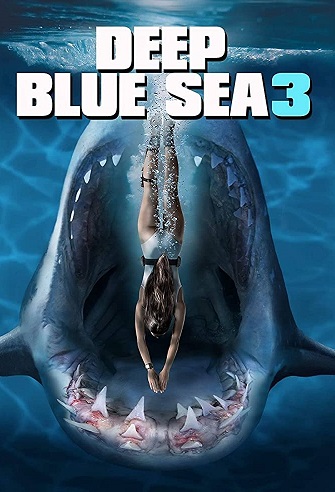
DEEP BLUE SEA 3 (US - 2020)
A quick glance at the title DEEP BLUE SEA 3 will probably cause most people to wonder "Wait, there was a DEEP BLUE SEA 2?" A DTV sequel coming nearly two decades after a 1999 original that gave us one of the all-time great surprise kills and one of the dumbest closing credits songs ever, DEEP BLUE SEA 2 did the bare minimum to get by, hindered by a low budget and some really shitty CGI, and its story of sharks turning into super-intelligent beings used as experimental subjects in a mad billionaire's Alzheimer's research was beyond absurd. Look no further than the instant classic moment when the bad guy announces his intention to destroy the sharks once he gets all the research info he needs, and he fails to notice an eavesdropping shark either listening or reading his lips. DEEP BLUE SEA 3, which tragically misses the opportunity to call itself D33P BLU3 S3A, sometimes hits those same heights of silliness, and it's a bit of an improvement over its predecessor. Filled with a cast of familiar second-tier TV faces, DEEP BLUE SEA 3 stars Tania Raymonde (of LOST and Lifetime's JODI ARIAS: DIRTY LITTLE SECRET) as shark expert Dr. Emma Collins, who's working with a small research team at Little Happy, a mostly abandoned fishing village on a man-made island in the Mozambique Channel (it was shot in nearby South Africa). Dr. Collins is also a great white whisperer of sorts, unafraid to get up close and personal with one longstanding resident of a great white breeding ground near Little Happy. The team--Collins, her late father's military buddy Shaw (Emerson Brooks of THE LAST SHIP), techie nerd Spin (Alex Bhat), and college intern Miya (Reina Aoi)--have their peaceful existence intruded upon by--conveniently enough--her ex Richard (Nathaniel Buzolic of THE VAMPIRE DIARIES and THE ORIGINALS) and a crew of mercenaries that includes loose cannon Lucas (Bren Foster, another LAST SHIP alum), who are on the hunt for three unusually aggressive bull sharks that killed some residents of a fishing village 100 miles away.
Those three bull sharks tie into DEEP BLUE SEA 2--they're more experimental subjects with human-level intelligence, even understanding Richard's warning of "Back the fuck off!" when one is captured and the other two start attacking the boat. DEEP BLUE SEA 3 is pretty by-the-numbers until it finally embraces its innate stupidity about an hour in, starting with a surprise kill that's actually just as great as the one in the first film (which was honestly one of the best crowd reaction moments I've ever experienced as a moviegoer). Then, it's all-out madness, highlighted by sharks circling a slowly sinking Little Happy as Shaw and Lucas have a spontaneous, full-on choreographed MMA throwdown (Lucas: "C'mon, old man!"); some groan-worthy zingers ("Sorry, chum!"); and an underwater Wilhelm Scream. Writer Dirk Blackman (OUTLANDER, UNDERWORLD: RISE OF THE LYCANS) and director John Pogue (writer of U.S. MARSHALS, THE SKULLS, and GHOST SHIP) understand that these things are basically slasher films with sharks, so they try to make every shark kill the equivalent of the Samuel L. Jackson moment from the original--it works the first time, but the one immediately after is really unnecessarily cruel--and after a draggy start, DEEP BLUE SEA 3 turns surprisingly entertaining, even with PS2-level CGI that seems intentionally cartoonish. Foster's Lucas is a cardboard psycho villain who endangers everyone's lives for no other reason than that's what the script needs him to do. But Raymonde commits herself to this like it's her ticket to the A-list as Collins and lone remaining Little Happy resident Nandi (Avumile Qongqo) eventually find themselves forced to deal with out-of-control, hyper-intelligent sharks and a lunatic Lucas. Not exactly good, but more guiltily enjoyable than it has any reason to be, you can do a lot worse than DEEP BLUE SEA 3 when it comes to cheap DTV shark movies. (R, 100 mins)
ANON (Germany/US/Canada - 2018) Written and directed by Andrew Niccol. Cast: Clive Owen, Amanda Seyfried, Colm Feore, Mark O'Brien, Sonya Walger, Joe Pingue, Iddo Goldberg, Charlie Ebbs, Damon Runyan, Sara Mitich, Doug Murray, Jean Michel Le Gal, Douglas Stolfi. (Unrated, 100 mins) The Netflix pickup ANON finds filmmaker Andrew Niccol back in the realm of high-concept sci-fi that briefly established him as the Next Big Thing in the 1990s. He's best known for writing and directing 1997's GATTACA and he received an Oscar nomination for scripting 1998's THE TRUMAN SHOW. Since then, Niccol's career has been on an erratic trajectory, splitting time between further explorations in sci-fi like the 2002 Al Pacino flop S1M0NE and 2011's terrible IN TIME, and political films like 2005's LORD OF WAR and 2015's barely-released drone treatise GOOD KILL, which was overshadowed by the more successful sleeper hit EYE IN THE SKY. He also tried his hand at big-budget YA sci-fi with 2013's THE HOST, but 20 years on, Niccol still hasn't matched the one-two punch of GATTACA and THE TRUMAN SHOW. His latest film ANON explores themes previously seen in his earlier sci-fi films but with middling and repetitive results. The production design is superb and it's a very expensive-looking film, but after a promising start, Niccol's script devolves into a string of rote cliches and tired genre tropes, becoming the kind of film that doesn't even bother following its own internal logic.
Set in a dystopian near-future (is there any other kind?), ANON presents a world where everyone's POV is one of constant information. Pass a stranger on the street, you get a readout of their name, age, and vital stats. Order a hot dog from a food truck, and the nutritional information is displayed. It's a totalitarian practice that makes crime solving easy for glum, burned-out cop Sal Frieland (Clive Owen). He can simply look at a victim, access the playback of the last ten seconds of their life, and see what the victim saw. But after coming across several corpses whose digital memories have been hacked and scrambled, it's clear to Frieland and his boss Gattis (Colm Feore) that they're dealing with a "ghost," a face without a name that goes about undetected, their stats and identity not in "The Ether," a term used to describe the seemingly limitless digital reality that holds the data and images and the place in which they venture to solve crimes. The only thing they know for sure is that the killer is female, and the trail eventually leads to "Anon" (Amanda Seyfried, also in IN TIME), a mercenary hacker who specializes in erasing memories and playback that a client wants gone, be it criminal activities, extramarital affairs, etc. But Anon's clients are turning up dead, so Frieland goes undercover as an investment broker for over a month, establishing an identity and memories outside of his existence as a cop and then seeking out "memory hackers" in the hopes that he'll draw Anon out of hiding, setting himself up as bait to catch her in the act. This ultimately leads to Frieland's perception of reality becoming dangerously skewed as Anon--or someone--gets inside his head and starts toying with his mind.
After an intriguing set-up, ANON soon demonstrates little urgency settling into a groove of Philip K. Dick worship combined with Niccol's usual sci-fi fixations of identity, individuality, and privacy. It all culminates in a heavy-handed lecture from Anon for a final scene, and the ultimate reveal of the guilty party is largely a non-event since we don't even spend enough time with the character in question for it to pack much resonance. And the longer ANON goes on, the more careless it becomes. Every inconsistency or deux ex machina that it pulls out of its ass can be explained away with "He got in my memory...that's what he wanted me to think!" The biggest eye-roller comes after Frieland spends over a month undercover and hires Anon to do a job and the cybersecurity experts working with the police are able to begin tracking her. After three days back as a cop, Gattis tells Frieland he has to go back undercover and re-establish contact with Anon, which concerns Frieland since his most recent memories and experiences will show him being a cop doing cop things and investigating her. "We'll put a patch over it!" Gattis says, as if Frieland has asked him a silly question. A patch? If you could just "put a patch over it" and mask the memories, then why make Frieland spend over a month working as an investment broker, creating a fake girlfriend for him to cheat on with a real hooker in order to give Anon a specific memory to digitally wipe when they could've just faked it all along? A patch? Owen treads on familiar ground here, with Frieland essentially being a cop version of his CHILDREN OF MEN character. Niccol doesn't really do Owen any favors, giving Frieland a checklist of cliched baggage--he's an alcoholic, his kid was killed in a tragic accident, and he's got a bitchy and unsympathetic ex-wife (Sonya Walger) who's moved on--that's supposed to function as backstory. ANON certainly isn't terrible, but it's tired and uninspired, feeling like the kind of sci-fi movie that should've hit theaters in 2002 or thereabouts. In a way, Netflix is the perfect venue for it, since there's a good chance at least some people will mistake it for a feature-length BLACK MIRROR episode.
A HOLOGRAM FOR THE KING
(US/Germany/France/Switzerland/Mexico - 2016)
There isn't much of a sense of urgency in this occasionally obvious and heavy-handed midlife crisis/culture clash drama based on the 2012 novel by Dave Eggers. It's a rare instance of a Tom Hanks movie not getting much of a push, with Lionsgate getting it on just 520 screens at its widest release. Hanks' durable, everyman persona makes him perfectly cast in this fish-out-of-water story centering on a skidding sales rep who's seen better days, being offered One Last Chance to Close the Sale of His Life. Alan Clay (Hanks) hasn't really liked himself much since selling out an American Schwin plant to China, a deal that put several hundred people--including his dad (Tom Skerritt)--out of work. His marriage fell apart and though he feels like a failure, his relationship with 21-year-old daughter Kit (Tracey Fairaway) remains strong thanks to her dislike of her mother. Now working for a tech company, Alan's been handed the plum contract of setting up IT service for Saudi Arabia's royal family. Once on site, he's constantly given the runaround, the wi-fi doesn't work, and he's so bogged down by jet lag that he repeatedly oversleeps and misses his shuttle to the work site. He forms a tentative friendship with Yousef (Alexander Black), a buddy of the hotel concierge, who drives him to the palace grounds every day in his beat-up clunker. A rapidly growing cyst sends Alan to a local doctor, Zahra (Sarita Choudhury), for whom an attraction is mutual, but societal customs initially prevent any moves from being made.
And that's about it. There's a health scare and Alan starts drinking to excess in an attempt to counter his malaise, and in his interactions with both Yousef and Zahra, he learns to appreciate life and pull himself together, while doing what he can to help his new friends in their assorted plights (Yousef's involvement with a married woman and Zahra's pending divorce and a life lived as a second class citizen, even though she's a brilliant doctor). A HOLOGRAM FOR THE KING is an unusual project for director Tom Tykwer, normally a more rambunctious filmmaker best known for the innovative 1999 cult classic RUN LOLA RUN. Tykwer directed Hanks in 2012's underappreciated CLOUD ATLAS, and Hanks, a huge fan of the Eggers novel, was likely instrumental in ensuring Tykwer could make this film at all. But even Hanks' involvement didn't generate any Hollywood interest, as the film was an independently-financed, five-country co-production, with extensive location work done in Saudi Arabia, Egypt, and Morocco. It's easily Tykwer's most low-key film to date, and somewhat European in its pacing and style, probably why Lionsgate didn't see much potential for it at US multiplexes, instead relegating it to its Roadside Attractions arthouse division. It really only starts gaining momentum very late, when Alan and Zahra start to admit their feelings for one another, after the symbolic removal of the cyst on Alan's back is the literal weight lifted off of his back. Tykwer more or less abandons Yousef, who's such a prominent character that you expect him to be there by the end, and a potential love interest for Alan in Danish contractor Hanne (THE DUKE OF BURGUNDY's Sidse Babett Knudsen) is a subplot that goes absolutely nowhere. Skerritt's brief performance looks phoned-in from his living room, and Ben Whishaw, a Tykwer semi-regular since 2006's underrated and insane PERFUME: THE STORY OF A MURDERER, has even less screen time as the titular hologram, designed as a long-distance meeting facilitator for the Saudi king. It's got some expectedly rock-solid work by Hanks, who gets strong support from Choudhury and a very likable performance by Black, but A HOLOGRAM FOR THE KING is a harmless trifle that just never really catches fire. (R, 98 mins) FATHERS & DAUGHTERS (US/Italy - 2016)
The warning signs are all there if you look closely: a movie you've heard nothing about, featuring a star-studded cast with several Oscar wins and nominations between them, debuting on VOD in 2016 courtesy of the Redbox-ready B-movie genre outfit Vertical Entertainment with no fanfare, still sporting its 2014 copyright. Yes, FATHERS & DAUGHTERS has spent some time gathering dust on a shelf, a bad movie that's so earnest and self-serious that is occasionally feels like an act of cruelty to be bagging on it. A maudlin, overwrought tearjerker that will have even the most easy weepers rolling their eyes, shaking their heads, and calling bullshit, FATHERS & DAUGHTERS is directed by Italian filmmaker Gabriele Muccino, who had some success in Hollywood several years back with a pair of Will Smith dramas, THE PURSUIT OF HAPPYNESS (2006) and SEVEN POUNDS (2008), before tanking with the instantly forgotten Gerard Butler flop PLAYING FOR KEEPS (2012). Muccino fashions FATHERS & DAUGHTERS as a shameless weepie, telling two intercutting, parallel stories taking place in 1989 and 2014. In 1989, blocked Pulitzer Prize-winning author Jake Davis (Russell Crowe, also one of the producers) is behind the wheel when a tragic car accident takes the life of his wife, leaving him to raise their seven-year-old daughter Katie (Kylie Rogers) alone. Jake's grief is overwhelming and, coupled with a head injury he sustained in the accident that causes random seizures that threaten a psychotic break, he's institutionalized for several months while Katie stays with his late wife's wealthy sister Elizabeth (Diane Kruger) and her high-powered lawyer husband William (Bruce Greenwood). Once Jake is out, Elizabeth, still bitter over her sister's death, wants custody of Katie. Jake's latest book becomes a critical laughingstock and commercial bomb, and he's running out of money to fight the impending court battle. In 2014, adult Katie (Amanda Seyfried) is a grad student and social worker attempting to break through to a troubled girl (BEASTS OF THE SOUTHERN WILD Oscar-nominee Quvenzhane Wallis) when she isn't trying to LOOKING FOR MR. GOODBAR her way through her daddy and abandonment issues, frequently picking up random men at bars for public quickies (Jake isn't around in 2014, so it's obvious he's died at some point in the 25-year interim). She meets an aspiring writer, Jake Davis superfan, and all-around good guy in Cameron (Aaron Paul), and their tender lovemaking is a stark contrast to numerous scenes of Katie getting drilled from behind in the backseat of a car or in a men's room shitter at a bar. Of course, nice-guy Cameron is exactly like her father and therefore, the film posits, exactly what she needs, so she repeatedly tries to sabotage a potentially good thing with her inability to commit and face all the trauma in her past with her mother's death and her father's breakdown.
Never mind the cliche of a woman resorting to promiscuity over unresolved parental issues--Muccino and debuting screenwriter Brad Desch have no notion of the concept of storytelling subtlety. They floridly hammer everything home in an overbaked fashion both in dialogue and filmmaking techniques, with one Katie/Cameron argument pointlessly played out in a long, dizzying single take down a NYC street, into a cab, and back out on the street again for no reason other than Muccino trying to make something out of nothing. Or there's clumsy exposition drops like our first look at adult Katie, when one of her fellow grad students runs up to her and exclaims "I can't believe you're about to get a graduate degree in Psychology!" It just grows more laughable as it goes on, in the 1989 scenes with an increasingly distracted Jake repeatedly trying to make amends with young Katie by referring to her nickname "Potato Chip," the two of them singing along to a Michael Bolton cover of Burt Bacharach's "(They Long to Be) Close to You," and Jake being hit by seizures at all the predictable times, like a major book signing (he has pills for this condition--why doesn't he take them?). In the 2014 scenes, FATHERS & DAUGHTERS turns into an all-out howler by the end, with Katie about to leave a bar to partake in an orgy with some strangers when the Bolton cover of the Bacharach song comes on the jukebox, prompting a total meltdown. This is a non-descript little dive bar in NYC that's playing alternative music at the beginning of the scene. Not even the most insufferable Williamsburg hipster douchebag would play a Michael Bolton song. And why is that song even a choice on a jukebox in this bar? And when a night out is ruined by the drunken appearance of one of Katie's one-nighters from a year ago ("I fucked you on your kitchen floor!" he yells), she tries to explain her past to Cameron, a guy so nice and sensitive that a never-played acoustic guitar is visible on a rocking chair in his apartment, with "You thought you were getting Potato Chip, and you ended up with some cheap piece of ass." What else? Oh, during an argument between Jake and William over the looming custody fight, a sneering Greenwood is actually required to bark the line "I've got more money than God!" The film completely strands its capable actors with unplayable roles, whether it's Crowe slipping in and out of a broad Noo Yawk accent or Kruger delivering a shrill, wine-swilling performance as the boozy, bitchy control freak Elizabeth. Younger actors Wallis and Rogers manage to escape unharmed, but there's also nothing supporting roles for Octavia Spencer (an Oscar winner for THE HELP) as Katie's boss, two-time Oscar-nominee Janet McTeer, wasted in one brief scene as Katie's therapist, and Jane Fonda in a small role as Jake's caring agent who can't bring herself to tell him he's washed up. Ludicrous, manipulative, and completely over-the-top, FATHERS & DAUGHTERS definitely has some potential to be an audience participation camp classic down the road. (R, 116 mins)
The final work of Russian auteur Aleksey German (credited here as Alexey Jurievich German), HARD TO BE A GOD was also the maverick filmmaker's career-long obsession. German first conceived the notion of adapting the 1964 sci-fi novel by Arkady and Boris Strugatski shortly after its publication. While other projects came and went, German remained determined to bring Hard to Be a God to the screen, even after a somewhat commercial Germany/USSR co-production directed by Peter Fleischmann and featuring Werner Herzog in a supporting role was released in 1989. He was known for his infamously meticulous nature, drawing obvious comparisons to Stanley Kubrick but probably more akin to Orson Welles with his doggedly stubborn nature and refusal to compromise. German, who only directed six films over his 45-year career, began shooting HARD TO BE A GOD in 2000 and didn't wrap until 2006. He then spent an additional seven years on post-production, endlessly tinkering with the editing and the sound mix until his death from heart failure in February 2013 at the age of 74, leaving his wife and son to finally complete the film. While it's tragic that German didn't live long enough to see his life's work through to its ultimate completion, one can't help but wonder how much longer it would've taken the film to be finished had he lived. Shot in black & white and running three hours, HARD TO BE A GOD is a cinematic endurance test to end all cinematic endurance tests, existing purely on its own terms and made for no one other than Aleksey German.
It opens in mid-story, with a team of scientists having spent an undisclosed amount of time (probably several years) on Arkanar, an Earth-like planet that's about 800 years behind in terms of thought and technological advancement, and still in what's tantamount to the medieval Dark Ages. Don Rumata (Leonid Yarmolnik) is one of several Earth scientists who have infiltrated the Arkanar society and are aghast at what they see, but are expressly forbidden from taking a proactive role in it, lest they influence the course of its future. They're strictly there as observers but smart enough to be considered gods by the unwashed, brutish masses. That's a summary of the Strugatski novel and indicative of things only vaguely hinted at in the finished film. German's HARD TO BE A GOD is adamantly against any kind of narrative drive or momentum whatsoever. The director's primary focus is capturing the medieval look and feel of Arkanar on sets constructed in the Czech Republic, and on that level, the film is an achievement both monumental and monotonous. HARD TO BE A GOD is one of the grossest films ever made, loaded with filthy, slobbering Dark Agers with endlessly streaming snot, shooting boogers out of their nose, vomiting, defecating, and pissing, rolling around in bodily waste, smearing feces everywhere, always looking like they're breaking the fourth wall as they look into German's handheld camera. There's a lot of nonsensical, stream of consciousness babbling by the denizens of Arkanar, almost like German is offering us what might happen if Terrence Malick lost his mind and directed a long-lost Chaucer adaptation written by Pasolini. Drenched in rain, fog, and mud, HARD TO BE A GOD looks like no other film ever made, and to that end, as well as German's endless devotion to the project, it's something that can't be easily dismissed. When someone puts that much into a project, are the accolades for the content of the work or for the obsession that drove it? There's a fine line between genius and insanity and though it may come off as cold, no one wants to say that perhaps German wasted the last 13 years of his life. It's a Stalinist allegory that took so long to complete from German's first inclinations of interest in 1964 to his death in 2013 that it inadvertently became a Putin critique, which may say something along the lines of "meet the new boss, same as the old boss," but it's lost here. There's incredible ambition in the end result, with fleeting moments that recall the likes of Herzog, Andrei Tarkovsky, Alejandro Jodorowsky, Bela Tarr and Terry Gilliam (Rumata even compares himself to Baron Munchausen on one occasion), but what's here is far beyond the bounds of reasonable self-indulgence. The bodily waste never stops flowing and, like the endlessly hanging gobs of snot, HARD TO BE GOD just goes on and on and on, which is part of German's master plan. He set out to make something as anti-entertaining as possible. While going against convention is admirable, you'll just feel numb around the 90-minute point, especially when you realize you're only halfway through this thing. HARD TO BE A GOD took 13 years to complete, and that's about how long it feels watching it. (Unrated, 177 mins, also streaming on Netflix Instant)
LAST KNIGHTS (US/South Korea/Japan - 2015)
With the financial backing of three countries and carrying 37 credited producers, it's clear that a lot of money went into the medieval adventure saga LAST KNIGHTS, but that still didn't keep it from spending three years on the shelf before getting an unceremonious VOD release. While the film is formulaic and a little too reliant on cliches, it's nevertheless surprisingly solid, grand in its presentation, and would've looked terrific on a big screen. There's a couple of instances where the CGI scenery gets a little dodgy, but for the most part, it's blended seamlessly and with care and precision, which is more than you can say for most mega-budget movies that get 3000 screen releases. Directed by Kaz I. Kiriya (2004's compromised but visually stunning CASSHERN), LAST KNIGHTS is set in a feudal society in medieval times, with the revered Lord Bartok (Morgan Freeman) outraged by a tax increase imposed on him by Geza Mott (HEADHUNTERS' Aksel Hennie), the sniveling minister to the Emperor (A SEPARATION's Payman Maadi), with the ulterior motive being to take over the Bartok lands for himself. Knowing a shakedown when he sees one, Bartok and his chief army commander Raiden (Clive Owen) venture to Geza Mott's palace for a meeting, where Bartok intentionally insults the greedy minister with a cheap gift in a wooden box ("You can keep the box, too," he snarks). Geza Mott later provokes Bartok into a physical confrontation, and when Bartok draws his sword in self-defense, he's nevertheless ordered by the Emperor to pay for his offense against Geza Mott with his life, and also cruelly orders Raiden to be his executioner. The Bartok lands are claimed by Geza Mott, who casts out Bartok's widow (Shohreh Aghdashloo) and forces his daughter (Si-Yeon Park) into prostitution. The paranoid minister lives in constant fear of Raiden's vengeance, unaware that Raiden has become a hopeless drunkard who sold his cherished sword and is so overcome by grief and guilt over killing his beloved master that he has little will to live. Unknown to Geza Mott, the rest of Raiden's army, led by Cortez (Cliff Curtis) has a spy inside their former stronghold and a plan for revenge is on, eventually joined and taken over by Raiden when he finally rises out of his sulking stupor and decides to take back the Bartok lands and restore his master's good name.
Loosely inspired by the legend of the 47 Ronin, and much better than the recent botched Hollywood take on the subject, LAST KNIGHTS could easily be written off as a GAME OF THRONES knockoff, but it's miles ahead of a lot of recent films of this type (HAMMER OF THE GODS, OUTCAST, SWORD OF VENGEANCE, and the terrible IRONCLAD sequel). though with its rousing battle scenes and committed performances, it's more akin to the original IRONCLAD and like that film, should have a long life on Netflix streaming and cable. There's one great shot of a guy getting his head sliced off and taking several more steps before stumbling into a pool, and one very well-choreographed, OLDBOY-inspired scene where Raiden works his way down a hallway, slicing and dicing about 20 of Geza Mott's soldiers without Kiriya employing a single cut. No, LAST KNIGHTS doesn't break any new ground (it opens with--spoiler alert--narration by Freeman), its momentum depends on the villains stupidly underestimating Raiden, and you just know that the most eager and ambitious young soldier in Raiden's army will be the first one to die ("Did I do well?" he gasps in his dying breath, tears welling up in the eyes of the weathered, seen-it-all dogs of war comforting him in his final moments), but it's an almost defiantly old-fashioned adventure nicely blended with the violent and downbeat nature of a GAME OF THRONES or a VIKINGS. Freeman, sporting some interesting facial hair, exits about 30 minutes in but does what he's required to do (basically, be Morgan Freeman). While Owen stars in the acclaimed period drama THE KNICK, Cinemax's "We're not just Skinemax, so put the Kleenex away, fellas!" bid at respectability, Hollywood has seemingly lost all faith in his ability to open a movie. Owen glowers and grimaces and is excellent as the battle-hardened, heartbroken Raiden, exhibiting the kind of dour, steel-edged gravitas that will come in handy in about eight years or so when his career gets a second wind after it inevitably enters its "Liam Neeson Geriatric Asskicker" phase. Very well-made and epic in scope, with every dollar up on the screen, LAST KNIGHTS was abandoned by its distributors--when's the last time you saw a Clive Owen movie in a theater?--and reviled by the few critics who saw it. It's not to be mistaken for a great movie, but it's a fine adventure and didn't deserve the shitty reception it got. (R, 115 mins)
WHILE WE'RE YOUNG (US - 2015)
Ben Stiller has always seemed like he was born ready for midlife crisis roles and now that he's nearly 50, he's got a prime one in WHILE WE'RE YOUNG, which reunites him with his GREENBERG writer/director Noah Baumbach. Baumbach, an occasional Wes Anderson collaborator (he co-wrote THE LIFE AQUATIC WITH STEVE ZISSOU and FANTASTIC MR. FOX), a voice of Gen-X malaise with his 1995 debut KICKING AND SCREAMING, and a master of cinematic discomfort with THE SQUID AND THE WHALE (2005) and the brilliant and underrated MARGOT AT THE WEDDING (2007), seems to be mellowing with age. WHILE WE'RE YOUNG isn't as caustic as some of his mid '00s work, and gives Stiller a chance to basically use his "Ben Stiller" persona as Josh, a 44-year-old documentary filmmaker who's gone full Aleksey German and has been working on the same project for nearly a decade, a coma-inducing series of interviews with left-wing theorist Ira Mandelstram (Peter Yarrow) that comprise so many hours that he's actually lost track of what the film is even about (when asked, he's quick to desperately blurt "It's about America, really"). His wife Cornelia (Naomi Watts), a producer for her legendary documentary filmmaker father (Charles Grodin), is constantly being hounded by her friends about why she and Josh are still childless. They seem happy and content with their careers and each other, but something's missing. That void is temporarily filled by Jamie (Adam Driver--and can someone explain the whole "Adam Driver is hot" thing to me?) and Darby (Amanda Seyfried), a pair of mid-20s, newlywed bohemian hipsters who make their own furniture, churn their own ice cream, watch old movies on VHS, and embrace CITIZEN KANE and Survivor's "Eye of the Tiger" with equal passion. Soon, Cornelia is joining Darby for hip-hop dance classes, Josh is wearing a porkpie hat, and they're drifting away from friends their own age. Tensions rise when Josh and Jamie collaborate on a documentary about a high-school classmate of Jamie's (Brady Corbet), which leads to a Jamie side project that starts getting him everything evading Josh: money from investors, critical acclaim, and the approval of his father-in-law.
Many pointed out that WHILE WE'RE YOUNG seems like an art-house version of the Seth Rogen/Zac Efron comedy NEIGHBORS. It's very low-key and never really cuts loose, instead focusing on character, where a more mainstream film would have Josh embarrassing himself beyond going out in a public in a porkpie hat. The film's one attempt at overt slapstick is also its weakest sequence--a tedious and overlong visit to a drug-tripping ayahuasca ceremony where everyone vomits into a bucket. As the film goes on and Jamie's and Darby's intentions and true nature come into question, Baumbach never paints them as villains and still treats everyone with sympathy, whether it's Josh and Cornelia trying to find themselves at a crossroads in their life together, and forgiving Jamie and Darby's trespasses because of their youth and inexperience at life. "They're not evil," Josh realizes. "They're just young." (R, 97 mins)
Directed by Seth MacFarlane. Written by Seth MacFarlane, Alec Sulkin, and Wellesley Wild. Cast: Seth MacFarlane, Charlize Theron, Liam Neeson, Amanda Seyfried, Giovanni Ribisi, Neil Patrick Harris, Sarah Silverman, Wes Studi, Evan Jones, Matt Clark, Christopher Hagen, Rex Linn, Alex Borstein, John Aylward. (R, 116 mins)
One of FAMILY GUY and AMERICAN DAD creator Seth MacFarlane's strong suits is his voice acting ability, bringing life to most of the characters on his animated shows as well as to a talking teddy bear in his 2012 feature directing debut TED. What makes his latest film, A MILLION WAYS TO DIE IN THE WEST, different is that director/producer/co-writer MacFarlane also puts himself front and center as a leading man. His presence as an actor doesn't offer him the versatility and spontaneity that he demonstrates as various animated characters, and he just doesn't have the chops to carry a movie as "Seth MacFarlane." And make no mistake, that's essentially who he's playing in this western spoof that offers a decidedly 2014-ish MacFarlane as Albert Stark, a sensitive, cowardly sheep farmer with a snark-laden view of the Old West in the kill-or-be-killed 1882 Arizona frontier town of Old Stump. The Monument Valley location shooting and the sweeping, reverent score by Joel McNeely do a nice surface job of paying homage to John Ford westerns, but with his bland, one-note performance, his propensity for dragging jokes past their breaking point and continuing to beat it to death after that, and his general sense of self-indulgence, MacFarlane gets some scattered laughs but falls far short of hitting the mark. Forget any absurd comparisons to BLAZING SADDLES--this doesn't even measure up to RUSTLER'S RHAPSODY.
After negotiating his way out of a duel in front of all of the Old Stump townfolk, Albert is dumped by his embarrassed girlfriend Louise (Amanda Seyfried), who runs to the open arms of sneering, pompous mustachery boutique owner Foy (Neil Patrick Harris), who's rich and successful and everything Albert is not. When he's not drowning his sorrows at the saloon with his devoutly religious, repressed best friend Edward (Giovanni Ribisi) and his prostitute wife Ruth (Sarah Silverman), Albert is hanging out with Anna (Charize Theron), the tomboyish crack shot who just arrived in town with her brother Lewis (Evan Jones), who's already in jail for starting a bar brawl. What Albert doesn't know is that Anna is the wife of dastardly outlaw Clinch Leatherwood (Liam Neeson), who sent Anna and Lewis to Old Stump to pose as siblings and wait for the arrival of the rest of his gang as they hunt for gold in the region. With Lewis locked up, Anna realizes this is the perfect chance to escape Clinch's clutches and comes to genuinely like Albert, who's funny and kindly and everything Clinch isn't. Albert, meanwhile, is obsessing over Louise and asks for Anna's help in winning her back from the insufferably smug Foy. She helps train him in firing a pistol after he gets so jealous and enraged that he challenges Foy to a gunfight. Of course, all of their plans go awry when Clinch and the gang arrive in Old Stump earlier than expected, and word gets back to Clinch that his wife's been spending a lot of time with the hapless Albert.
MacFarlane can be a smart satirist and the script (co-written with regular collaborators Alec Sulkin and Wellesley Wild) gets in a handful of legitimately good laughs about various western cliches, the joylessness of old-timey photos, the sheer misery of what life must've been like back then, and occasional digs at religion, antiquated norms of that time ("Why are the Indians so mad all the time? We share this land with them, it's pretty much 50/50" and a carnival shooting gallery game called "Runaway Slave" are particularly stinging), and the present-day culture wars ("Oh, Parkinson's is one of those things that God gives you that somehow shows how much He loves you"). Anachronistic humor is inherent in this kind of thing, but MacFarlane just doesn't have the screen presence to make it work. Neither his character nor his performance are very funny. Too much of A MILLION WAYS TO DIE IN THE WEST is focused on Albert's whining about Louise and on his slowly-blossoming romance with Anna. MacFarlane may be a gifted voice actor, but on the screen himself, he never seems comfortable and a lot of the script seems to be geared toward stroking his own ego, whether Theron's Anna is laughing at everything he says or constantly affirming what a nice guy he is and how he deserves someone better than the shallow Louise. Theron does a good job of playing the always-appealing, no-bullshit, "just one of the guys" types, but she can't really sell the idea of finding the self-pitying, constantly-complaining Albert that interesting. The supporting cast is mostly wasted, but Harris steals the film with his inspired turn as the loathsome Foy, especially when he makes Louise suck the end of his perfectly waxed mustache while he fondles himself. But even Harris is forced to succumb to the frequent bouts of MacFarlane's toilet humor--quite literally, at one point. After being introduced early on, Neeson is absent until the third act, so he doesn't really have time to make Clinch Leatherwood (a great name, by the way) anything more than a two-dimensional caricature of a western heavy.
One criticism that's rightfully been leveled at MacFarlane over the years is the way he finds humor in beating a joke to within an inch of its life (think FAMILY GUY's infamous Conway Twitty cutaways or Peter Griffin's epic brawls with Ernie the Giant Chicken). Here, MacFarlane isn't content with a couple of mustache jokes when 15 will do, and even then he'll tack on two musical numbers about mustaches just to be sure. Even the funny observation about stone-faced people in photos of the era is rehashed multiple times. The most labored jokes center on the relationship between Edward and Ruth. Ruth is Old Stump's busiest prostitute, but she refuses to have sex with Edward before marriage. Edward goes to the whorehouse to wait until she's done working, and even uses his finest handkerchief to wipe "dirty cowboy cum" off of her face. The joke of Edward waiting downstairs while she loudly screws Old Stump's skeeziest is funny once, so of course MacFarlane repeats it five more times. His set-ups are also getting predictable. As Edward and Ruth leave for lunch, the madam (Alex Borstein) tells Ruth she's got someone planning to see her around 5:30 that day. "What does he want?" Ruth asks. Now, if you've seen enough of MacFarlane's work, you know the answer will be "Anal," and it is. But it's not enough. Edward and Ruth have to somehow be confused about how soon they should be back, and need clarification on what time the guy will be there. "Whenever he feels like putting his penis in your asshole," the madam tells her. "Anal" was predictable but amusing. But MacFarlane just lets the scene go on and on. And then Ruth can't sit down because, yes, her asshole hurts. This happens time and again throughout the film, and with its nearly two-hour running time, it goes on entirely too long. Just when things should be heating up for the confrontation between Albert and angry Clinch, MacFarlane sends the story an unfunny, running-time-padding detour which finds Albert hanging out with Cochise (Wes Studi) and drinking a hallucinogenic potion that has him tripping and the film looking like the old west version of a Storm Thorgerson-designed album cover. Why? Because nobody's going to stop him, that's why.
A MILLION WAYS TO DIE IN THE WEST isn't a terrible movie, but it's not a very good one. It probably could've been a little better with someone other than MacFarlane in the lead. He tries to go for a sort-of Jason Bateman-type demeanor with his snide detachment and wry observations pointing out the absurdity of his surroundings, but instead, he's loud, aggressive, and annoying. There's simply too much Seth MacFarlane in this movie. He also tries to milk some easy laughs out of several cameos, but only one approaches the sheer insanity of James Woods voicing himself as "James Woods" on FAMILY GUY, and making Peter watch VIDEODROME (Peter: "Does anyone get naked in this?" Woods: "Yeah. I do") or FLASH GORDON's Sam J. Jones turning up as himself in TED. What MacFarlane doesn't understand about parody is that it has to be done from a place of genuine affection. That's why the one really inspired cameo here works as well as it does. That's also what shines through in the best work of Mel Brooks and the ZAZ team in their AIRPLANE/TOP SECRET heyday, and that's why those parodies are timeless. While very disappointing, A MILLION WAYS TO DIE IN THE WEST is nowhere near the depths of say, a typical Friedberg/Seltzer abomination like DATE MOVIE or MEET THE SPARTANS. But it does share with those films a certain fundamental misunderstanding of what it means to parody something. Most of the dud jokes here--and there's a lot of them--would probably work as single brief cutaways in a FAMILY GUY episode, but MacFarlane's script isn't nearly as funny as he thinks it is and he doesn't seem to realize that parodying something at feature length requires a bit more than being a flippant smartass.