EYE SEE YOU (US/Germany - 2002) Directed by Jim Gillespie. Written by Ron L. Brinkerhoff. Cast: Sylvester Stallone, Tom Berenger, Charles S. Dutton, Kris Kristofferson, Polly Walker, Robert Patrick, Jeffrey Wright, Robert Prosky, Courtney B. Vance, Christopher Fulford, Stephen Lang, Sean Patrick Flanery, Dina Meyer, Angela Alvarado Rosa, Mif, Alan C. Peterson, Hrothgar Mathews, Rance Howard, Tim Henry, Frank Pellegrino. (R, 96 mins) Sylvester Stallone has had his share of ups and downs over the course of his long and storied career, but he perhaps hit his roughest patch in that post-COP LAND period from 1998 to 2006, after which he went into nostalgia mode with the surprisingly good ROCKY BALBOA. That film's success sent Stallone on an ongoing greatest hits tour that's seen him resurrecting Rambo, creating a new all-star action franchise with THE EXPENDABLES, and continuing Rocky's story in two CREED films so far, the first earning him a Best Supporting Actor Oscar nomination. The 1997 "indie" COP LAND came at the height of Miramax's Oscar-baiting power, and was supposed to be then-51-year-old Stallone's bid to reinvent himself as a Serious Actor. He even pulled a De Niro by putting on 40 lbs and sporting a gut to play a powerless and partially-deaf sheriff in a small New Jersey suburb that a bunch of corrupt NYC cops call home. The film was critically-acclaimed, Stallone got some of the best reviews of his career, and it was a modest hit in theaters, but it was more or less viewed as a stunt for Stallone and offers for more serious roles never materialized. So he went back to action movies with 2000's remake of the Michael Caine classic GET CARTER and the 2001 racing drama DRIVEN, and both bombed critically and commercially. Aside from his comedic turn as the villain in 2003's SPY KIDS 3-D: GAME OVER, Stallone's next three films--2002's EYE SEE YOU, 2003's AVENGING ANGELO, and 2004's SHADE, where things had gotten so dire that he took a supporting role as the mark in a ROUNDERS underground poker knockoff starring Stuart Townsend--either made it to just a handful of theaters, or (as in the case of AVENGING ANGELO, notable only as Anthony Quinn's last film and released two years after his death), went straight-to-DVD after extended stays on the shelf.
EYE SEE YOU began life as DETOX, and was supposed to be a major-studio Stallone thriller, produced for Universal under the auspices of Imagine Entertainment and executive producer Ron Howard. Budgeted at nearly $60 million, with 1/3 of that going to the star, DETOX was shot in 1999, when its director, Jim Gillespie, was still enjoying a huge box office success with the 1997 smash I KNOW WHAT YOU DID LAST SUMMER, one of the most popular entries in the post-SCREAM slasher craze. A strong cast was assembled in support of Stallone, including the likes of Tom Berenger, Charles S. Dutton, Kris Kristofferson, Courtney B. Vance, Robert Prosky, Jeffrey Wright, and Stallone's COP LAND co-star Robert Patrick, among others. DETOX was clearly a riff on the kind of dark and grim serial killer thrillers that came in the wake of David Fincher's SE7EN, and it cast Stallone as a troubled FBI agent who ends up at a secluded psychiatric facility that's dedicated to helping law enforcement PTSD cases. But once he's there, all the cops in the treatment program start getting killed off one by one and they can't call for help because communication's been knocked out thanks to a blizzard, which keeps them trapped inside. Mistrust, paranoia, and anger set in and for a bunch of cops who already don't need another push to go off the deep end, the situation soon turns into something akin to John Carpenter's THE THING if re-imagined as an Agatha Christie mystery.
Not a bad idea for a thriller, but things went horribly awry. Both Universal execs and test audiences hated Gillespie's initial cut. Reshoots were ordered and Gillespie was told to overhaul the entire thing. It's not clear how much he was involved, but Stallone said years later that Ron Howard himself supervised the post-production for a brief period of time. The ending was reshot and the title kept changing--from DETOX to D-TOX to THE OUTPOST and back and forth again as Universal tried testing the revamped version in 2001 and still got a chilly response. Now with the title settled on D-TOX, the film was released in Europe in early 2002 with little success, while back in the States, Universal decided they'd seen enough and washed their hands of it. They sold it to the lowly DEJ Productions, who retitled it EYE SEE YOU, and released it--minus the Imagine Entertainment logo and Ron Howard's executive producer credit--on 78 screens with no publicity in September 2002 on its way to Blockbuster shelves two months later as one of the chain's "Blockbuster Exclusives." After three years, multiple reshoots, numerous test screenings, and at least $60 million spent on it, EYE SEE YOU opened in 57th place with a weekend gross of $32,000.
So is it that bad? No, it's not. Looking at it now, it's nowhere near the vicinity of being Stallone's worst movie, especially in a filmography that contains STOP! OR MY MOM WILL SHOOT, REACH ME, and ESCAPE PLAN 2: HADES. It doesn't even belong in his bottom five and might not even qualify for his bottom ten unless you're looking at OVER THE TOP through rose-colored glasses. EYE SEE YOU's biggest offense is that it's kinda dumb (but not as dumb as Paulie's robot in ROCKY IV) and it's quite shameless in its SE7EN worship, starting with the same kind of shaky and jittery opening credits, which was already a little past its sell-by date in 2002 but still hasn't stopped movies from ripping off even today. Stallone is Jake Malloy, an FBI agent on the trail of a serial killer who kills cops--nine so far in the last six months--by taking their eyes out with a power drill and calling Malloy with garbled, electronically distorted phone taunts of "I see you...but you don't see me." As is wont to happen in cop thrillers of this sort, things get personal when EYE SEE YOU's "head in the box" moment comes pretty early on as Malloy's girlfriend Mary (Dina Meyer, in a test run for the SAW franchise she'd be a big part of a few years later) becomes the killer's latest victim on the night he was going to propose to her, her eyes drilled out and her corpse strung up and left hanging in the dining room. After a pursuit into an abandoned building, complete with a requisite dungeon-like room filled with just chains dangling from the ceiling, Malloy is about to confront the killer only to find that he's committed suicide and left a full confession. Case closed, but a depressed Malloy spends three months drinking himself into numbness, and after attempting suicide, his boss Hendricks (Dutton) intervenes, taking him to the remote clinic for cops, located in middle-of-nowhere Wyoming at a decommissioned former military asylum.
It's an effectively ominous setting, and it enhances the situation when other cops in the program--among them bullying hothead Noah (Patrick), emotionally shattered Conner (Sean Patrick Flanery), aging Canadian Mountie McKenzie (Prosky), drug-addled undercover narc Jaworski (Wright), and bad cop-turned-man of God Reverend Jones (Vance)--start getting offed one by one, with other targets and potential killers that include affable janitor Hank (Berenger), ex-cop and head doc Doc (Kristofferson), shrink Jenny (Polly Walker), and weirdo orderly Jack (Stephen Lang), whose obvious red herring behavior is so bizarre from the start that there's no possible way he could be the killer. Stallone turns in a strong performance, and while there are some head-scratchers throughout (why would off-duty, on-disability cops come from all over the continent and still bring their guns for Doc to keep in the safe and their shields for him keep in a file cabinet? Obviously, so Malloy can bust into the safe and give everyone their weapon once a killer is on the loose and so the killer can break into the file cabinet and collect the shields of his victims as "trophies." Duh!), it's really not any more or less idiotic than a lot of studio thrillers from that time. And after driving Malloy all the way out to the retreat, Hendricks decides to rent a cabin so he can do some ice fishing and of course, finds a dead body frozen in the ice, which turns out to be a cop who was on his way to the facility, which means someone isn't who they claim to be, as evidenced when Malloy just happens to look under the eyelids of one of the dead cops to find "I" written under one and "C.U." under the other.
Just out on Blu-ray from MVD Visual (because physical media is dead), EYE SEE YOU isn't going to be re-evaluated as anything more than a derivative but watchable time-killer aside from the novelty of being the closest Stallone's come to starring in a horror movie. But the Blu-ray does have one intriguing extra that's a point of interest for the morbidly curious or if you're the type that slows down on the interstate to rubberneck a car crash: the first official release of Gillespie's original 1999 cut, presented here as a widescreen workprint of acceptable VHS quality and under the DETOX title, with incomplete opening credits and no closing credits. There's ultimately just a one-minute difference between the two versions (EYE SEE YOU runs 96 minutes, DETOX runs 95), but the changes are apparent from the very first scene, even though there doesn't appear to be much in the way of reshot material. Most of the footage in EYE SEE YOU is right there in DETOX, but DETOX has a radically different structure that, to put it mildly, is a total clusterfuck.
Gillespie's DETOX cut utilizes a fractured timeline, but all this does is slow the film down and inadvertently compromise Stallone's performance. Arranging the film this way forces the audience to not only follow the unfolding mystery, but at the same time try to figure out what the hell happened to get Malloy there in the first place. There's absolutely no sense of pacing and no smoothness to the storytelling. It opens with a pre-credits sequence showing the murder of a cop, goes to the opening credits, and the first shot after that is Hendricks driving Malloy to the facility. Who are these guys? Why is Stallone being taken here? Why are his wrists bandaged? Less than ten minutes in, and DETOX dives right into Malloy's therapy with Doc and the other cops, while using periodic random flashbacks and cutaways to fill in the backstory--exposition that was ultimately presented in a linear and much more coherent fashion as the opening 20 or so minutes in EYE SEE YOU. In Gillespie's DETOX cut, it takes so long to dole out these important details that it's a full 45 minutes--almost half the film's running time--before we're even aware that Mary was killed and we can finally conclude why Malloy has been brought here. EYE SEE YOU fixes all of this start/stop, momentum-killing nonsense by arranging these sequences in a conventional narrative that quickly and concisely establishes who the characters are and what they have to do with the story.
Poster art for the European release before Universal sold it to DEJ Productions.
Imagine SE7EN opening with Kevin Spacey walking into the police station and then Brad Pitt and Morgan Freeman thinking back to all the murders they've been investigating as they drive out to the desert. There would be no reason for the story to unfold that way, just as there's no reason for the clunky, jumbled narrative in DETOX, other than Gillespie getting a little too big for his britches after one hit and thinking he's pulling some USUAL SUSPECTS head games. Sometimes, the basic way is the way that works. The impenetrable structure of DETOX isn't in the service of a surprise, game-changing reveal. It's Stallone vs. a serial killer. There's no need to complicate it and overthink it with laboriously-executed trickery in a hapless attempt to be clever. Sometimes--not often, but sometimes--when a director is ordered to make changes or even has the movie taken away from them, and you finally get to see the director's intended version, you realize on occasion that the studio was right. And while that final version may be a flawed compromise, the term "director's cut" doesn't automatically mean it's the better version (PAYBACK, NIGHTBREED, and THE EXORCIST III come to mind). There are a couple of other major differences between EYE SEE YOU and DETOX. In EYE SEE YOU, when Malloy finds what he thinks is the killer's body post-suicide, he drops to his knees in exhausted anguish--a natural response. In the DETOX cut, he does an enraged Rambo yell and shoots the corpse six times. Lang gets a couple of additional lines of dialogue and sinister glances that make his twitchy character more aggressively asshole-ish in EYE SEE YOU. And in EYE SEE YOU, the climactic confrontation has been significantly reworked, with some new shots that give the killer a more violent, over-the-top death. EYE SEE YOU is not going to be mistaken for a neglected classic, but it looks like top-shelf Hitchcock when viewed in conjunction with the unreleasable DETOX. It's no mystery why test audiences hated it. And if the DETOX cut is what Stallone saw before washing his hands of the project, it's no wonder he and Patrick openly dissed it on the commentary track for the 2004-issued director's cut DVD of COP LAND (as Michael Rapaport's character vomits in a trash can, Stallone quips to Patrick "He looks like he just saw DETOX"). Or why Howard took his and Imagine's names off of it before its belated release, as all involved parties distanced themselves from it like a loud fart in a crowded room.
Richard Bates, Jr. had an impressive debut with 2012's transgressive and disturbing EXCISION, which felt not unlike MEAN GIRLS re-imagined by David Cronenberg. It found significant acclaim in indie horror circles, but his follow-ups--2015's SUBURBAN GOTHIC and 2016's TRASH FIRE--didn't attract nearly as much attention from genre fans. Early buzz for his latest, TONE-DEAF, served as a reminder of Bates' existence, but you won't get far into it before thinking he may have peaked with EXCISION. A heavy-handed and ultimately toothless generation clash horror satire, TONE-DEAF had some potential to offer some insightful and cutting commentary on today's volatile cultural and political climate, but true to the film's title, Bates settles on neither a tone nor what exactly the targets are supposed to be. After Olive (SILICON VALLEY's Amanda Crew) splits with her boyfriend (Nelson Franklin) and loses her job after refusing to take any shit from her sexually-harassing boss, her besties Lenore (Hayley Marie Norman) and Blaire (EXCISION's AnnaLynne McCord) convince her to get out of town for a few days and take some time to herself to regroup. She rents an old, lavish country home in the middle of rural nowhere ("This place is boujee as fuck") from recent widower Harvey (Robert Patrick, one of a dozen producers). It isn't long before Harvey is creeping around the house, spying on pot-smoking Olive in frowning disapproval, and playing tricks like hiding a spider in her contact lens case. What we know and Olive doesn't is that Harvey has killed Agnes (Nancy Linehan Charles), an elderly neighbor and his late wife's friend because, while he's lived a good life, "killing is an itch I never got around to scratching." And he's still feeling the itch.
TONE-DEAF might've functioned as a straight two-character suspense piece, but Bates instead fashions it as a Baby Boomer vs. Millennial throwdown, thus turning it into a pointless mash-up of a home-invasion thriller and a Thanksgiving argument with your Fox News-obsessed uncle. Olive is everything that the bitter Harvey hates: young, liberal, independent, her social media profile pic shows her in a T-shirt that reads "This Pussy Grabs Back," and her arrival at the house is accompanied by Awkwafina's "My Vag" in a car with a CoExist bumper sticker. Harvey has a chip on his shoulder about millennials, Venmo, climate change, young people's sense of entitlement and perceived lack of work ethic, and how Sundays are for the Lord, and Bates often allows him to break the fourth wall to rant directly to the viewer about "brunching bimbos getting drunk off your skinny-girl margaritas and cavorting around with your jobless, fedora-clad boyfriends." It's great in theory that Bates has given Patrick a role that he can sink his teeth into as a retiree Patrick Bateman for the MAGA crowd, but the characters are painted in such broad strokes that there's no room for subtlety, nuance (Harvey changing the lyrics to Woody Guthrie's "This Land is Your Land" and declaring "That's right, kids...Papa made a remix!" is embarrassing), or consistency (if his beef is with millennials, then why does he kill geriatric Agnes?). Bates also drops the ball by cutting away from the action to focus on inconsequential asides that only serve to pad the running time, like Olive's hippie mom (Kim Delaney), who joined a commune after Olive's dad (Ray Wise) committed suicide years ago, and now has a young, snowflake boy-toy (Johnny Pemberton) who can't change a tire and objects to her texting Olive while he goes down on her, a potential Olive Tinder hookup (Tate Ellington) at a townie bar, which does offer one legit surprise that goes nowhere, or Olive buying acid from a local dealer (shouldn't WHALE RIDER Oscar-nominee Keisha Castle-Hughes have better things going on than 13th billing in TONE-DEAF?) and tripping balls in the living room, where she imagines conversations with her exes and her dad. A couple of jokes land, like Harvey yelling "Jesus Christ, I didn't really think this through!" after he impulsively stabs Agnes and is shocked by the amount of blood gushing out of her, and a running gag about Olive's terrible piano-playing has a funny payoff that, of course, Bates bungles by immediately over-explaining it. But by the time Harvey and Olive have their final showdown, where he comes after her with a tomahawk and she snarkily sighs "Is that at tomahawk? Textbook cultural appropriation, man," you'll have long since lost your ability to even with TONE-DEAF. (R, 88 mins)
BLOODLINE (US/China - 2019)
When AMERICAN PIE became a huge summer hit 20 years ago, everyone was talking about Jason Biggs fucking an apple pie and quoting Alyson Hannigan's perfectly-delivered "This one time...at band camp..." But in the relatively minor supporting role of grating goofball Steve Stifler--aka "The Stifmeister"--it was Seann William Scott who stole every scene he was in and would eventually become a major focus of the subsequent big-screen sequels (not counting the various Eugene Levy-headlined DTV spinoffs), with each successive performance going more obnoxiously over-the-top. Inevitably, Scott found himself typecast as variations of Stifler in comedies like ROAD TRIP and DUDE, WHERE'S MY CAR? and even into his early 30s, he was still utilizing his Stifler schtick in MR. WOODCOCK and ROLE MODELS. Though he's found steady gigs doing voice work in animated films like the ICE AGE franchise (as fan favorite opossum Crash) and PLANET 51, and enjoyed a minor cult hit with the Canadian-made hockey comedy GOON and its lesser-seen sequel, Scott, perhaps more than any of his castmates from that influential raunch comedy from two decades back, will forever be inextricably linked with his AMERICAN PIE character.
With that in mind, BLOODLINE is about as radical a departure as possible for the now-43-year-old actor. An under-the-radar Blumhouse production that only made it into a few theaters, BLOODLINE is a horror oddity that doesn't skimp on the gore, but may be a little too offbeat and cerebral for those looking for run-of-the-mill jump scares. Scott is Evan Cole, a social worker at an L.A. high school who's happily married to Lauren (Mariela Garriga) and the father of a newborn son. Parenthood is stressing both of them out, even with Evan's mom Marie (a terrific Dale Dickey) helping out. Evan isn't feeling effective at his job, where he spends day after day counseling students--including a scholarship candidate with a junkie dad, another who's come out of the closet and is regularly beaten by his homophobic father, and a 15-year-old girl who's being sexually molested by her uncle--which brings up long-suppressed memories of his own abusive father. Evan decides the best way to help these kids is to permanently eliminate the source of their troubles, so he spends his evenings moonlighting as a serial killer. Lauren begins questioning where he goes at night while Marie offers a silent, knowing understanding of her son's apparent calling. It isn't long before an incredulous and persistent detective (Kevin Carroll) comes snooping around after Evan didn't do as thorough a job as he should have in disposing of his victims, the killings having a strangely similar M.O. to an unsolved string of murders in a different city and school district in where Evan used to work before he met Lauren.
Director/co-writer Henry Jacobson, a documentary filmmaker helming his narrative feature debut, stages a few startlingly blood-splattered kill scenes while sometimes going for bizarre shock value (a close-up of a stretched prosthetic vagina as Lauren gives birth to their son seems to be a bit...much). He also deploys some De Palma split diopters and an effectively-executed split-screen late in the game (he's also got a ringer in editor Nigel Galt, a late-period Stanley Kubrick inner-circler who worked on FULL METAL JACKET and EYES WIDE SHUT), but the idea of an everyman serial killer as portrayed here owes quite a bit to the likes of DEXTER and THE STEPFATHER (and I'm willing to bet that Jacobson is also a huge fan of Donald Cammell's WHITE OF THE EYE). The surprise development at the end is something you won't see coming, but its abruptness dampens things a bit, as it hasn't been built up enough to be wholly plausible. BLOODLINE isn't a great movie by any means, but it deserved more than the dump-off of a release that it got, though I get it: it's a strange and eccentric little thriller even beyond the novelty of the against-type casting of Scott, whose restrained and very internalized performance as a homicidal maniac quietly living his life as a family man and upstanding member of the community wouldn't have delivered the wisecracking, serial-slashing Stifler that mainstream horror fans would've expected. (R, 98 mins)
Hot on the heels of gems like THE CAR: ROAD TO REVENGE and BACKDRAFT 2, Spike Lee's hit 2006 bank heist thriller INSIDE MAN becomes the latest unlikely Universal catalog title to be belatedly sequelized by their "1440" DTV division (bring on Scott Eastwood in HIGH PLAINS DRIFTER 2!) with the South Africa-lensed INSIDE MAN: MOST WANTED. Of course, no one from INSIDE MAN--Lee, Denzel Washington, Clive Owen, Jodie Foster, Christopher Plummer, etc--is back, though some characters are mentioned. And you can't help but admire not only how the production designers try to pass Johannesburg off as NYC (at least it's more convincing than Bulgaria) but also the way a character exclaims "It's a copycat heist!" to justify more or less remaking INSIDE MAN with a cast of cable and streaming actors with varying degrees of recognizability. BETTER CALL SAUL's Rhea Seehorn will probably be the most familiar face as hard-nosed FBI agent Brynn Stewart, summoned to work point on a robbery taking place at the Federal Reserve in NYC. She's joined by NYPD hostage negotiator Remy Darbonne (SENSE8's Aml Ameen) as they try to meet the rigid demands of the robbery team's masked leader, who calls herself "Most Wanted" (Roxanne McKee, who's logged time on GAME OF THRONES, DOMINION, and STRIKE BACK). She's after a stash of gold hidden in a secret vault, and both Stewart and Darbonne notice (not quickly enough) that Most Wanted's methodology mirrors that of Dalton Russell, the brains behind the now-infamous "Nazi diamond heist" depicted in Lee's film (and played there by Owen, whose photo is seen numerous times throughout). So instead of diamonds, we've got gold bars, and instead of Plummer's aging Nazi sympathizer--who's passed on in the interim--we get that character's pissed-off son (Greg Kriek) pulling the strings because he wants the rest of his late dad's riches.
There's been flimsier foundations for a sequel, and INSIDE MAN: MOST WANTED is hardly the worst of these 1440 titles. Busy TV director MJ Bassett (ASH VS. EVIL DEAD, STRIKE BACK, ALTERED CARBON) began her career as a second-string Neil Marshall with 2002's supernatural WWI chiller DEATHWATCH and 2007's underseen gem of a survivalist thriller WILDERNESS before going on to SOLOMON KANE and SILENT HILL: REVELATION, and she keeps things moving briskly. Seehorn and McKee turn in solid performances, and British Ameel does a decent job of masking his accent by spending the whole movie doing a two-for-one impression of Will Smith and Kevin Hart. The South African supporting actors fare much worse, none of them even remotely convincing as New Yorkers and all of them sounding like Leonardo DiCaprio in BLOOD DIAMOND. INSIDE MAN: MOST WANTED is completely forgettable, but maybe worth a half-attentive glance if you liked Seehorn on BETTER CALL SAUL or have enjoyed Bassett's earlier work (definitely seek out WILDERNESS). Just don't think too hard about it, or else you'll be asking questions like "If the original Nazi diamond heist is such a legendary case in law enforcement, and they know it's a copycat case, then why don't they see any of the same shit coming long before it happens?" (R, 106 mins) JARHEAD: LAW OF RETURN (US - 2019)
Hey, remember that 2005 Jake Gyllenhaal movie JARHEAD? Did you know it's spawned three DTV sequels so far courtesy of Universal's 1440 division? There's no real connection between any of the films, though Dennis Haysbert's JARHEAD character made a brief appearance in 2016's JARHEAD 3: THE SIEGE. The only sense of continuity offered by the latest stand-alone installment, JARHEAD: LAW OF RETURN, is the return of JARHEAD 2: FIELD OF FIRE writer/director Don Michael Paul, a former B-movie supporting actor-turned-DTV specialist, whose other credits include three TREMORS sequels, two SNIPER sequels, LAKE PLACID: THE FINAL CHAPTER, KINDERGARTEN COP 2, DEATH RACE: BEYOND ANARCHY, THE SCORPION KING: BOOK OF SOULS, and the upcoming BULLETPROOF 2, a sequel to the 1996 Damon Wayans/Adam Sandler action comedy BULLETPROOF that will not in any way involve Damon Wayans or Adam Sandler. Like JARHEADs 2 and 3, JARHEAD 4 is more Bulgaria-shot jingoistic military porn, just more forgettable than usual. JARHEAD 3 at least had Scott Adkins. This offers PRISON BREAK's Amaury Nolasco as Sgt. Flores, a career Marine who's a month away from retirement (uh-oh) when he ends up in a covert mission to extract pilot Ronan Johnson (Devon Sawa) when he's shot down and taken prisoner by a Syrian terror outfit headed by the nefarious "The Ghost" (George Zlatarev). The catch: Johnson is the son of a Catholic US senator (Robert Patrick) and a Jewish mother. He married an Israeli woman (Shanti Ashanti) five years ago, obtained dual Israeli citizenship, and joined that country's military via Law of Return, which gives all Jews the right to come to Israel and become Israeli citizens. The Israeli government declares "He's ours!" and assigns the rescue operation to a Mossad agent (Yael Eitan), but a bloviating American general (Ben Cross) yells "This is Benghazi all over again!" to get your Hillary-hating uncle all riled up, and demands US military special ops be involved because of the political ramifications involving the package's father.
What follows are a bunch of dull firefights and a lot of hardass Marine bro-downs, filled with witty dialogue like "Fuckface? He called me a fuckface! Hey, I'd fuck your face!" and "This ain't our first time swingin' at the pinata, lady!" when the female Mossad agent in charge gives a final run-through of the assignment. Because, you know, this is...what they do. Also note how some stock news footage early on shows Israeli prime minister Benjamin Netanyahu speaking English, followed by some footage of Iran's prime minister with an English translator speaking over him, yet the slightly-accented translator's words are accompanied by subtitles like it's all pops and buzzes and we can't understand a word with these people. JARHEAD: LAW OF RETURN: come for the formulaic, by-the-numbers action, stay for the bonus One America News Network-pandering xenophobia. (R, 103 mins) Note: Universal 1440 also released the DTV sequel DOOM: ANNIHILATION this week, directed by Tony Giglio (writer of the three Universal 1440 DEATH RACE sequels), but life's too short.
THE POISON ROSE (US/Italy - 2019) Directed by George Gallo. Written by Richard Salvatore. Cast: John Travolta, Morgan Freeman, Famke Janssen, Brendan Fraser, Robert Patrick, Kat Graham, Peter Stormare, Ella Bleu Travolta, Blerim Destani, Julie Lott, Nick Vallelonga, Devin Ellery, Chris Mullinax, Melissa Greenspan, Sheila Shah, Nadine Lewington, Ashley Atwood, Anson Downes, Bill Luckett. (R, 97 mins) It's always unfortunate when great movie stars don't team up until the downside of their careers. This means you get things like Al Pacino and Anthony Hopkins having a one-scene confrontation in the 2016 straight-to-VOD dud MISCONDUCT, but they're never in the same shot together as it quickly becomes obvious that they weren't even there at the same time. That's not quite the case with John Travolta and Morgan Freeman in THE POISON ROSE, but it's just as dispiriting that these two never worked together until the era of VOD Travoltablivion. A neo-noir that feels like it's been frozen in ice since the waning days of Savoy Pictures and boasting the finest ensemble that 1997 had to offer, THE POISON ROSE opens in 1978 Los Angeles, as low-rent private eye Carson Phillips (Travolta, sporting a career-worst wig) is offered a job by a mystery woman (Julie Lott) to verify the whereabouts of an elderly relative named Barbara Van Poole, who's supposedly a patient at a sanitarium in Phillips' hometown of Galveston. Phillips is reluctant, as he got as far away from Texas as he could 20 years earlier when he was disgraced in a point-shaving scandal that ended his gridiron career. And before we go any further, yes, THE POISON ROSE is the kind of movie that asks you to buy 65-year-old John Travolta as a guy who was a college football star 20 years earlier.
Phillips arrives in Galveston and is promptly stonewalled by Dr. Miles Mitchell (Brendan Fraser, a last-minute replacement when Forest Whitaker backed out), the weirdo in charge of the sanitarium, who insists that Ms. Van Poole is undergoing intense treatment and cannot be bothered. Using his downtime to renew old townie acquaintances like Sheriff Bing Welsh (Robert Patrick), aging hippie Slide Olsen (Peter Stormare), and obscenely wealthy mover-and-shaker Doc (Freeman), Phillips gets involved in another mystery when college football star Happy Chandler (Devin Ellery) takes a nasty hit on the field and dies. An autopsy reveals speed, meth, and an overdose of a cancer drug in his system, and the chief suspect is his wife Becky (Ella Bleu Travolta), who has plenty of motive since Happy was abusive and was sleeping with several other women, including Doc's sultry chanteuse daughter Rose (Kat Graham). Further complicating matters is that Becky's mother is Jayne Hunt (Famke Janssen), the woman Phillips left after his football scandal and the widow of a Galveston oil baron who was Doc's chief competitor. Doc wants part of Jayne's empire and for her to talk a snooping Phillips into going back to L.A., and Jayne wants Doc to grease Sheriff Welsh and the local law to take the heat for Happy's death off of Becky. All the while, Phillips keeps investigating and uncovers a conspiracy of corruption, a cancer cluster resulting from groundwater contamination, rampant medical billing fraud, and disappearing sanitarium patients, with random people threatening and taking shots at him to let him know he's no longer welcome in Galveston.
This is more or less DIPSHIT CHINATOWN, with the period detail primarily limited to the cars and people smoking indoors, with no real point to it taking place in 1978. Freeman's Doc is straight out of the Noah Cross playbook ("He owns everyone and everything!" Jayne says) and the story is so convoluted that you'll ultimately stop caring. In relation to Travolta's recent output that's almost enough to make John Cusack and Bruce Willis look away in embarrassment (GOTTI, SPEED KILLS, TRADING PAINT), THE POISON ROSE has a little more going for it--it's hard to dislike any movie that opens with GREEN BOOK Oscar-winner Nick Vallelonga getting kneed in the balls--and its biggest disappointment is that it takes itself too seriously and never fully embraces its inherent insanity. This is a film where Peter Stormare is shown singing a country music ditty and even he doesn't have the weirdest accent in it. It's been a while since Fraser was in a feature film, and if he's gunning to reinvent himself as a character actor in the Sidney Lassick mold, he's off to a promising start with his fey, lisping, whiny Dr. Mitchell. Fraser gives THE POISON ROSE its biggest spark and it's entertainingly weird whenever he's onscreen, plus his final scene is a viral YouTube clip waiting to happen. There's a hilarious scene where local drug dealer Lorenzo (Blerim Destani) is firing at Phillips in an empty football stadium, and Phillips grabs a football and takes him down with a perfectly-thrown spiral. It's also nice to see Travolta acting with his daughter Ella Bleu, even if it's something dumb like Phillips teaching Becky how to properly dunk donuts in coffee. Screenwriter and Travolta pal Richard Salvatore, working from a self-published novel by, uh, Richard Salvatore, gets off a few good P.I. zingers in the requisite noir narration, with Phillips cracking that "the next big case Bing solved would be his first," but usually it's cliches along the lines of "This is a bad place...worse than you can imagine," or this groan-worthy exchange more fitting for DEAD MEN DON'T WEAR PLAID:
Phillips: "You're tough as nails."
Jayne: "Those nails got rusty."
The film was directed by George Gallo, best known for scripting the 1988 buddy classic MIDNIGHT RUN and co-writing 1995's BAD BOYS, but has done little else of note. IMDb and some reviews are crediting two Italian filmmakers--Francesco Cinquemani and Luca Giliberto--as additional co-directors, though their names are nowhere to be found on the film itself. Shot in Savannah, GA, THE POISON ROSE is a US/Italian co-production from Cannon cover band Millennium and Italian producer Andrea Iervolino, and the closing credits list an Italian unit. Cinquemani--who also directed the abominable Italian HUNGER GAMES ripoff ANDRON that somehow starred Alec Baldwin--has been actively plugging THE POISON ROSE all over social media but it's not clear from this exactly what his or Gilibertro's contributions were. The inclusion of numerous Italian actors in the cast listing on the film's IMDb page who aren't even in the movie--among them Claudia Gerini (JOHN WICK: CHAPTER 2) and Bruno Bilotta (DEMONS 2)--could indicate either some serious post-production tweaking or that Iervolino had Cinquemani and Giliberto shoot additional scenes specifically tailored for the Italian and/or European market, though I really can't imagine this being a hit anywhere.
MARK FELT: THE MAN WHO BROUGHT DOWN THE WHITE HOUSE (US/UK - 2017)
A middling biopic that goes into the Watergate saga from the POV of the whistleblower, the cumbersomely-titled MARK FELT: THE MAN WHO BROUGHT DOWN THE WHITE HOUSE focuses on the veteran FBI company man who, 30-plus years later, admitted that he was the informant known as "Deep Throat," who regularly fed information to Washington Post reporter Bob Woodward. These provided some of the most memorable scenes in the 1976 classic ALL THE PRESIDENT'S MEN, with Hal Holbrook as Deep Throat, but MARK FELT goes into what drove him to secretly talk to the press. Felt (1913-2008) is played by an excellent Liam Neeson, and as the film opens in 1972, J. Edgar Hoover has just died and Felt is generally considered by D.C. insiders as a lock to take over as director. The job goes to former deputy Attorney General L. Patrick Gray (Marton Csokas as Russell Crowe), a Nixon loyalist who also brings back disgraced agent Bill Sullivan (a twitchy and overly mannered Tom Sizemore), a longtime rival of Felt's. After the Watergate break-in, Felt leads the FBI investigation but is quickly shut down by Gray, who insists on reporting all of their findings to White House counsel John Dean (Michael C. Hall) over Felt's objections that the FBI doesn't work for the President. A frustrated Felt begins feeding info of a cover-up to Time reporter Sandy Smith (Bruce Greenwood) and eventually Bob Woodward (Julian Morris)at the Post as Gray and Dean desperately try to find the source of the leaks and protect the Oval Office.
Produced by Ridley Scott, MARK FELT was released in September 2017, just after President Donald Trump fired FBI director James Comey over concerns of "loyalty" and stopping an investigation into Russian meddling in the 2016 presidential election. There's some unintended contemporary parallels with the FBI side of the story in MARK FELT and the Oval Office's misunderstanding of the limits of its power and who answers to it, and for a while, as Felt keeps digging for info and keeps being stonewalled by his own boss--this is as much about Felt butting heads with Gray as it is about Watergate--it's a compelling flip side to events seen in ALL THE PRESIDENT'S MEN. But as the film goes on, writer/director Peter Landesman (who also wrote the underrated and little-seen KILL THE MESSENGER) loses focus. Felt's decision to become a whistleblower seems initially rooted in his bitterness at being passed over as director after 30 years of doing and saying all the right things, but as he uncovers more evidence that leads directly to Nixon's inner circle, he refuses to play along and be the good soldier that Gray expects. This sort of thing plays to Neeson's strengths, and he turns in one of his best serious performances of the non-TAKEN variety in a long time. The large cast of supporting actors (there's also Josh Lucas, Brian d'Arcy James, Eddie Marsan, Tony Goldwyn, Noah Wyle, Ike Barinholtz, Kate Walsh, and Wendi McLendon-Covey) exists primarily to dump reams of exposition, exclaim cliches ("What you're doing...will bring down the whole house of cards!"), and stare suspiciously at one another as paranoia mounts. To the film's credit, it doesn't ignore Felt's post-Watergate conviction for illegal wiretapping of the Weather Underground and other activist groups and his subsequent pardon by Ronald Reagan in 1981, but it's included almost as an afterthought and it doesn't go deep enough into his reasoning for the overzealous surveillance of those groups: his daughter Joan (Maika Monroe) ran away and joined a commune and he was trying to find her while at the same time hoping to shield her from any prosecution for things she might've done as part of these activist groups. The entire subplot about Felt's home life is botched, leaving Diane Lane with almost nothing to do but complain and guzzle wine as Felt's neglected, long-suffering wife Audrey (who would commit suicide in 1984). Both Neeson and Landesman have expressed regret that most of Lane's performance ended up being cut from the film for time reasons, but really, the whole second half of MARK FELT collapses into total incoherence and starts demonstrating all of the tell-tale signs of a movie that's been hacked to pieces in post-production (Felt is shown meeting with Woodward just one time). At 103 minutes, MARK FELT is curiously short for this kind of sweeping historical saga, almost as if Landesman was told to ditch everything that didn't involve Watergate. Sony had no idea what to do with this, even with a big name like Neeson headlining: this only made it to 332 screens at its widest release, grossing just $768,000. (PG-13, 103 mins)
LAST RAMPAGE: THE ESCAPE OF GARY TISON
(US - 2017)
A refreshingly old-fashioned B-movie of the sort that would've played drive-ins back in 1980, the true crime saga LAST RAMPAGE: THE ESCAPE OF GARY TISON deals with a prison break and subsequent statewide manhunt that took place in Arizona in July and August of 1978. The film is a gritty labor of love for veteran character actor Robert Patrick, who produced and stars as Tison, a convicted murderer and tyrannical father who lords over his three devoted sons Donnie (Alex MacNicoll), Ricky (Skyy Moore), and Ray (Casey Thomas Brown). It's his sons who help pull off the escape during a visit, with Tison's psycho prison buddy Randy Greenawalt (Chris Browning) tagging along. Weary Sheriff Cooper (Bruce Davison) leads the manhunt and, of course, it's personal since Tison killed one of his close friends, while an ambitious reporter (Molly C. Quinn) tries to get a story out of Tison's devoutly dutiful wife Dorothy (Heather Graham). Tison is a brutal, ruthless sociopath with no capacity for mercy. He's not above shotgunning a newlywed couple or a toddler if it means saving his ass, and he doesn't hesitate to point a gun at Donnie's head when the eldest son starts thinking for himself, questioning his actions and refusing to call him "sir."
LAST RAMPAGE was directed by career journeyman Dwight Little, who made his name in the horror genre back in the day with 1988's HALLOWEEN 4: THE RETURN OF MICHAEL MYERS and 1989's THE PHANTOM OF THE OPERA with Robert Englund. Since then, he's gone wherever his services have been required, from the 1991 Steven Seagal vehicle MARKED FOR DEATH, the 1992 Brandon Lee actioner RAPID FIRE, 1995's FREE WILLY 2, and 1997's MURDER AT 1600. Little's spent most of the last 20 years as a busy TV director, and LAST RAMPAGE is his first feature film since the $30 million video game adaptation TEKKEN went straight to DVD in 2011. Little doesn't bring any real sense of style to LAST RAMPAGE, but he keeps it fast-moving and focused, like a professional B-movie hired gun knows how to do. Patrick is terrifying and oozes pure evil as the monstrous Tison, and Davison has some nice moments as the folksy, matter-of-fact Cooper, even if the character seems to be a composite of Tommy Lee Jones in NO COUNTRY FOR OLD MEN and Jeff Bridges in HELL OR HIGH WATER. The film fails to take advantage of the unusual casting of Graham, and the scenes between the subtly manipulative Dorothy and the naive young reporter don't really seem to go anywhere. Dorothy is a woman who's convinced herself of many things, and Graham seems eager to disappear into a dowdy, unglamorous role with some truly hideous 1978 eyeglass frames, but the script, written by Alvaro Rodriguez (Robert Rodriguez's cousin) doesn't really give her much to do. The supporting cast also includes Megan Gallagher as Cooper's wife, Jason James Richter (the kid from FREE WILLY) as a deputy, and the late John Heard in one of his last roles (he died two months before the film's VOD release) as the useless warden. The Tison story was told once before, albeit in a more sanitized fashion, in the 1983 ABC TV-movie A KILLER IN THE FAMILY, which starred Robert Mitchum as Tison, with his three sons played by Lance Kerwin (SALEM'S LOT), and a young and unknown Eric Stoltz and James Spader. (R, 93 mins)
FUTURE HUNTERS (US/Philippines - 1986; US release 1989) Directed by Cirio H. Santiago. Written by J.L. Thompson. Cast: Robert Patrick, Linda Carol, Richard Norton, Ed Crick, Bob Schott, David Light, Paul Holmes, Peter Silton, Ursula Marquez, Elizabeth Oropesa, Bruce Le, Wang Chang Lee. (Unrated, 100 mins) While Filipino exploitation auteur Cirio H. Santiago is best known for his association with Roger Corman from the 1970s until his death in 2008, he frequently branched out and worked on his own. Some of the better-known non-Corman Santiago films include THE MUTHERS (1976), VAMPIRE HOOKERS (1978), DEATH FORCE, aka FIGHTING MAD (1978), and FINAL MISSION (1984). Perhaps the craziest Santiago joint away from Corman is 1986's FUTURE HUNTERS, where the filmmaker basically goes for broke, throwing every big Hollywood action/adventure genre from the period into one ambitious mash-up before anyone knew what a genre mash-up was. Perhaps more than anything, FUTURE HUNTERS is Santiago trying to make his own version of a Cannon/Golan-Globus production. Its dumb plot and nearly nonstop action could've worked for any Chuck Norris or Michael Dudikoff adventure outing; its rousing score by Ron Jones (who went on to write music for FAMILY GUY), divides its time between mimicking cues from Jerry Goldsmith's KING SOLOMON'S MINES score and something more synth and drum machine-based that does its best to invoke Gary Chang or Jay Chattaway; and its 100-minute running time matches the typical Cannon genre production to the minute. Alas, without a bottom-line guy like Corman to oversee things, Santiago indulges himself a bit too much. Even with a jam-packed plot and a shitload of action, FUTURE HUNTERS somehow manages to drag a bit. A lot of this is due to Santiago letting shots run longer than necessary and not trimming the fat elsewhere. In his quest to showcase every action subgenre he could in a single movie, Santiago somehow lets the pace slack. Had this been done under the Concorde banner instead of Vestron offshoot Lightning Pictures, Corman would've had this thing down to 80 minutes and it would've been perfect. As it is, it's stupidly entertaining in all the right ways, but it really could stand to lose 15 or 20 minutes.
Opening in the year 2025, 40 years after "The Holocaust" turned the world into a post-nuke wasteland, marauding, Mad Max-like hero Matthew (Richard Norton) is the last survivor of a group of renegade warriors who have ventured into the Forbidden Zone to find the head of the Spear of Longinus. The Holy Lance, which pierced the body of Christ on the cross, holds within it the power of creation, and with that the ability to turn back time. Matthew hopes to retrieve it and go back 40 years to prevent the Holocaust, with Wez-esque despotic madman Zaar (David Light) in pursuit. Matthew is transported back to 1986 but is badly wounded right beforehand. Before he dies, he hands off the spearhead to vacationing couple Michelle (Linda Carol) and Slade (a debuting Robert Patrick). So begins an adventure through every genre that pops into the heads of Santiago and screenwriter J.L. Thompson (probably a pseudonym for someone, and erroneously listed as veteran director J. Lee Thompson on IMDb). FUTURE HUNTERS is primarily a RAIDERS OF THE LOST ARK ripoff with the globe-trotting search for an ancient artifact, as Michelle and an incredulous Slade attempt to find the actual Spear of Longinus in order to reattach the spearhead and thus, prevent the approaching nuclear holocaust. But it dabbles in Santiago's familiar post-nuke wheelhouse before Norton's Matthew is killed off shortly after the prologue. Then the RAIDERS plot kicks in, then they're off to Asia where Slade meets an old buddy Liu (kung-fu second-stringer Bruce Le) and it becomes a Shaolin martial arts movie for ten minutes as Liu has an extended fight scene with powerful Silverfox (Wang Chang Lee, aka Jang Lee Hwang). Then it's back to RAIDERS as Slade and Michelle are confronted by Bauer (Bob Schott of GYMKATA), the chief henchman of modern-day Nazi Fielding (Ed Crick) who wants the spear in his quest to bring about a new Nazi uprising. Before long, they're a lost in the jungle for a brief segue into ROMANCING THE STONE before they encounter a dwarf tribe played by the same group of little people who play similar roles in all of Santiago's post-nukes, only this time it's a blatant riff on the RETURN OF THE JEDI Ewoks, That detour sends them to a group of Amazon warrior women, one of whom Michelle must battle over a crocodile pit in order to obtain the spear, attach the head, and save the world.
For such a wild plot, FUTURE HUNTERS could have some more spring in its step. Santiago pads a lot of the running time with overlong establishing shots and hanging on to some shots much longer than needed. Still, watching him rip off every '80s blockbuster in sight (you can even say there's some BACK TO THE FUTURE in Matthew's story) is ambitious and pretty ballsy on such a fairly low budget. Though the film was released in the Philippines in 1986, it didn't turn up in the US until its straight-to-video debut in 1989. Though he appeared in several films after, FUTURE HUNTERS marked Patrick's debut and he's a pretty engaging smartass hero, and he's clearly doing a lot of his own strenuous stunt work. Prior to making his impact in pop culture history with his role as the T-1000 in 1991's TERMINATOR 2: JUDGMENT DAY, Patrick got his start in Santiago's Filipino B-movies after he auditioned in L.A. for the Roger Corman production WARLORDS FROM HELL and, according to WARLORDS director Clark Henderson on the Blu-ray special features for Santiago's WHEELS OF FIRE, "it was obvious to all of us that he was a better actor than everyone else in the room." Corman farmed Patrick out to Santiago, who took an instant liking to the young actor and gave him the lead role in FUTURE HUNTERS, as well as his Vietnam actioner BEHIND ENEMY LINES (1988), along with supporting roles in other Philippines-shot, Santiago-directed Corman productions like EQUALIZER 2000 and EYE OF THE EAGLE (both 1987). Though he realizes the movies were junk, Patrick, who has never stopped working since FUTURE HUNTERS, has always looked back on his time with Corman and Santiago with appreciation, grateful for his first big break and for the experience, as well as for meeting his BEHIND ENEMY LINES co-star Barbara Hooper, another Corman ingenue loaned out to Santiago in the late '80s. They hit it off during during production of BEHIND ENEMY LINES and have been married since 1990.
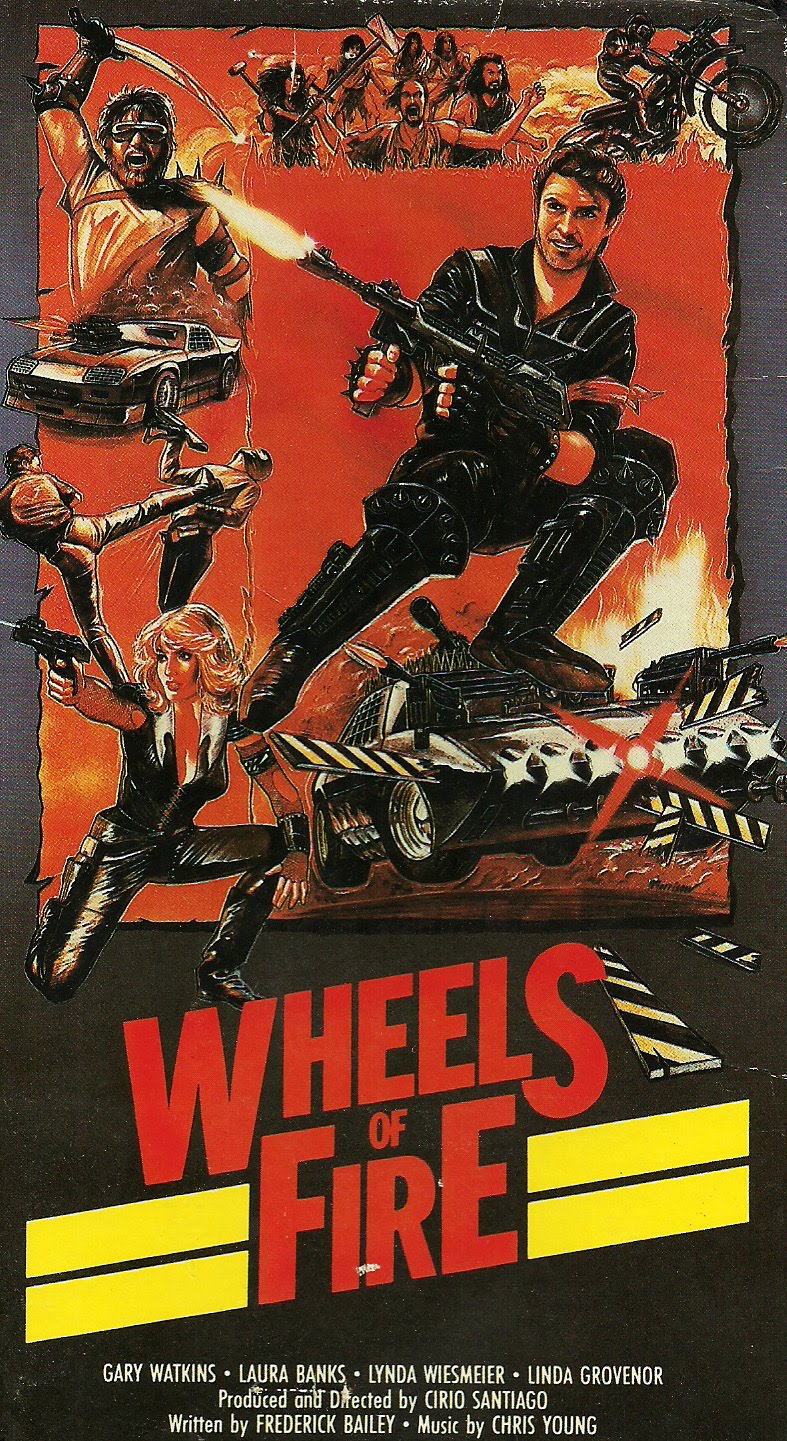
WHEELS OF FIRE (US/Philippines - 1985) Directed by Cirio H. Santiago. Written by Frederick Bailey. Cast: Gary Watkins, Laura Banks, Lynda Wiesmeier, Linda Grovenor, Joseph Anderson (Joe Mari Avellana), Joseph Zucchero, Jack S. Daniels, Steve Parvin, Dennis Cole, Henry Strzalkowski, Gary Taylor. (R, 81 mins)
Following 1983's STRYKER, Filipino exploitation legend Cirio H. Santiago went back for a few more laps around the same rock quarry for some more post-nuke ROAD WARRIOR ripoffs, starting with 1985's WHEELS OF FIRE, which is about as no-bullshit as drive-in actioners get. Santiago and screenwriter Frederick Bailey obviously know what you're here for and keep the plot as simple as it can be. In a post-apocalyptic wasteland, nomadic Trace (Gary Watkins) ends up rescuing his sister Arlie's (July 1982 Playmate of the Month Lynda Wiesmeier) dirtbag boyfriend Bo (Steve Parvin) from a death match against a post-nuke Robert Goulet lookalike. From then on, it's pretty much one long chase sequence, with the army of evil despot Scourge (second-unit director Joe Mari Avellana, credited as "Joseph Anderson," a last-minute replacement for Fear leader Lee Ving, who abruptly checked out of his Manila hotel room several hours after arriving and went to Tokyo without telling anyone) relentlessly pursuing Trace in one car and Arlie and the incredibly ungrateful Bo in the other. Arlie is eventually abducted by Scourge's creeps and repeatedly raped, while Trace hooks up with bounty hunter Stinger (Laura Banks) and psychic Spike (Linda Grovenor, Robby Benson's love interest in 1980's DIE LAUGHING) as he attempts to rescue his sister and wipe out Scourge's gang.
Except for one Trace-Stinger sex scene that's shot like the cover of a shitty romance novel, WHEELS OF FIRE is virtually non-stop action from start to finish. It's got more explosions than an Antonio Margheriti flick, constant car chases, countless shots of guys from Scourge's gang engulfed in flames, an out-of-nowhere appearance by a bunch of albino cavemen, and other instances of some truly hair-raising and clearly dangerous stunt work. With no plot to get in the way of the mayhem, WHEELS OF FIRE stands as one of the very best of the low-budget ROAD WARRIOR clones, and Code Red's new Blu-ray (available exclusively through Screen Archives as part of the "Roger Corman Post-Nuke Collection") is as good as it's ever looked. There's short interview segments with Corman, Bailey, and second-unit director Clark Henderson. Among the interesting tidbits is that one Filipino stuntman spent more than a week in the hospital after a stunt gone awry, and Henderson recounting when the crew discovered that Wiesmeier was such a natural behind the wheel that she was allowed to do her own driving, upstaging all of the professional Filipino stunt drivers in the process. WHEELS OF FIRE was the only big-screen lead for Watkins, who was known around Hollywood less for his acting chops and more for being John Belushi's coke dealer. He also had a supporting role in the previous year's JOHNNY DANGEROUSLY and a very small handful of TV and movie gigs after, with IMDb showing nothing after 1998.
EQUALIZER 2000 (US/Philippines - 1987)
Directed by Cirio H. Santiago. Written by Frederick Bailey. Cast: Richard Norton, Corinne Wahl, William Steis, Robert Patrick, Frederick Bailey, Rex Cutter, Warren McLean, Peter Shilton, Vic Diaz, Ramon D'Salva, Henry Strzalkowski, Bobbie Greenwood, Nick Nicholson, Eric Hahn. (R, 88 mins)
Despite some attempts at interjecting some story elements that only serve to slow it down, EQUALIZER 2000 follows the same template as WHEELS OF FIRE, right down to a mid-film appearance by an out-of-nowhere group of post-nuke freaks, in this case, a crew of ululating buffoons who look like Manila's most hopeless faction of the KISS Army. Set in northern Alaska 100 years after the nuclear holocaust has rendered it a scorched-earth wasteland, EQUALIZER 2000 centers on nomadic warrior Slade (Richard Norton) taking on The Ownership, a fanatical militia group that's hoarding water and supplies (just like in STRYKER) and generally making life even more miserable for everyone. When Slade makes off with The Equalizer, a high-tech (at least by Santiago's standards) automatic weapon that also functions as a high-powered bazooka (it's sort-of like a gun nut's version of a Cheap Trick five-necked guitar), psychotic Ownership commander Lawton (William Steis) leads the inevitable pursuit on the way to a solid 30 minutes of gunfire and explosions to cap off the film.
EQUALIZER 2000 is fun, but it's not quite as good as WHEELS OF FIRE. Norton could be a little more engaging, while Steis does a pretty good job as the chief villain. Female lead Corinne Wahl, married to actor Ken Wahl at the time, is better known as Corinne Alphen, 1982 Penthouse Pet of the Year. She plays a character similar to WHEELS' Stinger, and she and Slade get their obligatory tame sex scene. While the usual Santiago and Filipino exploitation regulars appear--Vic Diaz, Henry Strzalkowski, Nick Nicholson, Eric Hahn--the film's most interesting bit of casting is then-rookie Robert Patrick as a secondary bad guy. Patrick was just starting out and knew someone who worked at Roger Corman's office. According to Clark Henderson on the WHEELS Blu-ray, Patrick came in to read for another Corman production (WARLORDS FROM HELL) and it was instantly clear to them that he was a better actor than everyone else in the room. Patrick gained his earliest experience being farmed out by Corman to Santiago, who took an instant liking to the young actor and cast him in both Corman productions (EQUALIZER 2000 and 1987's EYE OF THE EAGLE) and his own solo joints (1986's FUTURE HUNTERS, 1988's BEHIND ENEMY LINES). Patrick also met his wife Barbara, then going by Barbara Hooper, another American on loan to Santiago (they worked together on Santiago's BEHIND ENEMY LINES), and they eventually headed back to Hollywood when he landed a small role in DIE HARD 2 (1990) before his breakthrough as the T-1000 in TERMINATOR 2: JUDGMENT DAY (1991).
THE SISTERHOOD (US/Philippines - 1988) Directed by Cirio H. Santiago. Written by Thomas McKelvey Cleaver. Cast: Rebecca Holden, Chuck Wagner, Lynn-Holly Johnson, Barbara Hooper, Robert Dryer, Henry Strzalkowski, David Light, Jim Moss, Anthony East, Tom McNeeley, Warren MacLean, Peter Shilton. (R, 92 mins)
WHEELS OF FIRE and EQUALIZER 2000 were not big-budget productions but they were professionally-constructed and made with flair and style, putting forth the effort to make it look good in spite of what little money they had. THE SISTERHOOD, on the other hand, shows some concrete evidence of Corman and Santiago beginning to cut corners. Oddly, of the three initial entries in Code Red's Corman Post-Nuke collection, THE SISTERHOOD has the most plot, but the film is so unbelievably cheap, badly-written, poorly-acted, and straight-up dull that it's easily the least of the trio. Still, it's not without its bad movie charms, set in 2021, several years after "The Final War," as the world is once again a desolate wasteland represented by the same stretch of Filipino desert seen in STRYKER, WHEELS, and EQUALIZER. It's a world dominated by men, where women have been relegated to a commodity, but a group of female warriors called The Sisterhood roams "The Outlands," fulfilling their mission to protect the disenfranchised and the marginalized, and rebel against the brutal patriarchal society. There's some potentially interesting ideas in Thomas McKelvey Cleaver's script, but Santiago is just content to break the same old post-nuke junkers out of storage and drive them around the desert while Jun Latonio's terrible synth score squonks endlessly, sounding like random notes farting out of a defective Casio. Branded as witches by the despotic male rulers, The Sisterhood is led by Alee (KNIGHT RIDER's Rebecca Holden), who teams up with Marya (champion figure skater Lynn-Holly Johnson, a long way from ICE CASTLES and FOR YOUR EYES ONLY), who has a strange psychic connection to a falcon, to rescue captured Sister Vera (Barbara Hooper), who's been abducted by Mikal (AMERICA 3000's Chuck Wagner) for leverage with the post-nuke overlords. Or something to that effect.
Santiago's post-nuke formula is here, right down to the mid-film appearance of a crew of freaks, in this case a bunch of robed mutants chasing Alee and Marya through a "radiation zone." A gust of wind causes the hoods to blow off a couple of the mutants, revealing them to be some normal-looking extras just making idiotic grunting noises. Performances are terrible across the board, though Wagner at least seems to realize he's in a shitty movie and tries to enjoy himself with some vaguely Shatnerian over-emoting (one interesting thing about Wagner that probably helps in his current career in touring Broadway productions is that his actual speaking voice sounds like a dubbed bellowing voice in a 1960s HERCULES movie). SAVAGE STREETS villain Robert Dryer overacts shamelessly as the fey, sneering Lord Barak, a sort-of post-nuke Billy Idol. A strange mix of sword & sorcery, post-nuke, and the supernatural (Alee has telepathic abilities and can shoot lasers from her eyes, but Santiago seems to forget about it until the end of the movie), THE SISTERHOOD is one of the most obscure titles from Corman's Concorde era and isn't nearly as fun as it should be. It's strongly indicative of the difference between '70s Corman and '80s Corman: a '70s Corman production (think of his women-in-prison titles like THE BIG DOLL HOUSE and CAGED HEAT) would've done something with the potential social commentary inherent in the concept. It's also a real slog at an interminable 92 minutes, which is epic by 1988 Corman standards. The Blu-ray contains the overseas version, where the US theatrical and VHS cut ran 75 minutes--the absolute last thing THE SISTERHOOD needs is 17 minutes of additional footage. It may be good for some laughs (watch the sloppy closing credits, where the cast listing changes format midway through), but is really only for die-hard Santiago completists and the most fanatical Henry Strzalkowski stalkers.
KILL THE MESSENGER (US - 2014) Directed by Michael Cuesta. Written by Peter Landesman. Cast: Jeremy Renner, Rosemarie DeWitt, Andy Garcia, Ray Liotta, Tim Blake Nelson, Barry Pepper, Oliver Platt, Michael Sheen, Paz Vega, Michael Kenneth Williams, Mary Elizabeth Winstead, Robert Patrick, Richard Schiff, Gil Bellows, Yul Vazquez, Lucas Hedges, Dan Futterman, Josh Close, Steve Coulter, Susan Walters, Clay Kraski. (R, 112 mins)
Though it has some flaws in its execution, particularly in its second half, it's a shame that the compelling KILL THE MESSENGER isn't finding an audience. That Focus only has it on 425 screens nationally isn't helping, but it's also indicative of the fact that smart films for adult audiences--films that used to be commonplace--are now largely relegated to art houses and limited/VOD releases. With just a $5 million budget and a sizable cast of well-known faces taking a pay cut to be onboard, KILL THE MESSENGER is obviously a project that the actors believed in and it'll find an audience eventually, but with its incendiary subject matter and a riveting performance by Jeremy Renner, it should be getting more attention than it's received thus far. Based on Gary Webb's 1998 book Dark Alliance and Nick Schou's 2006 book Kill the Messenger, the film tells the story of Webb (Renner), a small-time San Jose Mercury News reporter who stumbled onto a story that blew the doors off the CIA's involvement in cocaine trafficking and the crack epidemic in South Central L.A. that helped fund Contra rebels in Nicaragua in the 1980s.
KILL THE MESSENGER opens in 1996 with Webb following the money in the trial of drug dealer Danilo Blandon (Yul Vazquez) and sticking his nose into the story to the point where the irate prosecutor (Barry Pepper) drops the charges. Webb figures out that Blandon is both a drug dealer and a paid CIA informant who needs to be operational in order to supply the agency with the information it needs. Acting on a tip from incarcerated drug runner Ricky Ross (Michael Kenneth Williams), Webb's detective work leads him to Nicaragua where imprisoned cartel boss Norwin Meneses (Andy Garcia) informs him of the CIA's involvement in the drug trade to fund the Contra rebels a decade earlier, which was the government's only way to secretly pay for a war that Congress wouldn't approve for President Reagan. As Webb's investigation deepens and ominous government officials strongly encourage him to back down, it only fuels the fire and when the story runs, Webb is the toast of the journalism world, much to the delight of his editors (Oliver Platt, Mary Elizabeth Winstead). His triumph is short-lived, however, as he soon realizes he's being followed, he spots a prowler in his driveway, and finds silent, sinister men in suits in his basement, rifling through his files. The CIA and other news outlets begin a smear campaign to discredit him, digging into everything in his past, including an affair he had while working at the Cleveland Plain Dealer, which led to Webb moving his wife Susan (Rosemarie DeWitt) and kids to California to start over.
For its first hour or so, KILL THE MESSENGER is cut from the same cloth as ALL THE PRESIDENT'S MEN (1976), SHATTERED GLASS (2003), and the Robert Graysmith investigative portions of ZODIAC (2007), the kind of newsroom nailbiter where the tension is cranked up and every conversation is an edge-of-your-seat thriller. Director Michael Cuesta (L.I.E.) and screenwriter Peter Landesman (the little-seen Kevin Kline drama TRADE) have studied the classics and the film is propelled by an excellent Renner, in maybe his best performance yet. But once Webb's bombshell of a story is published, the filmmakers keep the focus strictly on Webb, despite the explosive implications of the bigger picture. On one hand, I get that he's the central character and everyone--from his previously-adoring editors to jealous competitors to shady CIA operatives--is trying to throw him under the bus, but other than a Los Angeles Times editor (Dan Futterman) chewing out his staff for missing the boat on the story, we never get a grasp of just how much Webb's story has shaken things up. All we see is the effect on his job (he's busted down to the Cupertino office, which seems to be located in a strip mall) and the soap-opera subplots for his family, with his adoring teenage son (Lucas Hedges) sobbing "I'm disappointed in you," when he learns of the affair, and Webb telling his wife "I never stopped loving you" when they reunite after Cupertino. Though Webb's story should be told, the KILL THE MESSENGER story is bigger than just Gary Webb. Cuesta and Landesman (and probably Renner, for that matter) seem conflicted over lauding and paying tribute to Webb while trying to do the right thing and show him as a flawed human being. They wisely avoid the pitfall of devolving into grandstanding pontification and canonizing the protagonist (can you imagine if Oliver Stone directed this?). Webb has cheated on his wife and been forgiven, though Susan lets him know that she hasn't forgotten. His CIA/Contra story, while completely true and enough to have the top levels of the US government in a panic, isn't air-tight as far as sources go. If anything, KILL THE MESSENGER probably needed to be a longer film in order to include all facets of the story and not make the second half feel glossed-over and scaled-down, and the detours into Webb's personal life flow more smoothly.
Gary Webb (1955-2004)
Though Renner is front and center, he and the film get solid support from the fine ensemble, many of whom only have one scene but make it count. Garcia is terrific as Meneses (when he mentions an "Ollie," Webb asks "Ollie? You mean Oliver North?" Meneses: "No, Oliver Hardy. Yes, Oliver North!"), Michael Sheen has a marvelous bit as a weary and disillusioned congressman who knows the story needs to be told but warns Webb that it will only ruin him ("They won't address the story...they'll just attack you"), and Ray Liotta has an odd scene that doesn't really go anywhere but allows him to serve as this film's Donald Sutherland-in-JFK. Until its midpoint, KILL THE MESSENGER is thoroughly engrossing, suspenseful filmmaking but it doesn't really follow through on its potential. Imagine ALL THE PRESIDENT'S MEN if it paused the Watergate digging and cut down the scenes with Jason Robards, Jack Warden, and Martin Balsam to introduce subplots about Woodward's and Bernstein's personal lives. That's not to say it isn't worthwhile--it's a very good film that, for a while, flirts with being almost great. Though the focus shifts to Webb the man, it doesn't follow him all the way to his tragic end as the CIA released a 400-page report later in 1998, admitting its complicity and completely vindicating Webb, though that story received almost no coverage because the media was focused on the Bill Clinton/Monica Lewinsky scandal. In December 2004, Webb was found in his apartment with two bullet wounds in his head. His death was ruled a suicide.