FUTURE HUNTERS (US/Philippines - 1986; US release 1989) Directed by Cirio H. Santiago. Written by J.L. Thompson. Cast: Robert Patrick, Linda Carol, Richard Norton, Ed Crick, Bob Schott, David Light, Paul Holmes, Peter Silton, Ursula Marquez, Elizabeth Oropesa, Bruce Le, Wang Chang Lee. (Unrated, 100 mins) While Filipino exploitation auteur Cirio H. Santiago is best known for his association with Roger Corman from the 1970s until his death in 2008, he frequently branched out and worked on his own. Some of the better-known non-Corman Santiago films include THE MUTHERS (1976), VAMPIRE HOOKERS (1978), DEATH FORCE, aka FIGHTING MAD (1978), and FINAL MISSION (1984). Perhaps the craziest Santiago joint away from Corman is 1986's FUTURE HUNTERS, where the filmmaker basically goes for broke, throwing every big Hollywood action/adventure genre from the period into one ambitious mash-up before anyone knew what a genre mash-up was. Perhaps more than anything, FUTURE HUNTERS is Santiago trying to make his own version of a Cannon/Golan-Globus production. Its dumb plot and nearly nonstop action could've worked for any Chuck Norris or Michael Dudikoff adventure outing; its rousing score by Ron Jones (who went on to write music for FAMILY GUY), divides its time between mimicking cues from Jerry Goldsmith's KING SOLOMON'S MINES score and something more synth and drum machine-based that does its best to invoke Gary Chang or Jay Chattaway; and its 100-minute running time matches the typical Cannon genre production to the minute. Alas, without a bottom-line guy like Corman to oversee things, Santiago indulges himself a bit too much. Even with a jam-packed plot and a shitload of action, FUTURE HUNTERS somehow manages to drag a bit. A lot of this is due to Santiago letting shots run longer than necessary and not trimming the fat elsewhere. In his quest to showcase every action subgenre he could in a single movie, Santiago somehow lets the pace slack. Had this been done under the Concorde banner instead of Vestron offshoot Lightning Pictures, Corman would've had this thing down to 80 minutes and it would've been perfect. As it is, it's stupidly entertaining in all the right ways, but it really could stand to lose 15 or 20 minutes.
Opening in the year 2025, 40 years after "The Holocaust" turned the world into a post-nuke wasteland, marauding, Mad Max-like hero Matthew (Richard Norton) is the last survivor of a group of renegade warriors who have ventured into the Forbidden Zone to find the head of the Spear of Longinus. The Holy Lance, which pierced the body of Christ on the cross, holds within it the power of creation, and with that the ability to turn back time. Matthew hopes to retrieve it and go back 40 years to prevent the Holocaust, with Wez-esque despotic madman Zaar (David Light) in pursuit. Matthew is transported back to 1986 but is badly wounded right beforehand. Before he dies, he hands off the spearhead to vacationing couple Michelle (Linda Carol) and Slade (a debuting Robert Patrick). So begins an adventure through every genre that pops into the heads of Santiago and screenwriter J.L. Thompson (probably a pseudonym for someone, and erroneously listed as veteran director J. Lee Thompson on IMDb). FUTURE HUNTERS is primarily a RAIDERS OF THE LOST ARK ripoff with the globe-trotting search for an ancient artifact, as Michelle and an incredulous Slade attempt to find the actual Spear of Longinus in order to reattach the spearhead and thus, prevent the approaching nuclear holocaust. But it dabbles in Santiago's familiar post-nuke wheelhouse before Norton's Matthew is killed off shortly after the prologue. Then the RAIDERS plot kicks in, then they're off to Asia where Slade meets an old buddy Liu (kung-fu second-stringer Bruce Le) and it becomes a Shaolin martial arts movie for ten minutes as Liu has an extended fight scene with powerful Silverfox (Wang Chang Lee, aka Jang Lee Hwang). Then it's back to RAIDERS as Slade and Michelle are confronted by Bauer (Bob Schott of GYMKATA), the chief henchman of modern-day Nazi Fielding (Ed Crick) who wants the spear in his quest to bring about a new Nazi uprising. Before long, they're a lost in the jungle for a brief segue into ROMANCING THE STONE before they encounter a dwarf tribe played by the same group of little people who play similar roles in all of Santiago's post-nukes, only this time it's a blatant riff on the RETURN OF THE JEDI Ewoks, That detour sends them to a group of Amazon warrior women, one of whom Michelle must battle over a crocodile pit in order to obtain the spear, attach the head, and save the world.
For such a wild plot, FUTURE HUNTERS could have some more spring in its step. Santiago pads a lot of the running time with overlong establishing shots and hanging on to some shots much longer than needed. Still, watching him rip off every '80s blockbuster in sight (you can even say there's some BACK TO THE FUTURE in Matthew's story) is ambitious and pretty ballsy on such a fairly low budget. Though the film was released in the Philippines in 1986, it didn't turn up in the US until its straight-to-video debut in 1989. Though he appeared in several films after, FUTURE HUNTERS marked Patrick's debut and he's a pretty engaging smartass hero, and he's clearly doing a lot of his own strenuous stunt work. Prior to making his impact in pop culture history with his role as the T-1000 in 1991's TERMINATOR 2: JUDGMENT DAY, Patrick got his start in Santiago's Filipino B-movies after he auditioned in L.A. for the Roger Corman production WARLORDS FROM HELL and, according to WARLORDS director Clark Henderson on the Blu-ray special features for Santiago's WHEELS OF FIRE, "it was obvious to all of us that he was a better actor than everyone else in the room." Corman farmed Patrick out to Santiago, who took an instant liking to the young actor and gave him the lead role in FUTURE HUNTERS, as well as his Vietnam actioner BEHIND ENEMY LINES (1988), along with supporting roles in other Philippines-shot, Santiago-directed Corman productions like EQUALIZER 2000 and EYE OF THE EAGLE (both 1987). Though he realizes the movies were junk, Patrick, who has never stopped working since FUTURE HUNTERS, has always looked back on his time with Corman and Santiago with appreciation, grateful for his first big break and for the experience, as well as for meeting his BEHIND ENEMY LINES co-star Barbara Hooper, another Corman ingenue loaned out to Santiago in the late '80s. They hit it off during during production of BEHIND ENEMY LINES and have been married since 1990.
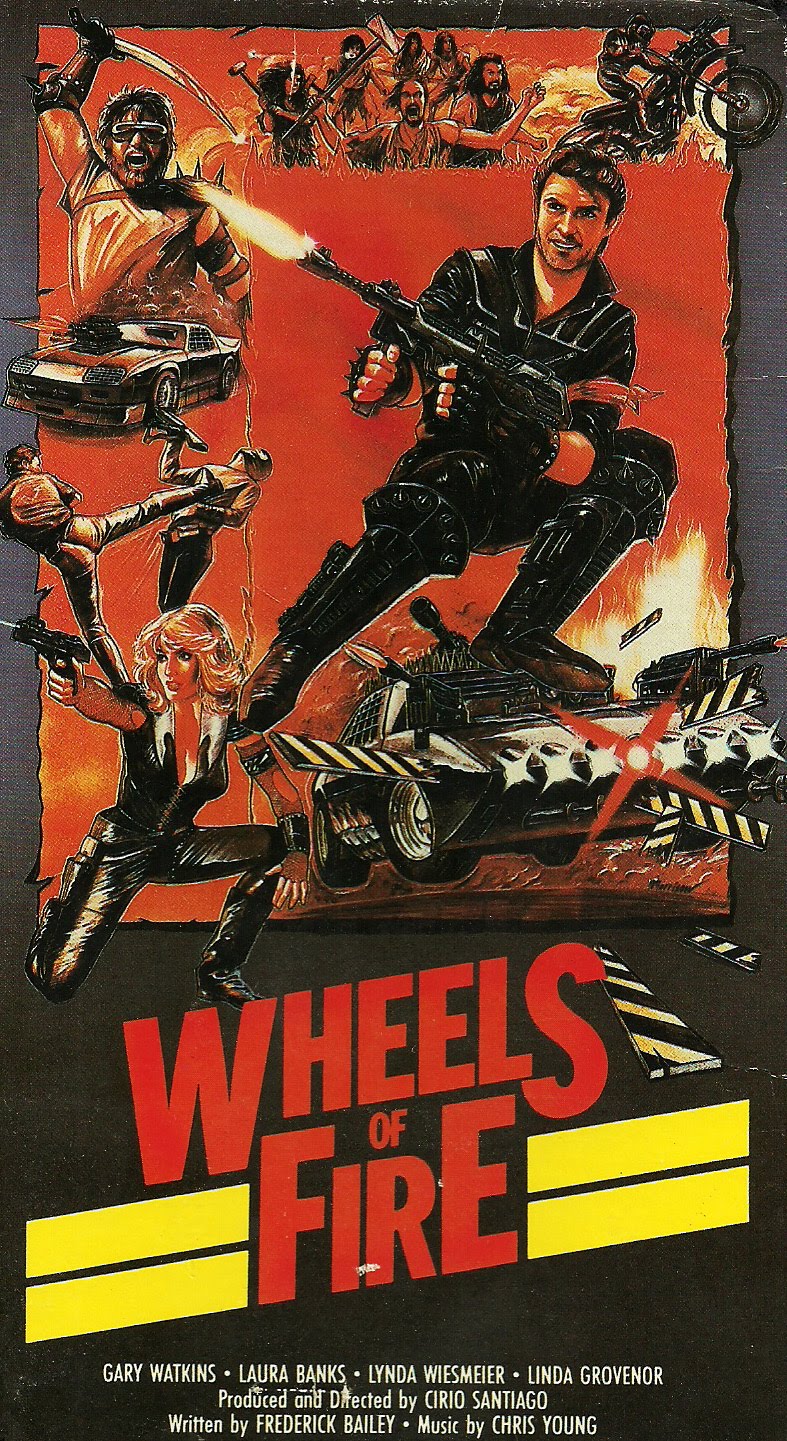
WHEELS OF FIRE (US/Philippines - 1985) Directed by Cirio H. Santiago. Written by Frederick Bailey. Cast: Gary Watkins, Laura Banks, Lynda Wiesmeier, Linda Grovenor, Joseph Anderson (Joe Mari Avellana), Joseph Zucchero, Jack S. Daniels, Steve Parvin, Dennis Cole, Henry Strzalkowski, Gary Taylor. (R, 81 mins)
Following 1983's STRYKER, Filipino exploitation legend Cirio H. Santiago went back for a few more laps around the same rock quarry for some more post-nuke ROAD WARRIOR ripoffs, starting with 1985's WHEELS OF FIRE, which is about as no-bullshit as drive-in actioners get. Santiago and screenwriter Frederick Bailey obviously know what you're here for and keep the plot as simple as it can be. In a post-apocalyptic wasteland, nomadic Trace (Gary Watkins) ends up rescuing his sister Arlie's (July 1982 Playmate of the Month Lynda Wiesmeier) dirtbag boyfriend Bo (Steve Parvin) from a death match against a post-nuke Robert Goulet lookalike. From then on, it's pretty much one long chase sequence, with the army of evil despot Scourge (second-unit director Joe Mari Avellana, credited as "Joseph Anderson," a last-minute replacement for Fear leader Lee Ving, who abruptly checked out of his Manila hotel room several hours after arriving and went to Tokyo without telling anyone) relentlessly pursuing Trace in one car and Arlie and the incredibly ungrateful Bo in the other. Arlie is eventually abducted by Scourge's creeps and repeatedly raped, while Trace hooks up with bounty hunter Stinger (Laura Banks) and psychic Spike (Linda Grovenor, Robby Benson's love interest in 1980's DIE LAUGHING) as he attempts to rescue his sister and wipe out Scourge's gang.
Except for one Trace-Stinger sex scene that's shot like the cover of a shitty romance novel, WHEELS OF FIRE is virtually non-stop action from start to finish. It's got more explosions than an Antonio Margheriti flick, constant car chases, countless shots of guys from Scourge's gang engulfed in flames, an out-of-nowhere appearance by a bunch of albino cavemen, and other instances of some truly hair-raising and clearly dangerous stunt work. With no plot to get in the way of the mayhem, WHEELS OF FIRE stands as one of the very best of the low-budget ROAD WARRIOR clones, and Code Red's new Blu-ray (available exclusively through Screen Archives as part of the "Roger Corman Post-Nuke Collection") is as good as it's ever looked. There's short interview segments with Corman, Bailey, and second-unit director Clark Henderson. Among the interesting tidbits is that one Filipino stuntman spent more than a week in the hospital after a stunt gone awry, and Henderson recounting when the crew discovered that Wiesmeier was such a natural behind the wheel that she was allowed to do her own driving, upstaging all of the professional Filipino stunt drivers in the process. WHEELS OF FIRE was the only big-screen lead for Watkins, who was known around Hollywood less for his acting chops and more for being John Belushi's coke dealer. He also had a supporting role in the previous year's JOHNNY DANGEROUSLY and a very small handful of TV and movie gigs after, with IMDb showing nothing after 1998.
EQUALIZER 2000 (US/Philippines - 1987)
Directed by Cirio H. Santiago. Written by Frederick Bailey. Cast: Richard Norton, Corinne Wahl, William Steis, Robert Patrick, Frederick Bailey, Rex Cutter, Warren McLean, Peter Shilton, Vic Diaz, Ramon D'Salva, Henry Strzalkowski, Bobbie Greenwood, Nick Nicholson, Eric Hahn. (R, 88 mins)
Despite some attempts at interjecting some story elements that only serve to slow it down, EQUALIZER 2000 follows the same template as WHEELS OF FIRE, right down to a mid-film appearance by an out-of-nowhere group of post-nuke freaks, in this case, a crew of ululating buffoons who look like Manila's most hopeless faction of the KISS Army. Set in northern Alaska 100 years after the nuclear holocaust has rendered it a scorched-earth wasteland, EQUALIZER 2000 centers on nomadic warrior Slade (Richard Norton) taking on The Ownership, a fanatical militia group that's hoarding water and supplies (just like in STRYKER) and generally making life even more miserable for everyone. When Slade makes off with The Equalizer, a high-tech (at least by Santiago's standards) automatic weapon that also functions as a high-powered bazooka (it's sort-of like a gun nut's version of a Cheap Trick five-necked guitar), psychotic Ownership commander Lawton (William Steis) leads the inevitable pursuit on the way to a solid 30 minutes of gunfire and explosions to cap off the film.
EQUALIZER 2000 is fun, but it's not quite as good as WHEELS OF FIRE. Norton could be a little more engaging, while Steis does a pretty good job as the chief villain. Female lead Corinne Wahl, married to actor Ken Wahl at the time, is better known as Corinne Alphen, 1982 Penthouse Pet of the Year. She plays a character similar to WHEELS' Stinger, and she and Slade get their obligatory tame sex scene. While the usual Santiago and Filipino exploitation regulars appear--Vic Diaz, Henry Strzalkowski, Nick Nicholson, Eric Hahn--the film's most interesting bit of casting is then-rookie Robert Patrick as a secondary bad guy. Patrick was just starting out and knew someone who worked at Roger Corman's office. According to Clark Henderson on the WHEELS Blu-ray, Patrick came in to read for another Corman production (WARLORDS FROM HELL) and it was instantly clear to them that he was a better actor than everyone else in the room. Patrick gained his earliest experience being farmed out by Corman to Santiago, who took an instant liking to the young actor and cast him in both Corman productions (EQUALIZER 2000 and 1987's EYE OF THE EAGLE) and his own solo joints (1986's FUTURE HUNTERS, 1988's BEHIND ENEMY LINES). Patrick also met his wife Barbara, then going by Barbara Hooper, another American on loan to Santiago (they worked together on Santiago's BEHIND ENEMY LINES), and they eventually headed back to Hollywood when he landed a small role in DIE HARD 2 (1990) before his breakthrough as the T-1000 in TERMINATOR 2: JUDGMENT DAY (1991).
THE SISTERHOOD (US/Philippines - 1988) Directed by Cirio H. Santiago. Written by Thomas McKelvey Cleaver. Cast: Rebecca Holden, Chuck Wagner, Lynn-Holly Johnson, Barbara Hooper, Robert Dryer, Henry Strzalkowski, David Light, Jim Moss, Anthony East, Tom McNeeley, Warren MacLean, Peter Shilton. (R, 92 mins)
WHEELS OF FIRE and EQUALIZER 2000 were not big-budget productions but they were professionally-constructed and made with flair and style, putting forth the effort to make it look good in spite of what little money they had. THE SISTERHOOD, on the other hand, shows some concrete evidence of Corman and Santiago beginning to cut corners. Oddly, of the three initial entries in Code Red's Corman Post-Nuke collection, THE SISTERHOOD has the most plot, but the film is so unbelievably cheap, badly-written, poorly-acted, and straight-up dull that it's easily the least of the trio. Still, it's not without its bad movie charms, set in 2021, several years after "The Final War," as the world is once again a desolate wasteland represented by the same stretch of Filipino desert seen in STRYKER, WHEELS, and EQUALIZER. It's a world dominated by men, where women have been relegated to a commodity, but a group of female warriors called The Sisterhood roams "The Outlands," fulfilling their mission to protect the disenfranchised and the marginalized, and rebel against the brutal patriarchal society. There's some potentially interesting ideas in Thomas McKelvey Cleaver's script, but Santiago is just content to break the same old post-nuke junkers out of storage and drive them around the desert while Jun Latonio's terrible synth score squonks endlessly, sounding like random notes farting out of a defective Casio. Branded as witches by the despotic male rulers, The Sisterhood is led by Alee (KNIGHT RIDER's Rebecca Holden), who teams up with Marya (champion figure skater Lynn-Holly Johnson, a long way from ICE CASTLES and FOR YOUR EYES ONLY), who has a strange psychic connection to a falcon, to rescue captured Sister Vera (Barbara Hooper), who's been abducted by Mikal (AMERICA 3000's Chuck Wagner) for leverage with the post-nuke overlords. Or something to that effect.
Santiago's post-nuke formula is here, right down to the mid-film appearance of a crew of freaks, in this case a bunch of robed mutants chasing Alee and Marya through a "radiation zone." A gust of wind causes the hoods to blow off a couple of the mutants, revealing them to be some normal-looking extras just making idiotic grunting noises. Performances are terrible across the board, though Wagner at least seems to realize he's in a shitty movie and tries to enjoy himself with some vaguely Shatnerian over-emoting (one interesting thing about Wagner that probably helps in his current career in touring Broadway productions is that his actual speaking voice sounds like a dubbed bellowing voice in a 1960s HERCULES movie). SAVAGE STREETS villain Robert Dryer overacts shamelessly as the fey, sneering Lord Barak, a sort-of post-nuke Billy Idol. A strange mix of sword & sorcery, post-nuke, and the supernatural (Alee has telepathic abilities and can shoot lasers from her eyes, but Santiago seems to forget about it until the end of the movie), THE SISTERHOOD is one of the most obscure titles from Corman's Concorde era and isn't nearly as fun as it should be. It's strongly indicative of the difference between '70s Corman and '80s Corman: a '70s Corman production (think of his women-in-prison titles like THE BIG DOLL HOUSE and CAGED HEAT) would've done something with the potential social commentary inherent in the concept. It's also a real slog at an interminable 92 minutes, which is epic by 1988 Corman standards. The Blu-ray contains the overseas version, where the US theatrical and VHS cut ran 75 minutes--the absolute last thing THE SISTERHOOD needs is 17 minutes of additional footage. It may be good for some laughs (watch the sloppy closing credits, where the cast listing changes format midway through), but is really only for die-hard Santiago completists and the most fanatical Henry Strzalkowski stalkers.
Directed by Robert Clouse. Written by Charles Robert Carner. Cast: Kurt Thomas, Tetchie Agbayani, Richard Norton, Edward Bell, John Barrett, Conan Lee, Bob Schott, Buck Kartalian, Eric Lawson, Sonny Barnes, Tadashi Yamashita. (R, 90 mins)
Boasting a premise so ridiculous and doomed to fail that it could almost be made an honorary Cannon film, GYMKATA was an attempt by director Robert Clouse and producer Fred Weintraub to replicate the success they enjoyed with 1973's ENTER THE DRAGON. Beginning with that influential classic, the pair teamed on ten films from 1973 to 1991, and 1985's GYMKATA is probably their most ludicrous. Instead of the late Bruce Lee, they had champion gymnast Kurt Thomas, who was deemed a lock for the gold medal had the US not boycotted the 1980 Olympics. In his day, he was the top name in men's gymnastics, with two legendary moves--the Thomas Salto and the Thomas Flair, both displayed in GYMKATA--named after him. By 1985, Thomas was retired from competition and tried to break into movies. He never made another one after GYMKATA.
Thomas plays Jonathan Cabot, a champion gymnast (duh) sent by the US government to the fictional Middle East mountain nation of Parmistan, where the US military wants to set up a satellite station. In order to infiltrate Parmistan, Cabot must be a participant in The Game, a to-the-death obstacle course through the country's dangerous terrain, and it's a tournament that no outsider has survived in over 900 years. The Game is personal to Cabot: his secret agent father (Eric Lawson) was killed playing it. Cabot also falls in love with Princess Rubali (Tetchie Agbayani), daughter of Parmistan leader The Kahn (Buck Kartalian), who's already promised his daughter to his treacherious chief aide and Game overseer Zamir (Richard Norton), who's amassed his own ninja army to kill the Game participants and overthrow The Kahn.
GYMKATA follows the "to the death" tournament template established by ENTER THE DRAGON that would continue to be used in countless martial arts films for years to come, most notably 1988's BLOODSPORT. Other than the gymnastics angle (the one-sheet's tag line boasted "A new kind of martial arts combat! The skill of gymnastics. The kill of karate"), GYMKATA plays pretty much like a typical mid-1980s ninja movie...at least until a little past the one hour mark, when Cabot makes his way to the most dangerous part of The Game: The Village of the Crazies, an isolated part of Parmistan where the country's insane have been dumped for generations. Once Cabot enters the village, the film goes into a completely unexpected direction. I can't decide if it's the silliest set piece in all of martial arts cinema or something that could work as a brilliant stand-alone short horror film. It makes as much sense out of context as in, so what the hell? Here it is, and if you're watching it MST3K-style, be sure to yell "Vic Tayback, no!" at 4:38 into the clip
Once you get over the fact that the Village of the Crazies' town square conveniently has a rock-cut pommel horse should someone like Kurt Thomas ever pass through, there's a lot to appreciate in that extended sequence. It belongs in another movie altogether and almost plays like something in a weird Eurotrash or Jess Franco fever dream: the fog, the noises the villagers make and the way they shamble about like zombies, the eerie and deliberately off-putting music, the two creepy-as-shit guys from 6:15-7:00. It's easy to laugh once Cabot hops on the pommel horse and starts Thomas Flair-ing the whole village. But up to then? Sentence me to the Village of the Crazies, but it's a brilliant sequence. Doesn't belong in GYMKATA, but brilliant nonetheless.
"You stay classy, Parmistan!"
But the other 77 or so minutes of GYMKATA are mostly of the so-bad-it's-funny variety. Thomas can't act; Cabot's training montage gets us dangerously close to a Thomas taint shot as he handstand-walks up some stairs; there's a near-record number of hilarious dummy deaths and people suddenly being silenced by arrows; Thorg, a hulking, homicidal Game participant played by Bob Schott, looks like a roid-raging Will Ferrell; and The Kahn, played by Kartalian with a bushy moustache and a hilarious combover, seems less like the leader of a Middle Eastern nation and more like a rejected Sid Caesar character. If GYMKATA is ever remade as an intentional comedy in the next few years, not only does Ferrell have to play Thorg, but Mel Brooks must play The Kahn.
Robert Clouse with Bruce Lee on
the set of ENTER THE DRAGON
Clouse (1928-1997) was a journeyman director who didn't really set out to specialize in martial arts movies but they kept getting offered to him and he was good at making them. If he was adept at filming well-choreographed fight scenes, it could be that he focused more on the visual aspects of his films for one important reason: he was completely deaf for much of his career, relying on production assistants to monitor the line readings of the actors. After gaining notoriety as a still photographer and directing two Oscar-nominated short subjects in the early 1960s, Clouse was 42 when he made his feature debut with the Rod Taylor vehicle DARKER THAN AMBER (1970), which got good reviews but wasn't a big box office success. It did feature an epic fight between Taylor and William Smith that demonstrated Clouse's innate talent for such sequences. Clouse followed his debut later the same year with the obscure romantic drama DREAMS OF GLASS, notable today only for featuring Danny De Vito in his film debut, buried in the credits as "Thug." Clouse then scripted the 1972 CBS TV-movie SOMETHING EVIL, directed by an up-and-coming Steven Spielberg, then fresh off the enormously popular ABC TV-movie DUEL, and when Clouse had his first box office smash three years later with ENTER THE DRAGON, he was obviously overshadowed by the star power of Bruce Lee, who died a week before the film's release. Having enjoyed the massive worldwide success of their first project together, Clouse and Weintraub reteamed with DRAGON co-star Jim Kelly for 1974's BLACK BELT JONES, which became a major blaxploitation hit. Kelly co-starred with Joe Don Baker in GOLDEN NEEDLES, another Clouse film from 1974, and Clouse would work with Baker again on the 1977 wild-dogs-on-the-rampage horror film THE PACK. After the 1975 Yul Brynner post-nuke prototype THE ULTIMATE WARRIOR and the 1977 Robert Mitchum thriller THE AMSTERDAM KILL, Clouse, without Weintraub, would complete the shelved project Lee was working on at the time of his death, which would become 1979's dubious GAME OF DEATH, precariously held together by ten minutes of footage Lee directed in 1973. Clouse constructed a plot around the salvageable Lee material that he had and used unconvincing doubles, superimpositions, and clumsily-integrated stock footage to complete what was billed as Lee's "final" film. GAME OF DEATH isn't very good and features perhaps cinema's least convincing double-for-a-long-dead-star since Ed Wood's PLAN 9 FROM OUTER SPACE (1959), released three years after star Bela Lugosi's death, with Wood's chiropractor walking around with a cape over his face pretending to be Lugosi. Nevertheless, Lee's climactic showdown with Kareem Abdul-Jabbar (shot by Lee in 1973) is one for the ages. Clouse made a couple of live-action made-for-TV Disney movies (1979's THE LONDON CONNECTION and 1980's THE KIDS WHO KNEW TOO MUCH) before he and Weintraub gave American audiences their first mainstream exposure to Jackie Chan in 1980's THE BIG BRAWL. Clouse followed that with the martial-arts thriller FORCE: FIVE (1981) and DEADLY EYES (1983), one of several early '80s "monster rat" horror movies. By the time Clouse got to GYMKATA, he was clearly in coast mode. He only made three more films, all produced by Weintraub, all of them going straight-to-video: two Cynthia Rothrock actioners (1990's CHINA O'BRIEN and 1991's CHINA O'BRIEN II) and 1992's IRONHEART, starring BLOODSPORT bad guy Bolo Yeung, who also had a small role in ENTER THE DRAGON.
If Clouse liked an actor, he tried to keep working with them. He made three films with Jim Kelly, two with Joe Don Baker, and two with B-movie badass William Smith (who also appeared in THE ULTIMATE WARRIOR) but his favorite actor, based on recurrent appearances in Clouse films, was probably the Australian Norton, who first worked with Clouse on FORCE: FIVE and, starting with GYMKATA, would co-star in the director's final four films. Norton, who has a sort-of David Carradine-like presence in GYMKATA, choreographed the film's fight scenes and was a ubiquitous C-lister in many low-budget exploitation and straight-to-video flicks from the '80s to well into the 2000s. Now 63, he's still active in the business, mainly as a stunt and fight coordinator on big-budget films like THE AMAZING SPIDER-MAN and the upcoming MAD MAX: FURY ROAD.
These days, GYMKATA is rightfully viewed through mocking MST3K goggles, but it's hardly the worst of its type. It's just that no one was really asking for the skill of gymnastics and the kill of karate. Amazingly, the film was backed by a major studio (MGM/UA) and opened nationwide on May 3, 1985, landing in tenth place at the box office. Chuck Norris' cop thriller CODE OF SILENCE opened the same day and took the top spot, and it speaks volumes for GYMKATA's lack of appeal and the complete absence of Kurt Thomas star power that BEVERLY HILLS COP out-performed it by $300,000 in its 22nd week of release. Thomas quickly found a home in sports broadcasting and it's not known whether he was ever approached about participating in the film's 2007 DVD release, but I'd like to think he has a good sense of humor about it. GYMKATA may be a terrible movie, but it's a fun terrible movie, and I honestly can't praise the "Village of the Crazies" detour enough. All respect to Clouse for fashioning a mini-masterpiece of a sequence where you least expect it, proof positive (along with ENTER THE DRAGON's legendary final showdown) that his disability enhanced his effectiveness with the purely visual side of directing, and it's a side of him that we just didn't see enough. When people talk about the excellence of ENTER THE DRAGON and how it's the standard-bearer of commercial martial arts cinema, they talk about Bruce Lee, not Robert Clouse. Ultimately, Clouse will go down in the film history books as a solid B-movie director and there's no shame in that. But there may have been a genuine auteur lurking somewhere within him.