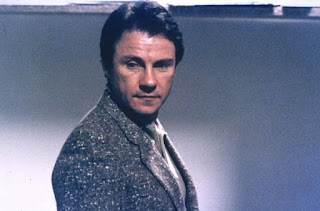
CORRUPT aka ORDER OF DEATH aka COPKILLER
(Italy - 1983; US release 1984) Directed by Roberto Faenza. Written by Ennio de Concini, Hugh Fleetwood and Roberto Faenza. Cast: Harvey Keitel, John Lydon, Nicole Garcia, Leonard Mann, Sylvia Sidney, Carla Romanelli. (R, 101 mins) You can't exactly say the psychological thriller CORRUPT has fallen into obscurity over the years, but it's a small miracle that it's now available in quality Blu-ray release in 2017. A staple on countless sketchy, public domain DVD sets and on YouTube for years, in crummy VHS quality transfers and often under different titles--the most dubious being CORRUPT LIEUTENANT in reference to another iconic role for star Harvey Keitel--with a myriad of truncated running times, CORRUPT was based on the 1977 novel The Order of Death by British writer Hugh Fleetwood, who co-wrote the script with director Roberto Faenza and veteran screenwriter Ennio de Concini (THE RED TENT, SALON KITTY, CHINA 9 LIBERTY 37). It was released in the UK in 1983 as ORDER OF DEATH, the rest of Europe that same year as COPKILLER, and in the US in 1984 as CORRUPT, by New Line Cinema, the B-movie and genre fare outfit that had been around for years but was about to have a breakout smash with Wes Craven's A NIGHTMARE ON ELM STREET. Code Red recently released CORRUPT--in its 101-minute US cut, a bit shorter than the 113-minute European version--on Blu-ray and it's the first time it's been in a watchable condition since the old Thorn/EMI VHS tape that was in every video store in America in the 1980s. The film has maintained a certain degree of cult notoriety for the last 30-plus years, thanks primarily to the presence of John Lydon--then the frontman for Public Image Ltd but still best known for his days as the Sex Pistols' Johnny Rotten--in the first of only three acting roles he's tackled over his career, and he more than holds his own against the powerhouse intensity of Keitel, with long stretches of the film focused on their two characters engaging in psychological warfare in the increasingly claustrophobic confines of a nearly empty luxury apartment. There were plans to take advantage of Lydon's day job: Public Image Ltd were set to do some music for the film, but the producers ultimately opted to go with a score by Ennio Morricone instead. Some of the material that Lydon and PiL recorded ended up on the band's 1984 album This is What You Want...This is What You Get, including "The Order of Death," which would've been great in CORRUPT but had to wait several years to find a cinematic home when it was prominently featured in Richard Stanley's 1990 cult classic HARDWARE, and more recently on the Syfy series MR. ROBOT.
NYPD narcotics Lt. Fred O'Connor (Keitel) has a full plate with a serial killer slashing the throats of corrupt cops in his division. He seeks escape and relaxation from the everyday grind by pretending he's a wealthy man named Stevens and lounging with fine cigars and a comfy robe and slippers at a nearly empty $400,000 apartment overlooking Central Park. Fred went 50/50 on it with his friend and colleague Bob Corvo (Leonard Mann)--a purchase funded by their sideline activities as drug dealing cops. Troubled by the deaths of several fellow officers, Corvo is feeling guilt over their off-duty criminal activities. Meanwhile, O'Connor realizes he's being followed by a stranger (Lydon) who shows up at the secret apartment and introduces himself as Fred Mason, confessing to the cop killer slayings and saying he's been following O'Connor for six months. O'Connor doesn't believe him, but frets because he knows about the apartment, so he reacts in a calm and rational way by boarding up the bathroom window and keeping Mason bound and handcuffed in the bathtub, periodically torturing him and giving him food in a dog dish. But Mason is really Leo Smith, a young man from an extremely wealthy Rhinecliff family who was raised by his grandmother (Sylvia Sidney) after his parents died. Leo, the kind of bored rich kid with too much time on his hands and too many toys who fills his bedroom with camcorders and TVs and makes videotapes of himself sleeping, has a history of confessing to crimes he didn't commit, ostensibly for attention but, as O'Connor finds out when he visits the grandmother after she files a missing persons report, because he's into S&M imagery and enjoys punishment. What follows are some often twisted and grueling cat-and-mouse head games, with O'Connor accidentally killing Corvo and trying to pin it on Leo, to Leo being set free by his captor but voluntarily returning to the secret apartment, turning the tables on his nemesis by insidiously taking over O'Connor's life and slowly wearing him down psychologically, methodically manipulating the dirty cop over his corruption and guilt to serve his own agenda that will become clear by the devastating finale.
UK poster under the film's original title.
CORRUPT is a strange film that, speaking in terms of pure plot synopsis, doesn't make much logical sense. Even the British ORDER OF DEATH trailer above doesn't seem to have any idea how to sell it. Of all the things that two corrupt cops could spend their money on, a secret apartment where they don't really do anything seems like a waste ("I looked at this as an investment," says Corvo after informing O'Connor that he wants to sell his share). Fleetwood's novel made overtures to O'Connor and Corvo being closeted gay lovers and that's subtly alluded to here, with O'Connor's seemingly disapproving reaction to Corvo shaving his beard (Nicole Garcia plays Corvo's wife Lenore, who rejected O'Connor's advances years earlier prior to her marriage) and that Corvo's excuse of the apartment as an "investment" seems like a lie he's repeatedly told himself until he believes it. Its "imprisonment and torture of a suspect" element prefigures Denis Villeneuve's PRISONERS by 30 years, but the Italian-made CORRUPT often demonstrates the logic and style of a giallo, which it may partially be classified as considering the throat-slashing nature of the cop killings along with Morricone's score, mainly a pulsating minimalist synth with asides that make it sound like a strange mix-tape hybrid of his entire career, from a spaghetti western banjo to some of his cacophonous early '70s free jazz freakouts (there's some BIRD WITH THE CRYSTAL PLUMAGE trumpet here) to a recurring piano cue (about 1:12 into this clip) that attentive viewers will spot from the Maestro's work on both Umberto Lenzi's ALMOST HUMAN (1974) and Brian De Palma's THE UNTOUCHABLES (1987). It can also be seen a more grounded, less surreal homage to PERFORMANCE, not just in the casting of a famous music personality but also in the way the protagonists (James Fox and Mick Jagger in PERFORMANCE) have dual identities and become distorted mirror images of one another as the film goes on. Even "cop killer" ends up with a reflecting flip side with "killer cop." It's also an effective, grimy NYC movie of the era done in the unique way that only Italians could, with some extensive location shooting for the exteriors (interiors were filmed at Cinecitta in Rome) and some vintage 42nd Street shots, including Keitel on a bus that passes the Lyric, then showing an incredible double bill of DOCTOR BUTCHER M.D. and SLITHIS, which would put CORRUPT's NYC shoot somewhere in the vicinity of May 1982. It's too bad Faenza didn't snag any footage of the Butchermobile cruising around.
But CORRUPT is really propelled by the performances of Keitel and Lydon, exact opposites in terms of approach and experience but making it work beautifully, almost like they're starring in the world's most dysfunctional, demented remake of THE ODD COUPLE. There's an undeniable nerve-wracking edginess to a lot of their scenes, the violence they inflict on one another looks convincingly real and they're deeply in the zone throughout. Watch one great bit where Keitel slams Lydon's face into a table, grabbing him by his hair and knocking over a glass of milk, breaking it with the milk splattering all over--it obviously wasn't planned and Keitel is visibly startled by the glass shattering, but neither actor breaks character. It's a "real" moment that Faenza wisely left in the finished film. Keitel brings a lot of his standard persona to the table, including the sense of guilt carried over by his MEAN STREETS character (as dishonest as O'Connor is, he still drinks milk and dutifully drops a quarter in the slot when he ends up on a bus chasing a suspect) along with the moral and ethical implosion that we'd see him play a decade later in Abel Ferrara's BAD LIEUTENANT (unfortunately, O'Connor never completely breaks down, depriving us of the unique Keitel Cry). Keitel gets a long monologue about corruption that would fit right into a Scorsese or Ferrara film. O'Connor is a total sadist in his treatment of Leo, whether he's feeding him out of a dog dish, threatening to burn him with a cigar, or stuffing his head into an oven.
And as played by a wild-eyed Lydon, Leo seems to welcome the mistreatment, even if it's all part of a ruse. The punk icon is a revelation here, and it's a shame he didn't pursue more acting roles. He's a perfect foil for Keitel, who's pure simmering rage waiting to boil over, while Lydon is more sarcastic and mocking, as Leo knows exactly what buttons to push, whether he's maniacally grinning at the idea of a cigar being put out on his cheek or taunting O'Connor with "You're falling to pieces" as he mic-drops what's left of a handheld radio that O'Connor just smashed in one of his numerous meltdowns. Faenza and the writers even pull a bait and switch on the audience, seeming to put the "cop killer" thread of the story on the backburner for much of the running time. All the while, the filmmakers slyly tighten the screws, as O'Connor's vast apartment becomes suffocatingly claustrophobic and Morricone's throbbing, repetitive synth score plays in a way that's pure Carpenterian in its droning, tension-escalating persistence. CORRUPT has been neglected for so long that it's easy to see why it's either completely forgotten or thoroughly despised by those who have only seen a really shitty presentation of it. While Code Red's Blu-ray represents the truncated American cut, it's unquestionably the best this film has looked since New Line released it 33 years ago (apparently just in NYC, as The New York Times' Janet Maslin appears to be the only major American critic who reviewed it at the time), and even for fans who are familiar with it, this is like seeing it for the first time. CORRUPT is a hard film to pin down--maybe think of it as what might happen if Sidney Lumet ever made a giallo--but it's endlessly fascinating, one of the great unknown films of the 1980s, and a must-see for fans of Lydon, as well as Keitel, who turns in one of his absolutely essential performances.
CORRUPT finally rescued from the indignity of
decades as a public domain title. You get what you pay for.
This looks legit, from the shot of Keitel from what may be be COP LAND to the flashy cars to "John Lyndon."
Totally legit.
That's a mid '90s Keitel and it's not even his left hand.
THE UNHOLY FOUR (Italy - 1970) Directed by E.B. Clucher (Enzo Barboni). Written by Mario di Nardo and Franco Rossetti. Cast: Leonard Mann, Woody Strode, Peter Martell (Pietro Martellanza), Luigi Montefiori, Evelyn Stewart (Ida Galli), Helmuth Schneider, Lucio Rosato, Alain Naya, Giuseppe Lauricella, Dino Strano, Andrew Ray (Andrea Aureli), Enzo Fiermonte, Luciano Rossi, Salvatore Billa, Romano Puppo. (Unrated, 94 mins) A spaghetti western mostly by virtue of being Italian, THE UNHOLY FOUR is a throwback of sorts and more in line with the psychological, character-driven 1950s westerns of Anthony Mann than with the more distinct 1960s spaghettis of the Sergios Leone and Corbucci. Even Riz Ortolani's score sounds like it came from an older Hollywood western, unlike the groundbreaking, iconic cues of Ennio Morricone. The film opens with a Dodge City asylum being set on fire as a distraction for an overnight bank robbery by a gang of miscreants led by Tom Udo (Lucio Rosato), the son of a wealthy landowner (Giuseppe Lauricella). Four inmates escape the burning jail: slow-witted, God-fearing strongman Woody (Woody Strode), intimidating card cheat Hondo (Luigi Montefiori, better known as "George Eastman"), loony Silver (Peter Martell), and Chuck Mool (Leonard Mann), an amnesiac with no idea who he is or why he's in the asylum until one of Udo's dying cohorts sees him and exclaims "Chuck Mool!" With his three unlikely compadres in tow, Chuck Mool (a name concocted by the English dub team--the Italian version was titled CIUKMULL, so everyone constantly refers to him as "Chuck Mool" on the English dub track) embarks on a quest to uncover the chain of events that led him to being locked up in Dodge City
But there's more to the story than the plight of Chuck Mool: the Udo family is fighting off an attempt to take over their land by John Caldwell (Helmuth Schneider), another rich asshole who's buying up everyone's property and wants the Udos out of the way. Caldwell believes Chuck Mool is his son, presumed dead in a fire three years earlier. Learning that Chuck Mool is alive and heading their way with three presumed-dangerous madmen, Old Man Udo devises a scheme to convince Chuck Mool that he's his father and that he's supposed to kill the Caldwells. Udo's daughter Sheila (Evelyn Stewart) isn't happy about the scam and tries to warn Chuck Mool after he arrives. Tensions escalate as Chuck Mool, Woody, Hondo, and Silver are forced to take on the duplicitous Udo family and a bunch of their hired killers (among them ubiquitous Eurocult stalwart Romano Puppo) and shoot their way out of town.
THE UNHOLY FOUR was the directing debut of veteran cinematographer Enzo Barboni, who shot Sergio Corbucci's influential 1966 classic DJANGO, as well as Corbucci's THE HELLBENDERS (1967) and American director Don Taylor's spaghetti western THE FIVE MAN ARMY (1970). Adopting the pseudonym "E.B. Clucher," Barboni (1922-2002) would go on to direct the enormously popular spaghetti western comedies THEY CALL ME TRINITY (1971) and TRINITY IS STILL MY NAME (1972), which led to international fame for stars Terence Hill and Bud Spencer. Barboni's experience as a cinematographer is put to excellent use in THE UNHOLY FOUR, with some expertly choreographed gunfight sequences and some--for the time--unusually fluid, almost Steadicam-like camera movements throughout the action scenes. For the most part, it doesn't really play like the more stylish and violent Leone westerns or the politically charged genre offerings from Corbucci, but rather like something out of the 1950s or early 1960s and more beholden to the Hollywood western. There's one wacky, comedic bar brawl that hints where Barboni's career would soon head with the TRINITY movies, but THE UNHOLY FOUR gets darker and more downbeat as it goes on, making Ortolani's incongruously upbeat music cues sound somewhat inappropriate. There's occasional flashes of genuine unpleasantness scattered throughout, none more shocking than the jaw-dropping moment when a leering, lip-smacking Tom Udo tells Sheila "You got a hell of a lot to offer...too bad we're brother and sister...I could show you what it's all about."
In just his second film, Mann, an American actor who spent the bulk of his career in Italy before retiring from movies in 1989 at the age of 42 (his few American gigs included 1981's NIGHT SCHOOL, 1987's FLOWERS IN THE ATTIC, and his final film to date, 1989's SILENT NIGHT, DEADLY NIGHT 3: BETTER WATCH OUT) to become a teacher and playwright under his real name Leonard Manzella, is good as the lost hero in an existential crisis. Things slow down a little too much in the sluggish midsection, which seems to just be killing time for the undeniably ass-kicking last 20 or so minutes, where Barboni really starts firing on all cylinders and the titular quartet bands together to take on Udo's army. Though it was dubbed in English by the usual suspects (Ed Mannix, Robert Spafford, and others can be heard), THE UNHOLY FOUR was never released theatrically in the US and pretty much fell into obscurity, a curio known only to the most devoted spaghetti western completists. Wild East released a gray market double feature DVD that paired it with Ferdinando Baldi's 1969 western THE FORGOTTEN PISTOLERO, which also starred Mann and Martell, but it was was recently issued on Blu-ray by Kino Lorber in another textbook example of the death of physical media being greatly exaggerated.
CUT AND RUN (Italy - 1985; US release 1986) Directed by Ruggero Deodato. Written by Cesare Frugoni and Dardano Sacchetti. Cast: Lisa Blount, Leonard Mann, Willie Aames, Richard Lynch, Richard Bright, Michael Berryman, Karen Black, John Steiner, Valentina Forte, Eriq La Salle, Gabriele Tinti, Barbara Magnolfi, Luca Barbareschi, Penny Brown, Carlos De Carvalho, Edward Farrelly, Ottaviano Dell'Acqua. (Unrated, 91 mins) Often erroneously lumped in with his controversial cannibal films, CUT AND RUN is a fairly straightforward and infrequently tacky '80s Italian jungle actioner from the infamous Ruggero Deodato. Unlike his JUNGLE HOLOCAUST (1977) and the legendary CANNIBAL HOLOCAUST (1980), CUT AND RUN has absolutely no cannibal gut-munching, so it's surprising that so many people consider it the final chapter of a non-existent Deodato "cannibal trilogy" or some such nonsense. Sure, it takes place in the Amazon and has some savage tribes who engage in shooting poisoned blowdarts, decapitations, and rape, but even it in its uncensored, hard-edged European form that features one poor bastard being split in half up the middle--softer kill scenes and alternate takes were used for the export version handled by New World, which hit US theaters in May 1986--there's nothing here that equals the disturbing savagery seen in any Italian cannibal outing. No flesh-eating. No on-camera animal deaths. It's not a cannibal movie. It's a distant cousin at best.
Deodato nevertheless finds other ways to be tactless, like using actual footage of Jonestown cult leader and Kool-Aid aficionado Jim Jones being interviewed by NBC reporter Don Harris, who would be one of the people ambushed and killed on a Guyana airstrip by Jones' "People's Temple" disciples when he and other members of Congressman Leo Ryan's entourage tried to help people escape from Jonestown in 1978. CUT AND RUN's chief villain is the fictional Col. Brian Horne (Richard Lynch), a disgraced and dishonorably discharged ex-Green Beret purported to be Jones' right-hand man and the mastermind behind the Jonestown massacre. Horne escaped from Jonestown and has secretly built a powerful drug operation in South America with a few Jonestown latecomers and some Amazon tribesmen he uses to eliminate the competition. He's more or less what might happen if APOCALYPSE NOW's Col. Kurtz ran a drug cartel. Horne has been believed dead, but when intrepid Cable Video News reporter Fran Hudson (Lisa Blount) and her cameraman Mark Ludman (Leonard Mann) beat the police to a bloody crime scene and find a recent picture of Horne with runaway Tommy Allo (Willie Aames), the son of their boss Bob (Richard Bright), they head down to the Amazon to find Tommy and get an exclusive interview with Horne. Obviously, mayhem and over-the-top violence ensue.
Shot in Florida and Venezuela, CUT AND RUN began life, oddly enough, as an unmade Wes Craven script titled MARIMBA. Written around 1980, MARIMBA got as far as pre-production when Craven made the acquaintance of Alessandro Fracassi, a wealthy Italian Formula One racing enthusiast looking to break into film production. Craven had scouted locations in South America and went so far as casting Dirk Benedict, Chris Mitchum, and Tim McIntire in starring roles before the project fell apart. Fracassi hung on to Craven's script and it was eventually completely reworked for Deodato by veteran Italian genre screenwriters Cesare Frugoni (MOUNTAIN OF THE CANNIBAL GOD, THE GREAT ALLIGATOR), frequent Lucio Fulci collaborator Dardano Sacchetti (CITY OF THE LIVING DEAD, THE NEW YORK RIPPER), and an uncredited Luciano Vincenzoni (THE GOOD, THE BAD AND THE UGLY). None of Craven's MARIMBA script was used, and he remains uncredited even in a courtesy "Story by" capacity on CUT AND RUN. The closest one gets to any sense of Craven's at-most peripheral involvement in what was eventually made is the presence of THE HILLS HAVE EYES' Michael Berryman as a machete-wielding madman working for Horne. He disembowels a few people and chops off a few heads, but other than that, his primary job is to be Michael Berryman.
1980 Variety ad announcing Wes Craven's never-made MARIMBA
Fracassi managed to corral an impressive cast for Deodato, certainly one with more recognizable names and faces than most junky Italian exploitation movies of the time. The appealing Blount was one of the few stars of AN OFFICER AND A GENTLEMAN who didn't get a career bump from it, possibly because her shallow, scheming Lynette was so unlikable, duping David Keith's Sid, faking a pregnancy, and ultimately driving him to suicide. On Anchor Bay's 2001 DVD release, Deodato praised Blount as "completely professional," but he got the sense that she "didn't really want to be there." The cast also included small roles for a shrieking Karen Black as a Cable Video News exec; John Steiner as a rival cartel boss and recipient of the truly disgusting "split up the middle" death, which was cut from the US release (he just gets put out of his misery by being shot instead); Gabriele Tinti as a drug-running pilot who gets a particularly gushing decapitation courtesy of Steve (David Warbeck lookalike Edward Farrelly), another Horne henchman; and future ER star Eriq La Salle, of all people, turns up as Vargas, a Huggy Bear-like Miami pimp and informant who keeps Fran in the loop about what's going on in the cartel. Of his stars, Deodato had the most trouble with two American actors. Bright (best known as Michael Corleone's chief enforcer Al Neri in the GODFATHER trilogy) was drinking heavily but, according to the director, got his act together after being kicked off the set for a day and set straight by an intervening Karen Black. EIGHT IS ENOUGH's Aames had just started both CHARLES IN CHARGE and a serious cocaine addiction around the time CUT AND RUN was made. By his own admission in his later memoir, Aames was on a massive coke binge during the entire shoot and, as required in such circumstances, destroyed a hotel room. He would eventually get clean and become a born-again Christian, producing and starring in the inspirational kids video series BIBLEMAN. Aames now works as a celebrity cruise director for Oceania Cruises, and other than a pair of EIGHT IS ENOUGH reunion movies in the late '80s, has acted very sparingly, most recently appearing in a couple of Hallmark Channel original movies.
Anchor Bay's uncut and uncensored DVD release was a welcome offering at the time, but it's in serious need of an upgrade. It's a composite assembling of the New World US cut (opening with the company's logo) with a few scattered scenes in Italian with English subtitles, usually whenever there's violent imagery exclusive to the European version. In the first issue of Video Watchdog, Stephen R. Bissette's article "Uncut and Run" details the differences between the European and American versions, with several scenes completely reshot for the softer US version or, in the case of Steiner's death scene, drastically edited to make it appear that he dies a different way (the same with Tinti's decapitation after getting shot with a poisoned dart; the US cut just shows him getting shot with the dart). The decline in quality of some of the footage is noticeable, with Steiner's big scene looking like a subpar bootleg.
There's enough of a minor cult following around CUT AND RUN and a major one around Deodato himself to warrant a Blu-ray upgrade to the acceptable but problematic 15-year-old DVD. CUT AND RUN suffers from some dumb plotting that relies too much on convenience and contrivance (no way the lady with the fake baby is making it through customs), but it's extremely fast-paced, loaded with action and splatter, has a killer score by Goblin's Claudio Simonetti, and has the kind of bizarre cast (Lisa Blount, Willie Aames, and Eriq La Salle in a Ruggero Deodato movie?) that makes it a must-see for followers of strange cinema. Deodato and Fracassi reteamed for the 1986 slasher BODY COUNT, which was never officially released in the US, and Fracassi continued to sporadically work in the Italian and Romanian film industry. Fracassi now makes his living in the financial industry, his last major credit being a co-producer of the 2006 Donald Sutherland-Sissy Spacek horror film AN AMERICAN HAUNTING.
CUT AND RUN and the Dario Argento-produced DEMONS
opening in Toledo, OH on May 30, 1986
Visual proof of a Ruggero Deodato movie opening
at three Toledo malls in the summer of 1986.