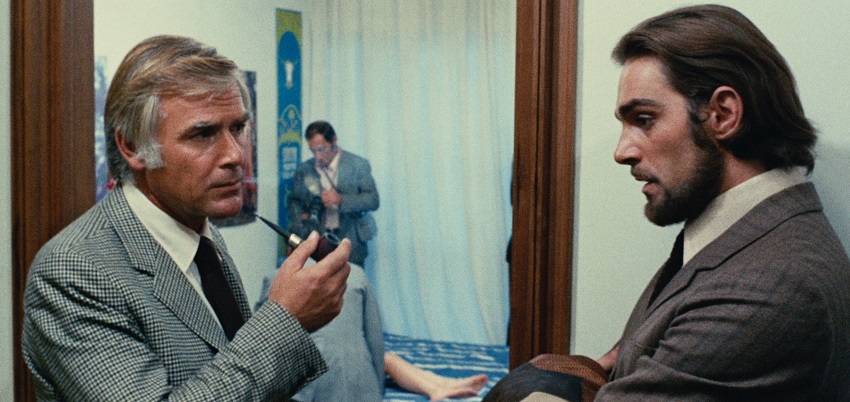
ELEVEN DAYS, ELEVEN NIGHTS (Italy - 1987) Directed by Joe D'Amato (Aristide Massaccesi). Written by Sarah Asproon (Rossella Drudi) and Clyde Anderson (Claudio Fragasso). Cast: Jessica Moore (Luciana Ottaviani), Joshua McDonald, Mary Sellers, Tom Mojack, Laura Gemser. (Unrated, 92 mins) A softcore cult classic that was instrumental in helping establish the legend of Skinemax while playing a significant role in the depletion of many a pubescent teenage boy's tube sock supply back in the day, 1987's ELEVEN DAYS, ELEVEN NIGHTS is a gender-swapped Italian ripoff of 9 1/2 WEEKS from notorious Eurocult journeyman Joe D'Amato. Written by Claudio Fragasso and Rossella Drudi--the husband-and-wife masters of erotica who would later gift us with TROLL 2--ELEVEN DAYS, ELEVEN NIGHTS pretty much follows the template of D'Amato's "Black Emanuelle" films of the late '70s, right down to the presence of Laura Gemser, this time as the editor to nympho journalist Sarah Asproon (Jessica Moore), who's writing a scintillating memoir of her sexual exploits entitled My One Hundred Men (Drudi uses the pseudonym "Sarah Asproon" for her writing credit, giving the film a bogus autobiographical ruse in the tradition of "Emmanuelle Arsan"). Sarah is nearing completion of the book as she seduces man #100, none-too-bright New Orleans engineer Michael Terenzi (Joshua McDonald, absurdly dubbed by the dulcet tones of the venerable Ted Rusoff). They have a torrid sexual encounter on a ferry, during which she steals his wallet and calls him later that evening for another hookup. Michael is due to be married in twelve days to his nice but boring, sexually unadventurous fiancee Helen (Mary Sellers) and isn't looking forward to a dull sex life or dealing with his controlling in-laws. So he doesn't hesitate to get all of his wild desires out of his system, diving head-on into a kinky and obsessive fling with Sarah, who wants to make the most of what little time they have, purring: "Give me all the nights you have left! Eleven nights...just for me!"
To paraphrase SNL Weekend Update city correspondent Stefon, ELEVEN DAYS, ELEVEN NIGHTS has it all: public sex, psycho-sexual dom/sub head games, gender role reversals, cross dressing, bondage, honey as a gooey sex accoutrement, silhouetted hard-ons, reacharounds, self-degradation, emasculating hot cuck action, a Jackie Rogers Jr cosplayer, and cringey Sarah rape fantasies ("Why don't you rape me? I'm dying to be raped!"). It's rather difficult to take any of it seriously, though it's easy to see why it was in regular rotation on late-night pay cable. D'Amato (one of the many pseudonyms of cinematographer-turned-director Aristide Massaccesi) dabbled in a little bit of everything but was best known for his EMANUELLE collaborations with Gemser, his horror gorefests like BURIED ALIVE (aka BEYOND THE DARKNESS) and THE GRIM REAPER (aka ANTHROPOPHAGUS), and he also directed the Miles O'Keeffe ATOR films under the name "David Hills." By the mid '80s, he started occasionally venturing into hardcore porn, where he'd eventually work almost exclusively in his later years until his death in 1999. But he also produced numerous films through his company Filmirage, including the future bad movie favorite TROLL 2, and thanks to ELEVEN DAYS, ELEVEN NIGHTS, he also carved himself a niche in late night cable, where his Eurosleaze exports always found a home. The film spawned an immediate follow-up in 1988, with Moore reprising her role as Sarah for what was shot as ELEVEN DAYS, ELEVEN NIGHTS PART 2, but released as TOP MODEL. That was followed by a string of numerically-challenged D'Amato-helmed sequels without Moore, including 1989's unrelated 11 DAYS, 11 NIGHTS 3, which offered a male protagonist in unknown American actor Cort McCown (who had small roles in '80s comedies TEEN WOLF and CAN'T BUY ME LOVE) and 1991's bafflingly-titled fourth installment 11 DAYS, 11 NIGHTS 2 (no, "2" is not a typo, and since the actual second film was rechristened TOP MODEL, perhaps D'Amato was trying to backtrack with a retroactive "part 2"), which starred Kristine Rose as a returning Sarah Asproon. Making matters even more mystifying is the existence of 1990's TOP MODEL 2, which was neither produced nor directed by D'Amato and starred neither Moore nor Rose. With this franchise--with its actual order being a riddle wrapped in a mystery inside an enigma--and with 1989's BLUE ANGEL CAFE and 1990's HIGH FINANCE WOMAN (aka THE LOVES OF A WALL STREET WOMAN), a pair of softcore titles with CANNONBALL RUN Lamborghini girl Tara Buckman, D'Amato was slightly ahead of the curve with the straight-to-video erotic thriller explosion that would hit American video stores over beginning in 1990-1991.
Recently-released on an all-region Blu-ray from the UK-based 88 Films (because physical media is dead), ELEVEN DAYS, ELEVEN NIGHTS was shot almost entirely on location in New Orleans, one of many Filmirage productions of the period that were being primarily lensed stateside, usually in Louisiana, Virginia, or Florida. They would also rely heavily on local--and frequently terrible--actors, though once in a great while, an unknown would break out and go somewhere (future MELROSE PLACE star Josie Bissett made her debut starring in the 1989 Virginia-shot D'Amato production HITCHER IN THE DARK, directed by Umberto Lenzi). Jessica Moore was actually an Italian model named Luciana Ottaviani, who acted in several films under a variety of pseudonyms from 1986 to 1989 before abruptly quitting the business (D'Amato would later say that her boyfriend disapproved of the movies she was making), though she did resurface for an interview on a 2010 Italian DVD release of ELEVEN DAYS, ELEVEN NIGHTS (unfortunately not included in the extras of the 88 Films edition). She appeared in Lucio Fulci's 1988 film SODOMA'S GHOST under her real name, and her gory death scene in Mario Bianchi's 1988 horror outing THE MURDER SECRET (as "Jessica Moore") was recycled in Fulci's 1990 meta cut-and-paste job A CAT IN THE BRAIN, where she was credited as "Gilda Germano." Her most high-profile job from a mainstream perspective was a small role in the 1987 Richard Chamberlain ABC TV-movie CASANOVA, where she played Faye Dunaway's niece and was credited with the "Gilda Germano" alias.
It's no wonder Moore never caught on considering she acted under at least three different names in her four-year career, but she's a bold and uninhibited presence throughout ELEVEN DAYS, ELEVEN NIGHTS (some of her nudity is quite graphic), and while she's dubbed, she displays a remarkable confidence for an inexperienced actress who was only 20 years old at the time (and perhaps too young to be playing a worldly writer just about to wrap up a memoir of 100 conquests). Elsewhere in the cast, Sellers is American, though she's spent her entire career in the Italian film industry and was a member of the Filmirage stock company for several years, also appearing in Michele Soavi's debut STAGEFRIGHT, Umberto Lenzi's GHOSTHOUSE, and Fabrizio Laurenti's THE CRAWLERS (aka CONTAMINATION .7). McDonald's career ended faster than Moore's--this was his second acting credit (after a bit part in Empire's shot-in-Italy ZONE TROOPERS), and he was out of movies after his third, Aldo Lado's 1988 actioner SAHARA HEAT. ELEVEN DAYS, ELEVEN NIGHTS isn't, by the standard definition, a good movie. But it's never dull (for obvious reasons), it's an essential title from an era of sexploitation that's somewhat fallen off the radar, and Jessica Moore is a stunning beauty who deserves her rightful place alongside Sylvia Kristel and Laura Gemser in the Softcore Eurotrash Hall of Fame. The Blu-ray release of ELEVEN DAYS, ELEVEN NIGHTS takes one back to a time in their formative junior high years before the age of the internet and streaming, when one would sneak downstairs in the middle of the night if one of these trashy imports was on, the wailing sax always the telltale indication that one of "the good parts" was coming up and you had to make sure the volume was low enough so as not to wake up the rest of the house. Hypothetically, of course.
EMANUELLE AND THE LAST CANNIBALS aka TRAP THEM AND KILL THEM (Italy - 1977/US release 1984) Directed by Joe D'Amato (Aristide Massaccesi). Written by Romano Scandariato and Aristide Massaccesi. Cast: Laura Gemser, Gabriele Tinti, Susan Scott (Nieves Navarro), Donald O'Brien, Percy Hogan, Monica Zanchi, Annamarie Clementi, Geoffrey Copleston, Dirce Funari, Cindy Leadbetter. (Unrated, 93 mins) The penultimate entry in the Joe D'Amato/Laura Gemser "Black Emanuelle" series, EMANUELLE AND THE LAST CANNIBALS is a mash-up of the softcore porn that defined the films to that point, fused with the burgeoning cannibal craze that would explode in Italy over the next few years. Umberto Lenzi's MAN FROM DEEP RIVER (1972) got the ball rolling, but it was more of a MAN CALLED HORSE ripoff that kept its extreme gore limited to very small doses. It was Ruggero Deodato's JUNGLE HOLOCAUST (1977), aka THE LAST SURVIVOR and his landmark CANNIBAL HOLOCAUST (1980) that really established the subgenre as it would come to be known, along with Sergio Martino's MOUNTAIN OF THE CANNIBAL GOD (1978) and Lenzi's double-shot of EATEN ALIVE (1980) and CANNIBAL FEROX (1981), the latter being pretty much the last word in the purely exploitative nature of the Italian cannibal gut-muncher cycle. To that end, D'Amato (real name: Aristide Massaccesi) was a bit ahead of the curve in 1977. Over the course of 1976 and 1977, he'd already sent Gemser's intrepid, globe-trotting, and sexually adventurous photojournalist Emanuelle to Bangkok in EMANUELLE IN BANGKOK, America in EMANUELLE IN AMERICA, and around the world in EMANUELLE AROUND THE WORLD. After the snuff film and bestiality extremes of EMANUELLE IN AMERICA, D'Amato probably figured the cannibal subgenre was the only transgressive depth to plummet. That is, until he decided necrophilia was a viable horror film subject with 1979's BEYOND THE DARKNESS.
But for its first half, it's mostly a standard EMANUELLE affair: there's one gratuitous sex scene after another, with a pretty ballsy one on the banks of the East River in broad daylight, between the Brooklyn and the Manhattan Bridges, with locals and some tourists on a passing ferry presumably getting an eyeful (this scene is shot in the same spot as the opening of Lucio Fulci's THE NEW YORK RIPPER and Yul Brynner's introduction in Antonio Margheriti's DEATH RAGE). Emanuelle is first seen undercover doing an expose of a NYC mental institution (an obvious Rome studio interior, with signs reading "Farmacy" and "Phisical Therapy") with a typically conspicuous camera, this one hidden behind the blinking eyes of a doll. One patient (Cindy Leadbetter) bites off the breast of a lesbian nurse, prompting Emanuelle to graphically grope her for information, discovering a tattoo just above her pubic region that's the sign of the Tupinamba, the last cannibal tribe still present in the Amazon jungle. Teaming professionally and sexually with anthropologist Dr. Mark Lester (Gabriele Tinti, Gemser's real-life husband), Emanuelle ventures to the jungle where Lester's old missionary pal Rev. Wilkes (Geoffrey Copleston) has his virginal daughter Isabelle (Monica Zanchi) and nun Sister Angela (Annamaria Clementi) accompany them on their quest to find evidence of the Tupinamba tribe. They eventually cross paths with impotent hunter Donald McKenzie (Donald O'Brien) and his sex-starved, nympho wife Maggie (Nieves Navarro, under her "Susan Scott" pseudonym), who's getting it on with their guide Salvador (Percy Hogan), before running afoul of the Tupinamba who, to the surprise of no one, start hunting, killing, and eating them one by one.
Factor out the plethora of sex scenes, and the set-up of EMANUELLE AND THE LAST CANNIBALS is virtually identical to DOCTOR BUTCHER M.D. (both films were written by Romano Scandariato), where a group of New Yorkers make their way to the jungle only to encounter cannibals and zombies, thanks to the experiments of the titular doctor (played by the busy O'Brien). Other than the bit of gore in the opening sequence of LAST CANNIBALS, D'Amato waits about an hour before the horror really gets going. Until then, it's a slightly more explicit than usual EMANUELLE outing, with one surprisingly creative bit where D'Amato skips the initial coupling of Emanuelle and Dr. Lester, merely implying it until he flashes back to it later during a cab ride to the airport. It's a like a softcore porn precursor to the non-linear editing style Steven Soderbergh would use to memorable effect with George Clooney and Jennifer Lopez in OUT OF SIGHT. Given the context, it's an unusual and inventive decision, demonstrating the kind of pure cinema that one usually doesn't expect to see in a Joe D'Amato joint, whether it's traditional genre fare like THE GRIM REAPER or his ATOR films, his horror/porno crossovers like 1980's EROTIC NIGHTS OF THE LIVING DEAD and 1981's PORNO HOLOCAUST, or the straight-up hardcore porn he'd churn out near the end of his career.
Just out on Blu-ray from Severin, EMANUELLE AND THE LAST CANNIBALS is a film that gives the devout Eurotrash exploitation fan everything they want: near-constant T&A, laughably bad dubbing, misspelled English-as-second-language signs, extreme gore, incredible 1977 NYC location work, a supporting cast filled with Eurocult stalwarts, a catchy Nico Fidenco theme song with "Make Love on the Wing," bullshit claims that it's a true story (citing the work of a fictitious reporter named "Jennifer O'Sullivan"), and the iconic Gemser, who looks even more gorgeous than usual here. And as an added bonus, unlike most of its type in the cannibal cycle, there's no graphic onscreen animal violence, which has always been the biggest obstacle in the "enjoyment" of this stuff (the closest it gets is a friendly chimpanzee helping himself to a Marlboro). It took the film seven years to make it to America, where the short-lived Megastar Films gave it a spotty release on the drive-in and grindhouse circuit in 1984 as TRAP THEM AND KILL THEM, a retitling obviously designed to capitalize on the notoriety of MAKE THEM DIE SLOWLY, the rechristening given to Umberto Lenzi's CANNIBAL FEROX when it hit the US in 1983. D'Amato and Gemser would make one more EMANUELLE film with 1978's EMANUELLE AND THE WHITE SLAVE TRADE, which features copious amounts of redubbed stock footage from earlier entries (Emanuelle's meeting with her editor and shots of Gemser and Tinti driving around NYC--complete with a theater showing KENTUCKY FRIED MOVIE--are lifted completely from LAST CANNIBALS), plus an amazing newly-shot bowling alley brawl. Though the D'Amato-run "Black Emanuelle" series would wrap up after WHITE SLAVE TRADE, Gemser starred in a few offshoots as a character named "Emanuelle," most notably a pair of wonderfully nasty and batshit Bruno Mattei women-in-prison classics with 1982's VIOLENCE IN A WOMEN'S PRISON (released in the US in 1984 as CAGED WOMEN) and 1983's WOMEN'S PRISON MASSACRE (released in the US in 1985). Gemser retired from acting following Tinti's death from cancer in 1991, though she worked behind the scenes as a costume and wardrobe designer on several Filmirage productions, most notably the cult classic TROLL 2. She's spent the last 25 years almost completely out of the public eye, resurfacing only for a few audio interviews and one on-camera interview for a 2000 British TV documentary on Sylvia Kristel's EMMANUELLE movies.
BLACK COBRA aka BLACK COBRA WOMAN aka EVA NERA aka EMMANUELLE AND THE DEADLY BLACK COBRA (Italy - 1976/US release 1980) Written and directed by Joe D'Amato (Aristide Massaccesi). Cast: Jack Palance, Laura Gemser, Gabriele Tinti, Michele Starke, Sigrid Zanger, G. Mariotti. (R, 97 mins) Though it stars Laura Gemser and is directed by "Joe D'Amato," the best-known pseudonym of Italian cinematographer-turned-journeyman genre legend Aristide Massaccesi (BURIED ALIVE, THE GRIM REAPER), BLACK COBRA isn't one of the duo's many "Black Emanuelle" movies, but it might as well be. Shot under the title EVA NERA, BLACK COBRA was filmed in Rome and Hong Kong on the same trip to the Far East that yielded the same year's earlier EMANUELLE IN BANGKOK, the first teaming of Gemser and D'Amato. Born in Indonesia in 1950, Gemser made an impression as a masseuse in 1975's EMMANUELLE: THE JOYS OF A WOMAN, the second in the official Sylvia Kristel series. As a result, Gemser was rewarded with the starring role in the same year's knockoff BLACK EMANUELLE (note the elimination of one of the "m"'s), directed by Bitto Albertini. Albertini replaced Gemser with the one-and-done Shulamith Lasri (aka "Sharon Lesley") for 1976's BLACK EMANUELLE 2, prompting Gemser to team with D'Amato for several EMANUELLE movies that are different from the initial BLACK EMANUELLEs but are generally lumped in with them anyway thanks to her presence. In addition to the actual EMANUELLE movies, Gemser made several other quickie softcore porn outings that were often rechristened as unofficial EMANUELLE or EMMANUELLE movies by their distributors (like 1976's dreadful EMMANUELLE ON TABOO ISLAND, probably the low point of five-time Oscar-nominee Arthur Kennedy's career). BLACK COBRA has gone under a variety of titles over the decades, but was just released on Blu-ray by Code Red as EMMANUELLE AND THE DEADLY BLACK COBRA. Other than Gemser's character being named "Eva," the EMMANUELLE retitling is fitting, given its focus on all of D'Amato's favorite things: Gemser's body, unkempt mid '70s bushes, and extensive location shooting in exotic ports of call.
"I'm in a Laura Gemser softcore porn. Believe it....or not!"
There was always a "travelogue" element to D'Amato's EMANUELLE movies, but never more than in BLACK COBRA. About 1/3 of the movie seems to be dedicated to Gemser and various co-stars sightseeing around Hong Kong, driving, walking into restaurants, watching street vendors skin, chop, and fry a live snake in a wok and then eating it, all in real time, or a long scene of Gemser feeding live rats to snakes as lounge music with the wordless vocals of Edda dell'Orso or someone who sounds just like her goes on and on. The EMANUELLE movies remain entertaining time capsules of their era (except for Pedro the Horse in the notorious EMANUELLE IN AMERICA), but Gemser and D'Amato are having a really off day here. Perhaps it's due to it being very early in their partnership and they hadn't yet found their groove and perfected their formula (this could really use an English-as-second-language tune as catchy as EMANUELLE IN AMERICA's "Celebrate Myself" or EMANUELLE AND THE WHITE SLAVE TRADE's "Run Cheetah Run"), but BLACK COBRA is loaded with sex, nudity, and sleaze and still manages to be boring, and that's even with the unlikely participation of Jack Palance, somehow cajoled into taking top billing in a Joe D'Amato softcore porno (he was most likely brought on by uncredited ghost producer Harry Alan Towers). The busy Palance was doing a lot of work in Italy over 1975-76 (Nello Rossatti's THE SENSUOUS NURSE, Bruno Corbucci's THE COP IN BLUE JEANS, Fernando Di Leo's RULERS OF THE CITY, Alfonso Brescia's BLOOD AND BULLETS), and also had his starring gig on CBS' one-season, Carroll O'Connor-produced cop show BRONK going on at the same time. Palance is in a lot of BLACK COBRA, but there's a few long stretches where he's not, and his appearances are spaced out enough--he's in none of the Hong Kong exteriors, only the interiors which were shot at Elios Studios back in Rome--that it's likely D'Amato managed to get all of his scenes in the can in matter of a few days, and maybe even got away with not telling the legendary Hollywood actor what was going on in the rest of the movie.
Eva (Gemser), a nightclub dancer whose act involves snakes writhing around her naked body, makes the acquaintance of smarmy businessman Jules Carmichael (Gabriele Tinti, Gemser's future husband and frequent co-star) on a flight from Holland to Hong Kong. Later that evening, Jules convinces his older brother Judas (Palance) to check out Eva's act. Judas, a wealthy eccentric obsessed with his large collection of venomous snakes, is immediately taken with Eva. He brings her home to show her his collection, but she's afraid of both the snakes and Judas, especially after he blows it up by creepily hissing "I like the scent of you" in a way that only Palance can. Eva eventually warms up to Judas, who becomes her platonic sugar daddy while duplicitous Jules has his own designs on her. Eva's not interested in either of the Carmichael boys, and though she gives her body to a sleazy Hong Kong nightclub owner, her serious carnal attentions go to Gerri (Michele Starck) and Candy (Sigrid Zanger), much to Jules' jealous disapproval.
There isn't much of a plot to BLACK COBRA, at least not in the sense that there's developed story or character arcs. Nobody's watching Gemser/D'Amato movies for the story, but the EMANUELLEs at least had the "crusading photojournalist" angle and some semblance of drama. Not much happens in BLACK COBRA in the periods between the Gemser/Starck nude rubdowns, soapy showers, and sex scenes. Tinti's Jules is the clear villain, but there's not really any urgency or forward momentum but the one legitimate surprise comes in the handling of Palance's Judas. D'Amato does flip the script to a certain extent by gradually revealing that Judas is a harmless guy and the film's most intriguing character, one who seems to have been brought in from another movie. Perhaps it was a concession made to dignify Palance's presence in this kind of project, but Judas turns out to be an introverted, sensitive homebody, a loner who has never felt comfortable around people and prefers the company of his snakes, tending to them and observing them. Early on, you expect Judas' behavior to lead to a horror movie, and it belatedly turns horrific to a degree in its final ten minutes, but it's through no fault of Judas. Palance being in BLACK COBRA is surprising enough, but to see him actually giving a shit is almost flabbergasting (there are a few fleeting instances where Palance's voice changes and he's dubbed for a line or two by Michael Forest, and the effect is strange, to say the least, especially since Forest's Palance impression sounds more like Clint Eastwood), especially to anyone who saw him slumming and visibly shitfaced in Jess Franco's 1969 film JUSTINE. Some of the scenes in his residence play like D'Amato talked him into believing he was in some kind of Visconti knockoff. Palance remains clothed and isn't directly involved in any of the more salacious material (he observes some fondling between Gemser and another woman in a restaurant, but it's cut between the women and Palance reaction shots, making it almost certain he wasn't actually watching them and wasn't there at the same time), he isn't there for any of Jules' snake-abetted murders, and he certainly isn't present for the scene where Jules gets his comeuppance when Eva has a cobra slither up his ass.
Video Gems' VHS cover art
Against-type casting for Jack Palance shouldn't be the most interesting thing about a skin-filled Gemser/D'Amato joint, and it would take four years and several Gemser EMANUELLE films for BLACK COBRA to find a US distributor. The short-lived Aurora Film Corporation gave it a spotty release on the grindhouse and drive-in circuit in 1980 (with the immortal tag line "How much snake can one woman take..."), which seems to be the only year the company existed, possibly due to acquiring product like BLACK COBRA. Aurora's other releases included the Stuart Whitman/Robert Vaughn B actioner CUBA CROSSING, one of the few feature films directed by Chuck Workman, best known for his filmed pieces for a couple decades' worth of Oscar telecasts, and the kiddie kung-fu comedy THE LITTLE DRAGONS, which was in heavy rotation on Showtime in the early '80s and an early credit for future L.A. CONFIDENTIAL and 8 MILE director Curtis Hanson. BLACK COBRA was released on VHS and has been on a number of dubious budget labels in crummy presentations, but Code Red's Blu-ray, distributed by Kino Lorber, looks great. It's too bad it's accompanied by an almost completely useless commentary by film historian Mirek Lipinski.
Code Red's 2018 Blu-ray cover art
Lipinski is a figure of some repute in cult movie circles (well, at least he was before this commentary), running the Latarnia Forums and doing a lot to document and preserve the legacy of beloved Spanish horror icon Paul Naschy. But commentaries--this is his first one--don't seem to be his thing (and in the interest of full disclosure, I was Facebook friends with Lipinski but was unfriended by him at some point several years ago). Lipinski gets sidetracked very early on, going into such ludicrous detail about Chinese restaurants and its many accoutrements (did we need an extensive lesson on the uses of the Lazy Susan serving dish?), and awkward analysis of why lesbian sex scenes are "a turn-on to the male of the species," that for a while, it almost seems like it's some kind of Andy Kaufman-style stunt. Lipinski does helpfully mention that Palance's scenes were shot in Rome and that he never went to Hong Kong, but then keeps repeating the point ad nauseum. His other observations are obvious and already known to any genre fan (like Massaccesi using the name 'Joe D'Amato' to seem more American), and ultimately, there's really no reason to listen this meandering, almost stream-of-consciousness track that makes Bill Olsen's usual antics of mispronouncing actors' names and complaining about the movie he's watching seem academic and Criterion-esque by comparison. The situation gets more dire as it goes on, starting with Lipinski proclaiming his disdain for women shaving their pubic hair, the likelihood of getting a "happy ending" at a Hong Kong massage parlor, and still more on Chinese restaurants. But as the movie winds down, he completely shits the bed, turning into the world's creepiest tour guide, babbling incessantly about the seedy underbelly of Hong Kong and the intricacies and loopholes of its prostitution laws and other details that have jack shit to do with the movie and maybe tell us a little TMI about Lipinski. In fairness, this probably wasn't the best film to tackle for a first time commentator. There's really no one from the production who could've taken part: Gemser is long-retired and has given maybe three interviews in the last 20 years; Starck's last IMDb credit is an appearance in the 1984 Tom Hanks hit BACHELOR PARTY; and D'Amato, Palance, Tinti, and editor Bruno Mattei are all dead. Judging from what's here, Lipinski just didn't have much to say about the movie, in which case, it was probably better to say nothing at all. Bottom line: it's a contender for the worst commentary I've ever heard, and the only one I can recall where I've felt the need to shower afterward.
ANTHROPOPHAGUS aka THE GRIM REAPER (Italy - 1980; US release 1981) Directed by Joe D'Amato (Aristide Massaccesi). Written by Luigi Montefiori. Cast: Tisa Farrow, Saverio Vallone, Zora Kerova, George Eastman (Luigi Montefiori), Vanessa Steiger (Serena Grandi), Margaret Donnelly (Margaret Mazzantini), Mark Bodin, Bob Larson, Rubina Rey, Simone Baker, Mark Logan. (R, 82 mins/Unrated, 91 mins)
One of the most legendary of all the Italian gore classics of the early '80s, though if you rented this at the video store back in the day, you probably wondered why. A banned "video nasty" in the UK, ANTHROPOPHAGUS was released in the US in the fall of 1981 by Film Ventures as the 82-minute THE GRIM REAPER, shorn of nearly ten minutes from its uncensored version. THE GRIM REAPER was missing almost all of the gore, including the two outrageously foul moments that were responsible for its notoriety. Directed by Italian exploitation journeyman Aristide Massaccesi under his most frequently-used of many pseudonyms ("Joe D'Amato"), ANTHROPOPHAGUS follows Lucio Fulci's ZOMBIE as the second Italian gore film in a row for American actress Tisa Farrow (Mia's younger sister) where her character ends up dragging people to a deserted island to their certain death. A group of friends on a Greek vacation end up giving a boat ride to Julie (Farrow, dubbed by Carolyn De Fonseca), who has some friends who live in a villa on a nearby island. Tarot enthusiast Carol (Zora Kerova) gets a bad feeling and of course, she's right. The villa is seemingly abandoned until they find lone survivor Rita (Margaret Mazzantini, who went on to become a renowned writer in Italy), a young blind woman who says a stranger has been prowling the island and reeks of blood. That stranger is Klaus Wortmann (George Eastman, who scripted under his real name Luigi Montefiori), a scarred, monstrous maniac with an insatiable taste for human flesh who starts picking off the travelers one by one.
ANTHROPOPHAGUS scores some points for atmosphere, and the massive villa is a memorable location, but the structure of the story is such that the characters have to spend an inordinate amount of time walking around and talking before the killing can start. The US version also eliminated some of the more repetitious dialogue scenes and helped speed up the pace, but honestly, without those infamous gore scenes, there's not much to ANTHROPOPHAGUS. Saving the most outrageous and offensive gut-muching splattergasms for the finale, Massaccesi and Montefiori have Wortmann--whose backstory includes accidentally killing his wife when he tried to eat their dead son when they were lost at sea--strangle the very pregnant Maggie (Serena Grandi, billed as "Vanessa Steiger") before reaching inside to rip out the fetus and eat it (in the US cut, he simply strangles her and it cuts away after he caresses her belly). In the climax, Julie and Wortmann end up in a well and she barely manages to escape before Carol's brother Andy (Saverio Vallone, the lookalike son of veteran Italian character actor Raf Vallone) reappears out of nowhere to swing a pick-axe into Wortmann's gut. The US cut ends there, but in the uncensored version, Wortmann's intestines spill out and he triumphantly begins to devour himself. Those scenes were enough to guarantee a spot for ANTHROPOPHAGUS on the Video Nasties list and they may have been all Farrow needed to see to decide she had enough: after co-starring with Harvey Keitel in James Toback's critically-lauded FINGERS just two years earlier before doing ZOMBIE in 1979 and Antonio Margheriti's THE LAST HUNTER (1980), she called it a career after ANTHROPOPHAGUS, retiring from acting at the ripe old age of 29.
Directed by Peter Newton (Aristide Massaccesi). Written by John Cart (Luigi Montefiori). Cast: George Eastman (Luigi Montefiori), Edmund Purdom, Annie Belle, Charles Borromel, Katya Berger, Kasimir Berger, Hanja Kochansky, Ian Danby, Ted Rusoff, Cindy Leadbetter, Martin Sorrentino, James Sampson, Michele Soavi, Goffredo Unger. (Unrated, 94 mins) Conceived as a sequel to ANTHROPOPHAGUS, ABSURD ended up being an Italian ripoff of John Carpenter's HALLOWEEN with some elements of HALLOWEEN II thrown in for good measure. It's got the core duo of Massaccesi and Montefiori, with the latter again starring as a killer, though this time he looks like George Eastman rather than the heavily-made up monstrosity of ANTHROPOPHAGUS. Eastman is Mikos Stenopolis, a homicidal maniac being pursued through a suburban American town by a renegade Greek priest (Edmund Purdom) who's running church-sanctioned biochemical experiments for which Stenopolis is the chief guinea pig. He's taken to a local hospital after he accidentally impales himself on a spiked gate, but it's discovered too late that the priest's experiments have turned Stenopolis into an unstoppable killing machine whose body is able to regenerate dead cells. Stenopolis escapes from the hospital and after the initial killing spree, makes his way to the home of Bennett family, killing babysitter Peggy (Cindy Leadbetter) and leaving visiting nurse Emily (Annie Belle) to protect the children: irritating young brat Willy (Kasimir Berger) and incapacitated Katya (Katya Berger), who's recovering from a spine operation. All the while, the priest and rumpled detective Engelman (Charles Borromel) scour the town trying to find the escaped Stenopolis.
Unlike the Greek exteriors of ANTHROPOPHAGUS exploiting the exotic island location, Massaccesi goes all-out to make ABSURD look like it's taking place in an American town despite being shot in Rome. That would like explain why such an unusual number of American and British dubbing regulars have onscreen roles here, from actors like Borromel and black British actors Martin Sorrentino and James Sampson, who were frequently seen in Eurocult films of the period, to people typically confined to the dubbing studio, like Ted Rusoff as a surgeon and Ian Danby as the Bennett kids' father, who runs over Stenopolis at one point and is wracked with guilt over the hit-and-run, unaware that the same guy is trying to murder his family. The ruse doesn't always work, as neither Massaccesi nor Montefiori have any idea how Americans behave while watching the Super Bowl: he has the Bennett parents attending a party for "The Game," shown on TV via stock footage from Super Bowl XIV between the Los Angeles Rams and the Pittsburgh Steelers that was almost certainly not authorized by the NFL and has Rusoff handling play-by-play, plus all of the guests are wearing their Sunday best suits and dresses and eating big bowls of spaghetti. But he does get American genre cliches down, as evidenced when the irate Engelman sees who he's got to take on Stenopolis and grumbles "So this is the team, then? A priest, a detective near retirement, and a moron rookie of a cop? That's terrific." He stops just short of declaring himself "too old for this shit," and promising they'll kill Stenopolis "if we don't kill each other first!" The structure is essentially HALLOWEEN all over again, with unkillable Stenopolis a stand-in for Michael Myers, Purdom's priest this film's Dr. Loomis, with Belle and Leadbetter jointly filling the Laurie Strode babysitter-in-peril role. Massaccesi generates some serious suspense throughout, with his relentless overuse of the same library cues that would be heard throughout the legendary PIECES, and by setting Stenopolis' rampage in a disorientingly large house that's every bit as effective as the Greek villa in ANTHROPOPHAGUS, with lots of corners and hallways that allow Stenopolis to jump out from anywhere.
Titled ROSSO SANGUE ("blood red") in Italy, ABSURD is superior in every way to its semi-predecessor, with a more evenly consistent approach to its extreme gore scenes instead of just cramming all of them into the last 15 minutes. Unfortunately, it didn't get a theatrical release in America, instead belatedly turning up in video stores in 1986 in a Wizard Video big box as MONSTER HUNTER, complete with inaccurate artwork and a synopsis that proved no one watched it before summarizing it. It would turn up on budget sell-thru VHS years later as ZOMBIE 6: MONSTER HUNTER and Mya would release a flawed DVD in 2009 under the title HORRIBLE. It's one of the unsung greats of the Video Nasty gorefest days, with Eastman a memorable killer, some admirably brutal kills with everything from a drill to a head in the oven, and a delirious final shot that would've been a real crowd-pleaser had anyone picked this up for the grindhouse and drive-in circuit. ABSURD was just released in a region-free Blu-ray edition by the UK-based 88 Films, a definitive presentation that has the film looking better than it ever did during its VHS and bootleg days of old.
EMANUELLE IN AMERICA
(Italy - 1977) Directed by Joe D'Amato (Aristide Massaccesi). Written by Maria Pia Fusco. Cast: Laura Gemser, Gabriele Tinti, Paola Senatore, Roger Browne, Riccardo Salvino, Lars Bloch, Maria Piera Regoli, Matilde Dell'Aglio, Stefania Nocilli, Giulio Bianchi, Efrem Appel, Lorraine De Selle, Salvatore Baccaro, Renate Kasche, Pedro the Horse. (Unrated, 100 mins) The most notorious of the tenuously-connected BLACK EMANUELLE series--at least in its uncut version--EMANUELLE IN AMERICA is, for the most part, another globe-trotting travelogue with freelance photojournalist Emanuelle (Laura Gemser) engaging in the usual spontaneous sexcapades. Made as a direct response to Just Jaeckin's X-rated, 1974 global phenomenon EMMANUELLE with Sylvia Kristel, 1975's BLACK EMANUELLE (note one less "m"), directed by Bitto Albertini, showcased 25-year-old, Indonesian-born Gemser in the title role (around the same time, she had a small part in the 1975 Kristel sequel EMMANUELLE: THE JOYS OF A WOMAN). Combining the erotic elements of EMMANUELLE with a nod to blaxploitation, BLACK EMANUELLE was successful enough that Gemser was soon starring in all sorts of softcore erotica that were often exported as EMANUELLE movies even though she sat out the first official sequel. 1976's BLACK EMANUELLE 2, also directed by Albertini, saw Gemser replaced by the George Lazenby of the series, one-and-done Israeli actress Shulamith Lasri, credited as "Sharon Lesley." Gemser, meanwhile, was headlining a slew of unofficial follow-ups that were often shot under one title but released as EMANUELLE movies, like Brunello Rondi's BLACK EMMANUELLE, WHITE EMMANUELLE (1976), which paired her with French actress Annie Belle and reinstated the extra "m" to the title; Enzo D'Ambrosio's boring EMANUELLE ON TABOO ISLAND (1976), which featured five-time Oscar nominee Arthur Kennedy at an all-time career low; Giuseppe Vari's nunsploitation outing SISTER EMANUELLE (1977); Mario Bianchi's sex comedy EMANUELLE IN THE COUNTRY (1978); and the Greek-made drama EMANUELLE'S DAUGHTER (1980). In 1978, perennial D-list producer and later serial Bruno Mattei enabler Franco Gaudenzi (STRIKE COMMANDO, ROBOWAR) tried to get a piece of the action, taking an unreleased mondo documentary and having Gemser host introductions to its segments, releasing it under the title EMANUELLE AND THE EROTIC NIGHTS, which received a US release in 1983 as an early acquisition of Bob and Harvey Weinstein's fledgling Miramax Films. So popular were these EMANUELLE films that Albertini would even be hired to direct Chai Lee as an Asian Emanuelle in the 1977 offshoot YELLOW EMANUELLE.
1976 saw a BLACK EMANUELLE reboot of sorts, with a returning Gemser and veteran cinematographer and journeyman director Aristide Massaccesi (better known as "Joe D'Amato") starting a long partnership that extended beyond just the BLACK EMANUELLEs. 1976's EMANUELLE IN BANGKOK was released around the same time as BLACK EMANUELLE 2 and more or less ignores it, with Emanuelle once again an independent, respected, and sexually-liberated journalist (Lasri's Black Emanuelle was a famous model) sent off to investigate something in some semblance of a plot that's just an excuse for a plethora of sex scenes. Gemser and D'Amato would make five of their own EMANUELLEs, with BANGKOK followed by three in a busy 1977: EMANUELLE IN AMERICA, EMANUELLE AROUND THE WORLD (released in the US in 1980), and the cannibal horror hybrid EMANUELLE AND THE LAST CANNIBALS (released in the US in 1984, after the craze had passed, as TRAP THEM AND KILL THEM, presumably to draw in the MAKE THEM DIE SLOWLY crowd). The final installment, 1978's EMANUELLE AND THE WHITE SLAVE TRADE, was a quickie padded with significant amounts of recycled and redubbed footage from previous Gemser EMANUELLEs. Another Gemser/D'Amato collaboration, BLACK COBRA WOMAN (1976), co-starring a slumming and probably shitfaced Jack Palance, was sold in Japan as an EMANUELLE film, and several years later, Gemser would resurrect the Emanuelle-as-crusading-reporter act without D'Amato for a pair of Bruno Mattei women-in-prison movies, 1982's VIOLENCE IN A WOMEN'S PRISON (released in the US in 1984 as CAGED WOMEN), and 1983's immortal WOMEN'S PRISON MASSACRE (released in the US in 1985).
Gemser and offscreen husband and frequent co-star Gabriele
Tinti. They were married from 1976 until his death in 1991.
Fans generally cite EMANUELLE IN AMERICA as the high point of Gemser's EMANUELLE run, but that seems most likely due to its shock value. It's rough going for the uninitiated, especially on Blue Underground's 2003 DVD release, which presents the film in its uncut, 100-minute version (VidAmerica's VHS ran somewhere in the vicinity of 82 minutes). It's a typical Gemser/D'Amato EMANUELLE set-up: moonlighting as a fashion photographer in NYC--with ALL THE PRESIDENT'S MEN and THAT'S ENTERTAINMENT PART 2 visible on theater marquees, Gemser riding the Roosevelt Island tram, and Big Apple pedestrians predictably gawking at the camera--Emanuelle is almost killed by a model's crazed boyfriend before calming him down the best way she knows how: with a blowjob. She then gets a hot tip about a sex trafficking ring involving wealthy asshole Eric Van Darren (Lars Bloch). Armed with her sneaky pendant camera with a seemingly endless supply of film, Emanuelle infiltrates his group of Zodiac-named women and going by "Virgo," she's privy to all sorts of high society, EYES WIDE SHUT transgressions, including one of the women (SALON KITTY's Paola Senatore), jerking off Van Darren's prized horse Pedro in a scene of explicit bestiality that was obviously cut from most releases. From there, Emanuelle follows Van Darren's duke friend (Gabriele Tinti, Gemser's husband and frequent co-star--they met on BLACK EMANUELLE and married in NYC around the time of EMANUELLE IN AMERICA's shoot, becoming the Bogie & Bacall of Italian trash cinema) to his villa in Venice, where she witnesses an orgy that includes some onscreen fellatio in shots that never involve Gemser. From there, she goes to an island where D'Amato stops the film cold for a solid ten minutes of hardcore sex scenes and money shots involving previously unseen actors (one of whom is Nazisploitation regular Salvatore Baccaro, best known for his credit "and Boris Lugosi as Ook the Neanderthal Man" in 1973's FRANKENSTEIN'S CASTLE OF FREAKS). While on the island, Emanuelle witnesses a copulating couple carrying on as a brutal snuff film plays in the background. An investigation of the snuff film leads her to the nation's capital (why didn't they call this EMANUELLE GOES TO WASHINGTON?), where she's seduced by a corrupt senator (Roger Browne, a Cincinnati, OH native who spent his entire career in Europe) with a penchant for LSD and getting off on the kind of filmed torture tactics that would make him the ideal target for Videodrome. Then it all ends with a wacky, fourth-wall breaking finale involving Emanuelle and her boyfriend (Riccardo Salvino)--yes, she has a boyfriend--and some comical stereotypes of island natives.
Narratively speaking, EMANUELLE IN AMERICA is a mind-boggling mess with little flow and even less logic. But nobody's watching this for storytelling. The more conventional sex scenes are well-handled--a sweaty steamroom hook-up between Emanuelle and Gemini (Lorraine De Selle) is nicely done--and while it's not quite "Run Cheetah Run" from EMANUELLE AND THE WHITE SLAVE TRADE, it's got a great catchy, "English-as-second-language" Nico Fidenco-penned theme song in "Celebrate Myself." But D'Amato just goes too far for the audience that watched these softcore Euro imports on late night Showtime back in the early '80s. Of course, the hardcore elements would've been trimmed (and were only shot by D'Amato as alternate takes for different territories in the first place), but while I see the demand for cum shots if there was potential for this on the XXX circuit, who other than Pedro really wants to see Paola Senatore (who, big surprise, was doing porn a decade later) give a horse a two-handed tugjob? Between that and the disgustingly graphic and very convincing snuff film snippets that D'Amato shot, I question EMANUELLE IN AMERICA's definition of "entertainment." Gemser is as lovely as ever here, but the enjoyment is significantly hampered by all the extraneous shit going on. I'll take the drag queen bowling alley brawl in EMANUELLE AND THE WHITE SLAVE TRADE any day. D'Amato would continue dabbling in all sorts of genres (zombies, cannibals, CONAN and ROAD WARRIOR ripoffs) before his death in 1999, spending the final years of his career in hardcore porn. Gemser would be an exploitation staple well into the '80s, with appearances in 1976's VOYAGE OF THE DAMNED, the 1981 Rankin/Bass period epic THE BUSHIDO BLADE, and an unlikely co-starring role with Michael Landon in the 1983 NBC TV-movie LOVE IS FOREVER (where she was credited as "Moira Chen" when producers didn't want her sexploitation notoriety to be a distraction) representing her only attempts at mainstream crossover. A devastated Gemser would retire from acting when 59-year-old Tinti died of cancer in 1991, though she worked behind the scenes as a costume designer on a few more D'Amato productions (including the legendary TROLL 2) before withdrawing from movies altogether in 1993. Now 65, Gemser lives completely out of the public eye. She gave an audio interview for EMANUELLE IN AMERICA's 2003 DVD release, but her last on-camera appearance to date was in an interview for EMMANUELLE: A HARD LOOK, a 2001 British TV documentary about Sylvia Kristel's EMMANUELLE films by REPO MAN director Alex Cox.
WHAT HAVE YOU DONE TO SOLANGE? (Italy/West Germany - 1972) Directed by Massimo Dallamano. Written by Bruno Di Geronimo and Massimo Dallamano. Cast: Fabio Testi, Karin Baal, Joachim Fuchsberger, Christine Galbo, Camille Keaton, Gunther W. Stoll, Claudia Botenuth, Maria Monti, Pilar Castel, Giovanna Di Bernardo, Rainer Penkert, Marco Mariani, Antonio Casale, Giancarlo Badessi, Aristide Massaccesi. (Unrated, 107 mins)
After the international success of Dario Argento's THE BIRD WITH THE CRYSTAL PLUMAGE (1970), the Italian horror/mystery subgenre known as giallo was a legitimate phenomenon. Argento is generally credited with starting the craze, but the style can be seen in its early stages as far back as Mario Bava's THE EVIL EYE (1963) and BLOOD AND BLACK LACE (1964) and other giallo prototypes like Antonio Margheriti's THE YOUNG, THE EVIL AND THE SAVAGE (1968), Romolo Guerrieri's THE SWEET BODY OF DEBORAH (1968) and Massimo Dallamano's A BLACK VEIL FOR LISA (1968). Following the breakout success of BIRD, Argento quickly followed with THE CAT O'NINE TAILS (1971) and FOUR FLIES ON GREY VELVET (1972), and the giallo floodgates were opened. Strange, poetic, verbose titles that often incorporated colors, numbers, letters, animals, a woman's name, or questions were hallmarks of the giallo movement, and Argento's films paved the way for Luciano Ercoli's THE FORBIDDEN PHOTOS OF A LADY ABOVE SUSPICION (1970) and DEATH WALKS ON HIGH HEELS (1971), Paolo Cavara's THE BLACK BELLY OF THE TARANTULA (1971), Lucio Fulci's A LIZARD IN A WOMAN'S SKIN (1971) and DON'T TORTURE A DUCKLING (1972), Riccardo Freda's THE IGUANA WITH THE TONGUE OF FIRE (1971), Duccio Tessari's THE BLOODSTAINED BUTTERFLY (1971), Emilio P. Miraglia's THE RED QUEEN KILLS 7 TIMES (1972), Giuliano Carnimeo's THE CASE OF THE BLOODY IRIS (1972), aka WHAT ARE THOSE STRANGE DROPS OF BLOOD DOING ON JENNIFER'S BODY?, Aldo Lado's SHORT NIGHT OF GLASS DOLLS (1971) and WHO SAW HER DIE? (1972), Carlos Aured's Spanish-made BLUE EYES OF THE BROKEN DOLL (1974), and several from Sergio Martino: THE CASE OF THE SCORPION'S TAIL (1971), YOUR VICE IS A LOCKED ROOM AND ONLY I HAVE THE KEY (1972), and ALL THE COLORS OF THE DARK (1972), aka THEY'RE COMING TO GET YOU, among countless others.
The gialli were also inspired by the work of prolific British mystery novelist, playwright, short-story writer, and screenwriter Edgar Wallace (1875-1932), who died while in the early stages of scripting the 1933 classic KING KONG. Wallace's works had been adapted to the big screen as far back as 1915, but the late 1950s saw a massive resurgence in Wallace's popularity in West Germany roughly 25 years after his death. In 1959, the German production company Rialto Film acquired the rights to a good chunk of the Wallace catalog and produced dozens of films based on his writings throughout the 1960s. Known as krimi, most of these were directed by Harald Reinl or Alfred Vohrer and made their way to the US as part of syndication packages aired on late-night TV and afternoon Creature Features, and like their future gialli brethren, boasted memorable titles like THE FELLOWSHIP OF THE FROG (1959), THE DEVIL'S DAFFODIL (1961), SECRETS OF THE RED ORCHID (1962), THE CURSE OF THE HIDDEN VAULT (1964), THE COLLEGE GIRL MURDERS (1967), and CREATURE WITH THE BLUE HAND (1967). The Rialto Wallace programmers featured a stock company of West Germany-based actors like Klaus Kinski, Karin Dor, Joachim Fuchsberger, Harald Leipnitz, Eddi Arent, Heinz Drache, Werner Peters, and Aidy Berber, but would occasionally import an international star like Christopher Lee. The films were so popular in West Germany that Rialto's rival studio CCC Film bought the rights to several books by Wallace's son Bryan Edgar Wallace, which were turned into a competing series of "B. Edgar Wallace" adaptations like THE STRANGLER OF BLACKMOOR CASTLE (1962), THE PHANTOM OF SOHO (1964), and THE MONSTER OF LONDON CITY (1964).
In 1972, for their final Wallace-inspired production and more or less a passing of the torch to Italian thrillers, Rialto teamed up with Clodio Cinematografica and Italian International Film to produce the Italian/West German giallo/krimi hybrid WHAT HAVE YOU DONE TO SOLANGE?, a film that attempted to balance the sleaze and the graphic violence of the gialli with the old-school, Edgar Wallace-inspired mystery of the krimi. For the most part, it succeeded, though it certainly leans more toward the giallo side of things, with the primary influence of the krimi coming from the presence of genre vets Karen Baal and Joachim Fuchsberger. If there's a poster boy for all things krimi, it's Fuchsberger (1927-2014), a busy character actor who became a beloved celebrity (nicknamed "Blacky" by friends and fans) and TV talk and game show fixture in his homeland, even serving as the stadium announcer at the opening and closing ceremonies at the ill-fated 1972 Olympics in Munich. Fuchsberger made a career playing detectives and inspectors in seemingly every krimi ever made, and of course, he's the lead detective in SOLANGE, which centers on philandering Enrico Rossini (Fabio Testi), a married gym teacher at a British girls' school who's having an affair with one of his students, Elizabeth (Christine Galbo). While the two are carrying on in a rowboat by the riverside, Elizabeth catches a flash of a blade coming from a nearby wooded area and the next day, a body is found near their canoodling spot, the woman stabbed and the knife still sticking out of her vagina. Initially dismissing Elizabeth's claims that she saw a knife, a concerned Rossini goes to the murder scene to find it swarming with police, arrives late for work and lies about having car trouble to wife and fellow teacher Herta (Baal), which blows up in his face when he's visible among the onlookers in a newspaper photograph of the murder scene on the front page of the next day's paper. This brings him into the sights of Inspector Barth (Fuchsberger), who thinks he has his prime suspect, which puts more strain on Rossini's already-fracturing relationship with the cold and brittle Herta. Elizabeth is plagued by nightmares about the murder, and more victims are found, all girls at the school and stabbed in the vagina, and though Rossini is eventually cleared as a suspect, he follows the rules of the giallo by conducting his own investigation. This ultimately leads him to the mysterious Solange (Camille Keaton, later to cement her place in exploitation history in the infamous 1978 grindhouse rape/revenge cult classic I SPIT ON YOUR GRAVE), a traumatized, mentally-disturbed young woman with a dark tragedy in her past that has a direct correlation to the horrific serial killings that also claim the life of Elizabeth.
Directed by Italian journeyman Massimo Dallamano, of the aforementioned A BLACK VEIL FOR LISA and the cinematographer on Sergio Leone's A FISTFUL OF DOLLARS (1964) and FOR A FEW DOLLARS MORE (1965), SOLANGE is very much a giallo, right down to its sordid story, and the haunting score by Ennio Morricone, with dreamy, wordless vocals by the ubiquitous Edda Dell'Orso. It's one of the great "schoolgirls in peril" slasher thrillers, a tangent of the giallo movement that began with Margheriti's THE YOUNG, THE EVIL AND THE SAVAGE, aka NAKED YOU DIE, and popularized by the likes of Narciso Ibanez Serrador's THE HOUSE THAT SCREAMED (1969), Sergio Martino's masterpiece TORSO (1973), and even Bob Clark's Canadian-made classic BLACK CHRISTMAS (1974), and Juan Piquer Simon's insane chainsaw massacre epic PIECES (1983). Even the schoolgirls-in-peril films had their own supernatural spinoffs, like Dario Argento's SUSPIRIA (1977) and PHENOMENA (1985). SOLANGE adheres to many tropes of its giallo contemporaries beyond its disturbing violence and its dark, bleak twist. Elizabeth is a murder witness haunted by a barely-glimpsed clue that's just one piece of a complicated puzzle. Rossini's wife Herta is introduced in somewhat of a misogynistic fashion as a shrewish and vaguely androgynous tight-ass, not unlike Mimsy Farmer's similarly blonde, angry, and cheated-on wife in Argento's FOUR FLIES ON GREY VELVET, with Herta only letting her tightly-bunned hair down after it's revealed that Elizabeth was a virgin and Rossini's escapades stopped at going down on her, which apparently is enough to forgive him and go full-on "Stand by Your Man." Additionally, a potential murder suspect in the school's priest Father Webber (Marco Mariani) and the possibility of the killer posing as a priest are two plot strands very much in line with the giallo's inherent distrust of religious and church figures, also a key element of DON'T TORTURE A DUCKLING, WHO SAW HER DIE? and Antonio Bido's THE BLOODSTAINED SHADOW (1978), to name a few.
Photographed by Aristide Massaccesi, the Italian exploitation legend later known as "Joe D'Amato," WHAT HAVE YOU DONE TO SOLANGE? was released in the US by Newport in 1975 as the more lurid, drive-in-ready THE SCHOOL THAT COULDN'T SCREAM. SOLANGE was the first of a very loose trilogy of Dallamano schoolgirl outings that was followed in 1974 by the giallo/polizia hybrid WHAT HAVE THEY DONE TO YOUR DAUGHTERS?, with Claudio Cassinelli and Giovanna Ralli (released in the US in 1977 under its original title and later reissued as THE COED MURDERS), and in 1978 by ENIGMA ROSSO (released on US home video in 1985 as TRAUMA), starring Testi in a different role than he played in SOLANGE. Dallamano was set to direct ROSSO but only has a co-writing credit--it was ultimately helmed by Alberto Negrin after Dallamano's tragic death in a car accident in Rome in November 1976. WHAT HAVE YOU DONE TO SOLANGE?'s cult has endured over the years for a variety of reasons--giallo superfans, hardcore krimi buffs, and the devoted horror-con fan base of the iconic Keaton, who doesn't appear until very late in the film but makes a powerful impression, starting with her memorable introduction--and was just released in a Criterion-level special edition from Arrow Video, complete with a booklet of essays, various interviews (including Baal, who really hates this movie), and a commentary track with film critics Kim Newman and Alan Jones. Firmly planted in the giallo but exhibiting a noticeable outside krimi influence, WHAT HAVE YOU DONE TO SOLANGE? is a bit of a slow-burner but is stylishly made, more emotionally-driven than most of its type, and with the devastating reveal of its still-controversial subject matter, it remains one of the most downbeat and heartbreaking of the entire Italian giallo movement.
2020: TEXAS GLADIATORS (Italy - 1983; US release 1984) Directed by Kevin Mancuso (Aristide Massaccesi and Luigi Montefiori). Written by Alex Carver (Luigi Montefiori). Cast: Harrison Muller, Al Cliver, Daniel Stephen, Peter Hooten, Al Yamanouchi, Sabrina Siani, Donald O'Brien, Geretta Geretta. (Unrated, 86 mins)
The credits of the Italian post-nuke ROAD WARRIOR ripoff 2020: TEXAS GLADIATORS take great pains to make the movie look American. All of the technical credits are pseudonymous, starting with score composer Carlo Maria Cordio going by "Francis Taylor" and production manager Donatella Donati as "Helen Handris," all the way to the end with assistant director and future Italian horror auteur Michele Soavi (CEMETERY MAN) hiding incognito as "Mike Soft." But all of that effort is for naught early on with the repeated sightings of signs reading "DANGER: EXSPLOSIVE," the tell-tale, "Do Not Entry" sign from THE BEYOND that, despite the Herculean efforts of everyone involved, the ruse collapses thanks to the Italian prop guy. And if you watch enough of these, you'll start recognizing not only the same actors being dubbed by the same voices, but also the same Italian locations, as 2020's action mostly has the actors running around the same abandoned factory and the stunt drivers careening around the same gravel pit and dirt mounds that can be spotted in most entries in the subgenre.
Set in the ruins of Texas several years after "the Atomic Wars," 2020 focuses on the Rangers, a group of mercenaries led by Nisus (Al Cliver). The Rangers battle the jack-booted forces of The Black One (Donald O'Brien), a nefarious dictator-type who's trying to conquer the community so he can have access to a refurbished refinery that now produces clean drinking water. After an early Rangers expedition results in Nisus banishing Catch Dog (Daniel Stephen) after he tries to rape single mother Maida (Sabrina Siani, in one of her few appearances outside of an Italian CONAN ripoff), Catch Dog immediately switches sides and joins the Black One, using his knowledge of the Rangers to get back at his former cohorts. When Nisus (the character is listed as "Nisus" in the credits, but it sounds like the dubbing team is saying "Nexus," which sounds cooler) is killed in a raid by the Black One's goons and Maida is sold into prostitution, the rest of the Rangers--Halakron (Peter Hooten), Jab (Harrison Muller), and Red Wolfe (Al Yamanouchi)--rescue her and avenge Nisus by taking on The Black One and Catch Dog. Filled with the usual goofy-looking cars, mutant goons, wild stunt work, gun battles, "exsplosions," completely inconsistent beard continuity for Hooten and Muller, over-the-top violence, and a pretty impressive body count, 2020 is total guilty pleasure stupidity, right from the start with the Rangers killing about 50 bad guys before the opening credits are even finished. There's no shortage of bloodshed and the near-constant action keeps things moving briskly, but 2020: TEXAS GLADIATORS doesn't really try to take advantage of its setting. Other than a hand-painted "Texas" sign, and Halakron challenging Maida's cowboy pimp to some DEER HUNTER-inspired Russian Roulette in an old west saloon, no effort is made to create the illusion of "Texas," unlike the many post-nukes set in NYC, like 2019: AFTER THE FALL OF NEW YORK, where even a half-melted model of the Statue of Liberty went a little way toward creating some NYC atmosphere. 2020 does an OK job of being a post-nuke western of sorts--an idea more successfully explored in Giuliano Carnimeo's EXTERMINATORS OF THE YEAR 3000--but it mainly resorts to cliches and cringe-worthy stereotypes that would've been antiquated in the 1940s, like the late-film introduction of some constantly war-whooping "Indians" who stop just short of saying "How!" and "We smokum peace pipe" when they reach a tentative truce with Halakron and the Rangers and join their fight against The Black One.
Aristide Massaccesi (1936-1999),
aka "Joe D'Amato," "David Hills,"
and at least 50 other pseudonyms
Released in the US in 1984 by short-lived grindhouse outfit Megastar Films and shown on TNT's MONSTERVISION with Joe Bob Briggs in 1999, 2020 was directed mostly by Aristide Massaccesi, who used countless pseudonyms over the course of his career, the most frequent and familiar being "Joe D'Amato." Massaccesi dabbled in everything, starting as a camera operator on Mario Bava's HERCULES IN THE HAUNTED WORLD (1961) before graduating to cinematographer by the late '60s and moving on to directing in the '70s, with everything from Laura Gemser's BLACK EMANUELLE films to the gore classics BEYOND THE DARKNESS, aka BURIED ALIVE (1979), and ANTROPOPHAGUS, aka THE GRIM REAPER (1981). As "David Hills," he directed several ATOR films during the post-CONAN craze, and under the name "Steven Benson," he would gather most of the cast and crew of 2020 for the same year's Italian post-nuke favorite ENDGAME. The workaholic Massaccesi also used the D'Amato name on several old-school Skinemax favorites like ELEVEN DAYS, ELEVEN NIGHTS (1986) and TOP MODEL (1988). By the early 1990s, Massaccesi was working exclusively in hardcore porn, where he would finish his career prior to his death in 1999. 2020: TEXAS GLADIATORS' direction is credited to "Kevin Mancuso," which is actually a shared pseudonym for Massaccesi and familiar Italian cult actor Luigi Montefiori, better known as "George Eastman."
Luigi Montefiori, aka "George Eastman"
Montefiori first gained notice as The Minotaur in 1969's FELLINI SATYRICON, and, as "Eastman," would later co-star in the Charlton Heston version of THE CALL OF THE WILD (1972) and with Kirk Douglas in SCALAWAG (1973), as well as one of the kidnappers in Mario Bava's RABID DOGS (1974), but that's about as classy as his resume got. As "George Eastman," he was a regular fixture in Eurotrash cinema, usually appearing in "Joe D'Amato" films. He starred as the cannibalistic killer in THE GRIM REAPER and in the D'Amato horror/porno crossovers EROTIC NIGHTS OF THE LIVING DEAD (1980) and PORNO HOLOCAUST (1981), the latter known more for its close-ups of porn actor Mark Shanon's genital warts than anything else. "Eastman" is perhaps best known by post-nuke fans for his performance as Big Ape in 2019: AFTER THE FALL OF NEW YORK (1983). In addition to acting under his "Eastman" moniker, Montefiori scripted numerous films, either under his own name (1976's KEOMA) or under a variety of pseudonyms (as "Lew Cooper," he co-wrote Michele Soavi's 1987 breakthrough STAGEFRIGHT). Montefiori scripted 2020 under the name "Alex Carver," and wanted to try his hand at directing some of it as well. It's been rumored that Massaccesi handled the action scenes, which would mean he directed most of the movie. Considering they remained friends and worked together several more times over the years, it's doubtful that this was a situation where Massaccesi stepped in and took over for Montefiori. More likely, Montefiori wanted to get his feet wet behind the camera and Massaccesi delegated some scenes to the neophyte director. Cult actress Geretta Geretta--aka Rosemary in Lamberto Bava's DEMONS--had a small role in 2020 and when asked who directed what, she responded "All I remember is that the director was tall and handsome," which would probably indicate that the few scenes she was in were handled by the the 6' 9" Montefiori. If Montefiori wanted to branch out into filmmaking, it didn't really pan out after partnering with Massaccesi on 2020: to date, he's only stepped behind the camera on one other occasion, the Norfolk, VA-shot horror film METAMORPHOSIS (1990)--memorable to back-in-the-day video store denizens for having one of those great, gimmicky Imperial Entertainment VHS boxes--where he's credited as "G.L. Eastman." Now 72, Montefiori hasn't acted since 2004 and has spent recent years writing for Italian TV.
Despite being fourth billed in the credits, Hooten is the real star of 2020: TEXAS GLADIATORS, at least after second-billed Lucio Fulci regular Cliver gets Janet Leigh'd out of the film by the 30-minute mark. A native of Florida, Hooten worked steadily on TV in the early '70s with guest appearances on shows like THE MOD SQUAD, MANNIX, and THE WALTONS. Over 1977 and 1978, with a co-starring role in ORCA and the title role in the CBS/Marvel pilot movie DR. STRANGE, it appeared as if he was about to break out, but DR. STRANGE wasn't picked up for series and Hooten quickly became a Next Big Thing instantly forgotten. By the end of 1978, he made his way to Europe where he would work almost exclusively starting with Enzo G. Castellari's THE INGLORIOUS BASTARDS. Already showing signs of disinterest in the projects he was being offered--his only Hollywood gig during this time came in a supporting role as one of Ken Wahl's commando unit in James Glickenhaus' 1982 actioner THE SOLDIER, and he didn't even stick around to dub himself for 2020, leaving it to voice actor Frank von Kuegelgen--Hooten only worked sporadically as the '80s went on. He eventually retired from acting in 1990 after starring in TROLL 2 director Claudio Fragasso's completely obscure NIGHT KILLER. It was shortly after shooting 2020 that the openly gay Hooten met Pulitzer Prize-winning poet James Merrill, and the two were together until Merrill's 1995 death from AIDS. Now 64, Hooten currently lives in Florida and came out of retirement in 2013 to appear in a pair of extremely low-budget Sarasota-shot regional horror movies, HOUSE OF BLOOD and SOULEATER.
2020: TEXAS GLADIATORS is a fun film, but between young Montefiori working with Fellini and Hooten almost becoming a Marvel superhero, it's also a film that those with once-promising careers settled for when they just needed the work. French-born Irish actor O'Brien was no exception. He got his start with supporting roles in big-budget films like John Frankenheimer's THE TRAIN (1964) and GRAND PRIX (1966) before finding his niche as villains and miscreants in a slew of Italian spaghetti westerns throughout the 1970s, going back to Sergio Sollima's RUN MAN RUN (1967), all the way up to era-enders such as Lucio Fulci's FOUR OF THE APOCALYPSE (1975), Enzo G. Castellari's KEOMA (1976), and Sergio Martino's MANNAJA (1977). He also played a Nazi general in THE INGLORIOUS BASTARDS and an exorcist in Massaccesi's sleazy nunsploitation classic IMAGES IN A CONVENT (1979). O'Brien is best known to Eurotrash audiences for Marino Girolami's ZOMBIE HOLOCAUST (1980), where his zombie-creating mad doctor was granted the title role when the film was rechristened DOCTOR BUTCHER M.D. for its 1982 American release. Vacationing in Paris in 1980, shortly after completing his work on ZOMBIE HOLOCAUST, O'Brien suffered a serious head injury when he slipped and fell in the bathroom of his hotel room. After spending several days in a coma, he awoke to find he was partially paralyzed. 2020: TEXAS GLADIATORS was his first film after the accident and its effects are obvious: he has a halting limp and is often dragging his left leg, and the right side of his face demonstrates frequent, involuntary twitching very similar to that of Japanese actor Takeshi Kitano/Beat Takeshi in the aftermath of his 1994 motorcycle accident. Still, the veteran actor, while dubbed, manages to create a vivid impression with his shaved head, hammy overacting (check out his overdone Dr. Evil cackle at a not-very-funny joke that Catch Dog makes), and memorable death scene. O'Brien continued to act in films, but his paralysis took its toll. He required a cane and as the years went on, in later films like HANDS OF STEEL (1986) and THE NAME OF THE ROSE (1986), he's usually seated or leaning against something. O'Brien would go on to appear in Massaccesi's final ATOR film QUEST FOR THE MIGHTY SWORD (1990) and Michele Soavi's THE SECT, aka THE DEVIL'S DAUGHTER (1991), before retiring from acting in 1994 after severely injuring his hip in another fall. He died in 2003 at the age of 73.