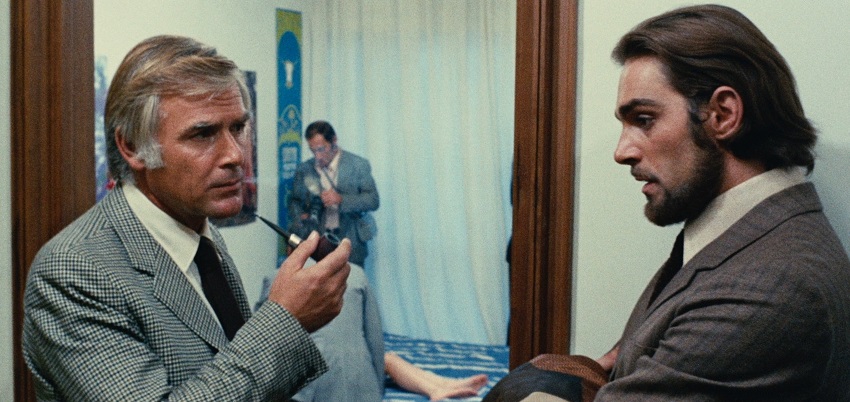
RED RINGS OF FEAR aka ENIGMA ROSSO aka RINGS OF FEAR aka TRAUMA aka VIRGIN KILLER (Italy/West Germany/Spain - 1978) Directed by Alberto Negrin. Written by Marcello Coccia, Massimo Dallamano, Franco Ferrini, Stefano Ubezio, Alberto Negrin and Peter Berling. Cast: Fabio Testi, Christine Kaufmann, Ivan Desny, Jack Taylor, Fausta Avelli, Bruno Alessandro, Tony Isbert, Helga Line, Brigitte Wagner, Caroline Ohrner, Silvia Aguilar, Taida Urruzola, Maria Asquerino, Cecilia Roth. (Unrated, 84 mins)
The final installment of a loosely-connected "Schoolgirls in Peril" trilogy that began with 1972's WHAT HAVE YOU DONE TO SOLANGE? and 1974's WHAT HAVE THEY DONE TO YOUR DAUGHTERS?, the giallo RED RINGS OF FEAR was a troubled production even before filming began. Massimo Dallamano, a career journeyman (A BLACK VEIL FOR LISA, DORIAN GRAY, THE NIGHT CHILD) who established himself as a top cinematographer in the 1960s with Sergio Leone's A FISTFUL OF DOLLARS and FOR A FEW DOLLARS MORE, directed SOLANGE and DAUGHTERS and was set to helm the third installment, but was killed in a car accident in Rome in November 1976, not long after the release of his final film, the polizia COLT 38 SPECIAL SQUAD. He was still in the process of completing the RED RINGS script, which was then cycled through an additional five credited writers--including future Dario Argento collaborator Franco Ferrini--over the next year and a half before shooting finally began. In Dallamano's stead, directing duties were assigned to Alberto Negrin, who's spent his entire career in Italian television as a go-to guy for prestigious RAI Radiotelevisione Italiana TV-movies and miniseries that would occasionally make it onto American networks, such as the 1985 miniseries MUSSOLINI AND I with Susan Sarandon, Anthony Hopkins, and Bob Hoskins as Il Duce, and 1990's VOYAGE OF TERROR: THE ACHILLE LAURO AFFAIR with Burt Lancaster and Eva Marie Saint. RED RINGS OF FEAR remains Negrin's only theatrical feature to date in a career going back to 1971, and he took the opportunity to cut loose and run with it. Typical of the sleazy direction gialli would take in the latter half of the 1970s beginning with the likes of the subtly-titled STRIP NUDE FOR YOUR KILLER, RED RINGS OF FEAR doesn't go as far as the 1979 giallo/porno crossovers GIALLO A VENEZIA and PLAY MOTEL, but it doesn't avoid embracing the trashier side of things, with a twisty and perverse story involving murders, corruption, cover-ups, abortion, and Catholic schoolgirls forced to take part in a prostitution ring being run by one of their own teachers.
Fabio Testi starred in WHAT HAVE YOU DONE TO SOLANGE? as a lecherous teacher at a posh girls school who, as per giallo rules, becomes an amateur sleuth in an attempt to get to the bottom of a mystery in which he's briefly the main suspect. Here, dubbed by the velvet tones of Ted Rusoff, he plays the actual detective in charge of the case, Insp. Gianni Di Salvo, assigned to investigate the death of a teenage girl whose genitally-mutilated corpse was found wrapped in plastic and dumped in a river near a dam. The girl was a student a nearby Catholic girls school and, from a tip by the victim's little sister Emily (Fausta Avelli), learns that she was part of a clique known as "The Inseparables." He immediately suspects the other girls are hiding something, and since it's a giallo, he's right. The investigation leads to numerous red herrings, mostly involving the teaching staff who all act like they're hiding something, including an uptight headmistress and another who pointlessly sleeps with one black glove on his bedside table. The dead girl's diary also has recurring drawings of a designer jeans logo, which eventually leads to the involvement of uncooperative clothing store owner Parravicini (Jack Taylor with a perm). Anger management case Di Salvo begins losing his patience, especially after an attempt on his life as well as an escalating body count when a teacher (Tony Isbert) is killed in a mysterious hit-and-run accident and the remaining Inseparables become targets themselves.
Unlike SOLANGE and DAUGHTERS, RED RINGS OF FEAR was never released theatrically in the US, instead going straight to video in 1985 as TRAUMA (one of its many retitlings, another being the grindhouse-ready VIRGIN KILLER), in one of those Wizard Video big boxes that also erroneously included five-time Oscar-nominee Arthur Kennedy in the credits on the packaging (he was in his share of Eurotrash movies in the mid-to-late '70s, but this wasn't one of them). It's just out now on Blu-ray from Scorpion in a restored transfer, properly framed at 2.35:1, and looking better than it ever has after decades of barely watchable VHS prints that were ported over to numerous public domain DVD sets. From the time of Dallamano's tragic death, the film was plagued with problems, from script changes to, as Nathaniel Thompson points out on the Blu-ray's commentary track, co-star Jack Taylor even claiming the film was never completely finished. At the very least, things seem to be missing and possibly never shot, which may explain the unusually brief running time of just 84 minutes. Second-billed Christine Kaufmann, an Austrian actress and former Hollywood ingenue who was married to Tony Curtis for five years after co-starring with him in 1962's TARAS BULBA, is barely in the movie as Di Salvo's kleptomaniac friend-with-benefits. It's not really clear if they already know each other when he catches her stealing cat food at the supermarket early on (some of the dialogue even hints at the possibility that she's a prostitute) and nothing results from a later revelation after they have a fight and she's next seen sleeping with Di Salvo's boss, Chief Insp. Roccaglio (Ivan Desny, dubbed by Ed Mannix). She's never seen again after that--it's unknown whether she had scenes cut or never filmed and her appearances are sporadic and pointless enough that it's not out of the question to wonder if she simply quit the movie. For a prominently-billed actress of established repute in both Europe and Hollywood (she won the Golden Globe for Best Newcomer Female for 1961's TOWN WITHOUT PITY and went on to appear in several Rainer Werner Fassbinder films before and after RED RINGS OF FEAR), it's a strangely minor and insignificant role. Spanish cult actress Helga Line (HORROR EXPRESS) also has a brief bit part as the first victim's mother and future Pedro Almodovar regular Cecilia Roth (ALL ABOUT MY MOTHER) has a small early role as a Parravicini employee sleeping with her boss. In keeping with the choppy, seemingly rushed nature of the film's assembly, Riz Ortolani's main theme sounds like it belongs more to a 1970s cop show than a giallo murder mystery (Thompson points out that it was recycled in full from Ortolani's score for Dallmano's 1973 crime film SUPERBITCH).
But RED RINGS OF FEAR holds your attention: you've got Testi's rageaholic detective barging into a school meeting and bellowing "Somebody with a cock THIS BIG raped and killed her!"; you've got a bizarre sequence where, following the designer jeans lead, Di Salvo's partner (Bruno Alessandro) goes jeans shopping and struts around in skin-tight denim; you've got Di Salvo sarcastically calling the same partner "Starsky," something obviously ad-libbed by Rusoff in the dubbing studio; you've got one victim being stabbed in the neck with a flaming hot curling iron; bullying Di Salvo interrogating and threatening a scared-shitless Parravicini on a speeding rollercoaster; there's an ominous, unsettling vibe in the dimly-lit hallways of the school, filled with intimidatingly-placed religious iconography and a statue of a scowling, finger-pointing nun at the top of the main staircase, seemingly silently and pre-emptively judging everyone who walks in the building; an Argento-like sequence where an absurd amount of marbles are poured down a staircase being ascended by one of The Inseparables; a memorable performance by young Avelli, the other little red-haired girl in 1970s Italian horror movies who was called upon when the far creepier Nicoletta Elmi was busy (Avelli is probably best known to mainstream audiences as "Sweets," the little girl O.J. Simpson is killed trying to rescue in the 1977 plague-on-a-train disaster movie THE CASSANDRA CROSSING); and, in what has to be the film's most notorious bit, a cross-cutting juxtaposition of Inseparables member Virginia (Silvia Aguilar) going to a clinic for an abortion, intercut with flashback footage of the Inseparables at the orgy where the first victim was killed, bleeding out after her vagina was penetrated and torn apart by an oversized dildo. It has to rank as one of the tackiest sequences in any giallo up to that point, made even more retroactively surreal since one of the actresses playing The Inseparables is a dead ringer for Jennifer Lawrence. It had to be hard to fathom the giallo getting any more tasteless, but fear not, the 1979 double shot of GIALLO A VENEZIA and PLAY MOTEL saw ENIGMA ROSSO's abortion/orgy jawdropper, said "Hold our beers," and introduced hardcore porn into the genre, pretty much taking things as far as they could go and effectively ending the giallo at least until it was given a post-slasher film resurrection with a return to relatively traditional, classier fare in the 1980s. RED RINGS OF FEAR is a mess, but it's got its share of unusual, inventive, and audacious moments that make it hard to outright dismiss, especially with a quality Blu-ray presentation that helps it make a credible case for itself.
The back of the Wizard Video big box from 1985,
with Arthur Kennedy mistakenly credited.
THE AMBASSADOR (US - 1985) Directed by J. Lee Thompson. Written by Max Jack. Cast: Robert Mitchum, Ellen Burstyn, Rock Hudson, Fabio Testi, Donald Pleasence, Heli Goldenberg, Michal Bat-Adam, Ori Levy, Shmulik Kraus, Avi Kleinberger, Sasson Gabai. (R, 95 mins) It was a box office flop at the time, but 1986's 52 PICK-UP has come to be regarded as a top crime thriller of its era and one of the best films to come off the Cannon assembly line in their heyday. Adapted from Elmore Leonard's 1974 novel and directed by the great John Frankenheimer, 52 PICK-UP stars Roy Scheider as Harry Mitchell, a successful L.A. businessman caught up in a web of blackmail and murder when a trio of porno industry dirtbags (the leader constantly condescendingly calling him "Sport") videotape him having sex with his young mistress, shaking him down for an exorbitant sum of money in exchange for not embarrassing his wife (Ann-Margret), the top aide to a popular mayoral candidate. When he refuses to pay, they kill the mistress and try to frame Mitchell, not understanding that he's a self-made man used to doing things his own way, bullheadedly determined to take on the blackmailers himself, manipulating them and beating them at their own game, of course inevitably leading to Scheider delivering one of his signature "Smile, you son of a bitch!" lines just as he takes out the chief shitbag ("So long, Sport!"). It's lean, mean, gritty piece of vintage '80s L.A. sleaze, not entirely faithful to Leonard--he wasn't happy that the setting was moved to L.A. from his native Detroit--but it stands today as one of the better adaptations of the author's work, which would enjoy a significant renaissance a decade later with films like GET SHORTY, OUT OF SIGHT, and JACKIE BROWN, the latter based on his novel Rum Punch.
52 PICK-UP was actually Cannon's second adaptation of Leonard's novel. Prior to the Frankenheimer film, Menahem Golan and Yoram Globus produced THE AMBASSADOR, ostensibly based on 52 Pick-Up but veering so far from the source that any mention of Leonard and the "Based on the novel by" credit weren't even included in the finished version. It was obviously a subject important to Israeli-born cousins Golan and Globus, but we may never know what it was about a decade-old, neo-noir novel set in Detroit that inspired them to turn it into a preachy polemic about Israeli-PLO relations, but that's exactly what happened with THE AMBASSADOR. The only plot point from Leonard's book that it retains is the blackmail element, but it even changes that by making it the wife's infidelity that's captured on film. One of Cannon's periodic mid '80s attempts at highbrow respectability, THE AMBASSADOR was shot in Tel Aviv and Jerusalem and wants to make serious political statements, but it also wants to be a Cannon genre picture. It wants a classy, Oscar-winning actress like Ellen Burstyn to give it awards season credibility, but it needs her topless and doing Skinemax back-arching in a couple of surprisingly revealing, sweaty sex scenes with Fabio Testi, who had just been fired from Cannon's BOLERO after clashing with Bo and John Derek and sent to Israel to have simulated sex with Ellen Burstyn instead. Burstyn is Alex Hacker, the bored, frustrated wife of Peter Hacker (Robert Mitchum, in a role that was probably pitched to Cannon regular Charles Bronson at some point), the US Ambassador to Israel. Hacker is so distracted trying to broker a peace deal between Israel and Palestine that he's completely oblivious to his wife's torrid affair with antiques dealer Mustapha Hashimi (Testi), a shady figure with lifelong ties to terrorism. After a bombing in Jerusalem, Hacker is summoned to an abandoned movie theater where he's shown a stag film of Alex and Hashimi having sex, and is promptly blackmailed in exchange for not airing the footage on TV and creating an international incident over the wife of the US Ambassador getting between the sheets with a terrorist. The blackmailers are presumed to be from the PLO, but it's actually a rogue faction of far-right Mossad agents determined to maintain the status quo. There's duplicity and double crosses, and numerous attempts on the Hackers' lives by a renegade KGB agent (Shmulik Kraus), which sends Hacker's security chief and bodyguard Stevenson (Rock Hudson in his final big-screen role) into ass-kicking Cannon action hero mode.
Dull, overly convoluted, and bearing no resemblance to the "He's through negotiating!" thriller the poster art indicated, the barely-released and justifiably obscure THE AMBASSADOR just hit Blu-ray thanks to Kino Lorber, though it's one of Cannon's worst films. It never finds the balance between serious drama and hard-hitting action, and the finale goes from laughably out-of-touch to appallingly tacky, with Hacker organizing Israeli and Palestinian youth for a candle-lit kumbaya "dialogue for young people" where he delivers a series of rambling talking points while the attendees chant "peace" before being interrupted by a machine-gunning terrorist attack with a Sam Peckinpah level of gore and splatter. It's another example of Cannon trying to have it both ways by taking what they think is a high-minded, serious film and turning it into a grindhouse action shoot-'em-up (outside of the same year's existential action classic RUNAWAY TRAIN, that kind of Cannon crossover move almost never worked). An aging Mitchum looks bleary-eyed and confused throughout, never once looking like he understands the Political Science 101 dialogue he's reciting. You could make a drinking game out of how many times he mumbles "I just want to start a dialogue for young people" and it's one he'd almost certainly be up for playing. Burstyn brings her A-game but the material is simply beneath her (surprisingly, she worked for Cannon again a few years later on the expensive Golan-directed prestige flop HANNA'S WAR), while Donald Pleasence gets to ham it up a bit as the irate Israeli defense minister.
Hudson is solid as the tough-as-nails Stevenson, working well with Mitchum even though they reportedly didn't get along well at all. Hudson was under the weather throughout the shoot and he looked slimmer than he had in the years prior to his 1981 heart attack and subsequent quintuple bypass surgery, but not in an ill way that would indicate the HIV diagnosis he would receive a few months after THE AMBASSADOR wrapped production in early 1984 (the film wasn't released until January 1985; Hudson starred with an unknown Sharon Stone in the 1984 TV-movie THE VEGAS STRIP WAR and appeared on the fifth season of DYNASTY before succumbing to AIDS in October 1985). Leadenly directed by the veteran J. Lee Thompson, who would become of the top in-house Cannon guys throughout the decade (10 TO MIDNIGHT, KING SOLOMON'S MINES, FIREWALKER, DEATH WISH 4: THE CRACKDOWN) and simplistically written by Max Jack and an uncredited Ronald M. Cohen (both vets of the short-lived 1981 ABC series AMERICAN DREAM), THE AMBASSADOR does offer one clever bit of caustic repartee between the Hackers (when she uses horseback riding as a cover story for some afternoon delight with Hashimi, Peter asks "English or western?" and she snidely replies "Bareback") but little else, jettisoning any connection to Elmore Leonard and wasting an overqualified cast in the process. At least with 52 PICK-UP, Cannon got it right the second time.
WHAT HAVE YOU DONE TO SOLANGE? (Italy/West Germany - 1972) Directed by Massimo Dallamano. Written by Bruno Di Geronimo and Massimo Dallamano. Cast: Fabio Testi, Karin Baal, Joachim Fuchsberger, Christine Galbo, Camille Keaton, Gunther W. Stoll, Claudia Botenuth, Maria Monti, Pilar Castel, Giovanna Di Bernardo, Rainer Penkert, Marco Mariani, Antonio Casale, Giancarlo Badessi, Aristide Massaccesi. (Unrated, 107 mins)
After the international success of Dario Argento's THE BIRD WITH THE CRYSTAL PLUMAGE (1970), the Italian horror/mystery subgenre known as giallo was a legitimate phenomenon. Argento is generally credited with starting the craze, but the style can be seen in its early stages as far back as Mario Bava's THE EVIL EYE (1963) and BLOOD AND BLACK LACE (1964) and other giallo prototypes like Antonio Margheriti's THE YOUNG, THE EVIL AND THE SAVAGE (1968), Romolo Guerrieri's THE SWEET BODY OF DEBORAH (1968) and Massimo Dallamano's A BLACK VEIL FOR LISA (1968). Following the breakout success of BIRD, Argento quickly followed with THE CAT O'NINE TAILS (1971) and FOUR FLIES ON GREY VELVET (1972), and the giallo floodgates were opened. Strange, poetic, verbose titles that often incorporated colors, numbers, letters, animals, a woman's name, or questions were hallmarks of the giallo movement, and Argento's films paved the way for Luciano Ercoli's THE FORBIDDEN PHOTOS OF A LADY ABOVE SUSPICION (1970) and DEATH WALKS ON HIGH HEELS (1971), Paolo Cavara's THE BLACK BELLY OF THE TARANTULA (1971), Lucio Fulci's A LIZARD IN A WOMAN'S SKIN (1971) and DON'T TORTURE A DUCKLING (1972), Riccardo Freda's THE IGUANA WITH THE TONGUE OF FIRE (1971), Duccio Tessari's THE BLOODSTAINED BUTTERFLY (1971), Emilio P. Miraglia's THE RED QUEEN KILLS 7 TIMES (1972), Giuliano Carnimeo's THE CASE OF THE BLOODY IRIS (1972), aka WHAT ARE THOSE STRANGE DROPS OF BLOOD DOING ON JENNIFER'S BODY?, Aldo Lado's SHORT NIGHT OF GLASS DOLLS (1971) and WHO SAW HER DIE? (1972), Carlos Aured's Spanish-made BLUE EYES OF THE BROKEN DOLL (1974), and several from Sergio Martino: THE CASE OF THE SCORPION'S TAIL (1971), YOUR VICE IS A LOCKED ROOM AND ONLY I HAVE THE KEY (1972), and ALL THE COLORS OF THE DARK (1972), aka THEY'RE COMING TO GET YOU, among countless others.
The gialli were also inspired by the work of prolific British mystery novelist, playwright, short-story writer, and screenwriter Edgar Wallace (1875-1932), who died while in the early stages of scripting the 1933 classic KING KONG. Wallace's works had been adapted to the big screen as far back as 1915, but the late 1950s saw a massive resurgence in Wallace's popularity in West Germany roughly 25 years after his death. In 1959, the German production company Rialto Film acquired the rights to a good chunk of the Wallace catalog and produced dozens of films based on his writings throughout the 1960s. Known as krimi, most of these were directed by Harald Reinl or Alfred Vohrer and made their way to the US as part of syndication packages aired on late-night TV and afternoon Creature Features, and like their future gialli brethren, boasted memorable titles like THE FELLOWSHIP OF THE FROG (1959), THE DEVIL'S DAFFODIL (1961), SECRETS OF THE RED ORCHID (1962), THE CURSE OF THE HIDDEN VAULT (1964), THE COLLEGE GIRL MURDERS (1967), and CREATURE WITH THE BLUE HAND (1967). The Rialto Wallace programmers featured a stock company of West Germany-based actors like Klaus Kinski, Karin Dor, Joachim Fuchsberger, Harald Leipnitz, Eddi Arent, Heinz Drache, Werner Peters, and Aidy Berber, but would occasionally import an international star like Christopher Lee. The films were so popular in West Germany that Rialto's rival studio CCC Film bought the rights to several books by Wallace's son Bryan Edgar Wallace, which were turned into a competing series of "B. Edgar Wallace" adaptations like THE STRANGLER OF BLACKMOOR CASTLE (1962), THE PHANTOM OF SOHO (1964), and THE MONSTER OF LONDON CITY (1964).
In 1972, for their final Wallace-inspired production and more or less a passing of the torch to Italian thrillers, Rialto teamed up with Clodio Cinematografica and Italian International Film to produce the Italian/West German giallo/krimi hybrid WHAT HAVE YOU DONE TO SOLANGE?, a film that attempted to balance the sleaze and the graphic violence of the gialli with the old-school, Edgar Wallace-inspired mystery of the krimi. For the most part, it succeeded, though it certainly leans more toward the giallo side of things, with the primary influence of the krimi coming from the presence of genre vets Karen Baal and Joachim Fuchsberger. If there's a poster boy for all things krimi, it's Fuchsberger (1927-2014), a busy character actor who became a beloved celebrity (nicknamed "Blacky" by friends and fans) and TV talk and game show fixture in his homeland, even serving as the stadium announcer at the opening and closing ceremonies at the ill-fated 1972 Olympics in Munich. Fuchsberger made a career playing detectives and inspectors in seemingly every krimi ever made, and of course, he's the lead detective in SOLANGE, which centers on philandering Enrico Rossini (Fabio Testi), a married gym teacher at a British girls' school who's having an affair with one of his students, Elizabeth (Christine Galbo). While the two are carrying on in a rowboat by the riverside, Elizabeth catches a flash of a blade coming from a nearby wooded area and the next day, a body is found near their canoodling spot, the woman stabbed and the knife still sticking out of her vagina. Initially dismissing Elizabeth's claims that she saw a knife, a concerned Rossini goes to the murder scene to find it swarming with police, arrives late for work and lies about having car trouble to wife and fellow teacher Herta (Baal), which blows up in his face when he's visible among the onlookers in a newspaper photograph of the murder scene on the front page of the next day's paper. This brings him into the sights of Inspector Barth (Fuchsberger), who thinks he has his prime suspect, which puts more strain on Rossini's already-fracturing relationship with the cold and brittle Herta. Elizabeth is plagued by nightmares about the murder, and more victims are found, all girls at the school and stabbed in the vagina, and though Rossini is eventually cleared as a suspect, he follows the rules of the giallo by conducting his own investigation. This ultimately leads him to the mysterious Solange (Camille Keaton, later to cement her place in exploitation history in the infamous 1978 grindhouse rape/revenge cult classic I SPIT ON YOUR GRAVE), a traumatized, mentally-disturbed young woman with a dark tragedy in her past that has a direct correlation to the horrific serial killings that also claim the life of Elizabeth.
Directed by Italian journeyman Massimo Dallamano, of the aforementioned A BLACK VEIL FOR LISA and the cinematographer on Sergio Leone's A FISTFUL OF DOLLARS (1964) and FOR A FEW DOLLARS MORE (1965), SOLANGE is very much a giallo, right down to its sordid story, and the haunting score by Ennio Morricone, with dreamy, wordless vocals by the ubiquitous Edda Dell'Orso. It's one of the great "schoolgirls in peril" slasher thrillers, a tangent of the giallo movement that began with Margheriti's THE YOUNG, THE EVIL AND THE SAVAGE, aka NAKED YOU DIE, and popularized by the likes of Narciso Ibanez Serrador's THE HOUSE THAT SCREAMED (1969), Sergio Martino's masterpiece TORSO (1973), and even Bob Clark's Canadian-made classic BLACK CHRISTMAS (1974), and Juan Piquer Simon's insane chainsaw massacre epic PIECES (1983). Even the schoolgirls-in-peril films had their own supernatural spinoffs, like Dario Argento's SUSPIRIA (1977) and PHENOMENA (1985). SOLANGE adheres to many tropes of its giallo contemporaries beyond its disturbing violence and its dark, bleak twist. Elizabeth is a murder witness haunted by a barely-glimpsed clue that's just one piece of a complicated puzzle. Rossini's wife Herta is introduced in somewhat of a misogynistic fashion as a shrewish and vaguely androgynous tight-ass, not unlike Mimsy Farmer's similarly blonde, angry, and cheated-on wife in Argento's FOUR FLIES ON GREY VELVET, with Herta only letting her tightly-bunned hair down after it's revealed that Elizabeth was a virgin and Rossini's escapades stopped at going down on her, which apparently is enough to forgive him and go full-on "Stand by Your Man." Additionally, a potential murder suspect in the school's priest Father Webber (Marco Mariani) and the possibility of the killer posing as a priest are two plot strands very much in line with the giallo's inherent distrust of religious and church figures, also a key element of DON'T TORTURE A DUCKLING, WHO SAW HER DIE? and Antonio Bido's THE BLOODSTAINED SHADOW (1978), to name a few.
Photographed by Aristide Massaccesi, the Italian exploitation legend later known as "Joe D'Amato," WHAT HAVE YOU DONE TO SOLANGE? was released in the US by Newport in 1975 as the more lurid, drive-in-ready THE SCHOOL THAT COULDN'T SCREAM. SOLANGE was the first of a very loose trilogy of Dallamano schoolgirl outings that was followed in 1974 by the giallo/polizia hybrid WHAT HAVE THEY DONE TO YOUR DAUGHTERS?, with Claudio Cassinelli and Giovanna Ralli (released in the US in 1977 under its original title and later reissued as THE COED MURDERS), and in 1978 by ENIGMA ROSSO (released on US home video in 1985 as TRAUMA), starring Testi in a different role than he played in SOLANGE. Dallamano was set to direct ROSSO but only has a co-writing credit--it was ultimately helmed by Alberto Negrin after Dallamano's tragic death in a car accident in Rome in November 1976. WHAT HAVE YOU DONE TO SOLANGE?'s cult has endured over the years for a variety of reasons--giallo superfans, hardcore krimi buffs, and the devoted horror-con fan base of the iconic Keaton, who doesn't appear until very late in the film but makes a powerful impression, starting with her memorable introduction--and was just released in a Criterion-level special edition from Arrow Video, complete with a booklet of essays, various interviews (including Baal, who really hates this movie), and a commentary track with film critics Kim Newman and Alan Jones. Firmly planted in the giallo but exhibiting a noticeable outside krimi influence, WHAT HAVE YOU DONE TO SOLANGE? is a bit of a slow-burner but is stylishly made, more emotionally-driven than most of its type, and with the devastating reveal of its still-controversial subject matter, it remains one of the most downbeat and heartbreaking of the entire Italian giallo movement.
CHINA 9 LIBERTY 37 (Italy/Spain - 1978) Directed by Monte Hellman. Written by Jerry Harvey, Douglas Venturelli, Ennio de Concini and Don Vicente Escriva. Cast: Warren Oates, Fabio Testi, Jenny Agutter, Sam Peckinpah, Romano Puppo, Isabel Mestres, Gianrico Tondinelli, Franco Interlenghi, Carlos Bravo, Sydney Lassick, Natalia Kim, Helga Line, Luis Prendes, David Thompson, Tony Brandt, Luis Barboo. (R, 102 mins) Born in 1929, Monte Hellman has always existed on the fringes of the movie industry, even on the rare occasions he found himself working for a Hollywood studio. Like many filmmakers of his generation and younger, he got his start working for Roger Corman. He made his debut with the 1959 horror cheapie BEAST FROM HAUNTED CAVE and, along with Francis Ford Coppola, Jack Hill, and others, was one of several Corman proteges involved in the assembly of Corman's 1963 patchwork THE TERROR. Hellman then directed a pair of 1964 Filipino action films, BACK DOOR TO HELL and FLIGHT TO FURY--both featuring a young Jack Nicholson, who co-wrote FLIGHT TO FURY with Hellman--and he made a name for himself in indie circles with a pair of enigmatic 1966 westerns co-starring Nicholson, RIDE IN THE WHIRLWIND (which Nicholson also wrote) and THE SHOOTING. Both were backed by Roger Corman but ended up going straight to TV and not getting any theatrical exposure until after Nicholson's big breakthrough in 1969's EASY RIDER. Hellman also benefited from the post-EASY RIDER craze of big studios backing auteur projects with minimal commercial appeal when Universal gave the greenlight to his cult classic TWO-LANE BLACKTOP. A philosophical, existential road movie where The Driver (James Taylor), The Mechanic (Dennis Wilson), The Girl (Laurie Bird), and GTO-driving GTO (Warren Oates) are the players in a slow-moving road race to nowhere in particular, TWO-LANE BLACKTOP is a mesmerizing odyssey with arguably the ultimate Warren Oates performance (it's a close call between that and Sam Peckinpah's 1974 journey into madness BRING ME THE HEAD OF ALFREDO GARCIA) and one of the all-time great final cinematic images. Hellman would re-team with Oates for 1974's COCKFIGHTER and, in a sign of odd jobs to come, began work on Hammer Films' kung-fu actioner SHATTER with Stuart Whitman and Peter Cushing before studio head Michael Carreras fired him and ended up directing the film himself. Hellman's career is filled with unrealized or partially completed projects. It would be another four years before his next film, the unlikely post-spaghetti western CHINA 9 LIBERTY 37.
Co-written by Jerry Harvey, the programming director of the influential 1970s/1980s L.A.-based pay-TV station Z Channel (the subject of the 2004 Xan Cassavetes documentary Z CHANNEL: A MAGNIFICENT OBSESSION) who would kill his wife and himself in a tragic 1988 murder-suicide, CHINA 9 LIBERTY 37--the title refers to a road sign showing the direction and distance to the two nearest towns--is offbeat, unpredictable, and very character-driven. Though it hasn't been the easiest film to see over the years, at least in Hellman's intended 102-minute form, it's become a legitimate cult classic since its extremely spotty release in 1978, the last film handled by a bankrupt and soon-to-be-defunct Allied Artists. So spotty was that initial release that CHINA 9 didn't even play in NYC until November 1984 when Lorimar, who acquired the Allied Artists library, gave it a brief relaunch that went nowhere. It's since fallen into the public domain and regularly turns up in battered, drastically edited, cropped prints on those bargain bin western collection DVD sets, almost always missing the film's explicit sex scenes and with running times ranging from 90 minutes all the way down to a pitiful 76. Hellman's director's cut has never received an official DVD or Blu-ray release but aired on the Z Channel decades ago. That changed recently, when an uncut, widescreen print was aired without fanfare on Turner Classic Movies, buried in the coveted 4:15 am time slot on a late Monday night/early Tuesday morning.
CHINA 9 LIBERTY 37 is a strange and somber mix of nihilistic spaghetti western, Hellman character piece, and loving Sam Peckinpah homage, right down to Bloody Sam getting an affectionate "Introducing Sam Peckinpah" credit for his brief appearance as a famous writer of western dime novels. Outlaw Clayton Drumm (Eurocult vet Fabio Testi, of WHAT HAVE YOU DONE TO SOLANGE? and THE BIG RACKET) is spared from the hangman when he's offered a cash reward and freedom if he kills Matthew Sebanek (Warren Oates, by this point a Hellman fixture), a proud rancher who refuses to sell his property--which rests directly in the path of a planned rail line--to the region's chief railroad baron. Drumm finds the Sebanek ranch and comes to befriend the gruff Matthew, who sees through his guest's "just passing through" act immediately and concludes that he's a hired killer. Drumm fesses up, admitting that he came there to kill him but changed his mind about going through with it because he didn't expect to like him. What Drumm likes even more is Matthew's younger, lonely, and sexually-frustrated wife Catherine (Jenny Agutter). The two have a clandestine morning fling in the river and when Matthew confronts her, things get violent and she hits him over the head with a rolling pin and stabs him in the back in self defense. Thinking he's dead, she runs off with Drumm, but once Matthew recovers, he and his loathsome brothers are hot on the lovebirds' trail, and both parties are pursued by the railroad's newest hired killer Zeb (Romano Puppo), who has orders to kill Matthew for refusing to sell the land and Drumm for not killing Matthew.
The elements are in place for a fairly standard-issue spaghetti oater, but Hellman doesn't give in to conventional story arcs. We don't expect Matthew to figure out Drumm's intent so quickly, just like we don't expect Drumm to confess and say that friendship made him change his mind about killing him. We don't expect Drumm and Catherine to feel terrible about how they've hurt Matthew. Even though the cuckolded Matthew is constantly mocked and having his manhood questioned by his vulgar younger brothers--one of whom even tries to have his own way with Catherine--he still seeks a reconciliation. He loves his wife, even though his patriarchal upbringing (often addressing her as simply "Woman...") frequently makes that difficult for her to see or for him to demonstrate. Realizing the error of his ways and understanding why she chose to run away, Matthew just wants to make things right, even if he feels compelled to kill Drumm anyway because that's what he "should" do. But there will be no showdown between Matthew and Drumm because there doesn't need to be. Like Ethan Edwards at the end of THE SEARCHERS, Drumm knows he doesn't belong here, and when Matthew insists on facing off, Drumm refuses. There's a big shootout, but it's not between the people you assume it will be. Instead, it's Matthew, Catherine, and Drumm inadvertently teaming up to take on Zeb and his posse. CHINA 9 has its stumbles--the overwrought Ronee Blakley love ballad that accompanies the ludicrous and overlong slo-mo hotel room sex scene with Drumm and Catherine is just awful, and Testi's thick Italian accent (though the supporting actors are dubbed by many familiar voices, Testi's own voice remains) sometimes makes his dialogue tough to decipher. The latter issue could just be the sound mix: Hellman stated on his Facebook page that the "restored" version," presumably what TCM aired, has some sound issues and still didn't meet with his approval. Other than Testi's sometimes garbled line readings, I didn't have any problems with the sound. Regardless, it's a fine film and probably Hellman's last good one, and it's long overdue for a proper Blu-ray edition. The beautiful-looking print shown on TCM is a huge step in the right direction, at last doing justice to Giuseppe Rotunno's cinematography.
Following CHINA 9's nearly non-existent American release, Hellman accepted a paycheck studio gig by taking over the espionage thriller AVALANCHE EXPRESS after director Mark Robson died during production in June 1978. In August 1978, shortly after Lorimar brought Hellman in to finish the film, it suffered another major setback when star Robert Shaw died unexpectedly from a heart attack while returning from a golf outing on a day off from shooting. Hellman and emergency producer Gene Corman (Roger's brother) were forced to restructure the rest of the film around Shaw's absence and subsequent rewrites caused some continuity issues that necessitated them having British voice performer Robert Rietty dub Shaw's entire performance. An uncredited Hellman and Corman (they got a "special thanks to" mention in the closing credits) did what they could to clean up the inevitable mess left behind when a movie loses its director and star in a short period of time, but the film (which also starred Lee Marvin) was a lost cause that should've been shelved, and instead opened to terrible reviews and flopped with audiences in October 1979.
Sam Peckinpah, cinematographer Giuseppe Rotunno, Sergio Leone, and Hellman during a Leone visit to the set of CHINA 9 LIBERTY 37.
Hellman spent the bulk of the 1980s prepping projects that never came to fruition. In 1988, he returned after a ten-year absence with IGUANA, a $3 million Herzog-like period drama with Everett McGill, CHINA 9 star Testi, Jess Franco regular Jack Taylor, and a young Michael Madsen that played film festivals but didn't get much of a release anywhere in the world (it ultimately appeared on home video in the US in 2000). Hellman's next project was a money job that, at least in spirit, took him back to his early Corman days: the 1989 horror sequel SILENT NIGHT, DEADLY NIGHT 3: BETTER WATCH OUT. Helming a straight-to-video third entry in a controversial splatter franchise was about as far away from THE SHOOTING and TWO-LANE BLACKTOP as an auteur like Hellman could get. He became a mentor of sorts to young Quentin Tarantino, who gave Hellman his script for RESERVOIR DOGS with the intention of having him make it until Tarantino decided to direct it himself with Hellman onboard as a producer. Hellman's involvement in RESERVOIR DOGS--how different would cinema be today had he directed it instead of Tarantino?--remains his last significant contribution to cinema to date. It would be another 16 years before he resurfaced, directing a segment of the awful 2008 horror anthology TRAPPED ASHES. 2011 brought ROAD TO NOWHERE, a tedious, barely-released nightmare noir that plays like a bad David Lynch knockoff and wasn't exactly worthy of the cineaste hype of being Hellman's first feature film in 22 years and as of now, his last. Still active at 86, Hellman teaches and seemingly prefers the emeritus scene, regularly doing Q&A's at screenings of his older films and recording commentary tracks, most recently the Criterion double feature Blu-ray release of RIDE IN THE WHIRLWIND and THE SHOOTING.
In the wake of the huge global success of Sergio Leone's A FISTFUL OF DOLLARS (1964), FOR A FEW DOLLARS MORE (1965), and THE GOOD, THE BAD AND THE UGLY (1966) came hundreds upon hundreds of spaghetti westerns that were cranked out at an astonishing rate well into the 1970s. By the early 1970s, with the coming of nihilistic American westerns like Sam Peckinpah's THE WILD BUNCH (1969), the genre segued into political westerns such as Damiano Damiani's A BULLET FOR THE GENERAL (1968), Sergio Corbucci's COMPANEROS (1968), and Leone's DUCK, YOU SUCKER (1971) before making a sharp turn towards the comedic with the success of THEY CALL ME TRINITY (1970). TRINITY made a star of Terence Hill, who had been working as a character actor for years under his real name Mario Girotti. Starting with 1967's GOD FORGIVES, I DON'T, Hill often teamed with burly Bud Spencer (real name Carlo Pedersoli) on a series of spaghetti westerns that ranged from lighthearted to outright slapstick. While American westerns got increasingly violent in response to the first wave of spaghetti westerns, this new wave, in which most characters seemed modeled after Eli Wallach's Tuco in THE GOOD, THE BAD AND THE UGLY (Wallach even played a Tuco-like character in the 1969 Hill/Spencer western ACE HIGH), was more concerned with the lighter side of the genre. The success of THEY CALL ME TRINITY led to a sequel (1971's TRINITY IS STILL MY NAME!) and tons of offshoots and unofficial sequels (even an earlier Hill film was retitled REVENGE OF TRINITY). Spaghetti western experts like Howard Hughes, author of the genre analysis Once Upon a Time in the Italian West, frequently cite 1973's MY NAME IS NOBODY as, for all practical purposes, the end of the genre. A TRINITY-inspired western-comedy produced by Leone (who also directed parts of it, though Tonino Valerii is given sole credit) and therefore bringing the genre full circle, NOBODY paired Hill with Hollywood legend Henry Fonda for the story of a goofball gunslinger goading an aging cowboy into going out in a blaze of glory by taking on a 150-man posse singlehandedly. While the film's 1974 US release flopped (it was sold as a BLAZING SADDLES knockoff), MY NAME IS NOBODY was a huge hit in Europe, and led to a Leone-produced semi-sequel A GENIUS, TWO PARTNERS AND A DUPE (1975), which was also released as NOBODY'S THE GREATEST. A few more slapstick spaghettis were produced and the genre quietly passed on as other trends, like polizias and EXORCIST ripoffs, took over.
Most audiences moved on as the spaghetti western faded into the sunset, which explains why three noteworthy (and too late for their own good) examples managed to fall through the cracks, though there were others that certainly justified the end of the genre, like Gianfranco Parolini's dreadful GOD'S GUN (1976), possibly the worst spaghetti western ever made. Lucio Fulci's FOUR OF THE APOCALYPSE (1975), Enzo G. Castellari's KEOMA (1976), and Sergio Martino's MANNAJA (1977) were about as far removed from the TRINITY school of spaghetti westerns as one could get, yet none of the three really fit in with the first or second wave of spaghettis, either. They're the kinds of bizarre, offbeat films that get made when no one's paying attention, from directors not normally associated with the genre.
FOUR OF THE APOCALYPSE (Italy - 1975)
Directed by Lucio Fulci. Written by Ennio De Concini. Cast: Fabio Testi, Tomas Milian, Lynne Frederick, Michael J. Pollard, Harry Baird, Donald O'Brien, Adolfo Lastretti, Bruno Corazzari, Lorenzo Robledo. (Unrated, 104 mins)
FOUR OF THE APOCALYPSE was directed by Lucio Fulci, then a jobbing journeyman just a few years away from cementing his place in cult movie history with 1979's ZOMBIE. Gambler and card cheat Stubby Preston (Fabio Testi) arrives in Salt Flat for his latest con game and is quickly kicked out of town by the sheriff (Donald O'Brien), along with three other miscreants: pregnant prostitute Bunny (Lynne Frederick), town drunk Clem (Michael J. Pollard), and the crazed Butt (Harry Baird), who claims to see dead people. Taking a coach and heading to Stubby's next stop of Sand City, the quartet are joined by depraved outlaw Chaco (Tomas Milian), who drugs them and rapes Bunny before shooting Clem in the leg and riding off. Vowing revenge on Chaco, Stubby pulls this odd "family" together as romance blooms between with Bunny and he decides to change his dishonest ways. There's very little in the way of action in this low-key, character-driven film, with most of the graphic bloodletting confined to the opening and closing sequences. With its odd characters and set pieces, its soft rock soundtrack, and its general eccentric quirkiness, it almost feels like Robert Altman, Arthur Penn, or George Roy Hill took a break from Hollywood and decided to go to Italy to make a spaghetti western just for the hell of it (it's probably not a coincidence that BONNIE AND CLYDE Oscar-nominee Pollard is in the cast). It's a film with surprising heart and shocking transgression, and the latter shouldn't be surprising given that it's a Lucio Fulci film. The bond that forms between the four outcasts feels genuine, and Fulci films rarely get more sensitively heartfelt than the moment when a dreary, depressed town filled with hard-bitten old bastards beaten down by life finds joy and hope in the cries of Bunny's newborn baby. It's moments like this that contrast sharply with Chaco's violation of Bunny, his horrific torture of a sheriff (perpetual victim Lorenzo Robledo, the Sean Bean of spaghetti westerns) and Butt's final meltdown after Clem dies, when Stubby finds out that the delicious meal Butt prepared for them is...Clem.
The four leads work very well together, though I wish Pollard's Clem had more to do and Butt's disappearance is abrupt and clumsily-handled (and may be due to British actor Baird's health issues; he was suffering from glaucoma and went blind around the mid-1970s--he died in 2005 but FOUR OF THE APOCALYPSE was his last film and the character's vanishing act looks like a textbook example of an actor suddenly being unavailable). Milian doesn't have a lot of screen time but is a truly repulsive bad guy (and it's one of the rare instances where he's dubbing himself in an Italian film). The effectively American-sounding score was composed by Bixio-Frizzi-Tempera, with songs performed by European duo Greenfield & Cook with the Benjamin Franklin Group. FOUR OF THE APOCALYPSE is a strange film that refuses labels. The brief, horrific foray into cannibalism and the emotional third act exemplify the kind of wild unpredictability that makes the film such a one-of-a-kind entry in both the spaghetti western genre and Fulci's filmography.
KEOMA (Italy - 1976)
Directed by Enzo G. Castellari. Written by Mino Roli, Nico Ducci, Luigi Montefiori, Enzo G. Castellari. Cast: Franco Nero, Woody Strode, William Berger, Olga Karlatos, Orso Maria Guerrini, Antonio Marsina, Gabriella Giaccobe, John Loffredo (Joshua Sinclair), Donald O'Brien, Leon Lenoir, Wolfango Soldati, Victoria Zinny, Massimo Vanni, Giovanni Cianfriglia. (Unrated, 101 mins)
Like many Italian genre directors, Enzo G. Castellari dabbled in a little of everything until he found his niche, first with Franco Nero-headlined crime thrillers like HIGH CRIME (1973) and STREET LAW (1974), and later with the Italian WARRIORS ripoff 1990: THE BRONX WARRIORS (1983) and the post-nuke THE NEW BARBARIANS (1983). He made everything from macaroni combat adventures like EAGLES OVER LONDON (1970) and THE INGLORIOUS BASTARDS (1978) to gialli like COLD EYES OF FEAR (1971), and had a few first-wave spaghetti westerns under his belt, like ANY GUN CAN PLAY (1967) and KILL THEM ALL AND COME BACK ALONE (1970). He also directed the dismal TRINITY ripoff CRY ONION (1976), one of the worst spaghetti westerns ever made despite a fascinating cast that included Nero, Sterling Hayden, Martin Balsam, legendary Chicago Bears linebacker Dick Butkus, and a farting horse. Perhaps to wash away the foul taste of CRY ONION, Castellari and Nero immediately reteamed for the more serious spaghetti throwback KEOMA.
KEOMA finds the Castellari-Nero alliance in fine form with Nero as the half-breed Keoma, who returns to his home after the Civil War to find the area a plague-infested wasteland ruled by the evil Caldwell (Donald O'Brien), a Confederate officer who took over the town and whose shady business dealings resulted in a polluted well that's killed off much of the population. Keoma immediately gets on Caldwell's bad side when he kills a couple of his flunkies who were terrorizing pregnant widow Lisa (Olga Karlatos). Things get even more complicated when Keoma must deal with his loathsome half-brothers (Orso Maria Guerrini, Antonio Marsina, and Joshua Sinclair), who never accepted Keoma as their father's (William Berger) son and now very inconveniently work for Caldwell.
"Lemme hear ya say KEOMA!"
Even though it arrived three years after the effective end of the spaghetti western, KEOMA was well-received by European fans eager to see Nero back in DJANGO mode after ten years. As far as I can tell, KEOMA never got a US theatrical release, which seems odd considering that even CRY ONION made it to a few US theaters in 1980. There's definitely a post-WILD BUNCH Peckinpah feel to the directorial style Castellari uses here, not so much in the violence (which is plentiful but not particularly bloody), but in the frequent use of slo-mo in the action scenes. Also notable is the imaginatively-staged finale with Keoma taking on his brothers while Lisa gives birth--as the mayhem ensues, we don't hear the gunfire but rather, the pained screams of Lisa and nothing else as Keoma's brothers are murdered. It's an initially disorienting effect that's ultimately a very creative use of sound and editing by Castellari and his regular editor Gianfranco Amicucci. There's also some crucifixion/resurrection symbolism and a witch (Gabriella Giaccobe), who may not be real and could represent Keoma's conscience. Nero, dubbing himself, is at the top of his game here, and KEOMA also benefits from the unusual casting of career badass Woody Strode as the disgraced and bullied town drunk who was once an idol to a young Keoma and sees the battle against Caldwell as his one shot at redemption. If there's one thing that's prevented KEOMA from becoming a legit spaghetti western classic and made it a target of ridicule, it's the absolutely terrible score by the usually-reliable Guido & Maurizio De Angelis, filled with badly-croaked songs that function as a Greek chorus warbled by singers for whom English is a second language. Sure, most of these films have goofy scores and silly songs, but the tunes in KEOMA are exceptionally godawful. Aside from that, KEOMA is top-notch.
MANNAJA aka A MAN CALLED BLADE (Italy - 1977)
Directed by Sergio Martino. Written by Sauro Scavolini, Sergio Martino. Cast: Maurizio Merli, John Steiner, Philippe Leroy, Martine Brochard, Sonya Jeannine, Donald O'Brien, Salvatore Puntillo, Rick Battaglia, Nino Casale, Enzo Fiermonte, Nello Pazzafini. (Unrated, 96 mins)
Maurizio Merli began his career in Italian genre fare as a second-string Franco Nero but briefly became a superstar in the mid-1970s with a string of extremely violent police thrillers like Umberto Lenzi's incredible ROME ARMED TO THE TEETH aka THE TOUGH ONES (1976). Usually playing a hard-nosed cop with anger management issues and a tendency to play by his own rules, Merli's Harry Callahan-like characters (he played different cops with names like Tanzi, Berni, and Betti, but they were all basically "Maurizio Merli") made him a sort-of Italian Clint Eastwood, but as the polizia films went out of style by the early 1980s, so did Merli. He drifted into Italian TV gigs and had a supporting role in the 1981 British drama PRIEST OF LOVE with Ian McKellen, but he never broke into American movies and never got to have his big Tarantino comeback: Merli was only 49 when he died in 1989 from a sudden, massive heart attack while playing tennis.
Merli's day in the sun was relatively brief, but he's become a beloved cult figure with fans of 1970s Italian cop thrillers. It's possible that the only reason MANNAJA got made was because Merli wanted to make a western and became a star after the genre faded away. MANNAJA was pretty much last call for the spaghetti western cycle. It's the last noteworthy one (though Fulci managed to sneak in SILVER SADDLE in 1978), and by this time, even the comedic TRINITY knockoffs had ceased being made and Italian genre fare was moving in a different direction, namely ripoffs of blockbuster American movies. MANNAJA was directed by Sergio Martino (1973's TORSO), who had one spaghetti western to his credit (1970's ARIZONA COLT RETURNS), but was known mainly for his early 1970s giallo collaborations with the stunning Edwige Fenech. Martino, like Fulci and Castellari, pinballed around the Italian B-movie scene for years but found his niche relatively early, and when gialli became passe, he tried his hand a bit of everything: cop thrillers (1975's SUSPECTED DEATH OF A MINOR), sex comedies (1976's SEX WITH A SMILE), cannibal horror (1978's MOUNTAIN OF THE CANNIBAL GOD), and post-nuke (1983's 2019: AFTER THE FALL OF NEW YORK), and almost everything in between. MANNAJA is stylistically interesting for its excessively foggy look, and Martino shoots some scenes as if he were making a horror movie (also helping this is a recurrent pulsating electronic music cue that sounds like it belongs in a zombie flick). It's a pretty standard western overall, but there are interesting touches throughout that make it a unique entry in the field.
Blade!
Blade (Merli) is a tomahawk-hurling, fur-coat-wearing bounty hunter who arrives in Suttonville to claim the reward for the wanted Burt Craven (Donald O'Brien, a fixture in these last spaghettis). Blade lets Craven go when he finds out that Suttonville has no marshal and the only law is McGowan (Philippe Leroy), a puritanical, religious fanatic mining magnate who rules the town and whose irresponsible business practices have created a smoggy, foggy pollution and a sick but practically enslaved work force (a "job creator," if you will). Blade irritates McGowan's top strongarm Voller (an expectedly hammy John Steiner) by jockeying for his job, but Blade has an ulterior motive: McGowan ran Blade's father off their land in the process of building his empire, and inadvertantly caused Blade Sr's death. Sick of taking orders from McGowan, Voller kidnaps his boss' daughter Deborah (Sonya Jeannine), setting off a chain of events that will, of course, lead to Maurizio Merli kicking all sorts of ass.
John Steiner as Voller
Merli tones down his rageaholic act a tad for MANNAJA, but he's still a solid hero and it's a shame his career didn't last longer. Martino achieves a nicely foreboding look to the film with all the fog and mud, and the way Blade emerges from the fog for his showdown with Voller is a great shot. Other than that, there's not much about MANNAJA that's very innovative, but it's an enjoyable actioner and a worthy eulogy for the genre, even if it gives us another batch of ill-advised Greek chorus songs from Guido & Maurizio De Angelis illustrating obvious plot points, this time with the croaking singer from the KEOMA soundtrack trading verses with a guy who's trying way too hard to sound like David Bowie.