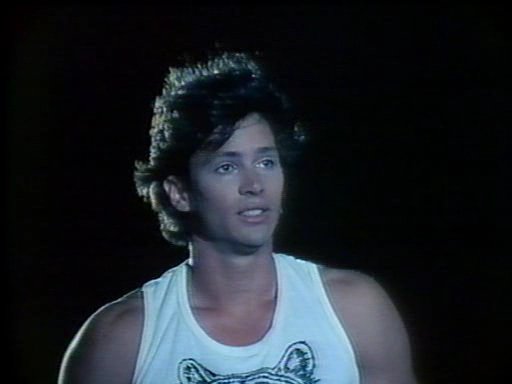
AMERICAN RICKSHAW aka AMERICAN TIGER (Italy - 1989; US release 1991) Directed by Martin Dolman (Sergio Martino). Written by Sauro Scavolini, Roberto Leoni and Maria Perrone Capano. Cast: Mitch Gaylord, Daniel Greene, Victoria Prouty, Donald Pleasence, Michi Kobi, Roger Pretto, Regina Rodriguez, Darin De Paul, Judi Clayton, Glenn Maska, Carmen Lopez, Gregg Todd Davis, Sherrie Rose, Von B. Von Lindenberg. (Unrated, 96 mins) Like me, if you saw the generic-looking AMERICAN TIGER VHS cover art to the left in the video store back in the early '90s, you probably didn't even give it a second glance. There was Mitch Gaylord, who led the gold medal-winning US gymnastics team at the 1984 Summer Olympics on his way to washing out as a leading man in the 1986 flop AMERICAN ANTHEM, slumming in what appeared to be a run-of-the-mill Italian-made actioner of some sort with the meaningless tag line "Miami just got hotter..." just in case the pastel color scheme didn't already vaguely remind you of MIAMI VICE. Oh, what a foolish mistake we made by dismissing this and putting this back on the shelf! Released in Europe in 1989 under its original title AMERICAN RICKSHAW, the film was retitled by Academy Entertainment for its 1991 straight-to-video release in the US, and you almost have to wonder if the marketing people at Academy ever bothered to watch it.
For about an hour, it's a somewhat slow-moving and barely-coherent hodgepodge of action, blackmail, sex, intrigue, religious cults, supernatural horror, and nonsensical Asian mysticism with some bonus inaccurate folklore that has about as much legitimacy as the old Calgon "Ancient Chinese Secret!" commercial. It seems as if director Sergio Martino (under his frequent '80s pseudonym "Martin Dolman") and co-writers Sauro Scavolini (YOUR VICE IS A LOCKED ROOM AND ONLY I HAVE THE KEY) and Roberto Leoni (THE FINAL EXECUTIONER, SANTA SANGRE) are riffing on BIG TROUBLE IN LITTLE CHINA, and it progresses in a weird enough way until the last half hour, when AMERICAN RICKSHAW goes so off-the-rails bonkers on a one-way trip to Crazytown that even attempting to explain it is an exercise in futility. The fact that there's almost no cult following around this thing has to be blamed on either that bland Academy Entertainment VHS cover (the Italian poster seen above at least appears to sell the supernatural angle) or on people who did rent it ejecting it halfway through out of boredom, while the select few who are aware of it have done a good job of keeping it to themselves. That finally seems to be changing, as AMERICAN RICKSHAW is one of the inaugural releases of the new Blu-ray company Cauldron Films, because physical media is dead. It probably ranks second on the list of 2020's insane Blu-ray resurrections, right after Arrow's WHITE FIRE (WHITE FI-YAAA!), and like that film, it warms my heart to know that there's still mind-blowing gems like this hiding out there, overlooked in their day and patiently waiting all these years to be unearthed.
Much like what happened with NYC and Atlanta in the late '70s and early '80s and with Fabrizio De Angelis' hostile takeover of Page, AZ in the mid '80s, AMERICAN RICKSHAW was produced during a time when Italian exploitation guys were a regular presence in Florida, particularly the Miami area, where Martino shot the boxing drama THE OPPONENT a year earlier. Gaylord stars as college kid Scott Edwards, studying engineering while working part-time at American Rickshaw, a rickshaw service that's big in the tourist areas and popular night spots. One night, his fare, a sultry stripper named Joanna (Victoria Prouty in her simultaneous debut and farewell from cinema) seduces him on a boat, where he discovers a perv hiding in the closet has videotaped the encounter. An enraged Scott beats the shit out of the perv--cutting his own foot on some broken glass in the process--and makes off with the videotape, but discovers when he gets home that it's the wrong one. He goes back to the boat to find the perv drowned in the toilet, and his blood, his fingerprints, and a missing sex tape putting him right there at the murder scene.
A fire ignites and destroys the boat, but the tape is in the possession of ruthless assassin Francis (FALCON CREST's Daniel Greene, who starred in several Martino films starting with 1986's HANDS OF STEEL). He's looking for a key that was on a necklace worn by the dead perv, who's revealed to be Jason Mortom (Gregg Todd Davis), the black sheep son of frothing, fire-and-brimstone megachurch televangelist Rev. Samuel Mortom (Donald Pleasence, chewing on a really hammy Southern accent). It seems--and yes, this gets complicated--Jason and Scott were born on the same day--June 6, 1966 in the Year of the Tiger, according to the Chinese calendar (note: 1966 is not a Year of the Tiger, but 1962 and 1976 are; 1966 is a Year of the Horse, so the movie doesn't even get it right)--and for their entire lives, they've been "linked" and watched over psychically from afar by elderly Chinese mystic Madame Luna (Michi Kobi). She was once in possession of a glowing talisman that holds the key to immortality, and it was stolen from her years ago by the evil Rev. Mortom, in actuality a cult leader who has assigned disciple Francis to retrieve it after Jason stashes it in a train station locker as part of an extortion plot against his father.
By the time one of the cops investigating Jason's death conveniently turns out to be a secret expert in Chinese folklore ("They were born on the same day! 6/6/1966 is the day of four sixes! The high point of the Year of the Tiger, the day of maximum power!" he breathlessly exclaims to his unimpressed partner) and characters start babbling about "celestial spheres," "The Stone of Evil," and "The Urn of Wisdom," things start to seem less like the Van Damme knockoff that the AMERICAN TIGER box art was selling and more like the lyrical outline to an abandoned Anderson Bruford Wakeman Howe concept album. This sets up a string of events--including Scott threatening Joanna with a needle and warning "You scream, I swear to God I'm gonna stick you with this thing. I found it in the gutter, I'm sure you're familiar with AIDS!" and one of the greatest dummy deaths I've ever seen--culminating in a jawdropper of a climax that's equal parts VIDEODROME and SPIRITED AWAY, and certainly belongs in the Donald Pleasence career highlight reel.
Pleasence probably only worked on this for a day or two (he was in nine movies in 1989, including another one for Martino, CASABLANCA EXPRESS), but he really immerses himself in his Southern drawl ("Aah shale keel yuuuuuu!"). Unlike most Italian productions of the time, AMERICAN RICKSHAW was shot with live sound aside from a couple of bit players who sound revoiced by veteran dubber Nick Alexander. There are no Italians in the cast, with the supporting roles filled by regional actors from the Miami and Fort Lauderdale areas (Davis was also in THE OPPONENT and Umberto Lenzi's Miami-lensed NIGHTMARE BEACH around the same time, and Judy Clayton, as Rev. Mortom's wife, later had small roles in Florida-shot titles like COP AND A HALF, ACE VENTURA: PET DETECTIVE, and BULLY). Mitch Gaylord's place as an Olympic hero is secure, but his big-screen aspirations never panned out. After AMERICAN RICKSHAW, he landed roles in two post-BASIC INSTINCT unrated DTV erotic thrillers--1992's ANIMAL INSTINCTS and 1994's SEXUAL OUTLAWS--and served as Chris O'Donnell's stunt double in BATMAN FOREVER. Aside from a one-off return with a supporting role in the 2005 indie comedy CONFESSIONS OF AN ACTION STAR, his acting career appears to be on permanent hold, though he remained active in the sports world, covering gymnastics for NBC Sports and Fox Sports, and found some success as a fitness guru and motivational speaker. It's doubtful AMERICAN RICKSHAW ever came up in his presentations. It needs to.
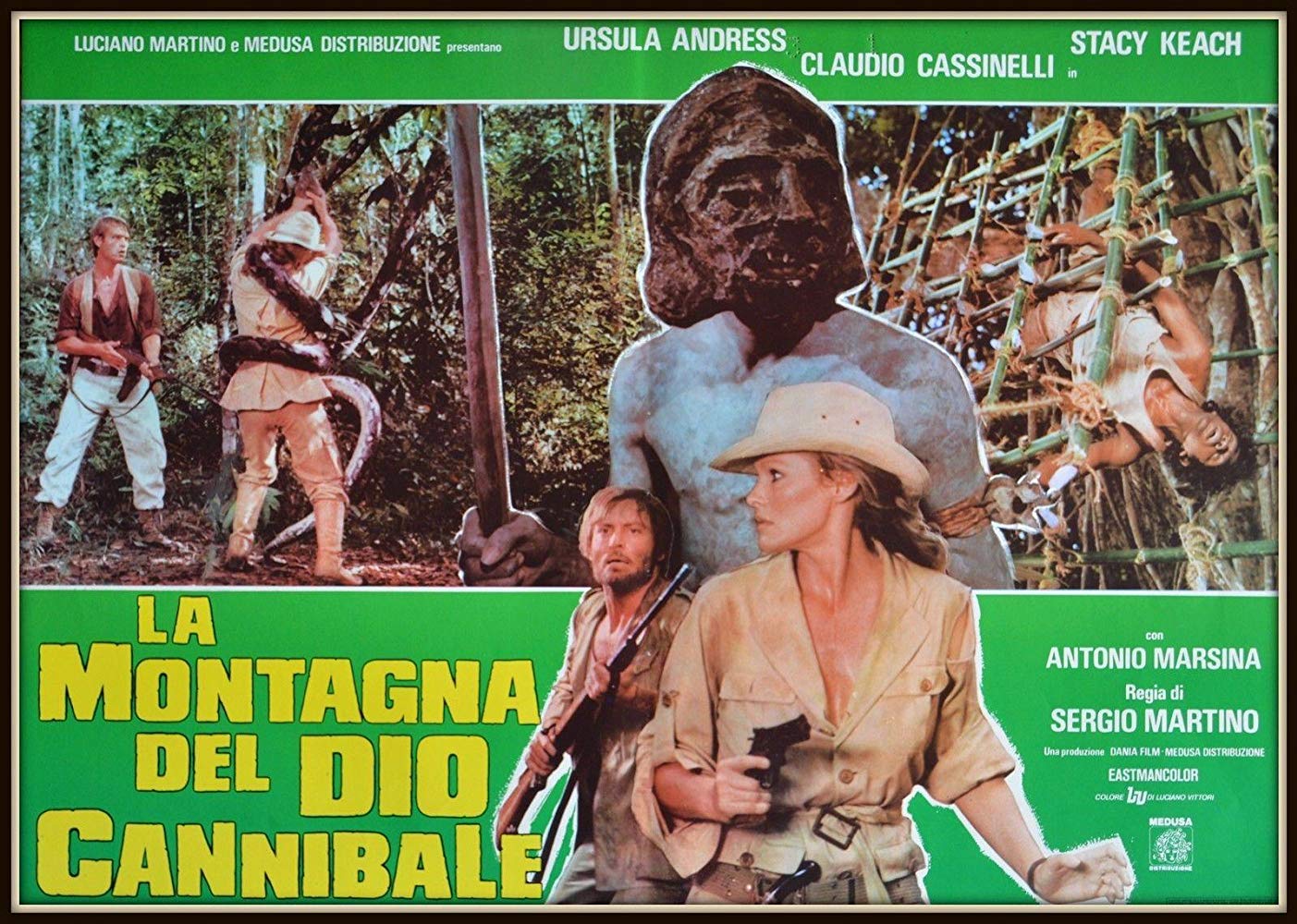
SLAVE OF THE CANNIBAL GOD aka MOUNTAIN OF THE CANNIBAL GOD (Italy - 1978; US release 1979) Directed by Sergio Martino. Written by Cesare Frugoni and Sergio Martino. Cast: Ursula Andress, Stacy Keach, Claudio Cassinelli, Antonio Marsina, Franco Fantasia, Lanfranco Spinola, Carlo Longhi, Luigina Rocchi, Akushla Sellajaah, T.M. Munna, M. Suki, Dudley Wanaguru, Gianfranco Coduti. (R, 85 mins/Unrated, 103 mins) Not as consistently disgusting as some of its more notorious contemporaries in the Italian cannibal craze, Sergio Martino's 1978 contribution MOUNTAIN OF THE CANNIBAL GOD is almost a mondo take on a traditional jungle adventure for most of its duration. That's especially the case in its significantly truncated US version, retitled SLAVE OF THE CANNIBAL GOD and released on the drive-in circuit by a relatively fledgling, pre-Freddy Krueger New Line Cinema in the spring and summer of 1979. Both versions--Martino's full-strength 103-minute director's cut and New Line's 85-minute US re-edit--are on Code Red's just-released SLAVE OF THE CANNIBAL GOD Blu-ray (because physical media is dead), and they offer a study in contrasts where each has its own unique strengths, the US cut in part because New Line saw fit to trim some of the fat. Indeed, the R-rated, 85-minute cut is better-paced and eliminates a talky early scene at the British consulate that ultimately makes no sense in the longer version. And while it retains a surprising amount of onscreen animal killing--always the major deterrent when it comes to one's ability to enjoy this type of tawdry exploitation fare--it suffers from almost complete lack of any graphic gut-munching, usually leaving the aftermath or reaction shots of other actors. In Martino's version, one major character is disemboweled and devoured, with a lingering shot of what feels like a mile of intestinal tract being yanked out of his gut, while in the US cut, it's reduced to one distant shot of the tribe chieftain holding up the victim's heart. Likewise, a graphic castration shown in Martino's version is merely implied in the US cut. The biggest difference in the uncut version is the inclusion of a CALIGULA-esque cannibal orgy, with some up-close and borderline pornographic footage of a young tribal woman masturbating along with some simulated bestiality involving a tribesman and a large pig. These shots were included in Martino's reconstructed version originally released by Anchor Bay back in the halcyon days of the Eurocult DVD explosion, and are understandably nowhere to be found in New Line's American cut. At the end of the day, regardless of which version of SLAVE OF THE CANNIBAL GOD you watch, both are trashy enough to make you wonder what the hell Stacy Keach and Ursula Andress are doing in it.
Andress is wealthy Susan Stevenson, who arrives in New Guinea with her younger brother Arthur (Antonio Marsina) in search of her missing explorer husband Henry (played in photos by perennial Eurocult bit player Tom Felleghy). They believe he was headed for the cursed mountain of Ra-Rami on the island of Roka, but the British consulate refuses to authorize a search and rescue mission. They instead direct her to Dr. Edward Foster (Keach), an anthropologist who happens to have been a close associate of Henry's (if you're wondering why she didn't just go to him in the first place, the US cut completely removes the ultimately pointless sequence at the British consulate) and is the only person who's been to Ra-Rami and made it back alive. Foster agrees to guide them on the treacherous trek to Roka, though tensions soon flare between him and the obnoxious Arthur and they're eventually joined by rugged adventurer Manolo (Martino regular Claudio Cassinelli). Foster confesses that he was captured by the Puka, a tribe on Roka, and was forced to partake in their cannibal rituals ("You never forget the taste of human flesh!" Foster cries in what's not one of Keach's most dignified moments), and is going along on the trek not to save Henry, but to wipe out the Puka once and for all. Susan and Arthur have their own secret, as she's not quite the probable grieving widow (she attempts to seduce Manolo), but is instead driven by TREASURE OF THE SIERRA MADRE-esque greed and wiling to put Foster and Manolo at risk, knowing Henry was searching for a massive secret uranium deposit on Roka, and they want those riches for themselves.
The expedition is whittled down, from Foster's native guides getting killed along the way to Keach making an abrupt exit with about 35 minutes to go when an injured Foster falls down a waterfall in one of Eurotrash cinema's more hilarious dummy deaths. Susan, Arthur, and Manolo are captured by the Puka and are introduced to the decaying, oozing corpse of her husband, with a Geiger counter planted in his chest and worshiped like a god by the Puka. Then they're submitted to the usual cannibal ritual antics--Arthur is eaten, Manolo forced to watch, and Susan is stripped nude and given a long, lingering oil and body paint rubdown in a scene that would be repeated with Alexandra Delli Colli in DOCTOR BUTCHER M.D. and with Bo Derek in TARZAN THE APE MAN, directed by her husband John Derek, who was once married to--wait for it--Ursula Andress. Martino's version comes to a screeching halt with the X-rated orgy, which really slows things down in a way that makes the third act of the US version move a lot faster, but it's also missing Arthur's disgusting demise, instead relying on Cassinelli reaction shots to convey the horrors taking place. It's worth noting that neither Andress nor Keach are around for the really gross stuff other than an early scene where Foster's guides capture a small crocodile and slice it open for food. Keach is killed off before they even encounter the cannibals, but up to that point, much of the big names' interactions with the horrific onscreen carnage was limited to the magic of the cutting room: the explorers are rowing along a river and someone says "Look!" as Martino cuts to footage of a giant lizard barfing up a snake (that one's not in the New Line version). Martino also gets a thumbs down for a morally bankrupt shot of a monkey being thrown by some rigged mechanism right into the waiting mouth of a large crocodile (that's in the New Line version), essentially negating the oft-repeated argument from directors of these cannibal films that these were examples of "survival of the fittest" caught on camera (some of SLAVE's animal killings were later recycled by Umberto Lenzi for 1980's EATEN ALIVE).
Martino's uncut version looks terrific on Code Red's Blu, and there's an HD transfer of the US cut that's not quite as good in quality but still looks better than it has in any home video incarnation. Keach is on hand for a new interview and expresses no regrets over appearing in the film (this was the same year that his uptight Sgt. Stedenko was a memorable foil to Cheech and Chong in UP IN SMOKE), saying it offered him a chance to work with Andress and to see Sri Lanka. where the exteriors were shot, and where Martino and Cassinelli would return for 1979's THE GREAT ALLIGATOR. He has some vivid memories of the shoot and shares stories about Andress and Cassinelli, and has a good laugh at his ridiculous death scene, but he still doesn't seem to be fully aware of just how foul SLAVE gets in the last third after he was no longer around. 1978 found Keach at the end of a brief sojourn into Eurocult, which included the 1976 gangster thriller STREET PEOPLE and Umberto Lenzi's cheap-looking 1978 WWII saga THE GREATEST BATTLE. But none of those were as dubious as SLAVE OF THE CANNIBAL GOD, where the involvement of respectable actors like Keach and Andress is certainly on par with Henry Fonda in TENTACLES and Richard Harris in STRIKE COMMANDO 2 in the "How the fuck did this happen?" chronicles of Italian trash cinema.
DEVILFISH aka MONSTER SHARK (Italy/France - 1984; US release 1986) Directed by John Old Jr (Lamberto Bava). Written by Gianfranco Clerici, Frank Walker (Vincenzo Mannino), Dardano Sacchetti and Herve Piccini. Cast: Michael Sopkiw, Valentine Monnier, John Garko (Gianni Garko), William Berger, Dagmar Lassander, Iris Peynado, Lawrence Morgant, Cinthia Stewart (Cinzia de Ponti), Paul Branco, Dino Conti, Darla N. Warner, Goffredo Unger. (Unrated, 94 mins) With its Key West locations and Florida setting at "Seaquarium," it's likely that DEVILFISH (aka MONSTER SHARK) was meant to be a low-rent Italian ripoff of JAWS 3-D. Showcasing one of the most amateurishly cheap-looking monsters this side Roger Corman's IT CONQUERED THE WORLD, DEVILFISH is a flat-out terrible movie and completely deserving of its MST3K skewering back in the day, but it has its undeniable charms for Eurocult aficionados. Considering how shoddy and stupid the film is, there's a surprising amount of top Italian genre talent for the time. It's directed by Lamberto Bava (under the pseudonym "John Old Jr," a shout-out to his father Mario's alias on 1963's THE WHIP AND THE BODY), after his impressive early films MACABRE (1980) and A BLADE IN THE DARK (1982) and just a year before establishing himself as a major name in Italian horror with 1985's Dario Argento-produced DEMONS (DEVILFISH apparently made it into a handful of US theaters courtesy of Cinema Shares in 1986 before its VHS release by Vidmark Entertainment). It's co-written by Eurocult stalwart and frequent Lucio Fulci collaborator Dardano Sacchetti (CITY OF THE LIVING DEAD), from a story co-conceived by Luigi Cozzi (STARCRASH) and Sergio Martino (TORSO). Bruno Mattei (STRIKE COMMANDO) was an assistant director, and the score is by Fabio Frizzi under the pseudonym "Antony Barrymore." Nobody is having their best day here, but it may be a case of too many cooks in the kitchen. It's hard to believe that Cozzi, Martino, Sacchetti, and Bava all had a hand in some of the illogical idiocy that unfolds in DEVILFISH. It's the kind of movie where people trying to find the location of a deadly creature that's part-octopus and part-prehistoric fish decide to take advantage of their downtime by going for a leisurely swim in the very area they're canvassing. It's the kind of movie where the sheriff is told that the creature can reproduce more of itself from its own severed flesh, and decides the best solution is to grab a shotgun and try to blow it into a million pieces. It's the kind of movie where a covert project to secretly develop a killer sea monster is stealthily codenamed "Sea Killer." It's the kind of movie where Bava tries to pull off some dazzling camera moves and ends up with an unexpected cameo by one of the lead actor's balls.
There's an unusual amount of exposition, intrigue, and soap opera histrionics, most of it just for the apparent sake of killing time and keeping the laughable creature offscreen as long as possible. A body is pulled out of the ocean with its legs bitten off, and cranky Sheriff Gordon (Gianni Garko) doesn't think it's an accident. Meanwhile, Seaquarium marine biologist Bob Hogan (Dino Conti) and dolphin trainer Stella Dickens (Valentine Monnier) get sonar readings and imagery indicating a large creature of some sort lurking in the deep waters. They get help from local electrician and equipment supplier Peter (Michael Sopkiw, who starred with Monnier in 2019: AFTER THE FALL OF NEW YORK and would reteam with Bava for BLASTFIGHTER) and outside oceanography expert Dr. Janet Bates (Darla N. Warner) and begin tracking down the aquatic monster, revealed to be man-made crossbreed of an octopus with the DNA of an extinct sea creature from the age of dinosaurs.
Code Red just released DEVILFISH on Blu-ray under the title MONSTER SHARK (because physical media is dead), and it looks great in its proper aspect ratio and its HD upgrade, but the commentary is yet another embarrassing shitshow typical of Code Red head Bill Olsen. Sopkiw (who left the movie business after his fourth film, 1985's MASSACRE IN DINOSAUR VALLEY) is on hand, along with DIY cult filmmaker Damon Packard, and to the surprise of no one, it's mostly useless and filled with erroneous information that shows that no research was done by either moderator prior to the recording. Sopkiw seems nice enough (nicer and more cooperative than he was with Nathaniel Thompson on the BLASTFIGHTER Blu) but he doesn't know much about movies, doesn't seem to like movies, and his memory is foggy on a lot of things, while Olsen (seen with Sopkiw in an intro before the movie and wearing his "Banana Man" costume, which he still seems to think people find amusing) almost instantly lapses into his usual schtick of mispronouncing Italian names a minute into the movie and fixating on inconsequential matters (he seems really perturbed that Sergio Martino didn't "die-rect" the movie and keeps bringing it up, despite Sopkiw repeatedly telling him that he didn't even know Martino came up with the story). Neither Olsen nor Packard have any idea who anyone in the supporting cast is. They think Iris Peynado is "Cynthia du Ponti" (Sopkiw doesn't remember Peynado's name and agrees with them), then they think Cinzia de Ponti is Dagmar Lassander. They think William Berger is Italian and his name was a pseudonym (nope--born in Austria, birth name Wilhelm Berger). Packard thinks Mario Bava directed SUSPIRIA (he does correct himself with "Oh, that was Argento," which is appreciated, but the proper thing to do after such a gaffe would be to just get up and leave). They ask Sopkiw if he dubbed himself, which he obviously didn't, then Packard seems surprised to learn that actors in multi-country co-productions were often speaking different languages on set before being revoiced in post. I'm sorry, but if you're moderating a commentary track for a specific film, there's an assumption on the part of the listener that you know something about the subject at hand. I bought the Blu-ray. I shouldn't be correcting these guys in my head as they go. Dagmar Lassander has been in a ton of Eurocult movies. They should know who she is. I realize this is only DEVILFISH we're talking about here, but can we get our shit together, fellas? Is that asking too much? If only there was some kind of website on the Internet that served as a sort-of database of movies or maybe even an easy-to-navigate search engine that could've been consulted for research on the film you're fucking talking about...
THE VIOLENT PROFESSIONALS (Italy - 1973; US release 1975) Directed by Sergio Martino. Written by Ernesto Gastaldi. Cast: Luc Merenda, Richard Conte, Silvano Tranquilli, Carlo Alighiero, Martine Brochard, Chris Avram, Luciano Bartoli, Lia Tanzi, Steffen Zacharias, Bruno Corazzari, Luciano Rossi, Cyrille Spiga, Rosario Borelli, Antony Vernon (Antonio Casale), Bruno Boschetti, Sergio Smacchi, Tom Felleghy. (R, 99 mins) After the artistic triumphs of Dario Argento's gialli, the next most notable figure in the genre in the early 1970s was arguably the journeyman Sergio Martino. Frequently teamed with the stunning Edwige Fenech, Martino cranked out a series of verbosely-titled gialli like 1971's THE STRANGE VICE OF MRS. WARDH and THE CASE OF THE SCORPION'S TAIL, and 1972's ALL THE COLORS OF THE DARK and YOUR VICE IS A LOCKED ROOM AND ONLY I HAVE THE KEY, and his 1973 masterpiece TORSO. Though directors like Umberto Lenzi and Fernando Di Leo also dabbled in gialli, their strengths at that point in time were the violent, politically-charged poliziotteschi, a craze to which Martino inevitably contributed a handful of entries, beginning with 1973's THE VIOLENT PROFESSIONALS, which has just been released on Blu-ray from Code Red.
Though it works in the social and political implications of an early '70s Milan that these films frequently presented as a violent, crime-infested hellhole, there's a definite DIRTY HARRY influence to THE VIOLENT PROFESSIONALS in its central character, Giorgio Caneparo (Luc Merenda). A standard-issue plays-by-his-own-rules cop, hot-tempered Caneparo is read the riot act by his boss Del Buono (Chris Avram) after blowing away a pair of escapees from a locomotive prisoner transport when they were already cornered and ready to give up and he was more than capable of simply arresting them. Del Buono suggests Caneparo lay low and look into some robberies that he's been investigating, and no sooner than mentioning that does Del Buono get gunned down in the street by a trio of mystery assailants. Obsessed with avenging his boss and fed up with the useless lip service paid to his memory ("Pathetic!" he shouts, interrupting an official government tribute to his slain boss), Caneparo goes undercover to infiltrate the bank robbery operation, which is being coordinated by Milan mob boss Padulo (Richard Conte). Caneparo gets a job as a wheelman for Padulo's current crew, and his first job with them goes off the rails when a psycho Padulo flunky (Bruno Corazzari) opens fire on a pregnant woman for no reason. But the rationale for the robberies runs deeper, as Caneparo gradually figures out that Padulo isn't quite who he says he is, and that the supposedly powerful mobster is just a cog in the wheel, serving much more powerful masters with more ambitiously sinister plans.
Those plans are never completely clear given the muddled political subtext of THE VIOLENT PROFESSIONALS. There's a lot of talk in Ernesto Gastaldi's script about creating an aura of chaos around Milan and throughout Italy and "rebuilding this country all over again," which probably played better for Italian audiences living through the political tumult of that era. But even in the English-dubbed version released in the US by Scotia in 1975, the film is a solid second-tier polizia offering, with a memorable score by Guido & Maurizio De Angelis, some not-quite-but-still-spirited FRENCH CONNECTION-style car chases and Merenda (dubbed by Michael Forest) a believably pissed-off lone wolf cop in the Dirty Harry vein (he even gets a final moment comparable to tossing his badge away in disgust). It's also worth noting for those with polizia experience that THE VIOLENT PROFESSIONALS is also the source of that oft-used shot of a car crashing through a stack of cardboard boxes engulfed in flames, which resurfaced in seemingly a dozen other polizias and even more trailers. Born in 1943, Merenda got his first big break as a doomed French racing driver in the 1971 Steve McQueen vanity project LE MANS. He would go on to work with Martino on several occasions, most notably in a supporting role in TORSO and in a pair of entertaining 1975 actioners, GAMBLING CITY and SILENT ACTION. Merenda was a regular presence in Italian action films throughout the '70s and he would shift to Italian TV in the '80s. He grew disenchanted with the entertainment industry and walked away, retiring from acting in 1992 to focus on his family and opening a successful antique shop in Paris, which he still runs to this day, taking a break only to make a one-off return to the screen when Merenda superfan Eli Roth talked him into accepting a small role in 2007's HOSTEL PART II.
Richard Conte (1910-1975)
After a memorable turn as the duplicitous Barzini in 1972's THE GODFATHER, veteran American actor Conte found himself in much demand in Italy. In 1973 alone, including THE VIOLENT PROFESSIONALS, he played mob figures in no less than seven Italian crime movies, including Fernando Di Leo's THE BOSS and the gangster spoof MY BROTHER ANASTASIA, which teamed him with beloved Italian comedian Alberto Sordi. Conte and Merenda reteamed in 1974 for Di Leo's SHOOT FIRST...DIE LATER, with Merenda as a corrupt cop and Conte as a subservient mob lawyer who jumps at the chance to throw his boss under the bus and take over as soon as he's feeling unappreciated. Thanks to the worldwide success of THE GODFATHER, Conte was such a sought-after export-value name for the Italian crime genre that he wound up spending the rest of his career in Europe and never appeared in another American film. Conte died in April 1975 from complications of a heart attack and a subsequent series of strokes (he's dubbed by someone else and looks noticeably frail and aged in SHOOT FIRST...DIE LATER compared to THE VIOLENT PROFESSIONALS just a year earlier), and by the end of his life, the jobs he was getting in Italy were on a marked decline compared to the exemplary polizia work and GODFATHER-associated star treatment he was receiving just two years earlier. Conte's final film found him as a glum, morose exorcist in 1975's tawdry and embarrassing NAKED EXORCISM, by far the worst Italian EXORCIST ripoff of them all, released in the US as THE POSSESSOR in 1977, two years after his death.
CASABLANCA EXPRESS
(Italy - 1989; US release 1990)
The great Sergio Martino's exceptionally late-to-the-party entry in the post-DIRTY DOZEN, WWII "men on a mission" subgenre, CASABLANCA EXPRESS plays like a hopelessly dated relic from two decades earlier and could pass for a made-for-TV movie were it not for some fleeting female nudity and some occasionally enthusiastic blood squibs. Looking like an Italian community theater version of THE TRAIN or VON RYAN'S EXPRESS, the film is set in Morocco in late 1942 and deals with a German plot to abduct Winston Churchill by hijacking a train bound for a summit with FDR. A joint operation between American, British, and French military headed by, respectively, General Williams (Glenn Ford), Colonel Bats (Donald Pleasence, saddled with his silliest character name since playing "Senator Blaster" in Bruno Mattei's 1987 Miles O'Keeffe actioner DOUBLE TARGET), and Major Valmore (Jean Sorel), assigns British spy Cooper (Jason Connery, son of Sean) and American officer Capt. Franchetti (Francesco Quinn, son of Anthony) to handle security. Double-crosses, treachery from within, and spy games ensue, with lots of explosions and gunplay as the good guys take on evil Germans led by the villainous Von Tiblits (Manfred Lehman of CODENAME: WILDGEESE) before a ridiculous and somewhat infuriating twist ending.
Considering the plethora of Vietnam movies and B-grade Namsploitation being made in the late '80s, a largely old-fashioned WWII throwback seems a little odd for the time, with the resulting film so cheap-looking that you might almost be convinced it's been on the shelf for 15 years if you don't notice how rough Ford looks. He was known for openly expressing contempt toward some of his later films that he felt were beneath him (he got pissed off and punched an assistant director on the 1981 slasher classic HAPPY BIRTHDAY TO ME), and with bloodshot eyes and several flubbed lines, he seems a little wobbly here (watch for the bit where he's mumbling "There's two (pause) one hundred people on that train," and looks blearily at Pleasence). Lehmann is a stereotypically cartoonish Nazi bad guy, exclaiming "Heil, Hitler!" as he's about to blow up the train and fails (of course, Connery responds by quipping "Up Hitler's ass!" before blowing him away). Quinn, one of the few young co-stars of the Oscar-winning PLATOON whose career didn't get a bump from it, found a lot of work in Italy around this time and gets to display some of his pop's intensity and gravitas but he fared better in Antonio Margheriti's "Rambo saves the rain forest" adventure INDIO the same year. By contrast, the bland Connery, a British Chad McQueen if you will, inherited none of his dad's screen presence and is as uncharismatic as can be, so much so that if Sean actually bothered watching this, he'd be justified in requesting a paternity test. CASABLANCA EXPRESS, written by Martino and Eurocult genre vet Ernesto Gastaldi, went straight-to-video in the US and is never egregiously bad, but it just sorta plods along and brings nothing new to the table, curiously playing like an overly earnest 1960s war movie but with no retro charm and the big-name guest stars slumming a little more than usual. Hollywood legend Ford worked very sparingly after his brief but memorable turn as Pa Kent in 1978's SUPERMAN. He lived until 2006, but CASABLANCA EXPRESS was one of his last films before retiring from acting in 1991. (Unrated, 84 mins)
2019: AFTER THE FALL OF NEW YORK (Italy/France - 1983; US release 1984) Directed by Martin Dolman (Sergio Martino). Written by Julian Berry (Ernesto Gastaldi), Martin Dolman (Sergio Martino) and Gabriel Rossini. Cast: Michael Sopkiw, Valentine Monnier, George Eastman (Luigi Montefiori), Anna Kanakis, Roman Geer (Romano Puppo), Edmund Purdom, Vincent Scalondro, Louis Ecclesia, Serge Feuillard, Haruhiko Yamanouchi, Jacques Stany, Tiziana Fibi, Siriana Hernandez, James Sampson, Angelo Ragusa, Giovanni Cianfriglia. (R, 96 mins)
While THE ROAD WARRIOR provided the chief template for the early '80s Italian post-nuke cycle, the influence of John Carpenter's ESCAPE FROM NEW YORK weaved its way in from time to time. This was certainly the case with Sergio Martino's 2019: AFTER THE FALL OF NEW YORK, which may very well be the best that the Italian post-apocalypse subgenre had to offer, not counting Enzo G. Castellari's 1990: THE BRONX WARRIORS, which isn't really a post-nuke but is almost always cited as one. Released in Italy in the summer of 1983 and in the US by Almi in December 1984 minus the "2019" portion of the title, 2019 is a case study in making the most of budgetary limitations. Even a major cue in the "Oliver Onions" (Guido & Maurizio De Angelis) score is recycled from their soundtrack for Antonio Margheriti's YOR: THE HUNTER FROM THE FUTURE (1983). What Martino's film lacks in gonzo car stunts and the ability to recreate a convincing NYC (even Carpenter had to let a declining East St. Louis, IL stand in for the ruins of the Big Apple), it makes up in imagination, perseverance, and old-school special effects techniques. Sure, the matte paintings, the miniatures of a bombed-out, radioactive Manhattan, and what looks like a half-melted souvenir model of the Statue of Liberty that appear to be set up on a workbench in Martino's basement will probably evoke derisive snickering upon a first glance, but after the opening skyline shot, he makes their appearances sparse enough that they're eerily effective when you do get fleeing glimpses of them later on. Martino's got very little to work with from a visual effects standpoint and knows just how much of it to show to keep the film from collapsing in on itself.
In 1999, the evil Eurac Monarchy ("the powerful Euro-Afro-Asian unity") initiated a nuclear holocaust that left the world a radioactive wasteland. Most of America is a desert, with only torched shells of skyscrapers remaining in major cities. It's been 15 years since a human child was born, and the US government, now called the Pan-American Confederacy, based in northernmost Alaska, and run by a sickly President (Edmund Purdom), gets word that one fertile female remains in the ruins of NYC. He orders nomadic warrior and former Pan-Am soldier Parsifal (Michael Sopkiw) to venture in with the help of two mercenaries, eye-patched strongman Ratchet (Romano Puppo) and Bronx (Vincent Scalondro), find the woman, and in exchange, they get three seats on the next shuttle to Alpha Centauri, where the Pan-American Confederacy is looking to rebuild itself beyond the boundaries of Earth.
If Parsifal reminds you of Kurt Russell's Snake Plissken and the President's offer vaguely recalls one presented to Plissken by Lee Van Cleef's Hauk, then you picked up on the not-very-subtle borrowing of elements from ESCAPE FROM NEW YORK. Parsifal, Ratchet, and Bronx eventually encounter a group of survivors, where they pick up Giada (Valentine Monnier) and dwarf Shorty (Louis Ecclesia) while being pursued by coldly ambitious Eurac soldier Ania (Anna Kanakis). Bronx takes an early exit in the form of a bullet to the head but not before he gouges out the eyes of the nefarious Eurac commander (Serge Feuillard). Eventually, the motley crew cross paths with a band of mutants led by the hirsute Big Ape (George Eastman)--or, as he was known in ESCAPE FROM NEW YORK, "The Duke" (you can also conclude that Shorty is this film's "Cabbie")--who ends up tagging along just because he wants to be the one to plant his seed in the fertile woman, Melissa (Tiziana Fibi), when they find her.
The more "Michael Sopkiw is almost
Kurt Russell" poster design.
2019 is consistently engrossing but really takes off with a wild climax that has its ragtag group of heroes and a hibernating Melissa packed into a steel-reinforced station wagon and driving through mined, obstacle course tunnels under NYC, during which Big Ape hurls his sword and decapitates about ten Eurac soldiers at once in one of the finest moments in all of Italian post-nuke. Again, Martino doesn't have the luxury of shooting a big action sequence in NYC, so he circumvents that hassle by taking the ESCAPE FROM NEW YORK 69th Street Bridge sequence underground in the same tunnel sets used in virtually all of the Italian post-nukes. Martino does have a couple of scenes early on that were shot in Arizona, prior to Parsifal being taken to Alaska (which looks almost exactly like the futuristic Mount Olympus set in Luigi Cozzi's HERCULES), but virtually the entire film was shot at De Paolis Studios in Rome. Martino (using his occasional "Martin Dolman" pseudonym) co-wrote the script with veteran screenwriter Ernesto Gastaldi (credited as "Julian Berry") and Gabriel Rossini, and they spend a bit more time on characterization than you usually see in ripoffs of this sort. Much like the team of oddballs helping Plissken on his mission, the crew surrounding Parsifal exhibit much in the way of character and personality, even when their actions (why would they leave Giada and Melissa alone with Big Ape?) don't make much sense. The writers don't play favorites with who lives or who dies and there's a genuine unpredictability and ambition to the way the plot builds and unfolds. It's been brought up online before (by Video Junkie's William Wilson and EUROCRIME co-producer Michael Martinez to name two) but it's worth repeating again: there's some interesting coincidences between 2019 and if not P.D. James' 1992 novel Children of Men, then at least Alfonso Cuaron's loosely adapted 2006 film version. Both are set in a dystopian, barren future where one fertile woman has been found (in James' novel, the men are infertile); both have a lone wolf hero being charged with finding her and getting her to where she needs to go to keep the human race from dying out; and both have upper-class characters (Feuillard's commander in 2019 and Danny Huston's Nigel in CHILDREN OF MEN) with Picasso's Guernicadisplayed on their wall. It's entirely possible that both Martino & Gastaldi and Cuaron came up with the notion of using Guernica, since it's regarded as a symbol of humanity's suffering in war. Just like it's entirely possible that Cuaron or one of CHILDREN OF MEN's four other screenwriters caught AFTER THE FALL OF NEW YORK on VHS or during one of its late-night cable airings in the '80s and it stuck with them enough to work it into another, much more higher-profile movie with a similar central conceit, albeit with different circumstances and metaphors.
Greatest credit ever?
2019: AFTER THE FALL OF NEW YORK marked the debut of Sopkiw, an American model whose acting career lasted three years and four films. Born in Connecticut in 1954, Sopkiw was a wandering sort in his youth, with stints in merchant sailing and the maritime shipping industry, during which time he served a year in prison for transporting marijuana. He briefly studied acting in NYC and fell into modeling in Europe, which got him the 2019 gig (he's still dubbed by someone else--this was one of the few Italian genre films of the era not handled by the usual crew of American and British dubbers working in Rome, but by SPEED RACER voice actor Peter Fernandez's crew in NYC). In 1984, Sopkiw made two films with director Lamberto Bava: the entertaining DELIVERANCE/FIRST BLOOD hybrid BLASTFIGHTER, which reteamed him with Eastman, and the future MST3K-favorite DEVIL FISH, which again paired him with Monnier. In 1985, he starred in Michele Massimo Tarantini's MASSACRE IN DINOSAUR VALLEY, a belated entry in the post-CANNIBAL HOLOCAUST gut-muncher craze, and that was it. Sopkiw went back into modeling in NYC before pursuing his interest in medicinal plant science, and went on to run the Los Angeles-based American importing office of the Dutch glass company Miron Violettglas. As 2019's cult grew over the years, so did the interest in the elusive Sopkiw, who emerged from obscurity to be more or less a bystander on a controversial, kamikaze commentary by a "post-nuke expert" on Shriek Show's 2003 DVD release of the film. The DVD was quickly withdrawn and re-released without the commentary, which found the moderator in question more or less using the opportunity to take cheap shots and settle scores with various figures and discussion forums in Eurocult's online community. The DVD's anamorphic transfer holds up well, but with the re-released version out of print for several years now, the film is long overdue for a Blu-ray upgrade. In recent years, Sopkiw has maintained a low profile but periodically appears at fan conventions, usually when there's a panel on '80s Italian cult movies.
The veteran journeyman Martino's only direct contribution to the Italian post-nuke movement (though you could argue that 1986's HANDS OF STEEL, with its arm-wrestling cyborg hero and John Saxon hoisting an over-the-shoulder laser bazooka, belongs under the umbrella as well), 2019: AFTER THE FALL OF NEW YORK featured several Eurocult mainstays in its cast, such as Eastman, Puppo (billed as "Roman Geer"), Purdom, Jacques Stany as a Eurac flunky, and Hal Yamanouchi in a small role as the leader of a band of radiated mutant goons who gets his head split open in a memorable shot. The other noteworthy cast member was 20-year-old Kanakis as the ambitious Ania. Kanakis made headlines five years earlier when she was named Miss Italy 1977 only to be disqualified from the eventual Miss World competition when the organization discovered that she was only 15 years old. She claimed that the Miss Italy people never told her that the minimum age requirement was 17 (1977's Miss Malta, also 15, was given the boot as well), but she soon ended up with an acting career, with 2019 her second post-nuke in quick succession, following Enzo G. Castellari's THE NEW BARBARIANS (1983), released in the US in early 1984 as WARRIORS OF THE WASTELAND. Kanakis, who was married to Goblin leader Claudio Simonetti from 1981-1984, remained sporadically busy over the next 20 years, primarily on Italian television. Her last acting appearance to date was a starring role in the 2007 Italian TV mini-series LA TERZA VERITA.
SCREAMERS aka SOMETHING WAITS IN THE DARK (Italy/US - 1981) Directed by Sergio Martino and Miller Drake. Written by Sergio Donati, Cesare Frugoni, Sergio Martino, and Miller Drake. Cast: Barbara Bach, Claudio Cassinelli, Richard Johnson, Beryl Cunningham, Joseph Cotten, Mel Ferrer, Cameron Mitchell, Franco Javarone, Roberto Posse, Giuseppe Castellano, Francesco Mazzieri, Eunice Bolt, Tom J. Delaney, James Alquist, Bobby Rhodes. (R, 90 mins)
The story of how the 1979 Italian fantasy adventure ISLAND OF THE FISHMEN became the 1981 Roger Corman drive-in splatter movie SCREAMERS is one of the more entertaining examples of hucksterism in the annals of exploitation cinema. Just out on Blu-ray and DVD in its SCREAMERS incarnation courtesy of Scorpion Releasing, the circumstances surrounding the metamorphosis of ISLAND OF THE FISHMEN into SCREAMERS are covered in great detail in the set's bonus features. Contrary to popular belief, Roger Corman didn't have anything to do with the changes despite SCREAMERS being released by his New World Pictures. It came to him with the changes already in place. Richard Kay and Harry Rybnick were two veteran B-movie producers of such titles as 1956's CURUCU, BEAST OF THE AMAZON, and both had a hand in bringing Ishiro Honda's GOJIRA (1954) to the US and its restructuring into GODZILLA in 1956. By 1980, Kay and Rybnick were still eking out a living on the fringes of Hollywood, with their company United Producers picking up foreign exploitation fare and frequently retitling them for their second and third runs through American drive-ins and grindhouses (for instance, Pete Walker's 1974 imprisoned-fashion-models thriller HOUSE OF WHIPCORD was twice relaunched via United Producers, first as PHOTOGRAPHER'S MODELS and then as the even more lurid STAG MODEL SLAUGHTER). Kay and Rybnick acquired Sergio Martino's ISLAND OF THE FISHMEN, a bizarre aquatic Italian ripoff of THE ISLAND OF DR. MOREAU that blended elements of Edgar Rice Burroughs and H.P. Lovecraft, and approached PIRANHA director Joe Dante about beefing it up with some American actors and gory killings. Dante was busy with THE HOWLING at the time and sent the guys to his buddy Miller Drake, a trailer editor at New World who had been wanting to branch out into directing. Drake took the job, recruited cinematographer Gary Graver, a longtime exploitation fixture whose main claim to fame among his friends was working on Orson Welles' shelved and never-released THE OTHER SIDE OF THE WIND in 1972, and assembled a crew comprised mainly of moonlighting New World staffers looking for some quick cash and some additional experience (future TERMINATOR producer and eventual James Cameron ex-wife Gale Anne Hurd is credited on SCREAMERS as "Maui location manager," even though no scenes were shot on Maui). Drake wrote and directed a prologue to be added to the beginning of FISHMEN with Mel Ferrer and Cameron Mitchell, aging warhorses who had been in the business long enough to remember the glory days of Hollywood but were now taking any job that came along if it paid enough, being stalked and killed by slimy creatures that didn't really look like the ones in FISHMEN. Drake was supplied with a $50,000 budget for the prologue and the additional footage was shot in four nights at the caves at Bronson Canyon in Los Angeles' Griffith Park, a favorite location of Corman's going back to the 1950s.
Though Dante, who paid his dues at New World and clearly had bigger fish to fry by this time as he was about to break into the big leagues after THE HOWLING, declined the offer to shoot the new footage and wanted to keep his involvement under the radar, he did help Drake out by editing the footage and overseeing the overhaul of FISHMEN into SCREAMERS. Using the pseudonym "Giuseppe Dantini," Dante worked with Drake to streamline the 99-minute FISHMEN down to its basics, cutting it down to about 75 minutes to work in approximately 12-13 minutes of Drake's footage and a couple of other changes sprinkled throughout, like the addition of one character (James Alquist) who appears briefly only to get killed by one of the fishmen, and a later shot in a laboratory where Drake and soon-to-be-revered makeup effects maestro Chris Walas (THE FLY) replaced a shot of one of Martino's fishmen in a tank with their own, more CREATURE FROM THE BLACK LAGOON-ish monster--shot in a makeshift tank in Dante's garage--and the seams barely show until they're pointed out to you by Drake in his interview segment. The film, now running 90 minutes (75 minutes from FISHMEN, 13 minutes of Drake's material, plus new credits) was retitled SOMETHING WAITS IN THE DARK, given a new English dub (star Claudio Cassinelli dubs himself in FISHMEN, Italian accent intact, but has been revoiced by someone else for SCREAMERS) and even though it wasn't a slasher film, that's how Kay and Rybnick wanted it marketed, and they began shopping it around to distributors. Because of their knowing Dante and Drake having used a number of off-the-clock New World guys, Corman was happy to take it off their hands. And that's where things got really interesting.
Original 1979 Italian ISLAND OF
THE FISHMEN poster art.
Using United Producers' artwork and assorted promo material, Corman sent SOMETHING WAITS IN THE DARK out to ten drive-ins in Virginia for a test run and it bombed. Refusing to lose money on an investment, he pulled the film from distribution for a marketing overhaul that was assigned to New World advertising honcho and future filmmaker Jim Wynorski. With SCANNERS being an early 1981 hit, Wynorski proposed the title SCREAMERS and it stuck. He devised an ad campaign that made it look completely American, with Cassinelli renamed "Charles Cass," FISHMEN producer Luciano Martino changed to "Lawrence Martin," and a non-existent "Dan T. Miller" credited as director (the original Italian names remained intact in the film itself). Most importantly, the new one-sheet boasted "Be warned: You will actually see a man turned inside out!" and on a Sunday afternoon, Wynorski quickly shot a TV spot that featured just one quick opening shot of actress Eunice Bolt screaming from the new SOMETHING WAITS IN THE DARK scenes and no footage whatsoever from ISLAND OF THE FISHMEN. Instead, it featured Wynorski's then-girlfriend running around the still-standing sets from the same year's GALAXY OF TERROR and a quick shot of a monster thrown together by his pal Rob Bottin (soon to make his mark with his makeup work on THE HOWLING and John Carpenter's THE THING) for free as a favor to Wynorski. A few weeks later, Corman picked Georgia for the new test run, and blitzed Atlanta and the surrounding areas with Wynorski's TV spot and sent out ten prints of the newly-christened SCREAMERS and its second test run was a smash hit. But there was a problem: exhibitors and customers were furious that there was no scene of a man being turned inside out. Word got back to Corman, who told Wynorski that the scene needed to be there. The prints were recalled, and the shot of the Bottin monster from the TV spot and a couple of additional test footage shots were spliced into the fourth reel when Cassinelli is peeking in some various doors in a hallway. More prints were struck, and SCREAMERS became a decent drive-in and grindhouse hit in the summer of 1981. Unless you saw SCREAMERS on the big screen in 1981, you've never seen the complete "man turned inside out" footage. When Corman had the Bottin monster from the TV spot spliced into the existing prints, no one bothered splicing it into the negative. The prints are long gone. The footage isn't in the negative, and it was the negative that was used for the Embassy Home Entertainment VHS release in the '80s and the subsequent interpositive utilized for the new Scorpion release (Dante, in his interview segment, is under the mistaken impression that the footage has been restored).
"Look, do you understand that I was
in CITIZEN KANE?"
SCREAMERS is definitely an improvement over the lethargic ISLAND OF THE FISHMEN. Opening in 1891 with the prologue as broke fortune hunter Radcliffe (Ferrer) charters a boat to a Caribbean island captained by wily old sea salt Decker (Mitchell) only to have the entire party offed by rampaging fishmen in an orgy of throat-slashing, disemboweling, and decapitations, the action quickly shifts to Martino's original film, also set in the Caribbean in 1891, after the sinking of a prison ship, with a small band of survivors led by the doc in charge, Lt. Claude de Ross (Cassinelli). They end up on the titular island of the fishmen, which is home to the fortress-like compound of the dastardly Edmund Rackham (a hammy Richard Johnson). Rackham believes the island lies over the ruins of Atlantis, and tells de Ross that the Fishmen are the amphibious descendants of the original inhabitants of Atlantis. Of course, he's lying. The fishmen are actually mutants created from the remains of dead men by doddering, senile mad scientist Professor Marvin (Joseph Cotten), who believes he's doing altruistic work in abetting humanity's adaptation to the world's future (perhaps the insane doc was an early proponent of climate change?). In reality, Marvin and his daughter Amanda (Barbara Bach) are being held prisoner as Marvin's gill-man creations are being used to raid Atlantis--depicted in miniatures that would make Antonio Margheriti turn away in shame--for the endless buried treasures desired by the despicable Rackham.
This is the original fishman-in-progress creature discovered
in a tank in Prof. Martin's laboratory in ISLAND OF THE FISHMEN, but
Richard Kay and Harry Rybnick didn't like the design, so
it was replaced with...
...this creature, designed by Chris Walas, for an insert shot
done by Miller Drake in a makeshift tank in Joe Dante's garage
In its original form, ISLAND OF THE FISHMEN was a harmlessly goofy adventure with a little violence but minimal gore. It would've easily gotten a PG rating in America, but Kay and Rybnick told Drake they wanted R-rated gore and splatter but, being the old-schoolers that they were, weren't interested in nudity (Drake says he could've easily gotten Bolt, as Radcliffe's female companion, to go topless, but the old-timers shot it down). The SCREAMERS prologue delivers splatter and then some, with Mitchell getting his gut sliced open, Ferrer's throat being ripped out, and another guy getting his head torn off in graphic detail. The biggest cuts Dante and Drake made to FISHMEN in their streamlining it into SCREAMERS was cutting out a good chunk of Beryl Cunningham's screen time as Shakira, a priestess who spends most of FISHMEN blathering on about voodoo and accomplishing little more than slowing the movie down until Martino and co-writers Sergio Donati and Cesare Frugoni finally find a use for her in the climax.
Bach may have been a minor factor in whatever success was enjoyed by SCREAMERS. It's surprising New World didn't play up her involvement a little more, considering that in the summer after John Lennon's murder, anything involving the Beatles was big news, and right around the time of SCREAMERS' release, Bach was a ubiquitous media presence thanks to her marriage to Ringo Starr after the two became an item while shooting the surprise hit comedy CAVEMAN, which hit theaters a couple months before SCREAMERS. Bach's potential breakout role as a Bond girl in 1977's THE SPY WHO LOVED ME got her the global notoriety that came with being a Bond girl, but like many of her predecessors, it evaporated quickly, and by 1979, she was back doing the same European B-movies she was prior to her time with 007, starting with back-to-back aquatic horrors with Martino, first FISHMEN and then THE BIG ALLIGATOR RIVER, which debuted in America on CBS in 1982 as THE GREAT ALLIGATOR. At the ripe old age of 37, Bach retired from acting after she and Starr appeared in Paul McCartney's 1984 vanity project GIVE MY REGARDS TO BROAD STREET. In the early 1990s, she enrolled in UCLA to get a Master's in Psychology, and in the years since, the now 66-year-old Bach has been involved in humanitarian work for numerous charities, generally staying out of the public eye but almost always seen accompanying Starr at red carpet events. Most of FISHMEN's main cast returned in ALLIGATOR, including Bach, Cassinelli (whose tragic 1985 death on the set of another Martino film is discussed here), Johnson, and Bobby Rhodes, who appeared in FISHMEN as a servant and would later go on to cult movie glory for his roles in Lamberto Bava's DEMONS and DEMONS 2. ALLIGATOR also featured Mel Ferrer, who had no idea he'd inadvertently be part of the FISHMEN reunion in a roundabout way thanks to the SCREAMERS additions. Johnson and Cotten were both busy hamming it up in Eurotrash at the time, with Johnson also starring in Lucio Fulci's ZOMBIE the same year as the Martino films. Cotten, who appears to have been granted the privilege of live-on-set sound, really dives into his mad scientist role with the utmost enthusiasm--he only has two or three scenes, but judging from his work here, you'd think he was as invested in this as he was CITIZEN KANE, SHADOW OF A DOUBT, and THE THIRD MAN decades earlier. That's a pro.
Mel Ferrer collecting an easy
$10,000 for his work on SCREAMERS
ISLAND OF THE FISHMEN was never officially seen in its original form in the US until Eurocult outfit Mya Communication released it on DVD in 2009. The Mya transfer is acceptable for the most part, with some very murky bits and various rough spots. Scorpion's SCREAMERS presentation essentially makes the FISHMEN DVD obsolete--not only is the quality better (except for one exterior scene with Bach offering some blue potion to the fishmen that's still quite murky, which must just be the way it was shot), but SCREAMERS, even with its patched-together nature, is the far more entertaining and fast-paced film. The Blu-ray also offers reversible artwork if you prefer the SOMETHING WAITS IN THE DARK poster design (both one-sheets can be spotted adorning the walls of the Civic TV offices in David Cronenberg's VIDEODROME). Corman knew how to make a movie play, and he obviously taught guys like Dante and Drake well, not to mention Wynorski, whose carnival barker act of an ad campaign upped the hyperbole factor past a point where even Corman was left bewildered. In the bonus features, Wynorski talks of getting the call from Corman on Saturday morning after he received word of the Friday night debacle of drive-in owners and audiences furiously voicing their outrage at not seeing a man turned inside out. "Jim, is there a man turned inside out in the picture?" the always soft-spoken Corman asked. "No, Roger. There isn't," Wynorski sheepishly replied, expecting to hear the words "You're fired." Instead, Corman told him to get down to the office so they could figure out what they were going to do to fix it. "You mean I'm not fired?" Wynorski asked. "No, Jim. You put people in seats. I'll never fire anyone for putting people in seats. But we need the inside out man." Roger Corman: a man who always knows what his audience wants.
Directed by Martin Dolman (Sergio Martino). Written by Elisabeth Parker, Jr., (Elisa Livia Briganti), Martin Dolman (Sergio Martino), Saul Saska (Dardano Sacchetti), John Crowther and Lewis E. Ciannelli. Cast: Daniel Greene, Janet Agren, John Saxon, Claudio Cassinelli, George Eastman (Luigi Montefiori), Amy Werba, Darwyn Swalve, Robert Ben (Roberto Bisucci), Pat Monti, Donald O'Brien, Frank Walden, Franco Fantasia, Sergio Testori, Bruno Bilotta, Alex Vitale. (R, 93 mins)
Arguably the silver screen's ultimate arm-wrestling cyborg movie, Sergio Martino's HANDS OF STEEL is a desert-set Italian TERMINATOR ripoff with elements of BLADE RUNNER and the yet-to-be-released OVER THE TOP. It was released in Europe in early 1986 and was acquired for US distribution by '80s exploitation outfit Almi Pictures (INVASION OF THE FLESH HUNTERS, THE HOUSE BY THE CEMETERY), by then running on fumes with HANDS OF STEEL its only 1986 theatrical release and also its penultimate one: Almi folded after 1987's Richard Ramirez-inspired slasher film THE NIGHT STALKER. Despite its severe budgetary limitations, troubled production, and spotty release by a company that was on life support, HANDS OF STEEL found an audience during the VHS glory days to become one of the more revered Italian exploitation films of the era, and one of its last highlights as the golden era of Eurotrash was beginning to wind down.
In the future of 1997, America is a polluted, destitute, overpopulated wasteland with dangerous acid rain zones. Blind politician Rev. Arthur Mosley (Franco Fantasia) has a plan to revitalize the country and turn its fortunes around, so of course, there's an attempt on his life by assassin Paco Queruak (Daniel Greene). Paco merely ruptures the Reverend's spleen and makes an escape through an underground "electrical conduit," with Inspector Banky (Frank Walden, who's terrible) and FBI psychologist Dr. Peckinpah (Amy Werba) in pursuit that could charitably be called "barely lukewarm." Paco makes his way to a middle-of-nowhere town on the outskirts of Page, AZ (actually Arcosanti, just outside of Page), the location of choice for numerous mid '80s Italian productions, where he takes a handyman job at a bar/truck-stop/no-tell-motel run by Linda (Janet Agren). For a while, Paco manages to keep his true nature a secret: he's 70% cyborg, reconstructed and programmed by a nefarious, big-money organization called the Turner Foundation, run by Francis Turner (John Saxon), a ruthless one-percenter who doesn't have time for Mosley's altruistic bullshit. The human Paco was "a veteran of the 1987 Guatemala Conflict," who was killed in an accident before being rebuilt by Prof. Olster (Donald O'Brien), who was employed by the Turner Foundation until he realized the extent of his boss' unscrupulousness. Paco was programmed by Turner hatchet man Cooper (Roberto Bisucci) but emotions still linger in the 30% of him that's still human (and Linda gets part of that 30%, if you catch my drift), which is why he couldn't bring himself to kill Mosley. Fearing his robo-experiment will get out of control, Turner has anyone with knowledge of Paco killed and hires "infallible European hit man" Peter Howell (Claudio Cassinelli) to track him down.
Meanwhile, back near Page, Paco makes a name for himself at Linda's place by dealing with asshole trucker Raoul (Luigi Montefiori/"George Eastman") and his posse of sub-literate rednecks, and taking the crown from local arm-wrestling champ Blanco (Darwyn Swalve), but earning his gratitude by saving him from a lethal snake. With Howell and another Turner flunky (Sergio Testori) unable to pin down the head-crushing Paco, an impatient Turner sends in a female cyborg in no way modeled on Daryl Hannah's Pris from BLADE RUNNER and then decides to take matters into his own hands, and if loving the idea of John Saxon hoisting an over-the-shoulder laser bazooka is wrong, then I don't want to be right.
HANDS OF STEEL is ludicrous and often unintentionally hilarious, from the cheap sets and special effects (Cooper starts destroying Olster's lab--which consists of randomly-placed aluminum dryer tubing--as Olster yells "Stop! You'll ruin everything!"; an FBI press conference updating Mosley's condition looks like it's taking place in a high-school classroom with about ten reporters in attendance; and yes, there's the obligatory scene with Paco tweaking his mechanized arm) to the stilted dialogue (Paco to Raoul: "You're a loser!"), but once you get past the clunky exposition and the action shifts to the desert town, it picks up quite a bit. As long as Martino (using his American-sounding "Martin Dolman" pseudonym) and his committee of screenwriters, including Italian genre vets Dardano Sacchetti (as "Saul Saska") and Elisa Livia Briganti (as "Elizabeth Parker, Jr") and an uncredited Ernesto Gastaldi, plus Lewis E. Ciannelli and American John Crowther (who also wrote such actioners as KILL AND KILL AGAIN, THE EVIL THAT MEN DO, and MISSING IN ACTION) stay focused on Paco and the yahoos at Linda's house of ill repute and Hallow's perpetually one-step-behind pursuit, HANDS OF STEEL is highly entertaining. The scenes with Werba and Walden (who, again, is a terrible actor) are filled with clumsy dialogue that explains the obvious ("It's possible that Turner developed a bionic killer to get to Mosley!") and only serves to slow down the action. Most of the interiors were probably shot in Rome, though Martino does make use of some Arcosanti locals in some scenes and most of the exteriors are definitely shot in the Colorado River area, with a climactic action sequence taking place on the Navajo Bridge over Marble Canyon, which marks the beginning of the Grand Canyon.
Claudio Cassinelli (1938-1985)
As fun as HANDS OF STEEL is, it's impossible to discuss without mentioning the dark cloud that still looms over the whole project: veteran Italian actor Cassinelli and a pilot were killed in a helicopter crash during production on July 12, 1985. Don Nasca, a local pilot hired by the producers, was flying the chopper as Cassinelli was being filmed firing out of the side at some actors on the Navajo Bridge. Nasca flew under the bridge, lost control of the helicopter, and crashed into the steel arch underneath. The chopper was destroyed on impact, killing both men instantly, with the pieces falling 470 feet into the Colorado River below. Nasca's body washed away and was never recovered and the current was so strong that it took rescue workers two days to find Cassinelli, whose body was still strapped to his seat. The actor was 46 years old, and left behind a wife and three children.
Martino and the cast decided to finish the movie, but it took some extensive rewriting to get Cassinelli's character out of the film. The Arizona scenes were shot first, with the Rome interiors to follow, and after Cassinelli was killed during the first half of production, Bisucci was hired to play Cooper, a new character whose consistent screw-ups result in his termination and the subsequent hiring of Cassinelli's Howell. Cooper and Hallow were originally supposed to be one character, Howell. Also, for most of the film, Saxon's Turner is seated at his desk barking "Find Paco Queruak!" into his phone and interacting with his co-stars as little as possible. But he eventually joins the pursuit of Paco and Linda when he grows frustrated with Howell's lack of progress. Turner shows up with some goons and one of them shoots "Cassinelli" and kills him (there's a cloud of smoke and you can't see his face), and all we see is Howell lying face down in the dirt. Obviously, this was shot after Cassinelli's death to give his character a hasty exit. Considering that the film seems to be building up to a Paco/Howell showdown, it seems odd--if you don't know the circumstances--why Turner would suddenly show up when he doesn't seem like the kind of guy who wants to get his hands dirty. It's entirely plausible that Saxon's guest appearance was expanded after Cassinelli's death, since Cassinelli was obviously intended to be part of the climax on the Navajo Bridge. Now there's a sequence with Linda escaping with Blanco intercut with close-ups of Saxon firing at them before he gets off the helicopter and has the laser bazooka showdown with Paco at the same abandoned Rome factory that's in nearly everyone of these Italian post-apocalypse dystopia movies, resulting in Turner learning one of life's harshest lessons as Paco informs him "You don't own a man until you control his heart."
Knowing that one of the stars was killed during filming, the seams are very apparent but HANDS OF STEEL makes a valiant effort to hide the stitching, even with the cumbersome way Cassinelli's character is taken out of the film. Cassinelli and Martino were long-time friends and colleagues--Martino directed him in several films, including 1975's THE SUSPICIOUS DEATH OF A MINOR, 1978's MOUNTAIN OF THE CANNIBAL GOD, 1979's ISLAND OF THE FISHMEN and THE GREAT ALLIGATOR, and 1982's THE SCORPION WITH TWO TAILS, and to the best of my knowledge, Martino hasn't discussed this tragedy in any interviews I've seen or read. Perhaps it's not a custom in Italian cinema the way it is in Hollywood movies, but considering their long working relationship and that he died making the film, the absence of a dedication to Cassinelli in the closing credits feels odd.
Agren, Eastman, O'Brien, and Fantasia are no strangers to Eurocult fanatics, plus Bruno Bilotta/"Karl Landgren" and STRIKE COMMANDO's immortal Alex Vitale can be seen as Mosley security guards. The voices of dubbing regulars Ted Rusoff, Ed Mannix, Susan Spafford, and Frank Von Kuegelgen can be heard, and Claudio Simonetti composes a catchy score that recycles at least one major cue from his soundtrack for Ruggero Deodato's CUT AND RUN (1985). This was the first in a string of Italian B-movies for American TV actor Greene, a GENERAL HOSPITAL vet who had appeared in T&A comedies like THE ROSEBUD BEACH HOTEL (1984), STITCHES (1985), and WEEKEND WARRIORS (1986) and was just coming off a two-year run on the CBS series FALCON CREST (oddly, a show in which Saxon was just beginning a two-year stint around this time). After HANDS OF STEEL, Greene would go on to star in four more Martino films: THE OPPONENT (1987), AMERICAN TIGER (1990), BEYOND KILIMANJARO (1990), and AFTER THE CONDOR (1991), as well as Enzo G. Castellari's HAMMERHEAD (1987) and Pierluigi Ciriaci's SOLDIER OF FORTUNE (1990), in addition to playing Elvira's love interest in 1988's ELVIRA: MISTRESS OF THE DARK. After his sojourn in Italy, Greene continued in TV and various bit parts but acts very sparingly these days, usually only in Farrelly Brothers comedies. The Farrellys--perhaps closet HANDS OF STEEL superfans?--have cast Greene in small parts in KINGPIN (1996), where he appeared as Woody Harrelson's dad, ME, MYSELF & IRENE (2000), SHALLOW HAL (2001), STUCK ON YOU (2003), FEVER PITCH (2005), and HALL PASS (2011). By no means an actor who had an Oscar in his future, Greene was beefy enough that he made a competent action hero, and even if tiny roles in Farrelly Brothers movies are what's keeping a roof over his head, he'll always be Paco Queruak for HANDS OF STEEL fans and disciples of classic '80s Italian Eurotrash ripoffs.
UPDATE: In February 2017, Code Red released a special edition Blu-ray of HANDS OF STEEL that features interviews with Greene, Saxon, Eastman, Martino, and Bisucci. Of the interviews, Saxon's is the least essential, basically a four-minute series of random recollections about working in the Italian film industry that have nothing specific to do with HANDS OF STEEL (Saxon on JOE KIDD co-star Clint Eastwood, who he's known since their 1950s Universal contract days: "Clint's done very well for himself"). Everyone else talks at length about the production, the location shooting, and Cassinelli's death, with Greene--a soft-spoken and immensely likable guy--describing witnessing the crash, calling it "one of the worst days of my life," and sharing fond recollections of working with Cassinelli and socializing with him off-set. Martino states "Ultimately, I'm responsible. Claudio was like a big kid and he wanted to fly in the helicopter so he could tell his son about it. He asked me if he could ride in it for the shot, and I should've told him no." Eastman's comments are a bit more extreme, calling the pilot an "asshole," a "hothead," and a "fanatic," painting him as an unstable Vietnam vet who was trying to show off, doing a U-turn inside the gorge, where a downdraft caused him to lose control and crash into the bridge. Eastman blames the entire production for Cassinelli's death, saying no one knew he was even on the helicopter except himself and an assistant director. When the crash happened, Eastman says he screamed "Claudio is inside!" and his entire account contradicts Greene's and Martino's recollections that Cassinelli was excited about the opportunity to ride in the helicopter.