STREET PEOPLE (Italy - 1976) Directed by Maurizio Lucidi. Written by Ernest Tidyman, Randal Kleiser, Gianfranco Bucceri, Roberto Leoni, Nicola Badalucco and Maurizio Lucidi. Cast: Roger Moore, Stacy Keach, Ivo Garrani, Ettore Manni, Fausto Tozzi, Ennio Balbo, Loretta Persichetti, Pietro Martellanza, Luigi Casellato, Romano Puppo, Rosemarie Lindt, Aldo Rendine, Emilio Vale, Salvatore Torrisi, Franco Fantasia, Giuseppe Castellano, Salvatore Billa. (R, 92 mins) One of four films Roger Moore made in quick succession between his second and third 007 outings (1974's THE MAN WITH THE GOLDEN GUN and 1977's THE SPY WHO LOVED ME), the 1976 Italian-made mob thriller STREET PEOPLE was always an oddity in his filmography, and that's even counting his appearance in the 2003 Cuba Gooding Jr/Horatio Sanz atrocity BOAT TRIP. Moore never held himself in any particularly serious regard as an actor, and with the mountains of cash he was making once he got the James Bond gig, his other jobs seemed to be decided by how nice of a working vacation they'd provide. Much of STREET PEOPLE was shot in San Francisco--which offered plenty of sights to see in his downtime--with interiors done in De Paolis Studios in Rome. Moore is quite improbably cast as Ulysses, the half-Sicilian/half-British consigliere to his uncle, San Francisco mob underboss Salvatore Francesco (Ivo Garrani), who helpfully gets the viewer up to speed on Ulysses sounding like Roger Moore by mentioning, apropos of nothing, "The smartest thing I ever did was get you out of Sicily and into that English law school!"
It's Ulysses' job to make Uncle Salvatore's business ventures look legal and that gets difficult when Salvatore arranges the importing of a large Sicilian cross from a church in the small town where he grew up in the old country. It arrives at a pier in the warehouse district, accompanied by Father Frank (Ettore Manni), a childhood friend of Salvatore's. But it turns out the inside of the cross, unbeknownst to Father Frank, has been packed with a massive heroin shipment that's hijacked by three ambitious gangsters--Nicoletta (Fausto Tozzi), Pano (Pietro Martellanza, aka "Peter Martell"), and Fortunato (Romano Puppo)--looking to make a huge score. Salvatore claims to know nothing about the drugs and pleads his case to boss of bosses Don Giuseppe Continenza (Ennio Balbo), who orders all the drugs off the streets in order to find the culprits. Don Giuseppe's edict still doesn't out them, which means it must be an inside job with someone in the organization, prompting Ulysses to recruit his racing driver pal Charlie (Stacy Keach) to track down the three gangsters and find the mastermind behind the shipment.
The mystery doesn't prove to be a difficult one to solve, especially once an enraged Father Frank starts reminding Ulysses about a long-suppressed traumatic memory from his childhood. The plot gets far too convoluted for its own good, and it doesn't sufficiently explore the frayed relationship between Salvatore and Father Frank or any parallels you might expect in the friendship between Ulysses and Charlie. It's possible these themes were touched upon in the 101-minute European version titled THE SICILIAN CROSS, but the film was chopped down to 92 minutes and rechristened STREET PEOPLE by American International when it played drive-ins and grindhouses in the fall of 1976. Director Maurizio Lucidi (STATELINE MOTEL) was one of six credited screenwriters, and it wouldn't be at all surprising if none of them bothered to check anyone else's work. Other hands in the screenplay include diverse figures like future SANTA SANGRE co-writer Roberto Leoni; a 30-year-old Randal Kleiser, the same year he directed the John Travolta TV-movie THE BOY IN THE PLASTIC BUBBLE and soon on his way to big-screen fame with 1978's GREASE and 1980's THE BLUE LAGOON; and Oscar-winning FRENCH CONNECTION screenwriter Ernest Tidyman, no stranger to '70s crime thrillers having also written 1971's SHAFT (based on his own novel) and 1975's underrated REPORT TO THE COMMISSIONER.
Just out on Blu-ray in its US cut from Kino Lorber with a new Stacy Keach interview (because physical media is dead), STREET PEOPLE isn't quite on the level of those gritty Tidyman-penned gems. But it does get a lot from some genuinely likable Terence Hill/Bud Spencer-style camaraderie between Moore and Keach, the latter having an especially good time as a devil-may-care hellraiser prone to oddball quips ("I'll have to tell everyone on the street that you're a turkey deluxe!" he says to a potential snitch who doesn't want to play ball), ambitious but foolhardy schemes (switching out the heroin with powdered milk), and some proto-SMOKEY AND THE BANDIT levels of wanton destruction. In addition to a vaguely FRENCH CONNECTION-inspired car chase, there's a long sequence where Charlie takes a car being sold by a cash-strapped Nicoletta for a test drive and speeds up and down the streets crashing into anything in sight and demolishing the car to the point where it's a barely-recognizable hunk of metal. It's unquestionably the film's highlight and also does a nice job of showing off Keach's rarely-utilized comedic skills. As enjoyable as STREET PEOPLE's goofy side can be, it's also indicative of its struggle to find its own identity, as the film can't decide if it wants to be a gangster buddy comedy, a violent pseudo-polizia mob thriller, or something more serious in terms of Ulysses confronting a horrible childhood memory, which is really sold by composer Luis Bacalov going for his best mournfully elegiac Ennio Morricone-style cues. Lucidi (1932-2005) had a generally undistinguished journeyman career, dabbling in peplum (1965's HERCULES THE AVENGER), spaghetti westerns (1967's HALLELUJAH FOR DJANGO, 1972's IT CAN BE DONE, AMIGO), macaroni combat war actioners (1969's PROBABILITY ZERO), gialli (1971's THE DESIGNATED VICTIM), and he even used the alias "Mark Lander" when he made a one-off, late-career sojourn into hardcore porn in the late '90s with A GYNECOLOGIST AND HIS VICES. He was also one of several uncredited directors who didn't want to deal with the always-unstable Klaus Kinski on 1988's notoriously troubled NOSFERATU IN VENICE. Lucidi isn't exactly an Umberto Lenzi or a Fernando Di Leo, and STREET PEOPLE isn't about to make anyone's list of top 1970s Eurocrime outings, but it's got some great San Francisco location work throughout (check out Keach driving through the city's seedy red-light district, and Moore and Keach chasing Tozzi across some downtown rooftops), and it's better than its reputation, even if Roger Moore was rarely more miscast.
A longtime pet project of John Travolta's (and we know those always turn out great), the dismal GOTTI was set to be released directly to VOD in December 2017 until Lionsgate abruptly whacked it and sold it back to the producers, who were hoping for a wide release with another distributor. It didn't quite pan out that way, with Vertical Entertainment and MoviePass teaming up to get it on 500 screens, with 40% of the people who saw it theatrically being MoviePass subscribers. Couple that with some obvious juicing of the moviegoer ratings and reviews on Rotten Tomatoes (where a suspicious number of glowing GOTTI reviews were written by people who just joined the site and reviewed nothing but GOTTI), and one might assume GOTTI is not very good. And they'd be right. It's quite terrible, actually, and you know from the start that it'll be something special when two consecutively-placed credits read "Emmett Furla Oasis Films" and "Emmet (sic) Furla Oasis Films." Travolta, one of 57 (!) credited producers, spent years getting this project off the ground, but it looks just like any other straight-to-VOD, Redbox-ready clunker, with NYC mostly unconvincingly played by Cincinnati. GOTTI, a film that makes KILL THE IRISHMAN look like GOODFELLAS, isn't very interested in telling a story as much as it is fashioning a John Gotti hagiography, being quite open in its admiration of "The Teflon Don" and his family, as if they were just hardworking, everyday folks getting a bum rap from the government. It plays like a long "Previously on..." recap from a mercifully non-existent TV series, with no drive or momentum to its narrative and instead going for a Cliffs Notes recap of major events in Gotti's life, with constant mentions of rats, respect, and "fuckin' cocksuckas!" It actually opens with Travolta in full Gotti makeup, breaking the fourth wall, standing with his back to the NYC skyline and addressing the viewer from beyond the grave like he's hosting a TV special: "This is New York City...MY fuckin' city!"
Somehow, it gets worse. A framing device of a terminally ill Gotti (Travolta plays these scenes sans wig) being visited in prison by his son John A. Gotti, aka "Junior" (Spencer Lofranco) comes back around only sporadically. Gotti's rise in the ranks of the Gambino crime family, mentored by underboss Neil Dellacroce (Stacy Keach), is represented by one hit in an empty bar and Carlo Gambino (Michael Cipiti) is never seen or mentioned again; there's a lot of talk about dissension in the ranks that results in the infamous Gotti-ordered 1985 assassination of boss Paul Castellano (Donald Volpenhein) outside a Manhattan steakhouse, but Castellano is seen on one or two occasions and has no dialogue, so we're never really sure what the beef is. The relationship between Gotti and his right-hand man Sammy "The Bull" Gravano (William DeMeo) is so glossed over that when Gravano eventually rats on him, the dramatic tension fails to resonate in any way. Most of the scenes of Gotti's home life involve him yelling at wife Victoria (Travolta's wife Kelly Preston) to get out of bed, as she's fallen into a deep depression after the 1980 death of their son Frankie when a neighbor accidentally hit him with his car. Like the script for GOTTI, that neighbor soon vanished and was never seen again. Given the loss of their own son Jett in 2009, there is some undeniably raw emotion in the way Preston and Travolta play the initial reaction to Frankie Gotti's death, and it's maybe the only moment in GOTTI that comes across as genuine and real.
Years jump by and back again (yet through it all, Lofranco looks exactly the same, with no effort to make him look 15-20 years older in the later scenes), and as a result, director Kevin Connolly (best known from his days co-starring on ENTOURAGE) basically comes off as Dipshit Scorsese. He never gets any kind of pacing or rhythm going, and seems more interested in what songs he can get on the soundtrack, whether it's some incongruously contemporary songs by Pitbull, or ridiculously irrelevant needle-drops, like the theme from SHAFT when Gotti whacks someone in the early '70s, the Bangles' "Walk Like an Egyptian" when he's strutting out of the courthouse, the Pet Shop Boys' "West End Girls" when Gotti underling Frank DeCicco (Chris Mulkey) is blown up in his car (why is that song in that scene?), Duran Duran's "Come Undone" when Junior's house is raided and the Feds bring him in, or The Animals' "House of the Rising Sun" during archival footage of the real Gotti's funeral, as if Scorsese's CASINO never happened. The screenplay is credited to occasional Steven Soderbergh collaborator Lem Dobbs (KAFKA, THE LIMEY, HAYWIRE) and co-star Leo Rossi, though there's little evidence that any of it was used in the finished product. GOTTI doles out its exposition in casual asides (with no previous mention of the brain cancer that would ultimately kill him, Dellacroce stops in mid-sentence, rubs his forehead and mutters "Oh, this cancer!" and goes back to what he was saying) and info dumps treat both the characters and the audience like idiots. The worst example of this comes after Gotti tells Dellacroce of his planned power play to take control of the families, and Stacy Keach, a professional actor with over 50 years in the business, is actually required to say "But only if you have the support of the other Five Boroughs...Queens, Brooklyn, Manhattan, Staten Island, the Bronx." Are we really supposed to believe that middle-aged, lifelong New Yorker John Gotti doesn't know what the Five Boroughs are and needs to have them specifically spelled out for him? (R, 104 mins) DEATH RACE: BEYOND ANARCHY (US - 2018)
The long-delayed fourth entry in the DEATH RACE franchise was shot two years ago and shelved while Universal instead opted to first release the offshoot DEATH RACE 2050, a direct sequel to 1975's DEATH RACE 2000. Whether or not there's two competing DEATH RACE franchises remains to be seen, but Paul W.S. Anderson's big-screen DEATH RACE with Jason Statham in 2008 gave way to a surprisingly decent pair of DTV sequels, both well-directed by Roel Reine, who succeeded in accomplishing much with drastically reduced budgets and has consistently displayed a knack for making his DTV sequel assignments (he's also directed THE SCORPION KING 3, THE MAN WITH THE IRON FISTS 2, and HARD TARGET 2) look much more polished and professional than most of their ilk. Reine is out for DEATH RACE: BEYOND ANARCHY, and in his place is another DTV sequel specialist in Don Michael Paul, whose credits include JARHEAD 2, KINDERGARTEN COP 2, a fourth LAKE PLACID, a fifth and sixth TREMORS, and a fifth and sixth SNIPER. BEYOND ANARCHY is less a sequel to its three predecessors and more a response to MAD MAX: FURY ROAD, as the hero driver "Frankenstein" is now a faceless villain who hides behind a mask (played by stuntman Velislav Pavlov and voiced by Nolan North). He essentially serves as the film's Immortan Joe, a ruthless driver in the now-illegal Death Race, which is still held inside a walled city called The Sprawl that serves as America's prison, a concept in no way reminiscent of ESCAPE FROM NEW YORK. Frankenstein finds new competition in Snake Plis--er, I mean, Connor Gibson (Zach McGowan), a new convict who falls in with Baltimore Bob (Danny Glover) and the ubiquitous Lists (series mainstay Fred Koehler), who's basically the Joe Patroni of the DEATH RACE franchise. Bob and Lists are running Death Race, broadcasting to 54 million viewers on the dark web (some "dark web"), and after an hour of fight-to-the-death battles, Gibson passes his tests and gets in the final race, teamed with tough-as-nails navigator Bexie (Cassie Clare), and it's pretty much business as usual.
Shooting in Bulgaria, Paul makes effective use of abandoned warehouses and factories to help establish The Sprawl as an apocalyptic hellhole, but the action sequences are done in a headache-inducing, quick-cut, shaky-zoom style, there's too many annoying supporting characters (like Lucy Aarden's Carley, Frankenstein's porn star girlfriend and de facto Grace Pander by way of TMZ, a clever idea that falls flat), there's too much dated, blaring, aggro nu-metal (including too many appearances by what looks like a Bulgarian knockoff of Coal Chamber, obviously riffing on FURY ROAD's beloved Doof Warrior), and it's entirely too long at an exhausting 111 minutes. Danny Trejo returns from the second and third installments as Goldberg, who's now running a gambling den in Mexico and watching Death Race on TV, obviously knocking out his scenes in a day and never interacting with any of the other cast members. TV vet McGowan (THE 100, BLACK SAILS, AGENTS OF S.H.I.E.L.D., THE WALKING DEAD) is a dull hero (he and Paul reteamed for the upcoming fifth SCORPION KING), Glover is collecting a paycheck, and Koehler is apparently waiting around in hopes that someone will write him a Lists origin story prequel. DEATH RACE: BEYOND ANARCHY is by far the goriest of the bunch and has a surprising amount of skin, but despite the set-up for yet another sequel, this series is starting to run on fumes. (Unrated, 111 mins) TALES FROM THE HOOD 2 (US - 2018)
A belated DTV sequel to the 1995 cult horror anthology, TALES FROM THE HOOD 2 is occasionally heavy-handed, cheaply made, and could use some more polished actors, but it gets a big boost from the return of the core creative personnel--the writing/directing team of Rusty Cundieff and Darin Scott, and producer Spike Lee--which helps make it more than a mere nostalgic, brand-name cash-in. With bona fides in horror (Scott produced 1987's THE OFFSPRING and 1989's STEPFATHER II) and as important black filmmakers in the early '90s (Scott produced The Hughes Brothers' MENACE II SOCIETY, while Cundieff was a protege of Lee's who co-starred in SCHOOL DAZE and wrote and directed the hip-hop mockumentary FEAR OF A BLACK HAT), Cundieff and Scott have picked the right time for a TALES FROM THE HOOD sequel, with at least two of the segments being overt responses to the Age of Trump, and another that couldn't possibly be any more timely, right down to a powerful conservative declaring "Boys will be boys" and sympathizing with a pair of male sexual predators after they're given a grisly comeuppance. A mix of humor and horror, TALES FROM THE HOOD 2 has some serious statements to make and there are times when it's a little too goofy and thus softens the blow somewhat, but it's better than it has any business being, closing big with a segment that's bold in concept and incendiary in execution.
The hokey wraparound segment, "Robo Hell" has storyteller Diomedes Simms (the great Keith David, stepping in for Clarence Williams III's Portifoy Simms) meeting with ultra-conservative weapons manufacturer, private prison magnate, and aspiring politico Dumass Beach (Bill Martin Williams as Robert John Burke as Mike Pence). Overtly racist ("Your brothers and sisters make up a lot of my profits," he sneers to Simms) and constantly groping his female assistant, Beach has overseen the development of a security robot called RoboPatriot, and needs to fill its database with stories and tales to aid in its ability to perceive and judge threats and criminal acts...from a black perspective because, of course, he thinks they're all criminals. The first segment is "Good Golly," where two clueless college girls visit a roadside "Museum of Negrosity" because one collects golliwogs and gets offended when the angry owner doesn't think they appreciate the gravity of the slave experience. The second and most comedic is "The Medium," where a reformed pimp-turned-community activist is confronted by former gang cohorts over the location of a stash of money. When he's accidentally killed before they get the information, they invade the home of a phony TV psychic (Bryan Batt) and force him to channel his spirit. "Date Night" doesn't really fit the "hood" motif, but is instead a Tinder hookup gone awry, as two dudebros meet a pair of sexy young ladies and decide to roofie their drinks and film their exploits once they're unconscious ("They probably like what we're about to do to them!" one says) only to get the tables turned on them in a way they never saw coming. The fourth and final segment, "The Sacrifice," is the standout and the only one that's played completely straight. Kendrick Cross stars as Henry Bradley, a black Republican who's the campaign manager for a white, race-baiting, "Take Mississippi back" far-right gubernatorial candidate. Henry's white, pregnant wife (Jillian Batherson) fears that some angry supernatural presence is affecting their unborn child. That presence soon reveals itself to be the ghost of 1950s teenage lynching victim Emmitt Till (Christopher Paul Horne), retconning Henry's life of oblivious privilege among wealthy white Southerners (he lives in a old, restored mansion that was once a notorious slave plantation) and making him experience the racism and violence that cost him his life and the lives of others like MLK, Medgar Evers, and the Four Little Girls. Horror anthologies have to end big, and "The Sacrifice," compared to the relative silliness of the rest, packs as sobering, audacious, and thought-provoking a punch as any top-tier BLACK MIRROR episode. Genre vet David (THE THING, THEY LIVE) has fun chewing the scenery, and Cross turns in a solid performance, and while TALES FROM THE HOOD 2 could use some better--or at least, better-known--actors, it's surprisingly decent as far as extremely tardy DTV sequels go. (R, 110 mins)
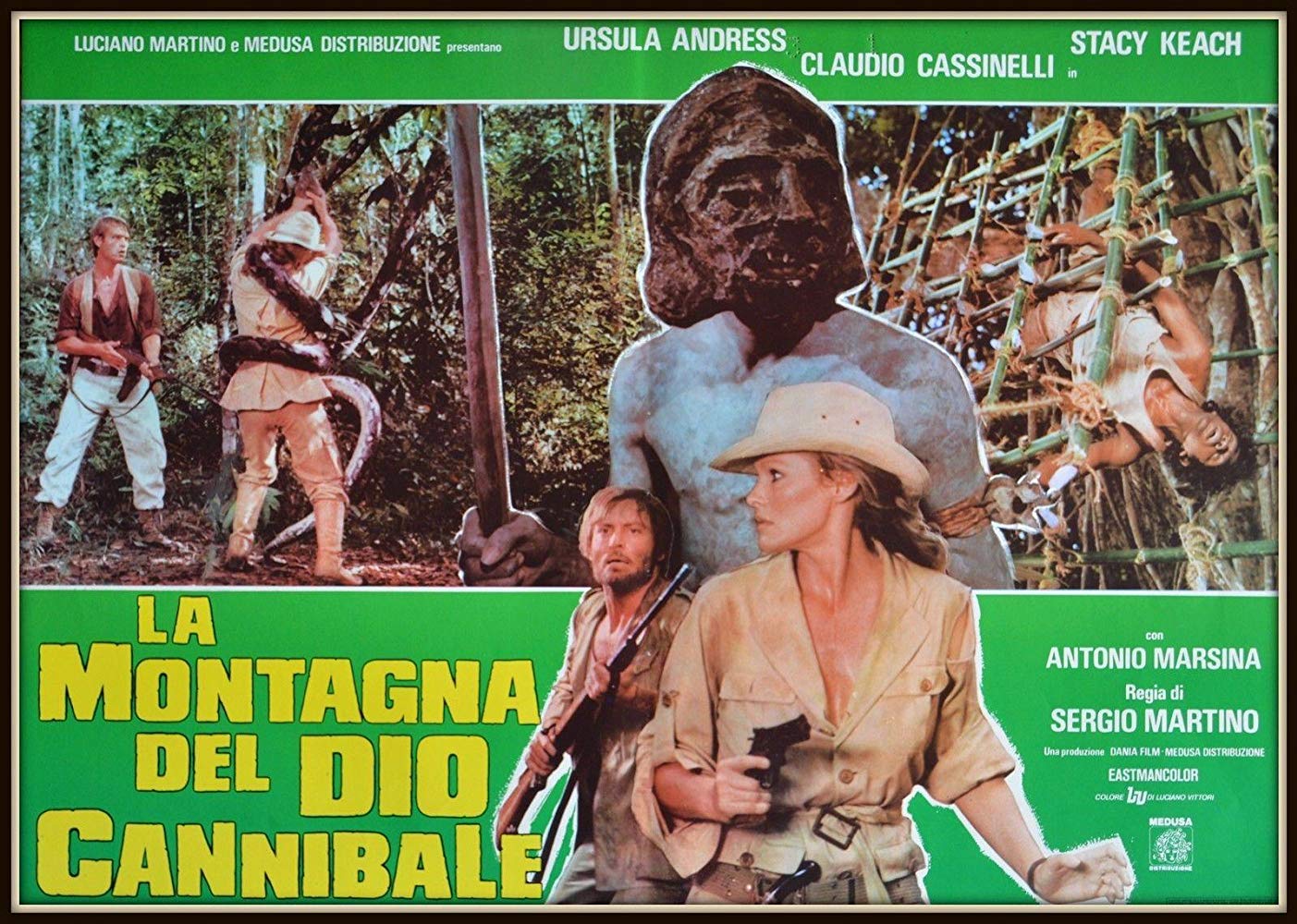
SLAVE OF THE CANNIBAL GOD aka MOUNTAIN OF THE CANNIBAL GOD (Italy - 1978; US release 1979) Directed by Sergio Martino. Written by Cesare Frugoni and Sergio Martino. Cast: Ursula Andress, Stacy Keach, Claudio Cassinelli, Antonio Marsina, Franco Fantasia, Lanfranco Spinola, Carlo Longhi, Luigina Rocchi, Akushla Sellajaah, T.M. Munna, M. Suki, Dudley Wanaguru, Gianfranco Coduti. (R, 85 mins/Unrated, 103 mins) Not as consistently disgusting as some of its more notorious contemporaries in the Italian cannibal craze, Sergio Martino's 1978 contribution MOUNTAIN OF THE CANNIBAL GOD is almost a mondo take on a traditional jungle adventure for most of its duration. That's especially the case in its significantly truncated US version, retitled SLAVE OF THE CANNIBAL GOD and released on the drive-in circuit by a relatively fledgling, pre-Freddy Krueger New Line Cinema in the spring and summer of 1979. Both versions--Martino's full-strength 103-minute director's cut and New Line's 85-minute US re-edit--are on Code Red's just-released SLAVE OF THE CANNIBAL GOD Blu-ray (because physical media is dead), and they offer a study in contrasts where each has its own unique strengths, the US cut in part because New Line saw fit to trim some of the fat. Indeed, the R-rated, 85-minute cut is better-paced and eliminates a talky early scene at the British consulate that ultimately makes no sense in the longer version. And while it retains a surprising amount of onscreen animal killing--always the major deterrent when it comes to one's ability to enjoy this type of tawdry exploitation fare--it suffers from almost complete lack of any graphic gut-munching, usually leaving the aftermath or reaction shots of other actors. In Martino's version, one major character is disemboweled and devoured, with a lingering shot of what feels like a mile of intestinal tract being yanked out of his gut, while in the US cut, it's reduced to one distant shot of the tribe chieftain holding up the victim's heart. Likewise, a graphic castration shown in Martino's version is merely implied in the US cut. The biggest difference in the uncut version is the inclusion of a CALIGULA-esque cannibal orgy, with some up-close and borderline pornographic footage of a young tribal woman masturbating along with some simulated bestiality involving a tribesman and a large pig. These shots were included in Martino's reconstructed version originally released by Anchor Bay back in the halcyon days of the Eurocult DVD explosion, and are understandably nowhere to be found in New Line's American cut. At the end of the day, regardless of which version of SLAVE OF THE CANNIBAL GOD you watch, both are trashy enough to make you wonder what the hell Stacy Keach and Ursula Andress are doing in it.
Andress is wealthy Susan Stevenson, who arrives in New Guinea with her younger brother Arthur (Antonio Marsina) in search of her missing explorer husband Henry (played in photos by perennial Eurocult bit player Tom Felleghy). They believe he was headed for the cursed mountain of Ra-Rami on the island of Roka, but the British consulate refuses to authorize a search and rescue mission. They instead direct her to Dr. Edward Foster (Keach), an anthropologist who happens to have been a close associate of Henry's (if you're wondering why she didn't just go to him in the first place, the US cut completely removes the ultimately pointless sequence at the British consulate) and is the only person who's been to Ra-Rami and made it back alive. Foster agrees to guide them on the treacherous trek to Roka, though tensions soon flare between him and the obnoxious Arthur and they're eventually joined by rugged adventurer Manolo (Martino regular Claudio Cassinelli). Foster confesses that he was captured by the Puka, a tribe on Roka, and was forced to partake in their cannibal rituals ("You never forget the taste of human flesh!" Foster cries in what's not one of Keach's most dignified moments), and is going along on the trek not to save Henry, but to wipe out the Puka once and for all. Susan and Arthur have their own secret, as she's not quite the probable grieving widow (she attempts to seduce Manolo), but is instead driven by TREASURE OF THE SIERRA MADRE-esque greed and wiling to put Foster and Manolo at risk, knowing Henry was searching for a massive secret uranium deposit on Roka, and they want those riches for themselves.
The expedition is whittled down, from Foster's native guides getting killed along the way to Keach making an abrupt exit with about 35 minutes to go when an injured Foster falls down a waterfall in one of Eurotrash cinema's more hilarious dummy deaths. Susan, Arthur, and Manolo are captured by the Puka and are introduced to the decaying, oozing corpse of her husband, with a Geiger counter planted in his chest and worshiped like a god by the Puka. Then they're submitted to the usual cannibal ritual antics--Arthur is eaten, Manolo forced to watch, and Susan is stripped nude and given a long, lingering oil and body paint rubdown in a scene that would be repeated with Alexandra Delli Colli in DOCTOR BUTCHER M.D. and with Bo Derek in TARZAN THE APE MAN, directed by her husband John Derek, who was once married to--wait for it--Ursula Andress. Martino's version comes to a screeching halt with the X-rated orgy, which really slows things down in a way that makes the third act of the US version move a lot faster, but it's also missing Arthur's disgusting demise, instead relying on Cassinelli reaction shots to convey the horrors taking place. It's worth noting that neither Andress nor Keach are around for the really gross stuff other than an early scene where Foster's guides capture a small crocodile and slice it open for food. Keach is killed off before they even encounter the cannibals, but up to that point, much of the big names' interactions with the horrific onscreen carnage was limited to the magic of the cutting room: the explorers are rowing along a river and someone says "Look!" as Martino cuts to footage of a giant lizard barfing up a snake (that one's not in the New Line version). Martino also gets a thumbs down for a morally bankrupt shot of a monkey being thrown by some rigged mechanism right into the waiting mouth of a large crocodile (that's in the New Line version), essentially negating the oft-repeated argument from directors of these cannibal films that these were examples of "survival of the fittest" caught on camera (some of SLAVE's animal killings were later recycled by Umberto Lenzi for 1980's EATEN ALIVE).
Martino's uncut version looks terrific on Code Red's Blu, and there's an HD transfer of the US cut that's not quite as good in quality but still looks better than it has in any home video incarnation. Keach is on hand for a new interview and expresses no regrets over appearing in the film (this was the same year that his uptight Sgt. Stedenko was a memorable foil to Cheech and Chong in UP IN SMOKE), saying it offered him a chance to work with Andress and to see Sri Lanka. where the exteriors were shot, and where Martino and Cassinelli would return for 1979's THE GREAT ALLIGATOR. He has some vivid memories of the shoot and shares stories about Andress and Cassinelli, and has a good laugh at his ridiculous death scene, but he still doesn't seem to be fully aware of just how foul SLAVE gets in the last third after he was no longer around. 1978 found Keach at the end of a brief sojourn into Eurocult, which included the 1976 gangster thriller STREET PEOPLE and Umberto Lenzi's cheap-looking 1978 WWII saga THE GREATEST BATTLE. But none of those were as dubious as SLAVE OF THE CANNIBAL GOD, where the involvement of respectable actors like Keach and Andress is certainly on par with Henry Fonda in TENTACLES and Richard Harris in STRIKE COMMANDO 2 in the "How the fuck did this happen?" chronicles of Italian trash cinema.
THE GREATEST BATTLE aka THE BIGGEST BATTLE aka THE GREAT BATTLE aka BATTLE FORCE (Italy - 1978) Directed by Umberto Lenzi. Written by Umberto Lenzi and Cesare Frugoni. Cast: Helmut Berger, Samantha Eggar, Giuliano Gemma, John Huston, Stacy Keach, Ray Lovelock, Henry Fonda, Edwige Fenech, Evelyn Stewart (Ida Galli), Aldo Massasso, Venantino Venantini, Guy Doleman, Patrick Reynolds, Rik Battaglia, Andrea Bosic, Giuseppe Castellano, Luciano Catenacci, Giovanni Cianfriglia, Geoffrey Copleston, Tom Felleghy, Manfred Freyberger, Marco Guglielmi, Fulvio Mingozzi, Giacomo Rossi Stuart, Bill Vanders, Robert Spafford, Olga Pehar Lenzi. (PG, 102 mins) WWII movies were extremely popular all over the world from the mid-1960s through the 1970s, and journeyman Italian director Umberto Lenzi was no stranger to the genre. He'd already made "macaroni combat" movies like 1967's DESERT COMMANDOS and 1969's BATTLE OF THE COMMANDOS in response to the 1967 blockbuster THE DIRTY DOZEN, but then he moved into gialli like 1972's SEVEN BLOODSTAINED ORCHIDS and really hit his stride with a string of ridiculously entertaining and extraordinarily violent poliziotteschi like 1974's ALMOST HUMAN and 1976's ROME ARMED TO THE TEETH among many others. But between his crime movies and his jumping on the post-CANNIBAL HOLOCAUST gut-muncher bandwagon with 1980's EATEN ALIVE and 1981's CANNIBAL FEROX, Lenzi cranked out two more "macaroni combat" films. Differing from the DIRTY DOZEN-inspired "men on a mission" formula of his late '60s genre contributions, 1978's THE GREATEST BATTLE and 1979's FROM HELL TO VICTORY (which starred George Peppard and George Hamilton, the same year he had a huge hit with LOVE AT FIRST BITE) seemed like responses to the more large-scale, all-star ensemble epics that were being produced at that time, like 1976's MIDWAY, 1976's THE EAGLE HAS LANDED, and 1977's A BRIDGE TOO FAR. Both films had casts of big-name actors who carried significantly more prestige than you'd expect in a run-of-the-mill Italian knockoff, but from the looks of THE GREATEST BATTLE, the entire budget went to paying those actors because for the most part, it looks like how a WWII epic might turn out if it was directed by Jess Franco or Al Adamson.
THE GREATEST BATTLE was shown under a plethora of different titles: it was shot in Rome, Almeria, and Los Angeles in 1977 as IL GRANDE ATTACCO, and then alternately known as THE BIGGEST BATTLE (the title it carries on Amazon Prime), THE GREAT BATTLE, and BATTLE FORCE, but THE GREATEST BATTLE is what it initially went by when drive-in outfit Dimension Pictures released it in the US, cut down to 90 minutes, with Lenzi pseudonym "Humphrey Longan" credited as director, and with added narration by Orson Welles, who's not heard on the complete 102-minute, English-dubbed BIGGEST BATTLE version streaming on Amazon (dubbing fixture Anthony La Penna handles some incidental narration in a few spots). Stacy Keach is among the stars, and in his very enjoyable 2013 memoir All in All, he refers to the film under yet another title, THE MARETH LINE, and calls it "flat-out awful." A fair assessment, though as Keach points out, "It gave me a chance to work with Henry Fonda and John Huston," and they're only a few of the reputable actors called upon to star in a film by the future director of CITY OF THE WALKING DEAD, MAKE THEM DIE SLOWLY, and FATTY GIRL GOES TO NEW YORK. THE GREATEST BATTLE opens in Berlin in 1936 just after the Olympics, as a small group of friendly acquaintances meet for a formal dinner: German Major Manfred Roland (Keach), British war correspondent Sean O'Hara (Huston, not even attempting a British accent) and his wife (Lenzi's wife Olga Pehar Lenzi), West Point legend General Foster (Fonda), and renowned German actress Annelise Ackermann (Samantha Eggar). They discuss the rise of Hitler and his disdain of Jews and "American negroes" in the wake of Jesse Owens' Olympic triumph, but all parties foolishly conclude that everything is fine, that war is unlikely and they'll all be friends for many years to come.
Cut to 1942, and the entire world is at war. From then on, THE GREATEST BATTLE is an episodic and seemingly random series of vignettes that eventually form some semblance of a story but it still feels choppy and haphazardly-assembled. There's copious amounts of stock footage from newsreels and other movies, and sometimes the various film stocks don't even match. Foster's son John (Ray Lovelock) has enlisted after flunking out of college, unable to win over his old man like his older, war hero brother Ted (never seen, but played by a framed photo of future CEMETERY MAN director Michele Soavi); Roland and Annelise are now married, but he's conflicted about pledging his allegiance to Der Fuhrer and the Nazi party and determined to keep Annelise's being half-Jewish a secret from his superiors. We also meet other characters who have nothing to do with the initial expository set-up of the Berlin dinner, such as British Capt. Martin Scott (Giuliano Gemma), his ex-wife (Ida Galli) and her new husband (Venantino Venantini), and German Lt. Kurt Zimmer (Helmut Berger), who's fallen in love with French prostitute Danielle (Edwige Fenech) who may or may not be a member of the Resistance. Some of these people cross paths, and some of them don't. Huston's O'Hara is the most confusing character of them all, a grouchy old cynic who seems far too old to be playing a roving war correspondent chasing a story at the center of the action, and it's anyone's guess why some characters occasionally refer to him as "Professor O'Hara" or why he's shown strutting around and barking orders at some officers in one scene. Huston--just four years removed from co-starring in CHINATOWN--doesn't even seem to know or care what he's doing, as he has one of the most jaw-dropping exits you'll ever see, a barely-concealed breaking of the fourth wall, almost as if he said "Alright, Lenzi, I'm done here...I'll show myself out of this movie." In between the Ovidio G. Assonitis classics TENTACLES and THE VISITOR, Huston isn't even hiding his disinterest in THE GREATEST BATTLE, further evidenced by an anecdote Keach shares in his memoir. Concerned about not overdoing his German accent and having difficulty communicating with Lenzi, who didn't speak English, Keach asked Huston, his director on 1972's FAT CITY and THE LIFE AND TIMES OF JUDGE ROY BEAN, for some advice. Huston replied "I'm only an actor here. I didn't ask you about my accent. Talk to the director," adding "Learn Italian or find an interpreter."
Speaking of TENTACLES, both Huston and Fonda appeared in that 1977 Italian JAWS ripoff about a giant mutant octopus, though they shared no scenes. Fonda has a few fleeting appearances scattered throughout TENTACLES, always on the phone yelling at someone. His entire role was shot in one morning at his house, and his dialogue is vague enough ("Well, take care of it!") that I remain convinced he had no idea he was in a movie about a giant mutant octopus. While Fonda gets out a bit in THE GREATEST BATTLE in both the opening dinner sequence and the closing scene at a cemetery, the rest of his appearances are, once again, by himself and on the phone in what looks suspiciously like a very 1970s Beverly Hills home in which a famous movie star might reside. Was this Fonda's thing prior to capping his stellar career with ON GOLDEN POND? Forcing journeymen Italian directors to make house calls if they wanted him in their movie? THE GREATEST BATTLE makes a lot of noise but very little sense, jumping from place to place with an ensemble whose members vanish for long stretches or right after they're introduced. The supporting cast is an impressive who's who of jobbing Italian supporting actors who always turn up in this sort of genre fare (I'm pretty sure Tom Felleghy owned that general's uniform, and having gravelly-voiced dubber Robert Spafford appear on camera as Gen. George S. Patton was an inspired choice), but the performances of the main cast are all over the map, with Huston looking visibly inconvenienced and demonstrably irritable in a way that borders on acting out, and Fonda mostly phoning it in TENTACLES-style (oddly, in Tony Thomas' 1983 Citadel Press-published The Complete Films of Henry Fonda, THE GREATEST BATTLE was absent even though his role is considerably more than a cameo, and in the early days of pay cable, this aired on HBO quite often). Berger is relatively restrained, considering his reputation and that he'd recently been in the 1976 Nazisploitation epic SALON KITTY, though if anyone can figure out why he and Fenech are even in this, let me know. The usually reliable Eggar is absolutely awful, but for whatever reason, Keach, the same year he co-starred in Sergio Martino's vile MOUNTAIN OF THE CANNIBAL GOD, is trying a lot harder than his other big-name co-stars and is the only one who seems interested in creating a three-dimensional character, even if the sloppiness of Lenzi's direction and the scattered script by Lenzi and Cesare Frugoni give him little with which to work. Franco Micalizzi's by-the-numbers "rousing" score lacks the maestro's usual catchy pizazz, and some of the miniatures in the battle sequences would make Antonio Margheriti cringe and look away in embarrassment. But for fans of "macaroni combat" movies, there's plenty of action sequences and a lot of big and loud explosions. Just don't expect it to make much sense. Maybe that's why Huston looks like he's breaking character and literally walking out of the movie.
CELL (US - 2016) Directed by Tod Williams. Written by Stephen King and Adam Alleca. Cast: John Cusack, Samuel L. Jackson, Isabelle Fuhrman, Stacy Keach, Owen Teague, Erin Elizabeth Burns, Clark Sarullo, Ethan Stuart Casto, Joshua Mikel, Catherine Dyer, Lloyd Kaufman. (R, 98 mins) Based on the 2006 Stephen King novel, CELL is easily the worst big-screen King adaptation since 1995's THE MANGLER, which may come as a surprise since King himself co-wrote the script. The novel had a bumpy journey from page to screen, first being announced in 2007 by the Weinsteins and Dimension Films as a project for Eli Roth, from a script by Scott Alexander and Larry Karaszewski. Roth left over "creative differences" and the entire project fell apart. The Weinsteins sold the rights to others, Alexander and Karaszewski's script was tossed, and King himself was commissioned to rewrite the screenplay. By the time filming began, with PARANORMAL ACTIVITY 2 director Tod Williams at the helm, significant rewrites were done by Adam Alleca, who scripted the 2009 remake of THE LAST HOUSE ON THE LEFT. That remake was OK as far as remakes go, but it begs a question: how bad was King's script that Adam Alleca was hired to fix it? CELL reunites John Cusack and Samuel L. Jackson, stars of the not-bad 2008 King short story adaptation 1408, but both actors have rarely seemed more disinterested in what they're doing. It's a badly-made, incoherent mess, starting with video-burned opening credits that make it look like a cheap TV show, and ending with some embarrassing CGI explosions that aren't even up to the standards of The Asylum. Remember when Stephen King movies were big events? It's not long into CELL before you realize why Lionsgate gave it a stealth VOD burial. It's an amateurish disaster that would be laughed off the screens if it got a wide multiplex release. This is so bad that even a prime time slot on Syfy on a Saturday night would've been too gala a premiere for it.
An exclusive pic of an audience exiting
a pre-release test screening of CELL
Whatever themes that were present in King's novel--there's some satirical points to be made by the effects of cell and smartphones on the public--are dumped here in favor of yet another generic zombie apocalypse story. Opening with an event known as "The Pulse," much of the world (or at least the few Atlanta locations the boatload of producers could afford) is turned into rampaging, flesh-eating 28 DAYS LATER creatures by a croaky signal that transmits over their phones. Fortunately for comic book artist Clay Riddell (Cusack), his cell battery died at the airport just before The Pulse, thus making him immune from the initial outbreak. Teaming up with subway conductor Tom McCourt (Jackson), the pair venture to Clay's studio where his neighbor Alice (ORPHAN's Isabelle Fuhrman) has just been forced to kill her zombified mother. The trio make their way across what's become a post-apocalyptic hellscape seemingly in a matter of hours, eventually picking up another survivor, Jordan (Owen Teague), and heading to Clay's house to find his estranged wife and son. They soon realize that the source of the cellular mayhem is a character drawn years ago by Clay: a spectre in a red hoodie known in the book as Raggedy but rechristened The Night Traveler for the movie (played by Joshua Mikel), a figure they've all seen in their dreams, who's somehow controlling the hive-minded horde of cell phone zombies.
Cell wasn't one of King's better novels, coming off much of the time like a technologically-tweaked revamp of The Stand with tired tropes taken from any number of older King books (does anyone rip himself off more than Stephen King?). CELL can't even manage to get to the level of an entertaining ripoff. It might've been effective ten years ago, but the overrated 2008 indie THE SIGNAL already covered a lot of this. There's a ton of deviations from the novel, none of them improvements. Most notable is the fate of Charles Ardai, the headmaster of a prep school where the trio first finds Jordan. In the book, Ardai is a major character overtaken by a "Phoner" signal that convinces him to commit suicide. In the film, Ardai, played by Stacy Keach in a five-minute cameo, simply gets impaled after an explosion and the group moves on. There's absolutely no sense of time or place in CELL. It looks like Clay, Tom, and Alice hit the road immediately after The Pulse, but the country is already a desolate wasteland and survival camps have sprung up. It's like an entire season of THE WALKING DEAD haphazardly whittled down to 98 minutes, and much of it shot in such total darkness that it's impossible to tell what's going on. Exposition is mechanically dropped by actors playing characters who sound like they're spouting facts they just yanked out of their asses, just as an easy way to get to the next set piece. This has all the hallmarks of a botched disaster--two years on the shelf; King nowhere in sight to promote a movie he co-wrote; a shrugging Cusack looking pale, disheveled, and bored, displaying almost no reaction to the carnage happening around him; Jackson seeming thoroughly pissed-off that he was talked into being in it; a dated appearance by the long-ago-viral "Trololo Song" as a plot point (it sedates the Phoners)--coming off very much like an unreleasable dumpster fire that was just abandoned by everyone involved. It's 98 minutes of nobody giving a shit. Even by the standards of much of Cusack's recent work in the Cusackalypse Now canon (his stellar turn in the terrific LOVE & MERCY aside), the shit-the-bed CELL is the worst film of his career.
TRUTH (US/Australia - 2015) Written and directed by James Vanderbilt. Cast: Cate Blanchett, Robert Redford, Dennis Quaid, Topher Grace, Elisabeth Moss, Bruce Greenwood, Stacy Keach, Dermot Mulroney, John Benjamin Hickey, David Lyons, Rachael Blake, Andrew McFarlane, Lewis Fitz-Gerald, Natalie Saleeba, Noni Hazelhurst, Nicholas Hope, Philip Quast. (R, 125 mins)
This chronicle of the 2004 events that led to the dismissal of 60 MINUTES II producer Mary Mapes and the end of Dan Rather's tenure at CBS suffers from being based on Mapes' own memoir. As a result, it constantly straddles the fine line between dramatization and Mapes hagiography. Writer/director James Vanderbilt's intent seems to be to make Mapes (played here by Cate Blanchett) a martyr for the dying profession of journalism, when it was primarily corner-cutting, sloppy fact-checking, and a rush to get on the air that undermined the explosiveness of the story itself. And whether it's her past accomplishments and her reputation as a tough ballbuster (she also broke the Abu Ghraib story), her upbringing at the hands of an abusive father, her need to challenge bullying power structures, or allowing herself to be duped for the sake of a big story, Vanderbilt seems to hold everyone but Mapes accountable for Mapes' questionable judgment.
Mapes was fired for the bungled report, whereas Rather (Robert Redford) was granted the dignity of resigning on his own terms. With the Swift Boat smear campaign of John Kerry in full force as he's in a dead heat with incumbent George W. Bush in the run up to the 2004 presidential election, Mapes gets word that retired Lt. Col. Bill Burkett (Stacy Keach) has documents that show Bush got special treatment to get into the National Guard and went AWOL and never reported for duty when stationed in Alabama in 1973. Burkett won't reveal his sources, and while Mapes and her team--freelance journalist Michael Smith (Topher Grace), researcher Lucy Scott (Elisabeth Moss), and retired Lt. Col. Roger Charles (Dennis Quaid)--follow the paper trail and assemble the story, they're unable to get complete confirmation that Burkett's photocopied documents are authentic. Two of four experts deem them authentic enough, and with Rather onboard, they run with it, putting the entire piece together in just five days in early October 2004 since 60 MINUTES II will be off the air until after the election to clear space for a Billy Graham crusade and a prime-time Dr. Phil special. Almost immediately after the report airs, discrepancies are brought to their attention and sources start recanting their original statements: Burkett lied about how he got the documents, the Times New Roman font in the documents is 100% consistent to how it looks when typed out on a computer, and the "th" superscript was very uncommon on typewriters of 1973. Additionally, one of the brass prominently mentioned in the documents wasn't even in a position of authority on the base in Alabama at the time the documents were supposedly written.
Eventually, Rather had to issue an on-air apology for what was referred to as "Memogate" and "Rathergate," and it brought his long and iconic run at CBS to an end. It was Mapes whose career took the biggest hit, and Vanderbilt makes sure we all realize it. Blanchett is one of our great actresses, but her Mapes is some pretty blatant Oscar-baiting. She's a little BLUE JASMINE and a little Faye Dunaway as she flips her hair and guzzles chardonnay and pops Xanax (the film also makes an effort to introduce her via a knitting pastime, which she's never seen doing again), and it's her against the world with the future of journalism at stake, but she's got father figure Rather to offer sage advice. Even the other characters marvel at her, as when Charles tells Smith that Mapes wanted to pursue Bush's alleged Guard misconduct in 2000, but her mother died and she dropped the story. "If her mother hadn't died...Al Gore would be the president," Quaid is forced to say with a straight face. The supporting characters, including Mapes' journalist husband Mark Wrolstad (John Benjamin Hickey), have precious little to do and exist only to prop up Mapes and repeatedly tell her some variation of "You're doing the right thing" or to break some bad news (you could make a drinking game out of how many times Quaid, Grace, or Moss enter a scene and say "It gets worse..."), or to passionately exclaim "This is what we do!" when she's feeling pangs of self-doubt. Journalism 101 turns to Cliche 101 throughout, right down to some truly terrible exposition when Grace's Smith is introduced to the rest of the team, and they all immediately do one of those LAW & ORDER: SVU info drops where everyone finishes everyone else's sentence as the camera zings from person to person, with Smith somehow completely up to speed on an investigation he's been a part of for about 30 seconds.
Dan Rather and Mary Mapes visiting the set of TRUTH during filming.
The presence of Redford is both the film's strongest aspect and its biggest distraction. Like Christopher Plummer's interpretation of 60 MINUTES' Mike Wallace in Michael Mann's THE INSIDER (1999), Redford wisely makes no attempt to look or sound like Rather, instead opting to nail down his speech patterns and his general persona. A legend portraying a legend, Redford walks off with every scene he's in, but seeing him is a constant reminder of his Bob Woodward and Dustin Hoffman's Carl Bernstein in 1976's ALL THE PRESIDENT'S MEN, the gold standard of the admittedly limited "investigative reporters bringing down a President" subgenre. TRUTH pales in comparison to that masterpiece, and it's indicative of just how much David Fincher had to do with the greatness of 2007's ZODIAC--scripted by Vanderbilt and with a major ALL THE PRESIDENT'S MEN influence in its structure and narrative. TRUTH marks Vanderbilt's debut as a director, but ZODIAC stands out as the anomaly among his screenwriting credits, which are littered with fun-but-lunkheaded fare like THE RUNDOWN (2003), THE LOSERS (2010) and WHITE HOUSE DOWN (2013). TRUTH has a powderkeg of a story at its core, but loses itself by constantly presenting Mapes as the crucified savior of real TV news reporting, the last bastion of integrity sacrificed at the altar of corporate business interests, with even Rather lamenting the death of the format once they're all forced out. Regardless of the truth--Bush's Guard record was quite dubious--Mapes, Rather, and their team dropped the ball and failed to get all their ducks in a row, which the film admits but stresses "that's not what it's about," a notion that only gave substance to the right-wing blogosphere's claim that the bombshell report was politically motivated. It is what it's about, and in making the presentation of the whole unfortunate saga so one-sided and myopic, Vanderbilt ends up making the same mistakes as his protagonists.
Directed by Robert Rodriguez and Frank Miller. Written by Frank Miller. Cast: Mickey Rourke, Jessica Alba, Josh Brolin, Joseph Gordon-Levitt, Rosario Dawson, Bruce Willis, Eva Green, Powers Boothe, Dennis Haysbert, Ray Liotta, Stacy Keach, Jaime King, Christopher Lloyd, Jamie Chung, Jeremy Piven, Christopher Meloni, Juno Temple, Lady Gaga, Marton Csokas, Julia Garner, Alexa PenaVega, Jude Ciccolella, Johnny Reno. (R, 102 mins)
When the Robert Rodriguez/Frank Miller collaboration SIN CITY was released in 2005, it was hailed as a groundbreaking visual triumph and a trendsetting example of how to adapt a graphic novel--in this case, Miller's legendary series--to the big screen. Nine years later, it holds up beautifully in terms of visuals and its very effective use of CGI, as well as with its loving tribute to the gutsy, hard-boiled prose of a bygone era. While the success of SIN CITY paved the way for other successful graphic novel adaptations like Zack Snyder's 300 (2007), its style is the kind of thing that can't really be repeated without feeling like a tired retread. Look no further than Miller's own disastrous solo directorial outing THE SPIRIT (2008), an excruciatingly awful adaptation of Will Eisner's graphic novel series that came off like a cheap, amateurish ripoff of SIN CITY and was rejected by even the most ardent Miller fanboys. Shot in 2012 and bumped nearly a year from its original October 2013 release date, the belated prequel/sequel combo SIN CITY: A DAME TO KILL FOR wasn't really warranted or demanded, and, this far removed from the first film, can't help but pale in comparison to what was so fresh and innovative nearly a decade ago. Rodriguez and Miller seem to recognize that and try to counter it by using 3-D. It makes for some occasionally striking imagery, but remove that superfluous cosmetic addition and you've got a perfectly watchable but thoroughly disposable revamp that plays like a SIN CITY knockoff rather than a follow-up by the same filmmakers. It's almost like a rock band that knocked it out of the park with one instant classic album and followed it with a cash-in comprised of leftover songs that weren't strong enough to make the cut the first time around.
SIN CITY: A DAME TO KILL FOR has four segments, only one of which, "A Dame to Kill For," is based on a published Miller work, while the others were written specifically for the film. The time element can be a bit confusing--sometimes it's set in the film's present, other times in the past, which explains the return of some characters killed off in the first film. Ex-boxer and 300-lb killing machine Marv (Mickey Rourke, whose character makeup combined with his own plastic surgery in the years since SIN CITY now have Marv looking like a roid-raging Lionel Stander) disposes of some douchebag college kids who get their kicks by setting bums on fire. Wiseass card sharp Johnny (Joseph Gordon-Levitt) wins a bundle from evil Sen. Roark (Powers Boothe reprises his role) in a backroom card game and lives to regret it. In the longest section, based on "A Dame to Kill For," photographer Dwight (Josh Brolin, replacing Clive Owen), is duped by his femme fatale ex Ava (Eva Green) when she kills her husband (Marton Csokas) and tries to frame him. After being beaten to a pulp by Ava's bodyguard Manute (Dennis Haysbert, replacing the late Michael Clarke Duncan), Dwight teams up with Marv, old flame Gail (a returning Rosario Dawson) and silent assassin Miho (Jamie Chung, replacing Devon Aoki) to exact his revenge. Ava, meanwhile, seduces and manipulates honest cop Mort (Christopher Meloni), despite the warnings of his cynical partner Bob (Jeremy Piven, replacing Michael Madsen). Finally, stripper Nancy (Jessica Alba also returns) is watched over at the sleazy dive bar Kadie's by the ever-present Marv, but she's really waiting for the perfect opportunity to kill Roark, the father of the first film's vicious serial killer The Yellow Bastard. Roark made sure his son's heinous crimes were pinned on pushing-60-with-a-bum-ticker cop Hartigan (Bruce Willis reappears, barely), who was Nancy's guardian angel father figure and was driven to suicide after killing the Yellow Bastard and ensuring her safety.
While SIN CITY: A DAME TO KILL FOR has its reasonably entertaining moments and it's never dull, it can't help but feel stale and tired most of the time. Much like the slo-mo and the speed-ramping of 300 have made that the most tired cliche going, the SIN CITY look is something that can only blaze a trail once before everything that comes after is simply following in its path. Miller's writing isn't nearly as good this time around, with the tough-guy narration sounding like cheesy posturing, and there's an almost-total absence of great hard-boiled one-liners that filled the first film, like Hartigan's "When it comes to reassuring a traumatized 19-year-old, I'm as expert as a palsy victim doing brain surgery with a pipe wrench," or Marv, strapped in the electric chair bellowing "Would you get a move on? I ain't got all night!" to a prison chaplain issuing the last rites.
The film does feature some strong performances by a snarling Boothe and a vamping, typically crazy-eyed and frequently nude Green, who almost single-handedly made a must-see film out of 300: RISE OF AN EMPIRE, another unnecessary sequel from earlier this year. There's a large cast of familiar faces here, but very few of them are put to any substantive use. Rourke and Willis were terrific back in 2005, but they're just clocking in for this one (it's easy to forget that, three years before THE WRESTLER, it was his performance in SIN CITY that started the now-squandered Rourkeassaince). Willis' Hartigan only appears fleetingly as a ghost. He has maybe two minutes of screen time and I'd be surprised if he was on the set for more than a day. An unrecognizable Stacy Keach, sporting some Jabba the Hutt-inspired makeup, gets about a minute as big shot mobster Wallenquist. Ray Liotta briefly appears as a philandering businessman in love with a young hooker (Juno Temple). Blink and you'll miss Christopher Lloyd as a drug-addicted, back-alley doc who helps reset Johnny's broken fingers. And Lady Gaga cruises through as a hash-slinging waitress at a skeezy all-night diner. With SIN CITY, even those actors in the smallest roles made an impression (remember Nicky Katt's hapless Stuka and his "Heeeey!" reaction to an arrow through the chest?) because that was a film made with care and precision, but here, they're just distractions (Lady Gaga?) popping into Rodriguez's Troublemaker Studios in Austin for a cameo and a quick run by the craft services table, with their driver presumably leaving the limo running outside. Rodriguez, Miller, and the returning actors don't seem very engaged with the second-rate material that consequently fails to provide much in the way of inspiration for the new cast members. SIN CITY was budgeted at $40 million in 2005, still looks terrific and has aged beautifully. SIN CITY: A DAME TO KILL FOR cost $70 million and, factoring out the use of 3-D, more often than not looks and feels like a slipshod, straight-to-DVD knockoff. I didn't hate SIN CITY: A DAME TO KILL FOR but unlike its predecessor, it's nothing I'll feel the need to watch again. If nothing else, I guess the best praise to bestow upon it is that it's a masterpiece compared to THE SPIRIT.
Directed by Alexander Payne. Written by Bob Nelson. Cast: Bruce Dern, Will Forte, June Squibb, Stacy Keach, Bob Odenkirk, Rance Howard, Mary Louise Wilson, Tim Driscoll, Devin Ratray, Angela McEwan. (R, 114 mins)
Bruce Dern, with his odd mannerisms and twitchy presence, is the kind of actor who only could've become a leading man in the more adventurous 1970s, the last time when the idiosyncratic, the offbeat, and the challenging were widely accepted in mainstream cinema. Dern was never cut out for the blockbuster films that took over in the 1980s. Even in his A-list heyday, he was usually called upon to play creeps and psychos, and in a rare instance when he was the hero, as in Walter Hill's THE DRIVER (1978), you still couldn't put your complete confidence in him as a good guy. Like most actors of his generation, Dern started out in TV in the early 1960s and moved into supporting roles (HUSH...HUSH, SWEET CHARLOTTE and HANG 'EM HIGH among others) and eventually became a fixture in biker and hippie films of the late 1960s, such as THE WILD ANGELS, THE TRIP, PSYCH-OUT, THE CYCLE SAVAGES, and THE REBEL ROUSERS. Dern's career really took off in the early 1970s, when he shot John Wayne in the back in 1972's THE COWBOYS, and with the same year's sci-fi cult classic SILENT RUNNING. Dern also attracted much critical attention with a pair of collaborations with friend Jack Nicholson, who appeared with him in some of those earlier biker/hippie outings before his EASY RIDER breakthrough: 1971's DRIVE, HE SAID (directed by Nicholson) and 1972's THE KING OF MARVIN GARDENS. Neither film was a commercial success, but they, along with the general momentum he had going, were enough to catapult him to stardom and leave the drive-in movies behind with prestige projects like 1974's THE GREAT GATSBY and 1978's COMING HOME, which earned a him a Best Supporting Actor Oscar nod (he lost to Christopher Walken in THE DEER HUNTER). To this day, Dern has never stopped working, but his time in the spotlight was short. By 1981's TATTOO, his days as a headliner were essentially over and he moved into character and ensemble parts in projects of varying quality. He could've just as easily turned up in supporting roles in films like 1990's AFTER DARK, MY SWEET and 1992's DIGGSTOWN, or in post-nuke junk like 1988's WORLD GONE WILD. In recent years, he appeared on the HBO series BIG LOVE and assorted indie dramas and horror movies, usually typecast as a standard Dern-like weirdo.
Alexander Payne's NEBRASKA offers Dern the kind of late-career triumph desired by any 77-year-old actor who's been schlepping it for over 50 years and has been out of the spotlight for years. In a role first pitched to the likes of Jack Nicholson, Gene Hackman, Robert Duvall, and Robert Forster, Dern is Woody Grant, an 80-ish Billings, MT man who seems to drift in and out of coherence. He's convinced he's won $1 million in one of those magazine sweepstakes mailers, and is determined to get to Lincoln, Nebraska to collect his prize. He keeps trying to walk there--several states away--which frustrates the local cops and his blunt, tells-it-like-it-is wife Kate (June Squibb). Out of frustration but thinking maybe a couple days of entertaining the fantasy might make his dad happy, Woody's son David (Will Forte) decides to take a few days off work to drive him to Lincoln. On the way, they stop at Hawthrone, Nebraska, the small town where Woody grew up. This leads to an impromptu family reunion with Woody's brothers, and even Kate and their oldest son Ross (Bob Odenkirk) make the trip. David, Ross, and Kate repeatedly try to convince Woody that he hasn't won anything, but he'll hear none of it. Soon, his extended family and the rest of the town, including Woody's glad-handing old business partner Ed Pegram (Stacy Keach) start swarming around Woody like vultures, not even masking their eagerness at getting a piece of the prize winnings.
Written by Bob Nelson, NEBRASKA has a lot in common with past Payne films like ABOUT SCHMIDT (2002), SIDEWAYS (2004), and THE DESCENDANTS (2009) with its road trip and family squabbling. Payne's decision to shoot NEBRASKA in black & white serves to llustrate the stark emptiness of the decrepit farm towns in this part of the country. Many of the shots achieved by cinematographer Phedon Papamichael could almost function as still photographs. Visually, it's beautiful and haunting, and the story is powerful yet simple in its execution. David is a grown man stuck in a rut who has never really understood his father. It's mentioned by a relative that the Grant boys (meaning Woody and his brothers) "don't talk much," and there's some dark humor to be found in the scenes of several of these old guys sitting around, silently watching a football game with nothing to say, until one (Rance Howard) pipes up, asking another "You still have that Chevrolet?" and the response being "Never had a Chevrolet...had a Buick back in 1979." David's never really talked to his dad and during this trip, finds that there's a lot he doesn't know about him. There's no big twist or huge revelation, but rather, it's a quiet and very perceptive little film about life, choices, regrets, unfulfilled dreams, and family dynamics that will resonate with many.
Of course, Dern is the show here, but it's almost fitting to his entire career that he's nearly upstaged by his supporting cast. SNL vet Forte demonstrates some chops here that you would've never suspected if you just knew him as MACGRUBER and "The Falconer." Keach and Odenkirk are both terrific, but it's 84-year-old Squibb who steals every scene she's in as Kate. Opinionated and never suffering fools gladly (Ed: "Kate always was kind of a bitch"), Kate insists she can't put up with Woody anymore but she obviously still loves him. Squibb finds a perfect balance between being a mouthy smart-ass and a loving matriarch, and does so without resorting to the old "senior being raunchy" standby. Her cutting remarks toward departed family members during a cemetery visit ("There's your dad's sister Rose...she was a whore...don't get me wrong, I loved her dearly but my God, she was a slut!") and the bit where she goes off on Woody's greedy relatives are absolutely priceless. Beautifully shot, intelligently-written, excellently-acted, thoughtful, and darkly hilarious, the low-key NEBRASKA is one of the 2013's best films and a potent reminder of what a gifted actor we have in Bruce Dern. He shouldn't have had to wait this long for the role of his career.
Directed by Michael Apted. Written by Leon Griffiths. Cast: Stacy Keach, David Hemmings, Edward Fox, Stephen Boyd, Freddie Starr, Carol White, Hilary Gasson, Stewart Harwood, Alan Ford, Roy Marsden. (Unrated, 107 mins)
This seedy, scuzzy British crime thriller has attained a small cult over the
years but is still a largely forgotten obscurity. An early directorial effort by busy journeyman Michael Apted, then earning a name for himself with his UP documentaries, THE SQUEEZE was a late but no less effective entry in the post-GET CARTER (1971) subgenre of unrepentant UK criminal nastiness typified by the likes of VILLAIN (1971) and SITTING TARGET (1972), coated in sleazy grime, with an unusual cast,
and a jarringly effective, synthy score by David Hentschel that wouldn't sound
out of place in a giallo.
Alcoholic, disgraced ex-Scotland Yard cop
Naboth (Stacy Keach, pulling off a convincing British accent) has just gotten
out of rehab and promptly goes to the nearest pub. Toying with his buddy Teddy's
(British TV comic/singer Freddie Starr, currently embroiled in the BBC/Jimmy Savile sex abuse scandal) idea of becoming a private eye, Naboth
almost instantly finds a job when his ex-wife Jill (Carol White) and her
daughter by her new husband Robert (Edward Fox)--she left Naboth and shows
little interest in being a mother to their two sons--are kidnapped and Robert,
who owns a successful armored car company, is expected to pay the ransom. Head
kidnapper Keith (David Hemmings), who was once arrested by Naboth and is none too
happy to hear news of him poking his nose into this matter, orders
Robert to kill Naboth. Also involved is Keith's boss, Irish mob kingpin and
pornographer Vic (Stephen Boyd), a thuggish sadist with a mean streak.
Other than the one-sheet above, there's little evidence of Warner Bros. releasing this in US theaters (it was issued on VHS in 1987 and aired in what had to be a drastically cut version on CBS in 1988), and the Warner Archive
DVD issued in 2010 doesn't carry a rating, but THE SQUEEZE is a pretty hard R even by today's
standards. Keach, in a strange phase of his career that saw his early 1970s critical acclaim in films like END OF THE ROAD (1970), BREWSTER MCCLOUD (1970), THE NEW CENTURIONS (1972), and FAT CITY (1972) give way to appearances in films as varied as the Cheech & Chong comedy UP IN SMOKE, the Italian cannibal gorefest MOUNTAIN OF THE CANNIBAL GOD (both in 1978), and William Peter Blatty's THE NINTH CONFIGURATION (1980), which should've gotten him an Oscar nomination had anyone seen the film, turns in a brave performance that's one of his best, looking like
absolute hell and spending much of the film soaked in booze sweats when he isn't
letting it all hang out Harvey Keitel-style, even going full frontal in a scene where
Boyd makes him strip at gunpoint. There's also some copious bloodletting late in
the film, and a skin-crawling bit where Hemmings forces White to do an uncomfortable, almost too-painful-to-watch striptease
for him and his goons to the tune of The Stylistics' "You Make Me Feel Brand New."
Keach is given strong support by Hemmings, Fox, Starr, and White, but Boyd in
particular, is terrific. In a major career slump at the time, Boyd, best known as Messala in BEN-HUR (1959), could've had a serious comeback with THE SQUEEZE, but he died of a
heart attack on a Northridge, CA golf course before it was released. He was just 45 years old. He did one more film after THE SQUEEZE
wrapped, playing Dracula in LADY DRACULA, a German sexploitation spoof, which
pretty much represents the type of work he was getting at the end of his career. Before his sudden passing, he was set to co-star with Richard Burton, Roger Moore, Richard Harris, and Hardy Kruger in the action epic THE WILD GEESE, but was replaced by Jack Watson. It's best for Boyd if we
just pretend THE SQUEEZE is his last film.
Apted, now 71, had his first big commercial hit three years later with 1980's COAL MINER'S DAUGHTER. Best known for his ambitious and ongoing UP documentaries that began back in 1963 with SEVEN UP (Apted was a research assistant on the film, but eventually took over directing them), where the filmmakers catch up with a group of people every seven years throughout their life, beginning at age seven (56 UP is scheduled for an early 2013 US release), Apted has worked steadily over the last 30 years as a Hollywood journeyman with films as varied as the John Belushi romantic comedy CONTINENTAL DIVIDE (1981), the William Hurt-Lee Marvin thriller GORKY PARK (1983), GORILLAS IN THE MIST (1988), THUNDERHEART (1992), NELL (1994), the 007 outing THE WORLD IS NOT ENOUGH (1999), the Jennifer Lopez thriller ENOUGH (2001), and co-directing the recent Gerard Butler surfing flop CHASING MAVERICKS (2012), which Apted took over when Curtis Hanson left the project for health reasons.
THE SQUEEZE lags a bit in the
midsection before really driving it home for the intense final showdown between
Naboth and the kidnappers, but it's a practically unknown gem that deserves some more recognition and is worth
seeking out for fans of Keach, Boyd, and uncompromisingly nasty crime
thrillers.