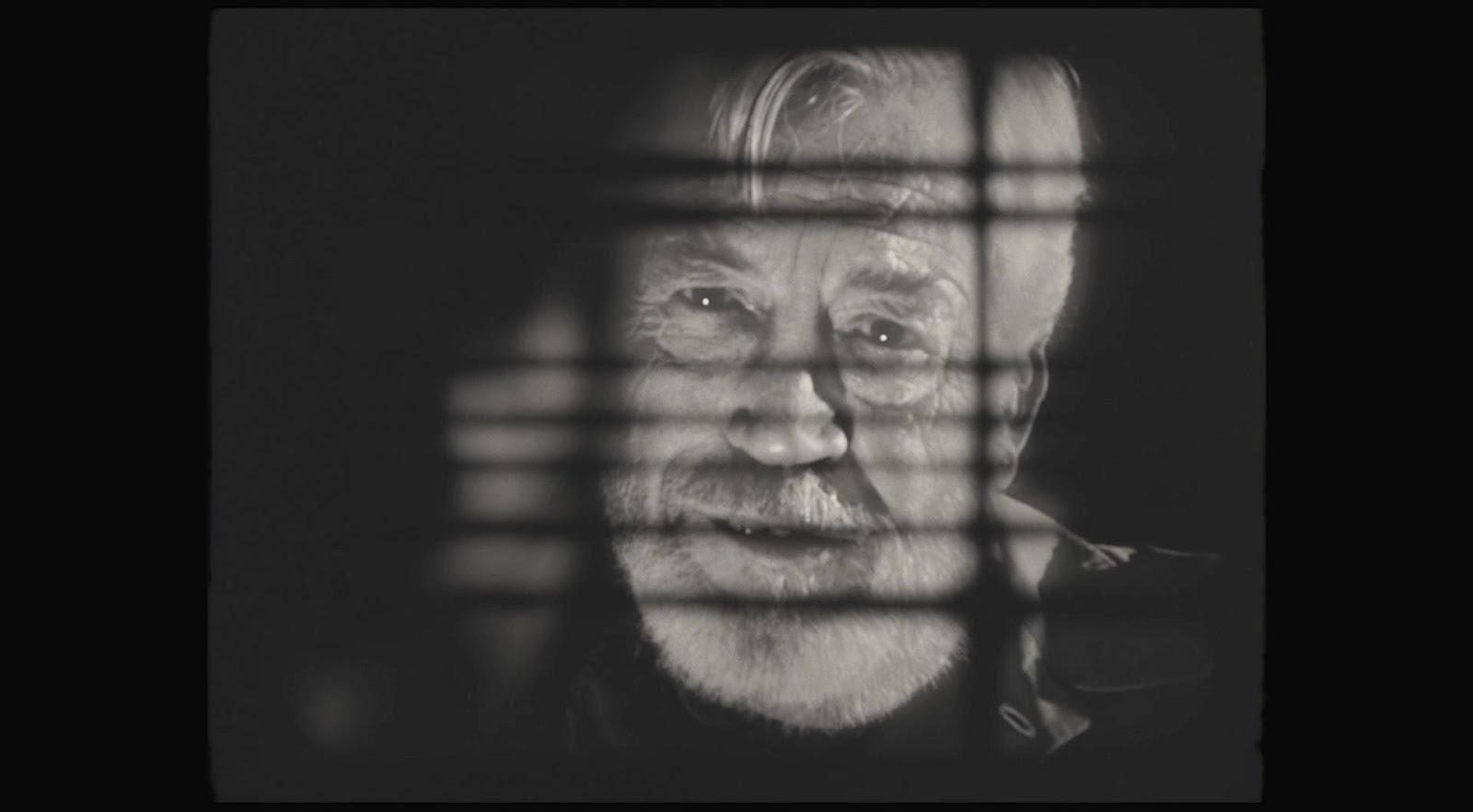
PHOBIA (Canada - 1980) Directed by John Huston. Written by Lew Lehman, Jimmy Sangster and Peter Bellwood. Cast: Paul Michael Glaser, Susan Hogan, John Colicos, David Bolt, Patricia Collins, David Eisner, Lisa Langlois, Robert O'Ree, Alexandra Stewart, Neil Vipond, Marian Waldman, Kenneth Welsh, Gwen Thomas. (R, 91 mins)
Barely released to theaters in the fall of 1980, the Canadian tax-shelter thriller PHOBIA is a front-runner for the most bizarre outlier of the legendary John Huston's filmmaking career. The director of THE MALTESE FALCON, THE TREASURE OF THE SIERRA MADRE, THE ASPHALT JUNGLE, THE AFRICAN QUEEN, and THE MAN WHO WOULD BE KING never turned down a lucrative gig, but like his contemporary Orson Welles, he usually reserved the more shameless cash grabs for his onscreen appearances in other directors' movies. Huston enjoyed a major resurgence as an in-demand character actor after his memorable performance as insidiously evil water magnate Noah Cross in Roman Polanski's 1974 classic CHINATOWN, but he wasn't very picky with his subsequent acting gigs. Within just a few years, he was starring in things like the Italian JAWS ripoff TENTACLES (1977), Mexican trash auteur Rene Cardona Jr's THE BERMUDA TRIANGLE (1978), Umberto Lenzi's cheap WWII would-be epic THE GREATEST BATTLE (1978), the insane THE VISITOR (1979), and the dismal Joe Lewis martial arts actioner JAGUAR LIVES (1979). Following his acclaimed but little-seen 1979 directing effort WISE BLOOD, Huston, then 74, somehow found himself in Toronto helming PHOBIA, which spent some time in cable rotation in the early '80s but has since fallen into almost total obscurity. It's just been resurrected on Blu-ray in a 4K restoration (!) by Kino Lorber, because physical media is dead.
In his only big-screen lead, STARSKY AND HUTCH's Paul Michael Glaser stars as Dr. Peter Ross, a Los Angeles shrink who's set up shop in Toronto, where he's conducting a potentially revolutionary experimental treatment of irrational fears, using volunteer prison convicts as his subjects. The treatment doesn't appear to be anything beyond planting the patients in front of a large screen where they're forced to watch what looks like a multimedia presentation of live-action images of whatever it that frightens them the most, whether it's snakes, crowds, fear of heights and falling, etc. As one expects to happen in thrillers of this sort, Ross' patients start getting offed one by one, mostly in ways related to their phobias, except for the initial victim (Alexandra Stewart), who's killed in a bomb blast that was meant for Ross. Red herrings abound--there's colleague and former lover Dr. Alice Toland (Patricia Collins), who doesn't seem too pleased that he's taken up with new girlfriend Jenny (Susan Hogan, memorable as the schoolteacher in THE BROOD), or it could be any of the remaining subjects in the program, including Bubba (Robert O'Ree), who has a fear of snakes; Henry (David Bolt), with a fear of falling, unstable nutcase Johnny (David Eisner), and Laura (Lisa Langlois), who has a fear of drowning. Could it even be irate, bellicose cop Barnes (John Colicos), who has little but scornful derision for both Ross and his "experimentees," as he dismissively calls them, or his condescending sidekick/partner Wheeler (Kenneth Welsh)? Who knows? Did John Huston even care?
The pieces are all in place for at least a workmanlike thriller: it's co-scripted by Hammer horror vet Jimmy Sangster, and reworked from an earlier draft by genre greats Ronald Shusett (ALIEN, TOTAL RECALL) and Gary Sherman (RAW MEAT, VICE SQUAD), both of whom would collaborate on Sherman's 1981 cult classic DEAD & BURIED. But Huston doesn't even hide his complete lack of engagement with the material. Granted, they can't all be winners in a career as long as his, but PHOBIA feels like a run-of-the-mill assignment that could've just as easily been made by Harvey Hart (SHOOT), Paul Lynch (PROM NIGHT), George Kaczender (AGENCY), George Mendeluk (STONE COLD DEAD), or any other mercenary director-for-hire who was consistently busy in the Canadian film industry at that time. There's absolutely nothing here to indicate that the guy who made THE MALTESE FALCON is the one calling the shots. The story plods along with no sense of urgency and little in the way of thrills, chills, or suspense, and the "shocking" reveal at the end lands with more or less a shrug. There's only some brief Langlois nudity and a couple of F-bombs to differentiate PHOBIA from any random made-for-TV movie of the period, and even a mid-film car chase comes off as perfunctory and spectacularly unexciting. The end result is certainly watchable--Glaser is fine in the lead, Colicos is terrific as the asshole detective, and there's a vaguely Pino Donaggio-esque score by Andre Gagnon that makes you wonder what Brian De Palma could've done with the same material--and it's obviously of interest to Huston completists, but the only thing they'll take away from PHOBIA is the nagging question of why he even bothered making it. Huston stayed busy in his final years with 1981's VICTORY, the 1982 musical ANNIE, and he finished big with three acclaimed films in a row with 1984's UNDER THE VOLCANO, 1985's PRIZZI'S HONOR, and his final work, 1987's posthumously-released THE DEAD, a longtime pet project based on James Joyce's novel, but PHOBIA remains his biggest head-scratcher of a directing credit. It's also one that apparently wasn't near and dear to his heart, as according to legend, Huston once walked out of an interview when he was asked about it.
Huston and Glaser on the set of PHOBIA
After PHOBIA tanked at the box office, Glaser continued appearing in TV movies for a few years until he took a two-decade sabbatical from acting to focus on directing. He'd already logged time behind the camera on a few episodes of STARSKY AND HUTCH and his work directing several episodes of MIAMI VICE led to his 1986 Michael Mann-produced feature directing debut BAND OF THE HAND. He followed that with Arnold Schwarzenegger's 1987 satirical sci-fi Stephen King adaptation THE RUNNING MAN, but as a director, Glaser is best known for the 1992 figure-skating romance THE CUTTING EDGE, which was a minor hit in theaters but found an even bigger audience on video and cable and remains a sentimental favorite for its fans today. In recent years, the now-76-year-old Glaser has acted and directed on TV occasionally and appeared at fan conventions with David Soul, the Hutch to his Starsky (both had cameos in the 2004 Ben Stiller/Owen Wilson big screen STARSKY AND HUTCH). For a long time post-PHOBIA, Glaser was known less for his Hollywood career and more for the unimaginable tragedy that befell his family when his wife Elizabeth contracted HIV from a blood transfusion in 1981 while giving birth to their daughter Ariel. She was unaware of it for several years, and didn't find out until 1985 that she had passed the virus on to both Ariel (via breastfeeding) and the couple's second child Jake, who was born in 1984. Seven-year-old Ariel succumbed to AIDS in 1988 and Elizabeth, who delivered a memorable speech on the AIDS epidemic at the 1992 Democratic National Convention, died in 1994. Glaser never contracted the virus, while his son Jake is now 35 and has lived with HIV since he was born. Father and son have remained active in promoting HIV and AIDS awareness through the Elizabeth Glaser Pediatric AIDS Foundation.
THE OTHER SIDE OF THE WIND (France/Iran/US - 2018) Directed by Orson Welles. Written by Orson Welles and Oja Kodar. Cast: John Huston, Oja Kodar, Peter Bogdanovich, Susan Strasberg, Lilli Palmer, Bob Random, Norman Foster, Edmond O'Brien, Mercedes McCambridge, Cameron Mitchell, Paul Stewart, Henry Jaglom, Paul Mazursky, Dennis Hopper, Curtis Harrington, Claude Chabrol, George Jessel, Gregory Sierra, Tonio Selwart, Dan Tobin, John Carroll, Stafford Repp, Geoffrey Land, Joseph McBride, Cathy Lucas, Pat McMahon, Peter Jason, Angelo Rossitto, Stephane Audran, Rich Little, Gary Graver, Frank Marshall, Cassie Yates, William Katt, Cameron Crowe, Les Moonves. (R, 122 mins) Orson Welles died in 1985, but 33 years later, his "last" film has finally been completed and released as a Netflix Original. One of the most famous of "lost" movies, THE OTHER SIDE OF THE WIND has spent decades mired in various legal, personal, and political quagmires among numerous involved parties. As was usually the case in Welles' European exile years in the 1950s and 1960s (the exception being his last Hollywood studio work as a director, 1958's TOUCH OF EVIL), funding came from his lucrative actor-for-hire jobs and when that ran out, he would constantly find himself hustling for cash from various wealthy investors from all over the world, who were always more than happy to partner with a revered filmmaker of Welles' stature until they realized they probably weren't getting their money back. Notorious for doing things his own way and clashing with Hollywood execs as far back as 1942's THE MAGNIFICENT AMBERSONS, Welles would rarely enjoy a hassle-free project other than 1962's THE TRIAL, and while he did have to cut corners when future SUPERMAN producer Alexander Salkind ran out of money by the end of production, he remained grateful that Salkind trusted him and left him alone to make the film he wanted to make.
Huston, Welles, and Bogdanovich apparently
coining the question "How 'bout a Fresca?"
As a result of his unconventional and often unreliable methods of finance, Welles probably had as many unfinished films as he did finished ones, none more talked about than THE OTHER SIDE OF THE WIND. Filming began in 1970 and wasn't completed until 1976, as Welles would shoot what he could in bits and pieces when the money was there, scraping by with acting and TV commercial gigs (and shooting another movie, 1973's F FOR FAKE) in the interim. He managed to get a French production company to back the project and when that money ran out, he secured additional financing from the Shah of Iran's brother-in-law (the production dragged on for so long and so sporadically that star John Huston didn't even join the cast until 1974). Written by Welles and his girlfriend Oja Kodar, THE OTHER SIDE OF THE WIND would remain unfinished in Welles' lifetime, the film caught up in his tax issues with the IRS; the alleged embezzlement of funds by a Spanish business associate Welles met while starring as Long John Silver in the 1972 Harry Alan Towers production of TREASURE ISLAND; the Ayatollah Khomeini-ordered seizure of the assets and property of the Shah and his entire extended family following the 1979 Iranian Revolution; and a seemingly never-ending conflict between Kodar and Welles' daughter Beatrice following his death, a battle that also involved Welles' protege and friend Peter Bogdanovich. The young director was then riding high on THE LAST PICTURE SHOW and PAPER MOON, and put $500,000 of his own money into Welles' vision in addition to letting his mentor crash at his Beverly Hills mansion from 1974 to 1976.
There was always talk of finishing the film, with Kodar attempting and failing to broker a deal with Showtime in the late '90s, but it was Bogdanovich who seriously got the ball rolling on the completion of THE OTHER SIDE OF THE WIND back in 2004 (other parties included cinematographer Gary Graver, who died in 2006, and producer Frank Marshall, who worked on part of the original shoot as a production assistant). Once all legal squabbles were resolved, Netflix agreed to fund the final restoration, with Oscar-winning editor Bob Murawski (THE HURT LOCKER) brought in to oversee the completion based on Welles' archived notes, multiple versions of WIND's scripts (including one that totaled 360 pages), and by studying his editing techniques on all of his previous films. Welles shot nearly 100 hours of footage, and it's an incredible achievement in itself that Murawski was able to put this together at all. The end result, running just over two hours, is seemingly free-form mash-up of various film stocks, image qualities, and aspect ratios, often switching from color to black & white in the same scene, almost like an art-house version of the kind of Z-grade drive-in patchwork you'd expect from Al Adamson or Jess Franco (an assistant to Welles on 1966's CHIMES AT MIDNIGHT). John Huston's actor son Danny was summoned to revoice some of his late father's dialogue in a few instances where the audio was too deteriorated to salvage or just missing altogether. Many scenes have the telltale signs of piecemeal shooting, with an absent Huston doubled from behind and conversations between two or more actors edited together even though the actors never share the frame and were shot years apart. Or even on a different continent in Lilli Palmer's case, with the actress in scenes with Huston and other cast members in California and Arizona shot anywhere from 1971 to 1976 even though she's always shown alone and all of her footage was shot in Spain in 1973.
Set up in an ahead-of-its-time mockumentary style by present-day voiceover from 1970s wunderkind Brooks Otterlake (Bogdanovich), THE OTHER SIDE OF THE WIND deals with the last day in the life of famed Hollywood movie director Jake Hannaford (Huston). A surrogate for Welles himself, Hannaford has invited his closest friends, colleagues, journalists, film students, and other assorted hangers-on and sycophants to his 70th birthday party being thrown by his long-ago lover and retired actress Zarah Valeska (Palmer), with everyone given 8mm and 16mm cameras to document the event. Hannaford's got other pressing issues: his latest film--titled THE OTHER SIDE OF THE WIND and a desperate attempt to attract the counterculture market--is in trouble. His star is John Dale (Bob Random), a Hannaford discovery who has no acting experience and is nowhere to be found after walking off the set midway through production; young studio boss Max David (Geoffrey Land) has seen the dailies and isn't happy, especially after loyal Hannaford flunky Billy Boyle (Norman Foster) confesses the director has tossed the script and is just making it up as he goes along; and Hannaford himself is growing increasingly jealous over the success of Otterlake, his protege who just scored a critically-acclaimed blockbuster hit with his third film and is now the toast of Hollywood. Hannaford needs Otterlake's help, but the young director won't use his newfound clout to help bail him out with David, who's been invited to the party and is a no-show.
Cameron Mitchell, Paul Stewart, Mercedes
McCambridge, and Welles on the set.
The party is a Who's Who of Hannaford's world, with tight-knit, ENTOURAGE-like acolytes like Boyle, retired actor friends Pat Mullins (an ill-looking Edmond O'Brien, who would retire from acting himself in 1974 after being diagnosed with Alzheimer's), Lou Martin (John Carroll), and Al Denny (Stafford Repp); former business partner "The Baron" (Tonio Selwart); loyal secretary Maggie Noonan (Mercedes McCambridge); his manager Matt Costello (Paul Stewart); and longtime makeup man Zimmie Zimmer (Cameron Mitchell), who attends the party even though he's fired en route. There's also macho screenwriter Jack Simon (Gregory Sierra), who's no fan of Hannaford's, and film critic Juliet Rich (Susan Strasberg), who's notoriously critical of the work of both Hannaford and Otterlake. As everyone mingles, drinks to excess, and wonders about everything from Dale's absence to Hannaford possibly being a closeted homosexual, the director screens an unfinished workprint of THE OTHER SIDE OF THE WIND, an experimental, avant-garde, Euro-tinged, psychedelic art film starring Dale and a nameless actress (Kodar). The film-within-a-film (shot mostly in 1970) has some striking imagery, whether it's a sex scene in the passenger seat of a garishly lit car that looks like a Dario Argento cab ride (this sequence was shot in 1974), or Dale and "The Actress" spending most of the screened film wandering around nude on the MGM backlot with no dialogue. The power goes out, forcing the party to use generators that also fail, at which point the screening moves to a nearby drive-in. When The Baron informs the projectionist that he's showing the reels out of order as "The Actress" happens upon a giant, erect cock in the desert, the response is "Does it matter?"
Almost every character in THE OTHER SIDE OF THE WIND is a stand-in for someone: Billy Boyle was reportedly based on Mickey Rooney, Max David on then-Paramount head Robert Evans, Zarah Valeska on Marlene Dietrich (Welles' original choice for the role, but she turned it down), Juliet Rich on famously combative film critic Pauline Kael, Jack Simon on John Milius, "The Baron" on John Houseman, and most importantly, Brooks Otterlake on Peter Bogdanovich himself, who skyrocketed to fame and fortune while Welles struggled to get any project off the ground (Otterlake's barely-legal date to the party, Mavis Henscher, played by Cathy Lucas, is based on Bogdanovich's then-girlfriend Cybill Shepherd). Bogdanovich's casting pretty much eliminates any mystery as to what Welles' feelings on their friendship were by that point, but it's interesting to note that Bogdanovich only ended up being cast after Welles' first choice--Rich Little, of all people--left the production just like John Dale left the film-within-a-film, partly because of other commitments but mostly because he had no idea what Welles was trying to accomplish. Little remains in the film as an unnamed party guest and has one scene with Lucas, and judging from his wardrobe and dialogue, it was clearly shot when Little was still playing Otterlake (and Otterlake's odd quirk of doing random celebrity impressions--not one of Bogdanovich's strengths--is something that was obviously conceived with Little in mind). Welles made no secret of his disdain for pretentious art cinema, with particular scorn reserved for Michelangelo Antonioni, whose ZABRISKIE POINT is being mocked in the film-within-a-film THE OTHER SIDE OF THE WIND, and with Kodar's constant nudity and some scattered instances of explicit sex, it's very likely that this would've gotten an X rating if it was released in the 1970s. There's a dark-humored and misanthropic streak throughout the film, but the cheap shots--at European cinema (Billy on LAST TANGO IN PARIS director Bernardo Bertolucci: "He's-a-spicy-a-meatball!"), at new Hollywood, at film critics (how else do you explain a drunk Hannaford physically assaulting Juliet Rich near the end?), and at misfit, Hannaford-obsessed film students, especially with a pair of clingy dweebs in Marvin Pistor (Joseph McBride) and Marvin P. Fassbinder (Pat McMahon), who are invited to the party, ask inane questions, and follow him around like lost puppy dogs--start to feel like sour grapes after a while.
As the booze-swilling, cigar-sucking Hannaford, Huston is captivating every moment he's onscreen, channeling Welles through his own persona to create a fascinating hybrid characterization of two larger-than-life filmmakers. With the rapid-fire quick-cuts, constantly-changing film stocks, and the fact that some of their scenes may have been shot months or years apart, most of the cast doesn't get a chance to make that much of an impression, though Mitchell, by that point slumming in D-grade schlock, is an unexpectedly poignant standout as the melancholy Zimmie. Other then-contemporary filmmakers appear as themselves arguing about the state of cinema at Hannaford's party, including Dennis Hopper, Claude Chabrol, Curtis Harrington, Paul Mazursky, and Henry Jaglom, who directed Welles' final performance in SOMEONE TO LOVE, released in 1988, three years after his death. There's some scattered moments of Welles-ian mastery in THE OTHER SIDE OF THE WIND, and at times, it's a remarkably candid confessional, like it's Welles' own personal version of Luchino Visconti's THE LEOPARD, where Burt Lancaster's aging prince wanders from room to room at a grand ball, saying goodbye to his aristocratic life, recognizing his irrelevance in a world that's moving on and leaving him behind. But after all these years, the knee-jerk reaction will be to label this Welles' lost masterpiece or his "ultimate statement," or something to that effect. Five decades of cineaste mystique surrounding an ambitious and unfinished project will do that, but at the end of the day, this is the kind of self-indulgent home movie that's an historical curio at best, and directly responsible for the career of Henry Jaglom at worst. I'm glad it's out, I'm glad we're able to see it, and it's required viewing for anyone with a serious interest in film history up to the 1970s, but am I ever gonna watch this again? There's a legend surrounding THE OTHER SIDE OF THE WIND, and the backstory--covered at length in Morgan Neville's simultaneously-released Netflix Original documentary THEY'LL LOVE ME WHEN I'M DEAD--is ultimately more fascinating than the film itself.
THE GREATEST BATTLE aka THE BIGGEST BATTLE aka THE GREAT BATTLE aka BATTLE FORCE (Italy - 1978) Directed by Umberto Lenzi. Written by Umberto Lenzi and Cesare Frugoni. Cast: Helmut Berger, Samantha Eggar, Giuliano Gemma, John Huston, Stacy Keach, Ray Lovelock, Henry Fonda, Edwige Fenech, Evelyn Stewart (Ida Galli), Aldo Massasso, Venantino Venantini, Guy Doleman, Patrick Reynolds, Rik Battaglia, Andrea Bosic, Giuseppe Castellano, Luciano Catenacci, Giovanni Cianfriglia, Geoffrey Copleston, Tom Felleghy, Manfred Freyberger, Marco Guglielmi, Fulvio Mingozzi, Giacomo Rossi Stuart, Bill Vanders, Robert Spafford, Olga Pehar Lenzi. (PG, 102 mins) WWII movies were extremely popular all over the world from the mid-1960s through the 1970s, and journeyman Italian director Umberto Lenzi was no stranger to the genre. He'd already made "macaroni combat" movies like 1967's DESERT COMMANDOS and 1969's BATTLE OF THE COMMANDOS in response to the 1967 blockbuster THE DIRTY DOZEN, but then he moved into gialli like 1972's SEVEN BLOODSTAINED ORCHIDS and really hit his stride with a string of ridiculously entertaining and extraordinarily violent poliziotteschi like 1974's ALMOST HUMAN and 1976's ROME ARMED TO THE TEETH among many others. But between his crime movies and his jumping on the post-CANNIBAL HOLOCAUST gut-muncher bandwagon with 1980's EATEN ALIVE and 1981's CANNIBAL FEROX, Lenzi cranked out two more "macaroni combat" films. Differing from the DIRTY DOZEN-inspired "men on a mission" formula of his late '60s genre contributions, 1978's THE GREATEST BATTLE and 1979's FROM HELL TO VICTORY (which starred George Peppard and George Hamilton, the same year he had a huge hit with LOVE AT FIRST BITE) seemed like responses to the more large-scale, all-star ensemble epics that were being produced at that time, like 1976's MIDWAY, 1976's THE EAGLE HAS LANDED, and 1977's A BRIDGE TOO FAR. Both films had casts of big-name actors who carried significantly more prestige than you'd expect in a run-of-the-mill Italian knockoff, but from the looks of THE GREATEST BATTLE, the entire budget went to paying those actors because for the most part, it looks like how a WWII epic might turn out if it was directed by Jess Franco or Al Adamson.
THE GREATEST BATTLE was shown under a plethora of different titles: it was shot in Rome, Almeria, and Los Angeles in 1977 as IL GRANDE ATTACCO, and then alternately known as THE BIGGEST BATTLE (the title it carries on Amazon Prime), THE GREAT BATTLE, and BATTLE FORCE, but THE GREATEST BATTLE is what it initially went by when drive-in outfit Dimension Pictures released it in the US, cut down to 90 minutes, with Lenzi pseudonym "Humphrey Longan" credited as director, and with added narration by Orson Welles, who's not heard on the complete 102-minute, English-dubbed BIGGEST BATTLE version streaming on Amazon (dubbing fixture Anthony La Penna handles some incidental narration in a few spots). Stacy Keach is among the stars, and in his very enjoyable 2013 memoir All in All, he refers to the film under yet another title, THE MARETH LINE, and calls it "flat-out awful." A fair assessment, though as Keach points out, "It gave me a chance to work with Henry Fonda and John Huston," and they're only a few of the reputable actors called upon to star in a film by the future director of CITY OF THE WALKING DEAD, MAKE THEM DIE SLOWLY, and FATTY GIRL GOES TO NEW YORK. THE GREATEST BATTLE opens in Berlin in 1936 just after the Olympics, as a small group of friendly acquaintances meet for a formal dinner: German Major Manfred Roland (Keach), British war correspondent Sean O'Hara (Huston, not even attempting a British accent) and his wife (Lenzi's wife Olga Pehar Lenzi), West Point legend General Foster (Fonda), and renowned German actress Annelise Ackermann (Samantha Eggar). They discuss the rise of Hitler and his disdain of Jews and "American negroes" in the wake of Jesse Owens' Olympic triumph, but all parties foolishly conclude that everything is fine, that war is unlikely and they'll all be friends for many years to come.
Cut to 1942, and the entire world is at war. From then on, THE GREATEST BATTLE is an episodic and seemingly random series of vignettes that eventually form some semblance of a story but it still feels choppy and haphazardly-assembled. There's copious amounts of stock footage from newsreels and other movies, and sometimes the various film stocks don't even match. Foster's son John (Ray Lovelock) has enlisted after flunking out of college, unable to win over his old man like his older, war hero brother Ted (never seen, but played by a framed photo of future CEMETERY MAN director Michele Soavi); Roland and Annelise are now married, but he's conflicted about pledging his allegiance to Der Fuhrer and the Nazi party and determined to keep Annelise's being half-Jewish a secret from his superiors. We also meet other characters who have nothing to do with the initial expository set-up of the Berlin dinner, such as British Capt. Martin Scott (Giuliano Gemma), his ex-wife (Ida Galli) and her new husband (Venantino Venantini), and German Lt. Kurt Zimmer (Helmut Berger), who's fallen in love with French prostitute Danielle (Edwige Fenech) who may or may not be a member of the Resistance. Some of these people cross paths, and some of them don't. Huston's O'Hara is the most confusing character of them all, a grouchy old cynic who seems far too old to be playing a roving war correspondent chasing a story at the center of the action, and it's anyone's guess why some characters occasionally refer to him as "Professor O'Hara" or why he's shown strutting around and barking orders at some officers in one scene. Huston--just four years removed from co-starring in CHINATOWN--doesn't even seem to know or care what he's doing, as he has one of the most jaw-dropping exits you'll ever see, a barely-concealed breaking of the fourth wall, almost as if he said "Alright, Lenzi, I'm done here...I'll show myself out of this movie." In between the Ovidio G. Assonitis classics TENTACLES and THE VISITOR, Huston isn't even hiding his disinterest in THE GREATEST BATTLE, further evidenced by an anecdote Keach shares in his memoir. Concerned about not overdoing his German accent and having difficulty communicating with Lenzi, who didn't speak English, Keach asked Huston, his director on 1972's FAT CITY and THE LIFE AND TIMES OF JUDGE ROY BEAN, for some advice. Huston replied "I'm only an actor here. I didn't ask you about my accent. Talk to the director," adding "Learn Italian or find an interpreter."
Speaking of TENTACLES, both Huston and Fonda appeared in that 1977 Italian JAWS ripoff about a giant mutant octopus, though they shared no scenes. Fonda has a few fleeting appearances scattered throughout TENTACLES, always on the phone yelling at someone. His entire role was shot in one morning at his house, and his dialogue is vague enough ("Well, take care of it!") that I remain convinced he had no idea he was in a movie about a giant mutant octopus. While Fonda gets out a bit in THE GREATEST BATTLE in both the opening dinner sequence and the closing scene at a cemetery, the rest of his appearances are, once again, by himself and on the phone in what looks suspiciously like a very 1970s Beverly Hills home in which a famous movie star might reside. Was this Fonda's thing prior to capping his stellar career with ON GOLDEN POND? Forcing journeymen Italian directors to make house calls if they wanted him in their movie? THE GREATEST BATTLE makes a lot of noise but very little sense, jumping from place to place with an ensemble whose members vanish for long stretches or right after they're introduced. The supporting cast is an impressive who's who of jobbing Italian supporting actors who always turn up in this sort of genre fare (I'm pretty sure Tom Felleghy owned that general's uniform, and having gravelly-voiced dubber Robert Spafford appear on camera as Gen. George S. Patton was an inspired choice), but the performances of the main cast are all over the map, with Huston looking visibly inconvenienced and demonstrably irritable in a way that borders on acting out, and Fonda mostly phoning it in TENTACLES-style (oddly, in Tony Thomas' 1983 Citadel Press-published The Complete Films of Henry Fonda, THE GREATEST BATTLE was absent even though his role is considerably more than a cameo, and in the early days of pay cable, this aired on HBO quite often). Berger is relatively restrained, considering his reputation and that he'd recently been in the 1976 Nazisploitation epic SALON KITTY, though if anyone can figure out why he and Fenech are even in this, let me know. The usually reliable Eggar is absolutely awful, but for whatever reason, Keach, the same year he co-starred in Sergio Martino's vile MOUNTAIN OF THE CANNIBAL GOD, is trying a lot harder than his other big-name co-stars and is the only one who seems interested in creating a three-dimensional character, even if the sloppiness of Lenzi's direction and the scattered script by Lenzi and Cesare Frugoni give him little with which to work. Franco Micalizzi's by-the-numbers "rousing" score lacks the maestro's usual catchy pizazz, and some of the miniatures in the battle sequences would make Antonio Margheriti cringe and look away in embarrassment. But for fans of "macaroni combat" movies, there's plenty of action sequences and a lot of big and loud explosions. Just don't expect it to make much sense. Maybe that's why Huston looks like he's breaking character and literally walking out of the movie.
CANDY (Italy/France - 1968) Directed by Christian Marquand. Written by Buck Henry. Cast: Charles Aznavour, Marlon Brando, Richard Burton, James Coburn, John Huston, Walter Matthau, Ringo Starr, Ewa Aulin, John Astin, Enrico Maria Salerno, Elsa Martinelli, Sugar Ray Robinson, Anita Pallenberg, Florinda Bolkan, Marilu Tolo, Nicoletta Machiavelli, Umberto Orsini, Joey Forman, Fabian Dean, Lea Padovani, Peter Dane, Enzo Fiermonte, Buck Henry. (R, 124 mins) Based on the controversial 1958 "dirty book" of the same name by Terry Southern and Mason Hoffenberg, CANDY is the kind of movie that could only have been made in the late 1960s. Unevenly mixing slapstick sex farce with trippy psychedelia and counterculture satire in one bloated, overly indulgent, and almost instantly dated package, CANDY is a chaotic all-star mess of the 1967 CASINO ROYALE variety, but like that film, it's an endlessly fascinating one. Contrary to the myth that's stuck over the nearly 50 years since its release, it was not a box office disaster. Indeed, opening in December 1968, it made $16 million and was the 18th highest grossing film of the year in the US, sandwiched between THE BOSTON STRANGLER and THE THOMAS CROWN AFFAIR. Adjusted for inflation, that's $111 million in 2016 dollars. Can you imagine something as balls-out insane as CANDY making $111 million in theaters today?
Adapted by Buck Henry, who had just been nominated for an Oscar for co-writing THE GRADUATE, and directed by Christian Marquand, the French actor who co-starred with Brigitte Bardot in the iconic AND GOD CREATED WOMAN (1956), CANDY's biggest draw was the spectacle of a huge cast of big names and a couple of Oscar winners starring in a smutty comedy based on a book that was widely considered pornography. Much less explicit than the book, the film nevertheless has a high raunch factor and a decent amount of nudity that still warrants the R rating it got 46 years ago. Opening with what looks like her arrival on Earth (2001: A SPACE ODYSSEY special effects mastermind Douglas Trumbull designed some of the surreal visuals in the opening and closing sequences), CANDY centers on naive high-school student Candy Christian (18-year-old Ewa Aulin) and her wild sexual escapades with a increasingly deranged parade of pervy older men. What was played as comedy in 1968 would undoubtedly be labeled rape by today's trigger warning-obsessed thinkpiece writers, but the oblivious Candy just rolls with it, starting with drunken poet MacPhisto (Richard Burton), who has his way with her in the back of his glass-bottom limo, slurping spilled champagne off the floor while ranting and grunting about his "overpowering need!" Arriving at her house while her social sciences teacher father T.M. (John Astin) is still at school, Candy is attacked by Mexican gardener Emmanuel (Ringo Starr) who shouts "Viva Zapata!" as he ejaculates and MacPhisto dry-humps a Candy-lookalike doll on the floor. Enraged by her dalliance with Emmanuel, her uptight, conservative father tries to take her to NYC with his lecherous brother Jack (also Astin), and Jack's swinging wife Livia (Elsa Martinelli), but they're accosted on the airport runway by Emmanuel's domineering, revolutionary biker sisters (Florinda Bolkan, Marilu Tolo and Nicoletta Machiavelli). Hopping aboard a refueled military plane that's been transporting the squadron of Gen. Smight (Walter Matthau) around the globe for six years, T.M. suffers a head injury while sexually frustrated Smight tries to force Candy to bear his child. Landing in NYC, they rush T.M. to the hospital where he's the next production in the gala theater of superstar brain surgeon A.B. Krankheit (James Coburn), who hosts a wild post-surgery after-party/orgy where Uncle Jack has sex with Candy in her father's hospital bed, pushing his brother onto the floor when he gets in the way. Krankheit seduces Candy in another room while a partially lobotomized T.M. wanders the halls, and even enraged hospital head Dr. Dunlap (John Huston) tries to spread unconscious Candy's legs and look up her skirt. From there, Candy is separated from Uncle Jack and Livia, and crashes the set of sex-crazed filmmaker Jonathan J. John (Enrico Maria Salerno) and is soon pursued by a pair of horny cops (Joey Forman, Fabian Dean). Then she meets a hunchback (Charles Aznavour) in Central Park, who asks her for "rub dub dub" before taking her back to his mansion, where he can fly and climb walls. Candy's next escapade finds her in an Indian temple housed in the back of a big rig, where she's mentored in the ways of bullshit philosophy and tantric sex by fake guru Grindl (Marlon Brando).
Unless you're in the mood for it, CANDY can be downright unwatchable, but the once-in-a-lifetime cast makes it mandatory viewing at least once (there's also model and longtime Keith Richards girlfriend Anita Pallenberg as Krankheit's chief nurse and boxing legend Sugar Ray Robinson as MacPhisto's chauffeur Zero). It gets more bewildering as it goes along, all the way to a fourth-wall breaking finale where a wandering Candy actually sees Marquand himself directing the movie that's imploding on itself. The good slightly outweighs the bad, and while some segments are tedious duds (the sequences with Matthau, Salerno, and Aznavour just land with a thud, and Starr's Mexican caricature is embarrassing even by 1968 standards), others are legitimately funny. Burton gets the best entrance of his career as MacPhisto, his hair and scarf constantly blown back by a seemingly supernatural wind that surrounds only him. Coburn is great as the demented Krankheit, with the notion of the rock star-like surgeon, years before Buckaroo Banzai, the height of the film's absurdist Southern influence (Southern also co-wrote DR. STRANGELOVE and would write 1969's star-studded and equally anarchic THE MAGIC CHRISTIAN, which also starred Starr). Brando is also quite amusing as the phony mystic, sheepishly trying to hide a footlong sub and a bottle of beer as Candy awakens after a marathon of Twister-like sex.
Of all the star power in the cast, the biggest surprise is Astin, who's a riot as the shameless horndog Uncle Jack, constantly leering and making suggestive, over-the-line comments as he tirelessly tries to get in his niece's pants. According to legend, Marquand's original choice for the T.M./Uncle Jack dual roles was Peter Sellers, and there's a lot of Sellers' style in Astin's performances, particularly the Clare Quilty skeeziness he brings to Uncle Jack's LOLITA-like designs on Candy. Probably because he was known as a TV actor, his spot in television history forever cemented by his Gomez Addams on THE ADDAMS FAMILY (he also briefly replaced Frank Gorshin as the Riddler in the second season of BATMAN), Astin isn't even granted the dignity of having his name above the title with the others--where, alphabetically, he would've been top-billed before legendary French singer Aznavour--even though between both of his roles, he's got the most screen time other than Aulin. Sellers would've been incredible but Astin's work in CANDY is rarely cited as one of its strong points and that's a shame. He manages to upstage his significantly higher-profile co-stars and gets some of the biggest laughs in the movie. Given an "introducing" credit even though it was her fourth film, Swedish actress Aulin's voice is dubbed but she certainly looks the part, and seems like a good sport considering she spends a good chunk of the film in various states of undress while being pawed by a bunch of overpaid and presumably highly intoxicated A-listers (quoted in the 2004 book The Candy Men by Terry Southern's son Nile, about the controversy surrounding the novel, Coburn claimed that inexperienced Aulin had a breakdown and needed several days off to decompress after dealing with Brando). CANDY's notoriety didn't really open any doors for Aulin, despite a Golden Globe nomination for Most Promising Female Newcomer (she lost to Olivia Hussey in ROMEO AND JULIET). She remained busy in Italian films, most notably the gialli DEATH LAID AN EGG (1968) and DEATH SMILES ON A MURDERER (1971), with her most high-profile post-CANDY role being in the Gene Wilder-Donald Sutherland comedy START THE REVOLUTION WITHOUT ME (1970). Tired of being offered the same kinds of sexpot roles, the now-66-year-old Aulin quit acting in 1974, enrolled in college, became a schoolteacher, and focused on raising her kids. She made a one-off comeback in a supporting role in the little-seen 1996 Italian comedy STELLA'S FAVOR and quickly returned to a life completely off the celebrity grid.
An unmistakable product of its time (featuring music by The Byrds and Steppenwolf), CANDY was hard to see after its theatrical run in 1968 (where it was in cinemas the same time as the similarly time-capsule-worthy SKIDOO), Outside of some occasional and highly-edited late-night TV airings, the film built a cult mystique as it essentially disappeared for a number of years. It was never released on home video until Anchor Bay's DVD and VHS editions in 2001. It recently debuted on Blu-ray courtesy of Kino Lorber, with a very good Buck Henry interview, where the 85-year-old comedy writing legend is pretty blunt about what works and what doesn't and shares a number of stories about the production.
Directed by Michael J. Paradise (Giulio Paradisi). Written by Lou Comici and Robert Mundy. Cast: Mel Ferrer, Glenn Ford, Lance Henriksen, John Huston, Joanne Nail, Franco Nero, Sam Peckinpah, Shelley Winters, Paige Conner, Wallace Wilkinson, Elizabeth Turner. (Unrated, 109 mins)
(Note: for a more in-depth review of the film, click here; this is a follow-up piece specifically covering the 2013 re-release by Drafthouse Films and the just-released Blu-ray)
A couple of years back, Drafthouse Films, the distribution offshoot of cinehipster mecca The Alamo Drafthouse, managed to create a legitimate cult movie sensation out of the delirious 1988 martial arts actioner MIAMI CONNECTION (and lest you think they're only showcasing "bad" movies, they also did a fine job of resurrecting the legendary, semi-lost 1971 Outback nightmare WAKE IN FRIGHT). Late last year, they tried to go for another MIAMI CONNECTION with the original 109-minute uncut version of the insane 1979 Italian horror film THE VISITOR. While the re-release wasn't greeted with the same level of enthusiasm as MIAMI CONNECTION, it did bring some increased notoriety to an utterly batshit, singularly unique film that's been patiently awaiting its day in the sun. Released on the drive-in and grindhouse circuit in America in a truncated 90-minute version in 1980, THE VISITOR was quickly consigned to late-night TV and video stores to be discovered by cult movie aficionados, Eurotrash addicts, and insomniacs who, for the most part, kept it to themselves for the next 30 or so years. With its perfect storm of past-their-prime actors, an incoherent script, and Italian filmmakers ripping off blockbuster American hits like THE OMEN and CLOSE ENCOUNTERS OF THE THIRD KIND, it's the kind of B-movie that only could've happened in the late 1970s. Perhaps one reason that the re-release of THE VISITOR didn't catch on like MIAMI CONNECTION did was that, while completely bonkers, it's not as MST3K hilarious as MIAMI CONNECTION, and also because it wasn't quite as obscure. Code Red released a fine DVD special edition of the uncut version (1.85:1 anamorphic) in 2010, with a great transfer and a wealth of extras, including two commentary tracks--one with star Paige Conner, moderated by filmmakers and VISITOR superfans Scott Spiegel (co-writer of EVIL DEAD II) and Jeff Burr (director of LEATHERFACE: TEXAS CHAINSAW MASSACRE III), and another with star Joanne Nail, moderated by cult movie expert Marc Edward Heuck.
None of those Code Red-produced extras (which included interviews with Conner, Nail, producer Ovidio Assonitis, and Atlanta location manager and future John Carpenter associate Stratton Leopold) are carried over to the new Drafthouse Blu-ray, so if you bought that DVD in 2010, you better hang on to it. The Conner and Nail commentaries are essential listening for VISITOR nerds, even if Conner has to repeatedly tell Spiegel and Burr that the movie was shot over the summer and she didn't need permission to be out of school, that Spiegel is incredulous over "no writers being credited," despite a "Written by Lou Comici and Robert Mundy" credit at the beginning of the film, and, in a real whopper, Spiegel declaring "Mel Ferrer and Jose Ferrer are brothers." Burr: "Are they?" Spiegel: "They're at least first cousins." No. Wrong and wrong. No relation. Drafthouse's Blu-ray (again framed at 1.85:1) may not have the extensive bonus features that Code Red offered but it does make itself unique with a great Lance Henriksen interview. A relative unknown at the time with small roles in DOG DAY AFTERNOON, NETWORK, and DAMIEN: OMEN II under his belt, Henriksen recalls the film as a "hodgepodge...with space babies, birds, and Jesus Christ," and often asked himself "What were they thinking? Where was the narrative in this thing? I had no idea what I was doing." He says that shooting was sometimes problematic because director Giulio Paradisi refused to speak English and the dialogue sometimes felt like it hadn't been translated accurately. He doesn't think very highly of the film itself but has fond memories of working with the veteran actors and thought it unusual that Assonitis actually showed up at his agent's office and told him "You're going to sign this contract and you're going to Rome, and you're going have a good time." Henriksen also recalls dragging a group of his friends to Times Square to see the movie in a 42nd Street grindhouse, where someone in the balcony yelled "I want my money back!" (Henriksen: "There were 30 people in the audience, and 15 of them were my friends").
In addition to a short segment with cinematographer Ennio Guarnieri, where he discusses some locations and visual effects, co-writer Comici is also interviewed and has some even more wild stories. Initially hired because he spoke both English and Italian, Comici's main responsibility was taking Paradisi's ideas and forming them into a story ("Giulio didn't have a story, he just had scenes"). Paradisi, a former assistant to Federico Fellini who primarily worked in TV commercials and nature documentaries, had some insane ideas (Comici: "He wanted elephants in one scene because he thought people liked elephants..." and "He was always trying to work in scenes of people on the toilet") and was even fired at one point during pre-production before (and Comici stresses that he heard this second-hand) "one of Giulio's relatives put a gun to the producer's head and told him to hire Giulio back." Comici's involvement in the film ended when he showed up at Assonitis' office with a complete script and handed it to Paradisi who, without even looking at a single page, dismissed it and threw it out of the fourth-story window.
If Comici's memories seem slightly embellished, then wait until you read the Blu-ray's accompanying booklet, written by Zack Carlson, featuring an interview with Assonitis. Assonitis has been prone to hard-to-swallow statements in the past, like saying he never saw THE EXORCIST before making the blatant EXORCIST ripoff BEYOND THE DOOR, and while it's not impossible to believe that other writers--including Oscar-nominated SERPICO and SATURDAY NIGHT FEVER screenwriter Norman Wexler--made some uncredited script contributions, you can't help but question the producer's claim that, upon visiting an ill John Huston a week before his death in 1987, he noticed a VHS copy of THE VISITOR on a table near the cinema icon's sickbed. Carlson's essay is nicely-done and he obviously displays a great affinity for the film, which he describes as a "distinctly European skull-wrecker," and "disorienting, uncomfortable, misanthropic, and a genuine masterpiece." Code Red's DVD looked superb and they deserve a significant amount of credit for making this available before the hipsters had the chance to embrace it. But Drafthouse's Blu-ray, an HD upgrade from the same materials provided by Assonitis, takes it a slight step further, and I'm in favor of anything that makes this one-of-a-kind, looney-tunes mindfuck as accessible as possible, and I have no doubt that anyone who's cherished THE VISITOR for as long as I have finds the idea of this being on Blu-ray almost as nuts as the film itself.
Directed by Michael J. Paradise (Giulio Paradisi). Written by Lou Comici and Robert Mundy. Cast: Mel Ferrer, Glenn Ford, Lance Henriksen, John Huston, Joanne Nail, Franco Nero, Sam Peckinpah, Shelley Winters, Paige Conner, Wallace Wilkinson, Elizabeth Turner, Steve Somers, Neal Boortz. (R, 90 mins/Unrated, 109 mins)
A longtime cult favorite thanks to its constant airings on late-night TV throughout the 1980s, the utterly delirious Italian horror film THE VISITOR is like nothing seen before or since. For years, the following this film had in America was based on its butchered 90-minute US cut released on the grindhouse and drive-in circuit throughout 1980 and quickly shipped off to TV. This US edit excised nearly 20 minutes from the original European version, with a good chunk of that being important exposition at the beginning of the film. Code Red released the uncut version on DVD in an impressive transfer with some great extras in 2010, finally allowing fans to see the intended version and it's a bit of a double-edged sword: on one hand, the film is still completely looney tunes, filled with confused actors, memorable set pieces, some impressive set designs, some incredibly striking imagery, and what looks like the most dangerous and impractical staircase ever built in a residence, but on the other, the clarification of several major plot points significantly reduces the jawdropping WTF? factor that US fans knew and loved for so many years. In its intended 109-minute form, THE VISITOR is still completely preposterous, but its preposterous plot elements now make some semblance of sense. Don't misunderstand me: this is a mandatory piece of head-scratching cinema, but people seeing the uncut version without experiencing the truncated US cut that so many of us were so thoroughly baffled by for so many years might not see what all the fuss is about among the people who love this thing. The two versions of THE VISITOR provide a rare example where some fans might actually prefer the chopped-down version just for the sentimental value.
Filmed mostly in Atlanta, GA in the summer of 1978, with some interiors (including the memorably-designed house where much of the climactic action takes place) shot in Rome at De Paolis and Cinecitta, THE VISITOR was produced by Italian schlock king Ovidio G. Assonitis, an Egyptian-born producer/director who first gained notoriety a few years earlier with his 1975 Italian EXORCIST ripoff BEYOND THE DOOR, which he directed under the pseudonym "Oliver Hellman." BEYOND THE DOOR, with Juliet Mills as a pregnant mom who turns into a vile, vomiting, obscenity-spewing hag when her fetus is possessed by Satan, became a surprise box office hit despite a lawsuit by Warner Bros., irate over its similarities to THE EXORCIST (this didn't stop Italian producers from unleashing a flood of EXORCIST ripoffs for the next several years). Assonitis then produced and may have directed some of 1976's FOREVER EMMANUELLE before ripping off another American blockbuster with 1977's TENTACLES, a JAWS imitation that replaced a great white shark with a mutant octopus stirred from the ocean depths some by illegal drilling done by an oil company whose unscrupulous owner is played by a seriously slumming Henry Fonda. If you're wondering why Fonda is appearing in an Italian ripoff of JAWS, you might want to ask John Huston, Shelley Winters, Bo Hopkins, and Claude Akins the same thing. And while it's not completely ridiculous to cast Huston (born in 1906) and Winters (born in 1920) as siblings, I have to question what compelled Assonitis to make it a plot point that Huston is the younger one. It's just that kind of movie. TENTACLES had an unusually overqualified cast for such a low-grade affair, but if you listen to the commentary track by longtime Assonitis production associate Peter Shepherd on 1986's Assonitis-produced CHOKE CANYON, you'll hear some great stories about Assonitis being the kind of producer who paid well-known but past-their-prime actors duffel bags full of cash that was stored above the ceiling tiles in a rented office. Fonda shot his three or four TENTACLES scenes--which consist of his character making some angry phone calls that are vague enough ("Why wasn't I told about this?" and "Just take care of it!") that I remain convinced he had no idea he was in a movie about a giant mutant octopus--in one morning at his own dining room table. That's right: Assonitis brought a skeleton crew to Fonda's Beverly Hills home, got the shots he needed and Fonda was handed a bag of money. They worked so quickly that Fonda audibly flubs a line at one point and they just left it in, as I'm sure the Hollywood legend wasn't about to listen to any of this "Let's try that again" bullshit. With that kind of chicanery in his bag of tricks, it's no wonder that Assonitis was picked to run Cannon in its final days after Menaham Golan and Yoram Globus left and before the plug was mercifully pulled.
Assonitis has always had a reputation for hiring directors just to fire them so he can take over the filming himself, with the most famous example being his Italian-made sequel PIRANHA II: THE SPAWNING (1982). Assonitis asked PIRANHA producer Roger Corman if he had any promising employees he thought might be a good candidate to direct, and Corman gave him special effects technician and art director James Cameron, who had worked behind the scenes on Corman productions like BATTLE BEYOND THE STARS (1980) and GALAXY OF TERROR (1981) and did some matte work on John Carpenter's ESCAPE FROM NEW YORK (1981). Cameron and Assonitis butted heads throughout the filming of PIRANHA II, with Cameron, unable to communicate with the all-Italian crew, required to run everything by Assonitis and usually being told no. Knowing what we know now about Cameron's mercurial, control-freak nature, this was a match made in Hell from the start, and eventually, after catching Cameron sneaking into the editing room to undo his ordered changes, Assonitis fired him and finished the film himself. Most of what's in PIRANHA II is Cameron's work, and while he went on to fame and fortune two years later with THE TERMINATOR, the "king of the world" still insists PIRANHA II: THE SPAWNING is "the greatest flying piranha movie ever made."
Assonitis' paw prints are all over THE VISITOR, a combination ripoff of THE OMEN and CLOSE ENCOUNTERS OF THE THIRD KIND, with much of his usual tech crew present, and TENTACLES alumni Huston and Winters showing up for another bag of that sweet Assonitis cash (some sources erroneously list Henry Fonda among THE VISITOR's cast, but he's not in either version and was never involved, and this likely stems from someone somewhere confusing this with TENTACLES). But according to co-stars Paige Conner and Joanne Nail (SWITCHBLADE SISTERS) on the DVD extras, Assonitis actually left the directing to the director on THE VISITOR, Giulio Paradisi, a former assistant to Federico Fellini. Credited as "Michael J. Paradise," Paradisi works with cinematographer Ennio Guarnieri to create some truly vivid, memorable images throughout the film. Some of the visual effects are rudimentary and might've worked a bit better if most of the budget wasn't going to the big-name cast, but there's a stylistic ambition to THE VISITOR that's undeniable and often breathtaking. How much of the film's singularly unique look is Assonitis and how much is Paradisi's time spent with Fellini is up in the air. Yeah, it's a cheesy Italian horror movie, but it's trying its utmost to be the weirdest, most batshit insane Italian horror movie you've ever seen.
The plot centers on eight-year-old Katy Collins (Conner), who lives with her divorced mother Barbara (Nail) and her boyfriend, Raymond Armstead (Lance Henriksen), the owner of the fictional Atlanta Rebels NBA team. Raymond keeps pressuring Barbara to marry him, but she refuses. She loves him, but never wants to remarry, and she has a fear that something unnatural within her has been passed on to Katy, a bratty, incredibly self-absorbed child who can be politely described as a sociopath. Unknown to Barbara, it's no accident that she's met Raymond. Raymond has sold his soul to a cabal of evil and limitlessly wealthy one-percenters headed by Dr. Walker (Mel Ferrer). Walker and his mystery men (one is played by then-Atlanta-based radio host and future Libertarian talk radio hero Neal Boortz!) have given Raymond financial success with his basketball team in exchange for access to Barbara, the one woman of her generation who possesses the genes of "Sateen," a cosmic demon who needs Barbara to give birth to a son to pair with Katy in order to be reborn through them and rule the universe.
Meanwhile, the mysterious Jerzy (Huston) has been dispatched from an unknown netherworld by a Christ-like figure (Franco Nero) surrounded by bald children to go to Atlanta and prevent Sateen's rebirth. Jerzy arrives at the Hartsfield-Jackson International Airport (where did he get that connecting flight?) and meets with a group of bald men in jogging suits on top of a downtown building (next to the famous Equitable Building), where he stares off at the Atlanta skyline while they do weird New Age/vogueing moves behind white partitions. Jerzy starts snooping around the Collins house just as a talking toy bird bought for Katy is somehow replaced with a gun, which accidentally goes off, resulting in Barbara getting shot in the spine and confining her to a wheelchair (Katy's reaction: a mere shrug). Skeptical detective Jake Durham (Glenn Ford, with some really distracting dried ointment covering a cold sore on his lower lip) keeps pestering Katy about how the gun got in the house, with his dogged persistence almost immediately resulting in a spectacular OMEN-style demise in an explosive car wreck after getting his eyes pecked out by a bird while behind the wheel (there's an incredible motorcycle stunt in this scene performed by Chuck Norris' brother Aaron). Along with an annoying, "Shortnin' Bread"-singing housekeeper (Winters), Jerzy ingratiates himself into the Collins house by posing as a sitter from the childcare service, because who wouldn't leave their eight-year-old daughter with a 73-year-old stranger who looks like John Huston? Considering that this is THE VISITOR, this is actually one of the film's more plausible plot points. After witnessing her wreak bitchy havoc at an ice skating rink and over a competitive game of Pong (John Huston playing Pong on a huge 1970s projection TV is worth the price of admission, folks), Jerzy lays out the situation for Katy: that he's there to take her away and destroy the evil part of herself that Sateen needs, and that they have to stop Raymond from fathering a child with her mother. The inherently evil Katy isn't buying it. She sneers, sasses, calls him an "old bastard," and essentially says "Game on."
Barbara wants nothing to do with having another child, and when she refuses Raymond's marriage proposal yet again, he's relieved of his duties by Dr. Walker, who tells him that "other measures" are now being taken. Specifically, Barbara is abducted by a spaceship on a dark highway and impregnated with the child of Sateen and left with no memory of the event (why didn't they just do this in the first place? Why did they have to buy an NBA team? Is it just to cram in the exploding basketball sequence that someone concocted?). When Jerzy finds out Barbara is pregnant, the stage is set for the final battle between good and evil. Or something like that.
And that's a plot synopsis from the uncut version. Imagine watching THE VISITOR without any of the "Sateen" stuff mentioned. All of that material was cut from the US version that was originally set to be released by AIP, but when they folded and became Filmways, THE VISITOR was sold to the short-lived International Picture Show. As far as the cast is concerned, most of the cuts to the US version affected Ford, Nero, and none other than legendary WILD BUNCH director Sam Peckinpah. Ford's already small role was even smaller in the American cut (which is a shame because he's really good here), but he gets a couple of crucial additional scenes in the uncut version, especially one unnerving bit where he finds the talking toy bird which repeatedly boasts "I'm a pretty bird." In the American cut, an uncredited Nero didn't even appear until the very end and had no dialogue. In the uncut version, he's introduced in the first scene and explains (via someone else's dubbed voice) all of the "Sateen" business and sends Jerzy on his mission. Also, the opening scene is different in both versions: in the uncut version, Jerzy is shown in some surreal, desolate landscape with a low, flaming sun as a robed, hooded figure walks toward him. Then, a snowy blizzard hits and the hood flies off to reveal some sort of demon-child underneath. The US cut opened the same way until the snow hit (with a shortened version of Nero's and Huston's conversation played over the imagery; mind you, we don't see Nero at this point in the US cut). The snowy part of the sequence was moved to much later in the film, intercut with the aforementioned Pong game as a vision presented to Katy by Jerzy. Either way works for that, but it's the removal of Nero's character from the opening of the film that completely eliminates any sense of coherence from the very start. We have no idea who these people are, why Jerzy is in Atlanta, who these bald jogging suit dudes are or why Raymond has these rich assholes prodding him to knock up his girlfriend.
Peckinpah's participation in THE VISITOR has always been one of its more inexplicable elements. Considered unemployable by Hollywood due to his rampant drug and alcohol abuse (painfully apparent on his 1975 misfire THE KILLER ELITE), he briefly dabbled in acting during this time to keep some money coming in, also appearing in Monte Hellman's Italian/Spanish western CHINA 9, LIBERTY 37 (1978), and getting a jokey "Introducing Sam Peckinpah" credit in the US version. Peckinpah had the biggest commercial success of his career with 1978's trucker blockbuster CONVOY, but rumors have persisted for years that he spent most of the shoot holed up in his trailer on coke binges while friend and second-unit director James Coburn, on the set because he wanted to get a DGA card and needed some experience, actually directed a large chunk of the movie. In the US cut of THE VISITOR, Peckinpah turns up late in the film as Barbara's doctor, and she consults him about having an abortion. He's shot mostly in silhouette, you never get a good look at his face, and his voice is dubbed by veteran expat actor Michael Forest. In the uncut version, he's specifically referred to as "Dr. Collins," and it's revealed that he's Katy's father and Barbara's ex-husband. Peckinpah and Nail also have an additional scene before that where they acrimoniously catch up--he's still bitter over the divorce--and she begs him for help. In the uncut version, you get a clear view of Peckinpah, though his behavior reportedly ranged from uncooperative at best to combative at worst during his brief time on the set and the skidding director was too wasted to remember his lines. Forest's voice doesn't always match Peckinpah's lip movements, and many shots of Peckinpah talking have him turned away from the camera, probably out of necessity. On the CHOKE CANYON commentary, which serves as more of a walk through every other Assonitis production, Shepherd recalls "I'm not exactly sure how Sam Peckinpah got involved in THE VISITOR, but we were glad when he left."
But it was the unusual cast and that complete lack of coherence that were major parts of THE VISITOR's appeal to impressionable kids and bleary-eyed insomniacs catching this on TV at 2:30 am back in the '80s and wondering the next morning if the entire film was just strange dream they had. You could've chalked it up to being edited for television but nope, that wasn't the problem. Renting this on VHS proved that it was just as confusing, only with minor additional splatter and some interesting swearing (young Conner telling Ford "Go fuck yourself!" is a keeper). Assonitis and Paradisi concocted the basic story for THE VISITOR, with the script written by Lou Comici (who went to write for TV shows like SILK STALKINGS and WALKER, TEXAS RANGER) and Robert Mundy, whose only other screenwriting credits are the forgotten Joe Namath/Barbara Eden comedy CHATTANOOGA CHOO-CHOO (1984) and the Bridget Fonda/Russell Crowe bomb ROUGH MAGIC (1995).
Georgia native Conner acted only sporadically after THE VISITOR. She had a small role in the Kristy McNichol/Tatum O'Neal hit LITTLE DARLINGS (1980) and briefly appeared (as the girl with the purse full of potential self-defense weapons) in the famous "Natalie gets assaulted" episode of THE FACTS OF LIFE (at 2:50 into that clip) before logging some time as an Atlanta Falcons cheerleader in the '90s. She now owns a luxury beauty salon in Atlanta. She's an absolute charmer on the DVD commentary track, sharply recalling details of the production 30 years later and sharing warm memories of working with Huston, who took her under his wing, coaching her on her performance and how to control her distinct Southern accent. Famed animator Bruno Bozzetto contributed some animation to the climactic bird attack that's quite an extraordinary sequence in conjunction with the memorable score by Franco Micalizzi. Micalizzi's work on THE VISITOR ranks among the great scores in any Italian horror film. It's so loud, so bombastic, and so catchy that I'm shocked Quentin Tarantino hasn't appropriated it for use in one of his own films. During this time, Italian film crews were regularly shooting in the Atlanta area (films like the Bud Spencer comedy THE SHERIFF AND THE SATELLITE KID and Antonio Margheriti's CANNIBAL APOCALYPSE had extensive location work in the downtown Atlanta area). Along with Burt Reynolds' SHARKY'S MACHINE, THE VISITOR makes maybe the best use of noteworthy Atlanta locations (the Equitable Building, the now-demolished Omni, the cylindrical, rotating Peachtree Plaza Hotel, Underground Atlanta) from that era. If you've never experienced THE VISITOR, in either of its two existing forms, then you're depriving yourself of a time-capsule-worthy piece of vital Italian Eurotrash cinema. This is pretty close to as crazy as it gets.
11-minute fan montage of VISITOR highlights with selections from Micalizzi's score
6 March 2014:
UPDATE: Click here for a look at the Drafthouse Films Blu-ray release