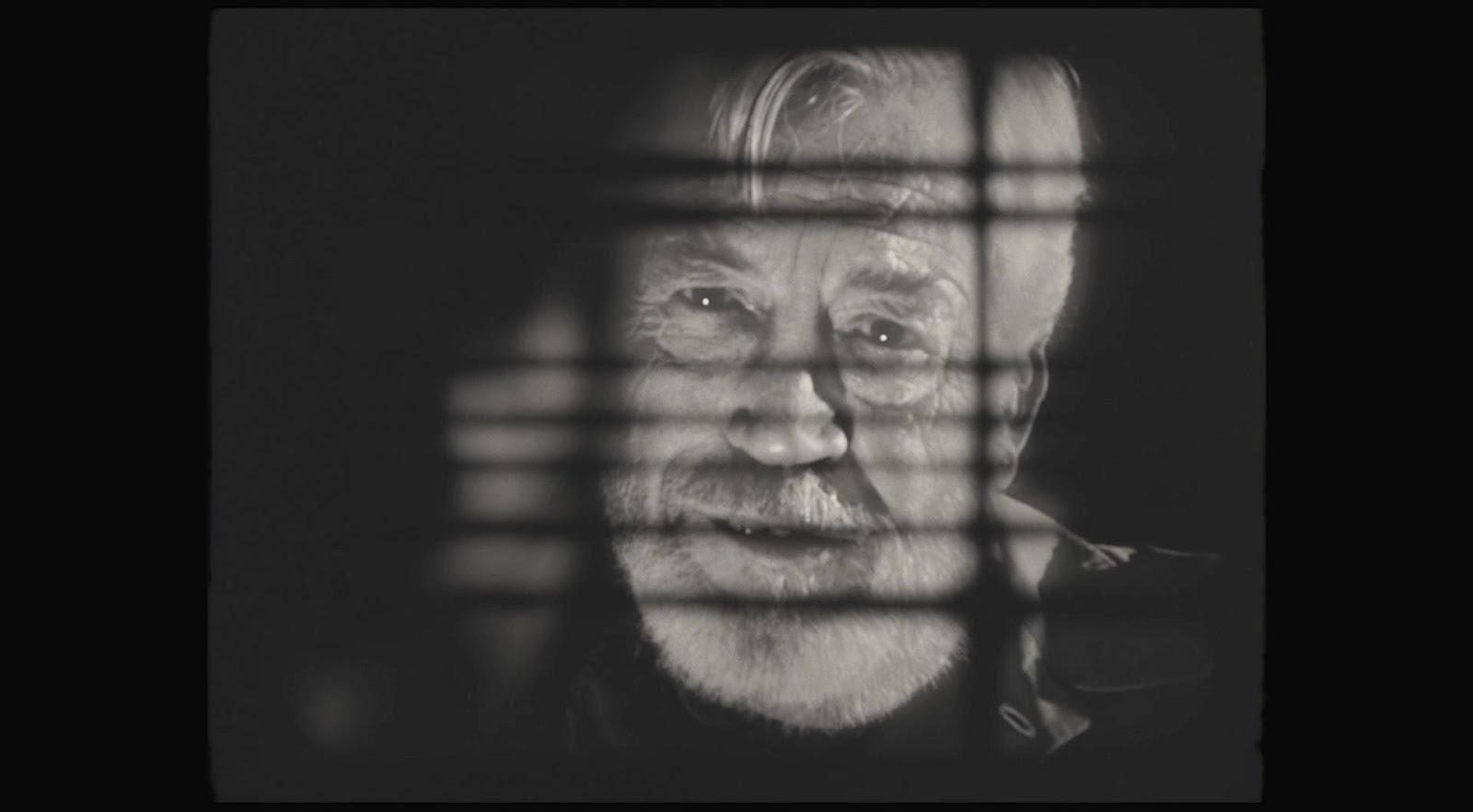
THE OTHER SIDE OF THE WIND (France/Iran/US - 2018) Directed by Orson Welles. Written by Orson Welles and Oja Kodar. Cast: John Huston, Oja Kodar, Peter Bogdanovich, Susan Strasberg, Lilli Palmer, Bob Random, Norman Foster, Edmond O'Brien, Mercedes McCambridge, Cameron Mitchell, Paul Stewart, Henry Jaglom, Paul Mazursky, Dennis Hopper, Curtis Harrington, Claude Chabrol, George Jessel, Gregory Sierra, Tonio Selwart, Dan Tobin, John Carroll, Stafford Repp, Geoffrey Land, Joseph McBride, Cathy Lucas, Pat McMahon, Peter Jason, Angelo Rossitto, Stephane Audran, Rich Little, Gary Graver, Frank Marshall, Cassie Yates, William Katt, Cameron Crowe, Les Moonves. (R, 122 mins) Orson Welles died in 1985, but 33 years later, his "last" film has finally been completed and released as a Netflix Original. One of the most famous of "lost" movies, THE OTHER SIDE OF THE WIND has spent decades mired in various legal, personal, and political quagmires among numerous involved parties. As was usually the case in Welles' European exile years in the 1950s and 1960s (the exception being his last Hollywood studio work as a director, 1958's TOUCH OF EVIL), funding came from his lucrative actor-for-hire jobs and when that ran out, he would constantly find himself hustling for cash from various wealthy investors from all over the world, who were always more than happy to partner with a revered filmmaker of Welles' stature until they realized they probably weren't getting their money back. Notorious for doing things his own way and clashing with Hollywood execs as far back as 1942's THE MAGNIFICENT AMBERSONS, Welles would rarely enjoy a hassle-free project other than 1962's THE TRIAL, and while he did have to cut corners when future SUPERMAN producer Alexander Salkind ran out of money by the end of production, he remained grateful that Salkind trusted him and left him alone to make the film he wanted to make.
Huston, Welles, and Bogdanovich apparently
coining the question "How 'bout a Fresca?"
As a result of his unconventional and often unreliable methods of finance, Welles probably had as many unfinished films as he did finished ones, none more talked about than THE OTHER SIDE OF THE WIND. Filming began in 1970 and wasn't completed until 1976, as Welles would shoot what he could in bits and pieces when the money was there, scraping by with acting and TV commercial gigs (and shooting another movie, 1973's F FOR FAKE) in the interim. He managed to get a French production company to back the project and when that money ran out, he secured additional financing from the Shah of Iran's brother-in-law (the production dragged on for so long and so sporadically that star John Huston didn't even join the cast until 1974). Written by Welles and his girlfriend Oja Kodar, THE OTHER SIDE OF THE WIND would remain unfinished in Welles' lifetime, the film caught up in his tax issues with the IRS; the alleged embezzlement of funds by a Spanish business associate Welles met while starring as Long John Silver in the 1972 Harry Alan Towers production of TREASURE ISLAND; the Ayatollah Khomeini-ordered seizure of the assets and property of the Shah and his entire extended family following the 1979 Iranian Revolution; and a seemingly never-ending conflict between Kodar and Welles' daughter Beatrice following his death, a battle that also involved Welles' protege and friend Peter Bogdanovich. The young director was then riding high on THE LAST PICTURE SHOW and PAPER MOON, and put $500,000 of his own money into Welles' vision in addition to letting his mentor crash at his Beverly Hills mansion from 1974 to 1976.
There was always talk of finishing the film, with Kodar attempting and failing to broker a deal with Showtime in the late '90s, but it was Bogdanovich who seriously got the ball rolling on the completion of THE OTHER SIDE OF THE WIND back in 2004 (other parties included cinematographer Gary Graver, who died in 2006, and producer Frank Marshall, who worked on part of the original shoot as a production assistant). Once all legal squabbles were resolved, Netflix agreed to fund the final restoration, with Oscar-winning editor Bob Murawski (THE HURT LOCKER) brought in to oversee the completion based on Welles' archived notes, multiple versions of WIND's scripts (including one that totaled 360 pages), and by studying his editing techniques on all of his previous films. Welles shot nearly 100 hours of footage, and it's an incredible achievement in itself that Murawski was able to put this together at all. The end result, running just over two hours, is seemingly free-form mash-up of various film stocks, image qualities, and aspect ratios, often switching from color to black & white in the same scene, almost like an art-house version of the kind of Z-grade drive-in patchwork you'd expect from Al Adamson or Jess Franco (an assistant to Welles on 1966's CHIMES AT MIDNIGHT). John Huston's actor son Danny was summoned to revoice some of his late father's dialogue in a few instances where the audio was too deteriorated to salvage or just missing altogether. Many scenes have the telltale signs of piecemeal shooting, with an absent Huston doubled from behind and conversations between two or more actors edited together even though the actors never share the frame and were shot years apart. Or even on a different continent in Lilli Palmer's case, with the actress in scenes with Huston and other cast members in California and Arizona shot anywhere from 1971 to 1976 even though she's always shown alone and all of her footage was shot in Spain in 1973.
Set up in an ahead-of-its-time mockumentary style by present-day voiceover from 1970s wunderkind Brooks Otterlake (Bogdanovich), THE OTHER SIDE OF THE WIND deals with the last day in the life of famed Hollywood movie director Jake Hannaford (Huston). A surrogate for Welles himself, Hannaford has invited his closest friends, colleagues, journalists, film students, and other assorted hangers-on and sycophants to his 70th birthday party being thrown by his long-ago lover and retired actress Zarah Valeska (Palmer), with everyone given 8mm and 16mm cameras to document the event. Hannaford's got other pressing issues: his latest film--titled THE OTHER SIDE OF THE WIND and a desperate attempt to attract the counterculture market--is in trouble. His star is John Dale (Bob Random), a Hannaford discovery who has no acting experience and is nowhere to be found after walking off the set midway through production; young studio boss Max David (Geoffrey Land) has seen the dailies and isn't happy, especially after loyal Hannaford flunky Billy Boyle (Norman Foster) confesses the director has tossed the script and is just making it up as he goes along; and Hannaford himself is growing increasingly jealous over the success of Otterlake, his protege who just scored a critically-acclaimed blockbuster hit with his third film and is now the toast of Hollywood. Hannaford needs Otterlake's help, but the young director won't use his newfound clout to help bail him out with David, who's been invited to the party and is a no-show.
Cameron Mitchell, Paul Stewart, Mercedes
McCambridge, and Welles on the set.
The party is a Who's Who of Hannaford's world, with tight-knit, ENTOURAGE-like acolytes like Boyle, retired actor friends Pat Mullins (an ill-looking Edmond O'Brien, who would retire from acting himself in 1974 after being diagnosed with Alzheimer's), Lou Martin (John Carroll), and Al Denny (Stafford Repp); former business partner "The Baron" (Tonio Selwart); loyal secretary Maggie Noonan (Mercedes McCambridge); his manager Matt Costello (Paul Stewart); and longtime makeup man Zimmie Zimmer (Cameron Mitchell), who attends the party even though he's fired en route. There's also macho screenwriter Jack Simon (Gregory Sierra), who's no fan of Hannaford's, and film critic Juliet Rich (Susan Strasberg), who's notoriously critical of the work of both Hannaford and Otterlake. As everyone mingles, drinks to excess, and wonders about everything from Dale's absence to Hannaford possibly being a closeted homosexual, the director screens an unfinished workprint of THE OTHER SIDE OF THE WIND, an experimental, avant-garde, Euro-tinged, psychedelic art film starring Dale and a nameless actress (Kodar). The film-within-a-film (shot mostly in 1970) has some striking imagery, whether it's a sex scene in the passenger seat of a garishly lit car that looks like a Dario Argento cab ride (this sequence was shot in 1974), or Dale and "The Actress" spending most of the screened film wandering around nude on the MGM backlot with no dialogue. The power goes out, forcing the party to use generators that also fail, at which point the screening moves to a nearby drive-in. When The Baron informs the projectionist that he's showing the reels out of order as "The Actress" happens upon a giant, erect cock in the desert, the response is "Does it matter?"
Almost every character in THE OTHER SIDE OF THE WIND is a stand-in for someone: Billy Boyle was reportedly based on Mickey Rooney, Max David on then-Paramount head Robert Evans, Zarah Valeska on Marlene Dietrich (Welles' original choice for the role, but she turned it down), Juliet Rich on famously combative film critic Pauline Kael, Jack Simon on John Milius, "The Baron" on John Houseman, and most importantly, Brooks Otterlake on Peter Bogdanovich himself, who skyrocketed to fame and fortune while Welles struggled to get any project off the ground (Otterlake's barely-legal date to the party, Mavis Henscher, played by Cathy Lucas, is based on Bogdanovich's then-girlfriend Cybill Shepherd). Bogdanovich's casting pretty much eliminates any mystery as to what Welles' feelings on their friendship were by that point, but it's interesting to note that Bogdanovich only ended up being cast after Welles' first choice--Rich Little, of all people--left the production just like John Dale left the film-within-a-film, partly because of other commitments but mostly because he had no idea what Welles was trying to accomplish. Little remains in the film as an unnamed party guest and has one scene with Lucas, and judging from his wardrobe and dialogue, it was clearly shot when Little was still playing Otterlake (and Otterlake's odd quirk of doing random celebrity impressions--not one of Bogdanovich's strengths--is something that was obviously conceived with Little in mind). Welles made no secret of his disdain for pretentious art cinema, with particular scorn reserved for Michelangelo Antonioni, whose ZABRISKIE POINT is being mocked in the film-within-a-film THE OTHER SIDE OF THE WIND, and with Kodar's constant nudity and some scattered instances of explicit sex, it's very likely that this would've gotten an X rating if it was released in the 1970s. There's a dark-humored and misanthropic streak throughout the film, but the cheap shots--at European cinema (Billy on LAST TANGO IN PARIS director Bernardo Bertolucci: "He's-a-spicy-a-meatball!"), at new Hollywood, at film critics (how else do you explain a drunk Hannaford physically assaulting Juliet Rich near the end?), and at misfit, Hannaford-obsessed film students, especially with a pair of clingy dweebs in Marvin Pistor (Joseph McBride) and Marvin P. Fassbinder (Pat McMahon), who are invited to the party, ask inane questions, and follow him around like lost puppy dogs--start to feel like sour grapes after a while.
As the booze-swilling, cigar-sucking Hannaford, Huston is captivating every moment he's onscreen, channeling Welles through his own persona to create a fascinating hybrid characterization of two larger-than-life filmmakers. With the rapid-fire quick-cuts, constantly-changing film stocks, and the fact that some of their scenes may have been shot months or years apart, most of the cast doesn't get a chance to make that much of an impression, though Mitchell, by that point slumming in D-grade schlock, is an unexpectedly poignant standout as the melancholy Zimmie. Other then-contemporary filmmakers appear as themselves arguing about the state of cinema at Hannaford's party, including Dennis Hopper, Claude Chabrol, Curtis Harrington, Paul Mazursky, and Henry Jaglom, who directed Welles' final performance in SOMEONE TO LOVE, released in 1988, three years after his death. There's some scattered moments of Welles-ian mastery in THE OTHER SIDE OF THE WIND, and at times, it's a remarkably candid confessional, like it's Welles' own personal version of Luchino Visconti's THE LEOPARD, where Burt Lancaster's aging prince wanders from room to room at a grand ball, saying goodbye to his aristocratic life, recognizing his irrelevance in a world that's moving on and leaving him behind. But after all these years, the knee-jerk reaction will be to label this Welles' lost masterpiece or his "ultimate statement," or something to that effect. Five decades of cineaste mystique surrounding an ambitious and unfinished project will do that, but at the end of the day, this is the kind of self-indulgent home movie that's an historical curio at best, and directly responsible for the career of Henry Jaglom at worst. I'm glad it's out, I'm glad we're able to see it, and it's required viewing for anyone with a serious interest in film history up to the 1970s, but am I ever gonna watch this again? There's a legend surrounding THE OTHER SIDE OF THE WIND, and the backstory--covered at length in Morgan Neville's simultaneously-released Netflix Original documentary THEY'LL LOVE ME WHEN I'M DEAD--is ultimately more fascinating than the film itself.
THE HOUSE THAT SCREAMED (Spain - 1969; US release 1971) Written and directed by Narciso Ibanez Serrador. Cast: Lilli Palmer, Cristina Galbo, John Moulder Brown, Mary Maude, Candida Losada, Tomas Blanco, Maribel Martin, Pauline Challenor, Teresa Hurtdao, Conchita Paredes, Victor Israel. (PG, 94 mins) It's not nearly the exploitative grinder that American International's poster art promised when it opened in the US in 1971, but 1969's THE HOUSE THAT SCREAMED is a slow-burning and quietly effective Spanish chiller that's certain to find a new audience now that it's been rescued from obscurity by Shout! Factory's new Blu-ray release. Never released on VHS and all but impossible to see in a decent-looking presentation for many years, THE HOUSE THAT SCREAMED looks terrific on Blu-ray with its "old dark house" sets and late 19th century period detail. The entire film takes place at a French boarding school for wayward girls run by Mme. Fourneau (Lilli Palmer), a strict spinster-type who lords over her charges and doesn't hesitate to dole out stern punishment, such as headstrong, rebellious Catherine (Pauline Challenor) being thrown into the "seclusion room," where Fourneau has her whipped by sadistic teacher's pet Irene (Mary Maude). The girls welcome the arrival of new resident Teresa (Cristina Galbo), dropped off by a friend of her family, which consists of her absent mother who may or may not be a prostitute. There's a gloomy cloud hanging over the proceedings, whether it's the unbending rule of Fourneau, who harbors a barely concealed desire for the girls--watch the way she leers at them while they shower or gently kisses the bleeding flagellation wounds in the middle of Catherine's back--or her sheltered and sexually curious son Luis (DEEP END's John Moulder Brown), who's prone to spying on the girls and seems to be developing a fixation on Teresa.
Writer/director Narciso Ibanez Serrador (the disturbing 1976 masterpiece WHO CAN KILL A CHILD?) spends nearly half the film methodically establishing an unsettling and perverse atmosphere (with some help from a moody score by Waldo de los Rios) before he even introduces a killer into the proceedings with the unexpected murder of Isabelle (THE BLOOD SPLATTERED BRIDE's Maribel Martin), a shy girl who angered Mme. Fourneau by having romantic feelings for Luis. It's only later that we discover several girls have vanished over the last few months, their disappearances unaccounted for and swept under the rug by Mme. Fourneau. The ultimate reveal of the killer isn't a big shock, but THE HOUSE THAT SCREAMED surprises in other ways. The best example is the unexpected character arc of Irene, who spends much of the film behaving even more despicably than Mme. Fourneau, exacting mean girl revenge on Teresa after her overt lesbian advances are rejected (the agonizingly long scene where she terrorizes Teresa is almost too uncomfortable to watch), but having a change of heart when she realizes Fourneau has been negligent about the missing girls and has been using her as a puppet to bully the other girls and keep them under her thumb. Irene's transformation from bitchy villain to hero-by-default is tough to pull off in a believable fashion but Maude does, and her performance really is the film's secret weapon. Serrador also displays some sly bits of dark humor, as evidenced in one scene where quick-cut shots of girls frantically knitting is used to symbolize intense sexual frustration as they listen to one of the others having sex outside with a local stud who secretly visits the school once a week.
With its horny schoolgirls, lesbian undertones, a weirdo mama's boy, rampant sexual repression and a knife-wielding maniac, there's an undeniable sense of tawdry sleaze permeating THE HOUSE THAT SCREAMED, but it's usually presented in as subtle and tactful a manner as possible. For lack of a better term, it could be called a "gothic giallo," with the look and feel of a Hammer horror period piece with a plot that prefigures the Italian thrillers that would be popularized by the likes of Dario Argento and Sergio Martino in the next year or two. It's one of the earliest "schoolgirls in peril" subgenre offerings, coming not long after Alfred Vohrer's krimi THE COLLEGE GIRL MURDERS and Antonio Margheriti's THE YOUNG, THE EVIL AND THE SAVAGE, and a few years before Massimo Dallamano's essential giallo/krimi hybrid WHAT HAVE YOU DONE TO SOLANGE? (which featured Galbo), initially released in the US as THE SCHOOL THAT COULDN'T SCREAM, and its semi-sequels WHAT HAVE THEY DONE TO YOUR DAUGHTERS? and ENIGMA ROSSO, There's only a couple of onscreen murders, but they're handled in an unusual fashion, with one playing with de los Rios' score and having it slowly grind to a halt as the victim dies. Factoring out the supernatural element with which Argento ran wild, SUSPIRIA also owes a bit of a debt to THE HOUSE THAT SCREAMED, especially with its girls trudging through a miserable ballet class and Palmer's Mme. Fourneau being cut from the same cloth as Joan Bennett's Mme. Blanc and Alida Valli's Miss Tanner in the Argento classic. Argento also incorporated the schoolgirl theme into his 1985 film PHENOMENA, aka CREEPERS, with Daria Nicolodi's psycho headmistress Miss Bruckner another variant on Mme. Fourneau. THE HOUSE THAT SCREAMED goes pretty bonkers in its unforgettable closing minutes, and without going too deeply into spoiler territory, it'll become clear to fans of the legendary 1983 Spanish splatter classic PIECES where that film got one of its craziest ideas.
Based on the plot, it was probably easy to sell THE HOUSE THAT SCREAMED as a trashy drive-in horror flick to American audiences, but like many Spanish films of that era and into the mid '70s, it takes some not-very-veiled swipes at the regime of Francisco Franco. There's no aggressive political statements being made, but certainly Mme. Fourneau's forcing the girls to shower in their nightgowns, refusing to allow them to be nude even while bathing--this is another thing against which Catherine rebels and Fourneau can't stop herself from staring with obvious desire at the young woman's breasts (Palmer plays this moment perfectly)--is a jab at the pervasive censorship of the arts under Franco. Such critiques were common in Spanish cinema of this period, most notably in the works of Luis Bunuel (1961's VIRIDIANA) and Carlos Saura (1975's CRIA CUERVOS), but also Victor Erice's 1973 classic THE SPIRIT OF THE BEEHIVE. THE HOUSE THAT SCREAMED is ultimately a film firmly ensconced in the thriller/horror genre and doesn't take quite the line-in-the-sand stances that Bunuel, Saura, and Erice did, or that Serrador would do seven years later with the still-shocking WHO CAN KILL A CHILD?, but it's got a little more going on than the typical AIP B-movie exploitation import you'd see in 1971. Born in Uruguay in 1935 and in apparent retirement now, Serrador's family moved to Spain when he was 12, and his career dates back to the late 1950s, much of it spent doing gun-for-hire work for Spanish television, often under the pseudonym "Luis Penafiel." He's best known in Spain for creating several TV game shows, including the hugely popular UN, DOS, TRES...RESPONDA OTRA VEZ, which ran in prime time from 1966 to 2004. He compiled a handful of screenwriting credits over the years and didn't aspire to be a "horror guy" but oddly, his mere two outings as a feature film director have cemented his status as a major figure in Spanish cult horror cinema to those outside of Spain, while to Spanish audiences, his association with game shows and variety programs have basically made him that country's Merv Griffin. Shout's Blu-ray includes both the 94-minute American cut of THE HOUSE THAT SCREAMED and an extended 102-minute version with standard-definition inserts of footage cut by AIP that included some additional gore and nudity but primarily consisted of dialogue that slowed the pace a bit. There's also interviews with Moulder Brown and Maude that make this as comprehensive a package as you can get for a horror gem that's been long forgotten except by a small cult of devoted fans.
THE HOLCROFT COVENANT (UK - 1985) Directed by John Frankenheimer. Written by George Axelrod, Edward Anhalt and John Hopkins. Cast: Michael Caine, Anthony Andrews, Victoria Tennant, Lilli Palmer, Mario Adorf, Michael Lonsdale, Bernard Hepton, Richard Munch, Carl Rigg, Shane Rimmer, Michael Balfour, Andre Penvern, Andrew Bradford, Tharita Olivera De Sera. (R, 113 mins)
A misfire that reunites director John Frankenheimer with his MANCHURIAN CANDIDATE screenwriter George Axelrod (who shares script credit with two other respected scribes in Edward Anhalt and John Hopkins), THE HOLCROFT COVENANT is an intriguing conspiracy thriller that just never finds its footing. Adapted from Robert Ludlum's novel, the film has a fatally miscast Michael Caine as Noel Holcroft, an American architect who gets involved in a decades-old plot hatched by his biological father--a high-ranking Nazi and member of Hitler's inner circle--to pay reparations to surviving Holocaust victims and heirs to those killed using a secret Zurich bank account that's ballooned to $4.5 billion in the 40 years since the end of WWII. Certain parties have other plans for the money, like creating a Fourth Reich, which requires getting rid of Holcroft, who has completely disavowed his father and whose mother (Lilli Palmer, in her last big-screen role before her death in 1986) fled Germany when he was 18 months old and settled in America where she married the man who would adopt Noel (Holcroft's repeatedly proclaiming "I'm a foreign-born American citizen!" seems to be Caine trying to explain away his distinctly Michael Caine accent). Holcroft isn't alone in this inheritance. He must share the proceeds with the children of two other Nazis who entered this "covenant"--the Von Tiebolt siblings (Victoria Tennant and Anthony Andrews) and famed conductor Jurgen Mass (Mario Adorf), which of course leads to numerous double and triple crosses and assassins lurking in the background and foreground of scenes, constantly making attempts on Holcroft's life.
Made during a several-year stretch when he was turning absolutely nothing down (how can we forget his triumphant turn in 1987's JAWS: THE REVENGE?), Caine finished shooting the comedy WATER on a Friday when he got a call to begin work on HOLCROFT on the following Monday, a last-minute replacement after a disagreeable James Caan bailed the day before shooting was to begin. In his memoir, Caine wrote that he arrived for his first day of work on HOLCROFT without seeing even a page of the script, so he had no idea what he was doing, only that it was a thriller and that he wanted to work with Frankenheimer (and, presumably, the pay was good). Nobody seemed to consider that Caine was completely wrong for the part and early scenes find him doing some weird thing with his voice where he's trying to sound American but quickly throws in the towel (Caine is one of the all-time greats, but his American accent, which sounds like someone doing a bad Michael Caine impression, wasn't any better when he tried it again on 2013's LAST LOVE). Frankenheimer spends too much time doing some distracting camera trickery and weird zooms and pointless Dutch angles instead of creating a suspenseful story. The script is a mess--it almost seems like none of the three credited screenwriters looked at what the others wrote--and Holcroft's transformation from a clueless dolt to a coldly lethal manipulator who becomes a crack shot when the movie needs him to never seems plausible. Coming soon after 1983's equally scattershot Sam Peckinpah swan song THE OSTERMAN WEEKEND, this would be the last big-screen Ludlum adaptation (other than a couple of TV-movies) until Hollywood finally got it right with THE BOURNE IDENTITY in 2002. For a globetrotting international thriller, it also looks surprisingly cheap and sloppy at times, with a London backlot doing a piss-awful job of portraying a Manhattan street, looking almost Bulgarian in its utter lack of conviction. And one laughable process screen shot shows Holcroft with some construction workers atop a skyscraper backed by a bush-league NYC skyline that looks edited in with all the cutting edge technology of your local TV weather forecast. Also, why does Noel Holcroft need a remote control for his answering machine? Is it that important that he put his bag on a chair ten feet away that he can't stand there and press "skip"?
THE HOLCROFT COVENANT is also the kind of film that gives away its surprises when you realize a prominently-billed actor has been given almost nothing to do and is barely in the first 3/4 of the movie, so of course, he has to end up being the chief villain (also, are we to believe that Caine, Tennant, Andrews, and Adorf are all roughly the same age?). There's some good work by Bernard Hepton as a British agent who helps Holcroft and the sluggish film finally comes to life with a climactic press conference that has a nice wink-and-a-nudge from Frankenheimer that's an obvious self-referential nod to a memorable scene in THE MANCHURIAN CANDIDATE. But all in all, THE HOLCROFT COVENANT is one of the great director's most forgettable films--not terrible (we're not talking THE EXTRAORDINARY SEAMAN or YEAR OF THE GUN here), but by no means essential, unless you never miss a Mario Adorf vehicle. Universal picked up the British-made HOLCROFT for the US but pretty much buried it, releasing it on just 73 screens in the fall of 1985 before it quickly turned up on video store shelves.