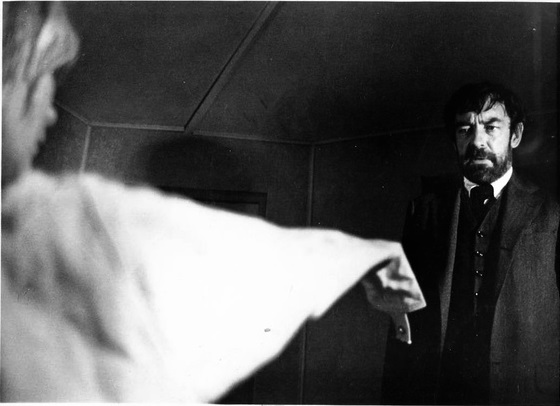
BEYOND THE DOOR (Italy - 1974; US release 1975) Directed by Oliver Hellman (Ovidio G. Assonitis) and R. Barrett (Roberto D'Ettorre Piazzoli). Written by Oliver Hellman (Ovidio G. Assonitis), Antonio Troisio, R. Barrett (Roberto D'Ettorre Piazzoli), Giorgio Marini, Aldo Crudo, Alex Rebar and Christopher Cruise. Cast: Juliet Mills, Richard Johnson, Gabriele Lavia, Nino Segurini, Elizabeth Turner, Barbara Fiorini, David Colin Jr., Luigi Marturano. (R, 98 mins/108 mins) When THE EXORCIST became a worldwide phenomenon in late 1973 and into 1974, it didn't take long for countless imitations, mostly from Italy, to spew forth. The most famous of these Italian ripoffs was BEYOND THE DOOR, which managed to fuse together elements of both THE EXORCIST and ROSEMARY'S BABY and, with the help of a memorably terrifying TV spot, became a surprise hit when it opened in the US over the spring and summer of 1975. It also infamously caught the attention of Warner Bros., who sued the producers and US distributor Film Ventures for copyright infringement. The case was eventually settled and BEYOND THE DOOR was never pulled from distribution, unlike ABBY, a 1974 blaxploitation EXORCIST knockoff that was withdrawn from circulation and hasn't been legitimately seen in decades, though poor-quality presentations of it aren't hard to find on YouTube and torrent sites. None of the other Italian EXORCIST ripoffs--among them 1974's THE ANTICHRIST (released in the US as THE TEMPTER in 1978), 1974's THE TORMENTED (released in the US in 1978 and rechristened for cable and home video in 1981 as THE EERIE MIDNIGHT HORROR SHOW), 1975's THE NIGHT CHILD, 1975's THE RETURN OF THE EXORCIST, aka CRIES AND SHADOWS (released in the US in 1977 as THE POSSESSOR), 1975's THE HOUSE OF EXORCISM (the retooled version of Mario Bava's 1973 film LISA AND THE DEVIL, featuring added possession scenes with Elke Sommer being exorcised by priest Robert Alda)--or the 1975 Spanish knockoff EXORCISM with Paul Naschy and the 1974 German copycat MAGDALENA, POSSESSED BY THE DEVIL (released in the US in 1976 as BEYOND THE DARKNESS), faced any legal action from Warner Bros. And though some of the them took a long time to get to the US, the fad pretty much died out in Europe by 1977, with only a few sexploitative stragglers like 1978's softcore OBSCENE DESIRE and 1979's MALABIMBA, the latter a product of Italy's short-lived determination to make horror/porno crossovers a thing.
But it's BEYOND THE DOOR that remains the signature Italian EXORCIST ripoff, and it's just been released in a comprehensive, limited-edition Blu-ray box set from Arrow, because physical media is dead. It's been out on DVD and Blu before from Code Red, and some of those extras are carried over here, but Arrow has done a magnificent job with its 2K restoration of the 108-minute European version, titled THE DEVIL WITHIN HER, and the 98-minute US cut (you also get a poster and a 56-page booklet with essays). Juliet Mills stars as Jessica Barrett, a wife and mother of two who finds she's unexpectedly pregnant with a third, something that wasn't really in the plans of her record producer husband Robert (Gabriele Lavia). Soon, the fetus is growing at an alarming rate, and she begins vomiting blood and suffering from erratic mood swings. Her young son Ken (David Colin, Jr) witnesses her levitating in the middle of the night, while daughter Gail (Barbara Fiorini) goes to check on her only to be greeted with a grin as Jessica's head turns completely around, amidst other disturbing, inexplicable activity. At the same time, Robert notices he's being followed by a serious-looking mystery man named Dimitri (Richard Johnson), who says he knows what's happening to Jessica and insists he's the only one who can help her.
BEYOND THE DOOR opening in Toledo, OH on 8/15/1975
BEYOND THE DOOR might shamelessly crib from THE EXORCIST's highlight reel, but it's got plenty of its own wacky ideas. It seems Dimitri and Jessica were once lovers long before she met Robert. And in what turned out to be a real relationship-killer, she left him when he took her to a black mass where she was supposed to be the sacrifice. Yes, Dimitri is a Satanist who promised Jessica to the Devil, and the Devil--who frequently taunts Dimitri in voiceover--is pissed-off at Dimitri's incompetence and wants restitution in the form of Jessica's baby. And he's given Dimitri only a few days to procure it or he's going to die. As Jessica's possession and pregnancy grow more intense--complete with the mandatory demonic voice, green puke, and various obscenities ("Get out of here, you piece of shit!," Lick the vile whore's vomit!" etc, etc), along with a craving for discarded banana peels--Dimitri manages to convince Robert to let him tend to Jessica, though it's only a desperate effort to get the child. It's an interesting approach in that the "exorcist" figure is there not out of the sense of spiritual altruism to save the possessed but rather, just to save his own sorry ass, and to their credit, Mills (who had recently co-starred with Jack Lemmon in Billy Wilder's AVANTI) and Johnson (THE HAUNTING) both appear to be taking this thing seriously and aren't coasting through for a quick paycheck.
Johnson imbues his rather silly dialogue ("The child...must be born!") with a generous amount of Royal Shakespeare Company gravitas, and Mills, the daughter of Oscar-winning actor John Mills and the older sister of early '60s Disney star Hayley Mills, really brings her A-game to a decidedly lowbrow production that was perhaps a tad beneath the family name ("Oh, I doubt Daddy ever saw this," she jokes on one of the ported-over commentaries). The possession histrionics aren't quite as intense as THE EXORCIST (there's no crucifix bit here, though there is a weird moment when Jessica kisses her young son for a uncomfortably long time), but their effectiveness is given a significant boost by an unnervingly bass-heavy sound design and by Mills' total commitment. The scene where she sits in a chair asking doctor and family friend George (Nino Segurini) "Who are you?" in a deep, guttural voice while Jessica seems to be internally fighting off the demon, quickly going back and forth in rapid-fire fashion from possessed to normal ("Help me, I'm so scared"), with Mills employing just slight changes in her facial expressions that you manage to see her through the contact lenses, the horrific makeup, and the chunky green vomit caking on her chin, is some legitimately terrific acting on her part.
BEYOND THE DOOR in Toledo, OH on 8/15/1975
Mills and Johnson class up the joint, but at the end of the day, BEYOND THE DOOR is still tacky as hell, particularly the finale where Dimitri is pounding on her very pregnant belly as the devil instructs him to "reach inside her and pull it out!" Shot in San Francisco with interiors done back in Rome, the film was the brainchild of Egyptian-born Italian exploitation producer Ovidio G. Assonitis (THE VISITOR, PIRANHA II: THE SPAWNING), who co-wrote and co-directed under the pseudonym "Oliver Hellman," which he would employ a few more times, most notably on the 1977 Italian JAWS ripoff TENTACLES. Up to this time, Assonitis had a few producer credits (1972's MAN FROM DEEP RIVER, 1974's SUPER STOOGES VS. THE WONDER WOMEN), but BEYOND THE DOOR marked his first directing effort, and he shared duties with cinematographer Roberto D'Ettorre Piazzoli, who hid under the alias "R. Barrett." Both were among seven (!) credited screenwriters, which included Alex Rebar, who would secure his place in B-movie history with the title role in 1977's THE INCREDIBLE MELTING MAN. Assonitis and D'Ettorre Piazzoli manage to create some scattered images that get under your skin throughout, whether it's the freakish grin on Mills' face during the head spin, or the unexpected use of Sam Peckinpah-style freeze-frames during a demonic fit, or an optical effect where one eye stares straight ahead while the other looks in every direction. With a budget of only $400,000, a good chunk of which likely went to Mills and Johnson, the effects--supervised by Wally Gentleman, who worked on Douglas Trumbull's crew on 2001: A SPACE ODYSSEY and has the most fake Italian pseudonym-sounding name that somehow isn't--are crude but they get the job done.
But there's a lot of quirky touches that don't always work, especially the antics of Jessica's two foul-mouthed kids (their nickname for their dad is "Asshole"), like Gail's obsession with owning over a dozen copies of Erich Segal's Love Story or Ken constantly drinking cans of Campbell's pea soup through a straw, an obvious nod to the colorful prop used for possessed Regan's puking scenes in THE EXORCIST. The film also opens with an offscreen Satan welcoming the audience and introducing the film like an avuncular TV host. When Film Ventures cut ten minutes out of the film for its US release, one of the first things to go had to be a bizarre, nonsensical scene late in the film where Robert is out walking around and is followed by an intimidating guy playing a flute with his nose. This seemingly goes on forever and only seems to be there so Assonitis can show off more San Francisco exteriors, stopping the uncut European version dead in its tracks at a pivotal time. Film Ventures also tossed a scene of Jessica getting groceries at a local Safeway, which was part of the original opening credits sequence showing Robert in the recording studio chewing out a funk band for not getting it right. The band is playing a Franco Micalizzi-written tune called "Bargain with the Devil," and it's an absolute jam that's unfortunately nowhere to be heard in the US version.
BEYOND THE DOOR was such an unexpected sleeper hit stateside that it led to two unrelated "sequels." Mario Bava's 1977 swan song SHOCK was picked up by Film Ventures and released in the US in 1979 as BEYOND THE DOOR II. It involved a little boy being possessed by the spirit of his dead father, and passing it off as a sequel was probably made a lot easier with the happy coincidence of David Colin Jr. playing the little boy. Assonitis had nothing to do with SHOCK or its rechristening as BEYOND THE DOOR II, but he did produce AMOK TRAIN, which had college students stuck on a possessed train while in Yugoslavia for a Balkan Studies research project. Shot in 1989, AMOK TRAIN was eventually released straight-to-video in the US in 1991 as--you guessed it--BEYOND THE DOOR III. The decision was probably inspired by Assonitis producing the minor 1987 horror hit THE CURSE, and then turning his 1989 "guy bitten by radioactive snake" epic THE BITE into the in-name-only CURSE II: THE BITE, an insane film that really should be better-known, and one so gross that the sight of a post-coital Jamie Farr doesn't even make the top five ghastliest things in it.
IRON WARRIOR (Italy - 1987) Directed by Al Bradley (Alfonso Brescia). Written by Steven Luotto and Al Bradley (Alfonso Brescia). Cast: Miles O'Keeffe, Savina Gersak, Elisabeth Kaza, Iris Peynado, Tim Lane, Tiziana Altieri, Frank Daddi, Josie Coppini, Malcolm Borg, Conrad Borg, Jon Rosser. (R, 87 mins) One of the countless Italian ripoffs of CONAN THE BARBARIAN, 1983's ATOR THE FIGHTING EAGLE helped keep Miles O'Keeffe employed following his career-killing Hollywood debut opposite Bo Derek in her husband John's 1981 fiasco TARZAN THE APE MAN. Directed by the venerable Italo sleaze king Aristide Massaccesi (aka "Joe D'Amato") under his "David Hills" pseudonym, ATOR led to the 1984 sequel THE BLADE MASTER, better known today by its MST3K incarnation CAVE DWELLERS. The third in the franchise, IRON WARRIOR, is an odd in-series reboot of sorts that almost feels like it wasn't intended to be part of the ATOR universe. Made not by Massaccesi and his Filmirage outfit but by producer Ovidio G. Assonitis (BEYOND THE DOOR, THE VISITOR, PIRANHA II: THE SPAWNING), IRON WARRIOR gives Ator a completely different origin story and puts him in decidedly different, R-rated surroundings with gore and T&A that doesn't gel with its two PG-rated predecessors. Assonitis farmed out directing duties to Alfonso Brescia as a consolation prize after removing him from 1986's CHOKE CANYON during pre-production when he decided the action-and-stunt-heavy film was too much for Brescia to handle. Better-known by his Americanized pseudonym "Al Bradley," and a perennial Italian D-lister, Brescia (1930-2001) cut his teeth on low-grade peplum (1964's THE MAGNIFICENT GLADIATOR), spaghetti westerns (1968's CRY OF DEATH) and men-on-a-mission WWII movies (1969's KILL ROMMEL!), never distinguishing himself in any conceivable way as his filmography ranked several notches below mediocre. As his career went on, he made the 1974 action comedy SUPER STOOGES VS. THE WONDER WOMEN and even managed to get Jack Palance to star in the 1976 GODFATHER knockoff BLOOD AND BULLETS, but it wasn't until his quartet of oppressively dull post-STAR WARS space operas (and the sexually explicit 1980 offshoot THE BEAST IN SPACE, which featured hardcore footage) that Brescia cemented his place in Eurocult history, even if it was for all the wrong reasons.
Shot on the same sets with most of the same supporting cast and looking like inept community theater versions of Antonio Margheriti's GAMMA 1 quartet over a decade earlier, 1977's COSMOS: WAR OF THE PLANETS, 1978's BATTLE OF THE STARS, 1978's WAR OF THE ROBOTS, and 1979's STAR ODYSSEY are virtually interchangeable and are differentiated only by their leading men (John Richardson in the first two, followed by Antonio Sabato in ROBOTS and Gianni Garko in ODYSSEY) and rank among the ultimate feats of cine-masochistic endurance. COSMOS: WAR OF THE PLANETS actually made it into some US theaters in 1979 but the other three went straight to syndicated TV and later surfaced on any number of public domain DVD sets, though I wouldn't be surprised if someone put them out on Blu-ray box set if the elements are able to be tracked down (nor would I be surprised when I clicked on "pre-order" when that hypothetical listing turns up on Amazon). With Scorpion's release of IRON WARRIOR, we're forced to confront what was once unthinkable: the stunning realization that an "Al Bradley" joint is on Blu-ray which, depending on your tolerance for bad movies, is either cause for celebration or the cracking of one of the seven seals that will open the gates of Hell.
IRON WARRIOR isn't exactly an expensive epic, but it's obviously got the biggest budget that the perpetually hapless Brescia was ever granted. It's his most polished and professional-looking film, shot on some stunning locales on Malta, where the production also took full advantage of some still-standing sets left over from Robert Altman's POPEYE seven years earlier. Brescia also had the added bonus of having veteran optical effects technician Wally Gentleman as a cinematographer. A real person despite his name sounding like a hastily-blurted alias, Gentleman worked on the effects crew of Assonitis' BEYOND THE DOOR and scored a visual effects gig with Francis Ford Coppola on 1982's ONE FROM THE HEART. Gentleman also worked on Douglas Trumbull's effects team for Stanley Kubrick's 1968 landmark 2001: A SPACE ODYSSEY, and how he went from that to serving as Alfonso Brescia's cinematographer on the third movie in the ATOR series is a story that demands to be told. Watching IRON WARRIOR in a pristine HD transfer is quite a different experience than seeing it on VHS back in the late '80s. It's less of an ATOR movie and more like a companion piece to Lucio Fulci's hallucinatory 1983 sword-and-sorcery saga CONQUEST. It's trippy and surreal, like if an Italian CONAN ripoff was directed by Alejandro Jodorowsky.
The script, credited to "Al Bradley" and veteran voice actor Steven Luotto (who can be heard dubbing Mark Gregory in 1990: THE BRONX WARRIORS), is a hot mess of curses, hexes, and mysticism, with Brescia shamelessly stealing iconic imagery from SUPERMAN, STAR WARS, and RAIDERS OF THE LOST ARK. Believing in a prophecy that she would be destroyed by twin brothers, evil old witch Phoedra (Elisabeth Kaza) spies on eight-year-old siblings Ator and Trogar and kidnaps Trogar as part of a revenge plot against Deeva (Iris Peynado), who freed Phoedra's enslaved people. 18 years later, Phoedra summons the Iron Warrior (Frank Daddi) to kill the King (Tim Lane), who sends his princess daughter Janna (Assonitis' girlfriend Savina Gersak) away for her own safety. Deeva puts Janna in the care of lone warrior Ator (O'Keeffe), but not before he's seduced by Phoedra in the form of a nude young temptress (Tiziana Altieri). Prophesied to protect the King's daughter ("She for who you are fated needs you now!" Deeva gravely intones), Ator leads Janna on a treacherous journey where they're constantly thwarted by the supernatural shenanigans of Phoedra, who pits brother against brother as the deadly Iron Warrior is--you guessed it--the grown Trogar, whose body and soul have been taken over by the spell of Phoedra.
Or something like that. IRON WARRIOR makes absolutely no sense and there's no chemistry between O'Keeffe and Gersak, reunited from Ruggero Deodato's 1986 Indiana Jones ripoff THE LONE RUNNER (released in the US in 1988 by Trans World Entertainment, who also got IRON WARRIOR on a whopping 17 screens in January 1987), but it's so hypnotic and strange from beginning to end that it ultimately doesn't matter. It's disorienting by design, especially a scene where Ator and Janna cross a precarious suspension bridge that's genuinely dizzying to watch. It's an ATOR movie on shrooms, something that Red and Mandy would watch while eating TV dinners, and the only reason it hasn't been embraced by the stoner crowd is because they just aren't aware of it. There's enough craziness here that I'm willing to bet Assonitis--known for firing directors and finishing movies himself--had more to do with the creative direction of this than Brescia, especially when you consider the bizarre imagery in something like THE VISITOR. But for all its visual flair, it's still tough to take it seriously when Deeva's trial of Phoedra employs the same type of "Council of Elders" faces on a giant screen behind the accused, who stands there shackled by rotating hula hoops on loan from Jor-El. Or the Iron Warrior's resemblance to Darth Vader. Or a long action sequence where Ator and Janna are in a cavern being chased by giant RAIDERS OF THE LOST ARK rolling boulders. O'Keeffe's catatonic performance actually enhances the hazy, stoned vibe, though he wouldn't be back for the fourth and final ATOR installment, 1990's QUEST FOR THE MIGHTY SWORD. That marked the return of Massaccesi and the introduction of a new Ator in the form of Grand Rapids, MI native Eric Allan Kramer, who presumably got the job after playing Thor in the 1988 TV-movie THE INCREDIBLE HULK RETURNS (Kramer is probably best known as Little John in Mel Brooks' ROBIN HOOD: MEN IN TIGHTS, and he's currently co-starring on the critically-acclaimed AMC series LODGE 49). As far as IRON WARRIOR is concerned, Scorpion's Blu-ray certainly makes the case that there's some artistic merit to it, even if the method to its madness gets lost along the way. Nevertheless, it takes a lesser-ranked place among other threequels--HALLOWEEN III: SEASON OF THE WITCH or THE EXORCIST III, for example--that either break from established formula or serve as outliers or stealth secret weapons in their respective franchises, an ATOR: TOKYO DRIFT, if you will.
PIRANHA II: THE SPAWNING (Italy/US - 1982) Directed by James Cameron. Written by H.A. Milton (James Cameron, Charles H. Eglee and Ovidio G. Assonitis). Cast: Tricia O'Neil, Steve Marachuk, Lance Henriksen, Ted Richert, Ricky G. Paull (Ricky Paull Goldin), Leslie Graves, Carole Davis, Connie Lynn Hadden, Arnie Ross, Tracy Berg, Albert Sanders, Ward White, Aston S. Young. (R, 95 mins) A tangentially-related sequel to Joe Dante's 1978 hit for Roger Corman's New World Pictures, PIRANHA II: THE SPAWNING was instead produced by Egyptian-born Italian schlock king Ovidio G. Assonitis, best known for his 1974 EXORCIST ripoff BEYOND THE DOOR and his 1977 JAWS knockoff TENTACLES. Assonitis has a bizarre history of hiring rookie directors just to fire them during production so he can take over himself, and the most infamous example of this tactic is indeed PIRANHA II: THE SPAWNING, which would likely be a forgotten footnote in drive-in exploitation history lost somewhere in your 1980s video store memories were it not the directing debut of one James Cameron. Though he logged time on the visual effects team of John Carpenter's 1981 classic ESCAPE FROM NEW YORK, the 27-year-old Cameron was hired for PIRANHA II: THE SPAWNING because of his association with Corman productions in various capacities as art director (1980's BATTLE BEYOND THE STARS) and production designer (1981's GALAXY OF TERROR), as well as his oft-expressed eagerness to start directing his own movies. He got his chance when Assonitis fired Miller Drake--a New World trailer editor who shot the US inserts for SCREAMERS, the 1981 re-edit of Sergio Martino's 1979 H.G. Wells-inspired ISLAND OF THE FISHMEN--during pre-production after a disagreement over the direction in which Drake wanted to take the story.
With his friend Drake's blessing, Cameron jumped at the opportunity, but clashed with Assonitis from the start. Working on location in Jamaica, with underwater sequences shot off Grand Cayman, and interiors done in Rome, and forced to use an Italian crew with whom he couldn't communicate, a miserable Cameron had to run every decision by Assonitis first and was almost always overruled. Cameron was fired at some point--exactly when depends on who's telling the story--but was at least around for some of post-production in Italy, as he was eventually locked out of the editing room and reportedly kept breaking in after hours to undo all of the changes Assonitis was making to the film. Cameron has frequently told this story over the years, sometimes standing by it, sometimes saying he was only kidding, but one thing is certain: his mercurial nature and uncompromising defiance in sticking to his vision was apparent even on a junky B-movie like PIRANHA II: THE SPAWNING. Once Assonitis kicked him off the movie for good and finished it himself--hopefully after shouting "You're through! Finished! You hear me? I'll see that you never work in this town again!" while furiously chomping on a cigar--Cameron used his sudden downtime to begin outlining and fleshing out a script idea he had brewing in his head for a while, which of course became his 1984 breakthrough THE TERMINATOR. You were right, Ovidio--this kid's going nowhere. Well-played, sir. Well-played.
It shouldn't be a surprise that PIRANHA II: THE SPAWNING (shot as PIRANHA II: FLYING KILLERS and shown in some parts of the US as simply THE SPAWNING) isn't a good movie. It's professionally made, with some nice cinematography by Assonitis regular Roberto D'Ettorre Piazzoli and an effective score by Stelvio Cipriani, hiding behind the Americanized alias "Steve Powder." The script--the combined efforts of Assonitis, Cameron, and Cameron's buddy and fellow Corman gofer Charles H. Eglee, who would go on to a prolific career in TV--is credited to the pseudonymous "H.A. Milton," and while it references its predecessor in one throwaway line, it's largely a standalone work. At a Club Med-type resort called Club Elysium, two divers are devoured by a school of piranha while engaged in the act of deep-sea fucking. More divers are killed, and a nurse at the morgue is attacked by a flying piranha that burrows out of the remains of one of the victims. Local police chief Steve (Lance Henriksen) is irate about the body count, but he's more pissed off about the time his estranged wife and Club Elysium diving tour guide Anne (Tricia O'Neil) is spending with new hire Tyler (Steve Marachuk). Anne turns out to be a former marine biologist who gave up her career when she married Steve and gave birth to their now-16-year-old son Chris (future daytime soap regular Ricky Paull Goldin), so she knows something is in the water, and so does Tyler. He's a biochemist who worked on a secret government gene-splicing project that resulted in the creation of a piranha/grunion crossbreed that has the ability to fly and survive out of water. Tyler believes a container of flying piranha eggs was on a boat that sank off the coast of the Elysium resort. Of course, he's right, and they've hatched and bred and with nothing left to eat in the water, it's only a matter of time before they attack the resort at its busiest time of the year.
It's your classic JAWS scenario, with Anne in the Roy Scheider role once she can't convince anyone there's piranha in the water and decides to cancel her diving tours, only to promptly get fired by asshole resort manager Raoul (Ted Richert as Murray Hamilton). The first hour of PIRANHA II: THE SPAWNING is spent with annoying, "wacky" characters at Club Elysium and player Tyler's tireless attempts to get in Anne's pants. The film has some unintended laughs and WTF? moments that are seemingly inherent with Italian trash movies (like the strange physical interaction when we're introduced to Anne and Chris, where it takes an unusually long time to finally conclude that they're mother and son and not, as it would initially seem, in a PRIVATE LESSONS scenario where a hot teacher has seduced a horny student), and the eventual flying piranha attack on Club Elysium is pretty entertainingly bonkers. It also certainly indulges in gratuitous gore (courtesy of the great Giannetto De Rossi) and plenty of T&A, knowing exactly what kind of movie it is. But whether it's the material or his lack of control over the whole project, there's absolutely nothing here to indicate that Cameron would go on to be the visionary trailblazer we know him as today, other than Goldin, in an interview on Shout! Factory's new Blu-ray (because physical media is dead), reminiscing about how "methodical" he was on set. It may not have established him in the way he'd hoped, but had he not been fired, he might not have been inspired to finally sit down and write THE TERMINATOR when he did. And it did establish his working relationship with Henriksen, who brings his usual intensity and gravitas to the film and puts forth far more effort than was really required. Henriksen previously worked with Assonitis on 1979's THE VISITOR, but became fast friends with Cameron, eventually appearing in both THE TERMINATOR and ALIENS. O'Neil never broke out despite a lot of TV guest spots in the '70s and '80s, but Cameron never forgot the star of his first movie and gave her a small role in TITANIC. Cameron also worked with Eglee further down the road, with the pair co-creating the Jessica Alba series DARK ANGEL for Fox, while Eglee carved himself a niche as a busy TV writer and producer on shows like ST. ELSEWHERE, MOONLIGHTING, NYPD BLUE, MURDER ONE, THE SHIELD, DEXTER, THE WALKING DEAD, and most recently, Netflix's HEMLOCK GROVE. Everyone has to start somewhere, and to his credit, Cameron has never tried to pretend PIRANHA II: THE SPAWNING doesn't exist and has always had a good sense of humor about it, even referring to it as "the very best flying piranha movie ever made" in a 2009 60 MINUTES interview with Morley Safer.
Based on H.P. Lovecraft's 1927 short story "The Colour Out of Space," THE CURSE could ostensibly fit in with the Stuart Gordon-led Lovecraft revival that was going on at Empire Pictures (RE-ANIMATOR, FROM BEYOND), but probably belongs more with the waning, last hurrah days of Italian horror. A U.S.-Italian co-production shot near Tellico Plains, TN, THE CURSE was produced by noted Egyptian-born Italian schlock king Ovidio G. Assonitis (BEYOND THE DOOR, TENTACLES, THE VISITOR), who brought along a mostly Italian crew hiding under subtly Anglicized names (cinematographer Roberto Forges Davanzati goes by "Robert D. Forges," editor Claudio Cutry is "Claude Kutry," composer Franco Micalizzi is "Frank Micalizzi," and most notably, associate producer Lucio Fulci supervised the second unit and the gore effects team and goes by "Louis Fulci") to work for AN OFFICER AND A GENTLEMAN and FIRESTARTER star David Keith, making his directorial debut. Keith hasn't had much to say about THE CURSE since a Fangoria interview prior to its release (when it was known as THE FARM), so little is known about whether Assonitis resorted to his usual "fire the director" routine, which he's best known for pulling with a then-unknown James Cameron on 1982's PIRANHA II: THE SPAWNING, an experience that left debuting director Cameron so upset and bitter that he decided to devote all of his energy to finishing a script he was working on called THE TERMINATOR. THE CURSE is perhaps best known as the first movie young Wil Wheaton made after his breakout starring turn the previous year in Rob Reiner's STAND BY ME. There were probably an untold number of ways Wheaton could've capitalized on his success in Reiner's critically acclaimed, sleeper hit adaptation of Stephen King's coming-of-age story "The Body," and you'd have to think that starring in a cheap-looking, low-budget Ovidio G. Assonitis production where his name is misspelled "Will Wheaton" in the opening and closing credits wouldn't have been near the top of the list. As written on Wheaton's blog, his memories of THE CURSE are not fond ones: "Your Uncle Willie was just a young'un, and some really evil producers from a scary foreign country came to him and said, 'We have this movie for you to be in, and we want to give you lots of money to be in it.' And Uncle Willie didn't have the best advisers at the time, and nobody told him that this big pile of shit would be around forever."
To a point, THE CURSE, scripted by David Chaskin, who had just written the 1985 landmark in homoerotic fever dreams A NIGHTMARE ON ELM STREET 2: FREDDY'S REVENGE, is relatively faithful to Lovecraft's source story, in the sense that it involves a crashing meteor poisoning the land, causing grotesque mutations in humans and animals and driving them insane. Wheaton is Zach, whose widowed mother Frances (Kathleen Jordon Gregory) moved him and his little sister Alice (Wil's sister Amy Wheaton) in with her new husband, the stern and fanatically religious apple farmer Nathan (Claude Akins). Zach doesn't get along with Nathan's oafish, perpetually plumber's-cracked son Cyrus (Malcolm Danare), but that's the least of his troubles once the meteor crashes and all hell breaks loose. Soon, the vegetation is poisoned and the water causes hideous changes in everyone who drinks it and cooks with it. Zach and local doc Forbes (Cooper Huckabee) can't convince anyone outside of town that something's wrong, and greedy real-estate sleazebag Davidson (Steve Carlisle) is trying to keep the truth from Willis (John Schneider), a Tennessee Valley Authority surveyor who's there to greenlight a development project in which the scheming Davidson has invested tons of money. THE CURSE has some fleeting moments of colorful or foggy atmosphere that establishes a nice mood until the film's general sloppiness ruins it--you can clearly see the pole to which the meteor is attached when it crashes into the miniature set, just like you can see the arm of a crew member moving behind a miniature of Nathan's farm, or how actress Gregory flubs a line when she tells Zach "Eat your eggs, Wil" (or "Will," according to the credits), or that the film completely forgets about the copiously hirsute handyman (Steve Davis), who just vanishes from the movie after Nathan figures out he's sleeping with the sexually frustrated Frances. A lot of the positives of THE CURSE come from the technical experience of the Italians, and it has that distinct late '80s Filmirage look to it that reminds one of the Joe D'Amato and Claudio Fragasso films of the era. But Keith's work behind the camera is largely undistinguished and it's not surprising that he only directed one more film, the 1988 INDIANA JONES knockoff THE FURTHER ADVENTURES OF TENNESSEE BUCK, where he cast himself in the lead. THE CURSE, probably the last Italian horror film from the glory days to get a wide release in the US, would become the first installment of an unexpected four-part franchise consisting of unrelated films that would be retitled with the CURSE moniker slapped on them. (R, 91 mins)
CURSE II: THE BITE
(Italy/US/Japan - 1989)
Though it didn't set the box office on fire, THE CURSE was enough of a minor hit in theaters and in video stores that in 1989, the Assonitis-produced THE BITE was turned into an unofficial and unrelated sequel when Trans World Entertainment rechristened it CURSE II: THE BITE. THE CURSE wouldn't be the first Assonitis production to be followed by bogus sequels cashing in on a recognized brand: his 1975 EXORCIST ripoff BEYOND THE DOOR led to Mario Bava's 1977 film SHOCK being renamed BEYOND THE DOOR II for its 1979 US release, and 1989's AMOK TRAIN was retitled BEYOND THE DOOR III for its 1991 debut in US video stores. Directed and co-written by Italian Federico Prosperi (under the name "Fred Goodwin"), CURSE II: THE BITE centers on Lisa (THE STEPFATHER's Jill Schoelen) and Clark (J. Eddie Peck, soon to star in Cannon's LAMBADA), a young New Jersey couple travelling across the country and out west in Nevada (the film was actually shot in Las Cruces, NM). Their vacation is derailed when Clark is bitten by a mutated snake that's poisoned with radiation from a nuclear test site. He's given an antidote by travelling salesman/amateur doctor Harry Morton (Jamie Farr in an Italian horror movie?!), but it turns out it's the wrong medication. As Harry frantically tries to locate the couple on the back roads and desert highways, Clark's left arm is slowly turning into a snake, with the radioactive virus infecting his entire body. This leads to some impressively slimy, oozy, and gnarly creature FX courtesy of Screaming Mad George (SOCIETY), and Prosperi doesn't really hold back on the gore and the splatter. Finally able to be seen in its proper 2.35:1 aspect ratio on Scream Factory's new Blu-ray (where it's paired with the correct 2.35:1-framed THE CURSE, no doubt to "Will" Wheaton's disapproval), CURSE II: THE BITE is revealed to be a well-shot film that really takes advantage of its wide-open desert locations and Roberto D'Ettorre Piazzoli's cinematography, especially in one legitimately famous scene (famous for fans of the movie, at least) where Clark and Lisa's Jeep speeds down a snake-covered stretch of highway, with snakes squashing and exploding under the tires. It's so visually striking that other than Clark slither-chasing Lisa while barfing up snakes as his body transforms into a giant one in the climax, it tends to be what people who've seen CURSE II remember the most. It owes a small debt to Cronenberg's remake of THE FLY, but it also fits in with Assonitis' trend towards rural or desert back roads horror in the late '80s, which also describes THE CURSE and 1990's immortal SONNY BOY.
CURSE II: THE BITE is an insane piece of work that should probably have a larger cult following than it does. It's spectacularly gross; Bo Svenson seems to be playing the same asshole sheriffs he played in the first two THUNDER WARRIOR movies; it's a reminder that Schoelen was an adorable scream queen in her day; there's a bizarre, out-of-nowhere appearance by a crazy, religious Swedish family with a mom played by Assonitis' girlfriend Savina Gersak and a kid played by a young, pre-ROSWELL Shiri Appleby; and Jamie Farr gets laid in the most unlikely horror movie appearance by a M*A*S*H vet until Gary Burghoff got a lap dance and went full batshit in 1992's SMALL KILL. It was only a matter of time before Christopher Lee ended up in the CURSE series whether he was aware of it or not, and a couple of years later, the 1989 Lee-headlined South African voodoo horror film PANGA was retitled CURSE III: BLOOD SACRIFICE for its straight-to-video US release in 1991. 1993 saw the release of CURSE IV: THE ULTIMATE SACRIFICE, which was actually the long-shelved and incredibly dull 1988 Empire production CATACOMBS, which has since been released to DVD under its original title. Though none of the sequels have anything to do with the 1987 original, the gloriously disgusting CURSE II: THE BITE is probably the best "dude turns into a giant snake" movie since 1973's unforgettable SSSSSSS ("Don't say it...hiss it!"), and deserves to be the face of what's perhaps horror's most disingenuous franchise. (Unrated, 98 mins)
Directed by Robert Martin Carroll. Written by Graeme Whifler and Peter Desberg, Ph.D. Cast: David Carradine, Paul L. Smith, Brad Dourif, Conrad Janis, Sydney Lassick, Savina Gersak, Alexandra Powers, Michael Griffin, Steve Carlisle, Steve Ingrassia, Robert Broyles, Jeff Bergquist. (R, 97 mins)
There's genuine heart and a feeling of twisted love deep within the sick horrors contained in SONNY BOY, a one-of-a-kind exploitation film whose cult status seems to be gaining momentum with each passing year and each subsequent late-night "TCM Underground" airing on Turner Classic Movies. Alternately grim, horrifying, and hilarious, SONNY BOY is indebted to the '70s drive-in horrors of Tobe Hooper and Wes Craven and along with those films, probably influenced the hillbilly horror of Rob Zombie's HOUSE OF 1000 CORPSES (2003) and THE DEVIL'S REJECTS (2005). SONNY BOY just came out at the wrong time--a decade earlier or later and it probably would've gotten more attention from fans. Filmed in 1987 but--for a variety of reasons--unreleased until 1990, the film had an extremely troubled production that seems to be the norm with Egyptian-born, Italy-based producer Ovidio G. Assonitis (BEYOND THE DOOR, TENTACLES, THE VISITOR). In the late '80s, Assonitis had a co-production deal with Trans-World Entertainment that produced films like David Keith's THE CURSE (1987), Alfonso Brescia's fake-ATOR entry IRON WARRIOR (1987), Ruggero Deodato's LONE RUNNER (1988), and Federico Prosperi's THE BITE (1989), rechristened CURSE II: THE BITE though it's completely unrelated to THE CURSE but is likely the only film that will ever contain both radioactive snakes and Jamie Farr getting laid. SONNY BOY was part of that same deal, but proved a much bigger headache than the others, most of which got small releases on their way to video stores, except for THE CURSE, which actually made some money thanks to a post-STAND BY ME Wil Wheaton, who has blogged about what a terrible experience he had making it (from wilwheaton.net):
"Well, at the time, your Uncle Willie was just a young'un, and some really evil producers from a scary foreign country came to him and said, 'We have this movie for you to be in, and we want to give you lots of money to be in it.' And Uncle Willie didn't have the best advisors at the time, and nobody told him that this big pile of shit would be around forever. Consider it the very expensive lesson. At least I didn't get a tattoo."
Equal parts Tobe Hooper, Wes Craven, Sam Peckinpah, and John Waters, with bonus Christ and Frankenstein metaphors, SONNY BOY opens in Harmony, New Mexico in 1970, with Weasel (Brad Dourif) killing a couple outside a cheap motel and making off with their car and a black & white TV from the motel room. Weasel delivers the goods to his boss Slue (Paul L. Smith), a hulking, intimidating brute who lords over the town from his desert junkyard base which also includes a bargain-basement recreation of the Louvre. Slue isn't happy with Weasel's take, especially since he had to kill the couple and that he took the TV (Slue: "What the fuck am I supposed to watch on black & white? DRAGNET?" Weasel: "OK, I'll take it back to the motel!" Slue: "I own the fucking motel!") Slue really loses his shit when he finds a baby in the backseat, which Weasel somehow missed. Wanting no evidence of his crimes, Slue makes a quick decision to feed the baby to some wild hogs, but that plan is thwarted by his lover Pearl, played by David Carradine in drag. Pearl wants to keep the baby and raise him as her own, and Slue agrees under duress. Years pass--at age 6, Sonny Boy is given "the gift of silence" by Slue, who removes the boy's tongue. Sonny Boy is kept locked in a shed and fed live chickens. By 17 (now played by Michael Griffin), he's a feral beast despite the unconditional love of Pearl, and he's only brought out to off Slue's enemies or clean up the messes left by the incompetence of Slue's flunkies Weasel and Charlie P. (Sydney Lassick). Eventually, Sonny Boy manages to escape and finds caring souls in Rose (Alexandra Powers, who went on to DEAD POETS SOCIETY) and disgraced, drunken local doc Bender (Conrad Janis of MORK & MINDY), who lost his medical license in a scandal involving transplanted monkey organs. But the folks of Harmony, egged on by white-trash barfly Sandy (Assonitis' then-girlfriend Savina Gersak, a regular in his late '80 productions, here sporting teeth that look like she just re-enacted a pivotal moment in SALO) are turning on Slue and all but break out the torches and pitchforks in pursuit of Sonny Boy, leading to an explosive, Peckinpah/WILD BUNCH-style showdown at Slue's desert fortress.
SONNY BOY was written by music-video director Graeme Whifler, who went on to script DR. GIGGLES (1992) and direct segments of the 2000-2002 Dean Cain-hosted revival of RIPLEY'S BELIEVE IT OR NOT. Whifler was hoping to direct SONNY BOY but was ousted from the project right after selling the script to Assonitis. The producer instead went with Robert Martin Carroll, whose only prior credit was a 1980 short film (there was a rumor that "Robert Martin Carroll" was a pseudonym for CANNIBAL HOLOCAUST and Assonitis' LONE RUNNER director Deodato, but Carroll is indeed a real person; his only other credit is the 2005 indie BABIES FOR SALE, which was shot five years earlier as BABY LUV). Much of Whifler's script was altered by Assonitis and Carroll (Sonny Boy was originally written as a disfigured monstrosity instead of an animalistic teenage boy), and someone going by "Peter Desberg, Ph.D" is credited with "additional dialogue" (Carroll has said that Whifler's original script was even more extreme and bizarre than what was filmed). Whifler remained bitter about SONNY BOY and for a long time, there was no love lost between him and Carroll, though in recent years as the film's cult has slowly grown, they've made peace with one another and, in a classic "enemy of my enemy is my friend" development, seem to have come together and found some common ground in their mutual loathing of Assonitis. Assonitis has long had a reputation as a meddling producer who hires rookie directors just to fire them--most infamously, he gave James Cameron his first directing gig on 1982's PIRANHA II: THE SPAWNING and butted heads with the future King of the World throughout the production, kicking him out of the editing room and eventually firing him altogether, infuriating the young Cameron enough that he was finally inspired to devote all of his energies to finishing his script for THE TERMINATOR (cue the PRICE IS RIGHT losing horn for Assonitis). Carroll got a taste of the Cameron experience during SONNY BOY's post-production in Rome as Assonitis--I hope you're sitting down for this--locked him out of the editing room and fired him.
SONNY BOY had to undergo a few cuts in the US to secure an R rating and the choppiness shows, especially in a scene where Sonny Boy is confronted by an angry mob and somehow escapes. The escape is never shown in the US cut, but in the version released overseas, which runs about seven minutes longer, he's shown clawing and biting his way through the crowd, with blood and flesh dripping from his mouth. In the US cut, someone runs into the bar and simply tells the sheriff that Sonny Boy escaped. Another pivotal moment cut from the US release is a shot of milk dripping from a mechanism on Pearl's breast as Slue walks in on her feeding an infant Sonny Boy. Carradine as Pearl is a bit of inspired and jaw-dropping stunt casting that, for some reason, the filmmakers never really exploit, at least not in the truncated American cut. Despite being granted a grand entrance and with top and above-the-title billing, Carradine is a supporting actor in SONNY BOY and absent for long stretches (presumably, they only had him for a limited time), though he was involved enough to sing the theme song "Maybe It Ain't." The central characters in SONNY BOY are Sonny Boy and Slue, and the film gives the great character actor Paul L. Smith perhaps the showiest role of his career. Dourif has said in interviews and at conventions that Smith and Carroll didn't get along at all, so perhaps some of that frustration helped fuel his performance. The Massachusetts-born Smith (1936-2012) was a former bouncer and bodyguard with a degree in Philosophy who got his start as the Bud Spencer fill-in in a series of low-grade Italian buddy movies with Terence Hill wannabe "Michael Coby" (actually Italian actor Antonio Cantafora) in the mid '70s. He's best known for his burly, leering, sneering presence in films like 1978's MIDNIGHT EXPRESS (as the brutal head prison guard Hamidou), 1980's POPEYE (as Bluto), 1983's chainsaw classic PIECES (as the stink-eyed, red herring handyman Willard), and 1984's DUNE (as The Beast Rabban). SONNY BOY gave Smith a rare starring role and he runs with it, glowering, glaring, and sweating through the entire film with a masterful slow burn. Smith retired from acting in the late 1990s and left Hollywood to recommit to his Jewish faith, changing his name to Adam Eden and relocating with his wife to Israel where he spent his last years. The folks at Grindhouse Releasing tracked him down and visited him at his home in Ra'anana for a candid and gregarious career-spanning interview on their PIECES DVD in 2008.
Griffin, who soon started going by Michael Boston, but has done nothing of note in the years since SONNY BOY, turns in a very credible and often haunting performance as the tortured Sonny Boy, and what's most interesting about the characters in SONNY BOY is how the actors don't ham it up and go over the top. Sure, Smith glares and yells, Dourif acts twitchy and sketchy, and Lassick does his patented Cheswick whining (this is probably not the ONE FLEW OVER THE CUCKOO'S NEST reunion either envisioned in 1975), but there's an oddly natural and lived-in feeling to their performances that makes the film that much more unsettling. No one is outraged by anything that goes on. No one seems to notice that Pearl is hideous and has chest hair. And even the townspeople are bunch of hatemongering yahoos. The straight performances of the cast--even Carradine is restrained, despite his garb--heighten the outrage factor when something completely batshit happens, whether Sonny Boy bites off Weasel's thumb or an irate Slue fires a cannon and blows up a snooping deputy sheriff who's not on board with how things operate in Harmony. Even Janis' quack doctor is portrayed as a noble guy who was just trying to do the right thing with what he had available, even if it invites endless derision from the residents (after he tells Weasel to get his severed thumb looked at, Weasel scoffs "What? And let you put a monkey dick on it?"). The film has a surprising conflict and depth to it in terms of its depiction of abuse and Sonny Boy's continued love of Slue despite everything he's put him through. Though it never justifies Slue's despicable actions, the film makes it clear that in his own way, he loves Sonny Boy. Yes, it's an often nightmarish freakshow, but it touches upon some difficult and complex topics and what's most surprising is that it retained these elements even with all the behind-the-scenes battles and Assonitis pulling rank and commandeering the editing process.
SONNY BOY languished on the shelf for a couple of years before Trans-World's financial issues--no doubt brought on by their expansion from home video into mostly unsuccessful theatrical exhibition--resulted in it being handed off to Triumph Releasing, a small Sony subsidiary. Triumph obviously didn't have much faith in the box office potential and only released it to a handful of theaters and it vanished after a week. It was released on VHS by Media Home Entertainment, and that's the blurry source of the print that TCM runs--they even forgot to remove the pre-film FBI and Interpol warnings. SONNY BOY was shot by Assonitis' usual cinematographer Roberto D'Ettorre Piazzoli in 2.35 widescreen, which is extremely compromised on the cropped 1.33 VHS print. The film has never been released on R1 DVD or on Blu-ray and is largely a forgotten obscurity, though it has had a few scattered midnight movie showings in recent years. For the most part, SONNY BOY's cult is a quiet one. It's growing thanks to the TCM exposure, but this is a film that demands a proper restoration to both its uncensored European version and to its proper aspect ratio. Somebody needs to make this happen, preferably with a commentary track that gets Assonitis, Carroll, and Whifler in the same room together. It manages to find an ideal balance, walking the line between gloriously unrepentant, offensive trash and surprisingly heartfelt drama with real, albeit twisted, emotion. Often sloppy and haphazardly-assembled, especially in the last half hour, SONNY BOY is nevertheless the kind of film that will have you laughing and cringing in equal measures, one where even the most jaded cult-movie cineastes who think they've seen it all will have to admire its audacity and forgive its flaws. There's never been anything else quite like it.
UPDATE (1/30/2016): On January 26, 2016, Shout! Factory released SONNY BOY on Blu-ray in its original 2.35:1 aspect ratio and in its uncut 103-minute version, with all the missing scenes reinstated, and two commentary tracks, one with Carroll and the other with Whifler.
Directed by Michael J. Paradise (Giulio Paradisi). Written by Lou Comici and Robert Mundy. Cast: Mel Ferrer, Glenn Ford, Lance Henriksen, John Huston, Joanne Nail, Franco Nero, Sam Peckinpah, Shelley Winters, Paige Conner, Wallace Wilkinson, Elizabeth Turner. (Unrated, 109 mins)
(Note: for a more in-depth review of the film, click here; this is a follow-up piece specifically covering the 2013 re-release by Drafthouse Films and the just-released Blu-ray)
A couple of years back, Drafthouse Films, the distribution offshoot of cinehipster mecca The Alamo Drafthouse, managed to create a legitimate cult movie sensation out of the delirious 1988 martial arts actioner MIAMI CONNECTION (and lest you think they're only showcasing "bad" movies, they also did a fine job of resurrecting the legendary, semi-lost 1971 Outback nightmare WAKE IN FRIGHT). Late last year, they tried to go for another MIAMI CONNECTION with the original 109-minute uncut version of the insane 1979 Italian horror film THE VISITOR. While the re-release wasn't greeted with the same level of enthusiasm as MIAMI CONNECTION, it did bring some increased notoriety to an utterly batshit, singularly unique film that's been patiently awaiting its day in the sun. Released on the drive-in and grindhouse circuit in America in a truncated 90-minute version in 1980, THE VISITOR was quickly consigned to late-night TV and video stores to be discovered by cult movie aficionados, Eurotrash addicts, and insomniacs who, for the most part, kept it to themselves for the next 30 or so years. With its perfect storm of past-their-prime actors, an incoherent script, and Italian filmmakers ripping off blockbuster American hits like THE OMEN and CLOSE ENCOUNTERS OF THE THIRD KIND, it's the kind of B-movie that only could've happened in the late 1970s. Perhaps one reason that the re-release of THE VISITOR didn't catch on like MIAMI CONNECTION did was that, while completely bonkers, it's not as MST3K hilarious as MIAMI CONNECTION, and also because it wasn't quite as obscure. Code Red released a fine DVD special edition of the uncut version (1.85:1 anamorphic) in 2010, with a great transfer and a wealth of extras, including two commentary tracks--one with star Paige Conner, moderated by filmmakers and VISITOR superfans Scott Spiegel (co-writer of EVIL DEAD II) and Jeff Burr (director of LEATHERFACE: TEXAS CHAINSAW MASSACRE III), and another with star Joanne Nail, moderated by cult movie expert Marc Edward Heuck.
None of those Code Red-produced extras (which included interviews with Conner, Nail, producer Ovidio Assonitis, and Atlanta location manager and future John Carpenter associate Stratton Leopold) are carried over to the new Drafthouse Blu-ray, so if you bought that DVD in 2010, you better hang on to it. The Conner and Nail commentaries are essential listening for VISITOR nerds, even if Conner has to repeatedly tell Spiegel and Burr that the movie was shot over the summer and she didn't need permission to be out of school, that Spiegel is incredulous over "no writers being credited," despite a "Written by Lou Comici and Robert Mundy" credit at the beginning of the film, and, in a real whopper, Spiegel declaring "Mel Ferrer and Jose Ferrer are brothers." Burr: "Are they?" Spiegel: "They're at least first cousins." No. Wrong and wrong. No relation. Drafthouse's Blu-ray (again framed at 1.85:1) may not have the extensive bonus features that Code Red offered but it does make itself unique with a great Lance Henriksen interview. A relative unknown at the time with small roles in DOG DAY AFTERNOON, NETWORK, and DAMIEN: OMEN II under his belt, Henriksen recalls the film as a "hodgepodge...with space babies, birds, and Jesus Christ," and often asked himself "What were they thinking? Where was the narrative in this thing? I had no idea what I was doing." He says that shooting was sometimes problematic because director Giulio Paradisi refused to speak English and the dialogue sometimes felt like it hadn't been translated accurately. He doesn't think very highly of the film itself but has fond memories of working with the veteran actors and thought it unusual that Assonitis actually showed up at his agent's office and told him "You're going to sign this contract and you're going to Rome, and you're going have a good time." Henriksen also recalls dragging a group of his friends to Times Square to see the movie in a 42nd Street grindhouse, where someone in the balcony yelled "I want my money back!" (Henriksen: "There were 30 people in the audience, and 15 of them were my friends").
In addition to a short segment with cinematographer Ennio Guarnieri, where he discusses some locations and visual effects, co-writer Comici is also interviewed and has some even more wild stories. Initially hired because he spoke both English and Italian, Comici's main responsibility was taking Paradisi's ideas and forming them into a story ("Giulio didn't have a story, he just had scenes"). Paradisi, a former assistant to Federico Fellini who primarily worked in TV commercials and nature documentaries, had some insane ideas (Comici: "He wanted elephants in one scene because he thought people liked elephants..." and "He was always trying to work in scenes of people on the toilet") and was even fired at one point during pre-production before (and Comici stresses that he heard this second-hand) "one of Giulio's relatives put a gun to the producer's head and told him to hire Giulio back." Comici's involvement in the film ended when he showed up at Assonitis' office with a complete script and handed it to Paradisi who, without even looking at a single page, dismissed it and threw it out of the fourth-story window.
If Comici's memories seem slightly embellished, then wait until you read the Blu-ray's accompanying booklet, written by Zack Carlson, featuring an interview with Assonitis. Assonitis has been prone to hard-to-swallow statements in the past, like saying he never saw THE EXORCIST before making the blatant EXORCIST ripoff BEYOND THE DOOR, and while it's not impossible to believe that other writers--including Oscar-nominated SERPICO and SATURDAY NIGHT FEVER screenwriter Norman Wexler--made some uncredited script contributions, you can't help but question the producer's claim that, upon visiting an ill John Huston a week before his death in 1987, he noticed a VHS copy of THE VISITOR on a table near the cinema icon's sickbed. Carlson's essay is nicely-done and he obviously displays a great affinity for the film, which he describes as a "distinctly European skull-wrecker," and "disorienting, uncomfortable, misanthropic, and a genuine masterpiece." Code Red's DVD looked superb and they deserve a significant amount of credit for making this available before the hipsters had the chance to embrace it. But Drafthouse's Blu-ray, an HD upgrade from the same materials provided by Assonitis, takes it a slight step further, and I'm in favor of anything that makes this one-of-a-kind, looney-tunes mindfuck as accessible as possible, and I have no doubt that anyone who's cherished THE VISITOR for as long as I have finds the idea of this being on Blu-ray almost as nuts as the film itself.
Directed by Michael J. Paradise (Giulio Paradisi). Written by Lou Comici and Robert Mundy. Cast: Mel Ferrer, Glenn Ford, Lance Henriksen, John Huston, Joanne Nail, Franco Nero, Sam Peckinpah, Shelley Winters, Paige Conner, Wallace Wilkinson, Elizabeth Turner, Steve Somers, Neal Boortz. (R, 90 mins/Unrated, 109 mins)
A longtime cult favorite thanks to its constant airings on late-night TV throughout the 1980s, the utterly delirious Italian horror film THE VISITOR is like nothing seen before or since. For years, the following this film had in America was based on its butchered 90-minute US cut released on the grindhouse and drive-in circuit throughout 1980 and quickly shipped off to TV. This US edit excised nearly 20 minutes from the original European version, with a good chunk of that being important exposition at the beginning of the film. Code Red released the uncut version on DVD in an impressive transfer with some great extras in 2010, finally allowing fans to see the intended version and it's a bit of a double-edged sword: on one hand, the film is still completely looney tunes, filled with confused actors, memorable set pieces, some impressive set designs, some incredibly striking imagery, and what looks like the most dangerous and impractical staircase ever built in a residence, but on the other, the clarification of several major plot points significantly reduces the jawdropping WTF? factor that US fans knew and loved for so many years. In its intended 109-minute form, THE VISITOR is still completely preposterous, but its preposterous plot elements now make some semblance of sense. Don't misunderstand me: this is a mandatory piece of head-scratching cinema, but people seeing the uncut version without experiencing the truncated US cut that so many of us were so thoroughly baffled by for so many years might not see what all the fuss is about among the people who love this thing. The two versions of THE VISITOR provide a rare example where some fans might actually prefer the chopped-down version just for the sentimental value.
Filmed mostly in Atlanta, GA in the summer of 1978, with some interiors (including the memorably-designed house where much of the climactic action takes place) shot in Rome at De Paolis and Cinecitta, THE VISITOR was produced by Italian schlock king Ovidio G. Assonitis, an Egyptian-born producer/director who first gained notoriety a few years earlier with his 1975 Italian EXORCIST ripoff BEYOND THE DOOR, which he directed under the pseudonym "Oliver Hellman." BEYOND THE DOOR, with Juliet Mills as a pregnant mom who turns into a vile, vomiting, obscenity-spewing hag when her fetus is possessed by Satan, became a surprise box office hit despite a lawsuit by Warner Bros., irate over its similarities to THE EXORCIST (this didn't stop Italian producers from unleashing a flood of EXORCIST ripoffs for the next several years). Assonitis then produced and may have directed some of 1976's FOREVER EMMANUELLE before ripping off another American blockbuster with 1977's TENTACLES, a JAWS imitation that replaced a great white shark with a mutant octopus stirred from the ocean depths some by illegal drilling done by an oil company whose unscrupulous owner is played by a seriously slumming Henry Fonda. If you're wondering why Fonda is appearing in an Italian ripoff of JAWS, you might want to ask John Huston, Shelley Winters, Bo Hopkins, and Claude Akins the same thing. And while it's not completely ridiculous to cast Huston (born in 1906) and Winters (born in 1920) as siblings, I have to question what compelled Assonitis to make it a plot point that Huston is the younger one. It's just that kind of movie. TENTACLES had an unusually overqualified cast for such a low-grade affair, but if you listen to the commentary track by longtime Assonitis production associate Peter Shepherd on 1986's Assonitis-produced CHOKE CANYON, you'll hear some great stories about Assonitis being the kind of producer who paid well-known but past-their-prime actors duffel bags full of cash that was stored above the ceiling tiles in a rented office. Fonda shot his three or four TENTACLES scenes--which consist of his character making some angry phone calls that are vague enough ("Why wasn't I told about this?" and "Just take care of it!") that I remain convinced he had no idea he was in a movie about a giant mutant octopus--in one morning at his own dining room table. That's right: Assonitis brought a skeleton crew to Fonda's Beverly Hills home, got the shots he needed and Fonda was handed a bag of money. They worked so quickly that Fonda audibly flubs a line at one point and they just left it in, as I'm sure the Hollywood legend wasn't about to listen to any of this "Let's try that again" bullshit. With that kind of chicanery in his bag of tricks, it's no wonder that Assonitis was picked to run Cannon in its final days after Menaham Golan and Yoram Globus left and before the plug was mercifully pulled.
Assonitis has always had a reputation for hiring directors just to fire them so he can take over the filming himself, with the most famous example being his Italian-made sequel PIRANHA II: THE SPAWNING (1982). Assonitis asked PIRANHA producer Roger Corman if he had any promising employees he thought might be a good candidate to direct, and Corman gave him special effects technician and art director James Cameron, who had worked behind the scenes on Corman productions like BATTLE BEYOND THE STARS (1980) and GALAXY OF TERROR (1981) and did some matte work on John Carpenter's ESCAPE FROM NEW YORK (1981). Cameron and Assonitis butted heads throughout the filming of PIRANHA II, with Cameron, unable to communicate with the all-Italian crew, required to run everything by Assonitis and usually being told no. Knowing what we know now about Cameron's mercurial, control-freak nature, this was a match made in Hell from the start, and eventually, after catching Cameron sneaking into the editing room to undo his ordered changes, Assonitis fired him and finished the film himself. Most of what's in PIRANHA II is Cameron's work, and while he went on to fame and fortune two years later with THE TERMINATOR, the "king of the world" still insists PIRANHA II: THE SPAWNING is "the greatest flying piranha movie ever made."
Assonitis' paw prints are all over THE VISITOR, a combination ripoff of THE OMEN and CLOSE ENCOUNTERS OF THE THIRD KIND, with much of his usual tech crew present, and TENTACLES alumni Huston and Winters showing up for another bag of that sweet Assonitis cash (some sources erroneously list Henry Fonda among THE VISITOR's cast, but he's not in either version and was never involved, and this likely stems from someone somewhere confusing this with TENTACLES). But according to co-stars Paige Conner and Joanne Nail (SWITCHBLADE SISTERS) on the DVD extras, Assonitis actually left the directing to the director on THE VISITOR, Giulio Paradisi, a former assistant to Federico Fellini. Credited as "Michael J. Paradise," Paradisi works with cinematographer Ennio Guarnieri to create some truly vivid, memorable images throughout the film. Some of the visual effects are rudimentary and might've worked a bit better if most of the budget wasn't going to the big-name cast, but there's a stylistic ambition to THE VISITOR that's undeniable and often breathtaking. How much of the film's singularly unique look is Assonitis and how much is Paradisi's time spent with Fellini is up in the air. Yeah, it's a cheesy Italian horror movie, but it's trying its utmost to be the weirdest, most batshit insane Italian horror movie you've ever seen.
The plot centers on eight-year-old Katy Collins (Conner), who lives with her divorced mother Barbara (Nail) and her boyfriend, Raymond Armstead (Lance Henriksen), the owner of the fictional Atlanta Rebels NBA team. Raymond keeps pressuring Barbara to marry him, but she refuses. She loves him, but never wants to remarry, and she has a fear that something unnatural within her has been passed on to Katy, a bratty, incredibly self-absorbed child who can be politely described as a sociopath. Unknown to Barbara, it's no accident that she's met Raymond. Raymond has sold his soul to a cabal of evil and limitlessly wealthy one-percenters headed by Dr. Walker (Mel Ferrer). Walker and his mystery men (one is played by then-Atlanta-based radio host and future Libertarian talk radio hero Neal Boortz!) have given Raymond financial success with his basketball team in exchange for access to Barbara, the one woman of her generation who possesses the genes of "Sateen," a cosmic demon who needs Barbara to give birth to a son to pair with Katy in order to be reborn through them and rule the universe.
Meanwhile, the mysterious Jerzy (Huston) has been dispatched from an unknown netherworld by a Christ-like figure (Franco Nero) surrounded by bald children to go to Atlanta and prevent Sateen's rebirth. Jerzy arrives at the Hartsfield-Jackson International Airport (where did he get that connecting flight?) and meets with a group of bald men in jogging suits on top of a downtown building (next to the famous Equitable Building), where he stares off at the Atlanta skyline while they do weird New Age/vogueing moves behind white partitions. Jerzy starts snooping around the Collins house just as a talking toy bird bought for Katy is somehow replaced with a gun, which accidentally goes off, resulting in Barbara getting shot in the spine and confining her to a wheelchair (Katy's reaction: a mere shrug). Skeptical detective Jake Durham (Glenn Ford, with some really distracting dried ointment covering a cold sore on his lower lip) keeps pestering Katy about how the gun got in the house, with his dogged persistence almost immediately resulting in a spectacular OMEN-style demise in an explosive car wreck after getting his eyes pecked out by a bird while behind the wheel (there's an incredible motorcycle stunt in this scene performed by Chuck Norris' brother Aaron). Along with an annoying, "Shortnin' Bread"-singing housekeeper (Winters), Jerzy ingratiates himself into the Collins house by posing as a sitter from the childcare service, because who wouldn't leave their eight-year-old daughter with a 73-year-old stranger who looks like John Huston? Considering that this is THE VISITOR, this is actually one of the film's more plausible plot points. After witnessing her wreak bitchy havoc at an ice skating rink and over a competitive game of Pong (John Huston playing Pong on a huge 1970s projection TV is worth the price of admission, folks), Jerzy lays out the situation for Katy: that he's there to take her away and destroy the evil part of herself that Sateen needs, and that they have to stop Raymond from fathering a child with her mother. The inherently evil Katy isn't buying it. She sneers, sasses, calls him an "old bastard," and essentially says "Game on."
Barbara wants nothing to do with having another child, and when she refuses Raymond's marriage proposal yet again, he's relieved of his duties by Dr. Walker, who tells him that "other measures" are now being taken. Specifically, Barbara is abducted by a spaceship on a dark highway and impregnated with the child of Sateen and left with no memory of the event (why didn't they just do this in the first place? Why did they have to buy an NBA team? Is it just to cram in the exploding basketball sequence that someone concocted?). When Jerzy finds out Barbara is pregnant, the stage is set for the final battle between good and evil. Or something like that.
And that's a plot synopsis from the uncut version. Imagine watching THE VISITOR without any of the "Sateen" stuff mentioned. All of that material was cut from the US version that was originally set to be released by AIP, but when they folded and became Filmways, THE VISITOR was sold to the short-lived International Picture Show. As far as the cast is concerned, most of the cuts to the US version affected Ford, Nero, and none other than legendary WILD BUNCH director Sam Peckinpah. Ford's already small role was even smaller in the American cut (which is a shame because he's really good here), but he gets a couple of crucial additional scenes in the uncut version, especially one unnerving bit where he finds the talking toy bird which repeatedly boasts "I'm a pretty bird." In the American cut, an uncredited Nero didn't even appear until the very end and had no dialogue. In the uncut version, he's introduced in the first scene and explains (via someone else's dubbed voice) all of the "Sateen" business and sends Jerzy on his mission. Also, the opening scene is different in both versions: in the uncut version, Jerzy is shown in some surreal, desolate landscape with a low, flaming sun as a robed, hooded figure walks toward him. Then, a snowy blizzard hits and the hood flies off to reveal some sort of demon-child underneath. The US cut opened the same way until the snow hit (with a shortened version of Nero's and Huston's conversation played over the imagery; mind you, we don't see Nero at this point in the US cut). The snowy part of the sequence was moved to much later in the film, intercut with the aforementioned Pong game as a vision presented to Katy by Jerzy. Either way works for that, but it's the removal of Nero's character from the opening of the film that completely eliminates any sense of coherence from the very start. We have no idea who these people are, why Jerzy is in Atlanta, who these bald jogging suit dudes are or why Raymond has these rich assholes prodding him to knock up his girlfriend.
Peckinpah's participation in THE VISITOR has always been one of its more inexplicable elements. Considered unemployable by Hollywood due to his rampant drug and alcohol abuse (painfully apparent on his 1975 misfire THE KILLER ELITE), he briefly dabbled in acting during this time to keep some money coming in, also appearing in Monte Hellman's Italian/Spanish western CHINA 9, LIBERTY 37 (1978), and getting a jokey "Introducing Sam Peckinpah" credit in the US version. Peckinpah had the biggest commercial success of his career with 1978's trucker blockbuster CONVOY, but rumors have persisted for years that he spent most of the shoot holed up in his trailer on coke binges while friend and second-unit director James Coburn, on the set because he wanted to get a DGA card and needed some experience, actually directed a large chunk of the movie. In the US cut of THE VISITOR, Peckinpah turns up late in the film as Barbara's doctor, and she consults him about having an abortion. He's shot mostly in silhouette, you never get a good look at his face, and his voice is dubbed by veteran expat actor Michael Forest. In the uncut version, he's specifically referred to as "Dr. Collins," and it's revealed that he's Katy's father and Barbara's ex-husband. Peckinpah and Nail also have an additional scene before that where they acrimoniously catch up--he's still bitter over the divorce--and she begs him for help. In the uncut version, you get a clear view of Peckinpah, though his behavior reportedly ranged from uncooperative at best to combative at worst during his brief time on the set and the skidding director was too wasted to remember his lines. Forest's voice doesn't always match Peckinpah's lip movements, and many shots of Peckinpah talking have him turned away from the camera, probably out of necessity. On the CHOKE CANYON commentary, which serves as more of a walk through every other Assonitis production, Shepherd recalls "I'm not exactly sure how Sam Peckinpah got involved in THE VISITOR, but we were glad when he left."
But it was the unusual cast and that complete lack of coherence that were major parts of THE VISITOR's appeal to impressionable kids and bleary-eyed insomniacs catching this on TV at 2:30 am back in the '80s and wondering the next morning if the entire film was just strange dream they had. You could've chalked it up to being edited for television but nope, that wasn't the problem. Renting this on VHS proved that it was just as confusing, only with minor additional splatter and some interesting swearing (young Conner telling Ford "Go fuck yourself!" is a keeper). Assonitis and Paradisi concocted the basic story for THE VISITOR, with the script written by Lou Comici (who went to write for TV shows like SILK STALKINGS and WALKER, TEXAS RANGER) and Robert Mundy, whose only other screenwriting credits are the forgotten Joe Namath/Barbara Eden comedy CHATTANOOGA CHOO-CHOO (1984) and the Bridget Fonda/Russell Crowe bomb ROUGH MAGIC (1995).
Georgia native Conner acted only sporadically after THE VISITOR. She had a small role in the Kristy McNichol/Tatum O'Neal hit LITTLE DARLINGS (1980) and briefly appeared (as the girl with the purse full of potential self-defense weapons) in the famous "Natalie gets assaulted" episode of THE FACTS OF LIFE (at 2:50 into that clip) before logging some time as an Atlanta Falcons cheerleader in the '90s. She now owns a luxury beauty salon in Atlanta. She's an absolute charmer on the DVD commentary track, sharply recalling details of the production 30 years later and sharing warm memories of working with Huston, who took her under his wing, coaching her on her performance and how to control her distinct Southern accent. Famed animator Bruno Bozzetto contributed some animation to the climactic bird attack that's quite an extraordinary sequence in conjunction with the memorable score by Franco Micalizzi. Micalizzi's work on THE VISITOR ranks among the great scores in any Italian horror film. It's so loud, so bombastic, and so catchy that I'm shocked Quentin Tarantino hasn't appropriated it for use in one of his own films. During this time, Italian film crews were regularly shooting in the Atlanta area (films like the Bud Spencer comedy THE SHERIFF AND THE SATELLITE KID and Antonio Margheriti's CANNIBAL APOCALYPSE had extensive location work in the downtown Atlanta area). Along with Burt Reynolds' SHARKY'S MACHINE, THE VISITOR makes maybe the best use of noteworthy Atlanta locations (the Equitable Building, the now-demolished Omni, the cylindrical, rotating Peachtree Plaza Hotel, Underground Atlanta) from that era. If you've never experienced THE VISITOR, in either of its two existing forms, then you're depriving yourself of a time-capsule-worthy piece of vital Italian Eurotrash cinema. This is pretty close to as crazy as it gets.
11-minute fan montage of VISITOR highlights with selections from Micalizzi's score
6 March 2014:
UPDATE: Click here for a look at the Drafthouse Films Blu-ray release