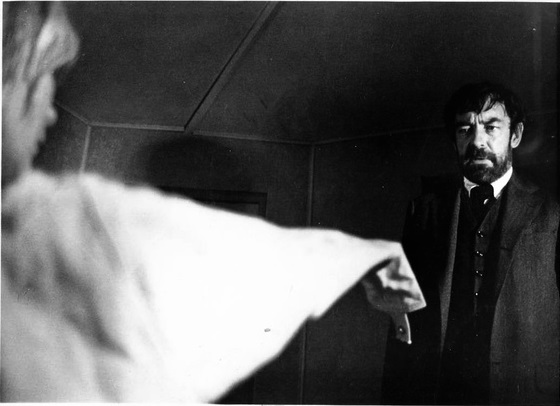
BEYOND THE DOOR (Italy - 1974; US release 1975) Directed by Oliver Hellman (Ovidio G. Assonitis) and R. Barrett (Roberto D'Ettorre Piazzoli). Written by Oliver Hellman (Ovidio G. Assonitis), Antonio Troisio, R. Barrett (Roberto D'Ettorre Piazzoli), Giorgio Marini, Aldo Crudo, Alex Rebar and Christopher Cruise. Cast: Juliet Mills, Richard Johnson, Gabriele Lavia, Nino Segurini, Elizabeth Turner, Barbara Fiorini, David Colin Jr., Luigi Marturano. (R, 98 mins/108 mins) When THE EXORCIST became a worldwide phenomenon in late 1973 and into 1974, it didn't take long for countless imitations, mostly from Italy, to spew forth. The most famous of these Italian ripoffs was BEYOND THE DOOR, which managed to fuse together elements of both THE EXORCIST and ROSEMARY'S BABY and, with the help of a memorably terrifying TV spot, became a surprise hit when it opened in the US over the spring and summer of 1975. It also infamously caught the attention of Warner Bros., who sued the producers and US distributor Film Ventures for copyright infringement. The case was eventually settled and BEYOND THE DOOR was never pulled from distribution, unlike ABBY, a 1974 blaxploitation EXORCIST knockoff that was withdrawn from circulation and hasn't been legitimately seen in decades, though poor-quality presentations of it aren't hard to find on YouTube and torrent sites. None of the other Italian EXORCIST ripoffs--among them 1974's THE ANTICHRIST (released in the US as THE TEMPTER in 1978), 1974's THE TORMENTED (released in the US in 1978 and rechristened for cable and home video in 1981 as THE EERIE MIDNIGHT HORROR SHOW), 1975's THE NIGHT CHILD, 1975's THE RETURN OF THE EXORCIST, aka CRIES AND SHADOWS (released in the US in 1977 as THE POSSESSOR), 1975's THE HOUSE OF EXORCISM (the retooled version of Mario Bava's 1973 film LISA AND THE DEVIL, featuring added possession scenes with Elke Sommer being exorcised by priest Robert Alda)--or the 1975 Spanish knockoff EXORCISM with Paul Naschy and the 1974 German copycat MAGDALENA, POSSESSED BY THE DEVIL (released in the US in 1976 as BEYOND THE DARKNESS), faced any legal action from Warner Bros. And though some of the them took a long time to get to the US, the fad pretty much died out in Europe by 1977, with only a few sexploitative stragglers like 1978's softcore OBSCENE DESIRE and 1979's MALABIMBA, the latter a product of Italy's short-lived determination to make horror/porno crossovers a thing.
But it's BEYOND THE DOOR that remains the signature Italian EXORCIST ripoff, and it's just been released in a comprehensive, limited-edition Blu-ray box set from Arrow, because physical media is dead. It's been out on DVD and Blu before from Code Red, and some of those extras are carried over here, but Arrow has done a magnificent job with its 2K restoration of the 108-minute European version, titled THE DEVIL WITHIN HER, and the 98-minute US cut (you also get a poster and a 56-page booklet with essays). Juliet Mills stars as Jessica Barrett, a wife and mother of two who finds she's unexpectedly pregnant with a third, something that wasn't really in the plans of her record producer husband Robert (Gabriele Lavia). Soon, the fetus is growing at an alarming rate, and she begins vomiting blood and suffering from erratic mood swings. Her young son Ken (David Colin, Jr) witnesses her levitating in the middle of the night, while daughter Gail (Barbara Fiorini) goes to check on her only to be greeted with a grin as Jessica's head turns completely around, amidst other disturbing, inexplicable activity. At the same time, Robert notices he's being followed by a serious-looking mystery man named Dimitri (Richard Johnson), who says he knows what's happening to Jessica and insists he's the only one who can help her.
BEYOND THE DOOR opening in Toledo, OH on 8/15/1975
BEYOND THE DOOR might shamelessly crib from THE EXORCIST's highlight reel, but it's got plenty of its own wacky ideas. It seems Dimitri and Jessica were once lovers long before she met Robert. And in what turned out to be a real relationship-killer, she left him when he took her to a black mass where she was supposed to be the sacrifice. Yes, Dimitri is a Satanist who promised Jessica to the Devil, and the Devil--who frequently taunts Dimitri in voiceover--is pissed-off at Dimitri's incompetence and wants restitution in the form of Jessica's baby. And he's given Dimitri only a few days to procure it or he's going to die. As Jessica's possession and pregnancy grow more intense--complete with the mandatory demonic voice, green puke, and various obscenities ("Get out of here, you piece of shit!," Lick the vile whore's vomit!" etc, etc), along with a craving for discarded banana peels--Dimitri manages to convince Robert to let him tend to Jessica, though it's only a desperate effort to get the child. It's an interesting approach in that the "exorcist" figure is there not out of the sense of spiritual altruism to save the possessed but rather, just to save his own sorry ass, and to their credit, Mills (who had recently co-starred with Jack Lemmon in Billy Wilder's AVANTI) and Johnson (THE HAUNTING) both appear to be taking this thing seriously and aren't coasting through for a quick paycheck.
Johnson imbues his rather silly dialogue ("The child...must be born!") with a generous amount of Royal Shakespeare Company gravitas, and Mills, the daughter of Oscar-winning actor John Mills and the older sister of early '60s Disney star Hayley Mills, really brings her A-game to a decidedly lowbrow production that was perhaps a tad beneath the family name ("Oh, I doubt Daddy ever saw this," she jokes on one of the ported-over commentaries). The possession histrionics aren't quite as intense as THE EXORCIST (there's no crucifix bit here, though there is a weird moment when Jessica kisses her young son for a uncomfortably long time), but their effectiveness is given a significant boost by an unnervingly bass-heavy sound design and by Mills' total commitment. The scene where she sits in a chair asking doctor and family friend George (Nino Segurini) "Who are you?" in a deep, guttural voice while Jessica seems to be internally fighting off the demon, quickly going back and forth in rapid-fire fashion from possessed to normal ("Help me, I'm so scared"), with Mills employing just slight changes in her facial expressions that you manage to see her through the contact lenses, the horrific makeup, and the chunky green vomit caking on her chin, is some legitimately terrific acting on her part.
BEYOND THE DOOR in Toledo, OH on 8/15/1975
Mills and Johnson class up the joint, but at the end of the day, BEYOND THE DOOR is still tacky as hell, particularly the finale where Dimitri is pounding on her very pregnant belly as the devil instructs him to "reach inside her and pull it out!" Shot in San Francisco with interiors done back in Rome, the film was the brainchild of Egyptian-born Italian exploitation producer Ovidio G. Assonitis (THE VISITOR, PIRANHA II: THE SPAWNING), who co-wrote and co-directed under the pseudonym "Oliver Hellman," which he would employ a few more times, most notably on the 1977 Italian JAWS ripoff TENTACLES. Up to this time, Assonitis had a few producer credits (1972's MAN FROM DEEP RIVER, 1974's SUPER STOOGES VS. THE WONDER WOMEN), but BEYOND THE DOOR marked his first directing effort, and he shared duties with cinematographer Roberto D'Ettorre Piazzoli, who hid under the alias "R. Barrett." Both were among seven (!) credited screenwriters, which included Alex Rebar, who would secure his place in B-movie history with the title role in 1977's THE INCREDIBLE MELTING MAN. Assonitis and D'Ettorre Piazzoli manage to create some scattered images that get under your skin throughout, whether it's the freakish grin on Mills' face during the head spin, or the unexpected use of Sam Peckinpah-style freeze-frames during a demonic fit, or an optical effect where one eye stares straight ahead while the other looks in every direction. With a budget of only $400,000, a good chunk of which likely went to Mills and Johnson, the effects--supervised by Wally Gentleman, who worked on Douglas Trumbull's crew on 2001: A SPACE ODYSSEY and has the most fake Italian pseudonym-sounding name that somehow isn't--are crude but they get the job done.
But there's a lot of quirky touches that don't always work, especially the antics of Jessica's two foul-mouthed kids (their nickname for their dad is "Asshole"), like Gail's obsession with owning over a dozen copies of Erich Segal's Love Story or Ken constantly drinking cans of Campbell's pea soup through a straw, an obvious nod to the colorful prop used for possessed Regan's puking scenes in THE EXORCIST. The film also opens with an offscreen Satan welcoming the audience and introducing the film like an avuncular TV host. When Film Ventures cut ten minutes out of the film for its US release, one of the first things to go had to be a bizarre, nonsensical scene late in the film where Robert is out walking around and is followed by an intimidating guy playing a flute with his nose. This seemingly goes on forever and only seems to be there so Assonitis can show off more San Francisco exteriors, stopping the uncut European version dead in its tracks at a pivotal time. Film Ventures also tossed a scene of Jessica getting groceries at a local Safeway, which was part of the original opening credits sequence showing Robert in the recording studio chewing out a funk band for not getting it right. The band is playing a Franco Micalizzi-written tune called "Bargain with the Devil," and it's an absolute jam that's unfortunately nowhere to be heard in the US version.
BEYOND THE DOOR was such an unexpected sleeper hit stateside that it led to two unrelated "sequels." Mario Bava's 1977 swan song SHOCK was picked up by Film Ventures and released in the US in 1979 as BEYOND THE DOOR II. It involved a little boy being possessed by the spirit of his dead father, and passing it off as a sequel was probably made a lot easier with the happy coincidence of David Colin Jr. playing the little boy. Assonitis had nothing to do with SHOCK or its rechristening as BEYOND THE DOOR II, but he did produce AMOK TRAIN, which had college students stuck on a possessed train while in Yugoslavia for a Balkan Studies research project. Shot in 1989, AMOK TRAIN was eventually released straight-to-video in the US in 1991 as--you guessed it--BEYOND THE DOOR III. The decision was probably inspired by Assonitis producing the minor 1987 horror hit THE CURSE, and then turning his 1989 "guy bitten by radioactive snake" epic THE BITE into the in-name-only CURSE II: THE BITE, an insane film that really should be better-known, and one so gross that the sight of a post-coital Jamie Farr doesn't even make the top five ghastliest things in it.
THE ANTICHRIST aka THE TEMPTER (Italy - 1974; US release 1978) Directed by Alberto De Martino. Written by Gianfranco Clerici, Vincenzo Mannino, and Alberto De Martino. Cast: Carla Gravina, Mel Ferrer, Arthur Kennedy, George Coulouris, Alida Valli, Umberto Orsini, Mario Scaccia, Anita Strindberg, Remo Girone, Ernesto Colli, Lea Lander. (Unrated, 112 mins; R-rated US theatrical cut, 96 mins) When THE EXORCIST opened in December 1973 and became a worldwide phenomenon well into the next year, it gave birth to a seemingly endless parade of imitations and blatant ripoffs, some from the US, but mostly from Europe, and Italy in particular. As they would later demonstrate with zombies, CONAN, and RAMBO ripoffs, the Italians latched on to the EXORCIST formula and beat it to death with films like 1974's BEYOND THE DOOR, 1974's THE TORMENTED (also released as THE SEXORCIST but best known under its 1978 ROCKY HORROR-inspired US release title THE EERIE MIDNIGHT HORROR SHOW), and the subgenre's absolute nadir, 1975's pathetic NAKED EXORCISM, aka THE RETURN OF THE EXORCIST (it was later shamelessly retitled THE EXORCIST III: CRIES AND SHADOWS for its UK video release), which showcased a possessed teenage boy howling "I've had it up to here with your mumbo-jumbo!" to an exorcist played by visibly embarrassed GODFATHER co-star Richard Conte, looking very frail in his final screen appearance (he was dead for two years when the film was released in the US in 1977 as THE POSSESSOR). Even the legendary Mario Bava's then-shelved 1973 pet project LISA AND THE DEVIL was infamously retooled with new footage featuring Robert Alda as an exorcist for its 1976 release as THE HOUSE OF EXORCISM. BEYOND THE DOOR was a surprise box office hit when it was released in the US in 1975, and even prompted an unsuccessful lawsuit from Warner Bros., though they did manage to get AIP's 1974 blaxorcist take ABBY (with BLACULA's great William Marshall as the exorcist) yanked from screens. The ripoffs weren't limited to Italy: Spain got into the game with the Paul Naschy-starring EXORCISM (1975) and BLIND DEAD mastermind Amando de Ossorio's DEMON WITCH CHILD (1975), released in the US in 1976 as THE POSSESSED. And Walter Boos took a break from SCHOOLGIRL REPORT installments to direct the West German MAGDALENA: POSSESSED BY THE DEVIL (1974), released in the US in 1976 as BEYOND THE DARKNESS and featuring THE EXORCIST's Rudolf Schundler (who played the servant Karl) as--go figure--the exorcist.
Where THE EXORCIST dealt with evil reaffirming the faith of troubled Father Damien Karras, THE ANTICHRIST is much more fervently Catholic in its presentation and its faith never in doubt, which makes its many transgressions all the more shocking. Wheelchair-bound Ippolita Oderisi (Carla Gravina) has been unable to walk since a childhood car accident that claimed the life of her mother. Around 30 years of age, Ippolita still lives in the family home with her father, Prince Massimo (Mel Ferrer), and seems well on her way to spinsterdom, telling her high-ranking Bishop uncle Ascanio (Arthur Kennedy) that no man has ever taken an interest in her and that a part of her would sell her soul to the devil just for the experience of intimacy. She's furiously possessive of her father and insanely jealous over his relationship with his secretary Gretel (Anita Strindberg). Offering to say a mass for her, Bishop Ascanio tells Ippolita that her jealousy is "absurd" and that she needs to realize that her widower father needs to move on with his life as well. He also hyperbolically expresses his concern to his brother Massimo that Ippolita may have fallen in with a sect of devil worshippers. Oh, it's way worse than that: thanks to some hypnosis sessions with parapsychologist Dr. Sinibaldi (Umberto Orsini), who believes her disability to be psychosomatic, horny Ippolita has been possessed by a spirit that has been lying dormant in her subconscious, an Inquisition-era Oderisi ancestor, also named Ippolita, who ran off with a Satanic cult the night before she was to be sent to a convent. She was branded a witch and burned, though she renounced Satan and pledged herself to God at the last moment. The demon that possessed the past Ippolita has taken over the present-day Ippolita, taking advantage of her secret feelings for her father (she writhes around on her bed, rubbing a photo of her father over her crotch) and her intense sexual frustration. Ippolita has an out-of-body experience where she goes through the same ritual as her ancestor, which involves a black mass/orgy where, among countless copulating Satanists, she eats the severed head of a toad, drinks toad's blood, and performs analingus on a goat before being sexually violated by the devil himself.
Things go from bad to worse as the demonic Ippolita now takes over as De Martino (HOLOCAUST 2000, THE PUMAMAN) and the screenwriters bring things more in line with the usual EXORCIST shenanigans: there's the requisite projectile green vomit, both in the face of family caregiver Irene (Alida Valli) and a handful that she force-feeds a bogus faith healer (Mario Scaccia). Ippolita goes an astonishingly profane tirade at dinner, seduces her playboy brother Filippo (Remo Girone), and tries to strangle her father. She taunts Ascanio, croaking "She's a big whore, your Ippolita...she'd lay you as well! She'd pluck gladly from under your tunic that innocent little nestling that never has flown," before exposing herself and bellowing "Dip your limp bird in holy water and bless me!" After all that, authorization is finally given for a formal exorcism, and, arriving out of the shadows Father Merrin-style is Austrian monk Father Mittner (George Coulouris), who has popped up on the fringes throughout, usually shaking a can for change, and is also seen in the Inquisition flashbacks and may be the reincarnation of the priest who saved the older Ippolita's soul.
THE ANTICHRIST is much more devout in its religious aspects than THE EXORCIST. There's much debate over theology vs. science, and though he considers Sinibaldi a fine doctor, Ascanio dismisses him as a "skeptic and a non-believer." Eventually, Prince Massimo relieves Sinibaldi of his duties, more or less admitting that only the power of Christ can compel Ippolita. The bluntly religious messages throughout are a bizarre mix with some of the blasphemous imagery and graphic sexuality, not to mention the unexplored plot point that Ippolita and Filippo clearly did some messing around together when they were teenagers (Ippolita: "Remember when we were children...how you made me feel special?"). The possessed Ippolita spills the beans to Massimo ("My brother and I fucked!") and Irene has witnessed it (she also deliberately doesn't tell Ippolita about Massimo and Gretel, so she's good at keeping secrets), but it's never again addressed, unless Massimo gives them a "devil made them do it" pass. And what about Ippolita's obvious designs on her father? Here lies the difference in the culture that produced THE EXORCIST and the one to which THE ANTICHRIST was born: the Oderisi family is one that's been waiting to have its ass handed to it by a scandalous past long buried. The past Ippolita has come to collect payment for generations of Oderisi hypocrisy and bourgeois decadence, not to mention weakness, represented by Ascanio' procrastination and cowardice in addressing his niece's ordeal. But it sort-of lets them all off the hook by the end--all sins forgiven--and emerging through the plethora of perversion on display throughout THE ANTICHRIST is a film that's perhaps too rooted in centuries-old reverence and tradition when it comes to its kid-gloves treatment of both the Catholic church and Italian nobility. Improbably enough, De Martino made a film that includes a scene of a goat having its ass eaten out, yet somehow still finds a way to pull its punches.
The production design in THE ANTICHRIST is spectacular and the ornate interiors (Bishop Ascanio's office is a sight to behold) beautifully shot by Aristide Massaccesi/Joe D'Amato. The score by Ennio Morricone and Bruno Nicolai is a piercing cacophony of screeching violins and organ music, augmented by eerie hisses, whispers, and deep gasps. It's a cut above the usual slapdash, exploitative EXORCIST ripoff, with a committed, vanity-free performance by Gravina, whose intensity comes through even though she's dubbed even prior to the possession scenes (SPEED RACER completists will be interested to know that the English dub was supervised by Peter Fernandez, who also voiced the possessed Ippolita; Ferrer, Kennedy, and Coulouris dub themselves) and would likely be taken a lot more seriously if the special effects weren't so terrible. The levitation scenes and the visual effects involving the moving furniture and Ippolita's disembodied hand strangling the faith healer are some of the most bush-league traveling mattes ever committed to celluloid. As an aside, I wonder if some of the more tawdry elements of THE ANTICHRIST were kept from the old pros in the cast (it's doubtful Ferrer and Kennedy ever envisioned reuniting on this after Fritz Lang's 1952 classic RANCHO NOTORIOUS). I can't imagine George Coulouris--the same year he co-starred in MURDER ON THE ORIENT EXPRESS--getting the script for this and thinking "OK, possession, levitation, green vomit, and uh, what? Rimjob on a goat? Well, I was in CITIZEN KANE...why not?"
THE NIGHT CHILD (Italy - 1975; US release 1976) Directed by Max Dallamano (Massimo Dallamano). Written by Max Dallamano (Massimo Dallamano) and Jan Hartman. Cast: Richard Johnson, Joanna Cassidy, Lila Kedrova, Evelyn Stuart (Ida Galli), Edmund Purdom, Nicole Elmi (Nicoletta Elmi), Richard Garrone, Dana Ghia, Tom Felleghy. (R, 89 mins)
WHAT HAVE YOU DONE TO SOLANGE? director Massimo Dallamano's THE NIGHT CHILD is often lumped in with the string of Italian EXORCIST knockoffs, but it's more like a DON'T LOOK NOW ripoff with subtle EXORCIST elements. That didn't stop Edward L. Montoro and Film Ventures International from selling it as such for its 1976 US release, where they really played up the success of BEYOND THE DOOR ("Beyond the door of madness..."), emphasizing the presence of that film's star Richard Johnson and even using very similar font in the one-sheet design. In fact, THE NIGHT CHILD is rather low-key and surprisingly restrained as far as these things go--it's almost more of an art film than an outright horror film--and with no child turning monstrous and no levitation or any of the standard possession histrionics on display, it had to thoroughly bore grindhouse audiences expecting another barf-happy, "Let Jesus fuck you!" EXORCIST clone. Widower BBC documentary filmmaker Michael Williams (Richard Johnson) gets into all sorts of devilish trouble when he decides to take his daughter Emily (FLESH FOR FRANKENSTEIN and DEEP RED's Nicoletta Elmi, the marvelously expressive, red-haired child actress who had the Creepy Kid market cornered in '70s Italian horror) and her nanny Jill (Ida Galli) to Italy with him for his latest project, a documentary entitled "Diabolical Art." His focus is a mysterious painting depicting a young girl who died 200 years earlier, and it has a profound effect on Emily, who also wears an allegedly cursed medallion that once belonged to her late mother. A local psychic (ZORBA THE GREEK Oscar-winner Lila Kedrova), senses that Emily is the reincarnation of Emilia, the girl's whose death is depicted in the painting, and that Michael's wife was killed by a hateful supernatural force with a connection to the medallion.
Also complicating matters is Michael's romance with his production manager Joanna, played by Joanna Cassidy, pulling some surprise Eurotrash duty, taking this gig after she was fired from THE STEPFORD WIVES and replaced by Paula Prentiss. Like Ippolita's fixation on Massimo, Emily is overly possessive of her father, in ways that a doctor (Edmund Purdom, with about a minute and a half of screen time) says "has all the elements of a neurosis." Like Ippolita's rage at Gretel, Emily wants nothing to do with Joanna, but THE NIGHT CHILD adds some unrequited love with the unspoken feelings Jill has for Michael. While Johnson's O-face as Cassidy disappears out of frame to go down on him is arguably as disturbing as anything in THE ANTICHRIST, you can see some similar themes developing between it and THE NIGHT CHILD: widower father, jealous daughter, reawakening of a vengeful spirit from centuries past, and useless doctors unable to do anything helpful. Both films take place in lush palazzos (though THE NIGHT CHILD makes greater use of some natural lighting in Franco Delli Colli's cinematography), both films feature characters dying in falls against amateurishly-integrated rearscreen matte work, and both films climax with the possessed females being chased out of their residence and through the streets by their desperate fathers. It's interesting that THE ANTICHRIST ends on an uplifting note thanks to divine intervention, the acceptance of God, and letting the pillars of society off the hook while things take a more agnostic turn in THE NIGHT CHILD, which doesn't feature an exorcism or even a priest, and its conclusion is downbeat, depressing, and godless. You can fuck your brother, try to kill your father, regurgitate some devil-cum, and enthusiastically toss a goat's salad in THE ANTICHRIST, but all is forgiven if you just believe and accept. There is no such salvation for the doomed protagonists of THE NIGHT CHILD.
Directed by Roy Ward Baker. Written by Edward and Valerie Abraham. Cast: Vincent Price, Donald Pleasence, John Carradine, Stuart Whitman, Richard Johnson, Barbara Kellermann, Britt Ekland, Simon Ward, Anthony Valentine, Patrick Magee, Anthony Steel, James Laurenson, Geoffrey Bayldon, Warren Saire, Lesley Dunlop, Fran Fullenwider, The Viewers, B.A. Robertson, Night, The Pretty Things. (Unrated, 98 mins)
Anthology, or portmanteau horror films weren't a new concept when they became hugely popular in the 1960s. 1945's DEAD OF NIGHT, anchored by the classic ventriloquist dummy segment with Michael Redgrave, established the template, Roger Corman's Poe anthology TALES OF TERROR (1962) was a big hit, and TV series such as ALFRED HITCHCOCK PRESENTS, THRILLER, THE OUTER LIMITS, and THE TWILIGHT ZONE got fans accustomed to compact, 30-minute stories. But when the British company Amicus, led by Max J. Rosenberg and Milton Subotsky, produced 1965's DR. TERROR'S HOUSE OF HORRORS, the style really took off, generating many similar, frequently star-studded anthology outings with titles like TORTURE GARDEN (1967), THE HOUSE THAT DRIPPED BLOOD (1970), ASYLUM (1972), TALES FROM THE CRYPT (1972) and THE VAULT OF HORROR (1973). By the mid-1970s, the subgenre's popularity began to fade, with lesser titles like TALES THAT WITNESS MADNESS (1973) and FROM BEYOND THE GRAVE (1974) paling in comparison to the anthology's heyday. With shocking horror films like THE EXORCIST (1973) and THE OMEN (1976) rendering classic horror passé with 1970s moviegoers, the omnibus film of the Amicus sort quietly faded away, much like Amicus itself as Subotsky (1921-1991) and Rosenberg (1914-2004) parted ways in the mid-1970s. Similar to the in-name-only resurrection of the legendary British horror house Hammer, the Amicus name would be revived in the 2000s, but we haven't heard much from it other than Stuart Gordon's STUCK (2008) and the atrocious 2009 remake of Larry Cohen's 1974 cult classic IT'S ALIVE. As far as the British anthologies go, a few stragglers wandered in, like 1977's Canadian/British feline-centric collection THE UNCANNY, but by this time, audiences moved on.
Made during a period when theaters were filled with gory, post-HALLOWEEN/FRIDAY THE 13TH slasher films and the groundbreaking special effects of ALIEN, THE HOWLING, and AN AMERICAN WEREWOLF IN LONDON, and featuring a cast of geriatric and/or past-their-prime actors, it's little wonder that the tardy anthology THE MONSTER CLUB failed to attract a US distributor, going straight to syndicated TV and appearing on VHS a few years later. An Amicus production in every way except by name, THE MONSTER CLUB, recently released in a beautiful transfer on Blu-ray and DVD by Scorpion, was an adaptation of three stories in British horror writer R. Chetwynd-Hayes' 1975 collection of the same name. Directed by Amicus and Hammer vet Roy Ward Baker, the film stars John Carradine as Chetwynd-Hayes, who's bitten by an affable vampire named Eramus (Vincent Price) and taken to the secret Monster Club, a hangout for ghouls, monsters, and new-wave bands, where Eramus tells him three horrific stories to inspire his writing. In the first, Simon Ward is a scheming shitbag who badgers his girlfriend (Barbara Kellermann) into answering a newspaper ad seeking someone to help catalog a library, figuring there's expensive goodies to steal and fence. The homeowner (James Laurenson), a sensitive, lonely shut-in, turns out to be a "shadmock," a supernatural creature who emits a lethal whistling sound when angered. In the more comedic second tale, Richard Johnson is a vampire quietly going about his nocturnal routine as his loving wife (Britt Ekland) keeps his secret even from their bullied son (Warren Saire). The son has been befriended by a concerned priest (Donald Pleasence), who's really the leader of a squad of vampire hunters from the government's "Blood Crimes" unit. The final story has a frustrated movie director (Stuart Whitman) location-scouting for a gothic horror film and stumbling on a creepy village populated by grave-desecrating, cannibalistic ghouls led by Patrick Magee (in one of his last roles) and figuring out too late that he's their next intended feast.
Occasionally eerie but never taking itself very seriously, THE MONSTER CLUB certainly won't go down as an essential British anthology horror flick, but even with some cheesy humor and some dated songs, time has been surprisingly kind to it. While there might not have been a place for it in American movie theaters in 1981, TV audiences were much more welcoming with it, likely because young horror fans were already watching movies with Price and Carradine (and Karloff, Lugosi, Lee, Cushing, etc) on Saturday afternoon and late-night "Creature Features." There's nothing in the way of gore other than one rather icky result of a shadmocking, and even some near-nudity gets obscured and turned into an animated joke. In those respects, it's quaintly old-fashioned, but also nothing that 1981 audiences wanted to see on the big screen. The biggest concession THE MONSTER CLUB makes to "the kids" is the inclusion of some extended musical interludes featuring songs by UB40 and onscreen appearances by the short-lived Night, and The Pretty Things, who had just reunited and contributed the title track as Price and Carradine can be seen busting moves on the Monster Club's dance floor (with Price almost grinding on a large actress named Fran Fullenwider). Carradine seems a bit miscast and more than a little bewildered (Peter Cushing would've been perfect; Christopher Lee was approached for the role and reportedly declined when he heard the title), but Price is clearly having fun with his sole big-screen appearance as a vampire.
While some of THE MONSTER CLUB's humor is corny by design (especially in the second story, though the predicament Pleasence ultimately finds himself in is a rather ingenious development that's legitimately laugh-out-loud funny), some of it is surprisingly witty, with Price's vampire complaining that his kind find it hard to do their thing because of so many horror movies ruining things for them ("Everybody knows about garlic and stakes through the heart!"), and when Anthony Steel appears as a producer of vampire films named "Lintom Busotsky," Carradine exclaims "A vampire film producer?" to which Price quips "Aren't they all?" There's also some unexpectedly sharp and cynical social commentary near the end when Price's Eramus nominates Chetwynd-Hayes to become the Monster Club's newest member, explaining that humans, with their guns, their wars, their anger, and their endless bloodlust and propensity for murder, are perhaps the biggest monsters of all. None of this is to say that THE MONSTER CLUB is filled with deep insight, but it is better than its reputation as the last gasp of a dying subgenre. Anthology films didn't go away--they just changed shape: George A. Romero's CREEPSHOW was in theaters the next year, Price would similarly appear in the wraparound segments of the much more grisly 1987 horror omnibus THE OFFSPRING (aka FROM A WHISPER TO A SCREAM), and more recently, the two V/H/S films and THE ABCs OF DEATH have found an audience with newer and apparently more lenient horror fans. But THE MONSTER CLUB was the last of its kind: the British portmanteau rooted in classic horror. Fittingly, it was also the last feature film directed by Baker (1916-2010), whose career began with Hollywood fare like the Marilyn Monroe thriller DON'T BOTHER TO KNOCK (1952). He's best known among serious cineastes for the Titanic classic A NIGHT TO REMEMBER (1958), but not long after that, he became a go-to horror guy for Hammer and Amicus, helming such genre favorites as FIVE MILLION YEARS TO EARTH (1967) and THE VAMPIRE LOVERS (1970), among many others. After THE MONSTER CLUB, Baker moved into British television until retiring in the early 1990s. Late in his life and still sharp and full of stories, he contributed several commentary tracks on DVD releases of some of his classic horror films.
Scorpion's Blu-ray, framed at 1.78, really is the best this film has ever looked (despite their usual packaging typos, like "R. Chetwood-Hayes" and "Milton Dubotsky"), and it features two outstanding extras courtesy of journalist/historian/close Price friend David Del Valle, including an audio interview and an hour-long, career-spanning 1987 interview for Del Valle's public access show THE SINISTER IMAGE. Price, taking a little time to plug Lindsay Anderson's just-released THE WHALES OF AUGUST, is very much the elegant raconteur here, candidly talking about his classic films and his old and, in some cases, departed Hollywood friends. This same interview, previously released as its own DVD by Image, is featured on Shout Factory's upcoming Price box set from his AIP/Poe days.