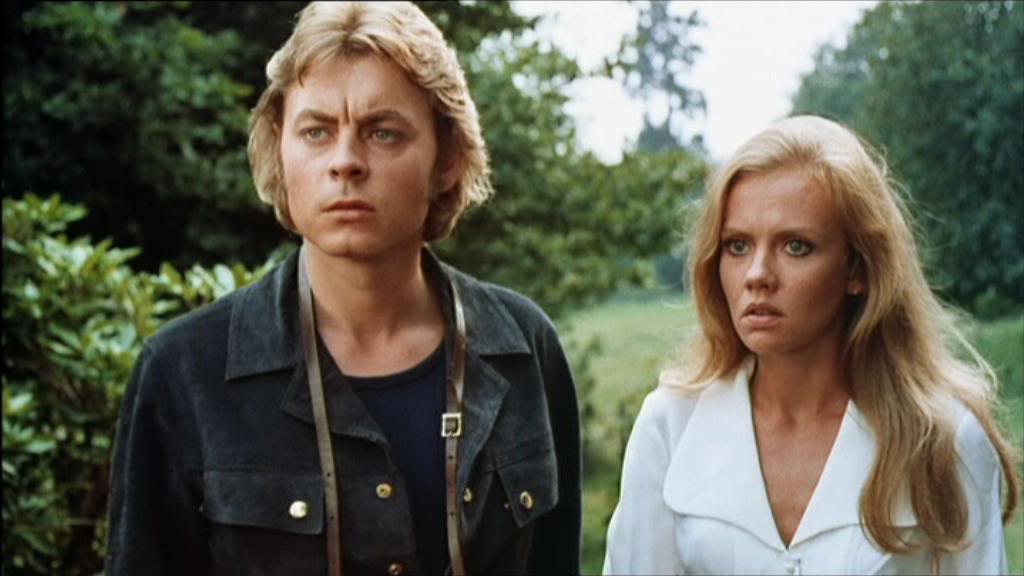
ENDLESS NIGHT (UK - 1972) Written and directed by Sidney Gilliat. Cast: Hayley Mills, Hywel Bennett, Britt Ekland, George Sanders, Per Oscarsson, Patience Collier, Aubrey Richards, Peter Bowles, Lois Maxwell, Madge Ryan, David Bower, Helen Horton, Walter Gotell, David Healy, Leo Genn. (Unrated, 99 mins) Along with the many versions of her 1939 novel And Then There Were None, usually under the title TEN LITTLE INDIANS, the overwhelming majority of Agatha Christie film and TV adaptations have been her mysteries featuring either Hercule Poirot or Miss Marple. With WITNESS FOR THE PROSECUTION, Billy Wilder's 1957 version of her 1925 courtroom drama short story, being tops among the exceptions, the film versions of her literary departures have proven mostly unsuccessful, particularly 1985's ORDEAL BY INNOCENCE, possibly the worst big-screen take on her work. 1972's ENDLESS NIGHT has been held in low regard for nearly 50 years, and its response was so unfavorable in its native UK that it was never even released in American theaters. It's not exactly obscure--between TV airings and its availability on VHS in the '80s and on DVD in the early '00s, it hasn't been all that difficult to see--but it's rarely-discussed and it's been generally dismissed, if not outright forgotten. Based on Christie's 1967 novel, ENDLESS NIGHT definitely falls into the ORDEAL BY INNOCENCE category in that it's a more inward psychological drama rather than a standard mystery, and the film is much more Hitchcockian than Christie in style and execution. And the connection is there, as writer/director Sidney Gilliat (1908-1994), whose career as a screenwriter dated back to the advent of talkies, first found success scripting Alfred Hitchcock films like 1938's THE LADY VANISHES and 1939's JAMAICA INN. ENDLESS NIGHT is generally faithful to Christie's novel, but like ORDEAL BY INNOCENCE, its story structure doesn't lend itself to a visual medium. As a result, unlike ensemble pieces featuring Poirot, Marple, or a group of strangers summoned to an isolated house where they're picked off one by one, Endless Night is one of Christie's works that's better-served on the page.
That doesn't mean it isn't interesting. In fact, it's unusual in the way that it's virtually impossible for it to work on a first viewing. It almost requires a second watch just to make sense of the plot. Its finale throws out twists and turns with such wild abandon that even if the intent is some kind of ambiguity, it will only result in frustration unless you have an opportunity to go back and rewatch key scenes, including a stilted, confusing opening that only makes sense on a second run-through. This is probably a big reason for its chilly reception, plus Christie mysteries just weren't a big draw at the time, with a lull of interest between the mid-1960s and the success of 1974's Oscar-winning MURDER ON THE ORIENT EXPRESS, which kickstarted a Christie renaissance just before her death in 1976. I don't mean to imply that ENDLESS NIGHT is some kind of innovative, misunderstood trailblazer, because at the end of the day, it really doesn't work. But it deserves some credit for being a little ahead of its time with the kind of smack-you-upside-the-head twists and kick-in-the-balls reveals that you'd start seeing regularly in the '90s, especially after THE USUAL SUSPECTS.
Recently released on Blu-ray by Kino Lorber (because physical media is dead), ENDLESS NIGHT was also notable for reuniting the stars of Roy Boulting's acclaimed 1968 chiller TWISTED NERVE: grown-up Disney child star and POLLYANNA herself, Hayley Mills, and cherubic David Hemmings-alike Hywel Bennett. Bennett, then coming off of 1971's penis-transplant sex farce PERCY, is Michael Rogers, an aimless, irresponsible, and immature young man who drifts from job to job with no real drive or sense of responsibility. He's a self-described "idle dreamer" obsessed with a large swath of land in the countryside called Gipsy's Acre, where he has a pie-in-the-sky notion of building a beautiful dream house. He loses a limo driving job over his attitude and is able to leave his new part-time job at a gas station after a chance encounter with free-spirited Ellie Thomsen (Mills). He soon discovers that she's an orphaned heiress--"the sixth-richest heiress in the world," in fact--and they marry after a whirlwind courtship where she surprises him by purchasing Gipsy's Acre. The marriage is frowned upon by her relatives who live on an allowance she doles out, including her bitter stepmother (Lois Maxwell, the Bond series' Miss Moneypenny seen here in rare bitch-on-wheels form). Ellie's cynical, condescending attorney Lippincott (an enjoyably snide performance by George Sanders, in his next-to-last film; he committed suicide six months before its release) even offers Michael a huge payout to divorce her and walk away, subtly implying that this isn't Ellie's first impulsive marriage. Things get strange, combative, and uncomfortable with the arrival of Ellie's friend Greta (Britt Ekland, Bennett's PERCY co-star), who seems familiar to Santonix (Per Oscarsson), an acquaintance of Michael's from his days as a limo driver and also a highly-regarded, terminally ill architect who designs the high-tech, state-of-the-art mansion that Michael and Ellie build at Gipsy's Acre, with Michael quickly coming to the realization that things aren't what they seem to be.
George Sanders (1906-1972)
Nothing is what it seems to be, and that becomes--I hesitate to use the word "clear"--the longer ENDLESS NIGHT goes on. Gilliat was better known as a writer than a director, though he was no slouch in that department, having helmed the great 1946 British mystery GREEN FOR DANGER. One can see why found this story appealing, with all of its Hitchcockian elements, plus the subterfuge, the misdirection, threats, secrets, and blackmail, all set to a score by Bernard Herrmann, whose contributions to Hitchcock classics like VERTIGO, NORTH BY NORTHWEST, and PSYCHO were inestimable. There's also the possibility that Michael is an unreliable narrator whose general shiftlessness, fleeting flashbacks to a tragedy from his childhood, and the fact that his own mother (Madge Ryan) doesn't seem to like him very much, all work together to imply that he's got his own secrets and ulterior motives. But the resolution happens so fast that it's almost too much to take in without going back and looking at parts of the movie again. Only then do things appear to begin coming together, and even then it's a shaky foundation. ENDLESS NIGHT is a film that's easier to appreciate than actually enjoy. It's not really a thriller, and despite some classifying it as "horror," it doesn't really fall into that category either, aside from a couple of creepy moments where Michael imagines Ellie as a faceless figure. Christie's novel was a journey into the mind of its main character, and that isn't easy to pull off as an "Agatha Christie" movie. For her part, Christie saw the film and expressed displeasure with the end result, though her biggest complaints stemmed from the concessions made to the era, primarily some Ekland nudity (Bennett also drops an F-bomb at one point, which isn't something you can imagine hearing from Hercule Poirot or Miss Marple). ENDLESS NIGHT also marked the end of the road for Gilliat, who called it a career and never wrote or directed another film.
MOON IN SCORPIO (US - 1987) Directed by Gary Graver. Written by Robert S. Aiken. Cast: Britt Ekland, John Phillip Law, William Smith, Lewis Van Bergen, April Wayne, Robert Quarry, Jillian Kesner, James Booth, Donna Kei Benz, Don Scribner, Bruno Marcotulli (R, 87 mins) "Moon in Scorpio...what does it mean?" That's the question asked by strait-jacketed heroine Linda (Britt Ekland) at the beginning of MOON IN SCORPIO, and like her, you still won't have an answer when it's over. One of the worst slasher films of the 1980s, MOON IN SCORPIO, just out on Blu-ray from Scorpion (because physical media is dead), squanders a more-than-capable B-movie cast in an amateurishly-shot and excruciatingly dull mishmash from director Gary Graver. A veteran cinematographer on drive-in and grindhouse fare going back to the 1960s--in his early days, he was part of the Al Adamson stock company, shooting SATAN'S SADISTS and DRACULA VS. FRANKENSTEIN before moving on to some New World-era Roger Corman productions--Graver (1938-2006) would occasionally helm mainstream exploitation like the 1981 Cameron Mitchell trucker actioner TEXAS LIGHTNING and the HALLOWEEN-inspired 1982 slasher film TRICK OR TREATS, in addition to having a long career directing hardcore porn under the name "Robert McCallum." But to present-day film nerds, he's best-known for his association with Orson Welles in the 1970s, which has earned him a certain degree of cred in cineaste circles. Graver struck up a friendship with Welles after contacting him out of the blue and expressing a desire to work for him. This occurred in early 1970 when the auteur was beginning work on THE OTHER SIDE OF THE WIND, which wouldn't be completed and released until 2018, long after Welles, Graver, and a good chunk of the creative and acting personnel passed on. Graver was a loyal Welles inner-circler in this latter phase of Welles' life and career, serving as an assistant and uncredited co-director on 1973's F FOR FAKE and other assorted projects left in various states of completion. Happy to be an apprentice to a master and correctly assuming he wouldn't be getting paid, Graver made ends meet by taking cinematography and directing gigs where he could get them, eventually relying on the hardcore porn industry to pay the bills. At one point during THE OTHER SIDE OF THE WIND's on-again/off-again production that lasted until 1976, Welles gifted Graver the Oscar he won for co-writing 1941's CITIZEN KANE, which Graver held on to until he reached a financially-strapped period of his life in the 1990s and sold it for $50,000, a move that eventually led to him being sued by Welles' daughter Beatrice.
Graver with his mentor Orson Welles
Until his death, Graver was one of many people involved in the long completion process of the infamously unfinished THE OTHER SIDE OF THE WIND. Welles died in 1985, and Graver probably could've used his help on MOON IN SCORPIO, a dismal slasher outing co-produced by '80s B action stalwart Fred Olen Ray (ARMED RESPONSE, CYCLONE). It was released straight-to-video in late 1987 with some admittedly great artwork on the VHS box that could be found in any video store well into the '90s. As was the case with his mercurial mentor on so many of his own projects, Graver clashed with the money men--in this case Trans-World Entertainment head Moshe Diamant--during the film's production and eventually had the film taken away from him in post, which was probably a Welles-ian badge of honor. Diamant didn't like the supernatural angle of the script by Robert S. Aiken (an unsuccessful flash-in-the-pan actor briefly known as "Ford Dunhill" in the late '50s when he was being groomed as a Rock Hudson clone for about an hour and a half before appearing under his real name in a couple of Russ Meyer films a decade later), and instructed Graver to make it a straight-up slasher movie. When Graver disregarded his marching orders, Diamant recut the film in his absence, resulting in complete incoherence, though it's really hard to imagine MOON IN SCORPIO being good even under the most ideal circumstances.
The plot has Ekland's Linda in a psych ward, babbling about a ghost ship after being found alone on an abandoned yacht. She tells attending shrink Dr. Khorda (Robert Quarry) that she was on the yacht for her honeymoon with her husband Allen (John Phillip Law), who surprised her on their wedding day with...a trip on a yacht with his Vietnam buddies Burt (William Smith) and Mark (Lewis Van Bergen, looking like SNL-era Dennis Miller) and their annoying girlfriends? Linda is understandably puzzled, especially as Allen has had a fear of water since the war, and still struggles with PTSD from an incident involving Burt murdering a Vietnamese woman in cold blood. Mark's much-younger squeeze Isabel (April Wayne) constantly reminds everyone that "The moon is in Scorpio, you know," while Burt and his booze-swilling girlfriend Claire (Graver's wife Jillian Kesner, star of FIRECRACKER and RAW FORCE) seem to be lost in their own community theater version of WHO'S AFRAID OF VIRGINIA WOOLF? If MOON IN SCORPIO accomplishes nothing else (and trust me, it doesn't), you at least get to hear the wonderfully gravelly Smith, who constantly sounds like he's gargling glass shards, grunt to a frequently-topless Kesner, "Hey, lay off the hooch, will ya?" thus saving it from complete ruin.
It takes about 45 of the film's 87 minutes before they're even on the yacht, and eventually, they find themselves being offed one-by-one by a possible stowaway, a knife-and-harpoon-wielding maniac. Apparently, Graver's initial cut, from Aiken's script, dealt with the trip being haunted by the vengeful spirit of the dead Vietnamese woman. That's vaguely hinted at here and in the scenes with Ekland and Quarry, where she's talking about the yacht being possessed. But none of that means anything since Diamant turned it into a Namsploitation-tinged slasher movie that offers some over-the-top gore but little in the way of suspense, since it's pretty easy to figure out the killer by simple process of elimination. Ekland was never mistaken for a great actress in her prime, though she could always get by (she was in THE WICKER MAN, after all), but still, she's terrible here, and she gets no help from the laughable dialogue ("My honeymoon turned out to be a nightmare...on a death ship!"). Much of the time, MOON IN SCORPIO resembles an L.A.-shot Jess Franco film, complete with glaring gaffes (watch Kesner fill her gin glass she just filled in the previous shot and say the same line of dialogue over again, and Van Bergen's name is misspelled "Louis" in the credits), bizarre supporting characters (why are James Booth and Donna Kei Benz even in this?) and a flashback Vietnam skirmish--augmented by grainy, mismatched, decades-old documentary combat stock footage (in 19-fucking-87!)--looks like it was hastily staged in a park down the street from Graver's house. There's one big laugh that's probably intentional (a weirdo private eye played by Don Scribner is made out to be a total badass and gets harpooned about ten seconds after he's introduced), and Smith and Kesner are trying to make something out of nothing, and while MOON IN SCORPIO looks better than it has any business looking on this strong candidate for the Buyer's Remorse Blu-ray of 2019, this is decidedly not a long-buried classic that's been patiently waiting to be discovered, no matter how tight Gary Graver was with Orson Welles.
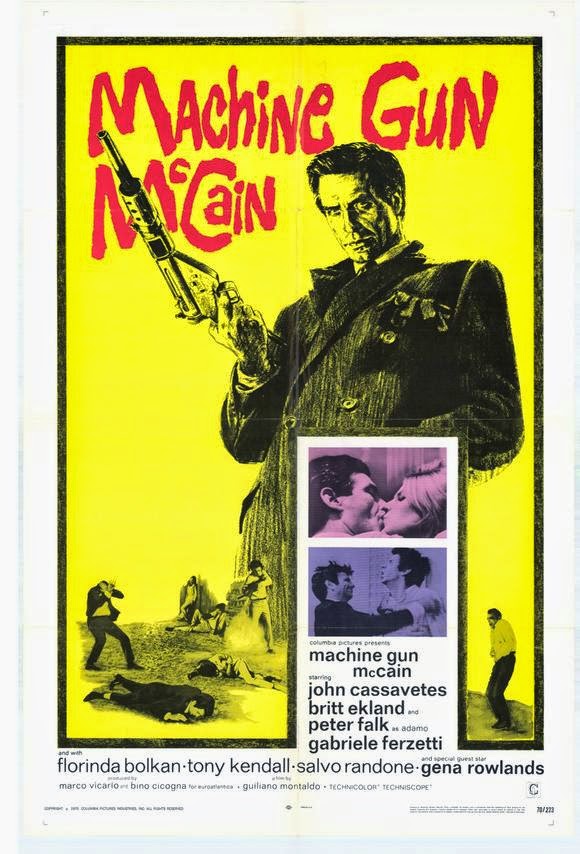
MACHINE GUN MCCAIN (Italy - 1969; US release 1970) Directed by Giuliano Montaldo. Written by Mino Roli and Israel Horovitz. Cast: John Cassavetes, Britt Ekland, Peter Falk, Gabriele Ferzetti, Gena Rowlands, Florinda Bolkan, Tony Kendall, Salvo Randone, Luigi Pistilli, Pierluigi Apra, Steffen Zacharias, James Morrison, Claudio Biave, Margherita Guzzinati, Val Avery, Carol Doda. (Unrated, 96 mins)
Actor/writer/director John Cassavetes (1929-1989) was one of the key figures in the birth of the American independent film. He was already a jobbing character actor throughout the 1950s in films like THE NIGHT HOLDS TERROR (1955), CRIME IN THE STREETS (1956) and EDGE OF THE CITY (1957), and on television, where he earned a shot at headlining his own series with the short-lived NBC private eye drama JOHNNY STACCATO in 1959. Though he was building a solid reputation as an actor, Cassavetes' true passion was directing (NBC let him direct several JOHNNY STACCATO episodes) and that same year, he released his self-financed writing/directing debut SHADOWS, which he actually shot twice, once in 1957 and again in 1959, preferring the reshot '59 version. SHADOWS received high praise, particularly from European critics, and it led to Cassavetes getting a couple of Hollywood studio directing gigs with the 1961 Bobby Darin vehicle TOO LATE BLUES and 1963's A CHILD IS WAITING, with Burt Lancaster and Judy Garland. Cassavetes took the latter film as an assignment after original director Jack Clayton (ROOM AT THE TOP, THE INNOCENTS) left over a scheduling conflict, and didn't get along with either of his legendary stars or producer Stanley Kramer, all of whom were old school Hollywood and very set in their ways and had no use for Cassavetes' love of improvisation and gritty sensibilities. Kramer took the film away from Cassavetes and fired him during the editing stage. Cassavetes ultimately disowned A CHILD IS WAITING while reiterating his respect for Kramer and conceding that it wasn't the kind of film he should've been directing in the first place. If Cassavetes took anything away from his unsuccessful stint as a Hollywood studio director, it was the mindset of the character played by Darin in TOO LATE BLUES, a talented jazz musician torn between selling out for easy money or sticking to his ideals and making the art he wished to make, regardless of commercial appeal or financial reward.
After his miserable experience on A CHILD IS WAITING, Cassavetes decided that he would no longer compromise himself as a filmmaker, and the easiest way to do this would be to compromise himself as an actor. Cassavetes wanted to make the films he wanted to make and didn't give a shit that some found them talky and self-indulgent. Like their maker, Cassavetes' films are raw, intense, and unpleasant, sometimes to the point of belligerence. He didn't want to fall into the same trap that continually managed to snag another maverick, Orson Welles, who perpetually found himself beholden to producers and investors who seduced him with romantic promises of total autonomy only to take the films away from him anyway once the realization set in that they most likely wouldn't be getting their money back. Cassavetes started taking acting gigs to both support his growing family with actress wife Gena Rowlands (they married in 1954) and their three children, but also to bankroll his own directing efforts so he'd have to answer to no one. He spent the next several years on television with guest spots on shows like THE ALFRED HITCHCOCK HOUR, BURKE'S LAW, VOYAGE TO THE BOTTOM OF THE SEA, and COMBAT! plus 1964's THE KILLERS, which was shot as the first made-for-TV-movie but released to theaters when it was deemed too violent, including a notorious scene where Angie Dickinson is slapped around by a vicious gangster played by Ronald Reagan in his final acting role before entering politics. Cassavetes returned to the big screen in 1967 with the biker movie DEVIL'S ANGELS and as one of THE DIRTY DOZEN. His performance in THE DIRTY DOZEN earned him an unexpected Best Supporting Actor Oscar nomination (he lost to George Kennedy in COOL HAND LUKE), and much to his surprise, his acting career was taking off. 1968 was a banner year for Cassavetes, as he co-starred in ROSEMARY'S BABY and re-established his dormant filmmaking career with his breakthrough FACES, which received Oscar nominations for Cassavetes' script as well as the supporting performances of Seymour Cassel and Lynn Carlin. As his career behind the camera gained significant momentum, Cassavetes' interest in acting diminished, but he soldiered on since it provided him with the budgets he needed for his personal projects, and as that interest waned, his reputation as "difficult" grew, which certainly wasn't helped by his heavy drinking. He didn't get along with Roman Polanski on ROSEMARY'S BABY, and this would be a recurring theme throughout the rest of Cassavetes' acting career. Shortly after THE DIRTY DOZEN and ROSEMARY'S BABY, Cassavetes acted in a pair of Italian gangster films: Alberto De Martino's ROME LIKE CHICAGO (1968), which wasn't even seen in the US until it aired on CBS in 1974, and Giuliano Montaldo's MACHINE GUN MCCAIN (1969), released in the US in the summer of 1970.
MACHINE GUN MCCAIN is an interesting film on Cassavetes' acting resume. While it's obviously a money gig for him first and foremost, producers Bino Cicogna and Marco Vicario allowed him to bring along members of his stock company, including Rowlands, and two of his best friends, Peter Falk and Val Avery. MCCAIN is an occasionally uneven film that tries to juggle more characters than it can handle in its 96 minutes (though the European version is reportedly 20 minutes longer), but it contains one of Cassavetes' best performances as ex-con Hank McCain. Hardened criminal McCain is unexpectedly pardoned 12 years into a life sentence at San Quentin. He's met by his 20-year-old son Jack (Pierluigi Apra), a two-bit hood who claims to have paid $25,000 to have him set free. Jack and two buddies, Cuda (James Morrison, in a role IMDb erroneously credited to Jim Morrison for years--yes, the Doors singer) and Barclay (Claudio Biave), woo him with a $2 million heist of The Royal, a new casino in Las Vegas. McCain doesn't buy that these three losers came up with this plan--or the $25,000--on their own (he gives Jack some tough-love with "You're gonna be small change your whole life"), and he's right: the job has been orchestrated by powerful mobster Charlie Adamo (Falk) and his consigliere Duke Mazzanga (Luigi Pistilli), who run the west coast operation for New York-based Don Salvatore (Salvo Randone) and his second-in-command, nephew Don Francesco DeMarco (Gabriele Ferzetti). Based in San Francisco, Adamo was given the west coast with specific instructions to stay out of Vegas, but believing Don Salvatore lacks confidence in him, Adamo thinks asserting his power in Vegas will prove that he's a player. What he doesn't know is that Salvatore and DeMarco secretly own The Royal, and when he finds out, he backs down, telling Jack that the heist is off and that he'll no longer need McCain. McCain doesn't care and moves ahead with the job on his own, along with Irene (Britt Ekland), a young woman he met at the Royal and impulsively married. Once McCain pulls off the heist and with Adamo and Mazzanga dead men walking, Don Salvatore dispatches top hit man Peter Zacari (Tony Kendall) to track down an on-the-run McCain and Irene, who are offered sanctuary by McCain's bitter ex Rosemary (Rowlands).
MACHINE GUN MCCAIN is almost three films in one: McCain doesn't figure much in the first third, which focuses more on the scheming of Adamo and Mazzanga, their ill-conceived plan to rob the casino, and the mob bosses deciding what to do with them. Then things shift to McCain and Irene and things bog down a bit, since Ekland, who looks great, isn't given much of a character to play and we never really care about Irene or, for that matter, learn anything significant about her (another missed opportunity: Cassavetes and Falk have no scenes together). Once the heist, pulled off with a complicated set of small explosions inside the casino, is over, MCCAIN becomes almost like a Cassavetes film, especially when Rowlands turns up about 80 minutes in. What makes MCCAIN an interesting and offbeat film for its type is not just its eclectic mix of American and European actors and settings (location work was done in California and Nevada, with most of the interiors shot in Rome), its fusing of the gangster genre with the then in-vogue international heist film (Montaldo had just directed 1967's GRAND SLAM, an essential entry in the subgenre), and its in-depth depiction of the legitimate business side of the Mafia, but most notably in what Cassavetes took from the project. The role almost seems written for him: Hank McCain is a gangster version of Cassavetes himself, doing things his own way, refusing to back down, and taking on the Mafia (read: "the system") all on his own, consequences be damned. This is a motif that would turn up again in later Cassavetes films like 1976's THE KILLING OF A CHINESE BOOKIE, with connected strip club owner Ben Gazzara roped into killing the head of the Chinese Mafia on the west coast in order to settle a debt to a mob boss; in 1980's GLORIA, his biggest commercial success as a director, with Rowlands in an Oscar-nominated performance as a hit woman on the run, protecting an orphaned boy after his parents are murdered by her bosses; and again with Cassavetes as an actor, co-starring with Falk in Elaine May's largely improvised and very Cassavetes-ish MIKEY AND NICKY (1976). Considering his increasingly surly reputation as an actor (it's no accident that he's name-checked by Denis Leary in the song "Asshole"), Cassavetes found some common ground with Montaldo, who speaks highly of his star on Blue Underground's 2010 DVD/Blu-ray release of the film. They clashed early in the filming, but once Montaldo asserted that he was the director and earned Cassavetes' trust, the pair got along fine, and Cassavetes even assisted his director with some indie/underground, guerrilla location filming tactics during the American portion of the shoot, securing a couple of rented cars and helping Montaldo catch some scenes on the fly in San Francisco, bypassing permits. It's probable that Cassavetes wrote much of his own dialogue, though the script is credited to GRAND SLAM co-writer Mino Roli, who would work again with Montaldo on 1971's SACCO & VANZETTI and go on to write Enzo G. Castellari's 1976 spaghetti western KEOMA. English dialogue is credited to Israel Horovitz, whose most noteworthy credit otherwise is for writing the 1982 Al Pacino comedy AUTHOR! AUTHOR!, though undoubtedly his biggest contribution to popular culture is fathering Adam Horovitz of the Beastie Boys. MACHINE GUN MCCAIN also featured a catchy score by Ennio Morricone, as well as the over-the-top "Ballad of Hank McCain," a Jackie Lynton-sung ditty more appropriate for a spaghetti western of the era, and one that was covered in 2000 by John Zorn and Faith No More frontman Mike Patton.
Using the money from his lucrative Hollywood and Italian acting gigs, Cassavetes funded 1970's HUSBANDS, a mid-life crisis drama starring himself, Falk, and their other best buddy Ben Gazzara (the trio going on THE DICK CAVETT SHOW completely drunk to plug the film is some priceless TV history, where they give Cavett so much grief that the host quips "This is why I didn't join a fraternity"). Occasionally, Cassavetes would be promised total freedom, as was the case with 1971's MINNIE AND MOSKOWITZ, made by Universal during their short-lived courting of indie filmmakers in post-EASY RIDER Hollywood that resulted in Monte Hellman's TWO-LANE BLACKTOP and Dennis Hopper's infamous THE LAST MOVIE. Universal still cut an early scene out of MINNIE despite Cassavetes' objections--the scene was later restored but he was once again disillusioned with Hollywood and went back to his usual routine. Only now, the acting roles temporarily slowed down and Cassavetes mortgaged his house to finance 1974's A WOMAN UNDER THE INFLUENCE with Rowlands and Falk. He followed that and CHINESE BOOKIE with 1977's OPENING NIGHT while finding work in front of the camera in big-budget movies like TWO-MINUTE WARNING (1976), BRASS TARGET (1978), and Brian De Palma's THE FURY (1978), which ends with Cassavetes getting one of cinema's all-time greatest death scenes.
Cassavetes made GLORIA with Columbia, originally planning to simply sell the studio his screenplay but Rowlands talked him into directing it and it became a surprise sleeper hit. Still, Cassavetes wasn't interested in going Hollywood. He continued acting in films for others, starring opposite Richard Dreyfuss in John Badham's WHOSE LIFE IS IT ANYWAY? (1981), with Rowlands in Paul Mazursky's acclaimed TEMPEST (1982), and reteaming with BRASS TARGET director John Hough on the grimy horror film THE INCUBUS (also 1982). In 1984, the drinking and the chain-smoking caught up with Cassevetes as he was diagnosed with cirrhosis of the liver and given months to live. He decided to spend the time making one more film, this time teaming up with none other then Menahem Golan and Yoram Globus for LOVE STREAMS. Though known for schlocky action movies, the Cannon duo of Golan & Globus also tried to cultivate a serious reputation with directors like Cassavetes, Jean-Luc Godard, Robert Altman, and Franco Zeffirelli just to name a few. Time went on, and though Cassavetes was slowed down by his liver problems, he was still around. In 1986, he directed his last film, the doomed BIG TROUBLE. Conceived as a follow-up to 1979's THE IN-LAWS and reuniting stars Falk and Alan Arkin with writer (and now director) Andrew Bergman, the film was a disaster from the start. Bergman quit 1/3 of the way into filming and had his writing credit removed (the script is credited to "Warren Bogle"). Knowing his friend's days were numbered, he could use the money, and would probably like to direct again, Falk talked Columbia into letting Cassavetes step in and finish the film, which he did without incident. He viewed it as a job and wasn't really bothered when the studio recut the film and barely released it. BIG TROUBLE is so bad then even producer Mike Lobell took his name off the movie. A few more years went by and Cassavetes was still beating the odds and planning to direct a project titled SHE'S DE-LOVELY, but he finally succumbed to his illness and died in February 1989 at 59, five years after he was told he had just a few months to live. Cassavetes and Rowlands' three children have all become filmmakers: son Nick (born in 1959), a sometime actor (FACE/OFF), would direct the retitled SHE'S SO LOVELY in 1997 as a tribute to his dad and go on to direct his mom in the tearjerker THE NOTEBOOK (not quite the Hollywood iconoclast his old man was, Nick's most recent film is the Cameron Diaz comedy THE OTHER WOMAN), daughter Xan (born in 1965) directed the acclaimed 2004 documentary Z CHANNEL: A MAGNIFICENT OBSESSION and the 2012 horror indie KISS OF THE DAMNED, and daughter Zoe (born in 1970) directed their mom in 2007's BROKEN ENGLISH.
Cassavetes and Rowlands in a photo
taken near the end of John's life.
Directed by Roy Ward Baker. Written by Edward and Valerie Abraham. Cast: Vincent Price, Donald Pleasence, John Carradine, Stuart Whitman, Richard Johnson, Barbara Kellermann, Britt Ekland, Simon Ward, Anthony Valentine, Patrick Magee, Anthony Steel, James Laurenson, Geoffrey Bayldon, Warren Saire, Lesley Dunlop, Fran Fullenwider, The Viewers, B.A. Robertson, Night, The Pretty Things. (Unrated, 98 mins)
Anthology, or portmanteau horror films weren't a new concept when they became hugely popular in the 1960s. 1945's DEAD OF NIGHT, anchored by the classic ventriloquist dummy segment with Michael Redgrave, established the template, Roger Corman's Poe anthology TALES OF TERROR (1962) was a big hit, and TV series such as ALFRED HITCHCOCK PRESENTS, THRILLER, THE OUTER LIMITS, and THE TWILIGHT ZONE got fans accustomed to compact, 30-minute stories. But when the British company Amicus, led by Max J. Rosenberg and Milton Subotsky, produced 1965's DR. TERROR'S HOUSE OF HORRORS, the style really took off, generating many similar, frequently star-studded anthology outings with titles like TORTURE GARDEN (1967), THE HOUSE THAT DRIPPED BLOOD (1970), ASYLUM (1972), TALES FROM THE CRYPT (1972) and THE VAULT OF HORROR (1973). By the mid-1970s, the subgenre's popularity began to fade, with lesser titles like TALES THAT WITNESS MADNESS (1973) and FROM BEYOND THE GRAVE (1974) paling in comparison to the anthology's heyday. With shocking horror films like THE EXORCIST (1973) and THE OMEN (1976) rendering classic horror passé with 1970s moviegoers, the omnibus film of the Amicus sort quietly faded away, much like Amicus itself as Subotsky (1921-1991) and Rosenberg (1914-2004) parted ways in the mid-1970s. Similar to the in-name-only resurrection of the legendary British horror house Hammer, the Amicus name would be revived in the 2000s, but we haven't heard much from it other than Stuart Gordon's STUCK (2008) and the atrocious 2009 remake of Larry Cohen's 1974 cult classic IT'S ALIVE. As far as the British anthologies go, a few stragglers wandered in, like 1977's Canadian/British feline-centric collection THE UNCANNY, but by this time, audiences moved on.
Made during a period when theaters were filled with gory, post-HALLOWEEN/FRIDAY THE 13TH slasher films and the groundbreaking special effects of ALIEN, THE HOWLING, and AN AMERICAN WEREWOLF IN LONDON, and featuring a cast of geriatric and/or past-their-prime actors, it's little wonder that the tardy anthology THE MONSTER CLUB failed to attract a US distributor, going straight to syndicated TV and appearing on VHS a few years later. An Amicus production in every way except by name, THE MONSTER CLUB, recently released in a beautiful transfer on Blu-ray and DVD by Scorpion, was an adaptation of three stories in British horror writer R. Chetwynd-Hayes' 1975 collection of the same name. Directed by Amicus and Hammer vet Roy Ward Baker, the film stars John Carradine as Chetwynd-Hayes, who's bitten by an affable vampire named Eramus (Vincent Price) and taken to the secret Monster Club, a hangout for ghouls, monsters, and new-wave bands, where Eramus tells him three horrific stories to inspire his writing. In the first, Simon Ward is a scheming shitbag who badgers his girlfriend (Barbara Kellermann) into answering a newspaper ad seeking someone to help catalog a library, figuring there's expensive goodies to steal and fence. The homeowner (James Laurenson), a sensitive, lonely shut-in, turns out to be a "shadmock," a supernatural creature who emits a lethal whistling sound when angered. In the more comedic second tale, Richard Johnson is a vampire quietly going about his nocturnal routine as his loving wife (Britt Ekland) keeps his secret even from their bullied son (Warren Saire). The son has been befriended by a concerned priest (Donald Pleasence), who's really the leader of a squad of vampire hunters from the government's "Blood Crimes" unit. The final story has a frustrated movie director (Stuart Whitman) location-scouting for a gothic horror film and stumbling on a creepy village populated by grave-desecrating, cannibalistic ghouls led by Patrick Magee (in one of his last roles) and figuring out too late that he's their next intended feast.
Occasionally eerie but never taking itself very seriously, THE MONSTER CLUB certainly won't go down as an essential British anthology horror flick, but even with some cheesy humor and some dated songs, time has been surprisingly kind to it. While there might not have been a place for it in American movie theaters in 1981, TV audiences were much more welcoming with it, likely because young horror fans were already watching movies with Price and Carradine (and Karloff, Lugosi, Lee, Cushing, etc) on Saturday afternoon and late-night "Creature Features." There's nothing in the way of gore other than one rather icky result of a shadmocking, and even some near-nudity gets obscured and turned into an animated joke. In those respects, it's quaintly old-fashioned, but also nothing that 1981 audiences wanted to see on the big screen. The biggest concession THE MONSTER CLUB makes to "the kids" is the inclusion of some extended musical interludes featuring songs by UB40 and onscreen appearances by the short-lived Night, and The Pretty Things, who had just reunited and contributed the title track as Price and Carradine can be seen busting moves on the Monster Club's dance floor (with Price almost grinding on a large actress named Fran Fullenwider). Carradine seems a bit miscast and more than a little bewildered (Peter Cushing would've been perfect; Christopher Lee was approached for the role and reportedly declined when he heard the title), but Price is clearly having fun with his sole big-screen appearance as a vampire.
While some of THE MONSTER CLUB's humor is corny by design (especially in the second story, though the predicament Pleasence ultimately finds himself in is a rather ingenious development that's legitimately laugh-out-loud funny), some of it is surprisingly witty, with Price's vampire complaining that his kind find it hard to do their thing because of so many horror movies ruining things for them ("Everybody knows about garlic and stakes through the heart!"), and when Anthony Steel appears as a producer of vampire films named "Lintom Busotsky," Carradine exclaims "A vampire film producer?" to which Price quips "Aren't they all?" There's also some unexpectedly sharp and cynical social commentary near the end when Price's Eramus nominates Chetwynd-Hayes to become the Monster Club's newest member, explaining that humans, with their guns, their wars, their anger, and their endless bloodlust and propensity for murder, are perhaps the biggest monsters of all. None of this is to say that THE MONSTER CLUB is filled with deep insight, but it is better than its reputation as the last gasp of a dying subgenre. Anthology films didn't go away--they just changed shape: George A. Romero's CREEPSHOW was in theaters the next year, Price would similarly appear in the wraparound segments of the much more grisly 1987 horror omnibus THE OFFSPRING (aka FROM A WHISPER TO A SCREAM), and more recently, the two V/H/S films and THE ABCs OF DEATH have found an audience with newer and apparently more lenient horror fans. But THE MONSTER CLUB was the last of its kind: the British portmanteau rooted in classic horror. Fittingly, it was also the last feature film directed by Baker (1916-2010), whose career began with Hollywood fare like the Marilyn Monroe thriller DON'T BOTHER TO KNOCK (1952). He's best known among serious cineastes for the Titanic classic A NIGHT TO REMEMBER (1958), but not long after that, he became a go-to horror guy for Hammer and Amicus, helming such genre favorites as FIVE MILLION YEARS TO EARTH (1967) and THE VAMPIRE LOVERS (1970), among many others. After THE MONSTER CLUB, Baker moved into British television until retiring in the early 1990s. Late in his life and still sharp and full of stories, he contributed several commentary tracks on DVD releases of some of his classic horror films.
Scorpion's Blu-ray, framed at 1.78, really is the best this film has ever looked (despite their usual packaging typos, like "R. Chetwood-Hayes" and "Milton Dubotsky"), and it features two outstanding extras courtesy of journalist/historian/close Price friend David Del Valle, including an audio interview and an hour-long, career-spanning 1987 interview for Del Valle's public access show THE SINISTER IMAGE. Price, taking a little time to plug Lindsay Anderson's just-released THE WHALES OF AUGUST, is very much the elegant raconteur here, candidly talking about his classic films and his old and, in some cases, departed Hollywood friends. This same interview, previously released as its own DVD by Image, is featured on Shout Factory's upcoming Price box set from his AIP/Poe days.