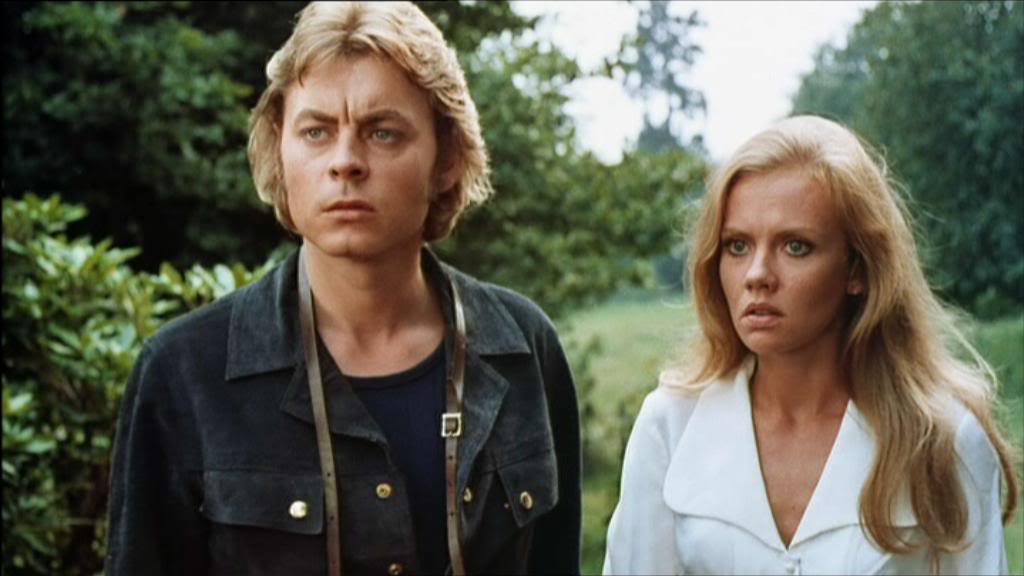
TEN LITTLE INDIANS (US - 1989) Directed by Alan Birkinshaw. Written by Jackson Hunsicker and Gerry O'Hara. Cast: Donald Pleasence, Brenda Vaccaro, Frank Stallone, Herbert Lom, Paul L. Smith, Moira Lister, Sarah Maur Thorp, Warren Berlinger, Yehuda Efroni, Neil McCarthy. (PG, 100 mins) Veteran producer Harry Alan Towers (1920-2009) already had two previous big-screen adaptations of Agatha Christie's 1939 novel And Then There Were None to his credit, with both 1965 and 1974 versions titled TEN LITTLE INDIANS, but only his 1989 version cites Christie's 1943 play Ten Little Indians as its basis. The difference is negligible, as the play had a more upbeat ending than the novel, but none of Towers' three versions stuck with the novel's bleak ending anyway. The 1989 version was the last and by far the least of Towers' takes on the material, with 1965 (directed by longtime David Lean assistant George Pollock) generally considered the best, though the 1974 (directed by Peter Collinson) has aged very well, and with its unique setting in a luxury Iranian hotel, its Bruno Nicolai score, and some surprisingly stylish murder sequences, it almost plays in retrospect like an Agatha Christie giallo. Despite Towers' obvious affinity for the material (he also scripted the 1965 and 1974 versions under his pseudonym "Peter Welbeck"), Rene Clair's 1945 version AND THEN THERE WERE NONE is still considered the definitive adaptation of this Christie work.
But this TEN LITTLE INDIANS, released by Cannon in November 1989 as they were transitioning into their life support years, is mostly lethargic and uninspired, blandly directed with little style or suspense by Alan Birkinshaw. A career D-lister who was usually brought in to clean up other people's messes, Birkinshaw replaced two fired directors on the 1984 killer Santa outing DON'T OPEN TILL CHRISTMAS, and he handled extensive uncredited reshoots on Cannon's 1985 Christie adaptation ORDEAL BY INNOCENCE when Desmond Davis (CLASH OF THE TITANS) was handed his walking papers after a disastrous Cannes screening. Birkinshaw's 1978 UK video nasty KILLER'S MOON has its admirers, but he never distinguished himself elsewhere. By 1989, he was finding steady employment with Towers, though TEN LITTLE INDIANS was the only one of their collaborations to make it into theaters: he also helmed two entries in the ill-advised Poesploitation craze of the era--THE HOUSE OF USHER and THE MASQUE OF THE RED DEATH--both shot in 1989 but released straight-to-video in 1991.
Like a lot of Cannon productions from this period, TEN LITTLE INDIANS '89 (like Birkinshaw's two Poesploitation movies, which were handled by Menahem Golan's post-Cannon outfit 21st Century) was shot in Towers' then-stomping grounds of apartheid-era South Africa, where production costs were low, and even though it was frowned upon by Hollywood, many actors who needed the work had to go where the work was, regardless of the ethical dilemmas inherent in such journeyman assignments (Michael Dudikoff expressed regret after shooting three Cannon films in South Africa, opting to sit out AMERICAN NINJA 3 and only returning for AMERICAN NINJA 4 after they agreed to move the production to Lesotho). Shooting in South Africa also allowed TEN LITTLE INDIANS '89 to take advantage of its location for a safari setting, and the cast of mostly familiar faces corralled by Towers is a veritable Who's Who of "Apartheid? Never heard of it!" The set-up is the same: a group of strangers have been invited to a remote location--this time an African safari in the 1930s--by a mystery host named "U.N. Owen." They have no known ties to one another, aside from all of them having a secret known only by Owen: they're all directly or indirectly culpable for at least one death, and Owen is making them pay, exposing the skeletons in their closet and offing them one by one. In no particular order, there's rugged safari guide Capt. Lombard (Frank Stallone); Judge Wargrave (Donald Pleasence); dementia-addled General Romensky (Herbert Lom, also in the 1974 version, but in a different role); boozy actress Marion Marshall (Brenda Vaccaro); former governess Vera Claythorne (Sarah Maur Thorp); Dr. Werner (Yehuda Efroni); dashing Anthony Marston (Neil McCarthy); private eye Blore (Warren Berlinger), who's been hired sight unseen by Owen to keep an eye on everyone; and Mr. and Mrs. Rodgers (Paul L. Smith, Moira Lister), who claim to have won a contest to be on the safari under the stipulation that they play a recording of Owen listing the crimes of those he's gathered.
TEN LITTLE INDIANS opening in Toledo, OH on 1/5/1990
Christie's novel is pretty much the gold standard in classic mysteries, one that's so good that it's difficult to screw it up, but TEN LITTLE INDIANS '89 is like lukewarm leftovers. The setting is unique in theory but doesn't make sense in execution, since they're at a small, cramped camp and it becomes increasingly difficult to believe that the killer can move about undetected in such a limited space. And of course, the more people are bumped off, the more the remaining survivors continue to split up instead of stick together. No one here is at their career pinnacle (well, except for maybe Maur Thorp, whose entire film career consisted of three Towers productions--this, EDGE OF SANITY, and RIVER OF DEATH--all released in 1989), but most of them seem to be acting with a sense of apathy rather than urgency. They're all suspects at one time or another and of the ensemble, Lom has a couple of Commissioner Dreyfus-esque harumphs and seems like the only one who brought his almost-A-game, but he's taken out fairly early. Vaccaro looks like a past Oscar-nominee who knows this is junk. Berlinger does a lot of Charles Durning/Brian Dennehy blustering but little else. Pleasence can always be relied upon to ham it up but he seems uncharacteristically bored and half-asleep (though the goofy grin on his face during a croquet scene is amusing). Smith does the same stink-eye squint that he perfected in MIDNIGHT EXPRESS, PIECES, and however many others, but it just seems stale here. And Stallone is just terrible. Just out on Blu-ray from Kino Lorber (because physical media is dead), TEN LITTLE INDIANS '89 has some beautiful exteriors when you get to see them, but this third time out for Towers just drags along and is of little interest to anyone but the most die-hard Cannon completists or Frank Stallone stalkers. Birkinshaw also worked with Pleasence on THE HOUSE OF USHER, and with Stallone, Vaccaro, and Lom on THE MASQUE OF THE RED DEATH, and I'm surprised neither of those have surfaced on Blu-ray yet.
ENDLESS NIGHT (UK - 1972) Written and directed by Sidney Gilliat. Cast: Hayley Mills, Hywel Bennett, Britt Ekland, George Sanders, Per Oscarsson, Patience Collier, Aubrey Richards, Peter Bowles, Lois Maxwell, Madge Ryan, David Bower, Helen Horton, Walter Gotell, David Healy, Leo Genn. (Unrated, 99 mins) Along with the many versions of her 1939 novel And Then There Were None, usually under the title TEN LITTLE INDIANS, the overwhelming majority of Agatha Christie film and TV adaptations have been her mysteries featuring either Hercule Poirot or Miss Marple. With WITNESS FOR THE PROSECUTION, Billy Wilder's 1957 version of her 1925 courtroom drama short story, being tops among the exceptions, the film versions of her literary departures have proven mostly unsuccessful, particularly 1985's ORDEAL BY INNOCENCE, possibly the worst big-screen take on her work. 1972's ENDLESS NIGHT has been held in low regard for nearly 50 years, and its response was so unfavorable in its native UK that it was never even released in American theaters. It's not exactly obscure--between TV airings and its availability on VHS in the '80s and on DVD in the early '00s, it hasn't been all that difficult to see--but it's rarely-discussed and it's been generally dismissed, if not outright forgotten. Based on Christie's 1967 novel, ENDLESS NIGHT definitely falls into the ORDEAL BY INNOCENCE category in that it's a more inward psychological drama rather than a standard mystery, and the film is much more Hitchcockian than Christie in style and execution. And the connection is there, as writer/director Sidney Gilliat (1908-1994), whose career as a screenwriter dated back to the advent of talkies, first found success scripting Alfred Hitchcock films like 1938's THE LADY VANISHES and 1939's JAMAICA INN. ENDLESS NIGHT is generally faithful to Christie's novel, but like ORDEAL BY INNOCENCE, its story structure doesn't lend itself to a visual medium. As a result, unlike ensemble pieces featuring Poirot, Marple, or a group of strangers summoned to an isolated house where they're picked off one by one, Endless Night is one of Christie's works that's better-served on the page.
That doesn't mean it isn't interesting. In fact, it's unusual in the way that it's virtually impossible for it to work on a first viewing. It almost requires a second watch just to make sense of the plot. Its finale throws out twists and turns with such wild abandon that even if the intent is some kind of ambiguity, it will only result in frustration unless you have an opportunity to go back and rewatch key scenes, including a stilted, confusing opening that only makes sense on a second run-through. This is probably a big reason for its chilly reception, plus Christie mysteries just weren't a big draw at the time, with a lull of interest between the mid-1960s and the success of 1974's Oscar-winning MURDER ON THE ORIENT EXPRESS, which kickstarted a Christie renaissance just before her death in 1976. I don't mean to imply that ENDLESS NIGHT is some kind of innovative, misunderstood trailblazer, because at the end of the day, it really doesn't work. But it deserves some credit for being a little ahead of its time with the kind of smack-you-upside-the-head twists and kick-in-the-balls reveals that you'd start seeing regularly in the '90s, especially after THE USUAL SUSPECTS.
Recently released on Blu-ray by Kino Lorber (because physical media is dead), ENDLESS NIGHT was also notable for reuniting the stars of Roy Boulting's acclaimed 1968 chiller TWISTED NERVE: grown-up Disney child star and POLLYANNA herself, Hayley Mills, and cherubic David Hemmings-alike Hywel Bennett. Bennett, then coming off of 1971's penis-transplant sex farce PERCY, is Michael Rogers, an aimless, irresponsible, and immature young man who drifts from job to job with no real drive or sense of responsibility. He's a self-described "idle dreamer" obsessed with a large swath of land in the countryside called Gipsy's Acre, where he has a pie-in-the-sky notion of building a beautiful dream house. He loses a limo driving job over his attitude and is able to leave his new part-time job at a gas station after a chance encounter with free-spirited Ellie Thomsen (Mills). He soon discovers that she's an orphaned heiress--"the sixth-richest heiress in the world," in fact--and they marry after a whirlwind courtship where she surprises him by purchasing Gipsy's Acre. The marriage is frowned upon by her relatives who live on an allowance she doles out, including her bitter stepmother (Lois Maxwell, the Bond series' Miss Moneypenny seen here in rare bitch-on-wheels form). Ellie's cynical, condescending attorney Lippincott (an enjoyably snide performance by George Sanders, in his next-to-last film; he committed suicide six months before its release) even offers Michael a huge payout to divorce her and walk away, subtly implying that this isn't Ellie's first impulsive marriage. Things get strange, combative, and uncomfortable with the arrival of Ellie's friend Greta (Britt Ekland, Bennett's PERCY co-star), who seems familiar to Santonix (Per Oscarsson), an acquaintance of Michael's from his days as a limo driver and also a highly-regarded, terminally ill architect who designs the high-tech, state-of-the-art mansion that Michael and Ellie build at Gipsy's Acre, with Michael quickly coming to the realization that things aren't what they seem to be.
George Sanders (1906-1972)
Nothing is what it seems to be, and that becomes--I hesitate to use the word "clear"--the longer ENDLESS NIGHT goes on. Gilliat was better known as a writer than a director, though he was no slouch in that department, having helmed the great 1946 British mystery GREEN FOR DANGER. One can see why found this story appealing, with all of its Hitchcockian elements, plus the subterfuge, the misdirection, threats, secrets, and blackmail, all set to a score by Bernard Herrmann, whose contributions to Hitchcock classics like VERTIGO, NORTH BY NORTHWEST, and PSYCHO were inestimable. There's also the possibility that Michael is an unreliable narrator whose general shiftlessness, fleeting flashbacks to a tragedy from his childhood, and the fact that his own mother (Madge Ryan) doesn't seem to like him very much, all work together to imply that he's got his own secrets and ulterior motives. But the resolution happens so fast that it's almost too much to take in without going back and looking at parts of the movie again. Only then do things appear to begin coming together, and even then it's a shaky foundation. ENDLESS NIGHT is a film that's easier to appreciate than actually enjoy. It's not really a thriller, and despite some classifying it as "horror," it doesn't really fall into that category either, aside from a couple of creepy moments where Michael imagines Ellie as a faceless figure. Christie's novel was a journey into the mind of its main character, and that isn't easy to pull off as an "Agatha Christie" movie. For her part, Christie saw the film and expressed displeasure with the end result, though her biggest complaints stemmed from the concessions made to the era, primarily some Ekland nudity (Bennett also drops an F-bomb at one point, which isn't something you can imagine hearing from Hercule Poirot or Miss Marple). ENDLESS NIGHT also marked the end of the road for Gilliat, who called it a career and never wrote or directed another film.
ORDEAL BY INNOCENCE (UK - 1985) Directed by Desmond Davis. Written by Alexander Stuart. Cast: Donald Sutherland, Faye Dunaway, Sarah Miles, Christopher Plummer, Ian McShane, Diana Quick, Michael Elphick, Annette Crosbie, George Innes, Valerie Whittington, Phoebe Nichols, Michael Maloney, Cassie Stuart, Billy McColl, Ron Pember. (PG-13, 90 mins)
The critical and commercial success of 1974's MURDER ON THE ORIENT EXPRESS kickstarted a big-screen Agatha Christie revival that lasted into the early 1980s, with Peter Ustinov as Hercule Poirot in 1978's DEATH ON THE NILE and 1982's EVIL UNDER THE SUN, as well as Angela Lansbury as Miss Marple in 1980's THE MIRROR CRACK'D. The small screen also proved to be a popular venue, with Ustinov continuing to portray Poirot and Helen Hayes taking a few turns as Miss Marple in a series of TV-movies. It was after Christie mysteries seemed relegated to television that Menahem Golan and Yoram Globus belatedly brought Cannon into the act with a trio of mid-to-late '80s Christie projects that received little theatrical exposure, starting with 1985's ORDEAL BY INNOCENCE, based on the legendary mystery writer's 1958 novel. Like most Christie adaptations, it was a star-studded affair, but the end result is a dreary, ponderous misfire that's arguably the worst movie version of her work. The novel was a bit of a departure for Christie at the time, focusing less on any mystery and more on psychological drama, but it simply doesn't translate well to the screen. Much of this was due to a troubled production that saw director Desmond Davis (CLASH OF THE TITANS) being relieved of his duties after a disastrous rough cut screening at Cannes in 1984. He was replaced by New Zealand-born British exploitation hack Alan Birkinshaw (KILLER'S MOON, INVADERS OF THE LOST GOLD), who shot about 25 minutes worth of new footage and oversaw extensive re-editing into its finished 90-minute state, though Davis remains the sole credited director (this wasn't the first time Birkinshaw stepped in for a fired director; he also took over for Edmund Purdom on 1984's killer Santa movie DON'T OPEN TILL CHRISTMAS, juicing it up with numerous splatter scenes and gratuitous T&A). Also jettisoned was a moody, atmospheric score by Pino Donaggio that Cannon and test audiences didn't like and would've had to be significantly reworked after Birkinshaw's new footage and subsequent restructuring. Donaggio had already moved on to another project and was no longer available to tweak the score to anyone's liking, prompting Golan and Globus, in search of a "name" composer, to make the ill-advised decision to sub in newly-recorded versions of existing pieces by Dave Brubeck and his quartet. Brubeck is one of the most important figures in the history of American music, but these compositions simply don't belong in this movie, with dark and somber scenes accompanied by bouncy jazz piano, noodling clarinet solos, and bombastic, pseudo-Buddy Rich drum histrionics that make the entire score sound like a temp track left in as a joke.
Just back in mid-1950s England after a two-year expedition to Antarctica, paleontologist Dr. Arthur Calgary (Donald Sutherland) finally gets around to delivering an address book left behind in his car by Jacko Argyle (Billy McColl), a stranger to whom he gave a lift en route to his departure by ship two years ago. They parted ways, but Calgary hung on to the address book, and when he delivers it to the Argyle mansion, he's informed by patriarch Leo (Christopher Plummer) that his son Jacko was hanged two years earlier for the murder of his mother, Leo's wife and Argyle matriarch Rachel (Faye Dunaway). Upon hearing the details of the murder and the time that it took place, Calgary is stunned to realize that Jacko had to be innocent, because he was in the passenger seat of his car when the murder occurred, making Calgary the perfect alibi, albeit two years too late. While Jacko apparently professed his innocence and insisted he was hitching a ride with a stranger at the time, the family sees fit to let sleeping dogs lie and not address the issue that there is a murderer among them. But the persistent Calgary becomes obsessed with exonerating Jacko, conducting his own investigation, much to the disapproval of the Argyles, who are only now beginning to recover from the scandal, and chief investigator Inspector Huish (Michael Elphick), who doesn't want his closed case reopened.
Most of ORDEAL BY INNOCENCE consists of an uncharacteristically bland Sutherland wandering from place to place to interview Argyle family members and ask each of them the same series of questions, which gives you a chance to see a parade of fine actors that are unfortunately not put to good use. Dunaway is wasted in a glorified cameo, seen only in black & white flashbacks, while 43-year-old Sarah Miles is improbably cast as the daughter of 55-year-old Plummer and 44-year-old Dunaway. Ian McShane has a couple of scenes as Miles' wheelchair-bound, Argyle-hating husband. There's also one weird bit where Jacko's widow (Cassie Stuart) attempts to seduce Calgary, with Stuart playing the entire scene topless, a move that has Birkinshaw's greasy fingerprints all over it. Screenwriter Alexander Stuart (who would fare much better by adapting his controversial 1989 novel The War Zone into Tim Roth's acclaimed 1999 directing debut) takes some liberties with the source novel, starting with Jacko being executed instead of dying in prison, but the finished film is so choppy, badly-paced, and obviously truncated (with scenes either cut or never filmed in the first place) that it never builds any sense of momentum, suspense, or urgency (not helped at all by Brubeck's completely inappropriate score), ending with a big reveal about the real killer and Sutherland's Calgary just shrugging and ambling away to the dock to take the boat back to the mainland, likely mirroring the reaction of the very few people who saw this when it was barely released in theaters in the spring of 1985. It's just out on Blu-ray from Kino Lorber (because physical media is dead), which would've been a good opportunity to have an alternate audio track that played parts of the film with Donaggio's discarded score just for the sake of comparison (it was eventually released on cd), but there's no bonus features other than a couple of trailers, as ORDEAL BY INNOCENCE is met with the same ambivalence today as it was in 1985, seemingly doomed to its destiny as a justly-forgotten footnote to the careers of everyone involved.
Cannon went on to make two more Christie adaptations with 1988's Michael Winner-helmed APPOINTMENT WITH DEATH (with Ustinov returning as Hercule Poirot, accompanied by legends like Lauren Bacall, Piper Laurie, and John Gielgud), and 1989's South Africa-shot Harry Alan Towers production TEN LITTLE INDIANS, directed by Birkinshaw and starring Frank Stallone, Donald Pleasence, and Herbert Lom. Ordeal by Innocence was retrofitted as a 2007 episode of the ITV/PBS series MARPLE (with Geraldine McEwan in the title role), and was recently turned into an acclaimed three-part miniseries by BBC One and aired on Amazon Prime in 2018 with Luke Treadaway as Calgary and Bill Nighy as Leo Argyll (changed to "Argyle" in the Cannon film). While it was much better-received than the 1985 version, the miniseries encountered some controversy when co-star Ed Westwick (as another Argyll son) was accused of sexual assault by multiple women, prompting BBC execs to pull an ALL THE MONEY IN THE WORLD and completely reshoot his scenes with replacement Christian Cooke.
MURDER ON THE ORIENT EXPRESS (US - 2017) Directed by Kenneth Branagh. Written by Michael Green. Cast: Kenneth Branagh, Penelope Cruz, Willem Dafoe, Judi Dench, Johnny Depp, Josh Gad, Derek Jacobi, Leslie Odom Jr, Michelle Pfeiffer, Daisy Ridley, Tom Bateman, Lucy Boynton, Olivia Colman, Manuel Garcia-Rulfo, Marwan Kenzari, Sergei Polunin, Gerald Horan, Phil Dunster, Miranda Raison, Hayat Kamille. (PG-13, 114 mins) The first big-screen Hercule Poirot mystery since Peter Ustinov starred in Cannon's little-seen APPOINTMENT WITH DEATH way back in 1988, MURDER ON THE ORIENT EXPRESS gives a mustache attached to the face of Kenneth Branagh the opportunity to play Agatha Christie's legendary detective. David Suchet enjoyed much success as Poirot in a series of PBS productions, including an ORIENT EXPRESS in 2010. The novel was also turned into a 2001 CBS TV-movie with Alfred Molina as a present-day Poirot. Suchet is often cited as the best Poirot, but the standard--at least as far as cinema is concerned--remains Albert Finney's Oscar-nominated turn as the fussy Belgian sleuth in Sidney Lumet's classic 1974 film version. While Christie adaptations were frequent (Margaret Rutherford played Miss Marple in several 1960s films, TEN LITTLE INDIANS was a big hit in 1965, and Tony Randall portrayed Poirot in 1966's THE ALPHABET MURDERS), it was the all-star MURDER ON THE ORIENT EXPRESS that got the ball rolling on a star-studded, big-screen Christie renaissance that lasted into the 1980s, including a 1974 remake of TEN LITTLE INDIANS, rushed into production by Harry Alan Towers to compete with Lumet's film; Ustinov starring as Poirot in 1978's DEATH ON THE NILE, 1982's EVIL UNDER THE SUN, the aforementioned latecomer APPOINTMENT WITH DEATH; and Angela Lansbury as Miss Marple in 1980's THE MIRROR CRACK'D, giving the actress an old-school test run before her long-running TV series MURDER, SHE WROTE.
All of this leads to the inevitable question: why does this 2017 remake of MURDER ON THE ORIENT EXPRESS exist? It brings nothing new to the table story-wise, with the mystery's solution being common knowledge to any older moviegoer who's seen the 1974 version and anyone who watched Suchet's run on PBS. Is it to give students something newer to stream when they want to skip the reading and have no idea who Albert Finney is and the quiz is tomorrow? Is that why Imagine Dragons' "Believer" was so prominently featured in the trailer? It's really just an excuse for director Kenneth Branagh to give star Kenneth Branagh some very wide latitude to ham it up. Boarding the Orient Express in Istanbul bound for Western Europe, Poirot makes the acquaintance of a diverse group of passengers: much-divorced, man-hunting Mrs. Hubbard (Michelle Pfeiffer); secret lovers Miss Debenham (Daisy Ridley) and Dr. Arbuthnot (Leslie Odom, Jr); missionary Pilar Estravados (Penelope Cruz); Princess Dragomiroff (Judi Dench) and her maid Hildegarde Schmidt (Olivia Colman); Count Andrenyi (Sergei Polunin) and his drug-addicted wife Countess Elena (Lucy Boynton); Nazi sympathizing Austrian professor Gerhard Hardman (Willem Dafoe); Marquez (Manuel Garcia-Rulfo), a car salesman; Ratchett (Johnny Depp), a sinister American "businessman" in the art forgery game; Hector MacQueen (Josh Gad), Ratchett's nervous, hard-drinking secretary; and Masterman (Derek Jacobi), Ratchett's long-suffering butler. Poirot turns down an offer to work as Ratchett's eyes and ears on the journey, as the corrupt entrepreneur has been receiving threatening letters and is aware that people are after him over his shady dealings. The second day of the journey, the train is stopped by an avalanche and left precariously stranded on a bridge in the mountains. But it gets worse when Ratchett's dead body is discovered in his compartment, with twelve random knife wounds over his torso and neck area.
Christie's novel and its adaptations thus far have arguably the most famous and well-known reveal of any whodunit. Branagh and screenwriter Michael Green (who's had a busy 2017 with LOGAN, ALIEN: COVENANT, and BLADE RUNNER 2049, plus his work on the Starz series AMERICAN GODS) don't change anything about the structure of the story or its final result, instead adding some ethnic diversity and some racial tension with Hardman not hesitating to air his true feelings about Arbuthnot, who fears that his being a black man instantly makes him a suspect (also the case for "Spaniard" Marquez). It's a lavishly-mounted production that allows Branagh to show off--perhaps too much--some directorial flair, with an overuse of overhead shots, Dutch angles, and beveled reflections. There's a CGI avalanche that looks like something out of an Asylum production, and one really badly-edited foot chase outside the derailed train. When we're shown the "how" part of the whodunit--one of the most memorable scenes in Lumet's 1974 version--Branagh bungles badly, staging the murder of Ratchett as a quick, shaky-cam, black & white cutaway that looks like something out of a cheap horror movie. And when he solves the mystery and confronts the passengers, the action is taken out of the tense, claustrophobic confines of the train car and moved to an improbably long table set up in a tunnel outside the train, with the suspects all seated Last Supper-style, out in the freezing cold with no visible breath. It's one thing to make a straight remake that gets a bunch of A-listers together to have a good time with a classic story, but the few changes that are offered are, if not worse, then at least dumber. Why do they have to go to the trouble of finding a long table and a bunch of chairs to sit outside? And if you're gonna do that, at least make it look cold.
Even with Pfeiffer, Depp, Dench, and Dafoe onboard, the whole point of something like this is the blinding shine of star power. In comparison to Lumet's film, Daisy Ridley is no Vanessa Redgrave, Leslie Odom Jr is no Sean Connery, Tom Bateman (as railroad official and Poirot pal Bouc, who assists in the investigation) is no Martin Balsam, and Josh Gad is no Anthony Perkins. In the end, ORIENT EXPRESS '17 is another in a long line of pointless remakes (2013's CARRIE, 2014's ROBOCOP, etc) that's not terrible but does nothing to justify its existence. It comes perilously close to being a Kenneth Branagh vanity project, with his Poirot making snide comments, laughing uproariously as he reads Dickens' A Tale of Two Cities, and often coming across like a Larry David version of the legendary detective, letting the mustache--presumably a spare MORTDECAI prop loaned to him by Depp or a tribute to Sam Elliott in THE BIG LEBOWSKI--do most of the acting for him. And of course, since everything has to be a franchise now, the film ends with Poirot being summoned to Egypt because, "there's been a death on the Nile!"