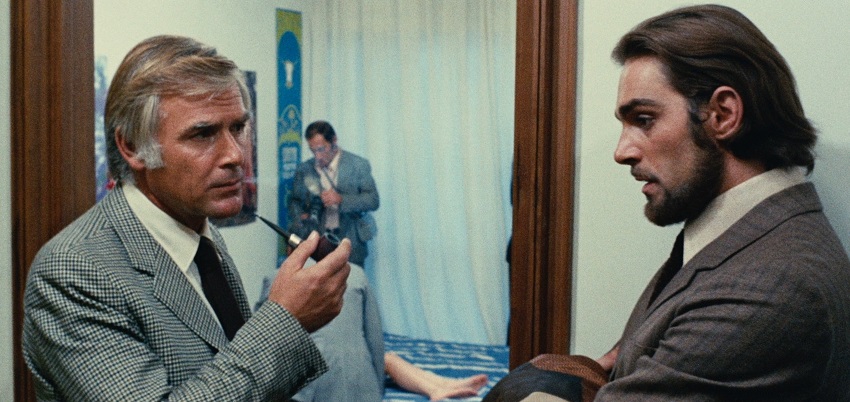
DORIAN GRAY aka THE SECRET OF DORIAN GRAY (Italy/West Germany - 1970) Directed by Massimo Dallamano. Written by Marcello Coscia and Massimo Dallamano. Cast: Helmut Berger, Richard Todd, Herbert Lom, Marie Liljedahl, Margaret Lee, Maria Rohm, Beryl Cunningham, Isa Miranda, Eleonora Rossi Drago, Renato Romano, Stewart Black, Giancarlo Badessi, Bobby Rhodes. (Unrated, 101 mins) Calling itself "a modern allegory based on the work of Oscar Wilde," DORIAN GRAY is an adaptation of Wilde's scandalous 1890 novel The Picture of Dorian Gray, updated to the mod, swinging London of its present day 1970. The shift to a then-contemporary setting seems gimmicky, especially with its protagonist becoming a cover-boy centerfold in a gay nudie mag and seen in some garish outfits that Austin Powers wouldn't be caught dead in, but more importantly, it helps allow the film to go to places forbidden in the era of the prestigious 1945 version from MGM. Produced by the well-traveled Harry Alan Towers, who never found a public domain source novel he didn't love, the film is explicit and exploitative, but it's also surprisingly faithful to both Wilde's novel and the 1945 film, and with its supporting cast comprised largely of Towers stock company regulars, it feels very much like a high-end, Towers-produced Jess Franco film of the era, such as VENUS IN FURS, COUNT DRACULA, or THE BLOODY JUDGE. But it's directed by Massimo Dallamano, a veteran cinematographer (A FISTFUL OF DOLLARS, FOR A FEW DOLLARS MORE) who would soon cement his place in Eurocult history with the 1972 giallo/krimi hybrid WHAT HAVE YOU DONE TO SOLANGE? Dallamano is a much more disciplined filmmaker than Franco, and while he doesn't shy away from numerous gratuitous sex scenes, they're handled with a certain degree of eroticism that avoids the inevitable erratically-focused crotch-zooms that Franco would've offered.
DORIAN GRAY was also a showcase for Helmut Berger in the title role, fresh off his star-making turn in Luchino Visconti's controversial, X-rated 1969 film THE DAMNED. Openly bisexual and known for his many conquests and indulgent playboy lifestyle, Berger was involved with the 35-years-older Visconti from 1964 until the director's death in 1976, and while he starred in several other Visconti films like 1973's LUDWIG and 1974's CONVERSATION PIECE, his influence was apparent and his presence felt even when he wasn't in one, such as 1971's DEATH IN VENICE, where Dirk Bogarde's aging composer grows obsessed with the "stunning beauty" of a 14-year-old boy. As he got older, Visconti's films exhibited a fixation on the beauty of youth and the inevitable decay brought by age. Like Visconti, DORIAN GRAY is obsessed with Berger, the camera lingering all over him, its infatuation with him rivaled only by the salivating attention paid to him by every character, female and male, throwing themselves at Dorian. Wilde's novel wasn't exactly subtle in its homoeroticism, and the subtext may have been there between the lines in 1945, but DORIAN GRAY, while not shying away from gratuitous female nudity, fully embraces the gay aspects of Wilde. Presumably, some of the more salacious material was toned down for AIP's US release, which was cut from 101 minutes to 93, but considering the time of its production, the homosexual element of DORIAN GRAY, even with more implied than actually shown, was unusual territory for Towers. The veteran producer obviously saw some of Berger's work with Visconti and, along with Dallamano, co-opted those recurring themes into a film that's still "exploitation" at the end of the day, but nevertheless a bit more classy than what Towers was making with Franco at the time.
Dorian starts out as just a good-looking, 21-year-old Londoner with a penchant for velvet scarves and tight jeans, introduced posing for a portrait painted by his artist friend Basil Hallward (Richard Todd), an older man clearly nursing an unspoken attraction.The finished work haunts Dorian, who says aloud that he'd sell his soul to maintain the perfect vision of beauty captured on the canvas. Dorian falls hard for virginal actress Sybil Vane (Marie Liljedahl, from Franco's EUGENIE: THE STORY OF HER JOURNEY INTO PERVERSION), but is inspired to explore his wild side after a chance meeting where Basil introduces him to wealthy art enthusiast, nobleman, and all-around perv Sir Henry Wotton (Herbert Lom) and his nymphomaniac sister Gwendolyn (Margaret Lee). The hedonistic siblings are both instantly infatuated with Dorian, persistent in persuading him to ditch Sybil, even openly mocking her limited acting abilities when Dorian drags them all to see her performance of Romeo and Juliet at a tiny, sparsely-attended theater. Sir Henry convinces Dorian to indulge in every whim and desire while he's young, before time turns him into "an old and hideous puppet" reflecting on his long-gone days of carefree youth. Dorian takes Sir Henry's advice and runs with it, bedding both Gwendolyn and elderly society matron Mrs. Ruxton (Isa Miranda) before a fight with Sybil ends their relationship. He plans on reconciling until Sir Henry almost joyously informs him that Sybil was so distraught over Dorian leaving her that she committed suicide. Sir Henry consoles his grieving young friend with these comforting words of sympathy like a devil on his shoulder: "Everything is yours. Take it. Enjoy it."
And boy, does he. And with every debauched, perverse transgression--diving into S&M with Gwendolyn and sleeping with wealthy Esther Clouston (Eleonora Rossi Drago) before encouraging them to explore one another; a leering seduction by Sir Henry, who joins Dorian in the shower and lathers him up after helpfully picking up the young man's dropped bar of soap; seducing the new bride (Towers' wife Maria Rohm) of his friend Alan (Renato Romano) and forcing her to fellate him; and cruising the marina for men and picking up a stranger (DEMONS' Bobby Rhodes!) in a public restroom--Basil's portrait of Dorian, hidden in Dorian's attic, ages and grows more grotesque, reflecting both the years and the moral corruption and self-absorbed decadence that he's adopted as a lifestyle. The years go by, and as Sir Henry, Basil, and everyone age, Dorian looks the same and hasn't changed. This ultimately leads to murder, blackmail, and revenge, as Sybil's brother James (Stewart Black) enters the picture, following Dorian on his nightly prowls of houses of ill repute in the red-light district (including a gay bar subtly named "The Black Cock," where Dorian's a regular known by the patrons as "Sir Galahad"), sworn to avenge his sister's suicide after she was cruelly dumped many years ago.
For a sleazy Harry Alan Towers production, DORIAN GRAY is well-made and surprisingly engrossing, though it does bungle the time element. If we're to assume 1970 as a starting or ending point, with the passing of 20 years being a key element, then the characters here were either wearing hip-hugging bell-bottoms in 1950 or were still wearing hilariously dated mod, shagadelic clothing in "the future" of 1990. There's also an interesting but under-explored layer added to the story with Liljedahl playing a different character later in the film, instantly reminding Dorian of the dead Sybil, a development that owes more to Italian horror than Oscar Wilde. Better handled is a framing device involving a bloody murder where the identity of the victim is initially unclear but gives the film somewhat of a giallo vibe, not surprising given Dallamano's interest in the subgenre. Its scenes of sexuality go far but are tastefully handled, though an insane montage of Dorian's conquests on a yacht excursion, accompanied by some Edda dell'Orso-esque "La-la-la-la-la..." Eurolounge vocals, is a gift that never stops giving. DORIAN GRAY played US grindhouses and drive-ins in the fall of 1970 and well into 1971, and was in regular rotation on late-night TV in a version that had to be cut to shreds. It was released on Blu-ray and DVD by Raro in 2011 but was quickly recalled due to some technical glitches and re-released even though the transfer left much to be desired. In late 2018, Raro quietly unveiled a brand-new Blu-ray edition of DORIAN GRAY (because physical media is dead) with a new and much-improved transfer, under its European title THE SECRET OF DORIAN GRAY, and it's unquestionably the best it's ever looked, helping make the case that this is a forgotten gem worthy of rediscovery.
DORIAN GRAY opening in Toledo, OH on 6/2/1971, on an unlikely
drive-in double bill with AIP's G-rated WUTHERING HEIGHTS.
WHAT HAVE THEY DONE TO YOUR DAUGHTERS? aka THE COED MURDERS (Italy - 1974; US release 1977) Directed by Massimo Dallamano. Written by Ettore Sanza and Massimo Dallamano. Cast: Giovanna Ralli, Claudio Cassinelli, Mario Adorf, Franco Fabrizi, Farley Granger, Marina Berti, Paolo Turco, Corrado Gaipa, Micaela Pignatelli, Ferdinando Murolo, Eleonora Morano, Sherry Buchanan, Roberta Paladini, Renata Moar, Adriana Falco, Lorenzo Piani, Giancarlo Badessi, Steffen Zacharias, Attilio Dottesio. (Unrated, 91 mins) The second film in a loosely-connected trilogy of "schoolgirl in peril" thrillers, WHAT HAVE THEY DONE TO YOUR DAUGHTERS? is a semi-sequel of sorts to 1972's giallo/krimi hybrid WHAT HAVE YOU DONE TO SOLANGE?, jettisoning the German "krimi" element to instead function as a giallo/poliziotteschi mash-up. Both films were directed and co-written by Massimo Dallamano, who earlier established himself as a top cinematographer for Sergio Leone on A FISTFUL OF DOLLARS and FOR A FEW DOLLARS MORE before becoming a filmmaker in his own right. Dallamano was set to direct the third film in the series, 1978's ENIGMA ROSSO, aka RED RINGS OF FEAR, but was killed in a car accident in late 1976 before finishing the script, which was completed by others with directing duties assigned to Alberto Negrin. All three films share the "schoolgirls in peril" motif, but where SOLANGE dealt with a string of brutal murders--where a group of teenage girls are stabbed in the vagina--committed in the wake of an unspeakable, heartbreaking tragedy, DAUGHTERS takes sociopolitical aim at the powers that be in the upper echelon of Italian society, with its darkly misanthropic tone abetted by one of Stelvio Cipriani's top scores, with a chipper-sounding, wordless vocal refrain that, given the subject matter, comes across as incongruously unsettling.
The film opens with the discovery of a nude 15-year-old girl found hanged in a small apartment that appears to be a secret love nest. Insp. Valentini (Mario Adorf) catches the case, but is soon replaced by the more bullish Silvestri (Claudio Cassinelli) and his partner Sgt. Giardana (Ferdinando Murolo), who team with deputy D.A. Vittoria Stori (Giovanna Ralli) in their investigation. For much of its first half, DAUGHTERS is more of a polizia-tinged procedural than a giallo, with Silvestri and Stori looking into the background of the dead girl, Silvia (Sherry Buchanan), who they soon discover was murdered at a different location, then taken to the apartment, with her body staged to look like a suicide. They also learn that Silvia was part of a secret teenage prostitution ring, much to the dismay of her wealthy parents, with her mother (Marina Berti) expressing outrage at finding her stash of birth control pills, and her father (Hollywood expat Farley Granger, in one of several gialli he made around this time) remorseful that he loved his daughter but never really tried to get close to her. Before long, the giallo end of the story kicks in as a meat cleaver-wielding hired killer decked out in leather and a black motorcycle helmet starts going after the other girls in the ring as well as any clients who pose a threat at exposing the powerful forces in charge of running it and profiting off the forced sexual servitude of underage girls.
From the beginning, Dallamano pulls no punches with WHAT HAVE THEY DONE TO YOUR DAUGHTERS? Valentini's reading of the coroner's report on Silvia's murder is graphic, mentioning the semen of multiple men found in her vagina, anus, and stomach, and later on, one scene where Silvestri and Stori listen in shock and disgust to secretly-recorded tapes of teenage girls being subjected to abhorrent sexual violence--including an impotent john who resorts to penetrating the girls with a bottle--is excruciating. With 1970s Italy in constant political upheaval and with crime rampant, there was also an epidemic of teenagers running away from home, disappearing, falling into drug abuse, etc. Secret prostitution rings were a recurring theme in Italian genre fare around this time, as seen in ENIGMA ROSSO as well as Sergio Martino's THE SUSPICIOUS DEATH OF A MINOR (1975), which also starred Cassinelli, Paolo Cavara's PLOT OF FEAR (1976), and Carlo Lizzani's bluntly-titled THE TEENAGE PROSTITUTION RACKET (1975), arguably the CHRISTIANE F of Red Brigade-era Italy. DAUGHTERS does an excellent job of balancing its dual polizia and giallo nature, with some dizzying camera work in a couple of chase scenes as well as a terrific suspense set piece with the killer pursuing Stori through a dark parking garage. There's also a few jarring moments of over-the-top splatter (one that prefigures a famous bit in Argento's TENEBRAE) along the way to its appropriately bleak, cynical, and pissed-off ending.
WHAT HAVE THEY DONE TO YOUR DAUGHTERS? wasn't released in the US until 1977, when short-lived exploitation outfit Peppercorn-Wormser sent it out on the grindhouse and drive-in circuit. It was re-released in 1980 as THE COED MURDERS, but never made it to video stores in VHS' 1980s glory days. It's been difficult to see in America outside of the bootleg circuit until Arrow's recent Blu-ray release with numerous extras, including a commentary by film historian Troy Howarth that takes time to give props to the unsung dubbing heroes revoicing the actors on the English version. Arrow's restoration really does the film justice in its 2.35:1 aspect ratio, of which former cinematographer Dallamano takes full advantage. It also benefits from a strong cast, though one wishes the great Adorf wasn't sidelined for much of the film, even though Cassinelli and Ralli make a fine LAW & ORDER: SVU team. Veteran actress Ralli was back in Italy after a brief attempt to break into Hollywood with James Coburn in the 1966 Blake Edwards farce WHAT DID YOU DO IN THE WAR, DADDY?, the 1967 Stephen Boyd/Yvette Mimieux heist comedy THE CAPER OF THE GOLDEN BULLS, and the 1970 George Peppard actioner CANNON FOR CORDOBA. She's given an especially substantive role, and her casting is practically progressive--perhaps even approaching woke--on the part of Dallamano, considering the unusual notion of a strong, independent female lead in a 1970s Italian polizia, a genre where women usually existed as victims, complaining girlfriends, or abused junkies. Ralli's Stori takes no shit from anyone, is respected by her male colleagues, lives alone, and she and Cassinelli's Silvestri never hook up. Fans of Aldo Lado's NIGHT TRAIN MURDERS will recognize Marina Berti and Franco Fabrizi in familiar roles, with Berti as the distraught mother of a victim and Fabrizi as a voyeuristic Peeping Tom. Also worth noting are some of the young actresses cast as the girls in the prostitution ring, with Mississippi-born Buchanan going on to a reasonably busy Eurotrash career over the next decade (TENTACLES, THE HEROIN BUSTERS, ESCAPE FROM GALAXY 3, DOCTOR BUTCHER M.D.), Micaela Pignatelli co-starring as James Franciscus' wife in Enzo G. Castellari's infamous JAWS ripoff GREAT WHITE, and Renata Moar, whose place in film history would be secured the next year as the girl forced to eat a handful of human excrement in Pier Paolo Pasolini's SALO, a moment preserved on the cover of the film's Criterion release.
RED RINGS OF FEAR aka ENIGMA ROSSO aka RINGS OF FEAR aka TRAUMA aka VIRGIN KILLER (Italy/West Germany/Spain - 1978) Directed by Alberto Negrin. Written by Marcello Coccia, Massimo Dallamano, Franco Ferrini, Stefano Ubezio, Alberto Negrin and Peter Berling. Cast: Fabio Testi, Christine Kaufmann, Ivan Desny, Jack Taylor, Fausta Avelli, Bruno Alessandro, Tony Isbert, Helga Line, Brigitte Wagner, Caroline Ohrner, Silvia Aguilar, Taida Urruzola, Maria Asquerino, Cecilia Roth. (Unrated, 84 mins)
The final installment of a loosely-connected "Schoolgirls in Peril" trilogy that began with 1972's WHAT HAVE YOU DONE TO SOLANGE? and 1974's WHAT HAVE THEY DONE TO YOUR DAUGHTERS?, the giallo RED RINGS OF FEAR was a troubled production even before filming began. Massimo Dallamano, a career journeyman (A BLACK VEIL FOR LISA, DORIAN GRAY, THE NIGHT CHILD) who established himself as a top cinematographer in the 1960s with Sergio Leone's A FISTFUL OF DOLLARS and FOR A FEW DOLLARS MORE, directed SOLANGE and DAUGHTERS and was set to helm the third installment, but was killed in a car accident in Rome in November 1976, not long after the release of his final film, the polizia COLT 38 SPECIAL SQUAD. He was still in the process of completing the RED RINGS script, which was then cycled through an additional five credited writers--including future Dario Argento collaborator Franco Ferrini--over the next year and a half before shooting finally began. In Dallamano's stead, directing duties were assigned to Alberto Negrin, who's spent his entire career in Italian television as a go-to guy for prestigious RAI Radiotelevisione Italiana TV-movies and miniseries that would occasionally make it onto American networks, such as the 1985 miniseries MUSSOLINI AND I with Susan Sarandon, Anthony Hopkins, and Bob Hoskins as Il Duce, and 1990's VOYAGE OF TERROR: THE ACHILLE LAURO AFFAIR with Burt Lancaster and Eva Marie Saint. RED RINGS OF FEAR remains Negrin's only theatrical feature to date in a career going back to 1971, and he took the opportunity to cut loose and run with it. Typical of the sleazy direction gialli would take in the latter half of the 1970s beginning with the likes of the subtly-titled STRIP NUDE FOR YOUR KILLER, RED RINGS OF FEAR doesn't go as far as the 1979 giallo/porno crossovers GIALLO A VENEZIA and PLAY MOTEL, but it doesn't avoid embracing the trashier side of things, with a twisty and perverse story involving murders, corruption, cover-ups, abortion, and Catholic schoolgirls forced to take part in a prostitution ring being run by one of their own teachers.
Fabio Testi starred in WHAT HAVE YOU DONE TO SOLANGE? as a lecherous teacher at a posh girls school who, as per giallo rules, becomes an amateur sleuth in an attempt to get to the bottom of a mystery in which he's briefly the main suspect. Here, dubbed by the velvet tones of Ted Rusoff, he plays the actual detective in charge of the case, Insp. Gianni Di Salvo, assigned to investigate the death of a teenage girl whose genitally-mutilated corpse was found wrapped in plastic and dumped in a river near a dam. The girl was a student a nearby Catholic girls school and, from a tip by the victim's little sister Emily (Fausta Avelli), learns that she was part of a clique known as "The Inseparables." He immediately suspects the other girls are hiding something, and since it's a giallo, he's right. The investigation leads to numerous red herrings, mostly involving the teaching staff who all act like they're hiding something, including an uptight headmistress and another who pointlessly sleeps with one black glove on his bedside table. The dead girl's diary also has recurring drawings of a designer jeans logo, which eventually leads to the involvement of uncooperative clothing store owner Parravicini (Jack Taylor with a perm). Anger management case Di Salvo begins losing his patience, especially after an attempt on his life as well as an escalating body count when a teacher (Tony Isbert) is killed in a mysterious hit-and-run accident and the remaining Inseparables become targets themselves.
Unlike SOLANGE and DAUGHTERS, RED RINGS OF FEAR was never released theatrically in the US, instead going straight to video in 1985 as TRAUMA (one of its many retitlings, another being the grindhouse-ready VIRGIN KILLER), in one of those Wizard Video big boxes that also erroneously included five-time Oscar-nominee Arthur Kennedy in the credits on the packaging (he was in his share of Eurotrash movies in the mid-to-late '70s, but this wasn't one of them). It's just out now on Blu-ray from Scorpion in a restored transfer, properly framed at 2.35:1, and looking better than it ever has after decades of barely watchable VHS prints that were ported over to numerous public domain DVD sets. From the time of Dallamano's tragic death, the film was plagued with problems, from script changes to, as Nathaniel Thompson points out on the Blu-ray's commentary track, co-star Jack Taylor even claiming the film was never completely finished. At the very least, things seem to be missing and possibly never shot, which may explain the unusually brief running time of just 84 minutes. Second-billed Christine Kaufmann, an Austrian actress and former Hollywood ingenue who was married to Tony Curtis for five years after co-starring with him in 1962's TARAS BULBA, is barely in the movie as Di Salvo's kleptomaniac friend-with-benefits. It's not really clear if they already know each other when he catches her stealing cat food at the supermarket early on (some of the dialogue even hints at the possibility that she's a prostitute) and nothing results from a later revelation after they have a fight and she's next seen sleeping with Di Salvo's boss, Chief Insp. Roccaglio (Ivan Desny, dubbed by Ed Mannix). She's never seen again after that--it's unknown whether she had scenes cut or never filmed and her appearances are sporadic and pointless enough that it's not out of the question to wonder if she simply quit the movie. For a prominently-billed actress of established repute in both Europe and Hollywood (she won the Golden Globe for Best Newcomer Female for 1961's TOWN WITHOUT PITY and went on to appear in several Rainer Werner Fassbinder films before and after RED RINGS OF FEAR), it's a strangely minor and insignificant role. Spanish cult actress Helga Line (HORROR EXPRESS) also has a brief bit part as the first victim's mother and future Pedro Almodovar regular Cecilia Roth (ALL ABOUT MY MOTHER) has a small early role as a Parravicini employee sleeping with her boss. In keeping with the choppy, seemingly rushed nature of the film's assembly, Riz Ortolani's main theme sounds like it belongs more to a 1970s cop show than a giallo murder mystery (Thompson points out that it was recycled in full from Ortolani's score for Dallmano's 1973 crime film SUPERBITCH).
But RED RINGS OF FEAR holds your attention: you've got Testi's rageaholic detective barging into a school meeting and bellowing "Somebody with a cock THIS BIG raped and killed her!"; you've got a bizarre sequence where, following the designer jeans lead, Di Salvo's partner (Bruno Alessandro) goes jeans shopping and struts around in skin-tight denim; you've got Di Salvo sarcastically calling the same partner "Starsky," something obviously ad-libbed by Rusoff in the dubbing studio; you've got one victim being stabbed in the neck with a flaming hot curling iron; bullying Di Salvo interrogating and threatening a scared-shitless Parravicini on a speeding rollercoaster; there's an ominous, unsettling vibe in the dimly-lit hallways of the school, filled with intimidatingly-placed religious iconography and a statue of a scowling, finger-pointing nun at the top of the main staircase, seemingly silently and pre-emptively judging everyone who walks in the building; an Argento-like sequence where an absurd amount of marbles are poured down a staircase being ascended by one of The Inseparables; a memorable performance by young Avelli, the other little red-haired girl in 1970s Italian horror movies who was called upon when the far creepier Nicoletta Elmi was busy (Avelli is probably best known to mainstream audiences as "Sweets," the little girl O.J. Simpson is killed trying to rescue in the 1977 plague-on-a-train disaster movie THE CASSANDRA CROSSING); and, in what has to be the film's most notorious bit, a cross-cutting juxtaposition of Inseparables member Virginia (Silvia Aguilar) going to a clinic for an abortion, intercut with flashback footage of the Inseparables at the orgy where the first victim was killed, bleeding out after her vagina was penetrated and torn apart by an oversized dildo. It has to rank as one of the tackiest sequences in any giallo up to that point, made even more retroactively surreal since one of the actresses playing The Inseparables is a dead ringer for Jennifer Lawrence. It had to be hard to fathom the giallo getting any more tasteless, but fear not, the 1979 double shot of GIALLO A VENEZIA and PLAY MOTEL saw ENIGMA ROSSO's abortion/orgy jawdropper, said "Hold our beers," and introduced hardcore porn into the genre, pretty much taking things as far as they could go and effectively ending the giallo at least until it was given a post-slasher film resurrection with a return to relatively traditional, classier fare in the 1980s. RED RINGS OF FEAR is a mess, but it's got its share of unusual, inventive, and audacious moments that make it hard to outright dismiss, especially with a quality Blu-ray presentation that helps it make a credible case for itself.
The back of the Wizard Video big box from 1985,
with Arthur Kennedy mistakenly credited.
WHAT HAVE YOU DONE TO SOLANGE? (Italy/West Germany - 1972) Directed by Massimo Dallamano. Written by Bruno Di Geronimo and Massimo Dallamano. Cast: Fabio Testi, Karin Baal, Joachim Fuchsberger, Christine Galbo, Camille Keaton, Gunther W. Stoll, Claudia Botenuth, Maria Monti, Pilar Castel, Giovanna Di Bernardo, Rainer Penkert, Marco Mariani, Antonio Casale, Giancarlo Badessi, Aristide Massaccesi. (Unrated, 107 mins)
After the international success of Dario Argento's THE BIRD WITH THE CRYSTAL PLUMAGE (1970), the Italian horror/mystery subgenre known as giallo was a legitimate phenomenon. Argento is generally credited with starting the craze, but the style can be seen in its early stages as far back as Mario Bava's THE EVIL EYE (1963) and BLOOD AND BLACK LACE (1964) and other giallo prototypes like Antonio Margheriti's THE YOUNG, THE EVIL AND THE SAVAGE (1968), Romolo Guerrieri's THE SWEET BODY OF DEBORAH (1968) and Massimo Dallamano's A BLACK VEIL FOR LISA (1968). Following the breakout success of BIRD, Argento quickly followed with THE CAT O'NINE TAILS (1971) and FOUR FLIES ON GREY VELVET (1972), and the giallo floodgates were opened. Strange, poetic, verbose titles that often incorporated colors, numbers, letters, animals, a woman's name, or questions were hallmarks of the giallo movement, and Argento's films paved the way for Luciano Ercoli's THE FORBIDDEN PHOTOS OF A LADY ABOVE SUSPICION (1970) and DEATH WALKS ON HIGH HEELS (1971), Paolo Cavara's THE BLACK BELLY OF THE TARANTULA (1971), Lucio Fulci's A LIZARD IN A WOMAN'S SKIN (1971) and DON'T TORTURE A DUCKLING (1972), Riccardo Freda's THE IGUANA WITH THE TONGUE OF FIRE (1971), Duccio Tessari's THE BLOODSTAINED BUTTERFLY (1971), Emilio P. Miraglia's THE RED QUEEN KILLS 7 TIMES (1972), Giuliano Carnimeo's THE CASE OF THE BLOODY IRIS (1972), aka WHAT ARE THOSE STRANGE DROPS OF BLOOD DOING ON JENNIFER'S BODY?, Aldo Lado's SHORT NIGHT OF GLASS DOLLS (1971) and WHO SAW HER DIE? (1972), Carlos Aured's Spanish-made BLUE EYES OF THE BROKEN DOLL (1974), and several from Sergio Martino: THE CASE OF THE SCORPION'S TAIL (1971), YOUR VICE IS A LOCKED ROOM AND ONLY I HAVE THE KEY (1972), and ALL THE COLORS OF THE DARK (1972), aka THEY'RE COMING TO GET YOU, among countless others.
The gialli were also inspired by the work of prolific British mystery novelist, playwright, short-story writer, and screenwriter Edgar Wallace (1875-1932), who died while in the early stages of scripting the 1933 classic KING KONG. Wallace's works had been adapted to the big screen as far back as 1915, but the late 1950s saw a massive resurgence in Wallace's popularity in West Germany roughly 25 years after his death. In 1959, the German production company Rialto Film acquired the rights to a good chunk of the Wallace catalog and produced dozens of films based on his writings throughout the 1960s. Known as krimi, most of these were directed by Harald Reinl or Alfred Vohrer and made their way to the US as part of syndication packages aired on late-night TV and afternoon Creature Features, and like their future gialli brethren, boasted memorable titles like THE FELLOWSHIP OF THE FROG (1959), THE DEVIL'S DAFFODIL (1961), SECRETS OF THE RED ORCHID (1962), THE CURSE OF THE HIDDEN VAULT (1964), THE COLLEGE GIRL MURDERS (1967), and CREATURE WITH THE BLUE HAND (1967). The Rialto Wallace programmers featured a stock company of West Germany-based actors like Klaus Kinski, Karin Dor, Joachim Fuchsberger, Harald Leipnitz, Eddi Arent, Heinz Drache, Werner Peters, and Aidy Berber, but would occasionally import an international star like Christopher Lee. The films were so popular in West Germany that Rialto's rival studio CCC Film bought the rights to several books by Wallace's son Bryan Edgar Wallace, which were turned into a competing series of "B. Edgar Wallace" adaptations like THE STRANGLER OF BLACKMOOR CASTLE (1962), THE PHANTOM OF SOHO (1964), and THE MONSTER OF LONDON CITY (1964).
In 1972, for their final Wallace-inspired production and more or less a passing of the torch to Italian thrillers, Rialto teamed up with Clodio Cinematografica and Italian International Film to produce the Italian/West German giallo/krimi hybrid WHAT HAVE YOU DONE TO SOLANGE?, a film that attempted to balance the sleaze and the graphic violence of the gialli with the old-school, Edgar Wallace-inspired mystery of the krimi. For the most part, it succeeded, though it certainly leans more toward the giallo side of things, with the primary influence of the krimi coming from the presence of genre vets Karen Baal and Joachim Fuchsberger. If there's a poster boy for all things krimi, it's Fuchsberger (1927-2014), a busy character actor who became a beloved celebrity (nicknamed "Blacky" by friends and fans) and TV talk and game show fixture in his homeland, even serving as the stadium announcer at the opening and closing ceremonies at the ill-fated 1972 Olympics in Munich. Fuchsberger made a career playing detectives and inspectors in seemingly every krimi ever made, and of course, he's the lead detective in SOLANGE, which centers on philandering Enrico Rossini (Fabio Testi), a married gym teacher at a British girls' school who's having an affair with one of his students, Elizabeth (Christine Galbo). While the two are carrying on in a rowboat by the riverside, Elizabeth catches a flash of a blade coming from a nearby wooded area and the next day, a body is found near their canoodling spot, the woman stabbed and the knife still sticking out of her vagina. Initially dismissing Elizabeth's claims that she saw a knife, a concerned Rossini goes to the murder scene to find it swarming with police, arrives late for work and lies about having car trouble to wife and fellow teacher Herta (Baal), which blows up in his face when he's visible among the onlookers in a newspaper photograph of the murder scene on the front page of the next day's paper. This brings him into the sights of Inspector Barth (Fuchsberger), who thinks he has his prime suspect, which puts more strain on Rossini's already-fracturing relationship with the cold and brittle Herta. Elizabeth is plagued by nightmares about the murder, and more victims are found, all girls at the school and stabbed in the vagina, and though Rossini is eventually cleared as a suspect, he follows the rules of the giallo by conducting his own investigation. This ultimately leads him to the mysterious Solange (Camille Keaton, later to cement her place in exploitation history in the infamous 1978 grindhouse rape/revenge cult classic I SPIT ON YOUR GRAVE), a traumatized, mentally-disturbed young woman with a dark tragedy in her past that has a direct correlation to the horrific serial killings that also claim the life of Elizabeth.
Directed by Italian journeyman Massimo Dallamano, of the aforementioned A BLACK VEIL FOR LISA and the cinematographer on Sergio Leone's A FISTFUL OF DOLLARS (1964) and FOR A FEW DOLLARS MORE (1965), SOLANGE is very much a giallo, right down to its sordid story, and the haunting score by Ennio Morricone, with dreamy, wordless vocals by the ubiquitous Edda Dell'Orso. It's one of the great "schoolgirls in peril" slasher thrillers, a tangent of the giallo movement that began with Margheriti's THE YOUNG, THE EVIL AND THE SAVAGE, aka NAKED YOU DIE, and popularized by the likes of Narciso Ibanez Serrador's THE HOUSE THAT SCREAMED (1969), Sergio Martino's masterpiece TORSO (1973), and even Bob Clark's Canadian-made classic BLACK CHRISTMAS (1974), and Juan Piquer Simon's insane chainsaw massacre epic PIECES (1983). Even the schoolgirls-in-peril films had their own supernatural spinoffs, like Dario Argento's SUSPIRIA (1977) and PHENOMENA (1985). SOLANGE adheres to many tropes of its giallo contemporaries beyond its disturbing violence and its dark, bleak twist. Elizabeth is a murder witness haunted by a barely-glimpsed clue that's just one piece of a complicated puzzle. Rossini's wife Herta is introduced in somewhat of a misogynistic fashion as a shrewish and vaguely androgynous tight-ass, not unlike Mimsy Farmer's similarly blonde, angry, and cheated-on wife in Argento's FOUR FLIES ON GREY VELVET, with Herta only letting her tightly-bunned hair down after it's revealed that Elizabeth was a virgin and Rossini's escapades stopped at going down on her, which apparently is enough to forgive him and go full-on "Stand by Your Man." Additionally, a potential murder suspect in the school's priest Father Webber (Marco Mariani) and the possibility of the killer posing as a priest are two plot strands very much in line with the giallo's inherent distrust of religious and church figures, also a key element of DON'T TORTURE A DUCKLING, WHO SAW HER DIE? and Antonio Bido's THE BLOODSTAINED SHADOW (1978), to name a few.
Photographed by Aristide Massaccesi, the Italian exploitation legend later known as "Joe D'Amato," WHAT HAVE YOU DONE TO SOLANGE? was released in the US by Newport in 1975 as the more lurid, drive-in-ready THE SCHOOL THAT COULDN'T SCREAM. SOLANGE was the first of a very loose trilogy of Dallamano schoolgirl outings that was followed in 1974 by the giallo/polizia hybrid WHAT HAVE THEY DONE TO YOUR DAUGHTERS?, with Claudio Cassinelli and Giovanna Ralli (released in the US in 1977 under its original title and later reissued as THE COED MURDERS), and in 1978 by ENIGMA ROSSO (released on US home video in 1985 as TRAUMA), starring Testi in a different role than he played in SOLANGE. Dallamano was set to direct ROSSO but only has a co-writing credit--it was ultimately helmed by Alberto Negrin after Dallamano's tragic death in a car accident in Rome in November 1976. WHAT HAVE YOU DONE TO SOLANGE?'s cult has endured over the years for a variety of reasons--giallo superfans, hardcore krimi buffs, and the devoted horror-con fan base of the iconic Keaton, who doesn't appear until very late in the film but makes a powerful impression, starting with her memorable introduction--and was just released in a Criterion-level special edition from Arrow Video, complete with a booklet of essays, various interviews (including Baal, who really hates this movie), and a commentary track with film critics Kim Newman and Alan Jones. Firmly planted in the giallo but exhibiting a noticeable outside krimi influence, WHAT HAVE YOU DONE TO SOLANGE? is a bit of a slow-burner but is stylishly made, more emotionally-driven than most of its type, and with the devastating reveal of its still-controversial subject matter, it remains one of the most downbeat and heartbreaking of the entire Italian giallo movement.
THE ANTICHRIST aka THE TEMPTER (Italy - 1974; US release 1978) Directed by Alberto De Martino. Written by Gianfranco Clerici, Vincenzo Mannino, and Alberto De Martino. Cast: Carla Gravina, Mel Ferrer, Arthur Kennedy, George Coulouris, Alida Valli, Umberto Orsini, Mario Scaccia, Anita Strindberg, Remo Girone, Ernesto Colli, Lea Lander. (Unrated, 112 mins; R-rated US theatrical cut, 96 mins) When THE EXORCIST opened in December 1973 and became a worldwide phenomenon well into the next year, it gave birth to a seemingly endless parade of imitations and blatant ripoffs, some from the US, but mostly from Europe, and Italy in particular. As they would later demonstrate with zombies, CONAN, and RAMBO ripoffs, the Italians latched on to the EXORCIST formula and beat it to death with films like 1974's BEYOND THE DOOR, 1974's THE TORMENTED (also released as THE SEXORCIST but best known under its 1978 ROCKY HORROR-inspired US release title THE EERIE MIDNIGHT HORROR SHOW), and the subgenre's absolute nadir, 1975's pathetic NAKED EXORCISM, aka THE RETURN OF THE EXORCIST (it was later shamelessly retitled THE EXORCIST III: CRIES AND SHADOWS for its UK video release), which showcased a possessed teenage boy howling "I've had it up to here with your mumbo-jumbo!" to an exorcist played by visibly embarrassed GODFATHER co-star Richard Conte, looking very frail in his final screen appearance (he was dead for two years when the film was released in the US in 1977 as THE POSSESSOR). Even the legendary Mario Bava's then-shelved 1973 pet project LISA AND THE DEVIL was infamously retooled with new footage featuring Robert Alda as an exorcist for its 1976 release as THE HOUSE OF EXORCISM. BEYOND THE DOOR was a surprise box office hit when it was released in the US in 1975, and even prompted an unsuccessful lawsuit from Warner Bros., though they did manage to get AIP's 1974 blaxorcist take ABBY (with BLACULA's great William Marshall as the exorcist) yanked from screens. The ripoffs weren't limited to Italy: Spain got into the game with the Paul Naschy-starring EXORCISM (1975) and BLIND DEAD mastermind Amando de Ossorio's DEMON WITCH CHILD (1975), released in the US in 1976 as THE POSSESSED. And Walter Boos took a break from SCHOOLGIRL REPORT installments to direct the West German MAGDALENA: POSSESSED BY THE DEVIL (1974), released in the US in 1976 as BEYOND THE DARKNESS and featuring THE EXORCIST's Rudolf Schundler (who played the servant Karl) as--go figure--the exorcist.
Where THE EXORCIST dealt with evil reaffirming the faith of troubled Father Damien Karras, THE ANTICHRIST is much more fervently Catholic in its presentation and its faith never in doubt, which makes its many transgressions all the more shocking. Wheelchair-bound Ippolita Oderisi (Carla Gravina) has been unable to walk since a childhood car accident that claimed the life of her mother. Around 30 years of age, Ippolita still lives in the family home with her father, Prince Massimo (Mel Ferrer), and seems well on her way to spinsterdom, telling her high-ranking Bishop uncle Ascanio (Arthur Kennedy) that no man has ever taken an interest in her and that a part of her would sell her soul to the devil just for the experience of intimacy. She's furiously possessive of her father and insanely jealous over his relationship with his secretary Gretel (Anita Strindberg). Offering to say a mass for her, Bishop Ascanio tells Ippolita that her jealousy is "absurd" and that she needs to realize that her widower father needs to move on with his life as well. He also hyperbolically expresses his concern to his brother Massimo that Ippolita may have fallen in with a sect of devil worshippers. Oh, it's way worse than that: thanks to some hypnosis sessions with parapsychologist Dr. Sinibaldi (Umberto Orsini), who believes her disability to be psychosomatic, horny Ippolita has been possessed by a spirit that has been lying dormant in her subconscious, an Inquisition-era Oderisi ancestor, also named Ippolita, who ran off with a Satanic cult the night before she was to be sent to a convent. She was branded a witch and burned, though she renounced Satan and pledged herself to God at the last moment. The demon that possessed the past Ippolita has taken over the present-day Ippolita, taking advantage of her secret feelings for her father (she writhes around on her bed, rubbing a photo of her father over her crotch) and her intense sexual frustration. Ippolita has an out-of-body experience where she goes through the same ritual as her ancestor, which involves a black mass/orgy where, among countless copulating Satanists, she eats the severed head of a toad, drinks toad's blood, and performs analingus on a goat before being sexually violated by the devil himself.
Things go from bad to worse as the demonic Ippolita now takes over as De Martino (HOLOCAUST 2000, THE PUMAMAN) and the screenwriters bring things more in line with the usual EXORCIST shenanigans: there's the requisite projectile green vomit, both in the face of family caregiver Irene (Alida Valli) and a handful that she force-feeds a bogus faith healer (Mario Scaccia). Ippolita goes an astonishingly profane tirade at dinner, seduces her playboy brother Filippo (Remo Girone), and tries to strangle her father. She taunts Ascanio, croaking "She's a big whore, your Ippolita...she'd lay you as well! She'd pluck gladly from under your tunic that innocent little nestling that never has flown," before exposing herself and bellowing "Dip your limp bird in holy water and bless me!" After all that, authorization is finally given for a formal exorcism, and, arriving out of the shadows Father Merrin-style is Austrian monk Father Mittner (George Coulouris), who has popped up on the fringes throughout, usually shaking a can for change, and is also seen in the Inquisition flashbacks and may be the reincarnation of the priest who saved the older Ippolita's soul.
THE ANTICHRIST is much more devout in its religious aspects than THE EXORCIST. There's much debate over theology vs. science, and though he considers Sinibaldi a fine doctor, Ascanio dismisses him as a "skeptic and a non-believer." Eventually, Prince Massimo relieves Sinibaldi of his duties, more or less admitting that only the power of Christ can compel Ippolita. The bluntly religious messages throughout are a bizarre mix with some of the blasphemous imagery and graphic sexuality, not to mention the unexplored plot point that Ippolita and Filippo clearly did some messing around together when they were teenagers (Ippolita: "Remember when we were children...how you made me feel special?"). The possessed Ippolita spills the beans to Massimo ("My brother and I fucked!") and Irene has witnessed it (she also deliberately doesn't tell Ippolita about Massimo and Gretel, so she's good at keeping secrets), but it's never again addressed, unless Massimo gives them a "devil made them do it" pass. And what about Ippolita's obvious designs on her father? Here lies the difference in the culture that produced THE EXORCIST and the one to which THE ANTICHRIST was born: the Oderisi family is one that's been waiting to have its ass handed to it by a scandalous past long buried. The past Ippolita has come to collect payment for generations of Oderisi hypocrisy and bourgeois decadence, not to mention weakness, represented by Ascanio' procrastination and cowardice in addressing his niece's ordeal. But it sort-of lets them all off the hook by the end--all sins forgiven--and emerging through the plethora of perversion on display throughout THE ANTICHRIST is a film that's perhaps too rooted in centuries-old reverence and tradition when it comes to its kid-gloves treatment of both the Catholic church and Italian nobility. Improbably enough, De Martino made a film that includes a scene of a goat having its ass eaten out, yet somehow still finds a way to pull its punches.
The production design in THE ANTICHRIST is spectacular and the ornate interiors (Bishop Ascanio's office is a sight to behold) beautifully shot by Aristide Massaccesi/Joe D'Amato. The score by Ennio Morricone and Bruno Nicolai is a piercing cacophony of screeching violins and organ music, augmented by eerie hisses, whispers, and deep gasps. It's a cut above the usual slapdash, exploitative EXORCIST ripoff, with a committed, vanity-free performance by Gravina, whose intensity comes through even though she's dubbed even prior to the possession scenes (SPEED RACER completists will be interested to know that the English dub was supervised by Peter Fernandez, who also voiced the possessed Ippolita; Ferrer, Kennedy, and Coulouris dub themselves) and would likely be taken a lot more seriously if the special effects weren't so terrible. The levitation scenes and the visual effects involving the moving furniture and Ippolita's disembodied hand strangling the faith healer are some of the most bush-league traveling mattes ever committed to celluloid. As an aside, I wonder if some of the more tawdry elements of THE ANTICHRIST were kept from the old pros in the cast (it's doubtful Ferrer and Kennedy ever envisioned reuniting on this after Fritz Lang's 1952 classic RANCHO NOTORIOUS). I can't imagine George Coulouris--the same year he co-starred in MURDER ON THE ORIENT EXPRESS--getting the script for this and thinking "OK, possession, levitation, green vomit, and uh, what? Rimjob on a goat? Well, I was in CITIZEN KANE...why not?"
THE NIGHT CHILD (Italy - 1975; US release 1976) Directed by Max Dallamano (Massimo Dallamano). Written by Max Dallamano (Massimo Dallamano) and Jan Hartman. Cast: Richard Johnson, Joanna Cassidy, Lila Kedrova, Evelyn Stuart (Ida Galli), Edmund Purdom, Nicole Elmi (Nicoletta Elmi), Richard Garrone, Dana Ghia, Tom Felleghy. (R, 89 mins)
WHAT HAVE YOU DONE TO SOLANGE? director Massimo Dallamano's THE NIGHT CHILD is often lumped in with the string of Italian EXORCIST knockoffs, but it's more like a DON'T LOOK NOW ripoff with subtle EXORCIST elements. That didn't stop Edward L. Montoro and Film Ventures International from selling it as such for its 1976 US release, where they really played up the success of BEYOND THE DOOR ("Beyond the door of madness..."), emphasizing the presence of that film's star Richard Johnson and even using very similar font in the one-sheet design. In fact, THE NIGHT CHILD is rather low-key and surprisingly restrained as far as these things go--it's almost more of an art film than an outright horror film--and with no child turning monstrous and no levitation or any of the standard possession histrionics on display, it had to thoroughly bore grindhouse audiences expecting another barf-happy, "Let Jesus fuck you!" EXORCIST clone. Widower BBC documentary filmmaker Michael Williams (Richard Johnson) gets into all sorts of devilish trouble when he decides to take his daughter Emily (FLESH FOR FRANKENSTEIN and DEEP RED's Nicoletta Elmi, the marvelously expressive, red-haired child actress who had the Creepy Kid market cornered in '70s Italian horror) and her nanny Jill (Ida Galli) to Italy with him for his latest project, a documentary entitled "Diabolical Art." His focus is a mysterious painting depicting a young girl who died 200 years earlier, and it has a profound effect on Emily, who also wears an allegedly cursed medallion that once belonged to her late mother. A local psychic (ZORBA THE GREEK Oscar-winner Lila Kedrova), senses that Emily is the reincarnation of Emilia, the girl's whose death is depicted in the painting, and that Michael's wife was killed by a hateful supernatural force with a connection to the medallion.
Also complicating matters is Michael's romance with his production manager Joanna, played by Joanna Cassidy, pulling some surprise Eurotrash duty, taking this gig after she was fired from THE STEPFORD WIVES and replaced by Paula Prentiss. Like Ippolita's fixation on Massimo, Emily is overly possessive of her father, in ways that a doctor (Edmund Purdom, with about a minute and a half of screen time) says "has all the elements of a neurosis." Like Ippolita's rage at Gretel, Emily wants nothing to do with Joanna, but THE NIGHT CHILD adds some unrequited love with the unspoken feelings Jill has for Michael. While Johnson's O-face as Cassidy disappears out of frame to go down on him is arguably as disturbing as anything in THE ANTICHRIST, you can see some similar themes developing between it and THE NIGHT CHILD: widower father, jealous daughter, reawakening of a vengeful spirit from centuries past, and useless doctors unable to do anything helpful. Both films take place in lush palazzos (though THE NIGHT CHILD makes greater use of some natural lighting in Franco Delli Colli's cinematography), both films feature characters dying in falls against amateurishly-integrated rearscreen matte work, and both films climax with the possessed females being chased out of their residence and through the streets by their desperate fathers. It's interesting that THE ANTICHRIST ends on an uplifting note thanks to divine intervention, the acceptance of God, and letting the pillars of society off the hook while things take a more agnostic turn in THE NIGHT CHILD, which doesn't feature an exorcism or even a priest, and its conclusion is downbeat, depressing, and godless. You can fuck your brother, try to kill your father, regurgitate some devil-cum, and enthusiastically toss a goat's salad in THE ANTICHRIST, but all is forgiven if you just believe and accept. There is no such salvation for the doomed protagonists of THE NIGHT CHILD.