STREET PEOPLE (Italy - 1976) Directed by Maurizio Lucidi. Written by Ernest Tidyman, Randal Kleiser, Gianfranco Bucceri, Roberto Leoni, Nicola Badalucco and Maurizio Lucidi. Cast: Roger Moore, Stacy Keach, Ivo Garrani, Ettore Manni, Fausto Tozzi, Ennio Balbo, Loretta Persichetti, Pietro Martellanza, Luigi Casellato, Romano Puppo, Rosemarie Lindt, Aldo Rendine, Emilio Vale, Salvatore Torrisi, Franco Fantasia, Giuseppe Castellano, Salvatore Billa. (R, 92 mins) One of four films Roger Moore made in quick succession between his second and third 007 outings (1974's THE MAN WITH THE GOLDEN GUN and 1977's THE SPY WHO LOVED ME), the 1976 Italian-made mob thriller STREET PEOPLE was always an oddity in his filmography, and that's even counting his appearance in the 2003 Cuba Gooding Jr/Horatio Sanz atrocity BOAT TRIP. Moore never held himself in any particularly serious regard as an actor, and with the mountains of cash he was making once he got the James Bond gig, his other jobs seemed to be decided by how nice of a working vacation they'd provide. Much of STREET PEOPLE was shot in San Francisco--which offered plenty of sights to see in his downtime--with interiors done in De Paolis Studios in Rome. Moore is quite improbably cast as Ulysses, the half-Sicilian/half-British consigliere to his uncle, San Francisco mob underboss Salvatore Francesco (Ivo Garrani), who helpfully gets the viewer up to speed on Ulysses sounding like Roger Moore by mentioning, apropos of nothing, "The smartest thing I ever did was get you out of Sicily and into that English law school!"
It's Ulysses' job to make Uncle Salvatore's business ventures look legal and that gets difficult when Salvatore arranges the importing of a large Sicilian cross from a church in the small town where he grew up in the old country. It arrives at a pier in the warehouse district, accompanied by Father Frank (Ettore Manni), a childhood friend of Salvatore's. But it turns out the inside of the cross, unbeknownst to Father Frank, has been packed with a massive heroin shipment that's hijacked by three ambitious gangsters--Nicoletta (Fausto Tozzi), Pano (Pietro Martellanza, aka "Peter Martell"), and Fortunato (Romano Puppo)--looking to make a huge score. Salvatore claims to know nothing about the drugs and pleads his case to boss of bosses Don Giuseppe Continenza (Ennio Balbo), who orders all the drugs off the streets in order to find the culprits. Don Giuseppe's edict still doesn't out them, which means it must be an inside job with someone in the organization, prompting Ulysses to recruit his racing driver pal Charlie (Stacy Keach) to track down the three gangsters and find the mastermind behind the shipment.
The mystery doesn't prove to be a difficult one to solve, especially once an enraged Father Frank starts reminding Ulysses about a long-suppressed traumatic memory from his childhood. The plot gets far too convoluted for its own good, and it doesn't sufficiently explore the frayed relationship between Salvatore and Father Frank or any parallels you might expect in the friendship between Ulysses and Charlie. It's possible these themes were touched upon in the 101-minute European version titled THE SICILIAN CROSS, but the film was chopped down to 92 minutes and rechristened STREET PEOPLE by American International when it played drive-ins and grindhouses in the fall of 1976. Director Maurizio Lucidi (STATELINE MOTEL) was one of six credited screenwriters, and it wouldn't be at all surprising if none of them bothered to check anyone else's work. Other hands in the screenplay include diverse figures like future SANTA SANGRE co-writer Roberto Leoni; a 30-year-old Randal Kleiser, the same year he directed the John Travolta TV-movie THE BOY IN THE PLASTIC BUBBLE and soon on his way to big-screen fame with 1978's GREASE and 1980's THE BLUE LAGOON; and Oscar-winning FRENCH CONNECTION screenwriter Ernest Tidyman, no stranger to '70s crime thrillers having also written 1971's SHAFT (based on his own novel) and 1975's underrated REPORT TO THE COMMISSIONER.
Just out on Blu-ray in its US cut from Kino Lorber with a new Stacy Keach interview (because physical media is dead), STREET PEOPLE isn't quite on the level of those gritty Tidyman-penned gems. But it does get a lot from some genuinely likable Terence Hill/Bud Spencer-style camaraderie between Moore and Keach, the latter having an especially good time as a devil-may-care hellraiser prone to oddball quips ("I'll have to tell everyone on the street that you're a turkey deluxe!" he says to a potential snitch who doesn't want to play ball), ambitious but foolhardy schemes (switching out the heroin with powdered milk), and some proto-SMOKEY AND THE BANDIT levels of wanton destruction. In addition to a vaguely FRENCH CONNECTION-inspired car chase, there's a long sequence where Charlie takes a car being sold by a cash-strapped Nicoletta for a test drive and speeds up and down the streets crashing into anything in sight and demolishing the car to the point where it's a barely-recognizable hunk of metal. It's unquestionably the film's highlight and also does a nice job of showing off Keach's rarely-utilized comedic skills. As enjoyable as STREET PEOPLE's goofy side can be, it's also indicative of its struggle to find its own identity, as the film can't decide if it wants to be a gangster buddy comedy, a violent pseudo-polizia mob thriller, or something more serious in terms of Ulysses confronting a horrible childhood memory, which is really sold by composer Luis Bacalov going for his best mournfully elegiac Ennio Morricone-style cues. Lucidi (1932-2005) had a generally undistinguished journeyman career, dabbling in peplum (1965's HERCULES THE AVENGER), spaghetti westerns (1967's HALLELUJAH FOR DJANGO, 1972's IT CAN BE DONE, AMIGO), macaroni combat war actioners (1969's PROBABILITY ZERO), gialli (1971's THE DESIGNATED VICTIM), and he even used the alias "Mark Lander" when he made a one-off, late-career sojourn into hardcore porn in the late '90s with A GYNECOLOGIST AND HIS VICES. He was also one of several uncredited directors who didn't want to deal with the always-unstable Klaus Kinski on 1988's notoriously troubled NOSFERATU IN VENICE. Lucidi isn't exactly an Umberto Lenzi or a Fernando Di Leo, and STREET PEOPLE isn't about to make anyone's list of top 1970s Eurocrime outings, but it's got some great San Francisco location work throughout (check out Keach driving through the city's seedy red-light district, and Moore and Keach chasing Tozzi across some downtown rooftops), and it's better than its reputation, even if Roger Moore was rarely more miscast.
KILLER CROCODILE (Italy - 1989) Directed by Larry Ludman (Fabrizio De Angelis). Written by David Parker Jr. (Dardano Sacchetti) and Larry Ludman (Fabrizio De Angelis). Cast: Anthony Crenna, Ann Douglas, Thomas Moore (Ennio Girolami), Van Johnson, Wohrman Williams (Bill Wohrman), Sherrie Rose, Julian Hampton (Pietro Genuardi), John Harper, Gray Jordan, Marte Amilcar. (Unrated, 92 mins) A very late-to-the-party "Nature Run Amok" Italian JAWS ripoff shot in the Dominican Republic, 1989's KILLER CROCODILE was never too hard to find even back in the VHS bootleg heyday prior to the circa-2000 Eurocult explosion on DVD. But for whatever reason, it's never been officially released in the US until now, courtesy of Severin's new Blu-ray (because physical media is dead). Directed and co-written by veteran producer (THE BEYOND, THE HOUSE BY THE CEMETERY, 1990: THE BRONX WARRIORS)-turned-exploitation knockoff specialist (the Rambo-inspired THUNDER WARRIOR trilogy, the Namsploitation OPERATION: NAM, aka COBRA MISSION) Fabrizio De Angelis under his trusty "Larry Ludman" pseudonym, KILLER CROCODILE doesn't waste any time, showing the titular beast front and center about 40 seconds into the film. Taking a page from 1980's ALLIGATOR, the croc here is an oversized mutant thanks to chemical contamination, in this case radioactive waste in barrels clandestinely dumped in a river surrounding an impoverished Caribbean island. A team of environmental activists led by Kevin (Anthony Crenna, son of the late, great Character Actor Hall-of-Famer Richard Crenna) are journeying along the river to find and expose the illegal waste disposal that's been orchestrated by corporate hatchet man Foley (Florida-based regional actor Bill Wohrman--credited as "Wohrman Williams"--who had a small role as a cop in PORKY'S and PORKY'S II: THE NEXT DAY), who keeps getting away with it because he's got a flunky with the corrupt local judge (Van Johnson--a long way from THE CAINE MUTINY--as Murray Hamilton) who represents the law on the island.
When one of the activists disappears, the judge blows off the concerns of her friends, and when her mutilated body is later found with clear evidence of crocodile chomping, the judge and Foley go full "Fake News" and accuse Kevin and the others of killing her. That lasts about a minute and a half until the massive croc destroys a dock and kills a few locals in the process. With the judge nervous about his corruption being made public and Foley threatening to "reveal who you really are," in a pointless attempt at throwing in a red herring (unless he's the croc wearing a Van Johnson disguise), Kevin and the activists team with wily local crocodile expert Joe (Ennio Girolami as Robert Shaw) to hunt down the beast and expose Foley's nefarious actions. De Angelis throws in a good amount of gore and dismemberment in the croc attacks, and there's no shortage of nonsensical bits that connoisseurs of Italian ripoffs know and love, such as the repeated mention of a big reveal about the judge not being much at all (he's a fugitive ex-con...big deal); dubious dubbing; Riz Ortolani's score being little more than barely tweaked John Williams/JAWS cues; members of Kevin's group swimming around in contaminated water and deciding to make camp right by a shore lined with visible barrels stamped "Radioactive," ample proof that Foley and the judge are doing a pretty shitty job of keeping their activities buried, and a riotous outboard-motor-in-the-mouth demise for the croc at the hands of a crazed Kevin.
The most ridiculous character is Joe the Crocodile Whisperer, with his good luck hat that he tosses to Kevin for inspiration in an incredible scene that begins with Joe riding the Giannetto De Rossi-designed croc like the redressed immobile surfboard that it likely is, and earlier sensing the croc is near and talking to it from the boat, calling it a "pollywog" and advising Kevin that "They get really crazy when you insult them." It's not quite the USS Indianapolis monologue, but you get what you pay for, and it's good enough for KILLER CROCODILE. It's not quite Henry Fonda in TENTACLES or Richard Harris in STRIKE COMMANDO 2, but it's still strange seeing a beloved figure from Hollywood's Golden Age like Johnson doing some late-career slumming here, but work's work, and he was appearing in quite of few of these Italian exploitation obscurities during this period, including Stelvio Massi's never-completed slasher film TAXI KILLER, Ettore Pasculli's post-apocalyptic sci-fi FLIGHT FROM PARADISE, and Pierluigi Ciriaci's DELTA FORCE COMMANDO 2. KILLER CROCODILE never even made it to US video stores and didn't even make much of an impression in Italy, but that didn't stop De Angelis from releasing the immediate sequel KILLER CROCODILE 2 the next year, shot back-to-back with its predecessor.
KILLER CROCODILE 2 (Italy - 1990) Directed by Giannetto De Rossi. Written by David Parker Jr. (Dardano Sacchetti), Larry Ludman (Fabrizio De Angelis) and Giannetto De Rossi. Cast: Anthony Crenna, Debra Karr, Thomas Moore (Ennio Girolami), Terry Baer, Hector Alvarez, Alan Bult, Paul Summers, Tony De Noia, Peter Schreiber, Franco Fantasia. (Unrated, 87 mins) Now available as part of a limited-edition two-disc Blu-ray set with KILLER CROCODILE, the even lesser-seen 1990 sequel KILLER CROCODILE 2 was cranked out so cheaply and so quickly that it doesn't even bother roping in a past-his-prime, "and with"-worthy name actor to pull Van Johnson special appearance duty. Fabrizio De Angelis farmed out directing chores to veteran Italian makeup effects designer Giannetto De Rossi, best known to genre fans for his trailblazing splatter work on Lucio Fulci gorefests like ZOMBIE and THE BEYOND. De Rossi designed the croc in KILLER CROCODILE, and constructs a bigger and even more ridiculous one here. An offspring of the first film's title monster, Killer Crocodile Jr. proves to be a huge disruption to the development of a tourist resort that's certain to boost the economy of the impoverished area, which somehow hasn't become a huge cancer cluster with all the barrels of radioactive waste being dumped in the area. The potential contamination is why NYC reporter Liza Post (Debra Karr) is sent to investigate only to spend much of her time fighting off leering locals in addition to the rampaging croc. It's first seen devouring a vacationing couple, then attacking two boats filled with schoolkids and their nun chaperones, followed by an insane scene where it plows into a hut in what looks like the world's worst Kool-Aid Man impression. Once Liza confirms the existence of radioactive waste, her boss calls in ace environmentalist Kevin (a returning Anthony Crenna, now dubbed by Ted Rusoff), who seeks out his old buddy Joe the Crocodile Whisperer (Ennio Girolami, dubbed by Robert Spafford), left hobbled and even more crazy after his fateful encounter with the first toxic monstrosity, resulting in him behaving less like JAWS' Quint and more like an Obi-Wan Kenobi-like Jedi master ("I feel something," he says, looking out at still water).
Starting with using the same Riz Ortolani score, KILLER CROCODILE 2 has all the tell-tale signs of a quickie sequel. While the crocodile set pieces are more over-the-top in terms of execution and splatter--with a climactic battle between Kevin and the croc that features an Anthony Crenna action figure attached to a toy croc in some shots that not even Antonio Margheriti would deem acceptable--the rest is padded with stock footage from the first film (including recycling the same initial appearance of the crocodile, which is just flipped) and absurdly longer-than-necessary establishing shots of buildings, people walking into offices, Crenna and Girolami on the boat, pans across the river, etc. It has to resort to these tactics just to make it to 87 minutes, yet somehow, top-billed Crenna doesn't even appear until around 40 minutes in. The actor is on hand for an interview in the KILLER CROCODILE extras (he now goes by "Richard Anthony Crenna") and explains that he went to Rome in the late '80s when his dad was working on a movie (most likely LEVIATHAN) and decided to test the waters of the Italian film industry since he wasn't catching any breaks in Hollywood. He quickly nabbed the KILLER CROCODILE gig, probably on the basis of his known surname, and recalls it being a fun shoot in Santo Domingo even though there were language barriers, the production got caught in a hurricane, and he contracted dysentery at one point. He returned for the sequel, which again took him to Santo Domingo, but when De Angelis offered him the lead in De Rossi's TERMINATOR ripoff CY WARRIOR immediately following the back-to-back KILLER CROCODILEs (and again scheduled to shoot in Santo Domingo), he turned it down because he was ready to return home, with the part eventually going to Frank Zagarino. Crenna's only notable acting job came with a recurring role on ROSWELL a decade later, as things ultimately didn't pan out for him like they did for his father. As with John Wayne's youngest son Ethan Wayne in 1985's THE MANHUNT and 1987's OPERATION: NAM, De Angelis did his best to make Anthony Crenna happen, but the young actor probably would've found more success in the Italian B-movie industry if he made the move a few years earlier. By 1989-90, the entire Italian genre scene was on life support aside from whatever Dario Argento or Michele Soavi were doing, as evidenced by neither KILLER CROCODILE film finding any US home video distribution.
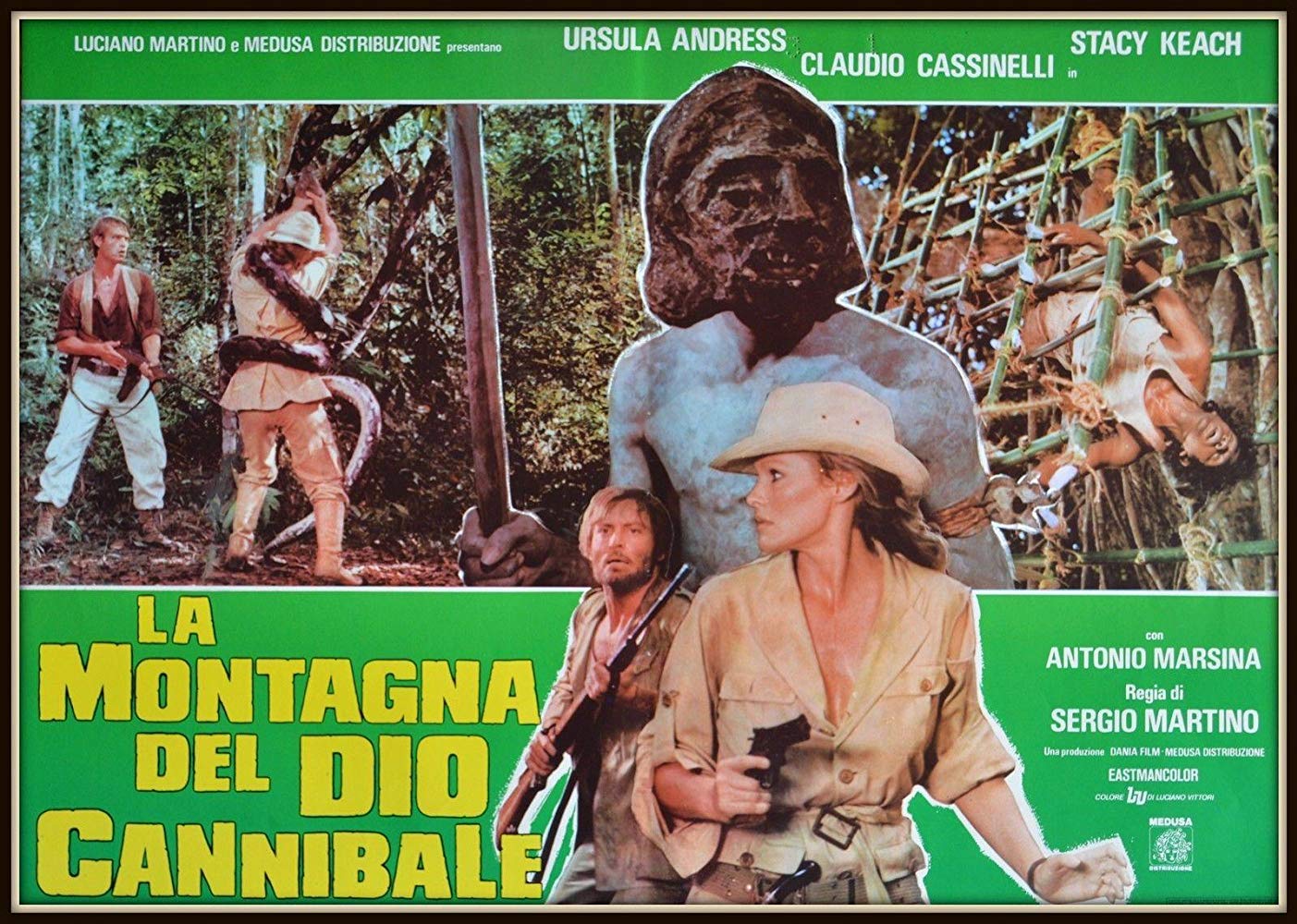
SLAVE OF THE CANNIBAL GOD aka MOUNTAIN OF THE CANNIBAL GOD (Italy - 1978; US release 1979) Directed by Sergio Martino. Written by Cesare Frugoni and Sergio Martino. Cast: Ursula Andress, Stacy Keach, Claudio Cassinelli, Antonio Marsina, Franco Fantasia, Lanfranco Spinola, Carlo Longhi, Luigina Rocchi, Akushla Sellajaah, T.M. Munna, M. Suki, Dudley Wanaguru, Gianfranco Coduti. (R, 85 mins/Unrated, 103 mins) Not as consistently disgusting as some of its more notorious contemporaries in the Italian cannibal craze, Sergio Martino's 1978 contribution MOUNTAIN OF THE CANNIBAL GOD is almost a mondo take on a traditional jungle adventure for most of its duration. That's especially the case in its significantly truncated US version, retitled SLAVE OF THE CANNIBAL GOD and released on the drive-in circuit by a relatively fledgling, pre-Freddy Krueger New Line Cinema in the spring and summer of 1979. Both versions--Martino's full-strength 103-minute director's cut and New Line's 85-minute US re-edit--are on Code Red's just-released SLAVE OF THE CANNIBAL GOD Blu-ray (because physical media is dead), and they offer a study in contrasts where each has its own unique strengths, the US cut in part because New Line saw fit to trim some of the fat. Indeed, the R-rated, 85-minute cut is better-paced and eliminates a talky early scene at the British consulate that ultimately makes no sense in the longer version. And while it retains a surprising amount of onscreen animal killing--always the major deterrent when it comes to one's ability to enjoy this type of tawdry exploitation fare--it suffers from almost complete lack of any graphic gut-munching, usually leaving the aftermath or reaction shots of other actors. In Martino's version, one major character is disemboweled and devoured, with a lingering shot of what feels like a mile of intestinal tract being yanked out of his gut, while in the US cut, it's reduced to one distant shot of the tribe chieftain holding up the victim's heart. Likewise, a graphic castration shown in Martino's version is merely implied in the US cut. The biggest difference in the uncut version is the inclusion of a CALIGULA-esque cannibal orgy, with some up-close and borderline pornographic footage of a young tribal woman masturbating along with some simulated bestiality involving a tribesman and a large pig. These shots were included in Martino's reconstructed version originally released by Anchor Bay back in the halcyon days of the Eurocult DVD explosion, and are understandably nowhere to be found in New Line's American cut. At the end of the day, regardless of which version of SLAVE OF THE CANNIBAL GOD you watch, both are trashy enough to make you wonder what the hell Stacy Keach and Ursula Andress are doing in it.
Andress is wealthy Susan Stevenson, who arrives in New Guinea with her younger brother Arthur (Antonio Marsina) in search of her missing explorer husband Henry (played in photos by perennial Eurocult bit player Tom Felleghy). They believe he was headed for the cursed mountain of Ra-Rami on the island of Roka, but the British consulate refuses to authorize a search and rescue mission. They instead direct her to Dr. Edward Foster (Keach), an anthropologist who happens to have been a close associate of Henry's (if you're wondering why she didn't just go to him in the first place, the US cut completely removes the ultimately pointless sequence at the British consulate) and is the only person who's been to Ra-Rami and made it back alive. Foster agrees to guide them on the treacherous trek to Roka, though tensions soon flare between him and the obnoxious Arthur and they're eventually joined by rugged adventurer Manolo (Martino regular Claudio Cassinelli). Foster confesses that he was captured by the Puka, a tribe on Roka, and was forced to partake in their cannibal rituals ("You never forget the taste of human flesh!" Foster cries in what's not one of Keach's most dignified moments), and is going along on the trek not to save Henry, but to wipe out the Puka once and for all. Susan and Arthur have their own secret, as she's not quite the probable grieving widow (she attempts to seduce Manolo), but is instead driven by TREASURE OF THE SIERRA MADRE-esque greed and wiling to put Foster and Manolo at risk, knowing Henry was searching for a massive secret uranium deposit on Roka, and they want those riches for themselves.
The expedition is whittled down, from Foster's native guides getting killed along the way to Keach making an abrupt exit with about 35 minutes to go when an injured Foster falls down a waterfall in one of Eurotrash cinema's more hilarious dummy deaths. Susan, Arthur, and Manolo are captured by the Puka and are introduced to the decaying, oozing corpse of her husband, with a Geiger counter planted in his chest and worshiped like a god by the Puka. Then they're submitted to the usual cannibal ritual antics--Arthur is eaten, Manolo forced to watch, and Susan is stripped nude and given a long, lingering oil and body paint rubdown in a scene that would be repeated with Alexandra Delli Colli in DOCTOR BUTCHER M.D. and with Bo Derek in TARZAN THE APE MAN, directed by her husband John Derek, who was once married to--wait for it--Ursula Andress. Martino's version comes to a screeching halt with the X-rated orgy, which really slows things down in a way that makes the third act of the US version move a lot faster, but it's also missing Arthur's disgusting demise, instead relying on Cassinelli reaction shots to convey the horrors taking place. It's worth noting that neither Andress nor Keach are around for the really gross stuff other than an early scene where Foster's guides capture a small crocodile and slice it open for food. Keach is killed off before they even encounter the cannibals, but up to that point, much of the big names' interactions with the horrific onscreen carnage was limited to the magic of the cutting room: the explorers are rowing along a river and someone says "Look!" as Martino cuts to footage of a giant lizard barfing up a snake (that one's not in the New Line version). Martino also gets a thumbs down for a morally bankrupt shot of a monkey being thrown by some rigged mechanism right into the waiting mouth of a large crocodile (that's in the New Line version), essentially negating the oft-repeated argument from directors of these cannibal films that these were examples of "survival of the fittest" caught on camera (some of SLAVE's animal killings were later recycled by Umberto Lenzi for 1980's EATEN ALIVE).
Martino's uncut version looks terrific on Code Red's Blu, and there's an HD transfer of the US cut that's not quite as good in quality but still looks better than it has in any home video incarnation. Keach is on hand for a new interview and expresses no regrets over appearing in the film (this was the same year that his uptight Sgt. Stedenko was a memorable foil to Cheech and Chong in UP IN SMOKE), saying it offered him a chance to work with Andress and to see Sri Lanka. where the exteriors were shot, and where Martino and Cassinelli would return for 1979's THE GREAT ALLIGATOR. He has some vivid memories of the shoot and shares stories about Andress and Cassinelli, and has a good laugh at his ridiculous death scene, but he still doesn't seem to be fully aware of just how foul SLAVE gets in the last third after he was no longer around. 1978 found Keach at the end of a brief sojourn into Eurocult, which included the 1976 gangster thriller STREET PEOPLE and Umberto Lenzi's cheap-looking 1978 WWII saga THE GREATEST BATTLE. But none of those were as dubious as SLAVE OF THE CANNIBAL GOD, where the involvement of respectable actors like Keach and Andress is certainly on par with Henry Fonda in TENTACLES and Richard Harris in STRIKE COMMANDO 2 in the "How the fuck did this happen?" chronicles of Italian trash cinema.