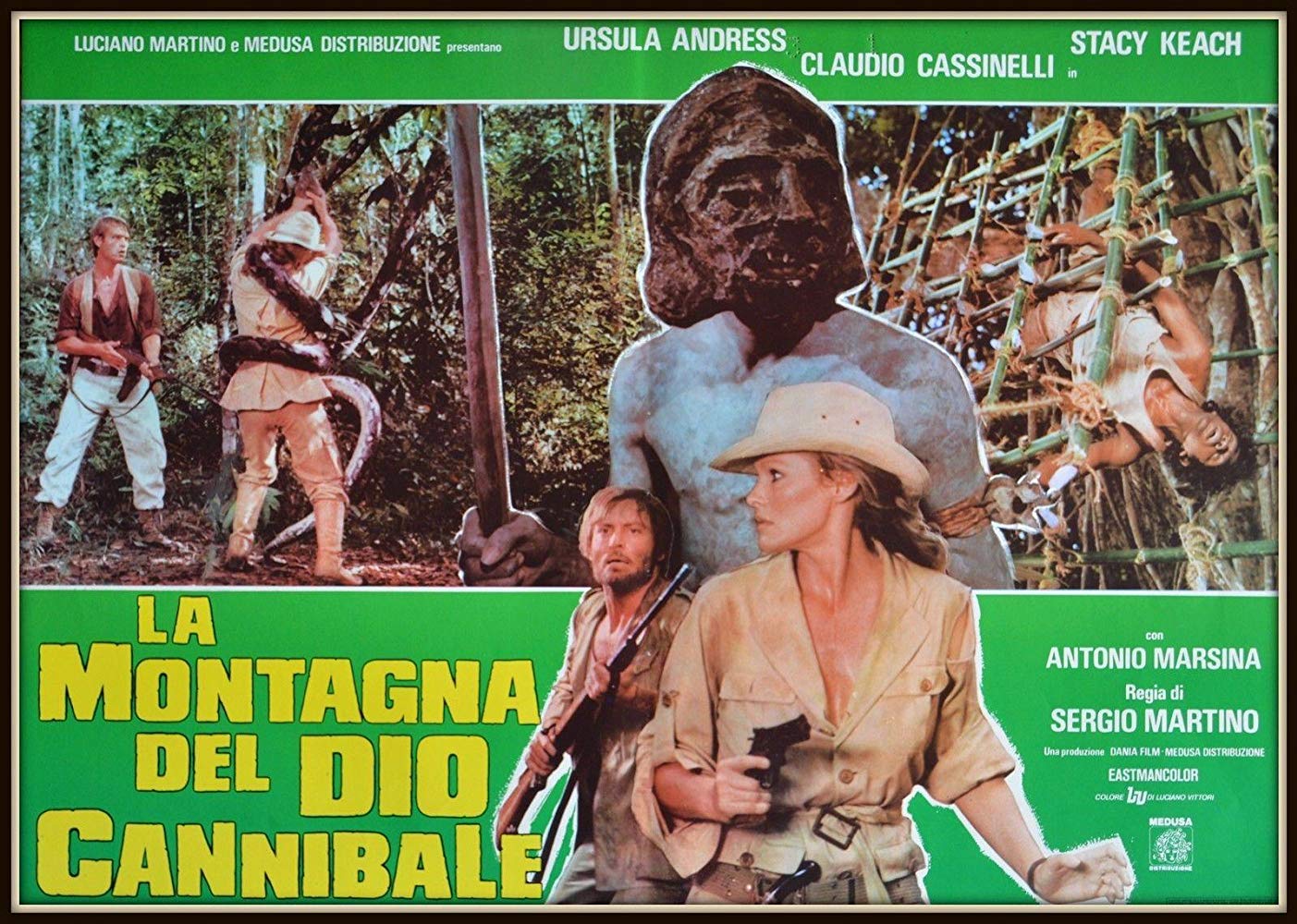
SLAVE OF THE CANNIBAL GOD aka MOUNTAIN OF THE CANNIBAL GOD (Italy - 1978; US release 1979) Directed by Sergio Martino. Written by Cesare Frugoni and Sergio Martino. Cast: Ursula Andress, Stacy Keach, Claudio Cassinelli, Antonio Marsina, Franco Fantasia, Lanfranco Spinola, Carlo Longhi, Luigina Rocchi, Akushla Sellajaah, T.M. Munna, M. Suki, Dudley Wanaguru, Gianfranco Coduti. (R, 85 mins/Unrated, 103 mins) Not as consistently disgusting as some of its more notorious contemporaries in the Italian cannibal craze, Sergio Martino's 1978 contribution MOUNTAIN OF THE CANNIBAL GOD is almost a mondo take on a traditional jungle adventure for most of its duration. That's especially the case in its significantly truncated US version, retitled SLAVE OF THE CANNIBAL GOD and released on the drive-in circuit by a relatively fledgling, pre-Freddy Krueger New Line Cinema in the spring and summer of 1979. Both versions--Martino's full-strength 103-minute director's cut and New Line's 85-minute US re-edit--are on Code Red's just-released SLAVE OF THE CANNIBAL GOD Blu-ray (because physical media is dead), and they offer a study in contrasts where each has its own unique strengths, the US cut in part because New Line saw fit to trim some of the fat. Indeed, the R-rated, 85-minute cut is better-paced and eliminates a talky early scene at the British consulate that ultimately makes no sense in the longer version. And while it retains a surprising amount of onscreen animal killing--always the major deterrent when it comes to one's ability to enjoy this type of tawdry exploitation fare--it suffers from almost complete lack of any graphic gut-munching, usually leaving the aftermath or reaction shots of other actors. In Martino's version, one major character is disemboweled and devoured, with a lingering shot of what feels like a mile of intestinal tract being yanked out of his gut, while in the US cut, it's reduced to one distant shot of the tribe chieftain holding up the victim's heart. Likewise, a graphic castration shown in Martino's version is merely implied in the US cut. The biggest difference in the uncut version is the inclusion of a CALIGULA-esque cannibal orgy, with some up-close and borderline pornographic footage of a young tribal woman masturbating along with some simulated bestiality involving a tribesman and a large pig. These shots were included in Martino's reconstructed version originally released by Anchor Bay back in the halcyon days of the Eurocult DVD explosion, and are understandably nowhere to be found in New Line's American cut. At the end of the day, regardless of which version of SLAVE OF THE CANNIBAL GOD you watch, both are trashy enough to make you wonder what the hell Stacy Keach and Ursula Andress are doing in it.
Andress is wealthy Susan Stevenson, who arrives in New Guinea with her younger brother Arthur (Antonio Marsina) in search of her missing explorer husband Henry (played in photos by perennial Eurocult bit player Tom Felleghy). They believe he was headed for the cursed mountain of Ra-Rami on the island of Roka, but the British consulate refuses to authorize a search and rescue mission. They instead direct her to Dr. Edward Foster (Keach), an anthropologist who happens to have been a close associate of Henry's (if you're wondering why she didn't just go to him in the first place, the US cut completely removes the ultimately pointless sequence at the British consulate) and is the only person who's been to Ra-Rami and made it back alive. Foster agrees to guide them on the treacherous trek to Roka, though tensions soon flare between him and the obnoxious Arthur and they're eventually joined by rugged adventurer Manolo (Martino regular Claudio Cassinelli). Foster confesses that he was captured by the Puka, a tribe on Roka, and was forced to partake in their cannibal rituals ("You never forget the taste of human flesh!" Foster cries in what's not one of Keach's most dignified moments), and is going along on the trek not to save Henry, but to wipe out the Puka once and for all. Susan and Arthur have their own secret, as she's not quite the probable grieving widow (she attempts to seduce Manolo), but is instead driven by TREASURE OF THE SIERRA MADRE-esque greed and wiling to put Foster and Manolo at risk, knowing Henry was searching for a massive secret uranium deposit on Roka, and they want those riches for themselves.
The expedition is whittled down, from Foster's native guides getting killed along the way to Keach making an abrupt exit with about 35 minutes to go when an injured Foster falls down a waterfall in one of Eurotrash cinema's more hilarious dummy deaths. Susan, Arthur, and Manolo are captured by the Puka and are introduced to the decaying, oozing corpse of her husband, with a Geiger counter planted in his chest and worshiped like a god by the Puka. Then they're submitted to the usual cannibal ritual antics--Arthur is eaten, Manolo forced to watch, and Susan is stripped nude and given a long, lingering oil and body paint rubdown in a scene that would be repeated with Alexandra Delli Colli in DOCTOR BUTCHER M.D. and with Bo Derek in TARZAN THE APE MAN, directed by her husband John Derek, who was once married to--wait for it--Ursula Andress. Martino's version comes to a screeching halt with the X-rated orgy, which really slows things down in a way that makes the third act of the US version move a lot faster, but it's also missing Arthur's disgusting demise, instead relying on Cassinelli reaction shots to convey the horrors taking place. It's worth noting that neither Andress nor Keach are around for the really gross stuff other than an early scene where Foster's guides capture a small crocodile and slice it open for food. Keach is killed off before they even encounter the cannibals, but up to that point, much of the big names' interactions with the horrific onscreen carnage was limited to the magic of the cutting room: the explorers are rowing along a river and someone says "Look!" as Martino cuts to footage of a giant lizard barfing up a snake (that one's not in the New Line version). Martino also gets a thumbs down for a morally bankrupt shot of a monkey being thrown by some rigged mechanism right into the waiting mouth of a large crocodile (that's in the New Line version), essentially negating the oft-repeated argument from directors of these cannibal films that these were examples of "survival of the fittest" caught on camera (some of SLAVE's animal killings were later recycled by Umberto Lenzi for 1980's EATEN ALIVE).
Martino's uncut version looks terrific on Code Red's Blu, and there's an HD transfer of the US cut that's not quite as good in quality but still looks better than it has in any home video incarnation. Keach is on hand for a new interview and expresses no regrets over appearing in the film (this was the same year that his uptight Sgt. Stedenko was a memorable foil to Cheech and Chong in UP IN SMOKE), saying it offered him a chance to work with Andress and to see Sri Lanka. where the exteriors were shot, and where Martino and Cassinelli would return for 1979's THE GREAT ALLIGATOR. He has some vivid memories of the shoot and shares stories about Andress and Cassinelli, and has a good laugh at his ridiculous death scene, but he still doesn't seem to be fully aware of just how foul SLAVE gets in the last third after he was no longer around. 1978 found Keach at the end of a brief sojourn into Eurocult, which included the 1976 gangster thriller STREET PEOPLE and Umberto Lenzi's cheap-looking 1978 WWII saga THE GREATEST BATTLE. But none of those were as dubious as SLAVE OF THE CANNIBAL GOD, where the involvement of respectable actors like Keach and Andress is certainly on par with Henry Fonda in TENTACLES and Richard Harris in STRIKE COMMANDO 2 in the "How the fuck did this happen?" chronicles of Italian trash cinema.
EMANUELLE AND THE LAST CANNIBALS aka TRAP THEM AND KILL THEM (Italy - 1977/US release 1984) Directed by Joe D'Amato (Aristide Massaccesi). Written by Romano Scandariato and Aristide Massaccesi. Cast: Laura Gemser, Gabriele Tinti, Susan Scott (Nieves Navarro), Donald O'Brien, Percy Hogan, Monica Zanchi, Annamarie Clementi, Geoffrey Copleston, Dirce Funari, Cindy Leadbetter. (Unrated, 93 mins) The penultimate entry in the Joe D'Amato/Laura Gemser "Black Emanuelle" series, EMANUELLE AND THE LAST CANNIBALS is a mash-up of the softcore porn that defined the films to that point, fused with the burgeoning cannibal craze that would explode in Italy over the next few years. Umberto Lenzi's MAN FROM DEEP RIVER (1972) got the ball rolling, but it was more of a MAN CALLED HORSE ripoff that kept its extreme gore limited to very small doses. It was Ruggero Deodato's JUNGLE HOLOCAUST (1977), aka THE LAST SURVIVOR and his landmark CANNIBAL HOLOCAUST (1980) that really established the subgenre as it would come to be known, along with Sergio Martino's MOUNTAIN OF THE CANNIBAL GOD (1978) and Lenzi's double-shot of EATEN ALIVE (1980) and CANNIBAL FEROX (1981), the latter being pretty much the last word in the purely exploitative nature of the Italian cannibal gut-muncher cycle. To that end, D'Amato (real name: Aristide Massaccesi) was a bit ahead of the curve in 1977. Over the course of 1976 and 1977, he'd already sent Gemser's intrepid, globe-trotting, and sexually adventurous photojournalist Emanuelle to Bangkok in EMANUELLE IN BANGKOK, America in EMANUELLE IN AMERICA, and around the world in EMANUELLE AROUND THE WORLD. After the snuff film and bestiality extremes of EMANUELLE IN AMERICA, D'Amato probably figured the cannibal subgenre was the only transgressive depth to plummet. That is, until he decided necrophilia was a viable horror film subject with 1979's BEYOND THE DARKNESS.
But for its first half, it's mostly a standard EMANUELLE affair: there's one gratuitous sex scene after another, with a pretty ballsy one on the banks of the East River in broad daylight, between the Brooklyn and the Manhattan Bridges, with locals and some tourists on a passing ferry presumably getting an eyeful (this scene is shot in the same spot as the opening of Lucio Fulci's THE NEW YORK RIPPER and Yul Brynner's introduction in Antonio Margheriti's DEATH RAGE). Emanuelle is first seen undercover doing an expose of a NYC mental institution (an obvious Rome studio interior, with signs reading "Farmacy" and "Phisical Therapy") with a typically conspicuous camera, this one hidden behind the blinking eyes of a doll. One patient (Cindy Leadbetter) bites off the breast of a lesbian nurse, prompting Emanuelle to graphically grope her for information, discovering a tattoo just above her pubic region that's the sign of the Tupinamba, the last cannibal tribe still present in the Amazon jungle. Teaming professionally and sexually with anthropologist Dr. Mark Lester (Gabriele Tinti, Gemser's real-life husband), Emanuelle ventures to the jungle where Lester's old missionary pal Rev. Wilkes (Geoffrey Copleston) has his virginal daughter Isabelle (Monica Zanchi) and nun Sister Angela (Annamaria Clementi) accompany them on their quest to find evidence of the Tupinamba tribe. They eventually cross paths with impotent hunter Donald McKenzie (Donald O'Brien) and his sex-starved, nympho wife Maggie (Nieves Navarro, under her "Susan Scott" pseudonym), who's getting it on with their guide Salvador (Percy Hogan), before running afoul of the Tupinamba who, to the surprise of no one, start hunting, killing, and eating them one by one.
Factor out the plethora of sex scenes, and the set-up of EMANUELLE AND THE LAST CANNIBALS is virtually identical to DOCTOR BUTCHER M.D. (both films were written by Romano Scandariato), where a group of New Yorkers make their way to the jungle only to encounter cannibals and zombies, thanks to the experiments of the titular doctor (played by the busy O'Brien). Other than the bit of gore in the opening sequence of LAST CANNIBALS, D'Amato waits about an hour before the horror really gets going. Until then, it's a slightly more explicit than usual EMANUELLE outing, with one surprisingly creative bit where D'Amato skips the initial coupling of Emanuelle and Dr. Lester, merely implying it until he flashes back to it later during a cab ride to the airport. It's a like a softcore porn precursor to the non-linear editing style Steven Soderbergh would use to memorable effect with George Clooney and Jennifer Lopez in OUT OF SIGHT. Given the context, it's an unusual and inventive decision, demonstrating the kind of pure cinema that one usually doesn't expect to see in a Joe D'Amato joint, whether it's traditional genre fare like THE GRIM REAPER or his ATOR films, his horror/porno crossovers like 1980's EROTIC NIGHTS OF THE LIVING DEAD and 1981's PORNO HOLOCAUST, or the straight-up hardcore porn he'd churn out near the end of his career.
Just out on Blu-ray from Severin, EMANUELLE AND THE LAST CANNIBALS is a film that gives the devout Eurotrash exploitation fan everything they want: near-constant T&A, laughably bad dubbing, misspelled English-as-second-language signs, extreme gore, incredible 1977 NYC location work, a supporting cast filled with Eurocult stalwarts, a catchy Nico Fidenco theme song with "Make Love on the Wing," bullshit claims that it's a true story (citing the work of a fictitious reporter named "Jennifer O'Sullivan"), and the iconic Gemser, who looks even more gorgeous than usual here. And as an added bonus, unlike most of its type in the cannibal cycle, there's no graphic onscreen animal violence, which has always been the biggest obstacle in the "enjoyment" of this stuff (the closest it gets is a friendly chimpanzee helping himself to a Marlboro). It took the film seven years to make it to America, where the short-lived Megastar Films gave it a spotty release on the drive-in and grindhouse circuit in 1984 as TRAP THEM AND KILL THEM, a retitling obviously designed to capitalize on the notoriety of MAKE THEM DIE SLOWLY, the rechristening given to Umberto Lenzi's CANNIBAL FEROX when it hit the US in 1983. D'Amato and Gemser would make one more EMANUELLE film with 1978's EMANUELLE AND THE WHITE SLAVE TRADE, which features copious amounts of redubbed stock footage from earlier entries (Emanuelle's meeting with her editor and shots of Gemser and Tinti driving around NYC--complete with a theater showing KENTUCKY FRIED MOVIE--are lifted completely from LAST CANNIBALS), plus an amazing newly-shot bowling alley brawl. Though the D'Amato-run "Black Emanuelle" series would wrap up after WHITE SLAVE TRADE, Gemser starred in a few offshoots as a character named "Emanuelle," most notably a pair of wonderfully nasty and batshit Bruno Mattei women-in-prison classics with 1982's VIOLENCE IN A WOMEN'S PRISON (released in the US in 1984 as CAGED WOMEN) and 1983's WOMEN'S PRISON MASSACRE (released in the US in 1985). Gemser retired from acting following Tinti's death from cancer in 1991, though she worked behind the scenes as a costume and wardrobe designer on several Filmirage productions, most notably the cult classic TROLL 2. She's spent the last 25 years almost completely out of the public eye, resurfacing only for a few audio interviews and one on-camera interview for a 2000 British TV documentary on Sylvia Kristel's EMMANUELLE movies.
THE GREEN INFERNO (US/Chile - 2015) Directed by Eli Roth. Written by Eli Roth and Guillermo Amoedo. Cast: Lorenza Izzo, Ariel Levy, Daryl Sabara, Kirby Bliss Blanton, Sky Ferreira, Richard Burgi, Aaron Burns, Magda Apanowicz, Ignacia Allamand, Nicolas Martinez, Matias Lopez, Ramon Llao, Antonieta Pari, Eusebio Arenas. (R, 100 mins)
For being as ubiquitous a cult horror figure as he is, Eli Roth's filmography has been surprisingly sparse. THE GREEN INFERNO is just his fourth feature film as a director, arriving eight years after his last, 2007's HOSTEL PART II, though he's produced and "presented" several others and co-starred as Sgt. Donny "The Bear Jew" Donowitz in buddy Quentin Tarantino's INGLORIOUS BASTERDS (2009). Part of the delay was beyond Roth's control: filmed back-to-back with AFTERSHOCK (co-written by and starring Roth, and utilizing most of the same cast and crew) in 2012 and shown at festivals in 2013, THE GREEN INFERNO saw its September 2014 release abruptly cancelled by Open Road Films. They sold it to High Top Films and Blumhouse offshoot BH Tilt, who have finally gotten it into theaters three years after it was completed, still sporting a 2013 copyright. A longtime pet project of Roth's, the film is homage to the most vile of Italian horror subgenres, the cannibal film, itself an offshoot of the 1960s mondo craze. The Italian cannibal film was born with Umberto Lenzi's 1972 adventure MAN FROM DEEP RIVER, a more violent ripoff of the 1970 Richard Harris hit A MAN CALLED HORSE. There were other cannibal films that followed--Ruggero Deodato's THE LAST CANNIBAL WORLD, aka JUNGLE HOLOCAUST (1977) and Sergio Martino's foul MOUNTAIN OF THE CANNIBAL GOD (1978), but it really exploded with Deodato's groundbreaking, found-footage-inspiring CANNIBAL HOLOCAUST (1980), and consecutive Lenzi assaults, EATEN ALIVE (1980) and CANNIBAL FEROX, aka MAKE THEM DIE SLOWLY (1981). The latter three, in particular, took the cannibal subgenre as far as it could go and even today, remain so extreme in their content that they still shock and repulse even the most jaded of uninitiated present-day gorehounds raised on post-SAW torture porn and hipster snark. I attended a midnight showing of CANNIBAL HOLOCAUST about 11 or 12 years ago and the packed theater was ready for a good time. They wasted no time talking back to the screen, making fun of the dubbing, and mimicking one particularly cheesy synth cue in Riz Ortolani's score. Around 25 minutes in, something happened that quieted down the audience. The discomfort escalated over the next half hour. By the one hour mark, many were leaving. When the closing credits rolled, those who remained exited the theater in traumatized silence. 35 years after it was made, the snark-proof CANNIBAL HOLOCAUST still separates the players from the poseurs in horror fandom, and approaching it with a derisive MST3K attitude won't cushion the blow. You don't just watch CANNIBAL HOLOCAUST. You survive it.
So in that respect, Roth is to be commended for daring to bring that kind of experience to the multiplexes of today. THE GREEN INFERNO (named after a documentary film-within-a-film in CANNIBAL HOLOCAUST) stretches its R rating about as far as it can go and more often that not, Roth and co-writer Guillermo Amoedo make a concerted effort to replicate the intensity of their influences. Alas, Roth is a director who has always straddled the line between fanboy and dudebro, and those conflicting identities trip him up throughout the film. His heart is in the right place: the jungle locations in Chile are stunning, he stays with practical effects as much as possible (though one CGI ant attack is just embarrassing to watch); in one shot, he frames his heroine (wife Lorenza Izzo) in a way that very purposefully recalls a memorable image of final girl Lorraine De Selle in CANNIBAL FEROX; and the closing credits feature a list of recommended Italian cannibal movies and end with a "Per Ruggero" dedication to the still very-much-alive Deodato, clearly a huge influence on the director (he also gave Deodato a cameo as "The Italian Cannibal" in HOSTEL PART II). But Roth also can't resist the temptation to play to the lowest common denominator, with comedic detours into a grossout humor involving vomit and diarrhea and a Scooby-Doo plan of stashing a bag of weed into the corpse of a soon-to-be-eaten character in order to make the natives high and allow the heroes to escape. That one character even derisively refers to it as "a Scooby-Doo plan" doesn't get Roth off the hook, nor does the resulting attack of the munchies that thwarts the escape when the buzzed tribesmen start chowing down on one guy like he's a bag of Funyuns.
Roth takes some shots at the college culture of hashtag activism and the political correctness of Generation Trigger Warning with mixed results. College freshman Justine (Izzo), the daughter of a big-shot U.N. attorney (Richard Burgi), falls in with a group of SJW campus activists led by the charismatic Alejandro (Ariel Levy). Alejandro and his buddy Carlos (Matias Lopez) are orchestrating a trip deep into the Peruvian rain forest to chain themselves to bulldozers to prevent an evil corporation from destroying the land and displacing the indigenous people to get to the natural gas supply deep underground. After successfully shaming the construction workers and their protecting militia via a live stream online, the group's plane crashes in an even more remote part of the jungle. While some die on impact, the survivors are soon abducted by a terrifying tribe, with one being eaten alive by the natives as an example of atrocities to come. The long sequence where the crash survivors watch in horror as one of their own is devoured limb-by-limb does a very credible job of replicating the brutal intensity of Deodato and Lenzi. Roth also makes the wise decision to avoid one troubling and indefensible element of Italian cannibal films that have always dogged them and rightly so: he doesn't even flirt with the idea of depicting on-camera animal killings, either for real or by special effects. The animals in THE GREEN INFERNO are treated with dignity (the tribe's pigs are pets who actually eat human flesh as well) and reverence, as shown by the respectful attitude displayed toward a majestic, beautiful jaguar resting near the river.
But then there's the juvenile, played-for-laughs diarrhea scene, where even the native kids are holding their noses and waving their hands in front of their faces. And there's the whole "stoned natives" sequence and the subsequent munchies. And a completely baffling scene where one character has committed suicide and Alejandro responds by vigorously masturbating in front of everyone in order to keep his mind focused. The standard-bearers of the Italian cannibal genre--CANNIBAL HOLOCAUST and CANNIBAL FEROX--depict generally docile tribes goaded by cruel white interlopers into committing the horrific atrocities they do. In CANNIBAL HOLOCAUST, a documentary team needs to sensationalize their film, so they burn down a village and rape a native girl, who's punished by the tribal elders by being impaled on a pole that goes through her vagina and exits her mouth. In CANNIBAL FEROX, a doctoral student (De Selle) ventures to the Amazon to once and for all disprove cannibalism, but first she encounters a fugitive, small-time NYC coke dealer (Giovanni Lombardo Radice) who also rapes a native girl and tortures another tribesman to death, and the tribe rises up to attack the white invaders and give them what's coming to them. Alejandro fills that "white villain" role to a certain extent, at least in terms of his increasingly sociopathic behavior, but in an unexpected switch that's either Roth subverting genre expectations or keeping the door open for a sequel, Alejandro never gets what's coming to him.
Like Tarantino, Roth wears his love of grindhouse trash on his sleeve and his sincerity is never in doubt. But he's neither the stylist nor the writer that Tarantino is, though of course, QT's is a unique voice in contemporary movies. Roth wants to make THE GREEN INFERNO his CANNIBAL HOLOCAUST or CANNIBAL FEROX, and while he occasionally succeeds, he too often doesn't have the courage of his convictions, whether it's his handling of Alejandro or in the way the film repeatedly brings up the subject of female genital mutilation and seems poised to present it, much like those old Italian cannibal films always had some poor schmuck getting his dick hacked off and eaten by a cannibal. Not that I'm advocating female genital mutilation, but if Roth really wanted to push the envelope like his genre heroes did, he would've crossed that line. Deodato's and Lenzi's films aren't the infamous transgressions they are for holding back in the name of good taste and a desire to treat the audience with kid gloves. All in all, THE GREEN INFERNO is...alright. It's doubtful it's going to catch on with mainstream multiplexers, but the hardcore cult aficionados who form Roth's base will eat it up, pun intended. When Roth approaches the story seriously, the film works quite well, both as a tribute and as an intense experience in horror cinema that perfectly exemplifies what Roth is about. When he doesn't, then, well, you get some smirking dudebro jerking himself off for no reason, and to a certain degree, that also exemplifies what Roth is about.
Original 2014 poster art when the film was still being handled by Open Road
CANNIBAL FEROX aka MAKE THEM DIE SLOWLY (Italy - 1981; US release 1983) Written and directed by Umberto Lenzi. Cast: John Morghen (Giovanni Lombardo Radice), Lorraine De Selle, Bryan Redford (Danilo Mattei), Zora Kerova, Robert Kerman, Venantino Venantini, John Bartha, Walter Lloyd (Walter Lucchini), Meg Fleming (Fiamma Maglione), "El Indio" Rincon, Perry Pirkanen, Dominic Raacke, Jake Teague. (Unrated, 93 mins)
The Italian cannibal genre is always a touchy subject. Its origins are in 1962's MONDO CANE and the subsequent mondo documentaries of the 1960s and into the 1970s by Gualtiero Jacopetti & Franco Prosperi and others. There's also the influence of the 1970 Richard Harris hit A MAN CALLED HORSE, which spawned Umberto Lenzi's 1972 Italian ripoff THE MAN FROM DEEP RIVER. In HORSE, Harris is an English aristocrat abducted and treated like an animal by a Sioux tribe until he eventually comes to earn their respect, abandons his privileged upbringing and ultimately becomes the tribe's leader. THE MAN FROM DEEP RIVER took a very similar concept--with Ivan Rassimov as a British wildlife photographer in the jungles of Thailand--but steered it in a Mondo direction that a Hollywood film wouldn't dare venture. THE MAN FROM DEEP RIVER, a fixture in American drive-ins throughout the 1970s under various alternate re-release titles (DEEP RIVER SAVAGES, SACRIFICE!), offered sparse but still graphic depictions of cannibalism, sex and rape involving subgenre mainstay Me Me Lai, and brutal animal killings, and though it's rather tame compared to what would come later, it's almost universally considered the first Italian cannibal film.
While Lenzi is generally credited with creating the Italian cannibal genre, it was Ruggero Deodato who established it as a legitimate craze with 1977's THE LAST CANNIBAL WORLD, released in the US in a cut version in 1978 as THE LAST SURVIVOR, but best known today as JUNGLE HOLOCAUST. A far more graphic riff on THE MAN FROM DEEP RIVER and featuring Rassimov in a supporting role, THE LAST CANNIBAL WORLD stars Massimo Foschi as an oil prospector stranded in Mindanao after a plane crash. He's abducted and humiliated by a cannibal tribe and eventually resorts to cannibalism to earn their respect. Allegedly based on a true story, THE LAST CANNIBAL WORLD raised the bar for what the Italian cannibal genre was willing to depict. Here was the more aggressive barrage of flesh-eating, graphic rape, Foschi and Lai (again as a tribe girl/sex object) completely nude for a good chunk of the film, and on-camera animal slaughter, hands-down the most troubling element of the genre. Sergio Martino hopped on the cannibal bandwagon with 1978's MOUNTAIN OF THE CANNIBAL GOD (released in the US in cut form as SLAVE OF THE CANNIBAL GOD), which got a minor boost in class thanks to the presence of Ursula Andress as a socialite venturing into the jungles of New Guinea to find her missing husband, and Stacy Keach as the experienced guide she hires, traumatized by his own experiences being abducted by a cannibal tribe years earlier. MOUNTAIN's really foul elements, including a monkey obviously being thrown into a snake's mouth, a borderline pornographic cannibal orgy that showcases gratuitous masturbation involving a female cannibal, and one really unpleasant depiction of simulated bestiality with a cannibal and a water buffalo, are mostly confined to the climax, don't directly involve Andress or co-star Claudio Cassinelli, and happen long after Keach's character is killed off, a certain indication that Martino pulled a CALIGULA on his cast and shot the really vile stuff when they weren't around.
If THE LAST CANNIBAL WORLD got the ball rolling on the cannibal craze, it was Deodato's infamous CANNIBAL HOLOCAUST (1980) that really caused the movement to explode. One of the key films in the genesis of found-footage that was used so effectively nearly 20 years later with 1999's THE BLAIR WITCH PROJECT and became practically standard after 2009's PARANORMAL ACTIVITY, CANNIBAL HOLOCAUST is a horrifying and intensely disturbing experience--go to a midnight showing of it with a snarky audience that's ready to mock it MST3K-style and you'll see them grow silent about 25 minutes in as the shell-shocked crowd starts really thinning out by the one-hour mark. It remains one of the very few irony-proof films that separates the players from the pretenders when it comes to cult hipster fandom. You don't simply watch CANNIBAL HOLOCAUST--you survive it. Deodato's handling of the found-footage element--the second half of the film consists of a professor (Robert Kerman, better known at the time as porn actor R. Bolla) watching increasingly damning footage left behind by a documentary crew who vanished while investigating the existence of cannibals in the Amazon--has yet to be equaled by any of its countless faux-doc/found-footage offspring. Deodato's film was so believable that Italian authorities actually thought he made a snuff film and he had to prove he didn't kill off his unknown actors. CANNIBAL HOLOCAUST has legitimate statements to make about the comparisons between the stone-age jungle and modern civilization, evidenced in the way that the tribes are generally peaceful but only end up turning on the documentary crew when the raw--no pun intended--footage shows the crew (civilization) acting like sociopathic assholes and goading them into acts of increasing savagery and abhorrence. One of the film's most telling moments involve two of the crew raping a tribe girl, who's later punished in one of the film's iconic images: impaled on pole that enters her vagina and exits her mouth. Lead filmmaker Alan Yates (Gabriel Yorke) is smirking and visibly amused at the horrific punishment until one of the other guys says "Watch it, Alan...I'm shooting," at which point he turns serious and melodramatically declares "Oh, good Lord! This is horrible!" CANNIBAL HOLOCAUST is an intelligent film with moments that remain prescient today in an era when there is no depth to which the media won't plummet to sensationalize or outright manufacture a story. But any indicting aspirations it has to being the NETWORK of Italian cannibal movies is negated somewhat by Deodato also wallowing in the same exploitation and sensationalism that he's criticizing, whether it's turning his camera on the gruesome slaughter of a helpless animal (the turtle scene is arguably the most revolting thing ever filmed for a commercial movie, and co-star Francesca Ciardi's vomiting is real) or playing up the graphic exploitation elements.
Giovanni Lombardo Radice and Umberto Lenzi
on the set of CANNIBAL FEROX
Even with its ultimately heavy-handed message ("I wonder who the real cannibals are," muses Kerman's pipe-smoking professor), CANNIBAL HOLOCAUST was as smart as the genre ever got. After that, there was nowhere to go but down, and Umberto Lenzi was happy to oblige. A veteran journeyman who went wherever genre trends took him (he really found his niche with 1970s polizia), Lenzi returned to the cannibal genre he helped create with EATEN ALIVE (1980), which fused the cannibal craze with the then-topical Jonestown massacre, with yet another wealthy young woman (Janet Agren) hiring a guide (Kerman, again) to find her missing sister (Paola Senatore), who's run off to Sri Lanka and fallen in with a religious cult led by the insane Jonas (Rassimov, again). EATEN ALIVE is grimy, trashy, and cheap, with animal slaughter scenes pilfered from MOUNTAIN OF THE CANNIBAL GOD, ears and breasts being sliced off, perpetual subgenre abuse object Me Me Lai being gang-raped, Senatore being sodomized by a cannibal, Rassimov inducting Agren into his cult by penetrating her with a venom-dipped dildo, and a seriously slumming Mel Ferrer, no doubt questioning the state of his career while appearing in his second movie in three years titled EATEN ALIVE, as a professor dropping exposition to a NYC detective (gay porn star Gerald Grant) about how cannibal tribes still exist.
Lenzi quickly followed EATEN ALIVE with CANNIBAL FEROX, the most infamous Italian cannibal film after CANNIBAL HOLOCAUST, and one of the most notorious films ever made. HOLOCAUST at least had something to say and broke new ground, but EATEN ALIVE and CANNIBAL FEROX are pure exploitation all the way. Abandoning any illusions of restraint and not about to be told "Don't go there!" Lenzi goes all-in with CANNIBAL FEROX as NYU anthropology grad student Gloria Davis (Lorraine De Selle), her brother/research assistant Rudy (Danilo Mattei, billed as "Bryan Redford"), and her friend Pat (Zora Kerova) venture deep into the Amazon to prove cannibalism has never existed. Of course, they're wrong, but cannibals aren't their only problem: they soon fall in with Mike Logan (Giovanni Lombardo Radice, using his "John Morghen" pseudonym) and Joe Costolani (Walter Lucchini), a pair of on-the-run, small-time NYC lowlifes who ripped off $100,000 from a mafioso (John Bartha) and fled to South America to make their bones in the cocaine business. It doesn't take long for Mike to expose himself as a dangerous psychopath whose actions only stir up the natives who, in true CANNIBAL HOLOCAUST style, turn on the white interlopers. Whether it's animal killings or cannibal mayhem, Lenzi holds nothing back in CANNIBAL FEROX, with the most horrific punishment reserved for the much-deserving Mike, who's paid back in kind after he ties up a tribesman, gouges out his eye, and chops off his penis. Since Lenzi goes for maximum tactlessness, Mike is given the further indignity of having his dick not only chopped off but devoured by a cannibal in loving close-up. Mike's terrible, horrible, no-good, very bad day continues when he gets his hand hacked off before being restrained under a table with his head poking through and locked in place has the top of his skull is macheted off and his brains picked at like hors d'oeuvres at a dinner party. And then there's one of FEROX's iconic images: Pat's punishment for her part in Mike's murder of a native girl by being strung up with hooks through her breasts.
Where Deodato tried to make a statement with CANNIBAL HOLOCAUST, Lenzi just unabashedly goes over the line time and again in ways not telegraphed by the film's opening theme that's so "'70s cop show" that you almost expect to hear an announcer intone "Previously on CANNIBAL FEROX..." (Lenzi opened EATEN ALIVE with a similarly incongruous Budy-Maglione number). CANNIBAL FEROX was acquired by Terry Levene's Aquarius Releasing--the company behind the cannibal/zombie crossover ZOMBI HOLOCAUST's transformation into DOCTOR BUTCHER, M.D.--and released in 1983. under the instantly legendary title MAKE THEM DIE SLOWLY, advertised with Levene's typically hyperbolic hucksterism ("Bizarre Human Sacrifices! The Most Violent Film Ever! Banned in 31 Countries!"). A grindhouse and drive-in staple well into the fall of 1984, MAKE THEM DIE SLOWLY became a fixture in video stores and scarred many budding gorehounds in those mid-1980s glory days of PMRC outrage and Satanic Panic. We knew slasher movies and zombie movies, but the Italian cannibal films were another beast entirely. To those who cut their teeth on horror in that era, MAKE THEM DIE SLOWLY and its ilk were as far as grossout cinema could possibly go, which of course, was part of its charm (plus, grindhouse gorehounds in America saw it before most of the others: CANNIBAL HOLOCAUST and EATEN ALIVE, the latter as both DOOMED TO DIE and later on VHS as THE EMERALD JUNGLE, didn't turn up in the US until 1985). Of course, CANNIBAL FEROX is garbage. Of course it's indefensible and utterly reprehensible. But it has its charms and it left its mark. In many ways, it's the ultimate exploitation movie: it's trashy, sleazy, sloppily-dubbed; has some incredible late 1980 time capsule NYC location shooting (DIVINE MADNESS, HOPSCOTCH, FAME, and THE EXTERMINATOR all playing at one NYC theater!); a pointless Manhattan mob subplot that Lenzi simply abandons; gratuitous nudity; delirious overacting by Radice; supporting roles for NYC-based porn actors (Kerman is present once again, this time as rumpled cop Lt. Rizzo in scenes shot at the same precinct Lenzi used for Ferrer and Grant's scenes in EATEN ALIVE), over-the-top violence, ridiculous dialogue ("Hey bitch, where's your stud?" and one of the greatest lines of all time as a starved Pat is tempted by a piece of meat: "No! Stop! It might be Rudy!"), and one of the most unforgettable and effective retitlings ever, even utilized by Rob Zombie for an early, pre-fame White Zombie album. You remember a movie called MAKE THEM DIE SLOWLY, even if it has a trailer as unappealingly narrated as this one:
After CANNIBAL FEROX, there was really nowhere else for the cannibal subgenre to go. By this point, they were all following the same template and audiences quickly grew fatigued with the repetitive mayhem. Joe D'Amato tried to get into the act with the softcore/cannibal fusion jams EMANUELLE AND THE LAST CANNIBALS (1977), released in the US in 1984 as TRAP THEM AND KILL THEM, and PAPAYA, LOVE GODDESS OF THE CANNIBALS (1978), and Jess Franco inevitably chimed in with DEVIL HUNTER (1980) and CANNIBALS (1980), both borrowing Lucio Fulci regular Al Cliver and Sabrina Siani for Italian legitimacy purposes but nevertheless exhibiting Franco's tendency toward amateur hour and his expected lack of attention to detail, whether it's a cannibal sporting a visible wristwatch or another with a disco perm, porn 'stache, and sideburns. There were a few later stragglers, like Michele Massimo Tarantini's MASSACRE IN DINOSAUR VALLEY (1985), Mario Gariazzo's AMAZONIA (1985) and Antonio Climati's dubiously titled CANNIBAL HOLOCAUST II (1988). Italian hack Bruno Mattei tried to restart the cycle with a pair of 2004 shot-on-video atrocities, MONDO CANNIBAL and IN THE LAND OF THE CANNIBALS, both of which shamelessly rip off CANNIBAL HOLOCAUST, and Jonathan Hensleigh (THE PUNISHER, KILL THE IRISHMAN) directed the justifiably little-seen 2007 American found-footage dud WELCOME TO THE JUNGLE, with two dipshit couples encountering cannibals while on a get-rich-quick plan to retrace the journey of Michael Rockefeller before his disappearance in New Guinea in 1961. Eli Roth's long-delayed THE GREEN INFERNO, shot in 2012 and finally due in theaters in fall 2015 after some distribution snafus, is purported to be an overt homage to the entire Italian cannibal subgenre.
MAKE THEM DIE SLOWLY, opening in my hometown of Toledo, OH on 9/14/1984
MAKE THEM DIE SLOWLY playing at
the Liberty in Times Square
The legend of CANNIBAL FEROX has grown over the years, and is cemented by Grindhouse's recent Blu-ray release, which is without question the definitive edition. Packed with extras, including Calum Waddell's feature-length documentary EATEN ALIVE: THE RISE AND FALL OF THE ITALIAN CANNIBAL FILM, and the instant-classic commentary with Lenzi and Radice--recorded separately--ported over from the 1997 laserdisc and later DVD edition. The commentary is one for the ages, with Lenzi's repeated defending of the film alternating with scorn and derision from Radice. The actor is known for his early '80s horror film work and being on the receiving end of the legendary drill scene in Lucio Fulci's CITY OF THE LIVING DEAD (1980), but whose first love has always been the stage, more or less admitting that he took these roles for the money. He doesn't hold back on the commentary, whether he's dissing Lenzi or repeatedly declaring that he's ashamed of CANNIBAL FEROX, citing it as the only film he regrets making. Radice also appears in a new interview segment, as do Zora Kerova and Danilo Mattei (Lorraine De Selle, retired from acting since 1988 and now a successful producer for Italian TV, is MIA). Grindhouse's two-disc Blu-ray set gives this landmark bit of drive-in scuzz the veritable Criterion treatment. CANNIBAL FEROX obviously isn't for everybody, but as Eli Roth points out in the Blu-ray's accompanying booklet of essays, "Lenzi's film was reviled for many years but for many of us, the film is a treasure." It's also a snapshot of a bygone era when something as vile as MAKE THEM DIE SLOWLY could play in American movie theaters and drive-ins, a time when impressionable young fans were devouring everything they could find at the holy sanctuary that was the video store. It's an era that's passed and the likes of which we'll never see again. It's more about sentiment than quality, especially since it's not even the best of the cannibal subgenre, but Grindhouse's CANNIBAL FEROX brings those memories and images and that sense of discovery back in all its sleazy, offensive, gut-munching HD glory. You'll probably need to shower after watching CANNIBAL FEROX, but that's not a criticism--that means it did its job.