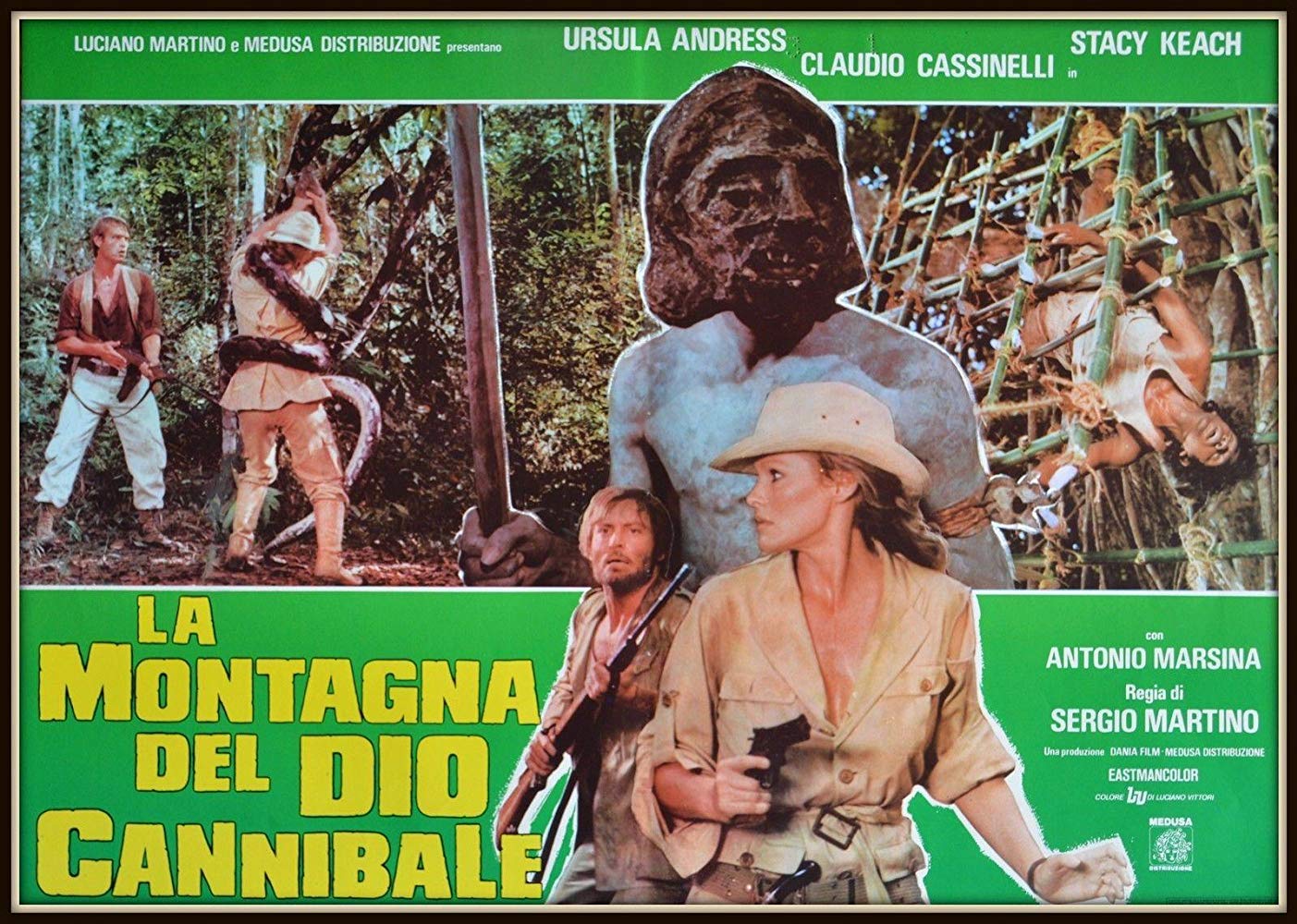
SLAVE OF THE CANNIBAL GOD aka MOUNTAIN OF THE CANNIBAL GOD (Italy - 1978; US release 1979) Directed by Sergio Martino. Written by Cesare Frugoni and Sergio Martino. Cast: Ursula Andress, Stacy Keach, Claudio Cassinelli, Antonio Marsina, Franco Fantasia, Lanfranco Spinola, Carlo Longhi, Luigina Rocchi, Akushla Sellajaah, T.M. Munna, M. Suki, Dudley Wanaguru, Gianfranco Coduti. (R, 85 mins/Unrated, 103 mins) Not as consistently disgusting as some of its more notorious contemporaries in the Italian cannibal craze, Sergio Martino's 1978 contribution MOUNTAIN OF THE CANNIBAL GOD is almost a mondo take on a traditional jungle adventure for most of its duration. That's especially the case in its significantly truncated US version, retitled SLAVE OF THE CANNIBAL GOD and released on the drive-in circuit by a relatively fledgling, pre-Freddy Krueger New Line Cinema in the spring and summer of 1979. Both versions--Martino's full-strength 103-minute director's cut and New Line's 85-minute US re-edit--are on Code Red's just-released SLAVE OF THE CANNIBAL GOD Blu-ray (because physical media is dead), and they offer a study in contrasts where each has its own unique strengths, the US cut in part because New Line saw fit to trim some of the fat. Indeed, the R-rated, 85-minute cut is better-paced and eliminates a talky early scene at the British consulate that ultimately makes no sense in the longer version. And while it retains a surprising amount of onscreen animal killing--always the major deterrent when it comes to one's ability to enjoy this type of tawdry exploitation fare--it suffers from almost complete lack of any graphic gut-munching, usually leaving the aftermath or reaction shots of other actors. In Martino's version, one major character is disemboweled and devoured, with a lingering shot of what feels like a mile of intestinal tract being yanked out of his gut, while in the US cut, it's reduced to one distant shot of the tribe chieftain holding up the victim's heart. Likewise, a graphic castration shown in Martino's version is merely implied in the US cut. The biggest difference in the uncut version is the inclusion of a CALIGULA-esque cannibal orgy, with some up-close and borderline pornographic footage of a young tribal woman masturbating along with some simulated bestiality involving a tribesman and a large pig. These shots were included in Martino's reconstructed version originally released by Anchor Bay back in the halcyon days of the Eurocult DVD explosion, and are understandably nowhere to be found in New Line's American cut. At the end of the day, regardless of which version of SLAVE OF THE CANNIBAL GOD you watch, both are trashy enough to make you wonder what the hell Stacy Keach and Ursula Andress are doing in it.
Andress is wealthy Susan Stevenson, who arrives in New Guinea with her younger brother Arthur (Antonio Marsina) in search of her missing explorer husband Henry (played in photos by perennial Eurocult bit player Tom Felleghy). They believe he was headed for the cursed mountain of Ra-Rami on the island of Roka, but the British consulate refuses to authorize a search and rescue mission. They instead direct her to Dr. Edward Foster (Keach), an anthropologist who happens to have been a close associate of Henry's (if you're wondering why she didn't just go to him in the first place, the US cut completely removes the ultimately pointless sequence at the British consulate) and is the only person who's been to Ra-Rami and made it back alive. Foster agrees to guide them on the treacherous trek to Roka, though tensions soon flare between him and the obnoxious Arthur and they're eventually joined by rugged adventurer Manolo (Martino regular Claudio Cassinelli). Foster confesses that he was captured by the Puka, a tribe on Roka, and was forced to partake in their cannibal rituals ("You never forget the taste of human flesh!" Foster cries in what's not one of Keach's most dignified moments), and is going along on the trek not to save Henry, but to wipe out the Puka once and for all. Susan and Arthur have their own secret, as she's not quite the probable grieving widow (she attempts to seduce Manolo), but is instead driven by TREASURE OF THE SIERRA MADRE-esque greed and wiling to put Foster and Manolo at risk, knowing Henry was searching for a massive secret uranium deposit on Roka, and they want those riches for themselves.
The expedition is whittled down, from Foster's native guides getting killed along the way to Keach making an abrupt exit with about 35 minutes to go when an injured Foster falls down a waterfall in one of Eurotrash cinema's more hilarious dummy deaths. Susan, Arthur, and Manolo are captured by the Puka and are introduced to the decaying, oozing corpse of her husband, with a Geiger counter planted in his chest and worshiped like a god by the Puka. Then they're submitted to the usual cannibal ritual antics--Arthur is eaten, Manolo forced to watch, and Susan is stripped nude and given a long, lingering oil and body paint rubdown in a scene that would be repeated with Alexandra Delli Colli in DOCTOR BUTCHER M.D. and with Bo Derek in TARZAN THE APE MAN, directed by her husband John Derek, who was once married to--wait for it--Ursula Andress. Martino's version comes to a screeching halt with the X-rated orgy, which really slows things down in a way that makes the third act of the US version move a lot faster, but it's also missing Arthur's disgusting demise, instead relying on Cassinelli reaction shots to convey the horrors taking place. It's worth noting that neither Andress nor Keach are around for the really gross stuff other than an early scene where Foster's guides capture a small crocodile and slice it open for food. Keach is killed off before they even encounter the cannibals, but up to that point, much of the big names' interactions with the horrific onscreen carnage was limited to the magic of the cutting room: the explorers are rowing along a river and someone says "Look!" as Martino cuts to footage of a giant lizard barfing up a snake (that one's not in the New Line version). Martino also gets a thumbs down for a morally bankrupt shot of a monkey being thrown by some rigged mechanism right into the waiting mouth of a large crocodile (that's in the New Line version), essentially negating the oft-repeated argument from directors of these cannibal films that these were examples of "survival of the fittest" caught on camera (some of SLAVE's animal killings were later recycled by Umberto Lenzi for 1980's EATEN ALIVE).
Martino's uncut version looks terrific on Code Red's Blu, and there's an HD transfer of the US cut that's not quite as good in quality but still looks better than it has in any home video incarnation. Keach is on hand for a new interview and expresses no regrets over appearing in the film (this was the same year that his uptight Sgt. Stedenko was a memorable foil to Cheech and Chong in UP IN SMOKE), saying it offered him a chance to work with Andress and to see Sri Lanka. where the exteriors were shot, and where Martino and Cassinelli would return for 1979's THE GREAT ALLIGATOR. He has some vivid memories of the shoot and shares stories about Andress and Cassinelli, and has a good laugh at his ridiculous death scene, but he still doesn't seem to be fully aware of just how foul SLAVE gets in the last third after he was no longer around. 1978 found Keach at the end of a brief sojourn into Eurocult, which included the 1976 gangster thriller STREET PEOPLE and Umberto Lenzi's cheap-looking 1978 WWII saga THE GREATEST BATTLE. But none of those were as dubious as SLAVE OF THE CANNIBAL GOD, where the involvement of respectable actors like Keach and Andress is certainly on par with Henry Fonda in TENTACLES and Richard Harris in STRIKE COMMANDO 2 in the "How the fuck did this happen?" chronicles of Italian trash cinema.
HOLD THE DARK (US/Switzerland - 2018) Directed by Jeremy Saulnier. Written by Macon Blair. Cast: Jeffrey Wright, Alexander Skarsgard, James Badge Dale, Riley Keough, Julian Black Antelope, Peter McRobbie, Tantoo Cardinal, Macon Blair, Jonathan Whitesell, Savonna Spracklin, Maureen Thomas, Sean Hoy, Brian Martell, Beckam Crawford. (Unrated, 125 mins) Adapted from William Giraldi's 2015 novel, the bitterly cold and endlessly snowy Netflix Original HOLD THE DARK is the latest bleak, grim thriller from BLUE RUIN and GREEN ROOM director Jeremy Saulnier. It's the filmmaker's most ambitious work yet, with some stunning cinematography by Magnus Nordenhof Jonck, jaw-dropping aerial shots that would look incredible on a big screen, and one of the most masterfully-staged and brilliantly-executed shootouts to come down the pike in quite some time. This long sequence, with its tension escalating to unrelenting terror and punctuated by bursts of shocking and extremely graphic violence, is the centerpiece of HOLD THE DARK and as a result, what follows can't help but pale in comparison, especially since Saulnier and screenwriter Macon Blair (the star of BLUE RUIN and the writer/director of I DON'T FEEL AT HOME IN THIS WORLD ANYMORE) jettison the more procedural, straightforward plotting of Giraldi's novel to go for something more allegorical and ambiguous. In a way, it's gussying up what could be a 90-minute commercial thriller and turning it into a somber slow-burner that runs just over two hours and veers toward the arthouse, giving it the feel of something A24 would pick and open nationwide just to piss people off. It often doesn't feel too far removed from last year's sleeper hit WIND RIVER, and though it has that distinct sense of Saulnier dread and despair, it could also be seen as what might happen if Taylor Sheridan remade WOLFEN.
In the small village of Keelut in the northernmost reaches of Alaska, three children have been taken away by wolves and are presumed eaten. One grieving mother is Medora Slone (Riley Keough), whose six-year-old son Bailey (Beckam Crawford) is the latest victim. Shell-shocked and alone--her soldier husband Vernon (Alexander Skarsgard) is in Fallujah and she hasn't yet notified him of Bailey's death--she sends a letter to renowned nature writer and wolf expert Russell Core (Jeffrey Wright), imploring him to track down and kill the wolf who took Bailey. Core arrives in Keelut and is almost as much of a broken soul as Medora, estranged from his grown daughter and hoping to visit her in Anchorage, where she teaches. There's an interesting subtext to these early scenes that show man is the interloper and wasn't meant for these parts, and while he agrees to track the wolf pack, he reminds Medora that "the natural order of things doesn't warrant revenge." Meanwhile, in Fallujuh, Vernon--after doing something that's the first of the film's many jolting shocks--is sent home after taking a sniper's bullet in the neck, and...
Well, that's about all the plot that can be summarized without going into significant spoilers. In short, Core has been summoned to Keelut under misleading circumstances. There's also, in no particular order, a padlocked cellar housing something unexpected that sends the story in a completely different direction, Vernon's reaction to his son's death sending him on a quest for revenge with his friend and fellow grieving father Cheeon (Julian Black Antelope), the Eskimo locals deeming the "Nordic-looking" Medora possessed by a wolf-demon known as a "tourmaq," and a melancholy Core reluctantly finding himself teamed with Donald Marium (James Badge Dale), the weary sheriff of Emery, the nearest thing resembling a modern town, and under whose jurisdiction Keelut falls. HOLD THE DARK is a film that's not eager to wrap things up in a conventional way, and that sometimes works against it. The ending is ambiguous to the point of frustration, and Saulnier and Blair seem unsure of where to take the narrative after the truly harrowing shootout that rivals anything in GREEN ROOM and is easily the most impressive single sequence of the filmmaker's career thus far. It's admirable that they don't spell things out like the novel did, particularly when it comes to Vernon and Medora's marriage, but there's clearly something "off" from the start, and that's even before a sleeping Core is stirred awake by a nude Medora wearing nothing but a ceremonial wolf mask as she grabs his hand and forces him to choke her. HOLD THE DARK establishes a parallel with the Slones and the wolf pack, and it's interesting to look back at the film once it's over and see how Saulnier and Blair have laid the reveals in plain sight all along. While that makes for some clever twists, it also feels like HOLD THE DARK is trotting out too many enigmatic bells and whistles in an attempt to be more highbrow than it needs to be. That said, what's here is an impressive step up in scope for Saulnier and Blair, and the cast brings their A-game, particularly Wright (why doesn't he get more leads?) and Dale, who's never been better. Part mystery, part culture-clash drama (Cheeon has a serious beef with the Emery police after it took an entire day for them to investigate his daughter's disappearance), and part horror film, HOLD THE DARK sucks you in and keeps your attention, and its strong points far outweigh its occasional hiccups.
SCREAM FOR HELP (UK - 1984) Directed by Michael Winner. Written by Tom Holland. Cast: Rachael Kelly, David Allen Brooks, Marie Masters, Rocco Sisto, Lolita Lorre, Sandra Clark, Corey Parker, Tony Sibbald, Stacey Hughes, David Baxt, Burnell Tucker, Bruce Boa. (R, 90 mins) "I remember coming out of the screening at the old MGM building and standing there with the executives from Lorimar and nobody knew what to say to each other. Everybody was just standing there, dumbfounded." - SCREAM FOR HELP screenwriter Tom Holland Though his place in horror history would soon be secured by writing and directing 1985's FRIGHT NIGHT and 1988's Chucky-spawning CHILD'S PLAY, Tom Holland already established his genre and cult movie bona fides by writing 1982's THE BEAST WITHIN, 1982's CLASS OF 1984, and 1983's PSYCHO II. Directed by Australian Hitchcock disciple Richard Franklin (PATRICK, ROAD GAMES), the excellent PSYCHO II surprised everyone, and the Franklin/Holland team reunited for 1984's generally well-received CLOAK AND DAGGER. Holland wanted Franklin to direct his script for SCREAM TO HELP, but it ended up in the hands of Michael Winner, the journeyman British director best known for his numerous collaborations with Charles Bronson, most notably 1974's landmark vigilante thriller DEATH WISH. Whether it's 1977's "gateway to Hell" horror film THE SENTINEL, with its use of circus freaks and a young Beverly D'Angelo introducing herself to heroine Cristina Raines by vigorously masturbating through her leotard, or 1982's DEATH WISH II, with an almost unbearably brutal gang-rape so over-the-top that some of the crew walked off the set in disgust when it was being filmed, Winner had a reputation as a button-pushing provocateur, though in the parlance of our times, one could also call him the directorial equivalent of an online troll. He was capable of making movies and behaving himself (1971's LAWMAN, 1972's THE MECHANIC, 1973's THE STONE KILLER), but the early '80s saw Winner going on a gonzo and often unbelievably nasty streak that more or less cemented his reputation through his retirement from filmmaking in the late '90s to begin a new career as the Sunday Times restaurant critic, to his death in 2013 at 77.
Just out on Blu-ray from Scream Factory (because physical media is dead), SCREAM FOR HELP was a fixture in every video store in America in the 1980s but never received much theatrical exposure aside from a few scattered test engagements in the summer of 1984. It was released by the prolific television production company Lorimar, who had a film division for a while but was just starting to branch out into distribution. After the test screenings tanked, they decided to make SCREAM FOR HELP one of the first releases under their Karl-Lorimar Home Video banner, a joint venture with Karl Home Video, the company behind the phenomenally successful Jane Fonda workout videos. After the VHS era, SCREAM FOR HELP fell into obscurity until a 2016 screening at the New Beverly in Los Angeles alerted cult movie scenesters and bad movie aficionados that a real doozy had fallen through the cracks. SCREAM FOR HELP certainly has its bad movie charms, but I don't find it nearly as bonkers as Winner's next film, 1985's insane DEATH WISH 3, and it's certainly not as egregiously awful as other trendy bad movie staples, like TROLL 2, MIAMI CONNECTION, or THE ROOM. Much of the laughs in SCREAM FOR HELP come from star Rachael Kelly's terrible line readings or Winner's sudden kamikaze dives into into shock value antics, whether it's an unexpected, explicit sex scene or Kelly forced to play an entire scene with her hand covered in blood from her virginal character's broken hymen. There's no need for the scene in question to go off on that tasteless tangent, but that's exactly why Winner did it.
The story, utilizing some of the clunkiest exposition imaginable, in many ways prefigures the 1987 sleeper hit THE STEPFATHER, as Christie Cromwell (Kelly), a 17-year-old in New Rochelle, NY, is convinced that her new stepfather Paul Fox (David Allen Brooks) is plotting to kill her mother Karen (Marie Masters). Wealthy Karen owns the local car dealership, and she recently dumped Christie's nice father (we never see him) for the younger, hunky Paul, her top salesman. Christie's been so adamant in her accusations that she even missed a stretch of school after her mother forced her to see a shrink. Still, she persists, especially after a handyman is electrocuted in the basement in an "accident" that she's convinced was set-up for her mother. She follows Paul around and discovers he's having an affair with trashy Brenda Bohle (Lolita Lorre), and the two are in cahoots with Brenda's psycho brother Lacey (Rocco Sisto) to get Karen's fortune. Soon, Christie's best friend Janey (Sandra Clark) is run over by a car in an "accident" meant for Christie, and Christie and Janey's stud boyfriend Josh Dealey (Corey Parker) borrow Karen's car only to have the brakes go out. Unable to convince anyone--her mother, Josh, or his police commissioner father (Tony Sibbald)--that Paul is trying to murder both her and her mother, Christie takes drastic measures--a Polaroid of Paul and Brenda getting it on--which is enough to convince Karen to kick him out of the house. Bad idea, since that only leads to the bickering trio of Paul, Brenda, and Lacey (who's not Brenda's brother but her husband, and he's not very happy about her enjoying so much of her time with Paul) staging a DESPERATE HOURS home invasion to do away with Christie and her mom--who's already in a wheelchair after breaking her leg in yet another botched attempt on her life--once and for all...if they don't kill each other first!
SCREAM FOR HELP's tone is all over the place. It revels in sleaze and nastiness, but it's shot almost like a TV-movie with Kelly's Christie being a haughty, plucky, self-assured Nancy Drew-type. She constantly addresses all the males in the movie by their full name, which quickly turns into a running gag."I was right about Paul Fox!" she says to Janey and Josh, both of whom know who Paul is, thus negating the need for her to specify "Paul Fox." This quirk continues with other statements, like "I'm telling the truth, Josh Dealey!" and, of course, "Fuck you, Josh Dealey!," all emphatically delivered by young Kelly, who logged some time in the late '70s as an orphan on AS THE WORLD TURNS, which may explain her acting style. Kelly quit acting after SCREAM FOR HELP, as did one-and-done co-stars Lorre and Clark, and of the surviving main cast members (Sibbald died in 2011), only Sisto and Parker are still active. But daytime soaps did provide a long career for Masters, a vet of both ONE LIFE TO LIVE and ANOTHER WORLD, but who's best known for spending 35 years on AS THE WORLD TURNS, split over two lengthy stints from 1968-1979 and then later returning in 1986 and staying until the show's end in 2010 (Brooks starred in the 1987 cult horror film THE KINDRED and eventually ended up on THE YOUNG AND THE RESTLESS in the late '90s).
Michael Winner (1935-2013)
Though it wasn't what Holland had in mind, it's possible Winner was going for a overly melodramatic fusion of soap opera and sleazy slasher, so it's likely the humor is intentional and Winner is just having a laugh. The baffling, off-kilter aura extends to the strange soundtrack by Led Zeppelin bassist John Paul Jones (Winner was an apparent Zeppelin superfan, having had guitarist Jimmy Page do the music for DEATH WISH II and DEATH WISH 3), who contributes overwrought instrumental cues and a mix of programmed pop (the Jones-sung "Bad Child"), radio-ready rock (Jones teams with Page for "Crackback" and the pair are joined by Yes frontman Jon Anderson for "Silver Train"), and the schmaltzy ballad "Christie," sung by Anderson. The SCREAM FOR HELP soundtrack was released by Atlantic as Jones' debut solo album, but it ended up in cut-out bins as quickly as the movie was shipped off to video stores. The film's revival as a cult classic is a mystery to Holland, who was so perplexed by Winner's decisions and upset over how SCREAM FOR HELP turned out that he demanded to direct his FRIGHT NIGHT script himself.
THE HOUSE WITH A CLOCK IN ITS WALLS (US - 2018) Directed by Eli Roth. Written by Eric Kripke. Cast: Jack Black, Cate Blanchett, Kyle MacLachlan, Owen Vaccaro, Renee Elise Goldsberry, Colleen Camp, Sunny Suljic, Lorenza Izzo, Braxton Bjerkin, Vanessa Anne Williams. (PG, 105 mins) Based on the popular 1973 YA fantasy/mystery novel by John Bellairs and illustrated by Edward Gorey, THE HOUSE WITH A CLOCK IN ITS WALLS makes its nostalgic intent clear from the start with an old-school Universal logo. Produced by Amblin Entertainment, HOUSE has the retro look, feel, and charm of any number of Steven Spielberg productions of the 1980s, so much so that it almost feels like you've gone back to 1985 to see the latest Joe Dante, Robert Zemekis, or Richard Donner movie. But the film is directed by Eli Roth, best known for his more extreme horrors of the first two HOSTEL films and the Italian cannibal homage THE GREEN INFERNO, and who just had the remake of DEATH WISH in theaters six months ago. The notion of splatter and grindhouse superfan Roth directing a kid-friendly, PG-rated Spielberg throwback might've seemed unthinkable at one point, but he creates an effectively foreboding atmosphere in its old, dark house setting and doesn't skimp on age-appropriate scares and some comical but still disturbing imagery. It got a good reaction from the few kids at a sparsely-attended matinee. I don't often see kids movies in the theater, but judging from the fact that they kept quiet, paid attention, laughed at things that were funny, said "Ew, gross!" at things that were gross, and applauded at the end, it seems Roth's efforts connected with the target audience, though it's also nostalgic fun for children of the '80s as well.
In 1955, orphaned misfit Lewis Barnavelt (Owen Vaccaro) is sent to the fictional Michigan town of New Zebedee to live with his eccentric uncle Jonathan (Jack Black) following his parents' tragic death in a car accident. Jonathan wears a fez and a kimono, allows Lewis all manner of freedoms (no bedtime, he can come and go as he pleases, and he can have cookies for dinner if he so chooses) and lives in a mysterious mansion referred to as "the slaughterhouse" by the kids at school. The only rule: there's a locked room from which Lewis is forbidden. The house and everything in it seem to be "alive," which Uncle Jonathan can't keep from Lewis for very long. He soon reveals that he's a "good" warlock, with a platonic, mutually chops-busting friendship with his neighbor and purple-loving fellow witch Florence Zimmerman (Cate Blanchett), who feels a kinship to young Lewis as she also lost her family in a horrific way in Europe during WWII. Lewis expresses interest in learning his uncle's warlock ways, and in an effort to bond with his one friend, lets young jock Tarby Corrigan (Sunny Suljic of THE KILLING OF A SACRED DEER) into the forbidden room where he removes a book of demonic spells from a locked cabinet. This resurrects Isaac Izard (Kyle MacLachlan under extensive makeup that makes him look like a zombie David McCallum), a master warlock and Jonathan's former mentor who died under mysterious circumstances a year earlier, after which Jonathan moved into his house. For the subsequent year, Izard has been tormenting Jonathan from the grave with a powerful clock hidden somewhere in the walls of the house that he intended to use for a diabolical plot to align the "magical world" with the real world, and the only thing keeping that from happening was Jonathan ensuring that Izard's book remained under lock and key.
From the Norman Rockwell-esque period detail of New Zebedee to the obligatory grouchy, busybody neighbor Mrs. Hanchett (Colleen Camp, riffing on Polly Holliday's Mrs. Deagle from GREMLINS) to a roomful of extremely living dolls to its elaborately detailed production design, THE HOUSE WITH A CLOCK IN ITS WALLS is enjoyable fun from beginning to end, with Vaccaro, Black, and Blanchett making an immensely likable trio of evil-fighting oddballs. Blanchett in particular seems to be having a good time, and it's not every day that you see a two-time Oscar winner head-butting a vomiting, demonic pumpkin that's been brought to life by the diabolical Izard. The script by Eric Kripke (creator of SUPERNATURAL, which sits right alongside GREY'S ANATOMY as the TV series most likely to make you say "Huh? What? That's still on?!" whenever someone mentions it) goes for some cheap laughs on occasion--Jonathan's garden has a scene-stealing, living topiary griffin with a problem controlling its bowels, and when Izard casts a spell on Jonathan, the image of Jack Black's head on a peeing infant's body is one of 2018's most impossible to shake, and that's in the same year as things seen in ANNIHILATION and HEREDITARY--but it's a fun addition to what will certainly become a Halloween family favorite for years to come. The book was the first of a dozen Lewis Barnavelt novels so far, the first three written by Bellairs from 1973 to 1976, then by Brad Strickland, who rebooted the long-dormant series in 1993, two years after Bellairs' death.
BRAIN DEAD (US - 1990) Directed by Adam Simon. Written by Charles Beaumont and Adam Simon. Cast: Bill Pullman, Bill Paxton, George Kennedy, Bud Cort, Patricia Charbonneau, Nicholas Pryor, Brian Brophy, David Sinaiko, Andy Wood, Kyle Gass. (R, 84 mins) One of the most ambitious and bizarre films to roll off of Roger Corman's Concorde Pictures assembly line, BRAIN DEAD began life as a Charles Beaumont script titled PARANOIA. Best known for his contributions to THE TWILIGHT ZONE (including classic episodes like "Perchance to Dream," and "Long Live Walter Jameson"), and his work scripting earlier Corman classics like THE HAUNTED PALACE (1963) and THE MASQUE OF THE RED DEATH (1964), Beaumont's life was cut tragically short when he died in 1967 at just 38 after being diagnosed with both early-onset Alzheimer's as well as Pick's Disease, the latter now known as frontotemporal dementia. Symptoms began appearing as early as 1963, but by 1965, his condition worsened to the point where he was no longer able to work. His decline was rapid, and friends and colleagues recalled him having the appearance of a frail, elderly man by the time he died. A cult following formed around Beaumont's work, both on the big screen (he also scripted the 1964 George Pal production 7 FACES OF DR. LAO) and on THE TWILIGHT ZONE and numerous other TV shows of the era. Beaumont's PARANOIA script dated back to around 1961 and was dusted off and assigned to writer/director Adam Simon, a Chicago native who arrived in Hollywood and started hanging around the famed Corman lumber yard headquarters.
Charles Beaumont (1929-1967)
Beaumont's core premise remained, but Simon largely rewrote the screenplay, updating it to the then-present 1990 and retitling it BRAIN DEAD. In a way, because it was shot very much in the late '80s/early '90s Concorde style and is clearly working with a low budget, BRAIN DEAD is, aesthetically speaking, very much a typical circa 1990 Corman product. But it's also immediately obvious that something's different about BRAIN DEAD. It's headlined by Bill Pullman and Bill Paxton, both of whom already past the point in their careers where they'd still be doing Roger Corman productions, and its plot is a jawdropping exercise in surreal, alternate-reality mindfuckery that's almost completely lacking the exploitation elements that Corman typically required from his directors. BRAIN DEAD isn't an undiscovered classic, but watching it almost 30 years on, it seems remarkably ahead of its time, and with some upgraded production design and a more stylish director at the helm, it could almost pass for an 84-minute BLACK MIRROR episode.
Dr. Rex Martin (Pullman) is an eccentric neurosurgeon conducting experimental brain tissue research. He's visited by Jim Reston (Paxton), an old college buddy who now works for a top-secret and vaguely sinister corporation called Eunice. Reston needs a favor: Dr. Jack Halsey (Bud Cort, who's really terrific here), a former mathematician and numbers cruncher for Eunice, has had a complete breakdown and is currently in a mental institution, accused of killing his wife, his children, and three research assistants, murders he blames on a mysterious "Man in White." He knows vital financial and research intel and Reston believes Martin has the ability to surgically extract it from the specific section of the brain that stores such memory. Martin agrees to help, much to the satisfaction of Eunice CEO Vance (George Kennedy), but after the procedure, he begins suffering from the same paranoid delusions as Halsey, including several run-ins with the blood-splattered Man in White (Nicholas Pryor).
At a certain point, the reality of Dr. Martin collapses altogether. He's convinced Reston is making a play for his wife Dana (Patricia Charbonneau), based on the fact that they competed for her attention back in college. He watches the Man in White gouge out the eyes of Reston and Dana after Martin walks in on them having sex, only to be thrown in a mental institution when he's accused of their murders and subsequently mistaken for Halsey by the entire staff. BRAIN DEAD continues on this path, as people thought dead are suddenly alive or start changing identities, and Martin can no longer recognize what's real or imagined. The film even finds time to reference the Daoist "Butterfly Dream" story by Zhuangzi dating back to 300 B.C., not the kind of subtext you'd typically see being explored in other Roger Corman productions from 1990, such as BLOODFIST II, WATCHERS II, and SLUMBER PARTY MASSACRE III.
Just out on Blu-ray from Scream Factory (because physical media is dead), BRAIN DEAD was a video store staple in the 1990s but has become relatively obscure over time. It's probably been referenced for its movie trivia value more than it's actually been seen, thanks to it being the only time that Bills Pullman and Paxton--each confused for the other by many a '90s moviegoer--appeared in a movie together (additional trivia: production designer Catherine Hardwicke would go on to direct the first TWILIGHT; and future Tenacious D member Kyle Gass can be briefly spotted as an anesthesiologist). At the end of the day, it doesn't quite hang together and its ambitions and ideas are too far beyond what a 1990 Roger Corman budget could possibly accommodate, but along with Paul Mayersberg's NIGHTFALL, this remains one of the most unusual projects to be shepherded under the Corman/Concorde banner (Simon mentions on the commentary track that Corman disliked the finished film and wanted to drastically recut it, but ultimately didn't). BRAIN DEAD is a true oddity that manages to show proper respect and homage to Charles Beaumont and old-school TWILIGHT ZONE while simultaneously being ahead of its time in ways that would anticipate BLACK MIRROR as well as certain key elements of films like JACOB'S LADDER (which hit theaters ten months later), 12 MONKEYS and INCEPTION.
A chronicle of the early 1980s L.A. Ponzi scheme that led to lost fortunes and two murders, BILLIONAIRE BOYS CLUB had already logged significant time on the shelf long before it found itself tangled in the downfall of co-star Kevin Spacey. Shot in late 2015 and early 2016, the film was quietly released on VOD and on ten screens in the summer of 2018, with news outlets latching on to the film's pitiful $126 opening day gross as if audiences were staying away in protest because of Spacey, when in fact it had no publicity and was getting only one to two screenings a day at those ten theaters, none of which were located in major cities. It got all the exposure of a stealth test screening. Other sites expressed outrage that Spacey was still "getting work" after the scandal, again distorting the big picture and conveniently leaving out the crucial detail that the film was on the shelf for over two years, long before Spacey's (for now) career-ending sexual assault allegations made headlines. It would be nice if all of these articles provided the proper context for the movie's dismal box office take, and as far as releasing it is concerned, let's judge it on what it is rather than on a problematic actor who happens to be in it. Not even factoring whether the movie is good or bad, there's an entire cast and crew who worked on it and shouldn't have to see their efforts get locked away forever just because Kevin Spacey is a fucking creep on his own time. Let's just be glad the next film he and Ansel Elgort both happened to be in, BABY DRIVER, managed to hit theaters before Spacey took his rightful place among Hollywood's post-Weinstein pariahs.
Ah...yes, there it is.
But even factoring out the Spacey situation, BILLIONAIRE BOYS CLUB was probably going straight to VOD anyway. It's essentially a DTV-level WOLF OF WALL STREET, with director/co-writer James Cox (making only his second feature since 2003's Val Kilmer-as-John Holmes saga WONDERLAND...yeah, I forgot that movie existed, too) taking the easy Scorsese-worship route, right down to the sub-GOODFELLAS narration by Taron Egerton (the KINGSMAN movies) as Dean Karny. Dean is a fast-talking Beverly Hills mover and shaker who gets reacquainted with prep school buddy Joe Hunt (Elgort). Dean talks junior-level investment broker Joe, a kid from Van Nuys who got into prep school on a scholarship and never really fit in, into stepping up his game and before long, Joe is engineering an investment firm called BBC (which means nothing; they just like the initials but end up calling it "Billionaire Boys Club"), which is really an elaborate Ponzi scheme that allows them all to live large (cue montage of partying and coke, accompanied by Frankie Goes to Hollywood's "Relax" and David Bowie's "Let's Dance"), but they're paper rich and cash poor. Egocentric, gay Wall Street con man Ron Levin (Spacey) is eventually brought into their circle, which marks the beginning of the end and the bottom falling out, leading to the separate murders of both Levin and a wealthy Iranian businessman (Waleed Zuaiter), on the run from his country's government and who allegedly has a safety deposit box filled with priceless diamonds the BBC wants to cover their losses. This story was already told in a more thorough 1987 NBC miniseries with Judd Nelson as Joe (Nelson plays Joe's dad here) and the sole reason for this shallow and superficial redux to exist is to let some NextGen Leo DiCaprios have some fun in a WOLF OF WALL STREET scenario. There's others in the BBC but we barely get to meet any of them (along with brief appearances by Rosanna Arquette, Bokeem Woodbine, Suki Waterhouse, and Carrie Fisher's daughter Billie Lourd), and Joe's romance with aspiring artist Sydney (Emma Roberts) is strictly by-the-numbers, serving only to try to make Joe a sensitive nice guy while he's ruining the lives of his investors but feeling really conflicted about it. Elgort and Egerton are alright, and Cary Elwes has an amusing cameo as Andy Warhol, but as much as no one wants to admit it, Spacey is the best thing about BILLIONAIRE BOYS CLUB. The film loses pretty much all of its spark once he's whacked with about 40 minutes to go, but if this does prove to be his last film (his completed Netflix biopic about Gore Vidal has been shelved, probably permanently), he goes out with an especially flamboyant take on his usual condescending asshole routine which, let's be honest, is something at which he excels. (R, 108 mins)
SIBERIA (US/UK/Germany/Canada - 2018)
A film whose title may also be the only place in which it played theatrically, SIBERIA stars Keanu Reeves in a ponderous thriller that feels like JOHN WICK reimagined as a European art film. The closest comparison one can make in tone and intent might be 2010's THE AMERICAN, the austere Jean-Pierre Melville-inspired mood piece that found critical acclaim but failed to win over multiplex audiences who were misleadingly sold a George Clooney action thriller. SIBERIA was written by Scott B. Smith, who also scripted A SIMPLE PLAN and THE RUINS, both based on his own novels. Smith is having a really off day with SIBERIA, with Reeves as Lucas Hill, an American diamond smuggler summoned to Russia when his business partner Pyotr (Boris Gulyarin) vanishes along with some priceless diamonds they were supposed to deliver to Russian crime boss Boris Volkov (Pasha D. Lychnikoff). Hill's search for Pyotr leads him to a remote town in eastern Siberia where he falls into an intense fling with local bartender Katya (Ana Ularu, who was memorable as Almost Milla Jovovich in 2016's otherwise completely forgettable INFERNO), despite being generally content in his marriage to Gabby (a mostly Skyped-in appearance by Molly Ringwald). Volkov grows increasingly agitated about the diamonds, which leads to one well-handled bit of excruciating cringe tension a little past the one-hour mark, but nothing really works in SIBERIA, starting with a borderline somnambulant Reeves (one of 31 credited producers), who doesn't seem to fare well these days when he isn't playing John Wick. There's no reason to care about Hill, his situation, or his midlife-crisis acting out with Katya, regardless of how vigorously Reeves and Ularu dive into their numerous sex scenes. It seems odd for any movie to rip off THE AMERICAN at all, let alone eight years down the road, and it's not even a very well-done ripoff, blandly directed by Matthew Ross (FRANK & LOLA) from a script that's so uninspired that Smith couldn't even be engaged enough to come up with a better Russian bad guy name than "Boris Volkov." (R, 105 mins)
WHITE BOY RICK (US - 2018) Directed by Yann Demange. Written by Andy Weiss, Logan Miller and Noah Miller. Cast: Matthew McConaughey, Richie Merritt, Bel Powley, Jennifer Jason Leigh, Piper Laurie, Bruce Dern, Brian Tyree Henry, Rory Cochrane, RJ Cyler, Jonathan Majors, Eddie Marsan, Taylour Paige, Raekwon Haynes, YG, Kyanna Simone Simpson. (R, 111 mins) The story of teenage street hustler Ricky Wershe, Jr., aka "White Boy Rick," is known by anyone who lived in Detroit in the 1980s, but in bringing that story to the screen, WHITE BOY RICK comes up short. Part of the problem is that the film feels rushed at best and incomplete at worst as it tries to tell too much in under two hours. There's obviously pieces of the story either cut out for time or never shot at all, but the bigger issue is its insistence on shaping the events to engineer the maximum amount of sympathy for both Ricky Jr and his "broke-ass" criminal dad Richard. This is particularly egregious when it comes to the depiction of Richard, played here by Matthew McConaughey in a fine performance when judged solely on what the screenplay is asking him to do. It's not McConaughey's fault that Richard Wershe was, according to Detroit reporters and cops who worked the case, an unrepentant shitbag that the film feels the need to present as some pie-in-the-sky dreamer and single dad selling modified AK-47s out of the trunk of his car because he just wants a better life for his kids by using the profits to open his own video store, which we see exactly one time and where he never seems to be after that.
That's the kind of checklist storytelling WHITE BOY RICK devolves into in its messy second half after a reasonably compelling first hour. 17-year-old newcomer Richie Merritt brings a sort of mush-mouthed, streetwise grittiness to his portrayal of Ricky Jr, who's 14 as the film opens in 1984, unloading some modified guns and homemade silencers on a gang run by Johnny "Lil Man" Curry (Jonathan Majors), who's an underling to his older brother, high-powered Detroit crime lord Leo "Big Man" Curry (rapper YG). Dubbed "White Boy Rick," he ingratiates himself into Lil Man's all-black crew, where he manages to stick out like a sore thumb and immediately captures the attention of FBI agents Snyder (Jennifer Jason Leigh) and Byrd (Rory Cochrane), and Detroit vice detective Jackson (Brian Tyree Henry). They're looking to bust up Lil Man's operation, which is being shepherded by corrupt cops and has tangential ties to Mayor Coleman Young, thanks to Lil Man being engaged to Young's niece Cathy (Taylour Paige). Deciding to use a little fish to catch a bigger one, they badger Ricky Jr into working as a paid informant by threatening to nail Richard on gun charges. White Boy Rick starts with small drug buys that escalate, and finally has to start dealing when Jackson and the Feds want him to get closer. It isn't long before Lil Man realizes there's a snitch in his crew, with White Boy Rick obviously drawing the most suspicion.
So far, so good. But director Yann Demange ('71) tries to juggle too much in the second half: Richard valiantly trying to keep his family together; White Boy Rick's crackhead older sister Dawn (Bel Powley); falling in love and having a baby with Brenda (Kyanna Simone Simpson); recovering from an attempt on his life; hooking up with Cathy, etc. Broke after barely surviving a gunshot wound to the gut, White Boy Rick voluntarily gets back in the crack dealing business, bringing in tons of cash and getting cocky and stupid, still living with his dad in the city's dangerous east-side with a Mercedes parked outside sporting a vanity plate that reads "SNOW MAN." WHITE BOY RICK makes a point of mentioning how the Feds' interest in him was a way of exposing a ring of police and municipal corruption in the city (there's a few passing mentions of famed Detroit homicide inspector Gil Hill, best known to moviegoers as Eddie Murphy's ass-chewing boss in BEVERLY HILLS COP, but he never figures into the narrative beyond that), but this is all glossed over, more or less an afterthought. Rushing through the story leaves several characters abandoned, such as Art Derrick (Eddie Marsan), a flashy Motor City drug kingpin, and Richard's crotchety parents (Bruce Dern and Detroit native Piper Laurie), who disapprove of all the crime shenanigans but passively enable whatever their son and grandson are up to. The period detail is hit or miss and not much attention is paid to pop culture timelines (Dawn is watching the legendary Luke and Laura wedding on GENERAL HOSPITAL in a scene set in 1986, five years after the episode aired), though some more rundown areas of Cleveland do a suitable job of playing mid '80s Detroit.
The things that work in WHITE BOY RICK do so largely because the actors are up to the task (and, for DAZED AND CONFUSED superfans, a 25th anniversary reunion of McConaughey and Cochrane). There isn't a weak performance to be found here, with Powley being a real standout, but the film seems hellbent on bending over backwards to make the Wershes as likable as possible. White Boy Rick got back into dealing on his own volition before being busted and was ultimately sentenced to life in prison without parole, even after being promised by the FBI that his sentence would be reduced if he cooperated. He did, and got the life sentence anyway. There's an injustice there, especially considering the cops and the other criminals (including Lil Man) nabbed in the resulting investigation have been out of prison for years (the real Lil Man actually attended the film's Detroit-area premiere). If the filmmakers wanted to make a statement about mandatory minimums for non-violent offenders, that's fine, but by this point, WHITE BOY RICK is just bum-rushing through plot points. None of this ever resonates because it never bothers to really explore how White Boy Rick's case tied to the police corruption scandal, other than a few comments about Cathy being the Mayor's niece. We never even see the corrupt cops in the context of the story. But the worst part of WHITE BOY RICK's fast and loose historical contortions comes at the end, when onscreen text says White Boy Rick was ultimately paroled in 2017. Yeah, for the drug dealing charges. There's even a recording played of the real Ricky Wershe Jr talking about how great it is to finally be released after all these years. But the film doesn't mention that he was paroled and immediately transferred to a Florida prison for his involvement in a stolen car ring while behind bars, instead giving WHITE BOY RICK the Hollywood happy ending that Detroit's Ricky Wershe, Jr didn't get. He's scheduled to be released from his current prison stay in 2021, but you'd never know that by watching the consistently misleading, cherry-picked WHITE BOY RICK.
The real Ricky Wershe, Jr upon entering prison in 1988.