THE GENTLEMEN (US - 2020) Written and directed by Guy Ritchie. Cast: Matthew McConaughey, Charlie Hunnam, Hugh Grant, Colin Farrell, Henry Golding, Michelle Dockery, Jeremy Strong, Eddie Marsan, Tom Wu, Bugzy Malone, Jason Wong, Lyne Renee, Chidi Ajufo, Simon Barker, John Dagleish, Eliot Sumner, Samuel West, Gershwyn Eustache Jnr, Tom Rhys Harries, Danny Griffin, Mark Rathbone, Andrew Greenaugh. (R, 113 mins) After a decade of playing the big-budget Hollywood franchise game with Robert Downey Jr.'s two SHERLOCK HOLMES films, the underrated THE MAN FROM U.N.C.L.E., the costly flop KING ARTHUR: LEGEND OF THE SWORD, and the live-action ALADDIN, writer/director Guy Ritchie returns to his LOCK, STOCK AND TWO SMOKING BARRELS and SNATCH roots with the twisty, convoluted, and wildly entertaining THE GENTLEMEN. He hasn't revisited these sorts of "fookin' 'ell, mate!" British gangster shenanigans since 2008's middling ROCKNROLLA, but buoyed by a game cast and a gleeful willingness to offend everyone, THE GENTLEMEN manages to be a lot of fun despite Ritchie not really having any new tricks up his sleeve. You could call it LOCK, STOCK 4: ALRIGHT, ALRIGHT, ALRIGHT, as Matthew McConaughey stars as expat American Mickey Pearson, who came to London from trailer park America with a genius-level IQ and a Rhodes Scholarship to Oxford that he blew off when he found being a weed dealer for his rich and spoiled classmates was more lucrative. And in the years since, he's set up a massive empire in the UK covering all facets from production to distribution. He's incredibly wealthy, has a ton of guys on his payroll to do any required dirty work, and he uses the property of lesser-ranking, under-the-radar royals to secretly house his dozen underground facilities in exchange for a cut of the profits.
But Mickey's been in the game a long time and he wants to retire, which brings everyone out of the woodwork in an attempt to buy out his operation, including unscrupulous American billionaire Matthew Berger (Jeremy Strong, reuniting with McConaughey after last year's SERENITY triumph) and Dry Eye (Henry Golding), an ambitious underboss with a Chinese mob outfit who's looking to break away from his boss Lord George (Tom Wu). There's also Fletcher (Hugh Grant), a sleazy private eye who's been hired by tabloid publisher Big Dave (Eddie Marsan) to dig up dirt on Mickey after he's snubbed by him at a swanky society gathering, to the delight of onlookers. And Big Dave knows Mickey has connections to distant Royal Family member Lord Pressfield (Samuel West), whose runaway daughter Laura (Eliot Sumner, youngest daughter of Sting and Trudie Styler) is a heroin addict. But Fletcher has his own ideas of taking the information he's gathered and selling it to Ray (Charlie Hunnam), Mickey's loyal right-hand man, occasionally embellishing his findings with some Hollywood bells and whistles in the hope that it could be sold as a script (Ritchie has some meta fun with this aspect, including a bit where the scheming Fletcher meets with a producer who has a 2015 MAN FROM U.N.C.L.E. poster in his office). Double, triple, quadruple, and quintuple crosses ensue, with shifting loyalties and unexpected players--including Mickey's take-no-shit wife Rosalind (Michelle Dockery), and Coach (Colin Farrell), a tough Irish bloke who runs a gym for underprivileged kids, and who's pulled into the proceedings when a few of his ne'er-do-wells foolishly decide to steal some of Mickey's product.
In other words, it's pretty much business as usual for old-school Ritchie fans, but it's done with enough style and panache that you won't mind the familiarity, sort-of like listening to a new AC/DC album. It's exactly what you think it is, it strictly adheres to a carved-in-stone formula, and it doesn't fix what isn't broken (unless you really want Ritchie to make another REVOLVER). It's comfort food of sorts if you're a LOCK, STOCK fan...that is, as long as you can still laugh at insensitive jokes (at the expense of pretty much everyone, for instance Fletcher describing Dry Eye as "a Chinese James Bond...with a ricense to kill") and extraordinarily profane dialogue being rattled off by some very bad guys (this may set a new record for the number of times "cunt" is yelled in a movie). The cast is having a blast, particularly Grant, who seems to be doing a scathing Ricky Gervais impression and keeps not-very-subtly hitting on Hunnam's Ray. An underused Farrell gets a few moments to shine in the de facto Vinnie Jones role, but it's really more of an ensemble piece when it's all said and done, despite the focus on Mickey, and even then, McConaughey is offscreen for a couple of long-ish stretches. Twists and turns pile up at an absurd rate near the end, and THE GENTLEMEN is a really good time if vintage Guy Ritchie is what you're after. He also gives you one of the more blatant shout-outs to THE LONG GOOD FRIDAY that you'll ever see, and that's a nice bonus.
THE BEACH BUM (US/UK/Switzerland/France - 2019) Written and directed by Harmony Korine. Cast: Matthew McConaughey, Snoop Dogg, Isla Fisher, Martin Lawrence, Zac Efron, Stefania LaVie Owen, Jimmy Buffett, Jonah Hill, Donovan St. V. Williams, Clinton Archambault, Joshua Ritter, Chela Arias, Bertie Higgins. (R, 95 mins) The stoner comedy THE BEACH BUM is a pretty blatant attempt by Matthew McConaughey to give himself his own BIG LEBOWSKI. Like Jeff Bridges, he's practically iconic just by being "Matthew McConaughey," right down to his signature "alright, alright, alright," which will likely be carved into his tombstone. McConaughey tried one of these projects before with 2008's barely-released and largely-forgotten SURFER, DUDE, an ill-advised, self-produced vanity project that came a few years before the vaunted "McConnaissance" that culminated in his Oscar for DALLAS BUYERS CLUB. With THE BEACH BUM, McConaughey puts himself in the hands of writer/director Harmony Korine, who made an enfant terrible splash a generation ago as the 22-year-old wunderkind screenwriter of Larry Clark's controversial 1995 provocation KIDS. Korine went on to direct his own films of varying degrees of unwatchability, like 1997's GUMMO and 1999's JULIEN DONKEY-BOY. He remained on the fringes of the indie scene over the next decade, with 2008's MISTER LONELY getting some acclaim before 2009's TRASH HUMPERS had him back in GUMMO mode. With 2013's instant cult classic SPRING BREAKERS, with perhaps the ultimate James Franco performance, Korine demonstrated an unexpected maturity in his ability to make something relatively multiplex-accessible. THE BEACH BUM again finds Korine in the vicinity of mainstream, albeit with some expected indie and arthouse flourishes, mainly in the form of the same kind of striking cinematography that Benoit Debie provided for SPRING BREAKERS. There's just something hauntingly beautiful about a shot of McConaughey's stoned character dancing in a torrential downpour lit with some SUSPIRIA-esque purple filters with accompaniment by Gordon Lightfoot's "Sundown."
While THE BIG LEBOWSKI had a shaggy dog mystery plot to guide The Dude along in his ambling antics, THE BEACH BUM feels mostly improvised and pretty much a goof on the part of all involved that's equal parts arthouse indie, DAZED AND CONFUSED, Cheech & Chong, and '80s slob comedy propelled by a ton of yacht rock needle drops. In a role he was born to play, McConaughey is Moondog, an affable stoner and Key West folk hero who spends his days smoking weed, drinking PBR, doing lines, getting laid, cruising on his boat christened Well Hung, and hanging with celebrity bros like Jimmy Buffett and Bertie Higgins, even joining the latter onstage at a beachfront bar for a rendition of his 1982 hit "Key Largo." Ostensibly a once-revered poet (think Charles Bukowski crossed with Captain Ron), though his watching an old VHS tape of a nearly vacant reading says otherwise, Moondog gets by on the family wealth passed down to his wife Minnie (Isla Fisher), with whom he's in an open marriage. She's in Miami, hooked up with Moondog's soul-singing best friend Lingerie (Snoop Dogg), and Moondog has just arrived for the wedding of the daughter Heather (Stefania LaVie Owen) to the square Frank (Joshua Ritter), referred to by everyone as "Limpdick." Moondog and Minnie go bar-hopping after the wedding, and a drunk and stoned Minnie crosses left of center and is killed in a head-on collision. Moondog survives and is told by her lawyer (Clinton Archambault) that half of the $100 million inheritance goes to Heather, while his half is held in escrow until he publishes his next long-delayed book of poetry, Minnie's final inspiration to get him off his ass and do something. Instead, he rounds up a bunch of homeless guys and destroys one of his houses, which leads to his arrest and a choice: jail or rehab. Moondog opts for rehab, which lasts almost an entire day before he busts out with Flicker (Zac Efron), a JNCO-wearing, panini-bearded, paint-huffing pyromaniac who once fronted a Creed cover band.
Efron doesn't even appear until around the 50-minute mark, and in about ten minutes of screen time, with the help of some hypnotically captivating facial hair that should be an early front-runner for next year's Best Supporting Actor Oscar, almost manages to steal the movie from McConaughey, bringing a surprisingly dark edge to what's been pretty aimless and easy-going for the most part. Even the grieving over Minnie's death is played for laughs, with Moondog reminiscing to Heather about how "Your mom had an amazing ass...and she could fellate like a python!" McConaughey is clearly enjoying himself playing one of the most irresponsible characters you'll ever see, though there's never any doubt he's a loving father. Heather's forgiving affection for him is genuine, though she recognizes his flaws and can hardly conceal the fact that marrying a guy like Frank is an act of rebellion (when Frank criticizes Moondog, Heather says "He's a great man...he's brilliant. You'll never be great or brilliant...but you're dependable"). Once Moondog breaks out of rehab, THE BEACH BUM becomes a series of increasingly silly vignettes, with a visit to his dolphin tour guide buddy Captain Wack (Martin Lawrence) and his coke-addicted parrot, and a trip to a party yacht with Lingerie and Buffett, who write an ode to Moondog called "Moonfog" before the cops arrive and Lingerie whisks him to a small charter plane captained by his personal pilot, an elderly rasta (Donovan St.V. Williams) with severe glaucoma. THE BEACH BUM has some genuine heart to it and there's no shortage of outrageous scenes (Minnie ripping a bong as Moondog goes down on her...while she's getting a pedicure) and quotable dialogue (Lingerie, officiating the wedding, asks Heather why she's settling down with a guy like "Limpdick" when "your pink tweeter ain't even squirted yet," which, trust me, is hilarious when said by Snoop Dogg). Sure, there isn't a whole lot to THE BEACH BUM's ramshackle structure beyond McConaughey trying to turn Moondog into his version of The Dude. It could've used more Snoop and Efron, and even at 95 minutes, it starts to wear a little thin by the end, but truthfully, I laughed quite a bit, which is more than I can say for a lot of present-day comedies. And while it's not exactly the best Matthew McConaughey performance, it's certainly the most Matthew McConaughey performance.
SERENITY (US/UK - 2019) Written and directed by Steven Knight. Cast: Matthew McConaughey, Anne Hathaway, Jason Clarke, Diane Lane, Djimon Hounsou, Jeremy Strong, Rafael Sayegh, David Butler, Charlotte Butler, Garion Dowds. (R, 106 mins). Steven Knight got an Oscar nomination for scripting 2003's DIRTY PRETTY THINGS, and his many other writing credits include the 2007 David Cronenberg film EASTERN PROMISES. He also earned significant acclaim for 2014's LOCKE, which he also directed. In addition, he's the co-creator of WHO WANTS TO BE A MILLIONAIRE? and the creator of the Netflix series PEAKY BLINDERS. He's done hired gun writing gigs on commercial fare like 2015's SEVENTH SON, 2016's ALLIED, and 2018's THE GIRL IN THE SPIDER'S WEB, but SERENITY, his latest auteur effort, is the kind of shit-the-bed clusterfuck that can completely derail an otherwise successful career. Just ask Martin Brest, the director of BEVERLY HILLS COP and MIDNIGHT RUN whose final film to date is GIGLI. Shot in 2017, SERENITY's release date was bumped a couple of times in the fall of 2018 until upstart Aviron Pictures yanked it from the schedule and saved it for January, an almost certain indicator that something was amiss. Trailers made it look like a BODY HEAT-type noir throwback, which unquestionably would've been preferable to the bait-and-switch that Knight haplessly tries to pull off. The end result feels like an homage to the heyday of the erotic thriller borne of a doomed alliance between James M. Cain, Joe Eszterhas, M. Night Shyamalan, Charlie Brooker, and Jack Daniels, populated by an overqualified cast clearly more intrigued by a paid vacation to scenic Mauritius and South Africa than containing whatever the dumpster fire was that Knight cobbled together on the page.
On Plymouth Island, a tiny, off-the-grid fishing island presumably somewhere in the Caribbean, local fisherman Baker Dill (Matthew McConaughey) is obsessed with catching a legendary giant tuna that he's named "Justice." When he isn't on his boat with his long-suffering first mate Duke (Djimon Hounsou), he's downing shots at Plymouth's one dive bar and having sweaty afternoon hookups with wealthy divorcee Constance (Diane Lane), who pays him for his services since he's perpetually short on cash. Plymouth is the kind of place where everyone knows everyone's business, and it isn't long before they've all noticed a well-dressed mystery woman who's arrived to meet Baker. She's Karen Zariakis (Anne Hathaway), his high-school sweetheart and ex-wife who knew "Baker Dill" when he went by his real name, John Marsh. She left him when he was serving in Iraq a decade earlier, taking their now-13-year-old son Patrick (Rafael Sayegh) with her. She married the shady and obscenely wealthy Frank Zariakis (Jason Clarke), a violent, vulgar lout who regularly beats and forces himself on her and demands she call him "Daddy." Haunted by PTSD and still bitter that gold-digging Karen abandoned him when he needed her most, Baker, who was so desperate to run from something in his past that he fled to an island in the middle of nowhere and adopted an alias, isn't interested in his ex's sob stories and wants no part of her very lucrative offer: $10 million if she takes Frank out on a fishing excursion and throws him into the shark-infested waters. He declines--for a while, at least-- even after she informs him that Franks's abuse is so relentless that Patrick, a savant-like genius, has locked himself in his room and spends all of his waking hours immersed in a computer game.
In any other movie, the notion of Diane Lane playing a woman who has to pay a man to sleep with her would easily be the most absurdly implausible plot detail. Or that McConaughey (born in 1969) and Hathaway (born in 1982) are supposed to be high-school sweethearts. But Knight is just getting started. What's with the weird, eccentric, persistent salesman (Jeremy Strong) who keeps anxiously running around Plymouth looking for Baker, even turning up outside his shack at 2:30 am in a torrential downpour to sell him fishing equipment? How does Baker have a telepathic communication with Patrick ("He hears you through his computer!" Karen tells him)? How does everyone know Frank is a wife-beater before he even gets to Plymouth? Why is everyone's chief reason for being seemingly to remind Baker "You gotta catch that tuna that's in your head?" You could actually make a drinking game out of every time someone says "Catch that tuna!" which actually might've made a better title than SERENITY (it's the name of Baker's boat). Hathaway makes a convincingly breathless, cooing femme fatale, even with the insipid dialogue Knight's written for her ("We're both the same," she purrs as she seduces Baker, "...damaged but in different ways," as if Knight doesn't trust the audience to draw the same conclusion). All of this is merely foreplay for what's almost certain to go down as the dumbest plot twist of 2019 or possibly even the history of narrative cinema. It might've worked if Knight hadn't telegraphed it so clumsily so early on, but anyone paying attention will figure it out long before Baker does, even if you initially dismiss your gut feeling, thinking "There's absolutely no fucking way an Oscar-nominated writer like Steven Knight is gonna pull something that stupid out of his ass." Oh, but he does! With its gaping plot holes, its jaw-dropping resolution guaranteed to leave you somewhere between thoroughly dumbfounded and utterly enraged, its idiotic dialogue, its squandering of Lane in a frivolous supporting role that's far beneath her, and the ludicrous amounts of self-indulgent McConaughey nudity and his third-act, Nic Cage-channeling histrionics, SERENITY is so bad that it almost demands to be seen with a large and increasingly hostile audience collectively losing its patience. I didn't get to experience that, as I had the entire theater to myself for a Monday matinee screening. Apparently, the word's gotten out.
WHITE BOY RICK (US - 2018) Directed by Yann Demange. Written by Andy Weiss, Logan Miller and Noah Miller. Cast: Matthew McConaughey, Richie Merritt, Bel Powley, Jennifer Jason Leigh, Piper Laurie, Bruce Dern, Brian Tyree Henry, Rory Cochrane, RJ Cyler, Jonathan Majors, Eddie Marsan, Taylour Paige, Raekwon Haynes, YG, Kyanna Simone Simpson. (R, 111 mins) The story of teenage street hustler Ricky Wershe, Jr., aka "White Boy Rick," is known by anyone who lived in Detroit in the 1980s, but in bringing that story to the screen, WHITE BOY RICK comes up short. Part of the problem is that the film feels rushed at best and incomplete at worst as it tries to tell too much in under two hours. There's obviously pieces of the story either cut out for time or never shot at all, but the bigger issue is its insistence on shaping the events to engineer the maximum amount of sympathy for both Ricky Jr and his "broke-ass" criminal dad Richard. This is particularly egregious when it comes to the depiction of Richard, played here by Matthew McConaughey in a fine performance when judged solely on what the screenplay is asking him to do. It's not McConaughey's fault that Richard Wershe was, according to Detroit reporters and cops who worked the case, an unrepentant shitbag that the film feels the need to present as some pie-in-the-sky dreamer and single dad selling modified AK-47s out of the trunk of his car because he just wants a better life for his kids by using the profits to open his own video store, which we see exactly one time and where he never seems to be after that.
That's the kind of checklist storytelling WHITE BOY RICK devolves into in its messy second half after a reasonably compelling first hour. 17-year-old newcomer Richie Merritt brings a sort of mush-mouthed, streetwise grittiness to his portrayal of Ricky Jr, who's 14 as the film opens in 1984, unloading some modified guns and homemade silencers on a gang run by Johnny "Lil Man" Curry (Jonathan Majors), who's an underling to his older brother, high-powered Detroit crime lord Leo "Big Man" Curry (rapper YG). Dubbed "White Boy Rick," he ingratiates himself into Lil Man's all-black crew, where he manages to stick out like a sore thumb and immediately captures the attention of FBI agents Snyder (Jennifer Jason Leigh) and Byrd (Rory Cochrane), and Detroit vice detective Jackson (Brian Tyree Henry). They're looking to bust up Lil Man's operation, which is being shepherded by corrupt cops and has tangential ties to Mayor Coleman Young, thanks to Lil Man being engaged to Young's niece Cathy (Taylour Paige). Deciding to use a little fish to catch a bigger one, they badger Ricky Jr into working as a paid informant by threatening to nail Richard on gun charges. White Boy Rick starts with small drug buys that escalate, and finally has to start dealing when Jackson and the Feds want him to get closer. It isn't long before Lil Man realizes there's a snitch in his crew, with White Boy Rick obviously drawing the most suspicion.
So far, so good. But director Yann Demange ('71) tries to juggle too much in the second half: Richard valiantly trying to keep his family together; White Boy Rick's crackhead older sister Dawn (Bel Powley); falling in love and having a baby with Brenda (Kyanna Simone Simpson); recovering from an attempt on his life; hooking up with Cathy, etc. Broke after barely surviving a gunshot wound to the gut, White Boy Rick voluntarily gets back in the crack dealing business, bringing in tons of cash and getting cocky and stupid, still living with his dad in the city's dangerous east-side with a Mercedes parked outside sporting a vanity plate that reads "SNOW MAN." WHITE BOY RICK makes a point of mentioning how the Feds' interest in him was a way of exposing a ring of police and municipal corruption in the city (there's a few passing mentions of famed Detroit homicide inspector Gil Hill, best known to moviegoers as Eddie Murphy's ass-chewing boss in BEVERLY HILLS COP, but he never figures into the narrative beyond that), but this is all glossed over, more or less an afterthought. Rushing through the story leaves several characters abandoned, such as Art Derrick (Eddie Marsan), a flashy Motor City drug kingpin, and Richard's crotchety parents (Bruce Dern and Detroit native Piper Laurie), who disapprove of all the crime shenanigans but passively enable whatever their son and grandson are up to. The period detail is hit or miss and not much attention is paid to pop culture timelines (Dawn is watching the legendary Luke and Laura wedding on GENERAL HOSPITAL in a scene set in 1986, five years after the episode aired), though some more rundown areas of Cleveland do a suitable job of playing mid '80s Detroit.
The things that work in WHITE BOY RICK do so largely because the actors are up to the task (and, for DAZED AND CONFUSED superfans, a 25th anniversary reunion of McConaughey and Cochrane). There isn't a weak performance to be found here, with Powley being a real standout, but the film seems hellbent on bending over backwards to make the Wershes as likable as possible. White Boy Rick got back into dealing on his own volition before being busted and was ultimately sentenced to life in prison without parole, even after being promised by the FBI that his sentence would be reduced if he cooperated. He did, and got the life sentence anyway. There's an injustice there, especially considering the cops and the other criminals (including Lil Man) nabbed in the resulting investigation have been out of prison for years (the real Lil Man actually attended the film's Detroit-area premiere). If the filmmakers wanted to make a statement about mandatory minimums for non-violent offenders, that's fine, but by this point, WHITE BOY RICK is just bum-rushing through plot points. None of this ever resonates because it never bothers to really explore how White Boy Rick's case tied to the police corruption scandal, other than a few comments about Cathy being the Mayor's niece. We never even see the corrupt cops in the context of the story. But the worst part of WHITE BOY RICK's fast and loose historical contortions comes at the end, when onscreen text says White Boy Rick was ultimately paroled in 2017. Yeah, for the drug dealing charges. There's even a recording played of the real Ricky Wershe Jr talking about how great it is to finally be released after all these years. But the film doesn't mention that he was paroled and immediately transferred to a Florida prison for his involvement in a stolen car ring while behind bars, instead giving WHITE BOY RICK the Hollywood happy ending that Detroit's Ricky Wershe, Jr didn't get. He's scheduled to be released from his current prison stay in 2021, but you'd never know that by watching the consistently misleading, cherry-picked WHITE BOY RICK.
The real Ricky Wershe, Jr upon entering prison in 1988.
THE DARK TOWER (US - 2017) Directed by Nikolaj Arcel. Written by Akiva Goldsman, Jeff Pinkner, Anders Thomas Jensen and Nikolaj Arcel. Cast: Idris Elba, Matthew McConaughey, Tom Taylor, Jackie Earle Haley, Katheryn Winnick, Dennis Haysbert, Abbey Lee, Claudia Kim, Fran Kranz, Nicholas Hamilton, Jose Zuniga, Nicholas Pauling, Eva Kaminsky, Robbie McLean. (PG-13, 94 mins) After a decade in assorted stages of development and pre-production hell, with both J.J. Abrams and Ron Howard attached to direct at various times, the long-planned adaptation of The Dark Tower, a series of Stephen King novels that began with the publication of a short story in 1978, is finally a thing. And they mostly blew it. A labyrinthine series of books that get larger and more unwieldy and self-indulgent with each new volume, going so far as to include King himself as a character by the time it's all over, the entire saga is nearly 5000 pages long. Something that complex, with its own internal mythology and the large cast of characters, is impossible to streamline and still be effective and probably needs to be a TV series along the lines of GAME OF THRONES to realize its full potential in a visual medium. But in the hands of Danish director and co-writer Nikolaj Arcel (best known for helming 2012's Best Foreign Language Film Oscar winner A ROYAL AFFAIR and scripting the original film version of THE GIRL WITH THE DRAGON TATTOO as well as the three DEPARTMENT Q movies), making his Hollywood debut, THE DARK TOWER is a jumbled, confused pastiche of the book series and other King tropes and references (a kid who "shines," someone walking a St. Bernard, a framed photo of the cinematic Overlook Hotel, a portal labelled "1408") that goes off on its own tangent, with the closing credits rolling at just under the 90-minute mark. At times feeling like a really long "Previously on..." recap of a DARK TOWER TV series that doesn't exist, Arcel and co-writer Anders Thomas Jensen (MIFUNE, WILBUR WANTS TO KILL HIMSELF, BROTHERS), who reworked an existing script from Abrams' and Howard's time with the project by, respectively, Jeff Pinkner (LOST, FRINGE) and human focus group response Akiva Goldsman, try to cram in as many recognizable "Dark Tower"-related things as possible to keep the die-hards happy. King adaptations don't need to be faithful to work on their own terms--THE SHINING is proof of that--but the makers of THE DARK TOWER blowtorch through the exposition so quickly, with no context or frame of reference, that the whole thing will come off as either completely incoherent to anyone who hasn't read the books (I stopped after the third) or as pointless Dark Tower fan fiction to those who have. Arcel keeps the pace fast to a fault--almost certainly so you don't have a chance to ask questions until it's over, by which point you'll have forgotten most of it--and he gets a lot of mileage out of a well-cast star, but this thing is a total mess, and what could've been the beginning of an ambitious, epic big-screen franchise (that was the plan under Howard) ends up being 2017's JONAH HEX.
Still dealing with the death of his firefighter father in the line of duty, 12-year-old Jake Chambers (Tom Taylor) is haunted by visions in his dreams of another dimension where a huge tower keeps order in the universe. The tower is what stands in the way of the master plan of the nefarious sorcerer The Man in Black (Matthew McConaughey), who rules Mid-World, a world of monstrous creatures in human masks who abduct psychic children, the only beings capable of destroying the tower, which is the Man in Black's plan to unleash the ultimate evil. No one believes Jake--not his sympathetic mother (Katheryn Winnick), his asshole stepfather (Nicholas Pauling), or his psychologist (Jose Zuniga)--and a vision of a dilapidated house leads him to a condemned building in Brooklyn, where he discovers a portal to Mid-World. After going through, he encounters Roland Deschain (Idris Elba), the last Gunslinger, sworn to avenge the death of his father (Dennis Haysbert) at the hands of the Man in Black. Armed with pistols forged from Excalibur (yes, that Excalibur), Roland takes Jake under his wing as they're pursued through Mid-World into Manhattan, on what Mid-Worlders call "Keystone Earth," just one of many dimensions that exist in the universe, of which the Dark Tower is the center of all planes of existence.
The script takes ideas from various points in the books and mashes them all into a barely coherent story. The Man in Black is also known as "Walter Padick," but it's not clear when he became the force of evil that he is (it seems like something pretty big has to happen to turn a guy named Walter into the ultimate manifestation of demonic evil), and the movie never even bothers to mention another of his identities in the book: Randall Flagg, the name of the antagonist in both The Stand and The Eyes of the Dragon. The Man in Black (this is not one of McConaughey's better performances) has some kind of sci-fi command center where he makes pithy comments to his underlings, all of whom seem to be completely incompetent, since he's constantly being beamed into Keystone Earth to take care of everything himself (example of how sloppy the finished film is: at one point, he makes a special trip to interrogate someone for information he was already made aware of a couple scenes earlier). The film was rushed through production and after some bad test screenings, underwent some hasty reshoots in an attempt to make sense of everything (three editors are credited), and about half of McConaughey's scenes appear to be from this second round of production, the major tell being that he has spiky bedhead in some scenes and a slicked-back, helmet-like wig in others, the production in such a mad rush to get done that they didn't even carefully monitor J.K.Livin's hair continuity. Other characters drift in and out with little purpose--Abbey Lee (MAD MAX: FURY ROAD) was described as "the female lead" in initial reports when she signed on, but her character is a mostly silent sidekick whose primary function is to stand beside by the Man in Black (or, if you prefer, Walter), and Jake's bullying school nemesis Lucas Hanson (Nicholas Hamilton) is reduced to about 30 seconds of screen time where he swipes Jake's sketch book and we never even get his name. Arcel essentially turns King's saga into a post-HUNGER GAMES/DIVERGENT/MAZE RUNNER YA adaptation, wasting a strong performance by Elba, who's very good in the action sequences and in the fish-out-of-water section when Roland goes through the portal and ends up in Manhattan. He and Taylor are apparently committed to a DARK TOWER TV series planned for 2018, which will hopefully be a more faithful take on King's saga than this misfire, which doesn't seem so much completed as it does abandoned. As far as Arcel is concerned, add him to the always-growing list of European filmmakers with cautionary tales of being seduced by Hollywood studios and a bigger budget than they've ever had only to find the film subjected to compromises, business decisions, and the fickle whims of test audiences, neutering any of the individuality and vision that got them the job in the first place, and sending them back home to regroup and focus on a small-scale, back to basics project.
The story of Gary Faulkner, the "Rocky Mountain Rambo" who took a series of trips to Pakistan armed with only a samurai sword after claiming God told him to capture Osama Bin Laden, has all the ingredients for an interesting film. It's a surprise then, that ARMY OF ONE--arriving on DVD/Blu-ray just a week and a half after debuting on VOD--fails so spectacularly. Directed by Larry Charles (BORAT, CURB YOUR ENTHUSIASM) and written by Rajiv Joseph and Scott Rothman, the duo who scripted the entertaining Kevin Costner football movie DRAFT DAY, ARMY OF ONE hits a brick wall the moment Nicolas Cage opens his mouth. Faulkner, a pony-tailed stoner and part-time handyman with bad kidneys, is an eccentric character who's right up Cage's alley, but the actor sabotages the entire film by playing Faulkner as a nasally, screechy-voiced kook, when the real man's various talk show appearances in the wake of his bonkers pursuit showed him to be an affable, amusing, and occasionally even peculiarly charming oddball nothing like the freakish Bizarro Faulkner that Cage is playing here. Cage's grating, mannered, fingernails-on-a-blackboard performance is arguably the worst of his career, one straight out of a trainwreck ten-to-1:00 sketch on SNL. As soon as he speaks, every subsequent moment of ARMY OF ONE is excruciating.
God (Russell Brand, cast radically against type as "Russell Brand") first appears to Faulkner in 2004, during one of his dialysis treatments, prompting Faulkner to ask his nephrologist (Matthew Modine) for a $1000 loan to buy a boat to sail to Pakistan. When that doesn't work (the small boat capsizes and he ends up in Mexico), he tries to hang-glide into Pakistan and falls off a cliff, breaking his leg. He eventually gets to Pakistan and in 2010, thinks he's found Bin Laden, facing off against him in a swordfight in a cave, but it's all a trippy hallucination since he's gone weeks without a dialysis treatment. All the while, Faulkner is given moral support by his new girlfriend Marci (Wendi McLendon-Covey), who still has the Bon Jovi "Livin' on a Prayer" tramp stamp she got in high school and is now raising the special needs daughter of her dead junkie sister. Marci has made some bad decisions in her life, but she seems sane and entirely too level-headed to be falling for a doofus like Faulkner, or at least the doofus cartoon version of Faulkner that Cage is playing. The actor seems less interested in Faulkner as a character and more concerned with shaping this as his own BIG LEBOWSKI, and it fails on every level, be it slapstick, satire, or biopic. Charles, perhaps accustomed to the off-the-chain magic of Sacha Baron Cohen in BORAT and BRUNO, is content to let Cage run amok, making no attempt to rein him in at all, and the result is less Lebowski and more like a manic, talk-show Robin Williams at his most over-the-top. It's virtually unwatchable and while LEFT BEHIND is an easy pick for Cage's worst film, this might sting a little more because it had the ingredients to be something, and instead it falls victim to its star being in a self-indulgent mood and a director who's completely derelict in his duty. It's a career low for all, including reliable ringers like Paul Scheer and Will Sasso as Faulkner's buddies, and Denis O'Hare and Rainn Wilson as CIA agents on Faulkner's trail, taking time-outs to discuss Michael Dudikoff movies and defend Timothy Dalton-era 007. Dalton's a tragically underappreciated Bond, but not even that sentiment can save ARMY OF ONE. (R, 93 mins)
THE SEA OF TREES
(US - 2016)
Booed at Cannes and barely released by A24 on just 100 screens for a $20,000 box office take, Gus Van Sant's THE SEA OF TREES is the second 2016 movie (after the horror film THE FOREST) to be set in Japan's Aokigahara Forest. Located at the northwest base of Mount Fuji, Aokigahara is a place infamously known as "The Suicide Forest" and "The Sea of Trees," where an average of 100 people per year go to end their lives. The Japanese government forbids filming in the Aokigahara, so THE SEA OF TREES finds an acceptable substitute Suicide Forest in Massachusetts. Written by Chris Sparling (best known for writing high-concept enclosed-space thrillers like BURIED and ATM), THE SEA OF TREES is a maudlin and superficial drama that's completely schizophrenic in tone, a combination marital dysfunction story, a disease-of-the-week TV-movie, a survivalist adventure, and finally, a manipulative Nicholas Sparks-meets-Mitch Albom feelgood movie with a twist that any seasoned moviegoer will spot long before the main character does. Science professor Arthur Brennan (Matthew McConaughey) buys a one-way ticket to Tokyo with the intention of downing a handful of sleeping pills in the Suicide Forest. His plan to find a secluded spot and die peacefully is interrupted by the appearance of Takumi Nakamura (Ken Watanabe), a disheveled, confused man who says he's been lost in the forest for two days. As Arthur repeatedly tries and fails to get Takumi on a trail out of the forest, they're forced to survive the harsh elements and deal with injuries as they bond, Takumi selflessly listening to Arthur's long monologues about his failed marriage to Joan (Naomi Watts in flashbacks) and how her death led him to end his life in the the Sea of Trees. A slowly-paced character piece, THE SEA OF TREES gets good performances from the three stars, but it's a pretty tedious journey, especially once you figure out where this is headed with a big reveal that's a hoary cliche at this point, and even after that, when it just keeps getting more shamelessly manipulative by the moment. There had to be films more deserving of the booing this got at Cannes, as THE SEA OF TREES biggest crime is that it's plodding, simplistic, and obvious, but it's hardly the worst thing to come from the wildly erratic Van Sant. (PG-13, 111 mins)
ITHACA
(US - 2016)
After a seven-year absence from the big screen and without a big box office hit since 2001's KATE & LEOPOLD, Meg Ryan co-stars in and makes her directing debut with ITHACA, based on William Saroyen's 1943 novel The Human Comedy. That was the title of the original movie version, also released in 1943, which starred Mickey Rooney and was a contemporary, topical life-at-home WWII film of its time. Now, this new version is a dated nostalgia piece with no feeling for the time and place and absolutely nothing in the way of narrative drive whatsoever. However sincere and well-intentioned it may be, this is an astonishingly dull film that just never finds a spark or any sense of dramatic momentum on any level. With his older brother Marcus (Jack Quaid, Ryan's son with ex-husband Dennis Quaid) off at war and his father recently deceased, 14-year-old Homer (Alex Neuestaedter) is the man of the house, taking care of his little brother Ulysses (Spencer Howell) and getting a job as a telegram messenger to help out his still-grieving mom (Ryan). Mom still sees visions of Dad (executive producer Tom Hanks, a nice guy doing Ryan a kindness but opting to keep his name off the poster) hanging around the house, keeping an eye on the family he left behind. Homer gets a firsthand look at the war at home, with many of his telegram deliveries coming from the US government, informing parents, wives, and loved ones that their soldier has died in combat. Homer finds father figures in his bosses Tom (Hamish Linklater) and drunk old Willie (top-billed Sam Shepard), and, well, that's about it. Not much happens in ITHACA. Neuestaedter is certainly no Mickey Rooney, but it would be hard for any young actor to make something out of this. Ryan lets scenes linger long past the point of necessity, and it often feels like actors are uncomfortably sitting there waiting for her to say "Cut." There's no interesting arcs or even standard coming-of-age tropes in the script by Eric Jendresen, whose credits include writing a few episodes of the Hanks-produced BAND OF BROTHERS. ITHACA feels like Ryan and Hanks called in some favors from a bunch of old friends (the score was composed by John Mellencamp) and asked them to hang out with no clear endgame. Shepard has nothing to do but sit at his desk and look catatonic, and Hanks appears visibly lost in his few scenes, at one point just stopping and staring at Ryan in what I'm convinced is not character-based dismay. Running a brief 89 minutes but feeling like four hours, ITHACA, which went straight-to-VOD after two years on the shelf, misfires at every turn, a DOA adaptation of a beloved novel of its day, never connecting with the viewer on any emotional level and rendering it completely inert with its bargain-basement, would-be Norman Rockwell sense of forced homespun Americana. (PG, 89 mins)
INTERSTELLAR (US - 2014) Directed by Christopher Nolan. Written by Jonathan Nolan and Christopher Nolan. Cast: Matthew McConaughey, Anne Hathaway, Jessica Chastain, Michael Caine, Ellen Burstyn, John Lithgow, Matt Damon, Casey Affleck, Wes Bentley, Mackenzie Foy, Topher Grace, David Gyasi, William Devane, Timothee Chalamet, Leah Cairns, David Oyelowo, Collette Wolfe, voices of Bill Irwin, Josh Stewart. (PG-13, 169 mins)
Like the work of his contemporary David Fincher, the films of Christopher Nolan are among the very few that qualify as legitimate "event" films. A master filmmaker who, like Fincher, consistently draws comparisons to Stanley Kubrick, Nolan has one of the finest track records of any filmmaker in the modern era, even with the inevitable backlash that comes with such a high level of acclaim. Through MEMENTO, the DARK KNIGHT trilogy, and INCEPTION, Nolan's scope and vision grow with each new project. His latest film, INTERSTELLAR, is his most ambitious yet, a stunning sci-fi saga filled with state-of-the-art visual effects, a memorable, organ-driven Hans Zimmer score, breathtaking cinematography by Hoyte Van Hoytema (TINKER TAILOR SOLDIER SPY), and excellent performances all around, and one packed with such grandiose vision that it can't be contained in one reality or even in one galaxy. With obvious influences including the likes of Kubrick's 2001: A SPACE ODYSSEY (1968) and Andrei Tarkovsky's SOLARIS (1972), along with Douglas Trumbull's SILENT RUNNING (1972), Robert Zemeckis' CONTACT (1997), and Danny Boyle's SUNSHINE (2007), INTERSTELLAR often feels like it's juggling too many hard sci-fi concepts. On one hand, it's almost impossible to not marvel at such a staggering achievement, but on the other, it magnifies Nolan's few weaknesses. In the span of just a few moments, your mouth is agape at what you're seeing, then you're groaning as the characters overexplain something for the third or fourth time. Again utilizing his trademark intercutting (think of that SUV's endless plummet into the water in INCEPTION), Nolan can present a brilliantly-edited set piece of nail-biting intensity with three or more distinct and equally suspenseful things simultaneously unfolding, then follow it with a hoary cliche like someone taking their last dying, gasping breath as they're about to reveal a deep, dark secret.
INTERSTELLAR takes place in a near future where Earth is dangerously close to being unable to sustain itself. Crops are scarce--they've just lost okra and corn is on its way out. Cities resemble a new Dust Bowl, the New York Yankees play to a crowd that consists of a few people on a small set of bleachers and the roster is filled with people who have no idea how to play baseball. Cooper (Matthew McConaughey) is a NASA-trained ex-pilot and widower struggling to make it as a farmer while supporting his teenage son Tom (Timothee Chalamet), ten-year-old daughter Murph (Mackenzie Foy), and his wry, wise father-in-law Donald (John Lithgow). Times have changed--all government money goes toward farming and organizations like NASA have been disbanded and discredited, as evidenced by Murph getting suspended from school for bringing an old textbook that doesn't reflect the new accepted version of history: that NASA wasn't a legit outfit and the moon landings were faked to help bankrupt the Soviet Union. Books keep falling off of Murph's bookshelf and Cooper dismisses her talk that it's a "ghost." Dust blowing in the windows falls in a specific pattern on her bedroom floor. Scientist and curious mind that he still is at heart, and Murph being his daughter, they eventually figure out that the pattern is a code for coordinates on a map. They follow it and stumble on a seemingly abandoned NORAD outpost in the desert that houses what's left of the space program: Cooper's old mentor Prof. Brand (Michael Caine), his protegee/daughter Amelia (Anne Hathaway), scientists Doyle (Wes Bentley) and Romilly (David Gyasi), and the de facto head of NASA (William Devane). Brand tells Cooper that 50 years earlier, a wormhole was discovered behind Saturn and probes sent through it found another galaxy with a dozen potentially habitable planets. Earth has, at most, a generation left before it dies, and they need to find another planet to sustain human life and carry on the species, either by colonizing it with the humans left on Earth or, if that fails, by incubating fertilized eggs on the new planet. Twelve astronauts were sent on a mission a decade earlier to survey each of the planets. Nine have been eliminated from contention and Amelia, Doyle, and Romilly need a pilot to get them through the wormhole to investigate the three planets where colonization has been deemed possible and attempt to locate the surviving astronauts.
Of course, Cooper leaves his family behind and has no idea how long he'll be gone, which doesn't go over well with Murph. A miscalculation by Amelia results in three members of the team--Amelia, Cooper, and Doyle--spending over three hours on a planet where one hour equals seven Earth years. When they return to the main spacecraft, Romilly is 23 years older and there's communication messages from the now-grown Tom (Casey Affleck) and the still-resentful Murph (Jessica Chastain), who's now working with the elderly and wheelchair-bound Prof. Brand to finish the equation that will being the quartet back to Earth. It's here that INTERSTELLAR goes in directions that are best approached knowing as little as possible.
In many ways, it's 2001: A SPACE ODYSSEY if Kubrick films had the ability to be warm and sentimental. And that streak of sentimentality is where INTERSTELLAR sometimes stumbles. Nolan is clinical and doesn't wear sentimental well. His protagonists--think Guy Pearce's Leonard Shelby in MEMENTO, Christian Bale's Alfred Borden in THE PRESTIGE and Bruce Wayne in the DARK KNIGHT trilogy, Leonardo DiCaprio's Dom Cobb in INCEPTION--are driven by emotion that's been distorted into obsession and, in most cases, revenge. That cold focus is something that draws the Kubrick analogies. Practically every major character in INTERSTELLAR gets a scene where Zimmer's score--quite majestic and often dark but still a bit much at times--swells up John Williams-style as tears roll down their faces. This look doesn't suit Nolan, and sometimes, the film seems less inspired by 2001: A SPACE ODYSSEY or SOLARIS or SUNSHINE (there's even talk of doing a shortcut to "sling-shot" around a black hole to land on one of the planets, much like the Boyle film's last-ditch, desperate "sling-shot" effort to drop the payload and restart the sun), and more like a secret, elaborate, hard sci-fi adaptation of the 1977 Todd Rundgren/Utopia song "Love is the Answer." The song's not in the movie, but someone at a more maudlin point in the proceedings alludes to love being the answer, which made me think of the song, and well, here, read the lyrics:
Name your price
A ticket to paradise
I can't stay here any more
And I've looked high and low
I've been from shore to shore to shore
If there's a short cut I'd have found it
But there's no easy way around it
Light of the world, shine on me
Love is the answer
Shine on us all, set us free
Love is the answer
Who knows why
Someday we all must die
Were all homeless boys and girls
And we are never heard
It's such a lonely world
People turn their heads and walk on by
Tell me, is it worth just another try?
Tell me, are we alive, or just a dying planet?
What are the chances?
Ask the man in your heart for the answers
Nolan's films have a grim darkness to them and that extends to INTERSTELLAR, particularly in some the mid-film plot turns. All the tears and the crying makes for an uneven work as Nolan and his screenwriter brother Jonathan try to have it both ways, and it's the same thing that made something like A.I.: ARTIFICIAL INTELLIGENCE (2001) so frustrating, as Steven Spielberg brought a never-realized Kubrick project to life and you can see in the film the precise moment where Kubrick's cold, clinical script ended and Spielberg's heart-tugging contributions took flight. Some of it works with INTERSTELLAR, particularly Cooper seeing the 23 years older Murph on a video message and realizing how bitter she remains over him leaving. It's heartbreakingly played by both McConaughey and Chastain, who's very good throughout. Other times, such as the climax (well, one of the climaxes, I should say), which follows this film's version of 2001: A SPACE ODYSSEY's "Jupiter and beyond the infinite..." set piece, and Prof. Brand's repeated invocation of Dylan Thomas' "Do Not Go Gentle Into That Good Night," the Nolan brothers are just belaboring the point for maximum mawkishness.
Please note that these are immediate reactions. Like Kubrick, Nolan is a filmmaker whose work is difficult to judge on one viewing. That's never been the case more than it is with INTERSTELLAR, a flawed film with some issues of tone that nonetheless has too many brilliant sequences and powerful performances to dismiss. There's a lot to process here, and for everything that doesn't work, there's ten things that do. Performances are terrific across the board, with Hathaway, Lithgow, and young Foy also standing out, in addition to a sardonic and droll work by Bill Irwin as the voice of TARS, the ship's robot, ballbusting the crew with his humor setting at 95% ("Why don't we take that down to 75?" Cooper instructs TARS after the robot jokes about using them as slaves for his planned robot colony). It's a gargantuan, visually dazzling, and often thematically bold piece of work, but in the end, it's really just a bigger, longer SUNSHINE, one of the most underrated sci-fi films of the last decade. INTERSTELLAR is demonstrative of Nolan wanting to make his Kubrick groundbreaker and Tarkovsky art film but needing to make sure it's Spielberg-accessible and audience-friendly. Most of the time, the reconciling of those two goals balances out, but the film struggles in the moments when that balance is lost.
Directed by Martin Scorsese. Written by Terence Winter. Cast: Leonardo DiCaprio, Jonah Hill, Matthew McConaughey, Margot Robbie, Kyle Chandler, Jean Dujardin, Rob Reiner, Jon Bernthal, Jon Favreau, Cristin Milioti, Shea Whigham, Joanna Lumley, Ethan Suplee, Jake Hoffman, P.J. Byrne, Kenneth Choi, Brian Sacca, Henry Zabrowski, Robert Clohessy, Christine Ebersole, Fran Lebowitz, Bo Dietl. (R, 180 mins)
Right on the heels of David O. Russell's de facto Martin Scorsese tribute AMERICAN HUSTLE comes the real thing, and while Scorsese, arguably American cinema's greatest living filmmaker, doesn't break any new ground here, there's nothing quite like watching a master do what he does best. Yes, THE WOLF OF WALL STREET finds Scorsese going back to the GOODFELLAS and CASINO well with his trademark relentless pacing, the precision editing skills of the great Thelma Schoonmaker (who hasn't worked on every Scorsese film but has been his partner-in-crime for the better part of 45 years, going back to his 1968 feature debut WHO'S THAT KNOCKING AT MY DOOR?), the breaking of the fourth wall with the protagonist directly addressing the audience, and a killer song selection propelling the action. In telling the story of convicted Wall Street investment broker Jordan Belfort (Leonardo DiCaprio) in the same manner he did with Ray Liotta's Henry Hill in GOODFELLAS and Robert De Niro's Sam "Ace" Rothstein in CASINO, Scorsese is squarely in "give the fans what they want" mode. Yes, it's familiar, but nobody does it like Scorsese and there's something about this particular manner of storytelling and the way he manages it that makes it pure, unabashed cinema at its most electrifying. There's a palpable, kinetic energy to this film and in its expert assembly that makes three hours fly by and a convoluted storyline coherent. Jaded cynics might accuse Scorsese of spinning his wheels, but he's 71 and has nothing left to prove. He's earned it. You won't find a bolder, more free-wheelingly insane, and just flat-out entertaining film in theaters right now. There's only one Scorsese, even he's said he might only have one, maybe two films left in him. So just enjoy it. We'll lose something irreplaceable when he's gone.
On the day he's hired at a prestigious Wall Street firm in 1987, Belfort is advised by his boss Mark Hanna (Matthew McConaughey) to jerk off at least twice a day and do plenty of coke if he wants to make it in the stock market. Recently married to Teresa (Cristin Milioti) and coming from a strong blue-collar background, Belfort makes some headway but the firm goes under in the Black Monday crash. Starting over at a cut-rate penny stock outfit in a strip mall, Belfort quickly establishes himself and with some guys from his neighborhood--whose sales experience is mainly confined to weed--creates a new firm called Stratton Oakmont. Belfort's right hand is the odd Donnie Azoff (Jonah Hill), a socially inept, frequently boorish individual who married his cousin and quits his job to join Belfort after seeing his car and a $72,000 pay stub. Roping in investors with blue-chip stocks and then conning them on the bullshit penny stocks which provide 50% commission, Belfort and his Stratton Oakmont underlings rapidly grow obscenely wealthy and prone to every over-the-top indulgence imaginable: a day at the office is tantamount to an id-driven bacchanal, with booze, cocaine, Quaaludes, prostitution, public sex, orgies, etc. By now a hopeless drug and sex addict, Belfort leaves the plain Teresa for the stunning Naomi (Margot Robbie), but his hunger for excess only grows, including S&M sessions with a dominatrix who inserts a lit candle up his ass. As the money keeps rolling in, Stratton Oakmont catches the attention of FBI agent Denham (Kyle Chandler) as Scorsese takes the film into an extended "last half hour of GOODFELLAS" territory when Belfort has to come up with convoluted schemes to get his money into a Swiss bank and keep the Feds off his back.
Anyone who knows Belfort's story (which inspired the 2000 film BOILER ROOM) is already aware that he was ultimately convicted of fraud and stock market manipulation and got a reduced sentence after he turned informant on his co-conspirators. He's since become an infomercial guru and motivational speaker. Even with the structural familiarity, Scorsese takes somewhat of a different approach to THE WOLF OF WALL STREET. Until Belfort's irrational behavior becomes violent near the end and the film turns deadly serious, the first 150 or so minutes are primarily conceived as a broad comedy. The sexual escapades of Belfort and his crew are almost CALIGULA-esque in their excess and depravity (Scorsese had to make some cuts to avoid an NC-17), and the drug episodes--the Lemmon 714 sequence is one of the most hilarious set pieces of 2013--almost take the film into the grotesquely comic territory of FEAR AND LOATHING IN LAS VEGAS, with some marvelously-executed physical acting by DiCaprio and Hill. In his fifth film with Scorsese, DiCaprio has never been better. While a good chunk of the film is played for often uncomfortable laughs in situations that are prone to going overboard, DiCaprio is given space to show the charisma that Belfort possessed amid his frequent atrocities. Belfort is an asshole and Scorsese shows that, but he's an asshole that people are drawn to, and even though success unleashes a monster, sometimes that decent blue collar kid shows up. DiCaprio explores this dichotomy in a terrific scene where he's about to leave the film as part of his plea deal and he singles out one broker--a single mom who was behind on her rent when she was hired--and speaks from the heart about how he gave her a salary advance because he believed in her.
But those meaningful, pensive moments are few and far between. Like its subject, THE WOLF OF WALL STREET is all about unabashed debauchery. It's profane, outrageous, raunchy, and gloriously offensive, whether Donnie's talking about the possibility of mentally-challenged children with his cousin/wife, saying if they had a "retard," he'd just take the child for a drive to the woods and just "set it free," or one stockbroker's inappropriate reaction to seeing Naomi for the first time ("I'd let her give me AIDS"). Scorsese and screenwriter Terence Winter (BOARDWALK EMPIRE) give the story space to develop and do a great job of keeping it contained even as its absurdity goes off the charts. Most other filmmakers would've had to whittle it down and still would've lost control, and a director with less clout would've been told to trim the Lemmon 714 section and probably the airplane orgy and probably the scene of DiCaprio and Hill double-teaming a hooker and definitely the scene of a prosthetic-penis-sporting Hill masturbating in a Quaalude-induced stupor. It's the kind of film where you're laughing even though you're appalled. Anchored by a career-best DiCaprio performance and a stellar supporting cast where everyone gets at least one memorable moment to shine (Rob Reiner, as Jordan's dad, losing his shit over getting a phone call during THE EQUALIZER; every time you see P.J. Byrne as Belfort's buddy Rugrat, with his "piece of shit hairpiece"; and a meeting between Belfort and Denham on Belfort's obnoxiously large yacht with its own helipad, where DiCaprio and Chandler do a brilliant job of showing both men psychologically wearing on one another), THE WOLF OF WALL STREET is almost like comfort food for Scorsese-philes. You've seen a lot of it before, but Scorsese is smart enough to not mess with success and doesn't fix what isn't broken. This is just great showmanship by a legend who may no longer have the drive and hunger of his MEAN STREETS youth, but he's still at the top of his game.
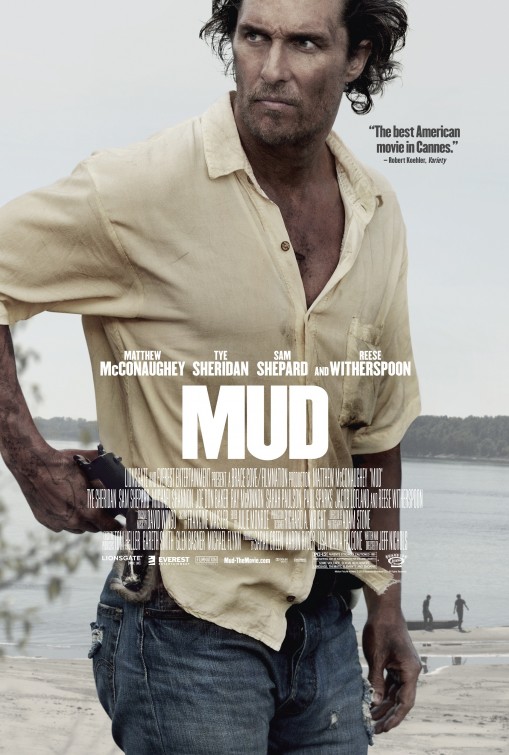
Written and directed by Jeff Nichols. Cast: Matthew McConaughey, Reese Witherspoon, Tye Sheridan, Sam Shepard, Michael Shannon, Joe Don Baker, Ray McKinnon, Sarah Paulson, Jacob Lofland, Paul Sparks, Bonnie Sturdivant. (PG-13, 132 mins)
MUD, the third feature by Arkansas filmmaker Jeff Nichols, continues to explore similar territory mined in his two previous works, 2008's SHOTGUN STORIES and 2011's TAKE SHELTER. In the gut-wrenching SHOTGUN, a small-town patriarch passes and the three sons by his second wife--who knew him as a loving, caring dad--clash with the three sons by his first wife, who remain bitter and resentful that their father abandoned them with their abusive mother and started his life over as a sober, born-again Christian, consciously choosing to have nothing to do with his first family. In TAKE SHELTER, the great character actor Michael Shannon (the oldest of the first set of brothers in SHOTGUN, and a Nichols regular) plays a rural Ohio husband and father who becomes obsessed with building a storm shelter in his backyard for reasons he can't explain but possibly have to do with his mother being diagnosed with paranoid schizophrenia at the same age he happens to be. In his first two films, Nichols focuses on fractured, troubled families in rural settings, portraying them as real people instead of cliched, condescending caricatures. Nichols' characters face deep-seeded problems both psychological and genetic that stretch across generations and haunt them through their lives. MUD expands on these ideas and is simultaneously Nichols' most ambitious and most predictable work. It's raw and emotional and steadily balances a large cast of supporting characters, but being Nichols' most commercial film yet, it's also very calculated and calls its shots a little too loudly. When characters start suddenly talking about things like snakebites and antivenom, and saying that one guy "used to be a sharpshooter," then there's a pretty good chance those traits will come into play in the most crowd-pleasing way possible. That's not to say MUD isn't a well-made and engrossing film, because it is. But because Nichols is going for some crossover mainstream appeal, he doesn't so much "dumb it down" as he "unsubtly foreshadows."
Returning to a rural Arkansas setting similar to SHOTGUN STORIES, MUD is the story of 14-year-old Ellis (Tye Sheridan), who lives in a houseboat with his struggling fisherman dad (Ray McKinnon) and his unhappy mother (Sarah Paulson). He regularly travels down the river with his best friend Neckbone (scene-stealing newcomer Jacob Lofland) and they discover a small, abandoned island with a boat stuck in a tree, which presumably happened during a hurricane. But the island has a resident: a fugitive named Mud (Matthew McConaughey), hiding from the authorities after killing the abusive beau of Juniper (Reese Witherspoon), the on/off-girlfriend he's loved since childhood. Mud and Ellis form a tentative bond as the boys keep his whereabouts a secret and bring him food and supplies and agree to help him get the boat down and reunite him with Juniper, who's hiding in an area fleabag motel. Meanwhile, the dead boyfriend's wealthy, car dealership-magnate father (Joe Don Baker back on the big screen!) has assembled a team of hired killers (Baker is introduced leading them in a bended-knee prayer circle) to scour the town and track down and take out Mud.
After years of sleepwalking through terrible romantic comedies--a task he's apparently delegated to Gerard Butler--MUD continues McConaughey's ongoing rebirth as a real actor taking his career seriously, but still manages to get his shirt off a couple of times to keep his base satisfied. He's matched by the fine work of young Sheridan (of Terrence Malick's THE TREE OF LIFE), whose Ellis is really the central character. The naive Ellis, facing some growing pains with the pending breakup of his parents and convincing himself that the two-years-older May Pearl (Bonnie Sturdivant) is his girlfriend, clings to the idealism of the relationship between Mud and Juniper. He believes it displays the love and commitment that he doesn't see with his parents or with May Pearl, who starts giving him the cold shoulder after one date. Ellis is able to overlook Mud killing a man because he did it for love, and reconnecting Mud and Juniper will, in his young mind, set things right. In many ways, Mud is an overgrown man-child, unable to control his temper (he's beaten nearly all of Juniper's ex's), and just as naive when it comes to adult relationships. MUD is, among other things, a film about fathers and sons and the cyclical nature of things passed down. Ellis' dad demonstrates a regretful instance of violence, and Ellis himself has difficulty controlling his temper, cold-cocking at least three people through the course of the film because he just can't contain himself. And the parent-child relationships that aren't fractured are non-existent: Mud's parents were long out of the picture and he was raised by local fisherman Tom Blankenship (Sam Shepard); and Neckbone is an orphan being raised by his uncle Galen (Shannon), who has moments of parental wisdom but generally still acts like a teenager. There's been some criticism leveled at the film in the way it presents the female characters as cold, selfish heartbreakers, but maybe they have their reasons: most of the male characters in MUD have some serious growing up to do.
Nichols is able to effectively fuse his usual rural, off-the-beaten path drama with a STAND BY ME-ish "summer that changed everything" movie and MUD is a worthy addition to this promising filmmaker's already-impressive body of work (SHOTGUN STORIES is currently the most recently-made film to air on Turner Classic Movies). It lacks the ambiguity of his earlier films (particularly the finale of TAKE SHELTER) but it shows that he can make a generally mainstream movie and still keep it recognizably his own. MUD is probably guilty of going with a feel-good Hollywood ending (I'm sure there's an alternate ending that will be offered on the Blu-ray) that Nichols likely wouldn't have chosen if it was Shannon starring instead of the bigger box-office draw of McConaughey, but it's still an excellently-acted and very worthwhile and thought-provoking piece of work. Currently 3-for-3, Jeff Nichols is a filmmaker you need to start paying attention to if you haven't already.