IT: CHAPTER TWO (US - 2019) Directed by Andy Muschietti. Written by Gary Dauberman. Cast: Jessica Chastain, James McAvoy, Bill Hader, Bill Skarsgard, Isaiah Mustafa, Jay Ryan, James Ransone, Andy Bean, Jaeden Martell, Wyatt Oleff, Jack Dylan Grazer, Finn Wolfhard, Sophia Lillis, Chosen Jacobs, Jeremy Ray Taylor, Teach Grant, Nicholas Hamilton, Javier Botet, Xavier Dolan, Jess Weixler, Taylor Frey, Molly Atkinson, Joan Gregson, Will Beinbrink, Stephen King, Peter Bogdanovich, Stephen Bogaert, Luke Roessler, Jackson Robert Scott, Ryan Kiera Armstrong, Joe Bostick, Megan Charpentier, Juno Rinaldi, Owen Teague, Jake Sim. (R, 169 mins) A blockbuster hit that currently stands as the highest-grossing horror film of all time (by present-day dollars and not by ticket sales or adjustment for inflation), 2017's IT, an adaptation of the first half of Stephen King's gargantuan 1986 novel, ushered in an era of renewed interest in the legendary author's work. This includes the Netflix films GERALD'S GAME and 1922, this year's remake of PET SEMATARY, this fall's DOCTOR SLEEP, a sequel to both King's novel The Shining and Stanley Kubrick's 1980 film version, which King has spent nearly 40 years criticizing, and several other announced film and TV projects in various states of development or production. Every generation has their genre touchstones, and IT--in many ways a hard-R GOONIES--has become a gateway film for impressionable young horror fans. Every generation's gateway is different, and just as aging purists who cut their teeth on Boris Karloff and Bela Lugosi dismissed the blood and guts horror that gained traction in the 1970s, it's easy to for us jaded cynics now in our 40s to take a shit all over whatever it is "the kids" are into and inevitably sound all Old Man Yells at Cloud. I liked IT--it didn't blow me away, but I can see where a 13-year-old might consider it a watershed moment that hopefully leads to further exploration. IT was entertaining but it relied heavily on the now-overused trope of "scary clowns" as well as the crutch of nostalgia, especially by updating the setting of the childhood section of the novel from 1958 to 1989. Of course this also meant recurring invocations of everything 1989, from BATMAN to LETHAL WEAPON 2 to A NIGHTMARE ON ELM STREET 5, and a running gag about New Kids on the Block. This retro fetishizing of everything '80s (all that's missing is a John Carpenter-esque synth score) is representative of the move in horror toward The Reference--the AMERICAN HORROR STORY/STRANGER THINGSification of the genre, if you will. And returning director Andy Muschietti and screenwriter Gary Dauberman push that even further in IT: CHAPTER TWO.
Running a bladder-challenging 169 minutes--a mere three minutes shorter than THE GODFATHER--IT: CHAPTER TWO is a disappointing sequel. With the first film's characters reconvening in 2016 after 27 years apart, the film is a success in terms of its effective casting choices and finding actors who, for the most part, strongly resemble the younger versions of their characters. When murders begin taking place in Derry 27 years after "It" was defeated, Mike Hanlon (Isaiah Mustafa), the town librarian and lone member of "The Losers" who never moved away, reaches out to his six childhood friends spread all across the country--Bill Denbrough (James McAvoy), a novelist and screenwriter with a habit of writing bad endings; Richie Tozier (Bill Hader), a popular but hacky stand-up comic who doesn't even write his own material; Eddie Kaspbrak (James Ransone), still a nervous hypochondriac who works insurance risk assessment and married a woman just like his mother (and played by the same actress, Molly Atkinson); Ben Hanscom (Jay Ryan), now an architect who lost all the weight that made him a target of incessant childhood bullying; Stanley Uris (Andy Bean), who grew up to be an accountant; and Beverly Marsh (Jessica Chastain), a successful fashion designer stuck in an abusive marriage. The reunion is one short when childhood memories come back to Stanley, who commits suicide rather than face the manifestation of It in Pennywise the clown (Bill Skarsgard). Those youthful traumas are only remembered by Mike, who informs the others that once you leave Derry, the memories slowly fade away. But with "It" rearing its ugly head again and the body count rising, the other Losers begin to remember. Through his research, Mike learns that the only way to defeat It is by performing "The Ritual of Chud," a Native American tribal rite that requires them to find one artifact from their childhood before venturing deep into It's lair underneath Derry.
The camaraderie of the young cast of IT--who also appear here in new scenes--was probably its most successful aspect aside from Skarsgard's wild performance as Pennywise. As in IT, the actor is too often replaced by herky-jerky CGI enhancement that almost makes his very presence pointless. IT: CHAPTER TWO, however, spends much of its length with the adult Losers on various solo quests to obtain their artifacts, during which time they have their own confrontations with the past and run-ins with It. There's also the grown-up bully Henry Bowers (Teach Grant), busted out of a mental institution by It in the form of the decayed corpse of his childhood partner-in-crime Patrick Hockstetter (Owen Teague); a little boy (Luke Roessler) who lives in Bill's childhood home and is a new target of It; and Ben's still-unrequited love for Beverly, and these are just some of the too many subplots that IT: CHAPTER TWO has to juggle while jettisoning key characters like Bill's movie star wife Audra (Jess Weixler) and Beverly's asshole husband Tom (Will Beinbrink), who are quickly introduced and never seen again, and still managing to find time for a jokey Stephen King cameo. The film seems long for the sake of being long, and certainly the interminable artifact quests, which constitute almost the entire second hour, could've been condensed or perhaps would've played better if this were made into the limited cable series that it often seems to be emulating, especially with the extended wrap-up that feels more like a series finale than the ending of a movie.
The MVP standout is Hader, whose grown-up Richie is given a new layer of characterization that could've easily come off as woke pandering but is brought to life with heartfelt empathy by the SNL vet, best known for his comedic skills but someone I can easily see morphing into a versatile dramatic actor of the Micheal Keaton variety. As it is, IT: CHAPTER TWO is the HOBBIT of Stephen King adaptations. For all its bloat and overlength despite dumping huge chunks of the novel, it's a story that could've easily been told in two hours, but its predecessor was such a success that Muschietti was likely given carte blanche to run as long as he wanted. It has its moments, but they're spread out over the nearly three-hour run time. Any experienced horror fans will see the jump scares coming a shot before they do since Muschietti's set-ups are all the same, and Pennywise's now-repetitive antics seemed much scarier when they were aimed at the childhood-era Losers (and nothing here even comes close to the terrifying slide projector scene in the first film). Plus, the endless referencing and shout-outs--to things like THE THING, ALIENS, THE SHINING, STAND BY ME, THE LOST BOYS, and even Hader is forced to utter a groaner in the form of DIE HARD's most iconic line in the final battle with Pennywise--just feels lazy. Right around the point when adult Eddie's frightful run-in with It in the dank, cavernous basement of the Derry pharmacy is punctuated by what might go down as the dumbest and most pointless needle-drop in film history in the form of Juice Newton's 1981 hit "Angel of the Morning," I was pretty much over this chapter of IT.
MISS SLOANE (France/US/UK - 2016) Directed by John Madden. Written by Jonathan Perera. Cast: Jessica Chastain, Mark Strong, Gugu Mbatha-Raw, Alison Pill, Michael Stuhlbarg, John Lithgow, Sam Waterston, Jake Lacy, Christine Baranski, David Wilson Barnes, Chuck Shamata, Dylan Baker, Ennis Esmer, Raoul Bhaneja, Douglas Smith, Meghann Fahy, Lucy Owen, Michael Cram, Joe Pingue. (R, 132 mins) A sort-of MICHAEL CLAYTON take on the gun control lobby, MISS SLOANE is fairly transparent end-of-the-year awards bait that works more often than it doesn't and serves as a reminder that movies for grown-ups used to not be such a rare commodity. The crammed story perhaps bites off more than it can chew yet still seems a little long running past the two-hour mark, and frequently seems like it could've been better served as an HBO or FX series. It also can't help but feel like Aaron Sorkin fan fiction, with debuting screenwriter Jonathan Perera slavishly devoted to the Sorkin style, from every line of dialogue sounding like an over-rehearsed proclamation to the presence of NEWSROOM co-stars Sam Waterston and Alison Pill to dubiously silly character names, though in fairness to Perera, neither "Rodolfo Schmidt" nor "Esme Manucharian" seem quite as improbable as Olivia Munn as THE NEWSROOM's chief financial reporter "Sloan Sabbith," though a point is made of Schmidt's middle name being "Vittorio." Though dealing with a topical subject matter, director John Madden (SHAKESPEARE IN LOVE, THE BEST EXOTIC MARIGOLD HOTEL) gives MISS SLOANE a '70s aesthetic in its matter-of-fact, Alan J. Pakula-esque presentation, right down to a clandestine meeting in a dimly-lit Washington, D.C. parking garage that's straight out of ALL THE PRESIDENT'S MEN.
Elizabeth Sloane (Jessica Chastain in icy and driven ZERO DARK THIRTY mode) is a top shark for a powerful D.C. lobbying firm run by George Dupont (Waterston). Dupont wants her to work with Bob Sandford (Chuck Shamata), a representative from an NRA-type organization looking to bring women aboard the pro-gun movement. Elizabeth derisively dismisses the idea, with everyone wrongfully assuming she lost a loved one in a mass shooting. Her rationale is simple: she has the skills and the power plays to sell anything on Capitol Hill, but pushing to make gun access easier is where she draws the line and grows a conscience. She quits Dupont's firm in protest and joins a smaller outfit owned by Rodolfo Schmidt (Mark Strong) that's backing a mandatory background check bill that Dupont and his new top gun Pat Connors (Michael Stuhlbarg) are working to help Sandford shut down. Elizabeth pulls out every trick in the book, putting the cause before all else, including outing colleague Esme Manucharian (Gugu Mbatha-Raw) as a survivor of a high school massacre 20 years ago, something Esme has kept buried from everyone except Schmidt. As Elizabeth's former colleagues--Dupont, Connors, and Jane Molloy (Pill)--plot her downfall with a forgotten incident in her past involving paying for a congressman's overseas trip as part of a lobby for palm oil tariffs (way too much time spent on that scintillating subject), Miss Sloane sets her own plan in motion that exemplifies her core philosophy: play your trump card right after they play theirs and make sure you surprise them.
Chastain commits to the character even as Perera's script has her go through all the predictable arcs. We learn little about Miss Sloane as a person other than she's a loner who doesn't relate to people, thinks only of her work, abuses prescription pills, and frequently enlists the services of male escorts when she needs a release or to "fantasize about the life I didn't want." When her usual appointment skips town, she meets his replacement Forde (Jake Lacy), and it's all business until he starts to sense real feelings in her, and she of course shuts down and sends him away, her illusion of emotionless isolation shattered. You see moments like this coming, and others like the desk-clearing fit of rage when her back's against the wall, the opposition is beating her, and she's questioning her entire career. Told mostly in a series of flashbacks as Elizabeth is testifying before a Congressional hearing overseen by a vindictive senator (John Lithgow) and not following her attorney's (David Wilson Barnes) advice and invoking the Fifth, MISS SLOANE sometimes suffers from its characters giving speeches in lieu of having actual, real-life conversations, but it does a mostly commendable job of replicating an "issues" movie from back in the day, fused with the least grating tendencies of its obvious inspiration in Aaron Sorkin. Madden and Perera succeed in making it less about taking sides on the gun issue and more about the characters while keeping the preachy, hectoring sanctimony (like, everything that ever came out of the mouth of Jeff Daniels' Will McAvoy on THE NEWSROOM) that's often Sorkin's Achilles heel, to a minimum.
CRIMSON PEAK (US - 2015) Directed by Guillermo del Toro. Written by Guillermo del Toro and Matthew Robbins. Cast: Mia Wasikowska, Jessica Chastain, Tom Hiddleston, Charlie Hunnam, Jim Beaver, Burn Gorman, Leslie Hope, Doug Jones, Bruce Grey, Jonathan Hyde, Sofia Wells, Emily Coutts. (R, 119 mins)
It seems as if all of Guillermo del Toro's films are long-gestating dream projects he's had toiling in the deepest recesses of his mind since he was a child. He announces more projects that he can possibly make (face it, kids--PACIFIC RIM 2 ain't happening) and there's seemingly no end to his boundless imagination and love for what he does. Del Toro's latest, CRIMSON PEAK, is an absolute triumph of style, set design, costuming, and an almost choking Gothic aura. Among the most ambitious of throwback homages, it plays like a never-made film where Alfred Hitchcock chose Mario Bava to be his cinematographer. It's the realization of what might've happened if Merchant-Ivory remade THE SHINING and moved it to Victorian-era England. Owing as much to Henry James, Daphne du Maurier, Charlotte Bronte, and Edith Wharton as it does to THE HAUNTING THE CHANGELING, and del Toro's own back catalog, CRIMSON PEAK is more of a supernatural Gothic tragedy than a non-stop frightfest, which isn't to imply that it skimps on the shocks and the gore. The jolting scares and the shocking violence are sporadic enough that del Toro makes them count. The found-footage and the digital splatter crowd will probably be bored senseless by CRIMSON PEAK--like the Wachowskis, del Toro is a visionary who still somehow manages to get studios to spend exorbitant amounts of money on his wildly inventive and very personal passion projects. CRIMSON PEAK is probably the best-looking film of the year, and it's a rare case where the surface beauty and visuals are stunning enough to give its writing and structural weaknesses a pass. The script, by del Toro and Matthew Robbins (his writing collaborator on MIMIC and the del Toro-produced DON'T BE AFRAID OF THE DARK), with uncredited contributions from British playwright Lucinda Coxon, hinges on too many predictable plot twists and familiar elements you've seen in a hundred other Gothic dramas and ghost stories. Had the plot been a little more inventive and up to del Toro's standards of production design, he would've had a legitimate classic instead of the year's best-looking retread. The layout, the decor, the architecture--del Toro's attention to even the most minute aesthetic detail is obviously obsessive on a Stanley Kubrick level. As exquisitely and hypnotically jaw-dropping as CRIMSON PEAKS looks, it's obvious where del Toro's priorities lied.
Just after the turn of the 20th century in Buffalo, shy Edith Cushing (Mia Wasikowska) has aspirations of being the next Mary Shelley. A headstrong, independent young woman forced to grow up early upon the death of her mother, Edith had an early supernatural experience as a child when she was visited by the ghost of her mother (played by del Toro's go-to guy Doug Jones) and warned to "Beware of Crimson Peak!" A bit of a loner with no interest in being a snobbish society matron, Edith lives with her loving, protective industrialist father Carter (Jim Beaver) and keeps ophthalmologist and potential suitor Dr. Alan McMichael (Charlie Hunnam) in the friend zone, but her comfortable upper-class life is upended with the arrival of Sir Thomas Sharpe (Tom Hiddleston) and his sister Lady Lucille Sharpe (a delightfully scowling Jessica Chastain) from England. Sir Thomas is hoping to convince Carter to invest in a machine that mines clay from the earth, but Carter is unconvinced of the worth of the machine and dismisses Sir Thomas and his "soft hands" as indicative of a life of too much privilege. After Sir Thomas begins courting Edith in an attempt to prove his worth, Carter has a private investigator (Burn Gorman) look into the Sharpe's background and is so perturbed by what he finds that he pays Sir Thomas to break Edith's heart and leave Buffalo at once. When Carter is brutally murdered, Edith finds solace and comfort in the loving arms of Sir Thomas and the two are quickly married, much to Alan's suspicion and Lady Lucille's apparent seething jealousy.
When the newlyweds and Lady Lucille relocate to the Sharpe ancestral home at Allerdale Hall, a decrepit mansion so far out in rural England that it's four hours to the nearest town, the truth becomes clear: the Sharpes are penniless, and Allerdale Hall is in almost complete ruins, with a hole in the roof that allows leaves , rain, and snow to pour down directly into the main living room. It also rests on a large deposit of natural clay into which it's been very slowly sinking for decades. While it's clear the Sharpes are running a con game of sorts in an attempt to get Edith's money, it's also obvious that Allerdale Hall is haunted by the vengeful ghosts of those who have died within its walls. Edith encounters these ghosts but can't convince Sir Thomas or Lady Lucille that they're real, and Edith grows even more alarmed when she learns that, because of the red clay surrounding Allerdale Hall, the home is referred to by some as "Crimson Peak," the very place the ghostly spectre of her mother warned her about years earlier.
While reminiscent of Rebecca and The Turn of the Screw, CRIMSON PEAK has a long stretch of being a Victorian take on THE SHINING. From her childhood, Edith has had a "shining" of sorts that she blocked and let manifest in her writing of ghost stories. The Kubrickian design and layout of Allerdale Hall, with its endless corridors, a bathtub scene that's a blatant riff on Jack's encounter in room 237, a ball that enters the frame and rolls to Edith but there's no one there who could've rolled it to her, and warnings from Lady Lucille to stay out of certain areas, all owe a debt to at least Kubrick's (perhaps not Stephen King's) vision of the Overlook Hotel. There's even a Dick Hallorann surrogate in Alan, who journeys overseas from Buffalo to England and travels a great distance in a blinding blizzard to the snowed-in Allerdale Hall in an attempt to rescue Edith once he realizes the Sharpes' true intent. All of this looks incredible, but in terms of story and theme, del Toro's a bit on autopilot. His efforts were unquestionably concentrated in the visual aspects of the film, and to that respect, it works beautifully. If you want an impossibly gorgeous piece of Gothic eye candy, you can't beat CRIMSON PEAK, which demands to be seen on as big of a screen as possible. Del Toro has said, in envisioning Edith as his heroine, that CRIMSON PEAK is for his "inner 14-year-old bookish girl." That's a telling statement, because in terms of content, CRIMSON PEAK isn't really for 14-year-old bookish girls, but its character arcs and story progression could've very well been concocted by a 14-year-old del Toro. There's a lot to love here, especially if you're a fan of Gothic chillers, haunted mansions, and the garish lighting of Roger Corman's AIP Poe adaptations and when Mario Bava started making movies in color with 1964's BLACK SABBATH. But del Toro the screenwriter just isn't working at the same level as del Toro the director.
THE MARTIAN (US - 2015) Directed by Ridley Scott. Written by Drew Goddard. Cast: Matt Damon, Jessica Chastain, Chiwetel Ejiofor, Kristen Wiig, Jeff Daniels, Michael Pena, Kate Mara, Sean Bean, Sebastian Stan, Aksel Hennie, Benedict Wong, Mackenzie Davis, Donald Glover, Chen Shu, Eddy Ko, Nick Mohammed. (PG-13, 141 mins)
During a manned mission to Mars, a catastrophic storm suddenly appears and the crew of the Ares III is ordered to evacuate the landing site and abort the mission by Cmdr. Melissa Lewis (Jessica Chastain). Astronaut Mark Watney (Matt Damon) is blown away by a satellite antenna in a powerful gust of wind and when he doesn't respond and his vitals cease to register, he's presumed dead and Lewis and the crew--Martinez (Michael Pena), Johansson (Kate Mara), Beck (Sebastian Stan), and Vogel (Aksel Hennie)--begin the ten-month journey home. But Watney survived, though he's been impaled by an antenna and has no way to communicate to anyone at NASA that's he's been left behind. With enough pre-packaged meals for the entire crew to last 400 sols (a Martian sol being slightly longer than an Earth day) if he rations carefully, he must find a way to grow food to last four years until the next planned manned Mars expedition. Fortunately, Watney is a botanist and uses his wits and ingenuity ("I'm gonna have to science the shit out of this thing") to grow a small potato crop. Around the 54th sol after being left behind, Mars expedition director Dr. Vincent Kapoor (Chiwetel Ejiofor) and graveyard-shift NASA analyst Mindy Park (Mackenzie Davis) notice movement of structures on satellite imagery of the landing site, proof that Watney is alive. What follows is the thoroughly engrossing saga of Watney's struggle to survive when faced with one catastrophic obstacle after another, and the efforts of those at NASA to get him home.
Adapted by Drew Goddard (THE CABIN IN THE WOODS) from the novel by Andy Weir, THE MARTIAN is career highlight for director Ridley Scott (BLADE RUNNER, THELMA & LOUISE), an ageless workaholic who shows no signs of slowing down at 77 years of age (he just had EXODUS: GODS AND KINGS in theaters ten months ago). Unlike 79-year-old Woody Allen and 85-year-old Clint Eastwood, two legends who seem to crank out annual movies more out of obligation than anything, Scott still seems interested in challenging himself, whether it's venturing back to the ALIEN universe for PROMETHEUS or going way off on a tangent with the inspired and insane THE COUNSELOR. Scott's hardly been skidding, but THE MARTIAN is his best work in years, a masterful mix of drama, humor (there's a great running gag about Lewis' terrible taste in music), thrills, hard science, and escapist entertainment, operating at a level of quality you rarely see these days. It's rousing without being pandering, and filled with baited-breath intensity, and emotion and sentiment that's earned and not forced. It's a crowd-pleasing popcorn movie done right, with a terrific ensemble whose performances make a very human and universal story rather than simply "CAST AWAY in space." The world comes together in plausible ways to rally behind Watney and his safe return--the Chinese space program even sets its own ambitions aside to work with rival NASA by contributing a necessary booster that the Americans have yet to develop. There's a certain element of "Nobody gets left behind!" but it's not a jingoistic flag-waver. Watley's plight unites the planet.
Sure, that could've been some hokey, feel-good bullshit, and a man stranded alone on the red planet has been explored to some degree in the revered 1964 sci-fi classic ROBINSON CRUSOE ON MARS, but Damon's performance, filled with raw emotion, self-deprecating humor, and a spirit of dogged persistence, is nicely juxtaposed with a large cast of characters. They all get moments in the spotlight (with the possible exception of Kristen Wiig, who isn't given much to do as NASA's media relations coordinator), from each of Watney's fellow astronauts to the brilliant scientific minds on the ground (Ejiofor's Mars mission director, Sean Bean as the launch director, Benedict Wong as a rocket designer, and Donald "Childish Gambino" Glover as an astrodynamicist), to Jeff Daniels as the bottom-line, very Jeff Daniels-ish NASA chairman, a character that other films would've made into an obligatory earthbound adversary but here, his blunt demeanor that occasionally comes off as insensitive is just a realistic reaction to the situation. THE MARTIAN is a triumph across the board, from its story to its performances to its astonishing visual effects, particularly in the tense, nerve-wracking climax. Most of the film was shot on sets constructed at a Hungarian studio, but the Mars exteriors were shot in the Wadi Rum desert in Jordan, looking appropriately desolate and otherworldly through the lens of cinematographer Dariusz Wolski (working on his fourth straight Scott film), augmented by the appropriately otherworldly, Tangerine Dream-ish synth score by Harry Gregson-Williams, who also contributed to the soundscapes of Michael Mann's underrated BLACKHAT. THE MARTIAN is the most satisfying and thrilling time at the movies since MAD MAX: FURY ROAD, and like the mad genius George Miller, the great Ridley Scott is essentially conducting a seminar on how it's done.
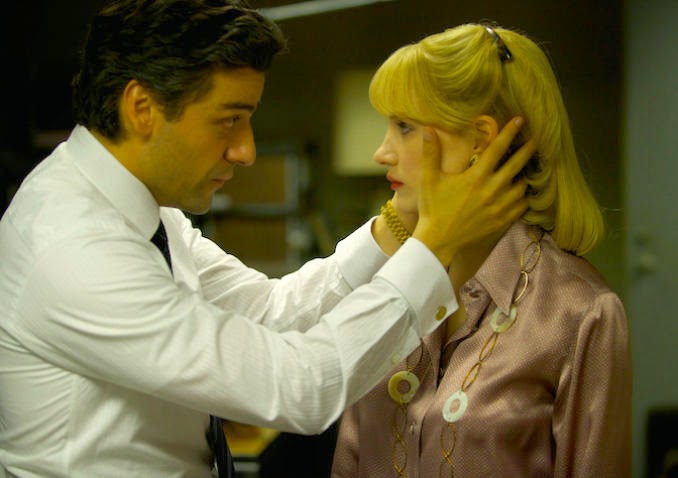
A MOST VIOLENT YEAR (US/United Arab Emirates - 2014) Written and directed by J.C. Chandor. Cast: Oscar Isaac, Jessica Chastain, David Oyelowo, Albert Brooks, Alessandro Nivola, Elyes Gabel, Catalina Sandino Moreno, Peter Gerety, Christopher Abbott, Ashley Williams, Jerry Adler, Elizabeth Marvel, David Margulies, Glenn Fleshler, John Procaccino, Robert Clohessy, Annie Funke. (R, 125 mins)
If you were to walk into J.C. Chandor's A MOST VIOLENT YEAR blind, knowing nothing about it, you might very well think it's a lost Sidney Lumet "gritty NYC" movie that's been on the shelf since 1981. In the course of just three films since 2011--he previously wrote and directed the mesmerizing financial meltdown chronicle MARGIN CALL and the Robert Redford lost-at-sea survivalist drama ALL IS LOST--Chandor has established himself as arguably the most versatile young talent in American filmmaking. With A MOST VIOLENT YEAR, Chandor wears his love of Lumet and a bygone era of NYC filmmaking on his sleeve. Set in the winter of 1981 during a record wave of violent crime, A MOST VIOLENT YEAR crackles with the kind of energy and intensity you just don't see much of these days. This is a movie for people who like big-city corruption dramas of the 1970s and early 1980s. Chandor's attention to detail is sharp and precise, and he lets the atmosphere, characterization, and performances convey the era rather than resorting to the easy, go-to tropes of garish clothing or the popular music of the period, which usually means a scene in a disco where Blondie's "Heart of Glass" is playing, or making the whole film play like the coked-up paranoia section of GOODFELLAS, which only works if you're AMERICAN HUSTLE. The problem with many of today's films that are set in the 1970s and 1980s is that they overdo the easy signifiers like hairstyles, clothing, and music. Chandor doesn't even break out those crutches, and instead approaches A MOST WANTED YEAR from a you-are-there 1981 perspective devoid of any sense of nostalgia. It's as if he's possessed by the spirit of the late, legendary Lumet.
In a performance that channels the best of the youthful Al Pacino and Robert De Niro, Oscar Isaac (INSIDE LLEWYN DAVIS) is Abel Morales, the president of the relatively small-time Standard Heating Oil. Abel has several rivals throughout the Five Boroughs, and they're all jockeying for better positions in the local market. Abel and his business partner/wife Anna (Jessica Chastain) have dumped their life savings into a deposit on a riverfront land purchase from Hasidic businessman Josef (Jerry Adler), a fuel and oil storage facility that will give Abel leverage in the local competition. All he needs to do is come up with $1.5 million in 30 days and the land is his. Otherwise, Josef keeps the deposit and sells the property to a competitor. Abel is stressed but confident. He runs a clean business, prides himself on Standard's presentation and dedication to customer service, and has a great relationship with his bank. Of course, everything starts falling apart. For the last year, Abel's trucks have been occasionally hijacked on their routes, the drivers assaulted and the oil sold to the competition. These occurrences have been on an alarming increase, the latest one resulting in dedicated driver Julian (Elyes Gabel) getting his face smashed and his jaw broken. Abel and his lawyer Andrew Walsh (an almost unrecognizable Albert Brooks) go to District Attorney Lawrence (David Oyelowo) to address the problem, only to be told that the city's been riddled with crime for over a year and hijacked heating oil trucks aren't a priority. And on top of that, Lawrence is launching an investigation into corruption among the city's heating oil providers, with a particular emphasis on Standard. And when the hijackings continue, Walsh and Anna, behind Abel's back, make an agreement with Teamsters rep O'Leary (Peter Gerety) to supply the drivers with guns accompanied by permits that range from sketchy to completely forged.
As all of these issues crash in on the beleaguered Abel, he keeps telling himself that everything will be OK because he runs an honest business, but he's deluding himself. In the revisionist bio he's imagined for himself, he thinks he's built the business from the ground up, when in fact, he bought it cheap from his low-level mobster father-in-law, with Anna cooking the books in a subtle enough way that it's taken the D.A.'s office ten years to catch on to it. An immigrant, Abel believes in the American dream so much that he's willing to convince himself that he's above the corruption that infests his chosen industry. In a very intense, controlled, and pitch-perfect performance, Isaac vanishes into his character the way a young Pacino and De Niro would. His Abel Morales is, at his core, a fundamentally good man who thinks that as long as he doesn't see something illegal happening, everything's going to be OK. He's too smart to not know about Anna's machinations, whether she's falsifying tax records or skimming off the top. The one major flaw in Chandor's script is the sometimes one-dimensional presentation of Anna, though it's not the fault of Chastain. She's a loving wife and, in a rarity for this type of film, an equal partner, but she's still too often cartoonishly bitchy and ruthless, saddled with heavy-handed, melodramatic ways of showing that she's the decisive ballbuster while Abel needs to man up and get with the program, such as the scene where they're driving home from dinner and hit a deer. Opting to put the poor creature out of its misery, Abel hesitantly dithers with a tire iron, while Anna pulls out a gun and shoots it in the head.
Elsewhere, Chandor offers two marvelous, pulse-pounding chase sequences--one during a shootout on the 59th Street Bridge in heavy traffic, the other a long, stunning FRENCH CONNECTION homage when Abel hears a truck hijacking on the radio and realizes he's right in the area where it's taking place. At the end, after a bitingly cynical dialogue exchange between Abel and Lawrence that illustrates just how intertwined politics and business really are, A MOST VIOLENT YEAR is still just Lumet-worship first and foremost (with some bonus affection for guys like William Friedkin and Alan J. Pakula). But it's the closest thing to a new Sidney Lumet film that you're ever going to get, and I imagine that's the best praise one can bestow upon it. Dialogue-heavy and character-driven, set in a world that exists in a perpetual shade of moral and ethical gray, A MOST VIOLENT YEAR is the kind of film that should've been an Oscar darling, but still-not-ready-for-prime-time distributor A24 Films only gave it a minimal, NYC/L.A. release on December 31, 2014. While that wasn't a fatal mistake, A24 completely fell asleep on the job when they were too late getting screeners out to Academy members to qualify it for awards consideration. As a result, what was pegged as a surefire Oscar candidate ended up with exactly zero nominations, all but killing its awards-season momentum and any moviegoer interest with the film finally opening nationwide at the end of January. Nevertheless, its day will come, as it's the work of a strong, confident filmmaker who's only starting to hit the peak of his powers. There's going to be some great films from J.C. Chandor in the coming years.
INTERSTELLAR (US - 2014) Directed by Christopher Nolan. Written by Jonathan Nolan and Christopher Nolan. Cast: Matthew McConaughey, Anne Hathaway, Jessica Chastain, Michael Caine, Ellen Burstyn, John Lithgow, Matt Damon, Casey Affleck, Wes Bentley, Mackenzie Foy, Topher Grace, David Gyasi, William Devane, Timothee Chalamet, Leah Cairns, David Oyelowo, Collette Wolfe, voices of Bill Irwin, Josh Stewart. (PG-13, 169 mins)
Like the work of his contemporary David Fincher, the films of Christopher Nolan are among the very few that qualify as legitimate "event" films. A master filmmaker who, like Fincher, consistently draws comparisons to Stanley Kubrick, Nolan has one of the finest track records of any filmmaker in the modern era, even with the inevitable backlash that comes with such a high level of acclaim. Through MEMENTO, the DARK KNIGHT trilogy, and INCEPTION, Nolan's scope and vision grow with each new project. His latest film, INTERSTELLAR, is his most ambitious yet, a stunning sci-fi saga filled with state-of-the-art visual effects, a memorable, organ-driven Hans Zimmer score, breathtaking cinematography by Hoyte Van Hoytema (TINKER TAILOR SOLDIER SPY), and excellent performances all around, and one packed with such grandiose vision that it can't be contained in one reality or even in one galaxy. With obvious influences including the likes of Kubrick's 2001: A SPACE ODYSSEY (1968) and Andrei Tarkovsky's SOLARIS (1972), along with Douglas Trumbull's SILENT RUNNING (1972), Robert Zemeckis' CONTACT (1997), and Danny Boyle's SUNSHINE (2007), INTERSTELLAR often feels like it's juggling too many hard sci-fi concepts. On one hand, it's almost impossible to not marvel at such a staggering achievement, but on the other, it magnifies Nolan's few weaknesses. In the span of just a few moments, your mouth is agape at what you're seeing, then you're groaning as the characters overexplain something for the third or fourth time. Again utilizing his trademark intercutting (think of that SUV's endless plummet into the water in INCEPTION), Nolan can present a brilliantly-edited set piece of nail-biting intensity with three or more distinct and equally suspenseful things simultaneously unfolding, then follow it with a hoary cliche like someone taking their last dying, gasping breath as they're about to reveal a deep, dark secret.
INTERSTELLAR takes place in a near future where Earth is dangerously close to being unable to sustain itself. Crops are scarce--they've just lost okra and corn is on its way out. Cities resemble a new Dust Bowl, the New York Yankees play to a crowd that consists of a few people on a small set of bleachers and the roster is filled with people who have no idea how to play baseball. Cooper (Matthew McConaughey) is a NASA-trained ex-pilot and widower struggling to make it as a farmer while supporting his teenage son Tom (Timothee Chalamet), ten-year-old daughter Murph (Mackenzie Foy), and his wry, wise father-in-law Donald (John Lithgow). Times have changed--all government money goes toward farming and organizations like NASA have been disbanded and discredited, as evidenced by Murph getting suspended from school for bringing an old textbook that doesn't reflect the new accepted version of history: that NASA wasn't a legit outfit and the moon landings were faked to help bankrupt the Soviet Union. Books keep falling off of Murph's bookshelf and Cooper dismisses her talk that it's a "ghost." Dust blowing in the windows falls in a specific pattern on her bedroom floor. Scientist and curious mind that he still is at heart, and Murph being his daughter, they eventually figure out that the pattern is a code for coordinates on a map. They follow it and stumble on a seemingly abandoned NORAD outpost in the desert that houses what's left of the space program: Cooper's old mentor Prof. Brand (Michael Caine), his protegee/daughter Amelia (Anne Hathaway), scientists Doyle (Wes Bentley) and Romilly (David Gyasi), and the de facto head of NASA (William Devane). Brand tells Cooper that 50 years earlier, a wormhole was discovered behind Saturn and probes sent through it found another galaxy with a dozen potentially habitable planets. Earth has, at most, a generation left before it dies, and they need to find another planet to sustain human life and carry on the species, either by colonizing it with the humans left on Earth or, if that fails, by incubating fertilized eggs on the new planet. Twelve astronauts were sent on a mission a decade earlier to survey each of the planets. Nine have been eliminated from contention and Amelia, Doyle, and Romilly need a pilot to get them through the wormhole to investigate the three planets where colonization has been deemed possible and attempt to locate the surviving astronauts.
Of course, Cooper leaves his family behind and has no idea how long he'll be gone, which doesn't go over well with Murph. A miscalculation by Amelia results in three members of the team--Amelia, Cooper, and Doyle--spending over three hours on a planet where one hour equals seven Earth years. When they return to the main spacecraft, Romilly is 23 years older and there's communication messages from the now-grown Tom (Casey Affleck) and the still-resentful Murph (Jessica Chastain), who's now working with the elderly and wheelchair-bound Prof. Brand to finish the equation that will being the quartet back to Earth. It's here that INTERSTELLAR goes in directions that are best approached knowing as little as possible.
In many ways, it's 2001: A SPACE ODYSSEY if Kubrick films had the ability to be warm and sentimental. And that streak of sentimentality is where INTERSTELLAR sometimes stumbles. Nolan is clinical and doesn't wear sentimental well. His protagonists--think Guy Pearce's Leonard Shelby in MEMENTO, Christian Bale's Alfred Borden in THE PRESTIGE and Bruce Wayne in the DARK KNIGHT trilogy, Leonardo DiCaprio's Dom Cobb in INCEPTION--are driven by emotion that's been distorted into obsession and, in most cases, revenge. That cold focus is something that draws the Kubrick analogies. Practically every major character in INTERSTELLAR gets a scene where Zimmer's score--quite majestic and often dark but still a bit much at times--swells up John Williams-style as tears roll down their faces. This look doesn't suit Nolan, and sometimes, the film seems less inspired by 2001: A SPACE ODYSSEY or SOLARIS or SUNSHINE (there's even talk of doing a shortcut to "sling-shot" around a black hole to land on one of the planets, much like the Boyle film's last-ditch, desperate "sling-shot" effort to drop the payload and restart the sun), and more like a secret, elaborate, hard sci-fi adaptation of the 1977 Todd Rundgren/Utopia song "Love is the Answer." The song's not in the movie, but someone at a more maudlin point in the proceedings alludes to love being the answer, which made me think of the song, and well, here, read the lyrics:
Name your price
A ticket to paradise
I can't stay here any more
And I've looked high and low
I've been from shore to shore to shore
If there's a short cut I'd have found it
But there's no easy way around it
Light of the world, shine on me
Love is the answer
Shine on us all, set us free
Love is the answer
Who knows why
Someday we all must die
Were all homeless boys and girls
And we are never heard
It's such a lonely world
People turn their heads and walk on by
Tell me, is it worth just another try?
Tell me, are we alive, or just a dying planet?
What are the chances?
Ask the man in your heart for the answers
Nolan's films have a grim darkness to them and that extends to INTERSTELLAR, particularly in some the mid-film plot turns. All the tears and the crying makes for an uneven work as Nolan and his screenwriter brother Jonathan try to have it both ways, and it's the same thing that made something like A.I.: ARTIFICIAL INTELLIGENCE (2001) so frustrating, as Steven Spielberg brought a never-realized Kubrick project to life and you can see in the film the precise moment where Kubrick's cold, clinical script ended and Spielberg's heart-tugging contributions took flight. Some of it works with INTERSTELLAR, particularly Cooper seeing the 23 years older Murph on a video message and realizing how bitter she remains over him leaving. It's heartbreakingly played by both McConaughey and Chastain, who's very good throughout. Other times, such as the climax (well, one of the climaxes, I should say), which follows this film's version of 2001: A SPACE ODYSSEY's "Jupiter and beyond the infinite..." set piece, and Prof. Brand's repeated invocation of Dylan Thomas' "Do Not Go Gentle Into That Good Night," the Nolan brothers are just belaboring the point for maximum mawkishness.
Please note that these are immediate reactions. Like Kubrick, Nolan is a filmmaker whose work is difficult to judge on one viewing. That's never been the case more than it is with INTERSTELLAR, a flawed film with some issues of tone that nonetheless has too many brilliant sequences and powerful performances to dismiss. There's a lot to process here, and for everything that doesn't work, there's ten things that do. Performances are terrific across the board, with Hathaway, Lithgow, and young Foy also standing out, in addition to a sardonic and droll work by Bill Irwin as the voice of TARS, the ship's robot, ballbusting the crew with his humor setting at 95% ("Why don't we take that down to 75?" Cooper instructs TARS after the robot jokes about using them as slaves for his planned robot colony). It's a gargantuan, visually dazzling, and often thematically bold piece of work, but in the end, it's really just a bigger, longer SUNSHINE, one of the most underrated sci-fi films of the last decade. INTERSTELLAR is demonstrative of Nolan wanting to make his Kubrick groundbreaker and Tarkovsky art film but needing to make sure it's Spielberg-accessible and audience-friendly. Most of the time, the reconciling of those two goals balances out, but the film struggles in the moments when that balance is lost.
Directed by Andy Muschietti. Written by Neil Cross, Andy Muschietti, Barbara Muschietti. Cast: Jessica Chastain, Nikolaj Coster-Waldau, Megan Charpentier, Isabelle Nelisse, Daniel Kash, Javier Botet, Jane Moffat. (PG-13, 100 mins)
Old-school jolts and some unusually strong performances for genre fare of this type elevate a potentially shopworn premise like MAMA's to a higher level. Yes, it's another story about a vengeful, malevolent spirit invading a house, but with the proceedings overseen by Guillermo del Toro (who's a bit more involved when he "presents" something than, say, the way Wes Craven would allow his name to be thrown on anything in the years right after SCREAM if the price was right), it's a cut above the norm, which, these days, usually mandates a found-footage premise. Not here. Del Toro protege Andy Muschietti, who also co-wrote the script with his sister Barbara (they dedicate the film to their mother), expands his 2008 short film of the same name and fashions a relentless, old-fashioned scare machine of a fright flick with no gore and only some occasionally wonky spirit CGI.
Two young girls, ages 3 and 1, are taken to a remote cabin in the middle of nowhere by the Wall Street broker father, who's just killed his business partners and his estranged wife. He's about to kill the oldest daughter when something comes from the wall and grabs him. Five years later, the girls' uncle Luke (Nikolaj Coster-Waldau of GAME OF THRONES) and his girlfriend Annabel (the ubiquitous Jessica Chastain, who will probably have three more films in the can by the time you finish reading this), a bassist in a punk rock band, are notified that the girls have been found. Victoria (Megan Charpentier) is now 8, and Lily (Isabelle Nelisse) 6, and both have been living in the wild all this time. Victoria already had an established vocabulary and remembers their dog who now lives with Luke and Annabel, so her reintegration into a normal life is going much smoother than Lily's, who was still a baby at the time of their abandonment is now completely feral, crawling on all fours, unable to form sentences, eating nothing but cherries and the occasional insect, and refusing to even wear shoes. Both girls keep referring to "Mama," and their psychologist (Daniel Kash) thinks this is a separate personality that Victoria has developed in caring for Lily, who literally clings to her sister. But when the girls call for "Mama," Victoria's eyes are filled with fear. She knows to be afraid of what Mama is capable of doing. Mama has followed them from the cabin to Luke and Annabel's house, a spirit residing in the wall at the back of their closet, fiercely protective of the girls she's loved and cared for over the last five years and not about to let anyone usurp that position in their lives. When Luke ends up in a coma after a Mama-provoked tumble down the stairs, Annabel is forced to take care of the girls, a job she flat-out doesn't want (she's introduced in a state of joy over a home pregnancy test coming up negative), but she steps up when it matters, and when she manages to make a breakthrough with each girl, a bond is formed and affection develops, and, well, Mama is upset, to put it mildly.
From a strictly technical standpoint, Muschietti does a terrific job with the staging of the film's many effective scare sequences. One in particular, with the stationary camera showing a hallway and the parallel entrance to the girls' room, as activity takes place in the girls' room (Lily is playing with what we initially assume to be Victoria, but Victoria is then seen in the hallway, and then we see a strange shadow in the room with Lily) is the kind of scene that's guaranteed to make future "100 Scariest Movie Moments" TV specials. It's one of several that had the audience buzzing throughout the film. I like the way Muschietti and cinematographer Antonio Riestra let the camera roam around the house, almost to the point where the house itself becomes a character. The script takes some real chances, especially in the way it handles Annabel. Not really the motherly type and not afraid to make it clear ("This is not my job!"), it falls to Chastain to make the audience care about this cold, stand-offish, and frequently selfish character, and much the way she did in ZERO DARK THIRTY, she pulls off the difficult task making such a character accessible. Chastain establishes a real chemistry with Charpentier and Nelisse, both very expressive young actresses who turn in a pair of remarkable performances. Nelisse, especially, doesn't say much other than "Mama" but conveys volumes with just a smile on her face, or even in the unsettling way she crouches under the bed or in a corner, like an animal waiting to attack. MAMA has its share of expertly-orchestrated scares, but the film's secret weapon is the work of these three actresses. The male characters aren't handled nearly as well, with Luke sidelined for much of the story, and the child psychologist filling the horror film's requisite idiot role by making moronic decisions that no reasonably intelligent or sane person would make. And, of course, in a plot development that's not even worthy of a spoiler alert, he pays for it.
One gets the sense that this is the vision of the Muschiettis to a point. Del Toro acts as a mentor in these producing situations and largely leaves those under his wing to do what they do, but his influence does become significantly more apparent in third act, which seems like a variation on the del Toro-produced THE ORPHANAGE (2007). I'm not sure who's responsible for the ending, but it's a courageous decision that probably had some studio execs at Universal concerned. I'm going to guess that it was the Muschiettis' idea and Del Toro backed them up. What transpires is unexpected and downbeat, but in a strange way, probably best for all concerned. It's an unexpected and emotional finish for what will likely be one of the top horror films of the year.
Directed by Kathryn Bigelow. Written by Mark Boal. Cast: Jessica Chastain, Jason Clarke, Joel Edgerton, Jennifer Ehle, James Gandolfini, Edgar Ramirez, Mark Strong, Kyle Chandler, Harold Perrineau, Stephen Dillane, Chris Pratt, Scott Adkins, Reda Kateb, Fares Fares, Mark Duplass, Frank Grillo, Nash Edgerton. (R, 157 mins)
Factoring out the controversy and whatever one chooses to be outraged about, director Kathryn Bigelow (NEAR DARK, POINT BREAK, STRANGE DAYS) and screenwriter Mark Boal reunite following the Oscar-winning THE HURT LOCKER to fashion what will likely be cinema's defining chronicle of the hunt for Osama Bin Laden. The film has been criticized for a pro-torture stance, but I don't see it taking that viewpoint as much as it acknowledges that yes, torture took place. It doesn't sugarcoat it or pretend it didn't exist because then it would be sanitizing what its purporting to depict. The film doesn't come down on one side or the other, and my interpretation of it is that it's presented and the audience can decide for itself to what extent it glorifies or condemns it. Anyone can find any meaning in anything if they're looking for it, and if it's not there and they want it to be, then they'll simply invent it. The way the film plays out, it's detective and surveillance work that are the primary keys in finding Bin Laden (or, "UBL" as the film calls him). "Enhanced interrogation" took place and the closest we get to a commentary on the topic is CIA black ops officer Dan (Jason Clarke) getting burned out on his current job and requesting a transfer back to Washington, DC, giving these telling words of advice to colleague Maya (Jessica Chastain): "Watch yourself...you don't wanna be the last one holding a dog collar when oversight comes down on this place." That isn't the film "condoning" it as much as it's accurately depicting what was, at the time, an accepted practice, carried out by people following orders. Bigelow and Boal don't come out and say "This is bad," because it's not their job. They're telling the story and telling it as close to the way it went down as they can and time and dramatic license will allow. The people complaining one way or the other are the ones who want their movies to do their thinking for them. And this is a film that runs nearly two hours and 40 minutes, with the torture confined to the first 30 minutes, so the fixation reeks of manufactured outrage. A film like this is a powderkeg and people on both sides of the political spectrum are bound to be touchy about something. There's no agenda here, and to continue harping on it detracts people from experiencing a thoroughly gripping thriller. There's much here in the way or moral and ethical complexity. We know how it ends, but it's not meant to be a stand-up-and-cheer ending. There's no Lee Greenwood over the closing credits here, people.
The film focuses on CIA officer Maya and her obsessive pursuit of UBL from 2003 until the raid on the compound in Abbottabad in 2011. For nearly a decade, she works day and night, fighting colleagues and Washington bureaucrats who have more or less written off UBL and are focusing on other terrorist operations. In sticking with the clinical, procedural presentation (the film is a direct relative of similarly-styled films like ALL THE PRESIDENT'S MEN and the more recent ZODIAC and CARLOS, which shares a star with this film's Edgar Ramirez), Maya remains an enigmatic figure throughout. We learn nothing about her other than she was recruited out of high school and seems to have no friends or close contacts. Bigelow and Boal try to give her some emotional qualities and allow the audience to connect with her through one tragic event midway through the film that tries to, for lack of a better word, personalize her quest for UBL and allow the audience to connect with her, but it's not really necessary, especially since Maya becomes a background character for a good chunk of the last act when the compound is raided.
Chastain, an actress who's as relentlessly devoted to her career as the character she's playing (this is her 12th film since the beginning of 2011), succeeds at making us care about a character who, by design, isn't very well-defined. She captures the intensity, the dedication, the obsession (the scene where she shouts down feet-dragging CIA Islamabad Station Chief Kyle Chandler probably secured her Oscar nomination), and the loneliness of someone in this job. The film only falters slightly when it tries to force a sense of "humanity" on her. For example, we never really convincingly see the friendship develop between Maya and fellow CIA officer Jessica (Jennifer Ehle), which doesn't really make the turn of events that transpires with Jessica have much in the way of a dramatic impact on Maya herself. With little development, the two go from being curt, stand-offish colleagues to texting BFFs. Of course, there's a time element involved and one scene might take place 18 months after the one that preceded it, but it's when the film tries to make the characters, in particular Maya, more accessible and more appealing is when it gets briefly sidetracked to a small extent.
But those are minor gripes. For the most part, this is an intense and expertly-crafted look at one of the biggest manhunts in US history, filled with nail-biting suspense (the pursuit of UBL's chief courier and the 2008 bombing of the Islamabad Marriott are standouts) and globe-trotting locations, and the final raid on UBL's hiding place in a compound in a middle-class Abbottabad neighborhood is one of the great set pieces in one of the most powerful films of 2012.