TRIPLE FRONTIER (US - 2019) Directed by J.C. Chandor. Written by Mark Boal and J.C. Chandor. Cast: Ben Affleck, Oscar Isaac, Charlie Hunnam, Garrett Hedlund, Pedro Pascal, Adria Arjona, Rey Gallegos, Louis Jeovanny, Juan Camilo Castillo, Sheila Vand, Madeline "Maddy" Wary. (R, 125 mins) In various stages of development since 2010, Netflix's drug cartel heist thriller TRIPLE FRONTIER was originally set to be director Kathryn Bigelow and screenwriter Mark Boal's follow-up to their Oscar-winning THE HURT LOCKER, with stars like Tom Hanks, Johnny Depp, Will Smith, Channing Tatum, Tom Hardy, Ben Affleck, Casey Affleck, and Mark Wahlberg all in talks or attached to make up the ensemble cast at different points along the way. By the time the film went into production in early 2018, only Ben Affleck remained as Bigelow and Boal were out, though both are listed as co-producers, and Boal shares screenwriting credit with eventual director J.C. Chandor, who established himself as a promising new filmmaker with the riveting financial crisis autopsy MARGIN CALL, the Robert Redford-starring ALL IS LOST, and the throwback Sidney Lumet-style NYC crime and corruption of A MOST VIOLENT YEAR. Chandor seems an odd choice for a big-budget actioner like this (and seeing the finished product, it's a little difficult to picture Tom Hanks starring), but it finds its bearings after a shaky opening act that, with dialogue like "That's the price of being a warrior" and needle-drops by Metallica and Pantera, seems dangerously close to venturing down the same path as the meat-headed, barbed-wire-tatted bicep brosploitation of 2014's mouth-breathing SABOTAGE, a fuckin' wicked sick fuckin' work-hard/play-hard fuckin' X-Treme energy drink disguised as an Arnold Schwarzenegger movie.
Pope (Oscar Isaac) is ex-Special Forces now earning a living as a military contractor. He's been after South American drug lord Lorea (Rey Gallegos) for several years and has an inside informant with his lover Yovanna (Adria Arjona), who handles Lorea's books. Pope wants to nail Lorea but he has other plans, namely getting his hands on his money, which Lorea keeps at his heavily-guarded Brazilian fortress. Hatching a plan that's dangerous and very off-the-books, Pope recruits four of his former Special Forces badass buddies to go along on a fact-finding recon mission to hopefully talk them into raiding the compound, wiping out Lorea and his army, and making off with his estimated $75 million fortune that's kept somewhere on the premises. There's Redfly (Ben Affleck), now a divorced dad and unsuccessful real estate agent; disgraced pilot Catfish (Pedro Pascal), who's been making ends meet as a coke trafficker; Ironhead (Charlie Hunnam), who's taken his PTSD anger-management issues and found work as a motivational speaker for the newly-enlisted; and Ironhead's nickname-less little brother Ben (Garrett Hedlund), now an MMA fighter with a losing record. None of these guys are happy with the current state of their lives and only feel at home in combat, so of course they'll hesitate at first but eventually agree. Before you know it, they're crossing the border into Brazil to the tune of Creedence Clearwater Revival's "Run Through the Jungle," without question the most overused classic rock song in commercial cinema today. I don't have scientific evidence, but I watch a shit-ton of movies and I see a lot of montages with a lot of familiar needle-drops, and I can say with certainty that I didn't hear the Fabulous Thunderbirds' "Tuff Enuff" in the mid-1980s as much as I've heard goddamn "Run Through the Jungle" in the latter half of the 2010s.
That's about 30 minutes in, and honestly, I was getting a little irritated with TRIPLE FRONTIER. Fortunately, it improves quite a bit, particularly with the botched escape from Lorea's fortress, where the money is hidden in the walls, and the eventual issues they have transporting it to their rendezvous point, which requires them to fly over the Andes in a military chopper that can't handle the weight of the cargo since the presumed $75 million is actually closer to $250 million. This forces them to resort to drastic measures--from ditching some of the money to finding alternate modes of transport--that turn TRIPLE FRONTIER into a sort-of FITZCARRALDO reimagined as a heist/survivalist adventure. The characters themselves are rather two-dimensional, though it does go for an unpredictable choice as to who the hair-trigger fuck-up among them will be that causes an already dangerous situation to get exponentially worse. Aside from a dodgy-looking CGI chopper crash, TRIPLE FRONTIER, shot on Oahu and in Colombia, is fairly suspenseful and solid entertainment that's certainly worth a stream, even if runs a tad longish at just past two hours.
AT ETERNITY'S GATE (UK/Switzerland/Ireland/US/France - 2018)
Beautiful and ponderous in equal measures, AT ETERNITY'S GATE does have an Oscar-nominated performance by Willem Dafoe as Vincent Van Gogh to carry it most of the way. Dafoe is so good--here and in general--that he successfully manages to overcome the major obstacle of being a 62-year-old actor playing someone who died at the age of 37. Directed by artist-turned-filmmaker Julian Schnabel (BASQUIAT, BEFORE NIGHT FALLS, THE DIVING BELL AND THE BUTTERFLY), AT ETERNITY'S GATE focuses on the last few months of Van Gogh's life and his artistic obsession, with a lot of time devoted to his almost sycophantic clinging to his successful contemporary Paul Gauguin (Oscar Isaac). Financially supported by his younger brother Theo (Rupert Friend), Van Gogh and his work would never be recognized in his lifetime, and while Gauguin sees potential, he feels Van Gogh is too erratic and psychologically unstable to focus and think his painting through ("You're changing things so fast that you can't even see what you've done"). It's at Gauguin's suggestion that Van Gogh leaves Paris to find inspiration in Arles in the south of France, and when Gauguin visits him and has to leave to attend to some sales of paintings back home, a devastated Van Gogh melts down and cuts off his left ear to show his devotion. After a stint in a mental hospital, Van Gogh spends his final days on a furious tear of productivity in Auvers-sur-Oise before meeting a tragic end.
Working from a script co-written with 87-year-old Jean-Claude Carriere, a frequent Luis Bunuel collaborator (DIARY OF A CHAMBERMAID, BELLE DE JOUR, THAT OBSCURE OBJECT OF DESIRE) still going strong as he approaches the seventh decade of his screenwriting career, Schnabel often stages his scenes as painterly images, where the screen starts to take on the look and texture of a Van Gogh work, a technique that's reminiscent of but not quite as immersive as Lech Majewski's 2011 film THE MILL AND THE CROSS. Elsewhere, Van Gogh's increasingly fragile mental state is conveyed by the intentional repetition of many lines of dialogue just seconds apart and in a series of distorted camera angles, blurred images, extreme close-ups, and shaky-cam that wouldn't be out of place in a found-footage horror film. Falling on the side of esoteric in comparison to the 1956 Hollywood biopic LUST FOR LIFE, with Kirk Douglas as Van Gogh, James Donald as Theo, and an Oscar-winning Anthony Quinn as Gauguin (or even Robert Altman's pre-comeback 1990 film VINCENT & THEO, with Tim Roth as Van Gogh, Paul Rhys as Theo, and Wladimir Yordanoff as Gauguin), but AT ETERNITY'S GATE is sometimes standoffish to a fault, with Schnabel's techniques growing self-indulgent and tedious after a while. Not surprisingly, it works best when he takes a break from the directorial wankery and lets Dafoe work his magic, whether it's a long monologue or in scenes with Isaac, Friend, Mads Mikkelsen as a priest counseling Van Gogh at the mental hospital, and Emmanuelle Seigner as Madame Ginoux, the "Woman from Arles" who inspired Van Gogh's famed series of "L'Arlesienne" paintings. (PG-13, 111 mins)
THE FRONT RUNNER (US/Canada - 2018)
Hitting a handful of theaters on Election Day 2018, THE FRONT RUNNER didn't really catch on and only got a half-hearted, 800-screen rollout from Sony over the next couple of weeks, its gross stalling at $2 million and the film completely forgotten by December. A chronicle of the three weeks leading up to Colorado senator Gary Hart's withdrawal from the 1988 Presidential campaign over allegations of an affair with Donna Rice, THE FRONT RUNNER isn't very subtle about making connections to present-day issues, particularly in an embarrassingly heavy-handed scene late in the film between two Washington Post reporters. Hart, played here by Hugh Jackman, doesn't think the public cares about allegations and politicians' private lives, but as his campaign manager Bill Dixon (J.K. Simmons, cast radically against type as "J.K. Simmons") tells him, "It's not '72." In the Senate for 15 years and losing the 1984 Democratic nomination to Walter Mondale, Hart's political star was on the rise, and going into 1988, he was posited as the front runner until a Washington Post reporter (Mamoudou Athie) brings up a brief separation from his wife Lee (Vera Farmiga) several years earlier. Already whispered about in political circles as a womanizer, Hart doesn't even mask his indignation and invites the press to "follow me around, put a tail on me...they'll be very bored." Following an anonymous tip, a pair of Miami Herald reporters, Tom Fiedler (Steve Zissis) and Jim Savage (BEAVIS AND BUTTHEAD creator Mike Judge) do just that and see Rice (Sara Paxton) visiting Hart at his D.C. townhouse. The senator insists she was there for a job interview, though it soon surfaces that they met a short time earlier in Miami on a crowded booze cruise arranged by Hart's lobbyist friend Billy Broadhurst (Toby Huss), on a yacht prophetically christened "Monkey Business."
A relatively tame preview of the media circus that was the Clinton era, the Gary Hart scandal is generally considered ground zero of tabloid journalism working its way into present-day politics. Director/co-writer Jason Reitman (JUNO, UP IN THE AIR) wants to fashion THE FRONT RUNNER as a rallying cry against the 24/7 cable news coverage that was on the horizon, but the end result is superficial and strangely aloof. It takes neither a methodical, ALL THE PRESIDENT'S MEN approach nor one of satire along the lines of VICE. It's just...there. It gets off to a clunky, plodding start and takes a while to recover and find its footing (it doesn't help that every other character seems to be named "Bill" or "Bob"), and keeps everyone at a distance, never really getting into the heads of Hart or his family, with everything reduced to melodramatic proclamations like "The public doesn't care about this!" from Hart and "I told you to never embarrass me!" from Lee. Jackman does what he can with the shallow script (he's very good in a scene where Hart talks a nervous young journalist through some mid-flight turbulence), Alfred Molina is badly miscast as Washington Post editor Ben Bradlee, and Paxton has some good moments with Hart's sympathetic top female campaign staffer (Molly Ephraim) who's quietly resentful that Hart is abandoning her to a media that paints her as a bimbo. But much of this ultimately rings hollow if you're aware that Ephraim's character, like the Post reporter played by Athie along with several others, is a composite or an outright fictional creation. There's a few worthwhile bits early on, like Hart and Rice's first meeting during the loud and rambunctious booze cruise, with their conversation barely audible and being drowned out by Boston's "Long Time" (watch Jackson's face when Hart first sees her and immediately turns on the charm), but THE FRONT RUNNER plays like a forgettable HBO biopic, offering about as much insight into the scandal and its impact on future political news coverage as Gary Hart's Wikipedia entry. (R, 113 mins)
THE BOUNCER (France/Belgium - 2018; US release 2019)
Released in Europe last summer as LUKAS, THE BOUNCER finds Jean-Claude Van Damme in the kind of serious actor mode he's generally avoided since his 2008 meta arthouse confessional JCVD. It comes at the right time, as he's really been skidding in his headlining action vehicles of late, littered with forgettable duds like POUND OF FLESH, KILL 'EM ALL and BLACK WATER in between the rebooted KICKBOXER nostalgia trips. Dumped on US VOD in early January, the French-Belgian co-production THE BOUNCER is a bit different from the film's LUKAS cut in that it's shortened by several minutes and all of the characters have been dubbed into English, where LUKAS had a mix of English, French, and Flemish. Van Damme is speaking both English and French in the overseas LUKAS trailer, but it's all English in THE BOUNCER, and while he's dubbing himself, the obvious revoicing of the French-speaking actors does this version a bit of a disservice. That hiccup aside, THE BOUNCER is Van Damme's best film in years, a surprising departure in a grim, gritty, somber character piece with shocking bursts of violence and some Alfonso Cuaron-inspired tracking shots and unbroken takes by director Julian Leclercq (CHRYSALIS). In Brussels, Lukas (Van Damme) is a bouncer in a club that looks like a Gaspar Noe wet dream. He's tossing out an unruly patron for roughing up a waitress, and a scuffle ensues when the kid plays the "Do you know who I am?" card, ending up with a serious head injury after taking a swing at Lukas, and even though he was defending himself, Lukas still gets fired. He's a widower and single dad with a vague past as a bodyguard in South Africa, struggling to get by and raise his eight-year-old daughter Sarah (Alice Verset). Though he's a loving and doting father, he has no job skills other than beating the shit out of people, and as a result, he ends up looking for work as a bouncer at a strip joint where the job interview consists of six guys locked in a dimly-lit, Tyler Durden-esque basement and the last man standing gets the job. Of course, Lukas gets the job.
The club is owned by Jan Dekkers (Sam Louwyck of EX-DRUMMER), who's known in the Brussels underworld as "The Dutchman" and is running a counterfeiting ring. This puts Lukas in the sights of ambitious cop Maxim Zeroual (Sami Bouajila), who offers to take care of the pending assault charges from his last job if he works as an informant supplying information about The Dutchman and his chief henchman Geert (Kevin Janssens of REVENGE). Story-wise, THE BOUNCER doesn't really bring anything new to the table, but director Leclercq succeeds in creating a bleak and oppressive atmosphere as Lukas gets in too deep, with Van Damme turning in an effective and very internalized performance and using every line and wrinkle in his aged, weathered face to convey just how weary and tired and beaten-down-by-life Lukas has become. During the '00s when he was cranking out some quality DTV actioners and nobody was paying any attention, Van Damme very quietly became a character actor disguised as an action star. Lately, he's been coasting, but THE BOUNCER is a welcome look at the direction his career should've taken after JCVD. That's why it's too bad the only version that's available stateside has all of his scenes with Bouajila and young Verset dubbed into English (quite badly in Bouajila's case) when they were in French in the LUKAS cut. Still, THE BOUNCER is a must-see for JCVD fans interested in seeing him stretch beyond the confines of his usual Redbox fare. He's a much better actor than he's ever gotten credit for being. (R, 87 mins)
OPERATION FINALE (US - 2018) Directed by Chris Weitz. Written by Matthew Orton. Cast: Oscar Isaac, Ben Kingsley, Melanie Laurent, Lior Raz, Nick Kroll, Haley Lu Richardson, Joe Alwyn, Greta Scacchi, Peter Strauss, Michael Aronov, Ohad Knoller, Greg Hill, Torben Liebrecht, Michael Benjamin Hernandez, Simon Russell Beale, Allan Corduner, Rainer Reiners, Rucio Munoz, Rita Pauls. (PG-13, 123 mins) In its best moments, OPERATION FINALE recalls the kinds of international espionage, manhunt, and WWII or post-war men-on-a-mission productions that were commonplace in the 1960s, and might star a Sophia Loren or a Julie Christie with a Peter O'Toole or a Christopher Plummer and feature some combination of Jeremy Kemp, Anton Diffring, or Donald Pleasence as monocle-wearing Nazis, along with the inevitable Karl-Otto Alberty as a sinister aide-de-camp to whoever was playing the primary villain. FINALE is set in 1960 and details the plot to extract SS Obergruppenfuhrer and key Holocaust architect Adolf Eichmann from Buenos Aires, Argentina, where he was hiding since 1950, working in a Mercedes-Benz factory under the alias "Ricardo Klement." Eichmann is played by Ben Kingsley, in his second "war criminal in hiding" role this year after the forgettable AN ORDINARY MAN and depicted as a captive that recalls, albeit in a much less psychosexual fashion, his role in Roman Polanski's 1994 film DEATH AND THE MAIDEN (famed Nazi hunter Simon Wiesenthal was also indirectly involved with supplying intel the early days of the search for Eichmann; he's not seen or mentioned in OPERATION FINALE, but of course, he was played by Kingsley in the 1989 HBO movie MURDERERS AMONG US). Things start to unravel for Eichmann/"Klement" when his son Klaus (Joe Alwyn), who he, as Klement, publicly refers to as his nephew through marriage (Greta Scacchi plays Mrs. Eichmann), begins dating young Sophie (Haley Lu Richardson), the daughter of Lothar Hermann (Peter Strauss sighting!), a blind, half-Jewish German businessman who's lived in Buenos Aires for 25 years. Sophie doesn't get around to mentioning that she's Jewish and flees in horror and disgust when Klaus, who has kept his last name and claims Adolf was just a relative he never knew, takes her to a de facto Nazi rally at a banquet hall, where prominent members of the city's German population still gather to privately goose-step and Sieg Heil like the good old days. Sophie gets suspicious of Klaus and his family when she hears him address his "uncle" Ricardo as "Father," prompting Lothar to notify German prosecutor Fritz Bauer (Rainer Reiners) that Adolf Eichmann might be hiding in Buenos Aires.
Bauer alerts Israel's Mossad intelligence, which launches an investigation as agency head Isser Harel (Lior Raz) assembles a team headed by Peter Malkin (Oscar Isaac), who's looking for redemption after being disgraced in a 1954 incident in Austria that saw his team thinking they found Eichmann and killing the wrong man in a case of mistaken identity (this plot point seems to be a creation of the filmmakers for dramatic purposes). Getting Eichmann turns out to be the easy part. Once the authorities and powerful Germans in Buenos Aires realize Eichmann is missing, the Israelis will only have a limited time to get him out of the country. It's too long by boat, and no Israeli airline flies direct to Buenos Aires. Harel manages to secure a plane under the guise of some diplomats from Tel Aviv visiting for the anniversary of Argentina's independence, but when the plane is delayed for a week, they're forced to sit on Eichmann at a safe house much longer than anticipated. As Argentine officials and Eichmann's German benefactors--along with an enraged, vengeful Klaus Eichmann--Malkin and chief interrogator Zvi Aharoni (Michael Aronov) attempt to break their captor and get him to sign a statement confessing to his roles in the atrocities.
Directed by Chris Weitz (AMERICAN PIE, ABOUT A BOY), helming his first film since 2011's A BETTER LIFE, OPERATION FINALE takes some dramatic license (especially in the occasionally talky middle) but remains generally faithful to the story. It's a terrific scene for a Hollywood movie in the way Aharoni coerces a confession, but it's doubtful that a stone cold master manipulator like Eichmann caved as quickly as it's depicted here. The film drags a bit in the middle when Malkin decides to play "good cop" and bond with Eichmann in order to get him to sign a statement, and it comes as no surprise when he learns that he's being played. But the scenes detailing the early procedural work involved in the mission and the nail-biting suspense of Eichmann's extraction, where agent/doctor Hanna Elian (Melanie Laurent, revisiting some more historically accurate INGLOURIOUS BASTERDS stomping grounds) keeps Eichmann in a state of dazed, barely-conscious sedation that requires the team to essentially WEEKEND AT BERNIE'S him out of Buenos Aires, all propelled by a terrific Alexandre Desplat score, provide edge-of-your-seat entertainment. Other than some flashbacks where Kingsley is saddled with some truly horrific-looking de-aging makeup that looks like it's ready to melt off his face at any moment, the actor is superb as Eichmann, even nailing the facial expressions and twitching that we see on the real Eichmann in some archival footage of his trial at the end. Despite the grim topic at hand, OPERATION FINALE is not overly self-serious and gunning for awards. Rather, it's a respectful genre piece that takes the time to treat its subject matter with appropriate respect and sensitivity while still remembering to be a solid, mainstream thriller and actually having some humorous one-liners, mostly provided by Nick Kroll as one of Malkin's wisecracking Mossad colleagues. We're not talking MUNICH here, but OPERATION FINALE is a welcome, old(ish)-school throwback of sorts, and better than the end-of-summer, Labor Day weekend dumping it's getting from MGM would indicate.
ANNIHILATION (US/UK - 2018) Written and directed by Alex Garland. Cast: Natalie Portman, Jennifer Jason Leigh, Oscar Isaac, Gina Rodriguez, Tessa Thompson, Tuva Novotny, Benedict Wong, David Gyasi, Sonoya Mizuno. (R, 115 mins)
Though he initially made his name as an acclaimed author with his 1996 novel The Beach, Alex Garland has become much better-known in recent years for his contributions to sci-fi cinema. He didn't pen the screenplay adaptation for Danny Boyle's 2000 film of THE BEACH, but he did team with the TRAINSPOTTING director on two future projects, scripting 2003's zombie apocalypse trailblazer 28 DAYS LATER and 2007's underrated environmental sci-fi gem SUNSHINE. Garland also scripted Mark Romanek's 2010 future dystopia drama NEVER LET ME GO, based on Kazuo Ichiguro's 2005 novel, and Pete Travis' 2012 cult classic reboot DREDD. But it was with his 2015 directing debut EX MACHINA that Garland really gained some serious momentum, including an Oscar nomination for Best Original Screenplay. EX MACHINA brings us to his first major-studio filmmaking effort, the $40 million ANNIHILATION, an adaptation of the first novel in Jeff VanderMeer's Southern Reach trilogy. Garland uses the book for the core concept and the structure, but largely takes it in his own direction, and anyone who's seen EX MACHINA or the films he's scripted will see recurring themes and ideas. As shaped by Garland, ANNIHILATION is densely-packed and thought-provoking, and while the utilization of ideas from films that have come before--the 1982 version of THE THING, EVENT HORIZON, THE RELIC, THE DESCENT, various old-school Cronenberg-derived body horrors, 2001: A SPACE ODYSSEY, ARRIVAL (which was hitting theaters when this was in production in 2016), and even a mutant bear on loan from 1979's PROPHECY--do give the story mechanics a too familiar feel at times that keeps it just shy of perfection, ANNIHILATION's real success lies not with the What, but with the Why, the How, the Who, and the When. Garland introduces some heady, hard-science ideas throughout, and it's refreshing to see a horror film trust and respect its audience enough to refuse to spell everything out for them. ANNIHILATION expects you to pay attention and keep up (multiple viewings are likely required). This trust and respect Garland placed in the audience caused friction with Skydance CEO and co-executive producer David Ellison, who was concerned about a disastrous test screening and complained that the film was "too intellectual." When Garland refused to make any changes and co-executive producer Scott Rudin remained supportive of the filmmaker's vision and backed him up (Rudin had final cut written into his deal, essentially pulling rank on Ellison), Skydance partner and distributor Paramount--perhaps out of spite or fearing they had another CLOVERFIELD PARADOX on their hands--sold the distribution rights to Netflix everywhere in the world but North America and China, then decreased the US theatrical screen count to around 2000.
Lena (Natalie Portman) is an Army vet and Johns Hopkins cellular biologist with a focus on cancer research. Other than her work, she's largely withdrawn from the world in the year since her career military husband Kane (Oscar Isaac) vanished along with other soldiers during a secret mission to a location he couldn't divulge. Out of nowhere, Kane returns home confused and distant and begins coughing up blood. A military convoy intercepts the ambulance and whisks Lena and Kane to a top-secret compound constructed at a location off the coast of the southern US termed "Area X." A comatose, quarantined Kane is on a ventilator and Lena is interrogated by Dr. Ventress (Jennifer Jason Leigh), a psychiatrist stationed at Area X. Outside the compound is a translucent, floating mass called "The Shimmer." Described by Ventress as "a religious or an alien event," it first appeared three years earlier and has slowly been growing and expanding, even taking over a small town that was evacuated under the pretext of a chemical spill. No one who's gone into The Shimmer has emerged except Kane, and prior to his coma, he had no recollection of his time inside, what happened, or how long he was there. Ventress is planning an expedition into The Shimmer with a trio of contracted personnel--paramedic Anya (Gina Rodriguez), physicist Josie (Tessa Thompson), and geologist Sheppard (Tuva Novotny)--that eventually includes Lena. Once inside The Shimmer, what feels like a few hours ends up being at least several days, as they've already gone through several meal rations and have no recollection eating or even setting up camp. The area is a vast forest filled with a mash-up of flora that don't exist in the same family. Josie is attacked by an alligator that's shot dead by Lena, and upon examination, has teeth that belong to the shark family and exhibits other signs of DNA that it shouldn't. As they venture deeper into The Shimmer, time blurs more and strange sights abound--deer with plants sprouting from their antlers, trees and plants growing in the shape of human bodies, Anya noticing her fingerprints fluidly moving on her fingertips, and the discovery of a memory card left behind by Kane's group at an abandoned Army base--as Josie theorizes that The Shimmer is prismically "refracting" everything contained in it, absorbing the DNA of whatever life forms have entered and creating an almost constantly-shifting change in them.
Things go much deeper--and get a lot worse--for the expedition, and Garland keeps the audience on its toes by the very gradual and subtle reveal of information, whether it's the framing device of Lena being debriefed by a mysterious, Hazmat-suited figure (Benedict Wong) in an observation room or the life choices made by the five women that led them on what's ultimately termed a "suicide mission" ("We're all damaged goods," Sheppard confides to Lena). Garland isn't afraid make Lena a very flawed character and even risks turning the audience against her, depending which way you read a key development. The film takes a downright trippy turn into Kubrick "2001 Stargate" territory in the last 20 or so minutes, leading to an ambiguous ending that's riddled with multiple interpretations and prompting reflection upon a number of small but very significant details parsed throughout (keep an eye on that ouroboros tattoo). While Garland goes for a couple of easy jump scares, where he really succeeds with ANNIHILATION beyond the implications of what The Shimmer is capable of doing, is by creating one of the most ominous and unsettling vibes that I've felt from a horror film in quite some time, probably since THE BLACKCOAT'S DAUGHTER, so much so that even the recurrent use of Crosby Stills & Nash's "Helplessly Hoping" starts to make you uneasy. This is an uncomfortable film whose images and soundscapes burrow under your skin and haunt you, with at least two nerve-shredding sequences of extended creepiness that aren't easily shaken. Whatever commercial potential Paramount thought ANNIHILATION might've had is irrelevant after the opening weekend. Mainstream audiences probably won't be very receptive to it, but Garland's film--pretty close to an instant genre classic--is a reminder that there was once a time when major studios welcomed creative artists with open arms and championed intelligent and challenging films that might stand the test of time rather than merely clean up at the box office for a week or two and quickly fade from memory. It will probably be out of theaters in two weeks, but ANNIHILATION is a film that's playing the long game, and it's one that fans will be discussing and debating for years to come. And coupled with EX MACHINA and his screenwriting resume before, it unquestionably establishes Alex Garland as a leading figure in sci-fi cinema today.
Based on Nathanial Philbrick's 2000 book chronicling the whaleship Essex and its crew's 1820 ordeal that inspired Herman Melville's Moby Dick, Ron Howard's $100 million IN THE HEART OF THE SEA was a costly box office bomb for Warner Bros, grossing just $25 million domestically. The film was shot in late 2013 and originally set to be released in March 2015 but was delayed for nine months after a skittish Warner Bros. decided to piss away more money by converting it to 3-D. Considering they had all that extra time to get it right, IN THE HEART OF THE SEA often looks shockingly bad when it isn't on land, and that's not something you want in a nautical adventure. The greenscreen work and CGI are utterly and unacceptably atrocious for such an expensive production. The CGI waves and whales aren't the least bit convincing, and in any scene on the Essex, it never once looks like the actors are anywhere other than a giant soundstage with their surroundings to be filled in later. It looks about as believable as SIN CITY. There's no excuse for a major studio movie to look this shitty, and you know something's wrong when the best parts of the film are the framing device that Howard and screenwriter Charles Leavitt (K-PAX, BLOOD DIAMOND, SEVENTH SON) completely made up. In 1850, Melville (Ben Whishaw) visits aging Essex survivor Tom Nickerson (Brendan Gleeson; Tom Holland plays Nickerson in the 1820 scenes) on Nantucket Island to interview him about what happened. Whishaw and Gleeson are very good, as is Michelle Fairley (GAME OF THRONES) as Nickerson's devoted wife, but the trouble is, it's complete dramatic license: Melville never met Nickerson and never used his specific story as the basis for his novel--he read stories of the Essex and took it from there. So that leaves us with Chris Hemsworth (star of Howard's racing flop RUSH, which has found a minor cult following) as first mate Owen Chase, and Benjamin Walker (ABRAHAM LINCOLN: VAMPIRE HUNTER) as Capt. George Pollard, butting heads and nearly coming to blows before a vengeful whale sinks their ship and leaves them and the crew lost at sea for 90 days, emaciated and forced to resort to cannibalizing their fallen shipmates--special appearance by Cillian Murphy as dinner--and drawing straws to see who should be killed to provide more sustenance to stay alive as the whale continues to relentlessly pursue them.
Its dismal box office further evidence that no one cares about Chris Hemsworth outside of a Marvel movie (and I'm someone who was a huge fan of BLACKHAT) or Benjamin Walker in anything (how did Jai Courtney or Sam Worthington not end up in this?), IN THE HEART OF THE SEA is a hot mess and probably Howard's worst film, though I'm not about to watch THE DILEMMA to say for certain. Nothing works except the framing story, and that's only because Gleeson, Whishaw, and Fairley manage to rise above the bullshit and give this thing some modicum of dignity. Chase and Pollard are such paper-thin characters--Chase is from a poor family, Pollard from a rich one, so of course they clash when Pollard throws his weight around and Chase is resentful since he was promised his own ship--that you never care about them, and every single moment on the Essex is bathed in such smudgy, smeary, bush-league CGI artifice that all you can focus on is how amateurishly shoddy the whole thing looks. Was Howard honestly happy with how this turned out? I haven't even mentioned that he uses more obnoxious lens flare than in the entire filmography of J.J. Abrams. There are shots in this film that don't even look finished, and for something that was delayed for nine months, Warner Bros, Howard, and everyone else behind the scenes really have no excuse for why John Huston's 1956 film version of MOBY DICK looks better than something made nearly 60 years later. Ugly, uninvolving, unending, and at times unwatchable, the dumbfounding, embarrassing IN THE HEART OF THE SEA has to be one of the worst big-budget films to come from a major director in a long time. (PG-13, 122 mins)
MOJAVE
(US - 2015)
William Monahan got an Oscar for his screenplay for Martin Scorsese's THE DEPARTED, and went on to script films like BODY OF LIES and the OK remake of THE GAMBLER, but misfired a bit with his directorial debut, the 2011 Scorsese-meets-Guy Ritchie knockoff LONDON BOULEVARD. Monahan's second effort as a director is the woefully self-indulgent MOJAVE, a gabby would-be thriller that constantly gets bogged down in pretentious, floridly overwritten conversations where capable actors play characters who say things like "I don't even know if you exist...as I understand existence," and somehow manage to keep a straight face. Monahan can't seem to decide if he wants to make a desert-set noir thriller or an industry-insider bitchfest about debauched Hollywood jagoffs, so he throws both ideas together to make a thoroughly miserable shit sandwich of a movie that could've easily been titled ZABRISKIE POINTLESS. Self-absorbed filmmaker Tom (Garrett Hedlund) heads out to the desert to clear his head, or whatever self-absorbed asshole filmmakers do in the desert. After crashing and abandoning his producer's Jeep, he sets up a small camp and encounters eccentric drifter Jack (Oscar Isaac). Jack is the "Mojave Murderer," a desert-dwelling serial killer who sees in Tom the perfect patsy on which to pin his crimes. Tom gets the upper hand, knocking Jack out cold and fleeing on foot. The next day, Tom accidentally kills a sheriff's deputy and Jack witnesses it. Getting to the nearest town, Tom arranges for a ride back to L.A. with all the incriminating evidence in tow, while Jack finds the abandoned Jeep and, from the vehicle registration, gets an address to make his way to L.A. to stalk Jack and finish whatever it is they started.
Once Jack gets to L.A. and starts trying to ingratiate himself into Tom's professional and personal circle, first allowing himself to get picked up by a gay producer and killing him and later showing up in the backyard of Tom's French actress mistress (Louise Bourgoin), MOJAVE has no idea what it's doing or where it's going. It never recovers from a terrible scene where Tom sulks in an empty bar and Jack finds him, and the final resolution is anything but final or a resolution. MOJAVE pretends to be a cat-and-mouse thriller but it's more of a bile-soaked screed by Monahan, who takes MAPS TO THE STARS-level cheap shots at easy targets like navel-gazing auteurs, bitchy starlets, indifferent agents, and coked-up, degenerate producers, the latter represented in a grating supporting turn by Mark Wahlberg, doing a favor for his buddy Monahan but drawing the line at having his name used in the advertising. Wahlberg is Norman, the producer of Tom's latest, troubled film and the owner of the crashed Jeep, though his biggest concern seems to be spending his days lounging in his bathrobe and getting hummers from on-call prostitutes. So edgy! Hedlund is a mumbling, catatonic bore, Wahlberg bloviates and overacts, and Walton Goggins is all impenetrable dime-store Zen bullshit as Tom's agent. Isaac actually seems to be having a good time, and he's the sole saving grace, but this is a big stumble in an otherwise impressive run with the likes of A MOST VIOLENT YEAR, EX MACHINA, the HBO miniseries SHOW ME A HERO, and STAR WARS: THE FORCE AWAKENS making him happen over the last year and a half or so. A24 also released A MOST VIOLENT YEAR and EX MACHINA, and Isaac is likely the only reason they picked this up, but it only got a token limited theatrical release after premiering on DirecTV. Little more than 90 minutes of tough-guy posturing, existential ennui, and tired doppelganger foreshadowing (you could make a drinking game out of how many times Tom and Jack refer to each other as "brother") that leads you to expect an inane FIGHT CLUB-derived twist that, like the point of MOJAVE, never comes, this film fails on almost every level. The only really good line is when Jack, perhaps representing Tom's conscience, tears into the opportunistic, fame-whoring filmmaker and wonders about all the old friends he's left behind, asking him "Are you in touch with anybody not useful?" Monahan is too head-over-heels in love with everything he wrote to effectively function as a director, which is strangely fitting since he has no one other than himself in mind for an audience. MOJAVE is an impossible film to like, though I'm sure it'll find a cult following because, well, what terrible movie doesn't these days? (R, 93 mins)
STAR WARS: THE FORCE AWAKENS (US - 2015) Directed by J.J. Abrams. Written by Lawrence Kasdan, J.J. Abrams and Michael Arndt. Cast: Harrison Ford, Mark Hamill, Carrie Fisher, Adam Driver, Daisy Ridley, John Boyega, Oscar Isaac, Max von Sydow, Lupita Nyong'o, Andy Serkis, Domhnall Gleeson, Anthony Daniels, Peter Mayhew, Gwendoline Christie, Joonas Suotamo, Simon Pegg, Pip Torrens, Kiran Shah, Greg Grunberg, Kenny Baker, Warwick Davis, Ken Leung, Iko Uwais, Harriet Walter, Thomas Brodie-Sangster. (PG-13, 135 mins) Picking up the STAR WARS saga a decade after the mixed-bag prequel trilogy, fan expectations were high with franchise overlord George Lucas removing himself from the equation and Episode VII being handed to polarizing director and lens flare enthusiast J.J. Abrams. Abrams himself is coming off a career nadir with the abysmal STAR TREK: INTO DARKNESS, a film that everyone loved until they actually saw it. Taking place 30 or so years after the events of RETURN OF THE JEDI, STAR WARS: THE FORCE AWAKENS brings together two protagonists--lone warrior/scavenger Rey (Daisy Ridley), from the desert planet Jakku, and morally-conflicted Stormtrooper FN-2187, or "Finn" (ATTACK THE BLOCK's John Boyega)--and a rolling droid called BB-8, who has an important piece of a map in his possession, placed there by Resistance pilot Poe Dameron (EX MACHINA's Oscar Isaac). The Empire may have fallen after the destruction of the second Death Star, but The First Order has risen in its place, overseen by the nefarious, masked Kylo Ren (GIRLS' Adam Driver) and ambitious General Hux (Isaac's EX MACHINA co-star Domnhall Gleeson, channeling Peter Cushing's Grand Moff Tarkin), who work at the behest of Supreme Leader Snoke (motion-captured Andy Serkis). The map contains the key to the whereabouts of the long-missing Luke Skywalker, and with Kylo Ren's Stormtroopers in pursuit, Rey, Finn, and BB-8 commandeer a junked Millennium Falcon and cross paths with none other than Han Solo (Harrison Ford) and Chewbacca (Peter Mayhew in some closeups, but played mostly by stuntman Joonas Suotamo due to 71-year-old Mayhew's disabling knee issues), who are surprised to find their old ship. As the hunt for BB-8 intensifies, the heroes end up joining the Resistance, led by General Leia Organa (Carrie Fisher), who's desperately searching for the whereabouts of her lost brother, Luke.
It's simply impossible to replicate the groundbreaking, game-changing phenomenon that was the original STAR WARS trilogy, which still stand among the most influential films ever made. It's clear that Abrams and co-scripters Michael Arndt (LITTLE MISS SUNSHINE) and EMPIRE STRIKES BACK/RETURN OF THE JEDI co-writer Lawrence Kasdan (THE BIG CHILL) have molded THE FORCE AWAKENS as the "give the fans what they want" nostalgia trip. There's nothing wrong with that, but one must keep their expectations in check. It's filled with exciting action, fun performances, and lots of trips down Memory Lane to get a good sentimental streak going, but that's really all it does. It works for the most part, and you'd almost have to be a total dick to not get a big, stupid grin on your face over Han's and Chewbacca's first appearance 40 minutes in when they discover the Millennium Falcon ("Chewie...we're home!"). The same goes for the eventual appearances of Fisher's Leia (she and Han still harboring feelings for one another, and both feeling a sense of responsibility for the rise of The First Order), Anthony Daniels' C-3PO, and an offline R2-D2 (81-year-old Kenny Baker now credited as "R2-D2 Consultant"), who comes back to life late in the film to provide an important piece of the puzzle involving Luke's location. Mark Hamill returns as Luke--obviously to help set up what must be a larger role in Episode VIII--but don't be fooled by his second billing: there are Hitchcock cameos that last longer than Hamill's appearance in THE FORCE AWAKENS.
There's also a trip to a bar run by 1000-year-old pirate Maz Kanata (motion-captured by 12 YEARS A SLAVE's Lupita Nyong'o) that looks very similar to the legendary Mos Eisley Cantina, and there's numerous callbacks and parallels to previous saga plotlines, from Rey living in the hollowed remnants of an AT-AT Walker to a father-son confrontation that looks very similar to the Cloud City showdown between Luke and Darth Vader in THE EMPIRE STRIKES BACK. The set-up itself is very similar to STAR WARS, with BB-8 carrying a crucial piece of information and teaming up with Rey, much like the circumstances that brought R2-D2 and Luke together. Franchise newcomers Boyega and Ridley acquit themselves well, particularly Ridley, whose fierce energy makes her an inspiring heroine worthy of becoming a next-gen Luke Skywalker. Once he removes the helmet, Driver is seriously miscast as the sulking, pouting Kylo Ren, and regardless of that being the intent with the character, it turns Kylo Ren into little more than a millennial Darth Vader with daddy issues. For those who saw the original trilogy when it was new, the real fun of STAR WARS: THE FORCE AWAKENS is seeing the old-school icons back in action. Even though only Han and Chewbacca get any significant screen time, it's great fun seeing them still doing what they do and bickering like an old married couple. Ford gets by on his legend alone, often delivering his dialogue with a "Look, Abrams...how much longer do I have to be here?" tone that sort-of works considering he's playing an older and even more cynical Han that gels rather well with the actor's grouchy persona. He gets a huge laugh out of fans when Rey says "You're the Han Solo?! You made the Kessel Run in 14 parsecs!" to which Han angrily snaps "12 parsecs!" then, shaking his head and harumphing in incredulous disgust under his breath, "14..." Abrams and the writers lean heavily on that sense of established goodwill and unlike the prequel trilogy, it moves quickly, gets pretty much all of the exposition out of the way in the traditional opening crawl, and doesn't dawdle around with political machinations and trade federation debates or get bogged down with George Lucas' complete post-JEDI inability to grasp human interaction. There have been some analogies made comparing this to a long-floundering classic rock band getting a few original members back together for a new album and going on a tour to play one song from it while the rest of the set is all the beloved hits from the past. That perfectly describes STAR WARS: THE FORCE AWAKENS: it's the real thing, it's got enough of the key components, it's fun while you're watching it and maybe you love it now because you really don't like the prequels and this gives you everything you want. But when the dust on Jakku settles, is it really going to hold up against the original trilogy?
EX MACHINA (UK - 2015) Written and directed by Alex Garland. Cast: Domhnall Gleeson, Oscar Isaac, Alicia Vikander, Sonoya Mizuno, Corey Johnson. (R, 107 mins)
It's easy to make surface comparisons to Caradog James' 2014 sci-fi film THE MACHINE, but Alex Garland's EX MACHINA, while sharing some similar ideas and, unfortunately, a focus on female android protagonists named Ava, goes in an otherwise completely different direction. A twisty, often philosophical mindbender, EX MACHINA marks the directing debut of novelist Garland, who's been a frequent Danny Boyle collaborator (he scripted 28 DAYS LATER and SUNSHINE, and his novel The Beach was adapted into a 2000 Boyle film by TRAINSPOTTING screenwriter John Hodge), and also wrote Pete Travis' instant cult classic DREDD (2012). Garland lays on the Kubrick worship a little thick, especially in the back end of the film, but he does it right, and the film's cold, clinical look, its long hallways, its recurring use of mirrors, and its limited number of protagonists in an isolated, claustrophobic location make it particularly indebted to THE SHINING. In conjunction with a throbbing electronic score co-written by Portishead's Geoff Barrow and the cinematography of Rob Hardy, EX MACHINA is one of those hypnotic films whose visual intoxication works on you quickly, but unlike many such instances, it's got the story to back up the style.
Caleb (Domhnall Gleeson) is a code writer for Bluebook, a Google-meets-Facebook-like behemoth and the internet's most utilized search engine. He wins a company-wide contest to spend a week with reclusive CEO Nathan (Oscar Isaac), a billionaire several times over who lives in a distant, subterranean fortress that doubles as his secret research facility. Nervous Caleb wonders why he's there and why he has to sign a confidentiality agreement, but Nathan soon reveals that he wants Nathan to administer the Turing Test--whether an artificial intelligence can engage in human behavior and make human decisions on its own--on an android named Ava (Alicia Vikander). After several interview and observational sessions with Ava, an odd mutual attraction forms, and during periodic power blackouts that Nathan claims were caused by faulty installation but now has too much top-secret research to allow the electricians back in--during which time Nathan loses security camera access to what Ava and Caleb are talking about--Ava secretly warns Caleb "Do not trust Nathan. You can't believe anything he tells you."
Roles eventually shift in unpredictable ways, but as heavy-drinking Nathan becomes more erratic, Caleb grows more paranoid about his host's intentions, and Ava begins to exhibit more signs of intelligence and independent thought, the film definitely starts to resemble THE SHINING, with evil Nathan subbing in for Jack Torrance and Caleb and Ava functioning as Wendy and Danny. There's a fourth major character in Nathan's mute Japanese servant and sexual outlet Kyoko (Sonoya Mizuno), who doesn't understand English but clearly has secrets of her own and knows much more than she lets on. But little is at it seems in EX MACHINA, which doles out its plot twists in a restrained, organic fashion rather than ridiculous reveals that negate what's happened prior. Garland engages in some clever misdirection designed to make you think you've got things figured out in a "maybe Caleb isn't the one conducting the Turing Test" sort-of way, but ultimately, he isn't interested in going down that road. It's a near-flawless fusion of intelligent, hard sci-fi and rich, vivid atmosphere that just gets better and more intense as it goes along, though if it ended one scene before it did, it would've been flirting with perfection. All four stars are superb, with Isaac turning in another dynamic performance right on the heels of A MOST VIOLENT YEAR. Shot at the Juvet Landscape Hotel in Valldalen, Norway, with the long hallway shots done at Pinewood Studios in London, EX MACHINA is a remarkable film, intelligently written, visually stunning, and with top-notch android CGI on Vikander, proving that CGI can look good, and doing so on just a $16 million budget. It belongs on that short list of almost trance-inducing modern sci-fi cult classics like BEYOND THE BLACK RAINBOW, UNDER THE SKIN, and the little-seen THE MACHINE, which also deals with AI and a female android named Ava but in an entirely different, post-apocalyptic setting and, it should be noted, lacking an amazing Isaac-Mizuno dance scene.
A MOST VIOLENT YEAR (US/United Arab Emirates - 2014) Written and directed by J.C. Chandor. Cast: Oscar Isaac, Jessica Chastain, David Oyelowo, Albert Brooks, Alessandro Nivola, Elyes Gabel, Catalina Sandino Moreno, Peter Gerety, Christopher Abbott, Ashley Williams, Jerry Adler, Elizabeth Marvel, David Margulies, Glenn Fleshler, John Procaccino, Robert Clohessy, Annie Funke. (R, 125 mins)
If you were to walk into J.C. Chandor's A MOST VIOLENT YEAR blind, knowing nothing about it, you might very well think it's a lost Sidney Lumet "gritty NYC" movie that's been on the shelf since 1981. In the course of just three films since 2011--he previously wrote and directed the mesmerizing financial meltdown chronicle MARGIN CALL and the Robert Redford lost-at-sea survivalist drama ALL IS LOST--Chandor has established himself as arguably the most versatile young talent in American filmmaking. With A MOST VIOLENT YEAR, Chandor wears his love of Lumet and a bygone era of NYC filmmaking on his sleeve. Set in the winter of 1981 during a record wave of violent crime, A MOST VIOLENT YEAR crackles with the kind of energy and intensity you just don't see much of these days. This is a movie for people who like big-city corruption dramas of the 1970s and early 1980s. Chandor's attention to detail is sharp and precise, and he lets the atmosphere, characterization, and performances convey the era rather than resorting to the easy, go-to tropes of garish clothing or the popular music of the period, which usually means a scene in a disco where Blondie's "Heart of Glass" is playing, or making the whole film play like the coked-up paranoia section of GOODFELLAS, which only works if you're AMERICAN HUSTLE. The problem with many of today's films that are set in the 1970s and 1980s is that they overdo the easy signifiers like hairstyles, clothing, and music. Chandor doesn't even break out those crutches, and instead approaches A MOST WANTED YEAR from a you-are-there 1981 perspective devoid of any sense of nostalgia. It's as if he's possessed by the spirit of the late, legendary Lumet.
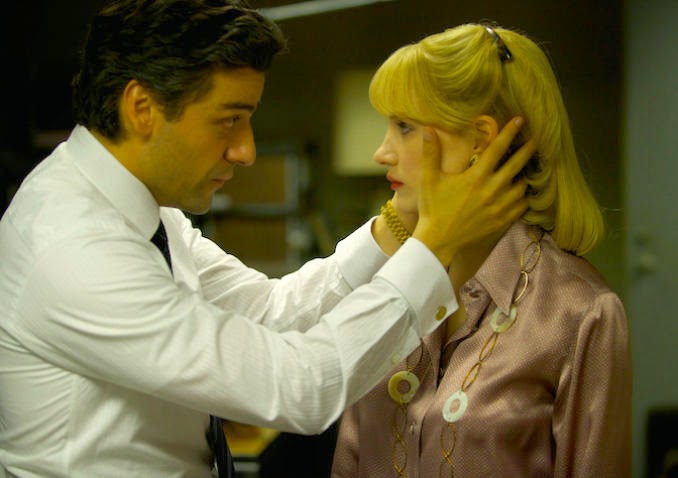
In a performance that channels the best of the youthful Al Pacino and Robert De Niro, Oscar Isaac (INSIDE LLEWYN DAVIS) is Abel Morales, the president of the relatively small-time Standard Heating Oil. Abel has several rivals throughout the Five Boroughs, and they're all jockeying for better positions in the local market. Abel and his business partner/wife Anna (Jessica Chastain) have dumped their life savings into a deposit on a riverfront land purchase from Hasidic businessman Josef (Jerry Adler), a fuel and oil storage facility that will give Abel leverage in the local competition. All he needs to do is come up with $1.5 million in 30 days and the land is his. Otherwise, Josef keeps the deposit and sells the property to a competitor. Abel is stressed but confident. He runs a clean business, prides himself on Standard's presentation and dedication to customer service, and has a great relationship with his bank. Of course, everything starts falling apart. For the last year, Abel's trucks have been occasionally hijacked on their routes, the drivers assaulted and the oil sold to the competition. These occurrences have been on an alarming increase, the latest one resulting in dedicated driver Julian (Elyes Gabel) getting his face smashed and his jaw broken. Abel and his lawyer Andrew Walsh (an almost unrecognizable Albert Brooks) go to District Attorney Lawrence (David Oyelowo) to address the problem, only to be told that the city's been riddled with crime for over a year and hijacked heating oil trucks aren't a priority. And on top of that, Lawrence is launching an investigation into corruption among the city's heating oil providers, with a particular emphasis on Standard. And when the hijackings continue, Walsh and Anna, behind Abel's back, make an agreement with Teamsters rep O'Leary (Peter Gerety) to supply the drivers with guns accompanied by permits that range from sketchy to completely forged.
As all of these issues crash in on the beleaguered Abel, he keeps telling himself that everything will be OK because he runs an honest business, but he's deluding himself. In the revisionist bio he's imagined for himself, he thinks he's built the business from the ground up, when in fact, he bought it cheap from his low-level mobster father-in-law, with Anna cooking the books in a subtle enough way that it's taken the D.A.'s office ten years to catch on to it. An immigrant, Abel believes in the American dream so much that he's willing to convince himself that he's above the corruption that infests his chosen industry. In a very intense, controlled, and pitch-perfect performance, Isaac vanishes into his character the way a young Pacino and De Niro would. His Abel Morales is, at his core, a fundamentally good man who thinks that as long as he doesn't see something illegal happening, everything's going to be OK. He's too smart to not know about Anna's machinations, whether she's falsifying tax records or skimming off the top. The one major flaw in Chandor's script is the sometimes one-dimensional presentation of Anna, though it's not the fault of Chastain. She's a loving wife and, in a rarity for this type of film, an equal partner, but she's still too often cartoonishly bitchy and ruthless, saddled with heavy-handed, melodramatic ways of showing that she's the decisive ballbuster while Abel needs to man up and get with the program, such as the scene where they're driving home from dinner and hit a deer. Opting to put the poor creature out of its misery, Abel hesitantly dithers with a tire iron, while Anna pulls out a gun and shoots it in the head.
Elsewhere, Chandor offers two marvelous, pulse-pounding chase sequences--one during a shootout on the 59th Street Bridge in heavy traffic, the other a long, stunning FRENCH CONNECTION homage when Abel hears a truck hijacking on the radio and realizes he's right in the area where it's taking place. At the end, after a bitingly cynical dialogue exchange between Abel and Lawrence that illustrates just how intertwined politics and business really are, A MOST VIOLENT YEAR is still just Lumet-worship first and foremost (with some bonus affection for guys like William Friedkin and Alan J. Pakula). But it's the closest thing to a new Sidney Lumet film that you're ever going to get, and I imagine that's the best praise one can bestow upon it. Dialogue-heavy and character-driven, set in a world that exists in a perpetual shade of moral and ethical gray, A MOST VIOLENT YEAR is the kind of film that should've been an Oscar darling, but still-not-ready-for-prime-time distributor A24 Films only gave it a minimal, NYC/L.A. release on December 31, 2014. While that wasn't a fatal mistake, A24 completely fell asleep on the job when they were too late getting screeners out to Academy members to qualify it for awards consideration. As a result, what was pegged as a surefire Oscar candidate ended up with exactly zero nominations, all but killing its awards-season momentum and any moviegoer interest with the film finally opening nationwide at the end of January. Nevertheless, its day will come, as it's the work of a strong, confident filmmaker who's only starting to hit the peak of his powers. There's going to be some great films from J.C. Chandor in the coming years.
Short on plot-driven momentum and long on atmosphere and richly-textured characterization, one's gut reaction to INSIDE LLEWYN DAVIS may be that it isn't top-tier Coen Bros., but it's still very good. Though written and directed by the Coens, the film belongs just as much to cinematographer Bruno Delbonnel, whose contributions earned one of the film's two Oscar nominations (the other was for sound mixing). The Coens and Delbonnel use a muted color palette to bring a snowy, slushy 1961 Greenwich Village to vivid life. Inspired by the real-life Greenwich Village folk fixture Dave Van Ronk, folk singer Llewyn Davis (Oscar Isaac) is dealing with the suicide of his performing partner and the tanking of his subsequent solo album. He's homeless, crashing on the couches of area friends, including Jean (Carey Mulligan), who's part of a duo with Llewyn's friend Jim (Justin Timberlake) and is carrying a child that might be Llewyn's or Jim's. Through a series of mishaps, Llewyn's also taking care of a cat that belongs to his academic friends Mitch and Lillian Gorfein (Ethan Phillips, Robin Bartlett). Llewyn's a bit on the misanthropic side and doesn't always set out to be a jerk, but that's usually how he comes off, and the film basically follows him through one week of hassles, arguments, and letdowns, whether it's turning down royalties on a song in favor of the quick payday he needs to pay for Jean's abortion or having to carpool with two other musicians (John Goodman, Garrett Hedlund) to a gig in Chicago that goes horribly awry. In terms of story, it's one of the Coens' slighter efforts, but where it really stands out is capturing the look and feel of a unique place and time, from the work of Delbonnel to the production design to the songwriting (Isaac, in what should've been a star-making performance, performs original songs by T-Bone Burnett and Marcus Mumford). I also liked the recurring visual motif of narrow, claustrophobic hallways and the stunning interior of a massive Fred Harvey restaurant that's almost Kubrickian in its presentation. While not on the level of a FARGO, THE BIG LEBOWSKI, or NO COUNTRY FOR OLD MEN, nor the Oscar magnet that many predicted, INSIDE LLEWYN DAVIS feels like one of those films that isn't initially powerful but sticks with you and quietly works on you over time. (R, 105 mins)
BEYOND OUTRAGE (Japan/France - 2012; US release 2013)
After leaving yakuza films behind following his underrated US crossover attempt BROTHER (2001), Japanese filmmaker Takeshi Kitano (VIOLENT COP, SONATINE) spent most of the next decade--except for his 2003 ZATOICHI reboot--in personal art-house projects, most of which didn't connect with his audience. 2010's blood-splattered OUTRAGE was his "give the fans what they want" return to the yakuza genre, and while it possessed an extremely complicated plot that wasn't always easy to follow, it was enormously entertaining in the almost comedic way it kept presenting the same set pieces. You could probably stage a drinking game over how many times a bunch of pissed-off Japanese gangsters would congregate in a room, hurl insults at each other until brawling and gunfire erupted, culminating in someone being obligated to slice off their pinky to atone for their disrespect. The film was such a success in Japan that Kitano has returned with the sequel BEYOND OUTRAGE (or, as the onscreen title reads, OUTRAGE BEYOND). Kitano again stars, under his usual acting alias "Beat Takeshi," as steely, ruthless gangster Otomo, believed dead by his former yakuza associates but actually incarcerated. When a police official and a nightclub hostess are found murdered in a car dragged from the bottom of a river, the police decide they've had enough of the yakuza families overstepping the established boundaries of their cop/criminal arrangement. Going against the wishes of his superiors and colleagues, Detective Kataoka (Fumiyo Kohinata) poses as a dirty cop to get on the good sides of both warring organizations--the Sanno and the Hanabishi. The Sanno are ruled by Kato (Tomokazu Miura), who concedes most of his decision-making to his ambitious young right-hand man Ishihara (Ryo Kase), much to the resentment of the embittered old guard yakuza who don't like that it's all about pressure to meet the bottom line and long for a return to the glory of the good old days ("Fuck hedge funding!" one grumbles). Sensing some discord in the ranks, Kataoka decides to spring Otomo from prison--he's there in part because his former underling Ishihara sold him out--and pull a vintage YOJIMBO by starting a war between the two yakuza clans. Needless to say, much arguing, insults, brawling, and impromptu pinky amputation ensue.
BEYOND OUTRAGE has its moments but it feels too much like a stale retread not just of OUTRAGE, but of other, better Kitano yakuza films in general. As a director, it seems like Kitano's just punching a clock on this one and as an actor, Beat Takeshi is offscreen far too much for what's ostensibly a Beat Takeshi vehicle (he doesn't even appear until 25 minutes in). Most of the violence is confined to the last half hour and it's noticeably more restrained than some of the things seen in the first film. There's so many double and triple crosses and conflicting loyalties that I doubt even Kitano can keep it all straight. Still, when he's the center of attention, he's as much of a badass as ever at 65 (no one twitches more intimidatingly than Beat Takeshi), and it's great fun watching him fearlessly mouth off to powerful crime bosses. But too much of BEYOND OUTRAGE feels like obligation and filler. It's relentlessly talky and it could've easily lost 20-25 minutes and been a much tighter, more exciting thriller instead of the overlong, draggy one it is. There's enough here for die-hard Kitano completists to enjoy and it's not a waste of time by any means (Kitano is smart enough to end it with a great final shot), but ultimately, one OUTRAGE was probably enough. (R, 112 mins)
SUSPENSION OF DISBELIEF (UK - 2012; US release 2014)
Anybody remember Mike Figgis? With his melancholy, jazz-and-rain-soaked British noir STORMY MONDAY (1988) to his Hollywood debut INTERNAL AFFAIRS (1990), and the devastating LEAVING LAS VEGAS (1995), which earned Nicolas Cage an Oscar, 1990s Figgis was poised to become one of the decade's top filmmakers. Around the time of 1999's THE LOSS OF SEXUAL INNOCENCE, Figgis seemed to grow bored with conventional storytelling, and 2000's TIMECODE caused a bit of a stir at the time of its release for its unique four-frame split-screen, real-time structure. TIMECODE is the kind of intriguing creative experiment that really only works once, but Figgis beat it to death in the redundant and borderline-unwatchable semi-sequel HOTEL (2002), which no one saw. Figgis has always marched to the beat of his own drum, but since the forgettable Dennis Quaid/Sharon Stone thriller COLD CREEK MANOR--clearly a paycheck gig for the director--bombed in 2003, he's almost completely gone off the mainstream cinema grid, focusing on experimental short films, music videos, and opera documentaries, though he did contribute to the 2003 PBS series THE BLUES and directed one episode of THE SOPRANOS in 2004. Now 66, Figgis has only made two narrative features since COLD CREEK MANOR: 2008's virtually unseen LOVE LIVE LONG, which still hasn't been released in the US, and SUSPENSION OF DISBELIEF, which was released in Europe to mostly dismissive reviews two years ago and has only now turned up in the US as a Netflix Instant exclusive. It's a terrible film, insufferably pretentious and unfathomably dull, with a noir-based premise that might've been fun and entertaining in the hands of say, an in-his-prime Brian De Palma, but Figgis is so lost up his own ass that the film is doomed from the very start, opening with a crawl about Karl Marx's "Participation Mystique" and the blurred lines between fact and fiction. Before four minutes even pass, Figgis is already breaking out the BRADY BUNCH squares and a douchebag filmmaker (Eoin Macken) is blathering on about his "film within a film within a film."
Figgis abandons the TIMECODE quadrants around the same time he decides to ditch the notion of a coherent story, as German-born, London-based screenwriter Martin (Sebastian Koch of THE LIVES OF OTHERS) sees his latest script, an erotic thriller, put in the hands of arrogant director Greg (Macken), who casts Martin's daughter Sarah (Rebecca Night) in the lead role. Sarah still lives with her father, who hosts a birthday party for her where he's approached by a French mystery woman named Angelique (Lotte Verbeek of the Showtime series THE BORGIAS), who offers him a joint and disappears. When she's found floating dead in a nearby canal, Martin is a suspect since it also coincides with the 15th anniversary of his actress wife's (Emilia Fox) still-unsolved disappearance. Martin is half-heartedly questioned by rumpled, wheezing detective Bullock (Kenneth Cranham), who seems more interested in getting feedback on his own cop screenplay. Enter Therese (also Verbeek), Angelique's twin sister, who arrives in London to identify the body. Therese stays with Martin and Sarah, leading to dark secrets, sexual tension and still, nothing much happens. Lots of long scenes play out only to be revealed as scenes in Martin's script being filmed by Greg or as re-enactments with different actors in one of the films within the film or as a staging of one of Martin's lectures to his screenwriting class. Professor Figgis frequently halts the action to flash things like "Character Is Plot" and the Webster's definition of "twin" on the screen. At one point, Therese sits down to read Martin's latest script and on the page, it describes her sitting down and reading Martin's latest script. SUSPENSION OF DISBELIEF gets so bogged down in endless academic, deconstructionist, meta bullshit that it forgets everything else. There's no mystery, there's no suspense, there's no eroticism, there's no character development...it's just a smug, meandering film-school exercise in anti-cinema that wastes Koch and a very good one-scene performance by Figgis regular Julian Sands as a sarcastically incredulous detective who takes over the case after Martin's criticisms of Bullock's script induce a heart attack in the aging, out-of-shape cop. With cheap production values making it look like a 3:00 am Skinemax offering with less skin and, somehow, even less story, SUSPENSION OF DISBELIEF shows the once-relevant Figgis light years removed from the triumph of LEAVING LAS VEGAS and strictly focused on pleasing what's since become his primary audience: Mike Figgis. (Unrated, 107 mins)