EVERY THING WILL BE FINE (Germany/Canada/France/Sweden/Norway - 2015)
One of the major voices of the 1970s New German Cinema who reached his pinnacle in the next decade with the classics PARIS, TEXAS (1984) and WINGS OF DESIRE (1987), Wim Wenders has enjoyed his biggest success in the latter half of his career with documentaries like THE BUENA VISTA SOCIAL CLUB (1999), PINA (2011), and his contributions to the PBS series THE BLUES. His first narrative feature since 2008's surreal PALERMO SHOOTING (one of Dennis Hopper's last films, and still unreleased in the US), EVERY THING WILL BE FINE plays more like an homage to SWEET HEREAFTER-era Atom Egoyan, from the crux of its story being a tragedy uniting several people, to its cold, wintry Canadian setting. Judging from the end result, Wenders can't do vintage Egoyan any better than Egoyan can these days. Making superfluous use of 3-D, which is limited mostly to some falling snowflakes for the six people who managed to see this in a theater, EVERY THING WILL BE FINE offers the most somnambulant cast this side of Werner Herzog's HEART OF GLASS, headed by James Franco as Tomas Eldan, a struggling Quebecois novelist whose marriage to Sara (Rachel McAdams, with a distracting and stilted Swedish--I think--accent) is in a rough patch. It gets worse when Tomas is involved in a freak accident on a snowy rural road where he thinks he narrowly averted hitting a young boy in a sled but realizes too late that there were two boys on the sled and the other died, pinned under his SUV. This scene, where Tomas thinks he and the surviving kid had a close call but slowly realizes, when the boys' shell-shocked single mother Kate (Charlotte Gainsbourg) asks where the other boy is, that he's accidentally killed the unseen second child, is by far the best in the film and it's all downhill from there.
Of course, even though it was a tragic accident, Tomas is plagued by guilt and half-heartedly attempts suicide, demonstrated in a trite montage where Wenders shows him crashing in a cheap motel, empty booze and pill bottles and torn up papers strewn about the room. The film repeatedly jumps through a few years at a time. Tomas and Sara have split up and he feels compelled to help the devoutly-religious Kate in some way. She's forgiven him and doesn't blame him and though they seem drawn to one another through their mutual grieving, Wenders and screenwriter Bjorn Olaf Johannessen don't indulge anything further, since that would mean something happening. The film takes place over an 11-year period, and every time Wenders seems to be building to something, he calls a time-out and jumps ahead four years. It's especially frustrating in the last section, when Tomas gets a letter from troubled, 16-year-old Christopher (Robert Naylor), who was five when he survived the accident that killed his little brother. Tomas has become a bestselling author, channeling his pain into prose and becoming rich and famous, and while Christopher is a fan of his work, he feels his brother's death has somehow worked in Tomas' favor while his mother has never really recovered. While Tomas and his second wife Ann (Marie-Josee Croze) are away on a brief book tour, someone--obviously Christopher--breaks into their house and urinates all over their bed. Just as EVERY THING WILL BE FINE seems poised to turn into a thriller of some kind, the film abruptly ends in the most enraging way possible, with Franco--who's about as believable a Quebecois novelist named Tomas as you'd expect--turning to the camera and smiling. Did Wenders just feel "Hey, it's been a while, I should probably make a drama again"? There's some beautiful cinematography by the venerable Benoit Debie, but EVERY THING WILL BE FINE is a film that keeps stopping itself dead in its tracks. Scenes crescendo into nothing and collapse, actors appear and disappear (Peter Stomare has one scene as Tomas' publisher; frequent Wenders actor Patrick Bauchau plays Tomas' dementia-addled father). It seems to be actively avoiding being about anything. The actors seem to be partially sedated, even more so as the film goes on. When a remarried Sara has a chance meeting with Tomas at a Patrick Watson concert (yes, time-killing concert footage) and slaps him, it seems less out of anger than to simply revive Franco. A comatose Wenders misfire like 2001's THE MILLION DOLLAR HOTEL moved at the pace of plate tectonics but at least had an insane performance by a neck-braced Mel Gibson to occasionally liven things up--there's nothing of the sort in EVERY THING WILL BE FINE. Life is filled with disappointments, regrets, and unresolved issues--which can make for compelling cinema but not when it's done the way Wenders does it here. It seems like a sincere enough film, but what's the point? (Unrated, 119 mins)
THE CONFIRMATION (UK/US/Canada - 2016)
The kind of slight, low-key character piece that goes over like gangbusters at film festivals but plays to crickets and tumbleweed in general release, THE CONFIRMATION is the directing debut of Oscar-nominated NEBRASKA screenwriter Bob Nelson. As in that film, we have a story set in a blue collar town where most of the residents have seen better days. Anthony (MIDNIGHT SPECIAL's Jaeden Lieberher) has it pretty good other than his ambivalence about being prodded into confession and confirmation by his church-going mom Bonnie (Maria Bello) and stepdad Kyle (Matthew Modine). Bonnie and Kyle are going away to a church-sponsored couples retreat for the weekend, leaving Anthony in the care of his alcoholic, sporadically-employed carpenter dad Walt (Clive Owen). Slumped-shouldered Walt has been dealt some shitty hands and is beaten down by life, but he's trying to make things work. He's on his latest attempt to quit drinking and isn't sure what to do with Anthony over the weekend, but that soon becomes a moot point as the pair encounter one obstacle after another. Walt gets a lucrative job lined up for Monday morning, but his expensive and sentimental (they were his dad's) specialty tools get stolen from his truck, his truck breaks down, a trip to drop a huge jar of change into a Coinstar machine at the grocery store to get some quick cash is all for naught when Anthony accidentally hits the "Donate" button, and they get locked out of the house when Walt gets an eviction notice. Borrowing Bonnie's SUV--Anthony neglects to tell Walt the brakes need replaced--the pair spend the weekend tracking down Walt's tools BICYCLE THIEF-style, getting help from a variety of odd folks both helpful and dubious, ranging from Walt's fatherly friend Otto (Robert Forster), drunken gun nut Vaughn (Tim Blake Nelson), and eccentric drywaller Drake (Patton Oswalt) whose claim to have the inside info on Walt's tools is negated by the fact that everyone knows he's back on meth.
THE CONFIRMATION is basically a standard redemption saga, with Walt and Anthony bonding and everyone realizing Walt's not such a loser after all. Nelson gives the story time to breathe and find its way, even with the trite symbolism of carpenter Walt "building" a relationship with his son. Walt tries to keep his temper in check as the deck is constantly stacked against him and and does everything he can to not cave to temptation and disappoint his son (after a bad withdrawal episode the first night, the first thing out of Walt's mouth in the morning is "Are you OK? Did I hurt you?"). Though he's hardly a textbook role model, Walt tries to dispense life lessons to the boy, and of course, he learns just as much from the wise-beyond-his-years Anthony. There's some legitimate surprises in the development of some of the characters: Anthony forms a friendship with Vaughn's sensitive son Allen (Spencer Drever); when Walt finds out who stole his tools, he feels sympathy rather than anger; and after constantly hearing from Walt what a useless tool he is, we're surprised to find that Kyle is actually a genuinely nice and sincere guy once we meet him. There's no big scenes or huge plot reveals in THE CONFIRMATION. It's a quiet, working-class indie film where the actors probably wore there own clothes and packed their own lunches for Nelson's heartfelt labor of love. It's not much to get excited about, but Owen and Lieberher make a good team, and fans of the actors will definitely want to check it out. (PG-13, 101 mins)
A mega-budget franchise non-starter that arrived on a wave of bad publicity due to casting controversies--a ridiculous grievance, really, considering that it's not a remotely serious film--GODS OF EGYPT seemed doomed the moment the trailer hit the internet. By the time it was released, the pile-on had already begun, and director Alex Proyas (THE CROW, DARK CITY, I ROBOT) didn't handle it well, taking to Twitter and social media to excoriate critics and detractors. Regardless of how legitimate his complaints were, he couldn't help but come off as, in the parlance of our times, a little butthurt. Is the movie good? Sometimes. "Kinda, almost" might be a good answer. Despite its lofty ambitions, it seems by the end that its sole purpose was to be played continuously on rows of display TVs in the electronics department of a big box retailer. Working with the screenwriting team of Matt Sazama and Burk Sharpless (whose previous triumphs include DRACULA UNTOLD and THE LAST WITCH HUNTER), the visionary Proyas establishes a pretty clearly campy tone, with the early scenes featuring intentionally anachronistic dialogue for its ancient Egypt setting ("This old thing?" one female character sasses when asked about her dress) and a very deliberate sense of humor. But the tone changes from scene to scene, along with the quality of the visual effects. The film is wall-to-wall CGI and looks almost completely animated at times. There are moments where the visuals are jawdroppingly beautiful and others where it looks like it's not even Asylum-worthy. The schizophrenic tone coupled with the repetitive set pieces eventually turn the film into a slog by the midway point.
That doesn't mean it's the catastrophic washout that everyone says it is. Oh, it's an unwieldy mess, but Proyas has stretches where he seems possessed by an in-his-prime Terry Gilliam, and for that reason alone, one shouldn't just blithely dismiss GODS OF EGYPT as soulless schlock. This just looks like a film that got away from its maker and had too much riding on it in terms of becoming a studio's next tentpole franchise. In Egypt, where gods are ten feet tall, bleed gold, and coexist with men, beloved and benevolent King Osiris (Bryan Brown sighting!) intends to pass the throne on to his son Horus (GAME OF THRONES' Nikolaj Coster-Waldau). That plan is thwarted by Osiris' scheming brother Set (a scenery-chewing Gerard Butler), who kills the king and gouges out the eyes of Horus, who goes into hiding as a power-crazed, despotic Set takes his nephew's intended, the Goddess of Love Hathor (Elodie Yung) for himself, enslaves the population, and destroys all the good Osiris has done like some ancient Egyptian Donald Trump. Bek (Brenton Thwaites), a wily young thief, also loses his love Zaya (Courtney Eaton) when she's killed by her owner, Set's architect Urshu (Rufus Sewell). Bek manages to steal one of Horus' eyes--the source of his godly powers--from Set's vault, promising him the other if he helps him find and restore Zaya to earthly life. Horus agrees, as he and Bek form an unholy god-and-man alliance to save Zaya and exact vengeance on Set...if they don't slay each other first! There's some fun in the early going, and it's hard not to get a kick out of Geoffrey Rush engulfed in CGI flames and hurling balls of fire as Horus' grandfather Ra, but GODS OF EGYPT is all over the place, and nearly every stop on their quest involves them being attacked by giant CGI creatures and fleeing an interior or exterior structure, outrunning the destruction as it crumbles around them. It loses its sense of fun and starts to seem more like a GODS OF EGYPT video game. The actors, especially Rush and Butler, came prepared to ham it up, but after a promising start, GODS OF EGYPT just switches to autopilot and becomes one eye-glazingly dull CGI action sequence after another. (PG-13, 127 mins)
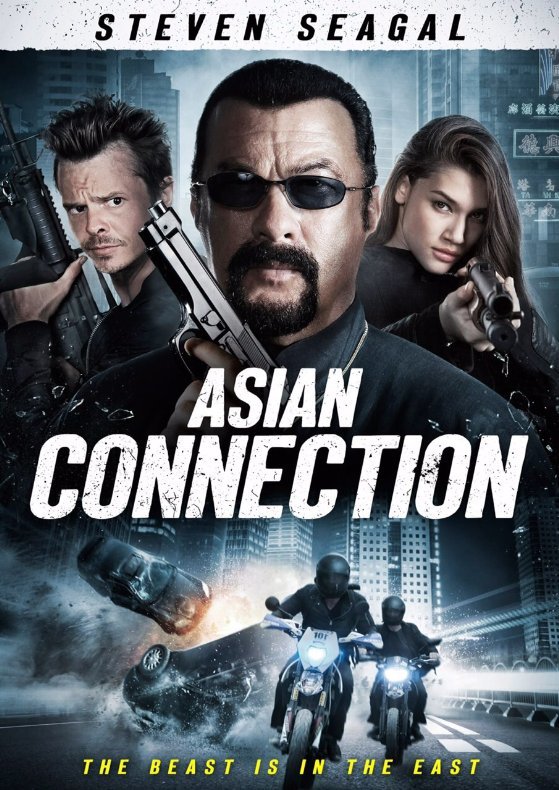
THE ASIAN CONNECTION
(US - 2016)
A pretty generic Far East shoot 'em up that features one of Steven Seagal's more lifelike performances in recent years, THE ASIAN CONNECTION would probably be a forgettable but diverting enough actioner if it had better leads. As the nominal villain, a Cambodia-based crime lord named Gan Sirankiri, Seagal is as mumbly as ever but actually logs some significant screen time and even takes part in a few big action sequences without being doubled (surprisingly, he's also a participant in the making-of featurette, a good indication that, for whatever reason, he gave a shit about this one). While Seagal has an "and Steven Seagal" credit and a puffy-eyed Michael Jai White gets top billing for a one-scene cameo as a gun dealer named Greedy Greg, the real star is the thoroughly unappealing John Edward Lee--who resembles some kind of Frankenstein fusion of Stephen Dorff and Josh Duhamel, but somehow with exponentially less charisma--as Jack, an expat American living in Bangkok with his Thai girlfriend Avalon (Kempo black belt Pim Bubear). Desperate for cash, Jack and his buddy Sam (Bryan Gibson) decide to rob a bank in Cambodia and take the cash back over the border into Bangkok. The bank they rob is holding the money of Sirankiri, who understandably wants it back and dispatches his chief goon Niran (Sahajak Boonthanakit, memorable as the gregarious taxi driver "Kenny Rogers" in the otherwise pedestrian NO ESCAPE) to recover it. Niran has other plans, like blackmailing Jack by having him and Sam rob a bunch of banks that hold various amounts of Sirankiri cash and giving him the bulk of the proceeds behind his boss' back, lest something nasty happen to Avalon.
Boasting a story credit for none other than former actor Tom Sizemore, THE ASIAN CONNECTION suffers from a smirking Lee as a hero you never care about, plus an inept performance by Bubear, who may be a karate champ but she can't act. On top of that, director Daniel Zirilli takes zero advantage of her Kempo skills. The script is predictable from start to finish, with Sam turning into a humorless, trigger happy loose cannon with each successive job, a character arc that was obvious upon the first of many times he admonishes Jack with "Don't call me stupid!" when he does something stupid (which is a lot). And yes, it all ends up with a shootout at an abandoned factory. Seagal is in character actor mode here, not nearly as loose as he was in GUTSHOT STRAIGHT, but definitely not sleepwalking through it, either, perhaps a major sign that he's ready to hand over his long-held Laziest Actor in the World crown to Bruce Willis. Not good at all but hardly the worst VOD/DTV title out there, the biggest problem with THE ASIAN CONNECTION is that you've seen it all before, and most likely with better actors than Lee and Bubear. Some more White really could've helped, even though he looks like he got stung by a bee right before his scene was shot. Wasn't BLACK DYNAMITE supposed to take him to better places than this? (R, 91 mins)
JARHEAD 3: THE SIEGE (US - 2016)
The third entry in one of the most unlikely DTV franchises, JARHEAD 3: THE SIEGE has nothing to do with 2014's JARHEAD 2: FIELD OF FIRE and almost nothing to do with Sam Mendes' original 2005 film version of Anthony Swofford's Gulf War memoir. Unlike JARHEAD 2, JARHEAD 3 at least brings back one character from JARHEAD with a brief appearance by Major Lincoln, played by Allstate insurance salesman Dennis Haysbert. Lincoln was a minor character in the 2005 film and is even less significant here, usually observing the action from a chopper and shaking his head when something bad happens. Now an action franchise whose main connecting thread is that it involves Marines, JARHEAD 3: THE SIEGE is budget-conscious 13 HOURS, as ambitious Corporal Evan Albright (HOW TO GET AWAY WITH MURDER's Charlie Weber) arrives at the US Embassy in an unnamed-but-obviously-Benghazi-like location, where everyone gets along with the locals and the US Ambassador (Stephen Hogan) has it pretty easy. Albright quickly establishes himself as an impulsive cowboy during a botched training exercise, and he doesn't win himself any friends by reporting a suspicious cameraman lurking outside the compound to the Ambassador, going over the head of his commanding Gunny Raines (top-billed Scott Adkins). Of course, Albright is right: the cameraman is notorious terrorist Khaled (Hadrian Howard), who leads an assault on the Embassy in which Albright and the other Marines get to engage in some Benghazi fan fiction where tragedy is averted and America triumphs, all while referring to the locals as "Ali Baba" and bellowing things like "This is OUR house! Let's show these motherfuckers how we do it!" and "Locked & loaded!" and, of course, "Let's roll!"
It's mostly jingoistic right-wing military porn in the grand tradition of "America! Fuck Yeah!" but veteran DTV director William Kaufman (now going by the hipper "Will Kaufman") pulls off a few decent shootouts amidst the shaky cam and the iPhone app-level explosions. Weber is a pretty bland hero, and the film doesn't give Adkins much to do other than glower and lecture Albright before being killed off in an explosion about an hour into the movie. The characters are largely cliches, like loudmouth racist Stamper (Joe Corrigall), who goes full Hudson-from-ALIENS as soon as the shit hits the fan, but the worst by far is Blake, a grating comedy relief blogger/documentarian played by 41-year-old Dante Basco, who's a good 15-20 years too old for the role. Blake is constantly filming (cue found-footage scenes) and saying inane things like "When the ambassador is burning shit, you know like, heavy shit is going down" (Blake also has a gluten allergy, making him even more insufferable). As far as in-name-only sequels go, JARHEAD 3: THE SIEGE is passably entertaining and never dull, but that still doesn't seem to be reason enough to justify its existence. (R, 89 mins)
POPSTAR: NEVER STOP NEVER STOPPING (US - 2016) Directed by Akiva Schaffer and Jorma Taccone. Written by Andy Samberg, Akiva Schaffer and Jorma Taccone. Cast: Andy Samberg, Jorma Taccone, Akiva Schaffer, Sarah Silverman, Tim Meadows, Maya Rudolph, Imogen Poots, Joan Cusack, Chris Redd, Edgar Blackmon, James Buckley, Justin Timberlake, Emma Stone, Will Arnett, Chelsea Peretti, Mike Birbiglia, Eric Andre, Bill Hader, Kevin Nealon, Paul Scheer, Derek Mears, Will Forte, Weird Al Yankovic. (R, 87 mins) The music mockumentary is best represented by the 1984 classic THIS IS SPINAL TAP, though even Christopher Guest and Rob Reiner have cited the 1978 TV special THE RUTLES: ALL YOU NEED IS CASH as its primary influence. The tradition continued in later Guest projects like A MIGHTY WIND and in the early '90s rap mockumentaries CB4 and FEAR OF A BLACK HAT. The latest project from the Lonely Island comedy team of former SNL star Andy Samberg, Jorma Taccone, and Akiva Schaffer, the brains behind numerous viral SNL Digital Shorts like "Jizz in My Pants" and "Dick in a Box," takes aim at the current pop music scene and does a mostly nice job of completely roasting it. Inspired mostly by Justin Bieber but with a generous helping of Kanye West included, Connor Friel, aka Connor4Real (Samberg) is a global pop culture phenomenon, a pop star and ubiquitous social media and tabloid presenc, about to drop his second album, Connquest, the long-awaited follow-up to his record-shattering solo debut Thriller, Also. It's the most anticipated album of the decade from the one-time member of the chart-topping rap trio The Style Boyz, whose biggest hit "The Donkey Roll" made them superstars before disbanding at the end of the boy band heyday when Connor's increased popularity started to keep bandmates Owen, aka Kid Contact (Taccone), and Lawrence, aka Kid Brain (Schaffer) relegated to the background. When a guest verse on "Turn up the Beef," a hit single from a Katy Perry-like diva (Emma Stone) helped launch Connor4Real's solo career, Kid Contact stayed with him as his DJ while Kid Brain released a flop solo single and moved to Colorado to live a quiet, anonymous life as a farmer and woodcarver.
Connquest tanks upon its release, which sends Connor4Real's manager Harry (Tim Meadows) and publicist Paula (Sarah Silverman) into panic mode, securing a promotional partnership with appliance behemoth Aquaspin to have Connor4Real's music constantly blaring from all of their wi-fi-compatible products (remember that U2 debacle?). The backlash is so strong that concert attendance dwindles (thanks in no part to insensitive songs like "Ethpania," the inspiration for which came from Connor noticing that "in Spain, people's S's sound like T.H.'s," and "Equal Rights," a pro-LGBT duet with Pink where all of Connor4Real's lyrics aggressively stress that he's not gay), forcing Harry to bring up-and-coming Hunter the Hungry (Chris Redd) onboard as an opening act. Hunter's presence increases the ticket sales, but Connor4Real is on a downward spiral: his televised-live-on-E! engagement to movie star Ashley Wednesday (Imogen Poots) is marred by wolves mauling guest singer Seal; there's a huge fallout over leaked video from the European tour where he takes a dump in the toilet in the Anne Frank house; a wardrobe malfunction during a concert goes viral when it appears he has no penis; someone's cell phone captures him drunk, starting a fight and getting his ass kicked by Martin Sheen in a sports bar; and he's constantly being overshadowed by the increasing popularity of Hunter the Hungry, whose sets start running long and Connor4Real has to face the realization that even though he's the headliner, nobody's there to see him. All the while, Kid Contact starts feeling more and more marginalized and resorts to PARENT TRAP machinations to encourage a Style Boyz reunion.
A balanced combination of spoof, satire, oddball humor (Bill Hader as a roadie who's a FLATLINERS superfan) and grossout raunch (Connor4Real signing one frantic male fan's dick from the back of his limo after the guy drapes his balls over the half-rolled-down window), POPSTAR: NEVER STOP NEVER STOPPING does an admirable job of shredding vacuous pop culture figures, annoying trends (Connor4Real goes on tour with an Adam Levine hologram), blasting the fickleness of a fan base (Connor4Real's "Connfidants"), torching industry greed (Paula: "I don't personally like Connor's music, but it makes so many people so much money!"), and taking some merciless shots at the sycophantic media. The periodic cutaways to the TMZ-like bull sessions of the cackling staff at CMZ, who gleefully revel in every Connor4Real misfortune, are absolutely blistering, with Will Arnett doing an absurd and vicious takedown of Harvey Levin, complete with large straws sticking out of an increasingly ridiculous number of cups, mugs, and pitchers as he asks for the most mundane items of "news" ("Does anyone have a pic of James Franco leaving a Denny's?"). As it becomes obvious that the Style Boyz will set aside their differences and triumphantly reunite, POPSTAR loses its caustic edge and gets a lot nicer. But in the first half, where Samberg boldly plays all of Connor4Real's clueless arrogance and megastar entitlement to the hilt--whether he's enjoying the constant reassurance of his entourage of paid enablers and yes-men or callously ignoring the Kubrick-like levels of care that go into the meticulous meal preparations of his devoted and long-suffering personal chef Tyrus Quash (Justin Timberlake)--it has a scathing mean streak and isn't afraid to take some hard-hitting jabs at the artists, the fans, the vapidity of Twitter, and the ubiquity of idiotic catchphrases ("Doink-de-doink!"). Like the protagonists of THIS IS SPINAL TAP, the Style Boyz might be clueless dolts but they're good guys deep down and it's a big-studio summer comedy, so one can't expect something too subversive. It's not about wanting to have bad things happen to Connor4Real, though a further exploration of the public's love of schadenfreude could've provided some more substance. This is bombing hard in theaters, as did the team's HOT ROD (directed by Schaffer and starring Samberg and Taccone, but written by Pam Brady) and Taccone-directed MACGRUBER, but both of those found cult followings later on Netflix. The same seems likely for the often very funny POPSTAR: NEVER STOP NEVER STOPPING.
THE KILLING OF A CHINESE BOOKIE (US - 1976/1978) Written and directed by John Cassavetes. Cast: Ben Gazzara, Timothy Carey, Seymour Cassel, Robert Phillips, Morgan Woodward, John Red Kullers, Al Ruban, Azizi Johari, Virginia Carrington, Meade Roberts, Alice Friedland, Donna Marie Gordon, Val Avery, Soto Joe Hugh. (R, 134 mins/109 mins) There's a cohesive story in this impenetrable John Cassavetes character study that becomes more apparent in his 1978 re-edit, which moves faster, has some scenes in a different order, uses alternate or unique-to-that-version takes, runs 25 minutes shorter, and is certainly the more commercially viable and entertaining cut of the film. But it's his original 1976 version, running a frequently grueling 134 minutes, that's quintessential Cassavetes. It's also got one of the great Ben Gazzara performances: as Cosmo Vitelli, the owner of the Crazy Horse West, the most oppressive burlesque show/strip club you'll ever see, Gazzara is all hubris and swagger, a perpetual small-timer hoping to run with the big dogs. Shooting his mouth off and trying to look like a player at a mob-run poker game gets him $23,000 in the hole to some L.A. gangsters--intimidating Flo (Timothy Carey), and manipulative, glad-handing Mort (Seymour Cassel) among them--who laugh at Cosmo and his club when his back is turned and force him to pay off his debt by whacking a bookie (Soto Joe Hugh) who turns out to be the head of the Chinese underworld in L.A.
In Cassavetes' 1976 cut, the plot is secondary to the feel, and boy, does this feel like no other film. Its improv nature is loose but admittedly off-putting for a first-time viewer, almost like Cassavetes couldn't part with anything he shot. This is especially true in the burlesque show production numbers introduced by depressing emcee Mr. Sophistication (Meade Roberts)--looooong sequences that Cassavetes lets play out in real time. Most of the Mr. Sophistication stuff got cut for the 1978 re-edit, but it's these scenes inside Cosmo's club and his interactions with the staff ("I'm a club owner...I deal in girls") that give CHINESE BOOKIE its distinctive flavor. The red and blue filters lend a grubby seediness that almost makes this feel like a west coast, Sunset Strip MEAN STREETS or TAXI DRIVER. Of course, Cosmo is a stand-in for Cassavetes himself: he doesn't care about the profits of the Crazy Horse West, only the presentation of the show itself, even when he checks in on his way to kill the Chinese bookie. Cosmo is an artist and an impresario, fashioning his show for seemingly no one but himself (there's always a big crowd, but part of me tends to think it's in his mind), and selling himself to money men when he needs to get out of debt, though Flo and Mort, plus "The Boss" (Morgan Woodward) don't give him much of a choice.
THE KILLING OF A CHINESE BOOKIE, in its original 134-minute format, is one of the all-time "movies you have to be in the mood for." It's almost deliberately alienating (it took me about four sittings to get through the whole thing the first time I tried to watch it) and incredibly self-indulgent even by Cassavetes standards, at times seeming like he's daring the audience to give up and walk out. But if you approach it for its mood and its vibe and its time and place as opposed to its point A-to-point B story, you may find it hypnotic in its sense of cynical, dead-end hopelessness, a portrait of an overconfident schmuck with big dreams and an even bigger mouth, forever condemned to be small-time.
OPERATION TITIAN (Yugoslavia - 1963) Directed by Rados Novakovic. Written by Vlasta Radavanovic. Cast: William Campbell, Rade Markovic, Patrick Magee, Miha Baloh, Vjekoslav Afric, Irena Prosen, Manja Golec. (Unrated, 95 mins)
PORTRAIT IN TERROR
(US - 1965) Directed by Michael Roy (Rados Novakovic and Stephanie Rothman). Written by Vic Webber (Vlasta Radavanovic and Stephanie Rothman). Cast: William Campbell, Anna Pavane (Irina Prosen), Patrick Magee, Kerry Anderson (Manja Golec), Dante Gerino (Rade Markovic), Mike Astin (Miha Baloh), Al Astar (Vjekoslav Afric). (Unrated, 81 mins)
BLOOD BATH
(US - 1966) Written and directed by Jack Hill and Stephanie Rothman. Cast: William Campbell, Marissa Mathes, Linda Saunders, Sandra Knight, Carl Schanzer, Sid Haig, Jonathan Haze, Biff Elliot, Patrick Magee. (Unrated, 62 mins) TRACK OF THE VAMPIRE
(US - 1966) Written and directed by Jack Hill and Stephanie Rothman. Cast: William Campbell, Marissa Mathes, Linda Saunders, Sandra Knight, Patrick Magee, Carl Schanzer, Sid Haig, Jonathan Haze, Biff Elliot, Manja Golec. (Unrated, 79 mins)
Out now in what's likely a contender for the Blu-ray restoration/box set of the year, the low-budget 1966 cult horror movie BLOOD BATH is part of a quartet of films with one of the most complex and labyrinthine backstories in all of cinema. At the center is the legendary Roger Corman, who was attending a film festival in Adriatic coastal city of Dubrovnik when he was approached by representatives from Avala Film, one of Yugoslavia's state-run film organizations, about the possibility of co-productions and distribution deals. Looking to test the waters of the Eastern European film industry, Corman agreed to be a silent partner on the Yugoslav crime thriller OPERATION TITIAN, under two conditions: the movie would be in English and some of his people had to be involved to make it an easier sell in the US. Corman sent American actor William Campbell and Irish actor Patrick Magee--both of whom had just been in the Corman-produced DEMENTIA 13 and the Corman-directed THE YOUNG RACERS--to Dubrovnik to star in OPERATION TITIAN, with young protege and DEMENTIA 13 director Francis Ford Coppola tagging along as a production supervisor to observe director Rados Novakovic's crew and make sure Corman's money wasn't being wasted.
OPERATION TITIAN is a lethargic and draggy thriller about the heist of a priceless Titian painting and the murder of its owner, Ugo Bonacic (Vjekoslav Afric), by duplicitous Italian doctor Maurizio (Magee). Maurizio is working in cahoots with Bonacic's nephew Toni (Campbell), who believes the Bonacics are connected to the legendary Sordi family of artists. Toni is also pining for Vera (Irina Prosen), who's engaged to reporter Dzoni (Miha Baloh), who's working the Bonacic murder case with detective Miha (Rade Markovic). Novakovic stages several stylish sequences that owe more than a passing debt to both the German krimis of the era as well as Carol Reed's THE THIRD MAN and the directorial work of Orson Welles. OPERATION TITIAN is an intriguing-looking and visually interesting film that too often gets bogged down by its confusing storyline and lugubrious pacing (its 95 minutes feel like three hours), with Novakovic far too willing to let too many sequences play like he's making a Dubrovnik travelogue. Corman wasn't happy with the resulting film and saw no potential for it whatsoever on the drive-in circuit, so he shelved it until early 1964, when he found two uses for it. One involved having in-house production and editing assistant Stephanie Rothman rework TITIAN into PORTRAIT IN TERROR, an overhauled version of the film that trimmed a lot of the fat from the clunky early scenes that go nowhere, streamlined some of the meandering story, rearranged some scenes, and replaced the TITIAN score with AIP library cues. Other than Campbell and Magee (his name misspelled "Patrick McGee" in the new credits), everyone else was hidden by Americanized pseudonyms and revoiced. Miha is now "Miho" and Dzoni "Donny," and one key character's offscreen murder is now seen in almost real-time detail in a new L.A.-shot sequence clumsily edited into the Yugoslav footage, with doubles who look nothing like the people they're supposed to be (the victim has a completely different hairstyle to obscure her face in the new footage). This murder takes place in broad daylight with the killer carrying the body for what seems like a mile and leaving a trail of blood behind before rowing it out to sea and dumping it in the Adriatic. Rothman's work was enough for Corman to declare OPERATION TITIAN salvaged, and with director credit going to the non-existent "Michael Roy," PORTRAIT IN TERROR went straight to US television in 1965 as part of an AIP syndication package deal.
While Rothman was working on PORTRAIT, Corman was determined to get his money's worth out of his botched Dubrovnik investment. Having taken bits and pieces of Soviet sci-fi films and working in new American footage in the past (like 1962's BATTLE BEYOND THE SUN being a reworking of a 1959 Russian film; Corman would also use Soviet sci-fi footage in 1965's VOYAGE TO THE PREHISTORIC PLANET and 1966's QUEEN OF BLOOD, both featuring Basil Rathbone in the new scenes, wearing the same wardrobe on the same sets in scenes shot in a day), the thrifty auteur decided to use the same approach with OPERATION TITIAN. In early 1964, he commissioned Jack Hill, who was called in for cleanup duty to shoot some gory axe murders when Corman wasn't happy with Coppola's cut of DEMENTIA 13, to take 30 minutes of footage from OPERATION TITIAN and create a horror movie around it. A production assistant looking to get into directing, Hill enthusiastically saw this bizarre assignment as a challenge, and TITIAN had enough stark Eastern European location work and imposing old-world architecture that it just might work. Hill came up with BLOOD BATH, and he would need Campbell to shoot additional scenes in Venice, CA. Campbell thought turning TITIAN into a horror movie was a terrible idea, so he made exorbitant salary demands on Corman than the producer reluctantly agreed to since he needed Campbell to match the TITIAN footage. In Hill's BLOOD BATH (handling sound on the BLOOD BATH crew was a young Gary Kurtz, who would go on to be George Lucas' Lucasfilm partner and producer of STAR WARS), Campbell was now playing Antonio Sordi, a crazed Venice Beach artist driven to kill his models and preserve their bodies in wax (an idea Hill got from the fate of Magee's Maurizio in TITIAN). None of the primary Yugoslav TITIAN cast--Markovic, Baloh, Afric, and Prosen--appear in BLOOD BATH. Hill pulls off one legitimately stunning, Antonioni-esque shot in the California desert and has some surprisingly bloody murders throughout (more proof that it was Hill, and not Coppola, who was behind some of DEMENTIA 13's more memorable moments). There's also some Cormanian callbacks to A BUCKET OF BLOOD with some beatniks played by LITTLE SHOP OF HORRORS' Jonathan Haze and a young Sid Haig, but for whatever reason--Corman off shooting THE SECRET INVASION is usually the cited one--Hill's BLOOD BATH got lost in the shuffle and was shelved by Corman...for the time being.
In 1966, Corman took another look at BLOOD BATH and while he still didn't like it, he wasn't done tinkering with it or squeezing every last nickel he could out of OPERATION TITIAN. Hill moved on to other projects (like the cult classic SPIDER BABY), so Corman assigned the BLOOD BATH revamp to Stephanie Rothman, who wrote and directed new scenes that now have Campbell's Antonio Sordi not only being a homicidal maniac artist, but also---wait for it---a vampire. An uncredited actor plays Sordi in the scenes where he metamorphoses into a bloodsucker, not for artistic reasons but because Campbell refused to do any more reshoots related to the now-two-year-old BLOOD BATH and even filed a grievance with the Screen Actors Guild against Corman for repeatedly reusing old footage of him in new movies and not compensating him for it (he lost, due to a loophole involving the source film--OPERATION TITIAN--being a foreign production outside of SAG jurisdiction). Combining footage from TITIAN and Hill's aborted BLOOD BATH with new footage of actors from Hill's shoot--Haze, Haig, Carl Schanzer as a Sordi rival, and Linda Saunders as a Sordi victim--plus scenes involving a new character, created by Rothman and played by THE TERROR's Sandra Knight, and a silhouetted double filling in for Sordi in a non-vampire scene, the revamped BLOOD BATH has Hill and Rothman sharing writing and directing credit, though they never collaborated and Hill has had nothing positive to say about Rothman's contributions. Considering it's a mash-up of three different productions dating back to 1963, it's amazing that it holds together at all, though it's sure to delight fans of rampant continuity errors.
BLOOD BATH was released by American International in 1966 on a double bill with Curtis Harrington's QUEEN OF BLOOD, where new and quickly-shot footage of John Saxon, Dennis Hopper, and Basil Rathbone was mixed in with scenes from the 1962 Soviet sci-fi epic A DREAM COME TRUE. Unusual for 1966, BLOOD BATH was in black & white since it still had to match OPERATION TITIAN, and it ran barely over an hour at just 62 minutes. When it came time to package the film in a syndication deal, AIP realized the film was too short. As a result, it was tweaked yet again, this time as TRACK OF THE VAMPIRE, with some scenes dropped and new footage added by Rothman, including two of the most blatant examples of pointless filler you'll ever see: a long and profoundly unsuspenseful foot chase, and an almost comically belabored five-minute interpretive dance sequence on a beach, with Saunders unconvincingly doubled by someone else. When that didn't add enough time, an entire subplot involving Magee's and Manja Golec's TITIAN characters is introduced in the final act, only with Magee badly redubbed to make it appear that he's a jealous husband convinced his wife (Golec) is having an affair with Sordi. These additional scenes got the film to 79 minutes, making TRACK OF THE VAMPIRE long enough to fit in a 90-minute time slot with commercials. Unlike Campbell, Magee was never called back for reshoots on any incarnation of BLOOD BATH (the future CLOCKWORK ORANGE co-star is uncredited in BLOOD BATH and TRACK OF THE VAMPIRE, and though he has a sizable role with the introduction of more TITIAN footage in TRACK, his appearance in BLOOD BATH is limited to one brief shot as a wax figure in Sordi's workshop), so it's not known how he felt about not being paid for three additional movies (four if you count Hill's never-released first cut of BLOOD BATH) or if he was even aware of it. TRACK OF THE VAMPIRE has enough deviations from BLOOD BATH that it should be regarded as its own stand-alone work as opposed to simply "the TV version of BLOOD BATH." Some of the shocking-for-the-time violence is toned down for TRACK, especially in the early murder of the character played by June 1962 Playmate of the Month Marissa Mathes. It's not really any better or worse than BLOOD BATH, though the interpretive dance scene, which rivals any extended MANOS: THE HANDS OF FATE driving scenes, has to be seen to be believed.
Though BLOOD BATH has a bit of a cult following and one of the more colorfully lurid one-sheet designs of the 1960s, neither it nor its three distantly-related cousins OPERATION TITIAN, PORTRAIT IN MURDER, and TRACK OF THE VAMPIRE are very good. Nevertheless, for any true cult horror fanatic, Arrow's Blu-ray box set is absolutely essential as the most thorough archiving of the complicated history of this particular Roger Corman project. The bonus features include interviews with Hill and Haig, but the big selling point is film historian and Video Watchdog big dog Tim Lucas' video essay "The Trouble with Titian," an 81-minute look at Corman in the early '60s and everything that went into the making of OPERATION TITIAN and its variant offshoots. BLOOD BATH is a Blu-ray package that's not really designed for the casual horror fan but rather, the hardcore obsessive who likely won't mind that the tangled and fascinating behind-the-scenes chronicle of the four films proves to be more interesting than the four films themselves.
CUT AND RUN (Italy - 1985; US release 1986) Directed by Ruggero Deodato. Written by Cesare Frugoni and Dardano Sacchetti. Cast: Lisa Blount, Leonard Mann, Willie Aames, Richard Lynch, Richard Bright, Michael Berryman, Karen Black, John Steiner, Valentina Forte, Eriq La Salle, Gabriele Tinti, Barbara Magnolfi, Luca Barbareschi, Penny Brown, Carlos De Carvalho, Edward Farrelly, Ottaviano Dell'Acqua. (Unrated, 91 mins) Often erroneously lumped in with his controversial cannibal films, CUT AND RUN is a fairly straightforward and infrequently tacky '80s Italian jungle actioner from the infamous Ruggero Deodato. Unlike his JUNGLE HOLOCAUST (1977) and the legendary CANNIBAL HOLOCAUST (1980), CUT AND RUN has absolutely no cannibal gut-munching, so it's surprising that so many people consider it the final chapter of a non-existent Deodato "cannibal trilogy" or some such nonsense. Sure, it takes place in the Amazon and has some savage tribes who engage in shooting poisoned blowdarts, decapitations, and rape, but even it in its uncensored, hard-edged European form that features one poor bastard being split in half up the middle--softer kill scenes and alternate takes were used for the export version handled by New World, which hit US theaters in May 1986--there's nothing here that equals the disturbing savagery seen in any Italian cannibal outing. No flesh-eating. No on-camera animal deaths. It's not a cannibal movie. It's a distant cousin at best.
Deodato nevertheless finds other ways to be tactless, like using actual footage of Jonestown cult leader and Kool-Aid aficionado Jim Jones being interviewed by NBC reporter Don Harris, who would be one of the people ambushed and killed on a Guyana airstrip by Jones' "People's Temple" disciples when he and other members of Congressman Leo Ryan's entourage tried to help people escape from Jonestown in 1978. CUT AND RUN's chief villain is the fictional Col. Brian Horne (Richard Lynch), a disgraced and dishonorably discharged ex-Green Beret purported to be Jones' right-hand man and the mastermind behind the Jonestown massacre. Horne escaped from Jonestown and has secretly built a powerful drug operation in South America with a few Jonestown latecomers and some Amazon tribesmen he uses to eliminate the competition. He's more or less what might happen if APOCALYPSE NOW's Col. Kurtz ran a drug cartel. Horne has been believed dead, but when intrepid Cable Video News reporter Fran Hudson (Lisa Blount) and her cameraman Mark Ludman (Leonard Mann) beat the police to a bloody crime scene and find a recent picture of Horne with runaway Tommy Allo (Willie Aames), the son of their boss Bob (Richard Bright), they head down to the Amazon to find Tommy and get an exclusive interview with Horne. Obviously, mayhem and over-the-top violence ensue.
Shot in Florida and Venezuela, CUT AND RUN began life, oddly enough, as an unmade Wes Craven script titled MARIMBA. Written around 1980, MARIMBA got as far as pre-production when Craven made the acquaintance of Alessandro Fracassi, a wealthy Italian Formula One racing enthusiast looking to break into film production. Craven had scouted locations in South America and went so far as casting Dirk Benedict, Chris Mitchum, and Tim McIntire in starring roles before the project fell apart. Fracassi hung on to Craven's script and it was eventually completely reworked for Deodato by veteran Italian genre screenwriters Cesare Frugoni (MOUNTAIN OF THE CANNIBAL GOD, THE GREAT ALLIGATOR), frequent Lucio Fulci collaborator Dardano Sacchetti (CITY OF THE LIVING DEAD, THE NEW YORK RIPPER), and an uncredited Luciano Vincenzoni (THE GOOD, THE BAD AND THE UGLY). None of Craven's MARIMBA script was used, and he remains uncredited even in a courtesy "Story by" capacity on CUT AND RUN. The closest one gets to any sense of Craven's at-most peripheral involvement in what was eventually made is the presence of THE HILLS HAVE EYES' Michael Berryman as a machete-wielding madman working for Horne. He disembowels a few people and chops off a few heads, but other than that, his primary job is to be Michael Berryman.
1980 Variety ad announcing Wes Craven's never-made MARIMBA
Fracassi managed to corral an impressive cast for Deodato, certainly one with more recognizable names and faces than most junky Italian exploitation movies of the time. The appealing Blount was one of the few stars of AN OFFICER AND A GENTLEMAN who didn't get a career bump from it, possibly because her shallow, scheming Lynette was so unlikable, duping David Keith's Sid, faking a pregnancy, and ultimately driving him to suicide. On Anchor Bay's 2001 DVD release, Deodato praised Blount as "completely professional," but he got the sense that she "didn't really want to be there." The cast also included small roles for a shrieking Karen Black as a Cable Video News exec; John Steiner as a rival cartel boss and recipient of the truly disgusting "split up the middle" death, which was cut from the US release (he just gets put out of his misery by being shot instead); Gabriele Tinti as a drug-running pilot who gets a particularly gushing decapitation courtesy of Steve (David Warbeck lookalike Edward Farrelly), another Horne henchman; and future ER star Eriq La Salle, of all people, turns up as Vargas, a Huggy Bear-like Miami pimp and informant who keeps Fran in the loop about what's going on in the cartel. Of his stars, Deodato had the most trouble with two American actors. Bright (best known as Michael Corleone's chief enforcer Al Neri in the GODFATHER trilogy) was drinking heavily but, according to the director, got his act together after being kicked off the set for a day and set straight by an intervening Karen Black. EIGHT IS ENOUGH's Aames had just started both CHARLES IN CHARGE and a serious cocaine addiction around the time CUT AND RUN was made. By his own admission in his later memoir, Aames was on a massive coke binge during the entire shoot and, as required in such circumstances, destroyed a hotel room. He would eventually get clean and become a born-again Christian, producing and starring in the inspirational kids video series BIBLEMAN. Aames now works as a celebrity cruise director for Oceania Cruises, and other than a pair of EIGHT IS ENOUGH reunion movies in the late '80s, has acted very sparingly, most recently appearing in a couple of Hallmark Channel original movies.
Anchor Bay's uncut and uncensored DVD release was a welcome offering at the time, but it's in serious need of an upgrade. It's a composite assembling of the New World US cut (opening with the company's logo) with a few scattered scenes in Italian with English subtitles, usually whenever there's violent imagery exclusive to the European version. In the first issue of Video Watchdog, Stephen R. Bissette's article "Uncut and Run" details the differences between the European and American versions, with several scenes completely reshot for the softer US version or, in the case of Steiner's death scene, drastically edited to make it appear that he dies a different way (the same with Tinti's decapitation after getting shot with a poisoned dart; the US cut just shows him getting shot with the dart). The decline in quality of some of the footage is noticeable, with Steiner's big scene looking like a subpar bootleg.
There's enough of a minor cult following around CUT AND RUN and a major one around Deodato himself to warrant a Blu-ray upgrade to the acceptable but problematic 15-year-old DVD. CUT AND RUN suffers from some dumb plotting that relies too much on convenience and contrivance (no way the lady with the fake baby is making it through customs), but it's extremely fast-paced, loaded with action and splatter, has a killer score by Goblin's Claudio Simonetti, and has the kind of bizarre cast (Lisa Blount, Willie Aames, and Eriq La Salle in a Ruggero Deodato movie?) that makes it a must-see for followers of strange cinema. Deodato and Fracassi reteamed for the 1986 slasher BODY COUNT, which was never officially released in the US, and Fracassi continued to sporadically work in the Italian and Romanian film industry. Fracassi now makes his living in the financial industry, his last major credit being a co-producer of the 2006 Donald Sutherland-Sissy Spacek horror film AN AMERICAN HAUNTING.
CUT AND RUN and the Dario Argento-produced DEMONS
opening in Toledo, OH on May 30, 1986
Visual proof of a Ruggero Deodato movie opening
at three Toledo malls in the summer of 1986.
JUNGLE WARRIORS (West Germany/Mexico - 1984) Directed by Ernst R. von Theumer. Written by Robert Collector and Ernst R. von Theumer. Cast: Nina Van Pallandt, Paul L. Smith, John Vernon, Alex Cord, Sybil Danning, Marjoe Gortner, Woody Strode, Dana Elcar, Kai Wulff, Louisa Moritz, Suzi Horne, Mindy Iden, Kari Lloyd, Ava Cadell, Myra Chason, Angela Robinson, Isabel "Chichimeca" Vazquez. (R, 95 mins) From the producers of 1983's legendary women-in-prison masterpiece CHAINED HEAT comes this similarly sleazy actioner packed with slumming big names, including returning co-stars John Vernon, Sybil Danning, and Louisa Moritz. The ludicrous plot involves a group of fashion models managed by coke-snorting asshole Larry (Marjoe Gortner) heading to a shoot in the Amazon and getting caught in the middle of a war between South American drug lord Cesar Santiago (Paul L. Smith) and gregarious mob kingpin Vittorio Mastranga (Vernon). Mastranga and a few of his goons, including his nephew/lawyer Nick Spilotro (Alex Cord), are trying to muscle in on Santiago's turf, but things get complicated when Santiago shoots down the models' plane and takes them prisoner. Of course, this leads to an extended and distasteful sequence where Santiago's slobbering underlings take turns raping all of the women before they revolt--one of them (Mindi Iden) is actually an undercover FBI agent, which begs the question "What would the point of her going undercover as a model be if the plane didn't get shot down?"--and become the titular ass-kickers. JUNGLE WARRIORS also provides ample space for Vernon to overact and for Smith to do his patented glowering stink-eye routine, but there's also some additional trashy enjoyment to be had from Cesar's obviously incestuous relationship with his sultry, psycho-bitch sister Angel (Danning), who instigates the models' gang rape and gets a nude oil rubdown from her brother, though the lighting of the scene suggests neither Danning nor Smith were directly involved with it.
Greatest grindhouse group shot ever?
You also get Woody Strode as Luther, Santiago's top henchman, top-billed Nina Van Pallandt (a former model and one-time Robert Altman muse) as Joanna, the producer of the photo shoot, German actor Kai Wulff as a pilot and brief love interest for Joanna, and Dana Elcar (MACGYVER) as irate FBI agent D'Antoni, who seems to exist in another movie altogether (Elcar shares no scenes with any other main cast members and is always shown stewing and yelling in an office). The primary reason anyone remembers JUNGLE WARRIORS today is because of who wasn't in it: Dennis Hopper was originally set to co-star when the film went into production in early 1983, and he arrived at the remote Mexican location with his legendary drug and alcohol problems at their apex, working for a couple of days before fleeing the set when he was convinced people were trying to kill him. He was discovered in a small village 20 miles away, where he was picked up by local police after stripping nude and wandering around in a daze shouting "Kill me naked!" He was fired and put on the first flight to Los Angeles, where he had to be restrained when he tried to open the plane's emergency exit. Hopper would tell this story many times over the years, and the details only came from those who witnessed it--he had no memories of being in Mexico or even working on the movie before his dismissal. After years of escalating and ultimately out-of-control alcoholism (he was drinking over a case of beer and a nearly a gallon of rum a day) and substance abuse ("I'd do a few grams of coke to sober up"), Hopper hit bottom with his JUNGLE WARRIORS meltdown, and it proved to be the wake-up call that got him into rehab upon his return home, after which he remained clean and sober and within a few years, rebuilt his career with his triumphant comeback that began in 1986 with BLUE VELVET and an Oscar-nominated supporting turn in HOOSIERS. The common belief is that Hopper was cast as Larry and replaced by Gortner, which makes sense given some of Larry's behavior and Gortner's very Hopper-like performance. But an early trade ad in Variety that ran when the film started production (thanks to Video Junkie's William Wilson for that bit of history seen below) shows that both Hopper and Gortner were in the cast. That same trade ad makes no mention of Kai Wulff, so it's possible--and this is pure hypothesis on my part--that Hopper was cast as Larry and Gortner as the pilot/Joanna love interest, and when Hopper was canned, Gortner was shifted over to the more showy Larry role. It doesn't seem likely that Hopper would've played the heroic love interest to the main heroine, and since both Larry and the pilot are killed off before the midpoint (Larry by booby-trap impalement, the pilot by one of the least-convincing decapitations ever), Gortner wouldn't have had to stick around any longer in order to play Larry instead.
"and Marjoe Gortner as Larry"
Distributed in the US by 42nd Street mainstay Terry Levene's Aquarius Releasing in November 1984, JUNGLE WARRIORS is a mostly crummy grindhouse affair that's prime guilty pleasure material thanks to the bewildered-looking cast and some splattery shootouts, not to mention one killing involving the rotor blades of a chopper that probably sounded better in concept that it plays in execution. And you really haven't lived until you've experienced Marina Arcangeli's incredible JUNGLE WARRIORS theme, quite possibly the worst song ever recorded. In addition to the headaches involving Hopper, the film also switched directors early in the shoot, with veteran German producer Ernst R. von Theumer giving Billy Fine the axe and taking over direction himself. Fine was also a producer on CHAINED HEAT and 1982's THE CONCRETE JUNGLE, and JUNGLE WARRIORS was set to be his debut behind the camera. Von Theumer had been a journeyman in German B-movies going back to the late 1950s (he also directed the 1972 Roger Corman pick-up THE BIG BUST-OUT under the pseudonym "Richard Jackson") and carved a brief niche for himself in the 1980s women-in-prison/jungle action explosion: he would later produce and co-write (and do some uncredited directing) on 1985's RED HEAT, a CHAINED HEAT semi-sequel that reunited Danning and Linda Blair, and he'd direct 1986's HELL HUNTERS, a typically sleazy jungle exploitationer that brought together the seen-better-days likes of Maud Adams, George Lazenby, William Berger, and Stewart Granger as a former Nazi hiding in Paraguay and working on a spider venom-based mind control drug.