tenebre

tenebre

Saturday, January 28, 2012

On Blu-ray: FASCINATION (1979)


FASCINATION
(France - 1979)

Written and directed by Jean Rollin.  Cast: Franka Mai, Brigitte Lahaie, Jean-Marie Lemaire. (Unrated, 82 mins)


I guess I should start by confessing that this is my first "real" exposure to Jean Rollin.  Of course, I've been aware of him for the last 20 years, but from everything I read, I always more or less wrote him off as a French Jess Franco, probably because of his involvement in the awful ZOMBIE LAKE (1981), which Franco wrote and Rollin directed under the name "J.A. Laser."  And outside of a few films, I've never understood the cult of Jess Franco.  When he had a budget, usually supplied by Harry Alan Towers in the late 1960s, Franco made some decent films.  I'd even say 1969's VENUS IN FURS is his masterpiece.  But other than that, and a few occasionally watchable films later on (1981's BLOODY MOON, 1987's FACELESS), I just don't get Franco's appeal to cult movie fans.  On his many DVD releases over the years, Franco seems like a nice guy and is a hell of a raconteur, but as a filmmaker, it's a triumph if he's got the camera pointed in the right direction and it's actually in focus.
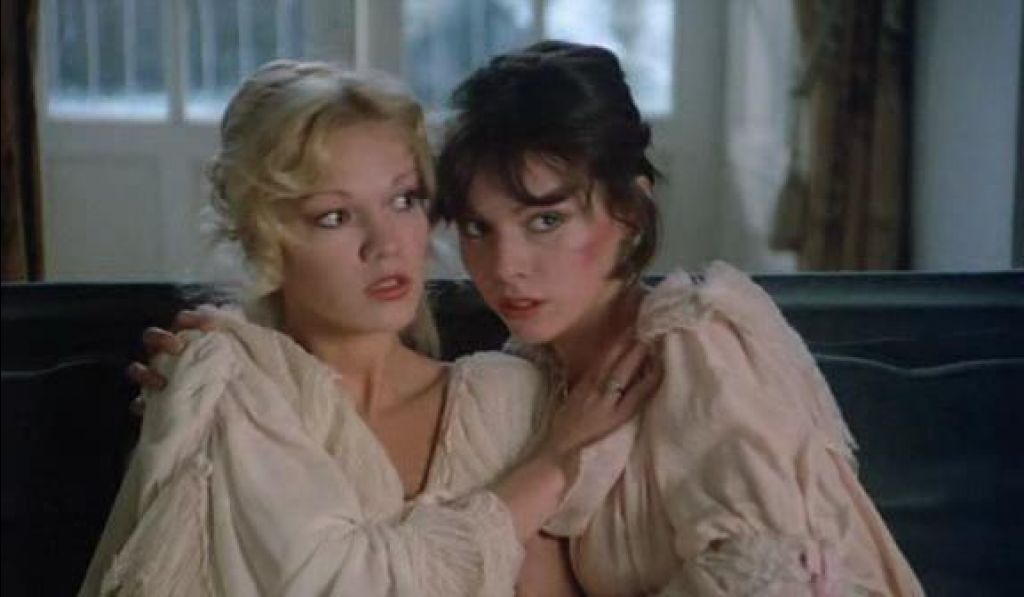


Brigitte Lahaie and Franka Mai


But I digress.  My point is that because of his one-time association with Franco, I think I often disregarded the accolades Rollin received (plus, while Franco merely dabbled in porn in 1980s, most of Rollin's career was spent directing hardcore porn under a pseudonym, which supplied the money to make his more personal, serious horror films).  But there's been a strange turn of events recently:  a Rollin film (1973's THE IRON ROSE) actually played on Turner Classic Movies.  And the prestigious Kino Lorber acquired the rights to Rollin's horror films via Redemption and has just released the first batch in deluxe Blu-ray and DVD editions (in addition to FASCINATION and THE IRON ROSE,  the initial wave includes 1970's THE NUDE VAMPIRE, 1971's THE SHIVER OF THE VAMPIRES, and 1975's LIPS OF BLOOD).  And just a few days ago, there was a story on the Rollin Blu-ray releases in the New York Times.  In short, it was time for me to stop being a dismissive dick and see what Rollin was all about.


1979's FASCINATION is generally regarded as the Rollin film to see if you're only going to watch one or want to get your feet wet.  It has the trademark Rollin touches--vampires, erotica, surreal, poetic imagery--with an added bonus of relative coherence, which wasn't always one of his primary concerns (Rollin died in 2010).  After opening with a scene of aristocrats drinking ox blood as a cure for anemia, the story settles on thief Marc (Jean-Marie Lemaire) making off with some gold coins as his cohorts chase him.  He hides in a desolate chateau nearby, where everyone is gone except for two bisexual chambermaids, Elisabeth (Franka Mai) and Eva (Brigitte Lahaie).  The chambermaids are waiting for the chateau's Marchioness and her servants.  Eva falls in love with Marc, much to the jealous disapproval of Elisabeth.  Eva tells Marc he has to leave before midnight when the Marchioness and the servants will arrive...

Marc (Jean-Marie Lemaire) has no idea what he's gotten himself into.


Watching this film--and I don't know if anyone has said this before, but I imagine they have--Rollin struck me as everything people say Franco is but isn't.  For starters, this is a much better-made, more polished and professional-looking film than anything Franco has ever done.  Rollin works wonders with a small budget, shooting in actual locations and using a lot of natural lighting.  Unforgettable imagery abounds:  the abbatoir in the opening scene, the path to the chateau, the eventual appearance of the Marchioness, and pretty much every scene involving Lahaie.  An actress who moved between legit films and hardcore porn under a variety of different names, Lahaie was a fixture in most of Rollin's films and a couple ones later on for Franco, but FASCINATION is her finest work.  The image of Lahaie and the scythe have become part of European horror iconography, and the whole sequence where Eva stalks and kills Marc's vengeful associates is unforgettable.  I mean, seriously, does imagery get any more effective than this?

Brigitte Lahaie cements her place in horror film history

Lahaie is hypnotically beautiful in this.  Stunning.  And Rollin knows it.  When she's on camera, you can't take your eyes off of her.  Short on standard scares but long on style and pure visual, cinematic artistry, FASCINATION, like all of Rollin's work, is a hard film to describe, which may be a reason I avoided it and Rollin for so long.  But this is an oversight that will be remedied soon.  Budget limitations and occasional clumsy editing aside, FASCINATION is, in its own way and with its dreamy, melancholy aura, a film as beautiful and spellbinding as Alain Resnais' LAST YEAR AT MARIENBAD.   So believe the hype.  There's clearly a Rollin renaissance going on right now, and I wish I'd been onboard sooner.


Friday, January 27, 2012

Forgotten Films Revisited: WHITE HUNTER, BLACK HEART (1990)


WHITE HUNTER, BLACK HEART
(US - 1990)  

Directed by Clint Eastwood.  Written by Peter Viertel, James Bridges, and Burt Kennedy.  Cast: Clint Eastwood, Jeff Fahey, George Dzundza, Marisa Berenson, Alun Armstrong, Timothy Spall, Richard Vanstone. (PG, 112 mins)

This review was originally published on the Mobius Home Video Forum in a different form in July 2010.


It's hard to believe there was once a time when Clint Eastwood was considered washed-up and had to kiss ass to get pet projects made. It really wasn't until 1984's TIGHTROPE that critics bothered to notice Eastwood was a real actor and not just Dirty Harry. But by the late '80s, his star was fading (he even took time off to serve as mayor of Carmel, CA), and as he approached 60, Eastwood was determined to be Taken Seriously, if not as an actor then as a filmmaker.  But he had to play ball with the studio. In order to get his 1988 Charlie Parker biopic BIRD released, he had to give Warner Bros. another Dirty Harry outing with the same year's THE DEAD POOL (and his boredom is obvious throughout) and the 1989 comedy PINK CADILLAC, and for this adaptation of Peter Viertel's fictionalized account of John Huston's adventures while filming THE AFRICAN QUEEN, he had to provide a LETHAL WEAPON knockoff, teaming up with Charlie Sheen in 1990's THE ROOKIE.  It's easy to forget that UNFORGIVEN was a major comeback for Eastwood after several years of uninspired and increasingly unpopular star vehicles and ambitious serious efforts that met with critical acclaim but audience apathy. Shot mostly on location in Zimbabwe, the $24 million WHITE HUNTER, BLACK HEART grossed just $2 million in the US, making it one of the biggest box-office bombs of Eastwood's career (and, when adjusted for inflation, according to Box Office Mojo, it IS the biggest bomb of his career), and one that I found suffocatingly dull when I saw it as an 18-year-old.  It's still the closest he's come to making a stuffy, PBS-ready Merchant-Ivory film.  But, looking at it with fresh eyes after a couple of decades, and watching it with the knowledge of some of his later works after establishing his auteur credentials, it's much easier to appreciate WHITE HUNTER, BLACK HEART today than it was in 1990.


Eastwood delivers a very uncharacteristic and sometimes (especially in the early scenes) mannered performance as egocentric director John Wilson, based on the larger-than-life John Huston. He's about to head to Africa for a film shoot and insists his writer friend Pete Verrill (Jeff Fahey, who's absolutely terrific here and should've had a much bigger career ahead of him) join him on his quest to bag a great elephant. This hunt comes at the expense of the actual film shoot, much to the consternation of his producer (George Dzundza, slipping in and out of a Gert Frobe-ish accent) and his British backers, and the bewilderment of his stars Kay Hooper (Marisa Berenson, doing an impeccable Katherine Hepburn) and Phil Duncan (Richard Vanstone, only vaguely Bogart-like). There are some almost-typical Eastwood moments--a brawl with a racist hotel manager, and a lacerating verbal bitchslapping of an anti-Semitic society woman, but it's a very (for the time) atypical Eastwood venture, one that fans flat-out ignored.  It just took the general public a couple of years and the right Eastwood project to catch up.


WHITE HUNTER, BLACK HEART is rarely mentioned these days, and it isn't deserving of its black sheep status with his fan base.  He's made a few missteps here and there in his career--I'd probably rank FIREFOX and INVICTUS as the worst films he's directed, though I'm prepared to give FIREFOX another look--but in hindsight, WHITE HUNTER, BLACK HEART is a fine film.  In terms of style, pacing, and tone, the mostly low-key UNFORGIVEN really isn't really all that different from WHITE HUNTER, BLACK HEART.  But it took a western--familiar ground for Eastwood and his fans--for him to find a project that would finally provide both the artistic bona fides and the box office to put him back on top.

Wednesday, January 25, 2012

In Theaters: HAYWIRE


HAYWIRE
(US/Ireland - 2012)

Directed by Steven Soderbergh. Written by Lem Dobbs.  Cast: Gina Carano, Antonio Banderas, Michael Douglas, Michael Fassbender, Ewan McGregor, Bill Paxton, Channing Tatum, Mathieu Kassovitz, Michael Angarano. (R, 93 mins)


Retired MMA star Gina Carano makes an impressive action movie debut in Steven Soderbergh's offbeat arthouse action thriller HAYWIRE.  It's already more or less bombed at the box office and the gap between critical raves and audience disapproval (scoring a D+ on Cinemascore) is among the widest in recent memory.  I think the best way to approach HAYWIRE is to accept it as a Soderbergh film first and an action flick second, as it has all the distinctive Soderbergh looks and rhythms, and is probably closest in spirit to his 1999 cult film THE LIMEY (both films were written by Lem Dobbs).  Like that film, HAYWIRE has a cold detachment to it that can be a little off-putting at first, and the story takes a good hour to really show all its cards and let you completely in on what's going on, but it grows on you.  It's got a great cast, exciting, brutal action sequences, a jarringly 1970s feel with the refreshing lack of CGI and shaky-cam and hyperactive editing, and a hypnotic score by David Holmes that kept reminding me of early '70s jazz fusion, almost like Chick Corea's keyboard sound in the heyday of Return to Forever.  It's a strange movie, there's no denying it, and I can see why Joe Multiplex is rejecting it if they aren't open to an B-grade action movie done through Soderbergh's vision.  Sure, Soderbergh could've made a standard, cookie-cutter, straight-to-DVD-style action flick.  But why would he?


Carano is Mallory Kane, a top operative for a black-ops outfit contracted by the government.  The film opens with Mallory in a diner in upstate New York, where she proceeds to get into a bonecrushing brawl with former associate Aaron (Channing Tatum).  She escapes and takes customer Scott (Michael Angarano) with her, telling him her story that plays out mostly in flashbacks.  It doesn't take long for Mallory to figure out she's being set up, but for what and by whom are the unknowns:  there's Aaron; Mallory's boss and ex-lover Kenneth (Ewan McGregor); MI-6 agent Paul (Michael Fassbender);  his associate Studer (Mathieu Kassovitz);  US government honcho Coblenz (Michael Douglas); and his contact Rodrigo (Antonio Banderas).


Carano is an engaging screen presence and holds her own with her impressive supporting cast.  There was an admission just prior to release that her voice was digitally lowered, but it wouldn't have been noticeable at all and, to me, is a complete non-issue.  The numerous fight scenes play out in long takes with little (if any) music and no sound effects.  Sometimes they aren't perfectly choreographed.  In short, they look, for the most part, like real fights.  Dobbs' script has numerous twists and turns and some occasionally witty dialogue (I love Douglas' deadpan delivery of the line "We got ourselves a real twizzler here," when he's on the phone trying to get to the bottom of things).  HAYWIRE was probably a hard sell, which could explain why it sat unreleased for almost two years before getting a January dumping (filming was completed well before Douglas' summer 2010 cancer diagnosis; and Soderbergh's next project was CONTAGION, which was released months ago).  It's an intriguing, enjoyable film that often seems like a lost relic from another bygone decade, and I mean that in a good way, and that's why I feel it makes a good companion piece to THE LIMEY, a film that's improved with age--the film's and my own.


On DVD: THE WOMAN (2011), LITTLE DEATHS (2011), ATROCIOUS (2011)


THE WOMAN
(US - 2011)


THE WOMAN earned some internet notoriety a year ago at Sundance when a member of the audience totally lost his shit and freaked out over what was happening onscreen (it's on YouTube if you care).  This was dismissed by most as a publicity stunt, but after seeing the film, if the guy was legit, I'm pretty much on his side.  Not because the content is offensive, but because the film is terrible.  The only thing I have left to ponder is whether it's a terrible horror movie or a terrible comedy.  Directed by the once-promising and now ironically-named Lucky McKee (best known for 2003's cult classic MAY), and based on a novel by McKee and extreme horror author Jack Ketchum (both co-wrote the screenplay), THE WOMAN is a semi-sequel to 2009's OFFSPRING, an adaptation of a Ketchum novel that didn't involve McKee (though McKee has a history with Ketchum: he started directing 2008's little-seen and worthwhile RED, based on a much more restrained Ketchum novel, but was relieved of his duties midway through production).  A feral woman (Pollyanna McIntosh), raised by wolves and living in the wild, is captured by small-town lawyer Sean Bridgers.  Bridgers chains McIntosh in a cellar under the barn with the intent of "civilizing" her, and his family (wife Angela Bettis, and three children)...well, they just kinda go along with it.  Nobody ever really reacts to anything in THE WOMAN.  Indeed, the film does contain the most nonchalant reaction to a finger being bitten off that you're likely to see.  The more time we spend with Bridgers and the family, the more we see what an unconscionable asshole this guy really is--a bitter misogynist and control-freak psychopath, almost cartoonishly so.  But hey, whatever.  Dad brings a wild woman home, chains her up under the barn, cleans her up, loses a finger.  Everybody just kinda pulls a "Whatev's" and goes about their dysfunctional business. 

To McKee's credit, THE WOMAN does finally gets its act together for a few minutes in the climax, but it's far too late to contain the damage, and then things just go too far over-the-top.  Until then, McKee endlessly dicks around with montage after montage with completely incongruous alt-rock tunes that border on parody.  Are he and Ketchum being funny?  Is this satire?  It's hard to tell.  Bridgers' (formerly of HBO's DEADWOOD) smirking, rage-boiling-to-the-surface performance kept reminding me of Will Ferrell, which further confuses the issue as to whether or not McKee is playing this straight.  And as for The Woman herself, McIntosh gives it her all, but the film abandons her for long stretches.  Of course, it's her presence that causes the family to implode and their disturbing secrets to be revealed, but until the finale, she curiously remains a background character.  Gorehounds and fans of transgressive cinema may find something to latch on to here, but it's all so heavy-handed, tone-deaf, and utterly pointless that it's impossible to care.  (R, 103 mins)


LITTLE DEATHS
(UK - 2011)

If transgression is what you're looking for, then the three-part British horror anthology LITTLE DEATHS is a better bet than THE WOMAN.  The first segment, "House and Home," written and directed by Sean Hogan, has an upper-class couple inviting a homeless woman to their posh residence for dinner, ostensibly out of generosity and Christian goodwill.  They clearly have something far more sinister in mind and, as you might expect, so does their guest.  The second segment, "Mutant Tool," written and directed by Andrew Parkinson, is the dead weight of the film, a grotesque, incoherent mess involving an ex-prostitute being given an experimental drug by a quack doctor that gives her a "third eye" psychic link to a man held captive in a grungy research lab, where he's intravenously fed blender-liquified human organs as two of the doc's assistants harvest psychedelic semen from his elephant trunk-sized penis.  I don't even know what I just wrote.  As should be the norm in anthology horror films, the best is saved for last, with Simon Rumley's "Bitch."  Rumley, whose RED, WHITE & BLUE was perhaps the most punch-in-the-gut shocking film I saw in 2011, is a bold, fearless filmmaker who is not afraid to take viewers into some dark, disturbing places.  We're going to hear more from this guy.  "Bitch" has a doormat boyfriend who's had just about enough of the constant head games of his manipulative, cuckolding girlfriend, who, among other indignities, brings other men home for sex when she isn't making the boyfriend wear a dog mask while she sodomizes him with a strap-on.  "Bitch" concludes with a long, brilliant sequence with the most sardonically inappropriate music imaginable, and, unlike Lucky McKee, Rumley finds the right balance between horror and sick humor.  For the adventurous viewer not easily offended, LITTLE DEATHS is 2/3 of a solid flick, but the middle segment is completely skippable.  And RED, WHITE & BLUE is still streaming on Netflix as of this writing.  It's well worth checking out, but word of warning:  like LITTLE DEATHS, it's most certainly not for everyone.  (Unrated, 95 mins)

ATROCIOUS
(Spain/Mexico - 2011)

There's not much left to do with the "found footage" horror subgenre, and the makers of ATROCIOUS would seem to be setting themselves up for easy abuse by calling their movie ATROCIOUS.  So, props to writer/director Fernando Barreda Luna for making one that still manages to induce some occasional goosebumps and knows not to overstay its welcome.  At just 74 minutes, ATROCIOUS wastes no time and the twist ending is genuinely surprising and chilling.

A vacationing family--Mom, Dad, three kids aged 8 to 18, and the dog--stay at a secluded, long-abandoned Sitges home that's been in Mom's family for years.  At the edge of the property is labyrinth/hedge maze where, legend has it, years and years ago a girl named Melinda was lost in the labyrinth and never found, and now, she supposedly turns up to guide those who find themselves lost in the maze.  The locals avoid the labyrinth, but the two oldest children, Cristian (Cristian Valencia) and July (Clara Moraleda) take their digital video cameras and investigate.  They get lost and, briefly, think they see a figure standing at a distance with its back to them.  Dad gets called back home on business.  Then...things start happening.  The film purports to be the whittled-down, police evidence version of the 37 hours of footage found on Cristian's cameras.  There's a lot of shaky-cam night vision and a lot of characters yelling "Mama!" and "Cristian!" and "July!" which is to be expected in this kind of film.  But ATROCIOUS knows it's not an innovative piece of work, and Luna never lets the characters grow tiresome (another pitfall of "found footage").  And there's that ending. Not a great film, but for a largely spent subgenre, it's a pretty good one, streaming on Netflix and worth a look. (R, 74 mins)

Monday, January 23, 2012

Cult Movie Trash/Margheriti Madness: SEVEN DEATHS IN THE CAT'S EYE (1973)


SEVEN DEATHS IN THE CAT'S EYE
(Italy/France/Germany - 1973)

Directed by Anthony M. Dawson (Antonio Margheriti).  Written by Antonio Margheriti and Giovanni Simonelli.  Cast: Jane Birkin, Hiram Keller, Francoise Christophe, Serge Gainsbourg, Venantino Venantini, Doris Kunstmann, Anton Diffring, Dana Ghia, George Korrade, Alan Collins (Luciano Pigozzi).  (Unrated, 95 mins)


Cover art for 2005 DVD release

Often labeled a giallo, probably due to its very Dario Argento-inspired title, Antonio Margheriti's SEVEN DEATHS IN THE CAT'S EYE is more in line with his gothic Euro-horrors of the 1960s, like THE VIRGIN OF NUREMBERG and CASTLE OF BLOOD.  There is a very giallo sense of sleazy perversity running through SEVEN DEATHS, but the film itself is ultimately a misfire that never gets out of first gear and is often too silly for its own good.  It is redeemed by a terrific twist ending that might have you thinking you just saw a better film than you did.  I remember thinking that after the first time I saw it six years ago, and I imagine in another half decade or so, I'll forget and once again think "Hey, I should revisit that one," and I can be disappointed all over again.


Jane Birkin and Hiram Keller


In a small Scottish village, Corringa (BLOW-UP's Jane Birkin) is visiting relatives at the Castle MacGrieff, overseen by her aunt Lady Mary MacGrieff (Francoise Christophe) and her eccentric, possibly insane son, Corringa's cousin Lord James (FELLINI SATYRICON's Hiram Keller).  Also hanging around the castle, for various reasons, are Corringa's mother (Dana Ghia);  bisexual tutor Suzanne (Doris Kunstmann), essentially hired by Lady Mary to seduce her son; groundskeeper Angus (Luciano Pigozzi); family advisor Father Robertson (Venantino Venantini); and lecherous family doctor Franz (Anton Diffring, dubbed by Ted Rusoff, who supervised the English script translation and dubbing), who's sleeping with both Lady Mary and Suzanne.  Soon, someone starts offing the unlikable cast one by one, with all the murders witnessed by the ever-observant family cat who constantly roams the castle grounds.  Before long, an eccentric detective who may as well be named Almost Hercule Poirot (Birkin's then-husband, French singer Serge Gainsbourg), starts investigating.

A ghostly vision in one of Corringa's nightmares.


It's a very Agatha Christie set-up, complete with a mysterious location, secret passageways, creepy crypts, sidelong glances, and scheming assholes, plus rats, bats, cobwebs, vampire superstitions, and Lord James' secret pet gorilla (!), who periodically frees himself from his cage and wanders the castle or peeps out of windows only to disappear a moment later.

Lord James MacGrieff's secret pet gorilla.  Whatever.


Margheriti and "director of photographye" (as the credits label him) Carlo Carlini establish a admirably creepy and very colorful atmosphere, but SEVEN DEATHS IN THE CAT'S EYE is pretty dull stuff.  There's a lot of padding and boring talk of inheritances and what not, with an occasional gory murder or sex scene to liven things up (Kunstmann supplies most of the nudity, but Margheriti gets dangerously close to showing Anton's Diffring at one point), plus an almost comical over-reliance of "DUN, DUN, DUNNNN!"  at even the most insignificant plot development.

Eurocult regular Venantino Venantini and some of the film's garishly colorful lighting.


Old-school Prism VHS box


It's interesting to see Birkin and Gainsbourg acting together, and to see how much a 27-year-old Birkin reminds you of their daughter, actress Charlotte Gainsbourg.  The performances are a little hard to judge since even the English-speaking actors are dubbed.  Blue Underground's DVD, issued in 2005, has some rough spots but looks very nice overall, and at the proper 2.35:1 framing, is obviously a huge improvement over the reportedly hideous Prism Entertainment pan & scan VHS edition that used to be a video store mainstay back in the day.

Sunday, January 22, 2012

Cult Movie Trash/Margheriti Madness: TAKE A HARD RIDE (1975)


TAKE A HARD RIDE
(US/Spain - 1975) 

Directed by Anthony M. Dawson (Antonio Margheriti).  Written by Eric Bercovici and Jerry Ludwig.  Cast: Jim Brown, Lee Van Cleef, Fred Williamson, Catherine Spaak, Jim Kelly, Barry Sullivan, Dana Andrews, Harry Carey Jr, Robert Donner, Ricardo Palacios, Buddy Joe Hooker, Paul Costello. (PG, 103 mins)

For this US/Spanish co-production, though for all intents and purposes a major studio American film, Italian journeyman Antonio Margheriti somehow found himself at the helm of a blaxploitation/spaghetti western hybrid that reunited the stars (Jim Brown, Fred Williamson, and Jim Kelly), screenwriters (Eric Bercovici and Jerry Ludwig) and producer (Harry Bernsen) of the 1974 hit THREE THE HARD WAY, which might be my all-time favorite blaxploitation flick.  TAKE A HARD RIDE is a more serious film, and as a result, it's not nearly as much fun, but it's not deserving of the harsh words it's gotten over the years.


Jim Brown as Pike

When his employer Morgan (Dana Andrews) drops dead from a heart attack, trail boss Pike (Brown) has to get Morgan's $86,000 fortune down to Mexico, where Morgan's wife and their new business await.  It doesn't take long for word to spread throughout the region that a black man is traveling with $86,000, and every gunslinger and bandit in the vicinity tries to ambush the honorable Pike.  Foremost among them is ruthless bounty hunter Kiefer (Lee Van Cleef), but Pike gets some help when he's joined by fast-talking card cheat Tyree (Williamson), and later, by widowed ex-prostitute Catherine (Catherine Spaak) and mute martial-arts zen dude Kashtok (Kelly).


Fred Williamson as Tyree


TAKE A HARD RIDE is entertaining but unexceptional.  It never really takes advantage of the blaxploitation element, and it never feels like a spaghetti western, despite being directed by an Italian.  Margheriti brought along Riccardo Pallotini, his favorite cinematographer, but even with beautiful locations in Spain and the Canary Islands, the film is made in the bland, TV-movie style that many 1970s American studio films exhibited.  That's not to say it's badly-directed.  There's some nicely-done action sequences, which were always a Margheriti specialty particularly in his later jungle action pictures of the 1980s, but the film just has the workmanlike, personality-free sense of clock-punching, hired-gun professionalism that an Andrew V. McLaglen or a Burt Kennedy would've brought to the table.  Take out the African-American stars, the PG-level profanity, and a thoroughly unnecessary Harry Carey, Jr. ass shot, and this could've been made 20 years earlier with Randolph Scott and Dan Duryea with no discernible difference.  In an era of blaxploitation, Sergio Leone, and Sam Peckinpah, TAKE A HARD RIDE probably seemed like a dated relic the moment it was released.  With the exception of an unsettlingly ominous, synthy Morricone-styled cue for Van Cleef, even Jerry Goldsmith's score sounds like it belongs in a 1950s western.

Lee Van Cleef as Lee Van Cleef


As a follow-up to the insane THREE THE HARD WAY, TAKE A HARD RIDE is a disappointment.  But taken on its own terms, it's a decent-enough western that could've been a lot better but is still enjoyable nonetheless.  Brown and Van Cleef would reunite in 1977 for KID VENGEANCE, which was also released as TAKE ANOTHER HARD RIDE.  Van Cleef had already worked with Margheriti on 1974's kung-fu/spaghetti hybrid THE STRANGER AND THE GUNFIGHTER (released in the US in 1976), and would reteam on several European films throughout the rest of the 1970s and the 1980s, most notably the superb 1978 NYC-shot heist thriller THE SQUEEZE.

Friday, January 20, 2012

Unseen Cinema: BLACKTHORN (2011)


BLACKTHORN
(Spain/France/Bolivia - 2011)

Directed by Mateo Gil.  Written by Miguel Barros.  Cast: Sam Shepard, Eduardo Noriega, Stephen Rea, Nikolaj Coster-Waldau, Magaly Solier, Padraic Delaney, Dominique McElligott.  (R, 102 mins)

It seems more films than ever--even big-budget films with big name stars--are falling through the cracks and not being seen until they get dumped on DVD/Blu-ray or VOD.  Or, in the case of many Magnolia releases, they follow an unconventional release pattern that sees them premiering on VOD or online, and then, maybe going to theaters before arriving on DVD or streaming on Netflix.  BLACKTHORN debuted on iTunes and VOD a month before an October 2011 theatrical release that saw it hit 21 US screens at its widest.  I'm almost certain more people saw it on VOD than in a theater (its total gross was less than $200,000), and while that may represent changing distribution methods, it's really unfortunate because this is a beautifully-made film that would've looked absolutely stunning on a big screen.


And it's a hell of a film, and not just visually.  Set in 1927 Bolivia, the film has an aging Butch Cassidy, played to grizzled perfection by Sam Shepard, living a low-profile existance nearly 20 years after he was thought to be killed with the Sundance Kid.  Calling himself James Blackthorn, Cassidy is set to leave Bolivia to return to the US upon hearing of the death of former cohort and lover Etta Place.  His plans take a detour when he's shot at by bandit Eduardo Apodaca (Eduardo Noriega), which causes his horse--and saddlebags filled with $6000--to run off.  Apodaca is being pursued by a posse after stealing $50,000 from an unscrupulous mine owner.  Cassidy, keeping his true identity a secret, goes along with Apodaca, intending to keep $25,000 for himself for all the trouble Apodaca has caused him.  An unlikely friendship forms between the men, and after a surprise encounter with two female members of the posse, Cassidy decides to make a run for it with Apodaca, but there's surprises in store for both men.


BLACKTHORN isn't really a big western shoot 'em up.  It falls more in line with the somber, elegiac tone of, say, Peckinpah's PAT GARRETT AND BILLY THE KID.  "James Blackthorn" gets by, but is forever haunted by his past, his dead friends, his lost loves ("Uncle Butch" is going to the US to meet Etta's son Ryan, who's really his son), and is coming to terms with the fact that he's an old man and he wants to set things right (his reflections are in the form of flashbacks, where young Cassidy is played by GAME OF THRONES' Nikolaj Coster-Waldau).   It's not all somber and remorseful, and there's still plenty of humor in the film (Cassidy, rubbing salve on Apodaca's bare, saddle-chafed ass: "Yer ass is softer'n a bookkeeper's!").  


Shepard has never been better than he is here, and this film's extremely limited release not only deprived moviegoers of a beautiful-looking film, but a beautifully-acted one as well, and in a perfect world, there'd be Oscar buzz for Shepard's performance.  It's the kind of performance that an often-overlooked actor delivers in the latter part of their career that cements their reputations and provokes a re-evaluation of their past work.  There's no shortage of great work in Shepard's past: DAYS OF HEAVEN (1978),  FRANCES (1982), THE RIGHT STUFF (1983), FOOL FOR LOVE (1985), DON'T COME KNOCKING (2005), and he even brought depth and heart to a small supporting role as a retired prison guard in the otherwise forgettable FELON (2008), working a hell of a lot harder than he had to for a film headlined by Stephen Dorff and Val Kilmer.  And, like any character actor, there's a lot of quick paycheck junk on Shepard's IMDb page (DEFENSELESS, SWORDFISH, STEALTH), but he's rarely lauded for the often subtly solid work he's done for most of the last 30-plus years.  You could argue that BLACKTHORN is a career performance for him.  It's certainly the best role he's had in years. 


He's given strong support by Noriega and, later in the film, a marvelous Stephen Rea as Mackinley, a former Pinkerton agent who's now a drunken wreck in Bolivia. Mackinley's pursuit of Butch and Sundance was an obsession, and his claims that Cassidy wasn't killed in 1908 only got him laughed out of a job.  Rea's another terrific character actor who too often gets saddled with journeyman paycheck gigs and doesn't do a good job of hiding his disinterest, but proves here that he still has an A-game and can bring it when the situation calls.


Written by Miguel Barros and directed by longtime Alejandro Amenabar collaborator Mateo Gil, who wrote Amenabar's films TESIS (1996), OPEN YOUR EYES (1999), THE SEA INSIDE (2004), and the underseen AGORA (2010), BLACKTHORN's other major weapon is the breathtaking cinematography by Juan Ruiz Anchia that makes use of every bit of the 2.35 aspect ratio.  BLACKTHORN is one of those unheralded gems that just get missed.  It's been on DVD/Blu-ray for a few weeks and it started streaming on Netflix today.  It's worth your time.  One of the best-kept secrets of 2011 cinema.