tenebre

tenebre
Showing posts with label Italian horror. Show all posts

Friday, March 25, 2016

Retro Review: A QUIET PLACE IN THE COUNTRY (1968)


A QUIET PLACE IN THE COUNTRY
(Italy/France - 1968; US release 1970)


A QUIET PLACE IN THE COUNTRY is a strange and impenetrable supernatural art/horror hybrid from Italian filmmaker Elio Petri that came between his pop Eurocult masterpiece THE 10TH VICTIM (1965) and the Oscar-winning INVESTIGATION OF A CITIZEN ABOVE SUSPICION (1970). Petri and THE GOOD, THE BAD AND THE UGLY co-writer Luciano Vincenzoni are credited with the screenplay, which also had some input from frequent Michelangelo Antonioni collaborator Tonino Guerra, and the end result definitely has an Antonioni-gone-horror feel to it, along with some distinctly Mario Bava-esque set pieces and story tropes (cursed houses, buried secrets, etc) that also prefigure the coming rise of the giallo, particularly the more paranormally-charged ones like Dario Argento's DEEP RED (1975). The film was also a likely influence on Pupi Avati's THE HOUSE WITH LAUGHING WINDOWS (1976), especially with its immersion in the art world. Unable to focus on his work in Milan, creatively-blocked artist Leonardo Ferri (Franco Nero) decides to get away to the titular location, a villa in a remote rural community that was found by his married lover and primary backer Flavia (Vanessa Redgrave). Already suffering from strange nightmares--the film opens with a psychosexual, S&M fever dream sequence where Flavia is teasing and taunting a restrained Leonardo, who's wearing nothing but a diaper--Leonardo finds the isolation of the villa does little to improve his mental state. He's losing his grip on reality and starts seeing the ghostly apparition of Wanda (Gabriella Grimaldi), a promiscuous 18-year-old local girl who died on the property under mysterious circumstances in 1944. The townspeople obviously know something they aren't revealing, Leonardo's already bizarre behavior grows more erratic by the minute, and it becomes quite clear that Wanda's spirit doesn't like it when Flavia is around.


That plot synopsis makes A QUIET PLACE IN THE COUNTRY sound a lot more consistently grounded than it is. Torn between his art film aesthetic and the genre gutter, Petri too often errs on the side of the pretentious cineaste. He seems particularly indebted to Antonioni and 1966's BLOW-UP, from the trippy psychedelia and the obsession of its lead character to the script input of Guerra and the presence of Redgrave who, despite her top billing, really has a supporting role (she and Nero met on the set of 1967's CAMELOT and were a couple at the time, and would eventually marry decades later in 2006). The film takes forever to get going and the tedious first hour is a real slog, but once Petri decides to focus on the horror elements, things improve significantly. The villa--a Cinecitta set seen in many Italian films--is incredibly atmospheric and filled with corners and hidden spaces that have you on edge (there's some terrific cinematography by Luigi Kuveiller and wonderfully fluid camera work by Ubaldo Terzano, Bava's favorite camera operator), and the film features a score by Ennio Morricone that finds the legendary composer in one of his free-jazz freakout moods, occasionally incongruously comedic-sounding, with moans, dissonant percussion, and randomly blaring trumpets. Until a surprisingly grisly finale, Petri keeps things pretty low-key though he does stage one of the more chillingly effective seances you'll ever see in this type of movie. There's a lot to appreciate about A QUIET PLACE IN THE COUNTRY, a rather obscure Eurocult curiosity that didn't turn up in US theaters until August 1970, just a couple of months before Petri's INVESTIGATION OF A CITIZEN ABOVE SUSPICION opened. It infrequently appears on Turner Classic Movies in the vicinity of 3:30 am (with its gore and nudity, this is pretty strong stuff by TCM standards) and was given an manufactured-on-demand DVD release by MGM a few years ago, but it remains a little-remembered relic from its day. Its biggest problem is that Petri non-committally hovers around the line separating "important" and commercial cinema and throughout, he fights the obvious desire to slum it in genre fare. He handled that fusion a bit better with THE 10TH VICTIM, but ultimately, A QUIET PLACE IN THE COUNTRY is an intriguing, uneven mess that works best after snapping out of its Antonioni worship and begrudgingly admitting that it's a horror movie. (R, 106 mins)


Wednesday, March 11, 2015

Cult Classics Revisited: THE EERIE MIDNIGHT HORROR SHOW (1974)


THE EERIE MIDNIGHT HORROR SHOW
aka THE TORMENTED
aka THE SEXORCIST
aka L'OSSESSA
(Italy - 1974; US releases 1977 and 1981)


Directed by Mario Gariazzo. Written by Ambrogio Molteni and Ted Rusoff. Cast: Stella Carnacina, Chris Avram, Lucretia Love, Ivan Rassimov, Gabriele Tinti, Luigi Pistilli, Umberto Raho, Gianrico Tondinelli, Piero Gerlini, Giuseppe Addobatti, Edoardo Toniolo, Gianni de Benedetto. (R, 85 mins)

After the phenomenal success of THE EXORCIST (1973), the imitation game was on, and nobody made more entertaining--often for all the wrong reasons--EXORCIST ripoffs than the Italians. Italy started cranking them out in 1974, though it sometimes took them a while to turn up in the US (THE ANTICHRIST, released in Italy in 1974, was retitled THE TEMPTER when it was finally shown in America in 1978). Few of the post-EXORCIST knockoffs had as many titles as L'OSSESSA, which translates to "The Obsessed." Beating Alberto De Martino's THE ANTICHRIST and Ovidio G. Assonitis' BEYOND THE DOOR to Italian theaters by two weeks in November 1974, L'OSSESSA holds the distinction of being the first Italian EXORCIST ripoff. Known in various parts of the world under the far more lurid moniker of THE SEXORCIST (it's listed on IMDb as ENTER THE DEVIL, which seems to be confused with a 1972 American horror film with the same title), the film would be acquired by the exploitation outfit 21st Century, who released it in the US throughout 1977 and into 1978 as THE TORMENTED. It was successful enough, at least in my hometown of Toledo, OH, to play for four (!) weeks at the two-screen theater in the tiny Greenwood Mall in April 1977. Someone at the Greenwood Cine thought so highly of THE TORMENTED that they brought it back for a week in July of that year! I don't think anything illustrates how times have changed quite like the idea of a tawdry, softcore Italian EXORCIST ripoff playing for a month straight at a shopping mall.


It wouldn't be until 1981 that L'OSSESSA (or whatever you want to call it) would settle on a definitive title by which everyone would refer to it from that point forward. 21st Century decided to relaunch the film for the burgeoning home video and cable markets, only this time, they ditched the rather bland THE TORMENTED and rechristened it THE EERIE MIDNIGHT HORROR SHOW, complete with a set of ROCKY HORROR lips adorning the newly-commissioned artwork. It was attention-getting, to say the least, and the film found a cult following both in video stores and through late-night airings on Showtime, where its mix of gory horror and softcore sex made it ideal for their "After Hours" programming. The plot concerns virginal art history grad student Danila (Stella Carnacina) and a large wood carving of one of the two men crucified with Christ, recovered from a deconsecrated church. The wooden man comes to life in the form of Eurotrash regular Ivan Rassimov and quickly reveals himself to be Satan, ravaging Danila in a sexual frenzy. As expected, her behavior becomes increasingly bizarre and inappropriate, whether she's masturbating in front of her parents Mario (Chris Avram) and Luisa (Lucretia Love), trying to seduce her father, or beating her head against the wall and escaping a sanitarium with the entire town in pursuit. Like a certain blockbuster from 1973, psychiatrists are consulted but with no success and ultimately, the local clergy recommends an exorcism despite concern that almost no priests are trained in the ritual. Fortunately, the hermit-like Father Xeno (Luigi Pistilli) is an experienced exorcist and happens to live high in the hills of a neighboring town because of course he does.


Like THE ANTICHRIST, there's a strong sexual element to THE EERIE MIDNIGHT HORROR SHOW but where the former was focused more on blasphemy and other unmentionables (like the infamous rimjob-on-a-goat scene), the latter has a kinky, S&M quality to it. It's personified mainly by Danila's mother, who's having a torrid, FIFTY SHADES fling with a sadistic playboy (Gabriele Tinti), who regularly whips her with roses, leaving cuts and lashes all over her body. Luisa's cuckolding of Mario is a main reason why Danila has so many hang-ups about sex and is keeping her boyfriend Carlo (Gianrico Tondinelli) waiting. But that's not really explored and Tinti serves little narrative purpose in the film, other than upping the softcore sleaze factor. Luisa's masochistic sexual tendencies do provide an interesting but underdeveloped parallel with Father Xeno, who almost succumbs to the temptation of a Satanic knobshine from the possessed Danila and responds by shouting "Abomination!" and apologizing to God for his weakness and making amends by engaging in some self-flagellation. As the sexual escapades of THE EERIE MIDNIGHT HORROR SHOW and THE ANTICHRIST demonstrate, Italians tended to get away with a lot more if they made the possession victim a young woman (or a young man in the case of 1975's unwatchable NAKED EXORCISM, aka THE POSSESSOR) instead of a teenage girl. One thing that differentiates THE EERIE MIDNIGHT HORROR SHOW from THE EXORCIST and its clones is that Danila doesn't hurl obscenities in a deep, demonic voice. She mainly just cries and screams (or moans, depending on where her fingers are). She doesn't even spew green vomit until the exorcism, and that's only after she eats clumps of her own hair, essentially barfing the devil out of her.


Finally looking good on home video (the occasional scratches and print damage only enhance the experience) with Code Red's recently-released Blu-ray (!), THE EERIE MIDNIGHT HORROR SHOW was directed by Mario Gariazzo (1930-2002), a perennial D-lister in the world of Eurocult journeymen, always sure to pop up with an obscure contribution to a then in-vogue genre, whether it's the 1969 spaghetti western GOD WILL FORGIVE MY PISTOL with Wayde Preston or the 1973 polizia THE BLOODY HANDS OF THE LAW with Philippe Leroy and Klaus Kinski. The same year as THE EERIE MIDNIGHT HORROR SHOW, he directed the G-rated tearjerker THE LAST CIRCUS SHOW, where he somehow managed to get James Whitmore, Lee J. Cobb, and Cyril Cusack onboard. Often working under the pseudonym "Roy Garret," Gariazzo dabbled in a little of everything, whether it was 1978's unbelievably boring post-CLOSE ENCOUNTERS OF THE THIRD KIND alien-invasion conspiracy thriller EYES BEHIND THE STARS, featuring Academy Award winner Martin Balsam absurdly dubbed by a British voice actor, or 1985's post-CANNIBAL HOLOCAUST jungle cannibal thriller AMAZONIA. Gariazzo rarely distinguished himself and THE EERIE MIDNIGHT HORROR SHOW is probably his best-known film by default, though his 1979 giallo/porno-crossover PLAY MOTEL has its admirers. L'OSSESSA's script was written by Ambrogio Molteni, another gun-for-hire who penned several insignificant spaghetti westerns before hopping on the BLACK EMANUELLE bandwagon in the mid '70s, and later, Bruno Mattei's skeezy 1982 women-in-prison classic VIOLENCE IN A WOMEN'S PRISON, released in the US in 1984 as CAGED WOMEN.


Dubbing maestro Ted Rusoff (1939-2013)
 posing with the 2010 issue of Video
Watchdog 
with him as the cover story.
Molteni no doubt supplied L'OSSESSA with its more pervy elements, but a good chunk of its American EERIE MIDNIGHT HORROR SHOW grindhouse/drive-in charm came from Ted Rusoff. The smooth tones of Canadian expat Rusoff can be heard in countless Eurocult films from the 1960s through the early 2000s. Rusoff spent his career in Italy and supervised the English dubbing of L'OSSESSA (with 21st Century even giving him a writing credit) while also providing the voice for Tondinelli's character. If you've seen enough of these things, you start recognizing the voices, and Rusoff brought the whole gang along for this one: his wife Carolynn De Fonseca dubbed Love, the gruff Ed Mannix dubbed one of the psychiatrists, Michael Forest supplied the voice of Rassimov's Satan, and the mellifluous Tony La Penna handled the actor playing Danila's professor. Rusoff must've had them in the recording studio after a long day and a lot of wine with dinner, because it's one of the most gloriously sloppy dub jobs this side of a vintage GODZILLA movie. In their scripting of English translations, guys like Rusoff would at least try to utilize words and phrasings that would closely match the lip movements while retaining the ideas and the intentions of the original Italian script. No such effort is put forth here. The English words rarely match the what the actors are saying in Italian, and the dialogue is often riotous, especially when Carlo yells at Luisa about her affair and "the whips and belts and other masochistic tomfoolery," pausing briefly before capping it off with a blunt, barked "Whore!" But Avram's back is turned when the dubbed voice spits "Whore!" and the over-the-top way that it's said is more comedic than anything. In other words, the voice actor dubbing Avram didn't have to say it, but it's almost like they knew it would get a big laugh, or maybe they were just amusing themselves. This is not Rusoff and his voice posse's finest hour in terms of quality control, but it's obvious they had a great time working on it...or at least a great time before working on it. Rusoff died in 2013 in the midst of a renewed interest in the world of dubbing, thanks in part to an extensive interview he did with John Charles in a 2010 issue of Video Watchdog. I corresponded with Rusoff on Facebook on several occasions and he had fascinating and often unfiltered stories to share about working with everybody in the business as well as a very self-deprecating attitude about his career, once replying with "I'm sorry you've seen so much of my work."


Stella Carnacina was 19 when she starred in THE EERIE MIDNIGHT HORROR SHOW. It was her first significant role and it led to a brief period where she was a frequently nude starlet in Italian sex comedies (the same year, she co-starred with Italian comedian Lando Buzzanca in THE HANDSOME DEVIL). Carnacina also graced the cover of the Italian edition of Playboy in May 1975, and embarked on a singing career that eventually took precedence over acting. She's been offscreen since 1982 and her musical output seems to have ceased in 1985 as the now-60-year-old Carnacina appears to be long retired from public life. The rest of the film's main cast is filled out by several familiar Eurotrash faces, most notably Rassimov, best known for his sinister performance in Sergio Martino's THE STRANGE VICE OF MRS. WARDH (1971) and as the Jim Jones-like cult leader Jonas in Umberto Lenzi's EATEN ALIVE (1980) and Tinti, who appeared in occasional Hollywood movies like THE FLIGHT OF THE PHOENIX (1965) and THE LEGEND OF LYLAH CLARE (1968), but was better known for co-starring in several EMANUELLE films with wife Laura Gemser.


Luigi Pistilli's naturally glum, sad face suits the morose Father Xeno. A respected Italian stage figure, Pistilli became a busy big-screen character actor and was a veteran of numerous westerns and gialli, even headlining Sergio Martino's YOUR VICE IS A LOCKED ROOM AND ONLY I HAVE THE KEY (1972) and co-starring with Avram in Mario Bava's BAY OF BLOOD (1971). Pistilli's place in film history is cemented by his brief role as Father Ramirez, the angry and heartbroken brother of Tuco (Eli Wallach) in Sergio Leone's THE GOOD, THE BAD AND THE UGLY (1966). Wallach does some of his career-best acting in his scene with Pistilli, who's dubbed but the performance shines through just with the look in his eyes. Pistilli spent most of the 1980s and into the 1990s concentrating on stage work. His life came to a tragic end on April 21, 1996 when he killed himself just before he was to take the stage for the final performance of the Terence Rattigan play Tosca, which had been shredded by critics and audiences. The 66-year-old Pistilli was believed to be depressed about the negative response to the play and was also angry and remorseful over the recent end of a relationship with Italian singer Milva, leaving a suicide note that included an apology for making several disparaging remarks about her to the press following their breakup.


Monday, May 5, 2014

Cult Classics Revisited: CONTAMINATION (1980)


CONTAMINATION
aka ALIEN CONTAMINATION
(Italy/West Germany - 1980; US release 1981)

Directed by Lewis Coates (Luigi Cozzi). Written by Lewis Coates (Luigi Cozzi) and Erich Tomek. Cast: Ian McCulloch, Louise Marleau, Marino Mase, Siegfried Rauch, Gisela Hahn, Carlo De Mejo, Carlo Monni, Martin Sorrentino, Mike Morris, Brigitte Wagner. (Unrated, 95 mins/R-rated US theatrical version, 84 mins).

Given its box-office popularity and groundbreaking special effects, it couldn't have been much of a surprise when Ridley Scott's 1979 classic ALIEN spawned its own subgenre of B-grade ripoffs over the next few years.  And it's also no surprise that the Italians climbed aboard the bandwagon, even though the most prominent of the ALIEN imitations were from the US with the Roger Corman productions GALAXY OF TERROR (1981) and FORBIDDEN WORLD (1982), plus the non-Corman CREATURE (1985), and the UK, with  HORROR PLANET, aka INSEMINOID (1982) finding fans in drive-ins and on late-night cable.  The Italian exploitation scene inevitably got into the act, but they must've been too busy with zombie and cannibal films and getting prepped for the flood of post-nuke and barbarian ripoffs coming down the pike because they didn't contribute much to the post-ALIEN cash-in cycle other than two films from 1980:  Ciro Ippolito's misleadingly-titled ALIEN 2: ON EARTH and Luigi Cozzi's CONTAMINATION.  What differentiates the Italian ALIEN clones from their American and British counterparts is spelled out in the title of Ippolito's film:  they primarily took place on Earth instead of space, and they only used the Scott film as a starting point for stories that went into generally different directions.  ALIEN 2: ON EARTH, which came out on Blu-ray in 2011 as the first and last release of Midnight Legacy, was considered a long-lost Holy Grail of obscure Eurotrash, allegedly never given an official US release, though Cinema Shares acquired it and it's listed under the title STRANGERS in John Stanley's Revenge of the Creature Features Movie Guide, published in 1988, so it must've gotten some kind of exposure somewhere in America, either theatrically or perhaps on TV.  It's a mind-numbing bore with Belinda Mayne as a psychic spelunker that has some occasional bits of inspired splatter caused by some alien rocks but is killed by a plethora of padding, with endless tracking shots inside the caves, Mayne standing at a marina while a boat docks in real time, and Ippolito's bizarre idea of how Americans hang out...with its group of heroes (among them is future CEMETERY MAN director Michele Soavi) heading to the local bowling alley to share a big can of pineapple juice.  ALIEN 2: ON EARTH is worth seeing for Italian ripoff completists, but it's a chore to sit through.  Fortunately, the news is better with CONTAMINATION, which is no less idiotic but is filled with some genuinely lively splatter, so much so that it landed itself a spot on the infamous British "video nasties" list in the early '80s.


CONTAMINATION was directed by genre vet and Dario Argento associate Luigi Cozzi under his usual "Lewis Coates" pseudonym. Cozzi was coming off of his highly entertaining STAR WARS ripoff STARCRASH (1979) and would go on to make two HERCULES movies with Lou Ferrigno for Cannon, who acquired CONTAMINATION in the early days of the Golan-Globus empire, cut 11 minutes out of it, and retitled it ALIEN CONTAMINATION to make sure everyone knew it was ALIEN ripoff.  But Cozzi and co-writer Erich Tomek, who worked under a variety of pseudonyms and spent most of his career penning screenplays for German softcore porn films, are less interested in an alien of the H.R. Giger variety and more concerned with constantly replicating that film's unforgettable chestbursting moment.  In an opening remarkably similar to Lucio Fulci's ZOMBIE (1979), a ship careens into New York Harbor, and police find the crew gruesomely slaughtered. Following one of the most awkward introductory handshakes you'll ever see, sarcastic NYPD Lt. Tony Aris (Marino Mase) and Dr. Turner (Carlo Monni) investigate the cargo hold and find countless crates of coffee filled with strange green, football-sized eggs. One of the eggs rolls under a pipe and, from the warmth, "ripens" and explodes, spraying a toxic goo all over Dr. Turner and an assistant, causing their torsos to explode.  Aris flees the scene and is detained by the military, led by brittle Col. Stella Holmes (Louise Marleau), who's from "Special Division #5," and prone to barking numerically-based orders like "Put emergency plan #7 into effect!" and "Call in the Special Section, Squad 2!" Military scientists determine that the eggs are filled with an alien bacteria, and then, almost as an afterthought, Holmes remembers she headed an inquiry into a disastrous space mission to Mars two years earlier where Hubbard (Ian McCulloch) claimed he and fellow astronaut Hamilton (Siegfried Rauch, Steve McQueen's racing nemesis in the 1971 vanity project LE MANS) found a cave filled with the same mysterious eggs, with Hamilton being drawn in by a strange power and never making it back home. Hubbard was written off as a delusional madman and is now a disheveled, self-pitying, alcoholic wreck when Holmes finds him and tells him he was right all along.  Hubbard joins Holmes and Aris, and they trace the ship to a Colombian coffee plantation where the presumed-dead Hamilton, taken over by an alien force known as "the Cyclops," is enacting a plan for the alien domination of Earth by spreading a chestbursting virus housed inside these Mars-based eggs that are to be distributed all over the planet.  Yes, that's right--the primary side effect of the alien bacteria is that it causes your chest and gut to explode: the perfect excuse to recreate ALIEN's signature move over and over and over again.


Of course, that was enough to make gorehounds happy, and the gleefully explosive splatter throughout CONTAMINATION is what's endeared it so much to Eurotrash fans over the years even though it really drags in the middle and almost turns Rauch's Hamilton into a Bond villain at times, right down to his Blofeld suit.  It also has an infectiously goofy main theme by "The Goblin" (when the band was led by Fabio Pignatelli and Agostino Marangolo and without Claudio Simonetti), which boasts a synth cue that sounds like Cozzi's hoping he doesn't land on the Whammy. CONTAMINATION was made during the period when British actor McCulloch found himself an unexpected witness to the Italian gore revolution:  he had just finished shooting both Fulci's ZOMBIE and Marino Girolami's ZOMBIE HOLOCAUST, which would be infamously released in the US in 1982, with additional Roy Frumkes footage, as the legendary DOCTOR BUTCHER M.D.  All three films were banned in the UK as part of the Video Nasty controversy. McCulloch didn't make any more Italian horror films after CONTAMINATION, opting instead for regular work on British TV until the mid '90s, when he seemed to retire from acting.  Now 74, McCulloch appeared in the 2013 British horror spoof BEHIND THE SCENES OF TOTAL HELL, but in recent years, has found a following on the cult horror convention circuit, usually as part of Italian horror panels discussing the career of Lucio Fulci and the Video Nasty era.


CONTAMINATION found Cozzi in the prime of his filmmaking career.  He co-wrote Argento's 1972 giallo FOUR FLIES ON GREY VELVET, had a hand in his four-part 1973 Italian TV series DOOR INTO DARKNESS, and directed his own giallo with 1975's impressive THE KILLER MUST KILL AGAIN. But it was the run from STARCRASH to 1983's HERCULES for which Cozzi is best remembered and there isn't much of note after 1985's hilariously bad THE ADVENTURES OF HERCULES.  Cozzi was often called upon for uncredited clean-up duty to fix the messes left by fired directors.  In what must've been a purely money gig, he finished LA GEMELLA EROTICA, a 1980 hardcore porno started by BLUE MOVIE director Alberto Cavallone.  He was one of five (!) directors cycled through the notoriously troubled NOSFERATU IN VENICE, the barely-released 1988 semi-sequel to Werner Herzog's NOSFERATU THE VAMPYRE (1979).  Producer Augusto Caminito is the credited director and helmed most of the picture, but Cozzi, Mario Caiano, and Maurizio Lucidi were onboard at various times and were either fired or driven away by the unstable nature of volatile star Klaus Kinski, who even took his own turn behind the camera.  In 1986, Cozzi reunited with Lou Ferrigno and Cannon when he wrote and planned on directing SINBAD OF THE SEVEN SEAS, which was intended to be a mini-series for Italian TV.  Cozzi was fired during pre-production and replaced by Enzo G. Castellari (THE INGLORIOUS BASTARDS, 1990: THE BRONX WARRIORS), who rewrote most of Cozzi's script. Castellari's footage was deemed unusable and Cannon shelved the entire project until 1989, when they rehired Cozzi and had him take the six hours of Castellari footage, shoot new wraparound sequences framing the plot as a thoroughly confusing bedtime story being read by a mom (Daria Nicolodi) to her daughter (Cozzi's daughter Giada) and edit it all down to a 90-minute feature. The result was understandably an incoherent hodgepodge and went straight-to-video in 1990, though Cozzi did manage to salvage John Steiner's gloriously hammy performance as evil wizard Jaffar from the wreckage.

Cozzi's career in narrative cinema has been on hold since two films he made in 1989:  THE BLACK CAT, an oddity marketed as a Poe movie but really Cozzi's unofficial attempt at completing Argento's "Three Mothers" trilogy, following 1977's SUSPIRIA and 1980's INFERNO (Argento officially completed the trilogy himself with 2007's MOTHER OF TEARS), and the bizarre PAGANINI HORROR, about a possessed Paganini composition unleashing hell on an all-female rock band--whose hit singles sound suspiciously like ELO and Bon Jovi--shooting a video in an old dark manor.  Cozzi made two documentaries about Argento in the 1990s and since then, has managed Profondo Rosso, the Argento and Italian horror memorabilia store and horror-fan tourist destination in Rome, named after Argento's 1975 classic DEEP RED.  These days, the now-67-year-old Cozzi can usually be found behind the counter at the store, a museum curator of sorts, preserving the memory of the glory days of Italian horror and genre cinema.  Like his former star McCulloch, Cozzi is also a fixture at horror conventions and has taken part in several interviews for DVD releases of his films.  Never the visionary auteur that many of his contemporaries were, Cozzi was at least proactive enough to see the writing on the wall concerning the decline of Italian horror (and, it should be added, his own films), and got out early. Perhaps his mentor Argento would've been wise to follow his lead.

This 1981 Florida newspaper ad, archived by horrorpedia.com, strongly suggests that
Cannon was trying to attract fans of SCANNERS as well as ALIEN.


Saturday, November 2, 2013

Cult Classics Revisited: THE CASTLE OF THE LIVING DEAD (1964)


THE CASTLE OF THE LIVING DEAD
(Italy - 1964)

Written and directed by Warren Kiefer.  Cast: Christopher Lee, Gaia Germani, Philippe Leroy, Mirko Valentin, Donald Sutherland, Anthony Martin (Antonio De Martino), Jack Stany (Jacques Stany), Luke Pigozzi (Luciano Pigozzi), David Pappas (Renato Terra), Lewis Bonos (Luigi Bonos), Ike Pallacn (Ennio Antonelli). (Unrated, 90 mins)

Trailblazing directors like Riccardo Freda and Mario Bava ushered in a series of Italian-made, Gothic-styled horror films throughout the early '60s.  These are thought to have been inspired by the success of Hammer Films' THE CURSE OF FRANKENSTEIN (1957) and HORROR OF DRACULA (1958), as well as Roger Corman's Edgar Allan Poe cycle, but though it wasn't released in the UK until 1960 and the US in 1963, Freda's 1957 film I VAMPIRI (partially directed by Bava) was made at roughly the same time the British horror cycle kicked off, and preceded Corman's Poe films by three years.  Freda also directed the 1962 classic THE HORRIBLE DR. HICHCOCK and its 1963 sequel THE GHOST, while Bava made his name with the legendary BLACK SUNDAY (1960) and THE WHIP AND THE BODY, aka WHAT! (1963).  As is the norm with trends in Italian genre cinema, other journeyman directors took stabs at the Gothic scene filled with haunted castles and dark family secrets:  Antonio Margheriti's HORROR CASTLE aka THE VIRGIN OF NUREMBERG (1963), CASTLE OF BLOOD (1964), and THE LONG HAIR OF DEATH (also 1964); Mario Caiano's NIGHTMARE CASTLE (1965); Camilo Mastrocinque's TERROR IN THE CRYPT (1964); and Massimo Pupillo's BLOODY PIT OF HORROR (1965) just to name a few. 

After a decade in bit parts and small supporting roles, Christopher Lee finally became a star with THE CURSE OF FRANKENSTEIN and HORROR OF DRACULA, and hasn't stopped working since.  Shortly after finding stardom, he tested the waters of the Italian film industry with the 1959 vampire spoof UNCLE WAS A VAMPIRE and Bava's HERCULES IN THE HAUNTED WORLD (1961).  Over 1963 and 1964, Lee starred in five Italian-made Gothic horror films:  Giuseppe Veggezzi's little-seen and presumed-lost KATARSIS, Margheriti's HORROR CASTLE, Bava's THE WHIP AND THE BODY, Mastrocinque's TERROR IN THE CRYPT, and finally, THE CASTLE OF THE LIVING DEAD.  LIVING DEAD isn't the best of Lee's contributions to the Italian Gothic cycle (that would be THE WHIP AND THE BODY), but its fascinating backstory, confusion over exactly who directed it, and that it features the film debut of an unknown Donald Sutherland in two roles (more on that in a bit), have combined to keep its cult status going for nearly 50 years.


It's hard to pin down exactly what happened behind the scenes on THE CASTLE OF THE LIVING DEAD, since even reputable sources--from IMDb to TCM.com--are riddled with incorrect information.  For years, Herbert Wise was considered the director of the film.  But "Herbert Wise" was a pseudonym for Luciano Ricci.  Using pseudonyms was a very common practice for Italian directors during this period, in order to make the films seem more British or American (Freda was frequently credited as "Robert Hampton"; Margheriti started going by "Anthony M. Dawson" and stayed that way for the rest of his career; Bava is credited as "John M. Old" on THE WHIP AND THE BODY).  Ricci/"Wise" was credited on European prints while Warren Kiefer was credited on the US release.  Years of confusion and the use of pseudonyms perpetuated the myth that "Warren Kiefer" was a pseudonym for a Lorenzo Sabatini, when in fact, it was the other way around.  Kiefer (1929-sometime in the early 2000s) was an American writer and documentary filmmaker who ended up in Europe by the early 1960s and met expat American producer Paul Maslansky, who would return to the US in the 1970s and go on to have his biggest success overseeing the POLICE ACADEMY franchise.  Maslansky and Kiefer conceived the LIVING DEAD story and Kiefer ended up directing the film.  Ricci/"Wise" was actually the assistant director but was given full directing credit on the Italian prints for quota purposes, to satisfy a government subsidies requirement that the director be Italian.  Further complicating the issue is that Maslansky hired 21-year-old Michael Reeves to handle the second unit and make some uncredited script contributions.  Maslansky met Reeves during the filming of the 1964 Richard Widmark/Sidney Poitier epic THE LONG SHIPS, where Maslansky was an assistant to the producer and Reeves was hired on as a low-level directorial assistant.  Reeves would go on to direct 1968's WITCHFINDER GENERAL before his tragic death from a barbiturate overdose in 1969 at just 25 years of age.  Reeves' untimely death and small body of work have made him the sort-of Kurt Cobain of British horror and there's been no shortage of "What might've been?" hypotheticals about how his career--taking off after the stunning WITCHFINDER--would've panned out had he lived.  The Reeves legend further fanned the flames of bewilderment over who did what on THE CASTLE OF THE LIVING DEAD.  Reeves fans, of course, claim that all of the good stuff in LIVING DEAD was directed by him.  Even if his duties were limited to running the second unit and punching up the script a bit, Reeves made enough of a good impression on Maslansky for the producer to give him his first shot at directing his own film with 1966's THE SHE-BEAST.

But the last word should probably go to Donald Sutherland, who has said in interviews over the years that he named his son Kiefer (born in 1966) after the director of his first film.  Warren Kiefer made a few more films in Italy, sometimes utilizing the "Lorenzo Sabatini" name to, oddly enough, make them appear more Italian, and eventually became a novelist.  He was tracked down for an interview not long before his death--an interview that featured a photo of him directing some actors on the set--and explained that he directed THE CASTLE OF THE LIVING DEAD, that Ricci was his assistant, and that Reeves worked on the second unit.  Sutherland naming his son after Kiefer would seem to corroborate at least the "Warren Kiefer was the real director" claim.  Turner Classic Movies recently aired an unfortunately subpar print (widescreen, but blurry and improperly-framed--probably from fake letterboxing--with the tops of everyone's heads cut off) that credited Kiefer as the director in one of three different spellings:  he has a story credit as "Warren Kiefer," a screenplay credit as "Warren Keifer," and a director credit as "Warren Kieffer."


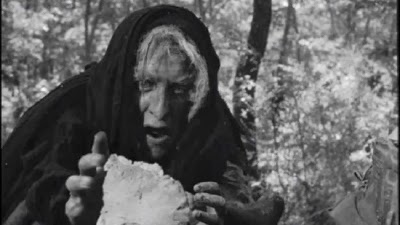
The film has a traveling circus troupe led by siblings Laura (Gaia Germani) and Bruno (Jacques Stany) being invited to the castle of area nobleman Count Drago (a gaunt Lee, sporting dark circles under his eyes and a hipster goatee).  En route, they're joined by Eric (Philippe Leroy), an officer whose horse was stolen by troupe member Dart (Luciano Pigozzi), and they're accosted by a hideous, hunchbacked old witch who warns them to avoid "The Castle of the Living Dead."  That the witch is played a dubbed Sutherland in drag is probably the biggest attraction to this for cult horror fans.  Sutherland also turns up later, dubbing himself and mugging shamelessly as Sgt. Paul, a doofus police official who functions as Drago's flunky and the film's comic relief.  Once at Drago's castle, the circus folks find themselves the unwitting victims in their host's diabolical scheme.   With the help of his evil henchman Sandro (Mirko Valentin, who co-starred with Lee in HORROR CASTLE), Drago has created a serum derived from tropical plant secretions that causes the victim to freeze in place, dying immediately.  Drago has what is assumed to be a taxidermy hobby but it's actually animals he's killed with the serum, and he's ready to try it on humans.

The plot is silly, to put it mildly, and Leroy's Eric is a pretty dense hero who takes forever to figure out what Drago's up to.  Even when Drago tells him all about the serum and the animals he's used it on, the most Eric can muster is an indifferent "Oh?"  Utilizing black & white, Kiefer and cinematographer Aldo Tonti have a nice Gothic look to the whole thing, filled with ominous shadows and howling winds, and it would probably look terrific in a properly remastered version instead of the shit sandwich of a print TCM aired.  There's one incredibly striking shot late in the film that ranks with the macabre best of Bava:  the discovery of the corpse of Drago's late wife, propped up in bed, perfectly still, head positioned toward a handheld mirror in her right hand as if frozen in time, admiring her own beauty for all eternity...as spiders crawl over her and rats gnaw on her fingers.


Lee, on set for ten of the film's 24-day shooting schedule, is good as Count Drago (a name in no way meant to invoke his fame as Count Dracula), and unlike some of his Italian and German films from this period, he actually dubs himself, which is important when you have a voice as distinctive as Christopher Lee's.  The voices used to dub him in HORROR CASTLE, THE WHIP AND THE BODY, and especially the 1962 German film SHERLOCK HOLMES AND THE DEADLY NECKLACE were distractingly inappropriate at best and complete deal-breakers at worst.  Lee and Maslansky became friends during the making of LIVING DEAD, with Lee acting in several future Maslansky productions, including RAW MEAT (1973), CIRCLE OF IRON (1978), THE SALAMANDER (1981), HONEYMOON ACADEMY (1990), and the unfortunate POLICE ACADEMY: MISSION TO MOSCOW (1994), a sequel so dire that even Bubba Smith opted out of it.  This would be Lee's last Italian film of this period, as he would soon return to the UK for such iconic classics as DRACULA: PRINCE OF DARKNESS (1965) and DR. TERROR'S HOUSE OF HORRORS (1965), which also co-starred Sutherland.  The Canadian Sutherland would work in British TV for a few years before getting his big break as one of THE DIRTY DOZEN (1967) and becoming a full-fledged Hollywood A-lister with 1970's MASH.


The surplus of erroneous information that's out there regarding THE CASTLE OF THE LIVING DEAD even extends to the cast:  one of the circus troupe members is a dwarf named Nick, played by Italian actor Antonio De Martino, who's credited as "Anthony Martin." De Martino only acted in a couple of other films, but going as "Anthony Martin" in this one has led some to confuse him with Skip Martin, another actor of short stature from that period, best known as Hop-Toad in Roger Corman's THE MASQUE OF THE RED DEATH (1964) as well as from other prominent roles in CIRCUS OF FEAR (1966) and VAMPIRE CIRCUS (1972).  The surname and the recurring circus motif are certainly noteworthy coincidences, and to their credit, IMDb hasn't confused the actors, but there's a lot of sources out there--including the otherwise reliable Warren Kiefer piece linked a few paragraphs up--that think Antonio De Martino/"Anthony Martin" and Skip Martin are the same person, when a look at photos of each pretty definitively show that they aren't.

Antonio De Martino/"Anthony Martin"


Skip Martin


Also causing confusion:  Lee's 1967 film TORTURE CHAMBER OF DR. SADISM has numerous alternate titles, one of which is CASTLE OF THE WALKING DEAD.  Lee's 1973 film NOTHING BUT THE NIGHT, the sole, misfired effort by his short-lived production company Charlemagne, went by a ton of different titles in any effort whatsoever to make the dull thriller appealing to audiences, including THE DEVIL'S UNDEAD, THE RESURRECTION SYNDICATE, and...wait for it...THE CASTLE OF THE LIVING DEAD, which is especially odd considering there's neither a castle nor living dead in the film.


THE CASTLE OF THE LIVING DEAD--the real CASTLE OF THE LIVING DEAD--was released in the US in 1965 by Woolner Brothers before making a quick turnaround to the small screen as part of an AIP-TV syndication package, and it was a late-night/Saturday afternoon Creature Feature fixture well into the '80s.  It isn't a great film by any means--though a better transfer prepared with some care would go far in pleading its case--but there's enough history to it that it's worth a look on that alone.  It's definitely required viewing for fans/completists of Lee, Sutherland, Reeves, and Italian horror of that period, and is almost worth seeing just for the scene with Drago's wife or any scene with Sutherland as the witch.  His first time on the big screen and he was lucky enough to get a director who would indulge his sometimes hammy tendencies right out of the gate.  Obviously, this meant a lot to the young actor, who held his first film director in high enough regard to name his son after him.  And as far as who directed the film, it's worth noting that Kiefer Sutherland isn't named "Reeves Sutherland," "Ricci Sutherland," or "Sabatini Sutherland."

Thursday, May 24, 2012

New on DVD: PLOT OF FEAR (1976)

PLOT OF FEAR
aka E TANTA PAURA
aka TOO MUCH FEAR
(Italy, 1976)

Directed by Paolo Cavara.  Written by Bernardino Zapponi, Paolo Cavara, Enrico Oldoini.  Cast: Corinne Clery, Michele Placido, Eli Wallach, Tom Skerritt, John Steiner, Jacques Herlin, Quinto Parmeggiani, Eddy Fay, Sarah Ceccarini, Cecilia Polizzi, Claudio Zucchet, Greta Vajant, Mary Ruth League. (Unrated, 95 mins)

Raro USA has done a nice job with the restoration of this obscure late-period giallo from director Paolo Cavara, best known for 1971's Dario Argento-inspired BLACK BELLY OF THE TARANTULA.  Long available in bootleg circles, PLOT OF FEAR (original Italian title: E TANTA PAURA) never made it to US theaters, nor did it ever turn up on home video, so this DVD marks the film's belated first official American release.  Scripted by Cavara, Enrico Oldoini, and DEEP RED co-writer and regular Fellini collaborator Bernardino Zapponi, PLOT OF FEAR gets off to a clunky, confusing start and veers wildly between giallo and poliziotteschi, with some liberal doses of trangressive softcore porn.  It's not a great film being rediscovered, but it's certainly an interesting artifact, not just for its rampant, cynical misanthropy (the rich are perverted and corrupt, men are petty and insecure, women are either vacuous models or dead hookers), but also for Eurotrash devotees, with its strange cast, terrible English dubbing (the original and better-preserved Italian audio track is also included), pervasive sleaze, and an infectiously catchy score by Daniele Patucchi, which is screaming to be covered by a present-day stoner rock band.

Opening scene.  Credits and kickass music start around 1:30 into the clip


Bad-tempered Inspector Lomenzo (Michele Placido) is dealing with several violent murders.  Heads have been bashed in, and bodies set ablaze.  One guy is even shot in the head while being interviewed on a talk show.  Pictures from a childrens book are left with the victims.  The victims are all wealthy and members of "Wildlife Friends," which imports wild animals caught on African safaris but is really a front for diamond smuggling and an underground sex club at Villa Hoffmann.  All of the murders are connected to the mysterious death of underage prostitute Rosa (Sarah Ceccarini) several years earlier at Villa Hoffmann, after a wild night that involved animated, surreal porn films, group sex, forced under-the-table fellatio, and an attempt to feed Rosa to a caged tiger.  Someone is out to avenge Rosa's death, and is brutally offing the rich, decadent perverts one by one.

One of the suspects is Rosa's pimp (Claudio Zucchet), who, in this scene, gets picked up for questioning and bolts from the police car, instigating a brief but amazing foot chase through what has to be the busiest intersection in Milan.  This brilliant bit looks as chaotic, awkward, and unchoreographed as a real pursuit would look (does that guy intend to tumble down the steps the way he does?), and I have serious doubts that the drivers of these cars knew that a movie was being shot.


Meanwhile, Lomenzo becomes romantically involved with Jeanne (Corinne Clery, fresh off the controversial, X-rated THE STORY OF O), a prostitute and part-time model who was also at Villa Hoffman the night of Rosa's death.  As the murders continue, Lomenzo is torn between his relationship with Jeanne and her possible connection to the murders, and he also finds himself tangling with Riccio (Eli Wallach), an eccentric, chocolate-addicted private investigator who seems to have all of Milan under surveillance, hired by the surviving deviants to find out who's trying to kill them.


John Steiner as Hoffmann
Placido is a fine actor, but he doesn't seem well cast here.  With its periodic delvings into polizia territory and with Lomenzo's ill temper, PLOT OF FEAR really could've benefitted from a Fabio Testi or especially a Maurizio Merli in the starring role. Placido just doesn't come off as intimidating enough.  Eurocult vet John Steiner also appears as the owner of Villa Hoffmann.  But the Strangest Casting Honors of PLOT OF FEAR (also known as TOO MUCH FEAR, and apparently released in Sweden, in what must set a new standard for "something lost in the translation," as BLOODY PEANUTS) go to visiting Americans Wallach and Tom Skerritt (yes, THAT Tom Skerritt), who has three brief scenes, wearing an entirely too-small leather jacket as Lomenzo's boss.  Neither Wallach nor Skerritt stuck around to dub their performances, so they aren't heard on the English track (Skerritt is dubbed by the ubiquitous Ted Rusoff).  For actors as recognizable as these two to be revoiced by others--especially with Wallach's gravelly tone--is more than slightly jarring.   Other English dubbing regulars heard throughout include Carolynn De Fonseca dubbing one of the Wildlife Friends, Pat Starke dubbing Clery, and Frank von Kuegelgen dubbing Steiner.  I'm not sure who's revoicing Placido and Wallach, but they sound very familiar.  Wallach actually has a sizable role, but given his brief screen time, I doubt Skerritt was on the set for more than a couple of days.  He had small roles in two other Italian projects around this time (the film LA MADAMA and the Italian TV miniseries ORIGINS OF THE MAFIA), so it's possible he knocked them all out in one trip and made a working vacation out of it.

"Buon giorno, Tom.  I'm Michele, nice to meet you.  Two quick questions:
why are you in this movie and exactly what is that you're wearing?"


"Italy?  All expenses paid?  Lots of naked women in
the movie?  And I don't even have to hang
around to dub myself?  Deal!"

Raro supplies plenty of extras, including a subtitled interview with Placido, who talks about the making of PLOT OF FEAR and shares warm memories of working with Wallach.   There's also interviews with co-writer Oldoini, as well as Pietro Cavara, son of the late director (Paolo Cavara died in 1982).  The 1.85:1 anamorphic transfer looks great and has to be a significant upgrade from Raro's original, non-anamorphic Italian release some years back.  Raro USA's packaging mentions "new and improved English subtitles," but Wallach's character ("Pietro Riccio") is inexplicably referred to as "Peter Struwwel" in the English subtitles, even though "Riccio" is clearly audible on both audio tracks.  This was apparently an issue with the original Italian DVD release.  In lieu of the liner notes they used to provide, Raro USA gives us an appreciation of the film by Fangoria editor Chris Alexander, in the form of a PDF file.   He can't explain BLOODY PEANUTS, either.


Original Italian poster


Monday, March 12, 2012

On DVD: YOUNG, VIOLENT, DANGEROUS (1976); THE GIRL IN ROOM 2A (1974)

YOUNG, VIOLENT, DANGEROUS
(Italy - 1976)

Mostly forgettable Italian crime obscurity written by Fernando Di Leo and featuring Tomas Milian is of little interest to anyone but Eurocult die-hards.  Raro USA's packaging makes it look like a Milian polizia, but he's really just got a supporting role as a dogged inspector after a trio of rich kids on a crime spree.  He's tipped off by Lea (INFERNO's Eleonora Giorgi) that her boyfriend Louie (Max Delys), and his pals Paul (Stefano Patrizi) and Joe (Benjamin Lev) are planning to rob a gas station with toy guns.  Louie is the reluctant driver and isn't aware that Paul and Joe are packing real heat and don't plan on stopping with the gas station.  Why?  Spoiled boredom and bad parenting, according to Milian, who spends his time lecturing their parents and telling them "Communication is the key to understanding."  You don't normally watch Italian crime films expecting Afterschool Special messages.  Was Di Leo going soft here?  These shitbags don't need a hug.  They need Milian smashing their heads through pinball machines Maurizio Merli-style.


1976 Italian poster
Di Leo and director Romolo Guerrieri (THE FINAL EXECUTIONER) choose to focus on the three hoods--none of whom are very interesting characters or actors (Joe is incredibly annoying, made even more insufferable by Lev's nonstop mugging)--while making the mistake of relegating a commanding presence like Milian to the sideline.  YOUNG, VIOLENT, DANGEROUS (original Italian title: LIBERI ARMATI PERICOLOSI) has a couple of good chase sequences and is never dull, but it's definitely not top-tier Italo crime.  Guerrieri, a competent journeyman director, just doesn't have the sense of style or energy that an Enzo G. Castellari (Guerrieri's nephew), an Umberto Lenzi or Di Leo himself would bring to these kinds of films.  Raro's DVD has been remastered and looks surprisingly good considering the 1.85:1 image is presented non-anamorphic.  Non-anamorphic.  In 2012.  Really, Raro USA?  Includes Italian and English audio tracks (the latter featuring the usual dubbing voices like Ted Rusoff, Michael Forest, Pat Starke, and others).  There's also an interview segment with Guerrieri, shot in 2004, a Guerrieri bio and filmography, plus a PDF critical essay to view on your PC in place of the booklet Raro used to put in the packaging. PDF, non-anamorphic...Raro USA's been up and running for a year, but after a roaring start, has recently had two glitch-laden releases (THE SECRET OF DORIAN GRAY and TO BE TWENTY) and now they're already cutting corners elsewhere.  All things considered, the YOUNG, VIOLENT, DANGEROUS DVD presentation has some issues, but it's an acceptable package for hardcore Eurocult genre addicts and completists. (Unrated, 97 mins)


THE GIRL IN ROOM 2A
(Italy - 1974)

Molasses-paced Eurosleaze from grindhouse god Dick Randall, an American expat who had a long career producing trashy, bad-movie classics in Hong Kong, Italy, Spain, and the UK.  Anyone familiar with gems such as CHALLENGE OF THE TIGER, FRANKENSTEIN'S CASTLE OF FREAKS, DON'T OPEN TILL CHRISTMAS, SLAUGHTER HIGH, the infamous Weng Weng vehicle FOR Y'UR HEIGHT ONLY, and the immortal PIECES, arguably the greatest bad movie ever made, already has a handle on Randall.  The Italian-made kinda-sorta-giallo THE GIRL IN ROOM 2A, written and directed by American William Rose, takes forever to get going with its story of an unjustly-jailed young woman (Daniela Giordano), paroled to a halfway house run by a group of mysterious weirdos who take it upon themselves to punish "bad" girls--who always get assigned to Room 2A--as some sort of moral Inquisition of their own.  They even have a red-cloaked/hooded torturer, who looks like a villain out of a 1940s Republic Pictures serial.  Giordano sees all sorts of strange goings-on and teams up with John Scanlon, whose sister was a previous tenant of Room 2A, to investigate.

1975 US theatrical poster


Rose, who only made '60s underground NYC nudie flicks up to this point (with titles like THE SMUT PEDDLER, PROFESSOR LUST and 50,000 B.C. (BEFORE CLOTHING)), has no sense of pacing whatsoever and is hopelessly out of his element making a--and I use the term loosely--"legit" film.  The film is a total snooze enlivened only by intermittent nudity or splatter, filled with ludicrously inappropriate music that does nothing to establish a suspenseful mood.  What's supposed to be a scary sequence is ruined by what sounds periously close to circus music.  Randall must've stepped in to save the day, because after 75 minutes of coma-inducing torpor, THE GIRL IN ROOM 2A erupts into all-out hilarity during the ridiculous climax, filled with cheap gore, terrible music, awful fight choreography, and just the general nonsense that one normally associates with Dick Randall productions, as Giordano is about to be sacrificed while Scanlon and his sister's ex-boyfriend (longtime Randall pal and ex-peplum star Brad Harris) attempt to rescue her.  The last ten or so minutes are so stupidly entertaining and laugh-out-loud funny that it makes the first 75 totally worth the endurance.  Also with Eurocult regulars Rosalba Neri, Karen Schubert, Frank Latimore and Angelo Infanti, plus, as the main villain, a curiously slumming Raf Vallone, who was getting a lot of work in Hollywood movies and on American TV at the time.  Mondo Macabro, a company that seems to be exclusively releasing Randall product these days, presents THE GIRL IN ROOM 2A in an occasionally beat-up but generally nice-looking transfer that the packaging lists as 1.66:1, but is actually 1.78:1.  Extras include a short interview with Giordano, where she dispels the longstanding rumor that William Rose was a pseudonym for Ramiro Oliveros, a Spanish actor who often gets credited in print and online with directing this film, plus some cast/crew info, and a lurid trailer for the film's 1975 US release ("Kidnapped!  Enslaved!  She became a sexual plaything in a strange, sadistic ritual!"). (Unrated, 85 mins).


Monday, January 23, 2012

Cult Movie Trash/Margheriti Madness: SEVEN DEATHS IN THE CAT'S EYE (1973)


SEVEN DEATHS IN THE CAT'S EYE
(Italy/France/Germany - 1973)

Directed by Anthony M. Dawson (Antonio Margheriti).  Written by Antonio Margheriti and Giovanni Simonelli.  Cast: Jane Birkin, Hiram Keller, Francoise Christophe, Serge Gainsbourg, Venantino Venantini, Doris Kunstmann, Anton Diffring, Dana Ghia, George Korrade, Alan Collins (Luciano Pigozzi).  (Unrated, 95 mins)


Cover art for 2005 DVD release

Often labeled a giallo, probably due to its very Dario Argento-inspired title, Antonio Margheriti's SEVEN DEATHS IN THE CAT'S EYE is more in line with his gothic Euro-horrors of the 1960s, like THE VIRGIN OF NUREMBERG and CASTLE OF BLOOD.  There is a very giallo sense of sleazy perversity running through SEVEN DEATHS, but the film itself is ultimately a misfire that never gets out of first gear and is often too silly for its own good.  It is redeemed by a terrific twist ending that might have you thinking you just saw a better film than you did.  I remember thinking that after the first time I saw it six years ago, and I imagine in another half decade or so, I'll forget and once again think "Hey, I should revisit that one," and I can be disappointed all over again.


Jane Birkin and Hiram Keller


In a small Scottish village, Corringa (BLOW-UP's Jane Birkin) is visiting relatives at the Castle MacGrieff, overseen by her aunt Lady Mary MacGrieff (Francoise Christophe) and her eccentric, possibly insane son, Corringa's cousin Lord James (FELLINI SATYRICON's Hiram Keller).  Also hanging around the castle, for various reasons, are Corringa's mother (Dana Ghia);  bisexual tutor Suzanne (Doris Kunstmann), essentially hired by Lady Mary to seduce her son; groundskeeper Angus (Luciano Pigozzi); family advisor Father Robertson (Venantino Venantini); and lecherous family doctor Franz (Anton Diffring, dubbed by Ted Rusoff, who supervised the English script translation and dubbing), who's sleeping with both Lady Mary and Suzanne.  Soon, someone starts offing the unlikable cast one by one, with all the murders witnessed by the ever-observant family cat who constantly roams the castle grounds.  Before long, an eccentric detective who may as well be named Almost Hercule Poirot (Birkin's then-husband, French singer Serge Gainsbourg), starts investigating.

A ghostly vision in one of Corringa's nightmares.


It's a very Agatha Christie set-up, complete with a mysterious location, secret passageways, creepy crypts, sidelong glances, and scheming assholes, plus rats, bats, cobwebs, vampire superstitions, and Lord James' secret pet gorilla (!), who periodically frees himself from his cage and wanders the castle or peeps out of windows only to disappear a moment later.

Lord James MacGrieff's secret pet gorilla.  Whatever.


Margheriti and "director of photographye" (as the credits label him) Carlo Carlini establish a admirably creepy and very colorful atmosphere, but SEVEN DEATHS IN THE CAT'S EYE is pretty dull stuff.  There's a lot of padding and boring talk of inheritances and what not, with an occasional gory murder or sex scene to liven things up (Kunstmann supplies most of the nudity, but Margheriti gets dangerously close to showing Anton's Diffring at one point), plus an almost comical over-reliance of "DUN, DUN, DUNNNN!"  at even the most insignificant plot development.

Eurocult regular Venantino Venantini and some of the film's garishly colorful lighting.


Old-school Prism VHS box


It's interesting to see Birkin and Gainsbourg acting together, and to see how much a 27-year-old Birkin reminds you of their daughter, actress Charlotte Gainsbourg.  The performances are a little hard to judge since even the English-speaking actors are dubbed.  Blue Underground's DVD, issued in 2005, has some rough spots but looks very nice overall, and at the proper 2.35:1 framing, is obviously a huge improvement over the reportedly hideous Prism Entertainment pan & scan VHS edition that used to be a video store mainstay back in the day.