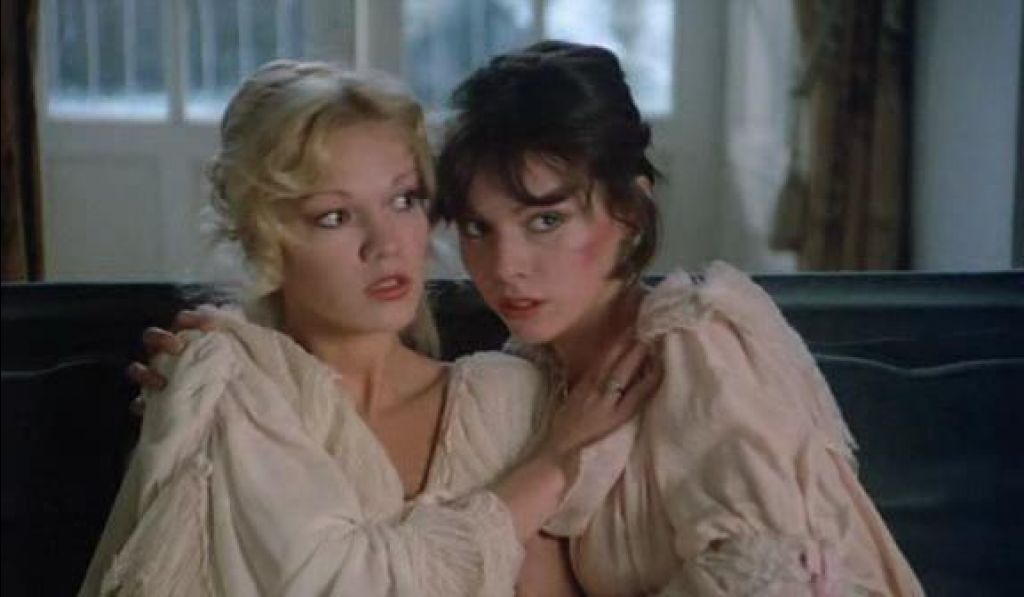
When Jess Franco died in April 2013 at the age of 82, cult cinema lost one of its most beloved icons, a legendarily prolific writer/director with over 200 films to his credit, but a comprehensive Franco filmography is all but impossible, given the number of unfinished films and the plethora of pseudonyms he used. Franco bounced around from genre to genre for the length of his career, sometimes for money, sometimes for personal expression, but from 1959 until his death, he never stopped working, often making multiple films in any given year (11 in 1975 alone). He's best known for his contributions to the horror genre, but he made comedies, dramas, spy thrillers, action films, erotica, and hardcore porn. Over the last couple of decades, serious film scholars have reconsidered Franco's gargantuan output and many, most notably Video Watchdog's Tim Lucas, have called him a genuine auteur. Indeed, many of Franco's self-financed films of the 1970s are some of the most aggressive examples of a filmmaker putting his obsessions front and center for everyone to see. I've always had conflicted feelings about Franco. When he had a budget, a competent crew, and real actors, he was completely capable of putting a thoroughly professional film together. His association with British producer Harry Alan Towers in the late 1960s resulted in several box office hits with actors who rarely turned down a sizable paycheck (Christopher Lee, Herbert Lom, Klaus Kinski) to others who may have been in a career slump and took what they could get (Jack Palance, Mercedes McCambridge, George Sanders, Leo Genn). But on his own, the low budgets and lack of quality control are sometimes too distracting to ignore. Franco would later express feelings of discontent working in commercial cinema, which led to his more independent films of the 1970s and beyond, but many of those "commercial" films represent his best filmmaking (1969's VENUS IN FURS is probably my favorite Franco film). Franco often had ambitions that lied beyond the capabilities of his budget (1970's COUNT DRACULA is a perfect example, finally allowing a frustrated Lee the chance to play Dracula as Bram Stoker intended, but hampered by cheap sets that appear ready to collapse around the actors at any moment). By 1970, Franco had grown tired of working for other producers and trying to make his own films while dealing with Spain's strict censorship laws. He needed a change, but had to leave Spain to do so. Two of those films are out on Blu-ray from Kino/Redemption on August 20, along with Franco's 1962 breakthrough THE AWFUL DR. ORLOF.
THE AWFUL DR. ORLOF (Spain/France - 1962)
Considered to be the first Spanish horror film, THE AWFUL DR. ORLOF owes a lot to Georges Franju's EYES WITHOUT A FACE (1960) with its central plot element of Dr. Orlof (Howard Vernon) and his deformed, blind sidekick Morpho (Ricardo Valle) murdering women in order to perform skin graft experiments to restore the disfigured face of Orlof's daughter. The Franju film would be a major influence on Franco's career, with several subsequent Orloff (the extra 'f' was added by the US distributor in 1964 and it stuck) films, all the way up to 1988's FACELESS, where murderous surgeon Helmut Berger pulls an Orloff to try and salvage his sister's scarred face, even seeking counsel from Vernon's Orloff at one point. THE AWFUL DR. ORLOF isn't very original and suffers from some clumsy exposition in spots, but it's an important film in the evolution of Spanish horror, Eurocult, and Franco himself, and looks terrific in this new Blu-ray edition. The 1.66:1 transfer looks appropriately film-like and doesn't see fit to remove every flaw and scratch in the image, but the detail is superb. Kino presents the film in its uncensored French version (with an English-dubbed option), which had two instances of nudity clumsily inserted by the French co-producers. Lucas contributes an extremely informative, exhaustive commentary that's overflowing with trivia (American expat actor Frank Wolff, best known as Brett McBain in Sergio Leone's ONCE UPON A TIME IN THE WEST, was one of the voice actors for the English-dubbed version), and comprehensively details Franco's influences for the film (Franju and THE LODGER/HANGOVER SQUARE director John Brahm being the major ones, but also classic Universal horror, Hammer, AIP's Edgar Allan Poe series, and the expanding Italian horror scene headed by Riccardo Freda and Mario Bava), the earliest examples of recurring Franco themes and archetypes (Orloff, the Morpho character, as well as incompetent police detective Tanner, played here by Conrado San Martin, would reappear in various forms in many subsequent Franco works), and the differences in the various versions of the film (the bombastic jazz score that opens the French print is significantly toned-down in the Spanish version). Despite its many derivative elements, THE AWFUL DR. ORLOF is one of Franco's most accessible and satisfying horror films, progressive in its themes and presentation but very deeply-rooted in classical and traditional horror. It was his first success and fittingly, the perfect starting point for anyone interested in exploring the director's work. The Blu-ray also features an interview with a frail-looking Franco, where he addresses his battles with the Spanish censors and his love-hate relationship with the horror genre in general, saying he wanted to be an Antonioni-style filmmaker but ended up doing other kinds of films. But, as he finally admits with a smile, "I like horror films." (Unrated, 86 mins)
NIGHTMARES COME AT NIGHT (France/Liechtenstein - 1970)
NIGHTMARES COME AT NIGHT was considered a lost film for over 30 years. Given a theatrical release only in Belgium in 1970, the film vanished from view and only when a print was discovered in the early 2000s, followed by a DVD release from Media Blasters in 2004, were Franco fans able to see it and place it in its proper context. According to Lucas' commentary on the new Blu-ray, Franco shot NIGHTMARES during some down time between two 1970 Harry Alan Towers productions--THE BLOODY JUDGE (released in the US in 1972 as NIGHT OF THE BLOOD MONSTER) and COUNT DRACULA. Franco had more personal projects in mind and by the time THE BLOODY JUDGE came around, grew tired of working in these multi-country co-productions and trying to appease the various producers involved. NIGHTMARES COME AT NIGHT serves a sign of things to come from Franco throughout the rest of his career--the more auteur side of him as a filmmaker that would explode once he met his muse and life partner Lina Romay in the next few years. NIGHTMARES stars Diana Lorys (who co-starred in THE AWFUL DR. ORLOF) as Anna, a former stripper at "a second-rate nightclub in Zagreb." She fears she's being driven insane and confides in Dr. Lucas (Paul Muller). Living with Cynthia (Collette Jack), she's haunted by vivid dreams in which she commits murder. Meanwhile, a mystery couple (Andre Montchall and Soledad Miranda, billed as "Susan Korda") watch the proceedings from a neighboring house.
If NIGHTMARES COME AT NIGHT feels disjointed and patched together, that's because it was. The scenes with Montchall and tragic Franco muse Miranda (who was killed in a car accident in Portugal the same year) came from an unfinished Franco project shot around the same time. Franco worked the footage into the film by creating a jewel heist subplot where Cynthia was in cahoots with these two and their plan is to drive Anna insane and pin the crime on her while they get away. Lucas doesn't go into this in any great detail, but there is a supplemental feature where Kino Blu-ray producer Bret Wood demonstrates how the film came from two different sources: the Lorys/Muller/Jack scenes are shot in 1.33:1 and the Montchall/Miranda scenes are shot in 1.66:1. Kino reformatted the entire film to 1.66:1 for the sake of continuity, while also pointing out that the final scene between Muller and Jack is shot in 1.66:1, indicating that Franco shot it after the fact in an attempt to bring both plots together. Of these three new Blu-rays, NIGHTMARES COME AT NIGHT probably fares the worst, though it's not really any fault of Kino's. The flaws in the visual presentation are inherent in the film itself, culled from a test print since wide-release prints were never struck and the negative is lost. By design, the dream sequences are grainy, but here, they're so grainy that it's impossible to tell what's going on. The Blu-ray offers the option of French with English subtitles or an English-dubbed track. The English-dubbed track is one of the worst I've ever witnessed, so French is clearly the way to go here.
This is the conundrum of watching Jess Franco films. Few filmmakers are given such wide leeway for sloppiness as Franco, whose status as an iconic movie maverick is often confused with his extraordinarily prolific output. Quantity is often mistaken for quality, and NIGHTMARES COME AT NIGHT may be given a bit of a pass since it was a "lost" film and fans were eager to discover it. It's really not very good at all. On his commentary, Lucas makes some credible and thoughtful arguments for Franco's recurring metaphors for Spain's fascistic government, but elsewhere, his defenses of the shoddy cinematography, mismatched footage, and haphazard construction seem like real reaches: the backdrop of Anna's dance routine is a wrinkled curtain; Lucas says that's by design but I'm going with "Franco was in too much of a hurry to give a shit about having it ironed." Devoted Franco fans insist that the amateurish filmmaking, the continuity errors, shots out of focus, the camera pointed in the wrong direction, etc are all part of some grand, subversive, Luis Bunuel master plan to mock the rules of conventional cinema. I just don't buy it. He was capable of solid filmmaking and occasionally stunning images, but he was also a guy who liked to make movies with a lot of hot, naked women (Lorys is nude for about 90% of the movie and she's spectacular). This became very apparent once Romay entered his life: it's around this time (1973's FEMALE VAMPIRE and on) that the quantity of the films becomes inversely proportional to the quality. And yet, this period is one of his most revered and Franco's personal favorite. But it's during this phase that the sloppiness becomes epidemic and he seems to be going for as many lingering crotch-zooms as possible, almost as if low-budget, pervy, DIY Franco was holding the camera with one hand and fondling himself with the other. Franco loved to make movies--all kinds of movies--and, especially in his later years, became a beloved cult figure and captivating raconteur in interviews for the many DVD releases of his films. Franco's interviews are frequently more interesting than his films. Look, I love Franco. How can you not? I could watch interviews with him all day long, but some of these films are indefensible and there seems to be a calculated movement to put him on the same iconoclastic pedestal as Orson Welles, frequently cited as "Franco's mentor," even though Franco only assisted him on two films (the unfinished-in-Welles'-lifetime DON QUIXOTE and 1966's CHIMES AT MIDNIGHT). I agree that there is something there with Franco. His more disciplined films (and something like CHRISTINA, PRINCESS OF EROTICISM--more on that shortly) prove it. But sometimes--to use but two examples, as shown in CANNIBALS and DEVIL HUNTER, Franco's two dismal 1980 contributions to the Italian cannibal craze that show jungle natives who look like they were rounded up from the nearest disco, right down to the perms, sideburns, and in one case, a visible wristwatch--shitty filmmaking is just shitty filmmaking. That said, the completists and apologists will get far more out of NIGHTMARES COME AT NIGHT than the casual viewer. (Unrated, 85 mins)
A VIRGIN AMONG THE LIVING DEAD (1973/1981) with CHRISTINA, PRINCESS OF EROTICISM (France/Liechtenstein - 1973) and A VIRGIN AMONG THE LIVING DEAD (France - 1981)
The biggest surprise in this latest batch of Kino/Redemption Franco titles has an even more complicated backstory than NIGHTMARES COME AT NIGHT. Shot in 1971 as NIGHT OF THE SHOOTING STARS but unreleased until 1973 under a handful of various titles, the film most popularly known as A VIRGIN AMONG THE LIVING DEAD is quite a revelation in this new Blu-ray edition. If you've only seen this in its mid-1980s big-box Wizard Video incarnation as A VIRGIN AMONG THE LIVING DEAD, then it's worth a reconsideration. Presented in a full-frame, washed-out, terribly-dubbed print, the old VHS edition was ejected fairly quickly when I gave it a look back in the day, not even bothering to fast-forward to the inevitable nude scenes and zombie attacks. As fans learned later on, that version was reworked from what Franco had originally intended. That version contained zombie footage directed by French cult auteur Jean Rollin (FASCINATION) in 1981, presented as dream sequences with an unconvincing double for lead actress Christina Von Blanc, as well as some softcore sex footage directed by Pierre Queret that utilized equally dubious-looking doubles for the main actors. French distributor Eurocine wanted to hop on the post-DAWN OF THE DEAD/ZOMBIE bandwagon and figured adding some nonsensically inserted zombies into an existing film would be the cheapest way to do it. Franco disowned this VIRGIN AMONG THE LIVING DEAD cut of the film, but confusion is inevitable since Eurocine also used that title on Franco's original 1973 cut, which has come to be known as CHRISTINA, PRINCESS OF EROTICISM, a misleading title that seems more fitting for a softcore porn romp than the somber, meditative art film that Franco made.
Released on DVD by Image Entertainment several years ago, the CHRISTINA, PRINCESS OF EROTICISM cut looks quite nice on Blu-ray. Flaws inherent in the print itself remain in the 1.66:1 transfer, but it looks fine. The previous DVD edition included the Rollin-added scenes as an extra, but this new Blu-ray set offers two cuts of the film: Franco's preferred CHRISTINA cut, running 79 minutes, and the 1981 Eurocine revamp A VIRGIN AMONG THE LIVING DEAD, with the Rollin/Queret scenes, running 90 minutes. It's amazing what a mere 11 minutes of padding can do to throw off the rhythm of an entire film. Despite my utmost respect for film scholars like Lucas and the many Franco fans and apologists, I've often dismissed the notion that Franco is some misunderstood genius, but watching CHRISTINA, PRINCESS OF EROTICISM, regardless of its ridiculous title, goes a long way in almost validating many of those claims. Self-financed and shot on the fly with a skeleton crew, the film is often technically inept (less than three minutes in, shooting some location footage along the coast of Portugal, a local man looks directly into the camera and quickly looks away), but has numerous moments of undeniable, poetic beauty that you'd never figure seeing given either of the film's grindhouse-ready titles. Von Blanc stars as Christina, who travels from London to Portugal upon the death of her estranged father (Paul Muller), a man she never really knew and hadn't seen since she was a small child. At her father's estate, she encounters other members of the "family," including her uncle Howard (Howard Vernon), seductive mystery woman Carmence (the stunning Britt Nichols), and grunting, dimwit handyman Basilio (Franco, billed as "Jesus Manera"). The film becomes a surreal fever dream as Christina is plagued by nightmares and nothing seems real, encounters the ghost of her father (in a great shot where they both seem to be floating through the air), leading to a terrific plot twist in the finale and culminating in a final sequence that's one of the most heartbreaking, haunting scenes in Franco's entire filmography.
Conceived as a mournful eulogy for the late Soledad Miranda (Lucas points out in his typically thorough and info-packed commentary that the footage shot along the coastal road seen in the opening credits was the same route Miranda was taking before she was killed in the car accident), CHRISTINA, PRINCESS OF EROTICISM is one of Franco's best films, even with its many gaffes and Franco self-indulgences. Sure, there's the requisite day/night continuity errors, an actress playing a corpse is seen blinking, and there's one incredibly annoying scene where Franco's Basilio laughs and giggles and makes assorted noises while Nichols' drunk Carmence rolls around on the floor in front of him for about four solid minutes of screen time, but the images captured by Franco and cinematographer Jose Climent are often breathtakingly beautiful. Watching this in its intended form, you get the impression that this is the kind of film Franco always wanted to make. This is the kind of film his devout fans are talking about when they praise him as an unheralded cinematic genius. 1970s Franco is often compared to Rollin (who also dabbled in hardcore porn when his financial situation demanded it), and for my money, Rollin was the more consistent and visionary filmmaker (his FASCINATION is a brilliant work that feels a lot like what Jess Franco might've accomplished with time, budget, a full crew, discipline, and a little self-control), but CHRISTINA, PRINCESS OF EROTICISM comes very close to that Rollin level of dream-like surrealism. It's incredibly atmospheric, at times feeling a lot like Mario Bava's LISA AND THE DEVIL (which was actually made a year later, before anyone would've had a chance to see Franco's film) with its gathering of cursed souls at an eternally damned house. I noticed this before listening to Lucas' commentary (over the CHRISTINA cut), and while he touches upon the similarities--including von Blanc's Christina having the surname "Reiner," also the last name of Elke Sommer's Lisa--he doesn't delve into them as much as I thought he would, considering his status as the world's foremost Mario Bava scholar, having written a comprehensive, 1128-page doorstop of a biography of the legendary father of Italian horror. Also contributing greatly to the hazy, dream-like aura of CHRISTINA is the score by Bruno Nicolai, which prominently features everything from the mournful vocals of Edda Dell'Orso, a frequent Ennio Morricone associate, to an all-out prog-rock freakout near the end. The schizophrenic score is as unpredictable as the film itself. CHRISTINA, PRINCESS OF EROTICISM is one of Franco's most ambitious films. If all the other alleged "classics" had the hints of greatness that this film demonstrates, I'd be onboard with the whole "Franco is a genius maverick of cinema" movement. Kino's Blu-ray presents the film with two audio options: French with English subtitles and in English. The English dub isn't quite as bad as the one on NIGHTMARES COME AT NIGHT, but it's close. Among the bonus features: an interview with Franco; a short piece detailing the various versions of the film, and five minutes of "alternate erotic footage" with Alice Arno that was shot for an unrealized third variant of the film.
The biggest bonus feature is the complete, 90-minute 1981 cut of A VIRGIN AMONG THE LIVING DEAD that was on the old Wizard Video VHS issued in 1985. Queret shot some sexually explicit footage with doubles for Vernon and Nichols--including a shot of "Vernon"'s character with an erection and turned the climactic accosting of Christina into a rape (with Vernon getting a thrusting-butt double), while Rollin shot several minutes worth of quickie zombie attack scenes that represent Christina's nightmares. These scenes were shot at the same time as Rollin's Eurocine hackjob ZOMBIE LAKE (also 1981), and feature a double for von Blanc, clearly indicated by the fact that her hair always seems to be covering her face. These inserted scenes are hastily-shot and hilariously awful (ZOMBIE LAKE was purely a money gig for Rollin, who stepped in when Franco abandoned the project over disagreements with the producers), and show that it's very easy for zombies to bust through a door when production assistants have already clearly removed the hinges. The 1981 revamp of A VIRGIN AMONG THE LIVING DEAD is barely entertaining on a bad-movie level (though with enough proper medication, I suppose it could be fun), but it's an outright travesty after seeing CHRISTINA, PRINCESS OF EROTICISM. (Unrated, 79 mins/90 mins)
Netflix recently added a truckload of Kino/Redemption titles to their streaming service, including several offerings from the extremely prolific British sex comedy subgenre of the 1970s. Often playing like THE BENNY HILL SHOW with tons of nudity and smarmy double entendres and centered on people in everyday jobs stumbling and bumbling into a series of slapstick sexual misadventures, these films, like the penis-transplant classic PERCY (1971), AU PAIR GIRLS (1972), and the whole CONFESSIONS OF... series starring Robin Askwith (1974's CONFESSIONS OF A WINDOW CLEANER, 1976's CONFESSIONS OF A DRIVING INSTRUCTOR, etc), which spawned its own imitations with 1975's THE UPS AND DOWNS OF A HANDYMAN and the Barry Evans-starring ADVENTURES OF... series (1976's ADVENTURES OF A TAXI DRIVER, 1977's ADVENTURES OF A PRIVATE EYE, and 1978's ADVENTURES OF A PLUMBER'S MATE), were hugely popular with audiences (CONFESSIONS OF A WINDOW CLEANER was a cultural phenomenon at home, becoming the highest-grossing film of 1974 in the UK), loathed by critics, and were staples in US grindhouses and drive-ins. Even the long-running CARRY ON film series, dating back to 1958, started to change with the times and up the raunch factor in films like CARRY ON GIRLS (1973), CARRY ON DICK (1974), and CARRY ON EMMANNUELLE (1978). Many of these comedies are now forgotten by everyone except cult movie enthusiasts and most of them are rather tame by today's standards, but even in the '80s, they were raunchy enough to be in regular rotation on late-night cable in the '80s, usually on Showtime's awesome "After Hours."
AU PAIR GIRLS aka THE YOUNG PLAYMATES (UK - 1972)
One of the best-known titles in the British sex comedy explosion of the 1970s, AU PAIR GIRLS, directed by veteran journeyman Val Guest, plays a lot like a British version of a Roger Corman/New World "Nurses" film of the same period. Four sexy young ladies arrive in England as au pairs (actually, there's a fifth, but she disappears after the opening scene--was she cut from the film?): Swedish Anita (Astrid Frank), Danish Randi (Gabrielle Drake, German Christa (Nancie Wait), and Chinese Nan Lee (Me Me Lay), leading to a series of mostly wacky and occasionally dramatic misadventures over the course of the night and into the next morning. Anita enchants the wealthy, lecherous Sheik El Abib (Ferdy Mayne), Randi spends the night in a barn with amiable doofus Stephen (Richard O'Sullivan) after his car gets a flat, the virginal Christa meets rock god Ricky Strange (Steve Patterson), and Nan makes a man of childlike, possibly autistic piano prodigy Rupert (Julian Barnes). Lots of hijinks and smutty, winking one-liners (Randi: "I'm Randi!" Stephen: "You're not the only one!"), every male is a leering horndog, and the women disrobe at every opportunity. In short, AU PAIR GIRLS delivers exactly what it promises, but in another similarity to the New World productions, it occasionally drifts into unexpected directions, such as the surprising sympathy demonstrated by Strange's sleazy manager Buster (John Standing) when he finds out Christa was a virgin and realizes how upset she is about feeling used by Strange and even by Buster himself when he allowed himself a drunken turn with her as well, but the film sort of sidesteps the issue that Buster essentially rapes her.
Also with Geoffrey Bayldon, John Le Mesurier, Johnny Briggs, Rosalie Crutchley, and Milton Reid, cast radically against type as a silent, hulking manservant. Me Me Lay co-starred in Umberto Lenzi's cannibal film MAN FROM DEEP RIVER the same year and would go on to be a fixture in the Italian cannibal subgenre. O'Sullivan became a huge TV icon in the UK, starring for six seasons on the popular MAN ABOUT THE HOUSE, which was remade for US TV as THREE'S COMPANY, with O'Sullivan's Robin Tripp becoming John Ritter's Jack Tripper. Guest (1911-2006), best known for helming the British sci-fi classics THE QUATERMASS XPERIMENT (1955) and QUATERMASS 2 (1957) and some of the 1967 Bond spoof CASINO ROYALE, saw his career get a second wind from these sex comedies and went on to direct CONFESSIONS OF A WINDOW CLEANER. AU PAIR GIRLS was released as THE YOUNG PLAYMATES in the US by the early, pre-Golan & Globus incarnation of Cannon. If you find the interminable opening theme song catchy, fear not...you'll only hear it 72 more times over the course of the film. (Unrated, 84 mins)
THE SEX THIEF (UK - 1974)
Several years before finding his niche in Eurocult films by the legendary likes of Lucio Fulci and Antonio Margheriti, a shaggy-haired David Warbeck starred in this racy British comedy that originally received an X rating in the US for its vigorously explicit sex scenes. Warbeck is second-rate paperback mystery writer Grant Henry, who supplements his income by working as a cat burglar, stealing and fencing expensive jewels and seducing the horny wives he finds sleeping alone while their husbands are away on business. His actions leave Scotland Yard's Inspector Smith (Terence Edmond) frustrated because, while all of the recent burglaries are obviously committed by the same person, the women all give wildly varied and increasingly ridiculous descriptions of the burglar ("he's everything from a club-footed midget to a six-foot-six Russian with a hare-lip!") and all inexplicably wait several hours before calling the police. Smith and his dim-witted partner Sgt. Plinth (co-writer Michael Armstrong, who also directed MARK OF THE DEVIL) team with accident-prone photographer Guy (Christopher Neil) and sexy, karate-expert insurance investigator Judy (Diane Keen) to set up a sting to nail the Sex Thief.
Armstrong and co-writer Tudor Gates (BARBARELLA, DANGER: DIABOLIK, THE VAMPIRE LOVERS) both hide behind the single screenwriting pseudonym "Edward Hyde" and Gates produced under the name "Teddy White." THE SEX THIEF marked the directorial debut of Martin Campbell, who went on to direct two 007 films (1995's GOLDENEYE, and 2006's CASINO ROYALE) in addition to big Hollywood movies like THE MASK OF ZORRO (1998), VERTICAL LIMIT (2000), and, most recently, GREEN LANTERN (2011). The film is moderately amusing, and the early scenes have some big laughs, particularly at Smith's exasperation at the ludicrous descriptions the victims give and his failure to understand how one wants the newspaper to print that the burglar didn't get all of her jewelry in the hope that he'll return and seduce her again, but it's a fairly predictable mix of slapstick antics and graphic sex, with one sped-up sequence an obvious riff on A CLOCKWORK ORANGE. The sex scenes leave little to the imagination and are absurdly overdone, and Campbell probably could've trimmed some of them, as one has the camera lingering on a huge pimple on Warbeck's ass. In its original form, THE SEX THIEF was released in the US in 1974 by International Amusements, then retro-fitted with body doubles in newly-shot hardcore inserts, re-edited without the involvement of any of the filmmakers or cast, and dumped on the porno circuit in 1976 as HER FAMILY JEWELS. (R, 93 mins)
ZETA ONE aka THE LOVE FACTOR aka ALIEN WOMEN (UK - 1969)
It's hard to imagine a 007 spoof about a race of topless alien women being dull, but ZETA ONE is an utter disaster from start to finish. Exhibiting a laundry list of red-flag indicators of a difficult production (obvious padding of the running time, a clumsy flashback structure valiantly attempting to explain the plot, the biggest-name actor completely disappearing from the film without explanation, and IMDb shows it's the director's first and last feature film), ZETA ONE begins with a laborious 20-minute prologue that turns out to be a wraparound segment. Suave secret agent James Word (charisma-vacuum Robin Hawdon) returns from his latest mission to find Ann (LUST FOR A VAMPIRE stunner Yutte Stensgaard), his boss W's secretary, in his mod bachelor pad. They play a drawn-out game of strip poker that finally leads to Word giving her the lowdown on what happened (it's interesting that Word arrives home with a fake mustache coming unglued and he removes it when Ann points it out to him--why would he wait until he got home to remove it? Because Hawdon has a mustache in what became the flashback footage and didn't have one when he was called back for the presumably hastily-arranged reshoots). Word got involved in an incomprehensible plot involving a clash that pits topless alien women of the planet Angvia (really?), led by Zeta (Dawn Addams, who remains clothed because she's a respectable actress), against the megalomaniacal Major Bourdon, played by an embarrassed and hopefully drunk James Robertson Justice, clearly reading cue cards like a disinterested SNL host in one of his last films before a series of strokes forced him to retire from acting.
ZETA ONE makes up in gratuitous nudity what it lacks in laughs and any sense of coherence or pacing, but even that's not enough to make this boring "comedy" worth the suffering. Hawdon is pathetic and Addams soldiers through with a stiff upper lip but looks like she'd rather be anywhere else. But beloved British character actor Justice doesn't even hide his contempt for the entire project, and one can hardly blame him. Chances are he didn't even stick around, because his character vanishes from the film shortly before the climax and is never referenced again. Director Michael Cort's IMDb page shows this and a 1972 short subject, and absolutely nothing else. The Hawdon-Stensgaard wraparound sequences were clearly added to clarify the plot (they don't) and add some T&A (well, OK, fine), but these scenes provide about 25 minutes of superfluous padding, which means Cort initially had about an hour of useable footage. There's probably an interesting story to be told about this obvious train wreck of a production (difficult star? First-time director in over his head? Unfinished script?), but anyone involved who's still with us has likely long since blocked it from their memory. The mod, swingin' '60s atmosphere of ZETA ONE had to look hopelessly dated by the time this was belatedly released in the US in 1975 as THE LOVE FACTOR (right around the time Justice died). It later turned up on US home video in the '80s from Prism Entertainment as ALIEN WOMEN. It's unwatchable under any title. (R, 86 mins)
Written and directed by Jean Rollin. Cast: Franka Mai, Brigitte Lahaie, Jean-Marie Lemaire. (Unrated, 82 mins)
I guess I should start by confessing that this is my first "real" exposure to Jean Rollin. Of course, I've been aware of him for the last 20 years, but from everything I read, I always more or less wrote him off as a French Jess Franco, probably because of his involvement in the awful ZOMBIE LAKE (1981), which Franco wrote and Rollin directed under the name "J.A. Laser." And outside of a few films, I've never understood the cult of Jess Franco. When he had a budget, usually supplied by Harry Alan Towers in the late 1960s, Franco made some decent films. I'd even say 1969's VENUS IN FURS is his masterpiece. But other than that, and a few occasionally watchable films later on (1981's BLOODY MOON, 1987's FACELESS), I just don't get Franco's appeal to cult movie fans. On his many DVD releases over the years, Franco seems like a nice guy and is a hell of a raconteur, but as a filmmaker, it's a triumph if he's got the camera pointed in the right direction and it's actually in focus.
Brigitte Lahaie and Franka Mai
But I digress. My point is that because of his one-time association with Franco, I think I often disregarded the accolades Rollin received (plus, while Franco merely dabbled in porn in 1980s, most of Rollin's career was spent directing hardcore porn under a pseudonym, which supplied the money to make his more personal, serious horror films). But there's been a strange turn of events recently: a Rollin film (1973's THE IRON ROSE) actually played on Turner Classic Movies. And the prestigious Kino Lorber acquired the rights to Rollin's horror films via Redemption and has just released the first batch in deluxe Blu-ray and DVD editions (in addition to FASCINATION and THE IRON ROSE, the initial wave includes 1970's THE NUDE VAMPIRE, 1971's THE SHIVER OF THE VAMPIRES, and 1975's LIPS OF BLOOD). And just a few days ago, there was a story on the Rollin Blu-ray releases in the New York Times. In short, it was time for me to stop being a dismissive dick and see what Rollin was all about.
1979's FASCINATION is generally regarded as the Rollin film to see if you're only going to watch one or want to get your feet wet. It has the trademark Rollin touches--vampires, erotica, surreal, poetic imagery--with an added bonus of relative coherence, which wasn't always one of his primary concerns (Rollin died in 2010). After opening with a scene of aristocrats drinking ox blood as a cure for anemia, the story settles on thief Marc (Jean-Marie Lemaire) making off with some gold coins as his cohorts chase him. He hides in a desolate chateau nearby, where everyone is gone except for two bisexual chambermaids, Elisabeth (Franka Mai) and Eva (Brigitte Lahaie). The chambermaids are waiting for the chateau's Marchioness and her servants. Eva falls in love with Marc, much to the jealous disapproval of Elisabeth. Eva tells Marc he has to leave before midnight when the Marchioness and the servants will arrive...
Marc (Jean-Marie Lemaire) has no idea what he's gotten himself into.
Watching this film--and I don't know if anyone has said this before, but I imagine they have--Rollin struck me as everything people say Franco is but isn't. For starters, this is a much better-made, more polished and professional-looking film than anything Franco has ever done. Rollin works wonders with a small budget, shooting in actual locations and using a lot of natural lighting. Unforgettable imagery abounds: the abbatoir in the opening scene, the path to the chateau, the eventual appearance of the Marchioness, and pretty much every scene involving Lahaie. An actress who moved between legit films and hardcore porn under a variety of different names, Lahaie was a fixture in most of Rollin's films and a couple ones later on for Franco, but FASCINATION is her finest work. The image of Lahaie and the scythe have become part of European horror iconography, and the whole sequence where Eva stalks and kills Marc's vengeful associates is unforgettable. I mean, seriously, does imagery get any more effective than this?
Brigitte Lahaie cements her place in horror film history
Lahaie is hypnotically beautiful in this. Stunning. And Rollin knows it. When she's on camera, you can't take your eyes off of her. Short on standard scares but long on style and pure visual, cinematic artistry, FASCINATION, like all of Rollin's work, is a hard film to describe, which may be a reason I avoided it and Rollin for so long. But this is an oversight that will be remedied soon. Budget limitations and occasional clumsy editing aside, FASCINATION is, in its own way and with its dreamy, melancholy aura, a film as beautiful and spellbinding as Alain Resnais' LAST YEAR AT MARIENBAD. So believe the hype. There's clearly a Rollin renaissance going on right now, and I wish I'd been onboard sooner.