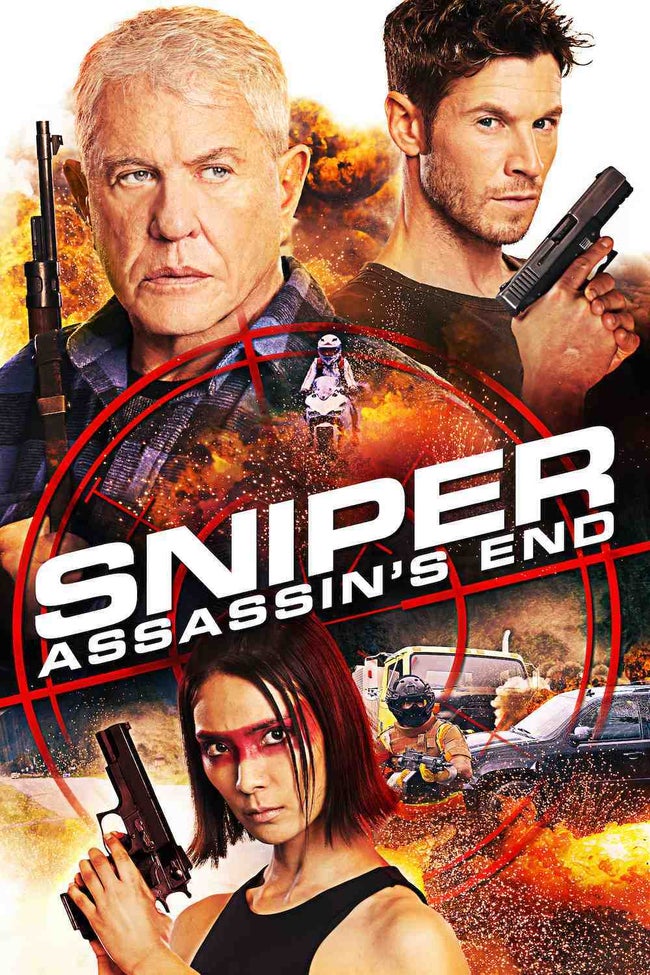
With the release of the eighth (!) film in the SNIPER franchise (not counting a fake one starring Steven Seagal), I realized I somehow missed the seventh, 2017's SNIPER: ULTIMATE KILL. Somehow, I was still able to follow SNIPER: ASSASSIN'S END, which is mostly standard-issue DTV fare, but it does try a couple of different things of interest. Director Kaare Andrews, a former Marvel writer and artist who dabbled in horror movies on the side (CABIN FEVER: PATIENT ZERO and a segment of THE ABCs OF DEATH), occasionally brings a budget-priced Michael Mann aura to this installment, opening with a strikingly-shot assassination and an effective Tangerine Dream-ish cue, and one later three-way sniper standoff framed as a top-to-bottom split screen. As director John Hyams showed with those later UNIVERSAL SOLDIER entries, one can do some unpredictable and adventurous things several films deep in a franchise when nobody's really paying any attention except for the die-hards, but aside from those few stylish touches, Andrews sticks to business-as-usual for the bulk of SNIPER: ASSASSIN'S END. In the fictional Central American country of Costa Verde, the president is taken out by a bullet from a sniper positioned over a mile away. The sniper is Japanese assassin "Lady Death" (Sayaka Akimoto), who plants a strand of hair as DNA evidence linking Sgt. Brandon Beckett (Chad Michael Collins, who's been headlining these since the 2011 reboot SNIPER: RELOADED) to the killing. He's apprehended and taken to a safe house for interrogation before Lady Death--working in the employ of someone else--has the chance to finish her assignment by killing him and staging it as a suicide. While CIA agent Franklin (Lochlyn Munro) bloviates to his underlings and sets out to nail Beckett's balls to the wall, Homeland Security agent Zeke "Zero" Rosenberg (Ryan Robbins) isn't buying that Beckett is guilty, and starts uncovering evidence linking a Vancouver pharmaceutical company to the murder of the Costa Verde president after he threatened to pull out of a trade agreement with the US.
Meanwhile, Beckett escapes from a military transport after Lady Death manages to take out everyone from afar but him, and he eventually makes his way to a remote, secluded forest outside Aberdeen, WA, where his dad--Thomas Beckett (original SNIPER star Tom Berenger, who sat out the fourth and sixth installments), the most lethal sniper in the US military--has been living off the grid. Of course, Pops Sniper will team up with Sniper Jr. to prove the latter's innocence, but if that plot trajectory sounds familiar, then you'll figure out that the filmmakers have also seen ANGEL HAS FALLEN. A sleepwalking Berenger is no match for a grumbling, madman-bearded Nick Nolte, but something else SNIPER: ASSASSIN'S END does is establish several new characters--along with a stinger before the closing credits hinting at the plot of the inevitable ninth SNIPER--in a blatant attempt at fashioning some kind of SNIPER Cinematic Universe in the vein of THE AVENGERS, and with Lady Death working for a nefarious villain named Drake Phoenix (Michael Jonsson), it might even get as ridiculous as the FAST & FURIOUS franchise. We're probably no more than two SNIPERs away from seeing Tom Berenger and Chad Michael Collins in space. (R, 95 mins)
GREED (US/UK - 2020)
Prolific journeyman British filmmaker Michael Winterbottom is probably best known for his numerous collaborations with Steve Coogan, going back to 2002's 24 HOUR PARTY PEOPLE. It's been a generally can't-miss prospect when these two get together, whether it's the TRIP BBC series or its three spinoff features, and 2006's hysterical TRISTRAM SHANDY: A COCK AND BULL STORY. It was inevitable that they'd hit a wall at some point, and they have indeed with GREED, a timely but shockingly unfunny would-be takedown of the obscenely wealthy. Coogan is Sir Richard McReadie, a hybrid of British retail billionaire Sir Philip Green and multi-millionaire fashion retailer-turned-UK restaurant chain magnate Richard Caring, and there's a little Donald Trump in there as well. McCreadie is known as "The Mozart of Retail," "The Da Vinci of Dealmaking," and "The Monet of Money," but his financial legend is mainly tied to his wealthy wife Samantha (Isla Fisher) and his ability to bully his way through handshake deals and having the magic touch to bankrupt his own companies while walking away with huge paydays. He's being investigated by a government commission but he's mainly preoccupied with a huge 60th birthday party being thrown at his lavish Greek beach house, where a Bulgarian construction crew is slowly erecting a Roman amphitheater specifically for his GLADIATOR-themed bash. He's pestered by dweeby biographer Nick (David Mitchell), doesn't seem to care that Samantha has a much younger lover, and is oblivious to his son Finn (Asa Butterfield) having Oedipal designs on his mother, an issue not helped by McCreadie constantly blowing off his attempts at father-son bonding.
In short, McCreadie is a real asshole, and GREED had potential. Sony even planned to expand it nationwide in March 2020 after a limited rollout in February, but it never happened due to the coronavirus. Coogan can usually play this kind of obnoxious prick in his sleep, but McCreadie is just a loud, bloviating version of Alan Partridge who's oblivious to any kind of tact and decorum, and he and Winterbottom think it's sufficiently funny to just have him yell "twat" and "cunt" a lot when he's berating everyone around him. There are entirely too many characters wandering in and out of the story, cutaways and flashbacks with jokes that don't land (a self-deprecating cameo by "You're Beautiful" one-hit wonder James Blunt), and even a subplot about the British media canceling McCreadie (once again) after he kicks some Syrian refugees off the public beach adjoining his property--leading to all of the celebrity guests bailing after he's paid them to attend (there are some Skype'd in cameos by Chris Martin, Ben Stiller, Colin Firth, and Keira Knightley)--falls flat. McCreadie's handlers try to rectify the situation by hiring professional lookalikes of Adele, Rod Stewart, Simon Cowell, Kylie Minogue, and George Michael, and the payoff to that entire laborious set-up is a furious McCreadie reminding them that George Michael is dead. Winterbottom also wrote the script, but there's an "additional material" credit for Sean Gray, who logged some time in the Armando Iannucci-verse with THE THICK OF IT and VEEP, and to that end, GREED really feels like cold Iannucci leftovers. It just gets worse by the end, when Winterbottom goes full ON DEADLY GROUND with (another) subplot about the working conditions at one of McCreadie's Sri Lanka sweatshops, and the closing credits have several minutes of statistics about the economic disparity between the women who work grueling days in these sweatshops for next-to-nothing and the billions their work generates for rich men like McCreadie. That's a valid conversation to have, and it's a perfect subject for Winterbottom to explore in one of his serious, WELCOME TO SARAJEVO or THE ROAD TO GUANTANAMO moods. But for a comedy where Steve Coogan's spent an hour and half acting a fool, being a cringe comedy dickhead, and calling everyone a "twat" and a "cunt," it comes off as tone-deaf, hectoring, and spectacularly heavy-handed. A total misfire. (R, 104 mins)
THE PROFESSOR AND THE MADMAN (Ireland/France/Iceland - 2019) Directed by P.B. Shemran (Farhad Safinia). Written by Todd Komarnicki and P.B. Shemran (Farhad Safinia). Cast: Mel Gibson, Sean Penn, Natalie Dormer, Steve Coogan, Stephen Dillane, Ioan Gruffudd, Eddie Marsan, Jennifer Ehle, Jeremy Irvine, David O'Hara, Anthony Andrews, Laurence Fox, Lars Brygmann, Bryan Murray, Sean Duggan, Olivia McKevitt, Brendan Patricks, Shane Noone. (Unrated, 124 mins) A longtime dream project that Mel Gibson's had on the backburner since purchasing the movie rights to Simon Winchester's book when it was released in 1998, THE PROFESSOR AND THE MADMAN ultimately became a nightmare of behind-the-scenes clashes and multiple lawsuits. Gibson began developing it as far back as 2001, when the great John Boorman (DELIVERANCE, EXCALIBUR) was set to write and direct. That fell apart and Boorman's script was reworked in 2007 by Todd Komarnicki (SULLY), with Luc Besson attached to direct, but that was right around the time that Gibson's traffic stop and other offscreen problems essentially made him persona non grata in Hollywood for at least the next decade. Nine years later, with numerous international financiers, Gibson finally got THE PROFESSOR AND THE MADMAN going with a new script by his friend and APOCALYPTO collaborator Farhad Safinia, who would also be making his directing debut. It was near the end of filming in Ireland in 2016 that disagreements began to develop between Gibson/Safinia and Voltage Pictures head Nicolas Chartier, when the pair asked for an additional $2.5 million for five additional days to shoot some scenes that they insisted had to be done on location at Oxford University (Trinity College was filling in for Oxford until then). Chartier rejected the request, telling them that they were already behind schedule and over the $25 million budget, so Trinity in Dublin would have to suffice.
Believing the film wouldn't be complete without these Oxford-shot scenes, Gibson told Chartier that Safinia wasn't being permitted to sufficiently finish the film. Gibson sued Voltage Pictures for breach of contract, claiming the film wasn't completed and he was guaranteed final cut, with Safinia also suing, claiming copyright infringement, accusing Voltage of never finalizing his contract, thus "his" script (which still contained some of Boorman's and Komarnicki's work) was never officially handed over to them. When Voltage released a statement accusing Gibson and Safinia of trying to "hijack the movie," Safinia sued for defamation. A judge ruled in favor of Voltage all around, and when Safinia's planned 160-minute film was whittled down to 124 minutes with neither Gibson nor Safinia's input, Gibson unsuccessfully tried to prevent it from being screened for potential distributors. These lawsuits kept the film on the shelf over 2017 and 2018 until a settlement was reached in early 2019, with Gibson removing his producer credit and any mention of his Icon Productions company. Safinia also successfully petitioned to have his name removed as director and co-writer, with credit now going to the non-existent "P.B. Shemran." Also absent is any mention of Boorman, still credited as a co-writer in initial press releases, in festival reviews, and on IMDb, but whose name is nowhere to be found on the released film. A troubled production, for sure, but there was a time when a prestige period piece starring Mel Gibson and Sean Penn would've been one of the most anticipated films of its year instead of one that gets a buried on VOD like a state secret by lowly, Redbox-ready Vertical Entertainment, with seemingly everyone involved actively distancing themselves from what sounds less like a battle of artistic differences and more like an alpha-male pissing contest.
With that kind of chaotic backstage melodrama, you'd think THE PROFESSOR AND THE MADMAN would be a folly of category five shitstorm proportions along the lines of LONDON FIELDS, another recent film left unreleased for several years due to endless litigation. It's a handsomely-produced period piece with meticulous production design that's often beautiful to look at and undeniably sincere in its approach, and while this Gibson-disowned version has some all-too-obvious red flags for post-production discord, it has other problems for which Gibson and Safinia should probably be held accountable. An account of the creation of the Oxford English Dictionary, THE PROFESSOR AND THE MADMAN focuses on Prof. James Murray (Gibson), a Scottish autodidact and linguist and self-taught expert in over a dozen languages, who successfully lobbies the powers that be at Oxford to entrust him with the task of compiling every word in the English language and its origin into a comprehensive, epic volume ("We are about to embark on the greatest adventure our language has ever known!" he declares). He estimates it'll take five years, but the project soon becomes too daunting, even with research assistants Henry Bradley (Ioan Gruffudd) and Charles Hall (Jeremy Irvine). It also places a strain on his family, with wife Ada (Jennifer Ehle) dutifully supporting him but truthfully not very enthused about moving their large family to a smaller home as Murray obsesses over his all-consuming project. The OED hits a brick wall, not helped by sneering publisher Philip Lyttleton Gell (Laurence Fox, conveying the erudite pomposity that his dad James and uncle Edward have projected so masterfully throughout their long careers) and supercilious Oxford board member Benjamin Jowett (Anthony Andrews), both of whom deem Murray's self-education dubious and a dishonor to the university ("I wonder if it's time to ease our gentle Scotsman off his little perch," Jowett harumphs).
Realizing it will take much longer than five years to complete the dictionary, Murray comes up with the idea of having a "dictionary by democracy," asking the general public to contribute words and origins, with Murray and his assistants determining the validity of the info provided (a pre-Wikipedia of sorts). Their largest selection of entries comes from an unexpected source: Dr. William Chester Minor (Penn, in his first feature film since 2015's THE GUNMAN), an American expat, paranoid schizophrenic and PTSD-afflicted Civil War vet being held at the Broadmoor Asylum for the Criminally Insane after killing a married father of six that he mistook for a wartime enemy. Minor is also a gifted surgeon and intellectual who earned reading privileges in the asylum after saving the life of an injured guard. He also feels remorse for what he's done and offers his military pension to his victim's widow Eliza (Natalie Dormer), who reluctantly accepts after briefly turning to prostitution to support her children. She begins to visit Minor in the asylum, he teaches her to read, and she slowly comes around to forgiving him after witnessing the extent of his mental illness. Dr. Murray visits and befriends Minor as well, which causes friction with the Oxford board when he insists that a known murderer be lauded as a major OED contributor.
Frequently heavy-handed and filled with barely-concealed allusions to Gibson's own personal quest for redemption, THE PROFESSOR AND THE MADMAN benefits from his solid, committed performance, but almost everything else is miscalculated to varying degrees. As in Komarnicki's script for SULLY, the film needs a villain where there really isn't one, so Gell and Jowett are there to undermine Murray and stonewall the OED at every turn for no legitimate reason at all aside from manufactured drama. Likewise at the asylum, the kindly and benevolent Dr. Richard Brayne (Stephen Dillane) suddenly does everything short of twirl a mustache while maniacally cackling to make Minor's life a living hell, starting with cutting off visits from Murray and Eliza and eventually barbaric forms of "therapy" like violently-induced vomiting that he blames on "catalepsy." Maybe some of this was explained in the excised 40-odd minutes of footage, but as presented here, Minor's deteriorating condition (starting with a self-castration) lacks a proper buildup. Not helping matters is a wildly overacting Penn, who's been given carte blanche to gorge on a buffet of scenery by Safinia and Gibson, who also seriously bungle the time element. There is one major instance where the blame can obviously be laid on some sloppy editing in post, as evidenced when Eliza's daughter slaps a white-bearded Minor, who's next seen in his room shouting "Look what you've done!" and his beard is suddenly dark brown, making it almost certain that the scene doesn't belong where Voltage's editors have placed it. But elsewhere, it becomes a huge distraction when Penn's Minor seems to be the only person who ages over the course of the film, set from 1872 to 1910. With a big, bushy salt-and-pepper beard, Gibson looks exactly the same from start to finish, as does everyone else and, save for the final shot at a Murray family gathering, neither Murray's nor Eliza's kids ever grow up as the story progresses and the decades pass. There's also some extensive Minor voiceover in letters he sends to Murray and it's clearly not Penn's voice reciting it. These goofs and haphazard stitches aside, what's here is a compelling story. Penn seems to keep himself in check in his initial scenes with Gibson (who is really good here), and the film also offers nice supporting turns from Eddie Marsan as a sympathetic asylum guard and Steve Coogan as Murray's biggest supporter on the Oxford board. But this is a compromised work that represents the vision of an executive producer doing damage control, and not that of the producer-star who spent a decade-and-a-half trying to get it made and was perhaps too close to it for his--and the film's--own good.
MINDHORN (UK - 2017) Directed by Sean Foley. Written by Julian Barratt and Simon Farnaby. Cast: Julian Barratt, Andrea Riseborough, Essie Davis, Steve Coogan, Russell Tovey, Simon Farnaby, Richard McCabe, David Schofield, Nicholas Farrell, Harriet Walter, Kenneth Branagh, Simon Callow, Jessica Barden, Robin Morrissey, Jordan Long. (Unrated, 88 mins) It succumbs to predictability when the comedy gives way to formulaic action in the third act, but the British-made Netflix acquisition MINDHORN, starring and co-written by THE MIGHTY BOOSH's Julian Barratt, gets its share of big laughs from an inspired premise. Barratt is Richard Thorncroft, a washed-up Isle of Man-born actor best known for a late '80s/early '90s TV series called MINDHORN, In it, Thorncroft starred as Bruce Mindhorn, an MI-5 agent who was captured and held prisoner at a secret compound in the outer regions of Siberia, where Soviet scientists replaced his left eye with a cybernetic optical lie detector, "allowing him to literally see the truth!" according to the show's dead-on INCREDIBLE HULK-type voiceover intro ("It's Truth Time!" Mindhorn declares when he nabs a perp). MINDHORN was a big hit for a few years but Thorncroft did a poor job of handling his fame. After releasing an album with the minor hit single "You Can't Handcuff the Wind" (sample lyric: "It's like tryin' to put thunder in jail!"), the show's popularity waned, ratings plummeted, his relationship with leading lady Patricia Deville (Essie Davis of THE BABADOOK) fell apart, and he had a very public meltdown when he appeared falling-down drunk on a live talk show, trash-talking co-star Peter Easterman (Steve Coogan), who played Mindhorn's sidekick Windjammer. Upon MINDHORN's cancellation, Easterman became a bigger star than Thorncroft ever was thanks to the spinoff WINDJAMMER, currently in its 16th season and still the most-watched show on British TV. Thorncroft's fall from grace continued when he ditched his loyal agent Geoffrey Moncrief (Richard McCabe) and went off to Hollywood when a megabudget producer promised to make him the next Burt Reynolds. The movie bombed and Thorncroft crashed and burned, and he's been scrounging for work and licking his wounds in London in the 20 years since. He's still trying to stage a comeback, still sucking in his gut and throwing on a Mindhorn toupee to cover his now-bald head, with his latest agent (Harriet Walter) unable to find any publisher interest in his autobiography (Easterman has just published his third memoir), while his most prominent recent gigs have found him coasting on what little MINDHORN notoriety he still has in TV commercials endorsing man-girdles and orthopedic socks.
After a disastrous audition with Kenneth Branagh where he humiliates himself pretending he and Branagh go back decades ("Kenny B!"), Thorncroft is about to throw in the towel, but he gets an unexpected offer from an Isle of Man police precinct: escaped lunatic Paul Melly (Russell Tovey), who makes squawking sounds and calls himself "The Kestral," is the prime suspect in a recent murder, but he refuses to speak with Baines (Andrea Riseborough), the detective on the case. Instead, MINDHORN superfan Melly, who thinks the character is real, will only talk to Agent Mindhorn, which leads the cops to hire Thorncroft to once again essay his signature role to help capture "The Kestral." Of course, at-an-all-time-low Thorncroft can't help but become a braying jackass and all-around egomaniac now that he thinks he's in-demand once more, and he very nearly screws up the entire investigation before accidentally helping apprehend Melly. But after reconnecting with Patricia, now a crusading reporter, and learning she ran off with his old stunt double Clive Parnevik (co-writer Simon Farnaby), Thorncroft is once more despondent until evidence surfaces that Melly has been framed for the murder, with Geoffrey having the proof on a VHS tape. When Geoffrey turns up dead and Thorncroft is implicated, he and Melly escape and set out to clear both of their names. Thorncroft's bigger concern seems to be his career, which, after a brief resurgence of interest thanks to his role in capturing Melly, immediately goes back into the shitter following an escalating confrontation with the gloating Easterman that goes viral when Thorncroft takes a swing at his former co-star and instead punches an innocent female bystander.
It should come as no surprise as MINDHORN (which counts Ridley Scott among its producers) reaches its conclusion that getting to the bottom of the case is key to Thorncroft's personal and professional redemption, as are rekindling his romance with Patricia and getting the idiotic Clive out of the picture. MINDHORN is consistently amusing but works best in its early scenes, especially its establishment of the current sad state of Thorncroft's life and career. There's a definite sense of Ricky Gervais/Stephen Merchant-style cringe comedy that gives way to a more HOT FUZZ-esque genre parody, and the styles don't always mesh. Also, the identity of the real villain is a bit of a letdown, since the individual doesn't have much to do with the plot and just seems arbitrarily tossed in. Barratt is appropriately self-deprecating in a role that would've had Kevin Kline written all over it 25 years ago, though he and debuting director Sean Foley could've just as easily gone in either direction the whole way through, be it a squirming discomfort about a washed-up actor or as an outright parody with a feature-length MINDHORN episode in the vein of an AUSTIN POWERS or a MACGRUBER. There's some very funny inside jokes for fans of British cinema, whether it's Branagh's deadpan cameo as himself ("No fucking clue who that was," he tells his assistant when Thorncroft finally leaves), or Thorncroft dealing with the ballbusting of actor/author Simon Callow, another of his agent's clients ("Fuck off, Callow!"). There's also some big laughs coming from his diva-like attitude when he arrives to help with the investigation, stopping a cop and ordering a coffee or requesting his tea with two teabags and name-dropping Sean Bean in the process ("Picked that up from Sean Bean...'Double-Bag' Bean, we called him."). MINDHORN doesn't maintain that same level of absurdist inspiration all the way through, but as far as Netflix Originals go, it's a better British comedy than DAVID BRENT: LIFE ON THE ROAD and a much better cop comedy than the dismal HANDSOME: A NETFLIX MYSTERY MOVIE.
RULES DON'T APPLY (US - 2016) Written and directed by Warren Beatty. Cast: Warren Beatty, Lily Collins, Alden Ehrenreich, Annette Bening, Matthew Broderick, Alec Baldwin, Haley Bennett, Candice Bergen, Dabney Coleman, Steve Coogan, Ed Harris, Megan Hilty, Oliver Platt, Martin Sheen, Paul Sorvino, Taissa Farmiga, Amy Madigan, Paul Schneider, Hart Bochner, Louise Linton, Graham Beckel, Chace Crawford, Ashley Hamilton, Marshall Bell, Patrick Fischler, Michael Badalucco, Joe Cortese. (PG-13, 126 mins) As an actor, writer, director, and producer, Warren Beatty has been nominated for 14 Oscars in total, winning one for Best Director with 1981's REDS. He's a living legend, and as a producer and star, one who was instrumental in ushering in the "New Hollywood" era with 1967's landmark BONNIE AND CLYDE. Beatty was never prolific even in his heyday: starting with his big-screen debut in 1961's SPLENDOR IN THE GRASS, he's acted in just 22 films in 55 years, the bulk of those being in the 1960s and 1970s. Offscreen since the expensive 2001 bomb TOWN & COUNTRY, Beatty returns with RULES DON'T APPLY, a pet project about Howard Hughes that he's had in various stages of development since 1973. Beatty also wrote and directed, and the whole thing was kept under wraps as shooting began in early 2014. Granted a Kubrickian level of freedom and secrecy that very few are afforded these days, Beatty made exactly the film he wanted to make, and if the end result is what he's had playing in his head for over 40 years, then you have to wonder what he was thinking and why he even bothered.
Set from 1959 to 1964, RULES DON'T APPLY takes its time getting to Beatty's Howard Hughes (79-year-old Beatty is about 25 years too old to play Hughes in this time period), instead focusing on Marla Mabrey (Lily Collins, daughter of Phil), a virginal, small-town beauty queen and bright-eyed songwriter from Virginia, who's been given a studio contract by Hughes and is flown out to Hollywood with her overprotective, devout Baptist mother Lucy (Annette Bening). They're picked up at the airport by Hughes employee Frank Forbes (Alden Ehrenreich), a Methodist engaged to 7th grade sweetheart Sarah (Taissa Farmiga) back in Fresno and with big dreams about getting Hughes to back his real estate ventures. Hughes has over 25 starlets under contract, and despite stipulations that the drivers aren't to get involved with them, Lucy and Frank can't deny their attraction to one another, even though she feels he's essentially married since he's already had sex with Sarah.
So far, so good. The opening half hour of RULES DON'T APPLY isn't great, but it has a sort-of "second-tier Woody Allen" thing going on and plays a lot like Allen's similar CAFE SOCIETY from earlier this year. But once Hughes enters the picture, the focus shifts to Beatty going through the litany of every Hughes tic, compulsion, oddity, and stereotype in existence. Sometimes it's played for laughs, other times it turns strangely dark, such as an uncomfortable and frankly creepy scene where a drunk Marla gives her virginity to a befuddled, babbling Hughes. Very little in this story is based on fact, other than there was a Howard Hughes and he was a total weirdo billionaire, so it's a jarring tonal shift to have what was essentially a light, romantic comedy suddenly turn bleak, with Marla feeling used and ending up pregnant and considering an abortion. Frank can't decide if he wants to be with Sarah or Marla, and for the sake of the script, instead gets a quick promotion from anonymous driver to Hughes' right-hand man almost overnight. Beatty then spends an inordinate amount of time on Hughes' dealings with his TWA airline, various defense contracts with the US government, and trying to convince the government that his plane can fly, with his behavior growing increasingly erratic with each passing scene. Many big names joined the project, obviously for the chance to work with Beatty, but with the exception of Matthew Broderick as another top Hughes flunky, none of them are put to good use: Candice Bergen has a thankless role as Hughes' secretary; Martin Sheen has three or four brief appearances before we even get a hint of who he's supposed to be (he's either Hughes' lawyer or he runs the day-to-day operations of the Hughes empire), then his character is fired and replaced by another character played by Alec Baldwin, doing a quick "Hey, I'm here to hang with Warren" drop-by; Ed Harris and Amy Madigan have one scene as Sarah's parents; Steve Coogan plays a scared pilot riding shotgun after Hughes drops what he's doing and goes to London to fly a plane; Dabney Coleman shows up briefly as Hughes' doctor; and in a barely-there bit part, Paul Sorvino is seen chatting in the background of a couple shots, eventually getting one line of dialogue when his character is seen on a TV screen. Who is he? Why is he here? Who knows?
It's never a good sign when four editors share credit, and RULES DON'T APPLY looks like a hastily-assembled mess that wasn't so much finished as it was given up on. Characters appear and disappear with no explanation, and early scenes are presented in such a brisk and choppy fashion that you never ascertain who certain people are and what purpose they serve to the story. Beatty bum-rushes through the exposition to get to the parts he cares most about--hamming it up as Howard Hughes--and leaves a large cast mostly stranded. It just gets worse as it goes on, Hughes impulsively heading to London, Managua, and Acapulco, with Frank in tow, for reasons never really explained. Beatty assembled some cast and crew for some reshoots in early 2015 and then spent well over a year putting the movie together. He had nearly five decades to figure out what he wanted with this thing and the end result is a leaden, lifeless, self-indulgent fiasco. Collins and Ehrenreich do what they can with the material (and you have to respect future Han Solo Ehrenreich, who arrived a few years ago as an obvious Leonardo DiCaprio clone who's now getting the roles Leo has aged out of, but he's a young actor who knows his history and has jumped at the chance to work with movie legends like Beatty, Francis Ford Coppola, and Woody Allen), but they're completely defeated by the whims and indecisiveness of a director who's just maybe been away from the game for too long. Beatty hasn't directed a film since 1998's still-scathing BULWORTH (though he reportedly pulled rank on Peter Chelsom and backseat-directed most of TOWN & COUNTRY himself), and that was a movie that had things to say that remain relevant today. Whether as a director, producer, writer, or star, Beatty has historically had his finger on the pulse of current events and deftly capturing the zeitgeist, whether it's the political commentary and the hip-hop awakening of BULWORTH, the changing cinema trends exemplified by BONNIE AND CLYDE, the post-Nixon/Watergate paranoia of THE PARALLAX VIEW, or the sexually liberated '70s in SHAMPOO. RULES DON'T APPLY (you could make a drinking game out of how many times that phrase is shoehorned in via dialogue or song) is a tone-deaf vanity project that puts Beatty in with other influential auteurs--Stanley Kubrick, Terrence Malick, George Romero, Dario Argento, to name a few--whose final or most recent works are indicative of aging legends who just don't get out much anymore. How else do you explain an extended gag about a cum stain on Frank's pants? Did Beatty just now get around to seeing a Farrelly Brothers comedy? And why is that joke in this movie? Given his sporadic work habits and his age, this is likely the last thing we're going to see from Warren Beatty. And that's a damn shame.
ALAN PARTRIDGE (France/UK - 2013; US release 2014)
British actor/writer/comedian Steve Coogan's (PHILOMENA) best known character is clueless and insufferably self-aggrandizing radio and TV personality Alan Partridge. Coogan's been playing Partridge off-and-on on numerous British TV shows since 1991, and it's proven so popular that he had a change of heart on his plan to retire Partridge some years back. Coogan's first stab at bringing Alan Partridge to the big screen resulted in a blockbuster hit in British theaters, where it was called ALAN PARTRIDGE: ALPHA PAPA. The second half of the title was dropped by US distributor Magnolia, but it makes no matter. If you like snappy, misanthropic, foul-mouthed British humor in the vein of THE THICK OF IT and its big-screen spinoff IN THE LOOP (2009), you'll dig ALAN PARTRIDGE since it also features the contributions of co-writer Armando Iannucci, whose unique brand of biting humor has translated beautifully to American TV with HBO's blisteringly funny VEEP. Here, Partridge is the afternoon DJ at North Norfolk Digital, a small-time radio station that's just been bought out by a big-time media company run by the loathsome Jason Tresswell (Nigel Lindsay). Fearing for his job security, Partridge trash-talks veteran night DJ Pat Farrell (Colm Meaney) enough that Farrell is canned. Later that night, at a party thrown at the station by Tresswell, a disgruntled Farrell shows up and takes everyone hostage. Acting as a liaison between the police and Farrell, Partridge sees the siege and the inevitable media circus as his ticket back to the big time.
Even if you haven't seen much of Coogan's past work as Partridge, ALAN PARTRIDGE works just fine as a stand-alone film. You'll be able to fill in the blanks, like Partridge's insensitive interaction with doting assistant Lynn Benfield (Felicity Montagu) or the antics of his Geordie friend Michael (Simon Greenall). Coogan and Iannucci assembled a summit of ALAN PARTRIDGE writers older and newer to put this together, including Peter Baynham, who worked on the early Partridge material and went on to write BORAT with Sacha Baron Cohen, plus twin brothers Neil & Rob Gibbons, who worked on more recent PARTRIDGE incarnations with Coogan. Along with the writers, director Declan Lowney (a veteran of numerous British TV favorites like FATHER TED and LITTLE BRITAIN) approaches this in a fan-friendly fashion and doesn't fix what isn't broken, while at the same time making it accessible for the first-time viewer. Of course, if you know Coogan's style or have seen any of his work with Rob Brydon, you know what to expect. Whether he's being politically incorrect, extraordinarily self-centered, pretending to be on the phone to avoid talking to someone only to have it ring, or just being an outright coward (as someone's about to enter a room with guns blazing, Partridge tells one woman "I'll protect you" while sheepishly crouching behind her), Coogan is hilariously obnoxious throughout, and has a good foil in Meaney's ill-tempered Farrell. Sure, the whole concept is more than a little reminiscent of the 1994 radio station hostage comedy AIRHEADS, but Coogan and Iannucci bring enough of their distinctive style to the table to make it very worthwhile. (R, 90 mins)
CAPITAL (France - 2012; US release 2013)
Though he's dabbled in various genres, the great Greek-French filmmaker Costa-Gavras is best known for his politically-charged films like the Oscar-winning Z (1969), THE CONFESSION (1970), STATE OF SIEGE (1972), MISSING (1982), BETRAYED (1988), and MUSIC BOX (1989). He's never shied away from controversy, especially with 1983's HANNA K, a film whose perceived Palestinian sympathies got it yanked from theaters and probably had a hand in effectively ending Jill Clayburgh's run as a Hollywood A-lister. Costa-Gavras hasn't made an American film since 1997's ham-fisted MAD CITY, but he's been working fairly steadily in France over the last decade. His latest--and first to get US distribution since 2002's AMEN--is CAPITAL, which finds the 80-year-old director taking aim at the global financial meltdown in sometimes heavy-handed ways, and while it's not essential Costa-Gavras, it's still worth seeing. It's hard to make financial thrillers thrilling (the recent MOBIUS is a great example of how not to do it), and while the characters and the subplots are fairly standard-issue, CAPITAL gets some genuine momentum going once all the pieces are in place.
When the old-school CEO (Daniel Mesguich) of France-based Phenix Bank has a heart attack and gets an overly symbolic testicular cancer diagnosis (that's right--he doesn't have the balls for this business anymore), he nominates his protege Marc Tourneuil (Gad Elmaleh) to replace him. The board isn't happy, but figure Tourneuil is enough of a yes-man that they can bully him around and get what they want anyway. Tourneuil proves to be a hard negotiator and a driven businessman and immediately makes a number of bottom-line decisions that are so unpopular that even his mentor wants him fired. Phenix is in dire shape and in order to turn things around, Tourneuil forms an uneasy alliance with an aggressive Miami-based hedge fund overseen by ruthless financial titan Dittmar Rigule (Gabriel Byrne, who had one of his earliest major roles in HANNA K). Rigule plots an insider trading scam to drain Phenix's assets through a secret corporation, then overtake it with his own hedge fund, essentially using Phenix's money to buy themselves out. Tourneuil is promised a fat payday out of it and the first step is firing 10,000 Phenix employees worldwide to aid in shareholder (and Rigule) profit. Of course, Tourneuil's mind isn't always focused on Rigule's junkyard-dog act or the deceptive machinations of his own underlings, since his newfound power predictably turns him into a total asshole, ignoring his devoted wife (Natacha Regnier) and growing obsessed with a manipulative supermodel (Laura Gemser lookalike Liya Kebede), even blowing off meetings so he can fly to Tokyo to go down on her in an airport restroom. The relationship between Tourneuil and the supermodel is the most problematic element in CAPITAL, taking up too much time and going nowhere, and their final scene together is just unpleasant and bizarre. Costa-Gavras pulls no punches in his depiction of the high-rolling sociopaths that inhabit the financial world: even from the beginning, when the old CEO collapses on a golf course, Tourneuil is already grinning at the prospect of being put in charge. He's not a nice guy corrupted by power. He's an asshole who was patiently waiting for his turn. In the end, CAPITAL's points are simplistic and obvious, but the financial cat-and-mouse game between Tourneuil and Rigule (it's great fun watching Byrne turn from a smooth operator into a bloviating prick as the film goes on) provides some well-handled dramatic tension. It's no Z, but Costa-Gavras, still looking spry, energetic, and a good decade younger than his age in the DVD's making-of doc, still has a little gas left in the tank. (R, 114 mins)
HAUNT (US - 2014)
It's probably easier to just list the movies HAUNT rips off rather than attempt a review. Another in an ever-increasing (and ever-annoying) line of slow-burner horror films that mistakes "long stretches of lethargically-paced nothing" for "building tension" (thanks, Ti West!), HAUNT offers yet another dull and oblivious family moving into a cursed house because it's impossibly cheap thanks to all of the murders that have taken place under its roof. The Ashers--dad (Brian Wimmer), mom (Ione Skye), oldest daughter (Danielle Chuchran), son (Harrison Gilbertson), and younger daughter (Ella Harris)--relocate to a spacious Iowa home where the the previous family all met horrific ends except for the matriarch (SILVER LININGS PLAYBOOK'S Jacki Weaver), who ran a pediatrics practice from a home office. The ghostly activity starts with an EVP (electronic voice phenomenon) machine that's been left behind in a secret room next to Gilbertson's. Gilbertson meets a troubled teen (Liana Liberato) who lives down the road with her abusive father, and soon she's sleeping over with him, which is totally cool since his folks are the hippest and most easygoing parents around. Gilbertson and Liberato mess around with the machine and a voice tells him to "Get out of my room!" Soon enough, they're haunted by the usual apparitions out of nowhere, shadows lurk in hallways, wet footprints lead nowhere, and the youngest Asher is having long conversations with her dolls, standing in doorways in a catatonic stupor, and scratching the eyes and faces out of family photos. Might it all have something to do with a clumsily-placed flashback with Weaver helping out a young mother with a screaming baby girl? Gilbertson is so preoccupied playing savior with Liberato that he doesn't even notice the weird stuff going on with his little sister, which is fine since director Mac Carter and writer Andrew Barrer completely forget about her anyway. Instead, they just restage elements of INSIDIOUS, WHITE NOISE, THE AMITYVILLE HORROR, SINISTER, and of course, once they unleash the angry spirit of Weaver's teenage son, Gilbertson briefly becomes possessed and starts doing the herky-jerky JU-ON/GRUDGE shuffle. With no scares, thoroughly cardboard characters, and an egregious wasting of two-time Oscar-nominee Weaver, HAUNT (not to be confused with the recent and much better HAUNTER) is an instantly forgettable trifle that almost wears its half-assed laziness like a badge of honor, its only concern being how many movies it can crib from on its way to the $5 DVD bin at Wal-Mart. I guess the only good thing you can say about it is that no one in the family seems to own a video camera. (R, 86 mins, also available on Netflix Instant)