THE GENTLEMEN (US - 2020) Written and directed by Guy Ritchie. Cast: Matthew McConaughey, Charlie Hunnam, Hugh Grant, Colin Farrell, Henry Golding, Michelle Dockery, Jeremy Strong, Eddie Marsan, Tom Wu, Bugzy Malone, Jason Wong, Lyne Renee, Chidi Ajufo, Simon Barker, John Dagleish, Eliot Sumner, Samuel West, Gershwyn Eustache Jnr, Tom Rhys Harries, Danny Griffin, Mark Rathbone, Andrew Greenaugh. (R, 113 mins) After a decade of playing the big-budget Hollywood franchise game with Robert Downey Jr.'s two SHERLOCK HOLMES films, the underrated THE MAN FROM U.N.C.L.E., the costly flop KING ARTHUR: LEGEND OF THE SWORD, and the live-action ALADDIN, writer/director Guy Ritchie returns to his LOCK, STOCK AND TWO SMOKING BARRELS and SNATCH roots with the twisty, convoluted, and wildly entertaining THE GENTLEMEN. He hasn't revisited these sorts of "fookin' 'ell, mate!" British gangster shenanigans since 2008's middling ROCKNROLLA, but buoyed by a game cast and a gleeful willingness to offend everyone, THE GENTLEMEN manages to be a lot of fun despite Ritchie not really having any new tricks up his sleeve. You could call it LOCK, STOCK 4: ALRIGHT, ALRIGHT, ALRIGHT, as Matthew McConaughey stars as expat American Mickey Pearson, who came to London from trailer park America with a genius-level IQ and a Rhodes Scholarship to Oxford that he blew off when he found being a weed dealer for his rich and spoiled classmates was more lucrative. And in the years since, he's set up a massive empire in the UK covering all facets from production to distribution. He's incredibly wealthy, has a ton of guys on his payroll to do any required dirty work, and he uses the property of lesser-ranking, under-the-radar royals to secretly house his dozen underground facilities in exchange for a cut of the profits.
But Mickey's been in the game a long time and he wants to retire, which brings everyone out of the woodwork in an attempt to buy out his operation, including unscrupulous American billionaire Matthew Berger (Jeremy Strong, reuniting with McConaughey after last year's SERENITY triumph) and Dry Eye (Henry Golding), an ambitious underboss with a Chinese mob outfit who's looking to break away from his boss Lord George (Tom Wu). There's also Fletcher (Hugh Grant), a sleazy private eye who's been hired by tabloid publisher Big Dave (Eddie Marsan) to dig up dirt on Mickey after he's snubbed by him at a swanky society gathering, to the delight of onlookers. And Big Dave knows Mickey has connections to distant Royal Family member Lord Pressfield (Samuel West), whose runaway daughter Laura (Eliot Sumner, youngest daughter of Sting and Trudie Styler) is a heroin addict. But Fletcher has his own ideas of taking the information he's gathered and selling it to Ray (Charlie Hunnam), Mickey's loyal right-hand man, occasionally embellishing his findings with some Hollywood bells and whistles in the hope that it could be sold as a script (Ritchie has some meta fun with this aspect, including a bit where the scheming Fletcher meets with a producer who has a 2015 MAN FROM U.N.C.L.E. poster in his office). Double, triple, quadruple, and quintuple crosses ensue, with shifting loyalties and unexpected players--including Mickey's take-no-shit wife Rosalind (Michelle Dockery), and Coach (Colin Farrell), a tough Irish bloke who runs a gym for underprivileged kids, and who's pulled into the proceedings when a few of his ne'er-do-wells foolishly decide to steal some of Mickey's product.
In other words, it's pretty much business as usual for old-school Ritchie fans, but it's done with enough style and panache that you won't mind the familiarity, sort-of like listening to a new AC/DC album. It's exactly what you think it is, it strictly adheres to a carved-in-stone formula, and it doesn't fix what isn't broken (unless you really want Ritchie to make another REVOLVER). It's comfort food of sorts if you're a LOCK, STOCK fan...that is, as long as you can still laugh at insensitive jokes (at the expense of pretty much everyone, for instance Fletcher describing Dry Eye as "a Chinese James Bond...with a ricense to kill") and extraordinarily profane dialogue being rattled off by some very bad guys (this may set a new record for the number of times "cunt" is yelled in a movie). The cast is having a blast, particularly Grant, who seems to be doing a scathing Ricky Gervais impression and keeps not-very-subtly hitting on Hunnam's Ray. An underused Farrell gets a few moments to shine in the de facto Vinnie Jones role, but it's really more of an ensemble piece when it's all said and done, despite the focus on Mickey, and even then, McConaughey is offscreen for a couple of long-ish stretches. Twists and turns pile up at an absurd rate near the end, and THE GENTLEMEN is a really good time if vintage Guy Ritchie is what you're after. He also gives you one of the more blatant shout-outs to THE LONG GOOD FRIDAY that you'll ever see, and that's a nice bonus.
THE PROFESSOR AND THE MADMAN (Ireland/France/Iceland - 2019) Directed by P.B. Shemran (Farhad Safinia). Written by Todd Komarnicki and P.B. Shemran (Farhad Safinia). Cast: Mel Gibson, Sean Penn, Natalie Dormer, Steve Coogan, Stephen Dillane, Ioan Gruffudd, Eddie Marsan, Jennifer Ehle, Jeremy Irvine, David O'Hara, Anthony Andrews, Laurence Fox, Lars Brygmann, Bryan Murray, Sean Duggan, Olivia McKevitt, Brendan Patricks, Shane Noone. (Unrated, 124 mins) A longtime dream project that Mel Gibson's had on the backburner since purchasing the movie rights to Simon Winchester's book when it was released in 1998, THE PROFESSOR AND THE MADMAN ultimately became a nightmare of behind-the-scenes clashes and multiple lawsuits. Gibson began developing it as far back as 2001, when the great John Boorman (DELIVERANCE, EXCALIBUR) was set to write and direct. That fell apart and Boorman's script was reworked in 2007 by Todd Komarnicki (SULLY), with Luc Besson attached to direct, but that was right around the time that Gibson's traffic stop and other offscreen problems essentially made him persona non grata in Hollywood for at least the next decade. Nine years later, with numerous international financiers, Gibson finally got THE PROFESSOR AND THE MADMAN going with a new script by his friend and APOCALYPTO collaborator Farhad Safinia, who would also be making his directing debut. It was near the end of filming in Ireland in 2016 that disagreements began to develop between Gibson/Safinia and Voltage Pictures head Nicolas Chartier, when the pair asked for an additional $2.5 million for five additional days to shoot some scenes that they insisted had to be done on location at Oxford University (Trinity College was filling in for Oxford until then). Chartier rejected the request, telling them that they were already behind schedule and over the $25 million budget, so Trinity in Dublin would have to suffice.
Believing the film wouldn't be complete without these Oxford-shot scenes, Gibson told Chartier that Safinia wasn't being permitted to sufficiently finish the film. Gibson sued Voltage Pictures for breach of contract, claiming the film wasn't completed and he was guaranteed final cut, with Safinia also suing, claiming copyright infringement, accusing Voltage of never finalizing his contract, thus "his" script (which still contained some of Boorman's and Komarnicki's work) was never officially handed over to them. When Voltage released a statement accusing Gibson and Safinia of trying to "hijack the movie," Safinia sued for defamation. A judge ruled in favor of Voltage all around, and when Safinia's planned 160-minute film was whittled down to 124 minutes with neither Gibson nor Safinia's input, Gibson unsuccessfully tried to prevent it from being screened for potential distributors. These lawsuits kept the film on the shelf over 2017 and 2018 until a settlement was reached in early 2019, with Gibson removing his producer credit and any mention of his Icon Productions company. Safinia also successfully petitioned to have his name removed as director and co-writer, with credit now going to the non-existent "P.B. Shemran." Also absent is any mention of Boorman, still credited as a co-writer in initial press releases, in festival reviews, and on IMDb, but whose name is nowhere to be found on the released film. A troubled production, for sure, but there was a time when a prestige period piece starring Mel Gibson and Sean Penn would've been one of the most anticipated films of its year instead of one that gets a buried on VOD like a state secret by lowly, Redbox-ready Vertical Entertainment, with seemingly everyone involved actively distancing themselves from what sounds less like a battle of artistic differences and more like an alpha-male pissing contest.
With that kind of chaotic backstage melodrama, you'd think THE PROFESSOR AND THE MADMAN would be a folly of category five shitstorm proportions along the lines of LONDON FIELDS, another recent film left unreleased for several years due to endless litigation. It's a handsomely-produced period piece with meticulous production design that's often beautiful to look at and undeniably sincere in its approach, and while this Gibson-disowned version has some all-too-obvious red flags for post-production discord, it has other problems for which Gibson and Safinia should probably be held accountable. An account of the creation of the Oxford English Dictionary, THE PROFESSOR AND THE MADMAN focuses on Prof. James Murray (Gibson), a Scottish autodidact and linguist and self-taught expert in over a dozen languages, who successfully lobbies the powers that be at Oxford to entrust him with the task of compiling every word in the English language and its origin into a comprehensive, epic volume ("We are about to embark on the greatest adventure our language has ever known!" he declares). He estimates it'll take five years, but the project soon becomes too daunting, even with research assistants Henry Bradley (Ioan Gruffudd) and Charles Hall (Jeremy Irvine). It also places a strain on his family, with wife Ada (Jennifer Ehle) dutifully supporting him but truthfully not very enthused about moving their large family to a smaller home as Murray obsesses over his all-consuming project. The OED hits a brick wall, not helped by sneering publisher Philip Lyttleton Gell (Laurence Fox, conveying the erudite pomposity that his dad James and uncle Edward have projected so masterfully throughout their long careers) and supercilious Oxford board member Benjamin Jowett (Anthony Andrews), both of whom deem Murray's self-education dubious and a dishonor to the university ("I wonder if it's time to ease our gentle Scotsman off his little perch," Jowett harumphs).
Realizing it will take much longer than five years to complete the dictionary, Murray comes up with the idea of having a "dictionary by democracy," asking the general public to contribute words and origins, with Murray and his assistants determining the validity of the info provided (a pre-Wikipedia of sorts). Their largest selection of entries comes from an unexpected source: Dr. William Chester Minor (Penn, in his first feature film since 2015's THE GUNMAN), an American expat, paranoid schizophrenic and PTSD-afflicted Civil War vet being held at the Broadmoor Asylum for the Criminally Insane after killing a married father of six that he mistook for a wartime enemy. Minor is also a gifted surgeon and intellectual who earned reading privileges in the asylum after saving the life of an injured guard. He also feels remorse for what he's done and offers his military pension to his victim's widow Eliza (Natalie Dormer), who reluctantly accepts after briefly turning to prostitution to support her children. She begins to visit Minor in the asylum, he teaches her to read, and she slowly comes around to forgiving him after witnessing the extent of his mental illness. Dr. Murray visits and befriends Minor as well, which causes friction with the Oxford board when he insists that a known murderer be lauded as a major OED contributor.
Frequently heavy-handed and filled with barely-concealed allusions to Gibson's own personal quest for redemption, THE PROFESSOR AND THE MADMAN benefits from his solid, committed performance, but almost everything else is miscalculated to varying degrees. As in Komarnicki's script for SULLY, the film needs a villain where there really isn't one, so Gell and Jowett are there to undermine Murray and stonewall the OED at every turn for no legitimate reason at all aside from manufactured drama. Likewise at the asylum, the kindly and benevolent Dr. Richard Brayne (Stephen Dillane) suddenly does everything short of twirl a mustache while maniacally cackling to make Minor's life a living hell, starting with cutting off visits from Murray and Eliza and eventually barbaric forms of "therapy" like violently-induced vomiting that he blames on "catalepsy." Maybe some of this was explained in the excised 40-odd minutes of footage, but as presented here, Minor's deteriorating condition (starting with a self-castration) lacks a proper buildup. Not helping matters is a wildly overacting Penn, who's been given carte blanche to gorge on a buffet of scenery by Safinia and Gibson, who also seriously bungle the time element. There is one major instance where the blame can obviously be laid on some sloppy editing in post, as evidenced when Eliza's daughter slaps a white-bearded Minor, who's next seen in his room shouting "Look what you've done!" and his beard is suddenly dark brown, making it almost certain that the scene doesn't belong where Voltage's editors have placed it. But elsewhere, it becomes a huge distraction when Penn's Minor seems to be the only person who ages over the course of the film, set from 1872 to 1910. With a big, bushy salt-and-pepper beard, Gibson looks exactly the same from start to finish, as does everyone else and, save for the final shot at a Murray family gathering, neither Murray's nor Eliza's kids ever grow up as the story progresses and the decades pass. There's also some extensive Minor voiceover in letters he sends to Murray and it's clearly not Penn's voice reciting it. These goofs and haphazard stitches aside, what's here is a compelling story. Penn seems to keep himself in check in his initial scenes with Gibson (who is really good here), and the film also offers nice supporting turns from Eddie Marsan as a sympathetic asylum guard and Steve Coogan as Murray's biggest supporter on the Oxford board. But this is a compromised work that represents the vision of an executive producer doing damage control, and not that of the producer-star who spent a decade-and-a-half trying to get it made and was perhaps too close to it for his--and the film's--own good.
VICE (US - 2018) Written and directed by Adam McKay. Cast: Christian Bale, Amy Adams, Steve Carell, Sam Rockwell, Tyler Perry, Jesse Plemons, Alison Pill, Lily Rabe, Eddie Marsan, Justin Kirk, LisaGay Hamilton, Bill Camp, Don McManus, Shea Whigham, Stephen Adly Guirgis, Fay Masterson, John Hillner, Paul Yoo, Joseph Beck, Tony Graham. (R, 132 mins) ANCHORMAN director and Will Ferrell BFF Adam McKay took the leap to "serious filmmaker" with 2015's THE BIG SHORT, an angry and irreverent autopsy of the housing market collapse. He takes the same approach and nets less consistent results with the Dick Cheney biopic VICE, which covers the life of George W. Bush's vice president from his days as a hard-drinking college dropout and all-around fuck-up in 1963, through the events of 9/11 to his heart transplant in 2012. Regardless of how one feels about Cheney and where you stand politically, the one thing everyone can agree on in these more-divisive-than-ever times is that Christian Bale completely disappears onscreen and all you see is Dick Cheney. Sporting Oscar-worthy makeup and an extra 45-50 lbs, the Oscar-winning actor, known for his startling transformations in past films like THE MACHINIST, THE FIGHTER, and AMERICAN HUSTLE, absolutely becomes Cheney. Bale carries VICE on his shoulders, and it's a good thing he does, because without the level of obsessive, Day-Lewisian dedication in his performance/metamorphosis, the film's shortcomings and inconsistencies would be a lot more glaring than they already are.
Counting Ferrell and Brad Pitt among its producers, VICE is entertaining, but McKay too often succumbs to Michael Moore agitprop with all the subtlety of a jackhammer or, perhaps, Ron Burgundy. Tonally, it's all over the place, with the grim seriousness of 9/11 juxtaposed with the kind of meta jokes that wouldn't have been out of place on something like MR. SHOW or FUNNY OR DIE (like a focus group stopping the movie to address its liberal bias). There's a ruthless, Lady Macbeth quality to Lynne Cheney, played here by Amy Adams, leading to Adams and Bale playing an entire scene in emphatic, scenery-chewing Shakespearean dialogue. McKay also takes the story into a hypothetical direction about 40 minutes in, just prior to Cheney accepting an offer to be Bush's VP where he, Lynne, and their extended family live happily ever after as historical footnotes, never to be heard from again as an inspiring score cue swells and the closing credits begin rolling before abruptly resetting and bringing the film back to reality. There's a scattershot, throw-everything-at-the-wall approach to VICE that's worked for McKay in the past (ANCHORMAN, THE OTHER GUYS) and has also completely backfired (ANCHORMAN 2). It splits the difference here because it is funny, but the comedy only spotlights the fact that VICE is never sure what it wants to be. Bale is diving into this and losing himself in the way he deftly captures everything about Cheney physically and psychologically, while Adams is stuck playing a one-dimensional Lynne Cheney who's defined almost exclusively by her shrewd opportunism and the Cheney image (when their daughter Mary, played by Alison Pill, comes out as gay, it's Dick who immediately embraces her and offers his support while Lynne stands there, already questioning how this affects Dick's political career). Others are doing convincing impressions that look like SNL on a good night, like Steve Carell's obnoxious and loathed-throughout-DC Donald Rumsfeld, Tyler Perry's Colin Powell, Eddie Marsan's Paul Wolfowitz, and Sam Rockwell's George W. Bush, seen here as an easygoing goofball who only seems to be in politics to earn his dad's respect.
There is a clever framing device involving an onscreen narrator (Jesse Plemons), and the story jumps back and forth through the years, chronicling Cheney's time as a protege of presidential adviser Rumsfeld in the pre-Watergate Nixon White House, and his eventual return as White House Chief of Staff under Gerald Ford (Bill Camp) in the 1975 "Halloween Massacre," a gig he gets after swooping in to scavenge for table scraps left by everyone tainted by the Watergate fiasco. He's also the Defense Secretary under George H.W. Bush and the film glosses over his tenure as CEO of Halliburton before he's persuaded to be George W. Bush's running mate. Throughout VICE, Cheney is accurately depicted as a Machiavellian mover and shaker, fixated on finding loopholes and reinterpretations to skirt around the Constitution and the law to find ways to grant the executive branch previously untapped levels of power, secrecy, and unaccountability. He's always working behind the scenes, quietly plotting, and never drawing attention to himself, qualities that come into play when he manipulates the younger Bush into letting him take on a much more significant role in policy and day-to-day operations than VPs have historically played ("The president and I have an understanding," he says whenever someone asks him if he's overstepping his boundaries).
The film's second half focuses almost entirely on the post 9/11 era, with the the Patriot Act, the invasion of Iraq, "enhanced interrogation," Cheney's vengeful outing of undercover CIA agent Valerie Plame, and other decisions that resonate to this day (the infamous incident where Cheney shot a guy in the face is also shown, along with a reminder that the only apology that ever came from it was from the victim to Cheney), but therein lies the core problem with VICE: you're not going to leave the theater knowing anything you didn't already know going in. And to that end, it's rather shallow and superficial, and lacking the focused rage of THE BIG SHORT (the most vicious jab is aimed not at Dick Cheney, but at the apathetic and easily-distracted general public, and it comes at the very end, so stick around for that stinger that comes early in the closing credits). It's a triumph of makeup and a testament to Christian Bale's many gifts as an actor and his complete devotion to his craft. He makes efforts to show Cheney's human side and doesn't play him a cartoonish Bond villain, but a long, "no apologies" monologue near the end might make you wonder if this wouldn't have made a more insightful film if it was a one-man show like James Whitmore as Harry S. Truman in 1975's GIVE 'EM HELL, HARRY! or Philip Baker Hall as Richard Nixon in Robert Altman's 1984 film SECRET HONOR.
WHITE BOY RICK (US - 2018) Directed by Yann Demange. Written by Andy Weiss, Logan Miller and Noah Miller. Cast: Matthew McConaughey, Richie Merritt, Bel Powley, Jennifer Jason Leigh, Piper Laurie, Bruce Dern, Brian Tyree Henry, Rory Cochrane, RJ Cyler, Jonathan Majors, Eddie Marsan, Taylour Paige, Raekwon Haynes, YG, Kyanna Simone Simpson. (R, 111 mins) The story of teenage street hustler Ricky Wershe, Jr., aka "White Boy Rick," is known by anyone who lived in Detroit in the 1980s, but in bringing that story to the screen, WHITE BOY RICK comes up short. Part of the problem is that the film feels rushed at best and incomplete at worst as it tries to tell too much in under two hours. There's obviously pieces of the story either cut out for time or never shot at all, but the bigger issue is its insistence on shaping the events to engineer the maximum amount of sympathy for both Ricky Jr and his "broke-ass" criminal dad Richard. This is particularly egregious when it comes to the depiction of Richard, played here by Matthew McConaughey in a fine performance when judged solely on what the screenplay is asking him to do. It's not McConaughey's fault that Richard Wershe was, according to Detroit reporters and cops who worked the case, an unrepentant shitbag that the film feels the need to present as some pie-in-the-sky dreamer and single dad selling modified AK-47s out of the trunk of his car because he just wants a better life for his kids by using the profits to open his own video store, which we see exactly one time and where he never seems to be after that.
That's the kind of checklist storytelling WHITE BOY RICK devolves into in its messy second half after a reasonably compelling first hour. 17-year-old newcomer Richie Merritt brings a sort of mush-mouthed, streetwise grittiness to his portrayal of Ricky Jr, who's 14 as the film opens in 1984, unloading some modified guns and homemade silencers on a gang run by Johnny "Lil Man" Curry (Jonathan Majors), who's an underling to his older brother, high-powered Detroit crime lord Leo "Big Man" Curry (rapper YG). Dubbed "White Boy Rick," he ingratiates himself into Lil Man's all-black crew, where he manages to stick out like a sore thumb and immediately captures the attention of FBI agents Snyder (Jennifer Jason Leigh) and Byrd (Rory Cochrane), and Detroit vice detective Jackson (Brian Tyree Henry). They're looking to bust up Lil Man's operation, which is being shepherded by corrupt cops and has tangential ties to Mayor Coleman Young, thanks to Lil Man being engaged to Young's niece Cathy (Taylour Paige). Deciding to use a little fish to catch a bigger one, they badger Ricky Jr into working as a paid informant by threatening to nail Richard on gun charges. White Boy Rick starts with small drug buys that escalate, and finally has to start dealing when Jackson and the Feds want him to get closer. It isn't long before Lil Man realizes there's a snitch in his crew, with White Boy Rick obviously drawing the most suspicion.
So far, so good. But director Yann Demange ('71) tries to juggle too much in the second half: Richard valiantly trying to keep his family together; White Boy Rick's crackhead older sister Dawn (Bel Powley); falling in love and having a baby with Brenda (Kyanna Simone Simpson); recovering from an attempt on his life; hooking up with Cathy, etc. Broke after barely surviving a gunshot wound to the gut, White Boy Rick voluntarily gets back in the crack dealing business, bringing in tons of cash and getting cocky and stupid, still living with his dad in the city's dangerous east-side with a Mercedes parked outside sporting a vanity plate that reads "SNOW MAN." WHITE BOY RICK makes a point of mentioning how the Feds' interest in him was a way of exposing a ring of police and municipal corruption in the city (there's a few passing mentions of famed Detroit homicide inspector Gil Hill, best known to moviegoers as Eddie Murphy's ass-chewing boss in BEVERLY HILLS COP, but he never figures into the narrative beyond that), but this is all glossed over, more or less an afterthought. Rushing through the story leaves several characters abandoned, such as Art Derrick (Eddie Marsan), a flashy Motor City drug kingpin, and Richard's crotchety parents (Bruce Dern and Detroit native Piper Laurie), who disapprove of all the crime shenanigans but passively enable whatever their son and grandson are up to. The period detail is hit or miss and not much attention is paid to pop culture timelines (Dawn is watching the legendary Luke and Laura wedding on GENERAL HOSPITAL in a scene set in 1986, five years after the episode aired), though some more rundown areas of Cleveland do a suitable job of playing mid '80s Detroit.
The things that work in WHITE BOY RICK do so largely because the actors are up to the task (and, for DAZED AND CONFUSED superfans, a 25th anniversary reunion of McConaughey and Cochrane). There isn't a weak performance to be found here, with Powley being a real standout, but the film seems hellbent on bending over backwards to make the Wershes as likable as possible. White Boy Rick got back into dealing on his own volition before being busted and was ultimately sentenced to life in prison without parole, even after being promised by the FBI that his sentence would be reduced if he cooperated. He did, and got the life sentence anyway. There's an injustice there, especially considering the cops and the other criminals (including Lil Man) nabbed in the resulting investigation have been out of prison for years (the real Lil Man actually attended the film's Detroit-area premiere). If the filmmakers wanted to make a statement about mandatory minimums for non-violent offenders, that's fine, but by this point, WHITE BOY RICK is just bum-rushing through plot points. None of this ever resonates because it never bothers to really explore how White Boy Rick's case tied to the police corruption scandal, other than a few comments about Cathy being the Mayor's niece. We never even see the corrupt cops in the context of the story. But the worst part of WHITE BOY RICK's fast and loose historical contortions comes at the end, when onscreen text says White Boy Rick was ultimately paroled in 2017. Yeah, for the drug dealing charges. There's even a recording played of the real Ricky Wershe Jr talking about how great it is to finally be released after all these years. But the film doesn't mention that he was paroled and immediately transferred to a Florida prison for his involvement in a stolen car ring while behind bars, instead giving WHITE BOY RICK the Hollywood happy ending that Detroit's Ricky Wershe, Jr didn't get. He's scheduled to be released from his current prison stay in 2021, but you'd never know that by watching the consistently misleading, cherry-picked WHITE BOY RICK.
The real Ricky Wershe, Jr upon entering prison in 1988.
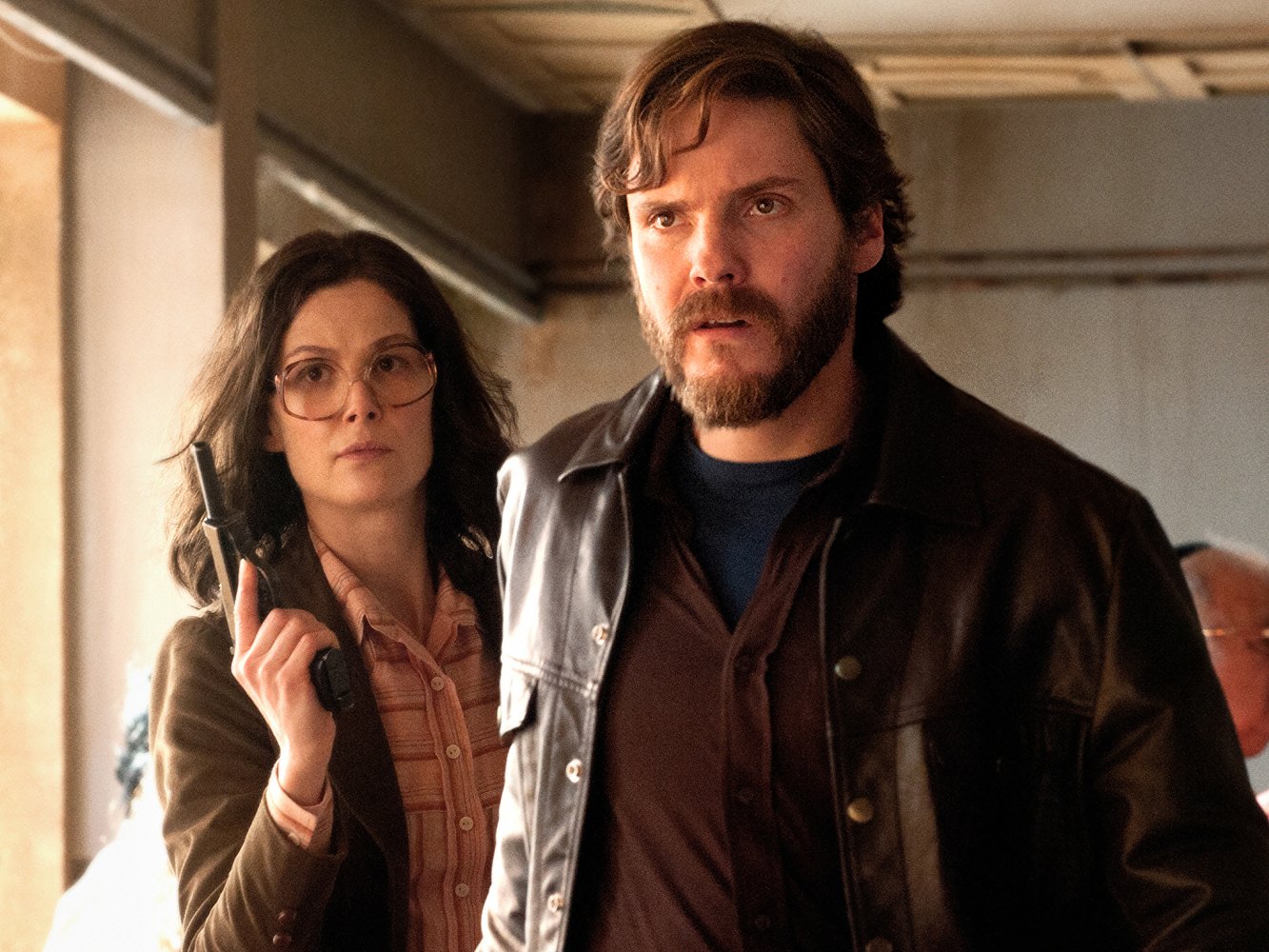
7 DAYS IN ENTEBBE (US/UK - 2018) Directed by Jose Padilha. Written by Gregory Burke. Cast: Daniel Bruhl, Rosamund Pike, Eddie Marsan, Denis Menochet, Lior Ashkenazi, Ben Schnetzer, Brontis Jodorowsky, Nonso Anozie, Mark Ivanir, Angel Bonnani, Peter Sullivan, Andrea Deck, Natalie Stone, Vincent Riotta, Trudy Weiss. (PG-13, 107 mins) Operation Thunderbolt, the Israel Defense Forces' successful July 4, 1976 raid of Entebbe Airport in Uganda to rescue hostages being held by the far left German Revolutionary Cells and the Popular Front for the Liberation of Palestine stands as one of the most daring military missions in history. It immediately spawned two competing, hastily-shot, all-star TV-movie "events" with ABC's VICTORY AT ENTEBBE (with Anthony Hopkins, Kirk Douglas, Burt Lancaster, Richard Dreyfuss, Helmut Berger, Linda Blair, and Elizabeth Taylor among others) airing just five months later in December, quickly followed by NBC's RAID ON ENTEBBE (headlined by Charles Bronson, Yaphet Kotto, Martin Balsam, Horst Bucholz, John Saxon, and Peter Finch in his last film) in early January 1977. Future Cannon heads Menaham Golan and Yoram Globus even got into the act, with the Golan-directed Israeli production OPERATION THUNDERBOLT (with Klaus Kinski and Sybil Danning as the hijackers) hitting theaters in January 1977. The Entebbe raid is also touched upon in other films, like THE LAST KING OF SCOTLAND and the epic CARLOS, and now, over 40 years later, 7 DAYS IN ENTEBBE is yet another take on the same subject.
On June 27, 1976, Germans Wilfried "Boni" Bose (Daniel Bruhl) and Brigitte Kuhlmann (Rosamund Pike), two members of Revolutionary Cells, board an Air France jet during a layover in Athens, en route from Tel Aviv to Paris. They and some accomplices commandeer the plane and force pilot Capt. Michel Bacos (Brontis Jodorowsky, best known as the little boy in his dad Alejandro's 1970 cult classic EL TOPO) and navigator Jacques Le Moine (Denis Menochet, looking like he's auditioning for THE NICK OFFERMAN STORY) to reroute to Benghazi, Libya to refuel en route to Entebbe, Uganda, where dictator Idi Amin (Nonso Anozie) has granted them an airstrip at Entebbe Airport. The pro-Palestine Bose and Kuhlmann are far-left ideologues, with Kuhlmann a protege of incarcerated and recently-deceased Red Army Faction leader Ulrike Meinhof, who was found hanged in her cell in what was deemed a suicide but many in German terrorist circles feel was a staged execution. Once the plane lands in Entebbe and Amin gives them passage, the days drag on and as the unstable Kuhlmann keeps popping amphetamines and Bose begins to resent that the Palestinian cohorts who were waiting for them at Entebbe--under the orders of PFLO leader Wadie Haddad--and begin to muscle the Germans aside and start separating the Israeli passengers, moving them to another room and threatening to begin killing them if Israeli Prime Minister Yitzhak Rabin (Lior Ashkenazi) doesn't release all of the Palestinian terrorists being held in Israeli prisons.
The most compelling parts of 7 DAYS IN ENTEBBE are the tense meetings with Rabin, the Israeli military, and testy Israeli Defense Minister Shimon Peres (a terrific performance by Eddie Marsan, sporting an amazing makeup job), and the debates over Israel's policy of never negotiating with terrorists (staunchly supported by Peres, who believes Rabin is deliberately stalling on a response in the hopes that he can just throw Peres under the bus). Less successful are the arcs of Bose and Kuhlmann. Pike can't do much with director Jose Padilha (ELITE SQUAD, NARCOS, and the ROBOCOP remake) and screenwriter Gregory Burke ('71) whittling her complex character--who blames herself for Meinhof's death--down to a stock "crazy bitch" act that culminates in a ridiculous scene where she calls her lover and pours her heart and her belief in the cause out to him in a long monologue on a pay phone that's not even functioning. The filmmakers don't give a pass to the Germans, but definitely want to engineer some sympathy for them as two idealistic young activists who get in way over their heads, though in one flashback scene, a Revolutionary Cells associate who's trying to talk them out of the hijacking does call Bose out as a bit of a poseur who likes to rant about oppression and the evils of capitalism while owning a small but financially successful publishing company ("You're not oppressed! You're a capitalist!" the guy yells). During the real seven days at Entebbe, Bose apparently did express some concern over the optics of being a German in a hostage situation where Israelis were being threatened with execution, but 7 DAYS IN ENTEBBE almost seems like it wants to absolve him of any wrongdoing. If Bose (and, to an extent Kuhlmann, who starts to realize they screwed up when she runs out of pills and is able to clear her head a little) really felt this way as the situation escalated way beyond the statement they wanted to make, it would hardly be the last time ideologically pure and stubbornly uncompromising far-left activists were duped into being the useful idiots that a powerful political organization requires to roll out a far more insidious plan.
For about 85 of its 107 minutes, 7 DAYS IN ENTEBBE is a generally involving hostage/political thriller despite some occasional tap-dancing around certain issues and the puzzling omission of key details, like the whole situation with elderly hostage Dora Bloch (briefly seen in a couple of scenes and played by Trudy Weiss), her disappearance during the ordeal and how her Amin-ordered execution is never even addressed. But in the home stretch, as the raid is underway (one of the commanders, and the only Israeli military officer killed during Operation Thunderbolt, was Yonatan Netanyahu--played here by Angel Bonnani--the older brother of current PM Benjamin Netanyahu), Padilha completely shits the bed by intercutting it with some footage of Israel's Batsheva Dance Company. One of the soldiers (Ben Schnetzer) is called to duty and will miss the opening night performance of his dancer girlfriend (Andrea Deck). We see the dance outfit practicing throughout and Operation Thunderbolt is intercut with their performance, with the girlfriend repeatedly falling flat on her face time and again. It's a mystery whether that's a metaphor for something happening with the raid or for Padilha himself, but it completely drains the suspense from what should be the key sequence in the film. Even the closing credits play over some dance routine with a male dancer contorting throughout the frame while a female dancer runs in place in the background. It's one of the all-time climactic derailments of what was an otherwise decent movie up to that point. Sure, it was sort-of an acceptably second-string MUNICH but Padilha's bizarre decision to turn it into what looks like snippets of a justifiably abandoned production of "Bob Fosse's ENTEBBE!" is thus far the head-scratcher of the year for 2018 moviegoing. Sure, the out-of-nowhere violent sex scene near the end of MUNICH was jarring, but it didn't instantly turn the film into a hot mess.
MARK FELT: THE MAN WHO BROUGHT DOWN THE WHITE HOUSE (US/UK - 2017)
A middling biopic that goes into the Watergate saga from the POV of the whistleblower, the cumbersomely-titled MARK FELT: THE MAN WHO BROUGHT DOWN THE WHITE HOUSE focuses on the veteran FBI company man who, 30-plus years later, admitted that he was the informant known as "Deep Throat," who regularly fed information to Washington Post reporter Bob Woodward. These provided some of the most memorable scenes in the 1976 classic ALL THE PRESIDENT'S MEN, with Hal Holbrook as Deep Throat, but MARK FELT goes into what drove him to secretly talk to the press. Felt (1913-2008) is played by an excellent Liam Neeson, and as the film opens in 1972, J. Edgar Hoover has just died and Felt is generally considered by D.C. insiders as a lock to take over as director. The job goes to former deputy Attorney General L. Patrick Gray (Marton Csokas as Russell Crowe), a Nixon loyalist who also brings back disgraced agent Bill Sullivan (a twitchy and overly mannered Tom Sizemore), a longtime rival of Felt's. After the Watergate break-in, Felt leads the FBI investigation but is quickly shut down by Gray, who insists on reporting all of their findings to White House counsel John Dean (Michael C. Hall) over Felt's objections that the FBI doesn't work for the President. A frustrated Felt begins feeding info of a cover-up to Time reporter Sandy Smith (Bruce Greenwood) and eventually Bob Woodward (Julian Morris)at the Post as Gray and Dean desperately try to find the source of the leaks and protect the Oval Office.
Produced by Ridley Scott, MARK FELT was released in September 2017, just after President Donald Trump fired FBI director James Comey over concerns of "loyalty" and stopping an investigation into Russian meddling in the 2016 presidential election. There's some unintended contemporary parallels with the FBI side of the story in MARK FELT and the Oval Office's misunderstanding of the limits of its power and who answers to it, and for a while, as Felt keeps digging for info and keeps being stonewalled by his own boss--this is as much about Felt butting heads with Gray as it is about Watergate--it's a compelling flip side to events seen in ALL THE PRESIDENT'S MEN. But as the film goes on, writer/director Peter Landesman (who also wrote the underrated and little-seen KILL THE MESSENGER) loses focus. Felt's decision to become a whistleblower seems initially rooted in his bitterness at being passed over as director after 30 years of doing and saying all the right things, but as he uncovers more evidence that leads directly to Nixon's inner circle, he refuses to play along and be the good soldier that Gray expects. This sort of thing plays to Neeson's strengths, and he turns in one of his best serious performances of the non-TAKEN variety in a long time. The large cast of supporting actors (there's also Josh Lucas, Brian d'Arcy James, Eddie Marsan, Tony Goldwyn, Noah Wyle, Ike Barinholtz, Kate Walsh, and Wendi McLendon-Covey) exists primarily to dump reams of exposition, exclaim cliches ("What you're doing...will bring down the whole house of cards!"), and stare suspiciously at one another as paranoia mounts. To the film's credit, it doesn't ignore Felt's post-Watergate conviction for illegal wiretapping of the Weather Underground and other activist groups and his subsequent pardon by Ronald Reagan in 1981, but it's included almost as an afterthought and it doesn't go deep enough into his reasoning for the overzealous surveillance of those groups: his daughter Joan (Maika Monroe) ran away and joined a commune and he was trying to find her while at the same time hoping to shield her from any prosecution for things she might've done as part of these activist groups. The entire subplot about Felt's home life is botched, leaving Diane Lane with almost nothing to do but complain and guzzle wine as Felt's neglected, long-suffering wife Audrey (who would commit suicide in 1984). Both Neeson and Landesman have expressed regret that most of Lane's performance ended up being cut from the film for time reasons, but really, the whole second half of MARK FELT collapses into total incoherence and starts demonstrating all of the tell-tale signs of a movie that's been hacked to pieces in post-production (Felt is shown meeting with Woodward just one time). At 103 minutes, MARK FELT is curiously short for this kind of sweeping historical saga, almost as if Landesman was told to ditch everything that didn't involve Watergate. Sony had no idea what to do with this, even with a big name like Neeson headlining: this only made it to 332 screens at its widest release, grossing just $768,000. (PG-13, 103 mins)
LAST RAMPAGE: THE ESCAPE OF GARY TISON
(US - 2017)
A refreshingly old-fashioned B-movie of the sort that would've played drive-ins back in 1980, the true crime saga LAST RAMPAGE: THE ESCAPE OF GARY TISON deals with a prison break and subsequent statewide manhunt that took place in Arizona in July and August of 1978. The film is a gritty labor of love for veteran character actor Robert Patrick, who produced and stars as Tison, a convicted murderer and tyrannical father who lords over his three devoted sons Donnie (Alex MacNicoll), Ricky (Skyy Moore), and Ray (Casey Thomas Brown). It's his sons who help pull off the escape during a visit, with Tison's psycho prison buddy Randy Greenawalt (Chris Browning) tagging along. Weary Sheriff Cooper (Bruce Davison) leads the manhunt and, of course, it's personal since Tison killed one of his close friends, while an ambitious reporter (Molly C. Quinn) tries to get a story out of Tison's devoutly dutiful wife Dorothy (Heather Graham). Tison is a brutal, ruthless sociopath with no capacity for mercy. He's not above shotgunning a newlywed couple or a toddler if it means saving his ass, and he doesn't hesitate to point a gun at Donnie's head when the eldest son starts thinking for himself, questioning his actions and refusing to call him "sir."
LAST RAMPAGE was directed by career journeyman Dwight Little, who made his name in the horror genre back in the day with 1988's HALLOWEEN 4: THE RETURN OF MICHAEL MYERS and 1989's THE PHANTOM OF THE OPERA with Robert Englund. Since then, he's gone wherever his services have been required, from the 1991 Steven Seagal vehicle MARKED FOR DEATH, the 1992 Brandon Lee actioner RAPID FIRE, 1995's FREE WILLY 2, and 1997's MURDER AT 1600. Little's spent most of the last 20 years as a busy TV director, and LAST RAMPAGE is his first feature film since the $30 million video game adaptation TEKKEN went straight to DVD in 2011. Little doesn't bring any real sense of style to LAST RAMPAGE, but he keeps it fast-moving and focused, like a professional B-movie hired gun knows how to do. Patrick is terrifying and oozes pure evil as the monstrous Tison, and Davison has some nice moments as the folksy, matter-of-fact Cooper, even if the character seems to be a composite of Tommy Lee Jones in NO COUNTRY FOR OLD MEN and Jeff Bridges in HELL OR HIGH WATER. The film fails to take advantage of the unusual casting of Graham, and the scenes between the subtly manipulative Dorothy and the naive young reporter don't really seem to go anywhere. Dorothy is a woman who's convinced herself of many things, and Graham seems eager to disappear into a dowdy, unglamorous role with some truly hideous 1978 eyeglass frames, but the script, written by Alvaro Rodriguez (Robert Rodriguez's cousin) doesn't really give her much to do. The supporting cast also includes Megan Gallagher as Cooper's wife, Jason James Richter (the kid from FREE WILLY) as a deputy, and the late John Heard in one of his last roles (he died two months before the film's VOD release) as the useless warden. The Tison story was told once before, albeit in a more sanitized fashion, in the 1983 ABC TV-movie A KILLER IN THE FAMILY, which starred Robert Mitchum as Tison, with his three sons played by Lance Kerwin (SALEM'S LOT), and a young and unknown Eric Stoltz and James Spader. (R, 93 mins)
A somewhat low-key take on THE PROFESSIONAL and THE TRANSPORTER, THE HUNTER'S PRAYER only managed a stealth VOD burial in June 2017 after over two years on the shelf. There's nothing original or inventive about it, but it's a perfectly acceptable time-killing chase thriller that's executed reasonably well in the capable hands of the long-absent Jonathan Mostow (BREAKDOWN, U-571), directing his first film since the 2009 Bruce Willis sci-fi dud SURROGATES. Mostow stepped in after journeyman Philip Noyce (PATRIOT GAMES, THE BONE COLLECTOR) bailed during pre-production, and had his TERMINATOR 3 and SURROGATES writing team of John Brancato & Michael Ferris (THE GAME) rework the script after Paul Leydon (THE FACTORY) and Oren Moverman (THE MESSENGER) took cracks at adapting Kevin Wignall's 2004 novel For the Dogs. Sam Worthington (also one of 24 credited producers) is Lucas, a junkie hit man in the employ of shady UK financial titan Addison (DOWNTON ABBEY's Allen Leech). Another assassin, Metzger (RED ROAD's Martin Compston) has been sent to New York to whack the family of Martin Hatto (Eben Young), an associate who embezzled funds from Addison's company and is about to expose his illegal dealings to the FBI and Interpol. Lucas' assignment is to kill Hatto's teenage daughter Ella (THE GIVER's Odeya Rush), who's enrolled in posh boarding school in Switzerland. Haunted by PTSD from his military days in Fallujah, and now a hopeless drug addict with a young daughter he's never met, Lucas has a change of heart and decides to become Ella's protector as Addison sends Metzger and corrupt FBI flunky Banks (TRANSPARENT's Amy Landecker) to pursue the pair through Europe.
There's also a less technological BOURNE element (sorry, no "crisis suites" or Addison flunkies staring at a row of monitors and shouting "There he is! It's Lucas!") to the tireless pursuit of Lucas and Ella, and while it's not exactly a high-energy action thriller, Mostow keeps THE HUNTER'S PRAYER reasonably well-paced and entertaining. Almost everything is telegraphed in advance and easy to see coming unless you've never seen a movie before: the moment Lucas says he's never met his daughter, we know he's meeting her by the end. Likewise, the moment Lucas shows Ella how to load and fire a gun, we know she'll be the one to ultimately take out Addison during the inevitable showdown in the murky catacombs underneath his castle-like fortress. And of course, the moment Lucas and Ella begin to bond, we know he'll realize he has a reason to live and she'll care for him when he quits the needle cold turkey and goes through his FRENCH CONNECTION II-inspired withdrawal. Worthington, who's been taking on more character roles in films like EVEREST and HACKSAW RIDGE after years of Hollywood trying to make him a thing following AVATAR and CLASH OF THE TITANS (where Liam Neeson managed to upstage him and the entire cast with one perfect line), does a credible job in a role that feels like it was written with Jason Statham in mind. There's nothing here to get really excited about it--it is what it is, but if you're looking for a fairly diverting chase thriller with no thinking required, you can do a lot worse than THE HUNTER'S PRAYER. (R, 91 mins)
THE EXCEPTION (Germany/US/Switzerland/Belgium - 2017)
The kind of prestige period drama that probably would've starred Keira Knightley and James McAvoy a decade ago and gotten at least seven Oscar nominations, THE EXCEPTION instead was given a limited release and a DirecTV dumping by A24 and will be a complete non-factor come awards season. Based on the 2003 novel The Kaiser's Last Kiss by Alan Judd, THE EXCEPTION is a fictionalized look at events in the last year of the life of Germany's abdicated Kaiser Wilhelm II, played here by the always magnificent Christopher Plummer. Set in 1940 at Wilhelm's palace in Utrecht, where he's been in exile since 1918, the film centers on Nazi Capt. Stefan Brandt (Jai Courtney), a disgraced officer given the duty of heading to the Netherlands to lead security for the Kaiser, who serves no current political purpose but is still viewed as a figure of great symbolic importance to Hitler's Germany. Brandt's real assignment--and his shot at redemption after standing up to a brutal senior officer who took way too much joy in mowing down some Jewish children--is to determine if the Dutch Resistance has planted a spy among the Kaiser's housekeeping staff. Of course, Brandt makes the job difficult by having a torrid, borderline NIGHT PORTER-ish fling with Mieke (BABY DRIVER's Lily James), one of the Kaiser's maids and a secret Jew. Brandt is a Nazi with a conscience, and Mieke being Jewish doesn't really bother him, but what he doesn't know and what any seasoned moviegoer will immediately figure out is that Mieke is the spy. She's working for Winston Churchill and the British government, there to observe any possible interaction between the Kaiser and high-ranking Nazi officials. Of course, it gets personal once she has a chance to avenge the murder of her Jewish parents when the Kaiser is visited by Heinrich Himmler (Eddie Marsan). A conflicted Brandt is torn between his duty to Germany and his love for Mieke, and their forbidden affair is encouraged by the Kaiser who, in the context of this film, is shown demonstrating some mildly anti-Semitic sentiments but nothing of the level of the monstrous Himmler, which isn't really historically accurate--in real life, the Kaiser's papers written as late as 1940 reveal a still very virulent anti-Semite. In the fictionalized, romance novel world of THE EXCEPTION, the Kaiser is reduced to playing a wizened, wily matchmaker who inspires these two crazy kids to set aside the whole "Germans hate the Jews" thing and maybe they can make it after all. And we know they will, because Brandt ultimately chooses good over evil when he embraces Mieke, looks her in the eye, and proclaims "I've found something else to fight for." Maybe they should've fought for a better script.
THE EXCEPTION looks lavish enough but is hokey and insultingly simplistic throughout, with Brandt's cliched character (he's not the rule, he's "the exception," get it?) never registering thanks to the utterly blank Courtney (A GOOD DAY TO DIE HARD, TERMINATOR: GENISYS, SUICIDE SQUAD), who's never going to be a star no matter how many times the movie industry tries to make him happen. He's completely miscast and entirely too present-day, Magic Mike buff to be a Nazi captain in 1940 (I'd suggest picturing Channing Tatum in this role, but Tatum is smart enough to know his limitations). Courtney sucks the energy out of scene after scene with his monotone delivery and blank stare, barely able to hold his own in scenes with James and Janet McTeer as the Kaiser's wife. Tony Award-winning stage director David Leveaux, making his big-screen directing debut, does Courtney a further disservice by giving Brandt a bunch of scenes with the Kaiser. And rest assured, nothing spotlights a mediocre leading man's shortcomings like having him spend significant chunks of screen time opposite Christopher Plummer, an 87-year-old living legend who's got more star power in his bowel movements than Courtney's been capable of mustering over his entire career. Some hyped actors that Hollywood insists on making a thing end up maturing into first-rate actors--Matthew McConaughey and Colin Farrell come to mind--so there's a chance Courtney might get better as he gets older. I don't mean to be a dick and dog Courtney so hard. He's probably a nice guy. But he's just...not good. And neither is THE EXCEPTION. (R, 107 mins)
ATOMIC BLONDE (US - 2017) Directed by David Leitch. Written by Kurt Johnstad. Cast: Charlize Theron, James McAvoy, John Goodman, Toby Jones, Eddie Marsan, Til Schweiger, James Faulkner, Sofia Boutella, Bill Skarsgard, Roland Moller, Barbara Sukowa, Johannes Hauker Johannessen, Sam Hargrave, Lili Gessler, Sara Natasa Szonda. (R, 115 mins) A Cold War espionage actioner that's an endlessly stylish exercise in retro late '80s cool, ATOMIC BLONDE is adapted from the 2012 graphic novel The Coldest City and it's a vehicle custom-engineered for Charlize Theron. Set in the final days before the fall of the Berlin Wall in 1989, ATOMIC BLONDE has several extended action sequences that are stunning on their own, playing out in long and seemingly single-cut fashion that was new and exciting back in 2006 with CHILDREN OF MEN. But these sorts of set pieces--yes, blood hits the camera--have been done many times since, and the illusion loses a little something when one has seen enough of them to spot the editors' trickery and see exactly where the cuts are. That doesn't mean they aren't brilliantly choreographed and convincingly done--Theron is a force of nature when she's kicking ass--but the style in which they're executed by director David Leitch, making his "official" debut as a director even though he co-directed JOHN WICK as a team with Chad Stahelski but had to go uncredited due to a snafu with the DGA, sticks out as too present-day amidst the almost obsessive, TINKER TAILOR SOLDIER SPY-level attention to period detail. ATOMIC BLONDE's interior production design and location work in Budapest and Berlin nails that pervasive sense of gloom and gray that screams "John Le Carre," along with some '80s tunes that are used very effectively--Theron strutting through a West Berlin bar drenched in red neon to the tune of After the Fire's "Der Kommissar" is just perfect--but the two distinct aesthetics never quite coalesce.
A framing device has MI-6 agent Lorraine Broughton (Theron) being debriefed by her boss Eric Gray (Toby Jones), who's accompanied by CIA agent Kurzfeld (John Goodman) as all are watched from behind the glass by MI-6 chief "C" (James Faulkner). Broughton was assigned to West Berlin to retrieve a list conveniently termed "The List," which named all British operatives deployed to the Soviet Union and fell into the KGB's hands after Broughton's fellow agent and lover James Gasciogne (Sam Hargrave) was murdered. The List was given to Gasciogne by a meek East German Stasi officer known as "Spyglass" (Eddie Marsan) who was working with agents from the west and hoping to use it as leverage to defect with his wife and daughter. Broughton was set to meet MI-6 agent David Percival (James McAvoy) in West Berlin, but as she explains, "I was made before my feet hit the ground." She's abducted by KGB goons and manages to kill them before finally meeting Percival, a loose cannon who's completely undercover in the Berlin underground, selling stolen merchandise with his specialty being the hugely-popular-in-the-East Jordache jeans. Broughton has several irons in the fire on her assignment: she must retrieve The List, deal with cowboy Percival, work on a plan to get Spyglass into West Berlin, and figure out the identity of "Satchel," a double agent who's working for MI-6 but providing intel to the KGB. She also finds time for a torrid fling with novice French agent Delphine Lasalle (THE MUMMY's Sofia Boutella) and endures constant bruising and battering but always emerging victorious in some truly nasty and brutal fight scenes.
I realize mileage may vary for some and ATOMIC BLONDE isn't supposed to be the second coming of THE SPY WHO CAME IN FROM THE COLD, but it's is so hypnotically captivating in its non-action sequences that, for me, the spell was broken and I was taken out of the film somewhat with the CGI-abetted action sequences and digital splatter started taking over. This is in no way a deal-breaker and most likely won't even be an issue on a second viewing, but I'm a sucker for gray, overcast, and dreary espionage and that, coupled with some striking locations and imaginative ideas like staging a brawl between Broughton and some Russian spies at a packed screening of Andrei Tarkovsky's STALKER, is enough to make hardcore cinephiles giddy. Leitch uses period pop music brilliantly, and whether it's a violent, bonebreaking fight scene set to George Michael's "Father Figure" (that's right up there with the "Ordinary World" beatdown in LAYER CAKE) or KGB operative Bakhtin (Johannes Hauker Johanessen) beating a breakdancing Berlin kid to death to the tune of Nena's "99 Luftballoons," the music choices are spot-on. That's something a lot of these present-day Cold War period pieces nail perfectly, whether it's Julio Iglesias' "La Mer" for the montage at the end of TINKER TAILOR SOLDIER SPY or Joe Jackson's "Stepping Out" and Pink Floyd's "Run Like Hell" in 2009's little-seen FAREWELL, and both FAREWELL and ATOMIC BLONDE prominently feature Queen and David Bowie's "Under Pressure."
But this is really The Charlize Theron Show first and foremost, and the Oscar-winning actress got a serious boost among action fans for her work as Imperator Furiosa in MAD MAX: FURY ROAD and she continued on that new career path with THE FATE OF THE FURIOUS and now ATOMIC BLONDE. She's nothing short of perfect here, and Theron kicking ass manages to supersede any issues I may have with the more modern style of the action and visual effects techniques breaking the spell the filmmakers cast as they so vividly capture the look and feel of the final days and hours before the fall of the Berlin Wall. They even go out of their way to make the it look like it was made in 1989, complete with old-fashioned and slightly blurry subtitles and location work in Budapest and some parts of Berlin that have remained largely unchanged over the last 30 years. It's in these scenes that ATOMIC BLONDE looks so convincing that you'd swear it's what might've happened if Wim Wenders followed 1987's WINGS OF DESIRE with a mainstream spy movie. ATOMIC BLONDE also gets bonus points for providing a small role for Rainer Werner Fassbinder regular Barbara Sukowa, further establishing its old-school bona fides.
The feature writing/directing debut of MAD MEN co-star John Slattery is an indie labor of love, based on a 1983 novel by then-Philadelphia Daily News columnist Pete Dexter, inspired by South Philly's Schuylkill neighborhood, known back in the day as "Devil's Pocket." In 1981, Dexter was badly beaten outside a bar by some Devil's Pocket locals who took umbrage with a column he wrote, and that incident is worked into GOD'S POCKET, a well-meaning but slight and flimsy slice-of-life saga that got a middling reaction from Sundance audiences and probably wouldn't have received any post-festival attention at all were it not for the unexpected passing of star Philip Seymour Hoffman in February, just three weeks after he was in Park City promoting it and A MOST WANTED MAN. GOD'S POCKET was commercially released before A MOST WANTED MAN but shot after, making it notable as the last film Hoffman completed before his death (he was nearly finished with his work on the next two simultaneously-shot HUNGER GAMES installments and will still be in both, due out in December 2014 and December 2015). But beyond that and being able to see the great actor in one of his final performances, GOD'S POCKET is pretty forgettable, the kind of film that usually gets accolades at festivals and is never mentioned again. But even the Sundance crowd didn't get that enthused about it. It's not a bad movie by any stretch, but it's rather aimless and has no real purpose. There's some interesting moments, Slattery and co-producer Hoffman were old friends (and they had a great scene together in 2007's CHARLIE WILSON'S WAR), and Slattery also brought along his MAD MEN co-star Christina Hendricks, but GOD'S POCKET is a film where the actors are having more fun than the audience. One is reminded of the old Gene Siskel quote where he would ask "Is this movie more interesting than the same group of actors having lunch?" No, not really. Watching Slattery, Hoffman, Hendricks, John Turturro, Eddie Marsan, and Richard Jenkins bullshit over pizza and beers would be a far more interesting experience than the bland GOD'S POCKET.
One thing Slattery does right is expressing the period detail in a matter-of-fact fashion without beating you over the head with it. It takes place in the late '70s and he doesn't swamp you with disco hits of the era to make sure you realize that. Of course, a tired, late-film montage to Blind Faith's "Can't Find My Way Home" negates that, but still, the effort is appreciated. God's Pocket is the kind of proud, blue collar enclave where, if you aren't from there, you'll never belong. Mickey Scarpato (Hoffman) is such a guy. A meat salesman and very small-time criminal, Mickey is married to Jeanie (Hendricks), a cop's widow whose son Leon (Caleb Landry Jones of ANTIVIRAL) is killed at a construction site after mouthing off and hurling racial slurs at an elderly black worker. The workers all claim that he hit his head in an accident, but Jeanie isn't buying it and tells Mickey to dig further. But Mickey's preoccupied with paying for Leon's funeral, and he's stuck dealing with price-gouging funeral home owner Smilin' Jack Moran (Marsan), as well as trying to sell his refrigerated truck, which gets stolen while Leon's body--tossed out of Smilin' Jack's funeral home when Mickey couldn't pay the bill--is in the back of it. There's some fleeting moments where some dark humor earns the film some points, and things pick up considerably whenever Hoffman and Turturro (as his gambling-debt-saddled, bad-luck pal) are onscreen together, but too much of GOD'S POCKET just rambles along with no particular place to go, especially the subplot about an alcoholic newspaper columnist (Jenkins) ostensibly trying to dig for the details of Leon's death but really trying to get Jeanie into bed. The film's time element is also badly-handled, with it supposedly taking place over three days, but with entirely too much happening in that small window of time. While it was always a privilege to see Hoffman at work, this won't go down as one of his more memorable films or standout performances. (R, 89 mins)
BORGMAN (Netherlands/France/Belgium/Denmark - 2013; US release 2014)
Dutch actor/filmmaker Alex van Warmerdam's BORGMAN is loosely inspired by Jean Renoir's 1932 film BOUDU SAVED FROM DROWNING, itself remade by Paul Mazursky in 1986 as DOWN AND OUT IN BEVERLY HILLS. BORGMAN takes the concept to a misanthropic extreme as the title character (Jan Bijvoet) has far more sinister, yet still vague, plans in store for the bourgeois family whose home he insidiously infiltrates. As the film opens, Borgman and several mysterious vagrants are being pursued from a small town by a group of men--including a priest--hoisting shotguns and axes. Borgman, sporting long, unkempt hair and a madman beard, is separated from his cohorts and ends up at the front door of Richard (Jeroen Perceval) and his wife Marina (Hadewych Minis). Borgman insinuates that he knows Marina, which is enough to set Richard off as he beats Borgman and accuses his wife of hiding something from him. Feeling sorry for who she believes to be a homeless unfortunate, Marina permits Borgman to bathe when Richard leaves for work, and allows him to stay in the guest house for a day or two if he stays out of sight. Of course, Borgman enters the house and interacts with the children (who call him a "magician") and the family's disgruntled nanny Stine (Sara Hjort Ditlevsen). Borgman seemingly casts a spell on all of them and phones his cohorts (van Warmerdam among them), who arrive and begin systematically murdering people associated with the family--the gardener, the doctor, anyone who may visit the house--putting their heads in cement and dumping the bodies at the bottom of a nearby lake so they can assume their identities and get on the property. Borgman leaves but returns, clean-shaven, well-groomed, and recognized only by Marina, as Richard hires him to take on the suddenly vacated gardener position. Borgman brings his associates along with him as they move in and slowly take over the household, already on shaky ground with unspoken tension between Richard and Marina. This tension is only magnified with the presence of Borgman, who crouches nude over Marina while she sleeps and somehow influences her dreams with imagery that violently turns her against her husband.
BORGMAN had some interesting potential, but it's heavy-handed and painfully obvious in its soapbox statement-making. Before Borgman inserts himself into their lives, Marina complains of feeling "a warmth that intoxicates but also confuses," all but spelling out that she'll be sexually drawn to Borgman and doing so in ways that no normal person would convey. Van Warmerdam also makes some ham-fisted points about class struggles, as Marina feels overwhelming guilt about their affluence and good fortune, with Borgman representing punishment for their success and upper-class privilege. Marina is also tone-deaf to her hypocrisy, secretly allowing Borgman on the premises early on while later chastising Stine, who politely requests that her on-leave-from-the-military boyfriend be allowed to stay overnight, with a firm "No...I've got to know who I've got under my roof." Bijvoet is OK as Borgman, but the more the film goes on, the more obscure his motives become and he's more or less just part of the scenery while the family--slowly being poisoned literally and figuratively--disintegrates around him. BORGMAN is essentially the Renoir and Mazursky films revamped through a Michael Haneke filter. We've been down this road before with Haneke's 1997 and 2008 versions of FUNNY GAMES and Yorgos Lanthimos' DOGTOOTH (2009), and the tedious BORGMAN brings little new to the table other than tame transgression and a ponderous sense of self-importance. (Unrated, 113 mins)
FILTH (Germany/US/UK/Sweden/Belgium - 2013; US release 2014) Written and directed by Jon S. Baird. Cast: James McAvoy, Jamie Bell, Eddie Marsan, Imogen Poots, Jim Broadbent, Joanne Froggatt, Shauna Macdonald, Shirley Henderson, John Sessions, Gary Lewis, Brian McCardie, Emun Elliott, Martin Compston, Kate Dickie, Iain De Caestecker, Joy McAvoy, Pollyanna McIntosh, Bobby Rainsbury. (R, 98 mins)
This grotesque adaptation of Irvine Welsh's 1998 novel suffers from the same problem that plagued the last movie based on a Welsh work, the little-seen Canadian film ECSTASY (2012). While FILTH doesn't have Canadian actors attempting to tackle Scottish accents and losing spectacularly, it does share with ECSTASY a sense that it's been kept in storage for 15 years and is only now being released. It seems inevitable that every film version of Welsh's work will look and feel like Danny Boyle's landmark TRAINSPOTTING (1996), but in the hands of a director with vision like, say, a David Cronenberg or a Terry Gilliam, FILTH's parade of filth could've had some unique gonzo artistry that would've made its own mark outside of the dated world of TRAINSPOTTING knockoffs. Instead, it's the work of writer/director Jon S. Baird, who has one other feature under his belt (the obscure 2008 crime drama CASS), with his only other credit of note being an associate producer on the 2005 cult film GREEN STREET HOOLIGANS. Baird is obviously a fan of Boyle and probably saw FILTH as a way to pay homage to both him and Welsh, but it's all so familiar and formulaic at this point. Baird's FILTH only makes fleeting mention of a key element of Welsh's novel: the tapeworm that's inside the protagonist's body and, as it grows and spawns, it starts narrating its own chapters. The elimination of that "character"--something with which a hypothetical Cronenberg or Gilliam would've had a blast--leaves Baird with little to do other than fashion FILTH as BAD LIEUTENANT with a Scottish burr.
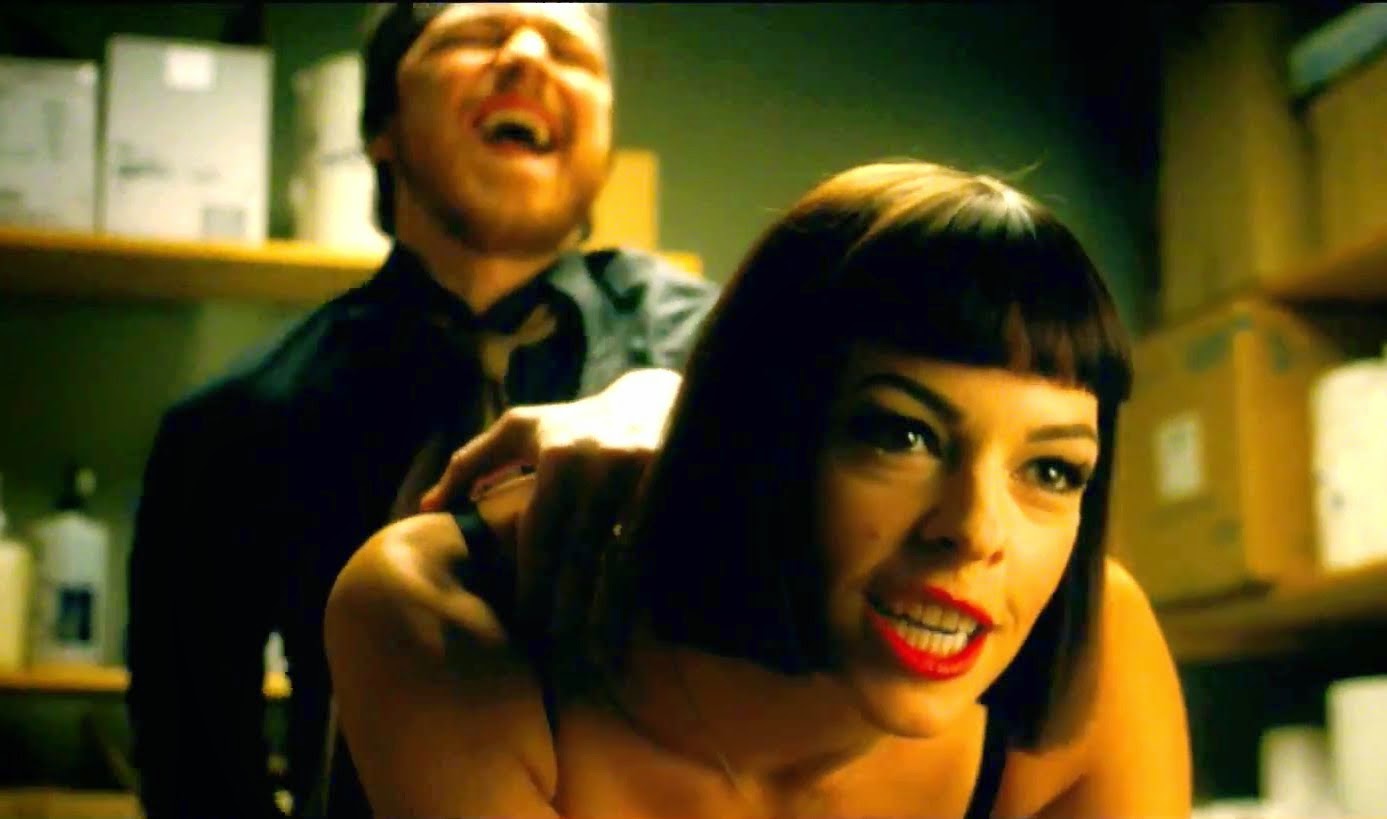
Det. Sgt. Bruce Robertson (James McAvoy), is an Edinburgh cop obsessed with discrediting the colleagues in line for the promotion he wants for himself. Robertson is a sociopath, a misanthrope, an alcoholic, a junkie, a thief, and a sex addict. He's corrupt and amoral, and his sickness has spread to his impressionable young partner Lennox (Jamie Bell), as the two routinely go on coke-and-hooker binges. While Lennox is questioning an 18-year-old man for engaging in unlawful sexual conduct with his under-the-age-of-consent 15-year-old girlfriend, Robertson is in the next room getting a blowjob from said underage girl in exchange for not telling her dad what she's been doing. Robertson is supposed to be investigating the murder of a Japanese tourist with Lennox and the ambitious Dunning (Imogen Poots), but they end up doing the leg work as Robertson instead spreads rumors about other cops, steals balloons from little kids, engages in mutual erotic asphyxiation with the wife (Kate Dickie) of an irate cop (Brian McCardie), makes obscene phone calls to the wife (Shirley Henderson) of his nebbishy, dweeby lodge brother Bladesey (Eddie Marsan), from whom he steals money to buy drugs, and then drags away on an ostensible bicycling trip to Hamburg, where he visits brothels on his own after slipping Bladesey some roofies, leaving him stranded at a gay bar, and forcing him to squint his way through the rest of the trip after stealing his incredibly thick-lensed eyeglasses, and throwing them in a river between periodic hallucinations with a mocking shrink (Jim Broadbent). Robertson is a bad guy---he's also bipolar and off his meds--and in his more introspective moments, pines for the wife (Shauna Macdonald) who left him, but some semblance of good exists deep within him when he tries to save a dying man on a busy street while everyone else stands around helplessly. The man's widow (Joanne Froggatt) sees he's a troubled soul but instead of letting her in, resorts to his maniacally excessive ways.
There's no denying McAvoy throws himself into the role much like Harvey Keitel and Nicolas Cage did in each of their interpretations of BAD LIEUTENANT. But FILTH the movie is a dumbed-down version of Filth the book and plays like stale retread of BAD LIEUTENANT filtered through TRAINSPOTTING. It doesn't even keep Welsh's very INVESTIGATION OF A CITIZEN ABOVE SUSPICION-esque ending. It's shot in very much the same style, and you can almost see Ewan McGregor as Robertson if this was made a decade and a half ago. Many of Welsh's novels take place in the same universe with recurring characters popping up throughout (for example: Begbie, played by Robert Carlyle in TRAINSPOTTING, is mentioned several times throughout Filth), and on the page, it's part of an ever-expanding, self-referential universe. On the screen, it just comes across as repetitive and uninspired. Welsh is one of the film's 34 (!) credited producers and obviously signed off on it (which, much like most authors selling book rights, probably involved getting paid and then had nothing else to do with it), but the alterations made to the story are to its detriment. Yes, film is a different medium, but Baird just seems interested in the most transgressive elements of Welsh's story with little concern for other things that were going on. An ambitious adaptation of Filth would've explored more than Robertson's over-the-top histrionics. I'm probably making FILTH sound like a bad movie. It's an OK film, moderately entertaining and never dull (and there is one admittedly brilliant use of David Soul's "Silver Lady"), but it never really tries, either. If shock value is all Baird was after, why didn't he just remake BAD LIEUTENANT? Why bother adapting Welsh's book if you're just going to toss its most unique elements?