IT: CHAPTER TWO (US - 2019) Directed by Andy Muschietti. Written by Gary Dauberman. Cast: Jessica Chastain, James McAvoy, Bill Hader, Bill Skarsgard, Isaiah Mustafa, Jay Ryan, James Ransone, Andy Bean, Jaeden Martell, Wyatt Oleff, Jack Dylan Grazer, Finn Wolfhard, Sophia Lillis, Chosen Jacobs, Jeremy Ray Taylor, Teach Grant, Nicholas Hamilton, Javier Botet, Xavier Dolan, Jess Weixler, Taylor Frey, Molly Atkinson, Joan Gregson, Will Beinbrink, Stephen King, Peter Bogdanovich, Stephen Bogaert, Luke Roessler, Jackson Robert Scott, Ryan Kiera Armstrong, Joe Bostick, Megan Charpentier, Juno Rinaldi, Owen Teague, Jake Sim. (R, 169 mins) A blockbuster hit that currently stands as the highest-grossing horror film of all time (by present-day dollars and not by ticket sales or adjustment for inflation), 2017's IT, an adaptation of the first half of Stephen King's gargantuan 1986 novel, ushered in an era of renewed interest in the legendary author's work. This includes the Netflix films GERALD'S GAME and 1922, this year's remake of PET SEMATARY, this fall's DOCTOR SLEEP, a sequel to both King's novel The Shining and Stanley Kubrick's 1980 film version, which King has spent nearly 40 years criticizing, and several other announced film and TV projects in various states of development or production. Every generation has their genre touchstones, and IT--in many ways a hard-R GOONIES--has become a gateway film for impressionable young horror fans. Every generation's gateway is different, and just as aging purists who cut their teeth on Boris Karloff and Bela Lugosi dismissed the blood and guts horror that gained traction in the 1970s, it's easy to for us jaded cynics now in our 40s to take a shit all over whatever it is "the kids" are into and inevitably sound all Old Man Yells at Cloud. I liked IT--it didn't blow me away, but I can see where a 13-year-old might consider it a watershed moment that hopefully leads to further exploration. IT was entertaining but it relied heavily on the now-overused trope of "scary clowns" as well as the crutch of nostalgia, especially by updating the setting of the childhood section of the novel from 1958 to 1989. Of course this also meant recurring invocations of everything 1989, from BATMAN to LETHAL WEAPON 2 to A NIGHTMARE ON ELM STREET 5, and a running gag about New Kids on the Block. This retro fetishizing of everything '80s (all that's missing is a John Carpenter-esque synth score) is representative of the move in horror toward The Reference--the AMERICAN HORROR STORY/STRANGER THINGSification of the genre, if you will. And returning director Andy Muschietti and screenwriter Gary Dauberman push that even further in IT: CHAPTER TWO.
Running a bladder-challenging 169 minutes--a mere three minutes shorter than THE GODFATHER--IT: CHAPTER TWO is a disappointing sequel. With the first film's characters reconvening in 2016 after 27 years apart, the film is a success in terms of its effective casting choices and finding actors who, for the most part, strongly resemble the younger versions of their characters. When murders begin taking place in Derry 27 years after "It" was defeated, Mike Hanlon (Isaiah Mustafa), the town librarian and lone member of "The Losers" who never moved away, reaches out to his six childhood friends spread all across the country--Bill Denbrough (James McAvoy), a novelist and screenwriter with a habit of writing bad endings; Richie Tozier (Bill Hader), a popular but hacky stand-up comic who doesn't even write his own material; Eddie Kaspbrak (James Ransone), still a nervous hypochondriac who works insurance risk assessment and married a woman just like his mother (and played by the same actress, Molly Atkinson); Ben Hanscom (Jay Ryan), now an architect who lost all the weight that made him a target of incessant childhood bullying; Stanley Uris (Andy Bean), who grew up to be an accountant; and Beverly Marsh (Jessica Chastain), a successful fashion designer stuck in an abusive marriage. The reunion is one short when childhood memories come back to Stanley, who commits suicide rather than face the manifestation of It in Pennywise the clown (Bill Skarsgard). Those youthful traumas are only remembered by Mike, who informs the others that once you leave Derry, the memories slowly fade away. But with "It" rearing its ugly head again and the body count rising, the other Losers begin to remember. Through his research, Mike learns that the only way to defeat It is by performing "The Ritual of Chud," a Native American tribal rite that requires them to find one artifact from their childhood before venturing deep into It's lair underneath Derry.
The camaraderie of the young cast of IT--who also appear here in new scenes--was probably its most successful aspect aside from Skarsgard's wild performance as Pennywise. As in IT, the actor is too often replaced by herky-jerky CGI enhancement that almost makes his very presence pointless. IT: CHAPTER TWO, however, spends much of its length with the adult Losers on various solo quests to obtain their artifacts, during which time they have their own confrontations with the past and run-ins with It. There's also the grown-up bully Henry Bowers (Teach Grant), busted out of a mental institution by It in the form of the decayed corpse of his childhood partner-in-crime Patrick Hockstetter (Owen Teague); a little boy (Luke Roessler) who lives in Bill's childhood home and is a new target of It; and Ben's still-unrequited love for Beverly, and these are just some of the too many subplots that IT: CHAPTER TWO has to juggle while jettisoning key characters like Bill's movie star wife Audra (Jess Weixler) and Beverly's asshole husband Tom (Will Beinbrink), who are quickly introduced and never seen again, and still managing to find time for a jokey Stephen King cameo. The film seems long for the sake of being long, and certainly the interminable artifact quests, which constitute almost the entire second hour, could've been condensed or perhaps would've played better if this were made into the limited cable series that it often seems to be emulating, especially with the extended wrap-up that feels more like a series finale than the ending of a movie.
The MVP standout is Hader, whose grown-up Richie is given a new layer of characterization that could've easily come off as woke pandering but is brought to life with heartfelt empathy by the SNL vet, best known for his comedic skills but someone I can easily see morphing into a versatile dramatic actor of the Micheal Keaton variety. As it is, IT: CHAPTER TWO is the HOBBIT of Stephen King adaptations. For all its bloat and overlength despite dumping huge chunks of the novel, it's a story that could've easily been told in two hours, but its predecessor was such a success that Muschietti was likely given carte blanche to run as long as he wanted. It has its moments, but they're spread out over the nearly three-hour run time. Any experienced horror fans will see the jump scares coming a shot before they do since Muschietti's set-ups are all the same, and Pennywise's now-repetitive antics seemed much scarier when they were aimed at the childhood-era Losers (and nothing here even comes close to the terrifying slide projector scene in the first film). Plus, the endless referencing and shout-outs--to things like THE THING, ALIENS, THE SHINING, STAND BY ME, THE LOST BOYS, and even Hader is forced to utter a groaner in the form of DIE HARD's most iconic line in the final battle with Pennywise--just feels lazy. Right around the point when adult Eddie's frightful run-in with It in the dank, cavernous basement of the Derry pharmacy is punctuated by what might go down as the dumbest and most pointless needle-drop in film history in the form of Juice Newton's 1981 hit "Angel of the Morning," I was pretty much over this chapter of IT.
GLASS (US - 2019) Written and directed by M. Night Shyamalan. Cast: James McAvoy, Bruce Willis, Samuel L. Jackson, Sarah Paulson, Anya Taylor-Joy, Spencer Treat Clark, Charlayne Woodard, Luke Kirby, Adam David Thompson, M. Night Shyamalan, Serge Didenko, Russell Posner, Leslie Stefanson. (PG-13, 129 mins) After a decade spent as a critical punching bag and all-around industry pariah, M.Night Shyamalan mounted an unexpected comeback with 2015's THE VISIT and 2017's SPLIT, a pair of surprise hits for low-budget horror factory Blumhouse. SPLIT focused on Kevin Wendell Crumb (James McAvoy), a disturbed young man with 23 personalities he collectively calls "The Horde," working to both protect Kevin and contain a 24th, known as "The Beast." Kevin abducts three teenage girls from a mall parking lot and by the end of the film, the monstrous Beast emerges, with a Hulk-like animal rage and a supernatural ability to climb walls. McAvoy's performance was an astonishing tour-de-force and should've been up for some awards, and his work did much of the heavy lifting when it came to making SPLIT Shyamalan's best film in years. A closing credits stinger showing an uncredited Bruce Willis threw everyone for a loop, establishing SPLIT as a secret sequel to Shyamalan's 2000 film UNBREAKABLE, the director's much-ballyhooed follow-up to his blockbuster THE SIXTH SENSE. Considered somewhat of a disappointment at the time, UNBREAKABLE was ultimately a superhero origin story and comic book deconstruction that was made at a time when comic book superhero movies weren't really a thing. The film quickly found loyal cult following and a critical reassessment over the years, and is now regarded by many as every bit as essential the Shyamalan canon as THE SIXTH SENSE.
A lot's changed in 19 years. Comic book and superhero movies rule the multiplex and it seems a new one is opening every other week, with no apparent signs of audience fatigue, so much so that even the ones people hate become blockbusters. The only superhero hit at the time of UNBREAKABLE was Bryan Singer's first X-MEN, and where Shyamalan was once ahead of the curve, he's now playing not so much catch-up, but this sort of analytical, deconstructive take runs the risk of seeming like didactic lecturing to a moviegoing public that, at this point, is pretty knowledgeably savvy when it comes to the medium. It doesn't help that the brief shot of Willis at the end of SPLIT seemed like something added after the fact, and even now, fusing the worlds of UNBREAKABLE and SPLIT into GLASS often feels like Shyamalan is forcibly retconning a superhero trilogy for himself. Set several weeks after the events of SPLIT and 19 years after UNBREAKABLE, GLASS opens with Crumb and his constantly shifting roster of personalities holding another four teenage girls captive in an abandoned Philadelphia factory. Meanwhile, security equipment store owner David Dunn (Willis), the sole survivor of a catastrophic train derailment and a man who's been impervious to injury and prone to superhuman feats of strength, is still moonlighting as a hooded rain poncho-sporting vigilante now referred to by the media as "The Overseer." Gifted with an ESP-like ability to come into physical contact with someone and "see" their criminal past, Dunn, aided by his adult son Joseph (the now-grown Spencer Treat Clark, who played the same role as a kid), goes on frequent walks through the surrounding Philly neighborhoods to seek out wrongdoers, and when Crumb stumbles into him, he "sees" the kidnapped girls. As "The Overseer," Dunn rescues the girls and battles Crumb in his "Beast" form, but when the fight goes outside the warehouse, the cops are already waiting.
Both men are hauled off to a mental institution where they're evaluated by Dr. Ellie Staple (Sarah Paulson), who specializes in cases of superhero-inspired "delusions of grandeur." She tries to convince them that their abilities aren't real and can be explained away, and brings them together with catatonic patient Elijah Price (Samuel L. Jackson), the brittle-boned man who caused the train derailment in UNBREAKABLE and introduced Dunn to his long-suppressed abilities. Price, an aspiring criminal mastermind and comic book villain come to life who calls himself "Mr. Glass," has been confined to the mental hospital for 19 years, faking his vegetative state to wait for the perfect storm. He conspires with Kevin and "The Horde" to plot an escape from the mental hospital and cause a chemical explosion at the opening of the Osaka Tower, a new skyscraper in downtown Philly.
Much of GLASS deals with subverting expectations, which is very much in line with Shyamalan's recurring twist endings. GLASS offers several unexpected turns in the third act, but even under the auspices of a live-action comic book, it too often strains credulity in both its plot developments and the ways it continues to retrofit itself into the events of UNBREAKABLE. The film works better in its first half, particularly with McAvoy's once-again outstanding work as "The Horde" and in the warm relationship between Dunn and his loyal son (bringing Clark back to play Joseph is one of the best decisions Shyamalan makes here). But once "Mr. Glass" starts putting his master plan into motion, things start collapsing. What kind of mental hospital is this? It's made clear that Dr. Staple is visiting and only has three days to evaluate them, but where is the head doctor? Where are the other patients? There appears to be one orderly on duty at any given time, but there's tons of security guards who let Kevin--wearing a nurse's uniform--just wheel Price right out of the ward. Dr. Staple's behavior is inconsistent, even after her motives are revealed--first she's against Kevin's one surviving victim Casey (Anya Taylor-Joy, returning from SPLIT) meet with him, but then says she can't help him without her. Shyamalan doesn't seem to know what to do with Taylor-Joy, Clark, or Charlayne Woodard as Elijah's mother, and the big superhero/villain battle outside the mental hospital is an often awkwardly-shot letdown that allows Willis to pull some of his Lionsgate VOD antics and sit out most of the showdown while his double hides under his poncho's hoodie, complete with some Willis dialogue obviously dubbed in post. When all is revealed and the pieces of the puzzle in place after a laborious epilogue, GLASS just never quite jells into a cohesive whole. It's an interesting idea in search of a point. It's well-made, McAvoy is marvelous (introducing even more of the 23 personalities we didn't get to meet the first time around), and in their scenes together, Clark's presence seems to engage Willis enough to remind him of a bygone era when he gave a shit, but in the end, this doesn't live up to either UNBREAKABLE or SPLIT and doesn't fully succeed in making its case that this should've been a trilogy.
SUBMERGENCE (France/Germany/Spain - 2018) Directed by Wim Wenders. Written by Erin Dignam. Cast: James McAvoy, Alicia Vikander, Alexander Siddig, Celyn Jones, Reda Kateb, Jannick Schumann, Jean-Pierre Lorit, Julian Bouanich, Loic Corbery, Hakeemshady Mohamed, Hans Torgard, Jess Liaudin, Abdikjam Abdulllahi Aden. (Unrated, 112 mins) All careers have ups and downs, but for those with an intense passion for movies, there's few things more depressing than watching a great filmmaker lose their way and fall into a pattern of sustained collapse. Along with trailblazers like Werner Herzog, Volker Schlondorff, Margarethe von Trotta, and Rainer Werner Fassbinder, Wim Wenders was one of the key figures in the New German Cinema movement of the 1970s. Important Wenders works from that era, like 1974's ALICE IN THE CITIES, 1976's KINGS OF THE ROAD and 1977's THE AMERICAN FRIEND, remain revered by cineastes and studied in film courses to this day. After his 1982 American debut HAMMETT flopped, Wenders returned to Europe and came back strong with 1984's PARIS, TEXAS, which gave Harry Dean Stanton the role of his career, and 1987's WINGS OF DESIRE, his masterpiece and an often breathtaking work of art that found Wenders at the peak of his powers. But over the last 25 years, something's gone wrong. Like Herzog, Wenders found himself more interested in documentaries, and he enjoyed the biggest commercial success of his career with 1999's BUENA VISTA SOCIAL CLUB, where he followed guitarist Ry Cooder to Havana to track down and pay tribute to an obscure collective of elderly Cuban musicians. In addition, he also directed several U2 music videos, and he helmed an episode of the PBS documentary series THE BLUES, among other short films and smaller, personal projects.
Throughout this period, following 1991's UNTIL THE END OF THE WORLD, Wenders continued exploring non-fiction while his narrative features were proving to be one forgettable disappointment after another: 1993's FARAWAY, SO CLOSE! was a decidedly inferior sequel to WINGS OF DESIRE that nobody liked; 1997's THE END OF VIOLENCE had some interesting moments amidst a generally muddled story involving Hollywood movie producers, government surveillance, and illegal immigrants; 2001's THE MILLION DOLLAR HOTEL is aggressively unwatchable, co-written by U2's Bono and headlined by Jeremy Davies in possibly the most annoyingly mannered performance in the history of motion pictures. It remains Wenders' worst film by a country mile, one whose cause wasn't helped by co-star Mel Gibson, going for some arthouse cred as a bellowing detective in a back and neck brace, telling an interviewer that it was--and he wasn't wrong--"as boring as a dog's ass;" and 2005's middling DON'T COME KNOCKING reunited Wenders with PARIS, TEXAS writer Sam Shepard but with significantly lesser results. 2005's post-9/11 drama LAND OF PLENTY is really his only consistently good scripted film after 1991. It more fully develops his half-baked surveillance themes from THE END OF VIOLENCE, and it got a big boost from Michelle Williams and a career-best performance by John Diehl, a veteran TV actor (he was Zito on MIAMI VICE) who took the opportunity and ran with it, but it's one of Wenders' least-known and least-seen films. Wenders stays busy and still earns significant accolades when it comes to his documentaries, most notably 2011's PINA, 2014's Oscar-nominated THE SALT OF THE EARTH, and the upcoming POPE FRANCIS: A MAN OF HIS WORD. But of his four scripted features over the last decade, two--2008's PALERMO SHOOTING (one of Dennis Hopper's final films) and 2016's THE BEAUTIFUL DAYS OF ARANJUEZ--remain unreleased in the US, while 2015's EVERY THING WILL BE FINE was a stilted, somnambulant Atom Egoyan knockoff with James Franco that was pointlessly shot in 3D, which hardly mattered since it went straight to VOD anyway.
That brings us to Wenders' latest, SUBMERGENCE, which again spotlights the esteemed filmmaker's ongoing inability to function outside of the documentary genre. It's based on a 2011 novel by J.M. Ledgard, but not helping matters is that the screenplay adaptation was entrusted to Erin Dignam, the same writer behind Sean Penn's 2017 embarrassment THE LAST FACE. As in that film, we have a blossoming romance between two driven but lost souls being intruded upon by career dedication, Third World strife, geopolitical concerns, godawful writing, and a director with a message that gets mired in lugubrious self-indulgence. To his credit, Wenders doesn't come close to approaching the smugness of Sean Penn, but make no mistake, this could very easily be titled THE LAST FACE II: SUBMERGENCE. The film chronicles the whirlwind romance between James More (James McAvoy) and Danny Flinders (Alicia Vikander) after they meet at a Normandy bed-and-breakfast resort. He's a Scottish-born MI-6 counterterrorism agent undercover as a water engineer and awaiting instructions for his next assignment in Somalia. She's a biomathematician prepping for a deep sea dive in a high-tech submersible off the coast of Greenland to study the origins of life. They court in vague riddles, usually with clunky nautical references. Lunch dates don't get much hotter than a monotone Danny droning "The ocean has five layers...the first one is epipelagic..." or James making his move when responding to her question "What's your favorite water body?" with a come hither "The human body."
He's eventually sent on his mission and is promptly abducted and held prisoner by Somali jihadists, who attempt to brainwash him into believing in their cause as he all the while insists he's just a water engineer. This leads to a real attention-grabbing conversation with a Somali doctor (Alexander Siddig) about well construction and water filtration systems. Danny, meanwhile, gets ready for her dive but is troubled by James' sudden disappearance and his unanswered texts. She tries to focus on her work, as evidenced by one breathlessly thrilling scene that's almost as riveting as Donald Sutherland's clandestine, 15-minute conspiratorial park bench exposition dump on Kevin Costner in JFK, where Danny's examining some large rock formations near the shore and tells a fellow researcher "If you come closer, they're like tiny trees...this one here is a marriage between a fungus and a cyanobacteria," adding "It dissolves from life into non-life." At this point, Vikander could very well be referring to the pages of Dignam's script.
If SUBMERGENCE has one thing working in its favor, it's that it certainly looks good, thanks to the contributions of regular Gaspar Noe cinematographer Benoit Debie, who's also worked on films as varied as Dario Argento's THE CARD PLAYER, Harmony Korine's SPRING BREAKERS, and Ryan Gosling's LOST RIVER. But for as utterly inert and lethargically lifeless as the dramatic elements are, Wenders would've been better served by making a documentary about either a biomathematician deep-sea diving off the coast of Greenland or a water engineer working with locals to construct a water filtration system in Somalia. Much like what's happened with Terrence Malick's recent string of duds, SUBMERGENCE comes across like Wim Wenders directing a parody of a Wim Wenders film. And like Malick, he's still attracting A-list stars who want to work with him, even though they must realize they aren't quite getting the same guy who made WINGS OF DESIRE. There's still enough cache in his legend that you can't blame McAvoy and Vikander for wanting to say "I was in a Wim Wenders film." At this point, the 72-year-old filmmaker has nothing to prove to anyone. His classic films are eternal and no amount of MILLION DOLLAR HOTELs, EVERY THING WILL BE FINEs, and SUBMERGENCEs will diminish their impact. Sure, it's not a so-bad-it-makes-you-question-your-will-to-live fiasco like THE MILLION DOLLAR HOTEL, a film that moved at the pace of plate tectonics and was so inconceivably awful that it took four sittings over a two-day period to get through because I could only endure it in 30-minute increments and I refused to let it defeat me. No, SUBMERGENCE is not on that level of bad, but it's a chore to sit through. It's not completely fair to say Wenders has lost his mojo, but this and almost all of his "commercial" features of the last quarter century don't play to his current strengths. Concerns and priorities evolve over a long career, and it's obvious that his passion lies with documentary filmmaking and not with ponderous drivel like SUBMERGENCE.
ATOMIC BLONDE (US - 2017) Directed by David Leitch. Written by Kurt Johnstad. Cast: Charlize Theron, James McAvoy, John Goodman, Toby Jones, Eddie Marsan, Til Schweiger, James Faulkner, Sofia Boutella, Bill Skarsgard, Roland Moller, Barbara Sukowa, Johannes Hauker Johannessen, Sam Hargrave, Lili Gessler, Sara Natasa Szonda. (R, 115 mins) A Cold War espionage actioner that's an endlessly stylish exercise in retro late '80s cool, ATOMIC BLONDE is adapted from the 2012 graphic novel The Coldest City and it's a vehicle custom-engineered for Charlize Theron. Set in the final days before the fall of the Berlin Wall in 1989, ATOMIC BLONDE has several extended action sequences that are stunning on their own, playing out in long and seemingly single-cut fashion that was new and exciting back in 2006 with CHILDREN OF MEN. But these sorts of set pieces--yes, blood hits the camera--have been done many times since, and the illusion loses a little something when one has seen enough of them to spot the editors' trickery and see exactly where the cuts are. That doesn't mean they aren't brilliantly choreographed and convincingly done--Theron is a force of nature when she's kicking ass--but the style in which they're executed by director David Leitch, making his "official" debut as a director even though he co-directed JOHN WICK as a team with Chad Stahelski but had to go uncredited due to a snafu with the DGA, sticks out as too present-day amidst the almost obsessive, TINKER TAILOR SOLDIER SPY-level attention to period detail. ATOMIC BLONDE's interior production design and location work in Budapest and Berlin nails that pervasive sense of gloom and gray that screams "John Le Carre," along with some '80s tunes that are used very effectively--Theron strutting through a West Berlin bar drenched in red neon to the tune of After the Fire's "Der Kommissar" is just perfect--but the two distinct aesthetics never quite coalesce.
A framing device has MI-6 agent Lorraine Broughton (Theron) being debriefed by her boss Eric Gray (Toby Jones), who's accompanied by CIA agent Kurzfeld (John Goodman) as all are watched from behind the glass by MI-6 chief "C" (James Faulkner). Broughton was assigned to West Berlin to retrieve a list conveniently termed "The List," which named all British operatives deployed to the Soviet Union and fell into the KGB's hands after Broughton's fellow agent and lover James Gasciogne (Sam Hargrave) was murdered. The List was given to Gasciogne by a meek East German Stasi officer known as "Spyglass" (Eddie Marsan) who was working with agents from the west and hoping to use it as leverage to defect with his wife and daughter. Broughton was set to meet MI-6 agent David Percival (James McAvoy) in West Berlin, but as she explains, "I was made before my feet hit the ground." She's abducted by KGB goons and manages to kill them before finally meeting Percival, a loose cannon who's completely undercover in the Berlin underground, selling stolen merchandise with his specialty being the hugely-popular-in-the-East Jordache jeans. Broughton has several irons in the fire on her assignment: she must retrieve The List, deal with cowboy Percival, work on a plan to get Spyglass into West Berlin, and figure out the identity of "Satchel," a double agent who's working for MI-6 but providing intel to the KGB. She also finds time for a torrid fling with novice French agent Delphine Lasalle (THE MUMMY's Sofia Boutella) and endures constant bruising and battering but always emerging victorious in some truly nasty and brutal fight scenes.
I realize mileage may vary for some and ATOMIC BLONDE isn't supposed to be the second coming of THE SPY WHO CAME IN FROM THE COLD, but it's is so hypnotically captivating in its non-action sequences that, for me, the spell was broken and I was taken out of the film somewhat with the CGI-abetted action sequences and digital splatter started taking over. This is in no way a deal-breaker and most likely won't even be an issue on a second viewing, but I'm a sucker for gray, overcast, and dreary espionage and that, coupled with some striking locations and imaginative ideas like staging a brawl between Broughton and some Russian spies at a packed screening of Andrei Tarkovsky's STALKER, is enough to make hardcore cinephiles giddy. Leitch uses period pop music brilliantly, and whether it's a violent, bonebreaking fight scene set to George Michael's "Father Figure" (that's right up there with the "Ordinary World" beatdown in LAYER CAKE) or KGB operative Bakhtin (Johannes Hauker Johanessen) beating a breakdancing Berlin kid to death to the tune of Nena's "99 Luftballoons," the music choices are spot-on. That's something a lot of these present-day Cold War period pieces nail perfectly, whether it's Julio Iglesias' "La Mer" for the montage at the end of TINKER TAILOR SOLDIER SPY or Joe Jackson's "Stepping Out" and Pink Floyd's "Run Like Hell" in 2009's little-seen FAREWELL, and both FAREWELL and ATOMIC BLONDE prominently feature Queen and David Bowie's "Under Pressure."
But this is really The Charlize Theron Show first and foremost, and the Oscar-winning actress got a serious boost among action fans for her work as Imperator Furiosa in MAD MAX: FURY ROAD and she continued on that new career path with THE FATE OF THE FURIOUS and now ATOMIC BLONDE. She's nothing short of perfect here, and Theron kicking ass manages to supersede any issues I may have with the more modern style of the action and visual effects techniques breaking the spell the filmmakers cast as they so vividly capture the look and feel of the final days and hours before the fall of the Berlin Wall. They even go out of their way to make the it look like it was made in 1989, complete with old-fashioned and slightly blurry subtitles and location work in Budapest and some parts of Berlin that have remained largely unchanged over the last 30 years. It's in these scenes that ATOMIC BLONDE looks so convincing that you'd swear it's what might've happened if Wim Wenders followed 1987's WINGS OF DESIRE with a mainstream spy movie. ATOMIC BLONDE also gets bonus points for providing a small role for Rainer Werner Fassbinder regular Barbara Sukowa, further establishing its old-school bona fides.
SPLIT (US - 2017) Written and directed by M. Night Shyamalan. Cast: James McAvoy, Anya Taylor-Joy, Betty Buckley, Haley Lu Richardson, Jessica Sula, Brad William Henke, Sebastian Arcelus, Izzie Coffey, M. Night Shyamalan, Neil Huff. (PG-13, 118 mins) While most viewed 2015's THE VISIT as a comeback for wunderkind-turned-pariah M. Night Shyamalan, I was in the minority and hated it with a near-blind fury that even LADY IN THE WATER and THE LAST AIRBENDER couldn't touch. A tardy trendhop onto the found footage bandwagon, THE VISIT was the most cynical move yet in the cratering of Shyamalan's career and I was pretty much ready to write him off for good. But now there's SPLIT, an ingenious and ambitious horror film that's easily his best work since the post-SIXTH SENSE glory days of UNBREAKABLE and SIGNS. A complex Hitchcockian mindfuck, SPLIT opens with three teenage girls--birthday girl Claire (Haley Lu Richardson), her best friend Marcia (Jessica Sula), and quiet outcast Casey (THE WITCH's Anya Taylor-Joy)--being abducted from a shopping mall parking lot and kept in a locked room in a vast basement. Their captor is Kevin Wendell Crumb (James McAvoy), who suffers from an extreme case of dissociative identity disorder and has 23 personalities existing within him. The girls were kidnapped by OCD neat-freak "Dennis," and the girls soon meet the prim, proper, British-accented "Miss Patricia," who wears a dress and explains that "Dennis knows he can't touch you." "Hedwig" is an eager-to-please, nine-year-old boy who knows what Dennis and Miss Patricia are up to: the two biggest troublemakers of the 23 personalities, they've planned an internal revolt and launched a coup in Kevin's mind, with Dennis even going so far as to pretend to be the affable, laid-back amateur fashion designer "Barry," the personality who regularly represents Kevin in his appointments with psychiatrist Dr. Fletcher (Betty Buckley), and the most conscientious and good-hearted of "The Horde," the collective name given to Kevin's personalities. All of this is to prepare for the coming of "The Beast," a powerful 24th personality brewing within the deepest recesses of Kevin's mind. Dr. Fletcher senses something is off about Barry in her sessions ("I'm gonna guess that you're....Dennis?" she asks at one point, and Dennis denies it) and is alarmed by the number of urgent e-mails he sends her, wanting to meet with her to warn her that something bad is about to happen but always overpowered when either Dennis or Miss Patricia step into "the light" or, the center of Kevin's head, making it necessary for Dennis to pass himself off as Barry to keep Dr. Fletcher from digging further.
"Dennis"
Among the girls, the focus is on Casey, who elects to hang back and survey the situation before attempting to escape. Casey has no friends and was only at Claire's party because Claire felt guilty about inviting everyone in her art class but her. Casey needed a ride home and was simply in the wrong place at the wrong time ("Dennis" has been stalking Claire and Marcia for days). Periodic flashbacks to young Casey (Izzie Coffey) and her relationship with her father (Sebastian Arcelus) and uncle (Brad William Henke) add depth to her character and help illustrate why she can read the situation more accurately and react to it more effectively than Claire or Marcia (sensing Dennis' germphobia and how to use it to their advantage, she advises Marcia to "pee on yourself" when she's carried into another room by Dennis, knowing he'll be too grossed out to touch her). To say anything more would risk spoilers, but SPLIT shows a Shyamalan that's rejuvenated and at the top of his game, with the film going into some disturbing places that stretch the PG-13 rating to its breaking point. SPLIT is a strange and inventive take on the psychological horror film, with a late development that has you scratching your head until a stinger early in the closing credits drops a ballsy twist that has you reconsidering the entire film from a different perspective once you realize exactly what Shyamalan has been up to for the last two hours. Shyamalan has demonstrated no shortage of arrogance and chutzpah over his career, to a detrimental degree in recent years, but the wrap-up of SPLIT is one that immediately goes down as one of the most daring and divisive that you'll see in any movie in 2017.
"Miss Patricia"
"Barry"
"Hedwig"
SPLIT wouldn't work nearly as well as it does without the tour de force performance of McAvoy in the most difficult role of his career. Though we only meet maybe eight of Kevin's 23 personalities, McAvoy is a sight to behold in each one, switching characters on a dime and also tasked with playing a personality impersonating another personality. He runs the gamut of emotions and acting techniques, sometimes playing to the back row as with the child Hedwig, or pursing his lips and emoting only with the slightest judgmental eyebrow arch that speaks volumes, as with Miss Patricia. The direction that SPLIT heads--and with it, Kevin's character and McAvoy's performance--requires a leap of faith from the audience that Shyamalan rewards with that reveal in the stinger. It doesn't so much change anything that happens before, but it does change your perspective on the film and what it's really doing. SPLIT isn't for everyone: it's a tad too long, Shyamalan still gives himself an annoying cameo, and some may find the extensive psychoanalytical dialogue a little too talky and clinical (though it does provide veteran actress Buckley with her most significant big-screen role in many years). Regardless, it's already going to go down as one of the strongest genre films of the year, with a go-for-broke, gives-it-everything-he's-got performance by McAvoy that's deserving of serious award consideration but will receive none. All is not yet forgiven, Mr. Shyamalan...but this is a huge step in the right direction and it's great to have you back for now.
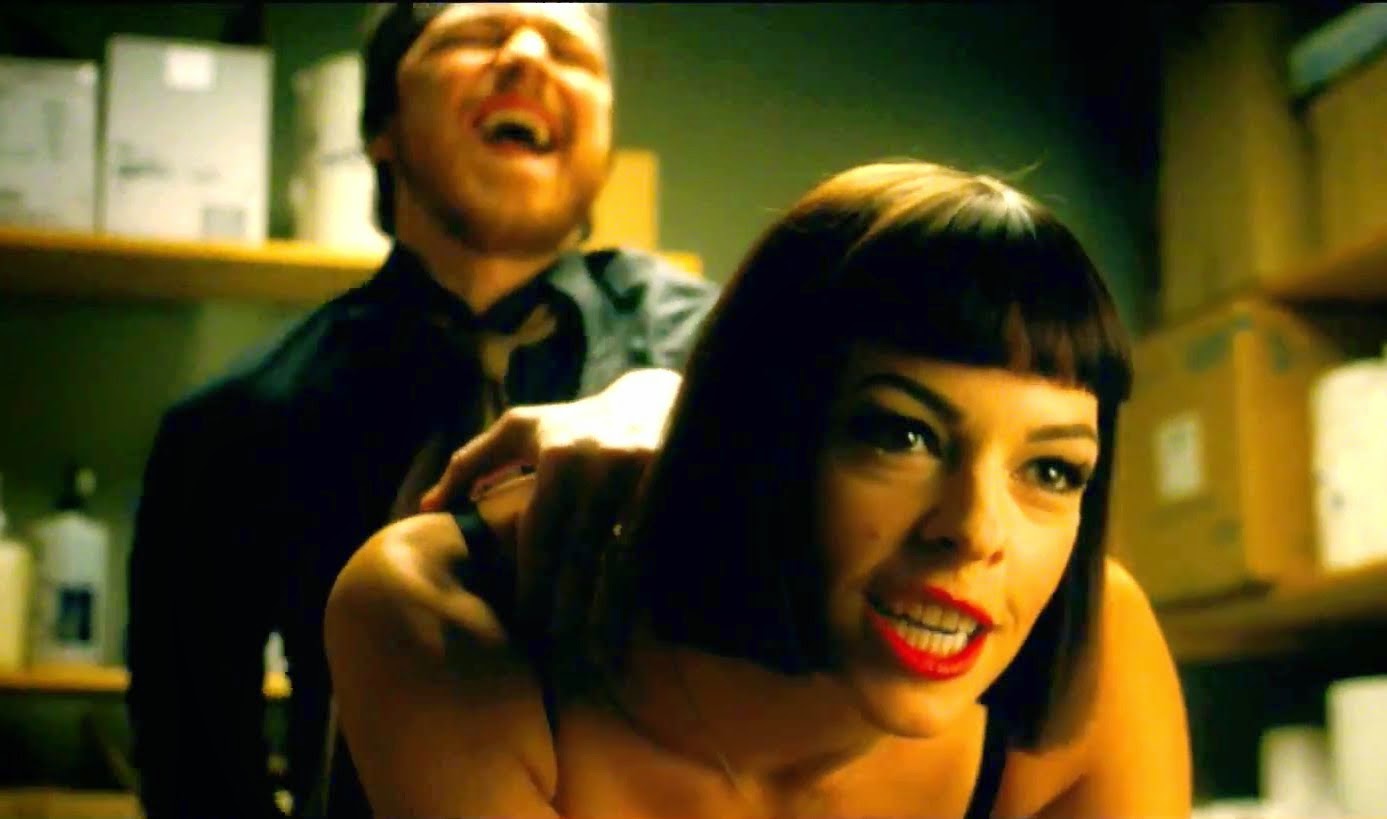
FILTH (Germany/US/UK/Sweden/Belgium - 2013; US release 2014) Written and directed by Jon S. Baird. Cast: James McAvoy, Jamie Bell, Eddie Marsan, Imogen Poots, Jim Broadbent, Joanne Froggatt, Shauna Macdonald, Shirley Henderson, John Sessions, Gary Lewis, Brian McCardie, Emun Elliott, Martin Compston, Kate Dickie, Iain De Caestecker, Joy McAvoy, Pollyanna McIntosh, Bobby Rainsbury. (R, 98 mins)
This grotesque adaptation of Irvine Welsh's 1998 novel suffers from the same problem that plagued the last movie based on a Welsh work, the little-seen Canadian film ECSTASY (2012). While FILTH doesn't have Canadian actors attempting to tackle Scottish accents and losing spectacularly, it does share with ECSTASY a sense that it's been kept in storage for 15 years and is only now being released. It seems inevitable that every film version of Welsh's work will look and feel like Danny Boyle's landmark TRAINSPOTTING (1996), but in the hands of a director with vision like, say, a David Cronenberg or a Terry Gilliam, FILTH's parade of filth could've had some unique gonzo artistry that would've made its own mark outside of the dated world of TRAINSPOTTING knockoffs. Instead, it's the work of writer/director Jon S. Baird, who has one other feature under his belt (the obscure 2008 crime drama CASS), with his only other credit of note being an associate producer on the 2005 cult film GREEN STREET HOOLIGANS. Baird is obviously a fan of Boyle and probably saw FILTH as a way to pay homage to both him and Welsh, but it's all so familiar and formulaic at this point. Baird's FILTH only makes fleeting mention of a key element of Welsh's novel: the tapeworm that's inside the protagonist's body and, as it grows and spawns, it starts narrating its own chapters. The elimination of that "character"--something with which a hypothetical Cronenberg or Gilliam would've had a blast--leaves Baird with little to do other than fashion FILTH as BAD LIEUTENANT with a Scottish burr.
Det. Sgt. Bruce Robertson (James McAvoy), is an Edinburgh cop obsessed with discrediting the colleagues in line for the promotion he wants for himself. Robertson is a sociopath, a misanthrope, an alcoholic, a junkie, a thief, and a sex addict. He's corrupt and amoral, and his sickness has spread to his impressionable young partner Lennox (Jamie Bell), as the two routinely go on coke-and-hooker binges. While Lennox is questioning an 18-year-old man for engaging in unlawful sexual conduct with his under-the-age-of-consent 15-year-old girlfriend, Robertson is in the next room getting a blowjob from said underage girl in exchange for not telling her dad what she's been doing. Robertson is supposed to be investigating the murder of a Japanese tourist with Lennox and the ambitious Dunning (Imogen Poots), but they end up doing the leg work as Robertson instead spreads rumors about other cops, steals balloons from little kids, engages in mutual erotic asphyxiation with the wife (Kate Dickie) of an irate cop (Brian McCardie), makes obscene phone calls to the wife (Shirley Henderson) of his nebbishy, dweeby lodge brother Bladesey (Eddie Marsan), from whom he steals money to buy drugs, and then drags away on an ostensible bicycling trip to Hamburg, where he visits brothels on his own after slipping Bladesey some roofies, leaving him stranded at a gay bar, and forcing him to squint his way through the rest of the trip after stealing his incredibly thick-lensed eyeglasses, and throwing them in a river between periodic hallucinations with a mocking shrink (Jim Broadbent). Robertson is a bad guy---he's also bipolar and off his meds--and in his more introspective moments, pines for the wife (Shauna Macdonald) who left him, but some semblance of good exists deep within him when he tries to save a dying man on a busy street while everyone else stands around helplessly. The man's widow (Joanne Froggatt) sees he's a troubled soul but instead of letting her in, resorts to his maniacally excessive ways.
There's no denying McAvoy throws himself into the role much like Harvey Keitel and Nicolas Cage did in each of their interpretations of BAD LIEUTENANT. But FILTH the movie is a dumbed-down version of Filth the book and plays like stale retread of BAD LIEUTENANT filtered through TRAINSPOTTING. It doesn't even keep Welsh's very INVESTIGATION OF A CITIZEN ABOVE SUSPICION-esque ending. It's shot in very much the same style, and you can almost see Ewan McGregor as Robertson if this was made a decade and a half ago. Many of Welsh's novels take place in the same universe with recurring characters popping up throughout (for example: Begbie, played by Robert Carlyle in TRAINSPOTTING, is mentioned several times throughout Filth), and on the page, it's part of an ever-expanding, self-referential universe. On the screen, it just comes across as repetitive and uninspired. Welsh is one of the film's 34 (!) credited producers and obviously signed off on it (which, much like most authors selling book rights, probably involved getting paid and then had nothing else to do with it), but the alterations made to the story are to its detriment. Yes, film is a different medium, but Baird just seems interested in the most transgressive elements of Welsh's story with little concern for other things that were going on. An ambitious adaptation of Filth would've explored more than Robertson's over-the-top histrionics. I'm probably making FILTH sound like a bad movie. It's an OK film, moderately entertaining and never dull (and there is one admittedly brilliant use of David Soul's "Silver Lady"), but it never really tries, either. If shock value is all Baird was after, why didn't he just remake BAD LIEUTENANT? Why bother adapting Welsh's book if you're just going to toss its most unique elements?
X-MEN: DAYS OF FUTURE PAST (US/UK - 2014) Directed by Bryan Singer. Written by Simon Kinberg. Cast: Hugh Jackman, James McAvoy, Michael Fassbender, Jennifer Lawrence, Ian McKellen, Patrick Stewart, Halle Berry, Ellen Page, Anna Paquin, Peter Dinklage, Nicholas Hoult, Shawn Ashmore, Fan Bingbing, Omar Sy, Evan Peters, Josh Helman, Daniel Cudmore, Famke Janssen, James Marsden, Michael Lerner, Mark Camacho. (PG-13, 131 mins)
Director Bryan Singer's return to the X-MEN universe for the first time since 2003's X2 is a loose adaptation of a 1981 storyline in The Uncanny X-Men and brings together both the original cast and their X-MEN: FIRST CLASS counterparts in a gathering the likes of which we haven't seen since Yes' 1991 album Union. Singer and screenwriter Simon Kinberg somehow manage to keep the multiple plot threads coherent for the most part, though if you aren't up to speed on your X-MEN lore, there's a good chance you'll be a bit lost here and there, as DAYS OF FUTURE PAST serves as a sequel to both 2006's X-MEN: THE LAST STAND and 2011's X-MEN: FIRST CLASS.
Opening in a dystopian future where robots known as Sentinels are waging war on mutants, DOFP has Kitty Pryde (Ellen Page) sending the consciousness of Wolverine (Hugh Jackman) back to 1973 so he can stop the assassination of Sentinel creator and Nixon cabinet member Dr. Bolivar Trask (Peter Dinklage) at the hands of Mystique (Jennifer Lawrence). As it plays out in their current timeline, Trask dies a hero, and Mystique is captured, with her DNA being used to help create the mutant-hunting Sentinels killing them in the future. Wolverine is advised by Professor Xavier (Patrick Stewart) and Magneto (Ian McKellen) to track down their younger selves in 1973 for assistance. Young Xavier (James McAvoy) is a despondent recluse being cared for by Hank/Beast (Nicholas Hoult) in the decrepit Xavier School, while young Magneto (Michael Fassbender) is being held in a enclosed prison deep beneath the Pentagon. Wolverine, Xavier, and Beast enlist the aid of Quicksilver (Evan Peters) to infiltrate the Pentagon and extract Magneto in what's probably the film's most inspired sequence, boasting an unforgettable use of Jim Croce's "Time in a Bottle." Once freed, it doesn't take Magneto long for his evil ways to take control, often working at cross purposes with Mystique, who has her reasons for killing Trask, who isn't the noble altruist that history has purported him to be.
The wild plot also works in the JFK assassination, the Watergate tapes (Mark Camacho is a peculiar-looking Nixon), SANFORD AND SON, and some time-travel comic relief as Wolverine adjusts to life in 1973. Other than Jackman's Wolverine, who acts as a bridge between the two casts, the focus is more on the FIRST CLASS end of things, with the original cast not having a whole lot to do after the opening sequence other than pop up periodically to remind the audience that they're still there as they bide their time until a climactic showdown with some Sentinels. McKellen and Stewart look dour and concerned, Page's Kitty Pryde (it's Kitty, not Wolverine, who goes back in time in the comic book source story) does little more than rub her hands on future Wolverine's temples as she guides his soul into the past, Halle Berry's Storm has maybe three lines of dialogue, and a prominently-billed Anna Paquin returns--if you can call it that--as Rogue, a central character in the first film but now reduced to a two-second walk-on without even a clear view of her face (Singer decided to cut all of her scenes, but they'll be included on the Blu-ray release). Other than Wolverine and a brief face-to-face with young and old Professor Xavier, there's no interaction between the originals and the First Class. Jackman, McAvoy, and Hoult make a great team, and Peters almost manages to steal the film with his Quicksilver antics (after the brilliant Pentagon escape sequence, you'll wish Peters was in the movie more). The X-Men vs. Magneto vs. Mystique vs. the Sentinels showdown on the White House lawn is a superbly crafted set piece, even if one element makes it bit too reminiscent of the stadium destruction from Bane in THE DARK KNIGHT RISES. It's not perfect, and CAPTAIN AMERICA: THE WINTER SOLDIER is looking even better as the year goes on, but X-MEN: DAYS OF FUTURE PAST is an ambitious return to the franchise for Singer, and it gets the job done as enjoyably huge big-screen summer entertainment.
Since taking a decade-long sabbatical from directing and returning with 2007's YOUTH WITHOUT YOUTH and 2009's TETRO, the legendary Francis Ford Coppola has essentially abandoned Hollywood and the mainstream and made it a stated point that he's only making personal films for himself. While the commercial appeal of the ponderous YOUTH and the intermittently-interesting TETRO were limited, they admirably avoided the self-indulgence that normally accompanies such endeavors, and while both are little more than interesting curios by a fabled filmmaker, the uneven TWIXT is Coppola's most satisfying effort of this post-comeback "experimental" phase. Recalling the low-budget B-movies Coppola cut his teeth on as an assistant to Roger Corman back in the early 1960s, TWIXT more often than not feels like an old-school horror movie that you used to find on late-night TV, at least until it starts taking esoteric, art-house detours as it goes on. In his best role in years, Val Kilmer stars as hard-drinking horror novelist Hall Baltimore, once hailed as a fresh, next-big-thing literary talent but now "the bargain-basement Stephen King," reduced to holding unattended book signings in small-town carry-outs. He finds a fan in gregarious Swann Valley sheriff Bobby LaGrange (an enjoyably hammy Bruce Dern), who wants to collaborate with him on a book where they solve a series of brutal stakings that LaGrange believes are the work of some goth kids who hang out across the lake. Initially apprehensive, but with mounting debt, his wife (Kilmer's ex-wife Joanne Whalley) threatening to sell his priceless, bound-by-Walt Whitman-himself copy of Leaves of Grass, and needing to move on from the recent death of his 14-year-old daughter in a boating accident, Baltimore pitches the idea to his publisher (David Paymer) and gets an advance...that he conveniently keeps secret from LaGrange. Meanwhile, Baltimore is visited by a strange girl named V (Elle Fanning) that no one else sees, and while out wandering through the Swann Valley woods, he nearly falls off a rope bridge but is rescued by the ghost of Edgar Allan Poe (Ben Chaplin), who takes him under his wing and shows him the dark secrets of the town. As Baltimore struggles with the book, he comes to terms with the guilt over his daughter's death and with Poe's help, starts uncovering the truth about what happened to V and how it ties into the serial stakings that are occupying the sheriff's time.
Coppola financed TWIXT out of his own pocket and when it failed to land a US distributor, he ended up arranging a scant few screenings himself before setting up a VOD distribution deal. Look, I realize the commercial prospects for an artsy endeavor like this are limited, but can someone explain to me what kind of bullshit state of cinema we're in where Francis Ford Fucking Coppola has to personally schlep his latest movie to individual theaters? He even shot a couple of sequences in 3-D! Some may find TWIXT meandering and obfuscating, but it feels a lot like an old Corman or William Castle flick, or sometimes like a TWILIGHT ZONE episode, especially since a good chunk of it is shot in black & white. It its more accessible sections, it occasionally feels--perhaps because of the presence of THE 'BURBS and THE HOLE co-star Dern--like the kind of throwback film that Joe Dante might make. Coppola's script never really ties everything together all that securely and the ending is a bit too abrupt, but it really captures the feeling of those old low-budget movies without doing so ironically. Coppola keeps it legit because he came from that school. He's not a young filmmaker paying ironic homage to it--he was actually there. That's just part of the personal touch Coppola brings to TWIXT. Baltimore's overwhelming grief over the loss of a child is something Coppola knows all too well: he lost his 22-year-old son Gio in a 1986 boating accident that's identically recreated in the way Baltimore's daughter is killed. Gio's wife was pregnant at the time of his death, and their daughter Gia worked on TWIXT with her grandfather. Knowing the story behind TWIXT and how it brings together a grandfather who lost his son and a granddaughter who never got to meet her father adds a powerful subtext to the film.
And it's great to see guys like Kilmer and Dern getting meaty, starring roles for a change. Kilmer's performance as Doc Holliday in 1993's TOMBSTONE is one of the most beloved and oft-quoted in modern cinema, but he's spent much of the last decade in a stunning career free-fall that found him starring in some of the worst of the worst in the world of DTV with unwatchable garbage like MOSCOW ZERO, THE CHAOS EXPERIMENT, PLAYED (where his character's repeated "You are not gonna taco!" failed to become the new "I'm your Huckleberry") and several ill-advised collaborations with 50 Cent. Kilmer is an eccentric actor who's frequently been labeled difficult (THE ISLAND OF DR. MOREAU director John Frankenheimer: "Will Rogers never met Val Kilmer") and has a tendency to run amok in some of these DTV films where he's only on the set for a couple of days and is given room to riff and improv. Coppola successfully reins him in here, but does give him some leeway in an amusing scene where an increasingly intoxicated Baltimore struggles to get a single sentence written, allowing Kilmer to once more bust out his famous Marlon Brando impression in addition to an impeccable James Mason. I've long maintained that Kilmer still has some real work and maybe even an Oscar left in him, and it was an admirable and perhaps conscious decision on Coppola's part to give Kilmer--a guy who can probably relate to the sorry state of Hall Baltimore's career--the lead role in this project. These three most recent Coppola films probably won't even make his career highlight reel, and of course I don't mean to imply that it's on the level of THE GODFATHER or its first sequel, or APOCALYPSE NOW, or THE CONVERSATION, but for a more thorough understanding of him as a filmmaker and as a still-grieving father, there's a strong argument that TWIXT is essential Coppola. (R, 88 mins)
TRANCE (France/US/UK - 2013)
Even after the crowd-pleasing Best Picture Oscar winner SLUMDOG MILLIONAIRE (2008), the grueling Best Picture Oscar nominee 127 HOURS (2010), and supervising the razzle-dazzle of the 2012 London Olympics opening ceremony, TRANCE, the latest from director Danny Boyle, didn't inspire much confidence from distributor Fox, who only rolled it out on 443 screens at its widest release. It's easy to say TRANCE, a remake of a 2001 British TV-movie, is Boyle's attempt at a Christopher Nolan mindfuck, but the head games here seem too contrived and complicated just for its own sake, eventually devolving into trying-too-hard misdirection and incoherence. Boyle's direction is as stylish as ever, but the plot's intriguing twists and turns and the eventual revelation that what you thought the film was about isn't what it's about at all probably seemed clever on the page, but it grows tiresome on the screen.
Working with screenwriter John Hodge (SHALLOW GRAVE, TRAINSPOTTING, A LIFE LESS ORDINARY) for the first time since 2000's THE BEACH, Boyle's TRANCE gives us mid-level London art auctioneer Simon (James McAvoy), who takes a nasty blow to the head during a museum theft where a priceless Goya is ripped off by Franck (Vincent Cassel) and his crew. Franck discovers the canvas has been sliced from the frame and once Simon, hailed as a hero by the media, is released from the hospital, he and his gang endlessly hassle and torture him, believing he stashed the painting somewhere. But Simon is suffering from amnesia, and can't remember anything during the robbery itself. Franck sends Simon to hypnotherapist Elizabeth Lamb (Rosario Dawson), hoping she can put him in a trance and extract the information from wherever it is in his memories. Elizabeth figures out what's going on and wants a percentage of the take. Then a love triangle develops. And then things get really twisty. The thing is, the more twists that Boyle and Hodge pile on, the more absurd TRANCE becomes, though I'm sure it's some kind of snickering joke on their part that a major element of the plot hinges on Dawson's shaved bush (the actress does some nudity here that leaves nothing to the imagination and should make her a frontrunner at the next Mr. Skin's Anatomy Awards). By the end, when all the pieces are (I think) in place, the reaction is less "Whoa!" and more "Really?! All that for this?" Some of those pieces have to get forced in place for the puzzle to be complete, and even in a film with this many acceptable implausibilities, it's asking a lot for an audience to buy a body decomposing in the trunk of a car for months and no one--least of all the people riding in the backseat--realizing it. TRANCE is never dull or uninteresting and McAvoy and Cassel are good, but Dawson feels a little miscast, despite her instantly legendary nude scene. Initial reaction might be mild disappointment, but something about this feels like it might be one of those movies that play better when viewed again in a year or two. (R, 101 mins)
Written and directed by Eran Creevy. Cast: James McAvoy, Mark Strong, Andrea Riseborough, David Morrissey, Peter Mullan, Johnny Harris, Jason Flemyng, Ruth Sheen, Daniel Mays, Natasha Little, Daniel Kaluuya, Elyes Gabel. (Unrated, 96 mins)
It won't win any points for originality, but the lean, mean WELCOME TO THE PUNCH is a highly entertaining British cop thriller produced by Ridley Scott and directed by the promising Eran Creevy, who achieved some acclaim for his 2008 debut SHIFTY. Creevy, a music video vet who cut his teeth as a production assistant on films by Matthew Vaughn (LAYER CAKE) and Danny Boyle (MILLIONS), is unquestionably a style-over-substance guy, as his script is pretty by-the-numbers with plot turns that barely twist, let alone surprise. But while his script may lack the punch promised by the title, it's obvious that Creevy worships at the altar of Michael Mann--not just in the big HEAT influence on PUNCH, but also in its look and feel, with everything drenched in a cold, blue sheen that brings scenes from vintage Mann classics like THIEF and MANHUNTER to mind. Like THE SWEENEY from a few weeks back, WELCOME TO THE PUNCH doesn't exactly forge a new path in the British crime genre, but it's diverting, well-acted, looks terrific, and doesn't try to be anything more than what it is.
Plays-by-his-own rules London detective Max Lewinsky (James McAvoy) is obsessed with bringing down criminal kingpin Jacob Sternwood (the always-excellent Mark Strong). The two come face to face in an underground tunnel, but Sternwood gets away after shooting Lewinsky in the knee. Three years later, and a hobbling Lewinsky is now the kind of cop who wakes up with a hangover and has to drain the fluid from his knee several times a day, with a wiseass partner in fiery Sarah Hayes (Andrea Riseborough). Meanwhile, a young man (Elyes Gabel) with a gunshot wound to the stomach causes a disturbance on an airport runway and it turns out he's Sternwood's son Ruan, who's been involved in a botched heist. Sternwood has been in hiding in Iceland for three years, and with Ruan in the hospital, Lewinsky is convinced he'll try to come back to London to see him. With the reluctant approval of police commissioner Geiger (David Morrissey), Lewinsky and Hayes stake out the hospital, and sure enough, Sternwood returns, but it turns out that Ruan was a pawn in a complicated chain of events that involve rampant corruption and backroom dealing and may (wait for it) lead all the way to the top of the department. Once realizing they share a common enemy who's employed sociopathic ex-military man-turned-hired killer Warns (Johnny Harris), Lewinsky and Sternwood put aside their Sworn Enemy status, forming an uneasy alliance to work together to blow the lid off a secret that may extend all the way to the government...
...if they don't kill each other first!
Creevy stages a number of impressive sequences, starting with the exciting chase that opens the film. There's also a memorable shootout in an empty nightclub, illuminated only by a bunch of rotating, spinning spotlights (don't look for a reason why...it just looks cool), and, in one of the few scenes that exhibit some creative writing, a tense encounter between a now-allied Lewinsky and Sternwood, accompanied by his gangland cohort Roy (Peter Mullan), and Warns, when Warns walks into the home of his sweet but dodderingly oblivious nan (Ruth Sheen) to find the other three already there waiting for him, his nan completely unaware that she's got a gun pointed to the back of her head. Of course, all roads lead to a showdown at a shipping yard (the abandoned warehouse must've been locked up), and you'll see the big reveals coming long before they happen, but WELCOME TO THE PUNCH gets a lot from its lead actors, both of whom are excellent, and it's ultimately undemanding, check-your-brain-at-the-door fun that doesn't have any pretentious aspirations about being anything more than mainstream entertainment (plus it features one of the more crowd-pleasing shotgun-blasts-to-the-head you'll ever see). Being distributed by IFC Films and featuring a cast of Brits automatically relegates it to a limited release arthouse run, but this is the kind of escapist flick that should be opening nationwide.