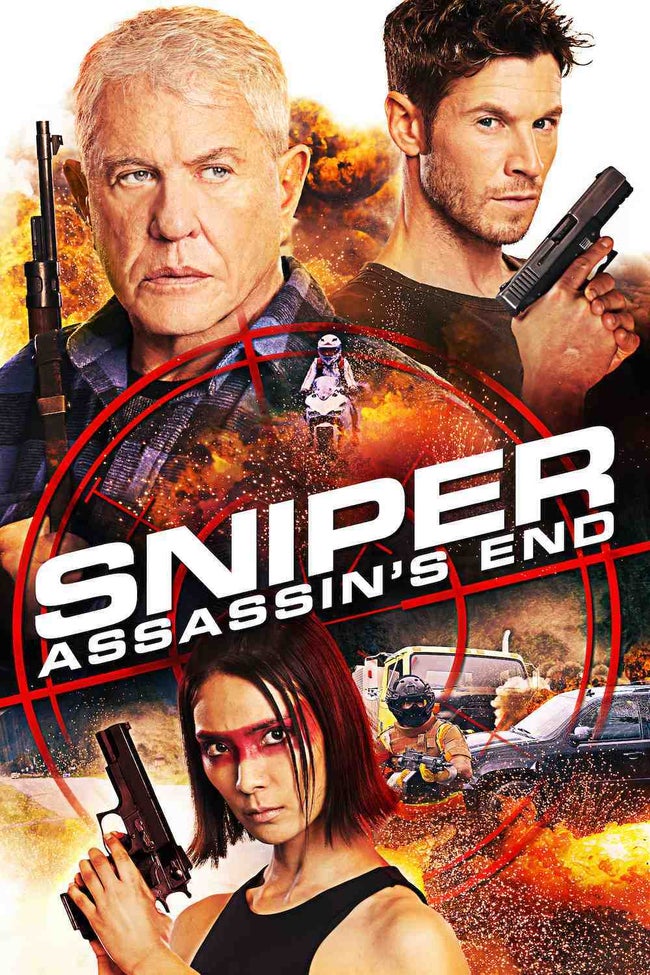
With the release of the eighth (!) film in the SNIPER franchise (not counting a fake one starring Steven Seagal), I realized I somehow missed the seventh, 2017's SNIPER: ULTIMATE KILL. Somehow, I was still able to follow SNIPER: ASSASSIN'S END, which is mostly standard-issue DTV fare, but it does try a couple of different things of interest. Director Kaare Andrews, a former Marvel writer and artist who dabbled in horror movies on the side (CABIN FEVER: PATIENT ZERO and a segment of THE ABCs OF DEATH), occasionally brings a budget-priced Michael Mann aura to this installment, opening with a strikingly-shot assassination and an effective Tangerine Dream-ish cue, and one later three-way sniper standoff framed as a top-to-bottom split screen. As director John Hyams showed with those later UNIVERSAL SOLDIER entries, one can do some unpredictable and adventurous things several films deep in a franchise when nobody's really paying any attention except for the die-hards, but aside from those few stylish touches, Andrews sticks to business-as-usual for the bulk of SNIPER: ASSASSIN'S END. In the fictional Central American country of Costa Verde, the president is taken out by a bullet from a sniper positioned over a mile away. The sniper is Japanese assassin "Lady Death" (Sayaka Akimoto), who plants a strand of hair as DNA evidence linking Sgt. Brandon Beckett (Chad Michael Collins, who's been headlining these since the 2011 reboot SNIPER: RELOADED) to the killing. He's apprehended and taken to a safe house for interrogation before Lady Death--working in the employ of someone else--has the chance to finish her assignment by killing him and staging it as a suicide. While CIA agent Franklin (Lochlyn Munro) bloviates to his underlings and sets out to nail Beckett's balls to the wall, Homeland Security agent Zeke "Zero" Rosenberg (Ryan Robbins) isn't buying that Beckett is guilty, and starts uncovering evidence linking a Vancouver pharmaceutical company to the murder of the Costa Verde president after he threatened to pull out of a trade agreement with the US.
Meanwhile, Beckett escapes from a military transport after Lady Death manages to take out everyone from afar but him, and he eventually makes his way to a remote, secluded forest outside Aberdeen, WA, where his dad--Thomas Beckett (original SNIPER star Tom Berenger, who sat out the fourth and sixth installments), the most lethal sniper in the US military--has been living off the grid. Of course, Pops Sniper will team up with Sniper Jr. to prove the latter's innocence, but if that plot trajectory sounds familiar, then you'll figure out that the filmmakers have also seen ANGEL HAS FALLEN. A sleepwalking Berenger is no match for a grumbling, madman-bearded Nick Nolte, but something else SNIPER: ASSASSIN'S END does is establish several new characters--along with a stinger before the closing credits hinting at the plot of the inevitable ninth SNIPER--in a blatant attempt at fashioning some kind of SNIPER Cinematic Universe in the vein of THE AVENGERS, and with Lady Death working for a nefarious villain named Drake Phoenix (Michael Jonsson), it might even get as ridiculous as the FAST & FURIOUS franchise. We're probably no more than two SNIPERs away from seeing Tom Berenger and Chad Michael Collins in space. (R, 95 mins)
GREED (US/UK - 2020)
Prolific journeyman British filmmaker Michael Winterbottom is probably best known for his numerous collaborations with Steve Coogan, going back to 2002's 24 HOUR PARTY PEOPLE. It's been a generally can't-miss prospect when these two get together, whether it's the TRIP BBC series or its three spinoff features, and 2006's hysterical TRISTRAM SHANDY: A COCK AND BULL STORY. It was inevitable that they'd hit a wall at some point, and they have indeed with GREED, a timely but shockingly unfunny would-be takedown of the obscenely wealthy. Coogan is Sir Richard McReadie, a hybrid of British retail billionaire Sir Philip Green and multi-millionaire fashion retailer-turned-UK restaurant chain magnate Richard Caring, and there's a little Donald Trump in there as well. McCreadie is known as "The Mozart of Retail," "The Da Vinci of Dealmaking," and "The Monet of Money," but his financial legend is mainly tied to his wealthy wife Samantha (Isla Fisher) and his ability to bully his way through handshake deals and having the magic touch to bankrupt his own companies while walking away with huge paydays. He's being investigated by a government commission but he's mainly preoccupied with a huge 60th birthday party being thrown at his lavish Greek beach house, where a Bulgarian construction crew is slowly erecting a Roman amphitheater specifically for his GLADIATOR-themed bash. He's pestered by dweeby biographer Nick (David Mitchell), doesn't seem to care that Samantha has a much younger lover, and is oblivious to his son Finn (Asa Butterfield) having Oedipal designs on his mother, an issue not helped by McCreadie constantly blowing off his attempts at father-son bonding.
In short, McCreadie is a real asshole, and GREED had potential. Sony even planned to expand it nationwide in March 2020 after a limited rollout in February, but it never happened due to the coronavirus. Coogan can usually play this kind of obnoxious prick in his sleep, but McCreadie is just a loud, bloviating version of Alan Partridge who's oblivious to any kind of tact and decorum, and he and Winterbottom think it's sufficiently funny to just have him yell "twat" and "cunt" a lot when he's berating everyone around him. There are entirely too many characters wandering in and out of the story, cutaways and flashbacks with jokes that don't land (a self-deprecating cameo by "You're Beautiful" one-hit wonder James Blunt), and even a subplot about the British media canceling McCreadie (once again) after he kicks some Syrian refugees off the public beach adjoining his property--leading to all of the celebrity guests bailing after he's paid them to attend (there are some Skype'd in cameos by Chris Martin, Ben Stiller, Colin Firth, and Keira Knightley)--falls flat. McCreadie's handlers try to rectify the situation by hiring professional lookalikes of Adele, Rod Stewart, Simon Cowell, Kylie Minogue, and George Michael, and the payoff to that entire laborious set-up is a furious McCreadie reminding them that George Michael is dead. Winterbottom also wrote the script, but there's an "additional material" credit for Sean Gray, who logged some time in the Armando Iannucci-verse with THE THICK OF IT and VEEP, and to that end, GREED really feels like cold Iannucci leftovers. It just gets worse by the end, when Winterbottom goes full ON DEADLY GROUND with (another) subplot about the working conditions at one of McCreadie's Sri Lanka sweatshops, and the closing credits have several minutes of statistics about the economic disparity between the women who work grueling days in these sweatshops for next-to-nothing and the billions their work generates for rich men like McCreadie. That's a valid conversation to have, and it's a perfect subject for Winterbottom to explore in one of his serious, WELCOME TO SARAJEVO or THE ROAD TO GUANTANAMO moods. But for a comedy where Steve Coogan's spent an hour and half acting a fool, being a cringe comedy dickhead, and calling everyone a "twat" and a "cunt," it comes off as tone-deaf, hectoring, and spectacularly heavy-handed. A total misfire. (R, 104 mins)
EYE SEE YOU (US/Germany - 2002) Directed by Jim Gillespie. Written by Ron L. Brinkerhoff. Cast: Sylvester Stallone, Tom Berenger, Charles S. Dutton, Kris Kristofferson, Polly Walker, Robert Patrick, Jeffrey Wright, Robert Prosky, Courtney B. Vance, Christopher Fulford, Stephen Lang, Sean Patrick Flanery, Dina Meyer, Angela Alvarado Rosa, Mif, Alan C. Peterson, Hrothgar Mathews, Rance Howard, Tim Henry, Frank Pellegrino. (R, 96 mins) Sylvester Stallone has had his share of ups and downs over the course of his long and storied career, but he perhaps hit his roughest patch in that post-COP LAND period from 1998 to 2006, after which he went into nostalgia mode with the surprisingly good ROCKY BALBOA. That film's success sent Stallone on an ongoing greatest hits tour that's seen him resurrecting Rambo, creating a new all-star action franchise with THE EXPENDABLES, and continuing Rocky's story in two CREED films so far, the first earning him a Best Supporting Actor Oscar nomination. The 1997 "indie" COP LAND came at the height of Miramax's Oscar-baiting power, and was supposed to be then-51-year-old Stallone's bid to reinvent himself as a Serious Actor. He even pulled a De Niro by putting on 40 lbs and sporting a gut to play a powerless and partially-deaf sheriff in a small New Jersey suburb that a bunch of corrupt NYC cops call home. The film was critically-acclaimed, Stallone got some of the best reviews of his career, and it was a modest hit in theaters, but it was more or less viewed as a stunt for Stallone and offers for more serious roles never materialized. So he went back to action movies with 2000's remake of the Michael Caine classic GET CARTER and the 2001 racing drama DRIVEN, and both bombed critically and commercially. Aside from his comedic turn as the villain in 2003's SPY KIDS 3-D: GAME OVER, Stallone's next three films--2002's EYE SEE YOU, 2003's AVENGING ANGELO, and 2004's SHADE, where things had gotten so dire that he took a supporting role as the mark in a ROUNDERS underground poker knockoff starring Stuart Townsend--either made it to just a handful of theaters, or (as in the case of AVENGING ANGELO, notable only as Anthony Quinn's last film and released two years after his death), went straight-to-DVD after extended stays on the shelf.
EYE SEE YOU began life as DETOX, and was supposed to be a major-studio Stallone thriller, produced for Universal under the auspices of Imagine Entertainment and executive producer Ron Howard. Budgeted at nearly $60 million, with 1/3 of that going to the star, DETOX was shot in 1999, when its director, Jim Gillespie, was still enjoying a huge box office success with the 1997 smash I KNOW WHAT YOU DID LAST SUMMER, one of the most popular entries in the post-SCREAM slasher craze. A strong cast was assembled in support of Stallone, including the likes of Tom Berenger, Charles S. Dutton, Kris Kristofferson, Courtney B. Vance, Robert Prosky, Jeffrey Wright, and Stallone's COP LAND co-star Robert Patrick, among others. DETOX was clearly a riff on the kind of dark and grim serial killer thrillers that came in the wake of David Fincher's SE7EN, and it cast Stallone as a troubled FBI agent who ends up at a secluded psychiatric facility that's dedicated to helping law enforcement PTSD cases. But once he's there, all the cops in the treatment program start getting killed off one by one and they can't call for help because communication's been knocked out thanks to a blizzard, which keeps them trapped inside. Mistrust, paranoia, and anger set in and for a bunch of cops who already don't need another push to go off the deep end, the situation soon turns into something akin to John Carpenter's THE THING if re-imagined as an Agatha Christie mystery.
Not a bad idea for a thriller, but things went horribly awry. Both Universal execs and test audiences hated Gillespie's initial cut. Reshoots were ordered and Gillespie was told to overhaul the entire thing. It's not clear how much he was involved, but Stallone said years later that Ron Howard himself supervised the post-production for a brief period of time. The ending was reshot and the title kept changing--from DETOX to D-TOX to THE OUTPOST and back and forth again as Universal tried testing the revamped version in 2001 and still got a chilly response. Now with the title settled on D-TOX, the film was released in Europe in early 2002 with little success, while back in the States, Universal decided they'd seen enough and washed their hands of it. They sold it to the lowly DEJ Productions, who retitled it EYE SEE YOU, and released it--minus the Imagine Entertainment logo and Ron Howard's executive producer credit--on 78 screens with no publicity in September 2002 on its way to Blockbuster shelves two months later as one of the chain's "Blockbuster Exclusives." After three years, multiple reshoots, numerous test screenings, and at least $60 million spent on it, EYE SEE YOU opened in 57th place with a weekend gross of $32,000.
So is it that bad? No, it's not. Looking at it now, it's nowhere near the vicinity of being Stallone's worst movie, especially in a filmography that contains STOP! OR MY MOM WILL SHOOT, REACH ME, and ESCAPE PLAN 2: HADES. It doesn't even belong in his bottom five and might not even qualify for his bottom ten unless you're looking at OVER THE TOP through rose-colored glasses. EYE SEE YOU's biggest offense is that it's kinda dumb (but not as dumb as Paulie's robot in ROCKY IV) and it's quite shameless in its SE7EN worship, starting with the same kind of shaky and jittery opening credits, which was already a little past its sell-by date in 2002 but still hasn't stopped movies from ripping off even today. Stallone is Jake Malloy, an FBI agent on the trail of a serial killer who kills cops--nine so far in the last six months--by taking their eyes out with a power drill and calling Malloy with garbled, electronically distorted phone taunts of "I see you...but you don't see me." As is wont to happen in cop thrillers of this sort, things get personal when EYE SEE YOU's "head in the box" moment comes pretty early on as Malloy's girlfriend Mary (Dina Meyer, in a test run for the SAW franchise she'd be a big part of a few years later) becomes the killer's latest victim on the night he was going to propose to her, her eyes drilled out and her corpse strung up and left hanging in the dining room. After a pursuit into an abandoned building, complete with a requisite dungeon-like room filled with just chains dangling from the ceiling, Malloy is about to confront the killer only to find that he's committed suicide and left a full confession. Case closed, but a depressed Malloy spends three months drinking himself into numbness, and after attempting suicide, his boss Hendricks (Dutton) intervenes, taking him to the remote clinic for cops, located in middle-of-nowhere Wyoming at a decommissioned former military asylum.
It's an effectively ominous setting, and it enhances the situation when other cops in the program--among them bullying hothead Noah (Patrick), emotionally shattered Conner (Sean Patrick Flanery), aging Canadian Mountie McKenzie (Prosky), drug-addled undercover narc Jaworski (Wright), and bad cop-turned-man of God Reverend Jones (Vance)--start getting offed one by one, with other targets and potential killers that include affable janitor Hank (Berenger), ex-cop and head doc Doc (Kristofferson), shrink Jenny (Polly Walker), and weirdo orderly Jack (Stephen Lang), whose obvious red herring behavior is so bizarre from the start that there's no possible way he could be the killer. Stallone turns in a strong performance, and while there are some head-scratchers throughout (why would off-duty, on-disability cops come from all over the continent and still bring their guns for Doc to keep in the safe and their shields for him keep in a file cabinet? Obviously, so Malloy can bust into the safe and give everyone their weapon once a killer is on the loose and so the killer can break into the file cabinet and collect the shields of his victims as "trophies." Duh!), it's really not any more or less idiotic than a lot of studio thrillers from that time. And after driving Malloy all the way out to the retreat, Hendricks decides to rent a cabin so he can do some ice fishing and of course, finds a dead body frozen in the ice, which turns out to be a cop who was on his way to the facility, which means someone isn't who they claim to be, as evidenced when Malloy just happens to look under the eyelids of one of the dead cops to find "I" written under one and "C.U." under the other.
Just out on Blu-ray from MVD Visual (because physical media is dead), EYE SEE YOU isn't going to be re-evaluated as anything more than a derivative but watchable time-killer aside from the novelty of being the closest Stallone's come to starring in a horror movie. But the Blu-ray does have one intriguing extra that's a point of interest for the morbidly curious or if you're the type that slows down on the interstate to rubberneck a car crash: the first official release of Gillespie's original 1999 cut, presented here as a widescreen workprint of acceptable VHS quality and under the DETOX title, with incomplete opening credits and no closing credits. There's ultimately just a one-minute difference between the two versions (EYE SEE YOU runs 96 minutes, DETOX runs 95), but the changes are apparent from the very first scene, even though there doesn't appear to be much in the way of reshot material. Most of the footage in EYE SEE YOU is right there in DETOX, but DETOX has a radically different structure that, to put it mildly, is a total clusterfuck.
Gillespie's DETOX cut utilizes a fractured timeline, but all this does is slow the film down and inadvertently compromise Stallone's performance. Arranging the film this way forces the audience to not only follow the unfolding mystery, but at the same time try to figure out what the hell happened to get Malloy there in the first place. There's absolutely no sense of pacing and no smoothness to the storytelling. It opens with a pre-credits sequence showing the murder of a cop, goes to the opening credits, and the first shot after that is Hendricks driving Malloy to the facility. Who are these guys? Why is Stallone being taken here? Why are his wrists bandaged? Less than ten minutes in, and DETOX dives right into Malloy's therapy with Doc and the other cops, while using periodic random flashbacks and cutaways to fill in the backstory--exposition that was ultimately presented in a linear and much more coherent fashion as the opening 20 or so minutes in EYE SEE YOU. In Gillespie's DETOX cut, it takes so long to dole out these important details that it's a full 45 minutes--almost half the film's running time--before we're even aware that Mary was killed and we can finally conclude why Malloy has been brought here. EYE SEE YOU fixes all of this start/stop, momentum-killing nonsense by arranging these sequences in a conventional narrative that quickly and concisely establishes who the characters are and what they have to do with the story.
Poster art for the European release before Universal sold it to DEJ Productions.
Imagine SE7EN opening with Kevin Spacey walking into the police station and then Brad Pitt and Morgan Freeman thinking back to all the murders they've been investigating as they drive out to the desert. There would be no reason for the story to unfold that way, just as there's no reason for the clunky, jumbled narrative in DETOX, other than Gillespie getting a little too big for his britches after one hit and thinking he's pulling some USUAL SUSPECTS head games. Sometimes, the basic way is the way that works. The impenetrable structure of DETOX isn't in the service of a surprise, game-changing reveal. It's Stallone vs. a serial killer. There's no need to complicate it and overthink it with laboriously-executed trickery in a hapless attempt to be clever. Sometimes--not often, but sometimes--when a director is ordered to make changes or even has the movie taken away from them, and you finally get to see the director's intended version, you realize on occasion that the studio was right. And while that final version may be a flawed compromise, the term "director's cut" doesn't automatically mean it's the better version (PAYBACK, NIGHTBREED, and THE EXORCIST III come to mind). There are a couple of other major differences between EYE SEE YOU and DETOX. In EYE SEE YOU, when Malloy finds what he thinks is the killer's body post-suicide, he drops to his knees in exhausted anguish--a natural response. In the DETOX cut, he does an enraged Rambo yell and shoots the corpse six times. Lang gets a couple of additional lines of dialogue and sinister glances that make his twitchy character more aggressively asshole-ish in EYE SEE YOU. And in EYE SEE YOU, the climactic confrontation has been significantly reworked, with some new shots that give the killer a more violent, over-the-top death. EYE SEE YOU is not going to be mistaken for a neglected classic, but it looks like top-shelf Hitchcock when viewed in conjunction with the unreleasable DETOX. It's no mystery why test audiences hated it. And if the DETOX cut is what Stallone saw before washing his hands of the project, it's no wonder he and Patrick openly dissed it on the commentary track for the 2004-issued director's cut DVD of COP LAND (as Michael Rapaport's character vomits in a trash can, Stallone quips to Patrick "He looks like he just saw DETOX"). Or why Howard took his and Imagine's names off of it before its belated release, as all involved parties distanced themselves from it like a loud fart in a crowded room.
FEAR CITY (US - 1985) Directed by Abel Ferrara. Written by Nicholas St. John. Cast: Tom Berenger, Billy Dee Williams, Jack Scalia, Melanie Griffith, Rossano Brazzi, Jan Murray, Rae Dawn Chong, Joe Santos, Michael V. Gazzo, Janet Julian, Maria Conchita Alonso, Daniel Faraldo, Ola Ray, Frank Ronzio, Juan Fernandez, Tracy Griffith, Robert Miano, Frank Sivero, Neil Clifford. (R, 95 mins) Though he established himself as a critically-acclaimed filmmaker during his '90s heyday with KING OF NEW YORK (1990), BAD LIEUTENANT (1992), and THE FUNERAL (1996) among others, the always controversial Abel Ferrara got his start in the NYC exploitation gutter. His first feature film was the 1976 porno 9 LIVES OF A WET PUSSY and he followed that with 1979's scuzzy THE DRILLER KILLER, a self-explanatory splatter film where he also starred in the title role under the name "Jimmy Laine." 1981's low-budget vigilante thriller MS .45, in which a mute garment district seamstress (Zoe Tamerlis) goes full DEATH WISH on NYC scumbags after she's raped twice in the same day, was a hit on the grindhouse and drive-in circuit and even got some accolades from critics. Bronx-born Ferrara's contemporary NYC-set films of that era are among the grimiest presentations of the city in all of cinema. Like a cinematic Travis Bickle, he's from the streets, he knows them, he's lived them, and he's seen the worst they have to offer. Ferrara's always had a keen ability to bring that sleazy world to vivid life on the big screen like few others.
MS .45 got Ferrara some attention from the big studios, and it makes one wonder exactly what 20th Century Fox expected when they greenlit FEAR CITY, Ferrara's first sizably-budgeted film with actual Hollywood actors. Filmed in the spring and summer of 1983--with BLUE THUNDER, FLASHDANCE, OCTOPUSSY, and LONE WOLF MCQUADE visible on Times Square theater marquees--FEAR CITY was produced by Zupnik-Curtis Enterprises, with a good chunk of the budget and a distribution deal provided by Fox. A combination cop/mob/slasher movie, FEAR CITY deals with the hunt for a serial attacker dubbed "The New York Knifer." He's slashing strippers, most of whom work for the Starlite Talent Agency, run by childhood buddies Nicky Parzeno (Jack Scalia in his first big screen role, fresh off two short-lived TV series with THE DEVLIN CONNECTION and BERRENGER'S) and Matt Rossi (Tom Berenger, who had just been in THE BIG CHILL and EDDIE AND THE CRUISERS). Both are connected to powerful mob boss Carmine (Rossano Brazzi, quite a ways away from THREE COINS IN THE FOUNTAIN and SOUTH PACIFIC), who's the cash behind their business. Matt is a former boxer who walked away from the sport after killing an opponent in the ring. He's also nursing a broken heart after a relationship with ex-junkie dancer Loretta (Melanie Griffith, around the same time she played a porn star in Brian De Palma's BODY DOUBLE) went south. Matt and Nicky's business starts collapsing after the wave of stripper murders, and when the body count starts rising, they're forced to team up with top competitor Goldstein (Borscht Belt legend Jan Murray, dropping F-bombs in what would be his last film appearance) as rival talent agents, club owners, and mobsters all set aside their ongoing beefs to organize their own hunt for the martial-arts madman (played by an uncredited Neil Clifford) who's killing their girls and costing them money. Matt also has to deal with perpetually irritable detective Wheeler (Billy Dee Williams), who doesn't seem to get much work done but has a big chip on his shoulder about Italian-Americans, never missing a chance to hurl slurs like "dago," "guinea," "greaseball," "goombah," and "wop" at Matt, Nicky, and anyone in the immediate vicinity who looks or sounds even remotely Italian.
Shot entirely on location and setting the mood with the theme song "New York Doll" by New York Dolls frontman David Johansen, FEAR CITY effectively captures the grimy filth and the neon sleaze of early 1980s NYC. The story structure in regular Ferrara collaborator Nicholas St. John's script is rather formulaic--of course Matt and Loretta will rekindle their love, and of course the horror of her friends being murdered will send her back to the needle--but the fascinating cast (also featuring Joe Santos, Michael V. Gazzo, Rae Dawn Chong, Maria Conchita Alonso, Ola Ray from Michael Jackson's "Thriller" video, and, as Loretta's dealer, a typically reptilian Juan Fernandez, best known to trash movie fans as "that shitbag Duke" in KINJITE: FORBIDDEN SUBJECTS) and various quirks keep things interesting. Ferrara goes off on a bit of a tangent near the end, invoking the kind of recurring Catholic imagery that was so prominent in MS .45 and would be again in later films like BAD LIEUTENANT. The momentum is sidetracked a bit in the late going as Ferrara and St. John explore Matt's tortured soul as everything haunting his conscience comes to a head: the murders he's witnessed as a mob flunky since being a neighborhood shoeshine boy in his youth, killing a man in the ring, Loretta using again, Nicky ending up in a coma after a near-fatal encounter with the Knifer. It all leads to not just a confessional with a sympathetic priest but also a Tom Berenger shadow-boxing/workout montage as he prepares to take out the Knifer himself. There's another interesting character element in that African-American Wheeler and his Hispanic partner Sanchez (Daniel Faraldo) are far and away the biggest racists in the movie. Its killer (dubbed "The Karate Killer" by FEAR CITY fans even though he's only referred to as "The New York Knifer" in the movie), who attacks with ninja-like precision and often practices his martial arts moves in the nude, could be a close relative of Gene Davis' legendary in-the-buff serial killer in the Charles Bronson classic 10 TO MIDNIGHT.
With its gratuitous nudity and graphic violence, FEAR CITY didn't endear itself to the top brass at Fox. Even after Ferrara trimmed some of the violence and nixed a kissing scene between bisexual Loretta and soon-to-be-victim Leila (Chong), the studio still wasn't happy and refused to release the film. After sitting on it for over a year, Fox finally sold it back to Zupnik-Curtis, who decided to release it independently through their own Maryland-based Chevy Chase Distribution (which may have led some moviegoers to believe Chevy Chase was involved in it) while selling the New York rights to Terry Levine's Aquarius Releasing, an outfit best known for driving a Butchermobile around Manhattan to promote DOCTOR BUTCHER M.D. (the uncut version of FEAR CITY was eventually released on Blu-ray in 2012 by Shout! Factory, but the reinstated shots were lesser-quality standard def). Though it was released in Europe in 1984, FEAR CITY didn't start hitting US theaters until February 1985. Berenger would get an Oscar nomination for the next year's PLATOON and Ferrara went on to direct a couple of MIAMI VICE episodes and the pilot for the acclaimed NBC series CRIME STORY in 1986. He moved on to two mishandled Vestron releases with the warring street gang ROMEO AND JULIET redux CHINA GIRL (1987) and the Elmore Leonard thriller CAT CHASER (1989) before the now-classic KING OF NEW YORK and BAD LIEUTENANT cemented his status as a key figure in the '90s indie explosion.
FEAR CITY opening with little fanfare or print support in Toledo, OH on 4/19/1985
Actual layout of the above shot, demonstrating how much
advertising support FEAR CITY was getting.
LOOKING FOR MR. GOODBAR (US - 1977) Written and directed by Richard Brooks. Cast: Diane Keaton, Tuesday Weld, William Atherton, Richard Kiley, Richard Gere, LeVar Burton, Alan Feinstein, Tom Berenger, Priscilla Pointer, Julius Harris, Richard Bright, Laurie Prange, Tony Fabiani, Robert Fields, Brian Dennehy, Richard Venture, Caren Kaye. (R, 136 mins) A controversial, zeitgeist-capturing water-cooler discussion movie of its day, LOOKING FOR MR. GOODBAR has been rather difficult to see over the last couple of decades. It was last issued on VHS in 1997, has never been released on DVD or Blu-ray, and occasional appearances on YouTube are usually incomplete and/or quickly pulled. There's been some rumors that star Diane Keaton has kept it out of circulation, but that seems suspect--the most likely explanation for the film's absence on DVD and Blu-ray is the clearance of the music rights. The soundtrack features a slew of ubiquitous radio hits from the era, including Thelma Houston's "Don't Leave Me This Way," Donna Summer's cover of Barry Manilow's "Could It Be Magic?" Diana Ross' "Love Hangover," and Boz Scaggs' "Lowdown," among others. The film recently resurfaced on Turner Classic Movies and may be a sign that a Blu-ray debut is forthcoming.
Based on Judith Rossner's bestselling 1975 novel, LOOKING FOR MR. GOODBAR is inspired by the life of Roseann Quinn, a NYC schoolteacher who was murdered in 1973. Quinn led a double life as a dedicated teacher by day and sexually liberated woman by night, much like GOODBAR's protagonist Theresa Dunn (Keaton). Raised in a stern Irish Catholic family and extremely self-conscious over a large surgical scar on her back from a grueling childhood bout with scoliosis, Theresa is introduced as a shy college student prone to fantasizing about her married professor Martin (Alan Feinstein). The two have an affair over her last year at school, but Martin ends it, adamantly refusing to leave his wife (plus, he's already screwing another student). Theresa gets a job teaching at a school for the deaf, where she's an inspiration to her students, investing much time, care and love in their education and growth and making them feel accepted in the world. After hours, still heartbroken over Martin's rejection and partially inspired by the swinging, group sex-lifestyle of her married older sister Katherine (Tuesday Weld), she becomes active in the singles scene and the nightlife of the Studio 54 era, spending her time at increasingly seedy bars looking for men. She starts an on/off fling with sleazy and the plays-rough Tony (Richard Gere in one of his earliest roles) and rejects the courtship of nice-guy James (William Atherton), her family-approved suitor who briefly considered entering the priesthood. Before long, Theresa's pursuit of casual sex and her increased recreational drug use start interfering with her job. She's tardy on a few occasions and Tony begins showing up on the school playground to harass and threaten her until he gets his ass beaten by the older brother (LeVar Burton) of one of her students. Feeling like she's spiraling out of control, Theresa resolves to get her life back on track, venturing out on New Year's Eve for one last wild night before changing her ways.
Written and directed by Richard Brooks (BLACKBOARD JUNGLE, ELMER GANTRY, IN COLD BLOOD), LOOKING FOR MR. GOODBAR was considered a bold, daring film in its day, and it remains surprising to see an occasionally nude Keaton in such sordid surroundings. 1977 was a banner year for the actress between this and her Oscar-winning performance in Woody Allen's ANNIE HALL. She gives this everything she's got, but the film doesn't seem dark and dirty enough, coming off more like a sanitized, Hollywood version of Rossner's much darker and more bleak novel. It plays now like an odd fusion of 1967's UP THE DOWN STAIRCASE, chronicling the experiences of a new and idealistic young schoolteacher (Sandy Dennis), and the later TIGHTROPE (1984), where Clint Eastwood's dedicated cop and single father lives a secret nightlife of kinky, S&M sex with New Orleans prostitutes. You can also see a strong GOODBAR influence on Jane Campion's 2003 thriller IN THE CUT, where Meg Ryan attempted to show another side of herself by taking on a very Theresa Dunn-like role. There's an artifice to some sequences in GOODBAR that's almost distracting--the film's Red Light District looks like a garishly lit studio backlot set that you'd see on a sitcom. Lots of major studio films suffered from unconvincing TV backlots in those days, but that still doesn't excuse why you almost expect to see Laverne & Shirley schlemeel-and-schlemazeling past Theresa's apartment building.
In the book, Theresa gives in to much baser instincts, seeking out danger and engaging in increasingly rough and reckless masochistic sexual activities. In the film, Keaton's Theresa just seems like a young woman going through a hard-partying phase. Brooks creates a problem by shortening the timeline of the story--the book took place over a period from the 1960s to the early 1970s. Brooks cuts that down to just 1975 and 1976. This doesn't really provide enough time for Theresa's after-dark exploits to become her norm. Instead, it's more akin to an experimental period of self-discovery by a young woman with newfound freedom. In the book, it covered enough time that her clubbing and drugging and random, anonymous sexual encounters became an increasingly dangerous and self-destructive way of life (the time change also leads to nonsensical comment by Katherine about going to Puerto Rico for an abortion, which was completely unnecessary in 1975, two years after Roe v. Wade). It's clear that Katherine and Theresa (and their younger sister Brigid, played by Laurie Prange, who has two out-of-wedlock children by the end of the movie) are acting out against their repressive upbringing by their domineering father. Mr. Dunn is played in an overwrought performance by the usually reliable Richard Kiley, who approaches the character as the loudest, proudest, most belligerent Notre Dame-loving Irish Catholic patriarch in movie history. This was a breakout role for Gere, and judging from his mannered and embarrassing work here, it's hard to imagine he'd be going anywhere. Like the film's ludicrous Red Light District, Gere's Tony is a sitcom version of a dangerous thug, spazzing around the room, doing push-ups wearing nothing but a jockstrap, prone to spontaneous shadow-boxing, and generally coming off about as threatening as Fonzie. Weld has almost nothing to do in one of the most inexplicable Oscar-nominated performances you'll ever see (she was up for Best Supporting Actress, losing to Vanessa Redgrave in JULIA), and Brooks really doesn't know what to do with Atherton (who would later cement his place in film history as one of the great movie assholes of the 1980s, from his work as Walter Peck in GHOSTBUSTERS, Jerry Hathaway in REAL GENIUS, and shitbag reporter Dick Thornburg in DIE HARD), whose James turns into a borderline psychotic stalker after Theresa dumps him.
But then there's that ending. Brooks starts building momentum with some foreshadowing--James stalking Theresa; an extremely creepy sketch Theresa draws; Katherine jokingly attacking her with a rubber knife--that escalates to a profoundly disturbing climax that gets under your skin more than any other 1970s movie not called THE EXORCIST. When people talk about LOOKING FOR MR. GOODBAR, they talk about the ending, in which Theresa hooks up with Gary (Tom Berenger), an insecure and angry homosexual (he claims to have a pregnant wife in Florida) who's just out of prison ("in prison, if you didn't fight, you spread ass!") and just cruelly dumped his older boyfriend (Richard Bright), shouting to him "I'm a pitcher, never a catcher!" Theresa and Gary end up in bed, where he has difficulty getting an erection, and it just gets worse from there. Considering Quinn was murdered by a man she picked up at a bar, who became known as the Goodbar Killer (Goodbar was a bar Quinn frequented), Theresa's fate should not be a surprise, but Brooks' handling of the murder and the performances of Keaton and Berenger (in his third film, and his first significant role), are unforgettable. The film's depiction of a psychotic, self-loathing gay man driven to murder when he feels his manhood is being questioned is a little antiquated even by 1977 standards, as is the victim-blaming discussion at the time by the more puritanical-minded over whether the promiscuous Theresa had it coming (in the book, Theresa deliberately sought out increasingly dangerous men, something the movie doesn't have the balls to depict). Even knowing what happens, this is the kind of ending that's not easily shaken off, and one that will flat-out fuck you up and stay with you for days. If only the rest of LOOKING FOR MR. GOODBAR was as bold and as shocking as the finale.
Though it's been largely forgotten over the years, John Herzfeld's 2 DAYS IN THE VALLEY (1996) was one of the better Tarantino knockoffs that came in the wake of PULP FICTION (1994). If it's remembered at all today, it's for giving moviegoers their first exposure to Charlize Theron, whose icy presence and epic catfight with Teri Hatcher managed to upstage the bigger names in the cast. Making his first feature film since the 2001 Robert De Niro thriller 15 MINUTES, Herzfeld returns to the Santa Monica settings of VALLEY for REACH ME, but the results are decidedly different. Like VALLEY, it's packed with big names (or, at least, familiar faces), but REACH ME falls into the played-out, post-CRASH, "everything is connected" ensemble subgenre, a simple-minded MAGNOLIA with a laughably hokey self-improvement slant that makes it resemble what might happen if a more-sanctimonious-than-usual Paul Haggis tried to make a movie version of the 2006 Rhonda Byrne bestseller The Secret. The premise is shaky from the start, and the film is so badly-assembled that it's obvious something bigger was planned before they settled on this 92-minute cut that ended up being barely released. As it is, REACH ME is so choppy and sloppy, which such whiplashing changes in tone that Herzfeld is never able to establish any dramatic or narrative momentum. It's just a collection of scenes that never come together and ideas that never coalesce, populated by characters you don't care about, played by actors who have no chance of overcoming the project's countless deficiencies. REACH ME is as preachy and pandering as any evangelical film and can only be described as "self-helpsploitation." This isn't a movie made for general release--it's a motivational DVD for businesses to play at workshops and training seminars they force their employees to attend. It's WHAT THE BLEEP DO WE KNOW!? for the self-improvement crowd.
As the self-help book Reach Me blows up on social media and skyrockets to the top of the bestseller list, the world searches for its enigmatic and reclusive author, Teddy Raymond (Tom Berenger), who spends his days anonymously wandering the beach, desperate to avoid the spotlight. Ambitious journalist Roger King (Kevin Connolly) works for a TMZ-like tabloid site run by celebrity blogger Gerald (Sylvester Stallone in rare character actor mode, going for "gregariously eccentric" but really just "loud"), who's obsessed with getting an exclusive interview with Raymond. King falls for Raymond's press agent (THE WALKING DEAD's Lauren Cohan) after tracking him down and finding he has a peculiar and effective method for making major life changes: Raymond simply has chain-smoker King stand on the beach and yell "My name is a Roger and I'm not a smoker!" at the top of his charred lungs for several hours and just like that, he's a non-smoker. The book has also affected the lives of others: ex-con Colette (Kyra Sedgwick), who discovered it while serving time, giving her the nerve to face down a bullying inmate; famous rapper E-Ruption (Nelly), who's built a hip-hop empire since absorbing Raymond's words; and dim-witted hitman Thumper (David O'Hara), who uses the book to convince his cohort Dominic (Omari Hardwick) to leave their mobster boss Frank (Tom Sizemore) and open a restaurant together instead of killing a Weiner dog that belongs to the guy (Christoph M. Ort), who's now with Frank's model ex Denise-Denise (Rebekah Chaney, Herzfeld's wife and one of 30 credited producers). Others drawn into the story's wobbling orbit include Colette's actress friend (Elizabeth Henstridge) who's sexually assaulted by an asshole movie star (Cary Elwes); rogue cop Wolfie (Thomas Jane) who acts like a spaghetti western gunslinger and keeps intentionally getting himself in situations where he's forced to kill his way out, angering the alcoholic priest (Danny Aiello) who has to hear his confessions; powerful gangster Angelo Aldobrandini (Kelsey Grammer), who's fed up with the incompetence of Frank and his chief flunky (Frank Pesce); Raymond's tough-but-sensitive spokesman (Terry Crews), who advises E-Ruption that it's not polite to curse in public; and a movie stuntman (Ryan Kwanten), whose Tourette's was cured by Raymond.
In his quest to turn REACH ME into the self-help IT'S A MAD, MAD, MAD, MAD WORLD you never knew you needed, Herzfeld also finds room for bit parts by Frank Stallone, Danny Trejo, Sally Kellerman, Jillian Barberie, Noel Gugliemi, Darius McCrary, Frankie Valli Jr., Chuck Zito, and yes, even Herzfeld himself as a movie director in arguably REACH ME's biggest casting stretch. There's no story here, no observations made about the self-improvement industry--just a staggering waste of actors who must really like Herzfeld, as they all took significant pay cuts on a strapped production that found Herzfeld and his benefactor buddy Stallone resorting to Kickstarter and Indiegogo to get the funding to complete the movie. The idea of Stallone asking people for money on Kickstarter is as absurd as his Nic Cage-meets-Al Pacino performance, with one scene where he's painting what looks like a giant vagina on a mural while incoherently screaming at Connolly that's begging to become a viral sensation. This is a shockingly bad film, one of the year's absolute worst and so awful that it makes something like THE POWER OF FEW look good. It scrapes the bottom of the barrel of an already historically dismal subgenre--poorly-written, amateurishly executed (watch the inept and awkward Fake Shemping for Stallone and Berenger in their scene together as Herzfeld can't cover for the obvious fact that the actors weren't there at the same time) and almost unparalleled in 2014 in its utter disregard for the concept of entertainment. Even with this cast, there is no commercial audience for REACH ME, which is probably why Cannon cover band Millennium only gave it an under-the-radar VOD debut just a month before its DVD release. (PG-13, 92 mins)
AS ABOVE SO BELOW (US - 2014)
The Catacombs of Paris are a natural setting for a horror film and if nothing else, AS ABOVE SO BELOW and its cast and crew deserve some credit for actually shooting on location and trekking further in-and-downward than any other commercial film crew before them. It's too bad that extra effort is wasted on yet another assembled-via-checklist found-footage horror film, with imagery too dark and handheld camera work too shaky to maximize the unique opportunity offered by the Catacombs. With all the screaming, shouting, dropped cameras, and blurry, jittery imagery, the Catacombs rarely get a chance to convey their inherently ominous, claustrophobic nature, regardless of how many tight passageways and narrow tunnels the characters have to squeeze themselves into and through. Urban archaeologist Scarlett Marlowe (Perdita Weeks) is dedicated to continuing the work of her late father, an alchemy historian who was after the magically healing Philosopher's Stone, believed to be discovered by 14th century alchemist Nicolas Flamel. Flamel's body, along with six million others, is buried in the Catacombs, and through ancient Aramaic carvings translated by her ex George (Ben Feldman)--who's still bitter about her leaving him behind in a Turkish jail during their last expedition--Scarlett makes a startling discovery: from the alchemist belief that the Number of the Beast is 741, she surmises that the Gates of Hell are located approximately 741 feet under Paris. Scarlett, her cameraman Benji (Edwin Hodge), and a reluctant George hire Parisian urban explorer Papillon (Francois Civil), who brings along two of his friends, and the group venture deep into the Catacombs and, of course, start going in circles and winding up at the same spot. It gets worse when they begin encountering physical manifestations of long-suppressed memories--George finding a battered piano with the same bum A-key that was in his family's house when he was a kid; Papillon happening upon the specter of his brother who died when he couldn't save him from a burning car; and Scarlett answering a ringing rotary phone and hearing her dead father on the other end of the line. Faster than you can say EVENT HORIZON, the explorers are being haunted by their own psychological traumas as they get closer to Hell, which may very well be nothing more than a vast room filled with found-footage horror films.
Directed by John Erick Dowdle (the [REC] remake QUARANTINE and the M. Night Shyamalan-produced DEVIL), who scripted with his brother Drew, AS ABOVE SO BELOW couldn't really have been made as anything but found-footage, given the close confines of the Catacombs and the whole hook of actually shooting down there but it's a moot point when you can't tell what's going on anyway. There's a fundamental problem with the Dowdles' approach when you're squeezed into some of the tightest confines a film crew has ever worked, and in a naturally terrifying location and the end result is not intense claustrophobia but rather, frustration and boredom. In the long-ago, ancient days of THE BLAIR WITCH PROJECT and even the first PARANORMAL ACTIVITY, found-footage was a clever way for no-budget, DIY filmmakers to produce effective, scary horror movies. Now, with studios like Universal and production houses like Legendary backing the $5 million AS ABOVE SO BELOW (still cheap, but mega-budget compared to the $23,000 spent on BLAIR WITCH), the entire subgenre's transformation into a cynical cash-grab is complete, and judging from the rapidly declining box office that recent titles have seen, the public is finally growing tired of them. AS ABOVE topped out at $29 million--far below what found-footage hits were raking in just a couple of years ago, but still making 6x its budget. With that kind of profit margin, you can rest assured that even with decreasing appeal and fan fatigue, you're getting more of these things whether you want them or not, and they'll be claiming squatters' rights at multiplexes nationwide for several years to come. That's not to say there haven't been interesting offerings here and there--Barry Levinson's THE BAY and Bobcat Goldthwait's WILLOW CREEK were limited-release/VOD standouts--but AS ABOVE SO BELOW squanders its access to the Catacombs and is as middling and forgettable as the majority of its ilk. (R, 93 mins)
RAGNAROK (Norway/Sweden/Denmark - 2013; US release 2014)
Some key personnel from Norway's hugely popular COLD PREY slasher franchise are behind this terrifically enjoyable homage to the commercial, crowd-pleasing heyday of Steven Spielberg, with some added James Cameron nods as well. Museum researcher Sigurd (Ryan Gosling lookalike Pal Sverre Hagen) is ridiculed and cut off by his financial backers and demoted to tour guide by his boss over his insistence that much of Norse mythology, particularly Ragnarok, essentially the Norse End of Days, actually happened. A widower who lost his wife and research partner to cancer five years earlier, Sigurd drags his two kids, daughter Ragnhild (Marie Annette Tandero Berglyd) and young son Brage (Julian Rasmussen Padolski) along with fellow curator Allan (Nicolai Cleve Brach), adventurer Elisabeth (Sofia Helin), and grumbly driver/terrain guide Leif (Bjorn Sundquist) to the mountains of Finnmark near the Norway/Russia border where they find runestones and Viking gear in a hidden cave. They're left behind by the scheming Leif, who steals the findings and has no interest in museum preservation, but he's killed by something in the surrounding lake. Brage finds a strange egg from which emerges a baby snake-type creature secretly stashed away by Allan. Soon, they all encounter a massive serpent documented in the runestones of Viking queen Asa over 1000 years earlier. The serpent is huge, hungry, and pissed off at the intruders, going on a motherly rampage to recover its missing offspring.
Director Mikkel Braenne Sandemose (2010's COLD PREY III, still unreleased in the US) and writer John Kare Raake (awesomely-named producer and COLD PREY director Roar Uthaug is credited as "screenplay consultant") wear their love of '80s and '90s Hollywood blockbusters on their sleeves. The Spielberg influences are all over the place--you'll spot elements of JAWS, RAIDERS OF THE LOST ARK, and JURASSIC PARK (the latter in particular when the serpent pursues the kids), and even more recent monster fare like 2007's THE HOST and 2008's ROGUE, and the idea of a giant creature unleashing hell to rescue its offspring from human interlopers dates back to the beloved British GODZILLA knockoff GORGO (1961). The CGI and special effects throughout RAGNAROK are top-notch and the cinematography by Daniel Voldheim is superb. This looks and feels like a huge movie, and there's some surprising depth to it as well, especially in the relationship between Sigurd and his kids and in the way loner Elisabeth is drawn to Ragnhild, a child forced to grow up too soon. Sigurd is a loving dad, but he has a habit of letting the kids down, not in a neglectful way but more out of absent-mindedness and focus on his research, and it's something the kids have just learned to work around. All issues get put aside to focus on survival, and once Leif is out of the picture, the remaining characters are turned into a tough and likable team...for a while, at least. RAGNAROK is formulaic and offers nothing original, but it's very good at what it sets out to do. It's filled with appealing performances, impressive and suspenseful action set pieces, and excellent visual effects. It's the kind of popcorn movie that just wants you to sit back and have a good time, getting to the point and not overlong, old-school in its execution, and light on the gore, making it acceptable for kids but intense enough for adult audiences to get sucked in as well. They need to make more movies like RAGNAROK. (PG-13, 95 mins, also streaming on Netflix Instant)
Fans of Troy Duffy's cult classic THE BOONDOCK SAINTS should recognize producer Chris Brinker's name. Brinker made his directing debut with this "inspired by true events" crime thriller shot in the fall of 2012 and it unfortunately proved to be his only film: the 42-year-old Brinker died unexpectedly from an aortic aneurysm in February 2013 while BAD COUNTRY was in post-production. While the film wasn't 100% finished when Brinker died, he did have it in the can and must shoulder the bulk of the blame for the utterly mediocre results. The elements are here for a solid crime thriller, but lethargic pacing, veteran actors often being outperformed by their facial hair, and some truly amateurish filmmaking, particularly in the botched climax, do it absolutely no favors. It does give Brinker a chance to work with his old BOONDOCK SAINTS pal Willem Dafoe, who turns in a typically intense performance as on-the-edge cop Bud Carter, who leads a squad of plays-by-their-own-rules badasses looking to up-end all manner of criminal lowlifes in their neck of the woods in 1983 Baton Rouge. A diamond bust results in Carter getting the name of Jesse Weiland (Matt Dillon), a jack-of-all-trades shitheel who dabbles in contract killing, drug-dealing, gun-running, and white supremacy. Weiland's got limitless connections to the Baton Rouge underworld, and he's also got a wife (Amy Smart) and a newborn son, and Carter, forced to work with an incompetent, wet-behind-the-ears FBI newbie (Chris Marquette), offers him a chance to stay out of prison and be with his family by becoming a snitch and leading them to the bigger fish, namely wealthy businessman and Ayran brotherhood crime lord Lutin Adams (Tom Berenger). Of course, loyalties are tested, lines are crossed, tables are turned, etc, etc, blah blah blah.
BAD COUNTRY features a generically predictable plot you've seen a hundred times before. Perhaps Brinker and screenwriter Jonathan Hirschbein should've kept the focus on Dafoe's Carter, a character based on the exploits of cop Don "Bud" Connor, one of the film's 23 credited producers. When Dafoe is onscreen doing his thing, BAD COUNTRY feels alive, but too much time is spent with a sulking Dillon, who can't do much with the role since we never care about the redemption of this unrepentant scumbag, and Smart is stuck with a role so woefully underwritten that she barely registers. There's sporadic appearances by other familiar faces, like IN PLAIN SIGHT's Frederick Weller; loathed Cadillac pitchman and I KNOW WHO KILLED ME/88 MINUTES/STREET FIGHTER: THE LEGEND OF CHUN-LI bomb magnet Neal McDonough, cast radically against type as an smirking, asshole lawyer; Kevin Chapman, best known as BLACK DYNAMITE's traitorous O'Leary; ARGO's Christopher Denham as Weiland's even bigger loser brother; veteran New Orleans-based character actor Don Yesso, also one of the producers; and the always-awesome Bill Duke as an irate fed, but top acting dishonors have to go to an embarrassing Berenger, who can't decide what he wants to do from word-to-word, let alone line-to-line. He'll start a sentence in his usual voice and finish it with a hammy drawl that sounds like he's playing tribute to Adam Sandler's Cajun Man by way of Alicia Bridges' "I Love the Nightlife" (listen to him say "Where did he get that information?" with "Where did he get that..." in his usual Berenger voice, but finishing the sentence with a garishly cartoonish "info-may-shaaaaawn?"). Berenger is hilariously awful throughout, but never more so than in the climax, where his one-on-one brawl with Dillon is staged so badly by Brinker that it doesn't even take coverage into consideration, with Berenger only doing some Seagal-esque closeups while his completely unconcealed double--with noticeably darker hair and his face visible--dukes it out with Dillon. And if you're expecting a reunion of PLATOON Oscar nominees Berenger and Dafoe, this ain't it: they have two brief scenes together, but they're shot in a way that the actors are never sharing the frame, making it obvious that they either weren't there at the same time or if they were, Brinker just shot it in the most awkward, cumbersome way possible. BAD COUNTRY seems like it was made with good intentions, and sure, perhaps some of its rough edges could've been smoothed over had Brinker lived to completely finish it, but what's here is just by-the-numbers stuff and the very definition of "straight-to-DVD." It's almost like the film's been released in the exact condition Brinker left it in the editing room at the time of his death. (R, 104 mins)
THE LEGEND OF HERCULES (US - 2014)
I'm not saying Kellan Lutz is the worst Hercules ever, but he does bring something to the role that famed predecessors like Steve Reeves and Lou Ferrigno lacked. Of course, I'm talking about frosted tips. Rushed into production by Millennium Films honcho Avi Lerner in the classic fashion befitting his Cannon cover band in order to beat Dwayne Johnson's upcoming HERCULES to theaters, the origin story THE LEGEND OF HERCULES allegedly cost $70 million to produce, but you'd never know it by the shoddy results. Shot in 3D at Lerner's Sofia-based Nu Boyana Studios and loaded with CGI courtesy of his usual Bulgarian clown crew at Worldwide FX, THE LEGEND OF HERCULES is dull and plodding, and seems to have been created by people who aren't even vaguely aware of the Hercules mythos. For the most part, this is yet another 300 ripoff, filled with stop/start slo-mo and the usual speed-ramping battle scenes. There's even a BEN-HUR slave galley detour and a section that blatantly cribs from SPARTACUS and GLADIATOR, with Hercules and friend Sotiris (Liam McIntyre, who replaced the late Andy Whitfield on the Starz series SPARTACUS) forced to fight for their lives in an arena. Lutz's Hercules doesn't even get to display his strength until 75 minutes in, and even then he just swings some bricks around before a sword fight with his vengeful stepfather King Amphitryon (Scott Adkins), who's spent the entire film trying to have him killed. Other than fighting the Nemean Lion, this is pretty much a standard-issue sword-and-sandal opus about a bland pretty boy who happens to be named Hercules. They don't even bother making Chiron a centaur; here he's just a doddering but wise elder played by Rade Serbedzija. Say what you will about director Renny Harlin, but he used to make entertaining movies once upon a time. THE LEGEND OF HERCULES isn't one of them. A barely-there Harlin sets himself to hack mode and is so content to just let the FX crew and the Almost Basil Poledouris score carry the load that it doesn't take long before you're wishing Lerner sent Lutz packing to the nearest TWILIGHT convention so the overacting Adkins could play Hercules and second unit director Isaac Florentine (WHY isn't he getting better gigs?) could relieve Harlin of whatever it is he's doing. Feeling twice as long as it is and exhibiting a laziness that borders on audience contempt, THE LEGEND OF HERCULES is saddled with an unengaging story, a complete blank of a leading man, Johnathan Schaech in corn-rows, and astonishingly bad visual effects that look like an already-outdated video game, in addition to wasting great character actors like Serbedzija and Kenneth Cranham. This is probably the cheapest-looking, wide-release would-be "blockbuster" you'll see in 2014. Is there any reason that 50-year-old muscleman epics look better than THE LEGEND OF HERCULES does now? I skipped this in theaters, but I have to believe that even the most ardent CGI apologists would've had to laugh this off the screen, right? (PG-13, 99 mins)
ODD THOMAS (US - 2014)
The first in Dean Koontz's best-selling series of novels had a tumultuous journey to its release after being shot back in 2011, with lawsuits between disputing production companies and a brief period where filming was suspended because money ran out. A labor of love for writer/producer/director Stephen Sommers, working with a relatively low--for him, at least--budget of $25 million after the bloated nothingness of 2004's reviled VAN HELSING and 2009's forgettable G.I. JOE: RISE OF THE COBRA, ODD THOMAS still has all the usual Sommers touches of whooshing camera movements and an overload of CGI. The biggest difference is that now it's all a bit less convincing and the whole film looks and plays less like a $25 million feature and more like the pilot to a CBS TV series. The story unfolds in a manner that makes it seem more at home on TV than on the big screen, which could at least partially be the reason it was practially smuggled into just a few theaters and on VOD earlier this year with absolutely no publicity. Another more likely one is that the central plot of the film's antagonists involves a mass shooting at a crowded shopping mall, which everyone involved perhaps felt was too touchy a subject. Anton Yelchin is Odd Thomas, whose first name came about because "Todd" was misspelled on his birth certificate. Odd can see dead people, and murder victims frequently come to him seeking justice against their still-free killers. Odd's gift comes in handy to small-town Pico Mundo police chief Porter (Willem Dafoe), who usually devises a way to entrap the guilty based on info provided by Odd. When Odd starts seeing "bodachs"--harbingers of evil who look like sinewy, ectoplasmic versions of H.R. Giger's ALIEN design--hovering around town, specifically around strange newcomer Fungus Bob (Shuler Hensley), he knows something horrible is about to happen that may obliterate Pico Mundo.
Yelchin is very well-cast as Odd, an affable guy who didn't ask for his "gift" but knows he must use it for the common good. He really just wants to work his simple job as a diner cook and hang out with his impossibly wholesome girlfriend Stormy (Addison Timlin), but duty frequently calls. Early on, the quaintly old-fashioned back-and-forth between the couple, Porter's head-shaking but fatherly "Oh, Odd! Why, I oughta..." admonishings, and the cozy, Spielbergian small-town atmosphere comes off as more than a little hokey, the charming Timlin is stuck with some irritatingly cutesy dialogue that seems to belong in an '80s sitcom ("That's some plan, Odd one!" she often chirps, almost pausing for the laugh track to kick in), and Sommers' script has a definite "TV show exposition" style to the plot set-up. That, coupled with the B-level visual effects, creates some hiccups and stumbles along the way, but once the main plot commences and Odd, Stormy, and Porter figure out what's going on, ODD THOMAS gets much better, leading to a legitimately surprising twist ending (if you haven't read the book) that probably would've been the first thing to go had Sommers made this for a major studio. Sommers makes some significant changes--he completely eliminates Stormy's backstory of being sexually abused by a foster father, and Little Ozzie, a major character in the book, is played by Patton Oswalt in just one scene here--but knew that the story wouldn't work without sticking with its original ending. Sommers deserves some credit for pulling off this ending and, considering most of his output, making a film that isn't terrible (though I will cop to being a big DEEP RISING fan), but ODD THOMAS is too blandly shot and just feels too much like a workmanlike television show to work as effective cinema. Put this on prime-time TV as a weekly series, and Sommers has a winner, but there's no way this is leading to a big-screen ODD THOMAS franchise. (Unrated, 97 mins, also streaming on Netflix)