LOOKING FOR MR. GOODBAR (US - 1977) Written and directed by Richard Brooks. Cast: Diane Keaton, Tuesday Weld, William Atherton, Richard Kiley, Richard Gere, LeVar Burton, Alan Feinstein, Tom Berenger, Priscilla Pointer, Julius Harris, Richard Bright, Laurie Prange, Tony Fabiani, Robert Fields, Brian Dennehy, Richard Venture, Caren Kaye. (R, 136 mins) A controversial, zeitgeist-capturing water-cooler discussion movie of its day, LOOKING FOR MR. GOODBAR has been rather difficult to see over the last couple of decades. It was last issued on VHS in 1997, has never been released on DVD or Blu-ray, and occasional appearances on YouTube are usually incomplete and/or quickly pulled. There's been some rumors that star Diane Keaton has kept it out of circulation, but that seems suspect--the most likely explanation for the film's absence on DVD and Blu-ray is the clearance of the music rights. The soundtrack features a slew of ubiquitous radio hits from the era, including Thelma Houston's "Don't Leave Me This Way," Donna Summer's cover of Barry Manilow's "Could It Be Magic?" Diana Ross' "Love Hangover," and Boz Scaggs' "Lowdown," among others. The film recently resurfaced on Turner Classic Movies and may be a sign that a Blu-ray debut is forthcoming.
Based on Judith Rossner's bestselling 1975 novel, LOOKING FOR MR. GOODBAR is inspired by the life of Roseann Quinn, a NYC schoolteacher who was murdered in 1973. Quinn led a double life as a dedicated teacher by day and sexually liberated woman by night, much like GOODBAR's protagonist Theresa Dunn (Keaton). Raised in a stern Irish Catholic family and extremely self-conscious over a large surgical scar on her back from a grueling childhood bout with scoliosis, Theresa is introduced as a shy college student prone to fantasizing about her married professor Martin (Alan Feinstein). The two have an affair over her last year at school, but Martin ends it, adamantly refusing to leave his wife (plus, he's already screwing another student). Theresa gets a job teaching at a school for the deaf, where she's an inspiration to her students, investing much time, care and love in their education and growth and making them feel accepted in the world. After hours, still heartbroken over Martin's rejection and partially inspired by the swinging, group sex-lifestyle of her married older sister Katherine (Tuesday Weld), she becomes active in the singles scene and the nightlife of the Studio 54 era, spending her time at increasingly seedy bars looking for men. She starts an on/off fling with sleazy and the plays-rough Tony (Richard Gere in one of his earliest roles) and rejects the courtship of nice-guy James (William Atherton), her family-approved suitor who briefly considered entering the priesthood. Before long, Theresa's pursuit of casual sex and her increased recreational drug use start interfering with her job. She's tardy on a few occasions and Tony begins showing up on the school playground to harass and threaten her until he gets his ass beaten by the older brother (LeVar Burton) of one of her students. Feeling like she's spiraling out of control, Theresa resolves to get her life back on track, venturing out on New Year's Eve for one last wild night before changing her ways.
Written and directed by Richard Brooks (BLACKBOARD JUNGLE, ELMER GANTRY, IN COLD BLOOD), LOOKING FOR MR. GOODBAR was considered a bold, daring film in its day, and it remains surprising to see an occasionally nude Keaton in such sordid surroundings. 1977 was a banner year for the actress between this and her Oscar-winning performance in Woody Allen's ANNIE HALL. She gives this everything she's got, but the film doesn't seem dark and dirty enough, coming off more like a sanitized, Hollywood version of Rossner's much darker and more bleak novel. It plays now like an odd fusion of 1967's UP THE DOWN STAIRCASE, chronicling the experiences of a new and idealistic young schoolteacher (Sandy Dennis), and the later TIGHTROPE (1984), where Clint Eastwood's dedicated cop and single father lives a secret nightlife of kinky, S&M sex with New Orleans prostitutes. You can also see a strong GOODBAR influence on Jane Campion's 2003 thriller IN THE CUT, where Meg Ryan attempted to show another side of herself by taking on a very Theresa Dunn-like role. There's an artifice to some sequences in GOODBAR that's almost distracting--the film's Red Light District looks like a garishly lit studio backlot set that you'd see on a sitcom. Lots of major studio films suffered from unconvincing TV backlots in those days, but that still doesn't excuse why you almost expect to see Laverne & Shirley schlemeel-and-schlemazeling past Theresa's apartment building.
In the book, Theresa gives in to much baser instincts, seeking out danger and engaging in increasingly rough and reckless masochistic sexual activities. In the film, Keaton's Theresa just seems like a young woman going through a hard-partying phase. Brooks creates a problem by shortening the timeline of the story--the book took place over a period from the 1960s to the early 1970s. Brooks cuts that down to just 1975 and 1976. This doesn't really provide enough time for Theresa's after-dark exploits to become her norm. Instead, it's more akin to an experimental period of self-discovery by a young woman with newfound freedom. In the book, it covered enough time that her clubbing and drugging and random, anonymous sexual encounters became an increasingly dangerous and self-destructive way of life (the time change also leads to nonsensical comment by Katherine about going to Puerto Rico for an abortion, which was completely unnecessary in 1975, two years after Roe v. Wade). It's clear that Katherine and Theresa (and their younger sister Brigid, played by Laurie Prange, who has two out-of-wedlock children by the end of the movie) are acting out against their repressive upbringing by their domineering father. Mr. Dunn is played in an overwrought performance by the usually reliable Richard Kiley, who approaches the character as the loudest, proudest, most belligerent Notre Dame-loving Irish Catholic patriarch in movie history. This was a breakout role for Gere, and judging from his mannered and embarrassing work here, it's hard to imagine he'd be going anywhere. Like the film's ludicrous Red Light District, Gere's Tony is a sitcom version of a dangerous thug, spazzing around the room, doing push-ups wearing nothing but a jockstrap, prone to spontaneous shadow-boxing, and generally coming off about as threatening as Fonzie. Weld has almost nothing to do in one of the most inexplicable Oscar-nominated performances you'll ever see (she was up for Best Supporting Actress, losing to Vanessa Redgrave in JULIA), and Brooks really doesn't know what to do with Atherton (who would later cement his place in film history as one of the great movie assholes of the 1980s, from his work as Walter Peck in GHOSTBUSTERS, Jerry Hathaway in REAL GENIUS, and shitbag reporter Dick Thornburg in DIE HARD), whose James turns into a borderline psychotic stalker after Theresa dumps him.
But then there's that ending. Brooks starts building momentum with some foreshadowing--James stalking Theresa; an extremely creepy sketch Theresa draws; Katherine jokingly attacking her with a rubber knife--that escalates to a profoundly disturbing climax that gets under your skin more than any other 1970s movie not called THE EXORCIST. When people talk about LOOKING FOR MR. GOODBAR, they talk about the ending, in which Theresa hooks up with Gary (Tom Berenger), an insecure and angry homosexual (he claims to have a pregnant wife in Florida) who's just out of prison ("in prison, if you didn't fight, you spread ass!") and just cruelly dumped his older boyfriend (Richard Bright), shouting to him "I'm a pitcher, never a catcher!" Theresa and Gary end up in bed, where he has difficulty getting an erection, and it just gets worse from there. Considering Quinn was murdered by a man she picked up at a bar, who became known as the Goodbar Killer (Goodbar was a bar Quinn frequented), Theresa's fate should not be a surprise, but Brooks' handling of the murder and the performances of Keaton and Berenger (in his third film, and his first significant role), are unforgettable. The film's depiction of a psychotic, self-loathing gay man driven to murder when he feels his manhood is being questioned is a little antiquated even by 1977 standards, as is the victim-blaming discussion at the time by the more puritanical-minded over whether the promiscuous Theresa had it coming (in the book, Theresa deliberately sought out increasingly dangerous men, something the movie doesn't have the balls to depict). Even knowing what happens, this is the kind of ending that's not easily shaken off, and one that will flat-out fuck you up and stay with you for days. If only the rest of LOOKING FOR MR. GOODBAR was as bold and as shocking as the finale.
There's undoubtedly a smart and funny satirical comedy to be made based on the conspiracy theory that a post-2001: A SPACE ODYSSEY Stanley Kubrick helped NASA fake the Apollo 11 moon landing in 1969, but the atrocious MOONWALKERS cluelessly pisses away any potential that it had. Written by DEATH AT A FUNERAL scribe Dean Craig, who's having a really off day here, MOONWALKERS stars a visibly bored Ron Perlman as Kidman, a hard-nosed CIA agent already suffering from Vietnam-related PTSD when he's assigned to travel to London with a briefcase full of cash to secure the services of Kubrick in the event Apollo 11 can't land on the moon. Through convoluted and unlikely circumstances, he thinks he's in a meeting with Kubrick's agent but he's really talking to Jonny (Rupert Grint from the HARRY POTTER series), a broke-ass concert promoter who owes money to some gangsters led by Dawson (James Cosmo), all of whom appear to be on loan from a shitty Guy Ritchie movie. Jonny takes the money and passes his acid-dropping buddy Leon (Robert Sheehan) off as Kubrick, but the money ends up getting stolen by Dawson's goons. Kidman tracks Jonny and Leon down, forcing them to rely on a pretentious, would-be filmmaker acquaintance named Renatus (Tom Audenaert) to somehow make a fake moon landing movie.
Laboriously-paced and utterly juvenile, MOONWALKERS makes a couple of easy Kubrick references but doesn't seem to even know much about the legendary filmmaker beyond the idea that he's legendary. There's nothing in the way of industry or political satire or absurdist humor that's inherent in the very concept. Instead, Craig and director Antoine Bardou-Jacquet focus on endlessly repetitive stoner humor, various vulgarities, predictable soundtrack choices (oh wow, hippies tripping on LSD at a happening set to Jefferson Airplane's "White Rabbit"! Imagine that!), stale sub-AUSTIN POWERS gags where the punchline is pretty much "it's the late '60s, baby!" and over-the-top splatter humor that wouldn't be out of place in an early Peter Jackson movie. What any of this has to do with Kubrick and the fake moon landing conspiracy is anyone's guess. Perlman and Grint never click as a comedy team, with the usually reliable Perlman looking irritable and completely sleepwalking his way through this. MOONWALKERS is appallingly bad, and the only thing resembling any legitimate humor is provided by Stephen Campbell Moore in a too-brief supporting role as Jonny's cousin--Kubrick's agent--a coke-snorting sleazebag with vintage 1969 Michael Caine glasses. Painfully unfunny, loud, abrasively obnoxious, and feeling three hours long, MOONWALKERS is a missed opportunity and a complete waste of time and the emptiest '60s nostalgia piece since the unwatchable PIRATE RADIO. (R, 97 mins)
THE BENEFACTOR
(US - 2016)
Did writer/director Andrew Renzi have any idea what his endgame was with THE BENEFACTOR? Feeling like it was decided to make a second, different movie midway through filming, it starts out like it's headed into commercial psychological thriller territory before abruptly turning into a turgid, overwrought addiction drama. And that's before everything falls into place for a pat, feelgood ending complete with a miscarriage scare and a premature birth that's used to symbolize the rebirth of the central character in the most facile, Intro to Creative Writing way imaginable. Over the last few years, Richard Gere has done fine work in some small, under-the-radar films like ARBITRAGE and TIME OUT OF MIND, but his performance in the Sundance-financed THE BENEFACTOR is self-indulgent, film festival awards baiting at its most transparent and shamelessly circle-jerking. Gere is Francis "Franny" Watts, an impossibly wealthy philanthropist who's fallen into total despair after his married best friends Bobby and Mia (Dylan Baker, Cheryl Hines) are killed in a car crash that happened when Franny was goofing off and distracting a behind-the-wheel Bobby. Five years later, the guilt-plagued Franny is largely a shut-in at his mansion except when he pops into to entertain the kids in the cancer ward at the hospital he owns. He finds a new mission in life when Bobby and Mia's daughter Olivia (Dakota Fanning) reconnects with him to announce she's pregnant and has just married young pediatric oncologist Luke (Theo Jones of the DIVERGENT series). Franny instantly ingratiates himself into the lives of Olivia, who he still refers to by her childhood nickname "Poodles," and Luke, who he keeps condescendingly calling "Lukey," by buying her childhood home and gifting it to them, getting Luke a cushy job at the hospital, and paying off all of his student loans. Franny seems vaguely sinister in the way he's always around and won't take no for an answer, and for a while, it's hard to tell if he's just trying to assuage the guilt he's assumed in Bobby and Mia's deaths or if he's a lunatic with a bizarre fixation on the young couple.
Just as it seems poised to play out like a glossy "(blank)-from-Hell" '90s throwback thriller (which would've been dumb but at least entertaining), THE BENEFACTOR drops everything to focus on morphine-addicted Franny's quest to find someone, anyone, to fill his hydrocodone prescription. In denial that he's a junkie, Franny tries to guilt-trip any medical professional he can find into getting a refill, with no success. Gere is an underrated actor that Hollywood seems to have largely left behind, and the earlier scenes with him shoehorning his way into the lives of Olivia and Luke are moderately effective in their cringe-worthy discomfort, especially when Olivia or Luke lose their patience and Franny immediately blurts out the "Hey, come on, I'm just jokin' around!" excuses. But then it abruptly turns into a completely different movie and he's not even playing a character anymore--he's going through a checklist of "big moments" in a rambling, disjointed film that never comes together and never gives you a reason to care about Franny either as an antagonist or a protagonist. Jones just looks lost throughout, Baker and Hynes are gone before the opening credits, the great WIRE/TREME star Clarke Peters has a nothing supporting role as a doctor, and Fanning is completely wasted, spending the bulk of her screen time sitting on the couch, looking concerned and rubbing her prosthetic pregnant tummy until the script needs her to confront an endlessly self-pitying, withdrawal-shaking Franny and yell "You're not the only one who lost them!" By the end, it's 90 minutes of pointless nothing, and it's too bad there wasn't a benefactor at Sundance to bequeath to Renzi a reason for this confused mess of a film to exist. (Unrated, 93 mins)
A long-planned pet project for Richard Gere, TIME OUT OF MIND is anchored by one of the veteran actor's most committed performances. Gere is the focal point and is in every scene as George Hammond, a homeless man on the streets of NYC. Introduced squatting in a vacant tenement and kicked out by the landlord (Steve Buscemi), George makes his way around the city, asking for spare change and trying to find a place to sleep. He has his rituals, like sitting in the park and selling his coat for beer money only to stop by a donation center at a church to grab a new one. He wants to reconnect with his estranged bartender daughter Maggie (Jena Malone), who wants nothing to do with him. The film is largely plotless and seems to go where George's day takes him, though we learn bits and pieces as it goes on: George's life started to collapse over a decade earlier when he lost his job and his insurance, then his wife got sick and he was unable to get her proper medical care. After she died, he handed Maggie over to be raised by his mother-in-law, and he's been surviving on the streets since, unable to pull his life together and admittedly living in a ten-year-long blur. Gere and writer/director Oren Moverman (THE MESSENGER, RAMPART) aren't really interested in telling a linear story as much as they are getting inside George's head. Moverman often plants the camera on Gere as we hear all the sounds that surround him, going in one ear and out the other: fragments of chatter and phone conversations, passing cars, horns, sirens, construction, and the general sounds of NYC. Moverman often goes for old-school guerrilla filmmaking, keeping the camera stationary and from a distance--perhaps from inside a business establishment--to observe Gere-as-George asking passersby for change, rummaging through trash cans, or sleeping on the sidewalk as actual NYC pedestrians are unaware that the homeless man they're passing is a famous Hollywood actor. It feels a little gimmicky at times, and at 121 minutes, it's an extremely slow-moving exercise in verite minimalism that's a good 30 minutes longer than it really needs to be (there were walkouts when it was shown at the Toronto Film Festival in 2014), but it's an ambitious experiment on Gere's part, and he gets some solid support from friends who appear in cameos, like Kyra Sedgwick as a homeless woman, Michael Kenneth Williams as a guard at the shelter, and, in his best role in years, Ben Vereen as a homeless former jazz pianist (or so he claims) and nonstop chatterbox befriended by George at the shelter. With no concern for mainstream appeal (IFC had this on 18 screens at its widest release) and no real drive to the story, it's most certainly not for everyone. It's absolutely the kind of film you need to be in the mood for, but it's a must-see for Gere fans and if you brew a pot of strong coffee ahead of time, it has its rewards, particularly in its powerful final shot. (R, 121 mins)
NASTY BABY
(Chile/France - 2015)
Chilean filmmaker Sebastian Silva (the 2012 Michael Cera stoner oddity CRYSTAL FAIRY & THE MAGICAL CACTUS) wrote, directed, and stars in this largely improvised--at least for its first 2/3--comedy-drama that remains effective despite never really settling on what it wants to accomplish. In a gentrified Brooklyn neighborhood, gay couple Freddy (Silva) and Mo (RACHEL GETTING MARRIED's Tunde Adebimpe, also the frontman for the band TV on the Radio) are trying to become parents with the help of Freddy's friend Polly (Kristen Wiig), who desperately wants to be a mom, with the trio planning to raise the child in an unconventional but loving home. Freddy's low sperm count prompts Polly to plead with Mo to be the donor, which he initially declines but eventually agrees to do. As they go about their daily lives, with performance artist Freddy planning an absurdly awful multimedia exhibition called "Nasty Baby," where he sucks on a pacifier and rolls around on the floor like a helpless infant while video of Mo, Polly, and Freddy's assistant Wendy (Alia Shawkat) doing the same plays on video monitors around him, Silva establishes an occasionally rambling improvisational feel in the relationship and interaction between Freddy, Mo, and Polly and how their lifestyle choice affects those in their lives. They get support from fatherly neighbor Richard (a rare nice-guy performance by veteran character actor Mark Margolis), who's also gay, and there's some static from Mo's opinionated sister about their "disregard" of tradition.
But their biggest obstacle is "The Bishop" (Reg E. Cathey), a homophobic and mentally unstable neighborhood nutjob who fires up his leaf blower at 7:00 am, hurls anti-gay slurs at the couple whenever they pass him on the sidewalk, and also repeatedly gets in Polly's personal space and physically grabs her from behind, but the cops won't arrest him because his mother is a prominent judge. Throughout the film, the Bishop's increasingly aggressive and antagonizing presence provokes a discomforting sense of unease to what otherwise feels like any number of self-indulgent mumblecore indie rom-coms, Indeed, the final third offers one of the most abrupt, jarring, and audacious plot shifts in recent memory, sort-of like how Robert Rodriguez's FROM DUSK TILL DAWN went from a kidnapping thriller to a vampire movie at its midpoint. Even with the Bishop's irrational behavior, you still won't be prepared for what Silva does--for better or for worse--with the character in the late stages. There's certainly an argument that NASTY BABY is an uneven, unfocused mess (and despite what some thinkpiece-type reviews might say, I don't see it saying one thing or another about gentrification), but after getting to know these characters for an hour and change, and suffering through Freddy's cringe-worthy demonstrations of his idiotic presentation (surely, Silva is satirizing pretentious, hipster performance artists with the ludicrous "Nasty Baby" project), the shocking development that dominates the last third and sends it into blood-splattered, SHALLOW GRAVE territory prompts you to question what you really think of them and what they think of themselves (you can see the self-doubt on Freddy's face in the final shot). Silva and Adebimpe make a likable couple, a wild-eyed Cathey is intimidating and terrifying, and Wiig continues to surprise in her post-SNL/BRIDESMAIDS career choices that include the blockbuster THE MARTIAN and the upcoming GHOSTBUSTERS remake, but also have her spending a lot of time in small, under-the-radar indies like this, HATESHIP LOVESHIP, and WELCOME TO ME. NASTY BABY is a weird and ultimately unsettling little movie that sneaks up on you and veers wildly down roads you never see coming. It's hard to tell if it's some kind of slyly brilliant head game or a last-ditch, desperation Hail Mary to keep the story going, but regardless, it sticks with you. (R, 101 mins)
GUNS FOR HIRE
(US - 2015)
You really have to sit back and admire the astonishing straight-to-DVD hosejob that is GUNS FOR HIRE. It's practically a throwback to the days of old when people were duped into seeing movies that were nothing like the misleading posters. One can't entirely blame the writing/directing team of Donna Robinson and Katherine Brooks. After all, GUNS FOR HIRE was a last-minute title change for a film shot as the more docile-sounding THE ADVENTURES OF BEATLE. It's a quirky character piece that was obviously never meant to be thought of as the gun-toting action thriller that the GUNS FOR HIRE artwork is selling, with the recognizable faces of Jeffrey Dean Morgan, Ben Mendelsohn, Tony Shalhoub, and Orlando Jones on display (all have supporting roles that range from minor to, in Shalhoub's case, a brief cameo). It almost looks like some kind of SMOKIN' ACES knockoff or something along those lines. But as you watch the movie, it doesn't take long to figure out that something doesn't seem right and something is very off, particularly with the appearance of Mendelsohn, whose craggy, sad-sack visage has been seen in several noteworthy films of late and the Netflix series BLOODLINE, but he looks distractingly young here. Then Morgan turns up, and he looks both younger and a little heavier in the face than he's been in recent films. Though it completed post-production in 2013 and has some 2013 and 2014 copyrighted songs by unknown bands in the credits, principal photography on what was called THE ADVENTURES OF BEATLE was done all the way back in 2006. In other words, the film now being released as GUNS FOR HIRE has spent nearly a decade on the shelf before being given a justifiably silent DVD burial.
Well, I've got news for Robinson and Brooks: this thing still doesn't seem to be ready for public consumption. The credits are video-burned; the opening credit roll lists Robinson and Brooks as co-directors but the closing credits only give Robinson director credit; prominently-billed Brooke Adams (the 1978 version of INVASION OF THE BODY SNATCHERS, THE DEAD ZONE) has a nanosecond of screen time as a secretary, another character whizzing by her as she gets up from her desk and has a door slammed in her face with her back to the camera, only allowing you to ascertain that it's Adams if you hit the pause button; and even better than that, Ivana Milicevic (RUNNING SCARED, CASINO ROYALE) is credited with playing someone named "Friday Green" and isn't even in it. GUNS FOR HIRE follows lesbian tow-truck driver and part-time assassin Beatle (Michele Hicks, who was on THE SHIELD at the time), and the story is told in flashbacks as she's being interrogated by angry cop Holt (Raffaello Degruttola) over her association with sleazy crime kingpin Kyle Sullivan (Mendelsohn). Athena (Ever Carradine) is a suicide case being pursued by Sullivan's psychotic hitman Bruce (Morgan), but instead hires Beatle to kill her first. Of course, they fall in love but not before endless psychoanalyzing and Cassavetesian discussions that turn the film into a talky remake of BOUND that plays like it's being staged by the world's worst acting workshop. That's bad enough, but then Robinson and Brooks pull two laughable whoppers of plot twists out of their asses that take a merely boring, pointless film and turn it into an inexcusable, infuriating one. Even factoring out the retitling and the marketing and looking at it as simply THE ADVENTURES OF BEATLE, this is an amateurishly-made, badly-acted, and thoroughly unwatchable collection of scenes that might make a lot of noise, but goes nowhere and says nothing. GUNS FOR HIRE wasn't so much completed as it was abandoned. It obviously ran into some huge problems on the long--but not long enough--road to release to be kept on the shelf for so many years (a 2014 BEATLE trailer got a polite but vague response from Morgan on Twitter), but this is such a hopelessly lost cause that not even a vigorous and sweaty Hicks/Sarah Shahi sex scene in the early-going can keep it from being the worst 2015 film I've seen so far. You're off the hook, HOT TUB TIME MACHINE 2, MONSTERS: DARK CONTINENT, and THE VATICAN TAPES. (Unrated, 82 mins)
Directed by Peter Farrelly, Steven Brill, Will Graham, Steve Carr, Griffin Dunne, James Duffy, Jonathan Van Tulleken, Elizabeth Banks, Patrik Forsberg, Brett Ratner, Rusty Cundieff, James Gunn. Cast: Dennis Quaid, Greg Kinnear, Common, Seth MacFarlane, Hugh Jackman, Kate Winslet, Naomi Watts, Liev Schreiber, Anna Faris, Chris Pratt, J.B. Smoove, Emma Stone, Kieran Culkin, Richard Gere, Kate Bosworth, Jack McBrayer, Aasif Mandvi, Justin Long, Jason Sudeikis, Uma Thurman, Kristen Bell, Bobby Cannavale, Leslie Bibb, John Hodgman, Katrina Bowden, Christopher Mintz-Plasse, Chloe Grace Moretz, Jimmy Bennett, Patrick Warburton, Matt Walsh, Seann William Scott, Johnny Knoxville, Gerard Butler, Halle Berry, Stephen Merchant, Nicole "Snooki" Polizzi, Terrence Howard, Elizabeth Banks, Josh Duhamel. (R, 94 mins)
The extremely R-rated sketch comedy MOVIE 43 boasts what might be the most overqualified cast ever assembled for the sole purpose of thoroughly embarrassing themselves. The project was headed by Peter Farrelly, who gathered eleven other directors and a total of 18 writers to put together what probably seemed like a good idea in theory: get an incredible amount of A-list movie and TV stars together for a modern take on raunchy 1970s sketch comedies like THE GROOVE TUBE (1974), IF YOU DON'T STOP...YOU'LL GO BLIND (1975), CAN I DO IT...TIL I NEED GLASSES? (1977), JOKES MY FOLKS NEVER TOLD ME (1978), and the subgenre's standard-bearer, THE KENTUCKY FRIED MOVIE (1977). It's hard to believe that this much talent could be squandered so badly, but MOVIE 43 only has a couple of good ideas and a total of about five decent laughs throughout. I don't think it's being too demanding to have expected a little more than that. A joke occasionally lands and only sticks out because what's around it is so depressing and dismal. Entire segments go by where you can't help but ask yourself "What was the endgame here? What is the joke?"
Farrelly handled the main storyline, which has Dennis Quaid as a washed-up director in skinny jeans and a Justin Bieber cut barging into studio exec Greg Kinnear's office and pitching him an idea for a sketch movie. And that's the premise. So, we get Kate Winslet and Hugh Jackman on a blind date, where she discovers that he has a scrotum dangling from his neck. Things briefly pick up with an interesting idea that's one of the very few examples of MOVIE 43 doing something edgy and daring: Naomi Watts and Liev Schreiber play homeschooling parents who want their teenage son to have the complete high school experience, so they regularly subject him to bullying and insults for starters, then throwing a huge party and not inviting him, culminating in Mom trying to make out with him and Dad making a pass at him, all to give him that special "awkward first time" opportunity that all teenagers should have. It's a funny idea, but the writers and segment director Will Graham don't really know where to take it, so it ultimately fizzles, but it's one of the only examples of MOVIE 43 trying to do something. Next, it's Anna Faris asking boyfriend Chris Pratt to "poop" on her (not even the great J.B. Smoove of CURB YOUR ENTHUSIASM can save this one, telling Pratt to eat beefy bean burritos with guacamole to "add some color" to it). Supermarket checkout clerk Kieran Culkin and ex-girlfriend Emma Stone have an intense erotic conversation, unaware that the intercom is picking it up and it's being pumped through the store (Stone: "Do you still like fingers in your butthole?" Culkin: "I want to give you a hickey on your vagina"). Then, Richard Gere is the CEO of a company facing lawsuits over their "iBabe" music player, which is a life-sized replica of a woman, prompting teenage boys to mutilate their penises because of a cooling fan that's in the "lower quadrant." I think the joke is that none of the execs except Kate Bosworth saw that this would be a problem. Next up, Robin (Justin Long) is at a speed date when Batman (Jason Sudeikis, who has a few amusing lines) shows up to cock-block him. Kristen Bell is Supergirl, Uma Thurman is Lois Lane, and Leslie Bibb is Wonder Woman. Then there's a painfully unfunny commercial about "Machine Kids," that shows people getting mad at vending machines, ATMs, and copiers and being told that little kids are inside operating them (I don't know what the joke is, either).
Chloe Grace Moretz is at boyfriend Jimmy Bennett's house when she gets her first period, prompting Bennett, older brother Christopher Mintz-Plasse, and their dad Patrick Warburton to freak out. Then there's a Tampax commercial with a CGI'd shark eating a female swimmer (because of the blood and the...yeah, you know). Seann William Scott and Johnny Knoxville are roommates who kidnap a foul-mouthed leprechaun (Gerard Butler's face CGI'd on to a smaller body) in a segment directed by Brett Ratner (it's a cliche to bag on Ratner at this point, but when there are four people credited as "Brett Ratner's assistants" for a contribution this miniscule, he's pretty much asking for it). Things get better for a short while with Halle Berry and Stephen Merchant on a blind date that turns into an increasingly ridiculous, rude, and politically incorrect game of Truth or Dare. It's another example of a solid idea without a punchline, but there are some amusing gags and this particular segment is comic genius compared to the several that preceded it, even with Oscar winner Berry mashing guacamole with her (stunt) breast and inserting a turkey baster filled with hot sauce into her vagina. Terrence Howard is the coach of a black college basketball team in 1959, where his game plan is essentially "You're black...they're white. This ain't hockey!" It's a one-joke premise that wears out its welcome fairly quickly, but it's not awful and it's nice to see segment director Rusty Cundieff (FEAR OF A BLACK HAT, TALES FROM THE HOOD) working on the big screen again. MOVIE 43 finally ends with a laughless offering from the otherwise dependable James Gunn, with Elizabeth Banks (who directed the Moretz/period segment) battling a jealous, gay, masturbating, animated cat named Beezil for the affection of boyfriend Josh Duhamel.
Other than the Watts/Schreiber "Homeschooling" and the Berry/Merchant "Blind Date," there's not much humor to be found in MOVIE 43. It's more concerned with shock value, which can be funny, but there's just nothing for these people to work with here. If they wanted to be edgy, the filmmakers needed to bring more to the table than diarrhea, menstrual blood, and a nutsack dangling from Hugh Jackman's neck. Even something as simple as having Gere make a gerbil joke would've demonstrated that they were trying and anything was fair game. But really, 15 years after THERE'S SOMETHING ABOUT MARY and we're still getting "jizz as hair gel" jokes? Is MOVIE 43 as apocalyptically bad as many critics have said? Is it "the CITIZEN KANE of bad movies"? No, not even close. Oh, make no mistake...it's terrible, and easily one of 2013's worst films, though I'm sure it won't be the worst. I laughed a few times and it's still better than, say, any spoof movie by Friedberg & Seltzer, the Antichrists behind DATE MOVIE and MEET THE SPARTANS. No, MOVIE 43's biggest crime is amassing an IT'S A MAD, MAD, MAD, MAD WORLD-sized cast (and JERSEY SHORE's Snooki) and thinking the shock and the novelty of these people making genitalia and bodily-function jokes would be enough.
MOVIE 43 was shot over a period of three years, and worked on whenever actors or directors had time in their schedules. The version released overseas omits the wraparound segments with Quaid and Kinnear and substitutes it with three teenagers scouring the internet for something called "Movie 43," reputed to be the world's filthiest film. That at least explains the title, which means nothing in the context of the US release. Two additional segments were shot but ultimately not included: one directed by Bob Odenkirk, with Julianne Moore and Tony Shalhoub as parents being interviewed about their missing daughter (funny!) and one with Anton Yelchin as a necrophiliac, which begs the question of how bad they must've been if they were deemed unworthy of MOVIE 43. I'm sure those will end up on the inevitable "Unrated and Unacceptable!" (or some such nonsense) version on DVD/Blu-ray, but for now, the biggest winners of MOVIE 43 have to be Julianne Moore, Tony Shalhoub, and Anton Yelchin.
Thanks to John Charles for the tip on the alternate version.
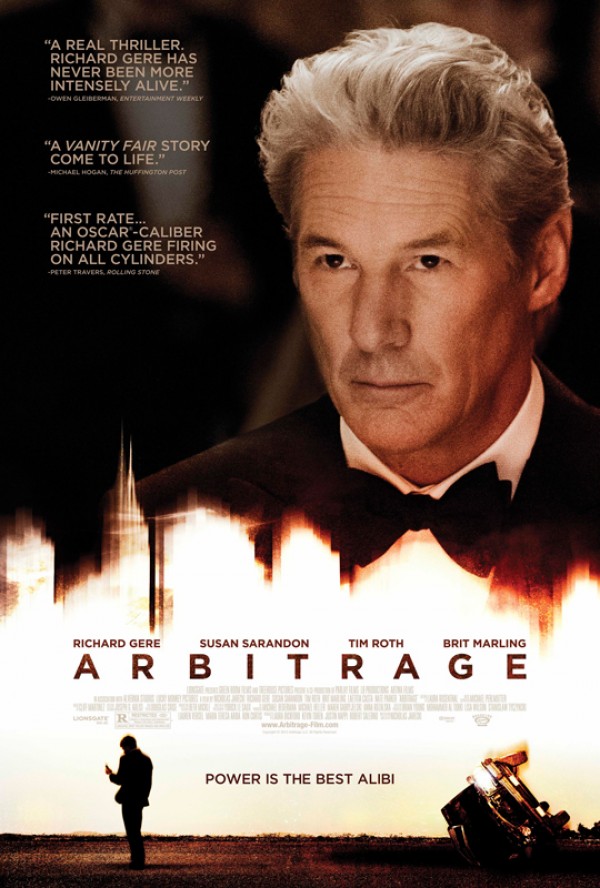
Written and directed by Nicholas Jarecki. Cast: Richard Gere, Susan Sarandon, Tim Roth, Brit Marling, Laetitia Casta, Nate Parker, Stuart Margolin, Chris Eigeman, Reg E. Cathey, Josh Pais. (R, 105 mins)
Early word from the Sundance Film Festival this past January was that the financial thriller ARBITRAGE represented Richard Gere's best work in years. It's been a while since he's had a hit movie, but he's been doing consistently good work, particularly in Antoine Fuqua's criminally underrated BROOKLYN'S FINEST (2010). Acquired by Roadside Attractions, the arthouse wing of Lionsgate, and released on less than 200 screens nationally in addition to VOD, ARBITRAGE looks to be another top-notch Gere performance that few people will see. It's a little disheartening that topical fare like this, for adults, is relegated to a distributor's arthouse subsidiary when 30 years ago, it would've been a major, popular film directed by a Sydney Pollack, a Sidney Lumet, or an Alan J. Pakula. ARBITRAGE is written and directed by Nicholas Jarecki, who made the 2005 documentary THE OUTSIDER (about veteran director James Toback) and comes from a family of documentary filmmakers: brother Andrew directed CAPTURING THE FRIEDMANS (2003), and brother Eugene helmed WHY WE FIGHT (2005) and REAGAN (2011). ARBITRAGE entertains as a thriller, but Jarecki's attempts to turn it into a metaphor for the recent financial crisis aren't always successful.
Big-time NYC hedge fund investment CEO Robert Miller (Gere) is in the process of selling his company, ostensibly to spend more time with his family as he hits 60 years of age, but it's really to deal with a $400 million loss in a botched Russian copper mine investment that's tied up overseas. He's about to be audited as part of the process of selling his firm, so he's clandestinely borrowed $400 million from another firm in an attempt to get by the auditors. That CEO wants his money back now and the CEO he's selling to seems to be avoiding him. There's numerous other fudged numbers in the books that get uncovered by his daughter and protegee Brooke (Brit Marling). As if Miller didn't have enough going on, his Bohemian artist mistress Julie (Laetitia Casta), whose work and lifestyle--expensive apartment, Mercedes, coke habit--are funded by Miller, is demanding more of his time and wants him to leave his wife Ellen (Susan Sarandon). Miller placates Julie with an impromptu romantic getaway, but briefly dozes at the wheel of her Mercedes and wrecks the car. The accident kills Julie, and an injured Miller, with a cut on his head, broken ribs, and probable internal bleeding, flees the scene as the car goes up in flames. His desperate attempt to cover up the accident ends up causing trouble for Jimmy (Nate Parker), the son of Miller's late former limo driver, when Miller calls Jimmy from a pay phone and asks him for a ride back to the city. Miller's attorney (Stuart Margolin!) advises him to turn himself in immediately because no matter how well he's covered his tracks, they're going to trace it back to him. Instead, Miller, who's spent his career taking chances and ignoring the odds, and became a billionaire for it, arrogantly assumes he can handle the situation on his own, even as it spirals more out of control by the minute.
Miller is a guy who sees everything as a business negotiation. He doesn't count on the dogged street smarts of homicide detective Bryer (Tim Roth), a rumpled, unkempt, cynical sort who seems like a descendant of Columbo. Bryer sees something fishy from the start, starting with Julie's charred body being in the passenger seat of the Mercedes ("Who kicked the driver's side door open?" he immediately asks his partner). Jarecki seems to be setting up an interesting battle of wits--and economic class--between Miller and Bryer, but it gets dropped for a large chunk of the film and once Bryer re-enters the story, Jarecki has him do something so clownishly unlikely that it just doesn't ring true. Miller figures he can finesse Bryer and Bryer, with his ill-fitting, wrinkled attire, slumped posture, four-day beard, and broad Noo Yawk accent, has a huge chip on his shoulder about "rich assholes" like Miller. Jarecki wants to show how wheelers & dealers like Miller run the show and get off or get bailed out and Everymen like Bryer pay the price, but it's not handled in a credible way. From the way Bryer is introduced and the way he's played by Roth, he's too wily to do what he ultimately does in an improbable third-act twist. Miller is a guy who's always been able to get out of sticky situations, and it goes without saying that a guy who commits investment fraud, cheats on his wife, flees the scene of a fatal accident, and almost throws his own daughter under the bus with his off-the-books machinations, puts himself first and thinks he can emerge unscathed and likely will. It's quite suspenseful watching a perfectly-cast Gere squirm, sweat, grimace, and panic as everything starts to fall apart. The film's key line comes when Parker's Jimmy, who has a gun charge in his past and faces ten years in prison for obstruction unless he cooperates with Bryer, finally realizes that Miller views him as expendable and scoffs at a tactless attempt to buy his silence and pay him for any jail time with a $2 million trust: "You think money's gonna fix this?" An incredulous Miller replies "What else is there?"
AN OFFICER AND A GENTLEMAN was perhaps 1982's stealthiest blockbuster. It opened with little fanfare on July 30 and didn't have its biggest week until September. It remained in the top five until December, only taking the top spot twice, but it made just under $130 million to became the third highest-grossing film of the year. The film, directed by Taylor Hackford (THE IDOLMAKER) and written by Douglas Day Stewart (THE BOY IN THE PLASTIC BUBBLE, THE BLUE LAGOON), is predictable and manipulative (especially the storybook finale), but it's got some strong performances and for the most part, it's aged well. Aimless, troubled, and angry Zack Mayo (Richard Gere), still not over his mother's suicide when he was child, joins the Navy as a way out of his dead-end life with his drunk father (Robert Loggia), whose idea of bonding is getting a prostitute for the two of them to share. He befriends fellow recruits Sid Worley (David Keith) and Casey Seeger (Lisa Eilbacher), clashes with drill sergeant Foley (Louis Gossett, Jr), and falls in love with local factory worker Paula Pokrifki (Debra Winger) who, along with her best friend Lynette (Lisa Blount) dream of finding a Navy man to whisk them away from their dead-end jobs so they can see the world. Gere is very good as the irresponsible Mayo (aka "Mayo-naise," aka "Mayo the Wop"), who finally learns how to be a man once he's away from his loser father (fourth-billed Loggia exits the film before the opening credits, and spends most of his screen time scratching his balls), and it's he and Winger's considerable onscreen chemistry that made this the massive hit that it became. That, and the hugely popular Joe Cocker/Jennifer Warnes theme song "Up Where We Belong."
The song got an Oscar, and the Best Supporting Actor Oscar went to Gossett, who's fine in the role, but there's really nothing exceptional in his performance (and the Oscar curse led him straight to 1983's ill-advised JAWS 3-D). Of course, this was before R. Lee Ermey rewrote the book on cinematic drill sergeants five years later in FULL METAL JACKET (some of Ermey's dialogue seems to have been taken from here, as Gossett mentions "steers & queers," and threatens to gouge out Sid's eyes and "skullfuck" him). Winger first gained notice in 1980's URBAN COWBOY and helped provide the voice of E.T.: THE EXTRA-TERRESTRIAL, and received the first of her three Oscar nominations here, and this film was big enough for her that it managed to get her top billing over established stars Shirley MacLaine and Jack Nicholson in the next year's TERMS OF ENDEARMENT. Winger, who famously clashed with MacLaine and quickly earned a reputation for being "difficult," has never been as vulnerable and appealing as she is here. Gere, coming off of AMERICAN GIGOLO, has been in a lot of big movies but has never really gotten the respect he's deserved as an actor. Watching the film again after many years, I was surprised at how good Gere is in this--not just in his interaction with Winger, Keith, or Gossett (the boot camp scenes are beyond formulaic), but most impressively in the scene where Mayo sacrifices his chance at the obstacle course record to help Seeger over the wall. It's audience manipulation at its most blatant, but Gere and the charming Eilbacher (why was she never a bigger star?) sell the hell out of it. But was it necessary for Mayo and Foley to settle their differences with a martial-arts match-up?
Ron Howard previously directed and starred in 1977's GRAND THEFT AUTO for Roger Corman, but NIGHT SHIFT was his first theatrical feature as a director since leaving HAPPY DAYS to focus on a career behind the camera. Working from a script by regular collaborators Lowell Ganz & Babaloo Mandel, Howard brought along his TV co-star Henry Winkler and created one of the most immensely likable comedies of the year. It would probably rank as a comedy classic if it didn't lose momentum in the last third and drag on a bit longer than necessary. Winkler stars as Chuck Lumley, a mild-mannered night shift attendant at the NYC morgue, but from the very moment he's introduced, the film belongs to a debuting Michael Keaton in a star-making performance as his new assistant, fast-talking "idea man" Bill "Billy Blaze" Blazejowski.
With the help of Chuck's prostitute neighbor Belinda (Shelley Long), Chuck and Bill begin running a profitable prostitution ring out of the morgue. Winkler and Keaton are a great team, and after several years of doing stand-up and assorted TV roles, Keaton immediately established himself as a major new comedic talent, and in the coming years, would prove to be just as adept in serious roles as well. Long was a few months away from starring in CHEERS, and the film also features appearances by Bobby DiCicco (who gets the immortal line "Oh, that Barney Rubble...what an actor!"), Richard Belzer, Joe Spinell, Nita Talbot, an ass-baring Michael Pataki, Vincent Schiavelli, Cassandra Gava (the witch in CONAN THE BARBARIAN), a young Shannen Doherty as a girl scout, and Kevin Costner as "Frat Guy #1" (he's at the party in the morgue, behind Keaton as he's balancing a beer bottle on his forehead), in addition to the inevitable Clint Howard.
The soundtrack features songs written by Carole Bayer Sager and Burt Bacharach, including the title track by Quarterflash (still riding high on "Harden My Heart"), Al Jarreau's "Girls Know How," and Rod Stewart's version of "That's What Friends Are For," which became a chart-topping charity single for Dionne Warwick and Friends (Elton John, Gladys Knight, and Stevie Wonder) in 1985. Other songs on the soundtrack include Van Halen's cover of "You Really Got Me," Talk Talk's "Talk Talk," and two songs by Riggs, a band that Warner Bros. got on the HEAVY METAL soundtrack as well, and were thoroughly unsuccessful at convincing the world to give a shit.
Also in theaters this weekend was the Chuck Norris thriller FORCED VENGEANCE. Norris was slowly building a name for himself with drive-in hits like BREAKER! BREAKER! (1977), GOOD GUYS WEAR BLACK (1978), A FORCE OF ONE (1979), and THE OCTAGON (1980). AN EYE FOR AN EYE (1981) moved him closer to mainstream action and SILENT RAGE (1982) mixed Norris action into a sci-fi/horror story. Four months after SILENT RAGE hit theaters, Norris was in theaters again with FORCED VENGEANCE, which finds him in more familiar surroundings as a casino security guard taking on the crime syndicate of Hong Kong. The relentlessly busy Norris next did LONE WOLF MCQUADE (1983) and then had his first bona fide box office smash with MISSING IN ACTION (1984). FORCED VENGEANCE was directed by Clint Eastwood protege James Fargo, who served as an assistant director on several Eastwood films throughout the '70s before the star let him direct THE ENFORCER (1976) and EVERY WHICH WAY BUT LOOSE (1978). Fargo left the Eastwood stock company in 1978, doing the box-office bombs CARAVANS (1978) and GAME FOR VULTURES (1979). FORCED VENGEANCE grossed $6.5 million and was the closest thing Fargo had to a hit without Eastwood, and by 1984, he was directing Pia Zadora in VOYAGE OF THE ROCK ALIENS before settling into a TV career (directing episodes of THE A-TEAM, SCARECROW AND MRS. KING, and HUNTER), with occasional B-movie assignments. After directing a low-budget 1998 kids movie called SECOND CHANCES, Fargo went MIA but finally emerged from obscurity after 13 years with BORN TO RIDE (2011), a straight-to-DVD SONS OF ANARCHY knockoff, with Casper van Dien and Patrick Muldoon reuniting from STARSHIP TROOPERS.
TEX was the first of a string of S.E. Hinton adaptations to hit screens from 1982 to 1985. Directed by Tim Hunter, who went on to make RIVER'S EDGE (1987), TEX stars Matt Dillon and Jim Metzler as two teenage brothers whose father (Bill McKinney) abandons them after their mother dies. It's a typical Hinton coming-of-age drama, with younger brother Tex (Dillon) forced to grow up fast and big brother Mason (Metzler) shouldering the responsibility of raising his little brother. The fine supporting cast includes the great Ben Johnson, Meg Tilly, and a young Emilio Estevez as a friend of Tex's. Dillon and Estevez would become almost the de facto faces of S.E. Hinton on the big screen, starring with an army of young, promising talent (Patrick Swayze, Tom Cruise, Rob Lowe, and others) in Francis Ford Coppola's THE OUTSIDERS (1983) and Dillon would also star in Coppola's second Hinton adaptation, RUMBLE FISH, later in 1983. Estevez wrote and starred in 1985's THAT WAS THEN...THIS IS NOW, leaving 1988's Taming the Star Runner the only one of Hinton's young-adult novels that hasn't been made into a film involving either Matt Dillon or Emilio Estevez.
1. E.T.: THE EXTRA-TERRESTRIAL
2. THE BEST LITTLE WHOREHOUSE IN TEXAS
3. AN OFFICER AND A GENTLEMAN
4. YOUNG DOCTORS IN LOVE
5. NIGHT SHIFT
6. ROCKY III
7. THE WORLD ACCORDING TO GARP
8. SIX PACK
9. POLTERGEIST
10. RAIDERS OF THE LOST ARK (re-release)