tenebre

tenebre
Showing posts with label Susan Sarandon. Show all posts

Thursday, May 7, 2020

On Blu-ray/DVD/VOD: THE JESUS ROLLS (2020) and ARKANSAS (2020)


THE JESUS ROLLS
(US/France - 2020)


The Coen Bros. have made it clear that there's never going to be a sequel to their beloved 1998 cult classic THE BIG LEBOWSKI, but they did give John Turturro their blessing to move forward with his labor-of-love spinoff THE JESUS ROLLS. Turturro's Jesus Quintana, a trash-talking bowling rival of The Dude, Walter, and Donny and a convicted pederast ("Eight-year-olds, Dude"), only had a couple of scenes in THE BIG LEBOWSKI, but the actor turned a minor character into a fan favorite, complete with his teasing lick of the bowling ball, his triumphant strike dance, and his catchphrase "Nobody fucks with the Jesus!" Jesus was funny in those two very small doses, but is there enough there to carry his own movie? Turturro certainly thought so, and spent years writing this during his downtime between other projects before finally shooting it way back in 2016. The fact that it took this long to get a limited release followed by VOD is the big red flag that this is decidedly not THE BIG LEBOWSKI II: THE JESUS ROLLS. It is, however, a remake of Bertrand Blier's controversial 1974 French film GOING PLACES, about two road-tripping buddies and petty criminals (one of them a young Gerard Depardieu) and their sexual exploits, with the two of them eventually sharing a young hairdresser's assistant who tags along on their aimless journey.


In THE JESUS ROLLS, Jesus is paroled from Sing Sing (wasn't it Chino in LEBOWSKI?) after serving six months for indecent exposure, with a farewell conversation with the warden (Christopher Walken, dropping by for two minutes to play "Christopher Walken") revealing that the whole pederast charge was a misunderstanding when an eight-year-old kid two urinals over in a men's room caught a glimpse of Jesus' huge dick and asked him about it. Greeted by his ex-con buddy Petey (Bobby Cannavale), the two immediately steal the muscle car of obnoxious hairdresser Paul Dominique (Jon Hamm) and take his girlfriend Marie (Audrey Tautou) with them. So begins an episodic road movie, with homoerotic overtures between Jesus and Petey (Jesus tries to seduce him at one point, telling a reluctant Petey "Take it easy, man...it's OK between friends"), and the two eventually forming a throuple with Marie, who's slept with 374 men but has never experienced an orgasm (among those 374 is Jesus' bowling sidekick Liam, who's mentioned but never seen). They get separated on a few occasions--Jesus and Petey end up having an expensive dinner and a motel threesome with "767" (Susan Sarandon), who's just been released after a long stretch in a women's prison, and later touch base with her just-paroled son (Pete Davidson), who becomes the first man to bring Marie to orgasm.

THE JESUS ROLLS


GOING PLACES

You think Turturro showed this to Joel and Ethan Coen? Because I'd pay to see their reaction to it. Watching the Coens watch THE JESUS ROLLS has to be more entertaining than just watching THE JESUS ROLLS. There's just one moment in its seemingly endless 85 minutes that I found even remotely amusing (Petey looking at a porno mag and declaring "Vanessa Del Rio is underrated!"), and it's hard telling why Turturro thought dropping Jesus into a ponderous remake of GOING PLACES was a good idea. Did he really want to direct a remake of GOING PLACES but found that shoehorning Jesus Quintana into it was the only way he could secure funding? You think it's a bad sign that THE BIG LEBOWSKI, arguably the most quotable comedy since CADDYSHACK, gets a spinoff with a memorable character and still takes over three years to find a distributor? The closing credits still display a 2017 copyright. Turturro tries to placate the LEBOWSKI superfans, blowtorching through Jesus' greatest hits in the early-going with numerous references and callbacks to give everyone what they came for (there's the mention of Liam, and Jesus says "Nobody fucks with the Jesus" twice, threatens to stick a gun up someone's ass and "pull the fucking trigger till it goes 'click,'" and does his cunnilingual bowling ball tongue move). But once he fulfills those obligations, THE JESUS ROLLS just becomes a miserable slog and an utterly pointless Turturro vanity project. A little of the Jesus goes a long way, and even the always-charming Tautou grates in the worst performance of her career. Turturro called in some favors from actor friends (Sarandon, Walken, Hamm, JB Smoove as a mechanic, Sonia Braga as Jesus' prostitute mother, Gloria Reuben as a restaurant owner, Michael Badalucco as a store security guard, Tim Blake Nelson as a doctor), but the ill-advised THE JESUS ROLLS--which technically isn't a sequel but still deserves to be mentioned in the same breath as other decades-late, legacy-defiling hosejobs like EASY RIDER: THE RIDE BACK and RAGING BULL II before its court-ordered title change to THE BRONX BULL--is a tedious, self-indulgent, borderline unwatchable disaster. Turturro shouldn't have fucked with the Jesus. (R, 85 mins)


ARKANSAS
(US/UK/Luxembourg - 2020)

Based on a 2009 novel by John Brandon, ARKANSAS belongs to that moody BLUE RUIN and BAD TURN WORSE subgenre of dark crime films. It wears its influences on its sleeve, with its Tarantino-inspired multiple narratives jumping between 1985, 1988, and the present day, and being a bleak Southern noir with doomed and frequently dim characters making bad decisions, it recalls the bleakly comedic crime sagas of the Coen Bros. It's also not the kind of film one would have expected to be the writing/directing debut of HOT TUB TIME MACHINE/late-period OFFICE co-star and hipster dweeb Clark Duke. A man-bunned Duke also co-stars as Swin who, along with Kyle (Liam Hemsworth), are two low-level drug couriers for Frog, a feared crime lord in the Dixie Mafia (described by Kyle as less an organized crime outfit and more "a loose affiliation of deadbeats and scumbags") who they've never even met. They're taking a shipment from Little Rock to Corpus Christi when they're intercepted by Bright (John Malkovich, who also starred with Hemsworth in the 2015 Coen riff CUT BANK), a Frog associate who uses his full-time job as a park ranger as cover. Under Frog's orders, Bright puts the two of them to work at the park, but a series of incidents--starting with the idiot grandson (Chandler Duke) of a Louisiana drug distributor (Barry Primus) deciding to follow Kyle and Swin back to Bright's house and retrieve the money they collected--sends things south. Complicating matters is that, despite being told to avoid socializing with the locals, the irritating Swin has taken up with cute nurse Johnna (Eden Brolin, Josh's daughter), after a meet-creepy in a Piggly Wiggly, in what co-writer Clark Duke and director Clark Duke no doubt thought was the perfect plot development for the character played by Clark Duke.


The early going is interesting enough, and Malkovich gets to Malkovich it up in his brief screen time, but ARKANSAS really comes alive when Duke goes for two long flashbacks to 1985 and 1988, showing the establishment of Frog's criminal empire. Frog is played by Vince Vaughn, who appears in the present day scenes a mystery man running a junky pawn shop, and though the viewer knows he's Frog, Kyle and Swin do not, and while Duke might've thought that would be a source of suspense, it's an aspect that sort-of fizzles. But it's the flashback sequences detailing Frog's origin story that are the best parts of ARKANSAS, showing his almost accidental rise from running a tiny pawn shop/flea market in West Memphis to becoming a major player in the Deep South drug trade under the tutelage of fireworks store owner Almond (Michael Kenneth Williams). Duke really establishes a hypnotic mood in these sequences, augmented by some hauntingly ethereal and strangely eerie Flaming Lips covers of Hank Williams Jr's "A Country Boy Can Survive" and "In the Arms of Cocaine," and The Band's "The Night They Drove Old Dixie Down." The film's tone and style give it the same feel that a lot of movies have nowadays--that of an entire season of a cable series that's been whittled down to two hours--but Vaughn's character is so intriguing and his sections so well-executed (The Flaming Lips really need to release these songs on a covers album) that the rest of ARKANSAS can't help but pale in comparison when Duke returns to the comparatively ho-hum main plot involving Kyle and Swin. Some occasionally funny dialogue helps (Kentucky-born Swin complaining about how his many sisters are destined to be working in a strip joint and quipping "One's already named Cinnamon!"), but it's hard to watch this and not think a stronger film could've resulted had it just been about the rise of Frog, as Vaughn does a much better job of commanding the screen than either Hemsworth or Duke. Originally intended to screen at the 2020 SXSW before the festival was canceled over coronavirus concerns, ARKANSAS was ultimately relegated to a same-day VOD/DTV release by Lionsgate. It's a mixed bag when it's all over, and while it doesn't always work, it makes a much more credible case for itself than you'd expect from Clark Duke directing a downer crime saga more in line with a Jeremy Saulnier or a Macon Blair. (R, 117 mins)

Saturday, September 27, 2014

On DVD/Blu-ray: THE CALLING (2014); THE SIGNAL (2014); and RAMPAGE: CAPITAL PUNISHMENT (2014)

THE CALLING
(Canada/US - 2014)


After nearly 45 years in the industry, 66-year-old Susan Sarandon has spent the last several years dealing with the unforgivable sin of being an aging woman in Hollywood essentially by staying in the game and taking whatever roles come her way. It doesn't seem like it was that long ago that she was still headlining major movies, but now she usually turns up in supporting roles as somebody's mother or grandmother. Lead roles have been few and far between for the Oscar-winning actress of late, so one can see why she might jump at something like the modestly-budgeted thriller THE CALLING. Sarandon stars as Hazel Micallef, a hard-drinking, pill-popping detective in Fort Dundas, a small town outside of Hamilton, ON. Also functioning as the de facto police chief, Hazel is confronted with a rare homicide in one of those sleepy towns where everybody knows everybody (it's fictional, though there is a Dundas, ON, where most of this was shot) when an elderly family friend is found with her throat slashed and her mouth set open in an unnatural way that the medical examiner says was staged post-mortem. A victim killed under similar circumstances is found in a nearby town, and Hazel, partner Ray Green (Gil Bellows), and big-city transfer Ben Wingate (Topher Grace) are convinced they're dealing with a serial killer after finding links between their victims and seven other unsolved murders across Canada.


THE CALLING starts falling apart about midway through, but for a while, it seems like it'll shape up to be a genuine sleeper. It's sort of like a less grim SE7EN restaged in the snowy environment of a FARGO, with a legitimately unusual set of clues that set things in motion: the killer (nicely underplayed by a well-cast Christopher Heyerdahl) has positioned the mouths of the victims in a way that forms silent words when autopsy head shots are viewed in quick succession in the order they were killed. Using the autopsy photos like a morbid flip book, the detectives are forced to sound out and decode the killer's message to them. They discover this a little too easily and it's a gimmick straight out of a CBS procedural, but it's off-the-wall enough to be intriguingly creepy. THE CALLING went straight to VOD in early August and ended up in a few theaters on the last weekend of summer with no publicity whatsoever. In the late '90s, it probably would've been a big hit but today, there's just no mainstream, multiplex market for serious, straightforward genre pictures for adults, especially one focused on a 66-year-old star, regardless of the fact that she looks a decade younger. But it's eventually all for naught, as rampant stupidity takes over, whether Hazel drives a great distance to visit a linguistics expert priest (Donald Sutherland) to get the definition of a Latin term when she could've just as easily called him or Googled it. Or when Wingate voluntarily traipses all over Canada to do some snooping and Hazel recklessly orders him into a dangerous situation with no backup that, of course, doesn't pan out well for him (this is after telling him to withhold information from neighboring police departments). THE CALLING starts out with smarts but eventually turns into the kind of thriller where the killer taunts Hazel over the phone with a "Did you get my package?" as the camera pans to an unopened package right in the middle of her desk that she's just left there untouched for just such a plot convenience. The killer's motives involve a misguided religious obsession about sacrifice and resurrection, though it eventually becomes overly concerned with Hazel's redemption at the expense of the suspense and the mystery that's been building. Hazel is a damaged and broken woman with a bad back that surgery still hasn't corrected and a tumultuous, on-and-off relationship with a married man, much to the disapproval of her concerned mother (Ellen Burstyn), with whom she lives. Granted, Sarandon looks a good bit younger than 66, and 81-year-old Burstyn (also looking younger than her age) could logistically be her mother, but the casting just doesn't work and the filmmakers (director Jason Stone and screenwriter Scott Abramovitch) give the great Burstyn absolutely nothing to do.  THE CALLING gets off to a promising start but never recovers once it starts skidding, though it does give Sarandon the opportunity to deliver a priceless line of dialogue like "I think I found the stomach." (R, 108 mins)


THE SIGNAL
(US - 2014)


There's style and ambition to this twisty, low-budget mind-bender that only made it to 120 screens over the summer but seems destined for cult status. Or, more accurately, director/co-writer William Eubank seems destined for bigger things. Eubank and his crew work wonders with a $4 million budget, assembling something that looks better than a lot of films that cost 25 times as much. It's too bad THE SIGNAL (not to be confused with the overrated 2008 horror film) gets bogged down with a draggy pacing (yes, this one's a slow-burner) and a twist ending that creates more questions than it answers, wanting to be Shane Carruth but ending up feeling more like M. Night Shyamalan at his most eye-rolling. There's a lot going on in THE SIGNAL that probably warrants a second viewing, but there's a lot of frustrating misdirection and time-killing as well, and the one twist prior to the big twist is entirely too easy to figure out. Three MIT students--Nic (Brenton Thwaites of OCULUS and THE GIVER), his girlfriend Haley (Olivia Cooke, one of the few positives of THE QUIET ONES), and their friend Jonah (Beau Knapp)--are road-tripping to California, where Haley is transferring to a new school. Nic was recently diagnosed with muscular dystrophy and is using forearm crutches, and is certain that Haley is using this opportunity to distance herself from him. The three were nearly expelled after a computer hacker known as "Nomad" got into the MIT servers and left evidence pointing to them. Nic and Jonah are also using the trip to track down Nomad, who they've traced to somewhere in the Nevada desert. While searching Nomad's shack of a house in the middle of nowhere, Haley is lifted into the air by an unseen force, Jonah vanishes, and Nic blacks out.  He awakens in a sterile, underground government bunker with "2.3.5.41" tattooed on his arm and is interrogated by HazMat-suited scientist Wallace Damon (Laurence Fishburne), who informs Nic that the three of them encountered an EBE (Extraterrestrial Biological Entity) and may be contaminated. Damon is intentionally evasive with Nic and is constantly changing his story. Nic eventually finds Haley in another part of the facility and manages to escape, with Damon warning "I can protect you down here...I can't protect you from what's up there."


Nor can Eubank protect himself from hackneyed plot developments and other contrivances. Visually, the film has moments that recall the work of Stanley Kubrick, Douglas Trumbull, Andrei Tarkovsky, and, to cite a more recent example, Duncan Jones. While arresting visuals show that Eubank is a contender, THE SIGNAL isn't nearly as successful on the script end as its numerous cerebral, hard sci-fi influences such as 2001: A SPACE ODYSSEY, SILENT RUNNING, or SOLARIS. Thwaites and Cooke are engaging leads, and Fishburne is appropriately obfuscating in his demeanor, but at some point, you start to feel like you're being strung along and ultimately, the reveal isn't worth the incredibly elaborate buildup. Still, there's a lot to appreciate in THE SIGNAL. Judging from what he's done here, with a better script, there's no limit to what Eubank is capable of achieving in the sci-fi genre. He's not quite there, but he's well on his way. (PG-13, 97 mins)


RAMPAGE: CAPITAL PUNISHMENT 
(Canada - 2014)


A gushing love letter to mass shooters everywhere, Uwe Boll's RAMPAGE: CAPITAL PUNISHMENT is too heavy-handed to pass as satire and too dumb to even be deemed irresponsible. This sequel to Boll's RAMPAGE (2010) with thematic ties to his ASSAULT ON WALL STREET (2013) finds the filmmaker in full-on "poking people with sticks" mode as "hero" Bill Williamson (Brendan Fletcher) emerges from hiding after the first film's titular killing spree to take on American corruption and hypocrisy. He starts by sitting in an alley and picking off random pedestrians (Boll, ever ready for a sick joke, makes sure a Target location is prominently displayed in the background) before shooting up the local TV station and taking gasbag news anchor Chip Parker (Lochlyn Munro) and some staffers hostage. Bill wants Chip to play his DVD manifesto and get his message out nationwide, which basically involves Fletcher (who shares a writing credit with Boll) getting far too much self-indulgent wiggle room as Bill expresses his admiration for Julian Assange and Edward Snowden and rants about topics as varied as the Bush and Obama administrations, politicians, lawyers, global warming, Wall Street, reality TV, Hollywood actors, Steven Spielberg, Anderson Cooper, and Botox.


Like most Boll movies, RAMPAGE was terrible, but the short-statured Fletcher was well cast as a ticking time bomb with a huge chip on his shoulder. The film was little more than FALLING DOWN JR, as Bill, seething with disenfranchised white-guy rage courtesy of cable news and right-wing talk radio, stockpiled weapons and went on a killing spree throughout his city. Here, Boll and Fletcher try to turn him into a modern messiah. Boll at least seems to briefly recognize that Bill is a deranged madman and a hypocrite--witness the way Bill rails against the insipid nature of media hype while spending hostage situation downtime checking his Twitter feed--but the filmmaker clearly still likes him. Whatever valid points Boll has to make--and there are some--are drowned out by the endless repetition of Fletcher's over-the-top performance as Bill quickly becomes your most humorless and annoying Facebook friend from high school. But even beyond that, RAMPAGE: CAPITAL PUNISHMENT is sunk by stupidity and tastelessness, like Bill's babbling on about "extermination" and "cleansing," obviously more transparent Holocaust jabs that Boll loves so much. Boll and Fletcher's script is wildly inconsistent: Bill chooses Chip Parker because he's "the Voice of America," yet it's established early on that Parker is just a local news star, plus Boll himself plays the greedy and unscrupulous station manager, selling footage of the hostage situation to the networks for millions. Also, after blowing up his house, Bill gets in his car and pays a visit to the first film's bingo "centre" where he spared a group of elderly folks from his rampage because they're "already dead." The bingo centre is closed, but it leads to an interesting observation beyond Boll neglecting to disguise his Canadian locations:  Bill is a fugitive responsible for the largest mass shooting in American history depicted in the first film, and judging from the opening sequences of the sequel, he seems to have been on the run by...hiding out in the same town where he's always lived. And where does he get his money to have guns and bombs and cars stationed all over town?  He was working part-time and living with his parents in the first film.


But nevermind--RAMPAGE: CAPITAL PUNISHMENT isn't about logic, it's about Boll shamelessly panhandling for attention and controversy. Certainly there was a way to turn Bill into a modern-day Howard Beale without having him take pleasure in killing an untold number of innocent people. Boll's misanthropy lacks the nuance and focus of a NETWORK and instead too often comes off like a tantrum-throwing child in desperate need of a time-out. Boll and Fletcher think they're being edgy and subversive, but they really look like assholes by the end of this thing. At least with ASSAULT ON WALL STREET--however bungled it was--the audience was supposed to take some degree of cathartic pleasure in watching Dominic Purcell mow down financial industry sociopaths. What are you supposed to take from something like this? What's next for Boll and Fletcher? The Columbine massacre reimagined as a wacky buddy comedy?  A dramatization of the Aurora tragedy where the victims had it coming for paying to see a Hollywood product like THE DARK KNIGHT RISES? (Unrated, 93 mins, also streaming on Netflix Instant)


Tuesday, May 6, 2014

Cult Classics Revisited: KING OF THE GYPSIES (1978)

KING OF THE GYPSIES
(US - 1978)

Written and directed by Frank Pierson. Cast: Sterling Hayden, Shelley Winters, Susan Sarandon, Judd Hirsch, Eric Roberts, Brooke Shields, Annette O'Toole, Annie Potts, Michael V. Gazzo, Antonia Rey, Stephen Mendillo, Roy Brocksmith, Matthew Labyorteaux, Danielle Brisebois. (R, 112 mins)

It's easy to forget that there was once a time in the early 1980s when critics were routinely hailing Eric Roberts as one of the greatest actors of his generation.  His performances as tragic Playboy Playmate Dorothy Stratten's estranged, possessive husband and eventual murderer Paul Snider in Bob Fosse's STAR 80 (1983) and as a dim-witted, small-time criminal in Stuart Rosenberg's THE POPE OF GREENWICH VILLAGE (1984) showed a raw, intense talent unlike any other leading men of the time, with the possible exception of his POPE co-star Mickey Rourke. Roberts wasn't generating big box office numbers but there was no denying that he was the real deal and an actor's actor. He received international acclaim for Yugoslav auteur Dusan Makavejev's offbeat comedy THE COCA-COLA KID (1985) and in just his sixth film, scored a Best Supporting Actor Oscar nomination for Andrei Konchalovsky's RUNAWAY TRAIN (also 1985).  He lost to Don Ameche in COCOON, and that Oscar nod would prove to be his career pinnacle.  Word of his being "difficult" along with drug abuse and instances of assaulting a police officer and domestic violence would tarnish his image over the next decade, the same decade that saw his younger sister Julia, from whom he would soon be estranged for many years, skyrocket to the kind of worldwide fame and fan adoration that he would never receive.  Roberts wasn't exactly blackballed out of Hollywood, but the accolades that culminated in a potential Oscar for RUNAWAY TRAIN led to nothing more than the little-seen romantic comedy NOBODY'S FOOL (1986), the period drama BLOOD RED (where he used his clout to get Julia a small role in her first acting job), which was filmed in 1986 and went straight-to-video three years later, and some made-for-TV movies. By 1989, Roberts was playing a replacement Tommy Chong to Cheech Marin in RUDE AWAKENING and starring in the kickboxing actioner BEST OF THE BEST, while Julia was getting her first Oscar nod for STEEL MAGNOLIAS and was about to star in PRETTY WOMAN.  In just a decade, Roberts went from being the Marlon Brando of his day to the misbehaving, troublemaking older brother of America's Sweetheart and one of the signature faces of straight-to-VHS in the 1990s.


But back in 1978, 22-year-old Roberts came storming out of the gate, earning a Golden Globe nomination for Best Motion Picture Acting Debut for his performance in KING OF THE GYPSIES, written and directed by Frank Pierson.  Pierson got his start writing for TV shows like HAVE GUN, WILL TRAVEL and NAKED CITY, and created the acclaimed but short-lived 1971 James Garner TV series NICHOLS.  He received Oscar nominations for his CAT BALLOU (1965) and COOL HAND LUKE (1967) screenplays and also wrote the Sidney Lumet apartment heist favorite THE ANDERSON TAPES (1971).  Pierson won a Screenplay Oscar for Lumet's DOG DAY AFTERNOON (1975), which got him enough clout to tackle the 1976 remake of A STAR IS BORN with Barbra Streisand and Kris Kristofferson. That was his second directing effort, the first being 1970's THE LOOKING GLASS WAR, his strangely inert adaptation of the John Le Carre spy novel that's best known for a brawl-for-the-ages between Christopher Jones and Anthony Hopkins, but stumbles badly in the second half when Pierson turns it into his own tedious version of an ennui-drenched Antonioni film.  But after blockbusters like DOG DAY AFTERNOON and A STAR IS BORN, he was essentially able to make whatever he wanted, which led him to KING OF THE GYPSIES, a very loose adaptation of the non-fiction book by Serpico and The Valachi Papers author Peter Maas (the credits read "Suggested by the book..." rather than "Based on the book..."), and by "very loose," I mean "uses the title and little else." What Pierson's film does is basically take the concept of the modern-day gypsy--and all the stereotypes that come with it--and fashion it into a de facto reworking of THE GODFATHER with gypsies in place of gangsters.  It's not a bad idea as far as commercial entertainment goes, but, like THE LOOKING GLASS WAR, KING OF THE GYPSIES starts out strong and and loses its way.


Shot in NYC in early 1978 in the snowy aftermath of the legendary blizzard that dumped on the midwest and moved east, KING OF THE GYPSIES tells the story of a gypsy tribe led by the fierce and ruthless King Zharko Stepanowicz (Sterling Hayden) and his wife Queen Rachel (Shelley Winters).  Years earlier, Zharko abducted Rose, the teenage daughter of rival tribe leader Spiro Giorgio (Michael V. Gazzo), when Giorgio tried to back out of a deal that would've seen Rose marry Zharko's despicable son Groffo (when Giorgio justifies his actions by saying "She hates him!" old world Zharko replies "Since when did 'like' or 'not like' have anything to do with marriage?").  When a tribal council rules against Zharko, the old man refuses to be "fucked like a $3 whore" and takes what he believes is his.  Eventually, Rose (Susan Sarandon) enters a loveless marriage with drunken, abusive Groffo (Judd Hirsch, right around the time TAXI was taking off) and they have a son, Dave. Growing up, young Dave assists his mother in scams and thefts as Groffo continues to be an drunken lout earning the perpetual disdain of his father, who sees in Dave everything Groffo is not.  As a young adult (Roberts appears 40 minutes in), Dave gets by on insurance money he scams from staging car accidents and slip-and-falls in grocery stores, but he has bigger dreams outside of the sheltered gypsy world. He gets a job as a singing waiter in a restaurant and starts dating pretty Sharon (Annette O'Toole), but King Zharko is determined to pull him back into the family and marry Persa (Annie Potts, who gets the film's most 1978 bit of dialogue with "His family's got a Betamax!"). Zharko is dying, and recognizing that Groffo would be the Joffrey Baratheon of gypsy kings, wants Dave to be his successor. When the old man passes and Dave holds the medallion and ring signifying his kingship, Groffo is so enraged that he hires two men to kill his son.  They fail, and Dave gets back at his father by attempting a daring rescue of his 12-year-old sister Tita (Brooke Shields), who Groffo's just sold for $6000 (that he's already lost at the track) in a hastily-brokered deal with another tribe leader (Roy Brocksmith) who's arranging a marriage for his own very Groffo-like son.  The story then turns into an almost TAXI DRIVER redux as a shotgun-toting Dave goes full vigilante against his father.


David Grisman's score has cues that recall the work of Nino Rota, but the GODFATHER parallels throughout KING OF THE GYPSIES go beyond that:  Zharko is Vito Corleone, Dave is Michael (though he's even more reluctant to get involved, he eventually fulfills that role), and Groffo displays some characteristics of Sonny, though Sonny's worst offense is that he was impulsive and bad-tempered, even though he thought he was doing the right thing for the family. Groffo puts himself first and has no redeeming qualities, whether he's selling his daughter, gambling away his money, or beating Rose, ripping her shirt off and violently shoving Dave's face against her bare breasts in some imagined Oedipal outrage. The very presence of Hayden and Gazzo is another nod, with Hayden's role as corrupt cop McCluskey in THE GODFATHER and Gazzo's Oscar-nominated performance as Frankie Pentangeli in THE GODFATHER PART II. The back end of KING OF THE GYPSIES reeks of either Pierson dropping the ball or Paramount and/or producer Dino De Laurentiis demanding a big, crowd-pleasing finale.  This is a rare instance of a film that would probably be much stronger if it was an hour longer.  Pierson wants this to be an epic, but once Zharko dies, it seems as if he started panicking and realized he only had 30 minutes to wrap this thing up.  When Hayden exits the film, everything after feels rushed and incomplete and the ending is terrible, with Roberts' voiceover--never a good sign--not very confidently mumbling "Maybe I can lead them into the 20th century," demonstrating all the craft, forethought and emotional resonance of a "Poochie died on his way back to his home planet" quick fix.  KING OF THE GYPSIES also has no idea what to do with its female characters--only Sarandon's Rose is given any significant screen time, while the rest are underwritten or simply vanish from the movie (Winters has nothing to do).  Even in the case of Shields' Tita, whose fate should change the course of the story, it's like she was never even there.  It's difficult to tell if this is deliberate, as in the context of this film's depiction of gypsy women as a commodity, or if Pierson simply forgot about her and assumed audiences would too as he turned Dave into a gypsy Charles Bronson.  All of this goes to illustrate that Pierson was a much better screenwriter than a director. Pierson's writing in the hands of a guy like Lumet produces celluloid magic.  Pierson's writing in the hands of Pierson the director seems to show him at odds with himself.  By the time Pierson died in 2012 at the age of 87, he went out on top as a producer on hugely popular TV shows like THE GOOD WIFE and MAD MEN.  He also served as the President of the Academy of Motion Picture Arts and Sciences from 2001 to 2005, and before that, directed acclaimed Showtime and HBO films like SOMEBODY HAS TO SHOOT THE PICTURE (1990), CITIZEN COHN (1992), TRUMAN (1995), DIRTY PICTURES (2000), and CONSPIRACY (2001).  It's also worth noting that he didn't write any of those cable films, which again supports the notion that Pierson was at his best when he didn't have to make directorial decisions that undermined and compromised his own scripts.


If you've seen Roberts in enough shitty movies over the last 25 years, going back to his early days as an ambitious, rising star is a revelation.  Roberts was doing the kind of acting that made Brando and James Dean legends.  He has such an unusual presence in films like this, STAR 80, and THE POPE OF GREENWICH VILLAGE that it's easy to see why some may have found him off-putting in the era of post-JAWS, post-STAR WARS blockbusters.  Young Roberts was the kind of actor who would've flourished in the late '60s and early '70s.  He's terrific as the conflicted would-be king, torn between family (mainly his respect for his grandfather and his concern for his baby sister) and his own dreams ("I'd kinda like to be a surgeon, you know...help people" he haplessly tells Zharko in a scene Roberts and Hayden improvised that's almost an homage to the "I coulda been a contender!" speech in ON THE WATERFRONT).  There are numerous instances where he recalls both Brando and Dean in the way he seems uncomfortable in his own skin and lashes out because of an inability to articulate his emotions, whether he just starts punching a wall or hurling multiple coffee cups across the room.  He's occasionally mannered and jumpy, but it's an extremely impressive debut.  A look at Roberts' IMDb page is a thoroughly depressing experience. His '90s decline still included supporting roles in hit movies like FINAL ANALYSIS (1992) and THE SPECIALIST (1994), with a good lead every now and again (1996's IT'S MY PARTY got him some acclaim but led nowhere), and in recent years, he occasionally turned up in a major film like THE DARK KNIGHT (2008) or THE EXPENDABLES (2010), but these days, apart from sporadic one-shot guest spots on TV shows like CSI, JUSTIFIED, and GLEE, Tom Six's upcoming THE HUMAN CENTIPEDE III is about as high-profile as he gets. He seems incapable of turning down an offer, resulting in bit parts in scores of films that probably won't even get released and probably shouldn't.  How else does one explain Roberts having 66 credits for 2014 alone? And 42 in 2013?  Those are the kinds of cameo gigs where you're on the set for half a day, tops, or where you can literally phone in your performance as the voice of A TALKING CAT!?!  Roberts gave up years ago and is simply taking advantage of name recognition for quick cash (of course, he managed to squeeze in a season on CELEBRITY REHAB, and he and his wife Eliza just appeared on a CELEBRITY WIFE-SWAP episode that also served to alert the world to the continued existence of Robin Leach and Joan Severance).  There's no shame in that and he knows the stuff he's doing is garbage, but it's sad that it's come to that when you see the dynamic, hungry young man in KING OF THE GYPSIES.  Hollywood doesn't know what to do with unconventional actors like Roberts and Rourke.  Their star vehicles bomb and execs usually have them play villains and psychos and the actors get frustrated, sometimes acting out by deliberately sabotaging themselves and their implosions become self-fulfilling prophecies. Obviously, Roberts' career didn't pan out the way he'd hoped, he's burned every bridge along the way and, like Rourke, he'd very likely squander another chance if he got it, but guys like Roberts and Rourke are survivors. Roberts is pushing 60 and shouldn't have to schlep this hard, appearing in so many Z-grade turds that a cameo in Uwe Boll's ASSAULT ON WALL STREET actually qualifies as one of his better recent assignments. Sure, he's always working and he probably lives comfortably, but there must be a serious filmmaker out there with a late-career-defining role for Eric Roberts.  Everybody loves a comeback. Wouldn't it be nice to see him in the kind of WRESTLER-type triumph worthy of his talents?


Wednesday, August 14, 2013

On DVD/Blu-ray: THE COMPANY YOU KEEP (2013) and THE BIG WEDDING (2013)


THE COMPANY YOU KEEP
(US/Canada/Luxembourg - 2013)

Despite one of the most star-studded casts of 2013, THE COMPANY YOU KEEP only made it to 807 screens in the US, just over the threshold required to consider it a "wide" release.  It's a rather sluggishly-paced thriller scripted by frequent Steven Soderbergh collaborator Lem Dobbs (THE LIMEY, HAYWIRE) and scored by ubiquitous Soderbergh regular Cliff Martinez (TRAFFIC, CONTAGION), and you wonder if perhaps Soderbergh could've brought more energy to the film than director/star Robert Redford.  As has been the case in some of his more recent directing efforts like 2007's LIONS FOR LAMBS and 2011's THE CONSPIRATOR, there's a good story that gets bogged down in talking points and speechifying lectures.  While THE CONSPIRATOR is a fine film nonetheless and LIONS FOR LAMBS a bit better than its reputation, THE COMPANY YOU KEEP never really catches fire.  When former Weather Underground activist Sharon Solarz (Susan Sarandon) is nabbed by the FBI in Albany for a 1979 Michigan bank robbery that left a guard dead, her arrest prompts local reporter Ben Shepard (Shia LaBeouf) to dig into her past.  He finds Albany-based lawyer Jim Grant (Redford), a widower and father to 11-year-old daughter Isabel (singing sensation and elderly America's fantasy granddaughter Jackie Evancho), who seems to have no existence before 1979.  That's because Grant is really Nick Sloan, a prominent Weather Underground figure and one of eight suspects still wanted for the 30-year-old crime.  Jim/Nick leaves Isabel with his younger brother Daniel (Chris Cooper) and goes on the run, searching the country for Mimi Lurie (Julie Christie), his ex-lover and the group's most volatile member and, through a convoluted set of circumstances, the only person who can clear his name and verify that he in fact had nothing to do with the robbery.  All the while, Shepard is on his trail, digging up secrets of his past, and the FBI, led by Agent Cornelius (Terrence Howard) is in hot pursuit.


It's based on a novel by Neil Gordon, but I wonder if THE COMPANY YOU KEEP would've been a more challenging, politically-charged film if Redford had the courage to present his character as a killer who saw the error of his ways, as opposed to a noble, heroic guy trying to prove his innocence even though everyone he hung out with is guilty.  Having Jim/Nick be falsely accused is a standard motif of the commercial thriller, but it feels like a missed opportunity to explore the idea of radicalism gone wrong.  Redford doesn't seem interested in that, but at the same time, with his pokey pacing, he doesn't seem interested in making a riveting thriller, either.   Also, Redford seems at least a decade too old for this role (photos of Nick from his activist days look Redford headshots circa THE ELECTRIC HORSEMAN).  LaBeouf, who looks cocky and smirking even when's not trying to be, is hard to buy as a rumpled, crusading reporter, and the banter with his scowling, barking editor (Stanley Tucci) would've come across as hackneyed as far back as THE FRONT PAGE (also laughably unconvincing:  Anna Kendrick, who looks 12, as a hard-nosed FBI agent).  It's nice to see a truly impressive roster of reliable old pros, even if many only have a couple of scenes: Nick Nolte is enjoyably grumbly as a former Weatherman, plus there's Richard Jenkins, Sam Elliott, Brendan Gleeson, Stephen Root, and the promising Brit Marling (ANOTHER EARTH, SOUND OF MY VOICE) as the subject of a plot twist that's practically spelled out the moment she mentions she's adopted.  Content to coast on clichés and its cast, THE COMPANY YOU KEEP is a passable thriller that's a bit plodding at times, but with that subject matter and those actors, this should've been a lot more interesting and thought-provoking than it turned out.  (R, 122 mins)


THE BIG WEDDING
(US - 2013)

Look at that poster.  Just look at it.  Is there any way this movie could possibly be good?  And really?  Someone thought it was a good idea to cast Robin Williams as a wacky priest after LICENSE TO WED?  THE BIG WEDDING, a remake of the 2007 French farce MON FRERE SA MARIE, assembles a huge cast of slumming actors and plants them in one unfunny, smutty situation after another before trying to go for the sappy, feel-good ending (writer-director Justin Zackham scripted THE BUCKET LIST).  The problem is, nobody in this film's target audience wants to see post-Farrelly Brothers vulgarity and other hijinks of that sort.  It doesn't quite approach the "jizz-as-hair-gel"-levels of outrageousness, but if you want to see Robert De Niro getting puked on by Katherine Heigl or going down on Susan Sarandon for a "poonjob," or Topher Grace getting jerked off at the table at a wedding rehearsal dinner, then you've found your movie.


Heading a cast that, for the most part, looks like they'd rather be anywhere else, Diane Keaton (who's already played this same role in SOMETHING'S GOTTA GIVE) is Ellie, who returns to artist ex-husband Don's (De Niro) Connecticut home for the wedding of their adopted Colombian son Alejandro (Ben Barnes, a British actor who doesn't look even remotely Colombian) to Missy (Amanda Seyfried), daughter of wealthy Barry and Muffin (David Rasche, Christine Ebersole), racists and anti-Semites who are appalled at the idea of "beige grandchildren."  Don lives with Bebe (Sarandon), Ellie's best friend until she and Don had an affair.  There's also Don and Ellie's daughter Lyla (Heigl), who can't have children and just left her husband, and their successful doctor son Jared (Grace), a 29-year-old virgin who's still waiting for the right girl.  The comically dysfunctional family gets along great, but things fall apart when Alejandro insists that Don and Ellie pretend to be married to please his devoutly Catholic biological mother Madonna (Patricia Rae), who sternly disapproves of divorce.  Of course, it leads to one comic mishap after another: Don and Ellie end up having sex, Jared wants to lose his virginity to Alejandro's impossibly hot biological sister (Ana Ayora), and then there's Williams, playing an alcoholic priest.  You know the performances are grating when Williams comes across as the least obnoxious.  Shot in 2011 and bounced around the release schedule for nearly two years, THE BIG WEDDING tries to be shocking with its rampant tastelessness, from the crude situations to the copious F-bombs, but it's merely boring.  This sort of gutter humor can be funny but doesn't really work with an accomplished cast of aging legends that's collectively got double-digit Oscar nods and several wins and seems visibly appalled at the lowbrow nature of the project. Gag after gag lands with a complete thud:  there's supposed to be something inherently funny about senior citizens talking dirty.  Burgess Meredith screeching about "takin' the skin boat to tuna town!" in GRUMPY OLD MEN gets a laugh, but De Niro jokingly calling Keaton a "cunt" comes off as more uncomfortable than funny, and you can even see on his face as he says it that he knows it doesn't work.  If nothing else, this is further proof that his brilliant work in SILVER LININGS PLAYBOOK is the anomaly in De Niro's recent filmography and THE BIG WEDDING fits in perfectly with his current career plan of complete apathy and utter contempt for his craft.  De Niro doesn't need to prove himself to anyone, but at what point do we start considering whether he's crossed that dubious line where his bad movies outnumber his good ones?  And he still has four more coming out between now and the end of the year. (R, 89 mins)

Friday, February 22, 2013

In Theaters: SNITCH (2013)


SNITCH
(US/United Arab Emirates - 2013)

Directed by Ric Roman Waugh.  Written by Justin Haythe and Ric Roman Waugh.  Cast: Dwayne Johnson, Susan Sarandon, Benjamin Bratt, Barry Pepper, Jon Bernthal, Michael K. Williams, Melina Kanakeredes, Nadine Velazquez, Rafi Gavron, David Harbour, Harold Perrineau, Lela Loren. (PG-13, 113 mins)

SNITCH purports to be "inspired by true events," which really means a 2004 profile on the PBS series FRONTLINE about the increase in convicted drug traffickers turning informant to get their sentences reduced.  That supplies the foundation of this preposterous but undeniably entertaining thriller with Dwayne Johnson as John Matthews, the owner of a successful Missouri construction company, a self-made man with a hot young wife (Nadine Velazquez), an impossibly adorable young daughter, and an all-around charmed life.  Matthews is informed by his ex-wife Sylvie (Melina Kanakeredes) that their 18-year-old son Jason (Rafi Gavron) has been arrested and faces federal charges of drug trafficking after he's pressured into accepting a package of 2000 Ecstasy pills sent by his buddy.  The reluctant Jason was only supposed to "hold on to it" until his buddy got back to town, but the buddy was nabbed by the feds while trying to ship it and agreed to name Jason as a co-distributor in exchange for a lighter sentence.  Jason's lawyer (David Harbour) tells him he can do the same if he agrees to give the feds information on any other drug dealers, but he doesn't know of any and refuses to take part in setting someone up.  A desperate Matthews goes to U.S. attorney Joanne Keeghan (Susan Sarandon) with an absurd proposition:  he'll be the snitch who infiltrates the area drug operation in exchange for getting Jason a reduced sentence.

Perhaps recognizing the implausibility of the situation, the film does include a scene where Matthews tries to pull off a sting on his own, naturally getting his ass beat in the process.  But the script by director Ric Roman Waugh and REVOLUTIONARY ROAD screenwriter Justin Haythe offers an unusual amount of character development for this type of film.  SNITCH sets up the basic premise fairly quickly but then gives the actors some time and space to establish relationships and make them into fully-realized characters that the audience can care about.  Johnson is consistently underrated as an actor and he's very good here as a man estranged from his son (who resents his father so much that he uses Sylvie's maiden name) and feeling the guilt of always being too focused on his career and his business and now that he's where he wants to be in his life, has traded in his old family for a newer, younger one in a huge house in the suburbs.  It's the guilt of never being there for his son that drives Matthews to such extreme actions now.  And he's not above using people if it means getting what he wants, particularly in the way he goads Daniel (Jon Bernthal), one of his warehouse employees, into helping him.  Daniel is an ex-con with two trafficking convictions who's trying to make a new start with his wife (Lela Loren) and son.  Daniel's got two strikes, and if he does anything, he's locked up for life.  Matthews pressures Daniel, offering him $20,000 if he gets him an introduction into the trafficking underworld, under the pretense that the business is struggling and he's looking to supply his trucks to any local organization that might require them.  Matthews tells Daniel nothing of Jason's situation, and Daniel could really use the money to move his family out of the dangerous hood where they presently reside.

Daniel introduces Matthews to area drug kingpin Malik (the great Michael K. Williams of THE WIRE and BOARDWALK EMPIRE), and eventually gets all the evidence requested by Keeghan and undercover DEA agent Cooper (Barry Pepper, sporting a ridiculous goatee), but when Malik namedrops Mexican cartel honcho El Topo (Benjamin Bratt), Cooper calls off the bust, sensing, along with the ambitious Keeghan, who's gunning for a Senate seat, a bigger fish if they wait it out.  This forces Matthews to continue lying to his family and to Daniel, and putting them all at risk by going after El Topo.

Waugh, a veteran stuntman who's directed a handful of films over the last decade or so, seems to have an interest in stories about those mishandled by the justice system:  his last film, 2008's FELON, was a mostly forgettable but occasionally interesting prison drama that had ambition beyond the usual DTV fare, with Stephen Dorff as a family man who kills a home intruder but still ends up going to prison on murder charges.  Though the film offered Val Kilmer wearing one of the worst glued-on goatees ever seen in a movie (apparently, ludicrous facial hair is to Waugh what women's feet are to Tarantino), it seemed to be trying a bit harder than most of its type, with a quietly powerful supporting performance by Sam Shepard as a retired prison guard who can't let go of the job and finds he misses talking to the lifers he's gotten to know as friends after 30 years.  SNITCH has similar levels of complex characterization, particularly with Bernthal's Daniel, and though some may regard it as unimportant and slowing the story down, it contributes to the overall impact of the film, giving the people and their situations a certain degree of gravity and consequence.  It would've been easy to just have The Rock morph overnight into a hardass vigilante single-handedly taking on a Mexican drug cartel, but Waugh finds a good balance between serious drama and hard-hitting action.  And how refreshing is it, especially after last week's cartoonishly inane A GOOD DAY TO DIE HARD debacle, to find strong characterization and human fallibility in a modern action thriller?

I don't mean to make SNITCH sound like Ten Best of 2013 material or some new classic or anything.  It is dumb on occasion (do we need to see Matthews sitting at his computer reading the Wikipedia page for "Drug cartel"?), and stripped to its bare bones and required plot points, it's a compelling but largely predictable couple of hours that's a little constrained by its PG-13 rating.  But it shows that with a little care and some effort, you can take something formulaic and predictable and give it some occasional depth and create something with a little more meat to it than you might expect going in.  As a director and writer, Waugh's made some noticeable strides in the five years since FELON.  If SNITCH is any indication, he might be worth keeping an eye on.


Thursday, November 1, 2012

In Theaters: CLOUD ATLAS (2012)


CLOUD ATLAS
(Germany/US/China/Hong Kong - 2012)

Written and directed by Lana Wachowski & Tom Tykwer & Andy Wachowski.  Cast: Tom Hanks, Halle Berry, Hugh Grant, Susan Sarandon, Jim Broadbent, Hugo Weaving, Jim Sturgess, Doona Bae, Ben Whishaw, James D'Arcy, Keith David, David Gyasi, Xun Zhou, Robert Fyfe, Martin Wuttke, Brody Nicholas Lee. (R, 172 mins)

Based on David Mitchell's 2004 novel universally considered unfilmable, CLOUD ATLAS is the kind of insanely ambitious undertaking that I suspect many people will respectfully admire from a distance rather than like.  It's a film that's bound to be divisive and not everything about it works, but it's a safe bet that you've never seen anything like it.  A collaborative effort between Lana & Andy Wachowski (THE MATRIX) and Tom Tykwer (RUN LOLA RUN), CLOUD ATLAS is one of those "everything is connected" films (in fact, that's the tag line on the poster art), but instead of the usual wallowing in self-absorbed ennui, it's a story that stretches across time, balancing multiple stories and timeframes.  It demands patience and attention and yes, it all eventually more or less comes together, though it can be a bit chaotic and messy at times.  There's a lot of comparisons one could make (I kept thinking of THE TREE OF LIFE if it was directed by Christopher Nolan), but CLOUD ATLAS is a film that stands uniquely alone. 

CLOUD ATLAS simultaneously tells six stories across six time periods and places, and almost all of the main cast appear as different characters in each:  in 1849, a lawyer (Jim Sturgess) travels by ship to facilitate a slave deal for his father-in-law.  In 1936 Scotland, Robert Frobisher (Ben Whishaw) is hired to assemble pieces of a symphony dictated to him by an aging composer (Jim Broadbent).  In 1973 San Francisco, journalist Luisa Rey (Halle Berry) gets in over her head investigating a conspiracy involving a powerful oil company and a nuclear power plant after a chance meeting with an elderly man (James D'Arcy) in a stuck elevator.  In 2012 London, a scheming literary agent (Broadbent again) is duped into committing himself to a nursing home while on the run from gangsters to whom he owes a significant amount of money.  In 2144 New Seoul, a replicant waitress named Sonmi (Doona Bae) is being interviewed prior to her execution for leading a clone rebellion against the totalitarian status quo.  And "100 winters after The Fall" in a post-apocalyptic world, the nomadic Zachry (Tom Hanks) agrees to guide a strange visitor (Berry again) into the mountains.

Team Wachowski handled the 1849/2144/The Fall scenes, while Team Tykwer tackled 1936/1973/2012, working at the same time with two different crews and sharing almost all of the actors, who are often unrecognizable under heavy makeup, or at least playing far against type.  Most of the actors handle their multiple assignments well (even when playing different genders and races), but Hanks, largely because he's likable and instantly-recognizable Tom Hanks, does seem a bit out of place and miscast in some of his roles.  Having said that, it is amusing in the 2012 segment to see him playing cauliflower-eared, scar-faced thug of the "fookin' ell!" variety, dropping plentiful F-and-C-bombs and throwing a guy off a balcony.  Actors often fare better in some segments than others:  Hugo Weaving is distracting as a female nurse in 2012, but absolutely terrifying as a demonic figure tormenting Zachry in the Fall.  Berry is fine as the crusading 1973 journalist, but as an elderly male Korean doctor under a ton of old-age prosthetics?  Not so much.  But the stunt casting, for the most part, has a point, and ties into the "connected" them, regardless of any controversial "sensitivity" issues, as odd as it seems in 2012 to see British actors like Sturgess and D'Arcy playing Asians.  When's the last time you saw eye makeup like this?  Peter Sellers in THE FIENDISH PLOT OF DR. FU MANCHU?  Joel Grey in REMO WILLIAMS?


CLOUD ATLAS is the kind of film that offers something for pretty much everyone:  drama, comedy, romance, art, high seas adventure, conspiracy/paranoia thriller, dystopian sci-fi, horror.  It's an incredible achievement in the sheer scope of what it tries to accomplish, and it mostly succeeds.  The filmmakers cut no corners with CLOUD ATLAS, and it's fascinating to watch a visual element in one time frame tie into another, or a line of dialogue in one section that has significance to something that happens in another.  As expansively huge as the film is, it's mostly very tight in its construction and rarely loses momentum despite two teams of filmmakers juggling six narratives for nearly three hours.


With CLOUD ATLAS, Tykwer and the Wachowskis reassert themselves as among the most visionary of modern filmmakers, even though they've only achieved fleeting mainstream success since their big breakthroughs.  The Wachowskis produced and scriped V FOR VENDETTA, but got otherwise chilly receptions for the disappointing MATRIX sequels, the underappreciated SPEED RACER and the unremarkable NINJA ASSASSIN (which they produced), and also had a hand in attempting to salvage THE INVASION (an uncredited rewrite, and their associate and V FOR VENDETTA/NINJA ASSASSIN director James McTeigue handled uncredited reshoots).  Tykwer thus far has yet to enjoy a repeat of the critical and commercial success of his 1999 cult classic RUN LOLA RUN, though 2006's PERFUME: THE STORY OF A MURDERER and 2009's THE INTERNATIONAL both deserved better receptions than they got.  I don't think CLOUD ATLAS is going to be a big US box office hit (it will likely do better overseas), but it's a complex and often extraordinary, one-of-a-kind film that will likely be discussed and dissected for years to come.  While not a perfect film by any means, and one where the technique is perhaps more important than the story, it strikes me as a film that will reveal more layers of detail with repeat viewings.

Saturday, September 15, 2012

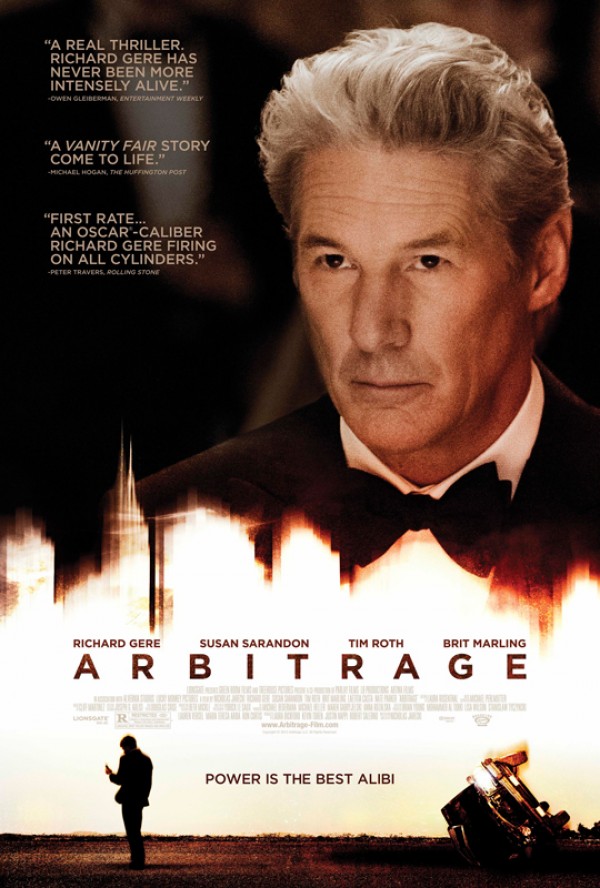
In Theaters/On VOD: ARBITRAGE (2012)


ARBITRAGE
(US/Poland - 2012)

Written and directed by Nicholas Jarecki.  Cast: Richard Gere, Susan Sarandon, Tim Roth, Brit Marling, Laetitia Casta, Nate Parker, Stuart Margolin, Chris Eigeman, Reg E. Cathey, Josh Pais. (R, 105 mins)

Early word from the Sundance Film Festival this past January was that the financial thriller ARBITRAGE represented Richard Gere's best work in years.  It's been a while since he's had a hit movie, but he's been doing consistently good work, particularly in Antoine Fuqua's criminally underrated BROOKLYN'S FINEST (2010).  Acquired by Roadside Attractions, the arthouse wing of Lionsgate, and released on less than 200 screens nationally in addition to VOD, ARBITRAGE looks to be another top-notch Gere performance that few people will see.  It's a little disheartening that topical fare like this, for adults, is relegated to a distributor's arthouse subsidiary when 30 years ago, it would've been a major, popular film directed by a Sydney Pollack, a Sidney Lumet, or an Alan J. Pakula.  ARBITRAGE is written and directed by Nicholas Jarecki, who made the 2005 documentary THE OUTSIDER (about veteran director James Toback) and comes from a family of documentary filmmakers:  brother Andrew directed CAPTURING THE FRIEDMANS (2003), and brother Eugene helmed WHY WE FIGHT (2005) and REAGAN (2011).  ARBITRAGE entertains as a thriller, but Jarecki's attempts to turn it into a metaphor for the recent financial crisis aren't always successful.

Big-time NYC hedge fund investment CEO Robert Miller (Gere) is in the process of selling his company, ostensibly to spend more time with his family as he hits 60 years of age, but it's really to deal with a $400 million loss in a botched Russian copper mine investment that's tied up overseas.  He's about to be audited as part of the process of selling his firm, so he's clandestinely borrowed $400 million from another firm in an attempt to get by the auditors.  That CEO wants his money back now and the CEO he's selling to seems to be avoiding him.  There's numerous other fudged numbers in the books that get uncovered by his daughter and protegee Brooke (Brit Marling).  As if Miller didn't have enough going on, his Bohemian artist mistress Julie (Laetitia Casta), whose work and lifestyle--expensive apartment, Mercedes, coke habit--are funded by Miller, is demanding more of his time and wants him to leave his wife Ellen (Susan Sarandon).  Miller placates Julie with an impromptu romantic getaway, but briefly dozes at the wheel of her Mercedes and wrecks the car.  The accident kills Julie, and an injured Miller, with a cut on his head, broken ribs, and probable internal bleeding, flees the scene as the car goes up in flames.  His desperate attempt to cover up the accident ends up causing trouble for Jimmy (Nate Parker), the son of Miller's late former limo driver, when Miller calls Jimmy from a pay phone and asks him for a ride back to the city.  Miller's attorney (Stuart Margolin!) advises him to turn himself in immediately because no matter how well he's covered his tracks, they're going to trace it back to him.  Instead, Miller, who's spent his career taking chances and ignoring the odds, and became a billionaire for it, arrogantly assumes he can handle the situation on his own, even as it spirals more out of control by the minute.

Miller is a guy who sees everything as a business negotiation.  He doesn't count on the dogged street smarts of homicide detective Bryer (Tim Roth), a rumpled, unkempt, cynical sort who seems like a descendant of Columbo.  Bryer sees something fishy from the start, starting with Julie's charred body being in the passenger seat of the Mercedes ("Who kicked the driver's side door open?" he immediately asks his partner).  Jarecki seems to be setting up an interesting battle of wits--and economic class--between Miller and Bryer, but it gets dropped for a large chunk of the film and once Bryer re-enters the story, Jarecki has him do something so clownishly unlikely that it just doesn't ring true.  Miller figures he can finesse Bryer and Bryer, with his ill-fitting, wrinkled attire, slumped posture, four-day beard, and broad Noo Yawk accent, has a huge chip on his shoulder about "rich assholes" like Miller.  Jarecki wants to show how wheelers & dealers like Miller run the show and get off or get bailed out and Everymen like Bryer pay the price, but it's not handled in a credible way.  From the way Bryer is introduced and the way he's played by Roth, he's too wily to do what he ultimately does in an improbable third-act twist.  Miller is a guy who's always been able to get out of sticky situations, and it goes without saying that a guy who commits investment fraud, cheats on his wife, flees the scene of a fatal accident, and almost throws his own daughter under the bus with his off-the-books machinations, puts himself first and thinks he can emerge unscathed and likely will.  It's quite suspenseful watching a perfectly-cast Gere squirm, sweat, grimace, and panic as everything starts to fall apart.  The film's key line comes when Parker's Jimmy, who has a gun charge in his past and faces ten years in prison for obstruction unless he cooperates with Bryer, finally realizes that Miller views him as expendable and scoffs at a tactless attempt to buy his silence and pay him for any jail time with a $2 million trust:  "You think money's gonna fix this?"  An incredulous Miller replies "What else is there?"