NEXT OF KIN (Australia - 1982; US release 1985) Directed by Tony Williams. Written by Michael Heath and Tony Williams. Cast: Jackie Kerin, John Jarratt, Alex Scott, Gerda Nicolson, Charles McCallum, Bernadette Gibson, Robert Ratti, Vince Deltito, Tommy Dysart, Debra Lawrance, Matt Burns. (Unrated, 89 mins)
A genuinely unsettling gem from Australia that fans of cult horror and Ozploitation have largely kept to themselves, 1982's NEXT OF KIN is a textbook example of the "slow burn" approach that many indie horror films have taken in recent years. Of course, Quentin Tarantino has gone on the record as being one of its biggest fans, but it's almost certain that filmmakers like Ti West (THE HOUSE OF THE DEVIL, THE INNKEEPERS) and Oz Perkins (I AM THE PRETTY THING THAT LIVES IN THE HOUSE, THE BLACKCOAT'S DAUGHTER) have seen it and studied it. Made during an era when the horror genre was dominated by both slasher movies and trailblazing special effects makeup and creature FX, NEXT OF KIN is almost a film out of its time, and one that spends its first 2/3 being deliberately coy about exactly what it's up to. In the end, its reveals don't offer much in the way of surprises and twists, but that's really not important. Throughout the film's duration, New Zealand-born director Tony Williams and his co-writer Michael Heath conduct such a master class in slowly-escalating dread and screw-tightening tension, pulling it off with such confidence, style, and panache that NEXT OF KIN's biggest mystery is ultimately why neither of their careers really went anywhere in the ensuing years.
Returning to her isolated rural Australian hometown after years away upon receiving word that her estranged mother has died, Linda (Jackie Kerin) isn't really enthused about being left in charge of Montclare, the family estate that now doubles as a nursing home. On the outskirts of a podunk town where nothing much goes on ("Well, there's a new public toilet!" boasts the gruff owner of the local greasy spoon), Montclare is in dire financial straits and has seen better days, and despite the hopes of administrative nurse Connie (Gerda Nicolson) and Dr. Barton (Alex Scott) that the facility be kept open, with Connie even admitting a new resident, Mrs. Ryan (Bernadette Gibson), against her wishes, Linda is exploring all of her options with what to do with the place and its dwindling number of residents. That number only keeps dwindling as a string of Montclare's elderly are found dead, with evasive Dr. Barton declaring one a drowning in a bathtub despite Linda seeing what appear to be deep bruises on the corpse's neck that would indicate strangulation. All the while, Linda is haunted by nightmares of a long-suppressed, traumatic incident that took place at Montclare when she was a child, eventually finding corroboration in her mother's hidden diaries that detail an extensive history of madness and murder at the house over 20 years earlier. The events taking place now and manifesting in Linda's nightmares seem to mirror those documented in the tattered pages of her mother's journals, with include a foreboding warning that "There is something evil in this house." Naturally, her concerns are mostly disregarded by Dr. Barton, Connie, and hunky local firefighter Barney (John Jarratt), with whom she cautiously rekindles a romance that began back when they were teenagers.
Williams and Heath take an inordinate amount of time letting NEXT OF KIN simmer to a raging boil. It flirts with being everything from a then-trendy slasher film, a haunted house ghost story, and an Australian giallo (one brief shot on a TV screen at a diner has echoes of Dario Argento briefly flashing a huge reveal early in DEEP RED that no first-time viewer ever catches but is plain as day on subsequent watches) before it finally shows its cards in its audacious third act that culminates in an almost apocalyptic finale straight out of MAD MAX. But before that, the filmmakers establish a sense of unease with unnerving images like Linda repeatedly spotting a figure watching her from a distance or pulling into the long driveway at Montclare and catching a fleeting glimpse of someone in a red coat standing in her bedroom window. This almost glacial buildup lasts for an hour before it suddenly explodes, almost out of nowhere, when the killer pursues Linda through a mostly unoccupied wing of Montclare as she runs from room to room to hide as the pounding footsteps of the sprinting, hammer-wielding murderer could be coming from any direction. The long corridors of the home allow HARLEQUIN and WE OF THE NEVER NEVER cinematographer Gary Hansen (who would be tragically killed in a helicopter crash while filming a TV commercial later in 1982) and Steadicam operator Toby Phillips (a protege of Steadicam inventor Garrett Brown, who used it to much notoriety in ROCKY and THE SHINING, the latter a clear stylistic influence on NEXT OF KIN) to prowl the ominous halls of Montclare--which also showcases one of the genre's great spiral staircases--and indulge in some breathtaking flourishes when the camera shifts and swings in unexpected directions, whether it's some overhead shots or the startling way Williams has one of the villains suddenly bolt into the frame like a wild animal about to pounce. Also greatly contributing to the atmosphere is a moody and effective score by German electronic music pioneer Klaus Schulze (an early member of Tangerine Dream and Ash Ra Tempel), which lends a bit of a SUSPIRIA vibe and really gets under your skin.
At the time, the cast was unknown outside of Australia, though Jarratt would find some notoriety among horror and cult movie fans many years later thanks to his dark-side-of-Crocodile Dundee performance as an affable Outback serial killer in the controversial WOLF CREEK and Jarratt superfan Tarantino giving him a brief role near the end of DJANGO UNCHAINED. The very appealing Kerin, who has a striking resemblance to Nastassja Kinski, had some TV credits to her name and appeared in a few episodes of PRISONER: CELL BLOCK H, a late '70s Australian women-in-prison series that aired in syndication in the States. NEXT OF KIN remains her only feature film to date, and while she acted sporadically on Australian TV over the next couple of decades, she's better known in her homeland these days as a children's book author and storyteller. Just out in an extras-packed Blu-ray from Severin (because physical media is dead), NEXT OF KIN didn't find any attention from American distributors at the time, taking three years to get a straight-to-video release in 1985 courtesy of Media Home Entertainment offshoot VCL Communications, and then getting relaunched again in 1988 through Virgin Vision. Heath went on to write the 1984 New Zealand-made video store fixture DEATH WARMED UP and the 1992 Al Lewis comedy MY GRANDPA IS A VAMPIRE. Born in 1944, Williams had the little-seen 1978 Australian drama SOLO under his belt, as well as a handful of gigs as an editor and a cinematographer, but he followed NEXT OF KIN with 31 years of off-the-radar silence. Since 2013, he's directed three documentaries that likely haven't been seen outside of either Australia or New Zealand. Looking at it now, NEXT OF KIN should've established Tony Williams as a major new figure in horror, but he seemingly walked away, leaving his legacy in the genre to stand with one small masterpiece of its kind.
Director/co-writer Tony Williams, star Jackie Kerin, and
cinematographer Gary Hansen on the set of NEXT OF KIN.
A Brian Wilson biopic that doesn't follow the standard formula of music biopics, LOVE & MERCY is an original and often deeply moving look at two significant periods in the life of the Beach Boys mastermind. Director Bill Pohlad, a busy producer (BROKEBACK MOUNTAIN, THE TREE OF LIFE, 12 YEARS A SLAVE) helming his first film since 1990's barely-released and long-forgotten OLD EXPLORERS, and screenwriters Oren Moverman (THE MESSENGER) and Michael Alan Lerner structure LOVE & MERCY as two parallel, GODFATHER PART II-type narratives as we see the beginning of the 1965 psychological breakdown of young Wilson, or "Brian Past" (Paul Dano) with the fragile shell of a man that is "Brian Future" (John Cusack) in 1988. The cracks are already starting to show with Brian hearing voices in his head before retiring from touring in 1965 to work exclusively in the studio on the Beach Boys' landmark Pet Sounds, which drives a wedge between him and bandmate/cousin Mike Love (Jake Abel). In 1988, an awkward and eccentric Brian stops into a car dealership to impulsively buy a Cadillac and meets salesperson Melinda Ledbetter (Elizabeth Banks), when a team of handlers headed by his therapist Dr. Eugene Landy (Paul Giamatti) arrive to escort him out. As Brian and Melinda grow closer, she sees Landy's mistreatment of Brian--misdiagnosing him as a paranoid schizophrenic, overmedicating him, psychologically abusing him, and bringing along his own group of hangers-on to essentially live off of Brian's fortune, even taking over Brian's larger beach house and moving him into a smaller one nearby.
Telling two stories with two different actors playing the same role (shades of the multiple Bob Dylans in I'M NOT THERE) is an unusual choice that pays off. While Dano strongly resembles Brian Past, Cusack looks nothing like Brian Future, but it doesn't matter. Dano handles the breakdown while Cusack plays the result, with their performances brilliantly complementing one another. In his best role in years, Cusack inhabits Brian Future through halting and nervous body language that never crosses the line into becoming a mannered Brian Wilson impression. He approaches the role not unlike Chevy Chase playing Gerald Ford on SNL--he looks and sounds nothing like the person he's playing, but he uses his skills to bring the character alive in a way that's accurate and very believable. Many actors would've turned it into an Oscar-baiting tic-fest, but Cusack is effectively understated, reminding you what a terrific performer he can be when he's not slumming it and vaping his way through bad VOD thrillers. While Dano and Cusack are the dramatic focus, Banks also does career-best work as the emotional core of LOVE & MERCY, the woman who would become his second wife (one of the film's few missteps is the short shrift given to Brian's first wife Audree, played by a barely-there Joanna Going). Giamatti is fine, though he's largely playing "Paul Giamatti," with Landy prone to outbursts of blustery rage, which works as Landy was accurately the villain in the Wilson story, along with, to a lesser degree, the unsympathetic Love and the stern, impossible-to-please Wilson patriarch, played here by Bill Camp (COMPLIANCE). A minor word-of-mouth sleeper hit over the summer of 2015, LOVE & MERCY is, thus far, one of the standout films of the year, with performances from Cusack, Dano, and Banks that deserve to be remembered come awards season, and one that refreshingly avoids the pitfalls and cliches of the music biopic genre. (PG-13, 121 mins) WELCOME TO NEW YORK (France/US - 2014; US release 2015)
NYC auteur Abel Ferrara is no stranger to unflinching provocation and getting his actors to bare their souls and more--he is, after all, the mad genius who directed Harvey Keitel's legendary performance in 1992's BAD LIEUTENANT. A long way removed from his '80s and '90s flirtations with commercial film and television, Ferrara has spent most of the last decade and a half making documentaries and little-seen films that didn't even get any US exposure beyond a sporadic festival screening. 2012's bohemian end-of-the-world drama 4:44: LAST DAY ON EARTH was the first narrative Ferrara film to get US distribution in a decade. WELCOME TO NEW YORK finds Ferrara reaching back to his BAD LIEUTENANT side for a not-very-thinly-veiled account of the 2011 Dominique Strauss-Kahn scandal, when the French economist, politician, and IMF managing director known to his friends and the media as "DSK" was accused of sexually assaulting a hotel employee who arrived to clean his suite at the Sofitel New York Hotel. Charges were eventually dropped due supposed credibility issues of the accuser and that much of the evidence was inconclusive, but DSK soon faced other allegations in France in what seemed to be a behavioral pattern. Gerard Depardieu stars in WELCOME TO NEW YORK as the DSK figure, here named "Devereaux," a high-powered exec at a French financial behemoth who's in NYC for one day on business. Once that's done, he decompresses in his hotel suite with an all-night-long parade of prostitutes. The next morning, a maid (Pamela Afesi) enters the suite, announces she's from housekeeping, but a showering Devereaux doesn't hear her. Once he's out of the shower, he drops his towel and pushes her down to her knees, grunting "Do you know who I am?" He's on his way to JFK Airport when he realizes he's left his phone at the hotel, so the cops, already taking the maid's statement, intercept him at the airport under the guise of returning his phone and arrest him, forcing his long-suffering wife Simone (Jacqueline Bisset) to fly over from Paris to bail him out and set up a legal team while he's equipped with an ankle bracelet and confined to a $60K per month apartment she's rented.
All the while, Devereaux remains calm and relaxed, spending his house arrest watching movies under the assumption that something--his constant invocation of diplomatic immunity, his wealth and privilege, the ambitious Simone's political connections, his attorneys' manipulation of the media--will get him off the hook. Of course, he assumes correctly, but at the same time, Ferrara presents a portrait of a man both entitled and ill, who's convinced himself he's done nothing wrong while admitting he's powerless to combat what he is. Similar to the fearless work he got from Keitel in BAD LIEUTENANT, Ferrara convinced Depardieu to abandon all illusions of shame and modesty and literally let it all hang out. Whether he's being strip-searched or attempting to force himself into the maid's mouth--during which a shot from behind captures the legendary actor's dangling scrotum--Depardieu throws all of himself into WELCOME TO NEW YORK in ways he hasn't done for many years. Likewise for Bisset, who first appears around 40 minutes in and quickly becomes the focus of the film. Simone is a woman with social and political aspirations for her and her husband (cue obvious Clinton analogy) who comes from money but is fully aware of what kind of man she married. She accepts his excesses--the booze, his predilection for prostitutes, his sex addiction--because they need each other. Simone doesn't buy Devereaux's claim that the rape accusation is false, and his excuse of "I just jerked on her! I just jerked on her mouth! That's all!" doesn't win him any sympathy. Ferrara goes for ultra-realism in the early going, in terms of the profoundly uncomfortable sequence between Devereaux and the maid, and with the police pursuit of him, where Ferrara makes the decision to cast the roles of the Port Authority and NYPD cops with real Port Authority and NYPD cops, who do a very good job of lending a gritty immediacy and not coming across like amateur actors. The first half is a riveting tour de force for Depardieu and represents some of Ferrara's best filmmaking since his early '90s heyday. There's a bit of a shift once Bisset arrives and she gets a couple of astonishingly vicious tirades to remind us that she's a terrific actress who hasn't been used to the best of her ability over the years.
Things bog down a bit in the home stretch, with some ponderous voiceover by Devereaux and some arguments with Simone that start to get repetitive. The cranky Ferrara loudly complained about both US distributor IFC and French co-producer Vincent Maraval preparing a 108-minute, R-rated US cut and not releasing Ferrara's 125-minute cut that was slapped with an NC-17 rating. While some of the more salacious material may have been eliminated, mostly from an early orgy sequence (we still get Depardieu's nutbag, however), WELCOME TO NEW YORK could still use some trimming near the end, which seems a little draggy even in the cut version. The only other weakness in the film is Ferrara's odd choice of showing a prologue that has Depardieu as himself being interviewed by reporters about why he chose to take this role--it's not even a real interview, as one of the reporters is played by Ferrara's girlfriend and associate producer Shanyn Leigh, demoted to bit player after her terrible lead performance in 4:44. While what's here was released under vehement protest by its maker, WELCOME TO NEW YORK is still a welcome return to vintage form for Abel Ferrara and, if you're so inclined, an opportunity to see more of Gerard Depardieu than you ever thought possible. (R, 108 mins) ELIMINATION GAME (Australia - 2014; US release 2015)
ELIMINATION GAME was released in its native Australia as TURKEY SHOOT, much like the film it remakes, Brian Trenchard-Smith's 1982 cult classic TURKEY SHOOT, released in the US in 1983 as ESCAPE 2000. A future dystopian take on THE MOST DANGEROUS GAME, ESCAPE 2000 was a mean and ultra-violent exploitation film that became a huge hit on cable throughout the '80s. The remake, which counts Trenchard-Smith among its producers, is an abomination: amateurishly-made and thoroughly shameless in the way it cribs from other, better movies. More of a satire on reality TV along the lines of THE RUNNING MAN and Paul W.S. Anderson's DEATH RACE, ELIMINATION GAME finds disgraced Navy SEAL Rick Tyler (a more lifeless-than-usual performance by former PRISON BREAK star and new Yoplait pitchman Dominic Purcell) rewarded for taking out a Libyan dictator (ESCAPE 2000's Roger Ward) at the behest of his commanding officer Gen. Thatcher (late 1970's TV Spider-Man Nicholas Hammond) and US President Sheila Farr (Carmen Duncan) by being thrown under the bus and sentenced to death for fabricated war crimes. Three years later, he's given a chance at freedom: being the target on "Turkey Shoot," the world's most popular TV show, which pits him in a fight for his life as expert assassins try to take him out, all for the entertainment of a global audience. Of course, Tyler manages to emerge victorious against his foes or there'd be no movie, and he's keeping top killer Ramrod (LONGMIRE's Robert Taylor, trying to make something out of nothing) alive for a reason.
ELIMINATION GAME wants to think it's perceptive satire, but its targets--vapid TV show hosts, bitch-on-wheels programming executive, corrupt government officials--are pitifully one-dimensional and obvious and its attempts to win over the audience with ESCAPE 2000 references--Ward's cameo, a scene from the 1982 film visible on someone's TV--just makes you want to watch ESCAPE 2000 instead (speaking of references to better movies, legendary Ozploitation producer Antony I. Ginnane has a cameo as Australasian president Charley Varrick). Purcell has never been worse, though putting yourself in his position, would you try? The lumbering lummox is defeated by any number of things, whether it's director/co-writer Jon Hewitt's tired use of shaky-cam, endless DOOM-like first-person shooter POV shots and crummy CGI, or letting whole sequences play out through CCTV footage and security cameras. The editing is very choppy and whole chunks of story seem to be missing. Also, for "Turkey Shoot" being as popular as it is, we never get enough of a sense of the outside world or how everyone would drop what they're doing to watch it. All of this would be petty nitpicking if ELIMINATION GAME was even reasonably clever or entertaining, or offered anything remotely worthwhile. There's no shortage of dark-humored avenues to travel if you're going to roast the concept of reality TV, but this is lazy and uninspired on an almost Friedberg/Seltzer level, and it easily supplants Mark Hartley's well-intentioned but botched PATRICK as the worst remake of an Ozploitation classic. When the best moment of your remake is a shot of the film it's remaking seen on a character's TV, then that's all the evidence you need to confirm that you really needn't have bothered. (Unrated, 90 mins)
For all the shit Nicolas Cage justifiably gets about the crummy movies he's been making, the precipitous decline of John Cusack--Cage's CON AIR co-star in better days for both--has flown under the radar with most mainstream critics and moviegoers who likely just assume he hasn't been busy. Oh, he's been busy. Any VOD denizen who regularly prowls the fringes of Netflix Instant's new arrivals or checks out a Redbox at the grocery store has probably noticed Cusack turning up in an alarming number of bad movies of late. It doesn't seem that long ago that he was briefly generating Oscar buzz for 2007's GRACE IS GONE, headlining 2009's mega-budget disaster epic 2012, and had a hit comedy with 2010's HOT TUB TIME MACHINE. In retrospect, it seemed like he stopped trying around the time no one really responded to his well-intentioned but smug and self-satisfied 2008 anti-war satire WAR, INC. There have been a couple of positives for Cusack in the last few years--even though nobody saw it, his reteaming with Cage on THE FROZEN GROUND produced a surprisingly compelling thriller, not something you can usually say about any film containing 50 Cent, and the Spanish GRAND PIANO was a goofy but enjoyable De Palma homage that featured Cusack mainly as a voice in an earpiece taunting concert pianist Elijah Wood from the balcony, threatening to shoot him if he plays one wrong note. Cusack is in David Cronenberg's upcoming MAPS TO THE STARS, which will mark the actor starring in his first respectably A-list production in years (not counting his brief bit as Richard Nixon in Lee Daniels' LEE DANIELS' THE BUTLER), but it would appear to be an exception and not the rule.
John Cusack in RECLAIM. Or maybe DRIVE HARD.
Careers have peaks and valleys, but in recent memory, few icons--yes, with SAY ANYTHING, GROSSE POINTE BLANK, BEING JOHN MALKOVICH, and HIGH FIDELITY, I'd say Cusack is iconic with a certain demographic--have plummeted so quickly without some offscreen scandal or obvious and very public personal problems pulling them down. Almost overnight, Cusack went from box office draw to the undisputed king of Video-on-Demand. Working actors work, and to quote '70s exploitation producer Mardi Rustam on casting past-their-prime actors, "working's better than sitting by a phone that's not ringing," but with rare exception, Cusack's recent string of credits--THE RAVEN, THE PAPERBOY, THE FACTORY, THE NUMBERS STATION, ADULT WORLD, THE BAG MAN, and THE PRINCE--range from forgettable to flat-out embarrassing. A pilot he shot for a potential CBS series about a Wall Street investment firm wasn't picked up by the network. Cusack did star with Chow Yun-Fat and Gong Li in Mikael Hafstrom's $50 million epic SHANGHAI, but it's been sitting on a Weinstein Company shelf for six years. The Cusackalyptic state of his career--honestly, an appearance in an Uwe Boll film can't be far off--has only become apparent to casual moviegoers in the last couple of weeks, when a poster for the Chinese period piece DRAGON BLADE, teaming Cusack as a centurion with Jackie Chan and Adrien Brody, made the rounds on the internet. Other upcoming Cusack projects include the Stephen King adaptation CELL, which maybe has commercial potential, and LOVE & MERCY, a low-budget Beach Boys biopic where he briefly appears as the older Brian Wilson (Paul Dano plays Wilson in most of the film) but other than that, it's business as usual, with a cop thriller called KICKBACK, where he co-stars with Famke Janssen, Rutger Hauer, Sean Young, Mischa Barton, and Tom Sizemore. Who knows if Cusack can pull himself out of this quagmire or if he's happy to just be working? In the meantime, here's his two latest obscurities that you probably haven't heard of until this moment.
DRIVE HARD (Australia/UK/Germany - 2014)
A grating buddy comedy from Ozploitation legend Brian Trenchard-Smith, DRIVE HARD isn't the action-packed fun-fest that it seems to think it is. Cusack is paired with Thomas Jane--both appeared in Terrence Malick's THE THIN RED LINE--and presumably both are only here for the paid Australian vacation. A quickie shot in Gold Coast, Queensland in a mere two and a half weeks, DRIVE HARD has Jane as Peter Roberts, a former American racing phenom who left the circuit to marry Aussie attorney Tessa (Yesse Spence). They have an impossibly cute daughter and a beautiful house, but Peter is unhappy working at his dull job as a driving instructor and misses the circuit. One morning, Peter's first appointment is American Simon Keller (Cusack), a vaping oddball in a black baseball cap and sunglasses, who claims to be in town on business. Simon's eccentric behavior irritates Peter, especially when he asks Peter to stop at a nearby bank so he can quickly run in and "take care of something." The bank is owned by the mob, and Simon is a freelance criminal from Cleveland sent to swipe some mob cash in the form of bank bonds set up by scheming executive Rossi (Christopher Morris). The connected Rossi uses his influence to keep the cops off as various unsavory sorts spend the rest of the film chasing the two Americans--with unwilling accessory Peter specifically targeted by Simon for his superior driving skills--who have to work together to survive...if they don't kill each other first!
Trenchard-Smith's storied history in stunt-crazed Ozploitation cinema of the 1970s and 1980s would seem to make him a natural for something like this, but he hasn't made a good film in about 25 years (no, LEPRECHAUN 4: IN SPACE doesn't count), and DRIVE HARD exhibits none of the past style and panache that have made him such an endearing figure in cult cinema. The actual car chases are sparingly shown and unexciting, things gets bogged down in Peter's marital problems and the investigation by a hard-nosed Gold Coast major crimes investigator (Zoe Ventoura), and there just isn't much of a story here. That would be fine if the action was good, but Trenchard-Smith seems so excited to be working with name American actors again that just lets them riff their way through it. Long stretches of the film consist of Cusack and Jane doing some uninspired improv in the car, with tiresome and endless banter that usually involves a yapping Cusack being an unfunny, hectoring smartass and Jane yelling, almost like they're both trying to be Vince Vaughn, and it doesn't work. Jane, in particular, is really hard to take here. He seems to be mistaking "being really loud" for being funny. His entire performance is one long spaz attack, while Cusack, who never takes off the hat and shades, has been given a green light to do whatever he wants. Simon's final monologue to Rossi, where he blathers on endlessly about Buddha before shooting the coke-addled banker in the balls, allows Cusack the kind of self-indulgent, incoherent nonsense you would've expected from late-period Marlon Brando. Cusack was obviously given the star treatment by the producers--his personal chef is credited twice--and he responds by at least coming to work awake, which is more than you can say for his contributions to THE PRINCE, but DRIVE HARD is just a dull, dumb, and loud exercise in Cusackalyptica with an Ozploitation twist, an action-comedy that struggles to find a tone and comes up lacking in both action and comedy. (Unrated, 96 mins)
RECLAIM (US/Australia - 2014)
I don't know if RECLAIM was shot immediately after DRIVE HARD or vice versa, but Cusack's wearing the same black hat in some scenes and he's introduced vaping, which has obviously become his personal prop of choice. Released on just ten screens, RECLAIM is like a less competent version of the kind of glossy, hot-button thrillers that dominated the 1990s. Indeed, if it came out 12-15 years earlier with the same leads and a bigger budget, it would've been a huge hit. Despite his top billing, Cusack has a mostly secondary role until a little past the midway point, with the real stars being Ryan Phillippe and Rachelle Lefevre as Stephen and Shannon Mayer, a Chicago couple arriving in Puerto Rico to finalize the adoption of seven-year-old Haitian orphan Nina (Briana Roy). Unable to have children of their own after a car accident several years earlier that caused a pregnant Shannon to miscarry and netted them a nearly $3 million settlement, the Mayers are desperate to become parents and have already paid $60,000 to a charity agency run by the altruistic Gabrielle Reigert (Jacki Weaver), but still must wait several days for Nina's passport and some general paperwork to clear. In the meantime, Gabrielle sets the Mayers up at a resort where they keep encountering the gregariously pushy Benjamin (Cusack, greasy-haired and disheveled), his girlfriend Paola (Veronica Faye Foo) and their extremely surly buddy Salo (Jandres Burgos). Benjamin and especially Salo (who beats the shit out of committed-to-sobriety Stephen in a bar after Stephen declines a drink) display enough red flags for the Mayers to inform Gabrielle that they're checking into another hotel, but of course Benjamin and his crew turn up there as well, and not long after, Nina goes missing. Stephen attempts to notify Gabrielle, but no one at the agency's office answers the phone, the web site is down, and the property vacant when Stephen pays a visit. Benjamin is part of a scam overseen by Gabrielle (not her real name) to bilk people out of exorbitant adoption fees and make off with the kid. The scam is common, according to the useless local police chief, played by Luis Guzman, in practically the same role he had in the recent Gina Carano actioner IN THE BLOOD. Feeling cheated out of his share by Gabrielle, Benjamin goes rogue and concocts his own scheme to get the Mayers' entire fortune.
Australian director Alan White really wants this to be a serious expose of child exploitation and trafficking, but it's really just a rote, formulaic B-movie, and not a very good one. It starts with Stephen and Shannon being entirely too gullible too many times, but even on a technical level, RECLAIM comes up short. It sports what may go down as 2014's most ineptly-shot car chase, which hilariously shoddy greenscreen work that moves entirely too fast and jerky and looks like a Hanna-Barbera wraparound background. Coupled with a scene where the Mayers' SUV is dangling off the side of a cliff, RECLAIM has the worst car crash CGI this side of 2011's IN TIME. Phillippe and Lefevre do what's required of them, but Cusack is in PRINCE mode here, looking haggard and sleepwalking through a Puerto Rican vacation either immediately before or after his DRIVE HARD Australian respite. Until the midway point, he really isn't in it that much and until late in the film, he's more of a henchman to mastermind Gabrielle. In some scenes, he defers to the hot-tempered Salo. Why is Cusack playing a stock heavy role that any jobbing character actor could've played? I doubt he's even reading the scripts he's given--he's choosing his films based on where they're being shot and how nice a resort the producers are willing to book him (though his personal chef doesn't seem to have made the trip for this one). Cusack's a smart actor and an insightful writer--if he was finding anything challenging or professionally rewarding about his Cusackalyptic career choices, he wouldn't resort to vaping in two different movies in a desperate effort to provide his character with some remotely interesting trait. An end caption states that over a million children are trafficked a year, adding "They're invisible and they're everywhere." These days, the same could be said for John Cusack movies. (R, 96 mins)
THE PYJAMA GIRL CASE (Italy/Spain - 1977) Written and directed by Flavio Mogherini. Cast: Ray Milland, Dalila Di Lazzaro, Mel Ferrer, Michele Placido, Howard Ross, Ramiro Oliveros, Rod Mullinar, Eugene Walter, Fernando Fernan Gomez, Vanessa Vitale, Giacomo Assandri, Luis Barboo. (Unrated, 102 mins)
The Italian giallo craze, popularized in the early 1970s by, among many others, Dario Argento's THE BIRD WITH THE CRYSTAL PLUMAGE and DEEP RED and other films by Mario Bava, Lucio Fulci, and Sergio Martino, was dying down by the latter part of the decade. Though gialli were still being produced (Antonio Bido's THE BLOODSTAINED SHADOW is a solid offering from 1978) and would still be made into the 1980s (Argento's TENEBRE in 1982, Lamberto Bava's A BLADE IN THE DARK in 1983), the filmmakers were moving into other areas, as evidenced by the supernatural element woven into Argento's DEEP RED as early as 1975. He would soon go into the realm of the overtly supernatural with SUSPIRIA (1977) and INFERNO (1980), while Fulci would find his niche with his 1979 classic ZOMBIE. During this giallo downturn, some films were being produced that were classified as giallo, but didn't strictly adhere to all of the genre tropes and expectations, like Pupi Avati's dark, bleak THE HOUSE WITH LAUGHING WINDOWS and Paolo Cavara's sordid giallo/polizia hybrid PLOT OF FEAR (both 1976). Flavio Mogherini's THE PYJAMA GIRL CASE (1977), despite sporting a title that sounds like a lost Hardy Boys/Nancy Drew mystery, is one of the most unconventional offerings in the giallo subgenre for a variety of reasons, starting with it being set and shot in Australia even though it's an Italian/Spanish co-production. Basing his film on a 1934 murder case in Australia, where the pajama-clad body of 28-year-old Linda Agostini was found mutilated and partially burned beyond recognition, Mogherini wasn't interested in making a typical giallo, and by subverting the expectations that came with that label, he created a haunting and very unusual film that was ahead of its time in some ways. It never scored a US theatrical release and was probably a hard sell considering its unorthodox construction that's admittedly confusing and seems choppy and disorienting for a first-time viewer. I didn't like THE PYJAMA GIRL CASE the first time I saw it, but it's a rare mystery that actually plays better a second and third time through, once you know its trickery and its final revelation and can admire the sleight of hand of Mogherini and editor Adriano Tagliavia (Pieter Jan Brugge's little-seen 2004 thriller THE CLEARING, with Robert Redford and Willem Dafoe, plays out in a similar fashion). Mogherini, occasionally to the film's detriment, is so concerned with the how of his gimmick that he often glosses over or outright neglects the what and the why, sometimes cramming key plot points into place to force the twist to work. It's a flawed film with its share of stumbles along the way, and its structure was probably a lot more innovative in 1977 before fractured timelines and the ubiquity of twist endings became more commonplace, but THE PYJAMA GIRL CASE is one of the most ambitious gialli of its time. Even though it doesn't quite knock it out of the park, it constantly aims for the fences and has deservedly--and quietly--become a cult item after being rescued from decades of obscurity by Blue Underground's 2006 DVD.
After a woman's body is found on a Sydney beach, wearing yellow pajamas and with her face burned beyond recognition, the police are baffled. This prompts crotchety, retired Inspector Timpson (Ray Milland in one of his best late-career roles), who misses the action and has grown bored spending his days tending to his flower garden, to offer his services on his own time ("Don't expect to get paid!" the chief yells). Timpson is an old-school sleuth who follows his gut instinct and has no time for the psychological analyses of college-educated cops like Inspectors Taylor (Ramiro Oliveros) and Morris (Rod Mullinar), who have been put in charge of the case. They initially have no leads since they don't even know the victim's identity, resulting in the film's most memorable scene, a desperation decision to publicly display the woman's mutilated corpse in the hopes that someone might recognize her (this actually happened in the 1934 source case). After Taylor and Morris beat a confession out of local pervert Quint (Giacomo Assandri), the case is closed despite Timpson's protestations otherwise. Meanwhile, Linda (Dalila Di Lazzaro, best known as the "female zombie" in FLESH FOR FRANKENSTEIN) has recently been seduced by a bisexual female friend who wore yellow pajamas very similar to the murder victim. With the woman gone on a trip and temporarily out of the picture, Linda goes back to juggling the three men in her life: her Italian immigrant husband Antonio (Michele Placido), his buddy Roy (Howard Ross), and Prof. Douglas (Mel Ferrer), her elite, upper-class sugar daddy. The parallel narratives intersect on occasion until fusing in a way that should've landed with more oomph than Mogherini gives it, but once you rewatch it knowing how it all plays out, it's fascinating to observe the way he obfuscates and intentionally misdirects the audience. It's easy for a first-time viewer to leave THE PYJAMA GIRL CASE feeling gypped and disgruntled, but there's a lot more going on in it than just a simple murder mystery or a cookie-cutter giallo, and its rewards might only manifest on subsequent viewings. That's more work than most people might wish to devote to a movie, which is why this film has flown so under-the-radar for so many years, with its cult growing as those who are pulled back to it discover its intricacies and what Mogherini was really doing.
Though some interiors were shot in Rome, most of the film was done on location in Sydney, and the presence of future PATRICK and BREAKER MORANT co-star Mullinar gives it some legitimate Aussie/Ozploitation credentials. Mogherini uses the downtown, business district of Sydney in ways that make it seem as barren, desolate, and unwelcoming as the intimidating Outback of something like WAKE IN FRIGHT (1971). There's an unmistakable Antonioni chilliness to some of the location work as Mogherini frequently sets exterior shots in vast, empty spaces--often with the Sydney Opera House in the shot to establish scale--emphasizing the isolation and loneliness of the characters. Antonio's introduction is one of the film's most striking moments as Mogherini has Placido wandering through an empty downtown Sydney business district, surrounded by the concrete and steel of towering skyscrapers as he eats lunch alone on a bench without a soul in sight. It's a scene that, taken out of context, could easily be mistaken for a new version of THE LAST MAN ON EARTH or THE OMEGA MAN. That sense of isolation is a key theme for Mogherini: Italian Antonio, German Roy, and Dutch Linda are all immigrants who have ended up in Sydney. They often complain that they're second-class citizens, intimating that Australians aren't particularly hospitable to outsiders. I don't see the film making this claim overtly as a knock on Australia specifically, as one could say that immigrants could feel that way anywhere. Linda gets dealt even worse as she's constantly leered at and objectified by men, whether she's stopping at a bar or working her shift at a restaurant, where every male customer checks her out as she walks away and makes no effort to be subtle about it. Even the men who line up at the public viewing of the corpse seem to be doing it more for the chance to ogle another naked woman. With the exception of Timpson, the men in THE PYJAMA GIRL CASE are a sad and immature lot. Almost all of them have homes lined with nudie magazine pics on the walls, and Quint is introduced vigorously and openly masturbating to his neighbor as she hangs laundry in her yard, only to be rudely interrupted by Timpson and Taylor barging into his shack of a house (the sight of 70-year-old Oscar winner Milland making the "jerk off" motion in mockery of Quint is itself worth the price of admission). Roy claims Antonio is his friend but thinks nothing of sleeping with Linda. Even the seemingly mature Prof. Douglas is a self-centered bastard, wooing Linda with promises of a life together only to bail when she finally takes him up on his offer, almost as if he suddenly remembered they met while he was on a business trip to Amsterdam, where Linda was working as a prostitute before following him to Sydney (there's also another love triangle involving the professor, Linda, and her bisexual lover with the yellow pajamas). It's the rejection by Prof. Douglas that sends Linda on a self-loathing, self-destructive downward spiral that eventually starts bringing the dual narratives together.
Mogherini (1922-1994) didn't direct anything else of note other than the minor Marcello Mastroianni comedy LUNATICS AND LOVERS (1976). He spent most of his career in art direction and production design on films like Mario Bava's DANGER: DIABOLIK (1968) and Federico Fellini's FELLINI SATYRICON (1969). With his unique depiction of Sydney as harsh and almost alien world (almost none of the Australian characters sound Australian, which effectively adds to the sense of detachment even if it's just a happy accident courtesy of a fast-working Nick Alexander-led dubbing crew), supplemented by a Riz Ortolani score that often sounds like a dry run for Giorgio Moroder disco (the songs croaked by Amanda Lear, however insidiously they burrow into your head, are an acquired taste regardless of how relevant their lyrics are), Mogherini created an uneven yet inventive and melancholy giallo like no other, offering a unique view of Australia through an Italian lens to tell a story of lost souls adrift, strangers in a strange land who left home out of a sense of not belonging only to arrive at a place that was even less welcoming. Perhaps THE PYJAMA GIRL CASE was ahead of its time in more ways than plot structure.
THE ROVER (Australia/US - 2014) Written and directed by David Michod. Cast: Guy Pearce, Robert Pattinson, Scoot McNairy, David Field, Tawanda Manyimo, Gillian Jones, Susan Prior, Anthony Hayes, Gerald Coulthard, Nash Edgerton, Jan Palo. (R, 103 mins) "You should never stop thinking about a life you've taken. That's the price you pay for taking it."
The Outback has been the setting of countless Australian films, and in the best of them, regardless of the genre, the vast, desolate region practically functions as a character. It gets one of its most unsettlingly sinister incarnations in THE ROVER, the latest film from ANIMAL KINGDOM director David Michod. Set "ten years after the collapse," THE ROVER opens with a stunning 15-minute sequence with the grizzled Eric (Guy Pearce) sitting alone in his car outside a shitty shack of a bar. He goes in for a drink as a pickup truck filled with three quarreling fugitives--Henry (Scoot McNairy), Archie (David Field), and Caleb (Tawanda Manyimo) flips over, careening past the bar and coming to an upright stop on the side of the road. Eric realizes too late that they're ditching the truck and taking his car. Glaring down the road, Eric decides to get in their truck and gets it unstuck by what seems like sheer will and determination, and takes off after them. After some high-speed road games, both cars come to a stop. Words are exchanged. Eric: "I want my car back." Archie: "I can see that." Eric: "Give me my car back." Henry: "That's not gonna happen." Even with guns pointed at him, Eric fearlessly charges at the men and gets knocked out for his trouble. He comes to and the men and his car are gone. He eventually crosses paths with Rey (Robert Pattinson), a slow-witted young man who happens to be Henry's younger brother. Shot in the stomach and assumed dead, Rey was left behind during whatever job his cohorts were pulling off. Eric, who proves time and again that he'll stop at nothing to get his car, takes Rey prisoner and orders him to take him to where his brother and the others are hiding out.
Part vigilante revenge saga, road movie, Ozploitation throwback, and dystopian nightmare punctuated by sudden bursts of shocking violence, THE ROVER has some surface similarities with John Hillcoat's THE PROPOSITION (2006), the great blood-splattered Outback western that also starred Pearce, but somehow, exists in a world that's even more bleak and nihilistic. Anyone can be killed at any moment in THE ROVER, and at any moment, the sins of your past can come back to haunt you. In his quest for revenge against the men who stole his car, Eric, the ostensible "hero," manages to leave a trail of bodies behind and brings death and tragedy to several people pulled into his destructive orbit. Michod asks a lot for the audience to get behind someone who's as much of an anti-hero as Eric, but as more layers of the character are revealed, there's glimpses of the man that may still lurk, however faintly, deep down. At its core, THE ROVER is a film about relationships, particularly the shaky bond that forms between and Eric and Rey. When Rey grows angry upon the realization that he's been left to die by his brother, it's debatable whether he comes to that conclusion on his own or if he's been manipulated into it by the misanthropic Eric, who's quite the killjoy with lines like "Who cares if he's your brother? Just because you both came out of the same woman's hole?" These are two men who, by different circumstances, are alone and find some tenuous common ground in a dangerous world where a wrong look gets you killed, seemingly kindly grandmothers offer young boys for sex, and the scenic route through the Outback offers the tourist-friendly sight of roadside crucifixions.
Pearce has rarely been better than he is here. With his constant snarl and his slumped right shoulder, he looks and moves like a wounded animal, and though Pattinson is sometimes a little too mannered, he generally handles his role well. I didn't care for David Cronenberg's COSMOPOLIS, but Pattinson, who reunited with Cronenberg for the upcoming MAPS TO THE STARS, continues to prove himself a sharper actor than you'd think as he seems to be taking on the most non-commercial projects he can to establish his post-TWILIGHT cred. To say much more would spoil the plot turns that THE ROVER takes, but it does offer a study in duality, not just with its two main characters, but also when the title and even the caption "ten years after the collapse" ultimately take on more than one meaning. Michod, cinematographer Natasha Breier, and the chillingly minimalist score by Antony Partos work together to create an atmosphere of suffocating hopelessness. You can smell the sweat and the despair. Real flies constantly swarm around the actors' faces. The stench of death and decay are everywhere under the perpetually baking sun. In many ways, THE ROVER is an Outback-set Sam Peckinpah homage, not in a way that Eric and Rey are men out of their own time with nothing left to do but go out with their guns blazing (as with THE WILD BUNCH), but in the quiet ways of loyalty and family and when someone's word meant something. It's not a crowd-pleasing summer movie for everyone, and you'll find the ultimate reveal either profoundly moving or dismiss it as completely hokey (one guy, a few rows back: "Are you kidding me?"). Eric is a total bastard and he's fully aware of it, but in a world where laws and a basic moral code have disintegrated and are never coming back, a man will do what he has to do to hold on to the slightest shred of humanity and dignity left in him. A love letter of understanding to the bitter misanthrope in all of us, THE ROVER is one of 2014's best films.
Veteran Andrew Bergman producer Mike Lobell (THE FRESHMAN, HONEYMOON IN VEGAS) began attempting to assemble a remake of the 1966 Shirley MacLaine/Michael Caine caper comedy GAMBIT as far back as 1997. Countless creative personnel were officially and unofficially attached to the new GAMBIT at various times over the next decade plus--directors Robert Altman, Mike Nichols, Alexander Payne, Anand Tucker, Bo Welch, Richard LaGravenese, and Doug Liman, writers Aaron Sorkin, Frank Cottrell Boyce, and Joel & Ethan Coen--and time and again, the project would stall and collapse. When LaGravenese was onboard around 2009, he rewrote much of the script, and again, it didn't make it out of pre-production. By the time filming finally started in 2011, Lobell had Michael Hoffman (ONE FINE DAY) directing, and LaGravenese's revisions were tossed in favor of the Coen Bros.' draft, which they penned during some down time between films a decade earlier. The Coens would probably prefer to forget they were ever involved in this doomed production, which bombed everywhere else in the world in 2012, prompting CBS Films to abruptly cancel the US release and shelve it for a couple of years in the hopes that everyone would forget about it. In a move of stealth deception that almost rivaled the Baltimore Colts sneaking away to Indianapolis in the middle of the night when no one was looking, CBS swiftly and silently released GAMBIT on VOD and on just nine screens in the US in late April 2014 with virtually zero publicity--probably not the desired end result of 15 years of work on Lobell's part.
It's often said that no one sets out to make a bad movie, that they sometimes just happen. Almost nothing goes right in the stunningly DOA GAMBIT, which tries to evoke the classic '60s caper aesthetic in a modern setting, but joke after joke after joke lands with such a dead thud that it actually feels uncomfortable watching a cast of pros flailing so helplessly. Considering the talent involved, there's no reason GAMBIT shouldn't be an enjoyable farce, but it's just a miserably dull misfire. Art appraiser Harry Deane (Colin Firth) is fed up with his venal boss, media baron Lionel Shabandar (Alan Rickman), and concocts a scheme with an art forger known as The Major (Tom Courtenay) to bilk him out of a fortune with a fake Monet. Helping them in the scam is hard-partying, trailer-park Texas rodeo gal P.J. Puznowski (Cameron Diaz), who lives with her senile grandmother (Cloris Leachman). Diaz plays it as broadly as possible (as does Stanley Tucci as Harry's German appraising rival), while Firth tries to be Michael Caine by way of Peter Sellers, whether he's losing his trousers or stuck on a ledge or repeatedly getting punched in the face or all manner of slapstick. This is the kind of stuff that should be funny, but everything is just off--the performances, the timing--everyone just seems lost and confused, with a "let's just get this over with" look on their faces. Everyone, that is, except for Rickman, who plays smug pricks as well as anybody and relishes the opportunity to do it again here. When Rickman is dismissively sneering at pretty much everything around him--it's possible he wasn't acting--GAMBIT has some spark. But Rickman's pomposity and the chance to hear Courtenay say "shitbag" aren't nearly enough to carry this all the way through. By the time GAMBIT resorts to fart jokes, it's a safe bet that everyone involved has officially given up. (PG-13, 89 mins) PATRICK (Australia/UK - 2013; US release 2014)
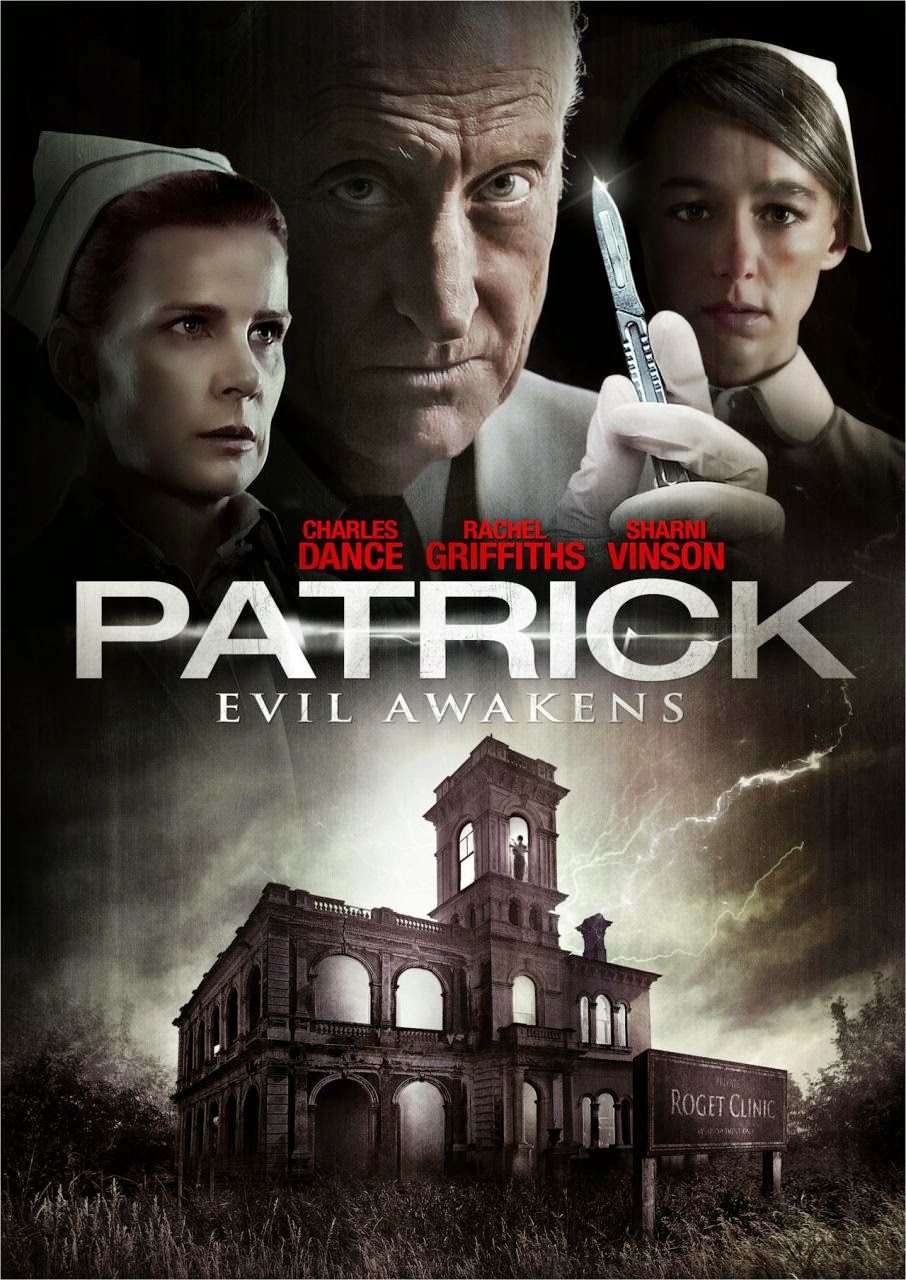
Hitchcock disciple and future PSYCHO II director Richard Franklin's PATRICK (1978) is one of the cornerstones of the Ozploitation scene. Written by the venerable Everett De Roche (LONG WEEKEND, ROAD GAMES, RAZORBACK), PATRICK dealt with a comatose young man wreaking telekinetic havoc in a hospital in a twisted display of obsessive love for a new nurse. It's rather slow and dry by today's standards, but the sight of Patrick lying in bed, eyes wide open, is one of the iconic horror images of the 1970s. The film did only modest business in Australia, but became a surprise hit in Italy, where its original score was wiped in favor of one by Goblin and was successful enough to generate its own Italian ripoff/fake sequel with Mario Landi's PATRICK STILL LIVES (1980), which turned Franklin's comparatively restrained little horror film a sleazy gorefest best known for its infamous "fireplace poker in the vagina" scene. PATRICK was acquired by Vanguard/Monarch for its 1979 US release, where it lost nearly 20 minutes of material to neuter it down to a PG rating and, as AIP did with MAD MAX a year later, the Australian cast was dubbed over by American voice actors. PATRICK remains a cult classic to this day, and exploitation superfan Mark Hartley, a native Australian behind such hugely enjoyable and infectiously fun documentaries as the Ozploitation love letter NOT QUITE HOLLYWOOD (2008) and the Filipino exploitation tribute MACHETE MAIDENS UNLEASHED (2010), as well as the upcoming ELECTRIC BOOGALOO: THE WILD, UNTOLD STORY OF CANNON FILMS, makes his narrative feature debut with this remake. NOT QUITE HOLLYWOOD jump-started the recent resurgence of interest in Australian cult cinema and it's very probable that a PATRICK remake wouldn't have happened were it not for NOT QUITE HOLLYWOOD. Hartley's love of '70s and '80s B-movies rivals that of Quentin Tarantino, but unfortunately, the comparisons end there: no matter how much his heart is in the right place by affectionately remaking one of his favorite films, Hartley's PATRICK is just not good, and it does no favors for vintage Ozploitation, PATRICK fans, or Hartley himself.
The plot is essentially the same: nurse Kathy Jacquard (Sharni Vinson of YOU'RE NEXT) gets a job at a hospital run by the stern Dr. Roget (Charles Dance) and his uptight head nurse daughter Matron Cassidy (Rachel Griffiths). Kathy is intrigued by comatose Patrick (Jackson Gallagher), who's been lying still and unresponsive since killing his mother and her boyfriend years earlier. Patrick seems to respond to Kathy in the form of reflexive spitting and transferring his thoughts to a computer monitor or via text to her phone (the lack of such technology forced him to communicate via typewriter in the original version). Of course, in true "One Froggy Evening" fashion, only Kathy sees this. Patrick is also able to control the minds and bodies of others, particularly those close to Kathy, whether it's her estranged boyfriend Ed (Damon Gameau) or doctor/potential suitor Brian (Martin Crewes). Kathy can't convince anyone of Patrick's brain activity, and as Dr. Roget's unethical, electro-shock treatments on Patrick increase, so do Patrick's violent tendencies and his drive to control Kathy and the people around her. Hartley is sure to pay homage to Franklin's film by giving the new Patrick the surname of the actor who played him in 1978 (Robert Thompson), giving Ed the surname Penhaligon, after the 1978 film's Kathy (British actress Susan Penhaligon), naming a hospital "The Royal Helpmann" after the 1978 Dr. Roget (Robert Helpmann), and in casting Ozploitation fixture Rod Mullinar (the 1978 Ed) in a small role as an asshole hospital administrator. He even pays brief tribute to PATRICK STILL LIVES (Italian title: PATRICK VIVE ANCORA) in the form of an end credits stinger. Hartley frames a lot of shots in the fashion of Hitchcock and De Palma, and has a score by regular De Palma collaborator Pino Donaggio, but it's so grating and over-the-top that it annoys more than enhances. Hartley also relies too much on cheap jump scares and some really bush-league, cheap-looking CGI that makes the whole project look like an Asylum ripoff of PATRICK. PATRICK '13 is a plodding, slowly-paced bore, with only Dance's acid-tongued villainy providing any entertainment (the way he spits "And you are prissy, meddling little bitch who's wasting my precious time, and I would dearly love for you to fuck off!" at Vinson is the highlight). He gave it a shot, but Hartley's first foray outside of the documentary realm is a resounding failure, though I have no doubt that ELECTRIC BOOGALOO will be his magnum opus. He's doing great things to preserve the memory of the B-movies that many of us hold so dear. But if PATRICK '13 is any indication, he just doesn't need to be making his own. (Unrated, 96 mins)
THE SIEGE OF FIREBASE GLORIA (Philippines/Australia - 1989)
Directed by Brian Trenchard-Smith. Written by William Nagle, Tony Johnston, Brian Trenchard-Smith and R. Lee Ermey. Cast: Wings Hauser, R. Lee Ermey, Albert Popwell, Robert Arevalo, Mark Neely, Gary Hershberger, Clyde R. Jones, Margi Gerard, Richard Kuhlman, John Calvin, Nick Nicholson, Michael Cruz, Henry Strzalkowski. (R, 99 mins)
Before it came back into circulation on MGM's HD cable channel, streaming services, and as an "MGM Limited Edition Collection" manufactured-on-demand DVD in recent years, Brian Trenchard-Smith's THE SIEGE OF FIREBASE GLORIA was a hard-to-find VHS obscurity going for exorbitant rates on eBay. It was a sought-after title not just for B-movie aficionados and cine-hipsters who embraced it after learning Quentin Tarantino was a huge fan, but also for Vietnam War veterans. Released in January 1989 by the short-lived Fries Entertainment, THE SIEGE OF FIREBASE GLORIA was one of many post-PLATOON Vietnam War dramas that saw a marked reduction in the "The war's not over till the last man comes home" side of Namsploitation, where the heroes of UNCOMMON VALOR (1983), MISSING IN ACTION (1984), and RAMBO: FIRST BLOOD PART II (1985) went back to 'Nam to settle scores and take care of unfinished business. Instead, there was a shift to grittier fare like HAMBURGER HILL (1987), PLATOON LEADER (1988), and EYE OF THE EAGLE 3 (1989), throwbacks to the types of straightforward, formulaic, B-grade WWII and Korean War battle pictures that Sam Fuller made in the 1950s. FIREBASE GLORIA's trump card was the presence of R. Lee Ermey, a Vietnam vet and former Marine drill sergeant who found work as a Vietnam genre Hollywood technical advisor on films like THE BOYS IN COMPANY C (1978) and APOCALYPSE NOW (1979), where he can be seen as a helicopter pilot during the famous "Ride of the Valkyries" sequence. Ermey was hired by Stanley Kubrick to mentor actor Tim Colceri, who was cast as the brutal drill instructor Gunny Sgt. Hartman in FULL METAL JACKET (1987). Kubrick's instructions to Ermey were simple: "Lee, I want it real." What Kubrick realized in witnessing Ermey's training of Colceri was that he cast the wrong guy in the part and that Ermey should be playing Hartman. Kubrick, never known as the most sympathetic director to actors, felt bad enough about replacing Colceri that he gave the young actor the consolation prize of a small but memorable one-scene role as a trigger-happy doorgunner ("Get some!"). Ermey, meanwhile, was given wide latitude by Kubrick to improvise and actually wrote much of his own dialogue, creating one of the most memorable characters and some of the most quotable lines in cinema history in the film's harrowing opening 45-minute basic training segment (it's worth noting that Hartman's insults about "steers & queers" and "I will gouge out your eyes and skullfuck you!" were bellowed five years earlier by an Oscar-winning Louis Gossett, Jr. in AN OFFICER AND A GENTLEMAN).
Ermey's FULL METAL JACKET success led to him being given the lead in THE SIEGE OF FIREBASE GLORIA, even though '80s B-movie icon Wings Hauser (VICE SQUAD) gets top billing. Like Kubrick, Trenchard-Smith gave Ermey a lot of wiggle room, allowing him to rewrite much of the script, which is credited to William Nagle and Tony Johnston (Trenchard-Smith and Ermey are credited with "additional dialogue"). Nagle wrote the novel The Odd Angry Shot, about Australian soldiers in Vietnam, and it was turned into the acclaimed 1979 film that may very well have the worst trailer ever. He also scripted the WWII courtroom drama DEATH OF A SOLDIER (1986) before working as an assistant director on 1990s straight-to-video fare like INDECENT BEHAVIOR II. It's hard telling how much of Nagle and Johnston's work made it into the finished film, but the result resonated with many Vietnam veterans who feel that THE SIEGE OF FIREBASE GLORIA is the most accurate cinematic depiction of the war. You can find that sentiment on message boards and IMDb user reviews, and I can even attest from my days at Blockbuster Video that this film was regularly cited as the most brutally realistic look at Vietnam that many of these vets had ever seen.
Now, as someone who's never served in the military, I can only approach THE SIEGE OF FIREBASE GLORIA from the perspective of a fan or a film critic. You can see it trying to be a little more than the typical Namsploitation offering. Its depictions of the savagery of war are unflinchingly grim and bloody, and the battle scenes have a relentless intensity to them. I suspect these are the bits of realism that the vets are talking about, along with paying briefly futile lip service to the idea that "The VC are soldiers, too," in the way it spends time with Viet Cong commander Cao Van (Robert Arevalo), who believes in respecting the courage of one's enemies. Other than that, the story and the characterizations roll straight off of the war movie assembly line. At the start of the Tet Offensive in 1968, Sgt. Maj. Hafner (Ermey) and his right-hand man DiNardo (Hauser) and their squad commandeer and fortify a ramshackle firebase populated by stoned, disillusioned burnouts and led by a C.O. (John Calvin), who sits at his desk nude while jerking off to nudie mags and getting high. Of course, the no-nonsense Hafner is outraged over such things as weed and long hair, as Ermey himself probably is, and proceeds to whip the men into shape using the same kind of speeches he gave in FULL METAL JACKET. Sure, it's entertaining hearing Ermey fire off quips like "We're gonna fortify this shithole and protect it like it's your daughter's cherry," or "It's time to sprinkle some shit in Charlie's rice," and another about how "there is no such thing as an atheist in a combat situation!" but when Ermey's not doing his Ermey schtick, FIREBASE GLORIA becomes so awash in cliches that it defeats itself. There's a little Vietnamese boy named "Pee Wee" (Michael Cruz), who becomes a surrogate son to battle-hardened DiNardo, who's still mourning the death of his own young son; there's Hafner having no time for emotional silliness like a female captain (Margi Gerard) who's in charge of the infirmary; there's wide-eyed, naive innocent Murphy (Mark Neely), who immediately goes off the deep end and starts thousand-yard-staring like he invented it as soon as the shit hits the fan when Cao Van's forces attack; there's the crazed, stoned photojournalist (Nick Nicholson as Dennis Hopper); and with several reminders that he only has 17 days left in his tour, is there any chance radio communications guy Shortwave (Clyde R. Jones) is making it out alive?
One of the few instances of Namsploitation doubling as Ozploitation, THE SIEGE OF FIREBASE GLORIA was a Filipino/Australian co-production that displayed the kind of grandiose action sequences that Trenchard-Smith was known for in his prior Australian exploitation films, which often showcased the death-defying stuntwork of perpetual Trenchard-Smith man-crush Grant Page (STUNT ROCK). Once it gets going, FIREBASE GLORIA is almost non-stop battle sequences, with some explosions that would make Antonio Margheriti envious. And that's really what this film is all about. It may have some scattered moments of lofty ambition, but it's really just a higher-end, Philippines-shot Namsploitation entry that's just made with more precision and care than, say, the Cirio H. Santiago joints of the same period, like BEHIND ENEMY LINES or EYE OF THE EAGLE (both 1987). Ermey is onboard to be R. Lee Ermey, but perhaps FIREBASE GLORIA's dramatic element would work better if Hauser's performance wasn't so terrible. Hauser is a legend in B-movie histrionics, but that approach doesn't adapt well to serious drama. His big emotional scene near the end, where he talks to Hafner about his dead son and how a drunken, post-funeral, three-week AWOL bender got him busted down to corporal should be DiNardo's big moment, but Hauser's bug-eyed over-emoting is just embarrassing and cartoonish, as is every line of dialogue spoken by Gary Hershberger, who turns up late in the film as Moran, an Army chopper pilot who lends the men some assistance. When Hafner gives Moran a list of necessary supplies, Moran quips "You want french fries with that?" Hershberger seems to have been told to act as much like Bill Paxton's Chet-from-WEIRD SCIENCE as possible, and he's so grating that you almost expect him to smirk "Cleanup, aisle 3!" after mowing down some VC. Speaking of ridiculous, don't miss the scene where an enraged Hafner yells at his men while carrying the severed heads of two slaughtered Marines. It's possibly the most batshit moment of R. Lee Ermey's career.
If one approaches THE SIEGE OF FIREBASE GLORIA as a B-grade actioner in the Namsploitation subgenre, it doesn't disappoint. It may occasionally try to go the extra klick quality-wise, but when it's all said and done, it's still the kind of movie that expects you to cheer and chant "U-S-A!" when DiNardo tortures an enemy soldier. That, coupled with Hafner/Ermey's almost John Wayne concepts of social conservatism (Hafner has bigger fish to fry than Moran getting a haircut and a shave), probably puts FIREBASE GLORIA more on the right-wing HANOI HILTON end of the political spectrum as far as these films are concerned. But it's all in the eye of the beholder: THE SIEGE OF FIREBASE GLORIA wasn't seen by many people in theaters, but became a word-of-mouth hit with both military vets and exploitation fans on video, and it's a film many of them have held near and dear in the 25 years since. In other words, it's the very definition of a cult classic.