MORGAN (US - 2016) Directed by Luke Scott. Written by Seth Owen. Cast: Kate Mara, Anya Taylor-Joy, Rose Leslie, Toby Jones, Paul Giamatti, Michelle Yeoh, Jennifer Jason Leigh, Brian Cox, Michael Yare, Boyd Holbrook, Chris Sullivan, Vinette Robinson. (R, 92 mins) Luke Scott has served as an assistant and a second-unit director on several films by his legendary and seemingly ageless father Ridley Scott, but MORGAN marks the 48-year-old scion's feature directing debut (Ridley's other filmmaker son, Jake Scott, debuted with 1999's PLUNKETT & MACLEANE). Pops Scott produced the film, and if Luke had any hopes of emerging from the long shadow cast by his visionary father, he's gonna have to try a lot harder than MORGAN. In all fairness, MORGAN looks fine, with some effective set design and a few breathtaking exterior visuals in a surrounding forest and on a lake (this was shot in Ireland), but the script by Seth Owen (rumored to be overhauled and rewritten by the director) is so derivative and obvious that any seasoned moviegoer will figure out where this thing is headed by the ten-minute mark. At a secret research facility in remote upstate New York, scientists have succeeded in creating, after two failed attempts, a flesh-and-blood, A.I. humanoid named Morgan (THE WITCH's Anya Taylor-Joy), who's five years old but whose accelerated growth rate gives it the appearance of a girl in her late teens. Cold and standoffish Lee Weathers (Kate Mara) is a risk assessment agent sent in by the project's corporate benefactors to determine Morgan's viability after it attacks one of the scientists, Dr. Kathy Grieff (Jennifer Jason Leigh), gouging out her eye in a fit of rage when it's informed it disobeyed the rules and can't go outside anymore. Lee is naturally met with apprehension and scorn by the rest of the research team--Dr. Simon Ziegler (Toby Jones), Dr. Amy Menser (Rose Leslie), Dr. Ted Brenner (Michael Yare), married Drs. Darren and Brenda Finch (Chris Sullivan, Vinette Robinson), and the head of the project, Dr. Liu Cheng (Michelle Yeoh)--with her only real ally coming from the facility's nutritionist/cook/potential love interest Skip (Boyd Holbrook).
Why these people can't prepare their own meals and require Skip to be on the payroll in a sworn-to-secrecy, middle-of-nowhere location for a minimum of five years is the least of the questions you'll have after watching MORGAN. As Morgan demonstrates more human qualities and has tangible feelings of joy and sorrow (it loves the outdoors and opera, and is set off when it's punished for wandering off the property while out on a walk with Amy), they've grown attached to it and refer to it as "she" and "her," which doesn't fly with the no-nonsense Lee. With her aloof, bottom-line attitude, Lee's character arc is pretty easy to pick up on thanks to Scott's inability to grasp the concept of subtlety. There's a big EX MACHINA influence on MORGAN, but it also works in a significant plot point of Dad Scott's first or second-most famous film in such a ham-fisted way that the biggest mystery isn't what the twist is, but how long it's going to take the rest of the dim characters to figure out what you already know. With her saucer-like eyes and the large pupil contacts she wears in some scenes, Taylor-Joy evokes memories of Delphine Chaneac's more monstrous Dren in Vincenzo Natali's 2010 film SPLICE, which took things in a decidedly more Cronenberg-ian slant, but whose transgressive perversions are hinted at here and dropped almost instantly. Indeed, there's something strongly suggested in outsider Amy's feelings for Morgan--feelings that don't seem to be maternal or sisterly. There's a throwaway line by Skip about how he briefly hooked up with Amy years ago before realizing "I'm not her type." There's enough in Leslie's performance here to suggest that Amy has other designs on Morgan but nothing comes of it (those who've seen SPLICE will recall that, yes, it went there).
There's good performances in MORGAN in the early-going, before it turns into a rote body count movie when Morgan escapes from the lab and starts killing everyone off one by one. Taylor-Joy does a solid job of balancing childlike innocence with palpable rage, but Alicia Vikander did it much better and with more complexity and ambiguity in EX MACHINA. Still, Morgan shows more emotion than Mara's Lee, whose brittle chilliness is oversold with a stick-up-her-ass demeanor and an "I'd like to speak to a manager" hairstyle that exemplifies MORGAN's rush to show its cards too soon. The veteran actors in the cast are underutilized: Leigh pretty much lies in a bed with gauze over her eye, catatonic with painkillers in one of the most inactive-by-design performances this side of Eric Stoltz in ANACONDA; Yeoh's Dr. Cheng drifts in and out of the story in ways that suggest Scott only had the actress for a very limited time (why is she not there for the big assessment of Morgan?); Brian Cox almost literally phones in his entire performance as the CEO of the company bankrolling the Morgan project; and Paul Giamatti has one ten-minute scene, breaking out every move in his "Paul Giamatti" arsenal as Dr. Shapiro, the psychologist brought in to interview Morgan. Giamatti's character is a man so bellicose and arrogant that the actor has barely finished emitting his first dismissive sneer before you conclude that he's not making out of the room alive. The fact that Shapiro's there because Morgan has attacked Kathy and his plan is to sit with it at the same table and agitate it to evaluate its temper--essentially poking Morgan with a stick until it attacks--tells you how smart this film and its characters are. MORGAN looks like what might've happened if EX MACHINA was made at a major studio and the suits let the test audiences and the focus groups dictate the outcome. It's never dull but it's doomed to be a forgotten afterthought as soon as its over, its primary influences thuddingly apparent to any knowledgeable cineaste with even a passing interest in genre fare. They've seen things the makers of MORGAN wouldn't believe. All those ripoffs will be lost online, like streams on demand.
A Brian Wilson biopic that doesn't follow the standard formula of music biopics, LOVE & MERCY is an original and often deeply moving look at two significant periods in the life of the Beach Boys mastermind. Director Bill Pohlad, a busy producer (BROKEBACK MOUNTAIN, THE TREE OF LIFE, 12 YEARS A SLAVE) helming his first film since 1990's barely-released and long-forgotten OLD EXPLORERS, and screenwriters Oren Moverman (THE MESSENGER) and Michael Alan Lerner structure LOVE & MERCY as two parallel, GODFATHER PART II-type narratives as we see the beginning of the 1965 psychological breakdown of young Wilson, or "Brian Past" (Paul Dano) with the fragile shell of a man that is "Brian Future" (John Cusack) in 1988. The cracks are already starting to show with Brian hearing voices in his head before retiring from touring in 1965 to work exclusively in the studio on the Beach Boys' landmark Pet Sounds, which drives a wedge between him and bandmate/cousin Mike Love (Jake Abel). In 1988, an awkward and eccentric Brian stops into a car dealership to impulsively buy a Cadillac and meets salesperson Melinda Ledbetter (Elizabeth Banks), when a team of handlers headed by his therapist Dr. Eugene Landy (Paul Giamatti) arrive to escort him out. As Brian and Melinda grow closer, she sees Landy's mistreatment of Brian--misdiagnosing him as a paranoid schizophrenic, overmedicating him, psychologically abusing him, and bringing along his own group of hangers-on to essentially live off of Brian's fortune, even taking over Brian's larger beach house and moving him into a smaller one nearby.
Telling two stories with two different actors playing the same role (shades of the multiple Bob Dylans in I'M NOT THERE) is an unusual choice that pays off. While Dano strongly resembles Brian Past, Cusack looks nothing like Brian Future, but it doesn't matter. Dano handles the breakdown while Cusack plays the result, with their performances brilliantly complementing one another. In his best role in years, Cusack inhabits Brian Future through halting and nervous body language that never crosses the line into becoming a mannered Brian Wilson impression. He approaches the role not unlike Chevy Chase playing Gerald Ford on SNL--he looks and sounds nothing like the person he's playing, but he uses his skills to bring the character alive in a way that's accurate and very believable. Many actors would've turned it into an Oscar-baiting tic-fest, but Cusack is effectively understated, reminding you what a terrific performer he can be when he's not slumming it and vaping his way through bad VOD thrillers. While Dano and Cusack are the dramatic focus, Banks also does career-best work as the emotional core of LOVE & MERCY, the woman who would become his second wife (one of the film's few missteps is the short shrift given to Brian's first wife Audree, played by a barely-there Joanna Going). Giamatti is fine, though he's largely playing "Paul Giamatti," with Landy prone to outbursts of blustery rage, which works as Landy was accurately the villain in the Wilson story, along with, to a lesser degree, the unsympathetic Love and the stern, impossible-to-please Wilson patriarch, played here by Bill Camp (COMPLIANCE). A minor word-of-mouth sleeper hit over the summer of 2015, LOVE & MERCY is, thus far, one of the standout films of the year, with performances from Cusack, Dano, and Banks that deserve to be remembered come awards season, and one that refreshingly avoids the pitfalls and cliches of the music biopic genre. (PG-13, 121 mins) WELCOME TO NEW YORK (France/US - 2014; US release 2015)
NYC auteur Abel Ferrara is no stranger to unflinching provocation and getting his actors to bare their souls and more--he is, after all, the mad genius who directed Harvey Keitel's legendary performance in 1992's BAD LIEUTENANT. A long way removed from his '80s and '90s flirtations with commercial film and television, Ferrara has spent most of the last decade and a half making documentaries and little-seen films that didn't even get any US exposure beyond a sporadic festival screening. 2012's bohemian end-of-the-world drama 4:44: LAST DAY ON EARTH was the first narrative Ferrara film to get US distribution in a decade. WELCOME TO NEW YORK finds Ferrara reaching back to his BAD LIEUTENANT side for a not-very-thinly-veiled account of the 2011 Dominique Strauss-Kahn scandal, when the French economist, politician, and IMF managing director known to his friends and the media as "DSK" was accused of sexually assaulting a hotel employee who arrived to clean his suite at the Sofitel New York Hotel. Charges were eventually dropped due supposed credibility issues of the accuser and that much of the evidence was inconclusive, but DSK soon faced other allegations in France in what seemed to be a behavioral pattern. Gerard Depardieu stars in WELCOME TO NEW YORK as the DSK figure, here named "Devereaux," a high-powered exec at a French financial behemoth who's in NYC for one day on business. Once that's done, he decompresses in his hotel suite with an all-night-long parade of prostitutes. The next morning, a maid (Pamela Afesi) enters the suite, announces she's from housekeeping, but a showering Devereaux doesn't hear her. Once he's out of the shower, he drops his towel and pushes her down to her knees, grunting "Do you know who I am?" He's on his way to JFK Airport when he realizes he's left his phone at the hotel, so the cops, already taking the maid's statement, intercept him at the airport under the guise of returning his phone and arrest him, forcing his long-suffering wife Simone (Jacqueline Bisset) to fly over from Paris to bail him out and set up a legal team while he's equipped with an ankle bracelet and confined to a $60K per month apartment she's rented.
All the while, Devereaux remains calm and relaxed, spending his house arrest watching movies under the assumption that something--his constant invocation of diplomatic immunity, his wealth and privilege, the ambitious Simone's political connections, his attorneys' manipulation of the media--will get him off the hook. Of course, he assumes correctly, but at the same time, Ferrara presents a portrait of a man both entitled and ill, who's convinced himself he's done nothing wrong while admitting he's powerless to combat what he is. Similar to the fearless work he got from Keitel in BAD LIEUTENANT, Ferrara convinced Depardieu to abandon all illusions of shame and modesty and literally let it all hang out. Whether he's being strip-searched or attempting to force himself into the maid's mouth--during which a shot from behind captures the legendary actor's dangling scrotum--Depardieu throws all of himself into WELCOME TO NEW YORK in ways he hasn't done for many years. Likewise for Bisset, who first appears around 40 minutes in and quickly becomes the focus of the film. Simone is a woman with social and political aspirations for her and her husband (cue obvious Clinton analogy) who comes from money but is fully aware of what kind of man she married. She accepts his excesses--the booze, his predilection for prostitutes, his sex addiction--because they need each other. Simone doesn't buy Devereaux's claim that the rape accusation is false, and his excuse of "I just jerked on her! I just jerked on her mouth! That's all!" doesn't win him any sympathy. Ferrara goes for ultra-realism in the early going, in terms of the profoundly uncomfortable sequence between Devereaux and the maid, and with the police pursuit of him, where Ferrara makes the decision to cast the roles of the Port Authority and NYPD cops with real Port Authority and NYPD cops, who do a very good job of lending a gritty immediacy and not coming across like amateur actors. The first half is a riveting tour de force for Depardieu and represents some of Ferrara's best filmmaking since his early '90s heyday. There's a bit of a shift once Bisset arrives and she gets a couple of astonishingly vicious tirades to remind us that she's a terrific actress who hasn't been used to the best of her ability over the years.
Things bog down a bit in the home stretch, with some ponderous voiceover by Devereaux and some arguments with Simone that start to get repetitive. The cranky Ferrara loudly complained about both US distributor IFC and French co-producer Vincent Maraval preparing a 108-minute, R-rated US cut and not releasing Ferrara's 125-minute cut that was slapped with an NC-17 rating. While some of the more salacious material may have been eliminated, mostly from an early orgy sequence (we still get Depardieu's nutbag, however), WELCOME TO NEW YORK could still use some trimming near the end, which seems a little draggy even in the cut version. The only other weakness in the film is Ferrara's odd choice of showing a prologue that has Depardieu as himself being interviewed by reporters about why he chose to take this role--it's not even a real interview, as one of the reporters is played by Ferrara's girlfriend and associate producer Shanyn Leigh, demoted to bit player after her terrible lead performance in 4:44. While what's here was released under vehement protest by its maker, WELCOME TO NEW YORK is still a welcome return to vintage form for Abel Ferrara and, if you're so inclined, an opportunity to see more of Gerard Depardieu than you ever thought possible. (R, 108 mins) ELIMINATION GAME (Australia - 2014; US release 2015)
ELIMINATION GAME was released in its native Australia as TURKEY SHOOT, much like the film it remakes, Brian Trenchard-Smith's 1982 cult classic TURKEY SHOOT, released in the US in 1983 as ESCAPE 2000. A future dystopian take on THE MOST DANGEROUS GAME, ESCAPE 2000 was a mean and ultra-violent exploitation film that became a huge hit on cable throughout the '80s. The remake, which counts Trenchard-Smith among its producers, is an abomination: amateurishly-made and thoroughly shameless in the way it cribs from other, better movies. More of a satire on reality TV along the lines of THE RUNNING MAN and Paul W.S. Anderson's DEATH RACE, ELIMINATION GAME finds disgraced Navy SEAL Rick Tyler (a more lifeless-than-usual performance by former PRISON BREAK star and new Yoplait pitchman Dominic Purcell) rewarded for taking out a Libyan dictator (ESCAPE 2000's Roger Ward) at the behest of his commanding officer Gen. Thatcher (late 1970's TV Spider-Man Nicholas Hammond) and US President Sheila Farr (Carmen Duncan) by being thrown under the bus and sentenced to death for fabricated war crimes. Three years later, he's given a chance at freedom: being the target on "Turkey Shoot," the world's most popular TV show, which pits him in a fight for his life as expert assassins try to take him out, all for the entertainment of a global audience. Of course, Tyler manages to emerge victorious against his foes or there'd be no movie, and he's keeping top killer Ramrod (LONGMIRE's Robert Taylor, trying to make something out of nothing) alive for a reason.
ELIMINATION GAME wants to think it's perceptive satire, but its targets--vapid TV show hosts, bitch-on-wheels programming executive, corrupt government officials--are pitifully one-dimensional and obvious and its attempts to win over the audience with ESCAPE 2000 references--Ward's cameo, a scene from the 1982 film visible on someone's TV--just makes you want to watch ESCAPE 2000 instead (speaking of references to better movies, legendary Ozploitation producer Antony I. Ginnane has a cameo as Australasian president Charley Varrick). Purcell has never been worse, though putting yourself in his position, would you try? The lumbering lummox is defeated by any number of things, whether it's director/co-writer Jon Hewitt's tired use of shaky-cam, endless DOOM-like first-person shooter POV shots and crummy CGI, or letting whole sequences play out through CCTV footage and security cameras. The editing is very choppy and whole chunks of story seem to be missing. Also, for "Turkey Shoot" being as popular as it is, we never get enough of a sense of the outside world or how everyone would drop what they're doing to watch it. All of this would be petty nitpicking if ELIMINATION GAME was even reasonably clever or entertaining, or offered anything remotely worthwhile. There's no shortage of dark-humored avenues to travel if you're going to roast the concept of reality TV, but this is lazy and uninspired on an almost Friedberg/Seltzer level, and it easily supplants Mark Hartley's well-intentioned but botched PATRICK as the worst remake of an Ozploitation classic. When the best moment of your remake is a shot of the film it's remaking seen on a character's TV, then that's all the evidence you need to confirm that you really needn't have bothered. (Unrated, 90 mins)
THE CONGRESS (Israel/Germany/Poland/Luxembourg/Belgium/France/India - 2013; 2014 US release)
Israeli filmmaker Ari Folman's WALTZ WITH BASHIR (2008) was a unique, gut-wrenching animated documentary with Folman addressing traumatic, long-suppressed memories of his time serving in the Israel Defense Forces during the 1982 Lebanon War. It was powerful enough to be banned in Lebanon, and Folman immediately began conceiving his next film, THE CONGRESS. Shot in 2011 and loosely based on Solaris author Stanislaw Lem's 1971 novel The Futurological Congress, THE CONGRESS is split just about evenly between live-action and animation, a hard sci-fi mindbender headlined by Robin Wright as a fictionalized, alternate-universe version of herself. A single mother of two--snarky daughter Sarah (Sami Gayle) and mildly autistic son Aaron (Kodi Smit-McPhee), who suffers from a rare disease that's slowly robbing him of his hearing and vision--who lives in a refurbished hangar next to an airport, Wright has been out of the Hollywood scene for some time and has a reputation as an unreliable, temperamental diva with an abundance of burned bridges in her wake. Her concerned, fatherly longtime agent Al (Harvey Keitel) laments the squandered potential after THE PRINCESS BRIDE and comes to her with an offer from Miramount Pictures: sell her digital likeness for a massive, one-time lump sum payment and have that likeness function as an undetectable CGI "Robin Wright" for 20 years worth of acting while she's free to live her life and never worry about working again ("Keanu Reeves and Michelle Williams just did it!" Al insists). Miramount head Jeff Green (Danny Huston, clearly basing his performance on what we imagine Harvey Weinstein to be) lays it on the line for Wright: she's got a bad reputation, she's not getting any younger, and her son has some serious health issues that will require her attention. "You gotta be what, 45? 48? You can be 34 forever!" he promises. Wright agrees to have her body and the gamut of her emotional responses scanned and captured and then Folman jumps ahead 20 years. An aged Wright is venturing to an event known as "The Congress," which takes place in a world where one must morph into animated form to visit. Six other "Robin Wright"'s are at The Congress, and she learns that the digital manifestations of herself that have been used in movies also "exist" in this animated realm. She finds she's been the star of a blockbuster sci-fi franchise called REBEL ROBOT ROBIN, and that the powers-that-be at Miramount have another plan for "Robin Wright." Movies are done, she's told by the animated recreation of Green. Miramount has gotten out of the movie business to become a pharmaceutical empire. Celebrity is a substance to be consumed. "Robin Wright" will now be available to her fans in liquid form.
There's some heady themes running throughout THE CONGRESS, a trippy and wildly ambitious film that unfortunately gets lost up its own ass time and again. The idea of "experiencing" your favorite celebrity recalls--and predates, considering it was conceived before--Brandon Cronenberg's ANTIVIRAL, but it's not really explored by Folman, and the notion of the digital actress is straight out of Andrew Niccol's underrated and virtually forgotten Al Pacino bomb S1M0NE, while the ability to traverse real and animated worlds owes a bit to Ralph Bakshi's COOL WORLD. As Wright enters the world of The Congress, the film incorporates numerous animation styles that alternately channel Bakshi, Rene Laloux (FANTASTIC PLANET, LIGHT YEARS), the 1981 cult classic HEAVY METAL, and the work of PINK FLOYD: THE WALL animator Gerald Scarfe. Folman is aiming at so many targets that THE CONGRESS eventually collapses in on itself and becomes a ponderous, patience-testing slog. He has some pointed observations about the banality of modern pop culture, the struggle of aging actresses in an industry that worships youth, and a sense of societal disconnect in the way that the world of The Congress is ultimately shown to be the product of Wright's subconscious. There is no reality--only what people construct in their mind after taking a pill available to everyone in the dystopia of 2033--everyone literally lives in their own world. The film looks superb--the production design of the live-action sequences is eye-catching and the animated sections have some surreal, midnight-movie appeal--but Folman has a pronounced lack of discipline and focus here and can't really decide what his film is about. Genuinely emotional moments are scattered here and there, and there's a good performance by Paul Giamatti as Aaron's sympathetic doctor, but a second-half subplot with animated Wright falling in love with activist Dylan Truliner (voiced by Jon Hamm), and joining him in a rebellion to break out of the animated world goes nowhere, and while Wright is fine, her casting makes no sense. Do we know all that much about the real Robin Wright? The idea of presenting herself as this horrible Hollywood asshole who closed every door that was opened for her seems pointless without comedic motivation, like seeing Ted Danson or Michael J. Fox playing boorish versions of themselves for laughs on CURB YOUR ENTHUSIASM. Usually, in those instances, the whole reason is to play off and have fun with a celebrity's image (like, say, BEING JOHN MALKOVICH). What's the point of Wright playing this scripted, dramatic version of Robin Wright, unlikable and with a fading career, if it says nothing about the real Robin Wright? Has anyone ever read a negative Robin Wright story in a tabloid? She may as well be playing a faded actress named "Jane Smith." This is the kind of meta role that could've used an 45-or-older actress with a history of being difficult on a movie set, like a Sharon Stone or a Madonna, or maybe an actress like Catherine Keener, by all accounts a nice woman who's great at portraying cold, brittle bitches and it could've made a statement about the pitfalls of typecasting. As it is, THE CONGRESS is a stylish and extremely well-made film but in terms of story, it's just blowing a lot of hot air and it's ultimately a long, slow road to tedium. A major disappointment after Folman's triumphant WALTZ WITH BASHIR. (Unrated, 123 mins)
GUTSHOT STRAIGHT (US - 2014)
There's enough intriguing, quirky touches and flashes of a legitimately interesting film in GUTSHOT STRAIGHT to make you wish it was something more. Its biggest fault is that there really just isn't much of a story, and what's there has been done countless times in the past. But director Justin Steele commendably avoids going for yet another belated Tarantino knockoff and does a really nice job of capturing the seedy side of Vegas that you don't see much of in movies anymore. He catches a lot of location footage on the fly, as evidenced by tourists looking at the camera in a welcome throwback to the old-school guerrilla tactics on the mean streets of Times Square in the '70s and '80s, and he has scenes take place not in the flashy, tourist-friendly establishments, but in the aging and past-their-prime Vegas casinos that have seen much better days. The film stars CSI's George Eads (also one of 30 credited producers) as Jack, a perpetual Vegas small-timer in a porkpie hat who tries to pass himself off as a high-roller but always loses big. He's $10,000 in the hole to loan shark Paulie Trunks (a surprisingly well-cast Steven Seagal) and sees no way out until a chance meeting with rich gambler Duffy (Stephen Lang). Duffy presents Jack with a business opportunity that happens to be worth $10,000: "I want you to fuck my wife," Duffy says, adding "$20,000 if you let me watch." Understandably skeeved out by the proposition, though he's tempted once he sees Duffy's wife May (AnnaLynne McCord), Jack declines and when he rejects $50,000, a scuffle ensues and Jack ends up killing Duffy in self-defense. May takes charge of the situation, telling Jack that Duffy was abusive, that she was a prisoner, and she'll deal with disposing of the body. Jack goes about his business until he realizes he left his wallet at Duffy's house, and when he tries to sneak back in the next night, he encounters the outwardly gregarious but incredulously sinister Lewis (Ted Levine), who wants to know where his brother Duffy has gone.
GUTSHOT STRAIGHT is the sort of indie-noir that filled the new release shelves of video stores 20 years ago in the wake of sleepers like RED ROCK WEST and THE LAST SEDUCTION. There's bits of HARD EIGHT mixed with BODY HEAT and INDECENT PROPOSAL and the cast is populated with colorful character actors and recognizable faces (there's also Vinnie Jones, doing his patented "fookin' 'ell, mate!" shtick as a Paulie Trunks strongarm, and a useless one-scene bit by WAYNE'S WORLD's Tia Carrere), but there's just not much here and Jerry Rapp's script is lacking. The climax doesn't make much sense, Jack is too arrogantly full of himself and too stupid for the audience to really get on his side, and it's painfully obvious from the start that May is your standard-issue femme fatale. The film plays out as if the actors are working from a checklist rather than a script, which may explain why it never feels like Jack is in serious danger, and that overwhelming, crushing feeling of there being no way out is essential for a film like this to really work. There are worthwhile elements to GUTSHOT STRAIGHT--where most films today hold off any credits until the end, this has got one of the best opening credits sequences of the year, a total homage to the fun and catchy opening credits of the 007 franchise. I'm not sure why it's in this movie, but it works beautifully. Levine and Lang are always effective at playing creeps, and Seagal, in rare character actor mode, steals the few scenes he's in, breaking out a not-bad Vito Corleone voice as the feared mob figure with an inexplicable soft spot for the hapless Jack. If you watch enough of Seagal's recent starring vehicles, then you know it's a small victory if you can get him to simply show up for work awake, let alone turn in an actual performance. According to Eads in the DVD's making-of segment, Seagal was only on the set for one day, so maybe he was excited about not having to stick around, but he's very good here. He gets a terrific monologue about why he's called "Paulie Trunks" and has a few genuinely funny, possibly ad-libbed lines and though his screen time is limited, he makes every moment count. GUTSHOT STRAIGHT has a lot of positives in its favor, and there's much here for Steele to build upon, but it just needed a stronger foundation than the weak script provides. (R, 89 mins)
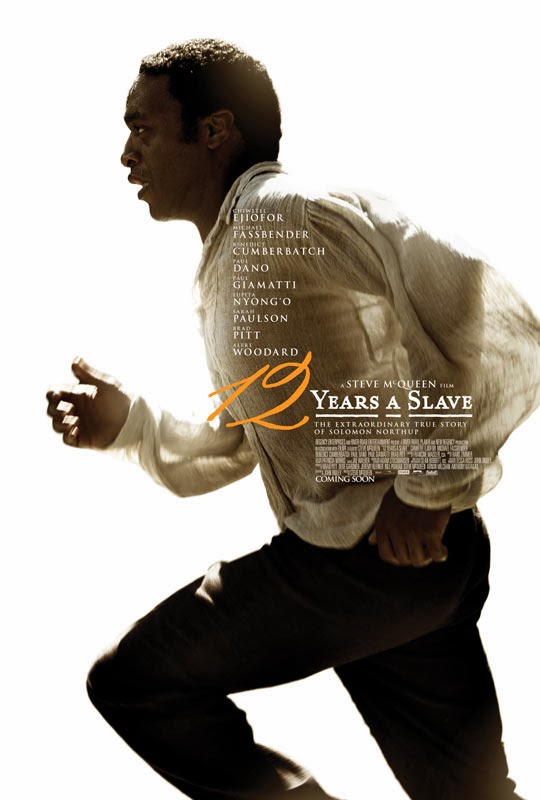
Directed by Steve McQueen. Written by John Ridley. Cast: Chiwetel Ejiofor, Michael Fassbender, Benedict Cumberbatch, Brad Pitt, Paul Dano, Paul Giamatti, Alfre Woodard, Sarah Paulson, Lupita Nyong'o, Scoot McNairy, Taran Killam, Garret Dillahunt, Adepero Oduye, Michael Kenneth Williams, J.D. Evermore, Andy Dylan, Kelsey Scott, Quevenzhane Wallis, Bill Camp, Chris Chalk, Tony Bentley, Christopher Berry, Liza J. Bennett. (R, 134 mins)
Solomon Northrup's 1853 memoir is adapted into a typically brutal and unflinching offering from British filmmaker Steve McQueen, who previously gave us the similarly harrowing hunger-strike chronicle HUNGER (2008) and the NC-17 sex addiction drama SHAME (2011). McQueen has already made his mark as a noteworthy modern filmmaker, but 12 YEARS A SLAVE shows he can make a commercial, mainstream film without watering down his pursuit of graphic and ugly realism. This is a gut-wrenching, upsetting, and horrifying film, and arguably the most unblinking, in-your-face depiction of slavery that you're likely to see. It's not hyperbole to compare it to SCHINDLER'S LIST as the final cinematic word on a specific subject.
Chiwetel Ejiofor stars as Northrup, a free black man in 1841 Saratoga, known and respected throughout the community as a violinist, artist, and family man. When his wife is out of town with their two children, Solomon meets two circus performers (Scoot McNairy, Taran Killam), who talk him into taking a lucrative gig in Washington, D.C. They get him drunk and he wakes up chained in a room. Rechristened Platt, Solomon is taken to Louisiana and sold to plantation owner William Ford (Benedict Cumberbatch). Ford is a slave owner, but is relatively kindly, and respects "Platt" for his obvious intelligence and his construction skills after he takes charge of devising a more efficient waterway transport for him. This angers Tibeats (Paul Dano), a sadistic Ford plantation overseer who tries to lynch Platt after starting a fight with him and embarrassingly losing. Realizing he can't have Platt and Tibeats working together, Ford transfers the debt of Platt's acquisition to cotton plantation owner Edwin Epps (Michael Fassbender, who starred in HUNGER and SHAME). Epps and his wife (Sarah Paulson) are a monstrous couple, abusive to their slaves, whipping them if they fall short of the 200 lb/day cotton quota. Epps has also been forcing himself on slave Patsey (Lupita Nyong'o), which causes her to be a constant target of Mistress Epps' jealous rages. Before arriving at Epps' plantation, Solomon/Platt repeatedly tries to explain that he's a free man, but it only gets him into trouble, as does his inability to stand idly by while those around him are being treated so unjustly.
Working from a script by John Ridley (THREE KINGS, UNDERCOVER BROTHER, RED TAILS), McQueen pulls no punches with 12 YEARS A SLAVE. The language and imagery are harsh, as they should be (Patsey is given the most vicious whipping this side of THE PASSION OF THE CHRIST). It's hard not to get angry as Solomon is let down by nearly everyone: the circus performers (it's odd to see SNL standout Taran Killam as one of the film's chief villains), people in positions of power who won't listen to him, even the kindly Ford, who cares about Platt to some extent but still puts profits before the slave's well-being. When Platt pleads with Ford to not give him to Epps and starts to explain that he's a free man from Saratoga, Ford can only say "I don't want to know." When Solomon/Platt is sold to the Fords along with Eliza (Adepero Oduye), a single mother who has her two children taken away from her by a cruel slave trader (Paul Giamatti), Eliza can't stop crying, and Ford's wife (Liza J. Bennett) brushes her off with "Get some sleep and some food and you'll forget those children soon enough."
12 YEARS A SLAVE features career-best work from Ejiofor, and Fassbender, who should've gotten Oscar nods for both HUNGER and SHAME, turns in yet another performance that demonstrates he's one of the best actors at work today. Where most directors handling a subject like this would have the villains played as cackling moustache-twirlers, McQueen makes them ugly and real. Fassbender and Paulson create one of the most loathsome screen couples in ages. I also liked what McQueen did with Cumberbatch's Ford, presenting him as conflicted about his feelings but still cynically putting himself and his money first. There's a number of familiar faces in smaller roles: Alfre Woodard as a former slave who pragmatically became a plantation mistress; Michael Kenneth Williams (BOARDWALK EMPIRE's Chalky White) as a too-small bit as a rebellious slave; and Brad Pitt as Bass, a Canadian carpenter who warns Epps that the slave owner's day of reckoning is coming. Difficult to watch and impossible to forget, 12 YEARS A SLAVE suffers from occasionally stilted dialogue but is otherwise masterful moviemaking and one of the year's best films.
Written and directed by Don Coscarelli. Cast: Chase Williamson, Rob Mayes, Paul Giamatti, Clancy Brown, Glynn Turman, Doug Jones, Daniel Roebuck, Angus Scrimm, Fabianne Therese, Jonny Weston, Jimmy Wong, Tai Bennett, Allison Weissman, Bark Lee. (R, 99 mins)
JOHN DIES AT THE END, the first film from cult director Don Coscarelli (PHANTASM, THE BEASTMASTER) since 2003's BUBBA HO-TEP, is based on the online serial-turned-2007 novel by Cracked.com editor and contributor David Wong, the pen name of writer Jason Pargin. The result is a twisty, trippy, free-wheeling, almost anything goes film that couldn't have been conceived as anything other than a prefab midnight movie. It's too easy to say it's for the stoner crowd, but yeah, it'll get a lot of love there. Filled with more concepts than it can handle, JOHN DIES AT THE END is pretty hit or miss: many jokes land with a thud or probably read better on the page, but there's some very imaginative ideas throughout and when it hits, it's very good. While it plays very much like BILL & TED'S NAKED LUNCH, Wong's source writing and Coscarelli's script make some intriguing observations about things like perception, fate, reality, the origin of the universe...there's a lot to absorb here.
The heroes--David Wong (Chase Williamson) and his buddy John (Rob Mayes) are sort-of "spiritualist exorcists" who specializing in exterminating beings from other dimensions who have crossed over into our world (such as a Meat Monster that assembles itself out of frozen cuts of meat). David tells his story to journalist Arnie Blondestone (Paul Giamatti, who also co-produced), and establishes his credibility by knowing how much change Arnie has in his pocket, right down to the years on the pennies, and rattling off intimate details of a dream Arnie had the night before. David and John are able to open doors to other worlds and traverse dimensions, and can remember things that have yet to take place. It all stems from a drug called Soy Sauce, which John obtained from a Jamaican named Robert Marley (Tai Bennett). John is able to physically be in one place with David while calling David on his cell from another point in time and space (David to Phone John: "I'm here with you." Phone John: "Ok, say hello to me for me!"). When a bunch of their friends die after OD-ing on Soy Sauce, the pair are arrested by irate detective Appleton (Glynn Turman). John dies while in custody, but manages to call David from another point in time and talk him out of the police station after he's attacked by another cop's living mustache. David is able to communicate with the dead John through a bratwurst that becomes a makeshift cell phone, and eventually teams up with a few friends (and John, whose body is present from another time or dimension--or at least, it's perceived as John) to do battle with a multi-dimensional Lovecraftian demon called Korrok, with the portal to this other realm located behind a ghost door in an abandoned shopping mall. Of course, they have trouble entering this alternate universe because the ghost door has a "ghost knob."
With the dead John repeatedly reappearing in slightly different form (and an opening sequence involving David's axe that has a replacement blade and a year later, a replacement handle, which begs the question "Is it the same axe?"), Wong's story and Coscarelli's adaptation of it are addressing the perception of things--life, death, reality--and the Soy Sauce doesn't necessarily cause insanity, as is initially believed, but rather, it enhances the perception of reality for the user. These multi-dimensional demons (one is known as "Shitload") are always here...they just can't be seen with the naked eye and the Soy Sauce allows that.
The Meat Monster
So yeah, JOHN DIES AT THE END is a rather unique piece of work, blending elements of Lovecraft, George Romero's DAWN OF THE DEAD, John Carpenter's PRINCE OF DARKNESS, and yes, even Coscarelli's own PHANTASM. The film is smart and frustrating in equal measures, sometimes brilliantly clever, other times annoyingly tedious, and some of the jokes tank (the bratwurst one just flatlines), but its good qualities outweigh the not-so-good (how can you not like a spiked bat wrapped in pages from the Old Testament? Or David going through a portal and finding a newspaper dated February 37th, 5189?). And it's simply too bizarre to just dismiss. While it's messy and chaotic and most definitely not for everyone, followers of strange cinema will find a lot to sift through and discuss here. If nothing else, it proves Coscarelli, usually boxed in as a "horror guy" because of the PHANTASM series, is a unique voice in cult cinema and should be heard from more than once a decade.
Postmodernist literary icon Don DeLillo has always seemed like one of those authors whose novels are simply unfilmable, and David Cronenberg proves both that theory and that every great director has to have a worst film with the ill-advised and badly-executed COSMOPOLIS, based on DeLillo's 2003 novel. Cronenberg hasn't shied away from difficult-to-film literary works before, and he succeeded with 1991's NAKED LUNCH, based on the William S. Burroughs novel. The filmmaker is long past the point of needing to prove anything to anyone, but COSMOPOLIS just doesn't work. In an admirable attempt to stretch, TWILIGHT's Robert Pattinson stars as 28-year-old Wall Street billionaire Eric Packer, whose fortune is about to be decimated by fluctuations in the Chinese yuan. Packer decides that today is the day he wants to travel across Manhattan to get a haircut, despite the protests of his security chief (Kevin Durand) that traffic is being tied up by a Presidential visit, anti-capitalist riots, and a funeral procession for a dead rap star, plus he's getting warnings from "The Complex" that there's been a "credible threat" issued against Packer. Undeterred, Packer orders his security team to take him for a haircut in his ludicrously high-tech stretch limo, where most of the film takes place. Over the course of the day-long ride, Packer picks up various advisors (Samantha Morton, Jay Baruchel, Emily Hampshire) for business meetings and philosophical discussions in the limo, hooks up with his art dealer (Juliette Binoche), picks up a doctor (Bob Bainborough) for his daily EKG and rectal exam, gets out of the limo for a quickie with one of his security detail (Patricia McKenzie), and to have lunch with his wife of less than a month (Sarah Gadon) who complains that she "smells sex" on him. Meanwhile, Occupy-type protestors vandalize the limo and one (Mathieu Amalric) throws a pie in Packer's face before he gets half of a haircut (from veteran Canadian character actor George Touliatos!) and comes face to face with the disgruntled ex-employee (Paul Giamatti) who has vowed to kill him.
Cronenberg updates DeLillo's novel to a certain extent (in the book, Packer was part of the dot com bubble), by tying in the Occupy Wall Street movement and utilizing the yuan as opposed to the Japanese yen. I get what Cronenberg was going after here, with Pattinson's intentionally blank-slate performance illustrating Packer's fundamental disconnect from reality, from emotions, from the 99%, etc. and in dark-humored bits where he's listening to his chief of theory Morton's financial analytical babbling while not even noticing that the limo is being violently attacked by rioters. But it's so ponderous, so tedious, and so heavy-handed that Cronenberg just never gets this off the ground. And dialogue like "The glow of cybercapital is so radiant and seductive," "Money has lost its narrative quality, the way painting did once upon a time," and "My prostate is asymmetrical," works a lot better on the page than on the screen being spoken by actors playing characters. Even the final-act appearance of Giamatti, cast radically against type as "Paul Giamatti," fails to generate any signs of life in this shockingly DOA misfire from Cronenberg. If you're looking for a reason why there haven't been any other features made of DeLillo's novels, look no further than COSMOPOLIS. Even with Pattinson's involvement, this still only played on 65 screens at its widest US release, grossing around $750,000. As bad as this Arthouse Hell is, it would've been undeniably entertaining to watch it in a crowded theater filled with members of Team Edward and seeing how quickly it took for an angry mob of texting Twi-hards to like, totally complain to the manager because they like, paid to get in here and this is so not cool because they're like, talking, and he's got that old doctor dude's finger up his ass, and it's like, eeew!(R, 109 mins)
RED HOOK SUMMER (US - 2012)
Other than documentaries like WHEN THE LEVEES BROKE (2006) and director-for-hire gigs like 25TH HOUR (2002) and INSIDE MAN (2006), Spike Lee has lost a bit of his magic when it comes to smaller, personal indie films. 2004's SHE HATE ME didn't seem to be liked by anyone and got Lee the worst reviews of his career. His latest, the low-budget, self-financed RED HOOK SUMMER, exhibits all the self-indulgent qualities that Lee keeps in check when he's working for a major studio. The newest chapter in Lee's "Brooklyn Chronicles" series (which includes such films as 1989's DO THE RIGHT THING, 1994's CROOKLYN, and 1998's HE GOT GAME), RED HOOK SUMMER (which Lee scripted with MIRACLE AT ST. ANNA writer James McBride), has 13-year-old Flik (Jules Brown) being shipped off from a cushy Atlanta suburb to the Red Hook projects in Brooklyn to spend the summer with his fiery preacher grandfather Bishop Enoch Rouse (Clarke Peters). Flik isn't enthused about being there, especially when the Bishop makes it clear that he's using this time together to turn Flik to Jesus. The fish-out-of-water teen also befriends the outgoing Chazz (Toni Lysaith) and has a run-in with gang member and aspiring rapper Box (Nate Parker). Lee frequenly meanders and lets scenes drag on much longer than necessary, with a lot of screen time devoted to the drunken ramblings of Deacon Zee (Thomas Jefferson Byrd), who's never short on opinions about Wall Street and the bailout. And when he isn't doing things like switching film stock for no reason other than because he can, Lee even finds time for a couple of awkward walk-ons as an aged, paunchy, gray-bearded Mookie, his character from DO THE RIGHT THING, and yes, he's still delivering pizzas for Sal's. Really, Spike? Come on.
The best thing about RED HOOK SUMMER is a powerhouse performance from Peters, best known for his work on the HBO series THE WIRE and TREME. There's a third act plot development that essentially forces Lee to turn the whole film over to Peters, and it's here that it finally finds some dramatic momentum, even if it creates a massive logic lapse as to why Flik's mom would send him to Red Hook. Too much time is spent with Flik and Chazz, and I know they're new to this and it's the first movie for each of them and it's kind of a dick move to take cheap shots at young, inexperienced performers and I'm sure they're nice kids, but Brown and Lysaith are absolutely terrible actors. I really don't think Lee could've done a worse job casting these two pivotal roles. Peters tries to carry young Brown along, but there's only so much he can do. If you're a fan of Peters' television work, then RED HOOK SUMMER is worth seeing for him. He's great but he's not enough to keep this from being one of Lee's least-interesting films, though it does have Peters' WIRE co-star Isiah Whitlock, Jr. stopping by long enough to drop a "Sheeeeeeeeeit!" (and he's credited as Isiah "Sheeeeeeet" Whitlock, Jr!). Otherwise, it's a sluggishly-paced horse pill that actually seems to last an entire summer. (R, 121 mins, also streaming on Netflix)
BEASTS OF THE SOUTHERN WILD
(US - 2012)
Equal parts Terrence Malick and Maurice Sendak, the critically-adored BEASTS OF THE SOUTHERN WILD stars a cast of non-professional actors led by six-year-old Quvenzhane Wallis, who rises above the film's more frustrating elements to deliver a truly remarkable performance. As terrific as she is, the film as a whole failed to connect, regardless of how well-intentioned it is. Hushpuppy (Wallis) lives with her father Wink (Dwight Henry, also excellent) in an impoverished, fictional area off the coast of Louisiana known as "The Bathtub" (inspired by the disappearing Isle de Jean Charles). The Bathtub is on the wrong side of the levee, and as Hushpuppy's teacher Miss Bathsheba (Gina Montana) tells her, the ice caps are melting and The Bathtub will eventually cease to exist due to rising waters. Hushpuppy has visions of rampaging aurachs frozen for centuries, now freed by the melted ice caps, in addition to having imaginary conversations with her absent mother and trying to care for the loving, but unstable and frequently abusive Wink after a Katrina-like storm destroys The Bathtub. The residents of The Bathtub are the kinds of close-knit, insulated, and isolated types that have always been left behind by society. Most are illiterate and live in uninhabitable shacks (Hushpuppy has her own home, an elevated trailer near her dad's rundown shack; and their boat is the detached bed of a pickup truck). Director/co-writer Benh Zeitlin is to be commended for getting such a natural, unaffected performance out of a six-year-old novice (she's particularly devastating near the end, and it's Oscar-caliber work), but the film otherwise comes off like an NPR wet dream. (PG-13, 93 mins)