THE LAST MOVIE (US - 1971) Directed by Dennis Hopper. Written by Stewart Stern. Cast: Dennis Hopper, Julie Adams, Daniel Ades, Stella Garcia, Don Gordon, Tomas Milian, John Alderman, Michael Anderson, Jr., Donna Baccala, Toni Basil, Rod Cameron, Severn Darden, Roy Engel, Warren Finnerty, Peter Fonda, Fritz Ford, Samuel Fuller, Henry Jaglom, Clint Kimbrough, Kris Kristofferson, John Phillip Law, Ted Markland, Sylvia Miles, Jim Mitchum, Michelle Phillips, Dean Stockwell, Russ Tamblyn, Chuck Bail, Tom Baker, Michael Greene, Toni Stern. (R, 108 mins) The kind of film that can only result from everyone involved tripping balls, 1971's THE LAST MOVIE almost became a self-fulfilling prophecy for Dennis Hopper, completely quashing the momentum he had going from 1969's landmark EASY RIDER and effectively killing his career for the better part of the next decade and a half. Sure, there were high points during that time--Wim Wenders' THE AMERICAN FRIEND in 1977, Francis Ford Coppola's APOCALYPSE NOW in 1979, and OUT OF THE BLUE in 1980, a low-budget film Hopper was co-starring in and took over directing early in production--but THE LAST MOVIE began a downward personal and professional spiral for Hopper, who would continue to be mired in alcoholism and substance abuse and would soon be working almost exclusively in low-budget European productions after being deemed an unemployable pariah in Hollywood. Hopper would occasionally find work in a bonkers cult movie like the 1976 Australian adventure saga MAD DOG MORGAN, or he'd temporarily behave himself enough to get a respectable gig like Coppola's RUMBLE FISH or Sam Peckinpah's final film THE OSTERMAN WEEKEND (both 1983), but much of his work from these lost years (BLOODBATH, REBORN, LET IT ROCK) has fallen into obscurity or was never even released in the US. He hit bottom when he was fired from the trashy 1984 West German/Mexican-produced fashion models-in-prison potboiler JUNGLE WARRIORS when, coked out of his mind in Mexico, he wandered naked into a village 20 miles from the set, ranting about people trying to kill him, and was promptly put by the producers on a flight back to Los Angeles, where he had to be restrained after freaking out and trying to open the plane's emergency exit. It was his meltdown on JUNGLE WARRIORS that finally served as a wake-up call to Hopper to get his shit together and get clean and sober, and within a couple of years, he was the Comeback Kid with the likes of BLUE VELVET and HOOSIERS, finally exorcising his demons and shaking the career self-immolation that began 15 years earlier with THE LAST MOVIE.
EASY RIDER was part of the post-BONNIE AND CLYDE "New Hollywood" movement, and Hopper found himself in the bizarre position of being both a counterculture hero and an unlikely toast of the town. As a result of the film's success, studios began giving the green light to artistic, auteur-driven projects to capture the youth market. Paramount backed Haskell Wexler's politically-charged, X-rated MEDIUM COOL and MGM brought trailblazing Italian director Michelangelo Antonioni to America for ZABRISKIE POINT, but Universal went all-in, giving a handful of notable independent filmmakers carte blanche to make whatever they wanted to make with no studio interference, most notably Monte Hellman with TWO-LANE BLACKTOP and John Cassavetes with MINNIE AND MOSKOWITZ. THE LAST MOVIE was part of this push by Universal, and the primary reason why the studio's enthusiasm for the avant-garde indie craze ended almost immediately after it began. Hopper spent almost all of 1970 on location in Peru going over budget on THE LAST MOVIE, a project he conceived with screenwriter Stewart Stern, best known for scripting 1955's REBEL WITHOUT A CAUSE, which was also Hopper's film debut. He brought an entourage of friends from the movie and music industry with him and shot over 40 hours of footage that he spent nearly a year in holed up in his New Mexico home trying to corral into a releasable, two-hour film. He even scrapped an initial, relatively mainstream-ish cut completely when he showed it to EL TOPO director Alejandro Jodorowsky, who derisively mocked it and advised Hopper to rearrange the story in a non-linear and more experimental fashion. THE LAST MOVIE found significant acclaim at the Venice Film Festival, where Hopper took home the Critics Prize, but Universal execs were much less impressed, especially since his final cut was several months overdue (they wanted it by the end of 1970 and he kept working until April 1971), and the end result was impenetrable and unsellable. It ended up opening in the fall of 1971 to largely blistering reviews from American critics, and it was soon yanked from distribution, never coming close to the zeitgeist-capturing success of EASY RIDER. Without Hopper's involvement, THE LAST MOVIE was re-released on the drive-in circuit a few years later in a shortened, recut version rechristened CHINCHERO (which was actually Hopper's original title), but beyond that, it was extremely difficult to see for many years, even with a 1989 VHS release from the exploitation outfit United American Video, likely to capitalize on Hopper's major career resurgence in the late '80s and into the 1990s.
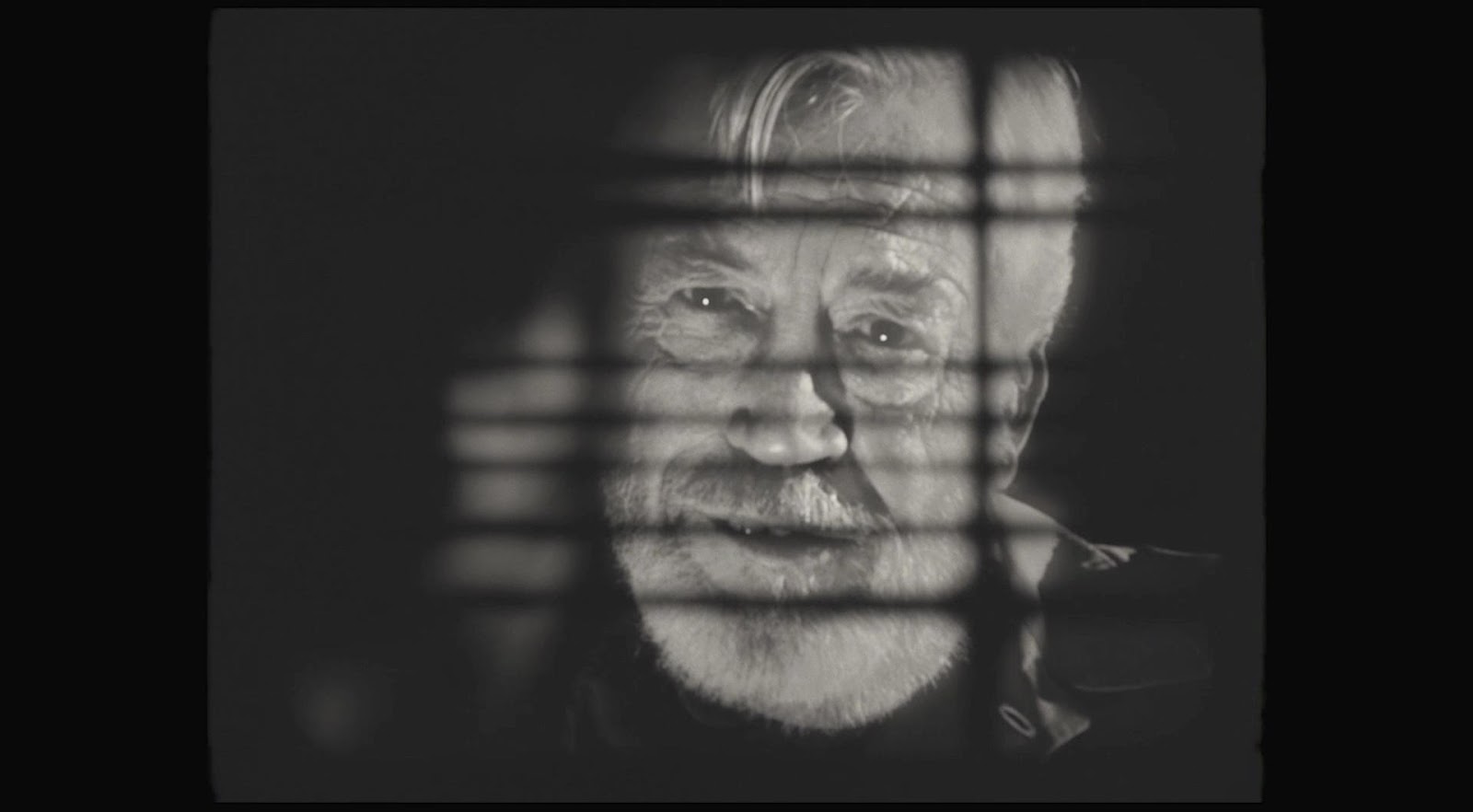
Dennis Hopper (1936-2010)
Its relative obscurity did much to bolster its reputation as a "lost" classic, and Hopper would frequently do Q&As at screenings once he reacquired the rights to the film in 2006. But Hopper died in 2010, before he was ever able to oversee a DVD/Blu-ray release, though thanks to others, THE LAST MOVIE finally made the restoration rounds in 2017 and 2018. It's now out on Blu-ray and is widely accessible again after 47 years (because physical media is dead), but minus L.M. Kit Carson and Lawrence Schiller's THE AMERICAN DREAMER, a 1971 documentary chronicling the making and editing of THE LAST MOVIE and serving as its own BURDEN OF DREAMS and HEARTS OF DARKNESS. When something is out of circulation as long as THE LAST MOVIE has been, there's always a tendency among cineastes to mythologize it, as if its long absence is a sign of neglect or unacknowledged greatness. It's interesting that its Blu-ray debut has virtually coincided with the Netflix release of Orson Welles' THE OTHER SIDE OF THE WIND (in which a LAST MOVIE-era Hopper has a small role), another much-ballyhooed film whose legend stems primarily from it being unfinished and unseen for over 40 years. Like WIND, THE LAST MOVIE is now a curio at best, a disjointed, largely improvised, self-indulgent misfire in which Hopper doesn't capitalize on EASY RIDER as much as he buys into the hype surrounding him.
The nominal plot has Hopper, looking a lot like he would as a pre-Matt Damon incarnation of Tom Ripley six years later in THE AMERICAN FRIEND, as Kansas, a disillusioned stuntman and horse wrangler working on a Hollywood western being shot in a small Peruvian village outside of Chinchero. It appears to be a formulaic bit of moviemaking, with an old-school, cigar-chomping director (Samuel Fuller), and starring an aging, John Wayne-esque cowboy actor (Rod Cameron) as Pat Garrett and a young up-and-comer (Dean Stockwell) as Billy the Kid. Once shooting wraps (other cast members in the film-within-a-film include familiar faces and Hopper buddies like Peter Fonda, John Phillip Law, Kris Kristofferson, Henry Jaglom, Severn Darden, and Russ Tamblyn), and the cast and crew head back to Hollywood, Kansas stays behind and shacks up with Chinchero local Maria (Stella Garcia) and is in no hurry to return home. His idyllic getaway, where he spends his days lounging about and having waterfall sex with Maria, is interrupted by the village priest (Tomas Milian), who informs him that the locals, led by "director" Thomas (Daniel Ades), are re-enacting the production of the movie and imitating what they witnessed--even constructing film "equipment" like cameras and cranes out of wood and sticks--and are so taken with their Hollywood experience that they can no longer differentiate fantasy from reality. Kansas also gets involved in role-playing sex games with Mrs. Anderson (Julie Adams), the horny socialite wife of an Peru-based American businessman (Roy Engel), and goes off on a hunt for gold with skeezy American expat Neville Robey (Don Gordon). That's before he's coerced back on the still-standing movie set by Thomas and the villagers and forced to re-enact his stunt work all over again in what seems to be shaping up as a proto-WICKER MAN but, like the rest of THE LAST MOVIE, goes nowhere.
There's some shallow statements about the artifice of cinema and the way Hollywood cynicism poisons a heretofore peaceful village populated by largely isolated people--note the way they production just packs up and leaves, leaving its large set of old-west building facades behind for the locals to deal with--but it's all much too muddled and meandering. It's beautifully shot by the great Laszlo Kovacs, Hopper gets a surprising performance out of Adams (THE CREATURE FROM THE BLACK LAGOON), and the themes he explores have some merit, but THE LAST MOVIE is awfully pretentious and full of itself, from the random intentional placement of "Scene Missing" cards, to the credit "A Film by Dennis Hopper" appearing 11 minutes in and followed a full 15 (!) minutes later by the title card, to Hopper paying homage to himself with a climactic restaging of the EASY RIDER campfire scene with Kansas and Neville. As the film grows increasingly abstract in its off-the-rails last half hour, Hopper simply loses the thread and gets lost up his own ass, as a long sequence with a drunk Kansas in a bar brawl is interrupted by cutaways to Hopper in a makeup chair stating "I never jerked off a horse before, ya know?" and another shot of Hopper lying down and a close-up of a lactating breast squirting milk into his face. Its chaos continues as Hopper breaks the fourth wall by smiling at the camera near the end as a LAST MOVIE clapboard is left in the shot. I suppose it's something do to about the blurring of film vs. life or illusion vs. reality, but the whole meta deconstruction/destruction of cinema thing was done much more succinctly with the unforgettable last shot of TWO-LANE BLACKTOP (also of note is that both films feature Kris Kristofferson's own version of his oft-recorded "Me and Bobby McGee"). THE LAST MOVIE is an insufferable mess, though it does have historical value as a document of its era and perhaps as "New Hollywood" taking a wrong turn prior to the age of the blockbuster ushered in by JAWS in 1975. It's certainly required viewing for fans of Dennis Hopper, but mileage may vary. It's either a hellraising artist's ultimate masterpiece and a defiant "Fuck you!" to the industry or a textbook example of the dangers of being handed too much money and too much freedom when your ego's running amok and you're high AF. In the years after he was in rehab, Aerosmith frontman Steven Tyler often quipped that in their hedonistic heyday, the band "probably snorted up all of Peru." Well, yeah, perhaps...or at least whatever was left after Dennis Hopper and his cast and crew were finished with THE LAST MOVIE.
THE OTHER SIDE OF THE WIND (France/Iran/US - 2018) Directed by Orson Welles. Written by Orson Welles and Oja Kodar. Cast: John Huston, Oja Kodar, Peter Bogdanovich, Susan Strasberg, Lilli Palmer, Bob Random, Norman Foster, Edmond O'Brien, Mercedes McCambridge, Cameron Mitchell, Paul Stewart, Henry Jaglom, Paul Mazursky, Dennis Hopper, Curtis Harrington, Claude Chabrol, George Jessel, Gregory Sierra, Tonio Selwart, Dan Tobin, John Carroll, Stafford Repp, Geoffrey Land, Joseph McBride, Cathy Lucas, Pat McMahon, Peter Jason, Angelo Rossitto, Stephane Audran, Rich Little, Gary Graver, Frank Marshall, Cassie Yates, William Katt, Cameron Crowe, Les Moonves. (R, 122 mins) Orson Welles died in 1985, but 33 years later, his "last" film has finally been completed and released as a Netflix Original. One of the most famous of "lost" movies, THE OTHER SIDE OF THE WIND has spent decades mired in various legal, personal, and political quagmires among numerous involved parties. As was usually the case in Welles' European exile years in the 1950s and 1960s (the exception being his last Hollywood studio work as a director, 1958's TOUCH OF EVIL), funding came from his lucrative actor-for-hire jobs and when that ran out, he would constantly find himself hustling for cash from various wealthy investors from all over the world, who were always more than happy to partner with a revered filmmaker of Welles' stature until they realized they probably weren't getting their money back. Notorious for doing things his own way and clashing with Hollywood execs as far back as 1942's THE MAGNIFICENT AMBERSONS, Welles would rarely enjoy a hassle-free project other than 1962's THE TRIAL, and while he did have to cut corners when future SUPERMAN producer Alexander Salkind ran out of money by the end of production, he remained grateful that Salkind trusted him and left him alone to make the film he wanted to make.
Huston, Welles, and Bogdanovich apparently
coining the question "How 'bout a Fresca?"
As a result of his unconventional and often unreliable methods of finance, Welles probably had as many unfinished films as he did finished ones, none more talked about than THE OTHER SIDE OF THE WIND. Filming began in 1970 and wasn't completed until 1976, as Welles would shoot what he could in bits and pieces when the money was there, scraping by with acting and TV commercial gigs (and shooting another movie, 1973's F FOR FAKE) in the interim. He managed to get a French production company to back the project and when that money ran out, he secured additional financing from the Shah of Iran's brother-in-law (the production dragged on for so long and so sporadically that star John Huston didn't even join the cast until 1974). Written by Welles and his girlfriend Oja Kodar, THE OTHER SIDE OF THE WIND would remain unfinished in Welles' lifetime, the film caught up in his tax issues with the IRS; the alleged embezzlement of funds by a Spanish business associate Welles met while starring as Long John Silver in the 1972 Harry Alan Towers production of TREASURE ISLAND; the Ayatollah Khomeini-ordered seizure of the assets and property of the Shah and his entire extended family following the 1979 Iranian Revolution; and a seemingly never-ending conflict between Kodar and Welles' daughter Beatrice following his death, a battle that also involved Welles' protege and friend Peter Bogdanovich. The young director was then riding high on THE LAST PICTURE SHOW and PAPER MOON, and put $500,000 of his own money into Welles' vision in addition to letting his mentor crash at his Beverly Hills mansion from 1974 to 1976.
There was always talk of finishing the film, with Kodar attempting and failing to broker a deal with Showtime in the late '90s, but it was Bogdanovich who seriously got the ball rolling on the completion of THE OTHER SIDE OF THE WIND back in 2004 (other parties included cinematographer Gary Graver, who died in 2006, and producer Frank Marshall, who worked on part of the original shoot as a production assistant). Once all legal squabbles were resolved, Netflix agreed to fund the final restoration, with Oscar-winning editor Bob Murawski (THE HURT LOCKER) brought in to oversee the completion based on Welles' archived notes, multiple versions of WIND's scripts (including one that totaled 360 pages), and by studying his editing techniques on all of his previous films. Welles shot nearly 100 hours of footage, and it's an incredible achievement in itself that Murawski was able to put this together at all. The end result, running just over two hours, is seemingly free-form mash-up of various film stocks, image qualities, and aspect ratios, often switching from color to black & white in the same scene, almost like an art-house version of the kind of Z-grade drive-in patchwork you'd expect from Al Adamson or Jess Franco (an assistant to Welles on 1966's CHIMES AT MIDNIGHT). John Huston's actor son Danny was summoned to revoice some of his late father's dialogue in a few instances where the audio was too deteriorated to salvage or just missing altogether. Many scenes have the telltale signs of piecemeal shooting, with an absent Huston doubled from behind and conversations between two or more actors edited together even though the actors never share the frame and were shot years apart. Or even on a different continent in Lilli Palmer's case, with the actress in scenes with Huston and other cast members in California and Arizona shot anywhere from 1971 to 1976 even though she's always shown alone and all of her footage was shot in Spain in 1973.
Set up in an ahead-of-its-time mockumentary style by present-day voiceover from 1970s wunderkind Brooks Otterlake (Bogdanovich), THE OTHER SIDE OF THE WIND deals with the last day in the life of famed Hollywood movie director Jake Hannaford (Huston). A surrogate for Welles himself, Hannaford has invited his closest friends, colleagues, journalists, film students, and other assorted hangers-on and sycophants to his 70th birthday party being thrown by his long-ago lover and retired actress Zarah Valeska (Palmer), with everyone given 8mm and 16mm cameras to document the event. Hannaford's got other pressing issues: his latest film--titled THE OTHER SIDE OF THE WIND and a desperate attempt to attract the counterculture market--is in trouble. His star is John Dale (Bob Random), a Hannaford discovery who has no acting experience and is nowhere to be found after walking off the set midway through production; young studio boss Max David (Geoffrey Land) has seen the dailies and isn't happy, especially after loyal Hannaford flunky Billy Boyle (Norman Foster) confesses the director has tossed the script and is just making it up as he goes along; and Hannaford himself is growing increasingly jealous over the success of Otterlake, his protege who just scored a critically-acclaimed blockbuster hit with his third film and is now the toast of Hollywood. Hannaford needs Otterlake's help, but the young director won't use his newfound clout to help bail him out with David, who's been invited to the party and is a no-show.
Cameron Mitchell, Paul Stewart, Mercedes
McCambridge, and Welles on the set.
The party is a Who's Who of Hannaford's world, with tight-knit, ENTOURAGE-like acolytes like Boyle, retired actor friends Pat Mullins (an ill-looking Edmond O'Brien, who would retire from acting himself in 1974 after being diagnosed with Alzheimer's), Lou Martin (John Carroll), and Al Denny (Stafford Repp); former business partner "The Baron" (Tonio Selwart); loyal secretary Maggie Noonan (Mercedes McCambridge); his manager Matt Costello (Paul Stewart); and longtime makeup man Zimmie Zimmer (Cameron Mitchell), who attends the party even though he's fired en route. There's also macho screenwriter Jack Simon (Gregory Sierra), who's no fan of Hannaford's, and film critic Juliet Rich (Susan Strasberg), who's notoriously critical of the work of both Hannaford and Otterlake. As everyone mingles, drinks to excess, and wonders about everything from Dale's absence to Hannaford possibly being a closeted homosexual, the director screens an unfinished workprint of THE OTHER SIDE OF THE WIND, an experimental, avant-garde, Euro-tinged, psychedelic art film starring Dale and a nameless actress (Kodar). The film-within-a-film (shot mostly in 1970) has some striking imagery, whether it's a sex scene in the passenger seat of a garishly lit car that looks like a Dario Argento cab ride (this sequence was shot in 1974), or Dale and "The Actress" spending most of the screened film wandering around nude on the MGM backlot with no dialogue. The power goes out, forcing the party to use generators that also fail, at which point the screening moves to a nearby drive-in. When The Baron informs the projectionist that he's showing the reels out of order as "The Actress" happens upon a giant, erect cock in the desert, the response is "Does it matter?"
Almost every character in THE OTHER SIDE OF THE WIND is a stand-in for someone: Billy Boyle was reportedly based on Mickey Rooney, Max David on then-Paramount head Robert Evans, Zarah Valeska on Marlene Dietrich (Welles' original choice for the role, but she turned it down), Juliet Rich on famously combative film critic Pauline Kael, Jack Simon on John Milius, "The Baron" on John Houseman, and most importantly, Brooks Otterlake on Peter Bogdanovich himself, who skyrocketed to fame and fortune while Welles struggled to get any project off the ground (Otterlake's barely-legal date to the party, Mavis Henscher, played by Cathy Lucas, is based on Bogdanovich's then-girlfriend Cybill Shepherd). Bogdanovich's casting pretty much eliminates any mystery as to what Welles' feelings on their friendship were by that point, but it's interesting to note that Bogdanovich only ended up being cast after Welles' first choice--Rich Little, of all people--left the production just like John Dale left the film-within-a-film, partly because of other commitments but mostly because he had no idea what Welles was trying to accomplish. Little remains in the film as an unnamed party guest and has one scene with Lucas, and judging from his wardrobe and dialogue, it was clearly shot when Little was still playing Otterlake (and Otterlake's odd quirk of doing random celebrity impressions--not one of Bogdanovich's strengths--is something that was obviously conceived with Little in mind). Welles made no secret of his disdain for pretentious art cinema, with particular scorn reserved for Michelangelo Antonioni, whose ZABRISKIE POINT is being mocked in the film-within-a-film THE OTHER SIDE OF THE WIND, and with Kodar's constant nudity and some scattered instances of explicit sex, it's very likely that this would've gotten an X rating if it was released in the 1970s. There's a dark-humored and misanthropic streak throughout the film, but the cheap shots--at European cinema (Billy on LAST TANGO IN PARIS director Bernardo Bertolucci: "He's-a-spicy-a-meatball!"), at new Hollywood, at film critics (how else do you explain a drunk Hannaford physically assaulting Juliet Rich near the end?), and at misfit, Hannaford-obsessed film students, especially with a pair of clingy dweebs in Marvin Pistor (Joseph McBride) and Marvin P. Fassbinder (Pat McMahon), who are invited to the party, ask inane questions, and follow him around like lost puppy dogs--start to feel like sour grapes after a while.
As the booze-swilling, cigar-sucking Hannaford, Huston is captivating every moment he's onscreen, channeling Welles through his own persona to create a fascinating hybrid characterization of two larger-than-life filmmakers. With the rapid-fire quick-cuts, constantly-changing film stocks, and the fact that some of their scenes may have been shot months or years apart, most of the cast doesn't get a chance to make that much of an impression, though Mitchell, by that point slumming in D-grade schlock, is an unexpectedly poignant standout as the melancholy Zimmie. Other then-contemporary filmmakers appear as themselves arguing about the state of cinema at Hannaford's party, including Dennis Hopper, Claude Chabrol, Curtis Harrington, Paul Mazursky, and Henry Jaglom, who directed Welles' final performance in SOMEONE TO LOVE, released in 1988, three years after his death. There's some scattered moments of Welles-ian mastery in THE OTHER SIDE OF THE WIND, and at times, it's a remarkably candid confessional, like it's Welles' own personal version of Luchino Visconti's THE LEOPARD, where Burt Lancaster's aging prince wanders from room to room at a grand ball, saying goodbye to his aristocratic life, recognizing his irrelevance in a world that's moving on and leaving him behind. But after all these years, the knee-jerk reaction will be to label this Welles' lost masterpiece or his "ultimate statement," or something to that effect. Five decades of cineaste mystique surrounding an ambitious and unfinished project will do that, but at the end of the day, this is the kind of self-indulgent home movie that's an historical curio at best, and directly responsible for the career of Henry Jaglom at worst. I'm glad it's out, I'm glad we're able to see it, and it's required viewing for anyone with a serious interest in film history up to the 1970s, but am I ever gonna watch this again? There's a legend surrounding THE OTHER SIDE OF THE WIND, and the backstory--covered at length in Morgan Neville's simultaneously-released Netflix Original documentary THEY'LL LOVE ME WHEN I'M DEAD--is ultimately more fascinating than the film itself.
STRAIGHT TO HELL (US/UK - 1987) Directed by Alex Cox. Written by Dick Rude and Alex Cox. Cast: Sy Richardson, Joe Strummer, Dick Rude, Courtney Love, The Pogues, Elvis Costello, Dennis Hopper, Grace Jones, Edward Tudor-Pole, Jim Jarmusch, Juan Torres, Biff Yeager, Zander Schloss, Sara Sugarman, Miguel Sandoval, Jennifer Balgobin, Xander Berkeley, Kathy Burke, Michele Winstanley, Sue Kiel, Ed Pansullo, Graham Fletcher-Cook, Luis Contreras, Del Zamora, Fox Harris, Cait O'Riordan, Martin Turner, Jem Finer. (R, 91 mins) Born in 1954, Alex Cox established himself as a major new talent with 1984's cult hit REPO MAN and 1986's critically-acclaimed SID AND NANCY, and as a result, the British wunderkind immediately found himself being courted by the major studios for a variety of commercial, big-budget projects. He turned down offers to direct THREE AMIGOS (eventually made by John Landis), ROBOCOP (Paul Verhoeven), and Arnold Schwarzenegger's Stephen King adaptation THE RUNNING MAN (Paul Michael Glaser), and instead chose to make the low-budget, spaghetti western-inspired STRAIGHT TO HELL for the prestige indie Island Pictures. A critical and commercial bomb in the summer of 1987, STRAIGHT TO HELL only made it into a handful of theaters on the same day as DRAGNET and SPACEBALLS, and topped out with a final box office tally of $210,000. The script was written over the course of three days by Cox and co-star Dick Rude, and only came about because the far-left Cox had organized a benefit concert in Nicaragua to be headlined by Elvis Costello, The Clash (shortly before they disbanded), and The Pogues with the intention of filming a documentary before the political tumult in the country led to everyone involved concluding that it wasn't a good idea. Still wishing to work with the musicians in some capacity, Cox came up with STRAIGHT TO HELL, which ultimately plays less like a real film and more like a self-indulgent home movie with Cox and a bunch of cult rocker buddies dicking off in Almeria, Spain.
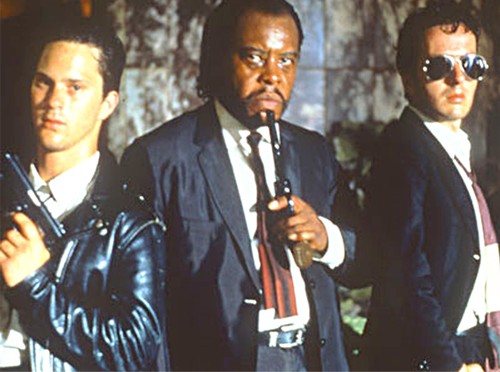
A textbook example of a film where it's obvious everyone had a blast during filming but the end result leaves the audience feeling like they're deliberately being excluded from the joke, STRAIGHT TO HELL opens with a quartet of incompetent bank robbers barely getting away with a suitcase full of cash in Spain: irate leader Norwood (Sy Richardson), cynical Simms (Clash frontman Joe Strummer), hyper Willy (Rude), and Norwood's abrasive, screeching girlfriend Velma (22-year-old Courtney Love, during her brief early acting career prior to fronting Hole and meeting Kurt Cobain). Their car dies after Simms stupidly fills the gas tank with diesel, stranding them in a middle of nowhere desert. They bury the money and happen upon a small town straight out of an old western, run by the large, coffee-addicted McMahon family, led by Frank (Biff Yeager), with most of the others, excluding Preacher McMahon (Xander Berkeley) and Stupid McMahon (Martin Turner, who's also credited as "sex and cruelty consultant," which is maybe the film's only funny joke), played by members of The Pogues. After intervening in a conflict between two McMahons and deranged rival Rusty Zimmerman (Edward Tudor-Pole) that sees Norwood, Simms, and Willy blowing away Rusty, the outsiders earn the trust of Frank McMahon. All that goes straight to hell when Frank's doddering old father (Jem Finer) is killed by his niece (Kathy Burke), a murder that's pinned on Whitey (Graham Fletcher-Cook), a flunky sent to search for Norwood and his cohorts by their employer, feared crime boss Amos Dade (Jim Jarmusch). This sets in motion a chain of double crosses and unholy alliances, complicated by the arrival of obscenely wealthy American gas station/convenience store magnate I.G. Farben (Dennis Hopper) and his wife Sonya (Grace Jones), who supply Norwood, Simms, and Willy with a Gatling gun and other weapons to start a war with the McMahons, the clan standing in Farben's way of redeveloping the desert town into an expensive housing development.
Cox having Hopper's Farben supply the fugitive bank robbers with weapons draws obvious parallels to the soon-to-explode Iran-Contra scandal, which the director would explore with more muddled results in 1987's WALKER, released six months after STRAIGHT TO HELL. An intentionally anachronistic, revisionist "biography" of William Walker (played in the film by Ed Harris), an American mercenary who declared himself president of Nicaragua in 1856 (Marlon Brando played Walker in Gillo Pontecorvo's BURN! in 1969), WALKER was Cox's most ambitious film to date, a bonkers left-wing polemic with helicopters and cars in 1856 Nicaragua and featuring a good chunk of STRAIGHT TO HELL's cast along with Marlee Matlin in her first role after winning an Oscar for CHILDREN OF A LESSER GOD. Barely released at the height of the holiday awards season as if it had a chance of winning anything, WALKER was somehow bankrolled by Universal, who had no idea what to do with it, and it grossed only slightly more than STRAIGHT TO HELL, effectively ending Cox's career in Hollywood. Like any terrible bomb that loses a lot of money, it's developed a cult following over the years, most notably from the Criterion Collection, who have taken it upon themselves to serve as WALKER's chief apologists.
Despite Criterion's insistence that it's a misunderstood masterpiece of gonzo cinema, WALKER is all kinds of terrible, as is STRAIGHT TO HELL, which is in some ways a more freewheeling, improvisatory test run for WALKER, both in terms of Hopper's weapons-selling Farben as well as the borderline slapstick antics of the three stars. The underrated Richardson, who provided REPO MAN with some of its funniest moments, displays some comedic chops both physically and in his facial expressions and tough guy act, but almost nothing in STRAIGHT TO HELL is even remotely amusing. It's laborious, slowly-paced, filled with obnoxious characters and a diverse cast that's just goofing off while Cox gets enough footage to piece a movie together. Why do the rough-and-tumble McMahons have a perpetually befuddled, properly-attired butler named Hives, and why is he played by Elvis Costello? Costello seems to be patterning his performance on both Rowan Atkinson and Donald Sutherland's "clumsy waiter" in THE KENTUCKY FRIED MOVIE, but like everything else, there's no rhyme or reason to it. Cox and Rude made this up as they went along and got Costello, Strummer, the Pogues, and pals like Richardson, Del Zamora, Fox Harris, and Miguel Sandoval, and called in some favors from Hopper (then in the midst of a major career resurgence following BLUE VELVET and HOOSIERS) and Jarmusch and just hoped the eclectic ensemble could somehow make something happen. It doesn't really work as a spaghetti western satire or spoof because Cox has nothing to say about the genre and only creates some sense of purpose once he introduces the heavy-handed Iran-Contra parallels. Even then, with the potential of some topical political commentary along the lines of the late '60s "Zapata" westerns, Cox can't get his shit together because he's too busy buying his own hype. It's an aimless mess where no one's in charge and there's no endgame. The Nicaragua concert got cancelled but everyone still wanted to hang out. That's the only reason STRAIGHT TO HELL exists.
Cox revisited STRAIGHT TO HELL in 2010, adding a five minutes of cut scenes and sprucing other shots up with visual effects and CGI splatter (including the obligatory "blood hitting the camera lens" schtick) and it got a brief release on the arthouse circuit as STRAIGHT TO HELL RETURNS. That's the version on Kino's new Blu-ray, now rechristened STRAIGHT TO HELL: THE DIRECTOR'S CUT. In any incarnation, it represents the beginning of the end for Cox, who has almost completely regressed like a directorial Benjamin Button in the decades since, helming a series of increasingly amateurish projects with decreasing budgets and very little exposure. His last behind-the-scenes association with anything resembling a real movie was when he scored a co-writing credit on Terry Gilliam's FEAR AND LOATHING IN LAS VEGAS. He's also acted in several films, most notably Alex de la Iglesia's PERDITA DURANGO (aka DANCE WITH THE DEVIL). Cox has long believed that WALKER got him blackballed in Hollywood, but as his standing as a filmmaker has cratered in the last 30 years, he has become a reputable spaghetti western historian, appearing on several DVD commentaries and writing a book about the subject titled 10,000 Ways to Die. He's also written other non-fiction books on a variety of topics--including a memoir, a book about JFK and Lee Harvey Oswald, and an analysis of the cult TV series THE PRISONER--and he's directed TV documentaries on Akira Kurosawa and the 1970s EMMANUELLE films. As a narrative filmmaker, Cox's place in movie history is secure thanks to REPO MAN and SID AND NANCY, but the combined, quick-succession tanking of STRAIGHT TO HELL and WALKER proved too toxic to overcome, with Cox imploding hard and hitting his nadir with 2011's ill-advised, desperate, and all-greenscreen semi-sequel REPO CHICK. Cox's most recent film is a crowd-funded time travel western with unknown actors called TOMBSTONE RASHOMON, which was screened as a work in progress at some film festivals in 2017 but has yet to be officially released. You'll likely never see it, and that's probably for the best.
JUNGLE WARRIORS (West Germany/Mexico - 1984) Directed by Ernst R. von Theumer. Written by Robert Collector and Ernst R. von Theumer. Cast: Nina Van Pallandt, Paul L. Smith, John Vernon, Alex Cord, Sybil Danning, Marjoe Gortner, Woody Strode, Dana Elcar, Kai Wulff, Louisa Moritz, Suzi Horne, Mindy Iden, Kari Lloyd, Ava Cadell, Myra Chason, Angela Robinson, Isabel "Chichimeca" Vazquez. (R, 95 mins) From the producers of 1983's legendary women-in-prison masterpiece CHAINED HEAT comes this similarly sleazy actioner packed with slumming big names, including returning co-stars John Vernon, Sybil Danning, and Louisa Moritz. The ludicrous plot involves a group of fashion models managed by coke-snorting asshole Larry (Marjoe Gortner) heading to a shoot in the Amazon and getting caught in the middle of a war between South American drug lord Cesar Santiago (Paul L. Smith) and gregarious mob kingpin Vittorio Mastranga (Vernon). Mastranga and a few of his goons, including his nephew/lawyer Nick Spilotro (Alex Cord), are trying to muscle in on Santiago's turf, but things get complicated when Santiago shoots down the models' plane and takes them prisoner. Of course, this leads to an extended and distasteful sequence where Santiago's slobbering underlings take turns raping all of the women before they revolt--one of them (Mindi Iden) is actually an undercover FBI agent, which begs the question "What would the point of her going undercover as a model be if the plane didn't get shot down?"--and become the titular ass-kickers. JUNGLE WARRIORS also provides ample space for Vernon to overact and for Smith to do his patented glowering stink-eye routine, but there's also some additional trashy enjoyment to be had from Cesar's obviously incestuous relationship with his sultry, psycho-bitch sister Angel (Danning), who instigates the models' gang rape and gets a nude oil rubdown from her brother, though the lighting of the scene suggests neither Danning nor Smith were directly involved with it.
Greatest grindhouse group shot ever?
You also get Woody Strode as Luther, Santiago's top henchman, top-billed Nina Van Pallandt (a former model and one-time Robert Altman muse) as Joanna, the producer of the photo shoot, German actor Kai Wulff as a pilot and brief love interest for Joanna, and Dana Elcar (MACGYVER) as irate FBI agent D'Antoni, who seems to exist in another movie altogether (Elcar shares no scenes with any other main cast members and is always shown stewing and yelling in an office). The primary reason anyone remembers JUNGLE WARRIORS today is because of who wasn't in it: Dennis Hopper was originally set to co-star when the film went into production in early 1983, and he arrived at the remote Mexican location with his legendary drug and alcohol problems at their apex, working for a couple of days before fleeing the set when he was convinced people were trying to kill him. He was discovered in a small village 20 miles away, where he was picked up by local police after stripping nude and wandering around in a daze shouting "Kill me naked!" He was fired and put on the first flight to Los Angeles, where he had to be restrained when he tried to open the plane's emergency exit. Hopper would tell this story many times over the years, and the details only came from those who witnessed it--he had no memories of being in Mexico or even working on the movie before his dismissal. After years of escalating and ultimately out-of-control alcoholism (he was drinking over a case of beer and a nearly a gallon of rum a day) and substance abuse ("I'd do a few grams of coke to sober up"), Hopper hit bottom with his JUNGLE WARRIORS meltdown, and it proved to be the wake-up call that got him into rehab upon his return home, after which he remained clean and sober and within a few years, rebuilt his career with his triumphant comeback that began in 1986 with BLUE VELVET and an Oscar-nominated supporting turn in HOOSIERS. The common belief is that Hopper was cast as Larry and replaced by Gortner, which makes sense given some of Larry's behavior and Gortner's very Hopper-like performance. But an early trade ad in Variety that ran when the film started production (thanks to Video Junkie's William Wilson for that bit of history seen below) shows that both Hopper and Gortner were in the cast. That same trade ad makes no mention of Kai Wulff, so it's possible--and this is pure hypothesis on my part--that Hopper was cast as Larry and Gortner as the pilot/Joanna love interest, and when Hopper was canned, Gortner was shifted over to the more showy Larry role. It doesn't seem likely that Hopper would've played the heroic love interest to the main heroine, and since both Larry and the pilot are killed off before the midpoint (Larry by booby-trap impalement, the pilot by one of the least-convincing decapitations ever), Gortner wouldn't have had to stick around any longer in order to play Larry instead.
"and Marjoe Gortner as Larry"
Distributed in the US by 42nd Street mainstay Terry Levene's Aquarius Releasing in November 1984, JUNGLE WARRIORS is a mostly crummy grindhouse affair that's prime guilty pleasure material thanks to the bewildered-looking cast and some splattery shootouts, not to mention one killing involving the rotor blades of a chopper that probably sounded better in concept that it plays in execution. And you really haven't lived until you've experienced Marina Arcangeli's incredible JUNGLE WARRIORS theme, quite possibly the worst song ever recorded. In addition to the headaches involving Hopper, the film also switched directors early in the shoot, with veteran German producer Ernst R. von Theumer giving Billy Fine the axe and taking over direction himself. Fine was also a producer on CHAINED HEAT and 1982's THE CONCRETE JUNGLE, and JUNGLE WARRIORS was set to be his debut behind the camera. Von Theumer had been a journeyman in German B-movies going back to the late 1950s (he also directed the 1972 Roger Corman pick-up THE BIG BUST-OUT under the pseudonym "Richard Jackson") and carved a brief niche for himself in the 1980s women-in-prison/jungle action explosion: he would later produce and co-write (and do some uncredited directing) on 1985's RED HEAT, a CHAINED HEAT semi-sequel that reunited Danning and Linda Blair, and he'd direct 1986's HELL HUNTERS, a typically sleazy jungle exploitationer that brought together the seen-better-days likes of Maud Adams, George Lazenby, William Berger, and Stewart Granger as a former Nazi hiding in Paraguay and working on a spider venom-based mind control drug.
THE OSTERMAN WEEKEND (US - 1983) Directed by Sam Peckinpah. Written by Alan Sharp and Ian Masters. Cast: Rutger Hauer, John Hurt, Craig T. Nelson, Dennis Hopper, Burt Lancaster, Chris Sarandon, Meg Foster, Helen Shaver, Cassie Yates, Sandy McPeak, Christopher Starr, Jan Triska, Merete Van Kamp, Tim Thomerson, Buddy Joe Hooker. (R, 103 mins)
The legendary Sam Peckinpah's final film was a typically troubled production that saw him clashing with producers and having the film recut without his involvement. A very loose adaptation of Robert Ludlum's 1972 novel, THE OSTERMAN WEEKEND stars John Hurt as Lawrence Fassett, an embittered CIA agent whose obsessive investigation into his wife's murder leads him to uncover evidence that three men--TV writer Bernard Osterman (Craig T. Nelson), plastic surgeon Richard Tremayne (Dennis Hopper), and hotheaded stockbroker Joseph Cardone (Chris Sarandon)--are really Soviet agents who have been operating in the US since their college days. Fassett convinces their old college buddy John Tanner (Rutger Hauer), now a successful liberal pundit in the political talk show arena, to host a weekend reunion with the guys and their wives. With Tanner's home filled with hidden surveillance cameras and Fassett in regular communication, it's the perfect set-up to expose the alleged KGB agents and in exchange for helping out the US government, Tanner gets an exclusive, one-on-one interview with controversial CIA chief Maxwell Danforth (Burt Lancaster), infamous for his extensive authorization of all manner of high-tech surveillance.
Given its prescient subject matter--cable news pundits, high-tech spy games, government overreach, etc--THE OSTERMAN WEEKEND was a bit ahead of its time and seems ripe for an updated remake today. This version is entertaining, often for the wrong reasons. It's incredibly convoluted, crossing over into the incoherent on occasion, and it's often very sloppily edited, with a few repeated shots and no one watching the continuity when it comes to Nelson's epic fake mustache, which almost never looks the same in two consecutive shots. Peckinpah reportedly tried to make this into an espionage satire, similar to his initial cut of 1975's THE KILLER ELITE which, by the time the producers finished recutting it, was left with only a visibly drunk and unsteady Gig Young slurring his words and struggling to stand and James Caan and Burt Young battling ninjas to keep it interesting. As with that film, the producers removed all the comedy, so maybe OSTERMAN's inconsistent editing and the varying mustache lengths were all part of unsung satirist Peckinpah's master plan. There's some effective bits, especially once Peckinpah lets the film fly off the rails in the last third. Peckinpah uses a peculiar technique in his action scenes here, with a lot of slow-motion and drawn-out, quick-cut editing that, in context, works well, especially in the late-going with the exploding RV, plus he gets a genuinely terrific performance out of Hurt. There's a lot to like here--irate Lancaster at his most assholish (is there any way a guy named "Maxwell Danforth" won't be a complete prick?); gratuitous nudity; Meg Foster decking Helen Shaver; and a hilarious bit involving a dog's head in the fridge--but at the same time, it feels like a missed opportunity. There's a pronounced lack of focus and the disconnect between the director and his producers is apparent. It's a mess, but a consistently intriguing one.
Speaking of messes, Anchor Bay's Blu-ray, released last year, is a splotchy, ugly disaster. And unlike their special edition DVD from 2004, it doesn't include the 116-minute Peckinpah rough cut that led to his dismissal from the project. THE OSTERMAN WEEKEND was Peckinpah's first film since 1978's CONVOY, much of which was directed without credit by his friend James Coburn. Coburn was interested in stepping behind the camera for some future projects and was serving as second unit director to get his DGA card. The veteran actor ended up directing significant portions of the movie while Peckinpah was holed up in his trailer on an extended coke binge. After doing uncredited second unit work without incident for old friend Don Siegel on the 1982 Bette Midler bomb JINXED!, Peckinpah was given THE OSTERMAN WEEKEND as a comeback project and while things initially ran smoothly, disagreements took over and by the end of shooting, there was no communication between him and the producers. When Peckinpah refused to make the changes demanded after a disastrous test screening in May 1983, he was handed his walking papers and the producers re-edited the film themselves. After directing a pair of Julian Lennon music videos, including one for his breakout hit "Too Late for Goodbyes." Peckinpah died of heart failure at just 59 in December 1984, a little over a year after THE OSTERMAN WEEKEND's November 1983 release.