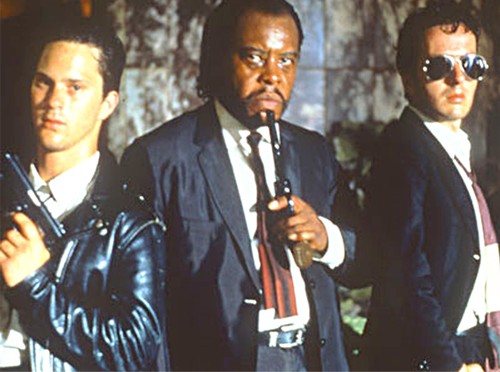
STRAIGHT TO HELL (US/UK - 1987) Directed by Alex Cox. Written by Dick Rude and Alex Cox. Cast: Sy Richardson, Joe Strummer, Dick Rude, Courtney Love, The Pogues, Elvis Costello, Dennis Hopper, Grace Jones, Edward Tudor-Pole, Jim Jarmusch, Juan Torres, Biff Yeager, Zander Schloss, Sara Sugarman, Miguel Sandoval, Jennifer Balgobin, Xander Berkeley, Kathy Burke, Michele Winstanley, Sue Kiel, Ed Pansullo, Graham Fletcher-Cook, Luis Contreras, Del Zamora, Fox Harris, Cait O'Riordan, Martin Turner, Jem Finer. (R, 91 mins) Born in 1954, Alex Cox established himself as a major new talent with 1984's cult hit REPO MAN and 1986's critically-acclaimed SID AND NANCY, and as a result, the British wunderkind immediately found himself being courted by the major studios for a variety of commercial, big-budget projects. He turned down offers to direct THREE AMIGOS (eventually made by John Landis), ROBOCOP (Paul Verhoeven), and Arnold Schwarzenegger's Stephen King adaptation THE RUNNING MAN (Paul Michael Glaser), and instead chose to make the low-budget, spaghetti western-inspired STRAIGHT TO HELL for the prestige indie Island Pictures. A critical and commercial bomb in the summer of 1987, STRAIGHT TO HELL only made it into a handful of theaters on the same day as DRAGNET and SPACEBALLS, and topped out with a final box office tally of $210,000. The script was written over the course of three days by Cox and co-star Dick Rude, and only came about because the far-left Cox had organized a benefit concert in Nicaragua to be headlined by Elvis Costello, The Clash (shortly before they disbanded), and The Pogues with the intention of filming a documentary before the political tumult in the country led to everyone involved concluding that it wasn't a good idea. Still wishing to work with the musicians in some capacity, Cox came up with STRAIGHT TO HELL, which ultimately plays less like a real film and more like a self-indulgent home movie with Cox and a bunch of cult rocker buddies dicking off in Almeria, Spain.
A textbook example of a film where it's obvious everyone had a blast during filming but the end result leaves the audience feeling like they're deliberately being excluded from the joke, STRAIGHT TO HELL opens with a quartet of incompetent bank robbers barely getting away with a suitcase full of cash in Spain: irate leader Norwood (Sy Richardson), cynical Simms (Clash frontman Joe Strummer), hyper Willy (Rude), and Norwood's abrasive, screeching girlfriend Velma (22-year-old Courtney Love, during her brief early acting career prior to fronting Hole and meeting Kurt Cobain). Their car dies after Simms stupidly fills the gas tank with diesel, stranding them in a middle of nowhere desert. They bury the money and happen upon a small town straight out of an old western, run by the large, coffee-addicted McMahon family, led by Frank (Biff Yeager), with most of the others, excluding Preacher McMahon (Xander Berkeley) and Stupid McMahon (Martin Turner, who's also credited as "sex and cruelty consultant," which is maybe the film's only funny joke), played by members of The Pogues. After intervening in a conflict between two McMahons and deranged rival Rusty Zimmerman (Edward Tudor-Pole) that sees Norwood, Simms, and Willy blowing away Rusty, the outsiders earn the trust of Frank McMahon. All that goes straight to hell when Frank's doddering old father (Jem Finer) is killed by his niece (Kathy Burke), a murder that's pinned on Whitey (Graham Fletcher-Cook), a flunky sent to search for Norwood and his cohorts by their employer, feared crime boss Amos Dade (Jim Jarmusch). This sets in motion a chain of double crosses and unholy alliances, complicated by the arrival of obscenely wealthy American gas station/convenience store magnate I.G. Farben (Dennis Hopper) and his wife Sonya (Grace Jones), who supply Norwood, Simms, and Willy with a Gatling gun and other weapons to start a war with the McMahons, the clan standing in Farben's way of redeveloping the desert town into an expensive housing development.
Cox having Hopper's Farben supply the fugitive bank robbers with weapons draws obvious parallels to the soon-to-explode Iran-Contra scandal, which the director would explore with more muddled results in 1987's WALKER, released six months after STRAIGHT TO HELL. An intentionally anachronistic, revisionist "biography" of William Walker (played in the film by Ed Harris), an American mercenary who declared himself president of Nicaragua in 1856 (Marlon Brando played Walker in Gillo Pontecorvo's BURN! in 1969), WALKER was Cox's most ambitious film to date, a bonkers left-wing polemic with helicopters and cars in 1856 Nicaragua and featuring a good chunk of STRAIGHT TO HELL's cast along with Marlee Matlin in her first role after winning an Oscar for CHILDREN OF A LESSER GOD. Barely released at the height of the holiday awards season as if it had a chance of winning anything, WALKER was somehow bankrolled by Universal, who had no idea what to do with it, and it grossed only slightly more than STRAIGHT TO HELL, effectively ending Cox's career in Hollywood. Like any terrible bomb that loses a lot of money, it's developed a cult following over the years, most notably from the Criterion Collection, who have taken it upon themselves to serve as WALKER's chief apologists.
Despite Criterion's insistence that it's a misunderstood masterpiece of gonzo cinema, WALKER is all kinds of terrible, as is STRAIGHT TO HELL, which is in some ways a more freewheeling, improvisatory test run for WALKER, both in terms of Hopper's weapons-selling Farben as well as the borderline slapstick antics of the three stars. The underrated Richardson, who provided REPO MAN with some of its funniest moments, displays some comedic chops both physically and in his facial expressions and tough guy act, but almost nothing in STRAIGHT TO HELL is even remotely amusing. It's laborious, slowly-paced, filled with obnoxious characters and a diverse cast that's just goofing off while Cox gets enough footage to piece a movie together. Why do the rough-and-tumble McMahons have a perpetually befuddled, properly-attired butler named Hives, and why is he played by Elvis Costello? Costello seems to be patterning his performance on both Rowan Atkinson and Donald Sutherland's "clumsy waiter" in THE KENTUCKY FRIED MOVIE, but like everything else, there's no rhyme or reason to it. Cox and Rude made this up as they went along and got Costello, Strummer, the Pogues, and pals like Richardson, Del Zamora, Fox Harris, and Miguel Sandoval, and called in some favors from Hopper (then in the midst of a major career resurgence following BLUE VELVET and HOOSIERS) and Jarmusch and just hoped the eclectic ensemble could somehow make something happen. It doesn't really work as a spaghetti western satire or spoof because Cox has nothing to say about the genre and only creates some sense of purpose once he introduces the heavy-handed Iran-Contra parallels. Even then, with the potential of some topical political commentary along the lines of the late '60s "Zapata" westerns, Cox can't get his shit together because he's too busy buying his own hype. It's an aimless mess where no one's in charge and there's no endgame. The Nicaragua concert got cancelled but everyone still wanted to hang out. That's the only reason STRAIGHT TO HELL exists.
Cox revisited STRAIGHT TO HELL in 2010, adding a five minutes of cut scenes and sprucing other shots up with visual effects and CGI splatter (including the obligatory "blood hitting the camera lens" schtick) and it got a brief release on the arthouse circuit as STRAIGHT TO HELL RETURNS. That's the version on Kino's new Blu-ray, now rechristened STRAIGHT TO HELL: THE DIRECTOR'S CUT. In any incarnation, it represents the beginning of the end for Cox, who has almost completely regressed like a directorial Benjamin Button in the decades since, helming a series of increasingly amateurish projects with decreasing budgets and very little exposure. His last behind-the-scenes association with anything resembling a real movie was when he scored a co-writing credit on Terry Gilliam's FEAR AND LOATHING IN LAS VEGAS. He's also acted in several films, most notably Alex de la Iglesia's PERDITA DURANGO (aka DANCE WITH THE DEVIL). Cox has long believed that WALKER got him blackballed in Hollywood, but as his standing as a filmmaker has cratered in the last 30 years, he has become a reputable spaghetti western historian, appearing on several DVD commentaries and writing a book about the subject titled 10,000 Ways to Die. He's also written other non-fiction books on a variety of topics--including a memoir, a book about JFK and Lee Harvey Oswald, and an analysis of the cult TV series THE PRISONER--and he's directed TV documentaries on Akira Kurosawa and the 1970s EMMANUELLE films. As a narrative filmmaker, Cox's place in movie history is secure thanks to REPO MAN and SID AND NANCY, but the combined, quick-succession tanking of STRAIGHT TO HELL and WALKER proved too toxic to overcome, with Cox imploding hard and hitting his nadir with 2011's ill-advised, desperate, and all-greenscreen semi-sequel REPO CHICK. Cox's most recent film is a crowd-funded time travel western with unknown actors called TOMBSTONE RASHOMON, which was screened as a work in progress at some film festivals in 2017 but has yet to be officially released. You'll likely never see it, and that's probably for the best.
Affected and mannered by design, Natalie Portman's feature-length impression of Jackie Kennedy carries this artsy, dream-like collage by acclaimed Chilean filmmaker Pablo Larrain (TONY MANERO, NERUDA). Taking place in the week after the assassination of JFK (Danish actor Caspar Phillipson), JACKIE is a largely experimental work that isn't concerned being a straightforward biopic, and that works in its favor about as often as it works against it. A framing device has Jackie being interviewed by a journalist (Billy Crudup) at the family home in Hyannis Port several days after her husband's funeral. She makes it clear from the outset that she won't indulge the obvious ("You want me to describe the sound the bullet made when it collided with my husband's skull?"), and she will shape the story and have final edit over what is written and presented to the public. From the moment LBJ (John Carroll Lynch) is sworn in on the flight back to D.C., a shell-shocked, blood-splattered Jackie is adamant about making sure her husband is honored and his public persona preserved. Whether she's planning his memorial or telling her story to the journalist, Jackie is constructing an image, that will shape the world's perception of herself and JFK for years to come. Her goal is to present to the world "the brief, shining moment that there was a Camelot," while acknowledging "There won't be another Camelot...not another Camelot."
As intricately constructed as its subject's public image, JACKIE is equal parts Stanley Kubrick and Terrence Malick. The often stream-of-consciousness monologues delivered by Jackie aren't nearly as wandering and meandering as more recent Malick, and the cold, clinical presentation and long tracking shots are straight out of Kubrick 101. Shooting in Super 16 gives the film a grainy and almost voyeuristic immediacy into Jackie's grief, but the more it goes on, the more ponderous it becomes. Larrain lets Mica Levi's Oscar-nominated score do a lot of the dramatic heavy lifting, and while there's a number of striking images throughout, JACKIE's insistence on keeping everyone--from its supporting characters to the audience watching--at a distance becomes a detriment. The script by Noah Oppenheim (whose two previous writing credits are THE MAZE RUNNER and ALLEGIANT) gets lost in frequently pretentious pontification, with Jackie telling a priest (the late John Hurt in one of his last roles; he died a month after the film's release) things like "The characters you read on the page become more real than the characters who stand beside us." In JACKIE's interpretation of its subject, the First Lady is someone who always seems to playing a part or playing to an audience ("I love crowds!" she tells JFK in a flashback), and to that extent, Portman's performance is remarkable in that it conveys that sense of deliberately manufactured artifice. It's nice that Larrain attempted something more than a cookie-cutter biopic, but in using such tactics, he never lets you in, and the large supporting cast--Hurt, Crudup, Lynch, Peter Sarsgaard as an unconvincing Bobby Kennedy, Greta Gerwig as White House Social Secretary and Jackie's friend Nancy Tuckerman, Richard E. Grant as Bill Walton--exists largely to listen to Jackie wax philosophical and marvel at Portman's uncanny interpretation with her clipped, airy inflections. JACKIE is ambitious and beautifully crafted, but Larrain's technique is too distant and clinical for its own good. (R, 100 mins)
PATERSON (US/Germany/France - 2016)
A quiet film even by Jim Jarmusch standards, PATERSON is a low-key character piece focusing on a Paterson, NJ bus driver named Paterson (Adam Driver) and--it's never really specified--his wife or girlfriend Laura (Golshifteh Farahani), and their English bulldog Marvin (a fine canine performance by eight-year-old Nellie, who was diagnosed with cancer during production and died shortly after filming). A creature of habit, Paterson wakes up every day between 6:10 and 6:15 am, eats a bowl of Cheerios, and walks to work. In his down time and on his lunch breaks, he writes poetry in a journal. When he gets home, Laura makes dinner and tells him about her day, which usually involves her constantly changing life goals ("I need to learn how to play the guitar so I can become a country singer and be as big as Tammy Wynette," she tells Paterson, who's obviously just hearing about this dream for the first time, right between her wanting to be a fashion designer, a painter, and hoping to start her own cupcake business), then he walks Marvin and stops at a neighborhood dive bar run by Doc (Barry Shabaka Henley), for one beer and some conversation before calling it a night. This is Paterson's daily routine, which we follow over the course of a week, and in the context of the film, we see little in the way of a social life (they go see ISLAND OF LOST SOULS at a revival house on Saturday) and nothing in the way of family or friends (a photo on a table tells us that Paterson is a former Marine). PATERSON is about finding heart and soul in the mundane and the everyday, whether it's Paterson being inspired by a box of Ohio Blue Tip matches or eavesdropping on slice-of-life passenger conversations while he's behind the wheel. To that extent, it feels a little like Wayne Wang and Paul Auster's 1995 arthouse hit SMOKE, but the daily repetition recalls Chantal Akerman's JEANNE DIELMAN and the general mood of the film comes off somewhat like Jarmusch's attempt at making a less-precious Wes Anderson film (the recurring use of twins gets a little too cute after a while). The atmosphere is intriguing--Jarmusch sets his scenes in old-school Jersey neighborhoods that have likely been unchanged for decades, and Paterson himself seems like a man not made for these times (he doesn't even have a cell phone). It's a film about the millions of average nobodies who have artistic ideas within them that need to come out but everyday life just happens. Flighty but loving Laura wants Paterson to publish his poetry, but he writes it mainly for himself. He's fine with that, and he's happy. There's a reverence for the history of Paterson, whether it's the invocation of revered Paterson-born poet William Carlos Williams, whose most well-known collection is titled Paterson, and in the framed photos of hometown heroes on the wall of Doc's bar. On a cursory glance, not much happens in PATERSON, but it very subtly sneaks up on you, as in a late sequence where Paterson, on one of his solitary walks, meets a kindred spirit in a traveler from Osaka (Masatoshi Nagase, who was in Jarmusch's MYSTERY TRAIN back in 1989) carrying a tattered Japanese translation of Paterson, that really carries some unexpected emotional resonance. (R, 118 mins)
MAX ROSE
(US - 2016)
Screened at the 2013 Cannes Film Festival and shelved for three years until it hit a few theaters in the fall of 2016, MAX ROSE marks the first significant big-screen role for Jerry Lewis since 1995's little-seen FUNNY BONES. Lewis brings much emotion and poignancy to the title character, a forgotten jazz pianist who had a brief day in the sun in the late 1950s but never became a star. As MAX ROSE opens, 87-year-old Max is dealing with the death of Eva (Claire Bloom), his wife of 65 years. He's understandably hit hard by it ("I can't even remember my life without her," he says) and despite the doting attention of his adult granddaughter Annie (Kerry Bishe) and attempts at bonding from his somewhat estranged son Chris (Kevin Pollak), Max grows obsessed with something he uncovered in the days before Eva's death: a makeup compact with a hidden inscription from a "Ben," dated November 5, 1959, the day he was in across the country in a NYC studio cutting his only record. Max is haunted by the notion that Eva had a secret lover and questions the whether his marriage and his entire life has been a lie, even breaking down and airing this potentially dirty laundry during the eulogy at Eva's funeral. A health scare permanently sends cantankerous Max to a retirement home, where he's not enthused about knitting and cooking classes but finds some buddies in a likable trio of fellow old-timer widowers (played by Rance Howard, Lee Weaver, and legendary political satirist Mort Sahl, and watching guys like Sahl and Lewis riff provides some of MAX ROSE's best moments), but he can't get "Ben" out of his mind. When he eventually finds out who Ben is and that he's still alive (Dean Stockwell turns up in the third act), Max realizes he can't have any kind of closure until he gets to the bottom of Eva's relationship with him.
MAX ROSE was written and directed by Daniel Noah, a producer on recent notable cult films like TOAD ROAD and A GIRL WALKS HOME ALONE AT NIGHT. Noah based the Max Rose character on his own grandfather, so there's no doubting his sincerity in the project, which was probably key in getting an essentially retired Lewis onboard. While things take a decidedly predictable turn (there's obviously an explanation for the inscription and no way the film will turn the saintly Eva into a cheating wife) and grow increasingly maudlin in the home stretch, with a closing scene that's audience manipulation at its most shameless, it's hard to not like MAX ROSE. This is almost entirely due to the sentimentality of seeing Lewis in a starring role once again after all these years. Like Clint Eastwood in GRAN TORINO, it's a film that sinks or swims on its star, in each case a cultural icon with decades of familiarity working in his favor. Lewis is a joy to watch here, even if he's grown notoriously prickly and abrasive with age, and he's convincing and heartbreaking in the small, quiet moments where Noah really nails the emotional impact of losing someone after so long: Max sitting alone in the living room, the house eerily silent; or deciding it's time to throw out Eva's toothbrush and her things in the medicine cabinet; or spotting the book she was reading, left on the coffee table with its bookmark sticking out at the halfway point, and realizing she'll never finish it. This is the kind of film that probably would've gotten a big push a decade or two ago, with a sentimental Oscar nod for Lewis all but guaranteed. But after some significant retooling following its panned Cannes screening in 2013 (which resulted in Fred Willard being cut from the film completely, which may be a factor in its truncated running time), there's no place for something like MAX ROSE in today's market. Some movies skew old and still get wide releases (the recent Shirley MacLaine-starring THE LAST WORD and the new remake of GOING IN STYLE come to mind), but is anyone under 80 going to pay to see a new Jerry Lewis movie in 2016? And while there are no doubt a good number of tech-savvy geriatrics, how many are into streaming and VOD? My dad is 73 and shakes his head and makes a face like he's sniffing Limburger when you mention "streaming" to him. MAX ROSE isn't any great shakes, but it's awfully hard to dislike, and a must for Jerry Lewis fans...if they're even aware of its existence. (Unrated, 84 mins, also streaming on Netflix)
ONLY LOVERS LEFT ALIVE (UK/Germany/Greece/France - 2014)
A moody, melancholy vampire film as only Jim Jarmusch could make, ONLY LOVERS LEFT ALIVE has almost no concern with the horror angle or any other genre trends. Jarmusch's centuries-old protagonists--Eve (Tilda Swinton) and Adam (Tom Hiddleston)--have loved one another through time and have been witness to countless historical and cultural touchstones: they knew Lord Byron and Mary Shelley, Adam worked with Nikola Tesla, ghost-composed pieces for Schubert, and was an early supporter of his friend Charles Darwin's theory of evolution. They've drifted apart, with Eve living in Tangier and Adam in Detroit. She passes her days devouring great literature and he holes up in his dilapidated Brush Park mansion with his extensive collection of guitars, recording shoegazing garage rock instrumentals. A limitlessly-wealthy shut-in, he gets his necessities from local rock club kid Ian (Anton Yelchin) and procures blood at a local hospital from hematologist Dr. Watson (Jeffrey Wright). Bored in Tangier, seemingly destined to live forever, and encouraged by her vampire mentor and blood supplier Marlowe (John Hurt), Eve flies to Detroit to rekindle her romance with Adam, but everything gets thrown in jeopardy with the arrival of her irresponsible, hard-partying sister Ava (Mia Wasikowska) from Los Angeles.
Jarmusch tells his tale with a significant amount of dark and deadpan humor that could come across as "cute" in the wrong hands but he plays it perfectly, with everything from Eve and Adam enjoying frozen bloodcicles to Adam sounding not at all like the cultured immortal he is when he expresses his everyman hate for his de-facto sister-in-law and complains that their uninvited, imposing houseguest is "drinking all the O-negative." Jarmusch makes very effective use of Detroit locations, not merely shooting there but incorporating the city's culture, blight, and wasteland-like surroundings into the story. Adam takes Eve on a tour of crumbling and decaying Detroit landmarks like the Packard Plant and the old Michigan Theater, and they serve as metaphors for relics of a long-gone day, much like Adam and Eve themselves. Unlike the misanthropic, dour Adam, Eve sees beauty in the ruins and its cultural significance ("I love Jack White!" she exclaims as Adam shows her the musician's childhood home in a now-rundown neighborhood). Swinton and Hiddleston are excellent in this very offbeat genre piece that's unlike any vampire film you've seen. Like most Jarmusch films, it's extremely slowly-paced, very much the distinct work of its maker, and mostly quite rewarding in the end. (R, 123 mins)
FADING GIGOLO (US - 2014)
An odd, low-key comedy written, directed by, and starring John Turturro, FADING GIGOLO seems like it's going for goofy and raunchy early on, but it settles into a very quiet and leisurely-paced (almost to a fault) character piece. Turturro's film is set in the kind of Brooklyn you don't see much of in the movies anymore, very nicely shot by Marco Pontecorvo, son of legendary Italian filmmaker Gillo Pontecorvo (THE BATTLE OF ALGIERS) and has a definite Woody Allen influence, which even extends to Allen co-starring in one of the rare occasions over his 50-year career that he's acting in a film he didn't write and/or direct (the last were Douglas McGrath's barely-released COMPANY MAN and Alfonso Arau's even less-seen PICKING UP THE PIECES, both back in 2000). Allen is Murray Schwartz, an aging Brooklyn bookstore owner who's closing up shop and in dire need of money. His bisexual dermatologist (Sharon Stone) happens to tell him that she and her girlfriend (Sofia Vergara) are interested in a menage-a-trois, prompting Murray to offer the services of his nice-guy florist pal Fioravante (Turturro). Before long, Fioravante becomes a sought-after Brooklyn gigolo with Murray his unlikely pimp (if this sounds like a nebbishy version of the HBO series HUNG, you're right), but things get complicated when Fioravante develops feelings for a Rabbi's widow (a de-glammed Vanessa Paradis), who's being courted by an angry Hasidic beat cop (Liev Schreiber).
The premise starts out like an R-rated sitcom and has some funny moments from Allen, coming up with would-be intimidating pimp names for himself, such as "Iceberg," and "Bookmaster Moe." But once Fioravante starts pining for the widow, the laughs get dialed down quite a bit and a somber Turturro frequently comes off like a black hole in the center of his own movie, almost like he knew Allen would steal all the scenes, so he's not even going to try. But even some of Allen's scenes don't work all that well, particularly a dreadful sequence where he's hauled off to some Hasidic kangaroo court with his lawyer (Bob Balaban). Fioravante's transformation from shy homebody to sexual dynamo seems forced, as does Turturro casting himself as someone that Brooklyn's sexiest, richest wives can't resist. FADING GIGOLO is a strange film that never settles on a tone and never really comes together, but Allen seems to be enjoying himself, even if this is just a minor footnote to his long and storied career. Allen's onscreen appearances, even in his own films, are a rarity these days and maybe if this was called FADING PIMP and focused on him, it would've been a bit more successful. This ended up being a small arthouse sleeper hit for Cannon cover band Millennium over the spring and summer of 2014, almost breaking into wide release like the company's BERNIE after landing in the top 15 on just 356 screens. (R, 90 mins)
THE SACRAMENT (US - 2014)
Ti West got a lot of attention in the cult horror scene with his impressive THE HOUSE OF THE DEVIL (2009), a very creepy and very methodically-paced '80s throwback that seems to have spawned a "slow-burn" movement in the genre: films where long periods of time pass with very little happening. An assured director uses this to ramp up the tension, and while it worked with THE HOUSE OF THE DEVIL, it failed with West's follow-up THE INNKEEPERS (2012), an inexplicably acclaimed horror film that was all slow-burn and nothing else. West, in many ways the Wes Anderson of horror, is so revered and coddled so gingerly with kid gloves by both critics and cult horror hipsters that it often seems like his career was granted by the Make-a-Wish Foundation. On the basis of THE HOUSE OF THE DEVIL, I want to like Ti West's films (he also directed and disowned the long-shelved CABIN FEVER 2: SPRING FEVER), but I just can't get on the bandwagon. Something's just not working for me when it comes to his films and I don't know if it's the films themselves or that everyone seems to be seeing some kind of magic that's eluding me.
Boasting the opening credit "Eli Roth Presents," which is probably the point where the target audience had seen enough to conclude that it was a new masterpiece of modern horror and the Academy should bestow its first Participation Oscar to its maker, West's latest, THE SACRAMENT, may be the most pointless film of the year. And in using the 1978 Jonestown tragedy in Guyana as the story template, I can't imagine a more dead-on metaphor for the Kool-Aid guzzling, fanboy adoration of West's work. Here we have a film specifically engineered for the uninformed or those younger genre fans who are blithely unaware of anything that happened prior to their lifetime. If you've been waiting patiently for Jonestown recreated as a found footage/faux-doc--and if you have, then you're not quite ready to run with the grownups--then THE SACRAMENT is for you. Sure, it's set in the present day and has two Vice staffers (AJ Bowen and the inevitable Joe Swanberg) tagging along to make a doc with a colleague (Kentucker Audley) whose recovering drug addict sister (Amy Seimetz) has run off with the cult. And yes, it changes the name of the cult's compound from Jonestown to Eden Parish and the messianic leader is known simply as "Father," but he's Jim Jones, right down to the folksy drawl, the black hair, and the dark glasses. Gene Jones (best known as the gas station clerk in the "friendo" coin toss scene in NO COUNTRY FOR OLD MEN) is OK in the role, but he doesn't do anything that Powers Boothe didn't already do in the then-topical 1980 TV-movie GUYANA TRAGEDY: THE STORY OF JIM JONES or, for that matter, Stuart Whitman as "Jim Johnson" in the spectacularly trashy GUYANA: CULT OF THE DAMNED (also 1980). But everything you know about Jonestown, right down to the cult members being held captive, the brainwashing, the Kool-Aid, the sex, and the drugs, is all here. There's nothing surprising. If you know the story of Jonestown, then you know what's exactly what's going to happen in THE SACRAMENT. So who is this movie for? Why does it exist? Why retell this story now, in this fashion? If West thinks the faux-doc angle with obligatory CANNIBAL HOLOCAUST/BLAIR WITCH PROJECT dropped-camera shots justifies a rudimentary, connect-the-dots, Wikipedia retelling of the story--and even the would-be doc stuff is handled erratically and inconsistently--then I'm calling bullshit on the entire Ti West mythos. In fact, I may even take it one step further and go full ROOM 237 and say THE SACRAMENT is West's confession that he's all smoke and mirrors, that he's been punking us all along, and that there really is nothing there. (R, 99 mins)