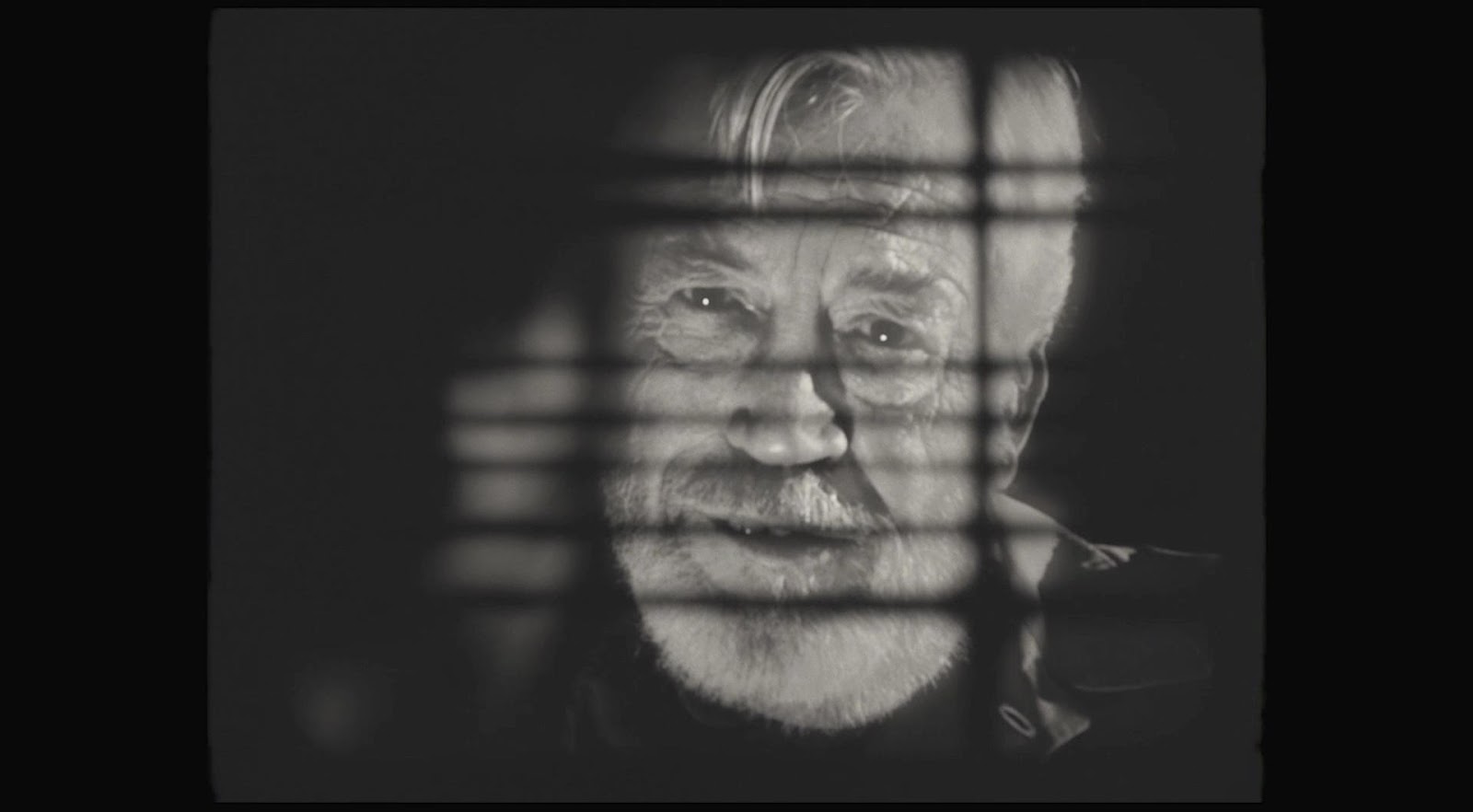
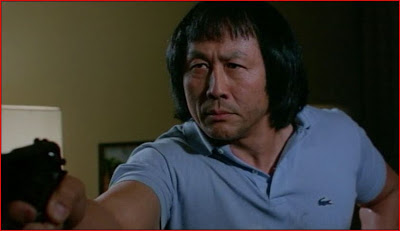
THE OTHER SIDE OF THE WIND (France/Iran/US - 2018) Directed by Orson Welles. Written by Orson Welles and Oja Kodar. Cast: John Huston, Oja Kodar, Peter Bogdanovich, Susan Strasberg, Lilli Palmer, Bob Random, Norman Foster, Edmond O'Brien, Mercedes McCambridge, Cameron Mitchell, Paul Stewart, Henry Jaglom, Paul Mazursky, Dennis Hopper, Curtis Harrington, Claude Chabrol, George Jessel, Gregory Sierra, Tonio Selwart, Dan Tobin, John Carroll, Stafford Repp, Geoffrey Land, Joseph McBride, Cathy Lucas, Pat McMahon, Peter Jason, Angelo Rossitto, Stephane Audran, Rich Little, Gary Graver, Frank Marshall, Cassie Yates, William Katt, Cameron Crowe, Les Moonves. (R, 122 mins) Orson Welles died in 1985, but 33 years later, his "last" film has finally been completed and released as a Netflix Original. One of the most famous of "lost" movies, THE OTHER SIDE OF THE WIND has spent decades mired in various legal, personal, and political quagmires among numerous involved parties. As was usually the case in Welles' European exile years in the 1950s and 1960s (the exception being his last Hollywood studio work as a director, 1958's TOUCH OF EVIL), funding came from his lucrative actor-for-hire jobs and when that ran out, he would constantly find himself hustling for cash from various wealthy investors from all over the world, who were always more than happy to partner with a revered filmmaker of Welles' stature until they realized they probably weren't getting their money back. Notorious for doing things his own way and clashing with Hollywood execs as far back as 1942's THE MAGNIFICENT AMBERSONS, Welles would rarely enjoy a hassle-free project other than 1962's THE TRIAL, and while he did have to cut corners when future SUPERMAN producer Alexander Salkind ran out of money by the end of production, he remained grateful that Salkind trusted him and left him alone to make the film he wanted to make.
Huston, Welles, and Bogdanovich apparently
coining the question "How 'bout a Fresca?"
As a result of his unconventional and often unreliable methods of finance, Welles probably had as many unfinished films as he did finished ones, none more talked about than THE OTHER SIDE OF THE WIND. Filming began in 1970 and wasn't completed until 1976, as Welles would shoot what he could in bits and pieces when the money was there, scraping by with acting and TV commercial gigs (and shooting another movie, 1973's F FOR FAKE) in the interim. He managed to get a French production company to back the project and when that money ran out, he secured additional financing from the Shah of Iran's brother-in-law (the production dragged on for so long and so sporadically that star John Huston didn't even join the cast until 1974). Written by Welles and his girlfriend Oja Kodar, THE OTHER SIDE OF THE WIND would remain unfinished in Welles' lifetime, the film caught up in his tax issues with the IRS; the alleged embezzlement of funds by a Spanish business associate Welles met while starring as Long John Silver in the 1972 Harry Alan Towers production of TREASURE ISLAND; the Ayatollah Khomeini-ordered seizure of the assets and property of the Shah and his entire extended family following the 1979 Iranian Revolution; and a seemingly never-ending conflict between Kodar and Welles' daughter Beatrice following his death, a battle that also involved Welles' protege and friend Peter Bogdanovich. The young director was then riding high on THE LAST PICTURE SHOW and PAPER MOON, and put $500,000 of his own money into Welles' vision in addition to letting his mentor crash at his Beverly Hills mansion from 1974 to 1976.
There was always talk of finishing the film, with Kodar attempting and failing to broker a deal with Showtime in the late '90s, but it was Bogdanovich who seriously got the ball rolling on the completion of THE OTHER SIDE OF THE WIND back in 2004 (other parties included cinematographer Gary Graver, who died in 2006, and producer Frank Marshall, who worked on part of the original shoot as a production assistant). Once all legal squabbles were resolved, Netflix agreed to fund the final restoration, with Oscar-winning editor Bob Murawski (THE HURT LOCKER) brought in to oversee the completion based on Welles' archived notes, multiple versions of WIND's scripts (including one that totaled 360 pages), and by studying his editing techniques on all of his previous films. Welles shot nearly 100 hours of footage, and it's an incredible achievement in itself that Murawski was able to put this together at all. The end result, running just over two hours, is seemingly free-form mash-up of various film stocks, image qualities, and aspect ratios, often switching from color to black & white in the same scene, almost like an art-house version of the kind of Z-grade drive-in patchwork you'd expect from Al Adamson or Jess Franco (an assistant to Welles on 1966's CHIMES AT MIDNIGHT). John Huston's actor son Danny was summoned to revoice some of his late father's dialogue in a few instances where the audio was too deteriorated to salvage or just missing altogether. Many scenes have the telltale signs of piecemeal shooting, with an absent Huston doubled from behind and conversations between two or more actors edited together even though the actors never share the frame and were shot years apart. Or even on a different continent in Lilli Palmer's case, with the actress in scenes with Huston and other cast members in California and Arizona shot anywhere from 1971 to 1976 even though she's always shown alone and all of her footage was shot in Spain in 1973.
Set up in an ahead-of-its-time mockumentary style by present-day voiceover from 1970s wunderkind Brooks Otterlake (Bogdanovich), THE OTHER SIDE OF THE WIND deals with the last day in the life of famed Hollywood movie director Jake Hannaford (Huston). A surrogate for Welles himself, Hannaford has invited his closest friends, colleagues, journalists, film students, and other assorted hangers-on and sycophants to his 70th birthday party being thrown by his long-ago lover and retired actress Zarah Valeska (Palmer), with everyone given 8mm and 16mm cameras to document the event. Hannaford's got other pressing issues: his latest film--titled THE OTHER SIDE OF THE WIND and a desperate attempt to attract the counterculture market--is in trouble. His star is John Dale (Bob Random), a Hannaford discovery who has no acting experience and is nowhere to be found after walking off the set midway through production; young studio boss Max David (Geoffrey Land) has seen the dailies and isn't happy, especially after loyal Hannaford flunky Billy Boyle (Norman Foster) confesses the director has tossed the script and is just making it up as he goes along; and Hannaford himself is growing increasingly jealous over the success of Otterlake, his protege who just scored a critically-acclaimed blockbuster hit with his third film and is now the toast of Hollywood. Hannaford needs Otterlake's help, but the young director won't use his newfound clout to help bail him out with David, who's been invited to the party and is a no-show.
Cameron Mitchell, Paul Stewart, Mercedes
McCambridge, and Welles on the set.
The party is a Who's Who of Hannaford's world, with tight-knit, ENTOURAGE-like acolytes like Boyle, retired actor friends Pat Mullins (an ill-looking Edmond O'Brien, who would retire from acting himself in 1974 after being diagnosed with Alzheimer's), Lou Martin (John Carroll), and Al Denny (Stafford Repp); former business partner "The Baron" (Tonio Selwart); loyal secretary Maggie Noonan (Mercedes McCambridge); his manager Matt Costello (Paul Stewart); and longtime makeup man Zimmie Zimmer (Cameron Mitchell), who attends the party even though he's fired en route. There's also macho screenwriter Jack Simon (Gregory Sierra), who's no fan of Hannaford's, and film critic Juliet Rich (Susan Strasberg), who's notoriously critical of the work of both Hannaford and Otterlake. As everyone mingles, drinks to excess, and wonders about everything from Dale's absence to Hannaford possibly being a closeted homosexual, the director screens an unfinished workprint of THE OTHER SIDE OF THE WIND, an experimental, avant-garde, Euro-tinged, psychedelic art film starring Dale and a nameless actress (Kodar). The film-within-a-film (shot mostly in 1970) has some striking imagery, whether it's a sex scene in the passenger seat of a garishly lit car that looks like a Dario Argento cab ride (this sequence was shot in 1974), or Dale and "The Actress" spending most of the screened film wandering around nude on the MGM backlot with no dialogue. The power goes out, forcing the party to use generators that also fail, at which point the screening moves to a nearby drive-in. When The Baron informs the projectionist that he's showing the reels out of order as "The Actress" happens upon a giant, erect cock in the desert, the response is "Does it matter?"
Almost every character in THE OTHER SIDE OF THE WIND is a stand-in for someone: Billy Boyle was reportedly based on Mickey Rooney, Max David on then-Paramount head Robert Evans, Zarah Valeska on Marlene Dietrich (Welles' original choice for the role, but she turned it down), Juliet Rich on famously combative film critic Pauline Kael, Jack Simon on John Milius, "The Baron" on John Houseman, and most importantly, Brooks Otterlake on Peter Bogdanovich himself, who skyrocketed to fame and fortune while Welles struggled to get any project off the ground (Otterlake's barely-legal date to the party, Mavis Henscher, played by Cathy Lucas, is based on Bogdanovich's then-girlfriend Cybill Shepherd). Bogdanovich's casting pretty much eliminates any mystery as to what Welles' feelings on their friendship were by that point, but it's interesting to note that Bogdanovich only ended up being cast after Welles' first choice--Rich Little, of all people--left the production just like John Dale left the film-within-a-film, partly because of other commitments but mostly because he had no idea what Welles was trying to accomplish. Little remains in the film as an unnamed party guest and has one scene with Lucas, and judging from his wardrobe and dialogue, it was clearly shot when Little was still playing Otterlake (and Otterlake's odd quirk of doing random celebrity impressions--not one of Bogdanovich's strengths--is something that was obviously conceived with Little in mind). Welles made no secret of his disdain for pretentious art cinema, with particular scorn reserved for Michelangelo Antonioni, whose ZABRISKIE POINT is being mocked in the film-within-a-film THE OTHER SIDE OF THE WIND, and with Kodar's constant nudity and some scattered instances of explicit sex, it's very likely that this would've gotten an X rating if it was released in the 1970s. There's a dark-humored and misanthropic streak throughout the film, but the cheap shots--at European cinema (Billy on LAST TANGO IN PARIS director Bernardo Bertolucci: "He's-a-spicy-a-meatball!"), at new Hollywood, at film critics (how else do you explain a drunk Hannaford physically assaulting Juliet Rich near the end?), and at misfit, Hannaford-obsessed film students, especially with a pair of clingy dweebs in Marvin Pistor (Joseph McBride) and Marvin P. Fassbinder (Pat McMahon), who are invited to the party, ask inane questions, and follow him around like lost puppy dogs--start to feel like sour grapes after a while.
As the booze-swilling, cigar-sucking Hannaford, Huston is captivating every moment he's onscreen, channeling Welles through his own persona to create a fascinating hybrid characterization of two larger-than-life filmmakers. With the rapid-fire quick-cuts, constantly-changing film stocks, and the fact that some of their scenes may have been shot months or years apart, most of the cast doesn't get a chance to make that much of an impression, though Mitchell, by that point slumming in D-grade schlock, is an unexpectedly poignant standout as the melancholy Zimmie. Other then-contemporary filmmakers appear as themselves arguing about the state of cinema at Hannaford's party, including Dennis Hopper, Claude Chabrol, Curtis Harrington, Paul Mazursky, and Henry Jaglom, who directed Welles' final performance in SOMEONE TO LOVE, released in 1988, three years after his death. There's some scattered moments of Welles-ian mastery in THE OTHER SIDE OF THE WIND, and at times, it's a remarkably candid confessional, like it's Welles' own personal version of Luchino Visconti's THE LEOPARD, where Burt Lancaster's aging prince wanders from room to room at a grand ball, saying goodbye to his aristocratic life, recognizing his irrelevance in a world that's moving on and leaving him behind. But after all these years, the knee-jerk reaction will be to label this Welles' lost masterpiece or his "ultimate statement," or something to that effect. Five decades of cineaste mystique surrounding an ambitious and unfinished project will do that, but at the end of the day, this is the kind of self-indulgent home movie that's an historical curio at best, and directly responsible for the career of Henry Jaglom at worst. I'm glad it's out, I'm glad we're able to see it, and it's required viewing for anyone with a serious interest in film history up to the 1970s, but am I ever gonna watch this again? There's a legend surrounding THE OTHER SIDE OF THE WIND, and the backstory--covered at length in Morgan Neville's simultaneously-released Netflix Original documentary THEY'LL LOVE ME WHEN I'M DEAD--is ultimately more fascinating than the film itself.
THE MESSENGER (Italy - 1987) Directed by Fred Williamson. Written by Brian Johnson, Conchita Lee and Anthony Wisdom. Cast: Fred Williamson, Christopher Connelly, Cameron Mitchell, Joe Spinell, Val Avery, Jasmine Maimone, Micheal Dante, Sandy Cummings, Peter Brown, Stack Pierce, Suzanne von Schaack, Umberto Raho, Riccardo Parisio, Maurizio Bonuglia, James Spinks, Cyrus Elias, Stelio Candelli, Frank Pesce, Chris Conte, Vince Townsend. (R, 97 mins) During his eight-season career in pro football with the Pittsburgh Steelers, the Oakland Raiders, and the Kansas City Chiefs, DB Fred Williamson earned the nickname "The Hammer," and upon his retirement in 1968, he parlayed his tough gridiron persona into a TV and movie career. He landed a recurring role as Diahann Carroll's love interest on the NBC series JULIA and made his big-screen debut as Spearchucker Jones in Robert Altman's 1970 classic MASH. Williamson followed that with a supporting role in Otto Preminger's 1970 Liza Minnelli vehicle TELL ME THAT YOU LOVE ME, JUNIE MOON before finding his niche as one of the top blaxploitation stars of the 1970s. Williamson enjoyed one drive-in and grindhouse success after another, with HAMMER and THE LEGEND OF NIGGER CHARLEY in 1972, and no less than four films in 1973, with the sequel THE SOUL OF NIGGER CHARLEY, BLACK CAESAR and its sequel HELL UP IN HARLEM, and the 007-inspired THAT MAN BOLT. Williamson worked relentlessly throughout the decade, often teaming with fellow football legend Jim Brown in films like 1974's THREE THE HARD WAY and 1975's TAKE A HARD RIDE, but by the mid '70s, Williamson grew restless and wanted to start making his own independent movies through his own Po' Boy Productions. He made his directing debut with 1976's MEAN JOHNNY BARROWS and managed to talk some celebrity friends into co-starring, including MASH buddy Elliott Gould in a cameo as a bum, and Roddy McDowall ludicrously cast as a Mafioso. Williamson directed and starred in three more films in 1976: the western ADIOS AMIGO with Richard Pryor, followed by NO WAY BACK and its immediate sequel DEATH JOURNEY, the first two of four films where he'd play private eye Jesse Crowder. With Enzo G. Castellari's 1978 cult classic THE INGLORIOUS BASTARDS, Williamson began a second career in Italy, even directing the Italian-made MR. MEAN during his BASTARDS downtime. Though he made some American films in the '80s, most notably 1983's THE BIG SCORE and the same year's VIGILANTE, Williamson spent most of that decade in Italy, starring in Castellari's 1990: THE BRONX WARRIORS (1983) as well as the director's post-nuke WARRIORS OF THE WASTELAND (1983) and Lucio Fulci's post-nuke THE NEW GLADIATORS (1984). 1985 also saw him as a pitchman in a series of King Cobra malt liquor commercials, and the same year, he took a break from Italian genre fare to co-star in the short-lived Joe Pesci NBC series HALF NELSON.
But by the mid '80s, Williamson was getting lazy. He made a pair of almost interchangeable back-to-back thrillers with 1986's FOXTRAP and 1987's THE MESSENGER, both vanity projects (well, every Williamson movie is a vanity project to some extent) that co-starred Williamson BFF Christopher Connelly and were little more than an excuse to get Italian production company Realta Cinematografica to send him on paid vacations throughout Europe and the US. THE MESSENGER is especially bad, with Williamson demonstrating a level of carelessness that borders on audience contempt, whether it's staging inept action sequences, putting himself in an overlong love scene where he has the camera pan down so we see his co-star Sandy Cummings' hands caressing his gyrating ass, or padding the running time with absurdly long establishing shots like following two actors on a golf course for over a minute or planting the camera inside a cab and giving us an impromptu, MANOS: THE HANDS OF FATE-style travelogue every time his character arrives in a different city. We get a two-minute look at Vegas, up and down the strip, past the casinos and hotels, and even going blocks away, taking the audience on a captivating drive past the local Woolworth. There's also a scene where Michael Dante, as a Hollywood mobster, is shown pulling into his driveway, turning his car around in the driveway, then backing into the garage, pulling back out and then maneuvering the car back into the garage again so he can straighten it out. Then Williamson keeps the camera right where it's at while Dante gets out of the car and leisurely walks into what I presume is the actor's own home. It's at least a solid minute and a half of static screen time devoted to watching Dante dick around in his driveway.
The threadbare vigilante/revenge plot requires location work in Rome, Chicago, Hollywood, and Las Vegas simply because Williamson was given enough money to do so. The Hammer is Jake Sebastian Turner, a Green Berets legend released from a Rome prison and reunited with his wife Sabrina (Cummings, in her first and thus far only film), who's turned into a junkie while he was locked up. She's killed in a drive-by shooting and Jake is informed by the improbably-named Italian mob boss Gielgud (Riccardo Parisio) that Sabrina got involved with Rome drug traffickers who were supplying Chicago gangster Paolo (Maurizio Bonuglia). The same people who killed Sabrina also murdered Gielgud's stepson, and he offers Jake $500,000 to go to Chicago and track down and kill those responsible. Arriving in Chicago, Jake kills Paolo with a ninja star only to find out that he was just a part of the machine and he'll need to head out west to find the real bosses behind the operation. His path of vengeance takes him to Hollywood (Schwarzenegger's RAW DEAL on a theater marquee!), where he finds Emerson (Dante), whose tool company is used as a money-laundering and narcotics distribution front for Vegas mob kingpin Rico (Joe Spinell) and his top flunkies Clark (John Cassavetes inner circler Val Avery) and Harris (Peter Brown). Meanwhile, loose-cannon, plays-by-his-own-rules FBI agent Parker (Connelly) develops a begrudging admiration for the so-called "Messenger of Death" who's wiping out syndicate goons, and butts heads with Chicago police captain Carter (Cameron Mitchell, hamming it up but still outacted by his garish eyeglasses that must be seen to be believed) and irate detective Leroy (Stack Pierce), who want this mystery vigilante off the streets.
THE MESSENGER is grossly incompetent but calling it "so bad it's good" is a stretch. Williamson's direction is unbelievably sloppy, from the half-assed action scenes to his direction of the actors, none of whom appear to be aware of what kind of movie they're in. As a director, his chief concern seems to be getting women to throw themselves at him and staging as many King Cobra product placements as possible (they even get a shout-out in the closing credits). Williamson and Connelly play it straight, Connelly especially enjoying himself as Parker, pointlessly doing a T.J. HOOKER shoulder-roll into Rico's mansion and throwing around the usual made-up insults that he used in a lot of his Italian films (RAIDERS OF ATLANTIS, OPERATION NAM, STRIKE COMMANDO). His favorite standby "suckfish" makes a required appearance (calling someone "suckfish" is Connelly's "John Cusack vaping"), along with "shitstick" and calling Spinell "butt-wipe." Mitchell just seems to be goofing off (did he borrow his mother-in-law's glasses for this role?), Dante does what he's required to do--be the guy you get when John Saxon, Henry Silva and Tony Lo Bianco turn you down--and Spinell plays it broad, turning Rico into a whiny, sniveling Joe Besser of a mob boss. The Rome scenes with Italian actors are shot with live sound, and it's pretty clear when you listen to Eurocult stalwarts like Stelio Candelli (DEMONS) and Umberto Raho (THE BIRD WITH THE CRYSTAL PLUMAGE) that their grasp of English is tenuous at best (bonus points if you can understand a single word Raho says as the warden who releases Jake from prison). Even the dialogue in the American scenes is often difficult to decipher, as the actors are constantly cut off or drowned out by William Stuckey's repetitious, flatulent synth score.
And whether it's a fault of the script--somehow the work of three people, two of whom did nothing else after while the other (Anthony Wisdom) went on to write 1990's THE RETURN OF SUPERFLY--or Williamson's slapdash direction, THE MESSENGER offers one of the all-time great continuity gaffes, one that involves Mitchell's pissed-off Capt. Carter. When introduced, he's bitching at Parker and refusing to cooperate with him after the Chicago hit on Paolo. When others turn up dead in Hollywood, Parker informs Carter that the Messenger must've left Chicago and made his way out west, with Parker announcing "I'm going to L.A." as Carter chomps on his cigar and seethes, adjusting his ill-fitting Estelle Getty glasses. Much later, in Hollywood, after Emerson is killed and his naive wife (Suzanne von Schaack) finds out he's a drug dealer and that's how he was providing for her and their children, she inexplicably turns up as a cokehead hooker in Vegas for no reason at all. She recognizes Jake at a casino, dials the operator and asks for the Los Angeles police department, specifically "Chief Carter," as we see Cameron Mitchell pick up the phone. Wait..,LAPD Chief Carter? Wasn't he just a precinct captain in Chicago a few scenes back, with a map of Illinois on the wall of his office? Sure enough, Carter rounds up the cops and Parker and they go straight to...Rico's mansion in Las Vegas?! Is Williamson even paying attention to his own movie?
Williamson campaigning for
Donald Trump in 2016.
Williamson continued dividing his time between Italy and America, and by the 1990s was a C-lister relegated to straight-to-video status with films like 1991's THREE DAYS TO A KILL and 1992's SOUTH BEACH. He enjoyed a brief resurgence in 1996 with the all-star blaxploitation throwback ORIGINAL GANGSTAS and with longtime fans Quentin Tarantino and Robert Rodriguez giving him a showy supporting role in FROM DUSK TILL DAWN, two years after turning down an offer from Tarantino to play crime boss Marcellus Wallace in PULP FICTION. Williamson passed on the part because of the scene where Wallace is raped by Zed in the Gimp dungeon in the pawn shop basement.. He got to demonstrate some slow-burn comedy skills, playing off Ben Stiller and Owen Wilson as the perpetually flustered Capt. Doby in 2004's STARSKY & HUTCH, but other than that, Williamson has done some sporadic TV guest spots and some Z-grade DTV swill you find in the New Release section at Walmart. He's also become a regular presence in low-budget faithsploitation dramas like 2015's LAST OUNCE OF FREEDOM, where he played a villain trying to stop a small rural town from celebrating Christmas. Now 79 and probably still able to kick your ass, Williamson most recently made the news in 2016 when he was spotted on the presidential campaign trail competing with Ben Carson for the coveted "Donald Trump's black friend" role.
THE KLANSMAN (US - 1974) Directed by Terence Young. Written by Millard Kaufman and Samuel Fuller. Cast: Lee Marvin, Richard Burton, Cameron Mitchell, O.J. Simpson, Lola Falana, Luciana Paluzzi, David Huddleston, Linda Evans, Ed Call, John Alderson, David Ladd, Vic Perrin, Spence Wil-Dee, Wendell Wellman, Hoke Howell, Virgil Frye, Lee De Broux, Susan Brown, Jeannie Bell, Larry Williams. (R, 112 mins) THE KLANSMAN is a film so consistently and unrelentingly repugnant that it opens with a group of white yahoos giving a mentally challenged black man $1 to rape a young black woman as they stand around in a circle cheering him on...and it somehow gets more offensive with each passing scene. A misguided clusterfuck from the moment it was greenlit to the week of its release over Thanksgiving 1974--because who doesn't want to spend the holiday with family watching a movie with rape, castration, and more racial slurs than the combined filmographies of Spike Lee and Quentin Tarantino?--THE KLANSMAN is, if you can stomach it, a film that simply must be seen to be believed. The fact that it's a Paramount release with big name stars probably lent an illusion of prestige, but make no mistake, this is as foul, if not more so, as any drive-in exploitation grinder, so trashy and shamelessly gutter-wallowing that, as Johnny LaRue's Crane Shot's Marty McKee stated in his review, "You need a SILKWOOD shower after watching it." Based on a 1965 novel by William Bradford Huie, THE KLANSMAN probably began with the best intentions. Samuel Fuller (FIXED BAYONETS, MERRILL'S MARAUDERS, SHOCK CORRIDOR) wrote the script and was set to direct before quitting the project over disagreements with the producers. Fuller's script was reworked by Millard Kaufman (BAD DAY AT BLACK ROCK, RAINTREE COUNTRY) and veteran British journeyman Terence Young (DR. NO, FROM RUSSIA WITH LOVE, THUNDERBALL, WAIT UNTIL DARK) was brought in to direct. Though he had some major hits under his belt, Young was pushing 60 and in paycheck mode by that point, primarily working in Europe, coming off three Charles Bronson films with 1970's COLD SWEAT, 1971's RED SUN, and 1972's THE VALACHI PAPERS, followed by the cheesy 1973 sword-and-sandal outing WAR GODDESS, and he reportedly only took the KLANSMAN gig because he was a sugar daddy to a much younger girlfriend and needed some major studio Hollywood cash.
A coasting Young was left in charge of a cast headed by legends Lee Marvin and Richard Burton, and much of the film's budget appears to have gone to their booze supply. Marvin is at least a functioning alcoholic and manages to turn in an actual performance, but Burton was bottoming out personally and professionally while in Oroville, CA working on THE KLANSMAN. His marriage to Elizabeth Taylor falling apart during production, Burton was also dogged by a persistent combined bout of bronchitis and the flu that lasted throughout the shoot, and he was drinking nearly three bottles of vodka per day. He checked himself into a hospital to deal with his alcoholism after filming wrapped, but Burton's condition and his ghoulish appearance are impossible to ignore when you watch the film: he's wobbly on his feet, shaky, pasty, often sweating profusely, slurring his words with his wildly inconsistent accent vacillating from "Richard Burton" to "HEE HAW" in the same sentence, and though it's mentioned his character has a bum leg, it could just be to explain why he's usually seen seated, holding onto, or leaning against something--a table, a chair, a wall--seemingly to keep from falling down. He seriously looks like he could drop dead at any moment.
Marvin is Track Bascomb, sheriff of Atoka County, Alabama, a hotbed of racial tension and Ku Klux Klan activity. Bascomb is a de facto good guy--he's not in the Klan, is not a hostile racist and he breaks up the rape in the opening scene ("Party's over, get on outta here"), but he more or less leaves everyone be, especially since his loathsome deputy Butt Cutt Cates (Cameron Mitchell) is a loud and proud Klan member and Mayor Hardy Riddle (David Huddleston) is the Exalted Cyclops of the Klan's Atoka chapter. At a town council meeting, the mayor tells his Klan guys to keep things under control, to not kill anyone and maybe just burn some crosses every once in a while and rough up some black folks just so they stay scared and always know their place. That all changes when white Nancy Poteet (Linda Evans) is raped by a black man and Butt Cutt eggs everyone on into blaming Willy Washington (Spence Wil-Dee), who has an alibi but is nonetheless kept in jail by Bascomb. Butt Cutt and his boys decide to harass any black guy they see, castrating one unlucky resident whose angry friend Garth (O.J. Simpson) escapes. The tensions continue to flare over an upcoming equal rights protest to be attended by black "agitator" Loretta Sykes (Lola Falana), who left Atoka years ago to move to Chicago but is back to care for her ailing grandmother. Loretta's grandmother lives in a cabin on Stancill Mountain, a huge swath of land owned by Breck Stancill (Burton), a progressive liberal do-gooder who lets poor black people live in cabins on his mountain rent-free. Butt Cutt and the Klan guys hate Stancill and they hate Loretta, who used to be close to Stancill and is assumed to be his "private piece of brown comfort." THE KLANSMAN just gets more charming from there. Hardly a scene goes by without some jaw-droppingly offensive act or line of dialogue.
Nancy's husband (Hoke Howell) can't bear the humiliation of his wife "gettin' screwed by a n----r," so he leaves town, bellyaching to Bascomb "Why did this thing have to happen to me?" She's also ostracized in church, where a woman shrieks "I can smell n----r on her! I think I'm gonna faint!" and the Reverend refuses to carry on with his racist sermon to the other "decent Christian folk" until she leaves. Garth, meanwhile, is disguising himself in Klan garb and showing up at the houses of the guys who castrated his friend (this was Young's second film--after THE VALACHI PAPERS--to prominently feature castration) and blowing them away with a shotgun. Racist vitriol eventually boils over in an unspeakably appalling scene where Butt Cutt and a bunch of guys kidnap Loretta and drag her to a warehouse, holding her down while Butt Cutt rapes her to send a message to Atoka's black population (Butt Cutt, at his most philosophical: "N----r gal don't mind bein' raped a little by another n----r, but a white man nailin' her would be humiliatin'''). The rape goes on and on, with Loretta suffering massive bleeding from her vagina (the leering Reverend mutters "N----r women are made for this"). Bascomb arrives on the scene and knows Butt Cutt raped her but tells her to say three black men did it, though he's outraged enough over what happened to smear some of her blood all over Butt Cutt's face. At the hospital, it's revealed that Loretta was a virgin and the blood was from her ruptured hymen, a diagnosis immediately dismissed by an incredulous Bascomb, who sensitively tells the medical examiner "Everybody in the county knows a black girl's popped by the time she's 13." Eventually, Butt Cutt, the mayor, and all the other racist assholes finally have enough of Loretta, protests, Bascomb developing a conscience, and liberal snowflake Stancill, who's further incurred the wrath of everyone by falling in love with sullied and tarnished Nancy, and all parties eventually converge on Stancill's Mountain for the inevitable shootout illuminated by a burning cross.
Alternate poster art focused on O.J. Simpson
Astonishing for all the wrong reasons, THE KLANSMAN was ultimately released on VHS in 1991 but has otherwise been kept pretty much buried like a state secret by Paramount, who released the similarly tacky MANDINGO in theaters a year later in 1975. Low-quality bootlegs weren't hard to obtain but they were often cut, losing the worst parts of the castration scene and the agonizing rape, which is probably the most graphically offensive depiction of a sexual assault in a mainstream film outside of the early gang rape of the housekeeper in 1982's DEATH WISH II, and not just because Young meets the demands of no one by giving us a Cameron Mitchell ass shot. It was recently released in uncensored form on Blu-ray by Olive Films, and it makes for interesting viewing decades later. There's probably a serious, thoughtful film buried somewhere in the wreckage and it undoubtedly would've turned out better had Fuller directed it (he and Marvin would eventually work together on 1980's THE BIG RED ONE). But Young is just punching a clock here, and while it's obviously not condoning the actions of its despicable antagonists, it sort-of pulls a CANNIBAL HOLOCAUST by wallowing like a pig in shit in the very ugliness it purports to condemn. There's no need for Bascomb to smear Loretta's blood across Butt Cutt's face or have Falana lie there naked for an extended amount of time with a pool of blood between her legs other than exploitative shock value more fitting for a LAST HOUSE ON THE LEFT knockoff.
For Lola Falana's and even O.J. Simpson's sake, let's hope
this Bronco was being pulled on a trailer
and Richard Burton wasn't actually driving it.
In Fuller's hands, the virulent racism in the story and the dialogue would've been hard-hitting and brimming with social commentary, but here it just feels like you're in the middle of a particularly feverish Steve Bannon wet dream. Some of Fuller's intent comes through--that scene in the church where Nancy is ordered to leave is legitimately enraging and upsetting and would certainly still happen in some parts of America today--but it's undermined by one bad decision after another. Who thought it was a good idea to cast Italian sex bomb Luciana Paluzzi (best known as femme fatale Fiona Volpe in THUNDERBALL) as an Alabama secretary named Trixie? Paluzzi always had a thick accent and she's obviously dubbed here, so her casting was probably just Young doing a favor for an old friend but it doesn't work. THE KLANSMAN marked the big-screen debut of O.J., who would still play in the NFL for another five years but was starting to build a movie career during his off-seasons (he was also in THE TOWERING INFERNO, in theaters a month after THE KLANSMAN). Juice was pushed as the star in some markets, but the film doesn't make very good use of him. His Garth exists on the periphery of the story for much of the time, hiding out in trees picking off Butt Cutt's dipshit cohorts. O.J. gets one amazing shot where he performs an extremely dangerous-looking stunt sprinting across railroad tracks in front of a speeding train that almost clips him, but his unintentional highlight in retrospect is a scene where he's in the backseat of Stancill's Bronco, forcing him to drive while waving a gun around, an almost surreal harbinger of things to come for the future double murderer. But nowhere does THE KLANSMAN shit the bed more than in the scene foreshadowed by a throwaway line from Trixie about Stancill learning karate while he was in the Marines.
Richard Burton, Luciana Paluzzi, and Lee Marvin
at a party during production of THE KLANSMAN.
Around 80 or so minutes into THE KLANSMAN, Stancill is buying Nancy a bus ticket out of town and they're confronted by Butt Cutt, who spends his free time hanging racist flyers around Atoka. Butt Cutt starts haranguing Nancy about having "been with a Negro," essentially blaming her for being raped, and a scuffle ensues, with karate expert Stancill giving Butt Cutt a kung-fu beatdown. The sight of Burton going full ENTER THE DRAGON would've been absurd even under the most sober conditions. But between his unsteady wavering, his pasty, sweaty visage, and what appears to be Stancill's entire knowledge of martial arts being limited to half-assed chops with his hand, he looks less like a student of karate and more like Donald Trump mocking a disabled reporter on the campaign trail. He has to grab a wall at one point to stay upright and even with his limited movement, he looks like he's about throw up from motion sickness. The staging of the fight is inept beyond comprehension, but Mitchell valiantly tries to help sell it, flinging himself through a restroom door that's obviously already off its hinges and diving through some luggage that's been strategically placed in the middle of the bus station. If THE KLANSMAN is remembered at all today, it's typically because of shitfaced Richard Burton stumbling and bumbling his way through the most unintentionally hilarious fight scene of the 1970s, not helped at all by accompanying "wacky" music that gives it a DUKES OF HAZZARD quality. This is a film that, no matter how much unexpected relevance it may inadvertently have today with the recent upsurge in hate crimes and backwards-ass racist shitbags feeling emboldened to express themselves thanks to the current occupant of the White House and those who surround and enable him, simply couldn't be made in this fashion in today's world of SJW outrage and trigger warnings. Fuller's original screenplay undoubtedly had a message, and some of it manages to come through every now and again in the finished version. But it's a staggeringly wrong-headed, stunningly tone-deaf examination of racism in the deep south, and regardless of whatever good intent it had at any point in its genesis, THE KLANSMAN is a time capsule relic that remains one of the essential "What the Fuck Were They Thinking?!" movies to ever be released by a major Hollywood studio.
MISSION: KILL (US - 1987) Directed by David Winters. Written by Maria Dante and David Winters. Cast: Robert Ginty, Merete Van Kamp, Cameron Mitchell, Olivia d'Abo, Sandy Baron, Henry Darrow, Brooke Bundy, Eduardo Lopez Rojas, David Kaufman, Clement St. George (Clement von Franckenstein), Miguel Angel Fuentes. (R, 96 mins)
After cementing his place in cult movie history as the title vigilante in 1980's THE EXTERMINATOR, Robert Ginty (1948-2009) stayed busy in B and usually C-grade exploitation fare throughout the '80s before drifting into directing in the '90s. Prior to THE EXTERMINATOR, Ginty first gained notice on a two-season stint on the NBC WWII series BAA BAA BLACK SHEEP, starring Robert Conrad, and from his co-starring gig on the first season of CBS' THE PAPER CHASE. He also had a supporting role in 1978's COMING HOME, but it was THE EXTERMINATOR that set the course for Ginty's career. He would still log time on TV with guest spots on shows like DIFF'RENT STROKES, SIMON & SIMON, QUINCY M.E., and KNIGHT RIDER, and even had his own short-lived ABC series HAWAIIAN HEAT in 1984, but he was also a regular presence at drive-ins and on video store shelves in the burgeoning '80s home video explosion. In addition to the Cannon-produced sequel EXTERMINATOR 2 (1984), Ginty also starred in films like the Thai actioner GOLD RAIDERS (1982), the Italian ROAD WARRIOR ripoff WARRIOR OF THE LOST WORLD (1983), the Spanish horror film SCARAB (1983), the Sig Shore political thriller THE ACT (1984), the French emeralds-and-chainsaws adventure WHITE FIRE (1985), and the long-shelved Empire horror film THE ALCHEMIST, shot in 1981 but unreleased until 1985, and directed by Charles Band under the pseudonym "James Amante." 1987 was Ginty's most prolific year as a B-movie headliner, with the TERMINATOR ripoff PROGRAMMED TO KILL, where he pursued cyborg Sandahl Bergman (it also featured a 14-year-old Paul Walker); the French-made Eurocine horror film MANIAC KILLER from BURIAL GROUND director Andrea Bianchi, co-starring a slumming Chuck Connors and Bo Svenson; the little-seen and even less-loved Cannon actioner THREE KINDS OF HEAT; and MISSION: KILL, a fixture in every video store in America in the late '80s that's just been rescued from oblivion with a new Blu-ray from Code Red.
Released in 1987, but sporting a 1985 copyright (and, if a calendar on a kitchen wall in one scene is any indication, shot in 1984), the shot-in-Mexico MISSION: KILL (onscreen title: THE MISSION...KILL) is a mostly standard explosion-filled action movie with some ambition beyond its paltry budget. Ginty is J.F. Cooper, an ex-Marine and demolitions expert who's just arrived in Arizona to visit his old Vietnam buddy Harry (Cameron Mitchell). Harry is jumpy and preoccupied, and his younger wife (Brooke Bundy) and teenage son (David Kaufman) are concerned. A trucker by day, Harry has a side gig running guns through Mexico to deliver to freedom fighters in the fictional Central American country of Santa Maria. The rebels are waging war on despotic El Presidente Ariban (Eduardo Lopez Rojas) and Harry talks Cooper into going on a delivery run with him. Of course, they're ambushed and Harry is killed (Mitchell exits the film and heads to the hotel bar around the 20-minute mark), prompting an enraged Cooper to take out the Ariban soldiers responsible. This leads to him assuming the identity of a dead British mercenary/gunrunner named Ian Kennedy (Clement von Franckenstein, under the less distracting pseudonym "Clement St. George") and becoming a significant figure in the revolution against Aliban, with the help of some glowing hype in the press from cynical reporter Bingo Thomas (Sandy Baron, later to play SEINFELD's Jack Klompus). Naturally, a furious Ariban and his chief lackey and supporter, wealthy aristocrat Borghini (Henry Darrow, smirking as if to say "I'm almost Robert Vaughn") use everything at their disposal to stop Cooper/"Kennedy" and quash the rebellion.
Directed and co-written by David Winters, MISSION: KILL plays like a low-budget knockoff of Oliver Stone's SALVADOR (which hadn't been made yet), with generous helpings of Michelangelo Antonioni's THE PASSENGER (outsider assuming the identity of a dead gunrunner) and LAWRENCE OF ARABIA (the hero getting endless press hype from an ambitious reporter who sees him as his ticket to the big time). Of course, any other comparisons to such higher brow material are absurd, but MISSION: KILL has a little more on its mind than most of its contemporary mid '80s Robert Ginty vehicles. The British-born Winters got his start directing episodes of THE MONKEES as well as TV variety show specials for Ann-Margret and Raquel Welch as well as Alice Cooper's 1975 concert film WELCOME TO MY NIGHTMARE. He drifted into feature films with the 1979 Bert Convy SHAMPOO ripoff RACQUET, but really made his mark with 1984's underrated meta horror film THE LAST HORROR FILM, with MANIAC stars Joe Spinell and Caroline Munro. Shoddily-made but demonstrating some clever ideas and genre deconstruction before such things were cool, THE LAST HORROR FILM displays an ambition that's carried over into MISSION: KILL. Winters isn't exactly making Oliver Stone statements, but he's also not making a mindless, jingoistic, "America! Fuck Yeah!" shoot 'em up, either. Alas, neither Winters nor co-writer Maria Dante possess quite the chops required to pull off the Thinking Man's Action Movie for which they're aiming (they would later seemingly give up on seriousness altogether with their next collaboration, the MST3K favorite SPACE MUTINY). Any time MISSION: KILL takes a step forward, it's immediately followed by two steps back, whether it's the mismatched and clumsily-integrated stock footage of explosions or Olivia d'Abo's embarrassing performance as one of the freedom fighters, saddled with a laughable wig and using an even worse accent ("Jew take care of deese peeg!"). Though it's a middling, forgettable action movie at the end of the day, MISSION: KILL has moments where it's really trying to be something more but just doesn't have the money or behind-the-scenes talent to pull it off.
Robert Ginty (1948-2009)
Winters and Mitchell would work together again on the South Africa-shot SPACE MUTINY and RAGE TO KILL (both 1988) and both would reunite with Ginty for 1989's CODE NAME: VENGEANCE, co-starring Shannon Tweed. Winters would later oversee the 1990s straight-to-video company Action International Pictures, producing such Blockbuster shelf mainstays as RAW NERVE (1991), CENTER OF THE WEB (1992), DOUBLE THREAT (1993), RAW JUSTICE (1994), and others, almost all of them directed by David A. Prior. Ginty continued to star in things like Umberto Lenzi's Miami-shot Italian cop thriller COP TARGET (1990) but also managed to land some supporting roles in major-studio releases. He played a young Patrick Dempsey's befuddled dad in the gigolo pizza delivery comedy LOVERBOY (1989), was one of the houseguests from Hell in the John Larroquette/Kirstie Alley-starring MADHOUSE (1990), and got some laughs as a chatty chopper pilot helping Mickey Rourke and Don Johnson in HARLEY DAVIDSON AND THE MARLBORO MAN (1991). Ginty directed himself in a pair of low-budget action films, THE BOUNTY HUNTER (1990), and VIETNAM, TEXAS (1991) before shifting his focus to directing throughout the 1990s. His efforts behind-the-camera included the Bo Derek erotic thriller WOMAN OF DESIRE (1994), along with episodes of TV shows like EVENING SHADE, DREAM ON, NASH BRIDGES, LOIS & CLARK, XENA: WARRIOR PRINCESS, and CHARMED. Ginty acted very sporadically during the '90s, and his final onscreen appearance came with Dennis Hopper in 2001's THE PROPHET'S GAME, a SE7EN ripoff from his WARRIOR OF THE LOST WORLD director David Worth. Ginty spent his final years directing theater productions in Los Angeles before succumbing to cancer in 2009 at the age of 60. Though most of his career was spent making undistinguished and forgettable movies that are most likely to be found today only if you spend time scouring through battered, dusty, and musty boxes of VHS tapes at antique malls and flea markets, he was a solid pro who loved what he did and never stopped working. And even if he accomplished nothing else, he'll always be THE EXTERMINATOR.
KILLPOINT is very much a junk movie, but it's not without points of interest. Fong stars as Lt. James Long, a widower Riverside cop assigned to partner with ATF agent Bryant (Richard Roundtree) to investigate a series of mass shootings that have been traced to an military armory depot heist engineered by lunatic crime boss Joe Marks (Cameron Mitchell) and ruthless arms dealer Nighthawk (Stack Pierce). The story itself is pretty standard-issue and there's plenty of ineptitude on display, starting with clumsy dialogue like "Long? Isn't he the cop whose wife and child were raped and killed?" and too much screen time given to non-actors--and this is how they're billed--Captain Michael Farrell (as Long's captain) and Special Agent Larry Lunsford (as Bryant's supervisor), both mumbling their lines and looking like a deer in the headlights, and presumably brought on by the Riverside P.D., who served as technical advisors. But writer/director Frank Harris brings an admirably rough aesthetic to the proceedings. The extensive location shooting throughout Riverside in places like Chinese restaurants, neighborhood grocery stores, pawn shops, low-rent gyms, dive bars, and skeezy strip clubs, and the plethora of non-professional actors (a bunch of Riverside cops have small bits as well) bring an effectively--if accidentally--seedy, DIY, KILLING OF A CHINESE BOOKIE-esque milieu to the proceedings, and the scenes of street criminals buying guns from Nighthawk and promptly mowing down innocent people offers chilling, disturbing imagery that remains prescient with today's level of gun violence. I'm not implying that Harris is some kind of unsung auteur, but if a really slumming John Cassavetes made a crummy '80s action movie with an aging and borderline immobile kung-fu D-lister, it might've ended up looking a lot like KILLPOINT.
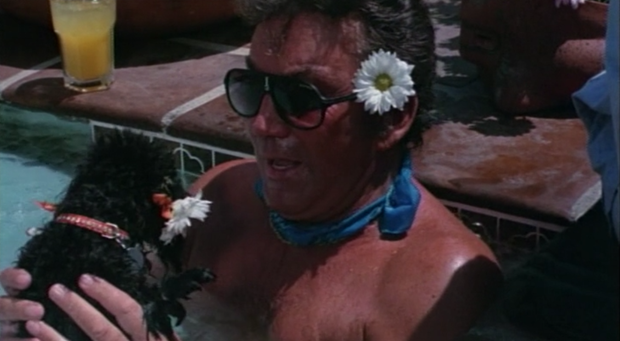
All hints at nihilistic artistry aside, KILLPOINT is first and foremost a scuzzy exploitation movie, and for that, look no further than Mitchell's insane performance as Marks: mumbling incessantly, yammering on about his poodle Sparky (and trying to get it to smoke), and quite possibly intoxicated, Mitchell's relentless scenery-chewing needs to be seen to be believed. Some of the cold, humorless Nighthawk's reactions to Marks' antics seem to be less character and more Pierce reacting to Mitchell's overacting (Pierce also has a great and possibly improvised bit where he's told to make a drink for Hope Holiday's screeching madam and forgoes the tongs to angrily put the ice and a lemon in the glass with his hands). SHAFT fans may be disappointed that second-billed Roundtree has little to do and exits the film about an hour in, but rest assured, it all ends up with a showdown at an abandoned factory (complete with a military guy rappelling down the side of the building for no reason whatsoever), and it's all propelled by an exceedingly mid '80s synthesizer/drum machine score and a catchy closing credits tune ("Too long! Livin' on the inside!"). KILLPOINT is unabashed trash, brutal and unrelentingly violent, but it's essential viewing for Cameron Mitchell fans and students of Fongsploitation. (R, 89 mins)
KILLPOINT newspaper ad making it look like a Richard Roundtree movie
LOW BLOW
(US - 1986)
A good chunk of KILLPOINT's cast and creative personnel--Leo Fong, Frank Harris, Harris' wife Diane Stevenett, Cameron Mitchell, Stack Pierce, and Hope Holiday--reunited for 1986's Fong-scripted LOW BLOW. Moving even less swiftly than he did in KILLPOINT, 58-year-old Fong at least had the good sense to make a number of LOW BLOW's laughs intentional, whether it's his character's beat-up '70s clunker or acquiescing to stereotypes about Chinese food and Asian drivers. Fong is Joe Wong, a ex-cop and broke-ass private eye with mounting bills who lucks into a job when rich industrialist John Templeton (early '60s heartthrob Troy Donahue, barely masking his contempt for the entire project) hires him to track down his missing daughter Karen (Patti Bowling). Karen has joined a religious cult run by Yarakunda (Mitchell), a blind, Jim Jones-type loon who wears a monk's robe and has a tiny Star of David tattoo on his face as well as a bindi on his forehead. Yarakunda is somewhat sincere in his beliefs, but the drugs and illegalities side of his operation is actually run by his "wife," a sadistic, manipulative ex-con named Karma (THE COLOR PURPLE's Akosua Busia). Unable to take on Yarakunda and Karma on his own, Wong and his perky secretary (Stevenett) demonstrate some of that old Mickey Rooney-Judy Garland "Let's put on a show!" moxie and hold a Toughman contest to assemble a worthy team of ass-kickers to raid the cult's compound and rescue Karen.
"YARAKUNDA!"
Threatening to break out into an actual comedy at any given moment, LOW BLOW is decidedly more lighthearted that the grim and ugly KILLPOINT, with set pieces so ridiculous that the humor has to be by design. That's really the only way to explain the scene where three bad guys barricade themselves in a Mercedes while Wong puts on some safety goggles and saws off the roof of the car to get to them. Or the opening scene, where Wong hears a robbery taking place at a diner down the block while he's in his second story office, then goes in SUDDEN IMPACT-style and blurts "Hey, is my ham sandwich ready?" before blowing the three scumbags away and declaring "Hey, forget the sandwich!" (which, needless to say, didn't become Leo Fong's "Go ahead, make my day"). Fong still can't act, but he's at least a lot more loose here than he was in KILLPOINT--he's at least trying to be a likable hero, and his effort is endearing. Mitchell looks like he's still nursing a KILLPOINT hangover, a glowering Donahue seems pissed off that he's even in it (was John Saxon out of their price range?), while Pierce plays a good guy who helps Wong assemble the team for the raid, and is rewarded with the character name "Corky," which doesn't send the same message as "Nighthawk." The standout in LOW BLOW however, is the gorgeous Busia, whose demented performance as Karma actually steals the ham honors from Mitchell, who's goofy but rather subdued throughout. Though she has no IMDb credits after 2007, Busia would stay busy in supporting roles and TV through the '90s. Born in 1966, she was briefly married to BOYZ N THE HOOD director John Singleton around the time she appeared in his 1997 film ROSEWOOD and she'd also co-write the script for Jonathan Demme's 1998 Toni Morrison adaptation BELOVED. Things didn't really pan out for Busia, for some reason. She never really got a career bump from her performance as Nettie in THE COLOR PURPLE despite making a big impression in one of its most memorable scenes, and though LOW BLOW was shot first but released second, it still had to be difficult for the young actress to wrap her head around exactly why her COLOR PURPLE co-stars Whoopi Goldberg, Danny Glover, and Oprah Winfrey were going on to acclaim and fame after working with Steven Spielberg while she was stuck cackling and munching on circus peanuts and straddling Cameron Mitchell in a Leo Fong movie produced by Crown International.
Also featuring a brief appearance by future Tae Bo guru Billy Blanks as a Yarakunda guard, LOW BLOW was the last of Crown's attempts to get mainstream America on the Fongsploitation bandwagon. He appeared in a few straight-to-video productions of dubious quality, usually directing himself (he reprised his Joe Wong character in LOW BLOW's 1990 semi-sequel BLOOD STREET and also resurrected his KILLPOINT character for 1993's SHOWDOWN). He had a supporting role in 1994's barely-released CAGE II, the sequel to the little-remembered Lou Ferrigno/Reb Brown cage-fighting non-hit, but he's really done nothing of note cinematically since LOW BLOW. Now 87, Fong is still active in martial-arts instruction and, at least according to IMDb, has two more Joe Wong movies with 2016 release dates, which I wouldn't anticipate seeing anytime soon, especially since one of them (HARD WAY HEROES) has a trailer that was posted to YouTube in 2010 and appears to have the production values of a homemade porno. (R, 85 mins)
RAW FORCE (Philippines - 1982) Written and directed by Edward Murphy. Cast: Cameron Mitchell, Geoff Binney, Hope Holiday, Jillian Kesner, John Dresden, Jennifer Holmes, Rey King, Carla Reynolds, Carl Anthony, John Locke, Mark Tanous, Ralph Lombardi, Vic Diaz, Camille Keaton, Jewel Shepard. (R, 86 mins)
Fans of early '80s grindhouse and late-night cable have largely kept RAW FORCE to themselves over the years, but that's likely to change with Vinegar Syndrome's release of the film in a Blu-ray/DVD combo pack. A revival of the MIAMI CONNECTION sort is likely, and while both are equally ridiculous, RAW FORCE at least knows it's ridiculous. Writer/director Edward Murphy is interviewed in the release's accompanying retrospective, and says "It was a movie for 17-year-old boys...and it probably still is." Probably the best Philippines-shot B-grade T&A actioner that Roger Corman never produced, RAW FORCE has a winking and very tongue-in-cheek attitude, mixing action, horror, comedy, and gratuitous nudity into a jawdropping plot that's equal parts kung-fu epic, DAWN OF THE DEAD, Nazisploitation, raunchy slob comedy, GILLIGAN'S ISLAND, and THE LOVE BOAT. Anyone taking this seriously is completely missing the point: RAW FORCE is the kind of sleazy exploitation gem that demands to be resurrected on the midnight movie circuit.
Members of the Burbank Karate Club--including Mike O'Malley (Geoff Binney), John Taylor (John Dresden), Go Chin (Rey King), and Los Angeles cop Cookie Winchell (Jillian Kesner)--are on a cruise organized by dotty Hazel (Hope Holiday) and captained by the disgruntled Harry Dodds (Cameron Mitchell), that runs afoul of the jade trading operation of nefarious, Hitler-mustached villain Speer (Ralph Lombardi). When Speer gets wind of the cruise stopping at Warrior's Island, he dispatches his incompetent underlings--who look like a Village People tribute act--to stop them, which only results in a bar fight where the kung-fu Love Boaters handle them with ease. Speer's jade operation is a cover for his lucrative sex trade, abducting and supplying girls for a sect of monks (led by Filipino exploitation fixture Vic Diaz) that live on the otherwise deserted island. But even that's a cover for what's really going on: the island was settled by this sect in 1779 as the burial ground for disgraced martial artists, and the monks are there to watch over the kung-fu zombies who require the flesh of young women to survive. Not even Speer's henchmen are aware of the truth behind his operation, and when they abduct cruise member Eileen (Carla Reynolds), the Burbank Karate Club and gun-toting Capt. Dodds take action. Because they're...the RAW FORCE!
There's some spirited and occasionally impressive fight choreography in RAW FORCE if it involves people actually schooled in martial arts, like Kesner (FIRECRACKER) or King. With most of the actors, however, it looks awkward and not-very-rehearsed, which of course only adds to the enjoyment. Like the filmmakers, most of the actors--particularly Lombardi as the evil Speer--seem to be in on the joke. RAW FORCE has such a pronounced sense of anything-goes giddiness that it's indicative of what might've happened if Filipino exploitation legend Cirio H. Santiago was clever enough to make a self-aware spoof of his own trash movies. In that sense, it almost belongs in the same category of self-conscious New World titles like HOLLYWOOD BLVD (1976) and PIRANHA (1978), but if anything, RAW FORCE is more ridiculous and cartoonishly over-the-top than almost anything Roger Corman was releasing in the early '80s, GALAXY OF TERROR worm-rape notwithstanding. It's not enough to have martial arts fight scenes and topless beauties throughout (including I SPIT ON YOUR GRAVE's Camille Keaton and future DTV erotic thriller mainstay Jewel Shepard in tiny roles), but RAW FORCE take it several steps further by throwing in a Hitler surrogate as the primary villain along with evil, clapping, cackling monks and a kung-fu zombie army. And it ends with Dresden's Taylor breaking the fourth wall and winking at the audience as a title card promises "To Be Continued..." thereby essentially all but openly stating that yes, RAW FORCE is a comedy.
BINNEY!
The cast is only as good as they have to be, though Lombardi, who obviously saw THE BOYS FROM BRAZIL and patterned his performance on Gregory Peck's Josef Mengele, chews the scenery with gusto, and the always-appealing Kesner is enjoyable as the tough-as-nails Cookie. Dresden is the nominal main hero, even though sporadically-employed 1970s TV actor Binney is more prominently-billed in what turned out to be his last role before retiring from acting at 37. It's great fun watching a grumbling Mitchell, who appears to be nowhere near the vicinity of sober, bitching his way through his role, endlessly griping about the lack of maintenance on the ship and the penny-pinching cheapness of Hazel's cruise operation--it's almost as if it's his own personal running commentary on being a once-promising 1950s leading man reduced to appearing in movies like RAW FORCE. With some of the film's financing coming from the Philippines' San Miguel Brewery, Mitchell (1918-1994) was the biggest name the producers could afford, and Holiday--Mitchell's girlfriend according to Murphy, even though she was married to character actor Frank Marth from 1967 until his death in 2014--presumably was part of his deal as they worked together on several D-list exploitation titles in the 1980s, including KILLPOINT (1984) and the MST3K favorite SPACE MUTINY (1988). Holiday had prominent supporting roles in the Billy Wilder films THE APARTMENT (1960) and IRMA LA DOUCE (1963) before she was relegated to TV and drive-in gigs.
Cameron Mitchell (1918-1994)
It was even worse for Mitchell by the early 1980s. He stayed busy but was a long way from Happy Loman in the big-screen version of DEATH OF A SALESMAN (1951), or playing the older brother of Marlon Brando's Napoleon in DESIREE (1954), or clashing with James Cagney over Doris Day in LOVE ME OR LEAVE ME (1955). Though he might still turn up in some all-star disaster movie like THE SWARM (1978), gigs for Mitchell in major-studio films dropped drastically by the late 1970s. Around the same time as RAW FORCE, Mitchell had a showy, cigar-chomping supporting turn with an Oscar-nominated Peter O'Toole in MY FAVORITE YEAR, which marked his last appearance in an A-list big-screen project. Mitchell continued making movies and was still guesting on TV shows like FANTASY ISLAND, MAGNUM P.I., KNIGHT RIDER, MURDER SHE WROTE, and SIMON & SIMON, and in miniseries like DREAM WEST (1986), but things like RAW FORCE and KILL SQUAD were pretty much the state of his career in the 1980s. In 1983, Mitchell even co-starred with John Leslie and Veronica Hart in the hard-boiled hardcore porno DIXIE RAY, HOLLYWOOD STAR, which was cut down into an R-rated softcore version retitled IT'S CALLED MURDER, BABY. Though Mitchell didn't partake in any sex scenes, it was very rare for a well-known, mainstream actor to appear in a XXX film (similarly-skidding '50s tough guy Aldo Ray co-starred with Carol Connors in the 1978 porno western SWEET SAVAGE), even if he would later claim he was unaware that it was going to be hardcore. No matter how many lowly, disreputable jobs he was offered, Mitchell never stopped working (eight credits in 1987 alone!) and while he was usually hired to overact and would often appear to be drunk, he would occasionally demonstrate that he still had that fire in his belly and would turn in an interesting and unexpectedly strong performance when no one was looking in something like THE OFFSPRING (1987). He died from lung cancer in 1994, never achieving a big comeback. Mitchell's final role came in Steve Latshaw's no-budget horror film JACK-O, released straight-to-video over a year after his death.
RAW FORCE marked Murphy's filmmaking debut, and he only made one other film, 1985's HEATED VENGEANCE, starring BATTLESTAR: GALACTICA's Richard Hatch. In the bonus features, the gregarious writer/director, who left movies to becoming a practicing attorney, talks about living as an expat in the Philippines after serving in Vietnam. He found work as a bit player in a slew of Filipino exploitation titles before stepping behind the camera. Like his cast, Murphy knows RAW FORCE is a stupid movie, but you can see the enthusiasm emanating from Murphy now and immediately see why RAW FORCE is so much fun. Murphy might be a bit too enthusiastic and reveling in the newfound attention that Vinegar Syndrome is bringing him. He talks about Holiday being Mitchell's girlfriend, but never mentioning her husband. Instead, he names Jonathan Winters as Holiday's ex-husband, and that was never the case. Winters was married once, to the same woman from 1949 until her death in 2009. Murphy claims to be good friends with Winters, even saying Winters was brought along by Holiday and Mitchell to a dinner meeting for a potential RAW FORCE II (it was never made, despite the joking promise at the end), yet he's surprised when offscreen interviewer Elijah Drenner informs him that Winters is dead (he died in 2013). I'm not saying Murphy is telling tales out of school--maybe Winters stepped out on his wife with Holiday, who knows?--or indulging in some full-of-shit revisionist history like Mark Damon claiming it was he, and not Roger Corman, who directed 1961's THE PIT AND THE PENDULUM, but it's possible that he misspoke and is simply confusing Jonathan Winters with someone else. It's also hard to believe Winters would even entertain the notion of accepting an offer to co-star in RAW FORCE II, unless he was just tagging along to get a free dinner out of it.