tenebre

tenebre
Showing posts with label Lee Marvin. Show all posts

Sunday, January 12, 2020

Retro Review: DOG DAY (1984)


DOG DAY
(France - 1984; US release 1985)

Directed by Yves Boisset. Written by Jean Herman, Michel Audiard, Dominique Roulet, Serge Korber and Yves Boisset. Cast: Lee Marvin, Miou-Miou, Jean Carmet, Victor Lanoux, Tina Louise, Henri Guybet, Pierre Clementi, Jean-Pierre Kalfon, David Bennent, Bernadette Lafont, Grace De Capitani, Muni, Jean-Claude Dreyfus, Juliette Mills, Julian Bukowski, Jean-Roger Milo, Joseph Momo. (Unrated, 99 mins)

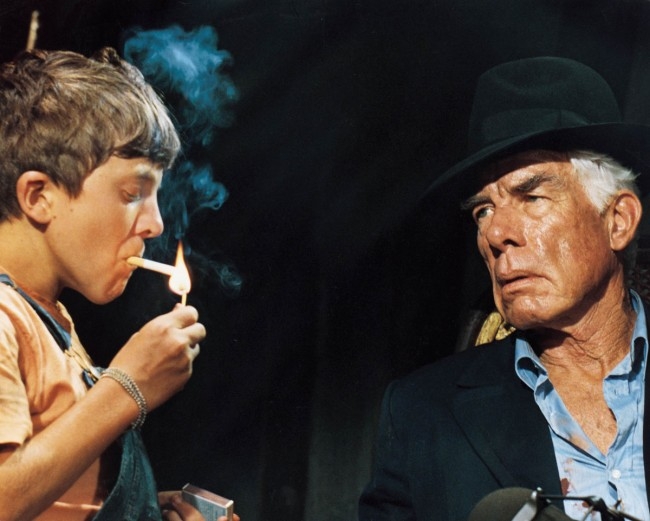
I'm pretty sure that Lightning Video VHS box with the art you see to the left was in every video store in America in the 1980s. I picked it up and looked at it approximately 85,000 times during those long gone days of old, but only now have I finally gotten around to the utterly deranged DOG DAY. And shame on me for neglecting this bonkers French gem that's long been a public domain mainstay on discount store DVD racks or in any number of low-quality "50 Action Hits!" sets, and is available in a shitty, cropped print on Amazon, but is just out in a restored and properly 2.35:1-framed Blu-ray from Kino Lorber (because physical media is dead). This is one of those weird movies that hasn't exactly been hard to find but has spent decades stealthily flying under the radar, and if there's any cult that's formed around this jaw-dropper, then they've successfully kept it to themselves. Based on a novel by Jean Vautrin (the literary pen name of FAREWELL, FRIEND/HONOR AMONG THIEVES director Jean Herman), and directed and co-written by journeyman Yves Boisset (THE FRENCH CONSPIRACY, THE PURPLE TAXI), DOG DAY is what might happen if you took the kind of Sebastian Japrisot-styled French crime thriller that Charles Bronson made in the early '70s (RIDER ON THE RAIN, COLD SWEAT, SOMEONE BEHIND THE DOOR, etc) and put it in the hands of Tobe Hooper circa THE TEXAS CHAINSAW MASSACRE or Wes Craven around the time of THE HILLS HAVE EYES. The end result in some ways resembles a French SONNY BOY but with a classier pedigree, and with its effective, Italian-sounding electronic score by Francis Lai (an Oscar-winner for his work on LOVE STORY), it wouldn't take much tweaking to turn DOG DAY into either a Fabrizio De Angelis actioner from the period or even an outright horror movie (I'm willing to bet that FRONTIER(S) director Xavier Gens is a fan). But it's very often darkly funny since you spend much of the time staring in incredulous dismay at the freakshow unfolding before your eyes, echoing the reaction of a fugitive American criminal played by the legendary Lee Marvin in one of his last films, and easily the weirdest one of his career.


Marvin was plagued with health problems over his few remaining years following DOG DAY, and he already doesn't look very good here. He seems tired and is sweating profusely throughout--the French title was CANICULE, meaning "heat wave," and it was shot during the unusually hot summer of 1983, which probably didn't do the actor any favors--though it's strangely fitting for his portrayal of Jimmy Cobb, an American gangster pulling off "one last job" in France. He's introduced prepping for an imminent armored car heist in Orleans and instructing his girlfriend Naomi Blue (GILLIGAN'S ISLAND's Tina Louise) to wait for him at a nearby hotel. With the kind of brutal, unflinching, misanthropic nastiness generally reserved for an Italian poliziotteschi directed by Umberto Lenzi, DOG DAY gets off to a rip-roaring shocker of a start with Marvin hoisting a bazooka to blow open the armored car, but something's already off: the police are there waiting for him, and in the ensuing shootout, numerous cops and many innocent bystanders--including children from a school that's letting out at the same time--are blown away with the help of some enthusiastically splattery squib work. Cobb manages to get away to the far rural outskirts of the city, where he comes upon a vast farm property in the middle of nowhere. With helicopters swarming the area, Cobb buries the loot--estimated to be in the vicinity of $1 million--in the field and takes refuge in a barn. He doesn't manage to go unnoticed for long, and when he's discovered, he finds himself at the mercy of a freakishly dysfunctional family of psychos and perverts and soon wishes he'd simply surrendered and turned himself in.


The only remotely normal one in the bunch is Jessica (Miou-Miou of Bertrand Blier's GOING PLACES), the abused wife of loathsome, brutish farm owner Horace (Victor Lanoux), the kind of charmer who clears everyone out of the kitchen immediately after breakfast so he can bend her over the table for a rough, degrading quickie. It was Jessica's father's property that she inherited, but when her first husband died and left her a widow with an infant son, she reluctantly married the repulsive Horace out of financial desperation ("He wasn't always like this," she tells Cobb at one point, and he doesn't believe it either). Horace quickly took over the farm and moved in his entire extended trash-ass family, including, among others, his dotty mother Gusta (Muni);' his prostitute daughter Lily (Grace De Capitani), who works at the brothel in town; his dim-witted older brother Socrate (Jean Carmet); and his nymphomaniac sister Segolene (Bernadette Lafont), who sexually propositions everyone--including her brothers, who affectionately call her "Slut"--and is having a torrid fling with black handyman Doudou Cadillac (Joseph Momo), which leads to no shortage of racist comments from Horace, who spends his free time disguising himself as a scarecrow and spying on a pair of nude female sunbathers who have taken up residence in his wheat field (he also tries to force them into a threesome at one point). There's also Jessica's young son Chim (THE TIN DRUM's David Bennent), a duplicitous little shit who's first seen getting a bare-assed whipping from Horace. Chim idolizes American gangsters, calls himself "Aniello Dellacroce," and refers to Cobb as "Al Capone" after he silently observes him burying the loot. He promptly digs it up and stashes most of it in the back of Doudou Cadillac's Cadillac, keeping some for himself to go live it up at the whorehouse, slapping some cash in the cleavage of the madam and declaring "I want to learn about life!" As in THE TIN DRUM, the short-statured Bennent was able to play much younger than his actual age (he was 17 in DOG DAY, and passing for maybe seven or eight), allowing the filmmakers to get away with some questionable things that essentially made him the highbrow version of BURIAL GROUND's Peter Bark.


Cobb spends most of his time at the farm bewildered by the lunacy happening around him, whether it's the actions of the gross Horace, who announces his intention to keep all of Cobb's money once he finds out where it is, or finding an unexpected superfan in Chim, or nearly being raped by an incredibly horny Segolene (every Lee Marvin fan needs to see him being aggressively straddled by a topless Lafont, who shoves his face in between her breasts while screaming "Fuck me hard! Suck my tits!"), or getting an unlikely partner-in-crime in Jessica. She pragmatically sees Cobb as her ticket out, offering to help him escape if he kills Horace. But with the police closing in--they've even stationed dumb cop Marceau (Henri Guybet) at the farm to keep lookout, only to have Horace and Socrate get him drunk while Segolene throws a screaming tantrum when her brothers won't let her have sex with him--along with some lowlife townies led by Snake (Pierre Clementi), who overhear a drunk Chim shooting his mouth off at the brothel about Cobb and the money, Cobb sees no alternative other than to send Jessica to the city to meet with the still-waiting Naomi while he stays behind and kills everyone. But he's still unaware that the money isn't where he left it thanks to Chim. DOG DAY doesn't quite succeed at sustaining its accelerated level of balls-out insanity all the way through to the end, and it more or less settles into a conventional "fugitive on the run/hostage scenario" crime thriller in the home stretch. But what a ride it is up to that point! Despite its '80s video store ubiquity and its many years in the public domain, the delightfully tawdry and thoroughly batshit DOG DAY remains one of Marvin's least-seen and least-discussed films, and that needs to change. It never received an American theatrical release, instead going straight to video in 1985, the same year Marvin starred in the TV-movie sequel THE DIRTY DOZEN: THE NEXT MISSION. His final screen appearance came a year later, co-starring with Chuck Norris in the 1986 Cannon favorite THE DELTA FORCE. He died of a heart attack in 1987.


.

Wednesday, March 22, 2017

Retro Review: THE KLANSMAN (1974)


THE KLANSMAN
(US - 1974)

Directed by Terence Young. Written by Millard Kaufman and Samuel Fuller. Cast: Lee Marvin, Richard Burton, Cameron Mitchell, O.J. Simpson, Lola Falana, Luciana Paluzzi, David Huddleston, Linda Evans, Ed Call, John Alderson, David Ladd, Vic Perrin, Spence Wil-Dee, Wendell Wellman, Hoke Howell, Virgil Frye, Lee De Broux, Susan Brown, Jeannie Bell, Larry Williams. (R, 112 mins)

THE KLANSMAN is a film so consistently and unrelentingly repugnant that it opens with a group of white yahoos giving a mentally challenged black man $1 to rape a young black woman as they stand around in a circle cheering him on...and it somehow gets more offensive with each passing scene. A misguided clusterfuck from the moment it was greenlit to the week of its release over Thanksgiving 1974--because who doesn't want to spend the holiday with family watching a movie with rape, castration, and more racial slurs than the combined filmographies of Spike Lee and Quentin Tarantino?--THE KLANSMAN is, if you can stomach it, a film that simply must be seen to be believed. The fact that it's a Paramount release with big name stars probably lent an illusion of prestige, but make no mistake, this is as foul, if not more so, as any drive-in exploitation grinder, so trashy and shamelessly gutter-wallowing that, as Johnny LaRue's Crane Shot's Marty McKee stated in his review, "You need a SILKWOOD shower after watching it." Based on a 1965 novel by William Bradford Huie, THE KLANSMAN probably began with the best intentions. Samuel Fuller (FIXED BAYONETS, MERRILL'S MARAUDERS, SHOCK CORRIDOR) wrote the script and was set to direct before quitting the project over disagreements with the producers. Fuller's script was reworked by Millard Kaufman (BAD DAY AT BLACK ROCK, RAINTREE COUNTRY) and veteran British journeyman Terence Young (DR. NO, FROM RUSSIA WITH LOVE, THUNDERBALL, WAIT UNTIL DARK) was brought in to direct. Though he had some major hits under his belt, Young was pushing 60 and in paycheck mode by that point, primarily working in Europe, coming off three Charles Bronson films with 1970's COLD SWEAT, 1971's RED SUN, and 1972's THE VALACHI PAPERS, followed by the cheesy 1973 sword-and-sandal outing WAR GODDESS, and he reportedly only took the KLANSMAN gig because he was a sugar daddy to a much younger girlfriend and needed some major studio Hollywood cash.


A coasting Young was left in charge of a cast headed by legends Lee Marvin and Richard Burton, and much of the film's budget appears to have gone to their booze supply. Marvin is at least a functioning alcoholic and manages to turn in an actual performance, but Burton was bottoming out personally and professionally while in Oroville, CA working on THE KLANSMAN. His marriage to Elizabeth Taylor falling apart during production, Burton was also dogged by a persistent combined bout of bronchitis and the flu that lasted throughout the shoot, and he was drinking nearly three bottles of vodka per day. He checked himself into a hospital to deal with his alcoholism after filming wrapped, but Burton's condition and his ghoulish appearance are impossible to ignore when you watch the film: he's wobbly on his feet, shaky, pasty, often sweating profusely, slurring his words with his wildly inconsistent accent vacillating from "Richard Burton" to "HEE HAW" in the same sentence, and though it's mentioned his character has a bum leg, it could just be to explain why he's usually seen seated, holding onto, or leaning against something--a table, a chair, a wall--seemingly to keep from falling down. He seriously looks like he could drop dead at any moment.


Marvin is Track Bascomb, sheriff of Atoka County, Alabama, a hotbed of racial tension and Ku Klux Klan activity. Bascomb is a de facto good guy--he's not in the Klan, is not a hostile racist and he breaks up the rape in the opening scene ("Party's over, get on outta here"), but he more or less leaves everyone be, especially since his loathsome deputy Butt Cutt Cates (Cameron Mitchell) is a loud and proud Klan member and Mayor Hardy Riddle (David Huddleston) is the Exalted Cyclops of the Klan's Atoka chapter. At a town council meeting, the mayor tells his Klan guys to keep things under control, to not kill anyone and maybe just burn some crosses every once in a while and rough up some black folks just so they stay scared and always know their place. That all changes when white Nancy Poteet (Linda Evans) is raped by a black man and Butt Cutt eggs everyone on into blaming Willy Washington (Spence Wil-Dee), who has an alibi but is nonetheless kept in jail by Bascomb. Butt Cutt and his boys decide to harass any black guy they see, castrating one unlucky resident whose angry friend Garth (O.J. Simpson) escapes. The tensions continue to flare over an upcoming equal rights protest to be attended by black "agitator" Loretta Sykes (Lola Falana), who left Atoka years ago to move to Chicago but is back to care for her ailing grandmother. Loretta's grandmother lives in a cabin on Stancill Mountain, a huge swath of land owned by Breck Stancill (Burton), a progressive liberal do-gooder who lets poor black people live in cabins on his mountain rent-free. Butt Cutt and the Klan guys hate Stancill and they hate Loretta, who used to be close to Stancill and is assumed to be his "private piece of brown comfort." THE KLANSMAN just gets more charming from there. Hardly a scene goes by without some jaw-droppingly offensive act or line of dialogue.


Nancy's husband (Hoke Howell) can't bear the humiliation of his wife "gettin' screwed by a n----r," so he leaves town, bellyaching to Bascomb "Why did this thing have to happen to me?" She's also ostracized in church, where a woman shrieks "I can smell n----r on her! I think I'm gonna faint!" and the Reverend refuses to carry on with his racist sermon to the other "decent Christian folk" until she leaves. Garth, meanwhile, is disguising himself in Klan garb and showing up at the houses of the guys who castrated his friend (this was Young's second film--after THE VALACHI PAPERS--to prominently feature castration) and blowing them away with a shotgun. Racist vitriol eventually boils over in an unspeakably appalling scene where Butt Cutt and a bunch of guys kidnap Loretta and drag her to a warehouse, holding her down while Butt Cutt rapes her to send a message to Atoka's black population (Butt Cutt, at his most philosophical: "N----r gal don't mind bein' raped a little by another n----r, but a white man nailin' her would be humiliatin'''). The rape goes on and on, with Loretta suffering massive bleeding from her vagina (the leering Reverend mutters "N----r women are made for this"). Bascomb arrives on the scene and knows Butt Cutt raped her but tells her to say three black men did it, though he's outraged enough over what happened to smear some of her blood all over Butt Cutt's face. At the hospital, it's revealed that Loretta was a virgin and the blood was from her ruptured hymen, a diagnosis immediately dismissed by an incredulous Bascomb, who sensitively tells the medical examiner "Everybody in the county knows a black girl's popped by the time she's 13." Eventually, Butt Cutt, the mayor, and all the other racist assholes finally have enough of Loretta, protests, Bascomb developing a conscience, and liberal snowflake Stancill, who's further incurred the wrath of everyone by falling in love with sullied and tarnished Nancy, and all parties eventually converge on Stancill's Mountain for the inevitable shootout illuminated by a burning cross.


Alternate poster art focused on O.J. Simpson
Astonishing for all the wrong reasons, THE KLANSMAN was ultimately released on VHS in 1991 but has otherwise been kept pretty much buried like a state secret by Paramount, who released the similarly tacky MANDINGO in theaters a year later in 1975. Low-quality bootlegs weren't hard to obtain but they were often cut, losing the worst parts of the castration scene and the agonizing rape, which is probably the most graphically offensive depiction of a sexual assault in a mainstream film outside of the early gang rape of the housekeeper in 1982's DEATH WISH II, and not just because Young meets the demands of no one by giving us a Cameron Mitchell ass shot. It was recently released in uncensored form on Blu-ray by Olive Films, and it makes for interesting viewing decades later. There's probably a serious, thoughtful film buried somewhere in the wreckage and it undoubtedly would've turned out better had Fuller directed it (he and Marvin would eventually work together on 1980's THE BIG RED ONE). But Young is just punching a clock here, and while it's obviously not condoning the actions of its despicable antagonists, it sort-of pulls a CANNIBAL HOLOCAUST by wallowing like a pig in shit in the very ugliness it purports to condemn. There's no need for Bascomb to smear Loretta's blood across Butt Cutt's face or have Falana lie there naked for an extended amount of time with a pool of blood between her legs other than exploitative shock value more fitting for a LAST HOUSE ON THE LEFT knockoff.


For Lola Falana's and even O.J. Simpson's sake, let's hope
this Bronco was being pulled on a trailer
and Richard Burton wasn't actually driving it. 
In Fuller's hands, the virulent racism in the story and the dialogue would've been hard-hitting and brimming with social commentary, but here it just feels like you're in the middle of a particularly feverish Steve Bannon wet dream. Some of Fuller's intent comes through--that scene in the church where Nancy is ordered to leave is legitimately enraging and upsetting and would certainly still happen in some parts of America today--but it's undermined by one bad decision after another. Who thought it was a good idea to cast Italian sex bomb Luciana Paluzzi (best known as femme fatale Fiona Volpe in THUNDERBALL) as an Alabama secretary named Trixie? Paluzzi always had a thick accent and she's obviously dubbed here, so her casting was probably just Young doing a favor for an old friend but it doesn't work. THE KLANSMAN marked the big-screen debut of O.J., who would still play in the NFL for another five years but was starting to build a movie career during his off-seasons (he was also in THE TOWERING INFERNO, in theaters a month after THE KLANSMAN). Juice was pushed as the star in some markets, but the film doesn't make very good use of him. His Garth exists on the periphery of the story for much of the time, hiding out in trees picking off Butt Cutt's dipshit cohorts. O.J. gets one amazing shot where he performs an extremely dangerous-looking stunt sprinting across railroad tracks in front of a speeding train that almost clips him, but his unintentional highlight in retrospect is a scene where he's in the backseat of Stancill's Bronco, forcing him to drive while waving a gun around, an almost surreal harbinger of things to come for the future double murderer. But nowhere does THE KLANSMAN shit the bed more than in the scene foreshadowed by a throwaway line from Trixie about Stancill learning karate while he was in the Marines.


Richard Burton, Luciana Paluzzi, and Lee Marvin
at a party during production of THE KLANSMAN.
Around 80 or so minutes into THE KLANSMAN, Stancill is buying Nancy a bus ticket out of town and they're confronted by Butt Cutt, who spends his free time hanging racist flyers around Atoka. Butt Cutt starts haranguing Nancy about having "been with a Negro," essentially blaming her for being raped, and a scuffle ensues, with karate expert Stancill giving Butt Cutt a kung-fu beatdown. The sight of Burton going full ENTER THE DRAGON would've been absurd even under the most sober conditions. But between his unsteady wavering, his pasty, sweaty visage, and what appears to be Stancill's entire knowledge of martial arts being limited to half-assed chops with his hand, he looks less like a student of karate and more like Donald Trump mocking a disabled reporter on the campaign trail. He has to grab a wall at one point to stay upright and even with his limited movement, he looks like he's about throw up from motion sickness. The staging of the fight is inept beyond comprehension, but Mitchell valiantly tries to help sell it, flinging himself through a restroom door that's obviously already off its hinges and diving through some luggage that's been strategically placed in the middle of the bus station. If THE KLANSMAN is remembered at all today, it's typically because of shitfaced Richard Burton stumbling and bumbling his way through the most unintentionally hilarious fight scene of the 1970s, not helped at all by accompanying "wacky" music that gives it a DUKES OF HAZZARD quality. This is a film that, no matter how much unexpected relevance it may inadvertently have today with the recent upsurge in hate crimes and backwards-ass racist shitbags feeling emboldened to express themselves thanks to the current occupant of the White House and those who surround and enable him, simply couldn't be made in this fashion in today's world of SJW outrage and trigger warnings. Fuller's original screenplay undoubtedly had a message, and some of it manages to come through every now and again in the finished version. But it's a staggeringly wrong-headed, stunningly tone-deaf examination of racism in the deep south, and regardless of whatever good intent it had at any point in its genesis, THE KLANSMAN is a time capsule relic that remains one of the essential "What the Fuck Were They Thinking?!" movies to ever be released by a major Hollywood studio.


Friday, June 8, 2012

The Cannon Files/New on Blu-ray: MISSING IN ACTION (1984); MISSING IN ACTION 2: THE BEGINNING (1985); THE DELTA FORCE (1986)


This week, Fox/MGM released three Chuck Norris/Cannon classics on Blu-ray, presumably to take advantage of his co-starring role in the upcoming THE EXPENDABLES 2, which will be the action star's first widely-released theatrical film since 1995's TOP DOG.  The Blu-ray editions of MISSING IN ACTION (1984), MISSING IN ACTION 2: THE BEGINNING (1985), and THE DELTA FORCE (1986), with new artwork draping Chuck in the American flag, are exclusively available at Wal-Mart for now, but will be available through other retailers at some point in the next several months.  Fox/MGM are also releasing a pair of other non-Cannon Norris films on Blu-ray on July 17 (not retailer exclusives):  LONE WOLF MCQUADE (1983) and what many consider his best film, CODE OF SILENCE (1985).


MISSING IN ACTION
(US, 1984)

The Vietnam War was still a raw, open wound for America in the 1980s, and before Oliver Stone's PLATOON (1986) paved the way for serious examination and reflection, there was a brief explosion of action-oriented "the war's not over till the last man comes home!" films, or for lack of a better term, "Namsploitation." After several years of films depicting Vietnam vets as madmen, psychos, and killers (TAXI DRIVER, THE EXTERMINATOR, and even FIRST BLOOD to some extent), Namsploitation films were, in essense, a chance for misunderstood, outcast American heroes to go back to 'Nam, kick ass, free the remaining POWs that many believed were still being held captive, and add another chapter to the story:  one where America wins. 1985's RAMBO: FIRST BLOOD PART II (in which Sylvester Stallone's John Rambo morphs from withdrawn, shell-shocked loner to Commie-killing cartoon) is probably the most famous example, though 1983's UNCOMMON VALOR really got the ball rolling.  Cannon had MISSING IN ACTION in theaters several months before RAMBO, and it was a surprise hit for the studio and for star Chuck Norris, until then generally known as a martial arts star, though he'd been attempting to move out of that genre for a couple of years.  Here, Norris is Col. James Braddock, a pissed-off vet forced into a diplomatic mission to present-day Vietnam.  He's there to prove MIA American soldiers are still being held captive, and neither spineless, useless American Sen. Porter (David Tress) nor the Vietnamese government, represented by Gen. Trau (James Hong!) will listen to him (Trau accuses of Braddock of war crimes against the Vietnamese people).  When Trau's right-hand man Vinh (Ernie Ortega), who held Braddock captive during the war, has him kicked out of the county, Braddock makes his way to Bangkok, meets up with wily old Army buddy Tuck (M. Emmet Walsh), who's still living it up in the city's red light district, and cajoles him into helping him sneak back into Vietnam by boat. 


MISSING IN ACTION ended up being one of Cannon's most successful films, and is arguably the point where American moviegoers finally recognized Norris as a legitimate action star and stopped boxing him in as "just" a martial arts guy.  The whole one-man-wrecking-crew motif is inherently absurd, but for the most part, MISSING IN ACTION is played totally straight, unlike many of the increasingly ridiculous films of the subgenre that came down the pike later (like many of the Italian ones, particularly 1987's STRIKE COMMANDO).  The stoical Norris is a tough, mean bastard throughout, and for a Cannon genre outing, it gets better direction that you'd expect from Joseph Zito (who had FRIDAY THE 13TH: THE FINAL CHAPTER in theaters the same year).  Zito often relies on long takes with fluid camera movements (watch the opening sequence) that do an effective job of making the action immediate and real.  Watching it again after all these years, I was surprised to see that MISSING IN ACTION is not the non-stop shoot 'em up that you'd think it is.  Rather, it plays more like a suspense thriller with periodic bursts of action.  It's a revisionist fantasy (complete with the iconic shot of Norris rising from the water, gun blazing, blowing away some cackling VC, plus a great crowd-pleasing final shot), but it's surprisingly grim, respectful of its subject (Norris had a younger brother who was killed in Vietnam), and non-exploitative, which is more than you can say for a lot of the films that followed in its and RAMBO's wake.  MGM's Blu-ray is framed at 1.85 and while not demo quality, is a definite upgrade from previous DVD editions, with a nice level of grain, texture, and detail throughout.  Also with Roger Corman vet Lenore Kasdorf (FLY ME) as a State Dept. representative, a terrible Bangkok karaoke version of Rod Stewart's "Do Ya Think I'm Sexy," and, credited among the stuntmen, one "J. Claude Van Damme."  (R, 102 mins)


MISSING IN ACTION 2: THE BEGINNING
(US, 1985)

MISSING IN ACTION was released in November 1984 and became a sleeper hit, and it was followed less then four months later by the prequel MISSING IN ACTION 2: THE BEGINNING.  Critics remarked that it was a cheap, quickly-shot cash-in of a follow-up, but in fact, both films were shot back-to-back and it was shot before MISSING IN ACTION and was intended to be released first.  What became MISSING IN ACTION was supposed to be a sequel.  Cannon honchos Menahem Golan and Yoram Globus liked Joseph Zito's MISSING IN ACTION more and decided to release it first.  When it proved popular with audiences, this film was sold as a prequel.  This explains at least one oddity about MISSING IN ACTION: why there's a "Based on Characters Created by" credit when it's ostensibly the first of two films. You wouldn't know they were shot back-to-back without being told: Norris is the only actor in both films, which have different directors (Lance Hool helms MIA 2) and different shooting locations (MIA was shot in the Philippines, MIA 2 in Mexico and on St. Kitts).  Where MISSING IN ACTION was handled relatively seriously, MISSING IN ACTION 2 (co-written by then-19-year-old millionaire investor/philanthropist and future tabloid fixture Steve "father of Elizabeth Hurley's kid" Bing), focusing on Braddock's time in a POW camp under the merciless rule of cardboard villain Col. Yin (Soon-Teck Oh), looks cheaper and feels more in line with the Namsploitation ripoffs that would come from the Philippines and Italy a year or so down the road.  There's much more of an emphasis on violence and gore, including the infamous "rat hood" scene, and Braddock and Yin have a totally out-of-place climactic karate battle. Taken for what it is, MISSING IN ACTION 2 is very entertaining, but it's interesting to see how two films intended to go together, and shot and released in such close proximity to one another, could be so vastly different in tone, style, and technique.  Zito has always been an underrated genre director (his FRIDAY THE 13TH: THE FINAL CHAPTER is easily the best of the sequels) who should've gone on to bigger things.  Lance Hool, while competent, doesn't have the same directorial flair.  It's easy to see why Golan & Globus, always out to make a quick buck but also craving respectability, opted to position the Zito film first, even though there's clearly more action in Hool's film. 

Chuck Norris 1, Huge Rat 0
Oddly, MGM's Blu-ray transfer (again framed at 1.85:1) actually looks and sounds better than MISSING IN ACTION.  Norris returned in 1988's forgettable BRADDOCK: MISSING IN ACTION III, and in the meantime, Golan & Globus returned to the Namsploitation genre with 1986's P.O.W.: THE ESCAPE (with David Carradine) and 1988's PLATOON LEADER (with Michael Dudikoff) in addition to the serious, post-PLATOON parade with Lionel Chetwynd's 1987 right-wing, Jane Fonda-bashing THE HANOI HILTON.  (R, 95 mins)


THE DELTA FORCE
(US, 1986)

Drawing heavily from the harrowing summer 1985 hijacking of TWA Flight 847, THE DELTA FORCE is one of Cannon and Chuck Norris' most ambitious action films.  Directed by the big guy himself, Menahem Golan, the film pairs Norris with the legendary Lee Marvin (in his last film) as the leaders of the elite Delta Force, called to duty when an Athens-to-Rome-to-NYC flight is hijacked by Ayatollah Khomeini-supporting Lebanese terrorists led by Abdul Rifi (Robert Forster).  The hijacking takes up the first half of the film, and the rest deals with the Delta Force's attempted rescue of the American hostages who were removed from the plane during a stop in Beirut.  To his credit, Golan does a great job of keeping the film on track and not succumbing to camp and overacting, a miraculous feat given the Golan-Globus-by-way-of-Irwin Allen supporting cast (the poster art even uses the Allen-pioneered classic '70s "faces in boxes" design for all-star disaster movies!):  Bo Svenson as the pilot, Robert Vaughn as the Chairman of the Joint Chiefs of Staff, Fassbinder ingenue Hanna Schygulla as the German flight attendant/Uli Derickson stand-in, Kim Delaney as a nun, Steve James as one of the Delta Force, and, straight from a Dean Martin Celebrity Roast, there's Martin Balsam, Shelley Winters, George Kennedy, Susan Strasberg, Joey Bishop, and Lainie Kazan as hostages.  They aren't asked to do much after the initial hijacking, but Kennedy, Bishop, and Balsam (as a Holocaust survivor) all get poignant moments in the spotlight, and even Winters keeps the shrieking to a minimum.  Forster is quite good as the fanatical terrorist, taking what could've easily been a politically incorrect caricature and turning it into something plausible and not embarrassing. 

Lee Marvin (1924-1987)
The film does get increasingly silly as it goes on, when Golan shifts the focus to nonstop explosions, stunts, guys engulfed in flames, and endless Norris fetishizing, which reaches its apex during a "How 1986 is this?" shot of Chuck on a motorcycle, silhouetted against the sky, his mullet blowing in the breeze, accompanied by Alan Silvestri's rousing, synth-and-drum-machine-propelled score.  And it's nice to see Marvin going out with one last solid tough guy role.  He was already having health problems at this point and looks much older than 62, but in no way lacking in energy or screen presence.  It's certainly a product of its time, but it holds up as an essential 1980s action flick.  Norris returned in 1990's DELTA FORCE 2, and his son Mike Norris starred (along with other less famous relatives of bigger names like Nick Cassavetes, Eric Douglas, and Matthew Penn) in 1991's DELTA FORCE 3.  Several years later, Cannon cover band NuImage released a series of five (!) similar OPERATION DELTA FORCE films. The Blu-ray offers a solid HD presentation, framed at 1.78:1, cropped slightly from the theatrical 1.85:1.  There were apparently some subtitling issues in a previous DVD edition, but that seems to have been corrected here.  (R, 129 mins)