LOST GIRLS (US - 2020) Directed by Liz Garbus. Written by Michael Werwie. Cast: Amy Ryan, Gabriel Byrne, Thomasin McKenzie, Lola Kirke, Oona Laurence, Dean Winters, Miriam Shor, Reed Birney, Kevin Corrigan, Stan Carp, Molly Brown, Ana Reeder, Grace Capeless, Jimi Stanton, Matthew F. O'Connor, Brian Adam DeJesus, James Liao, Jared Johnston. (R, 95 mins) Between HBO's THE WIRE and supporting roles in acclaimed films like CAPOTE and BEFORE THE DEVIL KNOWS YOU'RE DEAD, Amy Ryan was already on the radar when her breakout performance in 2007's GONE BABY GONE earned her a Best Supporting Actress Oscar nod (she lost to Tilda Swinton in MICHAEL CLAYTON). She had a recurring role on THE OFFICE, co-starred in 2014's Best Picture Oscar winner BIRDMAN and has appeared in numerous smaller indie films, but A-list stardom never happened for her, and the Netflix Original film LOST GIRLS is one of the very few times post-GONE BABY GONE where she's been given a substantive lead role. Of course, there's some surface similarities with her GONE BABY GONE character, which was probably instrumental in getting her the part after Sarah Paulson dropped out during pre-production. LOST GIRLS, subtitled "An Unsolved American Mystery," deals with the Long Island Serial Killer case over 2010-2011, which had several persons of interest who were questioned, but to this day, no one has been charged. The disappearance of Jersey City escort Shannan Gilbert--last seen running from a client's house in a private beachfront community in Oak Beach in Suffolk County, when she called 911 and it took the cops nearly an hour to arrive--inadvertently leads to the discovery of four bodies (none of them Shannan's) buried in burlap sacks along a remote stretch of Ocean Parkway on the outskirts of the area. The cops on the case, led by the useless Bostick (Dean Winters, cast radically against type as "Dean Winters") aren't really taking any of it seriously, essentially sweeping it under the rug because the victims are "just hookers," which obviously doesn't sit well with Shannan's mother Mari (Ryan), who lives two and a half hours away in Ellenville. Police commissioner Dorman (Gabriel Byrne, previously teamed with Ryan on HBO's IN TREATMENT and in 2016's little-seen LOUDER THAN BOMBS) is facing a PR nightmare and his own possible dismissal after some previous mishandled cases, and isn't prepared to deal with Mari, a blunt woman with no fear of confrontation, but with plenty of her own flaws that end up coming out during the investigation.
A single mother of three, Mari made some questionable decisions during Shannan's childhood, including giving her up when she unable to cope with her then-12-year-old daughter's diagnosis of bipolar disorder while still working two jobs, paying the bills, and raising her two younger girls. She now puts Shannan on a pedestal, despite being frequently blown off for planned dinners, always giving her a pass because she floats some money Mari's way when she's short. Mari never asks where the money comes from, and prefers to be in denial over Shannan being a sex worker, though the younger girls--Sherre (Thomasin McKenzie of LEAVE NO TRACE and JOJO RABBIT) and Sarra (Oona Laurence)--know more than they let on. Mari's own investigation comes about after a mysterious phone call from a Dr. Hackett, who claims to run a home for "wayward girls" and said he treated Shannan on the night she disappeared. She's stonewalled time and again by apathetic cops who don't seem very interested in checking security cameras in the area or looking into the fact that Dr. Hackett (Reed Birney) has a bunch of burlap sacks in a shed behind his house, a tidbit of info brought to her attention by his neighbor Joe Scalise (Kevin Corrigan), whose tips are dismissed by Dorman when he finds out Scalise is a paranoid conspiracy theorist who's had numerous property disputes with Hackett.
Much of LOST GIRLS focuses on Mari's reluctant bond with a group of women whose sisters and daughters were among the four unearthed bodies, all escorts and prostitutes and thus, viewed with scornful derision by the cops and the upright citizens of Oak Park, who look the other way, pull their shades, and close their curtains when Mari comes snooping around. One of the women is Kim (Lola Kirke), who also works as an escort and comes to be viewed by Mari as a surrogate for Shannan, which leads to McKenzie being forced into a somewhat hackneyed "I'm still here!" speech by Sherre. LOST GIRLS is the first narrative project for veteran documentary filmmaker Liz Garbus (GIRLHOOD, BOBBY FISCHER AGAINST THE WORLD), and even with a powerful performance by Ryan, the subject cries out for a true-crime-style examination. There's simply too much to the case to condense it all down to 95 minutes, giving it a rushed feel that has to cut too many corners in the early going to push the story along.
The way it's presented here, it looks like the four bodies are found right after Shannan disappears. In reality, it was seven months later. And Mari's transformation into a dogged sleuth ten minutes into the film seems a little unlikely. More remains are found in another area of Suffolk County, including a pair of dismembered legs tied to remains found elsewhere in 1996 (!), and there's significant hints of police corruption and some kind of cover-up, but LOST GIRLS doesn't have the time or space to go into it. Nor does it have time to delve into a part of the story that broadens the scope of this unspeakable tragedy: Sarra Gilbert, whose psychological troubles are mentioned in passing here and only grew worse following Shannan's disappearance and the later discovery of her remains in a marsh adjacent to Hackett's property, was later diagnosed as schizophrenic, and in 2016, killed Mari after going off her meds. That's only mentioned in almost "yadda yadda" fashion in an onscreen text at the end of the film. There's a larger story here that would best be served by Garbus' proven skills as a documentarian. What's here is the kind of actor's showcase that a jobbing pro like Ryan deserves, and she's absolutely convincing unleashing her fury at the do-nothing cops (Bostick: "Look, honey, why don't you let the police do their job?" Mari: "Why don't you suck my dick?"). And it's suitably compelling on its own terms, with a meeting between a nervous Mari and the overly folksy Hackett kinda sorta reminding you of that incredibly intense basement sequence in ZODIAC, but as is happening more and more with today's trend of serialized binge-watching, LOST GIRLS probably would've been more effective as a multi-episode documentary series.
THE HUNT (US - 2020) Directed by Craig Zobel. Written by Nick Cuse and Damon Lindelof. Cast: Betty Gilpin, Hilary Swank, Ike Barinholtz, Amy Madigan, Emma Roberts, Ethan Suplee, Wayne Duvall, Glenn Howerton, Reed Birney, Sturgill Simpson, Macon Blair, Christopher Berry, Kate Nowlin, Steve Coulter, Dean J. West, Vince Pisani, Teri Wyble, Usman Ally, Steve Mokate, Walker Babington, Sylvia Grace Crim, Jason Kirkpatrick, J.C. McKenzie, Tadasay Young, Hannah Alline. (R, 90 mins) Originally set to open in September 2019, the Blumhouse production THE HUNT had its advertising suspended by Universal after a string of mass shootings in August. Then its release was canceled entirely once Fox News informed President Trump that it was about conservative "deplorables" being hunted for sport by the liberal elite, sort-of like a MOST DANGEROUS GAME-meets-BATTLE ROYALE for the Rachel Maddow crowd. Several months later, THE HUNT has resurfaced--prefaced by a new and inferior trailer that reveals a little too much--with the hype of being "the movie they didn't want you to see," just in time for the inevitability of US movie theaters closing due to the COVID-19 coronavirus. After that six-month delay, is it worth the hype? Not really. Though if anyone on the right had actually bothered to watch THE HUNT before condemning it as dangerous propaganda from the "loony left," they would've seen that it takes far more potshots at liberals than it does conservatives, and that its right-leaning "final girl" is actually the smartest and most likable character in the film.
THE HUNT opens on a private charter flight with a group of rich, preening, condescending assholes shocked when a burly, bearded guy (Jason Kirkpatrick) breaks into the cabin from the cargo hold in a state of panic and confusion. A doctor (Steve Coulter) stabs him in the neck with a pen, followed by a mystery woman named Athena (Hilary Swank) emerging from a secluded area, stabbing him in the eye with a stiletto heel (the eye sticks to the heel when she yanks it out of the socket), with his corpse dragged back to cargo where others are restrained and sedated. Cut to a young woman in yoga pants (Emma Roberts as "Yoga Pants"), who wakes up gagged in a field in the middle of nowhere. Others have congregated in the area, all gagged and confused. There's a large crate that's pried open, and inside is a shirt-wearing pig named "Orwell," and a small arsenal of weapons. These strangers--in addition to Roberts' Yoga Pants, there's Wayne Duvall as "Don???," Ike Barinholtz as blowhard New Yorker "Staten Island," Ethan Suplee as "(Shut the Fuck Up) Gary," and Betty Gilpin as just Crystal, among others--quickly arm themselves only to be hit by ammo, arrows, and grenades coming from all directions. Most die gruesome deaths right there, but Staten Island and a couple of others make it to a gas station run by Ma (Amy Madigan) and Pop (Reed Birney) that definitely isn't what it seems. But after a few bits of misdirection and protagonist shifts thanks to some unexpected kills, it's Crystal who emerges as the central character, and she immediately proves to be a little more resourceful than her more bloviating far-right counterparts (for all his talk about owning seven guns because it's his Constitutional right, Staten Island isn't very skilled with them). She eventually teams with (Shut the Fuck Up) Gary, an ultra-conservative, Alex Jones-esque podcaster who constantly yammers on about "cucks," "crisis actors," and "the Deep State," and swears they're the latest victims of "Manorgate," a far-right, QAnon/Pizzagate-like conspiracy where "real patriotic Americans" like themselves are drugged, kidnapped, and taken to a manor in an isolated area of Vermont by a secret cabal of smug and impossibly wealthy liberals who set them free in the wild and hunt them for sport.
Well, they're not in Vermont, but it's impossible to say anymore about the plot without spoilers. Director Craig Zobel (COMPLIANCE) has fun staging some outrageously gory kills with near-Troma levels of comedic splatter. The script by Nick Cuse and Damon Lindelof seems adrift as far as what it's trying to accomplish. LOST co-creator Lindelof's involvement is almost certainly where the twists and turns come from, but the political satire is rather toothless, and its shots too easy. A few jabs land: one of the elite liberals crowing about his tweet getting a like from Ava DuVernay, or another wearing a kimono and being accused of cultural appropriation, and their hiring a trainer who was in the National Guard (Steve Mokate), and whose resume includes working as a technical adviser on the Bruce Willis movie TEARS OF THE SUN ("What's that? Is that like, a real title? Was it even in theaters?" they snark). I guess the problem with THE HUNT's political and social satire is that it isn't doing anything other than stating the obvious. It seems to be suffering from the "both sides"-ism that permeates today's news coverage, and as such, it errs on the side of caution by the bulk of the meaner gags being at the expense of the cartoonish liberals.
Granted, they're the villains here and none of the ribbing is unfair (the performative white wokeness and hand-wringing over whether to say "African-American" or "black," and guiltily whining "white people are the worst!"), but this is hardly the next GET OUT in terms of biting social commentary. It isn't even as subversive a politically-charged horror movie as Kevin Smith's underseen RED STATE, and its references and allusions to Animal Farm have all the analytical depth of a procrastinating high schooler's lit class essay cribbed from Wikipedia the morning that it was due. Where it does excel is as a showcase for GLOW's Gilpin, and in a better movie, this would be a star-making breakout. Right from the start, something seems off-kilter about Crystal and her instant grasp on the situation, as if Athena and the others have severely misjudged their prized quarry. In the wrong hands, this kind of reliance on tics, weird facial expressions, nervous sounds, and other oddball eccentricities could've resulted in a mannered, quirky disaster, but Gilpin manages to make Crystal endearingly strange. It's an intriguingly bizarre performance that's the unquestioned highlight of THE HUNT, a live-action comments section that's just a bit too pleased with itself and nowhere near the scorching hot take that it thinks it is.
Contrary to what the title might indicate, INHERIT THE VIPER is not the name of a circa-2001 metalcore band with two lead vocalists--one gurgly and one yelpy. Rather, it's a somber and downbeat look at a family of rural Alabama oxycodone dealers at a turning point. The Conleys--Kip (Josh Hartnett), his sister Josie (THE DEUCE's Margarita Levieva), and their baby brother Boots (Owen Teague)--were largely left to fend for themselves growing up after their mother split and their drug lord father died when Boots was five. Kip and Josie try to keep Boots as isolated from their business as possible, but he's a Conley and he wants to be part of the local "legend." That the Conleys are the town's chief suppliers of oxy and heroin is an open secret, but Kip is feeling the heat after a local woman dies from a bad dose supplied by Josie. He's got a very pregnant fiancee (Valorie Curry), and a decent day job at the local mill, and between the dead woman--whose enraged husband (Brad William Henke) also works at the mill--and intervening in a clandestine side deal orchestrated by an ambitious Boots and his buddy Cooper (Chandler Riggs, best known from his days as Carl on THE WALKING DEAD) that results in him killing two troublemakers who try to rip off Boots, Kip decides it's over and they're done dealing. Not so, says Josie, who vows to "fix this" because "This is who we are!"
INHERIT THE VIPER plays a lot like a pilot episode for a SONS OF ANARCHY-type FX series about the dynamics of a white trash oxy empire. Debuting director Anthony Jerjen does a very thorough job of establishing the atmosphere with effective location work in some beaten-down areas of Birmingham, AL that can charitably be described as "unwelcoming," vividly capturing the bleak and depressing surroundings in the same way as WINTER'S BONE and OUT OF THE FURNACE. Andrew Crabtree's script probably could've used another run-through, with Kip and Boots more or less stock characters: Kip is a shrewd businessman but has a good heart in the way he skims off the inventory to give a few pills to a struggling local veteran, and Boots is the naive kid who wants to make his mark in the family business but is dumb enough to buy himself a flashy, attention-getting sports car and drive it to a drug buy. We keep hearing about how no one fucks with the Conleys, but that's all anyone seems to do, and Kip's instant response is "OK, we're done, we're walking away."
The most interesting and complex character is Josie, with Levieva quietly adding layers to what could've been a one-note villain role, and delivering an internalized and very convincing performance as a hardened, ruthless woman who won't let minor inconveniences like some missing teenagers and a few dead bodies take away the only thing she knows how to do. The local color extends to the very real portrayal of a close-knit small town, albeit one slowly rotting from the inside thanks to the severe economic downturn as well as the Conleys. They go to all the home football games where Kip deals under the bleachers, and Josie goes to AA meetings also attended by the sheriff (Dash Mihok), who was her boyfriend in high school, is her current occasional fuck-buddy, and is pretty sure some shell casings he's found match a gun he knows the Conleys own. INHERIT THE VIPER takes place in the kind of forgotten underclass nowhere that progress has left behind: no one's ever left, and you either work at the mill, join the military, or become a junkie, and supplying that demand is synonymous with the name "Conley." There's a lot of interesting elements in play here, but it's impossible to dig deep and flesh any of them out in a film where the closing credits roll at 78 minutes. It also squanders Bruce Dern, who has a few scenes as a cantankerous, wheelchair-bound, emphysema-stricken bar owner whose only real purpose is to inspire Kip's fateful final decision by telling a him story about a kid being bitten on the hand by a snake, and metaphorically asking him whether or not "you're gonna cut off the arm to save the body." (R, 84 mins)
THE SONATA (Germany/France/UK/Latvia/Russia - 2019; US release 2020)
There's a feeling of the familiar throughout the minor supernatural horror film THE SONATA, but it establishes a little more cred than expected thanks to director/co-writer Andrew Desmond displaying a natural gift for atmospheric details and striking shot compositions. He gets a huge assist from location work at the Cesvaine Palace in Latvia, and with its foreboding appearance outside and the BARRY LYNDON-esque natural lighting inside, it looks a lot like the a present-day throwback to the kind of gothic horror films that Hammer or Amicus would've made in the early 1970s. The film opens with reclusive classical composer Richard Marlowe (the late Rutger Hauer, in one of his last films) putting the finishing touches on his final masterwork, after which he proceeds to douse himself in gasoline and set himself ablaze. His only heir is his estranged daughter, renowned violin prodigy Rose Fisher (Freya Tingley), who has no memories of him as he abandoned her mother when Rose was just a year old. She's kept the identity of her father a secret, even from her devoted manager Charles (Simon Abkarian), to avoid any chance of the connection furthering her career. As Charles puts it, Marlowe was "more notorious than famous," and an ex-colleague (James Faulkner) calls him a mad, innovative genius who flamed out too young, describing him as "the Syd Barrett of classical music."
Rutger Hauer (1944-2019)
Rose travels to the French castle where Marlowe locked himself away, and finds the final composition, a violin sonata that seems erratic and unplayable. The music is accompanied by strange symbols, there's a chapel in the woods where Marlowe was up to some weird shit, and the more Charles digs into the mystery, the more unstable he becomes. It seems Marlowe was the leader of a secret sect that believed music had the capacity to "unlock portals between worlds," and that his final, epic composition--which he'd been working on for decades--was a Satanic sonata written specifically to conjure the Antichrist when performed. Yes, THE SONATA is quite silly, it can't really decide if Rose or Charles should be the main character, it succumbs to some dodgy late-film CGI, and Hauer probably didn't work more than a day on it. Nevertheless, the promising Desmond establishes a quaintly retro British horror vibe, he throws a couple of bones to Italian horror fans, with one TENEBRAE shout-out that's never surprising at this point but it's always a welcome sight, and the striking interiors of the Cesvaine Palace make this look a lot more expensive than it likely was. (Unrated, 88 mins)
THE WAY BACK (US/Canada - 2020) Directed by Gavin O'Connor. Written by Brad Inglesby. Cast: Ben Affleck, Al Madrigal, Michaela Watkins, Janina Gavankar, Glynn Turman, Brandon Wilson, Jeremy Radin, Will Ropp, Charles Lott Jr., Melvin Gregg, Fernando Luis Vega, Ben Irving, Da'Vinchi, T.K. Carter, John Aylward, Todd Stashwick, Dan Lauria, Jeremy Ratchford, Matthew Glave, Nancy Linehan Charles. (R, 108 mins) 2004's exemplary MIRACLE demonstrated that director Gavin O'Connor--then best known for the 1999 indie TUMBLEWEEDS--had a knack for the inspirational sports drama, while 2011's WARRIOR remains one of the all-time great gut-wrenching man-weepies. He's had a generally well-regarded career as a journeyman with films like 2008's cop drama PRIDE AND GLORY and 2016's autistic assassin thriller THE ACCOUNTANT, with 2016's long-shelved JANE GOT A GUN being his only real misstep thus far, though in his defense, he stepped in at the last minute when Lynne Ramsey quit during pre-production a few major cast members followed suit, leaving O'Connor with an already out-of-control grease fire. O'Connor combines the feel-good underdog spirit of MIRACLE with the emotionally overwhelming haunted-by-the-past drama of WARRIOR in THE WAY BACK, which reunites him with ACCOUNTANT star Ben Affleck. The real story here isn't how it fits into the O'Connor oeuvre, but rather, the uncompromising, soul-baring performance of Affleck, who brings to the table much of his own history as a recovering high-functioning alcoholic who's publicly fallen off the wagon more than once.
Affleck is a longtime tabloid mainstay who's had enough ups and downs over his career to qualify as the John Travolta of his generation. Though only in the current pop culture environment can someone star in superhero movies that grossed between $230-$330 million domestically and still be held partially culpable for their status as "flops," with the added bonus of social media taking a meme-able glee in one's professional stumbles, personal meltdowns, and questionable choice in back tattoos. Yes, THE WAY BACK is a bit too contrived in its writing and it often comes close to being BEN AFFLECK IS SOBER: THE MOVIE, but it has a level of sincerity and authenticity that almost seems therapeutic for him at this point in time. Looking convincingly beaten down by life, Affleck is Jack Cunningham, a construction worker who's isolated himself from friends and family. He's separated from his wife Angela (Janina Gavankar), and every day is the same: he has a beer in the shower, pours some gin in a travel mug on the way to work, stealthily keeps it filled over the course of the day, fills it with a beer after work to hold him over until he gets to the bar, where he usually shuts it down with endless beers and shots, knowing that his elderly friend and bar regular Doc (Glynn Turman) will make sure he gets home. On the occasional nights he stays in, he sits at his kitchen table and works his way through a case of beer, passes out, and does it all again the next day.
An unexpected shot at redemption comes in the form of a job offer from his Catholic high school alma mater: their basketball coach is out indefinitely after a major heart attack and they need a replacement. Jack is a legend at the school, having taken them to victory at the state championship 25 years ago. He's reluctant to take the job since it interferes with his drinking schedule, but something ignites in him and he dives into the task at hand with the help of nice-guy assistant coach and algebra teacher Dan (a good serious performance by comedian and former DAILY SHOW correspondent Al Madrigal)--namely, trying to turn around a ragtag team of undisciplined showboaters who barely have the fundamentals down ("Hey, quit dancing!" Jack yells as the whistle's about to blow at the start of his first game as coach. "You're 1-9, stop acting like you hit the Powerball. It's embarrassing."). They very slowly begin to build camaraderie and momentum and become a better team, and have one legitimately good player in Brandon (Brandon Wilson), who gets no encouragement from his bitter widower father (T.K. Carter sighting!), who questions why Jack is even coaching when he pissed away a full ride and quit playing right after high school. Jack had his reasons for abandoning basketball, and he his reasons for medicating himself just to get through the day, which become clear over the course of the film. The "what" was pretty much spoiled by the trailers, but the "how" is a tragedy that's unbearably sad (like WARRIOR, THE WAY BACK doesn't shy away from picking at the scabs of traumatic family memories) and Jack is still unable to process it and move on. Coaching gives Jack a new focus and he even drastically cuts back on the drinking, until he's blindsided by a reminder from the past that puts him back on an even more destructive downward spiral than before.
Throughout, Jack repeatedly tells his players "it's the little things" that you build on to ensure a victory. It's also the little things Affleck brings to his character that keep THE WAY BACK on track and allow you to more or less speed-bump over its occasional contrivances and sports cliches dating back to HOOSIERS. The team is almost the Bad News Bears of high school hoops, but when Affleck takes Jack through the daily rituals of functional alcoholism, the film is gritty and real because he knows how it is and he wisely never overplays it for cheap awards bait. Watch the way he works through a case of beer over the course of the evening in a montage of repetition, grabbing one out of the fridge, putting in the freezer to replace the one he's taking out, keeping them ice cold and ready for each trip to the kitchen every five or so minutes. Or his wake-up shower beer. Or the cooler he keeps behind the passenger seat of his truck so he has a cold one ready after work for his drive to the bar. There's a type of rigid preparedness that goes into staying drunk. O'Connor utilizes some long takes, with a memorable one being Jack pulling into his usual bar's parking lot and the camera following him out of the truck and all the way into the bar to his seat, where the bartender welcomes one of his regulars and already has his first one waiting. O'Connor doesn't cut away or break the shot until Jack has effortlessly chugged that beer to the last drop without even pausing. A tailor-made, star vehicle for sure, THE WAY BACK isn't a great film on the level of WARRIOR (I rarely get emotional with movies, but Nick Nolte's performance in that just wrecks me), nor is it quite as inspiring as MIRACLE, but it's a solid sports man-weepie and dad movie anchored by Affleck's best work since GONE GIRL.
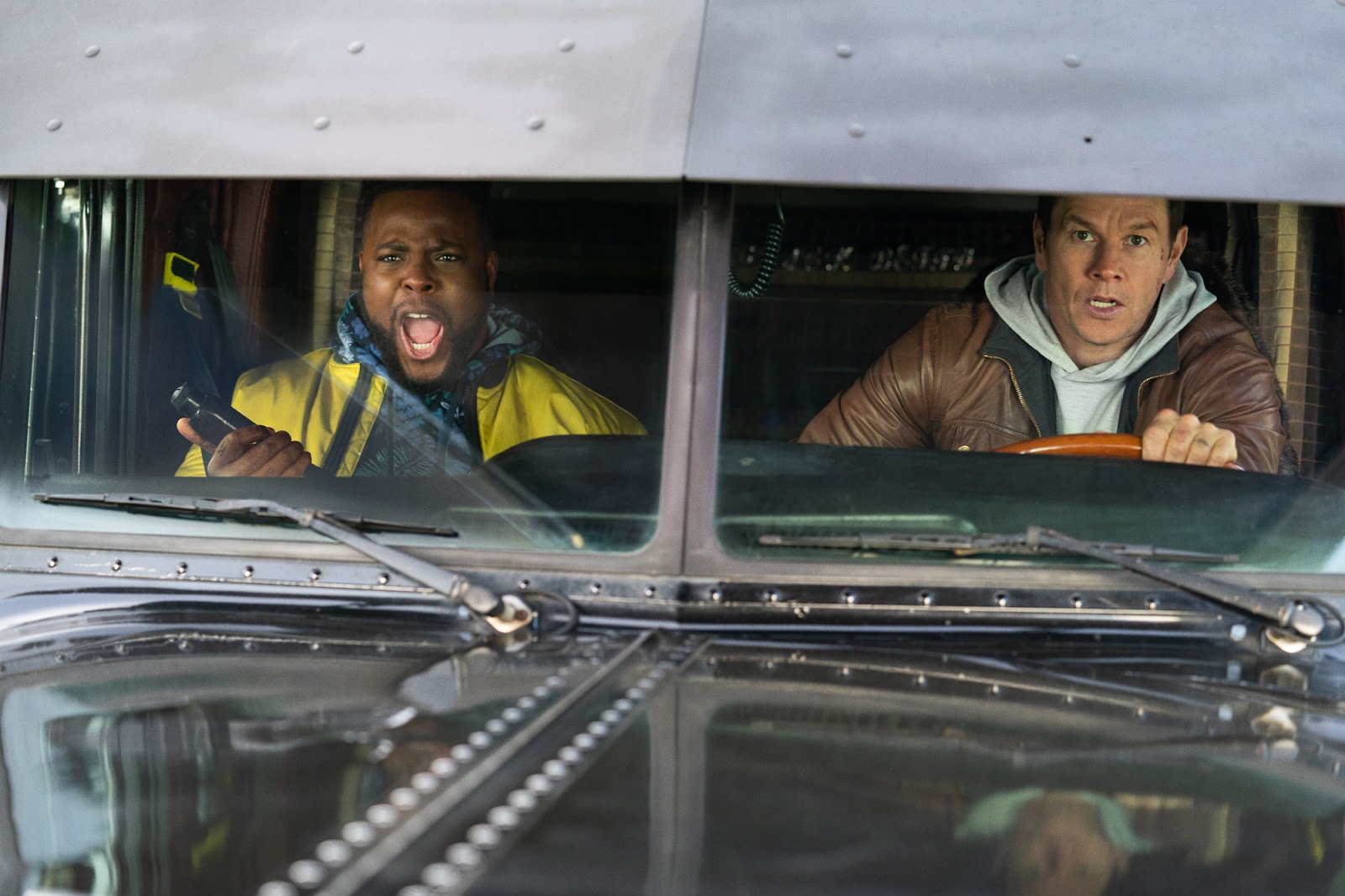
SPENSER CONFIDENTIAL (US - 2020) Directed by Peter Berg. Written by Sean O'Keefe and Brian Helgeland. Cast: Mark Wahlberg, Winston Duke, Alan Arkin, Iliza Shlesinger, Michael Gaston, Bokeem Woodbine, Marc Maron, James Dumont, Austin Post, Colleen Camp, Hope Olaide Wilson, Kip Weeks, Brandon Scales, Ayana Brown, Dustin Tucker, Rebecca Gibel, Alexandra Vino. (R, 110 mins) Mononymous Boston private eye Spenser was the subject of 40 novels by Robert B. Parker published from 1973 to 2011, as well as the inspiration for the 1985-1988 ABC series SPENSER FOR HIRE with Robert Urich in the title role and Avery Brooks as his buddy and partner Hawk, later followed by a trio of 1999-2001 A&E TV-movies with Joe Mantegna and Ernie Hudson. Following Parker's death in 2010, his estate commissioned mystery writer Ace Atkins to continue the Spenser series. Atkins has since written another eight Spenser novels, and it's his second, 2013's Wonderland, that's the basis of the Netflix Original film SPENSER CONFIDENTIAL, a very loose adaptation repurposed as an origin story, using little aside from the character names, incidental details, and the Boston setting, which is probably the biggest reason Mark Wahlberg and Peter Berg were attracted to the project. Yes, it's another chance for Wahlberg, in his fifth collaboration with Berg, to indulge in his feckin' "Say hi to your mother for me" act, along with obligatory shout-outs to Dunkin and classic rock bands Boston and Aerosmith.
As the film opens, disgraced Boston cop Spenser is about to be paroled after serving a five-year stretch for beating the shit out of his asshole captain Boylan (Michael Gaston), with whom he was already butting heads when he showed up at his house unannounced to discuss a case and walked in on him in an act of domestic violence against his wife. Ex-boxer Spenser shacks up in Southie with his cranky, fatherly former trainer Henry (Alan Arkin) and has to share a room with Henry's latest protege Hawk (Winston Duke of BLACK PANTHER and US). It's a temporary arrangement, as he just wants to leave Boston behind, get a license to drive a big rig, and move to Arizona with his beloved, elderly dog Pearl (who's giving him the cold shoulder and has bonded with Hawk during her human's five-year absence), but fate intervenes. The next morning, breaking news reports reveal that now-Chief of Police Boylan has been killed and in no time at all, Spenser's former partner Driscoll (Bokeem Woodbine) is knocking at the door, checking his alibi. Spenser is persona non grata with all of his one-time colleagues and the first obvious suspect, though Boylan's killer is quickly revealed to be Terence Graham (Brandon Scales), a boy scout of a cop who had drugs and money stashed away in his home and his found dead from a self-inflicted gunshot wound. Graham's widow (Hope Olaide Wilson) insists her late husband is being framed and that his suicide was staged, and Spenser isn't buying the official Boston P.D. story either. He's almost instantly nosing around in places he doesn't belong, with an intimidating Hawk as an initially reluctant but soon enthusiastic sidekick as they uncover a tangled web of corruption involving drug trafficking, a shady racetrack land deal, some Aryan Nations assholes in the joint (among them Austin Post, aka Post Malone, really stretching as a guy named "Squeeb"), machete-wielding enforcers, a money-laundering hit man known as Tracksuit Charlie (James Dumont), and a ring of dirty cops that might...wait for it...goall the way to the top.
Co-written by Oscar-winning L.A. CONFIDENTIAL screenwriter Brian Helgeland (his first gig since 2015's Krays biopic LEGEND), SPENSER CONFIDENTIAL doesn't have an original idea in its head, but it's enjoyable-enough formulaic entertainment most of the way, with Wahlberg much more likable here than in his last two Berg films, with the ludicrous, pandering bullshit of PATRIOTS DAY and the abysmal, career-worst MILE 22. He and Duke make a fun team that's eventually joined by his hot-headed, tough-as-nails ex Cissy (Iliza Shlesinger, seemingly patterning her performance on Heidi Gardner's recurring SNL character "Angel, Every Boxer's Girlfriend from Every Boxing Movie Ever"). SPENSER gets some points docked for not giving a national treasure like Arkin something substantive to do, and Berg indulges in way too many classic rock needle-drops: it opens and closes with Boston's "Foreplay/Long Time," Aerosmith's "Sweet Emotion" plays during some destructive truck crashes and a subsequent shootout (the big rig Spenser drives is called "Black Betty," and the only surprise is that they didn't license Ram Jam), Foreigner's "Feels Like the First Time" blares when Spenser and Cissy have wild sex in a restaurant restroom, and Neil Diamond's 'Sweet Caroline" accompanies a brawl in a cop bar where Spenser is no longer welcome. SPENSER is an OK time-killer that moves fast, is never dull, has a handful of funny lines, and gets dumber the longer it goes on. Spenser's only been away for five years but he has no idea how computers and the cloud work? And don't miss one really hackneyed exposition dump when Spenser uncovers a secret recording made by Graham during a private conversation with Boylan, where Graham engages in the most "I'm clearly wearing a wire" line of questioning you'll ever hear, or later, when the criminal mastermind behind it all Facetimes Spenser and actually says "Be there in one hour...and bring me my drug shipment!" Who talks like that? C'mon, Helgeland. You're smarter than that.
DEATH RAGE (Italy - 1976; US release 1978) Directed by Anthony M. Dawson (Antonio Margheriti). Written by Guido Castaldo and Giacomo Furia. Cast: Yul Brynner, Martin Balsam, Barbara Bouchet, Massimo Ranieri, Giancarlo Sbragia, Giacomo Furia, Sal Borgese, Loris Bazzocchi, Rosario Borelli, Luigi Williams (Luigi Bonos), Renzo Marignano, Tomasso Palladino. (R, 96 mins) A rather routine and formulaic Eurocrime outing from well-traveled Italian journeyman Antonio Margheriti, 1976's DEATH RAGE was a fixture on late-night TV and in video stores in the '80s and since has appeared on countless "50 Action Hits!" public domain DVD sets over the years, always looking like garbage and usually presented in a butchered 76-minute cut culled from an ancient TV print. It hit US theaters in 1978 at 85 minutes courtesy of short-lived S.J. International Pictures, but has just been issued on Blu-ray by Dark Force Entertainment--imagine, if you can, Code Red's less stable cousin--in a best-it-can-possibly-look transfer sourced from the original 96-minute Italian version, because physical media is dead. It's still got some print damage and scratches, but visually, it's a drastic improvement over every other version that's out there. The English soundtrack covers the 85 minutes that comprised the US release, with the eleven extra minutes scattered throughout presented in Italian with hit-or-miss subtitling, but it's doubtful you'll miss any important information. DEATH RAGE isn't really a standout in either the Eurocrime subgenre or in Margheriti's filmography, but it is of some historical significance as the big screen swan song of the great Yul Brynner (1920-1985), who would spend the remaining years of his life constantly touring with stage productions of THE KING AND I, arguably his most famous role and the one that won him the Best Actor Oscar for the 1956 film version.
Brynner played the villainous "Deaf Man" in the 1972 Burt Reynolds cop movie FUZZ and enjoyed a surprise box-office hit riffing on THE MAGNIFICENT SEVEN with his memorable turn as the robotic gunslinger in 1973's WESTWORLD, but those were rare highlights in an ongoing slump dating back to the late 1960s. 1975's post-apocalyptic THE ULTIMATE WARRIOR was a minor hit at drive-ins, but by 1976, his brief resurgence was over. He was reduced to an embarrassing cameo reprising his role as the Gunslinger in the lackluster WESTWORLD sequel FUTUREWORLD, and after heading to Italy to star in DEATH RAGE, he decided he was done with movies. It isn't exactly a Brynner classic, but it's a better one to go out on than FUTUREWORLD. He at least gets to spend the whole movie looking like a stone-cold badass: dressed in black, doing hardcore shit like throwing a guy under a speeding train and shooting another right in the gut with no hesitation and letting him bleed out even after the guy cooperates and gives him the info he demanded, and perhaps most importantly, spending long stretches of screen time with a frequently nude Barbara Bouchet. Hey...it's good to be the King.
DEATH RAGE in Toledo, OH on 9/29/1978
Far more convoluted than it needs to be in its original version--a problem that was actually rectified by the US cut with hired-gun editor and "creative adviser" Fima Noveck streamlining the opening 15 minutes and relaying the clunky exposition in a much more concise fashion that really improves the film overall--DEATH RAGE (shot as CON LA RABBIA AGLI OCCHI, or ANGER IN HIS EYES) was misleadingly sold in America as a vigilante thriller in the vein of DEATH WISH, with the poster art screaming "Bronson started it...Brynner finishes it!" However, it's really just a conventional Italian crime flick with Brynner as Peter Marciani, a retired and still-feared hit man summoned from NYC to the old country when he's informed that a mob hit at a racetrack in Naples was commissioned by Gennaro Gallo (Giancarlo Sbragia), the same top capo who ordered the death of his younger brother in NYC years earlier. He heads to Naples and meets up with Angelo (Massimo Ranieri, looking a lot like MEAN STREETS-era Harvey Keitel), an ambitious young hood who witnessed the racetrack hit and is eager to make his name under the tutelage of feared legend such as Marciani, who's been out of the game but whose lethal exploits are still whispered about in mob circles. The cops--headed by a perpetually irate commissario (Martin Balsam, who likely worked on Franco Prosperi's 1976 polizia MEET HIM AND DIE during the same trip to Italy)--also know that Marciani is in town and they desperately want to avoid an all-out mob war. Of course, it happens anyway with multiple botched attempts on Marciani's life--including acid in place of the eye drops he uses for a psychosomatic vision issue that he's had since witnessing his brother's murder-- that inevitably lead to him launching a one-man war on Gallo's organization.
DEATH RAGE in Toledo, OH on 9/29/1978
He also finds time for romance with stripper Anny, played by Bouchet, whose nude scenes were significantly trimmed in the US cut. Quentin Tarantino screened his print of DEATH RAGE at the New Beverly in L.A. in 2007 and flew Bouchet over from Europe for the occasion, hosting an audience Q&A where she told several stories about not getting along with Brynner and how unpleasant he was with the crew. Regardless of his alleged boorish behavior behind the scenes, he appears to be having a good time here. He has no chemistry with Bouchet but establishes a nice rapport with Ranieri (the two also appeared together in 1971's THE LIGHT AT THE EDGE OF THE WORLD), even though the younger actor's "eager protege" role seems completely superfluous and he really has nothing consequential to do until the very end. Margheriti was as much of a journeyman as every other Italian genre director of his day, and like all of them, he had his specialties, like his 1960s space operas and his 1980s commando jungle explosion movies. He just doesn't seem as engaged with DEATH RAGE, the type of post-GODFATHER Eurocrime/polizia offshoot more in the wheelhouse of a Fernando Di Leo (CALIBER 9, THE ITALIAN CONNECTION) or an Umberto Lenzi (ALMOST HUMAN, ROME ARMED TO THE TEETH), though he would follow it with one of his best films, 1978's wonderfully grimy, slushy, NYC-blizzard-shot Lee Van Cleef heist thriller THE SQUEEZE. DEATH RAGE does have an effective score by Guido and Maurizio De Angelis, though the fast tempos and blaring horns during the action sequences sound a lot like Franco Micalizzi cues from a Lenzi polizia. There's also a long mid-film car chase, and it's too bad Margheriti never finds a use for the apparently mandatory stock footage shot from Sergio Martino's THE VIOLENT PROFESSIONALS, with a car crashing though a stack of cardboard boxes engulfed in flames.
THE INVISIBLE MAN (US/Australia - 2020) Written and directed by Leigh Whannell. Cast: Elisabeth Moss, Aldis Hodge, Storm Reid, Oliver Jackson-Cohen, Harriet Dyer, Michael Dorman, Benedict Hardie, Nicholas Hope, Renee Lim, Nash Edgerton. (R, 124 mins) With Universal finally--for now--throwing in the towel with their attempted Marvelization of the studio's classic monsters in the ill-conceived "Dark Universe" that they tried their damnedest to make a thing (have you met anyone who actually likes the Tom Cruise MUMMY?), THE INVISIBLE MAN serves as a stand-alone, modern-day re-imagining from writer/director Leigh Whannell. Best known for co-writing and starring in the first SAW and then the INSIDIOUS franchise, Whannell seems to be sticking with relatively smaller-scale genre fare while his former creative partner James Wan has helmed the CONJURING films and blockbusters like FURIOUS 7 and AQUAMAN. Whannell's 2018 sci-fi actioner UPGRADE was an entertaining, imaginative, low-cost B-movie that should've gotten a lot more attention than it did, but with the Blumhouse production THE INVISIBLE MAN--budgeted at less than $10 million, or pocket change by today's standards--he establishes himself as a serious horror craftsman, very conservatively doling out the kind of jump scares that INSIDIOUS helped make overly familiar and instead using the Invisible Man trope in service of an intense, harrowing chronicle of abuse and gaslighting. And it's all in the guise of a nail-biting, pulse-pounding fright flick that's also--somehow, given the potentially triggering subject matter--a cathartic crowd-pleaser at the same time.
As effectively as Whannell uses uncomfortable silences in the sound design and makes every bit of empty space in the widescreen framing seem ominous and threatening, THE INVISIBLE MAN wouldn't work at all if not for the powerhouse performance by Elisabeth Moss, the latest example in a growing line of stellar work by exemplary actresses (think Toni Collette in HEREDITARY and Florence Pugh in MIDSOMMAR) that will go unrewarded because horror movies just aren't given serious awards consideration. Moss has been putting together an acclaimed body of work going back to AMC's MAD MEN, and more recently on Hulu's THE HANDMAID'S TALE, a memorable supporting turn in US, and the indie drama HER SMELL, and she just knocks it out of the park in THE INVISIBLE MAN. She plays Cecilia Kass, who's introduced pulling off a daring, intricately-planned 3:45 am escape from the oceanside mansion of her wealthy boyfriend Adrian Griffin (Oliver Jackson-Cohen). Adrian is a brilliant, groundbreaking optics scientist, and he's also a manipulative psychopath, a psychologically and physically abusive control freak, and Cecilia has reached her breaking point. She drugs Adrian and still barely manages to escape with her sister Emily (Harriet Dyer) in a waiting car nearby, and she hides out with her old friend, cop James (Aldis Hodge) and his teenage daughter Sydney (Storm Reid). Two weeks go by, and she's afraid to even walk outside for fear that Adrian has found out where she is, until Emily brings tragic, albeit relieving news: Adrian has committed suicide, and his younger brother and attorney Tom (Michael Dorman) informs Cecilia that Adrian has left her $5 million, payable in tax-free monthly installments of $100,000, contingent on her not being arrested for a crime or being declared mentally incompetent.
It seems too good to be true, and because it's a horror movie, it is. Cecilia cautiously begins building a new life and has a strong support system in Emily, James, and Sydney, but little things start happening. A knife disappears, a door is left ajar, a skillet catches fire when the burner is cranked too high. She starts feeling like someone is in the room with her even when she's alone. She goes to a job interview and finds her portfolio empty. She passes out and blood work reveals a dangerously high level of Diazepam, which she stopped taking when she lost the prescription bottle during her escape from Adrian's. That missing bottle suddenly turns up on the bathroom sink. Emily cuts off contact with her after receiving a cruel and harshly-worded e-mail that Cecilia swears she never sent. She confronts Tom and accuses him of helping fake Adrian's suicide, and that Adrian's work in optics and physics--possibly having something to do with a strange machine she observed in his high-tech lab during her escape--has resulted in the ability to somehow make himself invisible. Of course, no one believes her and she sounds insane, and she's soon terrifying Sydney to the point where James wants her out of the house. But she's not crazy. She can't prove it, but Adrian is very much alive, and even more of a domineering, narcissistic sociopath than when he was visible, and he's determined to destroy Cecilia's life as revenge for leaving him.
It doesn't quite qualify as a "#MeToo"-ification of H.G. Wells (though R-rated, there is one plot point later on with which a more exploitative film would've taken a much grosser path), but THE INVISIBLE MAN is frequently a very unsettling depiction of the PTSD suffered by abuse victims. Though she's given plenty of opportunities to go full-throttle, Moss often lets her eyes, forever sad and surveying everywhere in almost paralyzed fear that Adrian could be anywhere, speak volumes. Almost everyone knows someone who's been the victim in an abusive situation, and Moss (who, at Whannell's insistence, was asked to go over his script to make whatever tweaks were necessary to avoid any unintentional mansplaining and ensure its accuracy from a woman's perspective) absolutely nails the trauma, the terror, and the rage. It's a remarkable performance in a very well-done genre outing, albeit one where the plot holes do get a little too big to ignore. But the film is so intense, so good at playing the audience (if you see this in a theater, there's a guaranteed collective gasp at the restaurant scene), and so inspired in the way it shifts into unpredictable directions at which the trailer never even hinted that it's a case where griping about the logic lapses is just petty nit-picking. It is, after all, a movie about an invisible man.