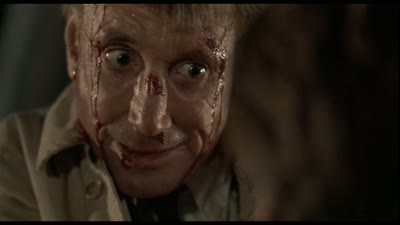
Written and directed by Eric Red. Cast: Roy Scheider, Adam Baldwin, Harley Cross, Cooper Huckabee, Suzanne Savoy, Frank Bates. (R, 86 mins)
With a title that sounds like a late '80s buddy cop comedy, COHEN AND TATE was all but abandoned by Hemdale, who only gave it a limited release with zero publicity or advertising in January 1989 before it quietly appeared on video store shelves a year later. The directorial debut of Eric Red, who made a name for himself as a screenwriter with 1986's THE HITCHER and 1987's NEAR DARK, the mob thriller/road movie COHEN AND TATE, inspired by O. Henry's short story The Ransom of Red Chief, may be a surface departure from Red's work in the horror genre, but it's pretty squarely in his wheelhouse, as he loves the sinister potential and inherent unease of late nights on dark highways and deserted back roads. COHEN AND TATE makes excellent use of color, particularly in the recurrent red glow of taillights on the faces of the characters, giving it an effectively moody feel that makes it ideal for 2:00 am viewing. COHEN AND TATE was quickly forgotten after its initial, far-below-the-radar release, but has proven surprisingly resilient in cult movie circles. Shout! Factory has just answered the demand with a special edition Blu-ray release, which features a Red commentary, interviews with cast and crew members, and deleted/alternate scenes, including several scenes of graphic violence that had to be toned down to avoid an X rating.
After witnessing a mob hit in Houston, nine-year-old Travis Knight (Harley Cross of THE BELIEVERS and THE FLY II) and his parents are put in witness protection at a small Oklahoma farmhouse. Thanks to an FBI agent on the mob's payroll, two hired killers show up and slaughter the agents and Travis' parents before hitting the road back to Houston to deliver Travis to the bosses. Cohen (Roy Scheider), the older of the two and sporting a hearing aid, is cynical about his job and knows he's expendable and that guys like him can get whacked at any moment, but he's a professional and does what he's paid to do. He's always worked alone, and he's offended that the bosses made him take a partner for this job: the hulking, sadistic, hot-headed Tate (Adam Baldwin), who just wants to shoot Travis in the head and be done with it. Cohen doesn't like Tate and the feeling is mutual. The perceptive Travis picks up on this and starts playing the two against each other before forming a tentative alliance with Cohen when they both figure out that Tate would just as soon kill both of them. The job gets more complicated when a radio report reveals that Travis' dad (Cooper Huckabee) has somehow survived his gunshot wounds and has given a description of the pair to the police--perhaps the bosses have realized that Cohen's lost a step or two in his advancing age--who are now actively pursuing the pair on the way from Oklahoma to Houston.
COHEN AND TATE is an involving little B-picture but it has some major issues. Suspension of disbelief is one thing, but the plot is frequently too far-fetched for its own good. For instance, early on, when Travis briefly escapes and ends up with a highway patrolman (Frank Bates), does it make any sense at all that Cohen, ostensibly the cooler, more level-headed of the two killers, would drive up behind the cruiser and shoot the patrolman in the head, forcing Travis to steer the speeding vehicle from the passenger seat? Don't they need to deliver him alive? On what planet does that make sense? Cohen might be hard of hearing, but he's not suffering from dementia. Also witness what might be cinema's least likely way of getting through a roadblock in a scene that's often cited as suspenseful highlight but just seems silly and unintentionally funny. And how does Tate chase Travis across a busy highway with Frogger-levels of speeding traffic in both directions, while hoisting a shotgun, and yet, no one seems to notice? Not only that, but the highway was practically empty two seconds earlier. Where did all this traffic come from? Did a sellout performance at Plot Convenience Playhouse just let out?
OK, so COHEN AND TATE has some problems. But Red's stylish direction and the work of the three leads do a lot of the heavy lifting that salvages Red's script occasionally dropping the ball. The great Scheider delivers one of his best performances in one of his last big-screen leads before aging into supporting roles, TV and straight-to-video. His Cohen is a fascinating character--in a retrospective doc on the Blu-ray, Red describes Cohen as a gangster with a "samurai code"--and one to which Scheider fully commits. Late in the film, the cool, steely Cohen turns momentarily frantic and helpless when his hearing aid pops out, and Red says that bit was all Scheider's idea to use the hearing aid as more than just a visual prop. Baldwin, best known at the time for the title role in 1980's MY BODYGUARD and as Animal Mother in Stanley Kubrick's FULL METAL JACKET (1987), though he would go on to co-star in the cult TV series FIREFLY and its big-screen spinoff SERENITY, is a good match with Scheider and the two do a fine job of getting on one another's nerves. But it's Cross who's really the emotional center of the film and he plays it very believably and never gets annoying, displaying a wisdom beyond his years that the young actor possessed in real life: he was interviewed on TODAY in 1987 to plug THE BELIEVERS, and the then-nine-year-old actor cited LAST TANGO IN PARIS as his favorite Marlon Brando movie. Cross appeared in a few films into his teen years, most notably the little-seen underground film THE BOY WHO CRIED BITCH (1991) and Alex de la Iglesia's insane PERDITA DURANGO (1997) aka DANCE WITH THE DEVIL but hasn't acted since a bit part in 2004's KINSEY. He stayed in touch with Bates over the years, with the two eventually becoming business partners and founding the Hint Mint line of breath mints.
COHEN AND TATE writer/director Eric Red
Red reteamed with NEAR DARK director Kathryn Bigelow for her 1990 film BLUE STEEL, was one of several screenwriters who turned in a draft for the troubled ALIEN 3 (1992), and directed two horror films (1991's BODY PARTS and 1996's BAD MOON) and a Showtime movie (1996's UNDERTOW) before making news more for his personal problems than his work. Years of battling financial troubles and personal demons culminated in a bizarre and tragic 2000 incident that involved a car crash that might've been a Red suicide attempt but inadvertently killed two bystanders instead, followed by Red getting out of his vehicle and slitting his own throat with a shard of glass. This horrific incident essentially derailed his filmmaking career. While his former writing partner Bigelow has gone on to Oscar glory with THE HURT LOCKER and the acclaim of last year's ZERO DARK THIRTY, Red has only made one film since the accident (2008's straight-to-DVD 100 FEET) but has become a regular fixture on the convention circuit and at midnight screenings of THE HITCHER and NEAR DARK. It didn't take long for those Red-penned films to find an audience, but COHEN AND TATE's fan base has been gradually expanding over the last 20+ years, and Red has even recently hosted some screenings of it. The odd circumstances of his suicide attempt still follow him but he seems to have rebuilt his life and gained acceptance in cult movie circles.
COHEN AND TATE isn't an undiscovered classic by any means. It suffers from too many lapses in logic to entirely work as a credible thriller, but fans of the actors, particularly Scheider, should definitely give it a look. Scheider (1932-2008) had a reputation for being difficult (he bailed on THE DEER HUNTER and only agreed to do JAWS 2 to avoid a lawsuit, and during the shooting of JAWS 2, he and director Jeannot Szwarc allegedly came to blows), and his days on the A-list ended quite abruptly in the mid-1980s. COHEN AND TATE showed that even though he may have fallen out of favor in Hollywood as a leading man, he still had that same fire and that same intensity that he brought to essential films like THE FRENCH CONNECTION, JAWS, SORCERER, and ALL THAT JAZZ. COHEN AND TATE isn't necessarily a great movie, but it does showcase a great Roy Scheider performance.
Directed by Mark Steven Johnson. Written by Evan Daugherty. Cast: John Travolta, Robert De Niro, Milo Ventimiglia, Elizabeth Olin. (R, 87 mins)
It's hard to believe Robert De Niro and John Travolta have never worked together until now. It's even harder to believe that they chose KILLING SEASON to be their long-overdue first collaboration. There have been many serious films made about the Bosnian War and its aftermath, but this isn't one of them. Oh, it tries to be, and it thinks it succeeds, but KILLING SEASON is a film divided against itself. Evan Daugherty's script, originally titled SHRAPNEL, set in the 1970s, and involving the aftermath of Vietnam, drifted around Hollywood for the last decade, and was initially a project planned for FACE/OFF stars Travolta and Nicolas Cage with the now-incarcerated John McTiernan (DIE HARD) set to direct. It never came together in that incarnation, and now the resulting film, directed by Mark Steven Johnson (DAREDEVIL, GHOST RIDER)--who knows how much, if any, of Daugherty's original script is on the screen?--wants to be a realistic, meditative examination of war and what it does to soldiers, but is torn between that and being a graphically gory revenge saga. So on one hand, KILLING SEASON is a terrible serious movie, but the sight of two iconic legends trying to kill each other in a wilderness splatter flick that's been dumped by its distributor on just 12 screens nationwide and VOD is probably the 2013 equivalent of prestige actors inexplicably turning up in a trashy grindhouse movie in the '70s. In other words, KILLING SEASON isn't good, but it's frequently entertaining for the wrong reasons, and you won't be bored.
In Bosnia in 1995, Emil Kovac (Travolta), a member of the Serbian paramilitary group the Scorpions, is shot in the head by American Col. Benjamin Ford (De Niro), the leader of a unit that's taken it upon themselves to execute a group of Serbian officers for their heinous crimes against the Bosnians. 18 years later, a recovered Kovac says he's "going hunting," and heads to a secluded area of Tennessee where a reclusive Ford lives in a cabin in the middle of Appalachian nowhere. Ford, who's cut himself off from family and friends and lives with the daily pain of shrapnel still embedded in his leg and the psychological torment of both the Serbian war crimes he observed and the ones he and his soldiers committed, leads a solitary existence and doesn't recognize Kovac when he finds the Serbian--claiming to be Bosnian--hiking through the woods. Kovac helps Ford with some engine trouble and Ford invites him to the cabin for dinner as the men bond over Bosnia, Jagermeister, and Johnny Cash. Out hunting the next day, Kovac reveals his true intent when he shoots an arrow through Ford's leg, forces him to run a line through the hole, and strings him up. Ford gets loose, and the men spend much of the remainder of the film pursuing one another, with the upper hand changing several times, mostly through stupidity and plot convenience. Let's just say it's not every day that you see a movie with Robert De Niro digging shrapnel out of his own thigh or firing an arrow through John Travolta's face, then waterboarding him with a seemingly bottomless pitcher of lemon juice seasoned with an entire container of salt.
Who is the intended audience for this movie? From scene to scene, it doesn't even feel like it's being made by the same filmmakers, nor does it seem like the stars are aware that they're still acting in the same movie. Say what you want about Travolta's hilarious accent (and I haven't even touched upon his ludicrous glued-on beard), but at least he's consistent. De Niro sounds like De Niro in half of his scenes, and in the other half, he's using a Southern accent. KILLING SEASON feels like a film where no one involved was ever on the same page at the same time. There's no way Daugherty's script could've possibly been as all-over-the-place as the resulting film turned out to be. But like I said, it's never dull. It's just hard to reconcile a serious, regular-sounding De Niro trying to express the pain of what he's seen and done with him resurrecting his Max Cady-from-CAPE FEAR drawl to gleefully taunt Travolta with "When life hands you lemons..." as a prelude to his lemonade vengeance. That's something Freddy Krueger would say. Why is it in this movie? And why is De Niro saying it?
Between the ridiculous facial hair, the graphic gore, the nonsensical plot elements (after Ford bails on his grandson's baptism party, why would his son, played in a few scenes by Milo Ventimiglia, and daughter-in-law drive three hours with their baby to surprise him? Did they just leave everyone at their party? No...the plot needs them to show up at his door so they can be threatened by Kovac), and De Niro and Travolta singing along to Johnny Cash in dueling bad accents, I can't figure out if KILLING SEASON is one of the year's worst dramas or best comedies. It tries to have it too many ways and succeeds at none. It does work best when it's in action mode and reminiscent of Tommy Lee Jones and Benicio del Toro battling in William Friedkin's THE HUNTED (2003) and even Roy Scheider and Jurgen Prochnow duking it out in John Frankenheimer's underappreciated THE FOURTH WAR (1990), even though 69-year-old De Niro is obviously doubled in some of the more strenuous scenes. And, being that it's from Cannon cover band Millennium/NuImage, it's mostly shot in Bulgaria and has the requisite unconvincing CGI from Bulgaria's Worldwide FX, though to their credit, the blood looks pretty wet here and not nearly as cartoonish as their work usually appears (but fear not...Worldwide's CGI fire is still the least convincing in the business). True to its feeling like a modern-day exploitation throwback, KILLING SEASON is unusually short, with the closing credits rolling at the 77-minute mark, and poking along for an absurd ten minutes just to pad the running time. The film is a waste of its stars, who almost certainly could've found a more worthy project to do together, though I can't help but think there's more to the story. There's just an abundance of tell-tale signs of too many cooks in the kitchen. But I gotta say, for everything that's working against him--the accent, the beard, his scalp looking like it's been smeared with Chia seeds--Travolta really commits to this thing.
Directed by Guillermo del Toro. Written by Travis Beacham and Guillermo del Toro. Cast: Charlie Hunnam, Idris Elba, Rinko Kikuchi, Charlie Day, Ron Perlman, Clifton Collins, Jr., Burn Gorman, Max Martini, Rob Kazinsky, Santiago Segura, Brad William Henke, Robin Thomas. (PG-13, 131 mins)
While squarely in the confines of "huge summer blockbuster," fantasy auteur Guillermo del Toro makes a concerted effort to put PACIFIC RIM in the realm of his distinct cinematic universe. The colors, the production and costume design, the creatures...all have that vivid del Toro feel, but when it's all over, it's still just another example the same kind of gargantuan big-screen destruction porn you'd find in any random summer multiplex colossus, with the similar fast, video-gamey editing (though not to the extreme degree) that causes your eyes to glaze over like most of the second half of MAN OF STEEL and almost all of STAR TREK: INTO DARKNESS. PACIFIC RIM gets a nice boost from the heart and soul put into it by del Toro, who dedicates the film to monster masters Ray Harryhausen and Ishiro Honda, but it also stands as an example of the struggle filmmakers like del Toro face when they're given $200 million to spend on pet projects: del Toro gets enough of "del Toro" in there to keep the fans who've followed him in the 20 years since CRONOS from crying "Sellout!", but once the CGI overload kicks into high gear in the second half, I dunno...I just kinda checked out.
In the near future, alien creatures known as kaiju burrowed up from beneath the Earth and attacked major world cities. The governments of the world set aside their differences to work together, building giant robots called jaegers, controlled by the body movements and thoughts of two military pilots stationed in the head, their minds melded by a process called "drifting," to attack and defeat them before they reach the shorelines. Within five years, the jaegers are a triumphant force, with jaeger pilots being treated like global rock stars, but the evolving kaiju begin to anticipate their actions. The jaeger program's decline starts when cocky ace pilot Raleigh Becket (Charlie Hunnam) loses his co-pilot/older brother in a battle. Seven years pass, and Raleigh, living on his own and picking up construction jobs, is called back to service by his jaeger commander Stacker Pentecost (Idris Elba) for one last hurrah before the faltering program is terminated by the UN: working with dweeby, motor-mouthed comic relief scientist Dr. Geiszler (Charlie Day), Pentecost has a plan to nuke the breach between the center of the earth and the tunnel burrowed by the kaiju. Things get complicated when Geiszler attempts to "drift" with part of a still-living kaiju brain, enabling him to get a first-hand look at the kaiju memories where he finds out their true origin and purpose.
I have to admit that in the weeks leading up to PACIFIC RIM's release, I wasn't enthused. It looked too much like a mega-budget take on Stuart Gordon's 1990 cult classic ROBOT JOX. But...so far, so good. The script by del Toro and Travis Beacham (the 2010 remake of CLASH OF THE TITANS) displays much imagination and wit in the early-going, and that continues with the introduction of Hunnam's SONS OF ANARCHY nemesis and frequent del Toro star Ron Perlman (CRONOS, HELLBOY) as a black-market kaiju remains dealer named Hannibal Chau. Chau conducts his shady business in a Hong Kong red-light district called The Bone Slums, constructed around the skeletal remains of a long-dead kaiju. These are very creative, inspired, and distinct del Toro touches (the look and color scheme of The Bone Yards had me wishing more of the film took place there). But once the "nuke the breach" plot is set in motion, del Toro hands the film off to the CGI teams for one showdown after another. Some of them have very cool touches (Raleigh "drifts" with Rinko Kikuchi's Mako Mori in his old jaeger Gipsy Danger, which finishes off one kaiju by wielding a ship from the Hong Kong harbor likes it's a sword), but PACIFIC ROOM ultimately devolves into complete clichés (any chance Raleigh and a rival jaeger pilot will reach a mutual understanding of one another?). The last 30 minutes of the film is little but clanking noise, whether it's the sounds of constant destruction or the characters yelling every predictable line of dialogue, which usually has someone bellowing "Let's do this!" or "Let's finish this!" The actors do a good job, particularly Elba, effectively conveying a stern feeling of no-nonsense authority and putting his personal troubles on the backburner for the sake of humanity. Perlman is a lot of fun, completely stealing the few scenes he's in, with his first appearance an hour in actually getting applause from the audience.
At its core, PACIFIC RIM is a B-movie. But with no expenses spared, it loses some of the feeling of the classic kaiju films that inspired it. It works best when del Toro is free to be del Toro, but once he starts fulfilling his obligations to Warner Bros. and bringing on the large-scale CGI destruction, it just starts to feel like any other routine Hollywood product. You can make these things as huge and with as much state-of-the-art technology as possible (and to its credit, PACIFIC RIM's CGI is very well-done), but when you start thinking how much more fun it would be to just watch an old-school Toho GODZILLA flick instead, with guys in rubber suits throwing themselves around a cheap set, well, then something's missing. I don't mean to be curmudgeonly about it--PACIFIC RIM is an overall entertaining movie with much to like--but it just left me a little cold. I guess it's a matter of bigger not always being better.
Directed by Robert Butler. Written by Bill Norton, Sr. and Rick Natkin. Cast: James Brolin, Cliff Gorman, Richard Castellano, Julie Carmen, Abby Bluestone, Linda G. Miller, Barton Heyman, Sully Boyar, Dan Hedaya, Joseph Carberry, Mandy Patinkin, Marco St. John, Sharon Mitchell, Rick Anthony, Steve Inwood, Serena, Robert Weil, Richard Gant, Samm-Art Williams. (R, 101 mins)
"You know...I got a feelin' it's gonna be another goddamn New York day."
A video store and cable favorite in the 1980s, NIGHT OF THE JUGGLER, loosely adapted from William P. McGivern's 1975 novel, has fallen into relative obscurity, championed today primarily by grindhouse enthusiasts and vintage 1970s NYC location-shooting fanatics. Indeed, if you're a fan of seeing the city and the surrounding boroughs in all their grimy, scuzzy, pre-Giuliani glory, then you'll probably reach a state of nirvana watching NIGHT OF THE JUGGLER. Shot in the summer of 1978 but unreleased until the summer of 1980 (Times Square marquees show such hits as THE DRIVER and TINTORERA), JUGGLER is the kind of film that simply couldn't be made today: it's sleazy, tasteless, racist, politically incorrect, and many of the chase sequences seem to put the actors and actual NYC pedestrians in harm's way. But damn it...this is how it should be. Today, they just greenscreen and CGI it. Back in the late '70s, they did it for real, and if they had to tie up busy streets for two weeks to get an action scene shot, then so be it. Right down to small roles for XXX stars like Sharon Mitchell and Serena and its palpable sense of Big Apple rage, NIGHT OF THE JUGGLER belongs in a time capsule with the same year's legendary THE EXTERMINATOR.
Divorced trucker and disgraced ex-cop Sean Boyd (James Brolin, with his awesome late '70s hair and beard, looking like he went straight from this to the set of 1979's THE AMITYVILLE HORROR) has his teenage daughter Kathy (Abby Bluestone) staying with him for the summer and taking some extra classes at summer school. Walking with her to school one morning but exhausted from working all night, Boyd lets Kathy go on her own but while she's still within his sight, she's abducted and thrown in a car by twisted psycho Gus Stolic (Cliff Gorman). Stolic, irate that rich real estate fat cats have allowed his beloved Bronx to deteriorate into a demolished, gang-ravaged war zone, devises a crackpot plan to kidnap the daughter of a rich property owner (Marco St. John). The rich kid and Kathy look similar and are walking through Central Park within a few steps of one another, and a momentarily confused Stolic grabs the wrong girl. Boyd hears Kathy scream and sees Stolic grab her, which sets off an absolutely insane foot/car chase that gets an even bigger lift from a fast-talking cab driver played by a scene-stealing Mandy Patinkin in one of his first films.
Boyd has no patience for the useless cops, led by grumpy Lt. Tonelli (Richard Castellano, in his first big-screen role since THE GODFATHER), and has to deal with vengeful Sgt. Barnes (Dan Hedaya), who has a personal score to settle with him. Despite her explanations and pleading, Kathy can't convince Stolic that he's kidnapped the wrong girl, and as the day goes on, it's pretty clear that he's got sexual designs on the underage girl as well (late in the film, Gorman's line "I'm gonna keep her" was a last-minute change when studio execs balked at "I'm gonna fuck her"). Boyd meanwhile, wages a one-man path of destruction across the city looking for his daughter, wrecking cars, injuring passersby, destroying property, getting into a brawl at a Times Square peep show, and tangling with a Bronx street gang when his pursuit of Stolic leads him to their turf.
It isn't the most plausible thriller you'll ever see (it never occurs to Kathy to just scream for help and say "This guy's kidnapping me!"?), but you can practically smell sweltering 1978 New York City while watching this. The packed streets, the porn palace jizz booths, the cramped subways, the garbage...it's just beautiful. NIGHT OF THE JUGGLER was started by journeyman Sidney J. Furie (THE IPCRESS FILE, LADY SINGS THE BLUES, THE BOYS IN COMPANY C, THE ENTITY), who broke his leg at some point during production and was replaced by veteran TV director Robert Butler, who had just made Disney's HOT LEAD AND COLD FEET. Brolin and co-writer Bill Norton Sr (BIG BAD MAMA, DAY OF THE ANIMALS) have both said in interviews that Furie directed much of the film, though only Butler is credited. An intense Brolin is excellent as the obsessed Boyd, who will stop at nothing to save his little girl, and he's matched by a skin-crawling Gorman as the repellently racist Stolic, who leaves a trail of corpses behind in his pursuit of the Bronx that he knew and loved from his childhood. Gorman was always an underrated actor who rarely got the showy roles and acclaim that he deserved, though not long before his death in 2002, he did get a memorable turn as an aging, rap-obsessed mobster in Jim Jarmusch's GHOST DOG: THE WAY OF THE SAMURAI (2000). Castellano, whose role as Clemenza in THE GODFATHER seemed to close more doors than it opened, is quite fun as the harried Tonelli. Francis Ford Coppola has said that Castellano's unreasonable demands caused him to be written out of THE GODFATHER PART II (rather than recast Clemenza, Coppola reworked the character as Michael V. Gazzo's bitter Frankie Pentangeli), and Castellano was primarily a sporadic TV actor for the remainder of his career, with a few TV movies and two short-lived sitcoms (ABC's THE SUPER in 1972 and CBS' JOE & SONS in 1975). He died in 1988, with his last film appearance coming in 1982's little-seen Joe Pesci vehicle DEAR MR. WONDERFUL.
NIGHT OF THE JUGGLER was released on VHS in 1984 but has yet to appear on DVD or Blu-ray. A rip of the 1.33:1 VHS print is available on YouTube and frequently suffers from too much darkness, particularly in the climax. This mean, gritty, relentlessly fast-paced thriller will probably be offensive and dated to some, but for those with an appreciation of the fascinating imagery provided by the sights, sounds, and yes, smells, of this period in New York City's history, NIGHT OF THE JUGGLER is mandatory viewing. A proper special edition DVD/Blu-ray restoration in its correct aspect ratio, preferably with a Brolin commentary, is long overdue.
If you enjoyed Jeffrey Combs' iconic turns in 1985's RE-ANIMATOR and 1986's FROM BEYOND, then you'll definitely want to take a look at his inspired performance in WOULD YOU RATHER. Combs, an actor whose talents have been too frequently squandered in subpar DTV horror movies and on the convention circuit, lets it rip as sinister philanthropist Shepard Lambrick, who hosts a dinner game for financially-strapped guests looking for a way out of their desperate situation. Iris (Brittany Snow), forced to drop out of school to deal with her late parents' mountain of debt and take care of her cancer-stricken younger brother (Logan Miller), ends up at Lambrick's mansion with other participants and the festivities begin with Lambrick offering the vegetarian Iris $10,000 if she eats a steak ("A lifetime of discipline...gone in an instant for $10,000!" he mocks). After goading recovering alcoholic Conway (John Heard) into ending 16 years of sobriety by downing a decanter of scotch for $50,000, the stakes get higher with a twisted game of Would You Rather where it quickly becomes apparent that Lambrick and his goonish butler Bevans (Jonathan Coyne), a former British intelligence interrogator, are going to make them kill each other until only one remains. Director David Guy Levy and screenwriter Steffen Schlachtenhaufen do a nice job of keeping the tension high and the pace swift, considering that most of the film takes place around a dining room table. While it has grisly moments, Levy also wisely keeps the gore to a minimum, showing an understanding that what's implied and maybe only heard offscreen can be far more unsettling than seeing it up close. It's a pretty misanthropic, feel-bad kind-of film that does occasionally succumb to cliché (of course, someone will scream "You sick fuck!" at Lambrick) and has some loose ends (Robin Lord Taylor, as Lambrick's sniveling son, disappears from the movie), but it's surprisingly engaging and Combs, bringing that "Who's going to believe a talking head? Get a job in a sideshow!" condescension to his character, is just terrific. (Unrated, 93 mins)
THE POWER OF FEW (US - 2013)
Here's yet another post-CRASH, "everything is connected" ensemble collection of vignettes and it's one of the worst. Produced, written, directed, and self-distributed by "groundbreaking" would-be indie auteur Leone Marucci, the New Orleans-shot THE POWER OF FEW gathers a group of unlikable characters into a 20-minute time span--replayed from different perspectives--where fate causes their lives to intersect. There's a homeless ex-news anchor (Christopher Walken) and his sidekick (Jordan Prentice), who come into possession of a dim cop's (Caleb Moody) misplaced firearm; a teenager (Devon Gearhart) attempting an impromptu robbery of a carryout because he needs to buy medicine for his infant brother; two undercover agents, one by-the-book (Christian Slater) and the other a hot-tempered cokehead (Nicky Whelan) in pursuit of a suspected terrorist (Navid Negahban); a quirky courier (co-producer Q'orianka Kilcher) hired by the suspected terrorist to deliver an important package, but she gets distracted by a meet-cute (Jesse Bradford) who's got bad people after him; and two thugs (Anthony Anderson, Juvenile) in pursuit of Bradford, only to be distracted by Few (Tione Johnson), a teenage girl with wisdom beyond her years, stowing away in the backseat of their car to plead with them to stop the violence and the killing.
Announced in industry trades as far back as 2006 and shot in 2010, THE POWER OF FEW was hyped as an "interactive" community filmmaking experience, where fans would get to edit the movie. That ended up being just a bit of a chase scene involving Kilcher and Bradford, though perhaps Marucci, not likely to be mistaken for Akira Kurosawa anytime soon, would've been better off letting random anonymous people on the internet work on this RASHOMON FOR DUMMIES. Pompously self-important and gratingly self-indulgent, the amateurish THE POWER OF FEW never gets going because Marucci can't stop showing off, whether it's a POV shot from a gunk-filled bathroom sink or dizzying over-the-shoulder shots when people are running. The writing is terrible (Slater: "We have to follow the law!" Whelan: "WHOSE LAW?!"), there's a ludicrous MacGuffin subplot about the missing Shroud of Turin and what's actually in the mysterious package, Larry King appears as himself, and several actors get long monologues that just go nowhere. Walken's might've worked if it wasn't painfully obvious that he's reading cue cards. Walken is a guy who's breathed life into his share of shitty movies and when even he's bad, you know the project is doomed. Put it this way: thanks to THE POWER OF FEW, KANGAROO JACK is now the second-worst movie that Walken and Anderson have appeared in together. (R, 96 mins)
CRAWLSPACE (Australia - 2012; 2013 US release)
CRAWLSPACE is somewhat of an Australian horror summit: produced by WOLF CREEK and ROGUE director Greg McLean, co-written by Adam Patrick Foster (the brutal revenge thriller CLOSURE) and featuring a score by STORM WARNING and NATURE'S GRAVE director Jamie Blanks, it's also the feature directing debut of veteran makeup effects artist Justin Dix, who worked on films like LAKE MUNGO and RED HILL. Dix gets a lot right with CRAWLSPACE, namely the sense of claustrophobia and his use of practical makeup and splatter effects, which in this era is almost an act of defiance, and he has a plethora of ideas, but whether it's meant to be twisty misdirection or just a fusing on influences, they all end up coming off as half-baked and unfocused, causing the film to drift into incoherence. The Australian government has lost contact with a secret underground military base located in the desolate Outback and sends in the requisite elite unit to locate personnel and exterminate any quarantined prisoners that may have escaped from a certain level. They also find a clearly non-human life form as well as Eve (Amber Clayton), an apparent amnesiac with a recent brain surgery scar. Eve has no recollection of how she got there, and her existence is also of interest to squad leader Romeo (the awesomely-named Ditch Davey, which is perhaps Australian for "Almost Jason Statham"), who recognizes her as his dead wife. The creature angle is quickly abandoned as the team, with Eve in tow, finds a couple of scientists who tell them of secret experiments involving memory implants and a new kind of espionage, a sort-of "psychic combat," where soldiers are trained to telepathically turn their enemies against themselves.
Dix borrows/steals from a lot of other films here and can't really settle on what kind of movie he wants to make: it starts off as an action-packed throwback to '80s fare like ALIENS mixed with the more recent RESIDENT EVIL, but then goes into a weird SCANNERS/UNIVERSAL SOLDIER hybrid, with elements of EVENT HORIZON and psychological horror tossed in at random. It's always watchable and certainly competently-made, but the plot is all over the place and around an hour in, you'll just stop caring and give up trying to make sense of it. Dix obviously has a knack for this sort of thing from a directing standpoint and he wears his love of these movies on his sleeve, which buys him a little breathing room, but it would be really interesting to see what he could do with a more disciplined script that didn't feel like it was bound with the pages in random order. (Unrated, 87 mins)
Directed by Robert Clouse. Written by Charles Robert Carner. Cast: Kurt Thomas, Tetchie Agbayani, Richard Norton, Edward Bell, John Barrett, Conan Lee, Bob Schott, Buck Kartalian, Eric Lawson, Sonny Barnes, Tadashi Yamashita. (R, 90 mins)
Boasting a premise so ridiculous and doomed to fail that it could almost be made an honorary Cannon film, GYMKATA was an attempt by director Robert Clouse and producer Fred Weintraub to replicate the success they enjoyed with 1973's ENTER THE DRAGON. Beginning with that influential classic, the pair teamed on ten films from 1973 to 1991, and 1985's GYMKATA is probably their most ludicrous. Instead of the late Bruce Lee, they had champion gymnast Kurt Thomas, who was deemed a lock for the gold medal had the US not boycotted the 1980 Olympics. In his day, he was the top name in men's gymnastics, with two legendary moves--the Thomas Salto and the Thomas Flair, both displayed in GYMKATA--named after him. By 1985, Thomas was retired from competition and tried to break into movies. He never made another one after GYMKATA.
Thomas plays Jonathan Cabot, a champion gymnast (duh) sent by the US government to the fictional Middle East mountain nation of Parmistan, where the US military wants to set up a satellite station. In order to infiltrate Parmistan, Cabot must be a participant in The Game, a to-the-death obstacle course through the country's dangerous terrain, and it's a tournament that no outsider has survived in over 900 years. The Game is personal to Cabot: his secret agent father (Eric Lawson) was killed playing it. Cabot also falls in love with Princess Rubali (Tetchie Agbayani), daughter of Parmistan leader The Kahn (Buck Kartalian), who's already promised his daughter to his treacherious chief aide and Game overseer Zamir (Richard Norton), who's amassed his own ninja army to kill the Game participants and overthrow The Kahn.
GYMKATA follows the "to the death" tournament template established by ENTER THE DRAGON that would continue to be used in countless martial arts films for years to come, most notably 1988's BLOODSPORT. Other than the gymnastics angle (the one-sheet's tag line boasted "A new kind of martial arts combat! The skill of gymnastics. The kill of karate"), GYMKATA plays pretty much like a typical mid-1980s ninja movie...at least until a little past the one hour mark, when Cabot makes his way to the most dangerous part of The Game: The Village of the Crazies, an isolated part of Parmistan where the country's insane have been dumped for generations. Once Cabot enters the village, the film goes into a completely unexpected direction. I can't decide if it's the silliest set piece in all of martial arts cinema or something that could work as a brilliant stand-alone short horror film. It makes as much sense out of context as in, so what the hell? Here it is, and if you're watching it MST3K-style, be sure to yell "Vic Tayback, no!" at 4:38 into the clip
Once you get over the fact that the Village of the Crazies' town square conveniently has a rock-cut pommel horse should someone like Kurt Thomas ever pass through, there's a lot to appreciate in that extended sequence. It belongs in another movie altogether and almost plays like something in a weird Eurotrash or Jess Franco fever dream: the fog, the noises the villagers make and the way they shamble about like zombies, the eerie and deliberately off-putting music, the two creepy-as-shit guys from 6:15-7:00. It's easy to laugh once Cabot hops on the pommel horse and starts Thomas Flair-ing the whole village. But up to then? Sentence me to the Village of the Crazies, but it's a brilliant sequence. Doesn't belong in GYMKATA, but brilliant nonetheless.
"You stay classy, Parmistan!"
But the other 77 or so minutes of GYMKATA are mostly of the so-bad-it's-funny variety. Thomas can't act; Cabot's training montage gets us dangerously close to a Thomas taint shot as he handstand-walks up some stairs; there's a near-record number of hilarious dummy deaths and people suddenly being silenced by arrows; Thorg, a hulking, homicidal Game participant played by Bob Schott, looks like a roid-raging Will Ferrell; and The Kahn, played by Kartalian with a bushy moustache and a hilarious combover, seems less like the leader of a Middle Eastern nation and more like a rejected Sid Caesar character. If GYMKATA is ever remade as an intentional comedy in the next few years, not only does Ferrell have to play Thorg, but Mel Brooks must play The Kahn.
Robert Clouse with Bruce Lee on
the set of ENTER THE DRAGON
Clouse (1928-1997) was a journeyman director who didn't really set out to specialize in martial arts movies but they kept getting offered to him and he was good at making them. If he was adept at filming well-choreographed fight scenes, it could be that he focused more on the visual aspects of his films for one important reason: he was completely deaf for much of his career, relying on production assistants to monitor the line readings of the actors. After gaining notoriety as a still photographer and directing two Oscar-nominated short subjects in the early 1960s, Clouse was 42 when he made his feature debut with the Rod Taylor vehicle DARKER THAN AMBER (1970), which got good reviews but wasn't a big box office success. It did feature an epic fight between Taylor and William Smith that demonstrated Clouse's innate talent for such sequences. Clouse followed his debut later the same year with the obscure romantic drama DREAMS OF GLASS, notable today only for featuring Danny De Vito in his film debut, buried in the credits as "Thug." Clouse then scripted the 1972 CBS TV-movie SOMETHING EVIL, directed by an up-and-coming Steven Spielberg, then fresh off the enormously popular ABC TV-movie DUEL, and when Clouse had his first box office smash three years later with ENTER THE DRAGON, he was obviously overshadowed by the star power of Bruce Lee, who died a week before the film's release. Having enjoyed the massive worldwide success of their first project together, Clouse and Weintraub reteamed with DRAGON co-star Jim Kelly for 1974's BLACK BELT JONES, which became a major blaxploitation hit. Kelly co-starred with Joe Don Baker in GOLDEN NEEDLES, another Clouse film from 1974, and Clouse would work with Baker again on the 1977 wild-dogs-on-the-rampage horror film THE PACK. After the 1975 Yul Brynner post-nuke prototype THE ULTIMATE WARRIOR and the 1977 Robert Mitchum thriller THE AMSTERDAM KILL, Clouse, without Weintraub, would complete the shelved project Lee was working on at the time of his death, which would become 1979's dubious GAME OF DEATH, precariously held together by ten minutes of footage Lee directed in 1973. Clouse constructed a plot around the salvageable Lee material that he had and used unconvincing doubles, superimpositions, and clumsily-integrated stock footage to complete what was billed as Lee's "final" film. GAME OF DEATH isn't very good and features perhaps cinema's least convincing double-for-a-long-dead-star since Ed Wood's PLAN 9 FROM OUTER SPACE (1959), released three years after star Bela Lugosi's death, with Wood's chiropractor walking around with a cape over his face pretending to be Lugosi. Nevertheless, Lee's climactic showdown with Kareem Abdul-Jabbar (shot by Lee in 1973) is one for the ages. Clouse made a couple of live-action made-for-TV Disney movies (1979's THE LONDON CONNECTION and 1980's THE KIDS WHO KNEW TOO MUCH) before he and Weintraub gave American audiences their first mainstream exposure to Jackie Chan in 1980's THE BIG BRAWL. Clouse followed that with the martial-arts thriller FORCE: FIVE (1981) and DEADLY EYES (1983), one of several early '80s "monster rat" horror movies. By the time Clouse got to GYMKATA, he was clearly in coast mode. He only made three more films, all produced by Weintraub, all of them going straight-to-video: two Cynthia Rothrock actioners (1990's CHINA O'BRIEN and 1991's CHINA O'BRIEN II) and 1992's IRONHEART, starring BLOODSPORT bad guy Bolo Yeung, who also had a small role in ENTER THE DRAGON.
If Clouse liked an actor, he tried to keep working with them. He made three films with Jim Kelly, two with Joe Don Baker, and two with B-movie badass William Smith (who also appeared in THE ULTIMATE WARRIOR) but his favorite actor, based on recurrent appearances in Clouse films, was probably the Australian Norton, who first worked with Clouse on FORCE: FIVE and, starting with GYMKATA, would co-star in the director's final four films. Norton, who has a sort-of David Carradine-like presence in GYMKATA, choreographed the film's fight scenes and was a ubiquitous C-lister in many low-budget exploitation and straight-to-video flicks from the '80s to well into the 2000s. Now 63, he's still active in the business, mainly as a stunt and fight coordinator on big-budget films like THE AMAZING SPIDER-MAN and the upcoming MAD MAX: FURY ROAD.
These days, GYMKATA is rightfully viewed through mocking MST3K goggles, but it's hardly the worst of its type. It's just that no one was really asking for the skill of gymnastics and the kill of karate. Amazingly, the film was backed by a major studio (MGM/UA) and opened nationwide on May 3, 1985, landing in tenth place at the box office. Chuck Norris' cop thriller CODE OF SILENCE opened the same day and took the top spot, and it speaks volumes for GYMKATA's lack of appeal and the complete absence of Kurt Thomas star power that BEVERLY HILLS COP out-performed it by $300,000 in its 22nd week of release. Thomas quickly found a home in sports broadcasting and it's not known whether he was ever approached about participating in the film's 2007 DVD release, but I'd like to think he has a good sense of humor about it. GYMKATA may be a terrible movie, but it's a fun terrible movie, and I honestly can't praise the "Village of the Crazies" detour enough. All respect to Clouse for fashioning a mini-masterpiece of a sequence where you least expect it, proof positive (along with ENTER THE DRAGON's legendary final showdown) that his disability enhanced his effectiveness with the purely visual side of directing, and it's a side of him that we just didn't see enough. When people talk about the excellence of ENTER THE DRAGON and how it's the standard-bearer of commercial martial arts cinema, they talk about Bruce Lee, not Robert Clouse. Ultimately, Clouse will go down in the film history books as a solid B-movie director and there's no shame in that. But there may have been a genuine auteur lurking somewhere within him.
Shot in 2008 under the title SHELTER, it took five years for the newly-christened 6 SOULS to get a 54-screen US release courtesy of Radius TWC, the B-movie arm of The Weinstein Company. Like many of today's horror films, it gets off to an interesting start before collapsing under the weight of its own silliness. In what will be nothing more than a minor footnote to her career, a decidedly overqualified Julianne Moore stars as Dr. Cara Harding, a widowed psychologist whose dismissal of multiple personality theory as an excuse used by guilty killers to plead insanity gets tested when her father/mentor (Jeffrey DeMunn) has her observe his latest patient, Adam (Jonathan Rhys Meyers). Adam's second personality is the paralyzed David, and while on an outing with "David," Cara is introduced to Wes, a third personality. After some investigating, Cara figures out that all of Adam's personalities--and Adam himself--are murder victims who may have been sacrificed by a backwoods cult that practices "sheltering," or sucking out the soul via the mouth, and filling it with dirt to deny the soul future re-entry. But who is this man claiming to be Adam, David, and Wes, and, eventually, Cara's late husband Charles, who had his throat slashed on Christmas Eve?
6 SOULS has more plot holes than scares, starting with the way Adam, confined to a mental institution, is free to roam about wherever he pleases, even showing up at Cara's daughter's (Brooklynn Proulx) school in his "Charles" guise. Are there no guards at this hospital? DeMunn's character has to be one of the most unprofessional medical figures in recent cinema, basically smirking with glee whenever Cara figures out another traumatic layer to "Adam"'s and her own story, reveling in the fact that she now must be forced to believe in multiple personalities. He acts less like her father and colleague and more like J. Walter Weatherman on ARRESTED DEVELOPMENT. And, excuse me, but does the internet exist in this film's world? I realize it was on the shelf for five years, but none of this would've happened if DeMunn's idiotic character had bothered to do a Google search or even checked with the police, hospital, or public records or the DMV in regards to Adam/David/Wes before he opts to just blithely put his entire family in danger. And who still goes to a musty old library to research old high school yearbooks to get to the bottom of something? Shots of medical files in the movie indicate that it's set in 2008, and the characters use cell phones, but their research methods and everything else feel more like it's 1978, right down to DeMunn's boat of a car. Yeah, it's a supernatural horror flick and there has to be some suspension of disbelief, but the implausible things in 6 SOULS reek of laziness courtesy of IDENTITY screenwriter (and, more importantly, the killer snowman classic JACK FROST writer/director) Michael Cooney and the Swedish directing team of Mans Marlind & Bjorn Stein, who would go on to bury the UNDERWORLD franchise with the pathetic UNDERWORLD: AWAKENING. 6 SOULS has some interesting ideas and Moore soldiers through it and gives it some credibility because she's a pro, but it's just not good. (R, 112 mins, also available on Netflix streaming)
INESCAPABLE (Canada/South Africa - 2013)
This boring, predictable melodrama is more serious than TAKEN but still owes a lot to its basic premise. Adib (Alexander Siddig) left Syria 20 years ago and has settled down in Toronto with a Canadian wife and two daughters. The oldest daughter is a photographer who disappears on an overseas trip when she takes an unplanned detour to Damascus. Adib, a former Syrian Intelligence officer who fled the country after accusations that he was a turncoat working for Israel and the Mossad, returns to Syria, where he's still a wanted man, teaming up in the search for his daughter with his ex-fiancée Fatima (Marisa Tomei, appearing to be auditioning for the lead in the THE SHOHREH AGHDASHLOO STORY) and a Canadian Consulate official (the perpetually bland Joshua Jackson) who--wait for it--may know more than he's letting on. Written and directed by Ruba Nadda (who previously teamed with Siddig in CAIRO TIME), INESCAPABLE is one of those films, like 6 SOULS, where no one knows how to use the internet. Adib is still wanted by the Syrian government, but hides in plain sight in Toronto. He hasn't changed his name and yet his Syrian Intel past is somehow still a secret to his oblivious wife and daughters, who just accept that Dad never talks about his youth when they would only have to go to Google to see that he was the subject of a controversial, headline-making espionage scandal in his homeland. He also manages to effortlessly get back into Syria simply by giving the border guards a bottle of whiskey, even though his passport has his actual name on it and he's a despised traitor throughout the country. The only thing inescapable here are the plot holes. It's nice to see busy character actor Siddig (STAR TREK: DEEP SPACE NINE, SYRIANA) in a rare big-screen lead but it's too bad it wasn't in a more worthy effort. Justifiably released on just seven screens to a whopping $4300 box office total. (R, 93 mins)
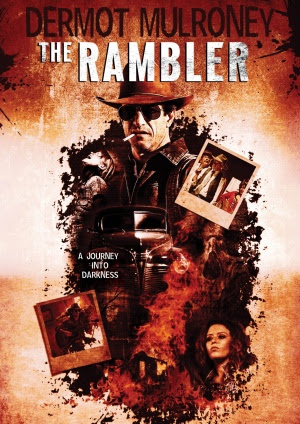
THE RAMBLER (US - 2013)
Don't try to make sense of this surreal road movie/horror film from writer/director Calvin Lee Reeder, one of the contributors to the overrated V/H/S anthology. THE RAMBLER is an impossible film to love and an easy one to hate (I wish I could've seen this in a theater just to see how many people walked out), but if you like unconventional cinema and can just roll with it, it'll certainly keep your attention even if you can't make heads or tails of it. A well-cast Dermot Mulroney, who doesn't get many starring roles these days, plays a man-of-few-words drifter who's just been paroled after four years in the joint. He immediately leaves his annoying girlfriend (Natasha Lyonne) and quits his job at a pawn shop when he decides to thumb his way through the small towns and desolate back roads of the southwest to go work for his brother. He's followed on his journey by a mystery girl (Lindsay Pulsipher) who may not be real but turns up wherever he goes. He gets duped into some cage-style fighting against an opponent with a literal left hook. Then he encounters a mad scientist (James Cady) with a machine that reads people's dreams and records them on a VHS tape (hipster cred!) but inevitably causes their heads to explode. The scientist also has a collection of mummies and keeps his grown daughter--who has an extended vomiting episode all over Mulroney that immediately takes its place among cinema's all-time great puking scenes--chained to a stake in the yard. Mulroney also meets a FRANKENSTEIN-obsessed taxi driver, has periodic visions of a naked, slime-covered figure slithering across the floor and repeatedly sees Pulsipher killed only to have her turn up in the next town. All the while, he's hearing strange, garbled radio transmissions and spots surveillance satellites that seem to be following him, blipping through the sky.
Reeder borrows quite a bit from other filmmakers: for a while, the film plays a lot like a weird, dark-humored fusion of Rob Zombie and PARIS, TEXAS-era Wim Wenders before we get some Alejandro Jodorowsky imagery, a little Polanski, some gratuitous David Lynch tributes (the naked slithering thing's first appearance is in a scene that could've come straight from TWIN PEAKS), and some Troma-style over-the-top splatter. I'm not gonna lie: this is an abrasive, frequently off-putting movie that's bound to alienate a lot of people. But even with the ending that you'll see coming, it's hard to write off the sheer lunatic feel that Reeder brings to it, almost like he's afraid he might never get another shot and is just throwing every homage and every idea he's ever had into this one project. Without question the strangest thing Mulroney's ever done, and perhaps 2013's most unapologetically bizarre movie, THE RAMBLER isn't something I can wholeheartedly recommend to a casual moviegoer or someone who sees Dermot Mulroney and thinks "Oh, MY BEST FRIEND'S WEDDING!" but I can honestly say I've never seen anything like it, and that has to count for something. (R, 99 mins)